
Biodiversity Heritage Library - Program news and collection highlights from BHL
  • Home
  • News
  • Featured Books
    • All Featured Books
    • Book of the Month Series
    • BHL at 20
  • User Stories
  • Campaigns
    • Fossil Stories
    • Garden Stories
    • Monsters Are Real
    • Page Frights
    • Her Natural History
    • Earth Optimism 2020
  • Tech Blog
  • Visit BHL
Home
News
Featured Books
    All Featured Books
    Book of the Month Series
    BHL at 20
User Stories
Campaigns
    Fossil Stories
    Garden Stories
    Monsters Are Real
    Page Frights
    Her Natural History
    Earth Optimism 2020
Tech Blog
Visit BHL
  • Home
  • News
  • Featured Books
    • All Featured Books
    • Book of the Month Series
    • BHL at 20
  • User Stories
  • Campaigns
    • Fossil Stories
    • Garden Stories
    • Monsters Are Real
    • Page Frights
    • Her Natural History
    • Earth Optimism 2020
  • Tech Blog
  • Visit BHL
Biodiversity Heritage Library - Program news and collection highlights from BHL
Blog Reel

Conservation 101: Near Threatened

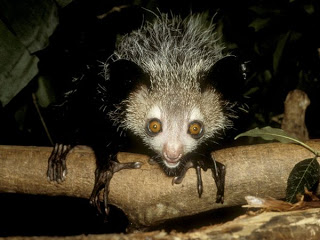
View Full Size ImageThe Aye-Aye. Also known as Daubentonia madagascar-iensis. This creature is peculiar, even by the lemur’s standards of peculiarity. It has a distinctively slender and very long middle finger used to seek out grubs and other possible food sources from tree trunks, like a woodpecker. They have dark brown or black fur that can have white flecks at the tip. The Aye-aye’s tail is much longer than its body in a way that frustrates our expectations for proportion and, well, let’s just say the eyes are intense. Further, the aye-aye’s mammary glands are located near the groin and persistent ova production allows reproduction for the entire life span of a female aye-aye. These strange and nocturnal primates are found almost exclusively in Madagascar and live in the canopies of rain forests.

Their status as near-threatened has two main sources. First, it’s the result of local superstition. View Full Size Image Aye-ayes are viewed as harbingers of evil and death and they are often killed on sight. One cannot help but suspect if these creatures were perhaps a little softer around the edges, a little less freaky, they might have avoided their local status as a boogie man. And though they are currently protected by law, well meaning villagers often kill them in an effort to mitigate the bad luck. And, secondly, deforestation and the loss of their original habitat also contributes to the decline of the species. Aye-ayes are forced to move closer to villages as they lose their treetop habitats and as we’ve seen, the villages are mostly bad luck for aye-ayes!
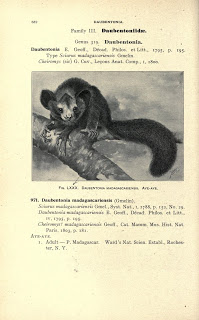
Although there is much we still don’t know about the Aye-aye (used to be classified as a rodent, for example), check out the Primate Fact-sheet from the University of Wisconsin for information regarding morphology, behavior and other detailed descriptions.


May 24, 2010by jwinberry
BHL News, Blog Reel

BHL Turns Three!

View Full Size ImageHappy Birthday, BHL! Three years ago this month, the Biodiversity Heritage Library began scanning books aimed at increasing access to the world’s vast array of biodiversity literature. While the word “dent” may be too strong to describe our goal of 100% completion of the universe of biodiversity literature, as you can see below, steady growth continues. Back in 2007, while busy working on the repository’s basic architecture, we had 228 items scanned. Roughly 12 and two thirds Traditional Library Shelves. Today’s numbers are a bit more impressive: 2,318 shelves worth of scanned material! Luckily, we don’t really need to find space to store each item as scanning marches ever forward!

View Full Size Image
01101000 01100001 01110000 01110000 01111001 00100000 01100010 01101001 01110010 01110100 01101000 01100100 01100001 01111001
That’s binary for Happy Birthday BHL!

May 13, 2010by jwinberry
Blog Reel, Featured Books

Book of the Week: The Power of Illustration

View Full Size Image
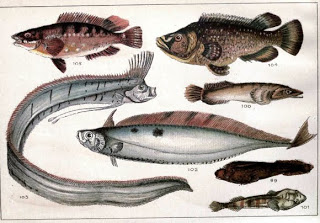
Illustrations play an integral role in the work of taxonomists, and they lend a depth, beauty, and sometimes pure romanticism to the volumes containing them. Case in point: this week’s book of the week, Our Country’s Fishes and How to Know Them: A Guide to all the Fishes of Great Britain (1902) by W.J. Gordon. This charming book contains over 30 plates illustrating the myriad of ichthyoids found in Great Britain. Furthermore, the lists of these fish are itemized according to their local and popular names. As the author points out, the purpose of this volume is the “ready identification of our native species, whether sea-water, fresh-water, or estuarine…[and] as the number of species found in British waters is not large, space has been found for a series of short notes…” So, take a few moments to look through the colorful plates depicting the many and varied species of fish found in Great Britain, and feel free to keep a copy of these illustrations for yourself by downloading high resolution images of these pages by clicking on the “Download Images” options found in the drop down menu entitled “Download/About This Book” when on the page viewer screen. Enjoy!

May 3, 2010by ulib-libraryjobs

Help Support BHL

BHL's existence depends on the financial support of its patrons. Help us keep this free resource alive!

search

About BHL

The Biodiversity Heritage Library (BHL) is the world’s largest open access digital library for biodiversity literature and archives. BHL operates as a worldwide consortium of natural history, botanical, research, and national libraries working together to digitize the natural history literature held in their collections and make it freely available for open access as part of a global “biodiversity community.”

Join Our Mailing List

Sign up to receive the latest news, content highlights, and promotions.

Subscribe Now

Subscribe to Blog via Email

Enter your email address to subscribe to this blog and receive notifications of new posts by email.

Join 319 other subscribers

Subscribe to Blog Via RSS

Subscribe to the blog RSS feed to stay up-to-date on all the latest BHL posts.

Access RSS Feed

Inspiring Discovery through Free Access to Biodiversity Knowledge.

The Biodiversity Heritage Library makes it easier than ever for you to access the information you need to study and explore life on Earth…for free, anytime, anywhere.


64+ Million Pages of
Biodiversity Literature Online.

EXPLORE

Tools and Services
to Transform Research.

EXPLORE

300,000+
Illustrations on Flickr.

EXPLORE

ABOUT | HARMFUL CONTENT | PRIVACY | SITE MAP | TERMS OF USE