Biodiversity Heritage Library - Program news and collection highlights from BHL
  • Home
  • News
  • Featured Books
    • All Featured Books
    • Book of the Month Series
    • BHL at 20
  • User Stories
  • Campaigns
    • Fossil Stories
    • Garden Stories
    • Monsters Are Real
    • Page Frights
    • Her Natural History
    • Earth Optimism 2020
  • Tech Blog
  • Visit BHL
Home
News
Featured Books
    All Featured Books
    Book of the Month Series
    BHL at 20
User Stories
Campaigns
    Fossil Stories
    Garden Stories
    Monsters Are Real
    Page Frights
    Her Natural History
    Earth Optimism 2020
Tech Blog
Visit BHL
  • Home
  • News
  • Featured Books
    • All Featured Books
    • Book of the Month Series
    • BHL at 20
  • User Stories
  • Campaigns
    • Fossil Stories
    • Garden Stories
    • Monsters Are Real
    • Page Frights
    • Her Natural History
    • Earth Optimism 2020
  • Tech Blog
  • Visit BHL
Biodiversity Heritage Library - Program news and collection highlights from BHL
BHL News, Blog Reel

Report from the Digital Data in Biodiversity Research Conference, University of Michigan

View Full Size Image
University of Michigan

The Digital Data in Biodiversity Research Conference was sponsored by iDigBio, the University of Michigan Herbarium, the University of Michigan Museum of Paleontology, and the University of Michigan Museum of Zoology. The conference was attended by about 185 people from a variety of institutions. I attended to participate in the GBIF North American Nodes Workshop and was joined by Alicia Esquivel (BHL NDSR Resident based at the Chicago Botanic Garden).

After a welcome from Dean Andrew D. Martin of the College of Literature, Science, and the Arts, the opening series of plenary talks began with Stephen Smith (University of Michigan) speaking on “The Utility of Large-scale Phylogenetic Analyses for Understanding the Evolution of Biodiversity.” The detailed talk covered the promise of a comprehensive view of the tree of life, whether for a particular clade or the entire tree of life which has been a major motivation of the systematics community for decades. Smith described new efforts and new ways for combining the resources from the Open Tree of Life with other phylogenetic analyses to construct a dated and comprehensive tree and discussed construction of a comprehensive tree for seed plants containing 80,037 taxa from GenBank and 356,807 total taxa.
View Full Size Image
Maureen Kearney

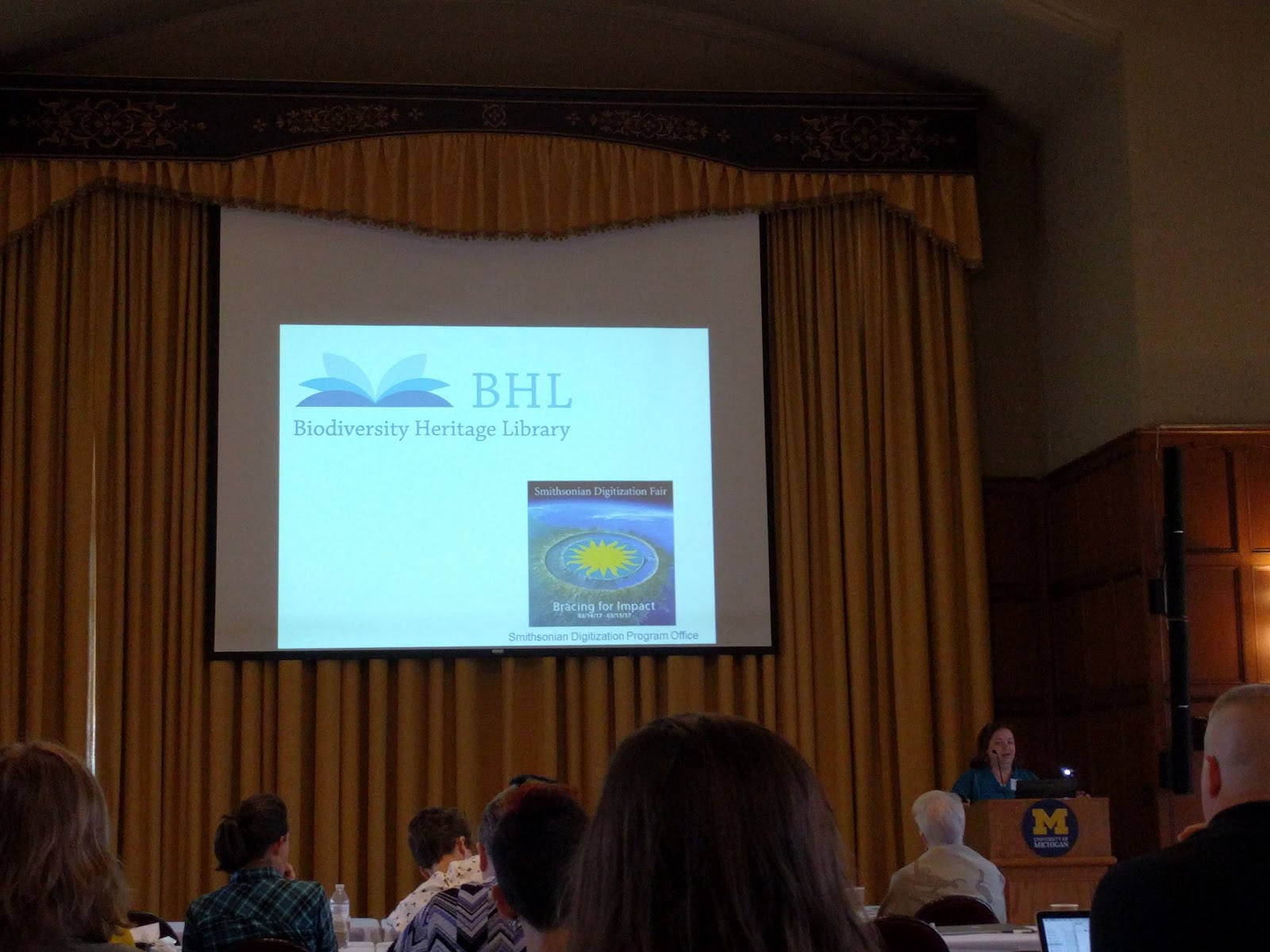
Maureen Kearney, Associate Director for Science, National Museum of Natural History (Smithsonian Institution) spoke next. Kearney’s talk, “Expanding the Power of Natural History Knowledge: Frontiers in Research and Collections at the Smithsonian’s National Museum of Natural History,” was an inspiring overview of the role of natural history museums in this era of rapid global change to mobilize collections data and natural history knowledge for science and society.

Kearney spoke of how natural history scientists help us comprehend the fundamental nature of the planet, of organisms (including humans), and of evolutionary and ecological interactions throughout the history of life on Earth. Enormous potential exists for natural history museums in the 21st century if they highlight their unique niche as irreplaceable research and data centers for the study of global change. Kearney also noted that this can only be realized if museums build large-scale pipelines and open-source, dynamic platforms to digitize, structure, link, and share our natural history data and knowledge. She spoke of key partners inside the National Museum of Natural History (such as the Global Genomics Initiative and the Encyclopedia of Life) and other partners at the Smithsonian, including the Biodiversity Heritage Library and the Smithsonian’s Digitization Program Office and its 3D imaging team.
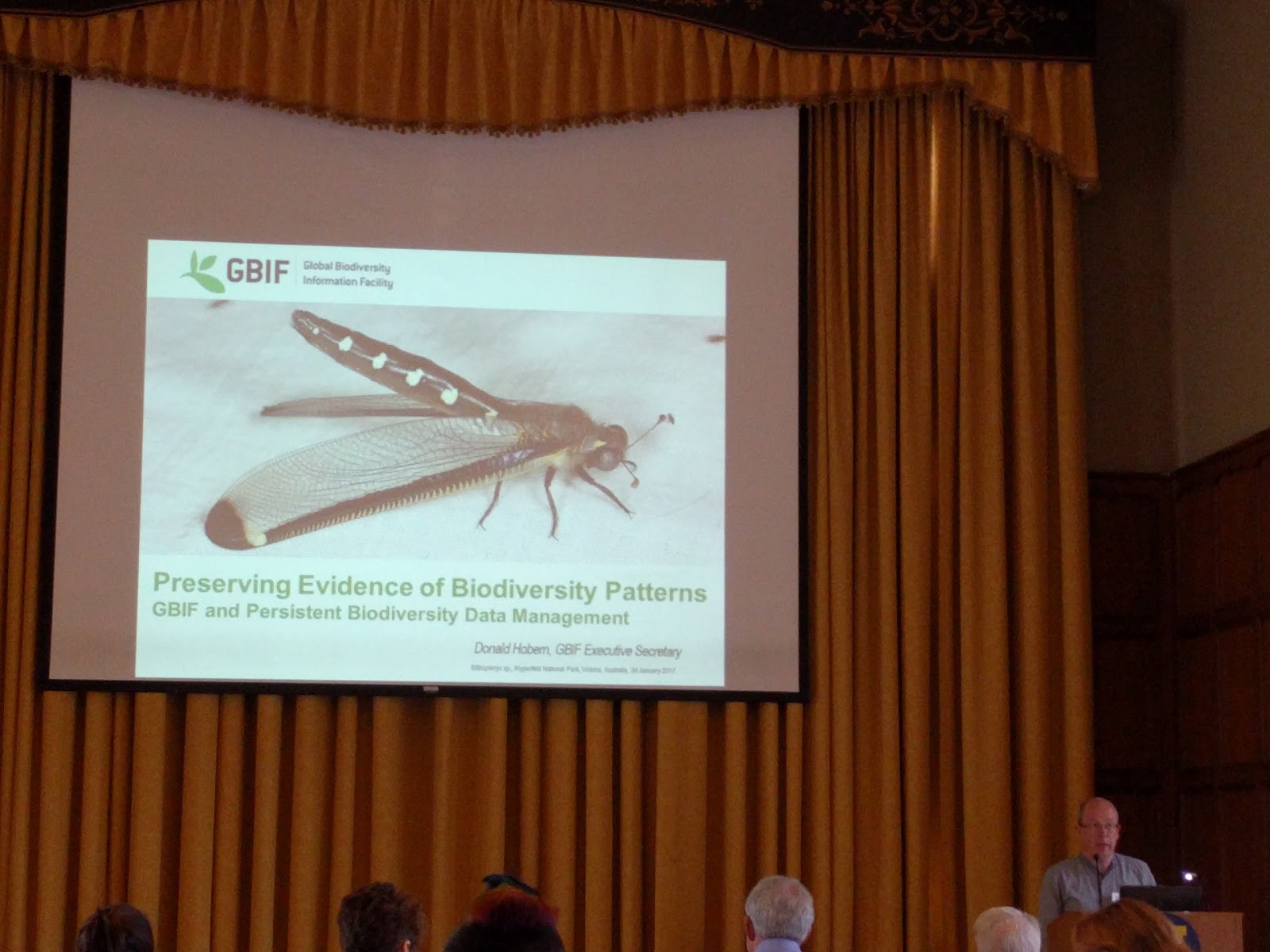
View Full Size Image
Donald Hobern

Donald Hobern, GBIF Executive Secretary, spoke on “Preserving Evidence of Biodiversity Patterns: GBIF and Persistent Biodiversity Data Management.” Hobern gave an overview of GBIF as well as the goals of the GBIF implementation plan, which include simplifying and supporting data publishing and assisting with delivery of the most detailed version possible for each data source.

Other plenary talks included:

  • “Linking Heterogeneous Data in Biodiversity Research” by Pam Soltis, Florida Museum of Natural History, University of Florida
  • “Using ‘Digital Specimens’ to explore the behavioral phenotype” by Mike Webster, Cornell Laboratory of Ornithology
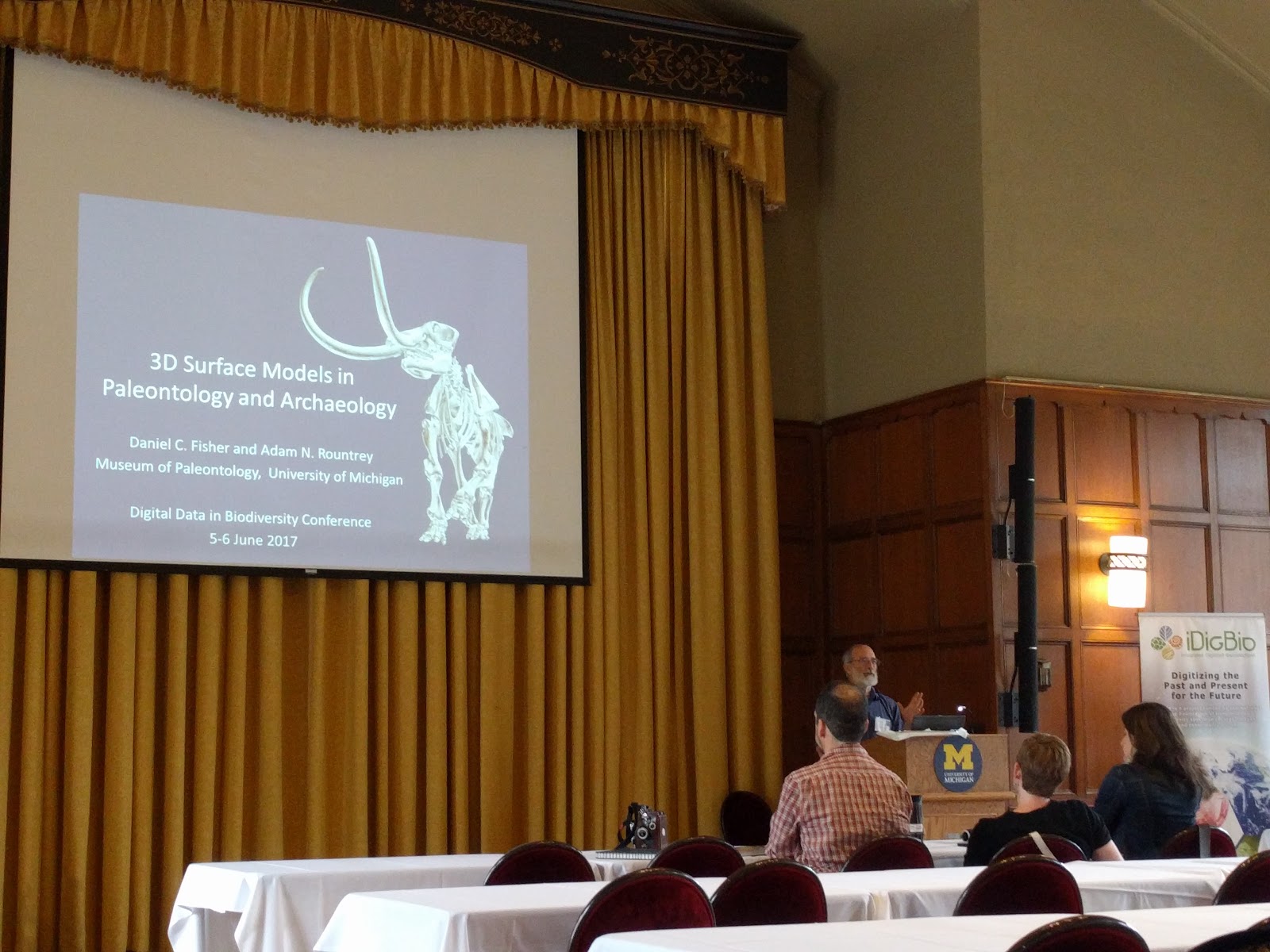
View Full Size Image
Dan Fisher

DAY 1: CONCURRENT SESSIONS
Full abstracts and details of the Concurrent Sessions are online. Sessions attended were:

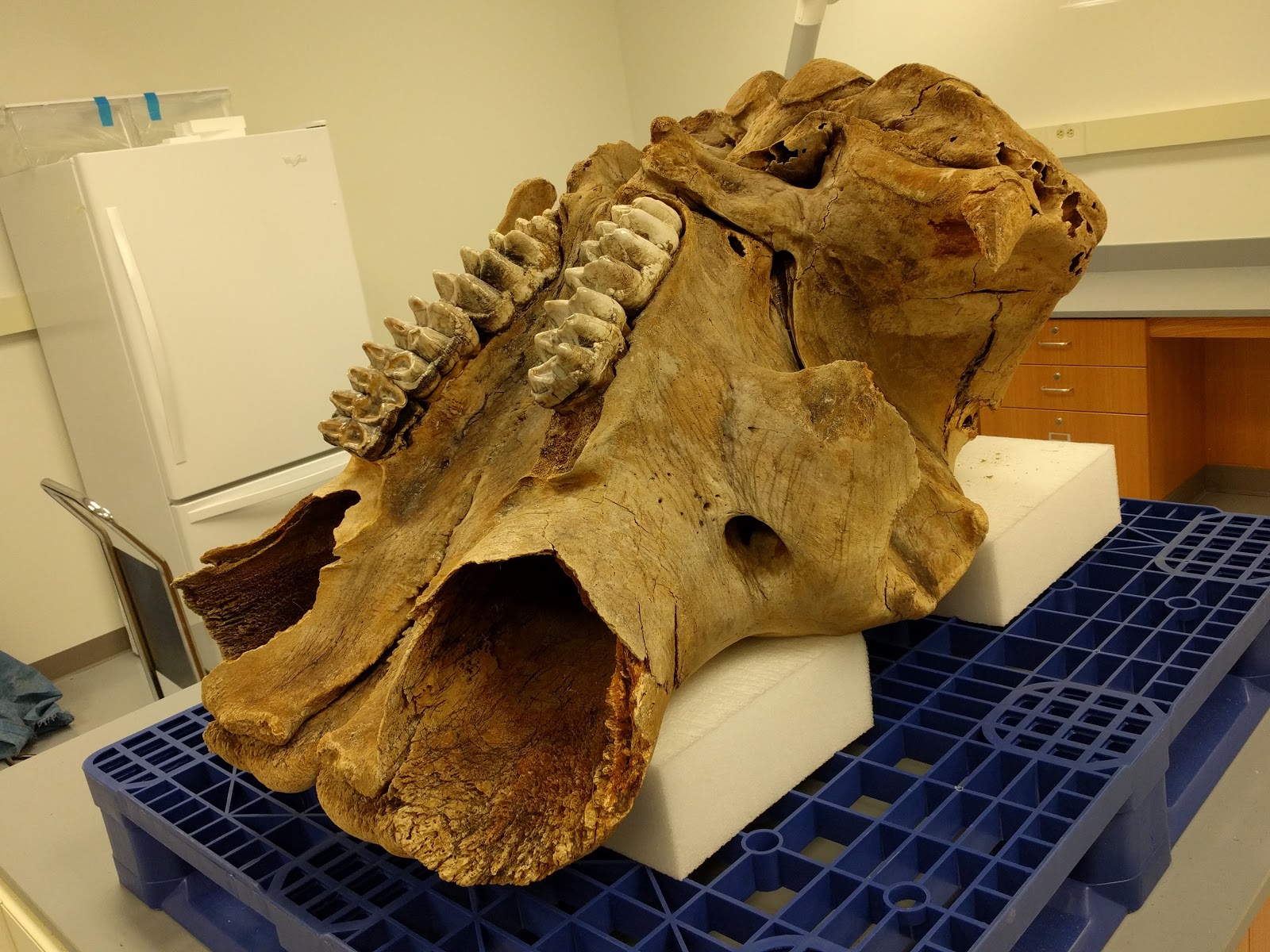
  • 3D Surface Models in Paleontology and Archaeology by Dan Fisher, University of Michigan Museum of Paleontology. Used the Buesching mastodon (now at University of Michigan) as a case study for the talk. Walked through the excavation and the 3D imaging process. Digital data on the external form of specimens are central to many paleontological and archaeological analyses. Digital models minimize handling of fragile and/or heavy specimens, facilitate access and collaboration, allow complex measurements, enhance visualization of surface topography, and simplify inspection of multi-object assemblies.
  • Paleobiology Database: A Community Based Data Service for Research, Education, and Museums by Mark Uhen, George Mason University
  • MorphoSource: A Virtual Museum and Digital Repository for 3D Specimen Data by Doug Boyer, Duke University
  • ePANDDA: enhancing Paleontological and Neontological Data Discovery API by Susan Butts, Yale University; Seth Kaufman, Whirligig Inc.
  • The Importance and Challenges of Database Integration: MorphoBank, MorphoSource, and the Paleobiology Database by Julie Winchester, Duke University
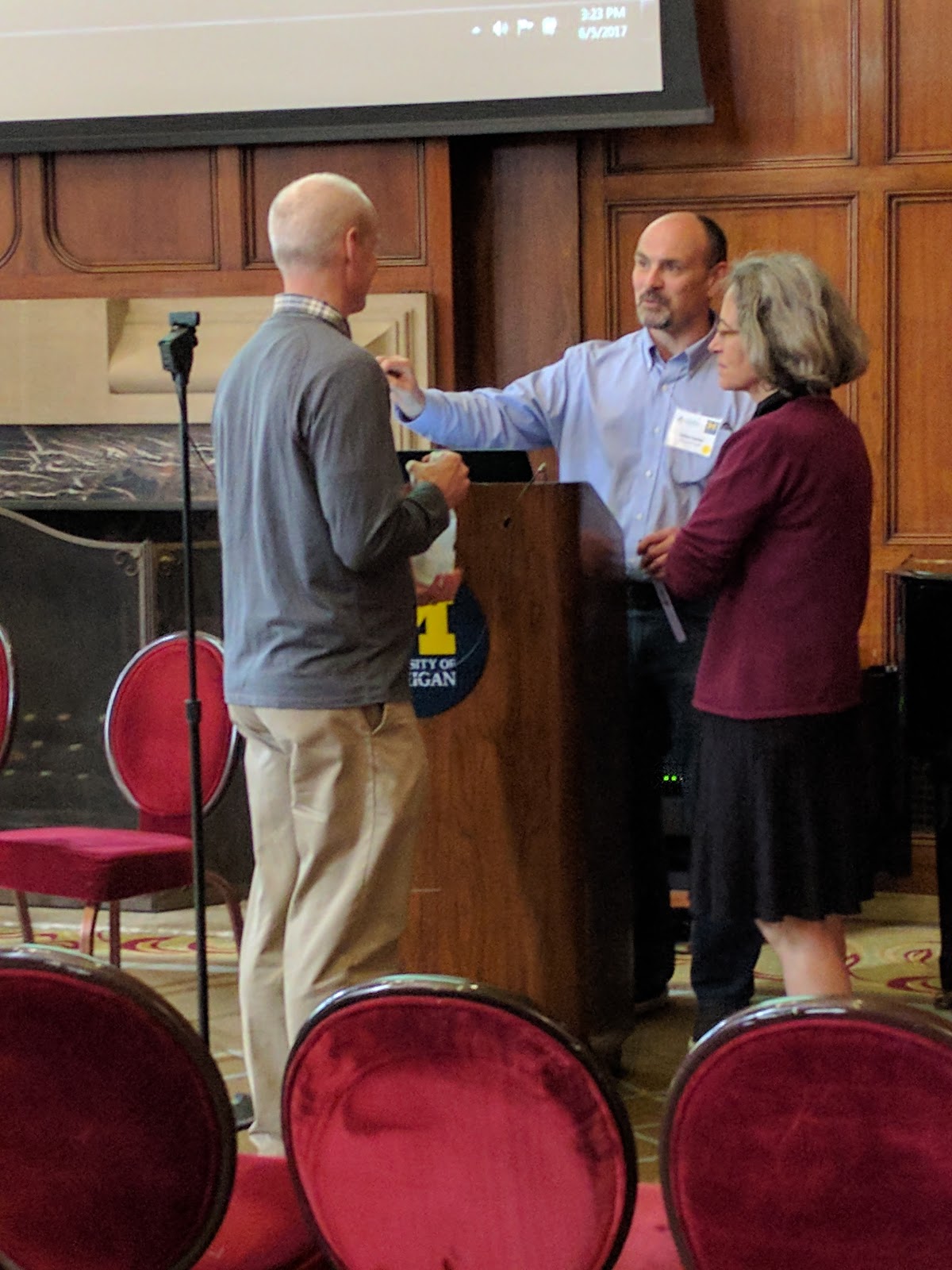
 

View Full Size Image
Macklin, Hanner, Bruneau

AFTERNOON WORKSHOP
In the afternoon, the meeting offered focused workshops. The Biodiversity Heritage Library was invited to participate in the Digital Data and the North American Nodes of the Global Biodiversity Information Facility session led by Bob Hanner, Stinger Guala, and James Macklin. A goal of the workshop was to discuss the current status of the GBIF North American Nodes, current activities and collaborations.

Attended by about 50 participants, the presentations at the workshop included:

  • National and Regional Coordination Roles within GBIF (Donald Hobern)
  • Biodiversity Information Serving Our Nation (BISON): Connections and Cooperation (Stinger Guala)
  • The Canadian Biodiversity Information Facility (CBIF) (James Macklin)
  • Canadensys: revealing the biodiversity of Canada (Anne Bruneau)
  • Overview of the Biodiversity Heritage Library Recent Activities (Martin Kalfatovic)
  • The Catalogue of Life: Infrastructure for Science (Tom Orrell)
  • Global Genome Biodiversity Network – Infrastructure for Genomic Research (Jon Coddington)
  • iDigBio, National Coordinating Center for NSF’s ADBC Program (Larry Page)
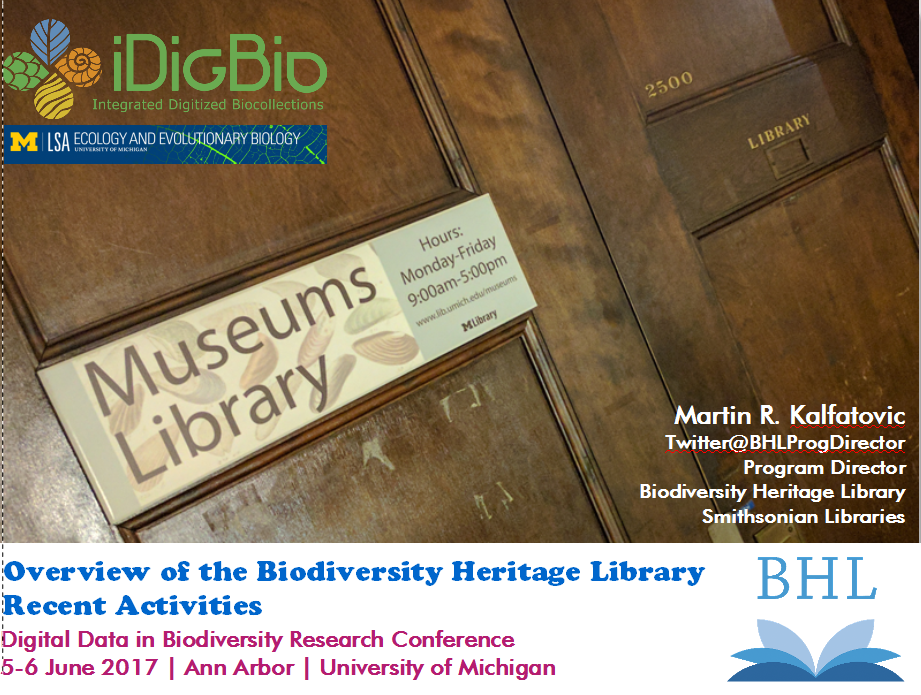
View Full Size Image

The BHL talk, “Overview of the Biodiversity Heritage Library: Recent Activities” covered:

As the world’s largest open access digital library for biodiversity literature, the Biodiversity Heritage Library (BHL) is an unparalleled resource that has forever changed the way researchers around the globe understand, describe, and conserve life on Earth. BHL has become not only a model for digital libraries but also a fundamental resource for taxonomic literature aggregation, discovery, and presentation by engaging the taxonomic community and responding to user needs. To achieve this, BHL relies on many standards and tools, such as Digital Object Identifiers (DOIs), Application Programming Interfaces (APIs), and Global Names Architecture (GNA). These standards and tools help ensure that data in and about the literature matches the needs and expectations of the scientific community and is readily available for widespread reuse. To meet the evolving needs and expectations of researchers, we must continually innovate and adapt to the changing technological landscape.  BHL is in the process of organizing widespread user needs analysis and an environmental scan of information resources to define requirements for a next generation digital library.

The presentations were followed by a panel discussion and a conversation with the audience.

EVENING RECEPTION AND TOUR OF THE RESEARCH MUSEUMS CENTER
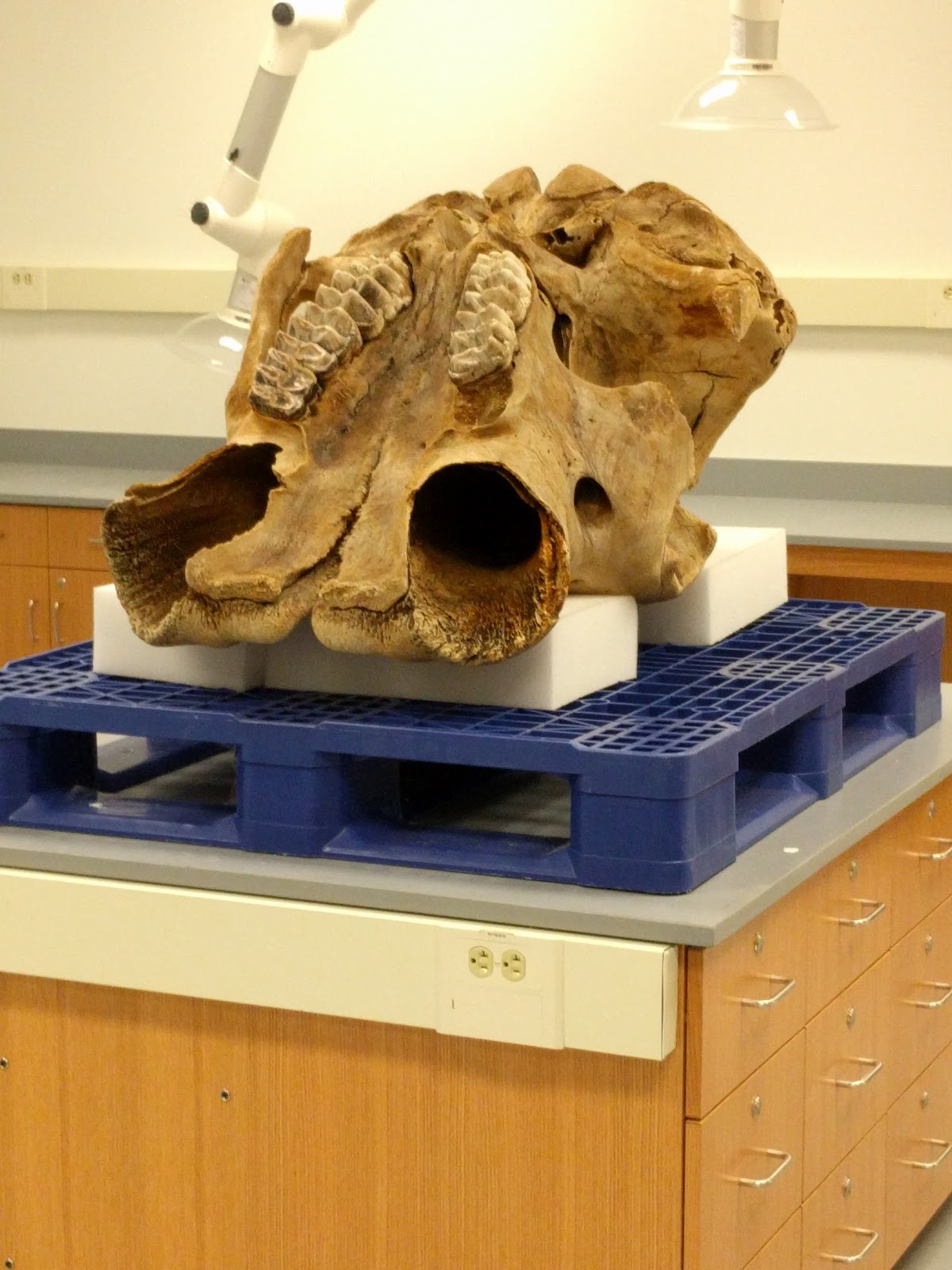
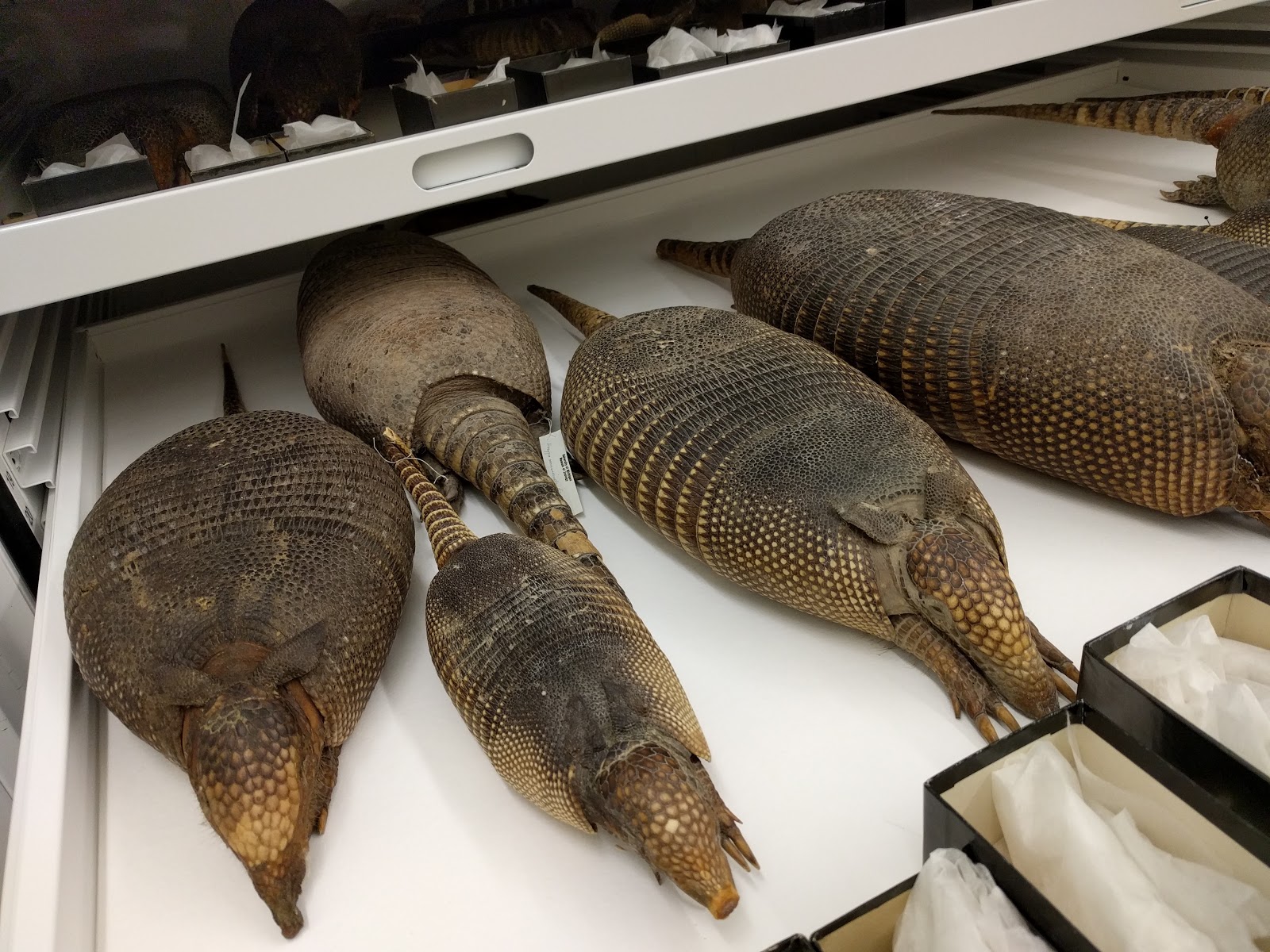
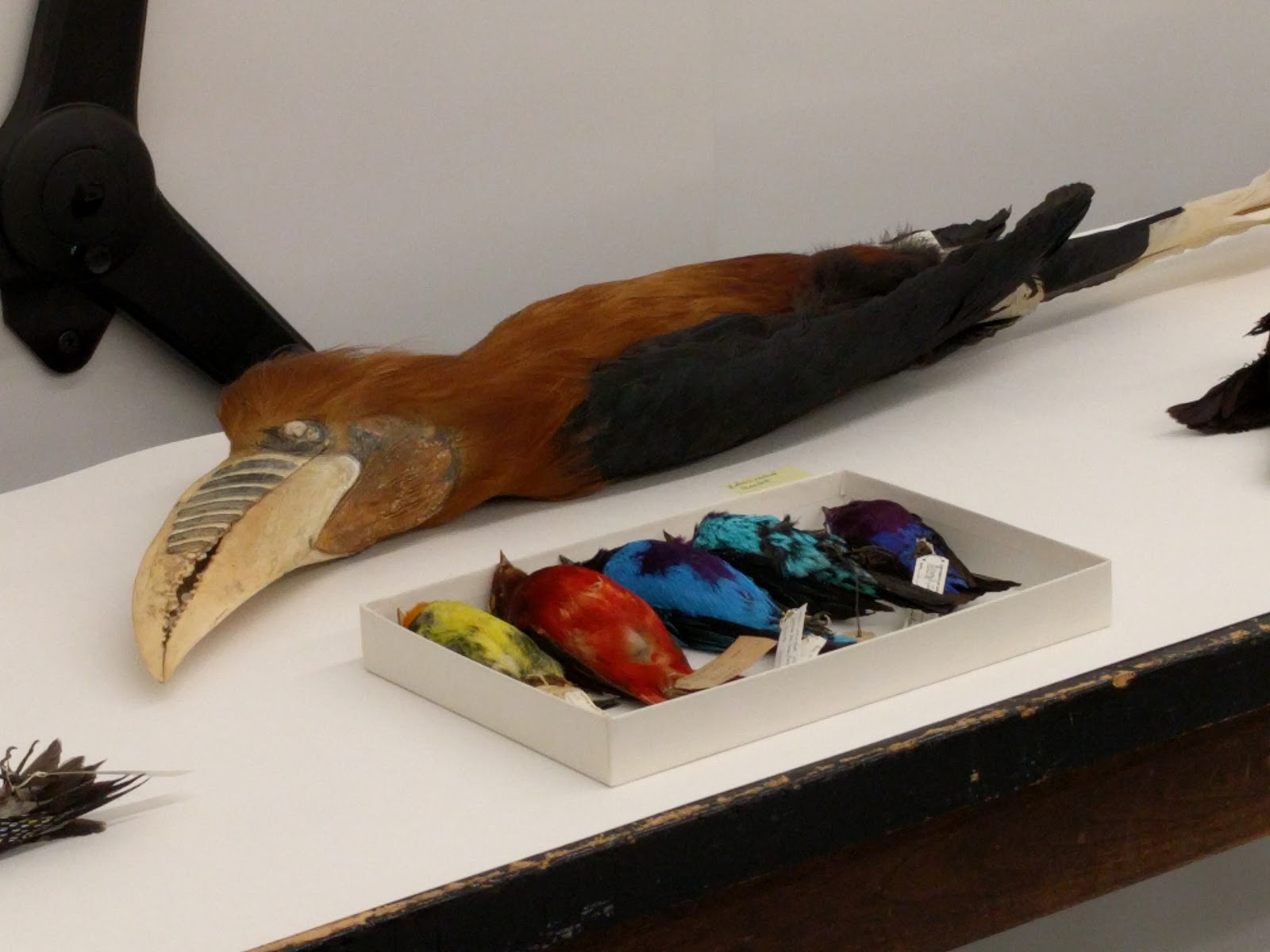
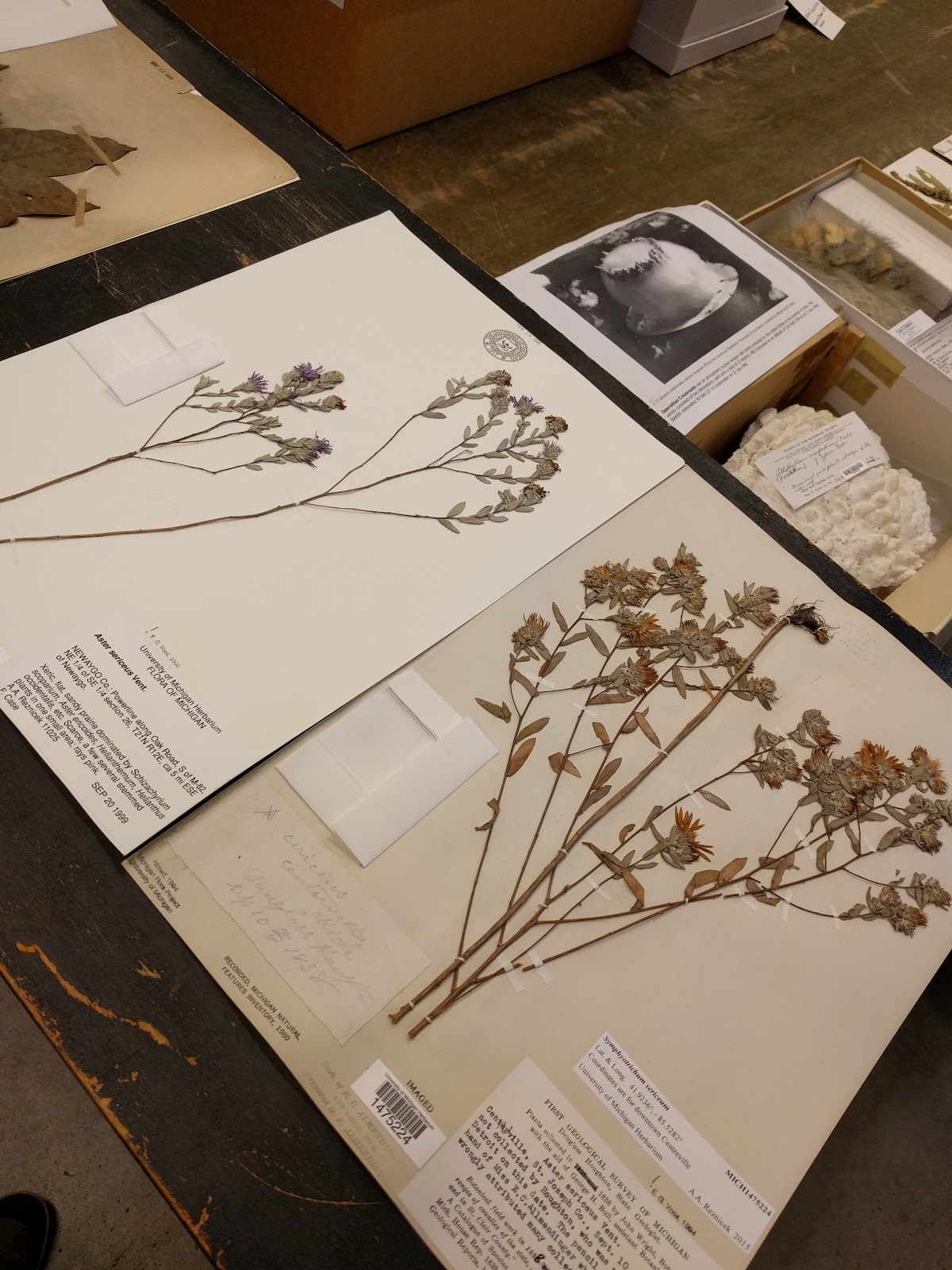
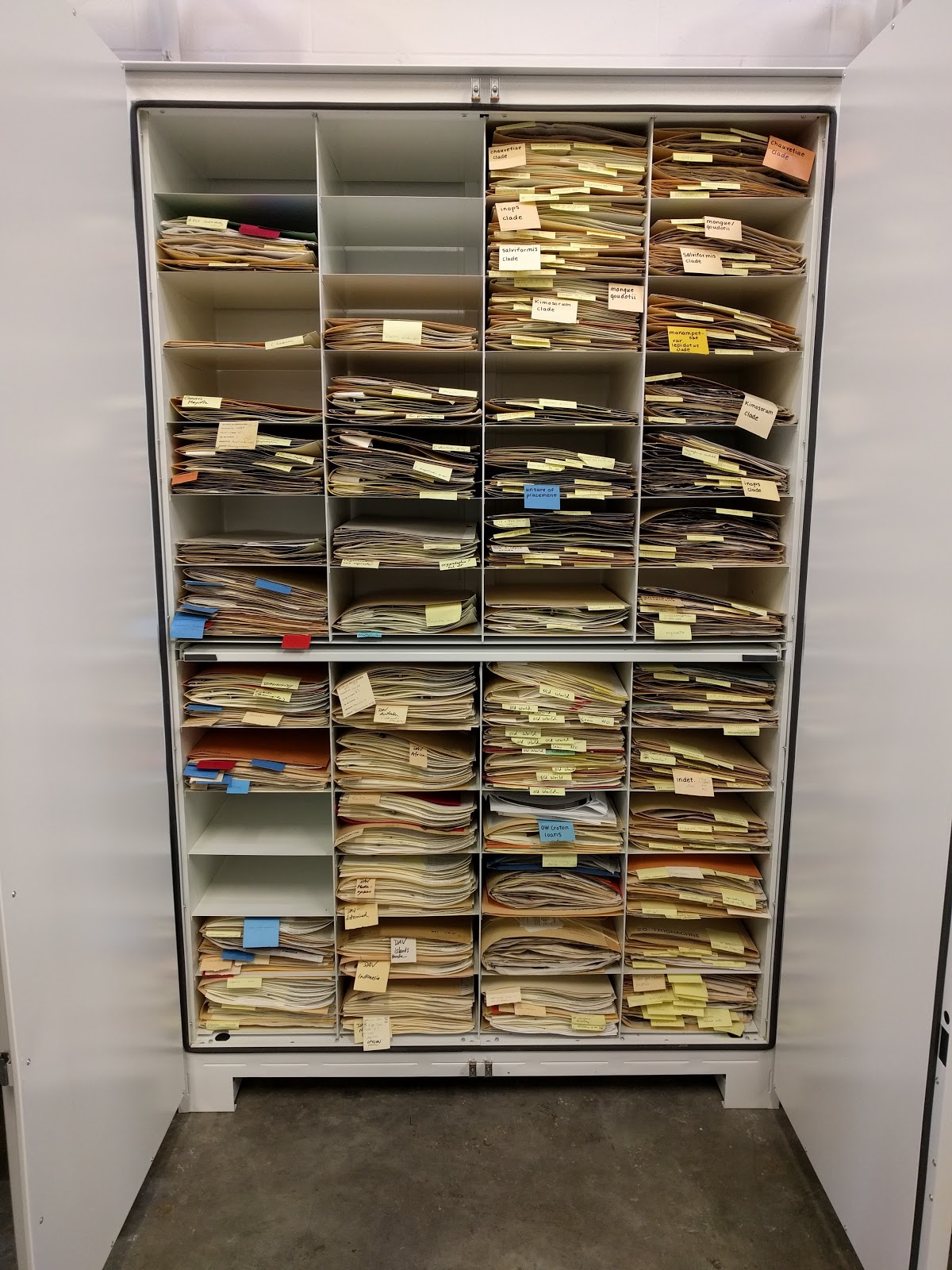
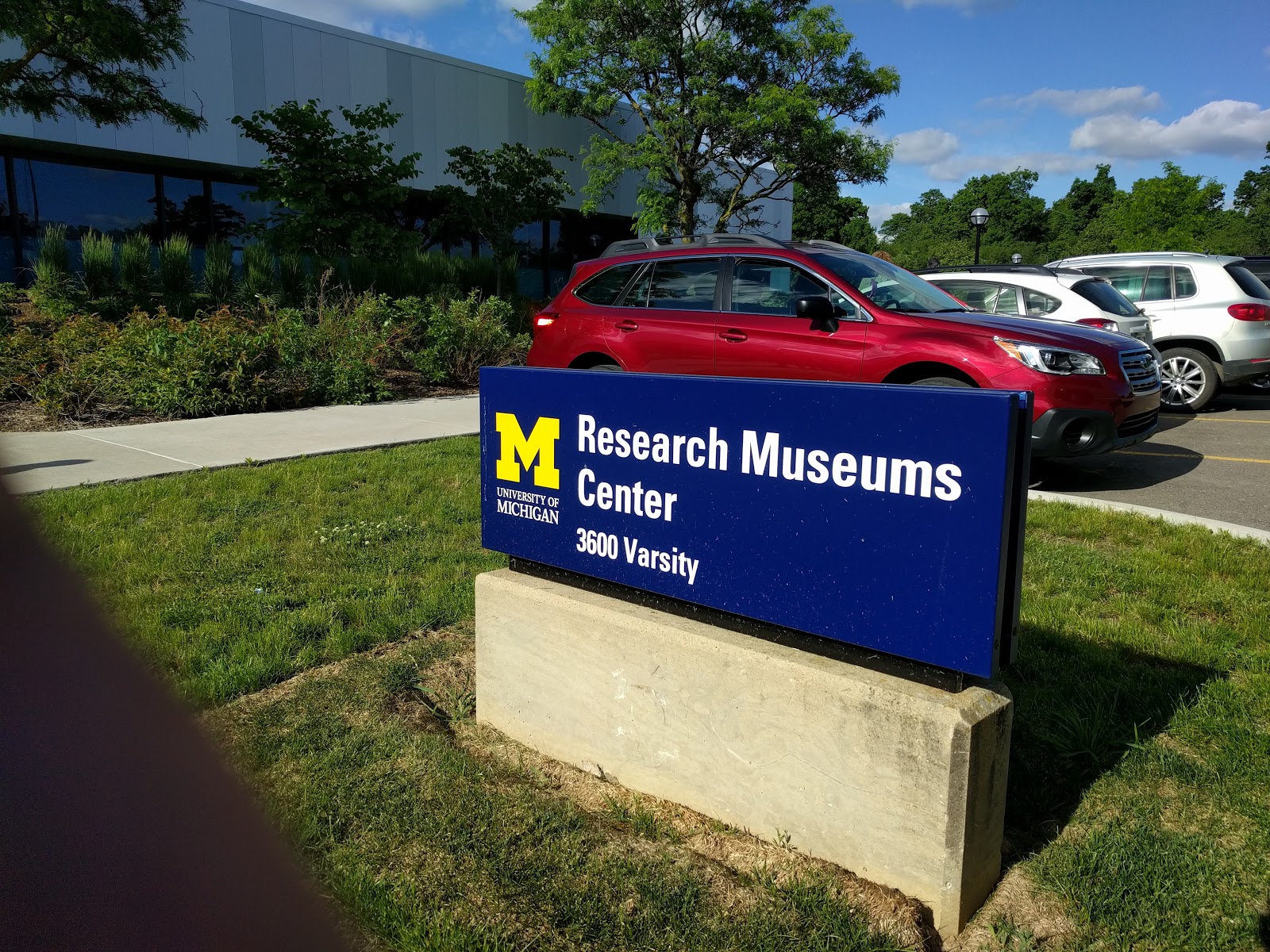
After the day’s meetings, attendees were bused to the Research Museums Center, located about 7.5 kilometers from the center of the University of Michigan campus. Participants were given the opportunity of guided tours of the University of Michigan Herbarium, collections areas of the Museum of Paleontology, and the wet and dry collections of the Museum of Zoology.
View Full Size Image View Full Size Image


View Full Size Image
Adam Summers

DAY 2: PLENARY TALKS
The second day again opened with plenary talks which included:

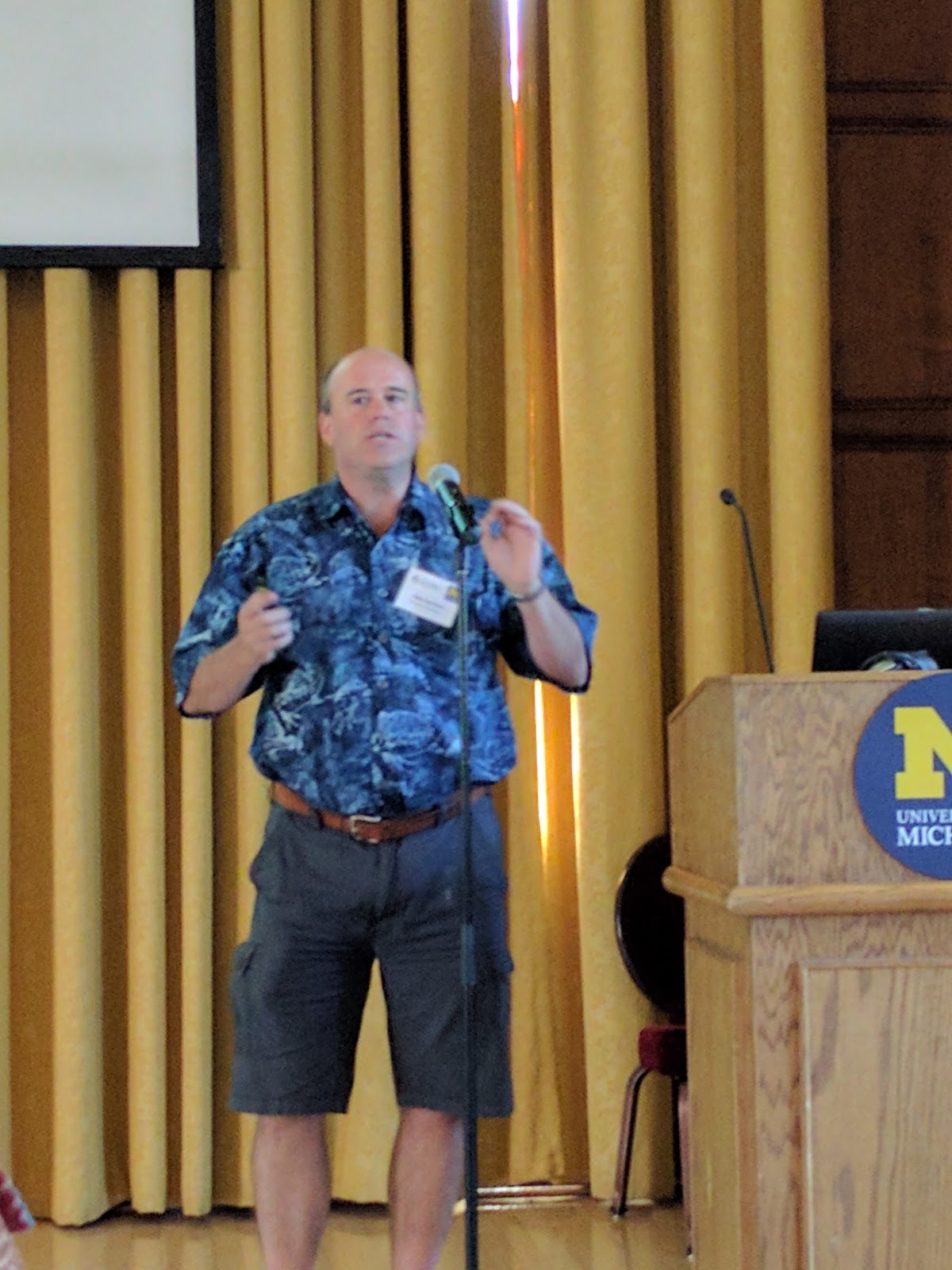
  • Big Data, Museum Specimens, Access and Archiving – Lessons from #scanAllFish by Adam Summers, University of Washington. Amazing high energy talk about Summers’ project #scanAllFish, over 1,991 species, 3,094 specimens from 109 collections. Expects to store over half a petabyte of data for 30,000 vertebrates. Storing and backing these data up is an issue. It is also interesting to consider what collections plan to do when these data are returned to them with the specimens.
  • Video Data and Motion Analysis in Comparative Biomechanics Research by Beth Brainerd, Brown University. “Film or video recordings have long been important primary data for research in comparative biomechanics. Innovations have included the use of two or more cameras to capture 3D motion, and the use of two X-ray video cameras (fluoroscopes) to capture 3D motion of bones in vivo. Over the past decade we have developed X-ray Reconstruction of Moving Morphology (XROMM), which combines  dual-fluoroscopy with bone models from CT scans to produce accurate animations of 3D bones moving in 3D space.”
  • The PREDICTS Project: Projecting Responses of Ecological Diversity In Changing Terrestrial Systems by Adriana De Palma, Natural History Museum, London. “PREDICTS is a collaborative project that aims to produce global models of how local biodiversity responds to land use and related human impacts, in order to make projections under possible future scenarios.”
  • Field Collections to Digital Data: A Workflow for Fossils and the Use of Digital Data for Reconstructing Ancient Forests by Dori Contreras, University of California Museum of Paleontology. “The integration of curation and digitization with project-focused data collection is a key component to performing time-efficient studies from new fossil collections. Standard workflows for processing fossil specimens starting from initial field collection and continuing through digital analysis/measurement are not widely established. Here I present my workflow for reconstruction of a diverse Late Cretaceous flora from plant macrofossils preserved in an extensive recrystallized volcanic ashfall deposit.”
  • Natural History Data Pipelines: The Good, the Bad, and the Ugly by Andy Bentley, University of Kansas Biodiversity Institute. “Collections, aggregators, data re-packagers, publishers, researchers, and external user groups form a complex web of data connections and pipelines that form the natural history knowledge base essential for collections use by an ever increasing and diverse external user community.  We have made great strides in developing the individual parts of this knowledge base and we are now well poised to integrate these capabilities to address big picture questions.  Although we need to continue work on the individual pieces, the focus now needs to be on integration of these disparate sources of data that create the pipeline.”
View Full Size Image
Esquivel

DAY 2: CONCURRENT SESSIONS
Sessions attended included:

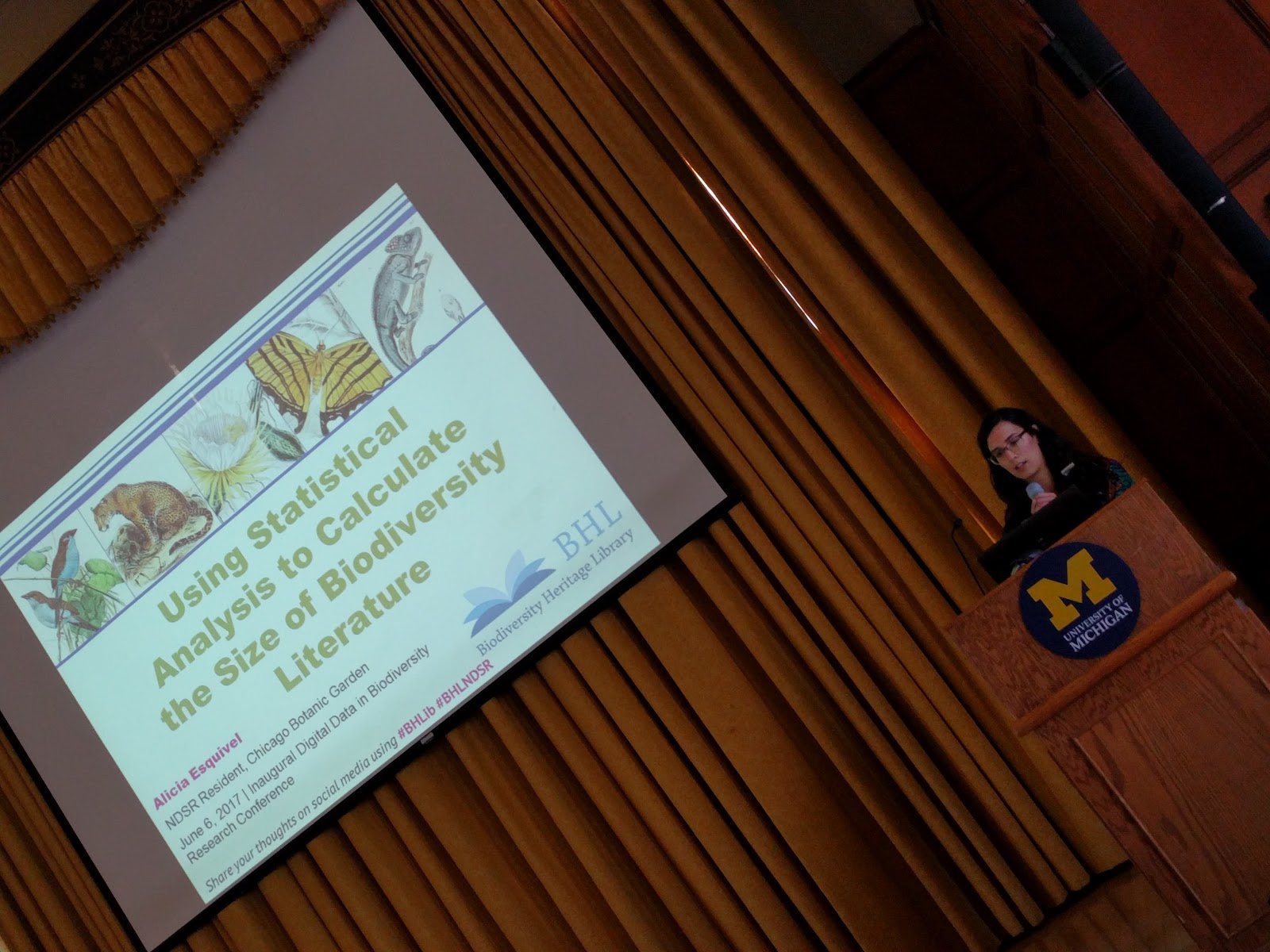
  • Using Statistical Analysis to Calculate the Size of Biodiversity Literature by Alicia Esquivel, Chicago Botanic Garden
  • Illustrating Value Added in Databasing Historical Collections: Entered, Proofed, and Done (or Not!) by Tony Reznicek, University of Michigan Herbarium
  • The Encyclopedia of Life v3: constructing a linked data model by Jennifer Hammock, National Museum of Natural History, Encyclopedia of Life, Smithsonian Institution
  • Encyclopedia of Life Version 3: New Tools for the Exploration of Biodiversity Knowledge by Katja Schulz, National Museum of Natural History, Encyclopedia of Life, Smithsonian Institution
  • How do People see Biodiversity? Using a Digital Identification Key in a Citizen Science Program by Mathilde Delaunay, Muséum national d’Histoire naturelle, Paris, France
  • Taxonomic Data Quality in GBIF: A Case Study of Aquatic Macroinvertebrate Groups by Joan Damerow, Field Museum of Natural History
  • Hole-y Plant Databases! Understanding and Preventing Biases in Botanical Big Data by Katelin D. Pearson, Florida State University
View Full Size Image

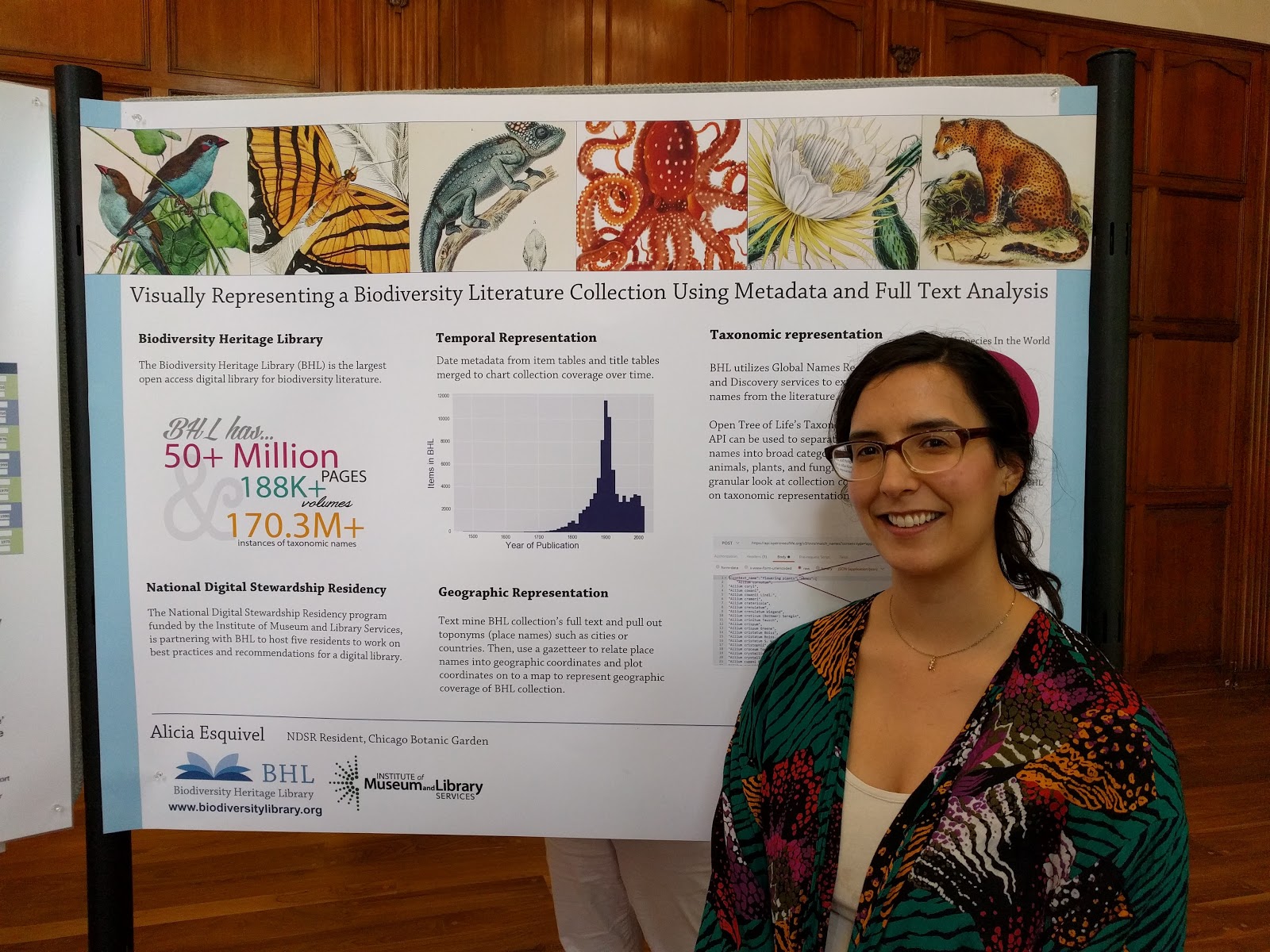
Alicia Esquivel’s talk was an excellent overview of the BHL NDSR Resident program and the important work being done by the group as BHL looks forward to BHL Version 2. Esquivel’s work focuses on looking for gaps in the BHL collections and other collections analysis. In addition to her talk, she also presented a poster (co-authored by Constance Rinaldo, BHL Chair / Museum of Comparative Zoology, Harvard University).

CAPSTONE SESSION

  • Prospects for the Use of Digitized Specimens in Studies of Plant Diversity and Evolution by Michael Donoghue, Yale University
  • A Vision for a National Cyberinfrastructure for Biodiversity Research and what NSF can do Enable it by Peter McCartney, National Science Foundation

OTHER RESOURCES

  • Link to Abstracts for Plenary Talks | Concurrent Sessions | GBIF Workshop | Poster Sessions
  • Conference Information Page | Conference Wiki Page
  • iDigBio Blog Post
  • Link to Twitter Hashtag: #digibiodata
View Full Size Image
Research Museums Center, University of Michigan
June 14, 2017by
Blog Reel

My Experience as a BHL Product Development and Marketing Intern

View Full Size Image
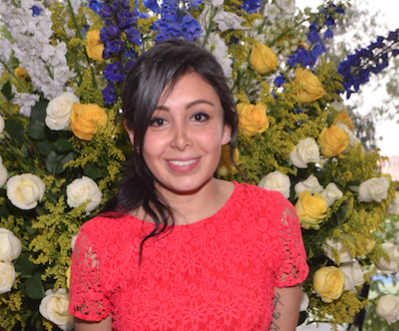
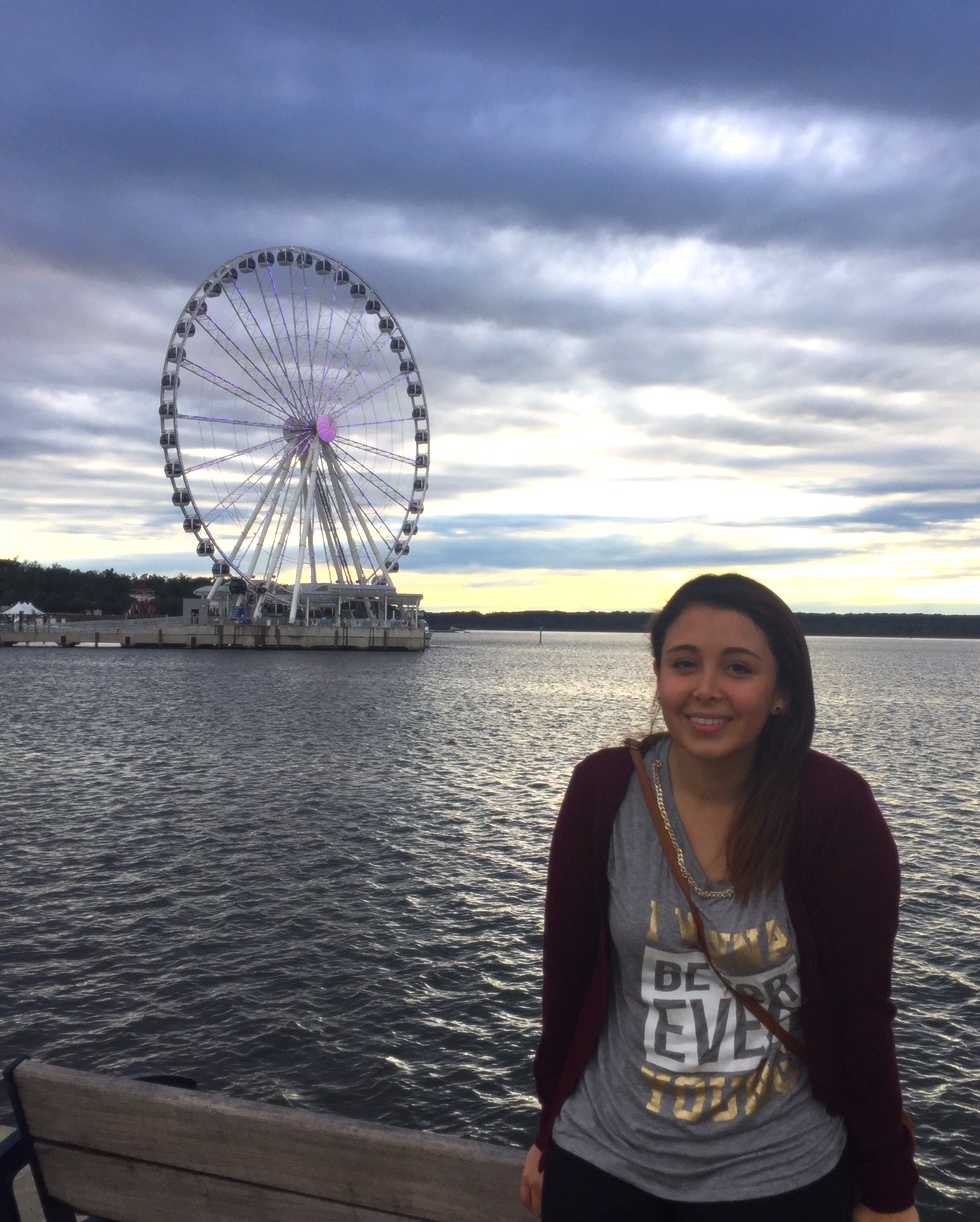
Carolina Murcia. BHL Product Development and Marketing Intern.

I am a designer. I am an artist. I am an illustrator. I am an amateur photographer, a daughter, a traveler, an adventurist, a niece, a walker, a cyclist, a friend, an intern, a professional, a foreigner, a Latina, a Colombian, a woman, a strong woman, a bilingual. I am a person that has grow and re-recognized myself since I started my journey with the Biodiversity Heritage Library. I know the value of real things and how lucky I am for the people and opportunities that life has placed my way.

Over the past eight months, I served as the BHL Product Development and Marketing Intern for BHL at the Smithsonian Libraries, designing products for the BHL Store and creating promotional graphics for those products. As a designer, I enjoyed creating products, managing scientific illustrations, taking pictures inside the wonderful National Museum of Natural History, and creating and imagining different graphical styles to advertise the products in each collection.

View Full Size Image
Botanic Wonderland products created for the BHL Store. Products and marketing materials designed by Carolina Murcia.

For me, as a designer, the most magical part of my experience was exploring the amazing illustrations in the BHL collection. I was awed by the skills of these illustrators, and I saw that many of these early scientists were real artists. The lines of the drawings, the colors, the perspective – how the illustrators translated the movement of nature to a flat page that persists over the years – is just wonderful.

I am grateful that my internship allowed me to experience every aspect of product development and marketing. I not only searched for and chose the images for a new collection in the store, but also edited each image to work within a given product, creating a complete family of products, and finally designed the marketing advertising graphics. I was involved from the beginning until the end of each collection, and for all of the products, I have a special affection.

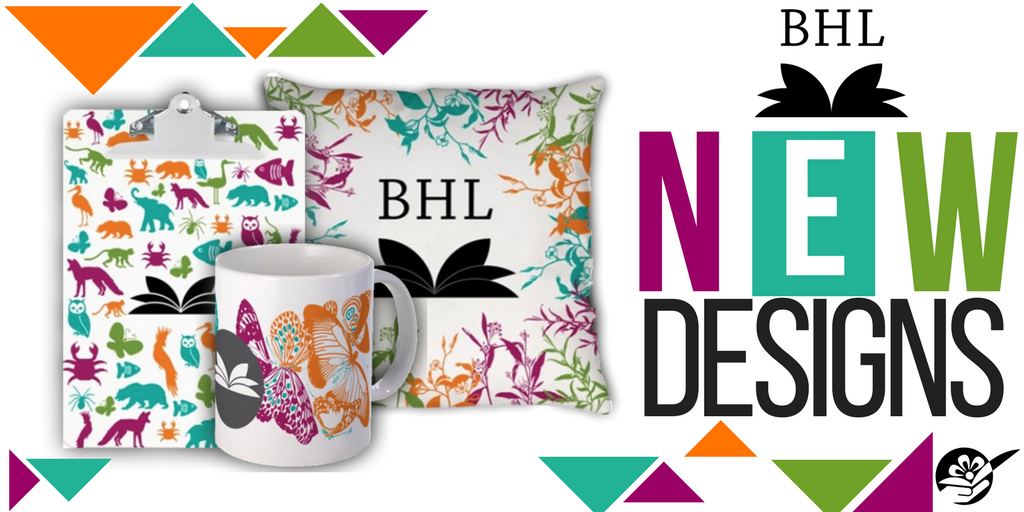
My favorite product collection, however, allowed me to stretch my creative skills. After working with all of these amazing books and their illustrations, I had the opportunity to create my own graphic line inspired by the BHL brand. For this collection, I started from scratch. I didn’t have any base illustration or book to start with. I designed all of the graphics from my own imagination. I wanted to find a way to enhance the logo and produce amazing products that didn’t just look like simple souvenirs but that can compete with big brands.  I put the real and complete “me” in the graphic line, now I can say…. I am proud of the results. My hope is that BHL staff will use the products and be proud of having a t-shirt/Mug/Journal/etc. from BHL, knowing that it has design and style. I hope people really look twice every time they are near a BHL New Design Products.

View Full Size Image
BHL New Design products. Products and promotional graphics designed by Carolina Murcia.

So, after 8 months of learning, creating and designing, I decided that I liked everything about my experience. My favorite part of the internship was choosing and playing with the illustrations. I was like a kid with a new toy. I could spend hours just playing with the graphics, creating patterns, changing colors, etc. Working through the complete process of product development was the best way to develop my skills as a professional designer.

I want to say thanks to BHL, but especially to my mentor and supervisor, Grace Costantino, for being patient, for giving me the chance to come to the Smithsonian Libraries, for trusting in my abilities, and for helping me develop my skills. It has been 8 happy months where I got to know people and places that I love…and I hope that I will see them again.

June 12, 2017by ulib-libraryjobs
Blog Reel, User Stories

Expanding Library Impact through Open Access Digitization

View Full Size Image
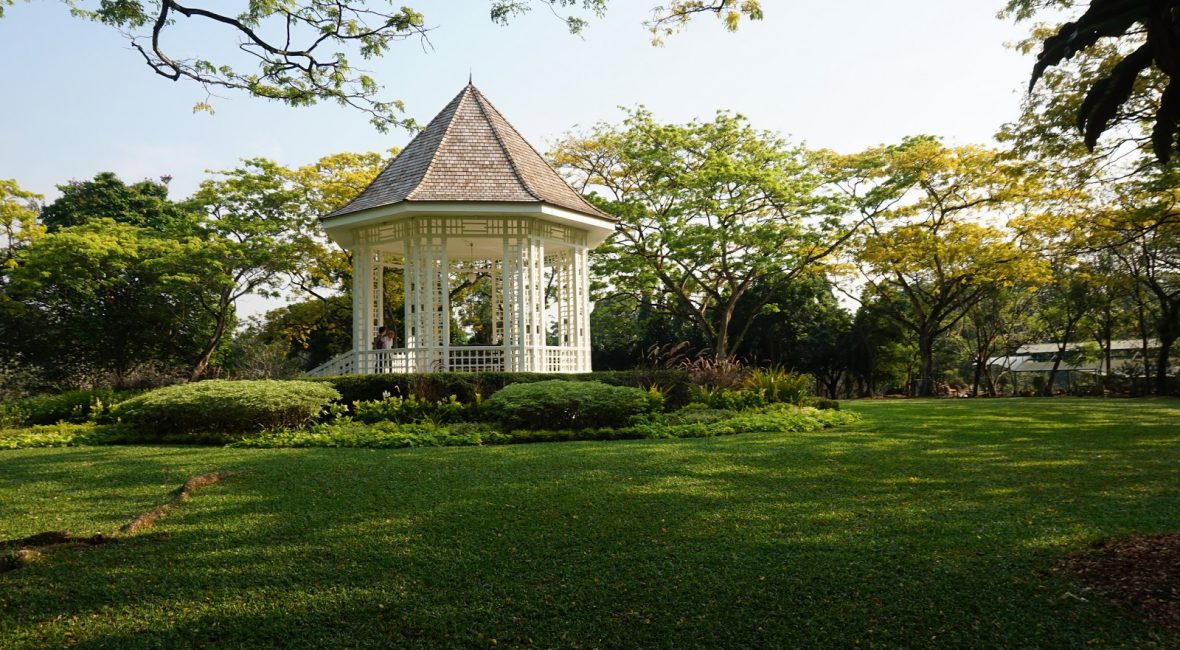
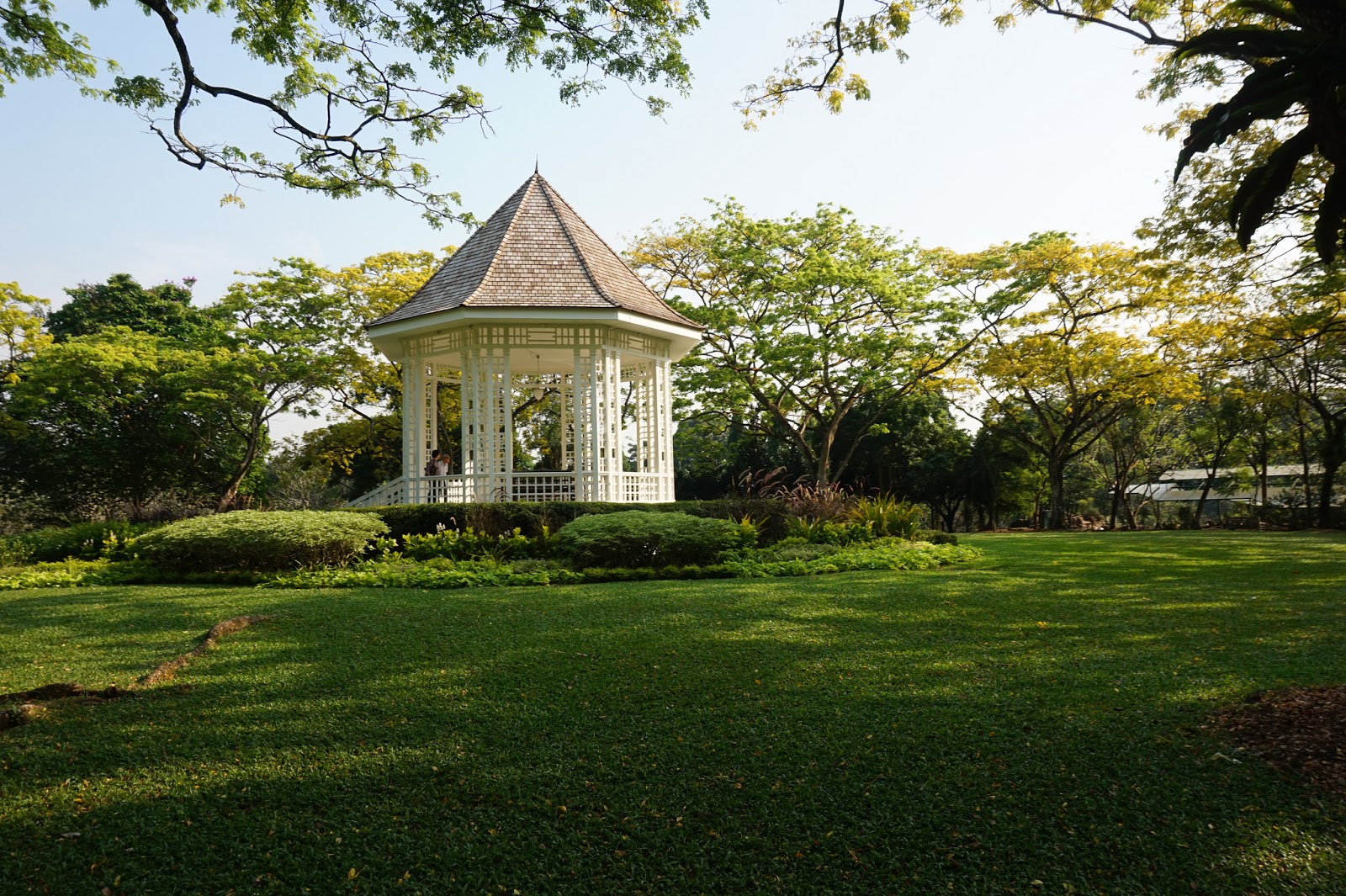
Bandstand at the Singapore Botanic Gardens. Photo by Martin Kalfavotic.

Located in central Singapore, just minutes away from the city’s main shopping district, sits the first and only tropical botanic garden listed as an UNESCO World Heritage Site. Established at its present site in 1859, the Singapore Botanic Gardens (SBG) covers 82 hectares and is home to thousands of plant species.

Since 1875, the SBG Library has supported research at the Gardens. Over the years, the Library has amassed a large collection of rare and scholarly literature and artworks that are housed in climate-controlled spaces. Access to these materials has traditionally been limited to privileged, on-site researchers. Recently, to increase the accessibility and impact of these collections, the SBG Library has embarked on an extensive preservation and digitization program.

View Full Size Image
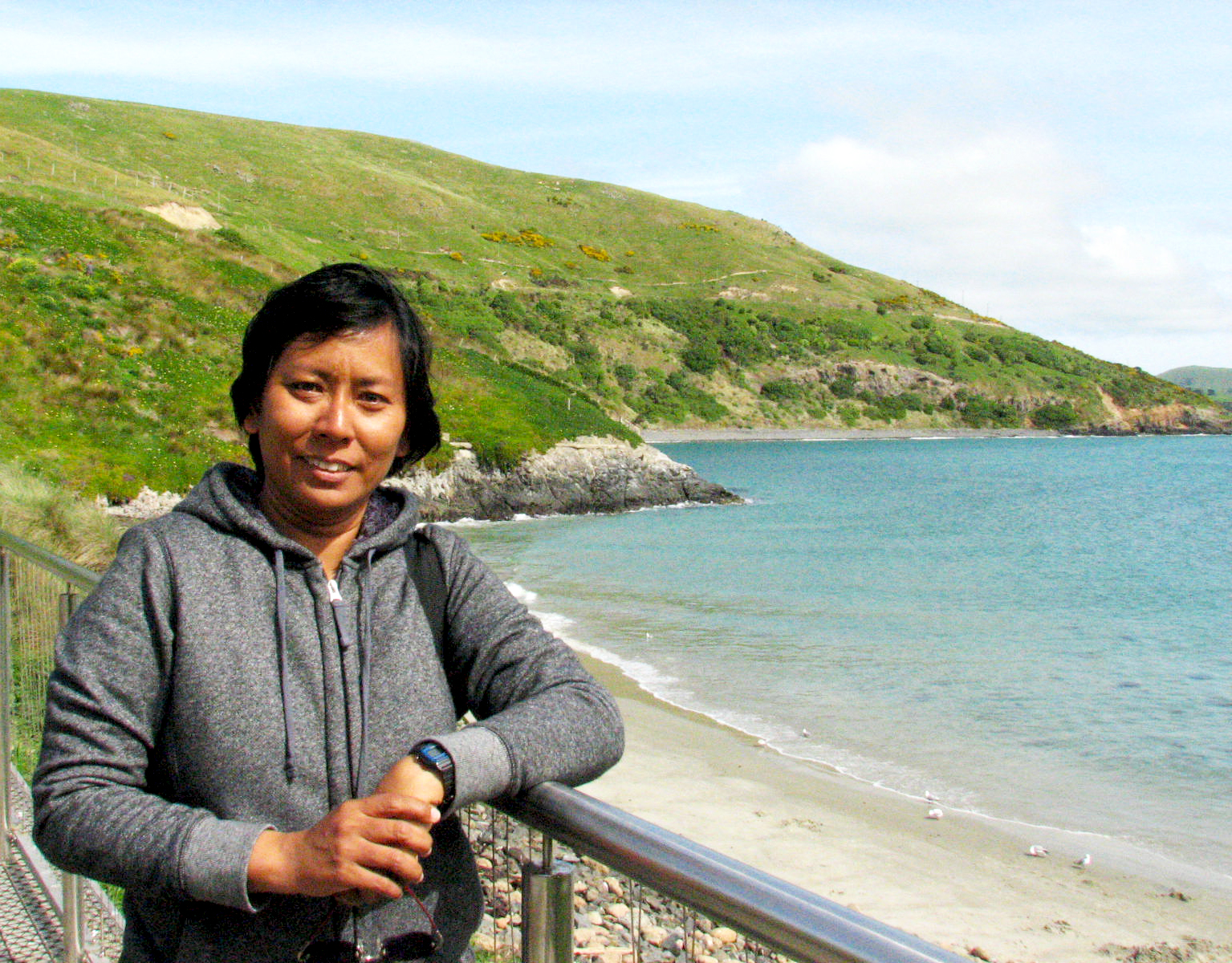
Dr. Nura Abdul Karim, Deputy Director of Library, Training, and External Relations at Singapore Botanic Gardens.

“A thorough understanding of biodiversity in Singapore and the Southeast Asia region relies both on the study of the plants and animals in the region and also on the accumulated knowledge of researchers who have gone before us,” asserts Dr. Nura Abdul Karim, Deputy Director of Library, Training, and External Relations at SBG. “SBG Library believes that digital access is an important avenue for sharing knowledge and information in this Computer Age.”

To that end, SBG is participating in BHL Singapore, which is led by the National Library Board, Singapore. To date, SBG Library has digitized over 8,000 pages for BHL.

“As custodian of this wealth of biodiversity literature, SBG Library believes that these important legacy works need not only be restored but also preserved and made available through the digital access platform of the Biodiversity Heritage Library,” says Abdul Karim. “BHL will allow far greater access to academics, researchers and students, and possibly even to the global public, than was ever possible before.”

View Full Size Image
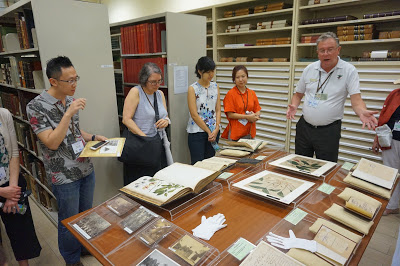
Tour of the Singapore Botanic Gardens Library by Dr. Nigel Taylor. Photo by Martin R. Kalfatovic.

As a participant in BHL Singapore, the SBG Library is not only digitizing its collections for BHL, but the Gardens also hosted the BHL Open Day this past March as part of the 2017 BHL Annual Meeting festivities. During the event, local researchers spoke about the impact that open access to biodiversity literature through BHL has on their research.

“We believe that by sharing important collections in BHL and allowing free digital access to such materials, we will greatly assist researchers in furthering their own research on biodiversity in the Southeast Asian region,” affirms Abdul Karim. “Information inequality between developing and developed world researchers can be narrowed with the availability of open access digital repositories.”

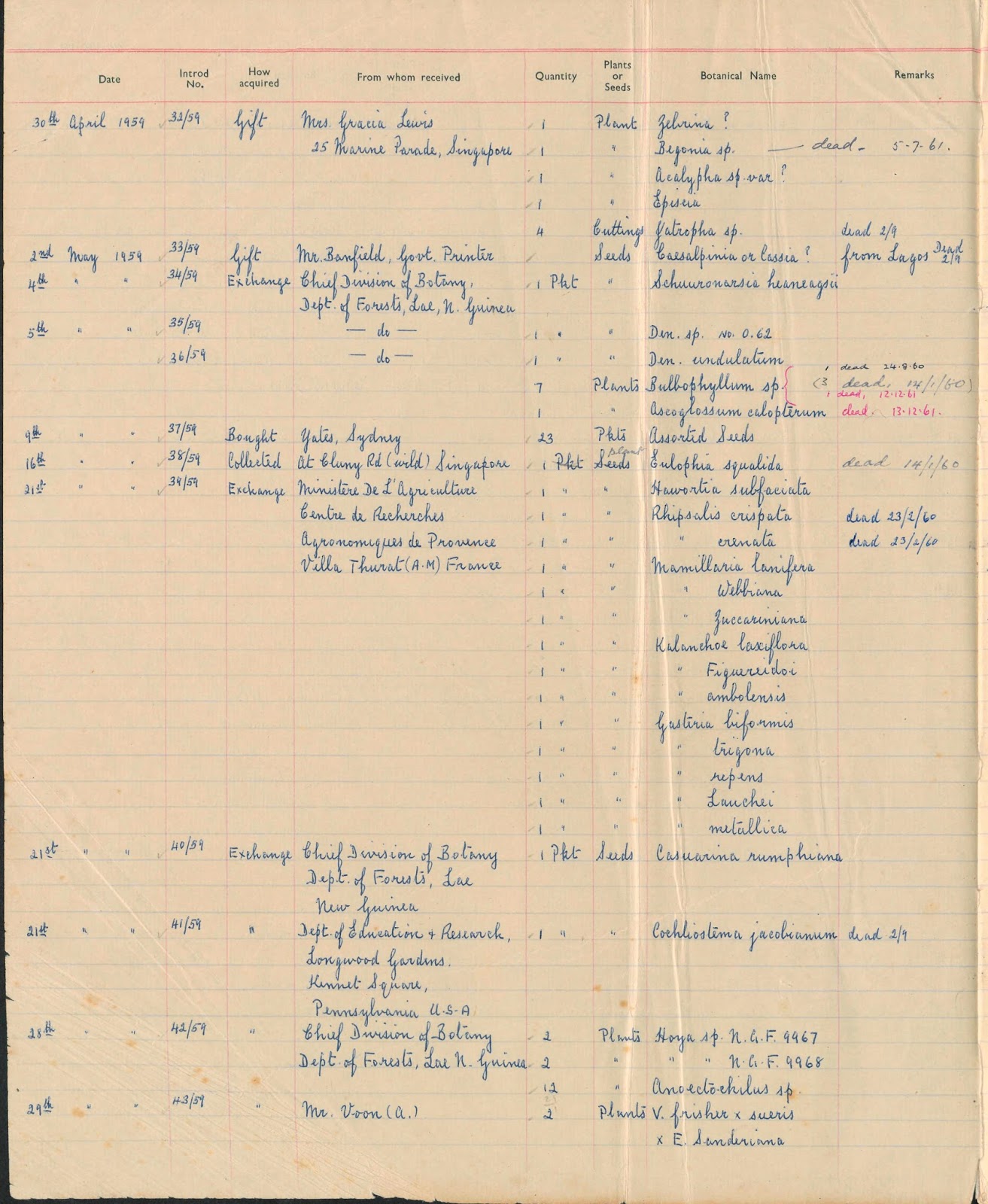
Content digitized by SBG Library to date includes the Gardens’ Bulletin as well as registers of the plants and seeds acquired by the Gardens. In the future, the Library plans to contribute unique field notes from the Gardens’ collections, including those by orchid botanist Cedric Errol Carr, which are currently being transcribed as part of The Citizen Archivist Project at the National Archives of Singapore.

View Full Size Image
Page from Plants and seeds inward register, 2 January 1959-1972. Digitized by Singapore Botanic Gardens, National Parks Board Singapore. http://www.biodiversitylibrary.org/page/50744514.

Dr. Abdul Karim is confident that this digitization will have a significant impact on local and global research.

“Very few libraries in the world have resources that would enable all of the researchers that they serve to be able to conduct their studies unencumbered by lack of vital literature,” says Abdul Karim. “Access to a wider array of literature through BHL can have a profound and positive impact on biodiversity, as research can be more wide ranging, accurate and speedy, and the data vital in many fields of science and conservation can be published in a much shorter timeframe.”

Indeed, user testimonials illustrate how BHL increases the efficiency and effectiveness of research around the world. With the help of partners such as SBG Library, BHL’s growing collections will continue to empower research on a global scale. Dr. Abdul Karim and her Singapore colleagues share this conviction.

“SBG Library believes that BHL, with its rich digital repository of biological information, will continue to play an important role in botanical research and has indirectly also become a platform for long-term preservation of historical and legacy biodiversity literatures.”

______________________________________

This post may contain the personal opinions of BHL users or affiliated staff and does not necessarily represent the official Biodiversity Heritage Library (BHL) position on these matters.

June 8, 2017by ulib-libraryjobs
BHL News, Blog Reel

Promoting the Biodiversity Heritage Library and Scholarly Communications at the Mpala Research Centre in Kenya

View Full Size Image

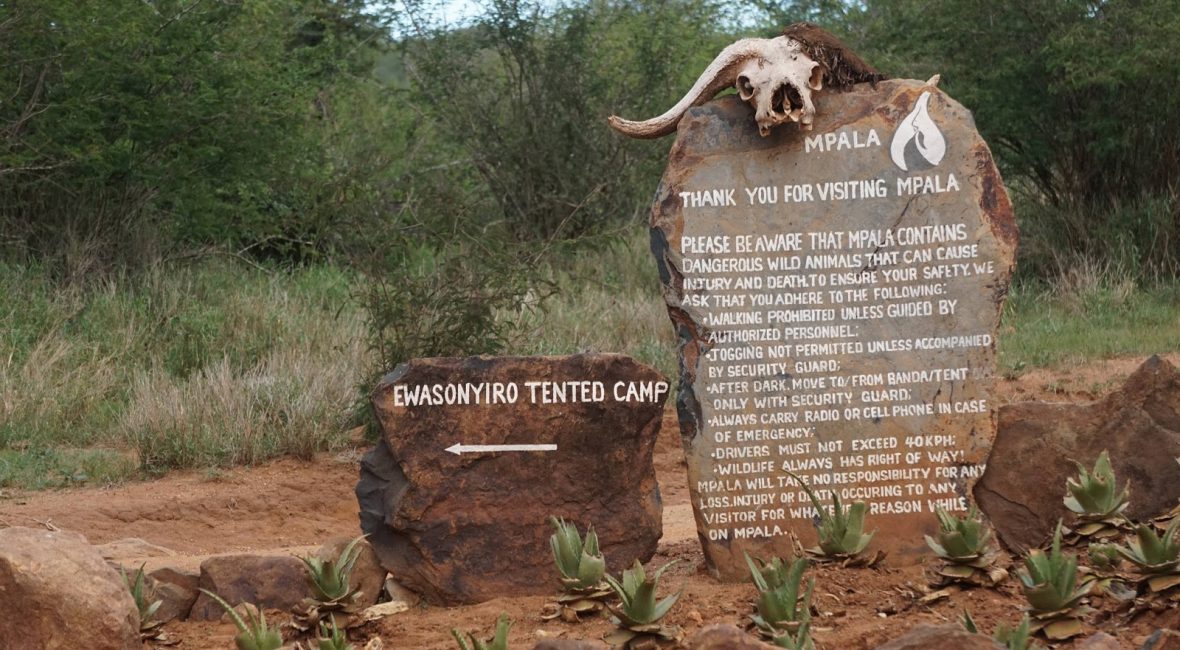
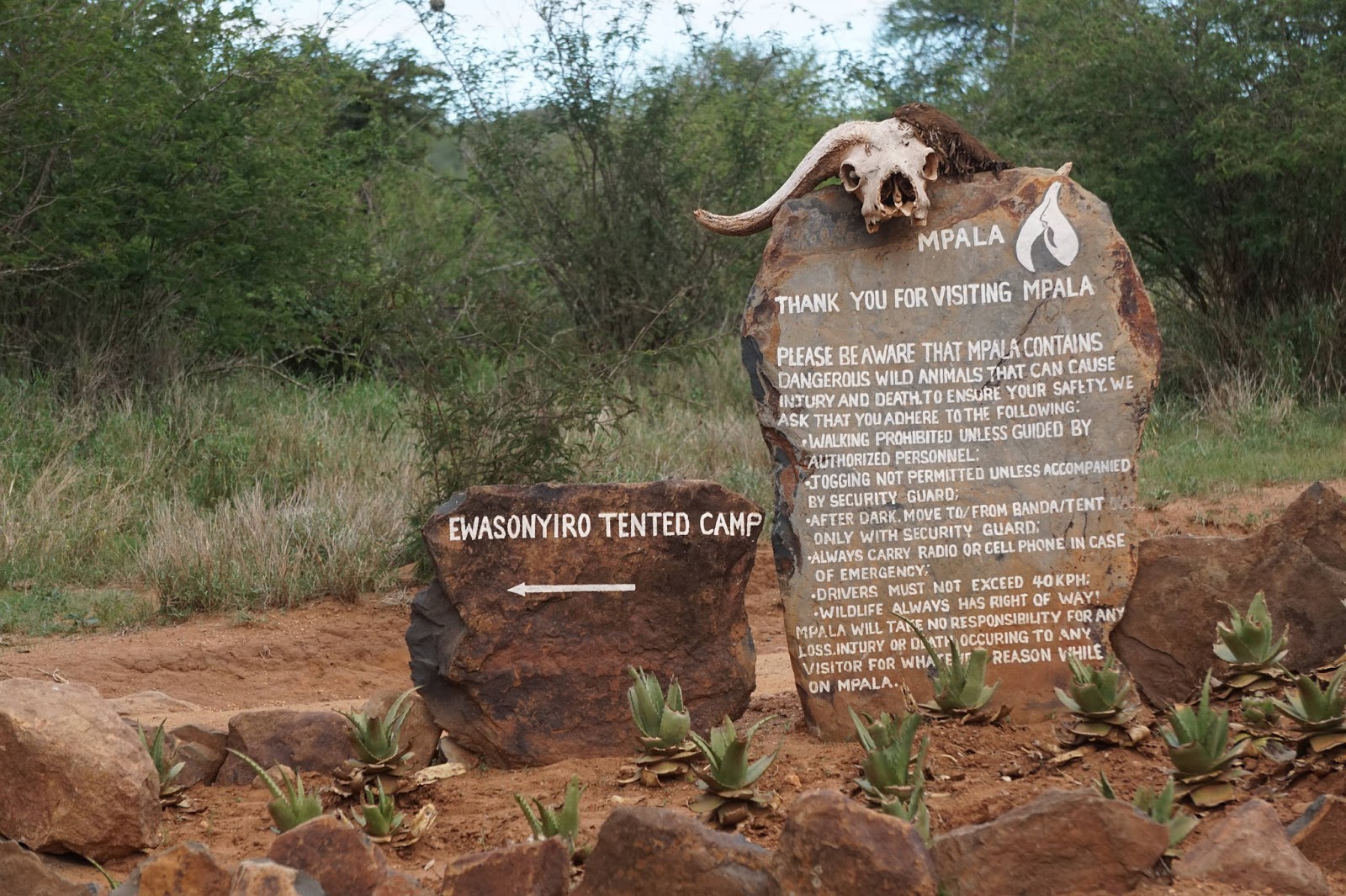
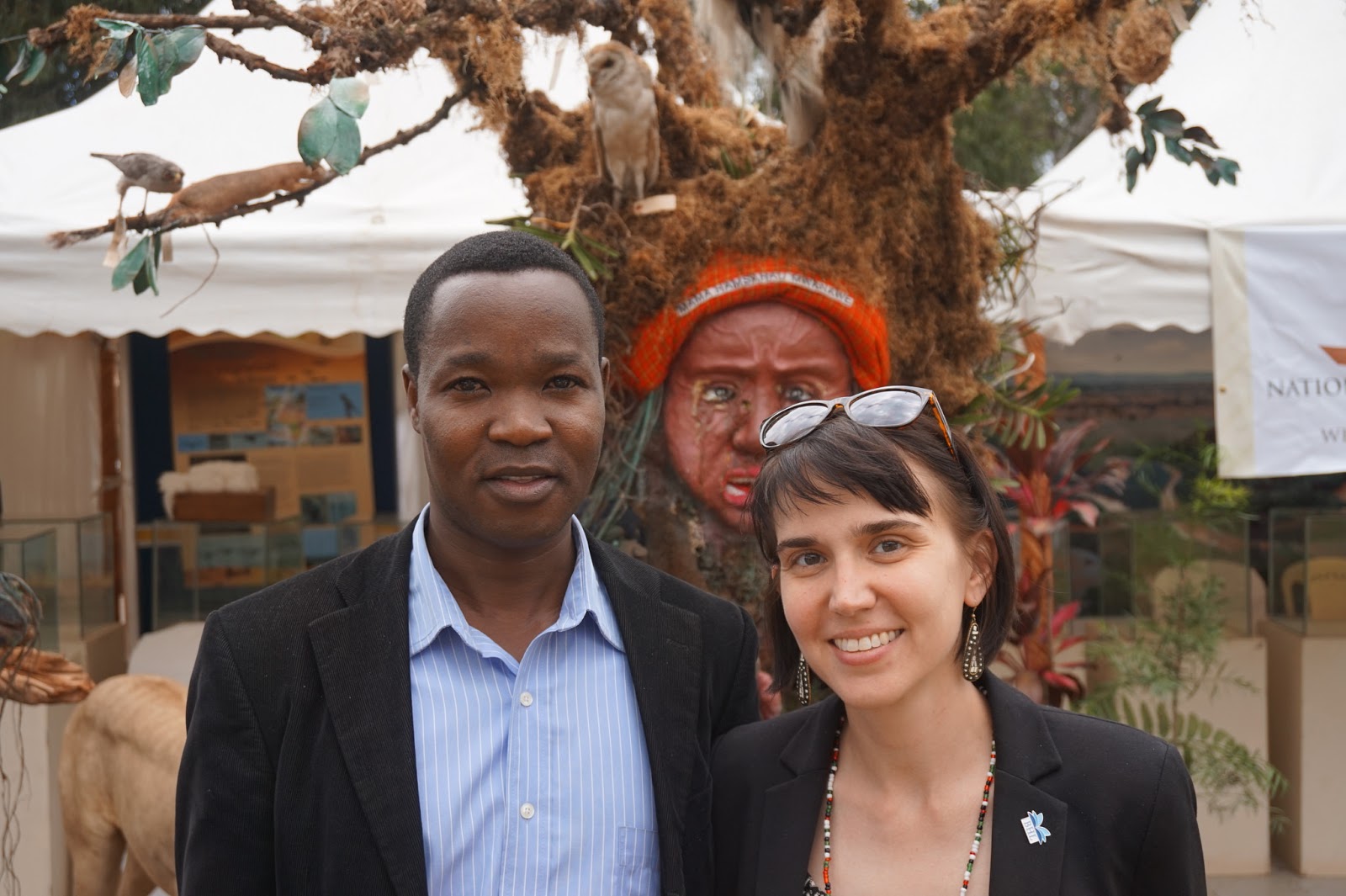
Under the auspices of Scott Miller, Deputy Under Secretary for Collections and Interdisciplinary Support (DUSCIS) at the Smithsonian Institution and Vice-Chair of the Mpala Research Centre, I spent three days at the Mpala Research Centre in Laikipia County, Kenya with Carolyn A. Sheffield (BHL Program Manager) to learn more about the activities and research at Mpala and to explore partnerships around the Biodiversity Heritage Library and scholarly communications.

View Full Size Image
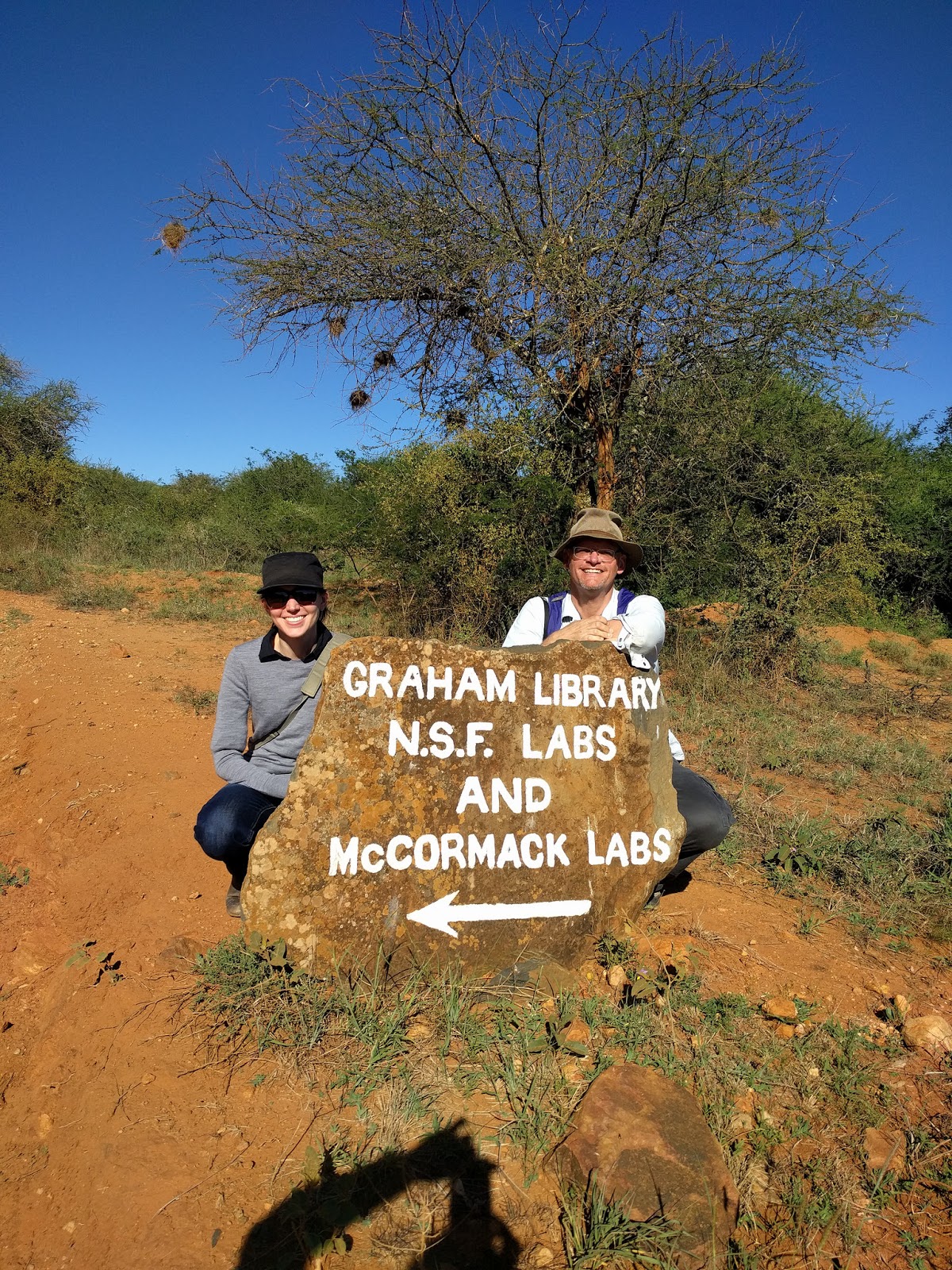
Library this way!

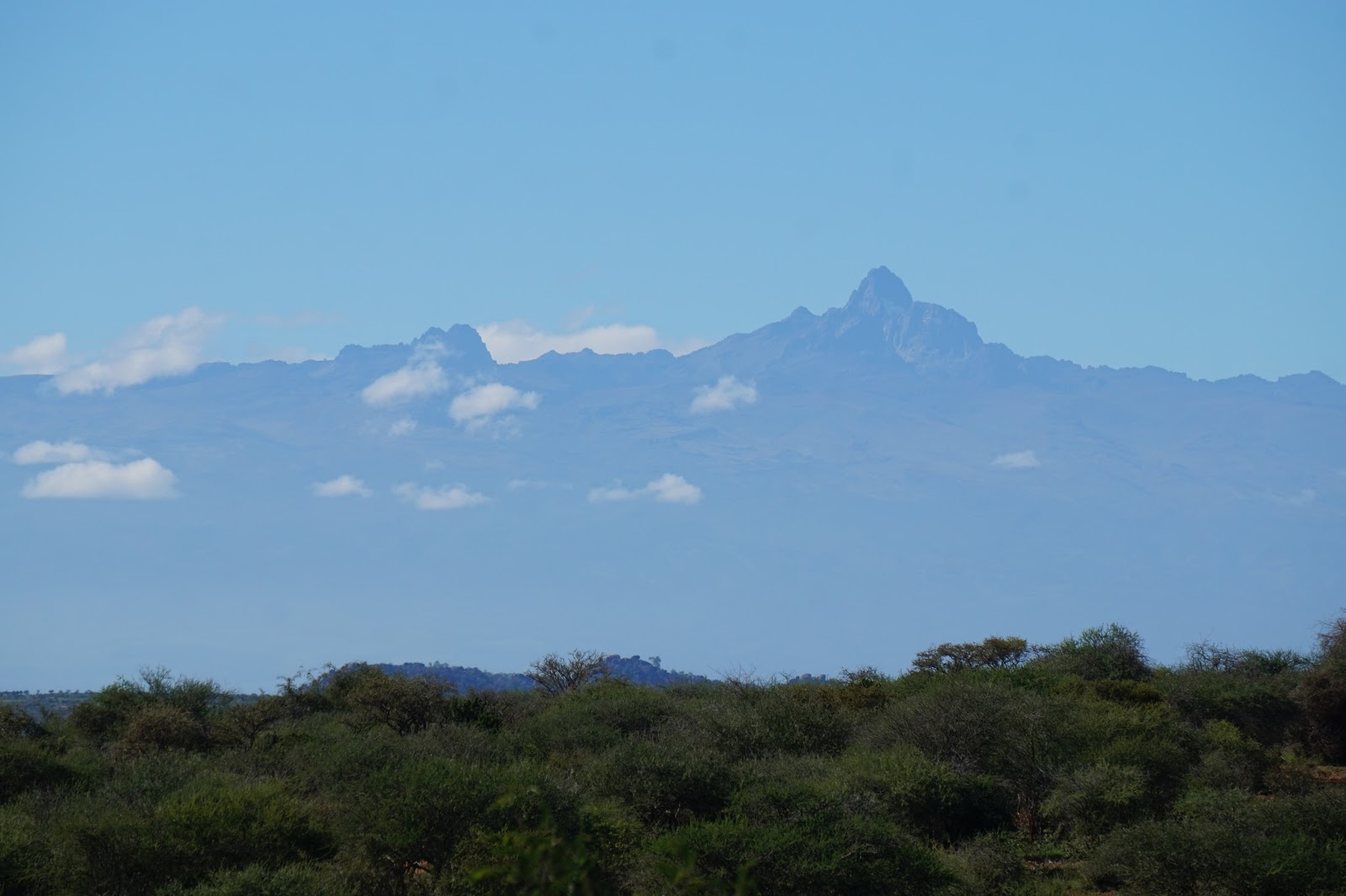
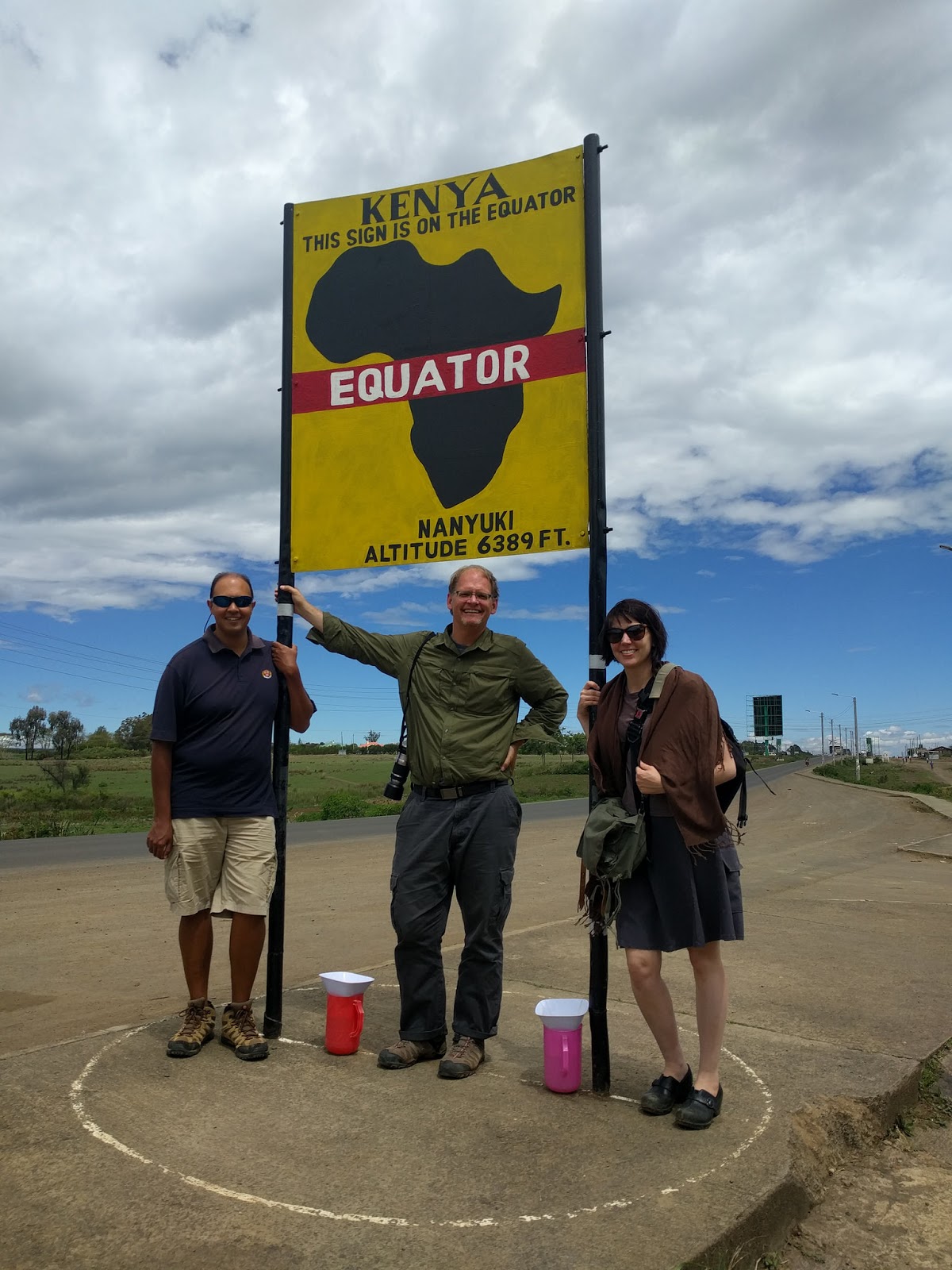
Dr. Dino Martins, Executive Director of the Mpala Research Centre, met Kalfatovic and Sheffield outside of Nanyuki just north of the equator and in the shadow of Mt. Kenya, about 240 kilometers north of Nairobi. We made a short stop at the equator marker before picking up a few supplies for the trip back to Mpala. On the ninety minute drive from Nanyuki to Mpala, Dr. Martins gave a fascinating and useful overview of the history of Mpala and the complex interactions of wildlife and human agricultural activities around livestock and farming. Increasing pressure on the environment from the subdivision of land for residential development and challenges presented by climate change on the area are a daily concern for Martins as he manages the important living laboratory that is the Mpala Research Centre.

View Full Size Image
Mt Kenya

As noted on the Mpala website:

Mpala stretches over 48,000 acres of semi-arid savanna, acacia bushland, wooded grassland, rocky escarpments and riverine habitats along the Ewaso Nyiro and Ewaso Narok rivers. The Mpala Research Centre (MRC) receives hundreds of students, educators, and scientists from around the globe each year, conducting research on everything from parasites to elephants. The unique set up of Mpala allows for researchers to use the land as a ‘living laboratory’ in which to conduct experiments and answer pressing questions on conservation and wildlife.

View Full Size Image
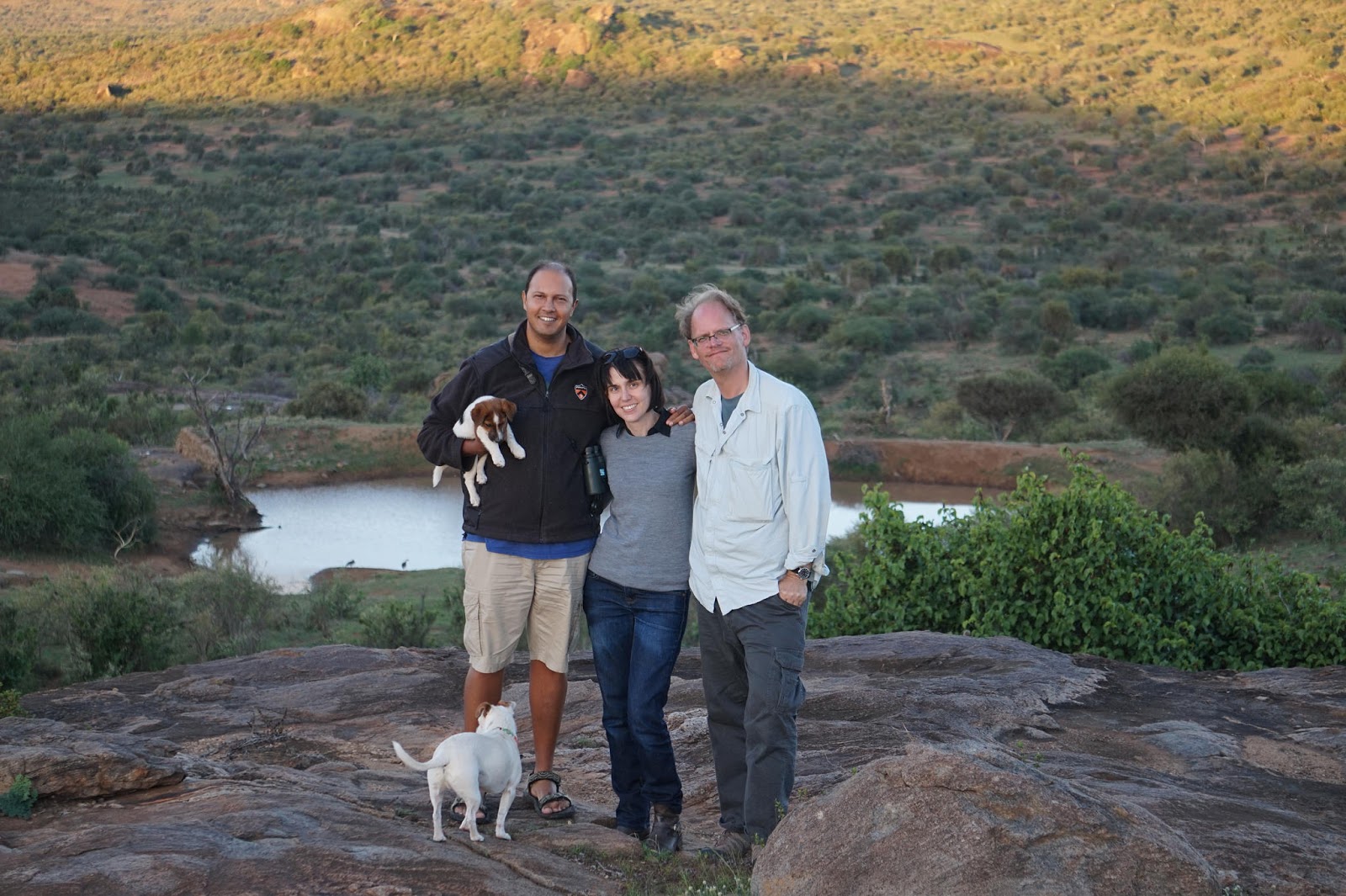
With Dr. Martins

In touring the grounds of the Centre, Dr. Martins also spoke of the opportunities presented by the ongoing collaborative work done by the Conservancies, such as Mpala, Kenyan local and national governmental agencies, and private landowners to balance wildlife and nature conservation, sustainable economic development, and farming/ranching activities.

“Most research organizations in Kenya (including Mpala), as well as agencies who regulate research, are struggling with the challenges of tracking and making available the results of research. The tools that Smithsonian Research Online have used could be readily adapted for use by some of these organizations” said the Smithsonian’s Scott Miller.

View Full Size Image
At the equator with Dr. Martins

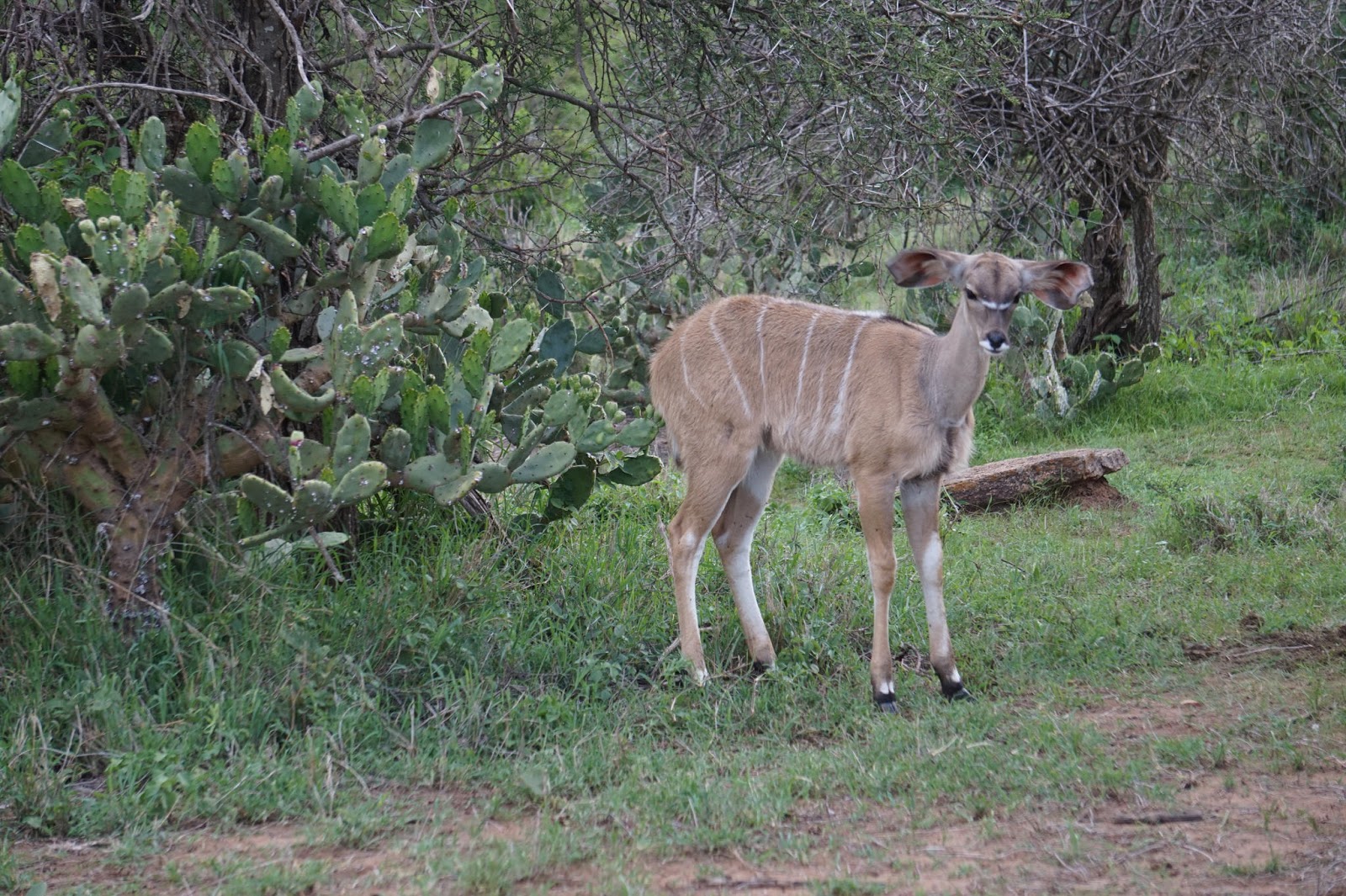
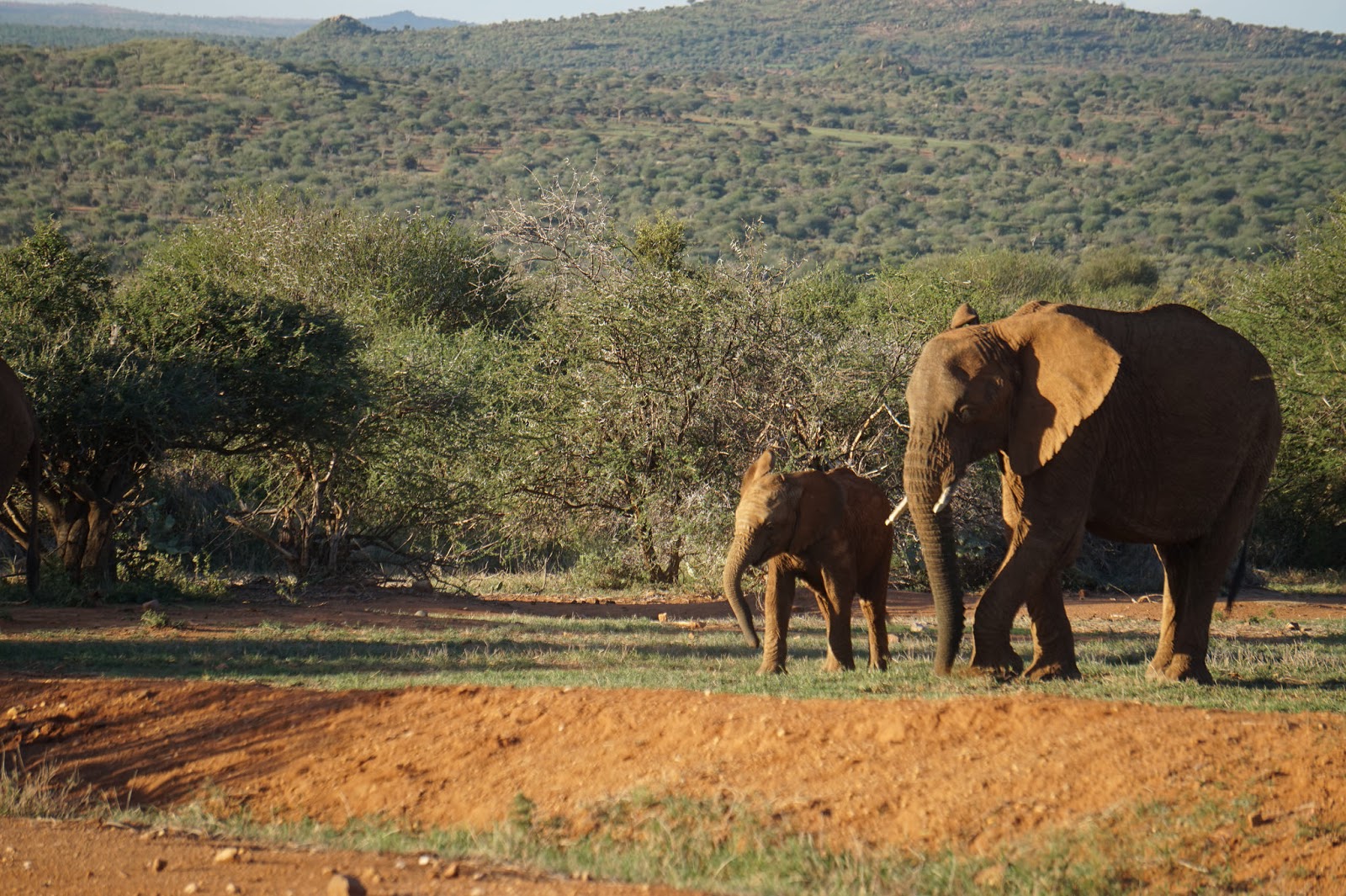
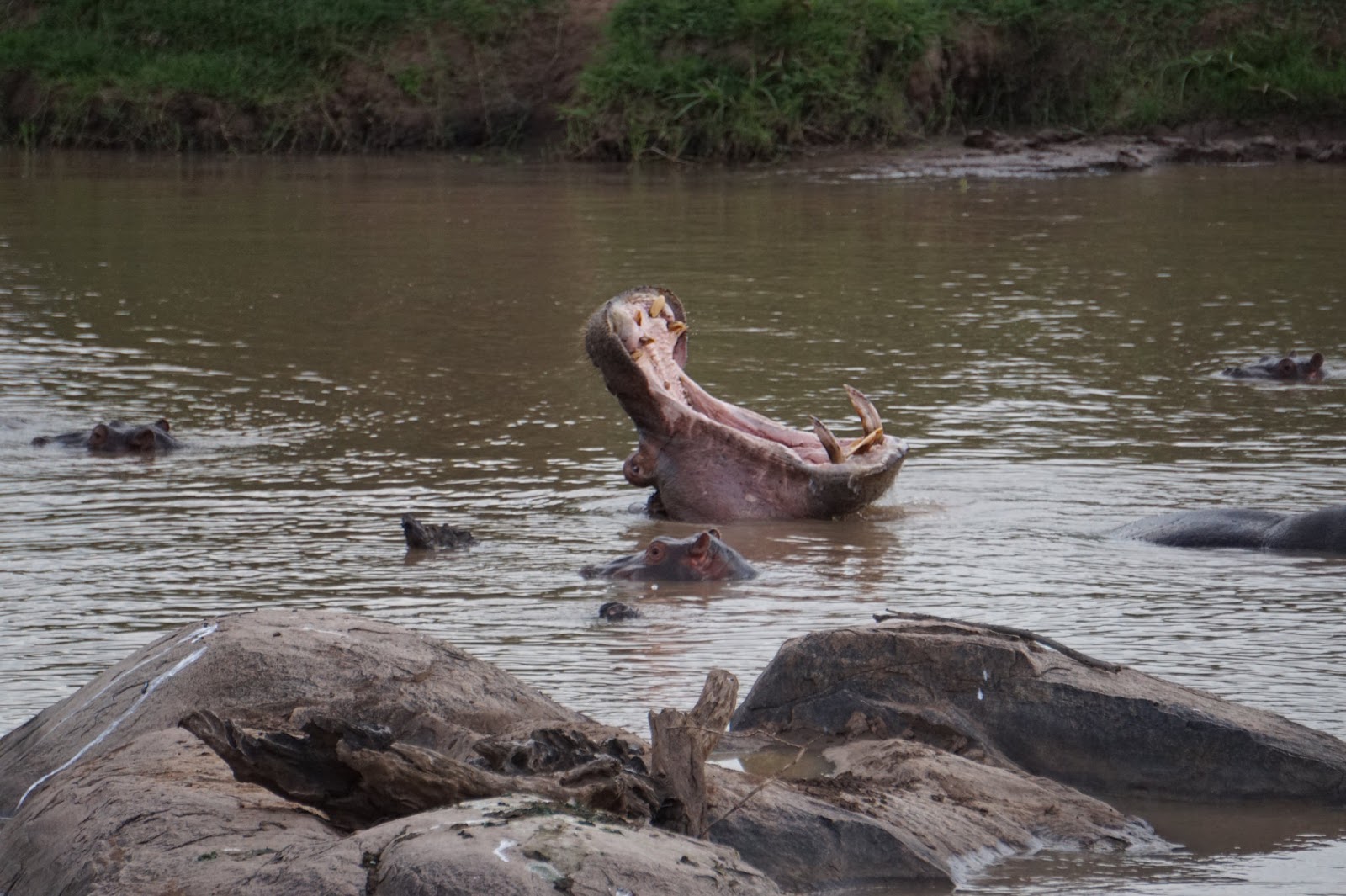
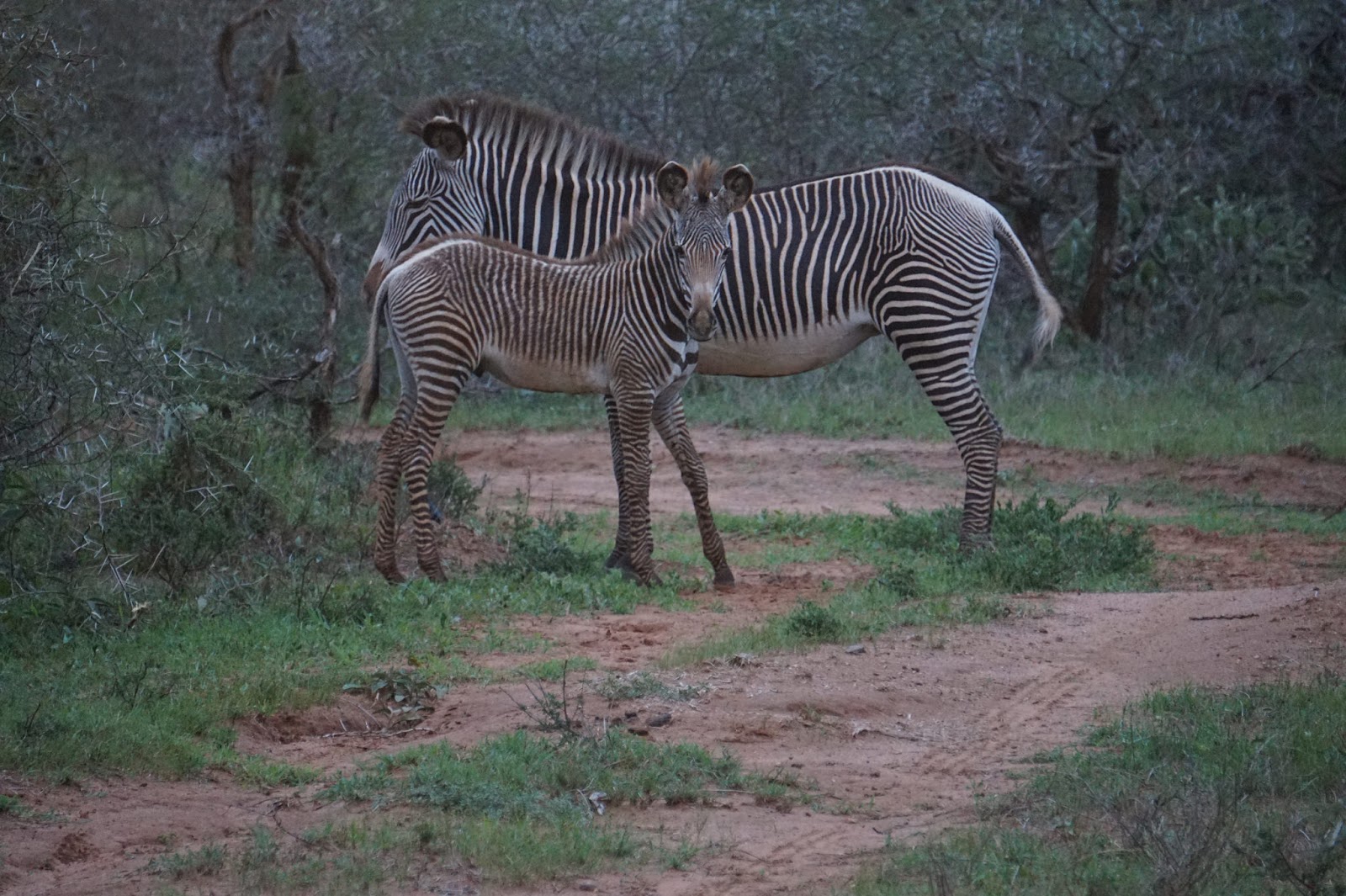
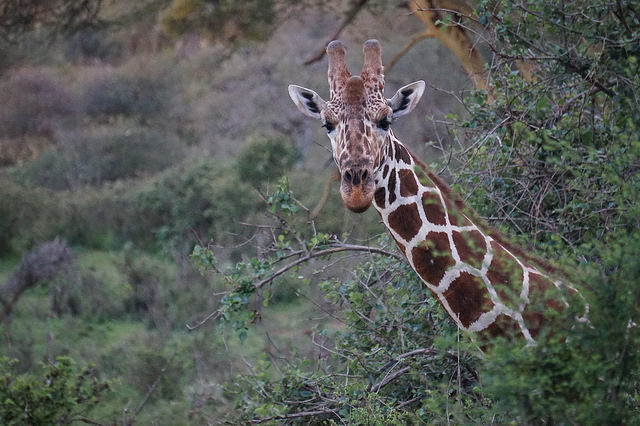
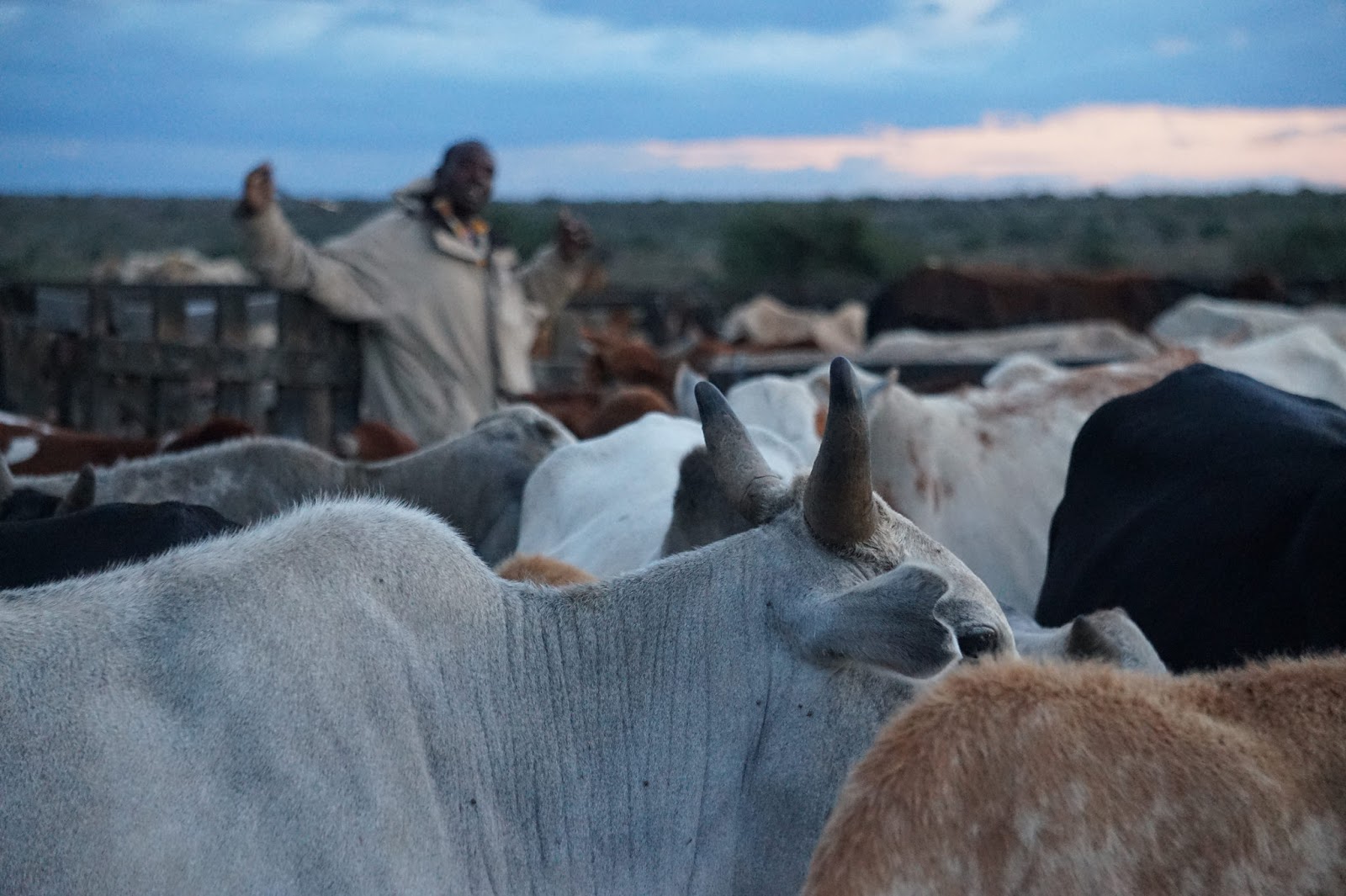
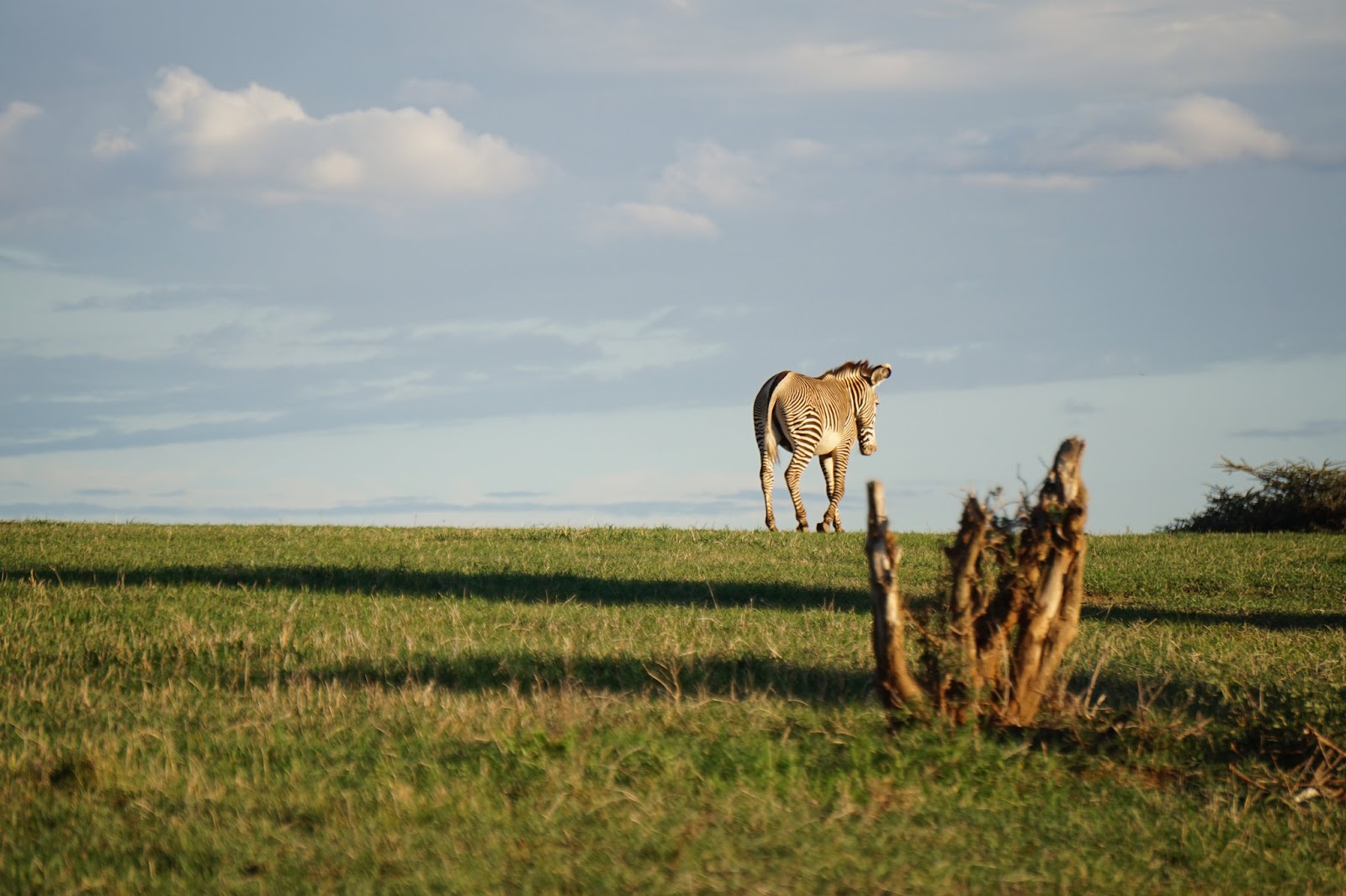
To help better understand the work done at Mpala and the research needs, Dr. Martins personally took us on two evening game drives throughout the Mpala grounds. The visits were nothing short of spectacular. Sightings of various wildlife were numerous (see fuller list below), including many listed as vulnerable or endangered on the IUCN Red List of Threatened Species. It was wonderful to see large groups of the endangered Grévy’s zebra (Equus grevyi) with young foals. Three species of vulnerable animals, Hippopotamus (Hippopotamus amphibius), Reticulated giraffe (Giraffa camelopardalis reticulata), and Elephant (Loxodonta africana) were present in large numbers. Among the other Artiodactyla sighted, the groups of Greater Kudu (Tragelaphus strepsiceros) were spectacular. Mpala also maintains herds of domestic cattle. At the end of the game drive, we stopped by one of the cattle enclosures as Dr. Martins consulted with the Mpala herdsmen on the status of the cattle.

View Full Size Image
Greater Kudu  (Tragelaphus strepsiceros)


View Full Size Image
Elephant (Loxodonta africana)


View Full Size Image
Hippopotamus (Hippopotamus amphibius)


View Full Size Image
Grévy’s zebra (Equus grevyi)

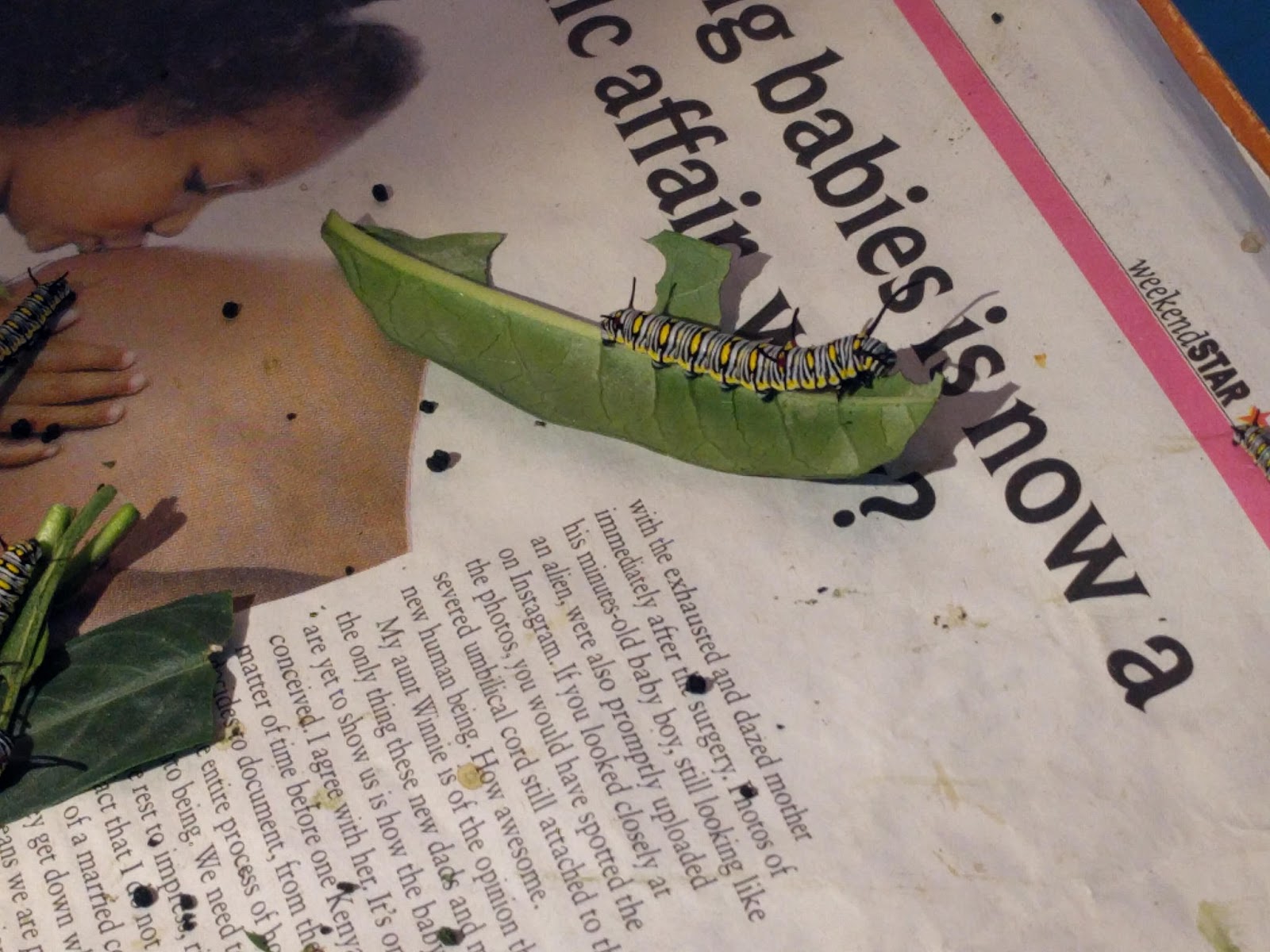
The next morning, during a visit to the research facilities, we spent time in the N.S.F. and McCormack Research Labs at Mpala, where we were shown the ongoing work of visiting and longer term researchers, including experiments being down with caterpillars. On our first full morning at the Centre, we were taken on a bird watching walk of the grounds with ornithologist Sylvester Karimi.

View Full Size Image
Research labs

On the final day of the visit, presentations on scholarly communications management and the Biodiversity Heritage Library were given to an audience of about twenty people. Included in the audience were representatives from ten institutions, in addition to Mpala Research Centre staff. Institutions represented included: Space for Giants,  Laikipia Wildlife Forum, Kenya Forestry Research Institute (KEFRI), Olpejeta Conservancy, Lewa Conservancy, University of Bayreuth, Daraja Academy,  Lekiji Primary School, Oljogi Primary School, and the Mpala Academy.

I spoke on “Managing Scholarly Research Output: The Smithsonian Institution Experience: An Introduction to Smithsonian Research Online” and BHL Program Manager Carolyn A. Sheffield presented on “Inspiring Discovery Through Free Access to Biodiversity Knowledge: The Biodiversity Heritage Library (BHL).”

View Full Size Image
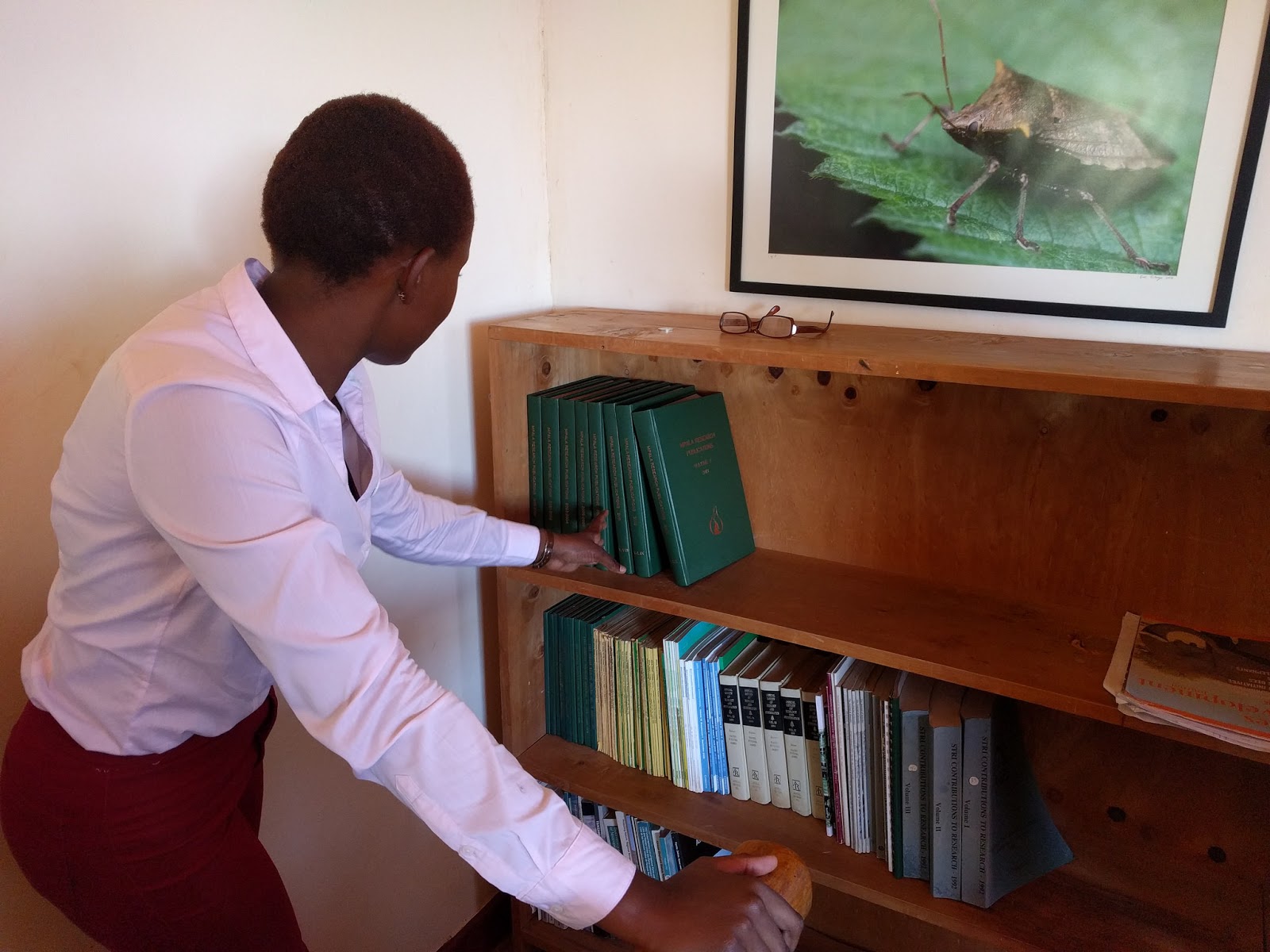
Mpala library volunteer Naomi Wanjiru Chege

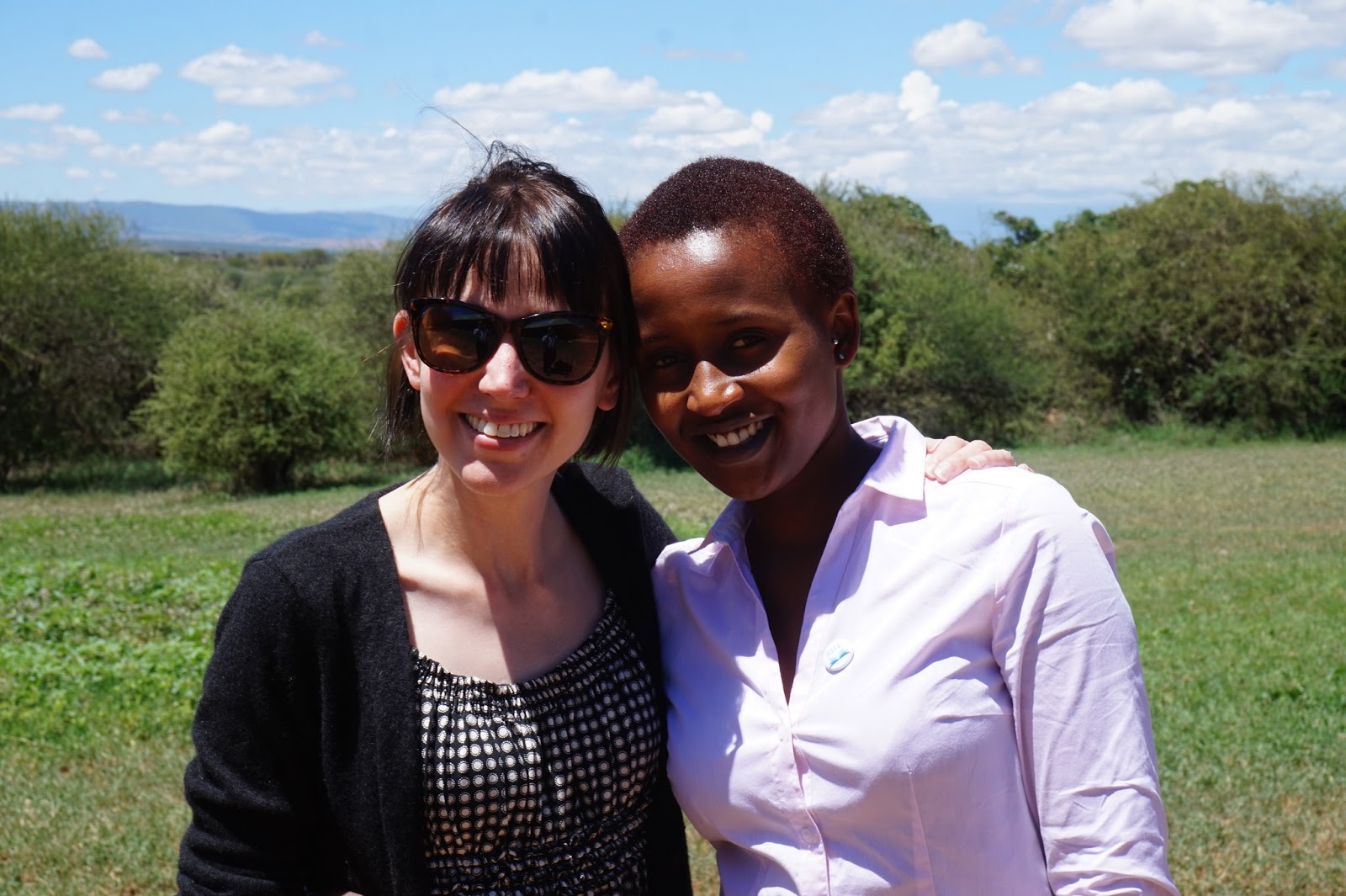
At the conclusion of the presentations, we met with Mpala library volunteer Naomi Wanjiru Chege and Anchal Padukone (Princeton in Africa Fellow) to discuss the library facility at Mpala and possible areas of collaboration between the Centre and Smithsonian Libraries as well as the Biodiversity Heritage Library. We also had an opportunity to visit the studio facilities of Mpala Live!:

“Mpala Live! gives you a round-the-clock look at the lives of elephants, lions, zebras, giraffes, hippos, birds, and other animals in a fascinating swath of African landscape. Our webcams let you visually enter this realm. The Hippo Pool cameras, for instance, take you to a watering hole that attracts hippos, monkeys, zebras, giraffe, scores of bird species, and the occasional crocodile.”

Mpala Live!, with viewership in the millions, provides both educational and research activities with its active citizen science engagement.

View Full Size Image
With Naomi Wanjiru Chege

As our work at the Centre ended, we shared yet another wonderful meal with the guests, researchers, and Mpala staff. The lunch provided additional opportunities to learn about the work done in the Kenyan wildlife conservancies and at Mpala. The luncheon concluded, we met our transportation for the five hour ride back to Nairobi and our departing flight at the Jomo Kenyatta International Airport.


On this visit to Kenya, we were treated to some wonderful sightings of the local flora and fauna. In Mpala and the nearby areas, the following were some of the highlights of the local fauna. For lists of the flora and fauna of Mpala, please see the following Mpala website page.

PRIMATES

  • Vervet Monkey (Cercopithecus aethiops)
  • Black-and-white colobus monkey (Colobus) [sighted outside the Mpala Research Centre]
  • Olive Baboon (Papio anubis) [sighted outside the Mpala Research Centre]

CARNIVORA

  • Bat-eared Fox (Otocyon megalotis)
  • Slender Mongoose (Galerella sanguinea)
View Full Size Image
Reticulated giraffe (Giraffa camelopardalis reticulata)

ARTIODACTYLA

  • Hippopotamus (Hippopotamus amphibius)
  • Common Warthog (Phacochoerus africanus)
  • Reticulated giraffe (Giraffa camelopardalis reticulata)
  • Impala (Aepyeros melampus)
  • Guenther’s Dikdik (Madoqua guentheri)
  • Steenbok (Raphicerus campestris)
  • Greater Kudu (Tragelaphus strepsiceros)
  • Bushbuck (Tragelaphus scriptus)

PROBOSCOIDEA

  • Elephant (Loxodonta africana)
View Full Size Image
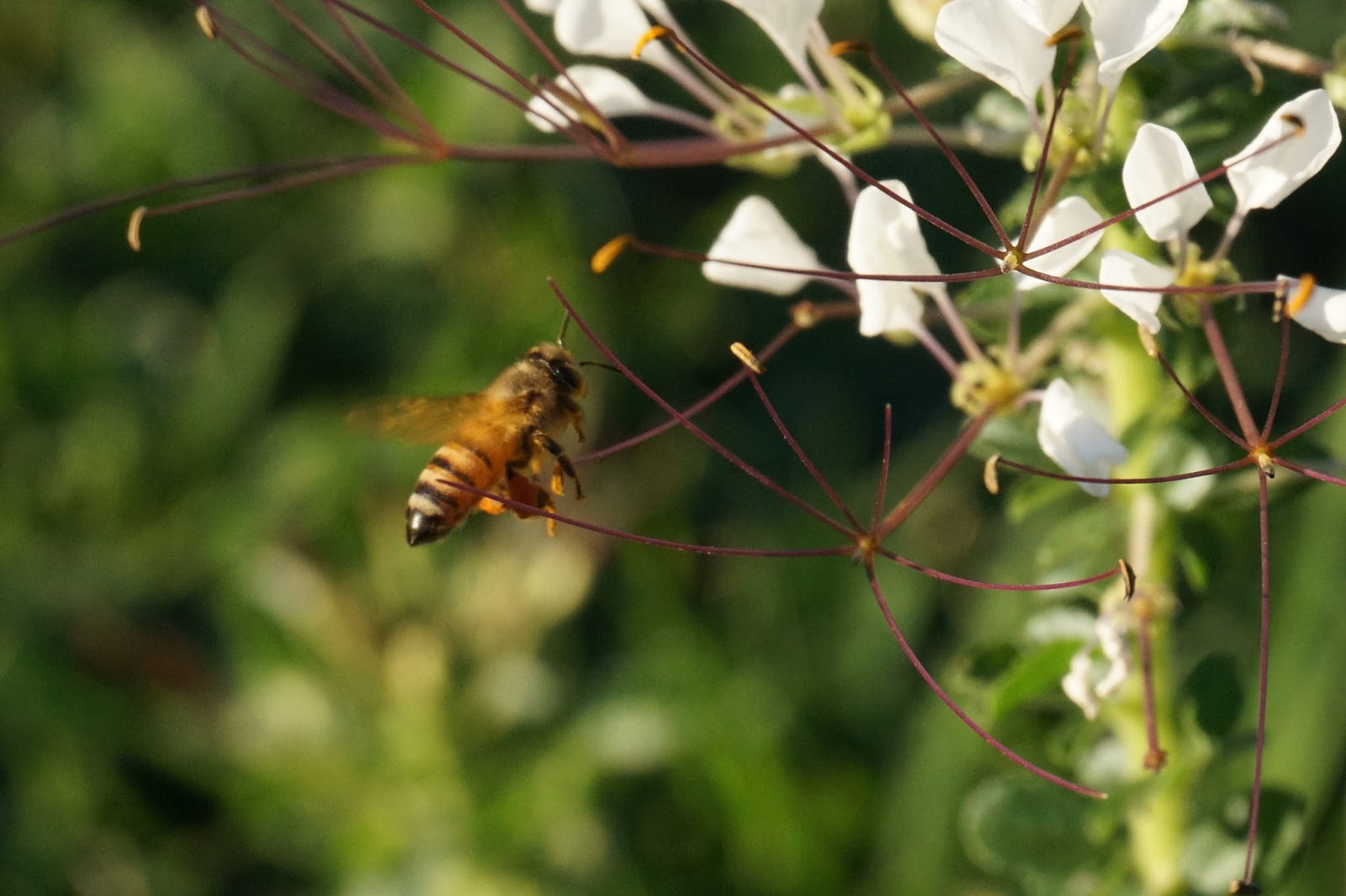
Spider plant (Cleome gynandra)

PERISSODACTYLA

  • Grévy’s zebra (Equus grevyi)

LAGOMORPHA

  • Scrub hare (Lepus saxatilis)

HYRACOIDEA

  • Bush Hyrax (Heterohyrax brucei)
View Full Size Image
Cow (Bos taurus/indicus)

DOMESTIC

  • Cow (Bos taurus/indicus)
  • Sheep (Ovis aries) [sighted outside the Mpala Research Centre]
  • Goat (Capra hircus) [sighted outside the Mpala Research Centre]
  • Donkey (Equus africanus) [sighted outside the Mpala Research Centre]
  • Camel (Camelus dromedaryus)
  • Domestic Dog (Canis familiaris)
  • Domestic Cat (Felis sylvestris)

AVES (Selected)

  • Vulturine Guineafowl (Acryllium vulturinum)
  • Egyptian Goose (Alopochen aegyptiacus)
  • Gabar Goshawk (Micronisus gabar)
  • Martial Eagle (Polemaetus bellicosus)
  • Red-chested Cuckoo (Cuculus solitarius)
  • Red-billed Hornbill (Tockus erythrorhynchus)
  • Rock Martin (Hirundo fuligula)
  • Common Bulbul (Pycnonotus barbatus)
  • Superb Starling (Lamprotornis superbus)
View Full Size Image
A lone Grévy’s zebra (Equus grevyi)
June 7, 2017by
BHL News, Blog Reel

Promoting Scholarly Publication Data and the Biodiversity Heritage Library in Kenya with a Special Presentation at the U.S. Embassy, Nairobi

Portrait version of the Biodiversity Heritage Library logo.
View Full Size Image

In May 2017, while attending the XXI Congress of the Association for the Taxonomic Study of the Flora of Tropical Africa (AETFAT), Smithsonian Libraries‘ (SIL) staff Martin R. Kalfatovic and Carolyn A. Sheffield received a speaking invitation for the Embassy of the United States of America, Nairobi, Kenya from Tatum Albertine (Environment, Science, Technology & Health Officer).

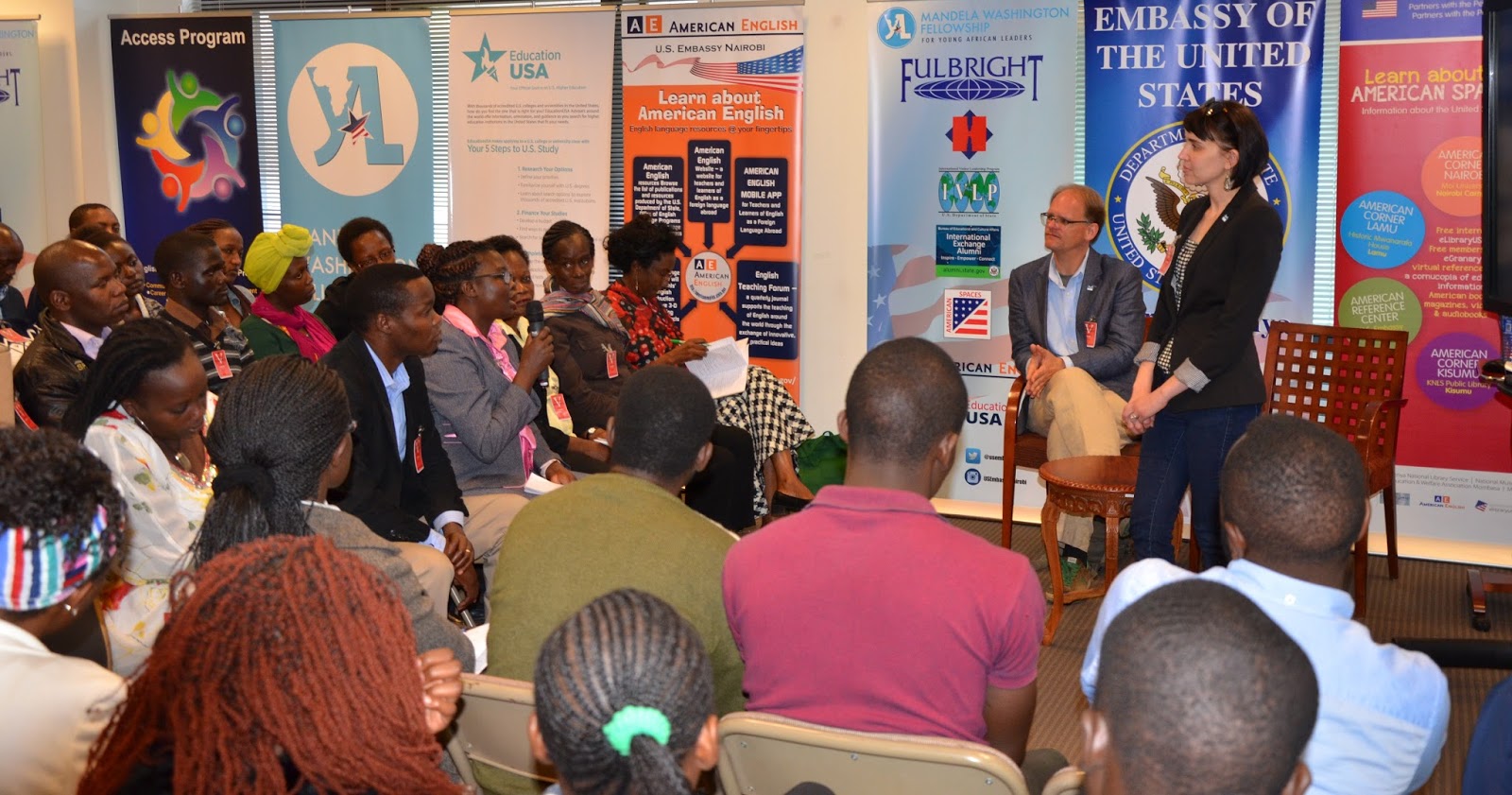
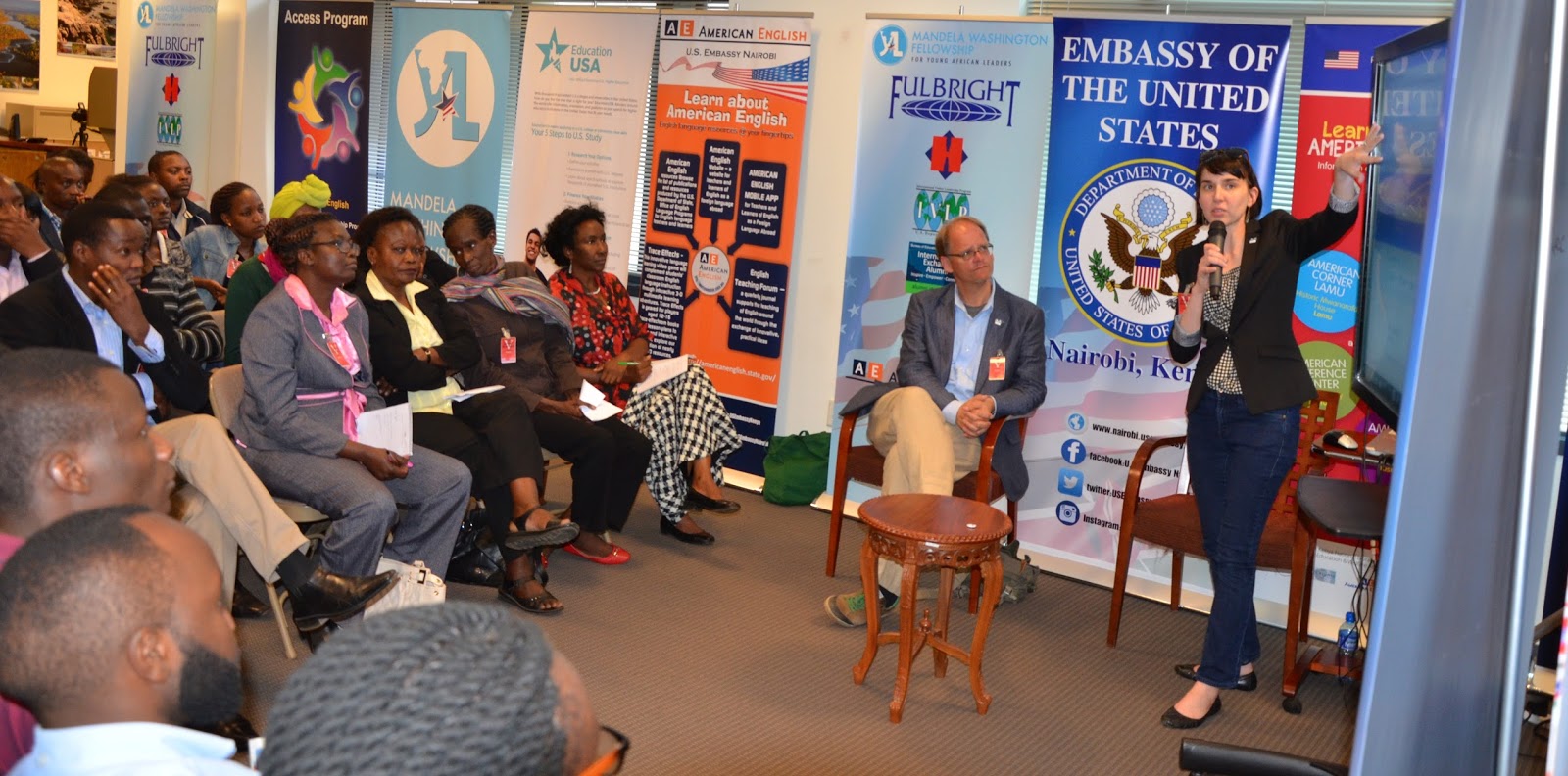
The Embassy is located in Gigiri, north of the Nairobi central business district, about a two hour drive in Nairobi traffic from the Karen neighborhood where the AETFAT Congress was being held. The program was held in the American Reference Center (ARC) on the Embassy campus. The ARC serves students, teachers, researchers, journalists, business professionals and individuals simply interested in broadening their horizons on any topic.

View Full Size Image

The purpose of the talk was to provide a wider Kenyan community with information about the Biodiversity Heritage Library and services provided by Smithsonian Libraries to Smithsonian researchers that could serve as a model or inspiration for similar services to the broader research community in Kenya. There were invited guests from National Museums of Kenya, the Kenya Wildlife Service, Nature Kenya: The East African Natural History Society, and the National Commission for Science, Technology and Innovation (NACOSTI). In addition, Albertine worked with ARC Deputy Director Nashon Akello to publicize the program widely with the university community and faculty and students from both Kenyatta University and the Technical University of Kenya.

View Full Size Image

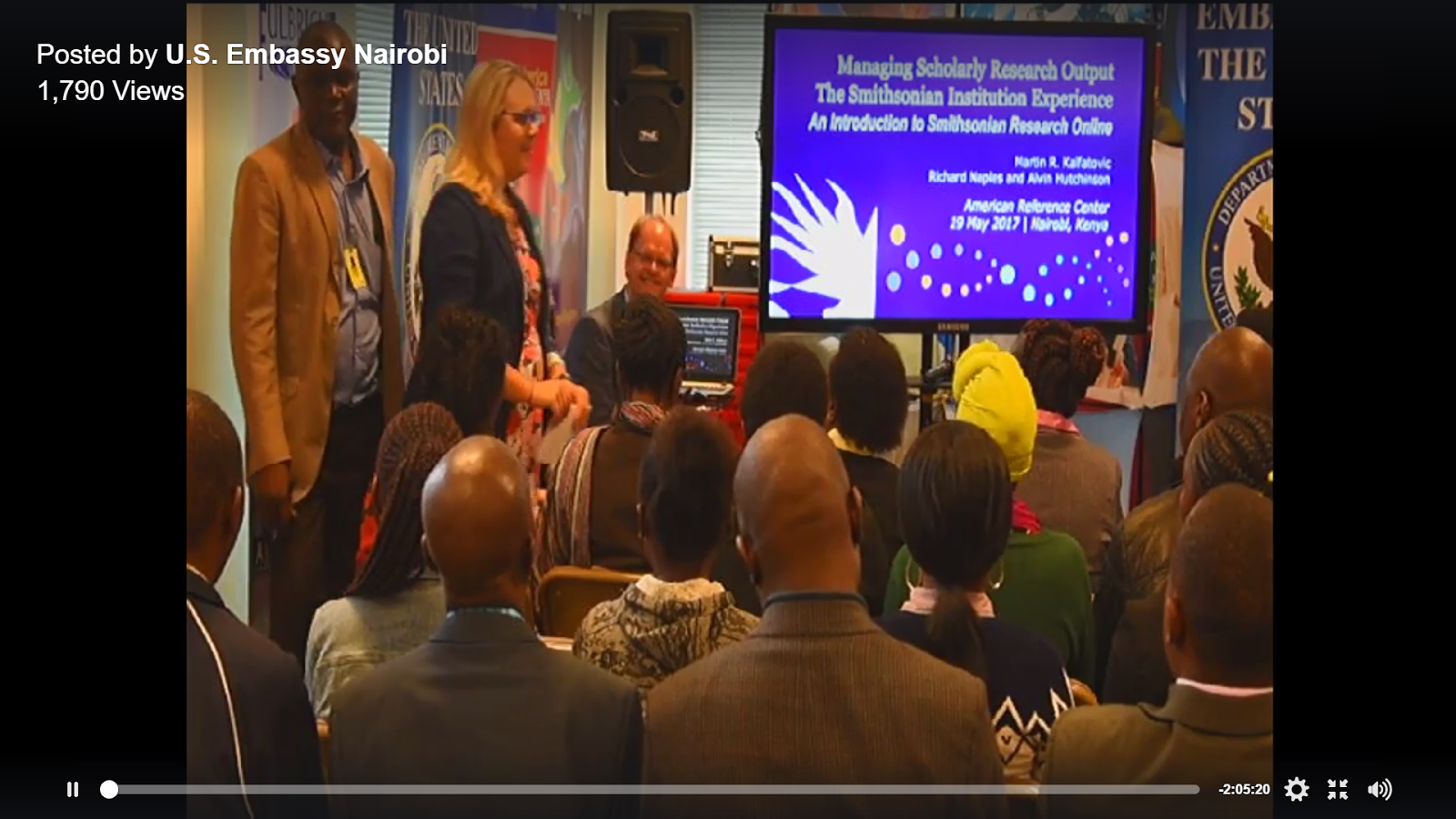
Smithsonian Libraries Associate Director Martin R. Kalfatovic’s presentation, “Managing Scholarly Research Output: The Smithsonian Institution Experience: An Introduction to Smithsonian Research Online (SRO)” covered key components of the Smithsonian Libraries’ SRO program of bibliographic data collection, data analysis for metrics and reporting, and communications to administrators, researchers, and the public. The presentation was based on previous presentations of SIL staff Alvin Hutchinson and Richard Naples and with input from Suzanne C. Pilsk. A representative of NACOSTI in attendance commented:

Information management and data analysis towards scholarly publications is a very important indicator of a nation’s development and reflects the potential of a nation to harness its human resource in solving problems of mankind. It also broadens the horizons of policy thinking and in addressing many critical issues the government faces. As a policy making institution, scholarly publications will be very important in advising the government accurately. Therefore, your invitation of our institution was timely because this is one of the areas needed to be harnessed in advising the government by policy directions using real data.

As Scott Miller, Deputy Under Secretary for Collections and Interdisciplinary Support at the Smithsonian Institution, who facilitated the planning for the program, noted:

Most research organizations in Kenya, as well as agencies who regulate research, are struggling with the challenges of tracking and making available the results of research. The tools that Smithsonian Research Online have used could be readily adapted for use by some of these organizations.

Given the overlap of interests of many organizations in biodiversity research in Kenya, I also hope these presentations catalyze discussion of the possibility of a multi-organization collaboration to create a centralized data archive that has multiple portals to serve different users.

Carolyn A. Sheffield, BHL Program Manager, presented on “Inspiring Discovery Through Free Access to Biodiversity Knowledge: The Biodiversity Heritage Library (BHL).” Sheffield covered a general introduction of the BHL as well as recent accomplishments and metrics related to Kenya and Africa. BHL Africa colleagues, Asha Owono and Ben Nakitare were in attendance and provided additional support in relation to Kenyan participation in the BHL during the question and answer period. A participant from the Kenya Wildlife Service noted: “The lecture and demonstration were very encouraging and I have the feeling that if this is pursued more vigorously, it can enhance information sharing within the conservation field in this country and the world at large.”

View Full Size Image
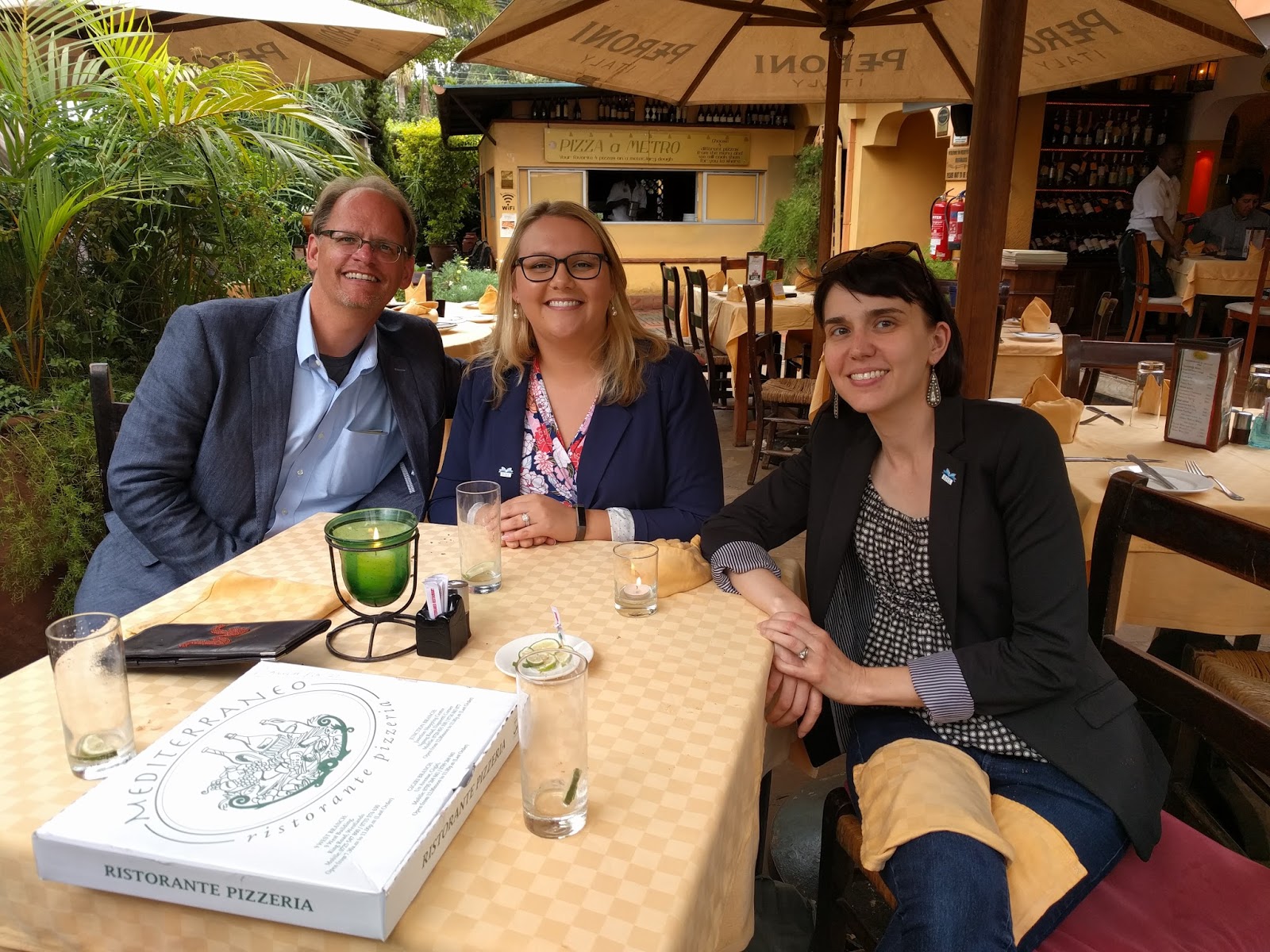
Kalfatovic, Albertine, Sheffield

Again, as Dr. Miller commented during the planning for this presentation, “This program is important for several reasons beyond helping users understand how to use the Biodiversity Heritage Library (which is important in itself). Kenya is poised to make significant additions to the BHL.  As was discussed at the Laikipia landscape workshop in February, there is a rich history of ‘grey literature’ in East Africa on agriculture, wildlife, public health, etc., that is not available to most people today.”

The ARC was filled to capacity with sixty attendees. The Embassy social media team led by Amos Rono also presented the program as a Facebook Live broadcast as well as live streaming it to other U.S. Embassies in East Africa (see link below). Smithsonian Libraries and Biodiversity Heritage Library social media team also promoted the event.

Thanks to ARC Director George Kamau and ARC Deputy Director Nashon Akello for hosting the program in their space and Dan Travis (Public Affairs Officer), Megan Larson-Kone (Cultural Affairs Officer), Alka Bhatnagar (Information Resource Specialist), and Pushpinder Dhillon (Economic Section Chief) on the U.S. Embassy staff who worked to make this program a success.

View the Facebook Live presentation.

June 6, 2017by joelrichard
BHL News, Blog Reel, Tech Updates

Changes Coming to the BHL API on 12 June 2017

The BHL API will be updated on 12 June 2017. The current Contributor element will be replaced with a HoldingInstitution element in the result sets of the following API methods:

GetItemMetadata
GetItemByIdentifier
GetTitleMetadata
GetTitleItems
BookSearch
NameGetDetail

Here is an example of the change:

Current API Response:

<Contributor>MBLWHOI Library</Contributor>
<RightsHolder>MBLWHOI Library</RightsHolder>
<ScanningInstitution>MBLWHOI Library</ScanningInstitution>

New API Response:

<HoldingInstitution>MBLWHOI Library</HoldingInstitution>
<RightsHolder>MBLWHOI Library</RightsHolder>
<ScanningInstitution>MBLWHOI Library</ScanningInstitution>

Detailed documentation for the BHL APIs is available at http://www.biodiversitylibrary.org/api2/docs/docs.html. It will be updated to reflect these changes after they are moved into production on 12 June 2017.

Learn more about BHL’s developer tools and services here.

If you have questions, please feel free to submit feedback via this form.

June 5, 2017by ulib-libraryjobs
BHL News, Blog Reel

BHL at XXI AETFAT 2017 in Nairobi, Kenya

Last month, the BHL Program Director Martin R. Kalfatovic and Program Manager Carolyn A. Sheffield participated in multiple events throughout different regions of Kenya to help promote BHL to existing and potentially new users, connect with our BHL Africa partners, and explore opportunities for growing partnerships in the region.  We will be highlighting each event with its own blog post throughout the week, starting with the first stop in Nairobi, Kenya.

From 15-19 May 2017, the National Museums of Kenya and the Catholic University of East Africa (CUEA) co-hosted the XXI AETFAT (Association for the Study of Tropical Flora of Africa) Congress. Held on the beautiful campus of CUEA, the Congress brought together approximately 250 individuals from around the world to meet and discuss research on various aspects of the botany of tropical Africa.  BHL participated with a symposium Botanical Contributions from the Biodiversity Heritage Library: A Focus on Africa, which focused on digital library resources related to the conference topics.

View Full Size Image
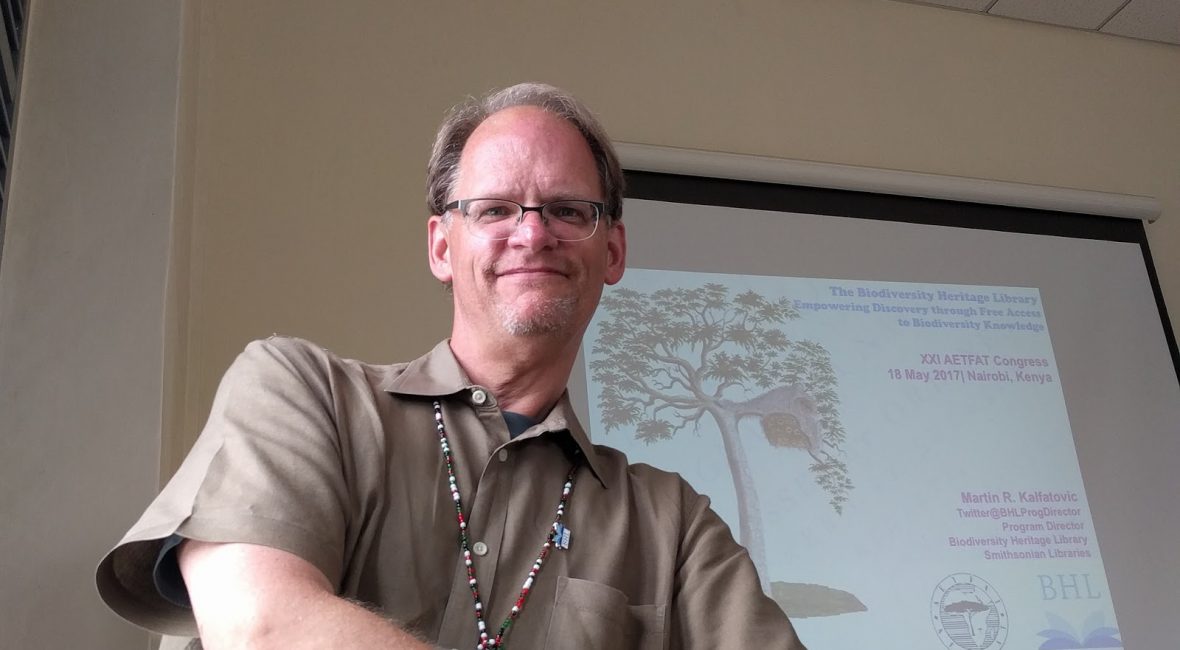
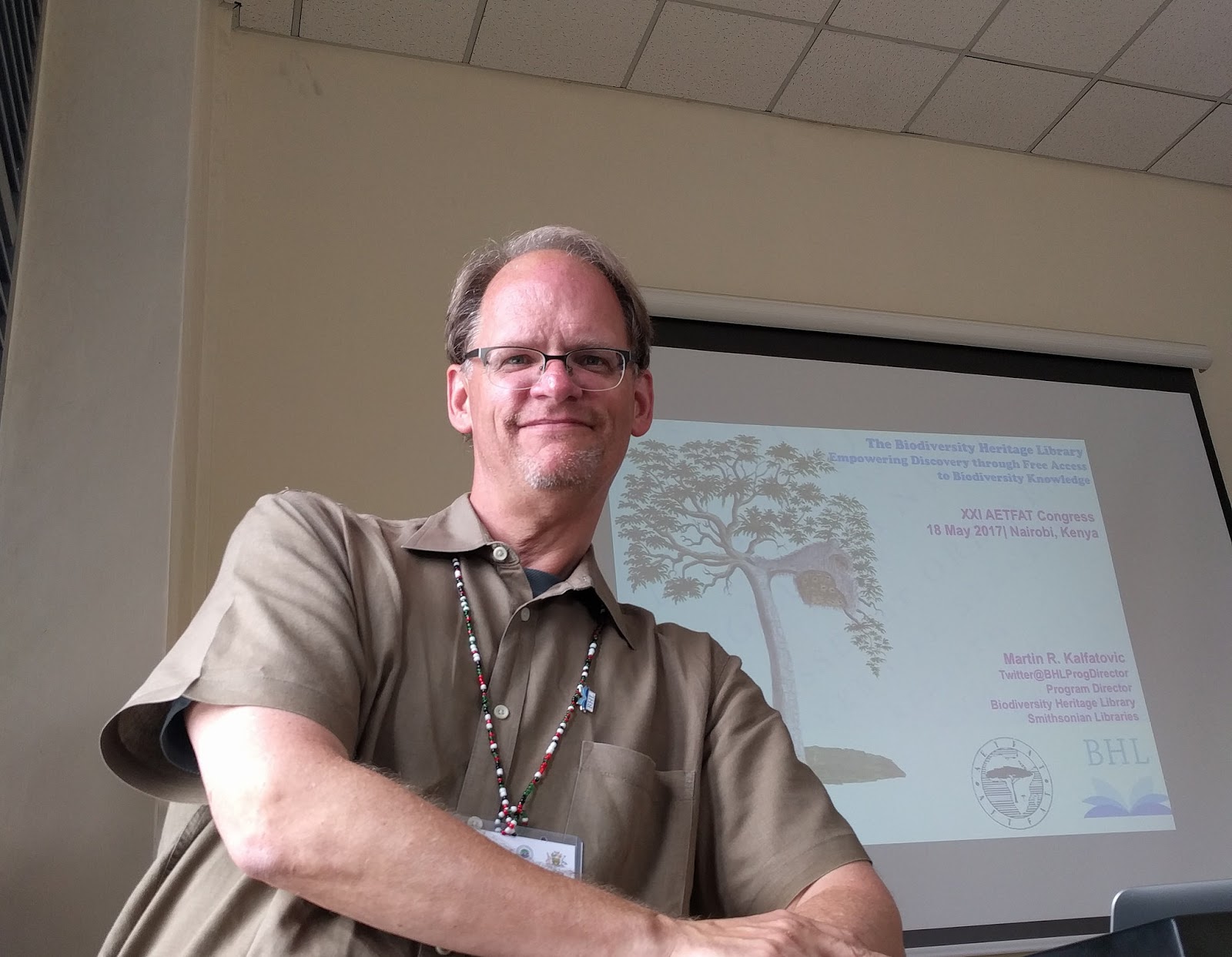
Martin R. Kalfatovic at the podium for the BHL symposium

 at XXI AETFAT 2017

The symposium was led by BHL Program Director, Martin R. Kalfatovic and also included presentations from BHL Program Manager, Carolyn Sheffield and Director of JSTOR Primary Sources, Deirdre Ryan. 

Kalfatovic opened the session with an introduction to BHL, entitled Biodiversity Heritage Library: Empowering Discovery Through Free Access to Biodiversity Knowledge. Kalfatovic also delivered a presentation on behalf of Grace Costantino entitled The Story of Engagement: Outreach Strategies at the Biodiversity Heritage Library.  
In Building the Biodiversity Heritage Library Through Standards and Content, Sheffield reported on strategies and results from BHL Workshops, highlighting involvement and new contributions from BHL Africa partners.  

Ryan delivered an overview of JSTOR entitled “Journals, AETFAT, African Plants, and more…,” covering the scope and breadth of JSTOR collections, including 2,600 journal titles which are made freely available to all non-profit and educational institutions in Africa through the African Access Initiative.  Additionally, she highlighted results of the African Plants Initiative that grew into the Global Plants Initiative and has brought digitized herbarium sheets into the JSTOR collection, many of which link to BHL!  She also identified the AETFAT Congress as a historically significant event for JSTOR, where some of the founding ideas first germinated.  Kalfatovic then concluded the session and opened it up for questions.  

View Full Size Image
Carolyn Sheffield and Ben Nakitare at the NMK booth

      at the XXI AETFAT 2017 exhibits

Approximately 20 people were in attendance at the session and discussions were fruitful, focusing on both BHL work to date and potential future opportunities. 

In addition to the symposium, the conference provided several other opportunities for productive discussions with both BHL users and also with several BHL Africa partners.  It was especially lovely to catch up with some of our colleagues from National Museums of Kenya who hosted and participated in the BHL Africa Workshop in 2015, including Dr. Geoffrey Mwachala, Dr. Asha Owano, Lawrence Monda, and Ben Nakitare. We are thrilled with their ongoing commitment to participate in BHL, and we look forward to continued collaborations with our partners at National Museums of Kenya and all of our BHL Africa partner institutions!  

June 5, 2017by sayeedmd
Page 2 of 3«123»

Help Support BHL

BHL's existence depends on the financial support of its patrons. Help us keep this free resource alive!

search

About BHL

The Biodiversity Heritage Library (BHL) is the world’s largest open access digital library for biodiversity literature and archives. BHL operates as a worldwide consortium of natural history, botanical, research, and national libraries working together to digitize the natural history literature held in their collections and make it freely available for open access as part of a global “biodiversity community.”

Join Our Mailing List

Sign up to receive the latest news, content highlights, and promotions.

Subscribe Now

Subscribe to Blog via Email

Enter your email address to subscribe to this blog and receive notifications of new posts by email.

Join 319 other subscribers

Subscribe to Blog Via RSS

Subscribe to the blog RSS feed to stay up-to-date on all the latest BHL posts.

Access RSS Feed


64+ Million Pages of
Biodiversity Literature Online.

EXPLORE

Tools and Services
to Transform Research.

EXPLORE

300,000+
Illustrations on Flickr.

EXPLORE

ABOUT | HARMFUL CONTENT | PRIVACY | SITE MAP | TERMS OF USE