Biodiversity Heritage Library - Program news and collection highlights from BHL
  • Home
  • News
  • Featured Books
    • All Featured Books
    • Book of the Month Series
    • BHL at 20
  • User Stories
  • Campaigns
    • Fossil Stories
    • Garden Stories
    • Monsters Are Real
    • Page Frights
    • Her Natural History
    • Earth Optimism 2020
  • Tech Blog
  • Visit BHL
Home
News
Featured Books
    All Featured Books
    Book of the Month Series
    BHL at 20
User Stories
Campaigns
    Fossil Stories
    Garden Stories
    Monsters Are Real
    Page Frights
    Her Natural History
    Earth Optimism 2020
Tech Blog
Visit BHL
  • Home
  • News
  • Featured Books
    • All Featured Books
    • Book of the Month Series
    • BHL at 20
  • User Stories
  • Campaigns
    • Fossil Stories
    • Garden Stories
    • Monsters Are Real
    • Page Frights
    • Her Natural History
    • Earth Optimism 2020
  • Tech Blog
  • Visit BHL
Biodiversity Heritage Library - Program news and collection highlights from BHL
Blog Reel, Campaigns, Her Natural History

Marjorie Eileen Doris Courtenay-Latimer: Beyond the Coelacanth

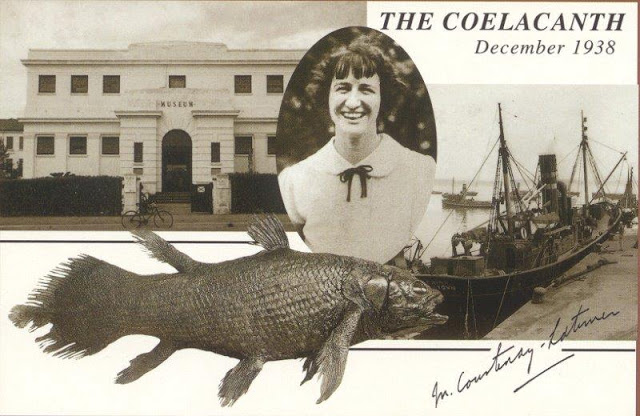
Commemorative postcard

A version of this post was originally published on the blog of the Margaret Smith Library, SAIAB. It is reproduced with permission from the author, Sally Schramm.

Willie and I look forward to our first born towards the end of April/beginning of May and we both pray it will be a lover of all that is beautiful in nature. Willie wants it to be a botanist — I want it to be a lover of birds and animals.
Eric Latimer’s diary, 25th November 1906

Marjorie Eileen Doris Courtenay-Latimer (1907-2004) is ubiquitously remembered and celebrated for her part in recognising that the large fish trawled by Capt. Hendrik Goosen and the crew of the Nerine in December 1938 was an astonishing find. This was to be identified as the first live coelacanth known to Western science. JLB Smith, the ichthyologist who first described it, named it Latimeria chalumnae after Marjorie, and the Eastern Cape river mouth near which it was found.

Commemorative postcard

Commemorative postcard on the “re-discovery” of the coelacanth.

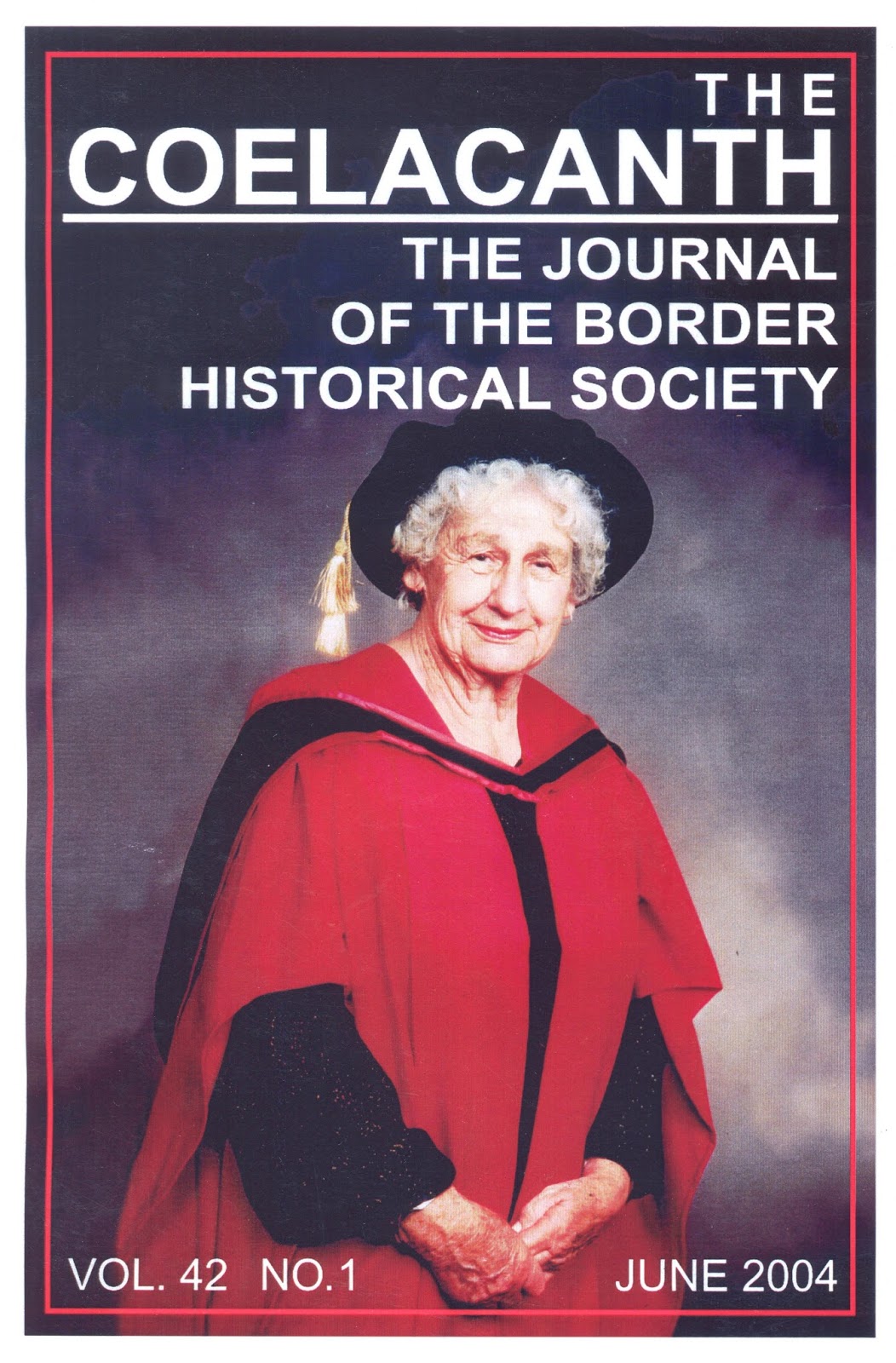
Reading the Border Historical Society’s The Coelacanth journal Commemorative edition in honour of Dr Marjorie Courtenay-Latimer (2004) we find a life dedicated to a great deal more than that single event. Her contributions to the Eastern Cape town of East London, and to the Museum in particular, were immense.

Born two months prematurely, surviving practically every childhood disease known — and the Flu Pandemic (1918-1920) — the apparently frail Marjorie’s interest in “all that is beautiful in nature” intensified as her family followed father Eric Latimer to his postings at a succession of often isolated railway stations in the Free State and Eastern Cape. The entire family walked and picnicked, collected, recorded and illustrated specimens, thoroughly appreciative of the wild areas around them.

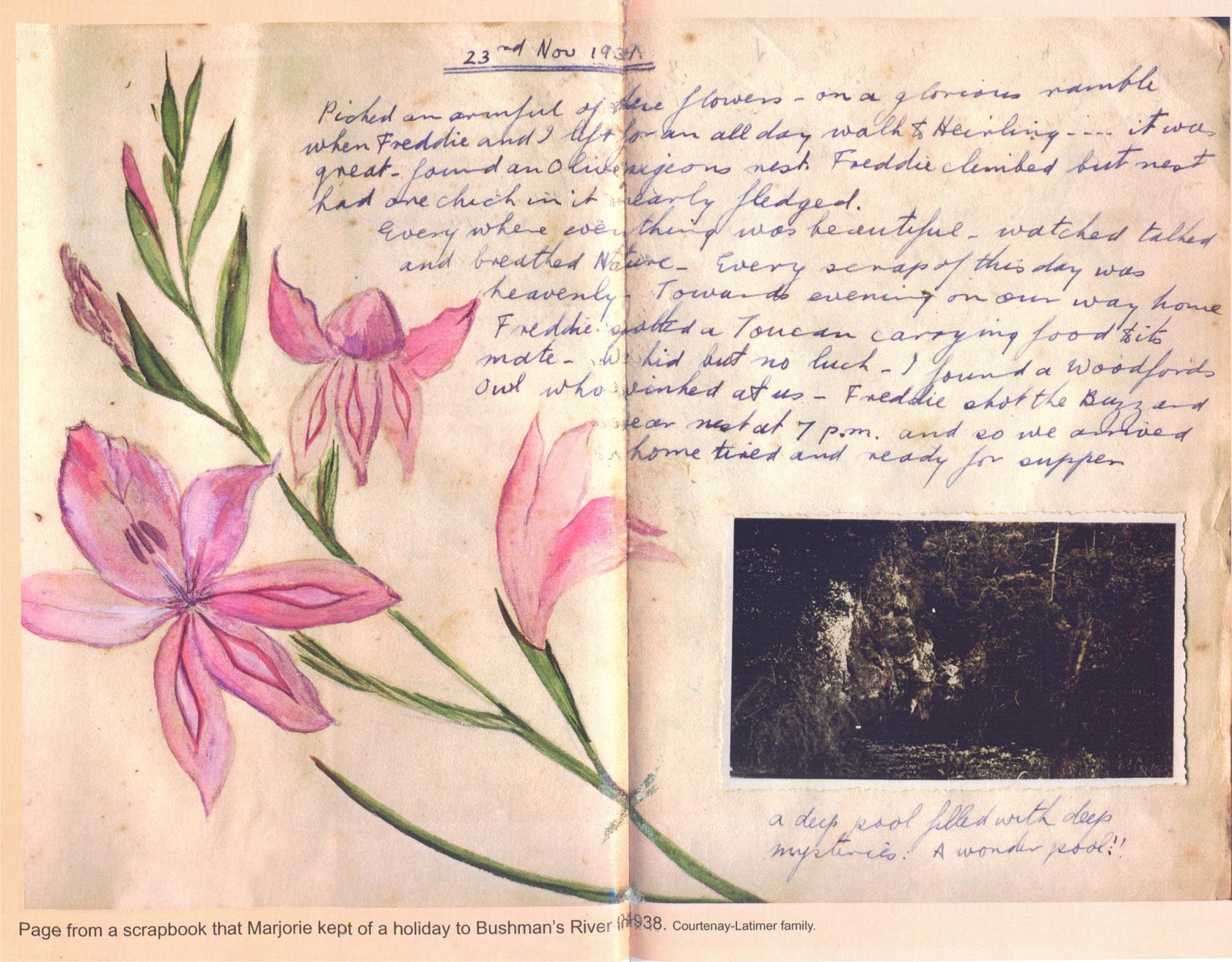
Keeping natural history journals and scrapbooks became a life-long habit for Marjorie. Here we read in 1938, “Every where everything was beautiful — watched, talked and breathed nature. Every scrap of this day was heavenly”.

The Coelacanth Vol. 42 (1) Centrepiece

The Coelacanth Vol. 42 (1) Centrepiece.

We also read of Marjorie, aged 24, as the first curator in 1931 (at £2 a month, with a petty cash allowance of 5/-) of the new and sparsely provisioned East London Museum, with its meagre collections; setting up displays (initially from her family’s own collections) and dioramas; her dedication in building collections both cultural and of natural history; her awareness of the museum’s value and interest to the public and especially to children; and of the planting of the indigenous museum garden. All this was accomplished in the early years with very little help; we read only of one named assistant Enoch [Enoch Elias], who helped Marjorie lug the coelacanth back to the Museum in 1938.

Other contributions tell of her stint on Bird Island in Algoa Bay for six weeks in 1936, with her parents as chaperones (mother enthused, father dreadfully bored); of her botanical and fossil-collecting field trips, often with close friends, specifically of the excavation and mounting of the almost-complete dicnodoni skeleton Kannemeyeria simocephalus.

Marjorie recounts many of these events from her early life and career, and explains how they ultimately contributed to the coelacanth “discovery”, in a 1979 paper published in the Occasional papers of the California Academy of Sciences. For example, it was because of her employment at the East London Museum that she met JLB Smith, with whom she developed a professional relationship that she called upon following her discovery in December 1938. And it was during her time on Bird Island that she met Capt. Hendrik Goosen, who became a regular source of specimens for her collecting activities for the Museum — and ultimately the supplied the famed coelacanth specimen.

Marjorie summarizes her story and the events that culminated in her famed discovery as such:

“This story is one of the most astounding records of a woman’s intuition, for:

had I never gone to Bird Island;
had I never met Dr. JLB Smith who, of all the scientists I met as a young girl struggling with meagre funds in a small Museum, always gave encouragement and never criticism;
and had I not gone to the wharf to wish the men a Happy Christmas,

there never would have been a coelacanth discovery in South Africa, on 22 December 1938.”

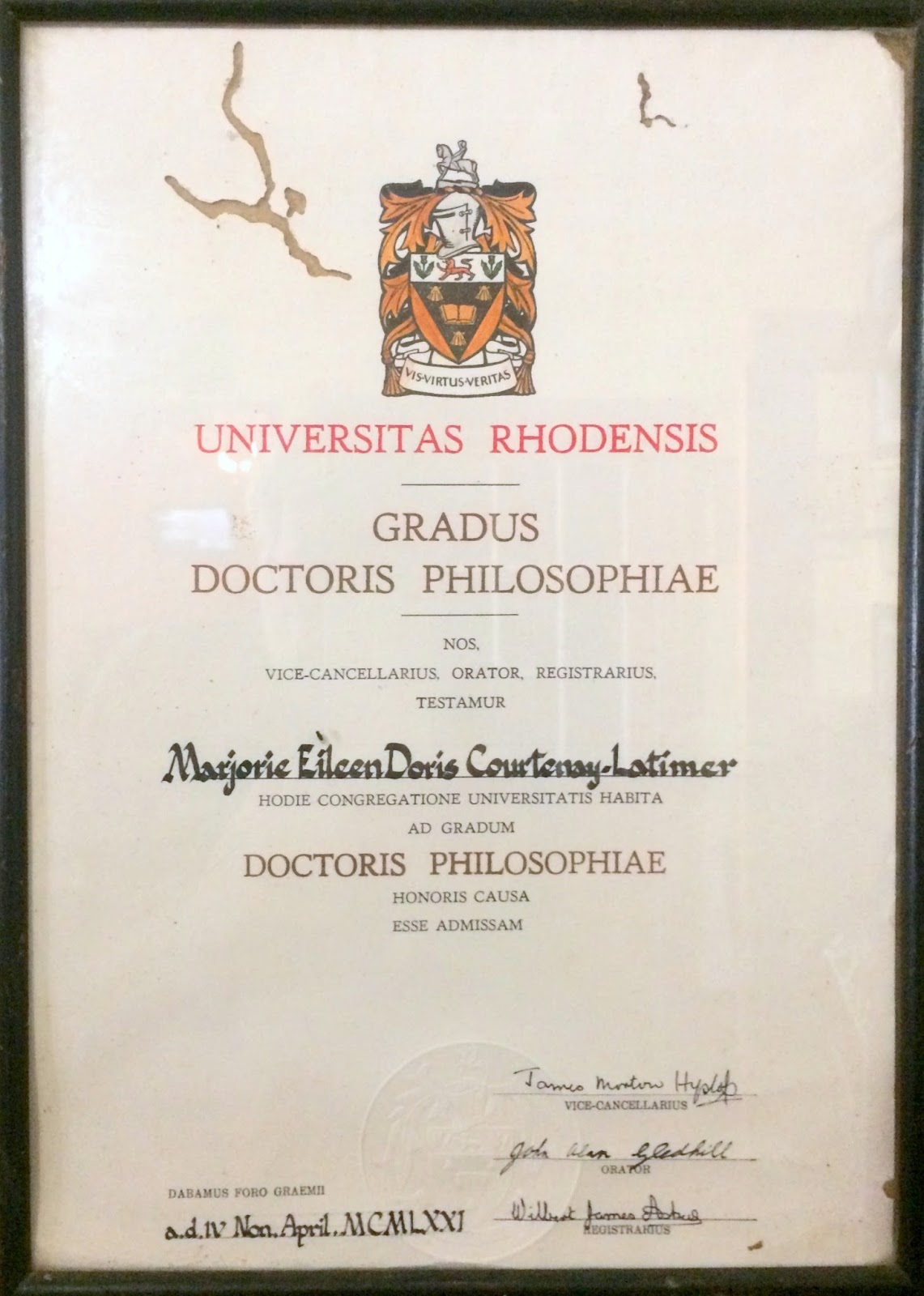
Marjorie was an author of scientific and popular literature on a wide variety of topics and was an active member of diverse museum, historical and natural history societies. She supported conservation and the establishment of nature reserves such as Potters Pass, East London, and Gonubie Nature Reserve. Finally, we read of her numerous civic awards, honorary fellowships, and her Honorary Doctorate from Rhodes University.

Dr Marjorie Courtenay-Latimer

Dr Marjorie Courtenay-Latimer PhD (Honoris Causa) 1971.

Marjorie Courtenay-Latimer Collection Thomas River Historical Village (Pic: Mike Schramm)

Marjorie Courtenay-Latimer Collection. Thomas River Historical Village. (Pic: Mike Schramm)

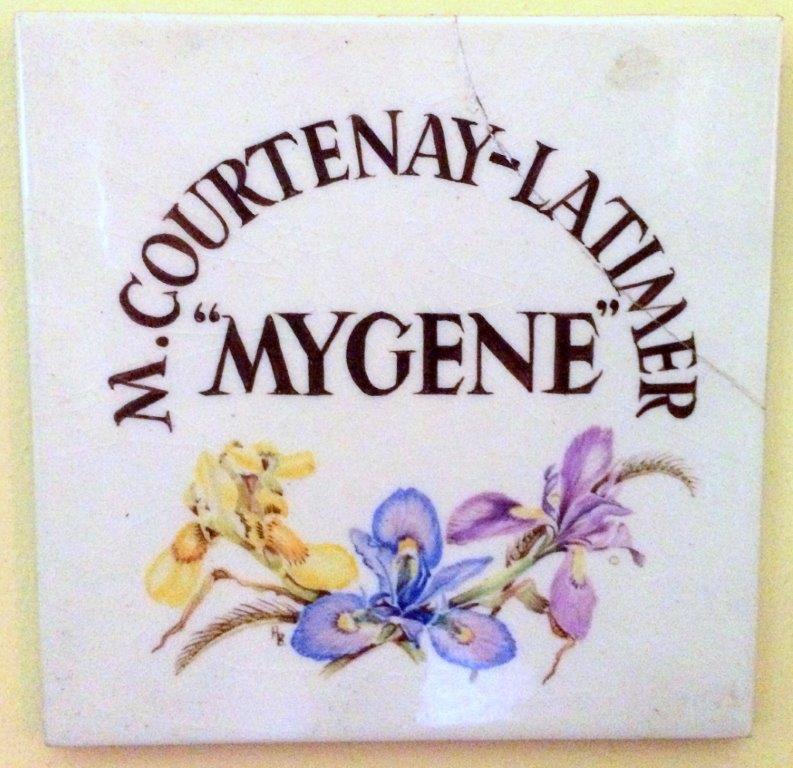
On her retirement as Director from the East London Museum in 1973, Marjorie moved to Witselbos in the Tsitsikamma area. Her house Mygene was named for her childhood nickname “Genie”, from the popular song “Jeanie with the light brown hair”, “… I see her tripping where the bright streams play, Happy as the daisies that dance on her way …”

Having done a brick-laying course at the East London Technical College, she tackled a kitchen extension with aplomb. She painted and sculpted in clay. She still kept in touch with friends and colleagues world-wide. Forays into nature continued as ever.

Marjorie Courtenay-Latimer Collection Thomas River Historical Village (Pic: Mike Schramm)

Marjorie Courtenay-Latimer Collection. Thomas River Historical Village. (Pic: Mike Schramm)

She returned to East London in the 1980s. On her moving to frail-care shortly before her death in 2004, a collection of Marjorie’s personal effects (including the certificate and house plaque above) were left behind in the house which she had recently occupied.

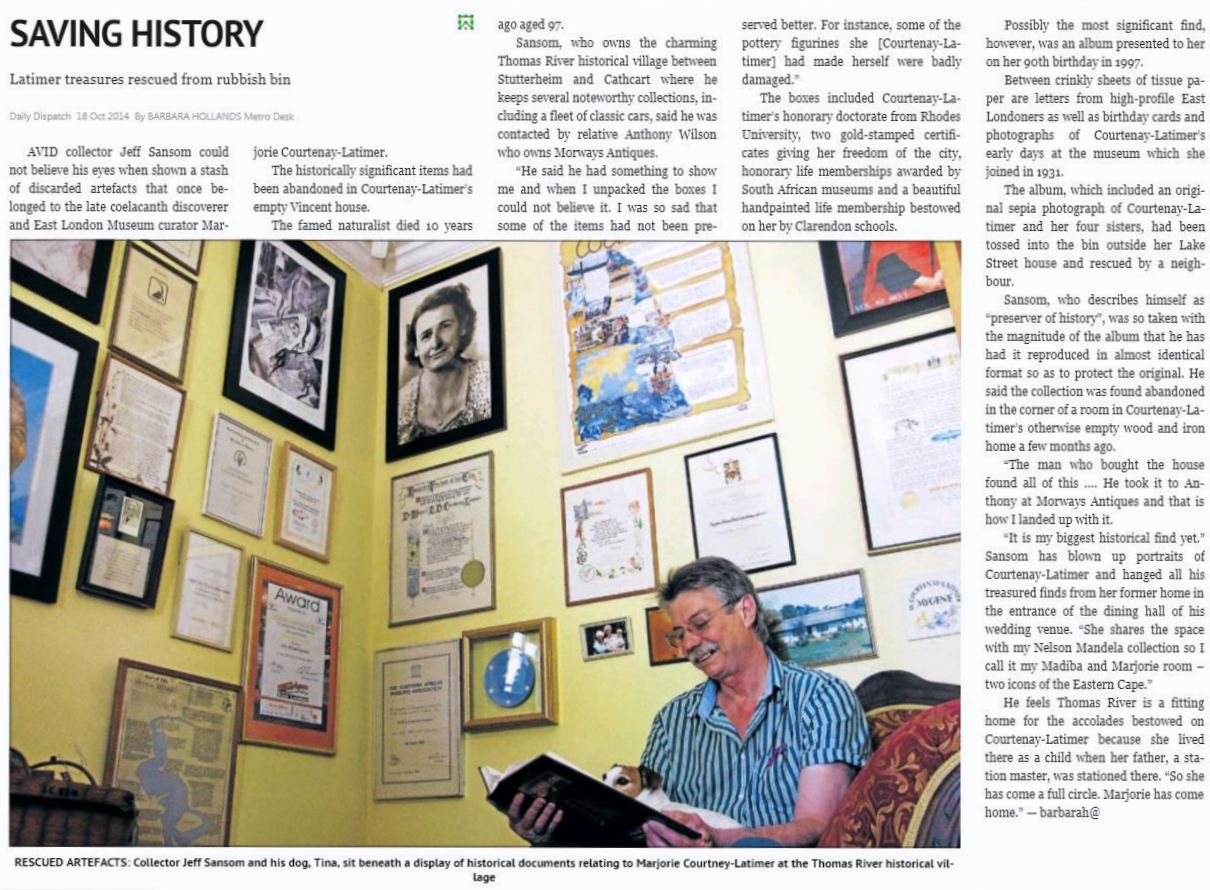
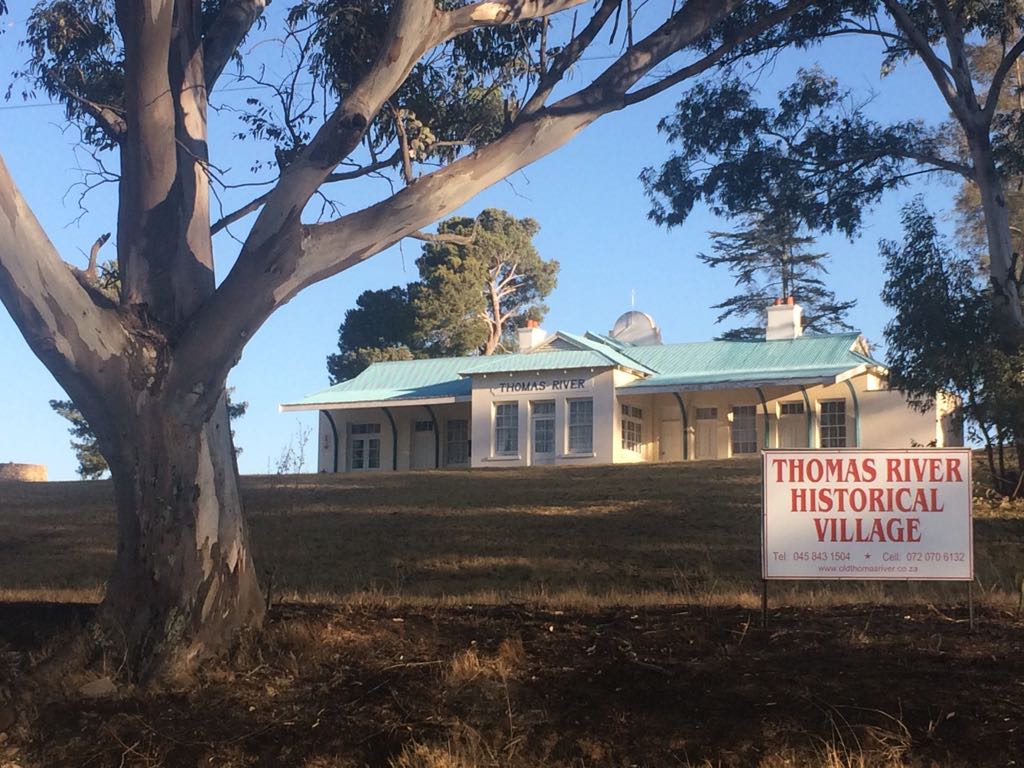
Fortuitously, these were subsequently recovered when the house was sold ten years later. A serendipitous chain of events led to the display of some items at Thomas River Historical Village near Cathcart, Eastern Cape. The Village is the site of the original Thomas River Station — where Eric Latimer and his family had lived in the late 1920s.

Saving History (Daily Dispatch 18th Oct 2014)

Saving History (Daily Dispatch 18th Oct 2014).

The original Thomas River Station, built in the late 1870s. (Pic: Mike Schramm)

The original Thomas River Station, built in the late 1870s. (Pic: Mike Schramm)

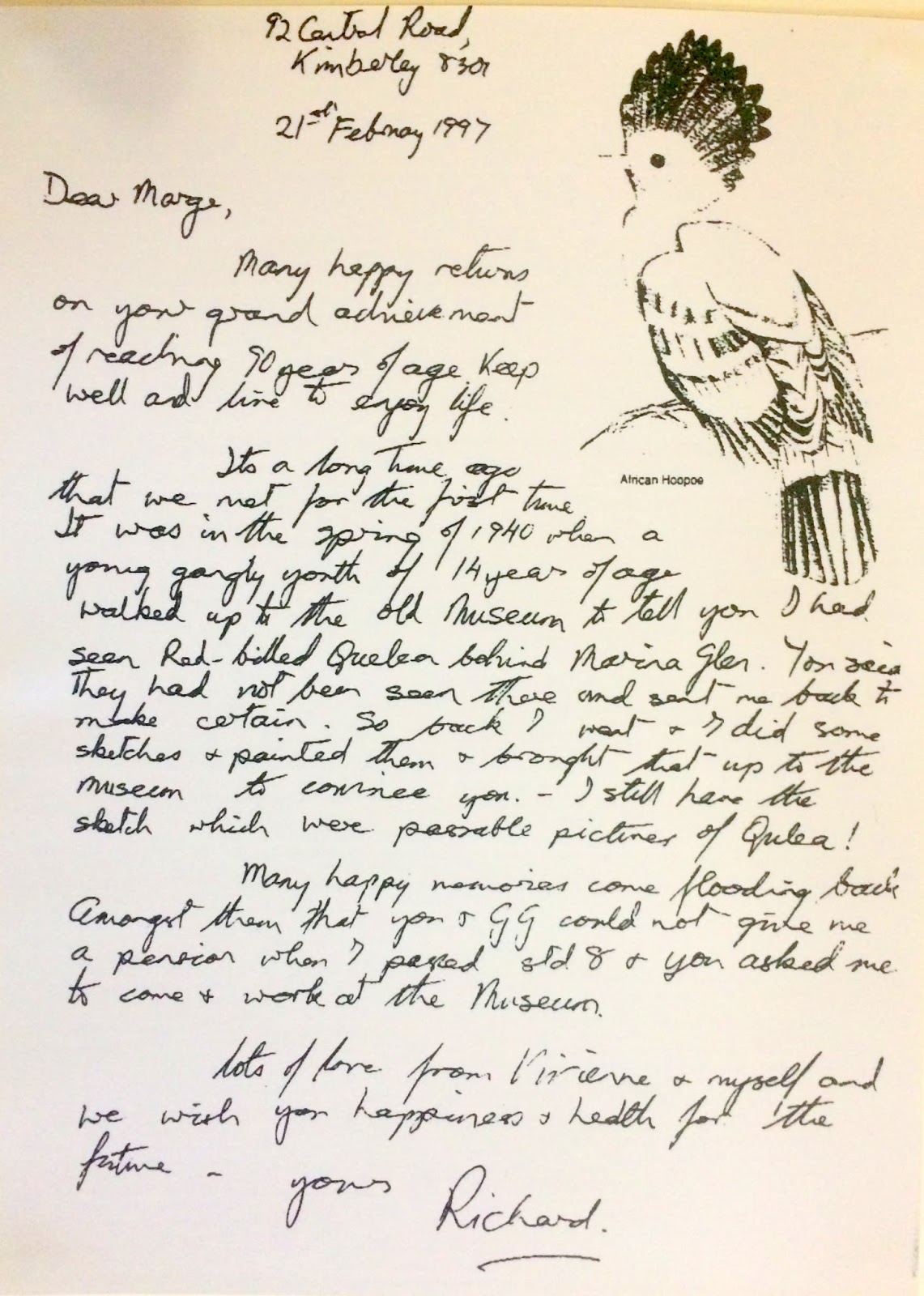
Among the treasures found was the album presented to Marjorie on her 90th birthday in 1997 “with appreciation and admiration” by the South African Museums Association. There is a facsimile copy at Thomas River Historical Village. Many of the contributors are a who’s who of prominent naturalists, authors and artists, all friends and colleagues.

Contribution by Richard Liversidge, ornithologist, previously Director, McGregor Museum, Kimberley Marjorie Courtenay-Latimer Collection,Thomas River Historical Village (Pic: Mike Schramm)

Contribution by Richard Liversidge, ornithologist, previously Director, McGregor Museum, Kimberley. Marjorie Courtenay-Latimer Collection,Thomas River Historical Village. (Pic: Mike Schramm)

The many happy memories recalled through the warm contributions would have delighted Willie and Eric Latimer. Their first child was a daughter who truly was a “lover of all that is beautiful in nature”.

Marjorie Courtney-Latimer — a life lived richly beyond the coelacanth!

March 23, 2019by michelle.underhill
Blog Reel, Campaigns, Her Natural History

A lifetime among Cacti: Helia Bravo-Hollis

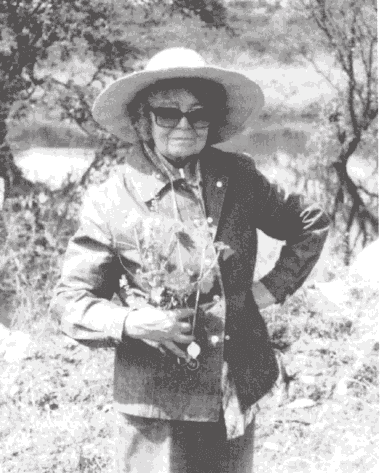
Four days before becoming a centenarian, Dr. Helia Bravo Hollis passed away, on September 26th, 2001. Her biography is the history of the inclusion of women in the scientific research community and the slow but productive development of academic calling.

Teacher Bravo, as she liked to be called, never bothered or worried about being a pioneer in a discipline at a complicated stage in Mexican history. Although she always had a genuine concern for social inequalities, she believed that only through education this could be changed. To do so, she was a very dedicated researcher and teacher.

Her work is defined by the word vocation, as she describes it in her own words, full of humility:

“I did my job with a sense of responsibility before the National Autonomous University of Mexico UNAM, with love, passion, and courage; It was enjoyable research rather than a job. In spite of everything, I think that my work is still far from being satisfactory because the knowledge of the cacti is not finished, it is always being done”.

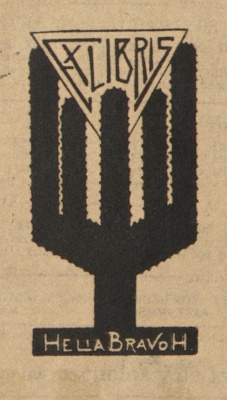
Dr. Bravo Hollis’ bookplate. Historic Archive of Biology Institute of UNAM.

Since her childhood, Dr. Bravo Hollis stood out for her hard work. When she was 10 years old, she received a diploma of achievement from President Porfirio Díaz. In high school, she shared the classroom with distinguished personalities such as Octavio Paz, Salvador Novo, Carlos Pellicer, and even Frida Kahlo, among many other brilliant personalities of Mexican culture. As a teenager, she presented her works in the Antonio de Alzate Society and published them in Revista Mexicana de Biología (Mexican Biology Journal). Those tasks motivated her first trip abroad: a summer course at Pomona College, California. All of this gives us an idea of her striving at academic matters.

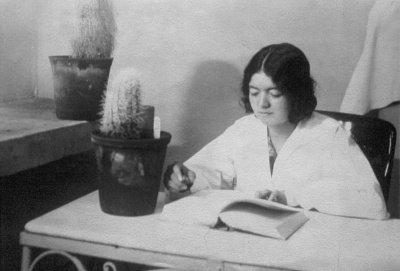
Helia during her studies with Dr. Ochoterena. Ca. 1930. Historic Archive of Biology Institute of UNAM.

The First Certified Biologist

Bravo Hollis was meant to study Medicine, however, she decided to study Biology against her family’s wishes. The career did not exist formally yet, and the studies were set in combination at the National School of Medicine and at the High Studies School, both part of UNAM.

In 1927, Bravo Hollis became the first certified biologist of Mexico and, in 1929 when the University reached its autonomy and her mentor Dr. Isaac Ochoterena was appointed in charge of the future Institute of Biology, she was chosen to create the Herbarium and was also commissioned with the study of the Cactaceae, one of the most identifiable, diverse plant families in Mexico: cactus, cholla, nopales, … and thus more than 700 species that, for the most part, do not exist anywhere else.

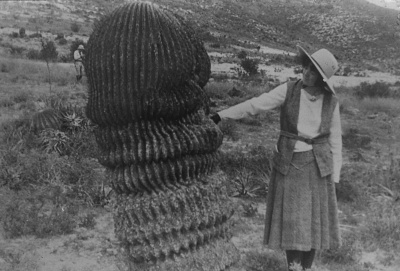
Therefore, Bravo Hollis began a stage in her career where she travelled around Mexico to collect information and samples and photograph different types of cacti. This culminated in 1931 when she graduated as a Master in Biological Sciences at the Faculty of Philosophy and Letters of UNAM, with the thesis entitled Contribuciones al conocimiento de las cacatáceas de Tehuacán (Contribution to knowledge of the Cacti of Tehuacán). This would set the beginning of her subject of study for the years to come.

Dr. Bravo Hollis in one of her many trips of specimen recollections. Ca. 1940. Historic Archive of Biology Institute of UNAM.

From this moment forward, her research career was unstoppable, focused on systematics of cacti in Mexico and part of North America. In 1937, she published her book Las cactáceas de México (Mexican Cacti), which placed her at the forefront of this field of research around the world. In the autumn of 1951, the Mexican Society of Cactology was founded with Dr. Bravo Hollis as president of Cactaceae and Suculentas Mexicanas, which published its first issue in June 1955. Its members carried out intense field work and with all the collected material contributed to the foundation of what became the Botanical Garden of UNAM. Throughout the 1960s, Dr. Bravo Hollis managed the gardens with passion and was highly respected, to the point that she even says she paid the workers out of her own pocket when a strike left them without a salary. Sorrowfully as she expressed:

“I am retired from working at the Biology Institute at 90 years old, handicapped by painful arthritis that prevents me from walking”.

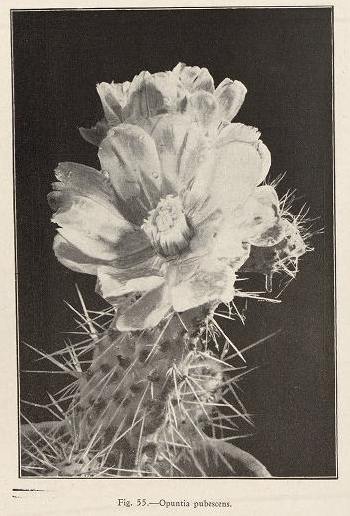
Bravo Hollis, Helia. Las Cactáceas de México. 1937. Contributed in BHL by Instituto de Biología UNAM as part of BHL México. CC-BY-NC-SA.

In total, Bravo Hollis published almost 170 articles and three books, described 60 scientific classifications and made 59 nomenclature reviews. She received numerous awards and recognitions, including the Cactus d’Or from the International Organization of Succulents, an honorary doctorate and an Emeritus Research Prize at UNAM. Her works received worldwide acclaim from fellow biologists and botanists, and today six species and one subspecies of cacti are named after her. Additionally, the Botanical Garden in Tehuacán pays tribute to her through its name: the Helia Bravo Hollis Botanical Garden.

Dr. Bravo Hollis on fieldwork. Ca. 1980. Historic Archive of Biology Institute of UNAM.

References

Bravo-Hollis, Helia. (2004). Memorias de una vida y una profesión. México: Universidad Nacional Autónoma de México, Instituto de Biología, Dirección General de Divulgación de la Ciencia.

Granados Chapa, Miguel Ángel. (2001). La reina de las cactáceas. La Jornada. Recuperado de: https://www.proceso.com.mx/302201/la-reina-de-las-cactaceas

Salcedo Meza, Concepción. (2001). La pasión por la ciencia de una mujer centenaria. ¿Cómo ves? (34). pp. 29-30. Recuperado de: http://www.comoves.unam.mx/assets/revista/34/quienes_34.pdf

Photographs: Historic Archive of Biology Institute of Universidad Nacional Autónoma de México, UNAM.

March 22, 2019by Joel Richard
Blog Reel, Campaigns, Her Natural History, User Stories

The Legacy of late-19th-Century Emma Jane Cole and her Grand Rapids Flora Lives on in the 21st Century

This post is the second in a two-part series about the life and legacy of botanist Emma Jane Cole. View the first part by Julie Christianson Stivers.

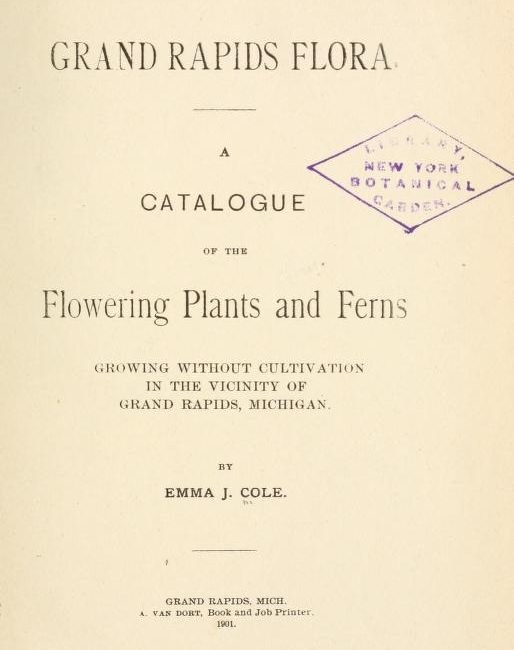
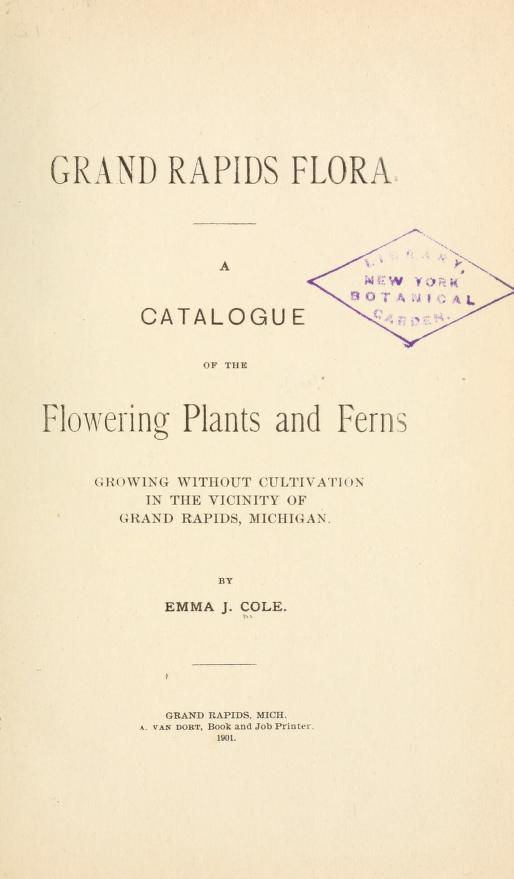
Cover: Cole, Emma. Grand Rapids Flora: A Catalogue of the Flowering Plants and Ferns Growing Without Cultivation in the Vicinity of Grand Rapids, Michigan. 1901. Contributed in BHL by the LuEsther T. Mertz Library of The New York Botanical Garden.

Nearly 120 years ago Emma Jane Cole (1901) published Grand Rapids Flora: A Catalogue of the Flowering Plants and Ferns Growing Without Cultivation in the Vicinity of Grand Rapids, Michigan.

Surprisingly, this botanical account published in 1901 for the Grand Rapids area remains the most recent comprehensive treatment of the plants specific to our region. And we still use it!

Today’s students tend to think that anything published in the scientific literature before they were born must certainly be old and obsolete. However, we have had the opportunity to impress upon students that Emma Cole’s Flora is a “gold mine,” informing us of the landscape of the late 1890s and the plants that occupied the Grand Rapids region at that time (covering 585 square miles). Enormous changes have taken place within and around Grand Rapids since the “horse and buggy” days of Emma Cole’s study. But how have they changed? And what can we learn by comparing Emma Cole’s Grand Rapids to what we see today?

Drs. David Warners, Professor, Calvin University, and perennial Visiting Scholar, Garrett Crow (Professor Emeritus, Univ. of New Hampshire) established a project through the Calvin Herbarium, A Field-based Retrospective Assessment of Emma Cole’s Grand Rapids Flora After 100+ Years of “Progress.” A key component of the study is to conduct field research for the purpose of identifying areas studied by Emma Cole that have persisted into the present time.

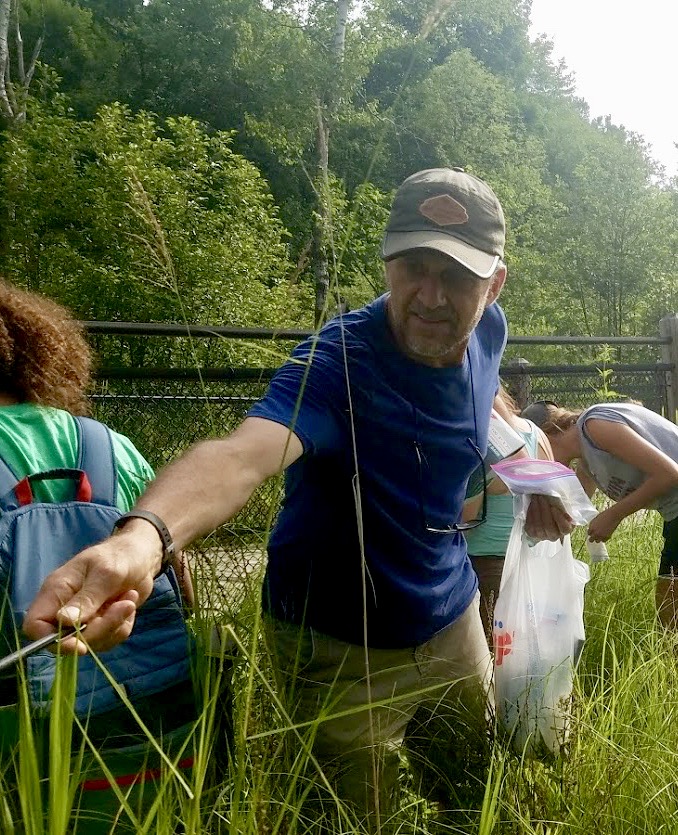
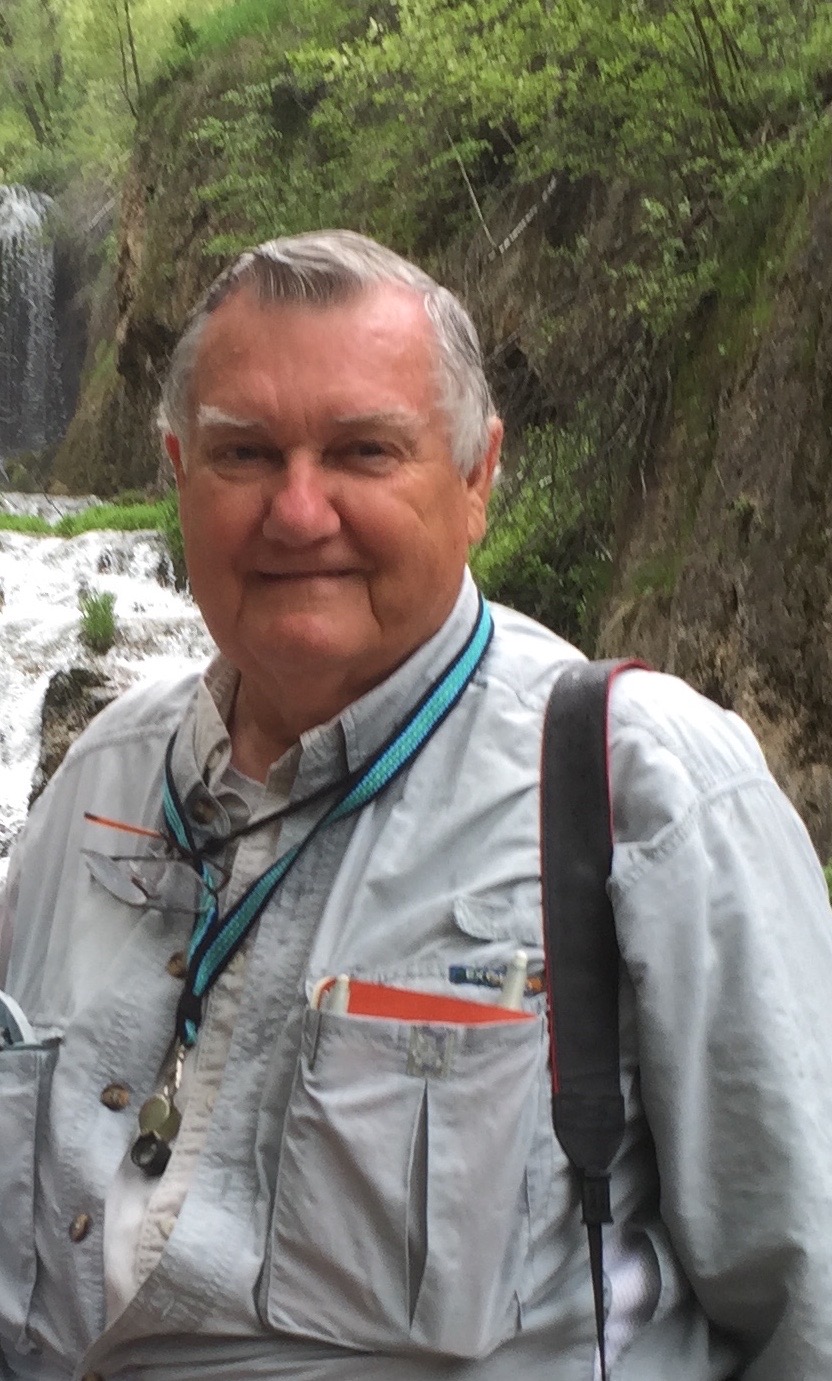
David Warners, Professor, Calvin College. Photo by Andrea Lubberts.

Garrett Crow, Visiting Scholar, Calvin College.

Two things were critical at the outset of the project. First, Cole’s Flora had to be brought in line with today’s botanical nomenclature as well as taxonomic changes that have resulted from more than 100 years of botanical investigation. “Emma Cole’s 1901 Grand Rapids Flora: Nomenclaturally updated and revised” (Crow 2017) accomplished that task. Second, we needed to scour Cole’s Flora and identify specific localities that she frequented and determine which of these sites might still retain natural vegetation that we could “field check” as potential study sites. For this, we engaged students. Each summer a research team of 2 students worked with us, focused on areas botanized by Cole, as well as other remnant natural areas our research discovered, that appear to be of potentially high botanical diversity and have unusual features for the Grand Rapids area (e.g. plants considered rare for the State, and/or habitats of special interest).

Over the past 4 years we have been able to study 24 locations in detail, producing a Floristic Quality Assessment of each site as a way of quantifying the natural quality of these historical remnants. We used the online Floristic Quality Assessment (FQA) Calculator to evaluate both the historical species list (compiled from specimens collected by Emma Cole and her students) and recent inventories (done by us and our students) (https://universalfqa.org). This tool utilizes the Michigan FQA Plant Database (Reznicek et al. 2014), which rates each species on a scale of 0–10. Native species with high fidelity for pristine habitats have the highest value (called the coefficient of conservation), whereas the weedy generalists (like cattails) receive low values; non-native species receive a zero. Hence, the FQA Calculator uses the list of species found at a site together with a relatively simple equation to derive a Floristic Quality Index (FQI) for that site. These FQI values, then, can be compared across sites and over time to quantitatively compare the relative natural quality of various parcels of land.

One of the enormously valuable aspects of Cole’s work is that her Flora was extremely well-documented by herbarium specimens; approximately 97% of the plants in her Flora are represented by at least 1 specimen. Remarkably, more than 5,000 specimens collected by Emma Cole, her students, and her colleagues are extant, with most specimens belonging to the Kent Scientific Institution’s herbarium (now Grand Rapids Public Museum, on permanent loan at the University of Michigan Herbarium), but many additional specimens reside in the Michigan State University Herbarium.

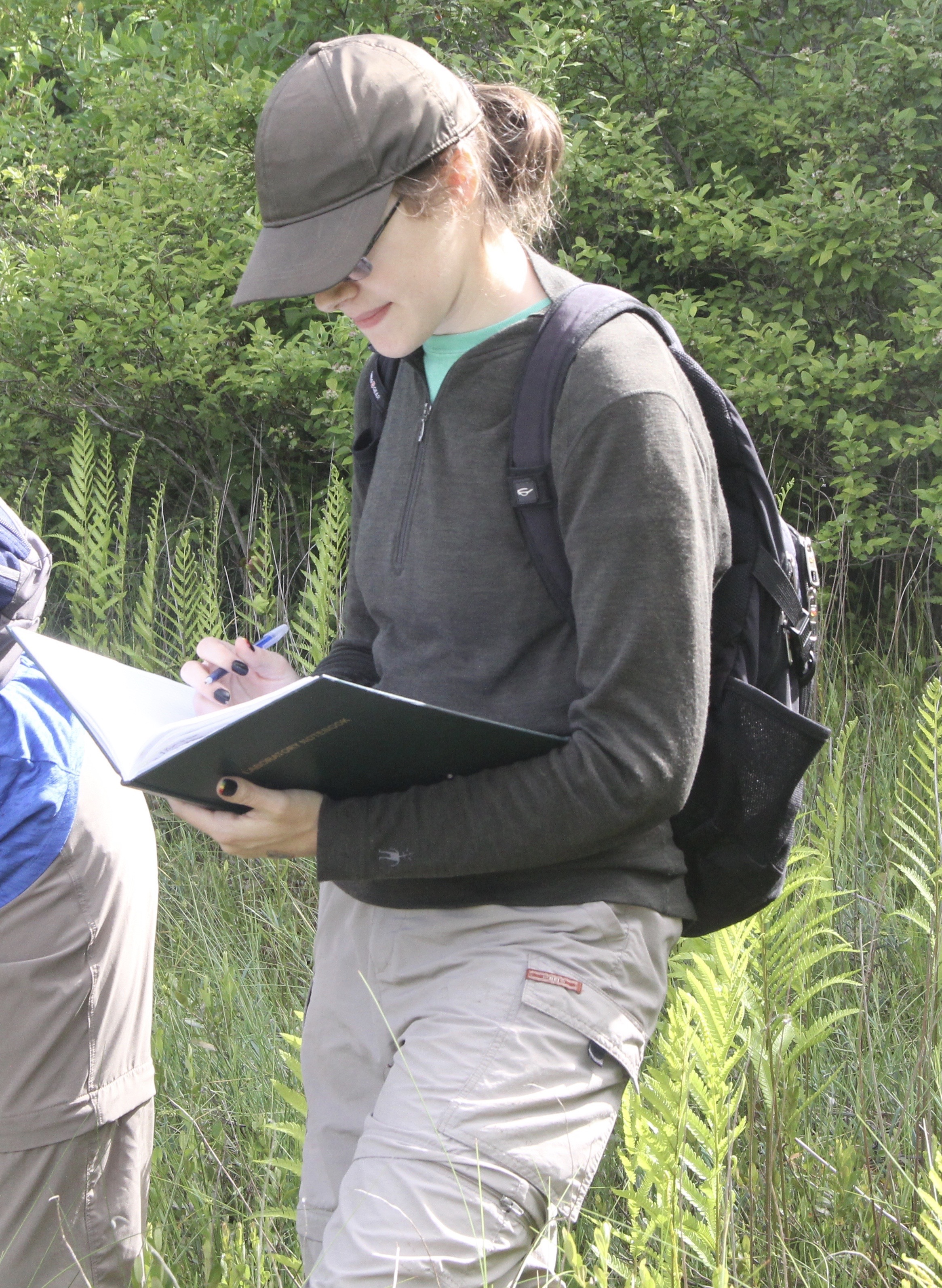
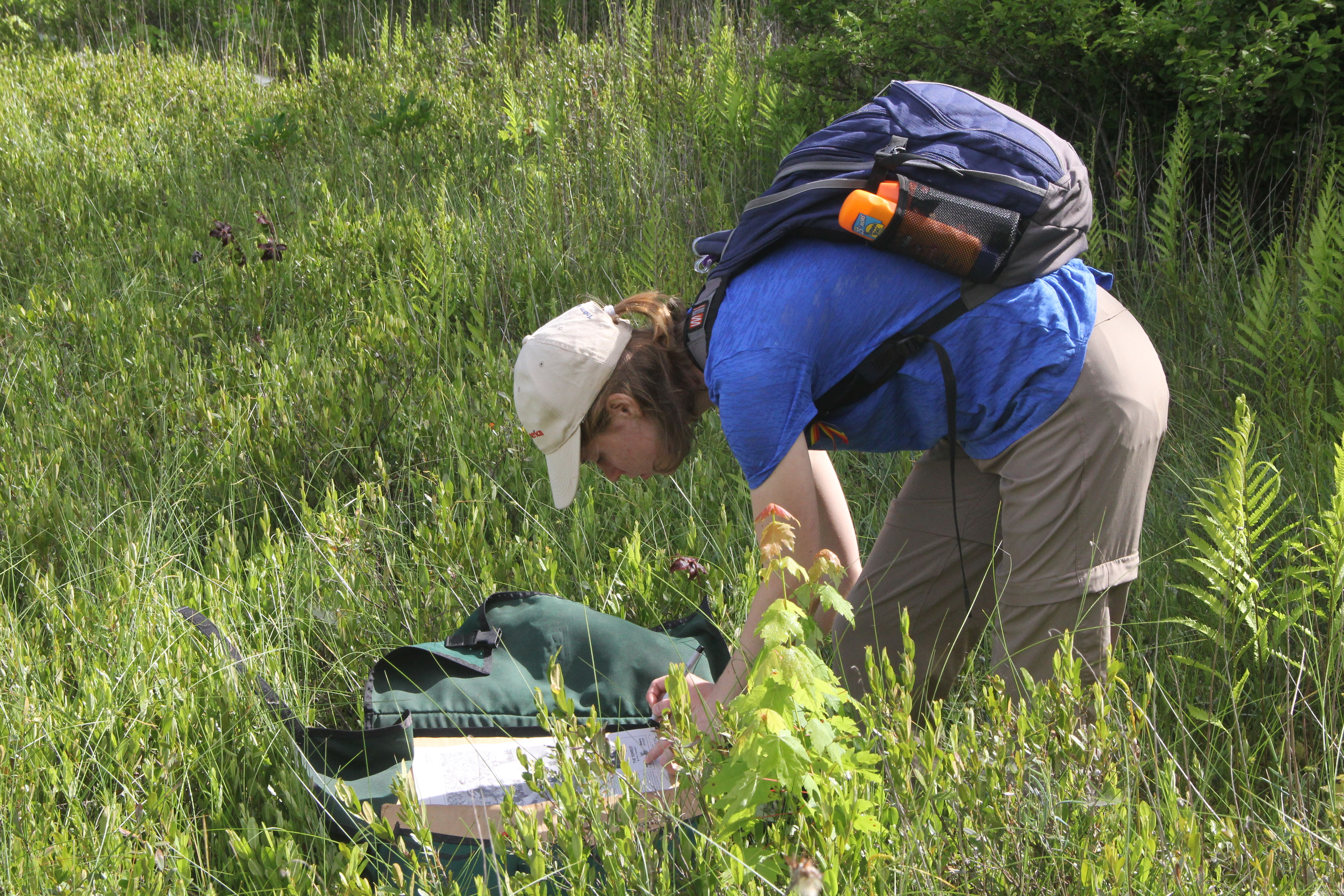
DeAnna Clum, Calvin College student, recording field data in a bog. Photo by Garrett E. Crow.

The existence of these specimens has allowed us to make direct comparisons, utilizing Floristic Quality Assessments of specific sites in which Emma or her students collected, with the plants growing in these same sites today. For instance, the woods at the present-day Grand Rapids Home for Veterans seemed to be a favorite place for her to botanize. We were able to generate a list of 62 species based on the 1890s herbarium specimens. Comparatively, our inventory of 2015-16 yielded over twice as many species (139 total) but remarkably, the historic FQI for the 1890s was 41.7, a bit higher than our 38.9 modern FQI. A conclusion from this work is that this site has remained a high-quality landscape over time, as any site with a FQI of 35–50 is regarded as fairly high quality from the perspective of the State.

Another site described in Cole’s Flora was a wooded area along Mill Creek studied by two of her high school students, Homer Skeels and Jennie Shaddick. Based on specimens of the 51 species they collected, the 1890s Mill Creek Woods had an FQI of 40.0, whereas today’s woods has a somewhat higher FQI of 47.6 (Stockdale et al. submitted manuscript). There being so many specimens collected by Homer and Jennie, we began to wonder. Further digging revealed that they married after Homer finished his BS at Michigan Agricultural College. Homer enjoyed a long career with the Plant Introduction Department, USDA, Washington DC (with a specialty of seed identifications). Mentorship by Emma Cole resulted in a number of her students following career paths as professional botanists and zoologists.

Carolyn Lindemulder, Calvin College student, pressing plants in the bog near Emma Cole’s family home. Photo by Garrett E. Crow.

Of the 8 students trained thus far in our project, 7 have been women. From our first year, the 2 women selected for our project began by searching for biographical information on Emma Cole, discovering Julie Stiver’s (2007) brief biosketch written to support the nomination of Emma Cole to Michigan Women’s Hall of Fame. This led to connecting and collaborating with Julie to further flesh out Emma Cole—the person and her work (Stivers and Crow 2018).

You can read more about Julie Stiver’s research and discoveries related to Emma Cole in this past blog post.

Here is what our students from summer 2018 had to say in their Researcher’s Report about their participation in the project.

The Emma Cole project has been both fascinating and fun research. During this project, we were able to appreciate natural areas of Grand Rapids that are rarely seen. We gained considerable skills in identifying plants, by both identifying distinctive flora in the field and becoming familiar with the guides used to identify collected specimens. Finally, we got to appreciate the historic work of a female scientist [Emma J. Cole]. As aspiring female scientists ourselves, it has been inspiring to continue the work of an accomplished female botanist who worked in a time when women in science were much less common and encouraged than they are now.  (DeAnna Clum, Carolyn Lindemulder).

So, even though it was published in 1901, the Grand Rapids Flora continues to be an important contribution to our understanding of the natural landscapes and the plants that grow in them. Furthermore, through this book and the extensive work she did, Emma Cole continues to inspire young scientists today. And it is always more meaningful when you feel like you have been able to get to know the author.

March 21, 2019by Joel Richard
Blog Reel, Campaigns, Her Natural History

Discovering Emma J. Cole (1845-1910), Author of the “Remarkably Fine” Grand Rapids Flora

This post is the first in a two-part series about the life and legacy of botanist Emma Jane Cole. View the second part by Drs. Garrett E. Crow and David P. Warners.

In the early years of the 21st century, I was delving into the archives of the Grand Rapids Public Museum researching a book to celebrate their 150th anniversary in 2004. Among the lists of men involved in the lyceums and institutes that shaped the beginnings of the western Michigan museum in the 1850s, there finally appears, at the very end of the 19th century, the name of Emma J. Cole, emerging like the first blossom of hepatica on a spring afternoon.

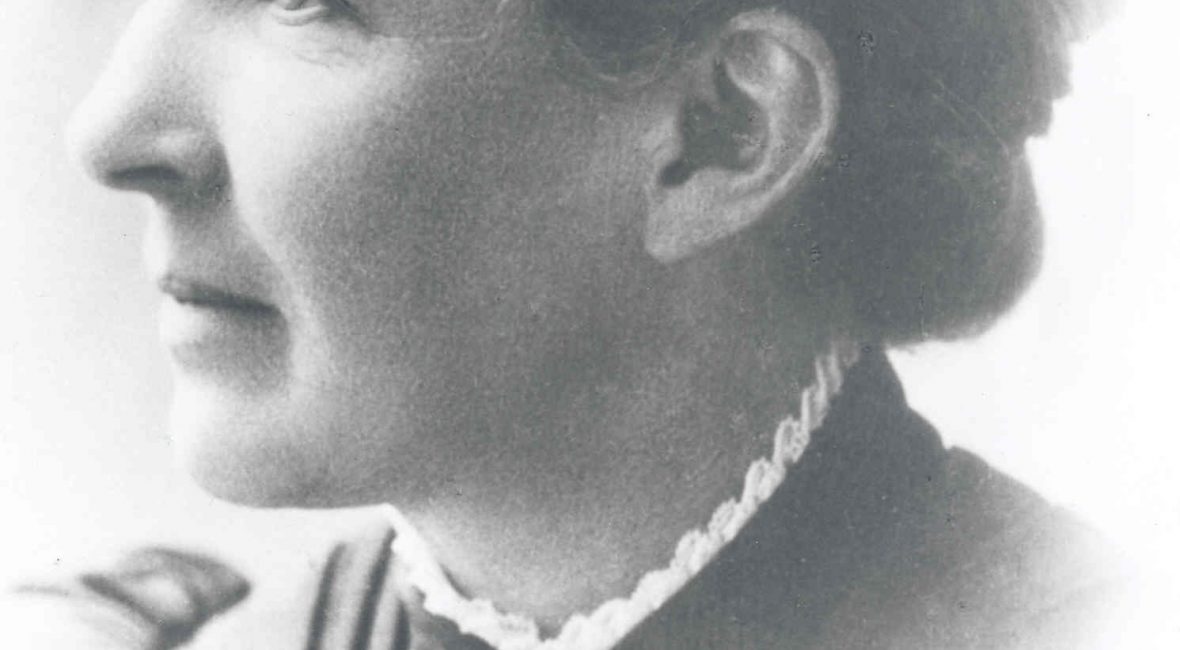
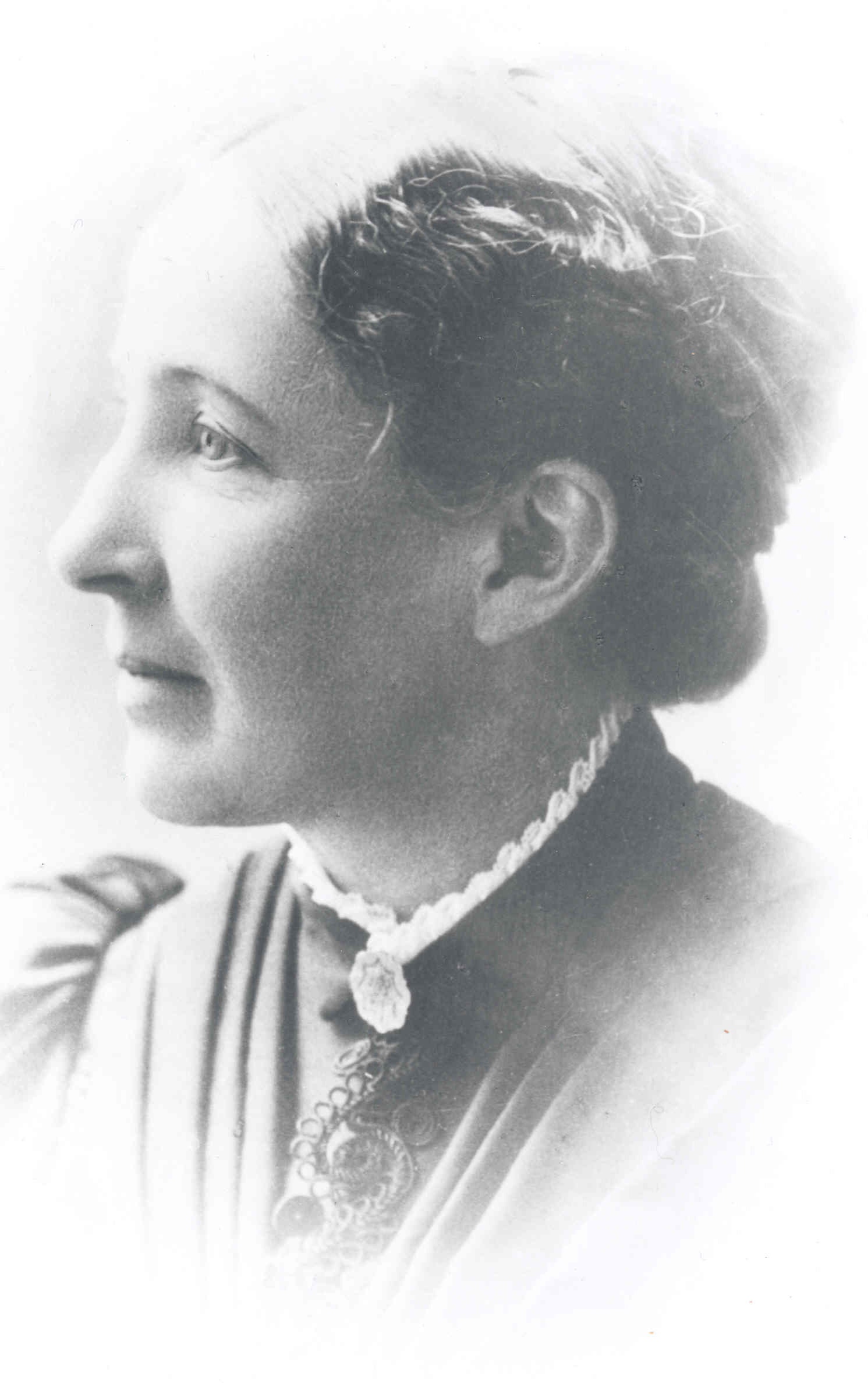
Emma J. Cole as she appeared in the 1895 Yearbook, Central High School, Grand Rapids, Michigan. Date of photo uncertain, as the same photo was used in all yearbooks from the beginning of her tenure, 1881. Photo courtesy Grand Rapids History & Special Collections, Grand Rapids Public Library.

Emma was elected a Vice President of the Kent Scientific Institute, precursor to the public museum, in 1900, but in 1891 the trustees had voted to pay her expenses while she collected plants to create an extensive herbarium for the institute (the completed sheets numbered nearly 4,000). As far as I have been able to glean, everyone involved with the KSI served without compensation for an organization whose annual budget seems to have been around $100. Emma’s reimbursements amounted to little more than $10 each summer, but as many women in science even today will attest, receiving 10% of an annual budget for a project is a significant vote of confidence at any institution.

Emma recruited students from the local high school, where she had been a teacher since 1881, to help in her field work, eventually resulting in the publication in 1901 of Grand Rapids Flora: A Catalogue of the Flowering Plants and Ferns Growing Without Cultivation in the Vicinity of Grand Rapids Michigan. It remains the only comprehensive survey of wildflowers in this area.

I was intrigued. Who was this woman and how did she undertake what seemed to me to be a truly ambitious project, on her own and in the face of a social structure less than amenable to professional work by women?

I had heard of Emma Cole before. For the past ten years I had been the editor of the Museum’s newsletter, and in 1994 the local Women’s History Council had commissioned a play about significant women in Grand Rapids history, including Emma. After a little scouring of abandoned file cabinets, I found a dusty file of research for the project containing census records about Emma’s early life, as well as copies of her Cornell University transcripts from 1876-79.

Cornell! How did this young woman from Lowell, a small town 15 miles east of Grand Rapids, leave her safe and secure family life to attend an elite eastern institution that had only begun to admit women six years earlier? I was hooked.

I started my search beyond the archives at the museum in the History and Special Collections division at the local library. I quickly stumbled onto the work of Dr. Edward Voss at the University of Michigan. What a treasure trove!

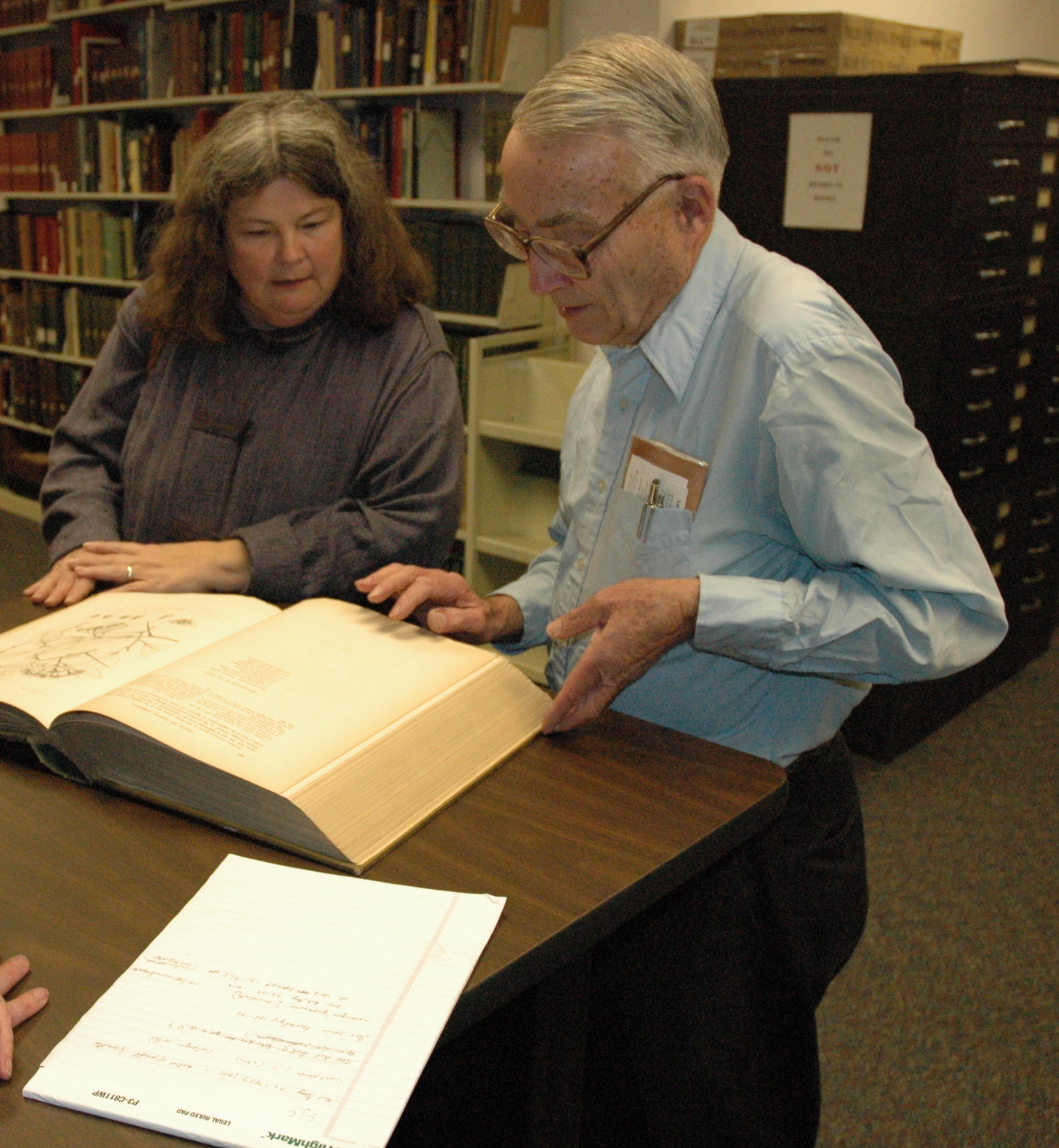
As I’m sure almost every reader of this blog will know, Dr. Voss was a professor of botany at the University of Michigan and curator of the herbarium there for decades, continuing as professor and curator emeritus until his death in 2012 at age 82. He was an internationally renowned expert on plant nomenclature, a fellow of the Linnean Society and author of the highly acclaimed three-volume Michigan Flora. He was the editor of The Michigan Botanist from 1962-1976. In the second issue he edited, September 1962, he published a 1907 manuscript by Emma Cole about her experiments with Green Dragon (Arisaema dracontium) that he found in some archives, and described her as “author of the remarkably fine Grand Rapids Flora.” He added, “She evidently influenced a large number of people in the study of botany, and she will surely be worthy of a biographical treatment one day in The Michigan Botanist.” I wish he had lived to see the July-December 2018 volume of that journal, now called The Great Lakes Botanist, in which Professor Garrett E. Crow and I published just that.

I began corresponding with Ed Voss in October of 2005, and he responded to my first e-mail with characteristic delight and enthusiasm: “I have hoped that someone with Grand Rapids connections would undertake a thorough treatment of Emma Cole!” It turned out that not only had he published her article, he included her in several surveys of historical Michigan botany and referenced her in his Flora.

Dr. Edward G. Voss and author Julie Stivers, at the University of Michigan Herbarium, 2005. Photo by John Stivers.

When Emma Cole died in 1910, she left a very substantial estate that included a bequest to the University of Michigan to establish a scholarship in botany. (I still have not determined how she was able to accumulate an estate that included many property holdings on the salary of a high school teacher.) In the 1953-54 academic year, Edward Voss was an Emma Cole Scholar, and he retained a lifelong interest in “Miss Cole,” as he persisted in addressing her. Not only did he provide me with a wealth of materials he had collected, he spent hours with me pulling Emma’s herbarium sheets from the University of Michigan collection so they could be photographed for various programs about her I was presenting, including tracing her botanical travels through Europe, Cuba, Mexico and all over the U.S. Her herbarium, after serving as the basis of the natural history exhibitions at the Kent Scientific Institute until the 1930s, was put on permanent loan at the University of Michigan in the 1970s. Dr. Voss also became my gentle coach in the labyrinths of botanical terminology, historical and contemporary.

Emma had substantial contact with renowned botanists during her lifetime. As I proceeded in my pursuit of information about her, the Internet became a much more significant source. In those early years, before resources such as the Biodiversity Heritage Library were readily available, most of the online listings were finding aids for archival holdings. I found an intriguing reference to “50 letters of E. Cole” in the archives of the Harvard University Herbarium, and mentions of Emma Cole in the correspondence record of Charles Sprague Sargent at the Arnold Arboretum.

Again, a treasure trove. In 2008 I traveled to Cambridge to read and copy those letter. During the time she was compiling her data for Grand Rapids Flora, Emma corresponded extensively with Dr. Benjamin Lincoln Robinson, Director of the Gray Herbarium at Harvard, and his young assistant, Merritt Lyndon Fernald (who were in the midst of writing the 7th edition of Gray’s Manual of Botany). The correspondence, which we have reproduced in the Great Lakes Botanist article, is one-sided, as only her letters survived. But from her repeated gratitude expressed for their assistance, it is clear that they provided interested and detailed advice on nomenclature and species identification.

The archive of correspondence with Charles Sprague Sargent, Director of the Arnold Arboretum at Harvard, was equally one-sided, consisting of copies only of his letters to her. She evidently had sent him numerous specimens from one of his many plant passions, the genus Crataegus (Rosaceae), and he made several visits to Grand Rapids to explore what she had found. He credited her help in describing twenty new species, and even named one Crataegus coleae, a recognition that has persisted despite the taxonomic debate surrounding this genus.

At this point in my research, after giving several public programs about Emma Cole and working with the Women’s History Council to nominate her to the Michigan Women’s Hall of Fame (she was inducted in 2007), I was at a loss as to what to do next. I had come to the opinion that the most useful next step would be to visit some of her collecting areas in the 585 square miles covered in Grand Rapids Flora, find out what might still be growing there, and publish some kind of guide that could be used by contemporary plant enthusiasts. I went as far as determining the most likely spots that would still be accessible, and found myself hopelessly in over my head with the botanical work. I stored my Emma Cole boxes away in our attic, and thought that someday I might pick up that idea again.

Eight years later — I had a call from the president of the Women’s History Council. Students from Calvin College in Grand Rapids had tracked down an article I had written about Emma for the Council’s newsletter. They were involved in a project to — revisit the collecting areas outlined in Grand Rapids Flora, assess what was growing there now and publish their results! In January of 2016 I met with Dr. Garrett Crow and Dr. David Warners, visiting scholar and professor of botany, respectively, who were directing the student project (Dr. Warners also had been an Emma Cole scholar at the University of Michigan). The three of us have given public programs about Emma and the project, and Garrett published an article updating Emma’s nomenclature in the July 2017 issue of The Great Lakes Botanist. Learn more about the student project in this post by Drs. Crow and Warners.

Me? Someday I’m going to work out how this remarkable woman left an estate totaling nearly a half-million dollars in today’s money, a curiosity sparked over two long afternoons in Kent County Probate Court records, poring over her 60-page will. Some day.

March 20, 2019by Joel Richard
BHL News, Blog Reel, Campaigns, Her Natural History

#HerNaturalHistory: Open Data, BHL, and Wiki Projects

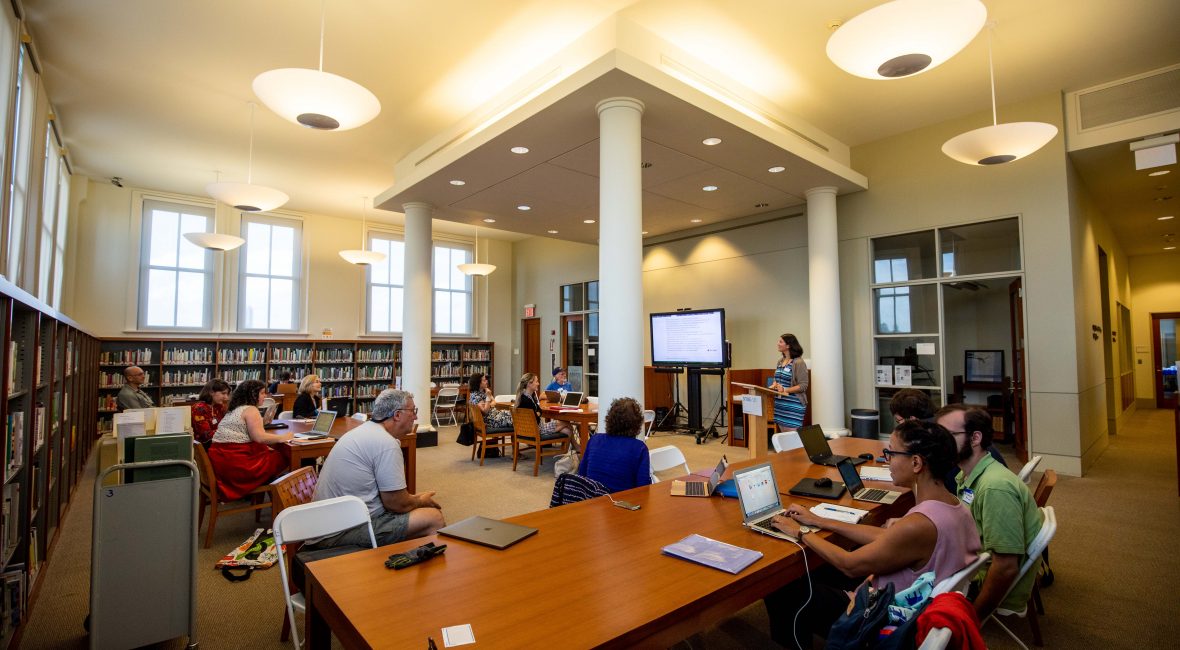
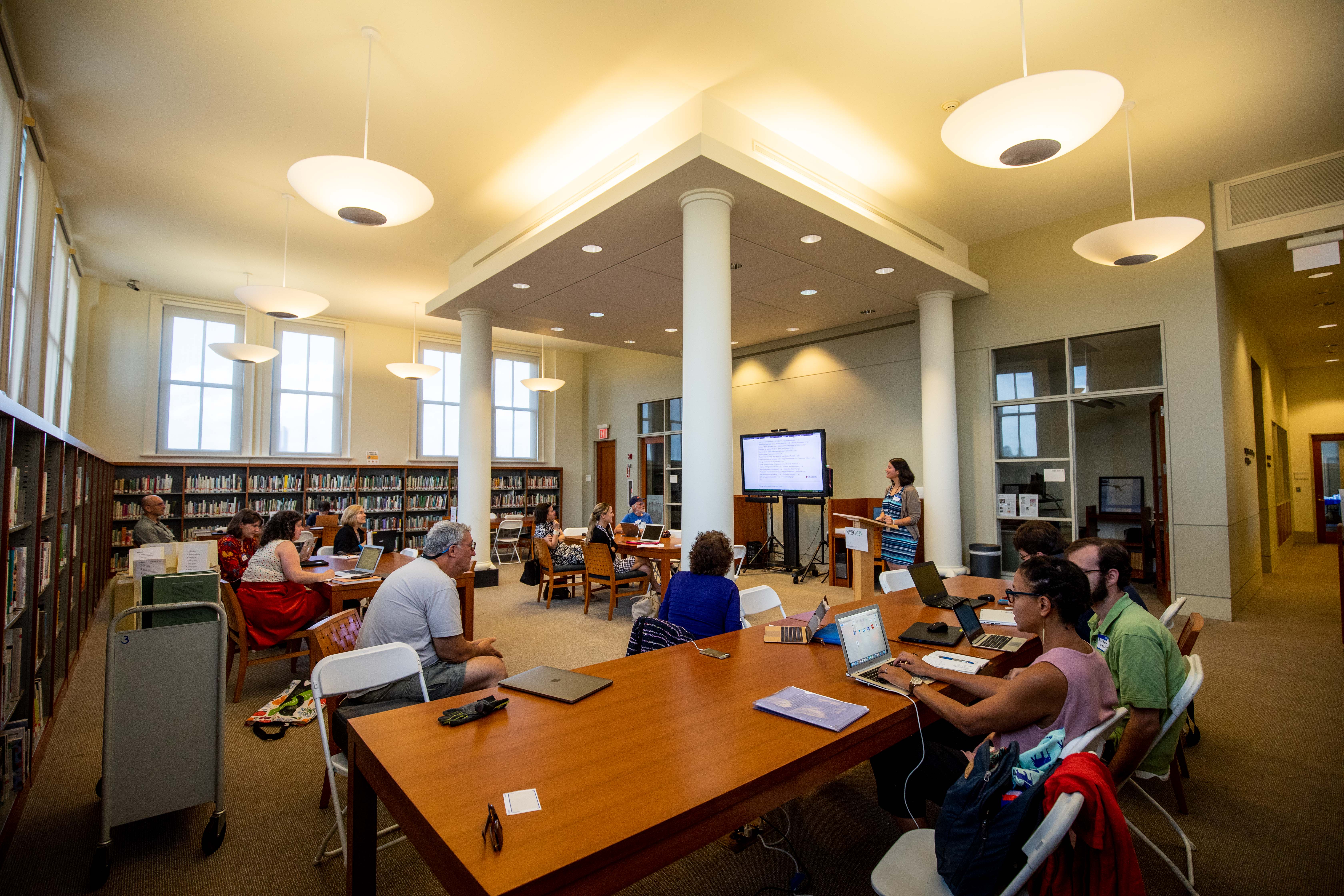
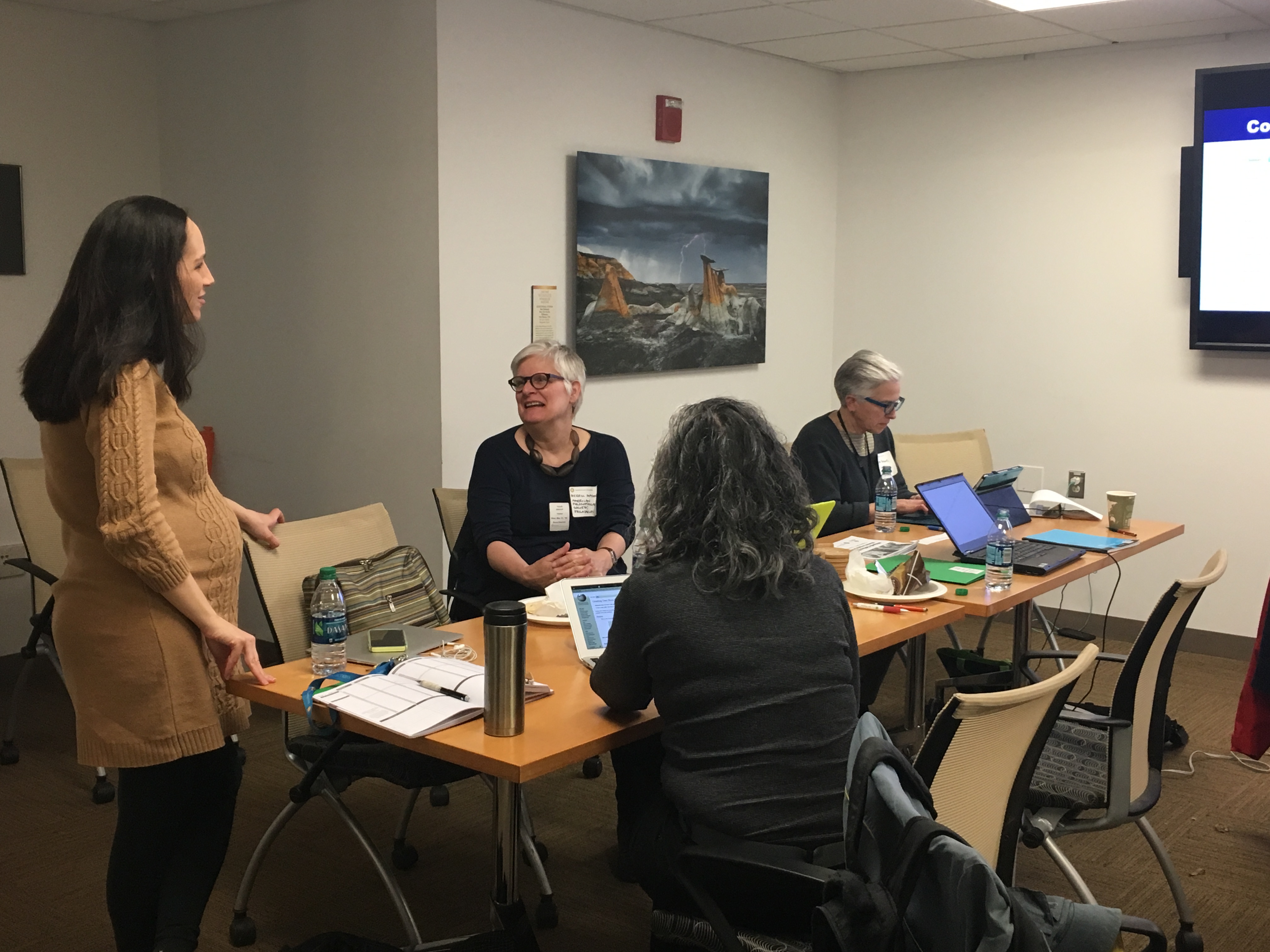
Attendees edit Wiki content at the LuEsther T. Mertz Library of the New York Botanical Garden. Photo by Marlon Co.

Wiki projects, including Wikipedia, Wikimedia Commons, and Wikidata, contain the information that powers the web. Wikipedia is the fifth most-visited website in the world. To edit a Wiki project is to contribute content that could potentially be viewed by thousands or even millions of people over time, both on Wiki sites and on sites like Google and Facebook, which harvest data, including media, from Wiki sites.

Like Wiki editors, BHL contributors are passionate about having their content accessible to and used by the most people possible. The information that we provide through BHL is intended for global audiences. We hope that the special things and unique data in our collections have a life beyond our walls and our institutions.

This similarity in missions and goals is what makes projects involving both BHL and Wiki* a great fit. To this end, for the #HerNaturalHistory campaign, the LuEsther T. Mertz Library of the New York Botanical Garden and the Smithsonian Libraries held three crowd-sourcing citizen science/citizen humanities events in March of 2019. These events were intended to bring new editors to Wiki projects, have editors add information about female scientists to Wikipedia, and have editors add information to BHL collections on Flickr and in Wikimedia Commons utilizing the Wikidata knowledge base/database/catalog.

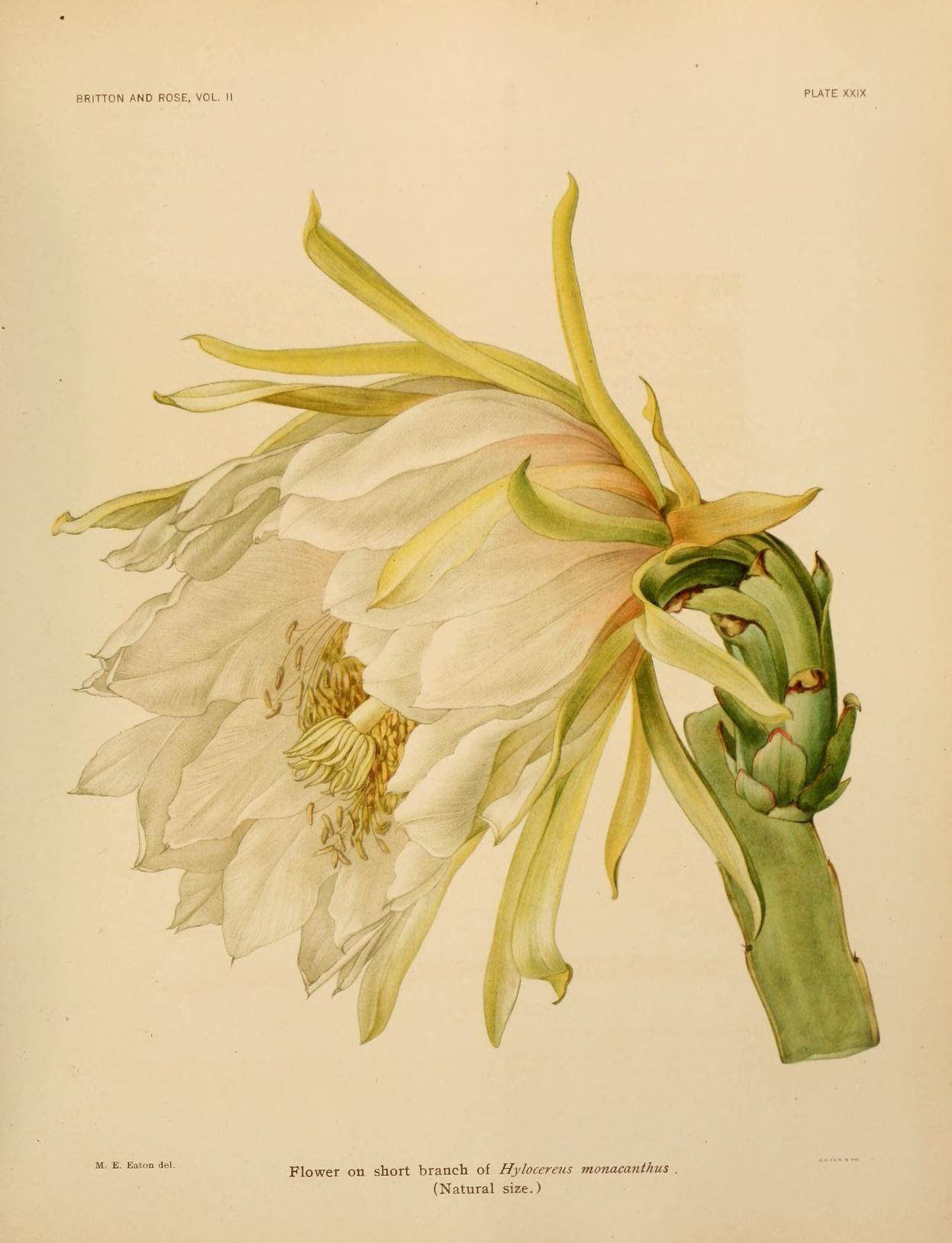
Illustration of Hylocereus monacanthus by Mary Eaton, The Cactaceae, . Contributed in BHL from The New York Botanical Garden.

At the New York Botanical Garden on 12 and 13 March, attendees had the opportunity to add data to images in Flickr, add data and categories for images in Wikimedia Commons, and add data to items in Wikidata. (The task list can be found here.) Over the span of two days, attendees edited 22 files on Flickr, adding 84 taxonomy:binomial and 34 taxonomy:common machine tags. 206 edits were made to Wikimedia Commons files, categories, and other content, adding 16,748 bytes of data and five new images to the repository. On Wikidata, four new items were created and 24 items were edited 114 times, for a total of 30,700 bytes added.

The event was offered in collaboration with Wikimedia NYC, the regional Wikimedia chapter serving the New York metropolitan area. WM NYC promotes free access to the world’s knowledge and supports Wiki projects in the greater New York City region; the attendance of WM NYC members provided the other attendees with a great deal of expertise on the finer points of Wiki projects and editing.

During the Smithsonian Libraries Workshop on 13 March, in-person participants at the Natural History Museum Library and virtual participants from around the world focused on editing the Wikipedia pages of female contributors to natural history using resources from BHL. Attendees focused their edits on women included in the Workshop’s Suggested Article Work List, comprised of over 100 women represented in the BHL collection. The Work List was compiled based on research and suggestions predominantly from BHL citizen scientists Michelle Marshall and Siobhan Leachman, as well as colleagues from the New York Botanical Garden, Smithsonian Institution Archives, and the BHL Cataloging Group.

Attendees editing at the Smithsonian Libraries Wikipedia Editing Workshop, hosted in the Natural History Museum Library and sponsored by Wikimedia DC. Photo by Grace Costantino.

The Smithsonian Libraries Workshop was sponsored by Wikimedia DC, with representative Ariel Cetrone facilitating the meeting. Two other representatives from Wikimedia DC, Jim Hayes and Andrew Lih, were also in attendance to provide support to participants. To facilitate virtual attendance, the Workshop was live-streamed via YouTube Live. A copy of the presentation used during the Workshop is also available online.

In total, over 70 people attended the Smithsonian Libraries Workshop, representing 20 in-person and over 50 virtual attendees. All told, as a result of the Workshop, 50 articles were edited, 5 new articles were created, and 14 images were uploaded to Wikimedia Commons, representing a total of 140 edits. Additionally, 36 new “editors” (first-time Wikipedia editors) participated in the Workshop.

The Suggested Work List will remain active indefinitely, and we welcome anyone to continue editing the Wikipedia pages for these women.

Although metrics are important, and offer a glimpse into one aspect of these events, the more impactful takeaways from these collaborations were the discussions that attendees had on topics ranging from open content, to information architecture, data storage, content curation, and more. In a sense, these crowd-sourcing edit-a-thons were a salon of sorts, where curious people who are passionate about open information were able to discuss strategies for how to make data more accessible and useful to the public, and work together to find and implement these solutions.

March 19, 2019by michelle.underhill
Blog Reel, Campaigns, Featured Books, Her Natural History

Elizabeth Gould: An Accomplished Woman

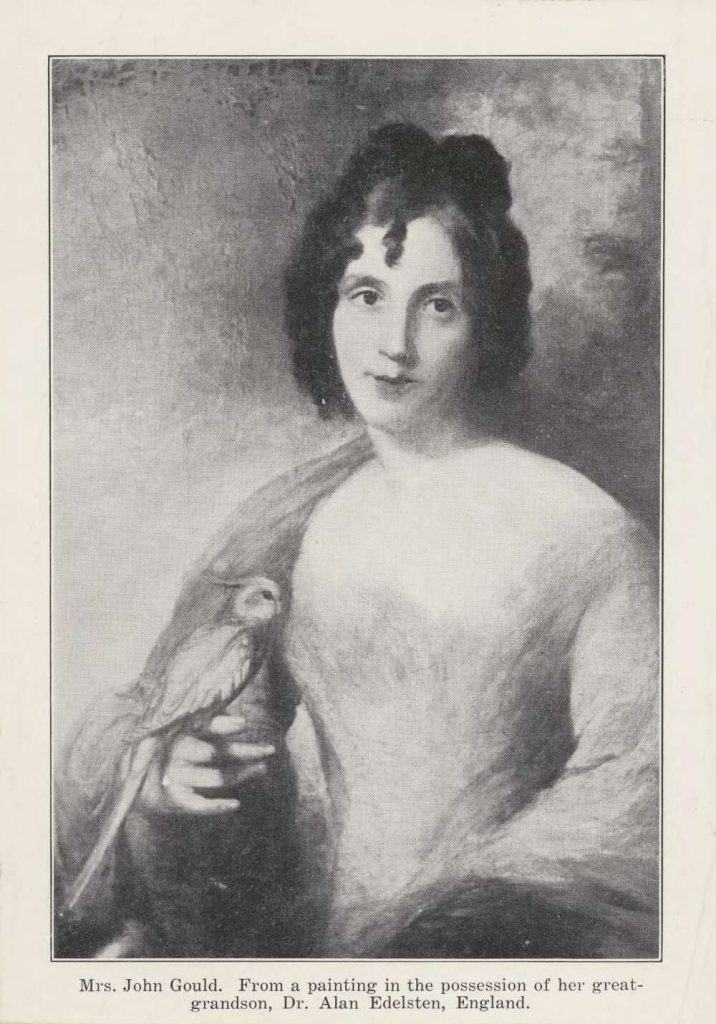
Elizabeth Gould

This post was originally published on the Smithsonian Libraries’ blog. It is reproduced with permission from the Author, Alexandra K. Newman.

Be sure to join Alexandra Newman for a behind-the-scenes look at Elizabeth Gould’s work in the Natural History Rare Book Library at the Smithsonian Libraries during a Facebook Live broadcast produced as part of the #HerNaturalHistory campaign: 22 March @ 1pm ET via https://www.facebook.com/SmithsonianLibraries.
Elizabeth Gould

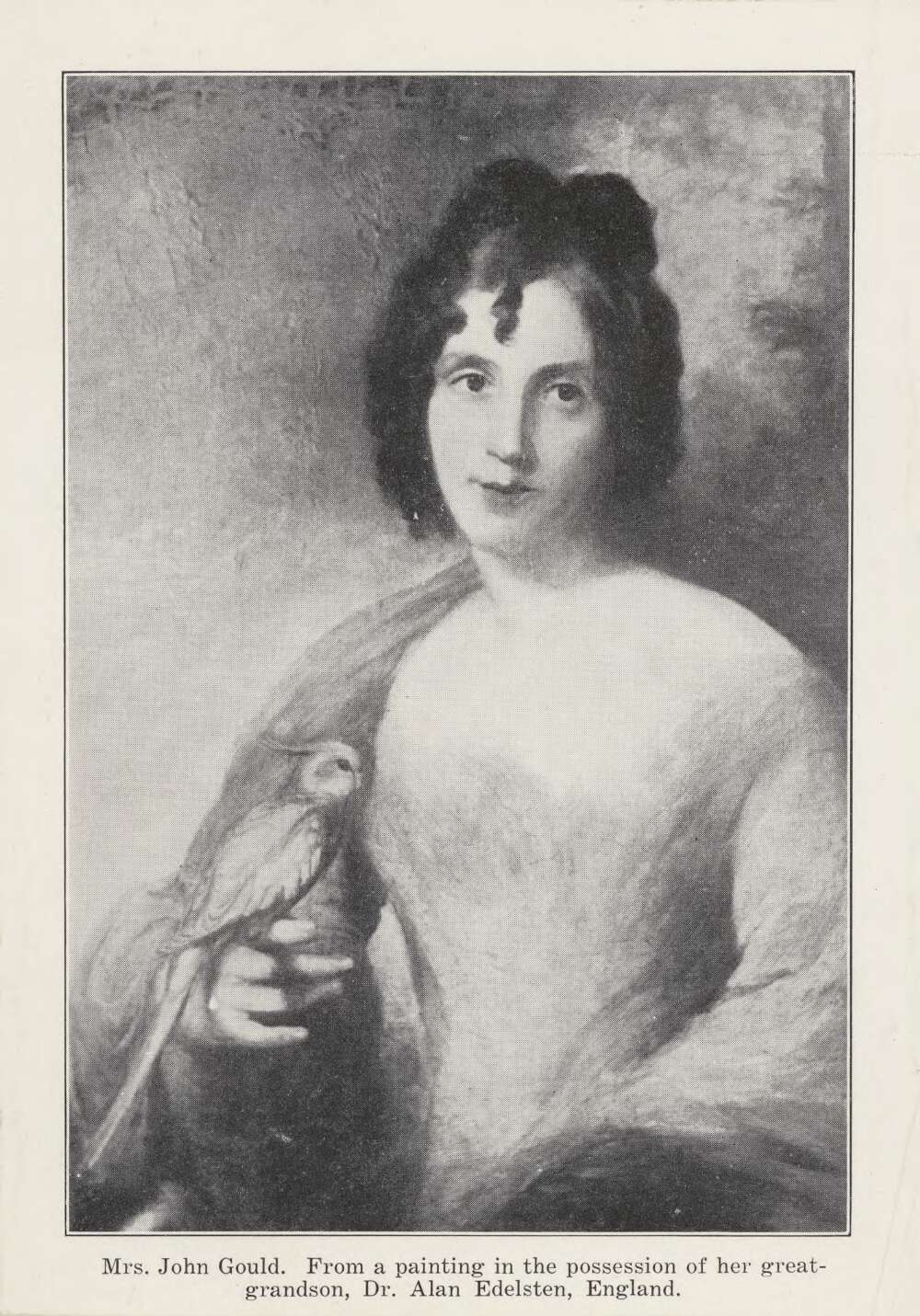
Portrait of Elizabeth Gould. National Library of Australia.

Author’s note: Elizabeth Gould was a 19th century artist responsible for some of the most historically significant images of birds ever published. She was also a devoted wife and mother. It is sometimes difficult to reconcile both of these aspects of her life through our modern lens of 21st century social issues and feminism; it can be tempting to paint her story as that of a woman repressed by antiquated gender roles, and to speculate on her career trajectory had she not tragically died shortly after the birth of her eighth child. However, while history strives to be objective, it impossible to completely purge our modern sentiments from the retelling of her story, so it is important to strive to tell it based on documentary evidence rather than speculation. Elizabeth’s life was very eventful for being so short, as we shall soon see, so it is not difficult to craft an exciting biographical narrative for her. The difficulty comes, instead, from trying to ensure that she maintains a degree of agency in her own story. I have tried to write this post in such a way that is respectful to both Elizabeth and the time in which she lived.

The beautiful lithographs produced by Elizabeth Gould show lively birds of all shapes and colors performing mating displays, protecting their young, and interacting with their environments. A far cry from the dead-bird-on-stick approach to book illustration of the 18th century and prior, Elizabeth’s birds are reminiscent of the more dynamic figures depicted by John James Audubon; in fact, distinguished ornithologist Prideaux John Selby proclaimed “I like [Elizabeth’s illustrations] as well as Audubon’s.”[1] However, it is not Elizabeth’s name on the title page of A Century of Birds from the Himalaya Mountains (for which she lithographed 80 plates) or on the ‘Birds’ volume of The Zoology of the Voyage of the H. M. S. Beagle (for which she lithographed all 50 plates); rather, it is that of her husband, John. A respected taxidermist and ornithologist, John was also a master of marketing, putting out numerous large-format lithography plate books over the course of his career. But John’s artistic skill was not up to the task of such a grand undertaking; instead, he relied on the artistic talents of others, including his wife, to carry his work to new heights.
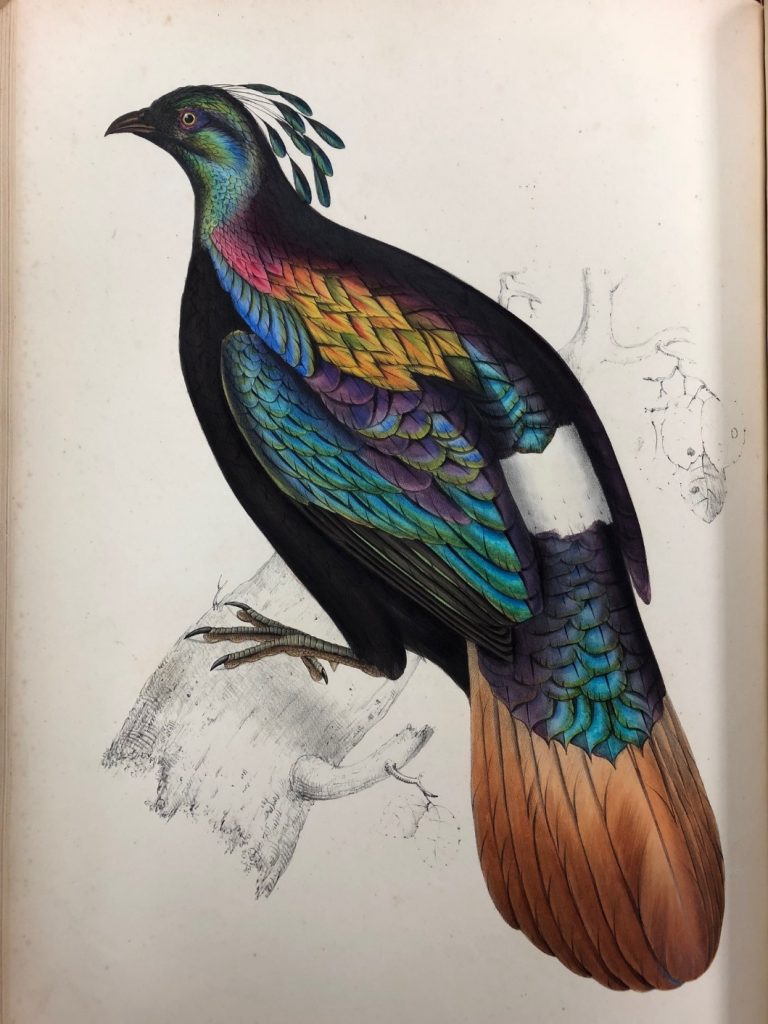
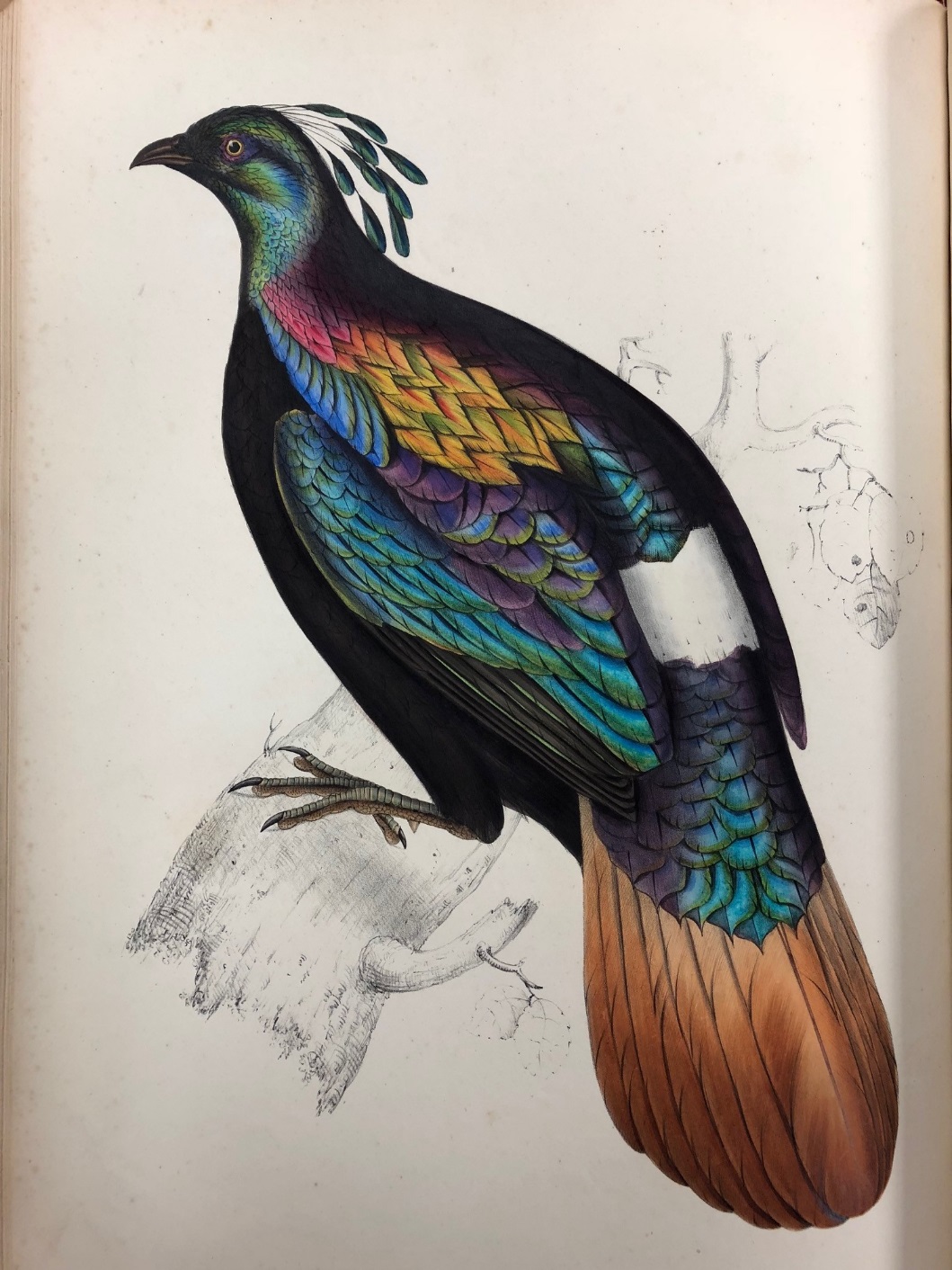
Lophophorus impeyanus. Art by Elizabeth Gould. A century of birds from the Himalaya Mountains. 1831. Contributed in BHL from Smithsonian Libraries.

Elizabeth Gould, nee Coxen, was born in 1804 to a military family in Ramsgate, England. One of eleven children, and the only daughter to survive to maturity, information on how she and her siblings spent their childhood is unfortunately sparse; however, by age 22, Elizabeth had obtained a position as governess to the 9-year-old daughter of the Chief of the Office of the King’s Proctor in London. Being able to work as a governess for aristocracy implies that Elizabeth was highly educated, which was not unusual for middle- and upper-class women of the period: as part of this education, she would have been taught foreign languages, music, as well as to draw and paint in watercolor, genteel pursuits that earned a young lady the epithet of being “accomplished.”

However, the fact that she had to seek employment also implies that her family could not financially support an unmarried daughter. Indeed, she was not overly fond of the job—between teaching the young girl French, Latin, and music, Elizabeth wrote to her mother that her duties as a governess were “miserably-wretched dull,” and that she feared she would soon become “very melancholy.”[2] Thus, her marriage to John Gould when she was 24 in 1829 has been characterized as a “rescue” by some authors.[3] In reality, the rescuing went both ways.

John’s career in ornithology was on the rise at the time of his and Elizabeth’s wedding—by 1828, he had been appointed Curator and Preserver at the Museum of the Zoological Society of London. In 1830, a collection of Himalayan bird skins came across his desk for preservation, which his colleague, N. A. Vigors, was in the process of describing. Familiar with the new printing technology of lithography through the work of one Edward Lear, John put forward a proposal for an illustrated book to show off the new and interesting species contained in the collection. Fully aware that his own artistic abilities did not lend themselves to the subtle medium of lithography, John brought the project to Elizabeth, who at first did not grasp the gravity of her husband’s request. “But who will do the plates on stone?” she reportedly asked. “Why you, of course!” John replied matter-of-factly.[4]

No record exists of how Elizabeth felt about suddenly being designated the family draughtswoman. However, executing her new role cannot have been easy for her from a purely physiological standpoint: pregnant with her and John’s first child, she nevertheless spent hours transferring her specimen drawings onto stone in anticipation of the publication of the first batch of plates for the work. She gave birth to a son, John Henry, only days after the plates were sent to subscribers.[5]
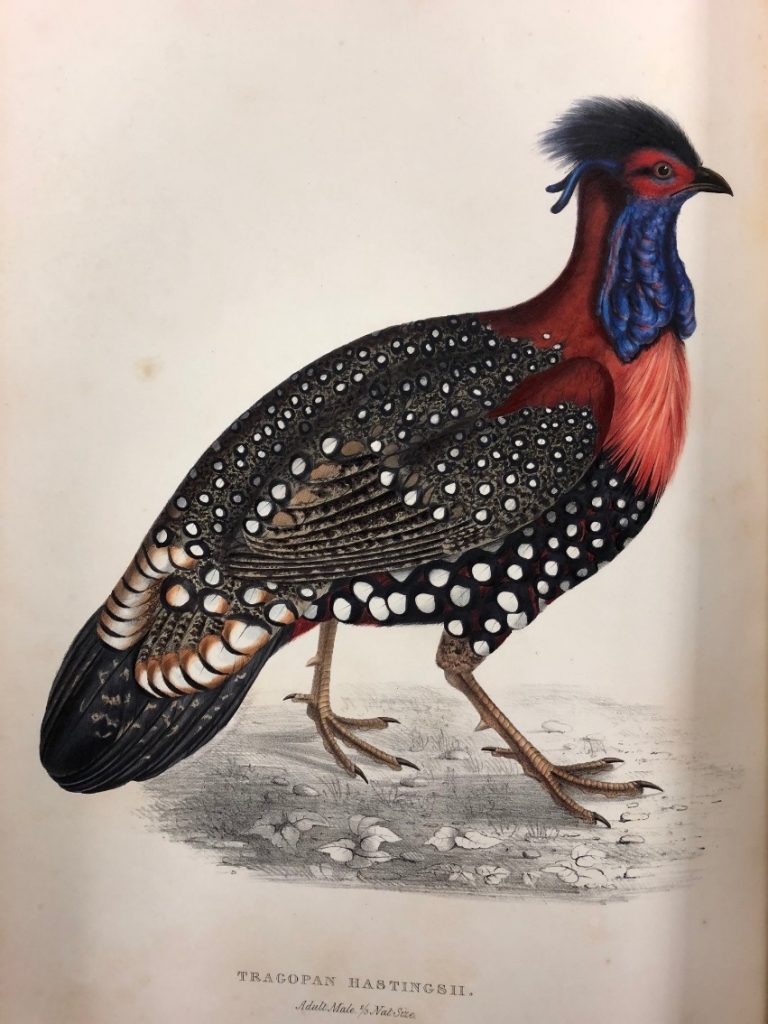
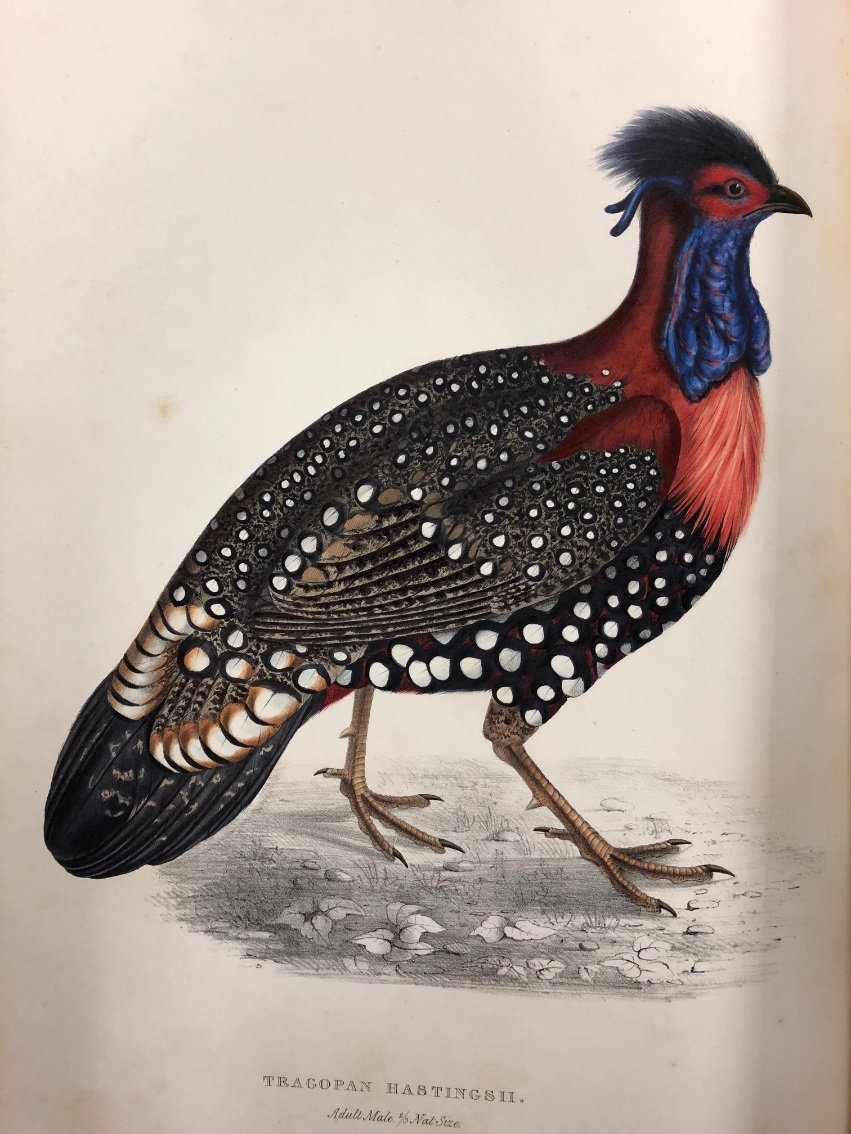
Tragopan hastingsii. Art by Elizabeth Gould. A century of birds from the Himalaya Mountains. 1831. Contributed in BHL from Smithsonian Libraries.

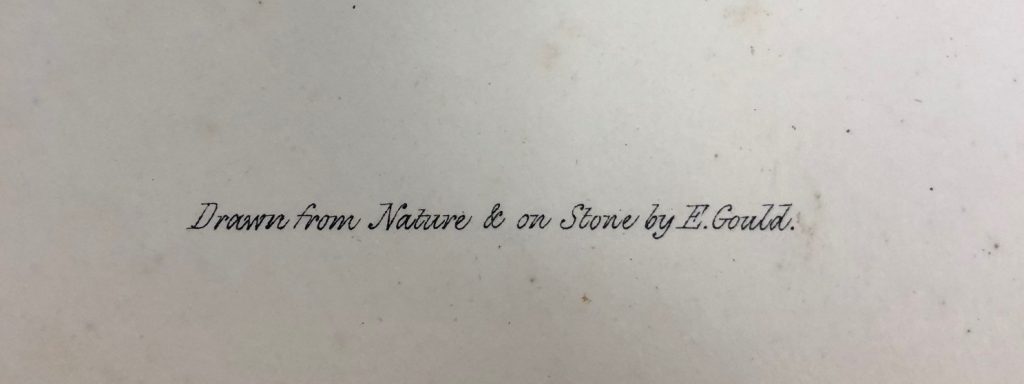
As previously stated, Elizabeth’s name is absent from the title page of what became A Century of Birds from the Himalaya Mountains; her contribution is briefly mentioned in the preface of the work, which simply states that her “well-known abilities” were employed in “delineating these birds.”[6] Each of the plates bears a small artist’s credit on the lower left—“Drawn from nature on stone by E. Gould”—but none of them feature her signature. Edward Lear, who John enlisted to teach Elizabeth lithography methods, incorporated his signature into much of his work, so it is somewhat curious that she elected not to sign her pieces.
Her work was well-received in ornithological circles, and N. A. Vigors was so impressed by her artistry that he named a species of colorful sunbird in her honor. But it was John who received the lion’s share of professional accolades. The success of Century spurred John to undertake a much larger survey of European birds, which he initiated while the final parts of Century were still being delivered to subscribers. This ambitious publication, which became the 448-plate Birds of Europe, required John and Elizabeth to travel extensively in continental Europe, visiting natural history collections and observing and collecting specimens in the wild. Being able to see living, moving birds enabled Elizabeth’s artistic talent to improve immensely; it is during this publication that she truly began to show the lively interactions between males and females of species, and incorporating movement into her figures that made them look as though they could fly off of the page at any moment.
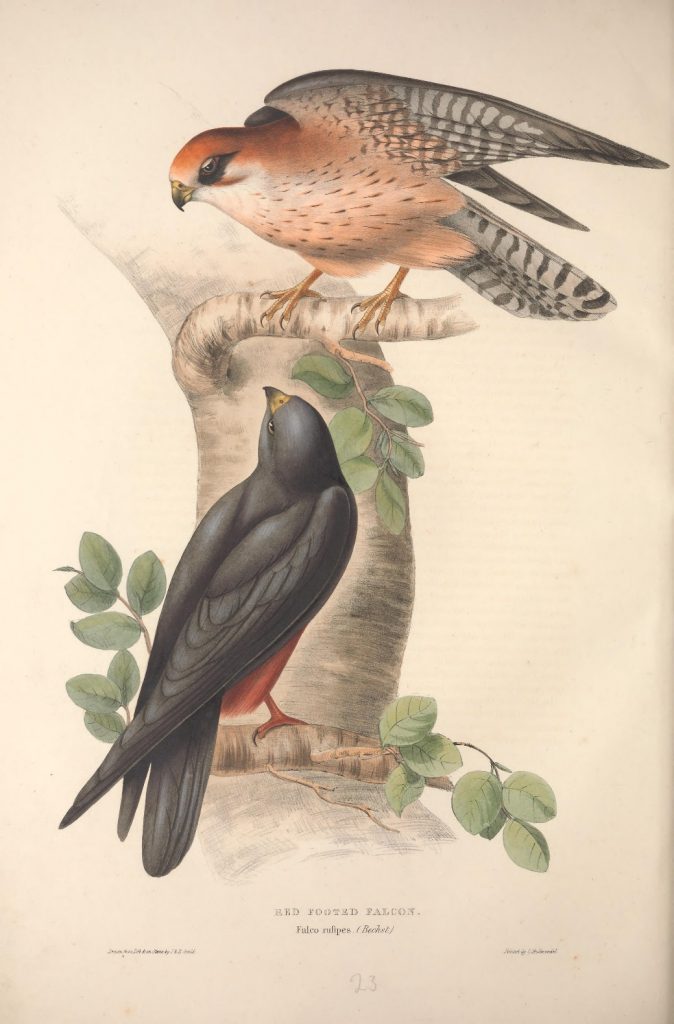
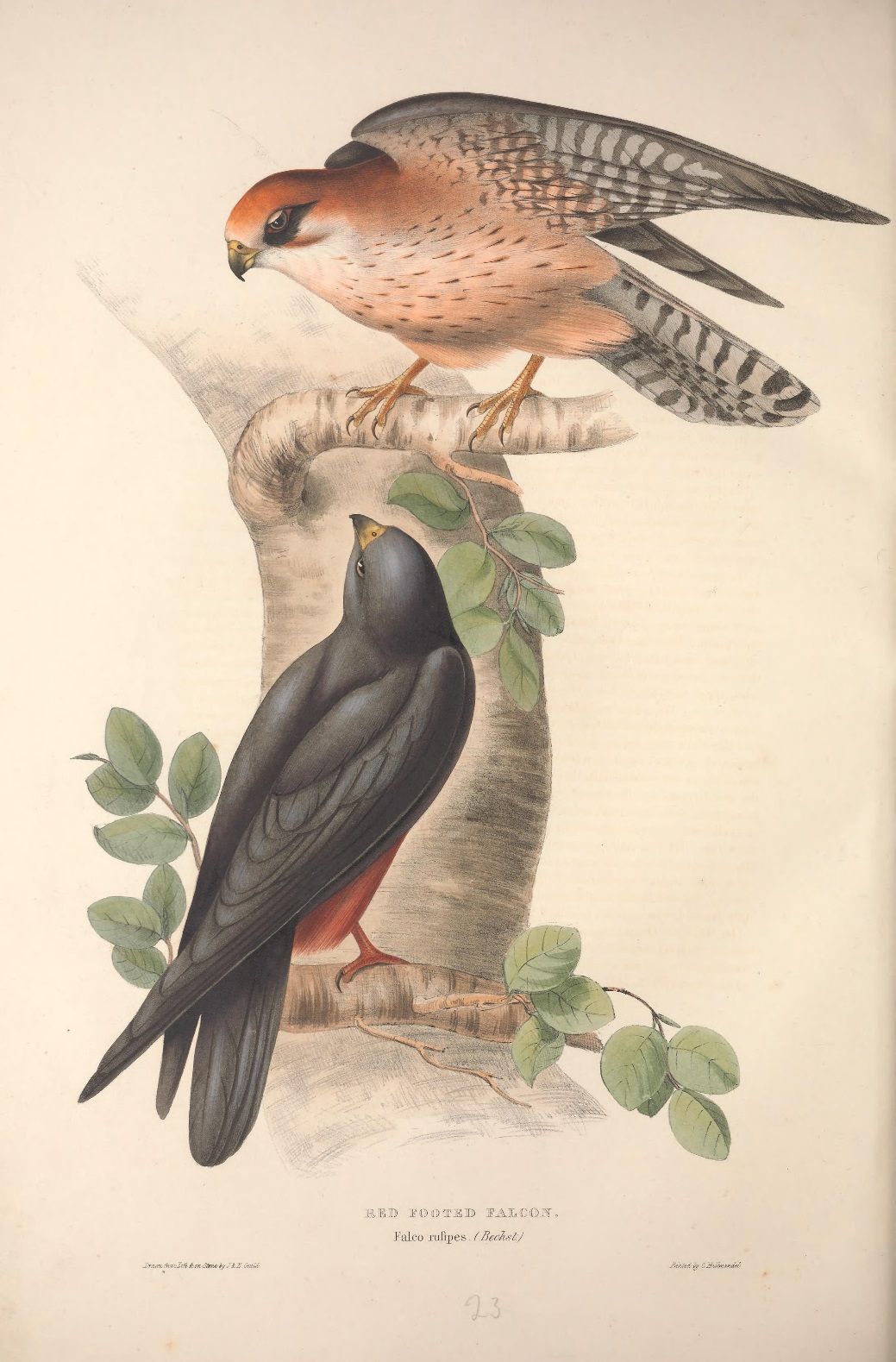
Red Footed Falcon. Art by Elizabeth Gould. The Birds of Europe. v. 1 (1837). Contributed in BHL from Smithsonian Libraries.

However, the artist credit on the lower left corner of the plates of Birds of Europe does not just bear Elizabeth’s name. Instead, her initial E. is preceded by a J., as John claimed artistic credit for the composition of the designs.
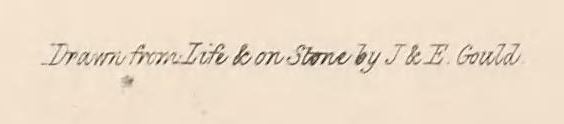
This line would remain the norm throughout the rest of the publications they worked on together. In his preface to Birds of Europe, John describes how Elizabeth drew and lithographed the pieces, but credits himself for the “sketches and designs.”[7] Documentary evidence tells a different story. The Ralph Ellis Collection, housed at the University of Kansas’ Kenneth Spencer Research Library, contains a number of sketches that indicate that, rather than arranging the composition, John would either make minor changes to or simply approve Elizabeth’s sketches that became the final designs.[8]

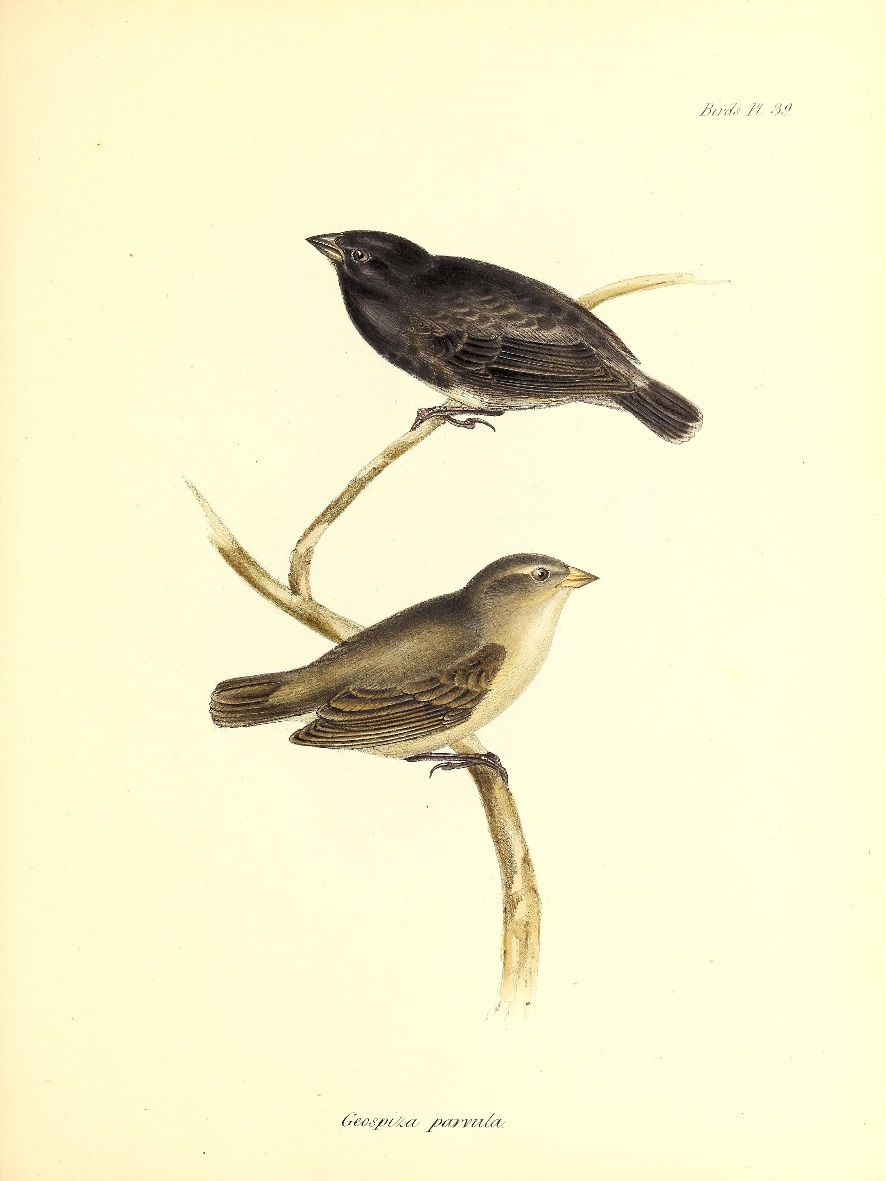
Observation, drawing, printing, and publication of Birds of Europe took a total of five years, during which Elizabeth gave birth to five more children, only three of whom survived infancy. Also during this time, John employed Elizabeth to draw the plates to accompany his text on the bird specimens brought back by the young naturalist Charles Darwin from the voyage of the H. M. S. Beagle. Among these specimens were the now-famous Galapagos finches, which Darwin referred to when formulating his theory of natural selection in his 1859 On the Origin of Species. Elizabeth’s name is completely absent from the plates.
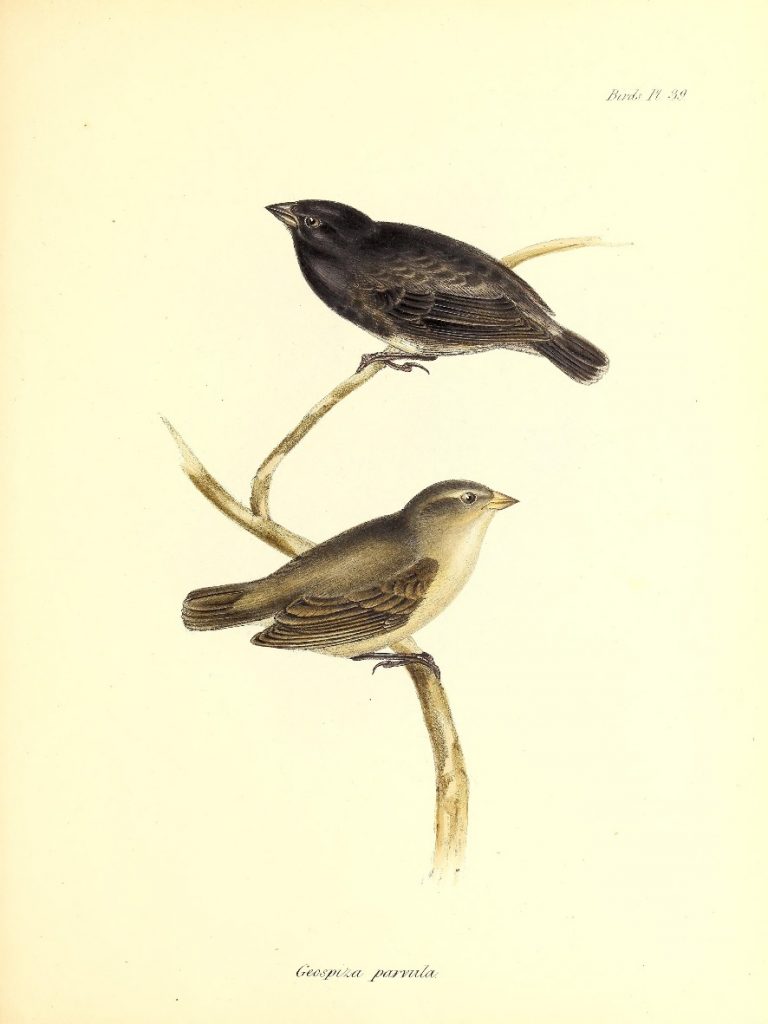
Finches. Art by Elizabeth Gould. The Zoology of the Voyage of the H.M.S. Beagle. pt. 3 (1841). Contributed in BHL by Smithsonian Libraries.

The work that truly established John Gould as a master of ornithological publication was Birds of Australia, published over eight years from 1840-1848. After his experience with Birds of Europe, John had realized the importance of field observation to the quality of his publications. He subsequently arranged for Elizabeth, their eldest child John Henry, their nephew Henry Coxen, zoologist John Gilbert, servants, and himself to make the voyage to Australia in 1838, a trip that was in part made possible by Elizabeth’s family. Her two brothers, Charles and Stephen, had established farms in New South Wales, and had already sent a number of Australian bird specimens back to the Goulds for description and lithography, and the Gould party even used their property as a base for the latter months of their two year stay in the colony.

It is this period of Elizabeth’s life that is most well-documented, thanks to the letters she wrote to her mother in England, as well as her travel diaries. It was also likely one of the most difficult periods of her life. Forced to leave three of her children behind to accompany John on his scientific pursuits, she was distraught; she was so emotionally plagued by the prospect that she was nearly unable to board the ship on the day of their embarkation.[9] It is unclear how John finally managed to persuade her to go up the gangplank, but it is clear from her correspondence that she remained deeply concerned about the wellbeing of the children, the youngest of whom was only six months, as well as her mother.

Rather than being entirely maudlin, her letters also contain anecdotes of John’s collecting prowess (“he has already shown himself a great enemy of the feathered tribe”), her reluctance to participate in a ball held for the Queen’s birthday (“Don’t fancy I attempt dancing—no, no. I am well content to look on.”), and the ambiance of a campsite in New South Wales (“where nature appeared in her wild luxuriance”).[10] What they do not discuss, unfortunately, is her art. Her surviving sketches and the lithographs they became have been left to speak for themselves.
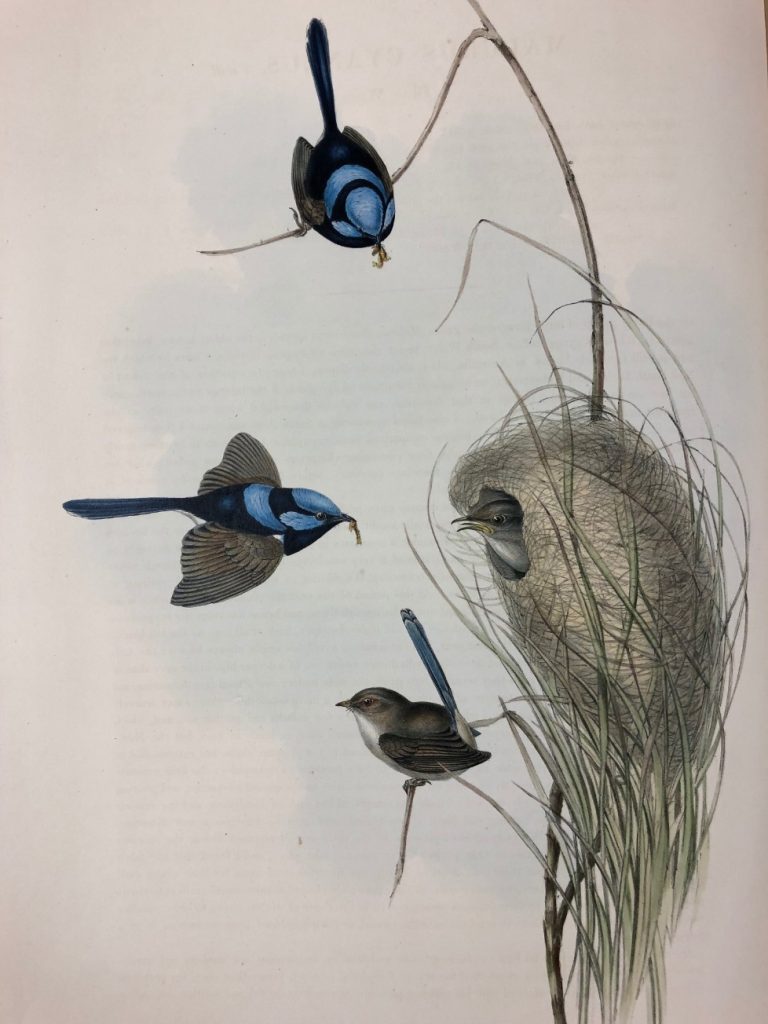
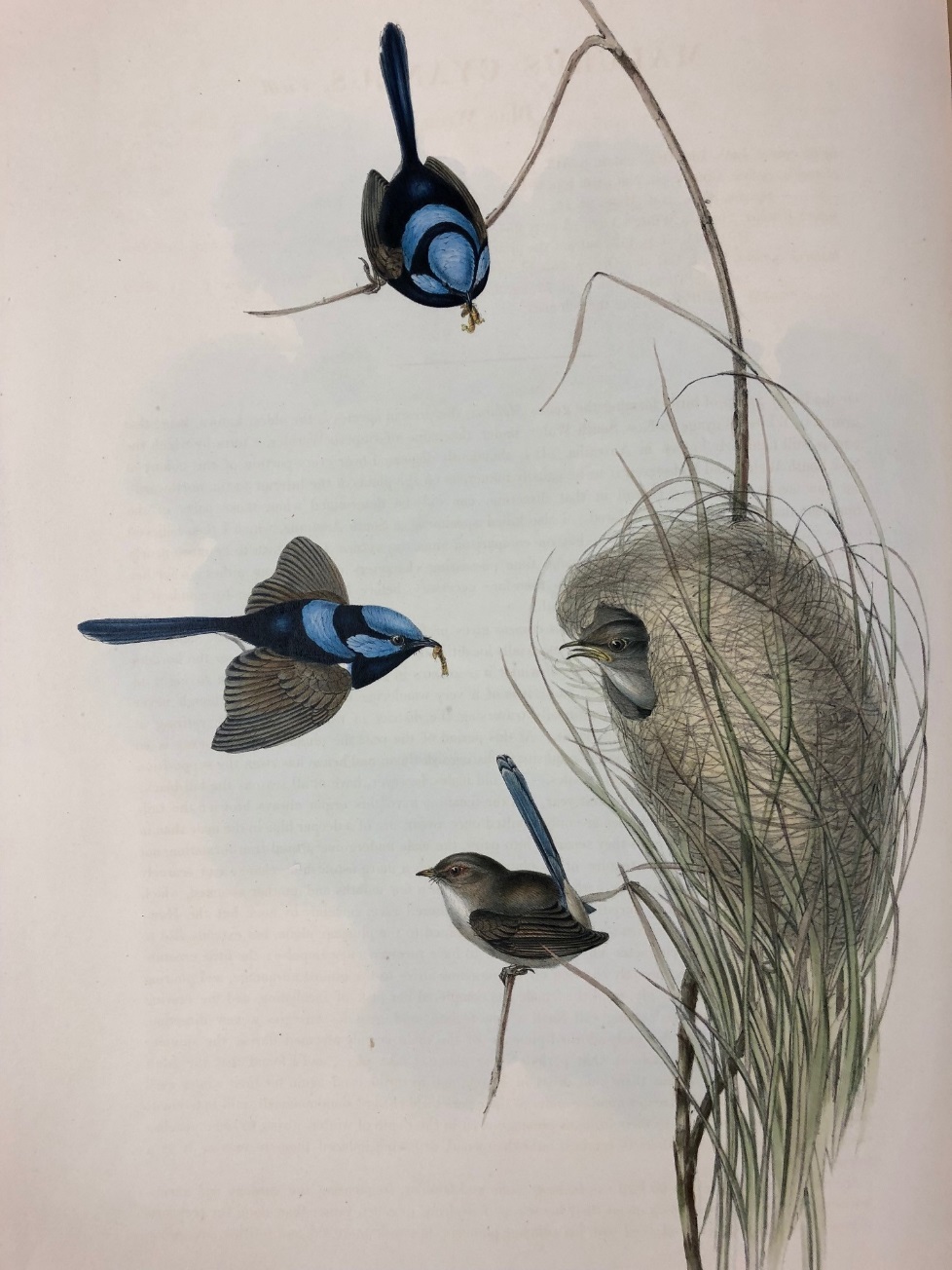
Superb Fairy Wren. Art by Elizabeth Gould. The birds of Australia. v. 3 (1848). Contributed in BHL from Smithsonian Libraries.

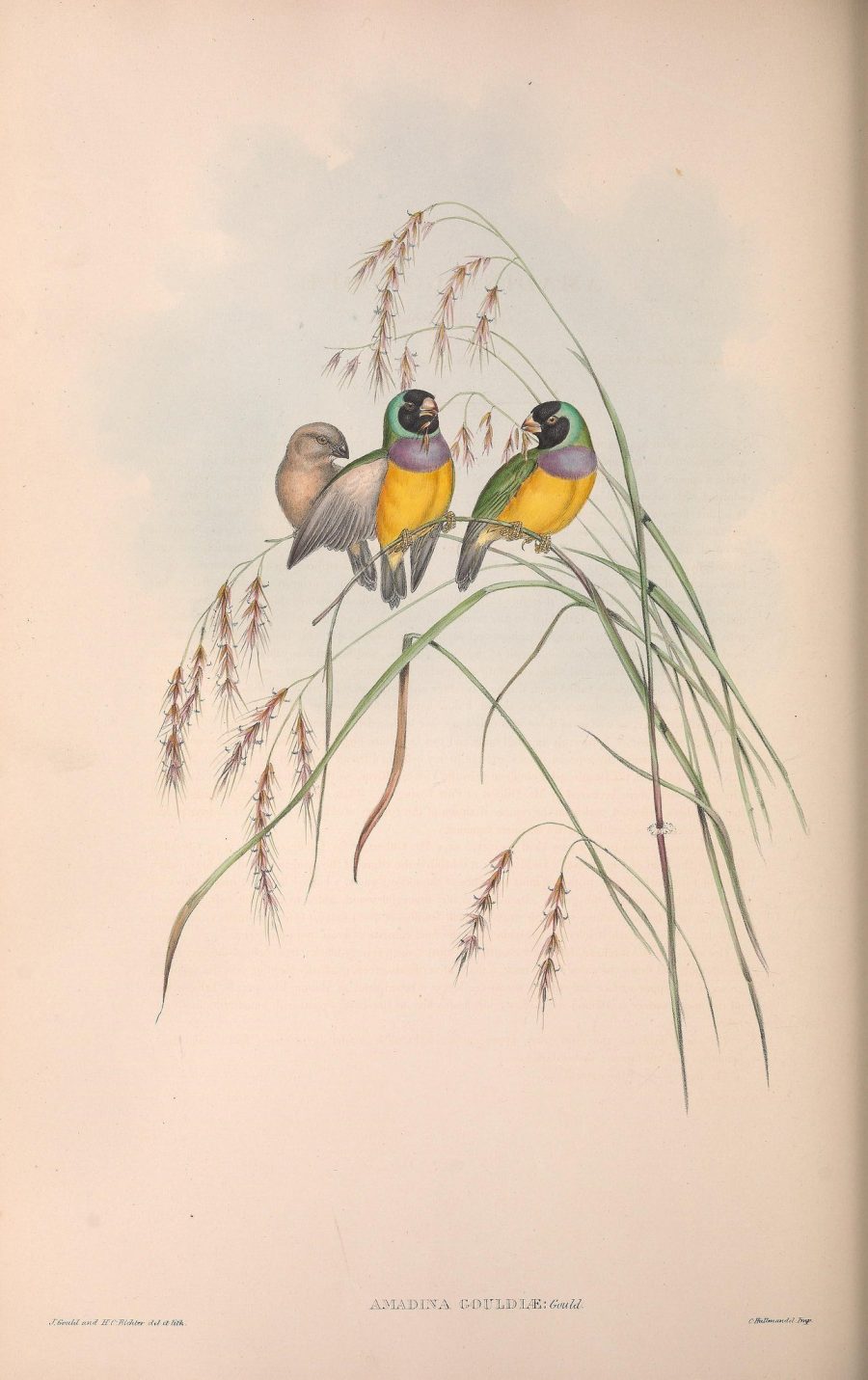
When the Goulds returned to England in August 1840, they brought back sketches, specimens, and another child—Elizabeth gave birth to a son, Franklin, in Tasmania. The first part of Birds of Australia was due to be published in December of that year, so John and Elizabeth quickly got to work on the text and lithography. Elizabeth had managed to transfer 84 of her drawings onto stone by August 1841, but tragically, she would not live to see the project through to completion. A few days after giving birth to an eighth child, Sarah, Elizabeth was struck by puerperal fever and passed away. She left John with multitudinous sketches and six children. There is no record of how this affected John emotionally. However, he memorialized her in the best way he knew how: he named a multicolored finch in her honor, and described her devotion to the family publication pursuit in the accompanying text.
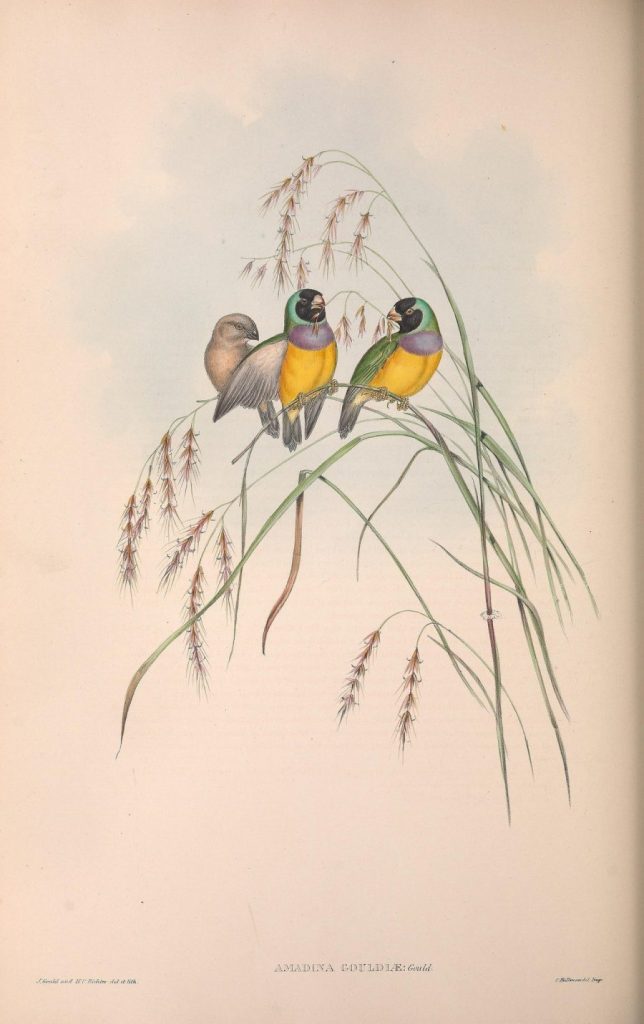
Amadina gouldiae. Art by Elizabeth Gould. The Birds of Australia. v. 3 (1848). Contributed in BHL from Smithsonian Libraries.

Elizabeth’s life is inexorably linked and influenced by that of her husband John. The way he credited (or rather, failed to credit) her contributions is objectively bad practice, and some of John Gould’s other collaborators denounced him years later; notably, upon hearing of John’s death in 1881, Edward Lear wrote that John “owed everything to his excellent wife, and to myself, without whose help in drawing he had done nothing.” However, researchers combing Elizabeth’s correspondence and diaries have found no record of her dissatisfaction with the process. It is frustrating that such a talented woman has left behind so little in the way of information about her feelings toward her art; but the delicacy and care by which she portrayed her subjects can convey nothing else than love.

The Biodiversity Heritage Library holds many of Elizabeth Gould’s works, including the Smithsonian Libraries’ copies of A Century of Birds from the Himalaya Mountains, The Birds of Australia, and The Birds of Europe, for anyone to view and appreciate for themselves. You can also browse a collection of her artworks in the BHL Flickr.
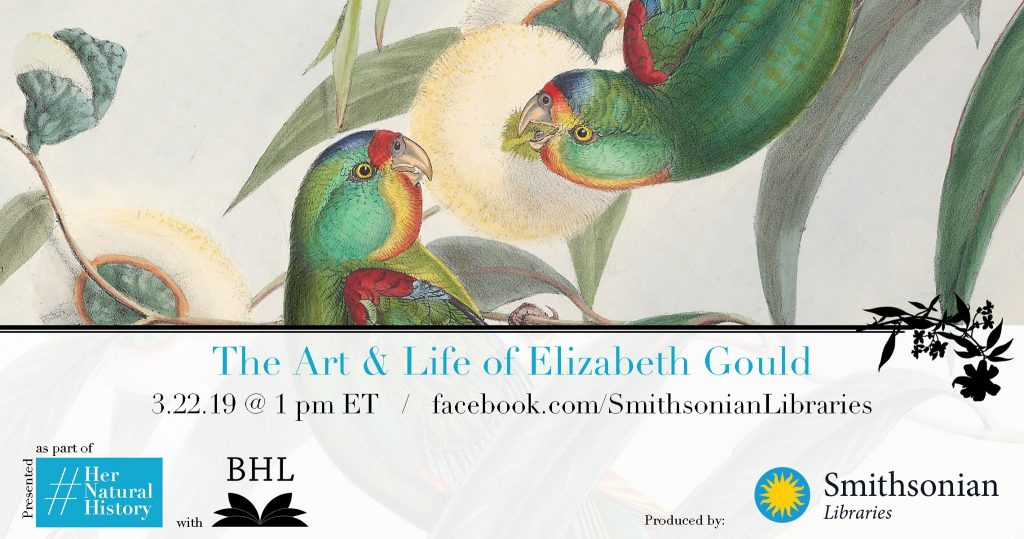
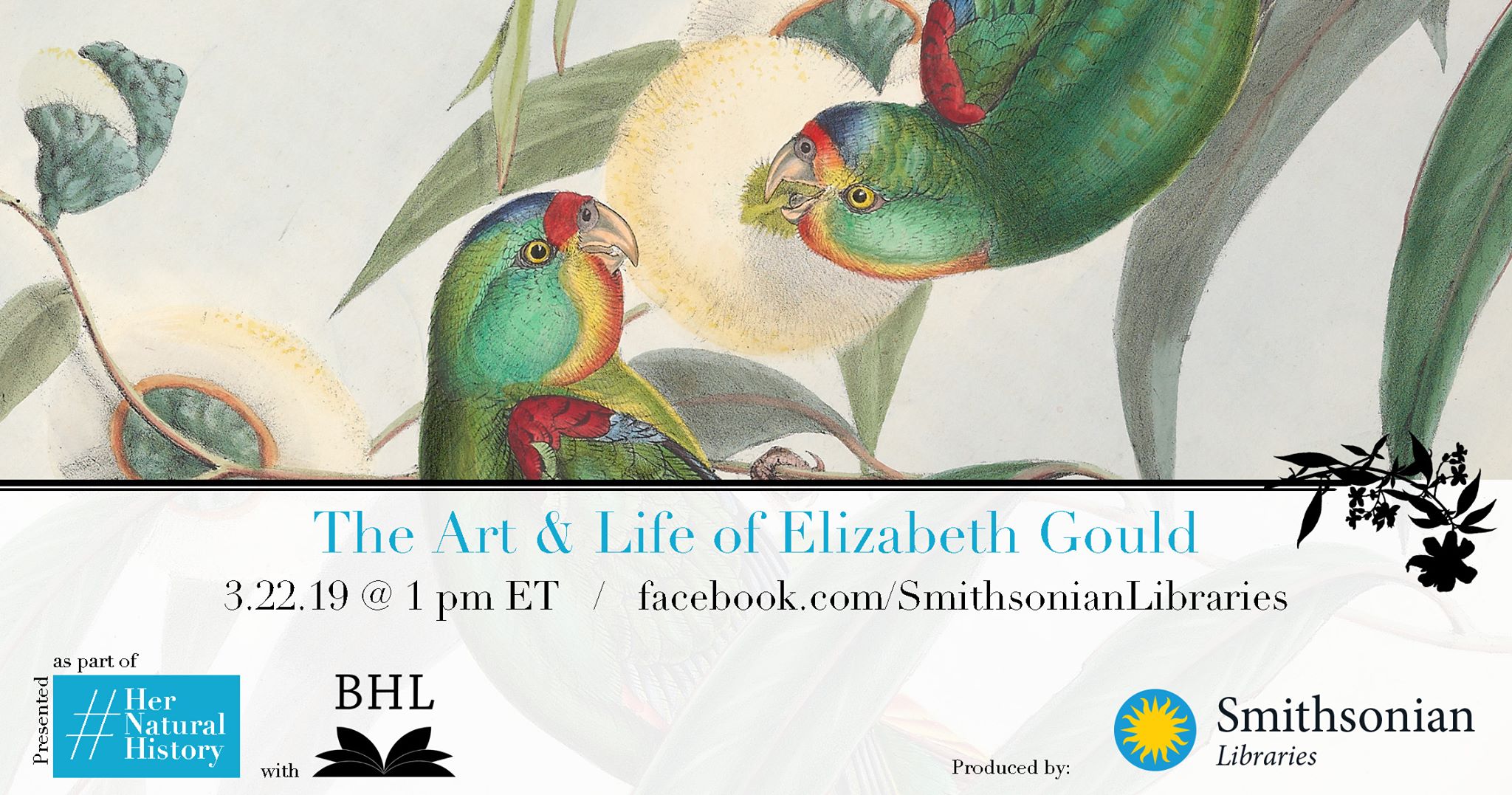
Facebook Live at Smithsonian Libraries: The Art of Elizabeth Gould

You can learn more about Elizabeth Gould and see a selection of her works during a behind-the-scenes tour at the Natural History Rare Book Library at the Smithsonian Libraries with Alexandra Newman.

When? Friday, 22 March @ 1pm ET

Where? https://www.facebook.com/SmithsonianLibraries

References

[1] Isabella Tree. The Bird Man: The Extraordinary Story of John Gould. London: Ebury Press. 2004.

[2] Chisolm, Alec. 1964. “Elizabeth Gould: Some “New” Letters.” Journal of the Royal Australian Historical Society 49(5): 10.

[3] Roslyn Russel. The Business of Nature: John Gould and Australia. Canberra: The National Library of Australia, 2011.

[4] Richard Bowdler Sharpe. An Analytical Index to the Works of the Late John Gould, F. R. S., with a Biographical Memoir and Portrait. London: Henry Sotheran, 1893.

[5] Russel, 2011.

[6] John Gould. A Century of Birds from the Himalayas. London, 1831.

[7] John Gould. The Birds of Europe. London, 1837.

[8] Melissa Ashley. “Elizabeth Gould.” John Gould: Bird Illustration in the Age of Darwin. 2014. https://exhibits.lib.ku.edu/exhibits/show/gould/about/elizabeth_gould

[9] Ibid.

[10] Russel, 2011.

March 18, 2019by michelle.underhill
Blog Reel, Campaigns, Her Natural History

Botanical Field Guides of Alice Lounsberry and Ellis Rowan

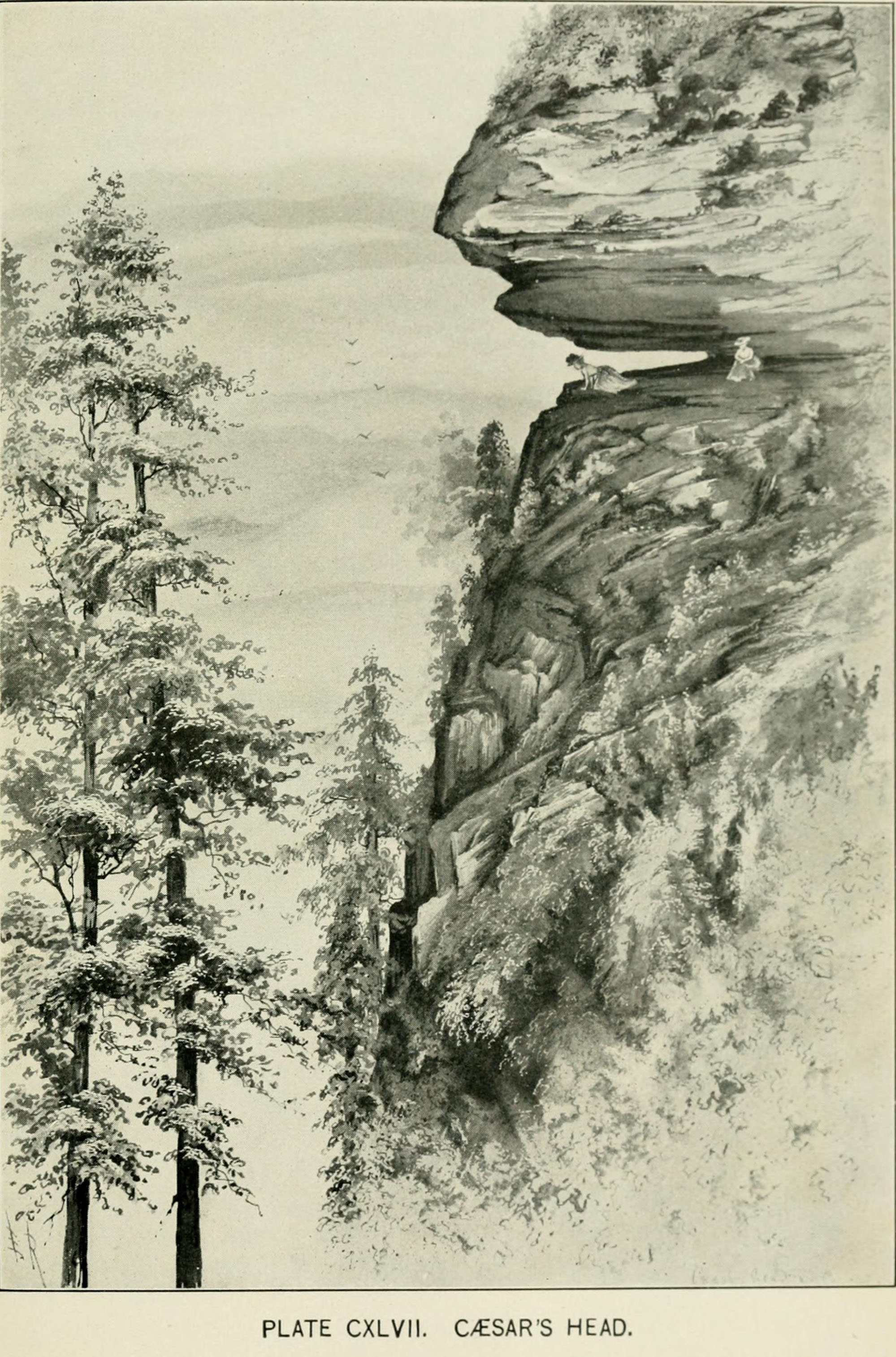
“Caesar’s Head.” Lounsberry and Rowan. Southern wild flowers and trees. 1900. Contributed in BHL by NCSU Libraries /Archive.org.

When the flower seekers reached a great crevice in the rock called Caesar’s Head, their eyes no longer sought the ground, but rested and wandered over the panorama of far-stretching mountains and the fertile valley of the depth below. Could they have trodden over that broad surface, what discoveries might they have made; what secrets have gathered from Nature’s heart? (Lounsberry and Rowan, Southern wild flowers and trees.)

Artist Marian Ellis Rowan depicts herself with botanist Alice Lounsberry peering over a cliff face on Caesar’s Head, South Carolina, as they travel together to research their botanical guidebooks. (Look closely for the two figures on the ledge!) The pair’s collaboration produced A guide to the wild flowers (1899) and A guide to the trees (1900), both popular guides to North American flora; this image comes from their guide Southern wild flowers and trees, together with shrubs, vines and various forms of growth found through the mountains, the middle district and the low country of the South (1901).

Their three guides are illustrated with pen and ink illustrations as well as full color paintings. Intended to make botanical study accessible for a popular audience, they take an ecological approach by organizing species according to where they habitually grow, from aquatic environments to dry sandy soils. In the introduction to Guide to the wild flowers, American botanist and taxonist Nathaniel Lord Britton notes that botanical guides organized by ecosystem reflect a new and significant shift:

[This book will] aid in the appreciation of that new development of botanical study, the science of Plant Ecology. It will teach the novice how altitude, latitude, soil and environment affect the vegetation of certain areas; how certain plants are found growing together because of the nature of the soil and of their surroundings. If it also leads to the understanding of their gradual adaptation to changed conditions it will give a broader and more comprehensive view of plant morphology and lead away from the mistaken idea that plants must and should conform to our artificial definitions, and make clearer the laws of evolution. (Guide to the wild flowers, p. xv)

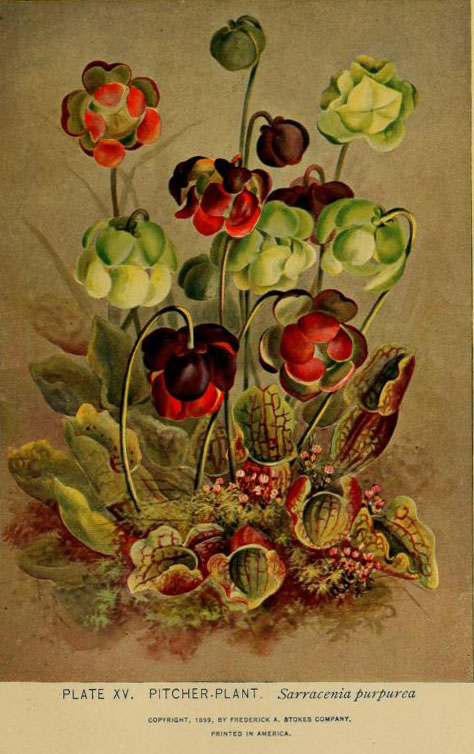
“Pitcher Plant, Sarracenia purpurea.” Lounsberry and Rowan. A guide to the wild flowers. 1899. Contributed in BHL by New York Botanical Garden, LuEsther T. Mertz Library.

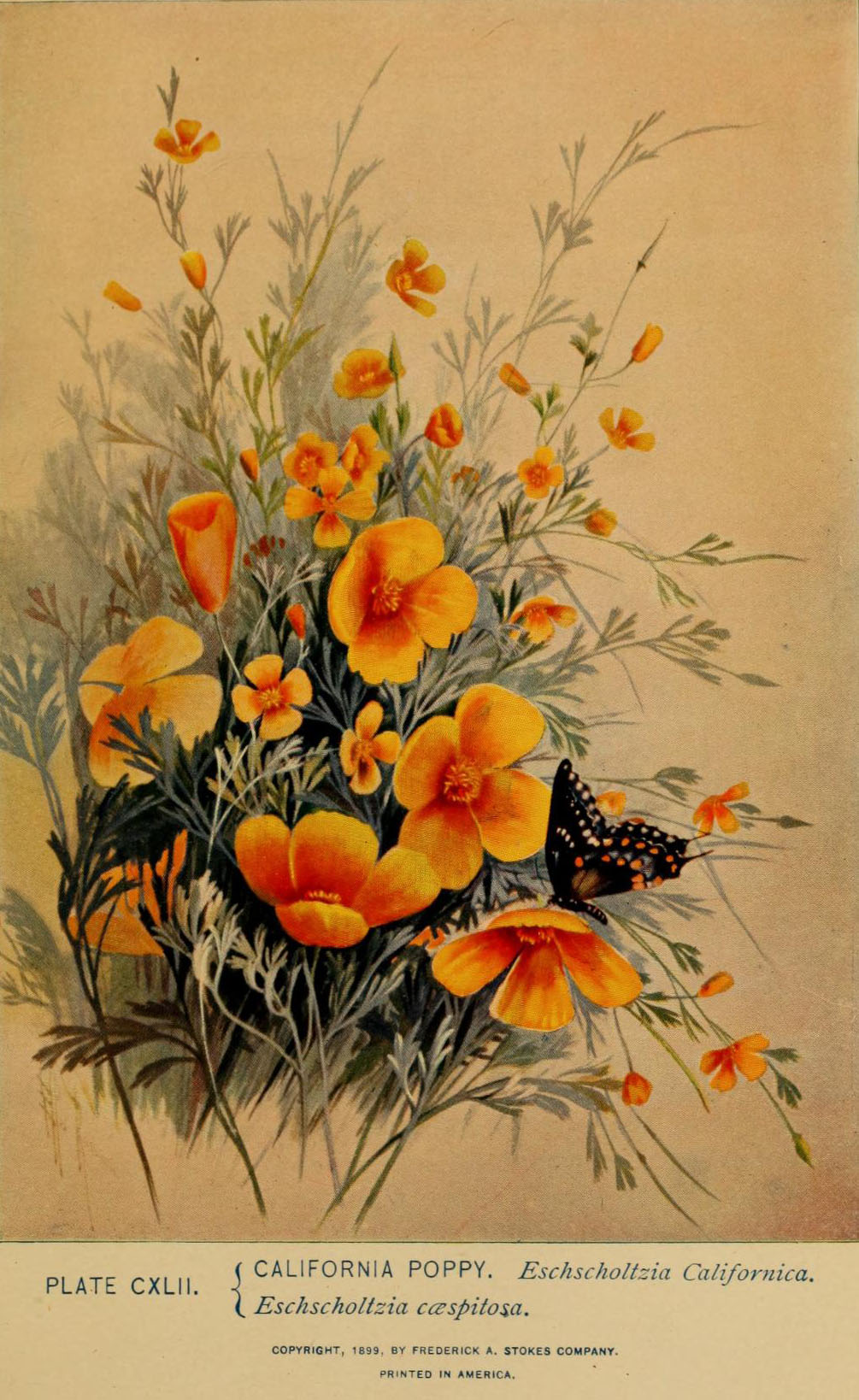
“California poppy, Eschscholtzia Californica and caespitosa.”  Lounsberry and Rowan. A guide to the wild flowers. 1899. Contributed in BHL by New York Botanical Garden, LuEsther T. Mertz Library.

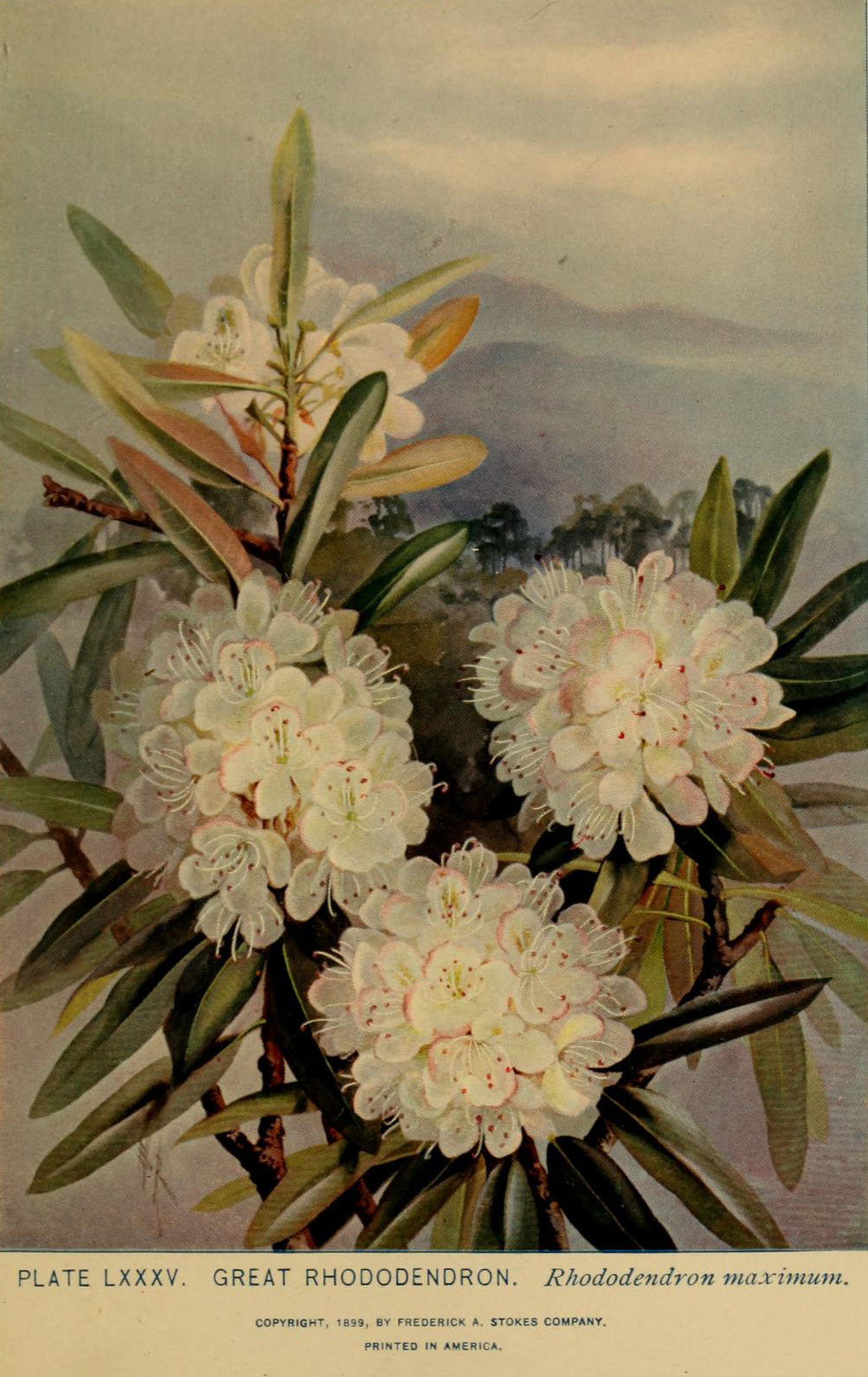
“Great Rhododendron, Rhododendron maximum.”  Lounsberry and Rowan. A guide to the wild flowers. 1899. Contributed in BHL by New York Botanical Garden, LuEsther T. Mertz Library.

Marian ‘Ellis’ Rowan (1848-1922), born in Melbourne, Australia, was a well-known popular artist in her time. Raised by a botanist father, she had access to his internationally famous garden at their home Derriweit Heights while she developed her skills in observational painting. Ferdinand von Mueller, the Victorian Government Botanist and a friend of Rowan’s father, also encouraged her interest in botanical painting and commissioned her illustrations in his publications.

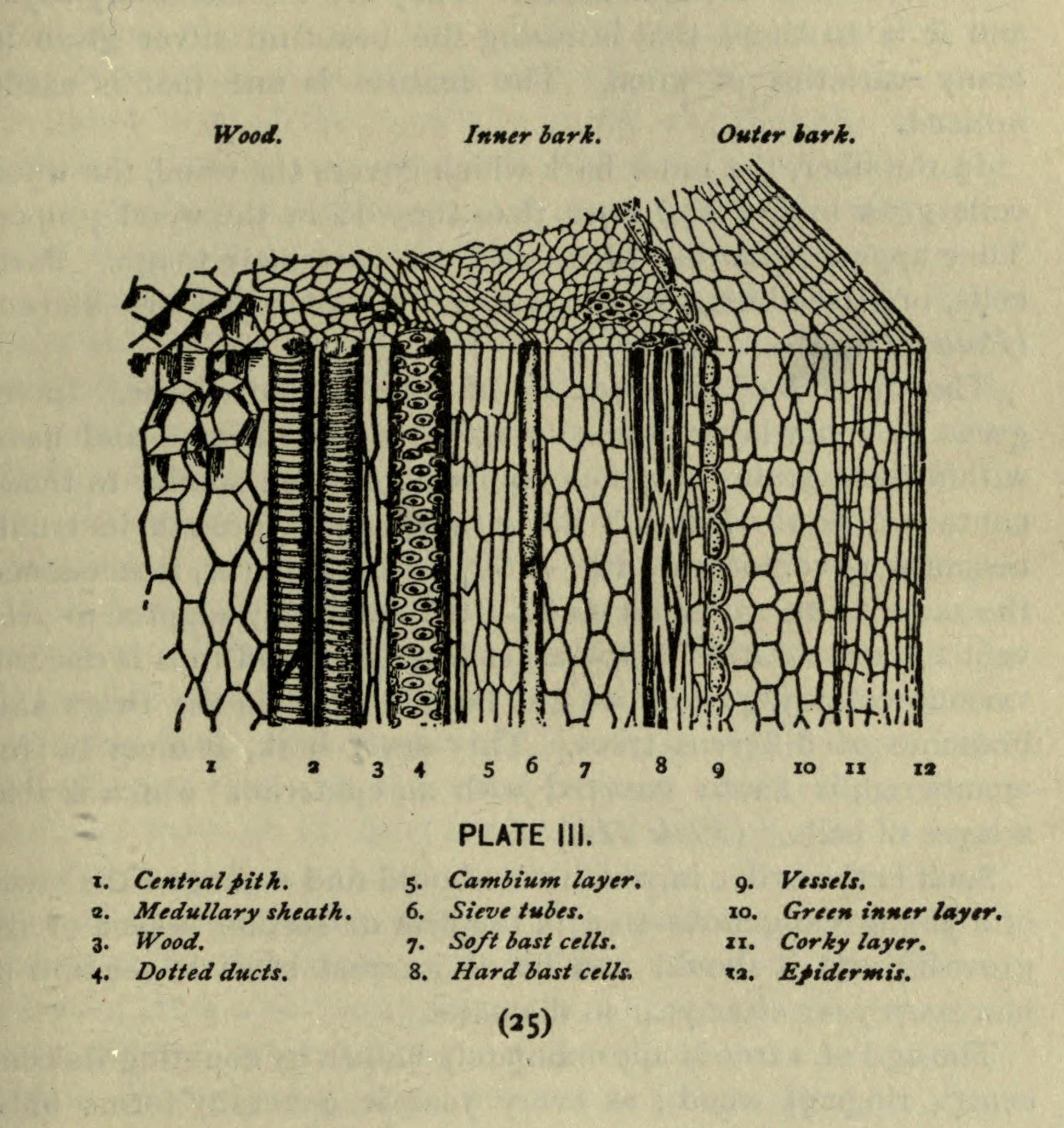
Diagram of wood and bark cell layers. Lounsberry and Rowan. A guide to the trees. 1900. Contributed in BHL by University of Toronto Earth Science Library (Noranda).

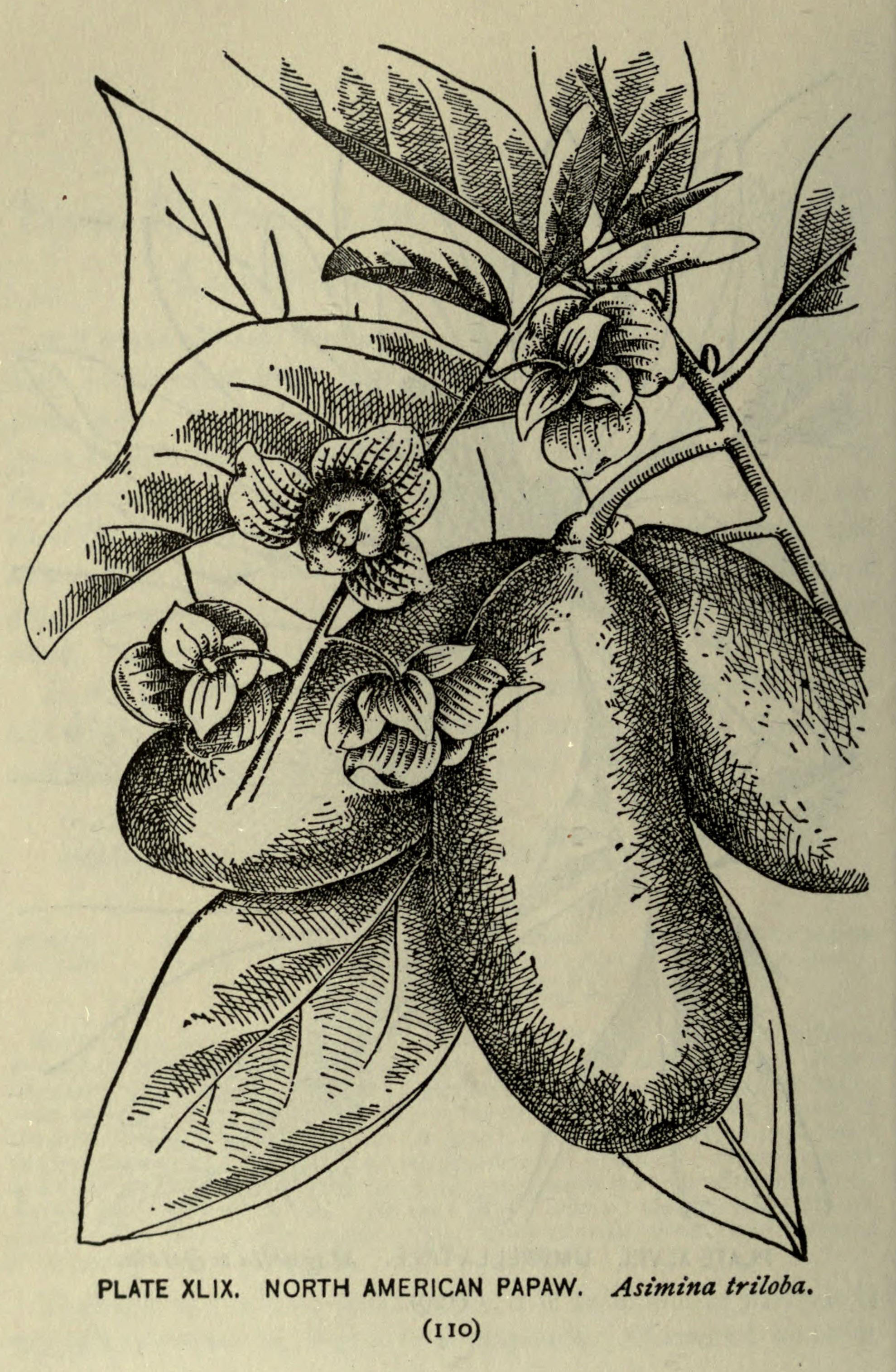
“North American Papaw, Asimina triloba.” Lounsberry and Rowan. A guide to the trees. 1900. Contributed in BHL by University of Toronto Earth Science Library (Noranda).

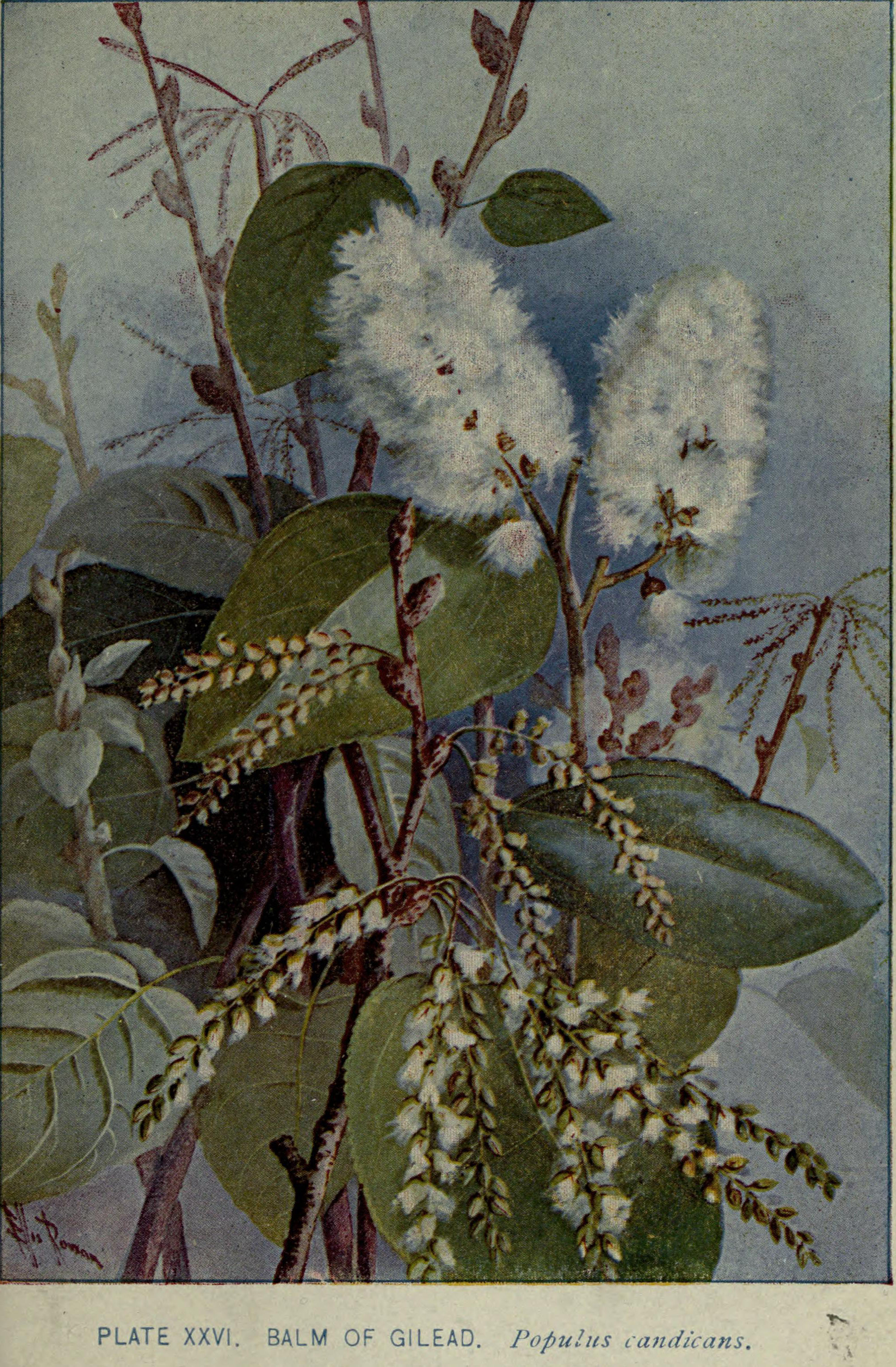
“Balm of Gilead. Populus candicans.” Lounsberry and Rowan. A guide to the trees. 1900. Contributed in BHL by University of Toronto Earth Science Library (Noranda).

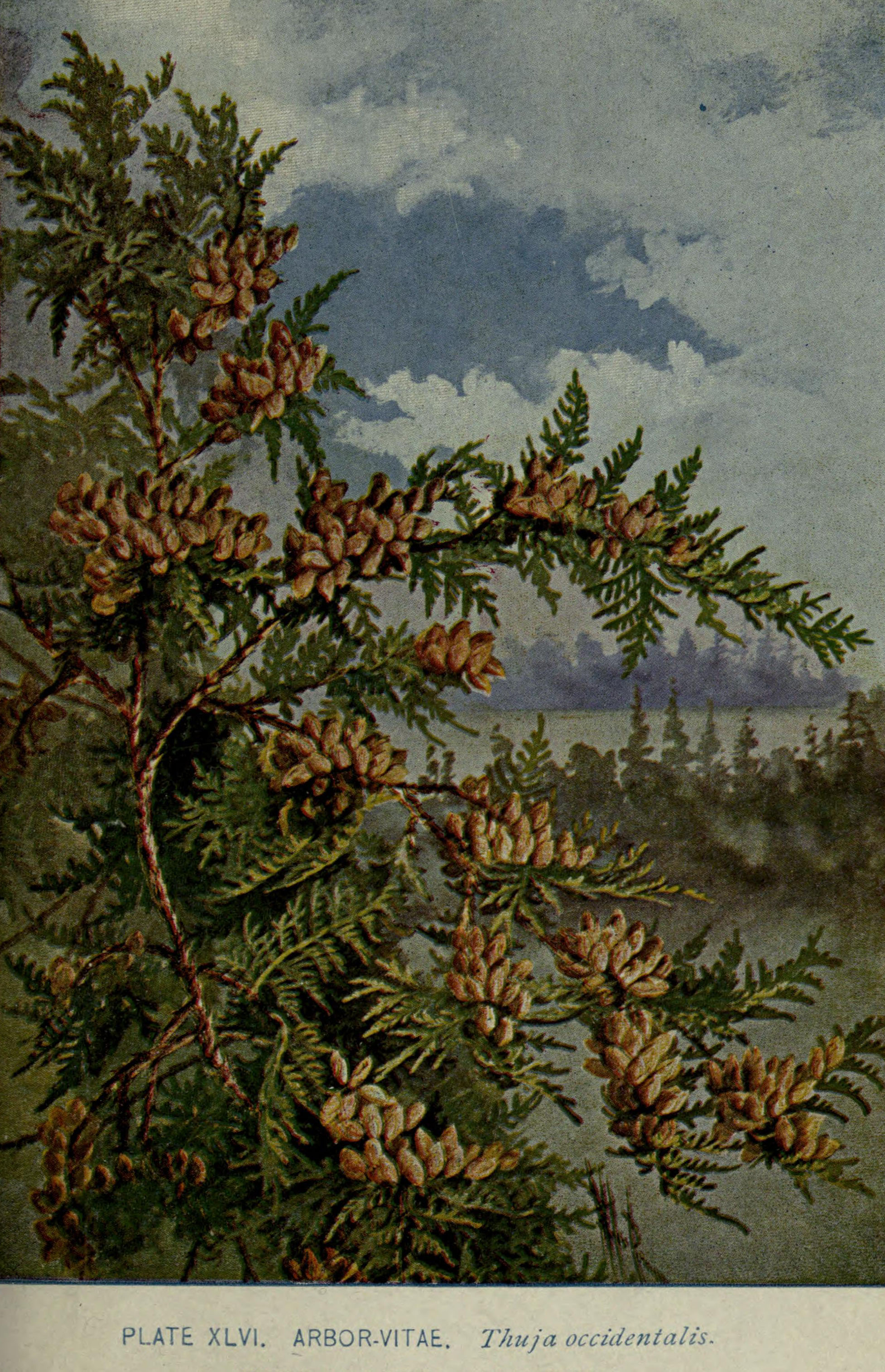
“Arbor-vitae. Thuja occidentalis.” Lounsberry and Rowan. A guide to the trees. 1900. Contributed in BHL by University of Toronto Earth Science Library (Noranda).

Rowan had many opportunities to travel throughout her life, and used them to paint diverse plants in the field. She moved to New Zealand at Pukearuhe on the North Island after her marriage in 1873. During her pregnancy, she moved back to her family home and dove into botanical painting in earnest. In the 1880s she travelled throughout Australia on her husband’s business trips, and also to India and England with her sister. During this time, she painted species for scientific classification, won prestigious exhibition awards, and established herself as a commercially successful artist (despite some controversy stirred by disgruntled male artists). She writes about her travels in her book, A flower-hunter in Queensland and New Zealand (1898). (Interested readers should expect that her descriptions of people of color reflect a white imperialist perspective.)

In 1895 Rowan left Australia for a trip to England and America, where she met Alice Lounsberry in New York in 1896 and extended her stay to take on their collaborative projects. Later in life she would travel to New Guinea, where despite her declining health, she produced over 300 paintings of Birds of Paradise, butterflies, flora, and fungi.

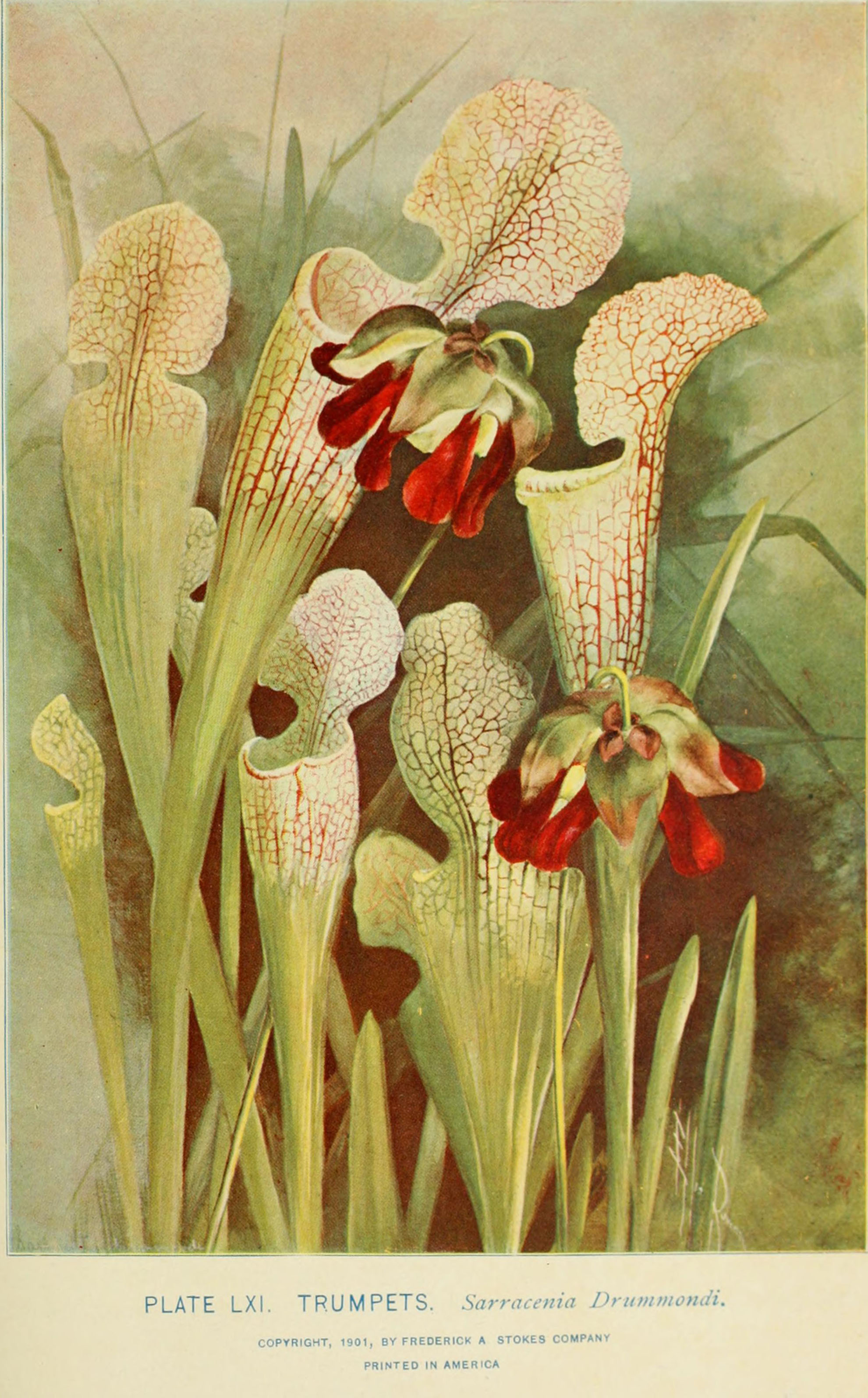
“Trumpets. Sarracenia Drummondi.” Lounsberry and Rowan. Southern wild flowers and trees. 1901. Contributed in BHL by NCSU Libraries.
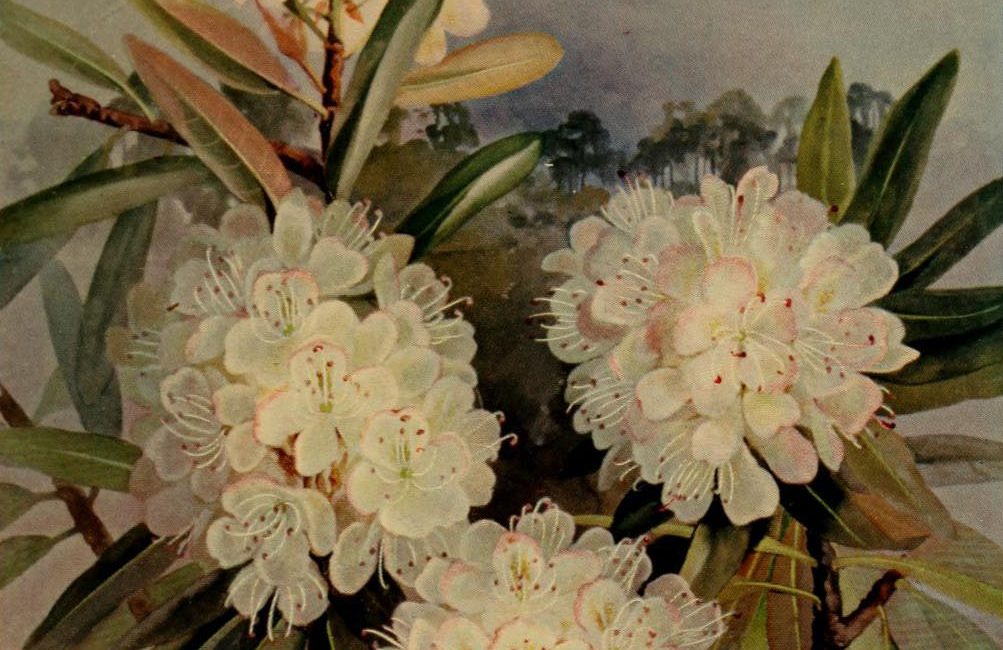
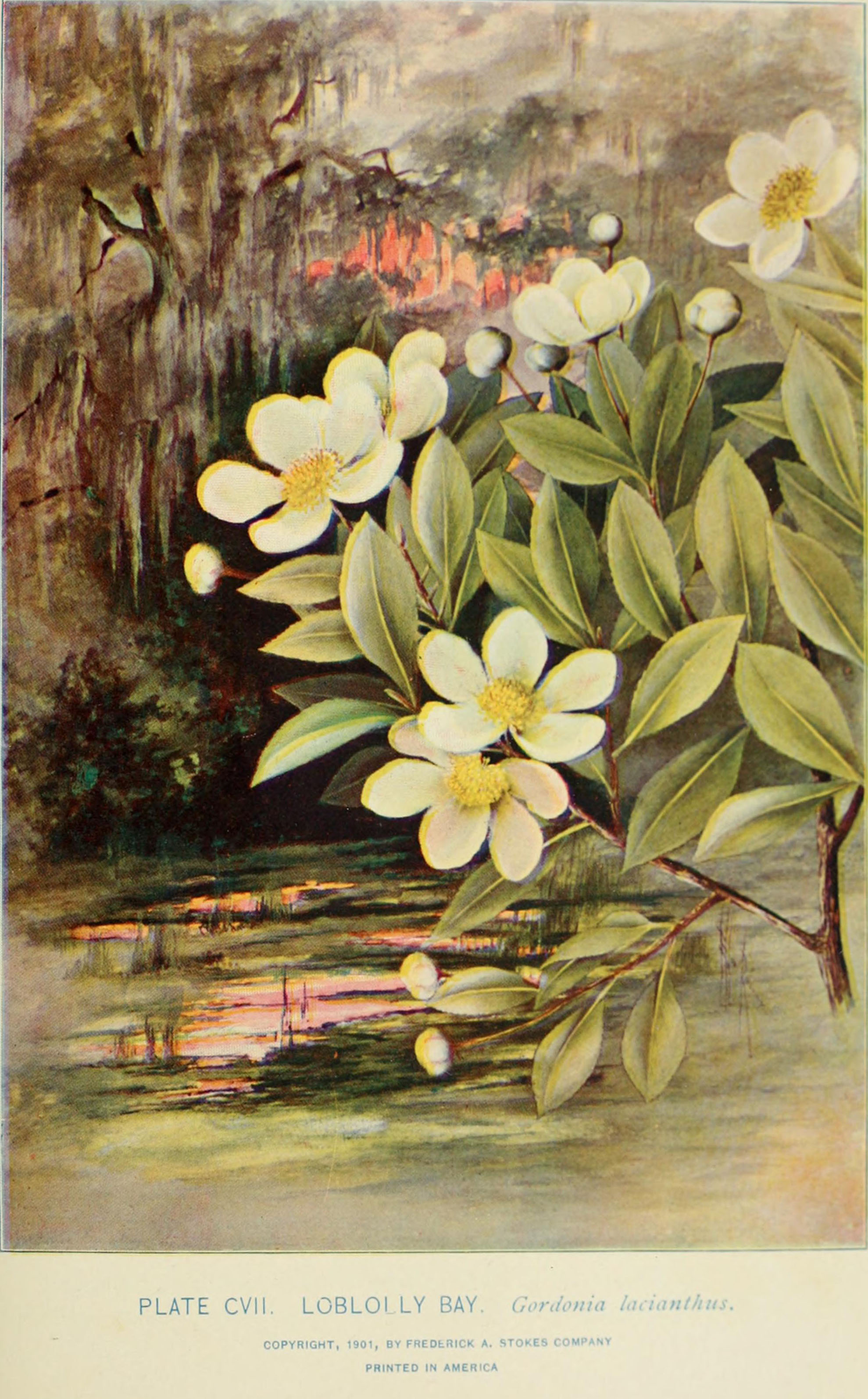
“Loblolly Bay. Gordonia lacianthus.” Lounsberry and Rowan. Southern wild flowers and trees. 1901. Contributed in BHL by NCSU Libraries.

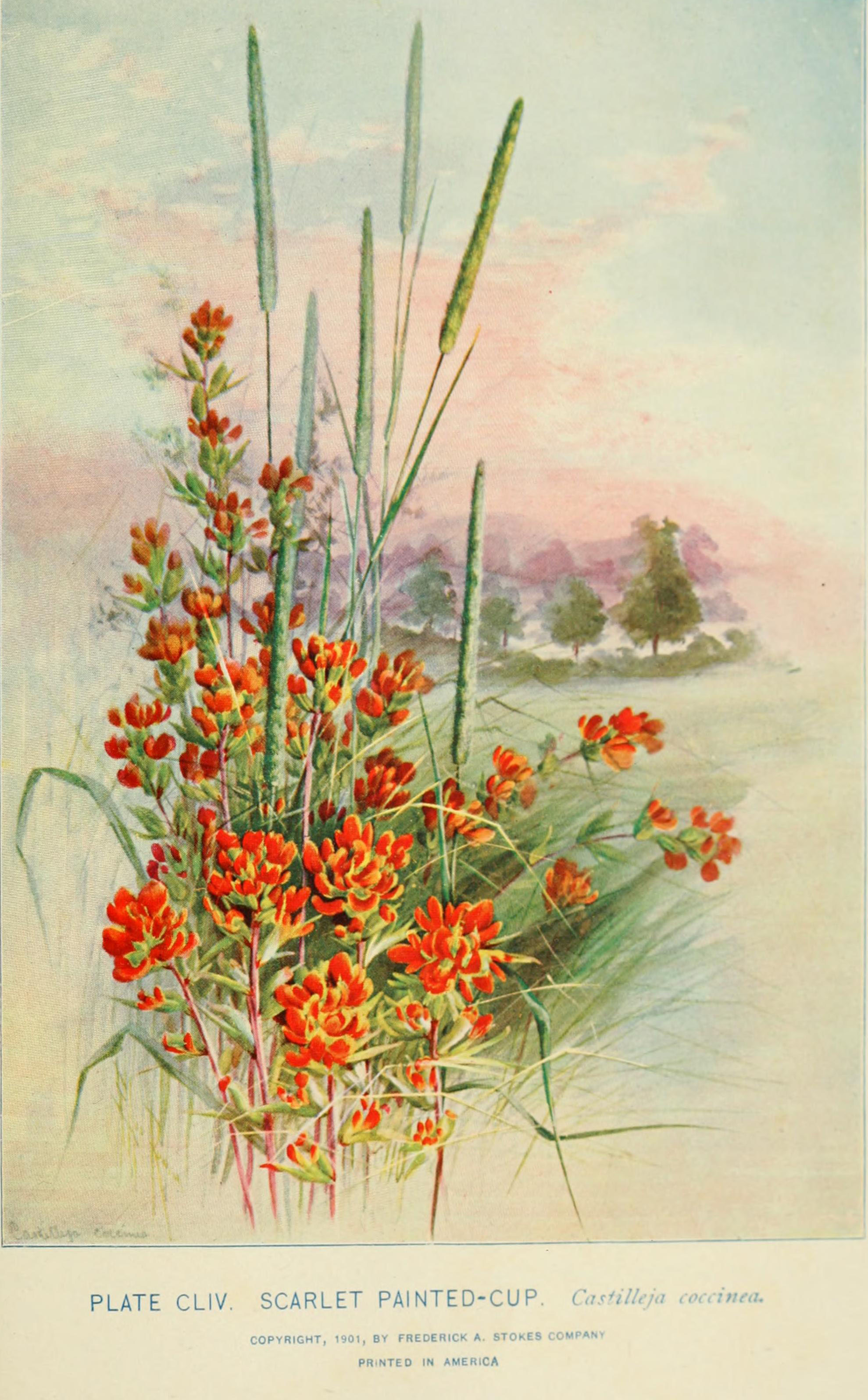
“Scarlet painted-cup. Castilleja coccinea.” Lounsberry and Rowan. Southern wild flowers and trees. 1901. Contributed in BHL by NCSU Libraries.

Biographical details on Alice Lounsberry (1873-1929) are more sparse. She was a New Yorker, and would have been about twenty-three when she proposed her vision of a collaborative project with Rowan, who by then was an internationally acclaimed painter. They spent at least two years traveling together in the U.S. to research their botanical guides.

Lounsberry shares some of that process in the preface to Southern Wildflowers and Trees,

To learn something of the history, the folk-lore and the uses of southern plants and to see rare ones growing in their natural surroundings, Mrs. Rowan and I travelled in many parts of the south, exercising always our best blandishments to get the people of the section to talk with us. Through the mountainous region we drove from cabin to cabin, and nowhere could we have met with greater kindness and hospitality. At the present time, however, there seems to be little country-lore concerning numbers of southern plants. In years to come, when they are better known, more tales of wonder will, no doubt, be woven about them. But for variety and beautiful, luxuriant growth the southern field is perhaps unrivalled. (Lounsberry and Rowan, Southern wild flowers and trees, pp. ix-x).

Lounsberry credits the Biltmore Herbarium in North Carolina as an essential resource.

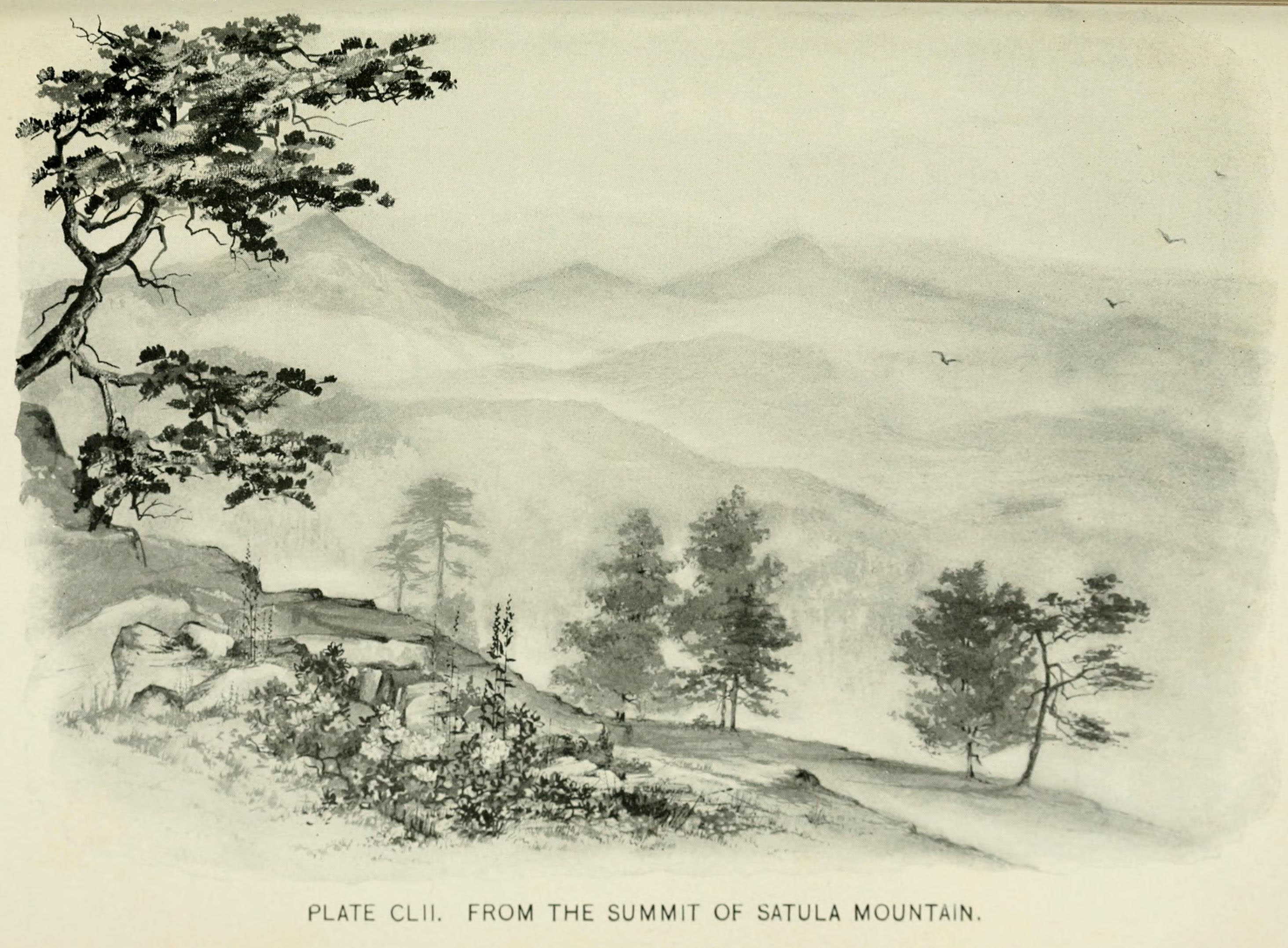
“From the summit of Satula Mountain.” Lounsberry and Rowan. Southern wild flowers and trees. 1901. Contributed in BHL by NCSU Libraries.

Southern wild flowers and trees shares snapshots of the pair’s travels with a scattering of landscape paintings and descriptive vignettes. The above image (“From the summit of Satula Mountain”) pairs with the caption:

At the approach of twilight we stood on the top-most rock of Satula Mountain about which, as a great unbroken ring, row after row, arise the mountains; for so is this peak encircled by the great Appalachian system. To our view the most distant ones appeared as though blending with the sky, while those nearer became more clear until was reached the green verdure at our feet. Nor were these mountains simply an undulatory line. Ruggedly and individually formed, each peak had withal a look humane and friendly. Between the rocks were fresh flowers, and higher than all else a pine, stunted and forlorn, raised its ungainly branches. (Lounsberry and Rowan, Southern wild flowers and trees.)

On her own, Lounsberry wrote and published other books including:

The wild flower book for young people, 1906. New York, F. A. Stokes company. Digitized in BHL by Cornell University Library.

The garden book for young people, 1908. New York, F. A. Stokes company. Digitized in BHL by Smithsonian Libraries.

Gardens near the sea; the making and care of gardens on or near the coast with reference also to lawns and grounds and to trees and shrubbery, 1910. New York, Frederick A. Stokes company. Digitized in BHL by Cornell University Library.

References

“Alice Lounsberry.” Accessed: https://upclosed.com/people/alice-lounsberry/

“Ellis Rowan: Plant Hunter.” Wilson, Sally. Accessed: https://theplanthunter.com.au/culture/ellis-rowan-plant-hunter/

“The Flower Hunter Ellis Rowan.” National Library of Australia. Accessed: http://pandora.nla.gov.au/pan/44384/20040920-0000/www.nla.gov.au/exhibitions/ellisrowan/home.html

March 15, 2019by Joel Richard
Page 5 of 17« First...«4567»10...Last »

Help Support BHL

BHL's existence depends on the financial support of its patrons. Help us keep this free resource alive!

search

About BHL

The Biodiversity Heritage Library (BHL) is the world’s largest open access digital library for biodiversity literature and archives. BHL operates as a worldwide consortium of natural history, botanical, research, and national libraries working together to digitize the natural history literature held in their collections and make it freely available for open access as part of a global “biodiversity community.”

Join Our Mailing List

Sign up to receive the latest news, content highlights, and promotions.

Subscribe Now

Subscribe to Blog via Email

Enter your email address to subscribe to this blog and receive notifications of new posts by email.

Join 319 other subscribers

Subscribe to Blog Via RSS

Subscribe to the blog RSS feed to stay up-to-date on all the latest BHL posts.

Access RSS Feed

Inspiring Discovery through Free Access to Biodiversity Knowledge.

The Biodiversity Heritage Library makes it easier than ever for you to access the information you need to study and explore life on Earth…for free, anytime, anywhere.


ABOUT | HARMFUL CONTENT | PRIVACY | SITE MAP | TERMS OF USE