Biodiversity Heritage Library - Program news and collection highlights from BHL
  • Home
  • News
  • Featured Books
    • All Featured Books
    • Book of the Month Series
    • BHL at 20
  • User Stories
  • Campaigns
    • Fossil Stories
    • Garden Stories
    • Monsters Are Real
    • Page Frights
    • Her Natural History
    • Earth Optimism 2020
  • Tech Blog
  • Visit BHL
Home
News
Featured Books
    All Featured Books
    Book of the Month Series
    BHL at 20
User Stories
Campaigns
    Fossil Stories
    Garden Stories
    Monsters Are Real
    Page Frights
    Her Natural History
    Earth Optimism 2020
Tech Blog
Visit BHL
  • Home
  • News
  • Featured Books
    • All Featured Books
    • Book of the Month Series
    • BHL at 20
  • User Stories
  • Campaigns
    • Fossil Stories
    • Garden Stories
    • Monsters Are Real
    • Page Frights
    • Her Natural History
    • Earth Optimism 2020
  • Tech Blog
  • Visit BHL
Biodiversity Heritage Library - Program news and collection highlights from BHL
Blog Reel, Campaigns, Her Natural History

The Life and Works of Margaret Meen

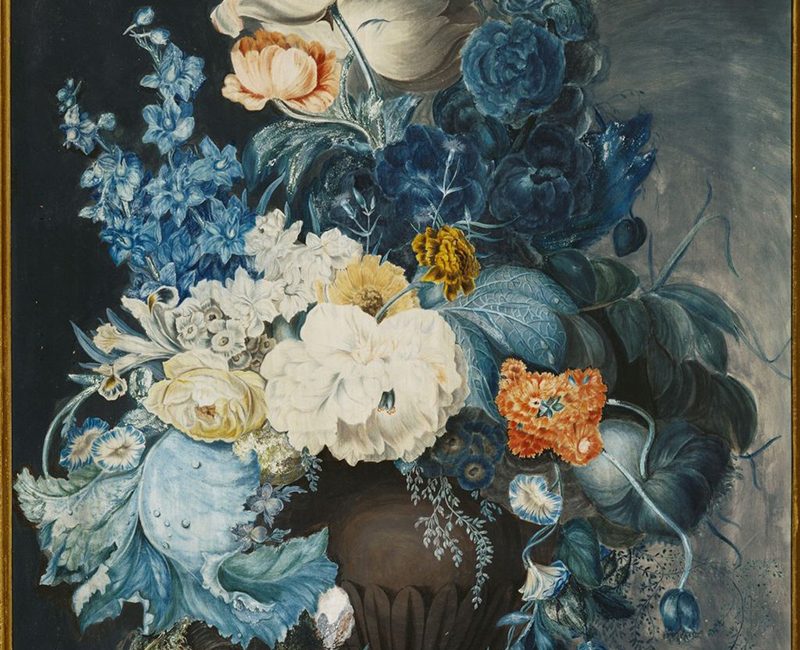
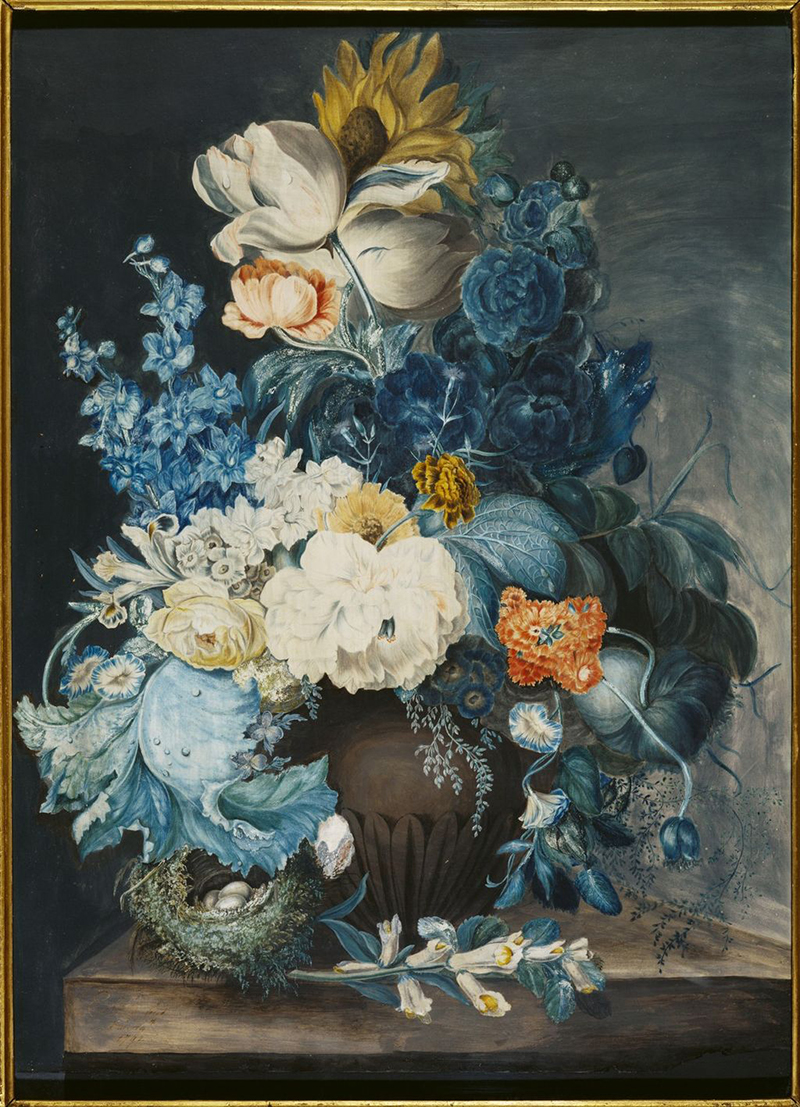
“A group of flowers in a jar and a bird’s nest,” by Princess Elizabeth after Margaret Meen. Now in the Victoria and Albert Museum, London. Public domain, retrieved from Wikimedia Commons.

As you may have seen in BHL’s blog yesterday, The Royal Botanic Gardens, Kew, has been partnering with the Oak Spring Garden Foundation to digitize works by women botanical artists held in Kew’s archives. One of these talented but largely unknown artists is Margaret Meen – whose botanicals graced the walls of royal palaces and scientific academies. In fact, though little remembered or written about today, Meen’s botanicals and her prowess as an instructor of fledgling artists left a lasting impression on British botanical illustration.

Margaret Meen was born sometime around 1751 in the English county of Suffolk, but lived most of her life in London in order to better sustain herself as a working artist and teacher.  Though it is not known where or how Meen developed her skill as an artist, her brother Henry was Prebend of Twyford and also taught at St. Paul’s, indicating that Margaret most likely came from a family of some wealth and standing and thus would have had access to an education in the arts.  Certainly Henry’s status in London allowed Margaret to come into contact with the upper echelon of British aristocracy, and Meen’s talent as an artist was soon recognized by the royals.

One of her most celebrated patrons, in fact, was Queen Charlotte—wife of George III—who wrote in her diary in 1789 that she “drew with Miss Mean [sic] from 10 till one,” and who most likely purchased a painting of flowers that now hangs at the Victoria and Albert Museum in London.

Additionally, the queen’s daughter, Princess Elizabeth, was quite the budding artist herself, and her notable painting “Flower piece with bird’s nest” (1792) is modeled after Meen’s work purchased by the queen.  The princess even maintained a friendly correspondence with Meen as late as 1822.

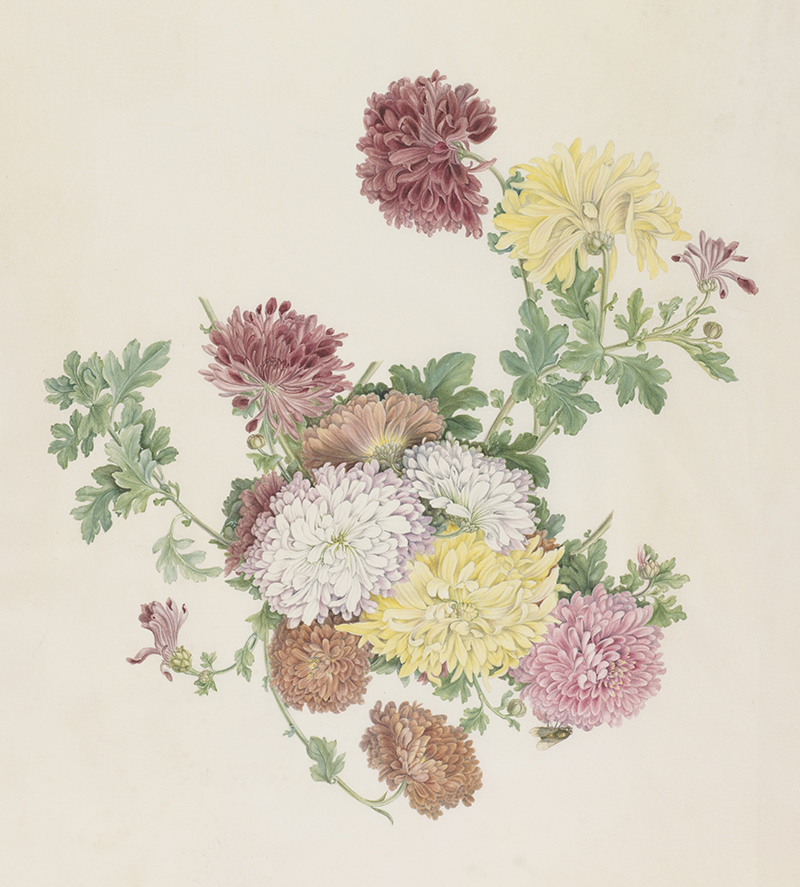
Chrysanthemums and a fly. Reproduced with permission from the Board of Trustees of the Royal Botanic Gardens, Kew, digitized with support from the Oak Spring Garden Foundation.

Aside from being the occasional tutor to artistically-inclined members of the royal family, Meen was a member of and exhibited her work at the Royal Academy from 1775 to 1785 and also with the Associated Artist in 1810. She was also employed to document the many new plants being grown in the Royal Gardens at Kew in the late 18th and early 19th centuries, using William Aiton’s Hortus Kewensis to name the species she illustrated. At this time, the Gardens at Kew were unrivaled in Britain for their botanical collection.

Her work, though largely unheralded, has been highly praised on the occasions that it is critiqued with special notice of Meen’s prodigious output and effective illustrative techniques.  Also, usually mentioned with Meen’s name is her founding of the periodical Exotic Plants from the Royal Gardens at Kew (1790), which she dedicated to Queen Charlotte but which only lasted for two issues.

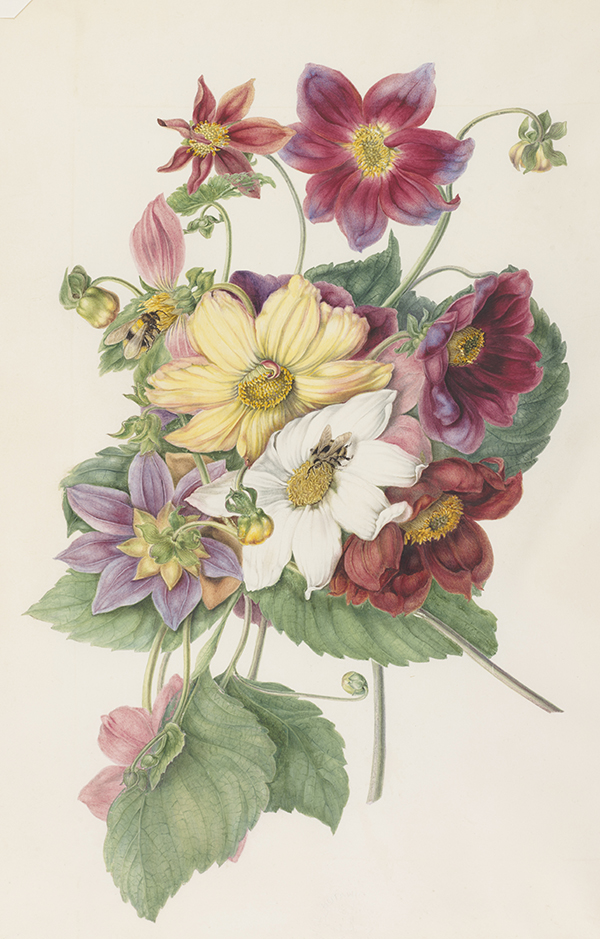
Watercolor of various flowers and bees. Reproduced with permission from the Board of Trustees of the Royal Botanic Gardens, Kew, digitized with support from the Oak Spring Garden Foundation.

Finally, Meen spent a large part of her later years as a drawing tutor for families with the means to provide their children with one and as an instructor for larger groups of students at a school in Notting Hill, London.  Among Meen’s pupils was the future Lady Northampton and Emma Smith, the future wife of Jane Austen’s nephew and biographer. Meen kept up her teaching until late in her life and as she never married or had children of her own, was especially determined to impart her artist lessons on to young minds in whom she saw latent talent.

Margaret Meen’s career as a botanical artist took her from the halls of Buckingham Palace to chambers of the Royal Academy and the schoolrooms of London. Over her long life she not only contributed to the furtherance of scientific knowledge through her botanical prints but also to the development of young artists from the most privileged to those who simply attended her classes in Notting Hill. Her artwork was appreciated by everyone from the Queen of England to its most revered scientists and its precocious young scholars. Though little remembered today, Margaret Meen’s art and legacy thus stands as an important part of late 18th and early 19th century British botanical history and deserves to be better celebrated today.

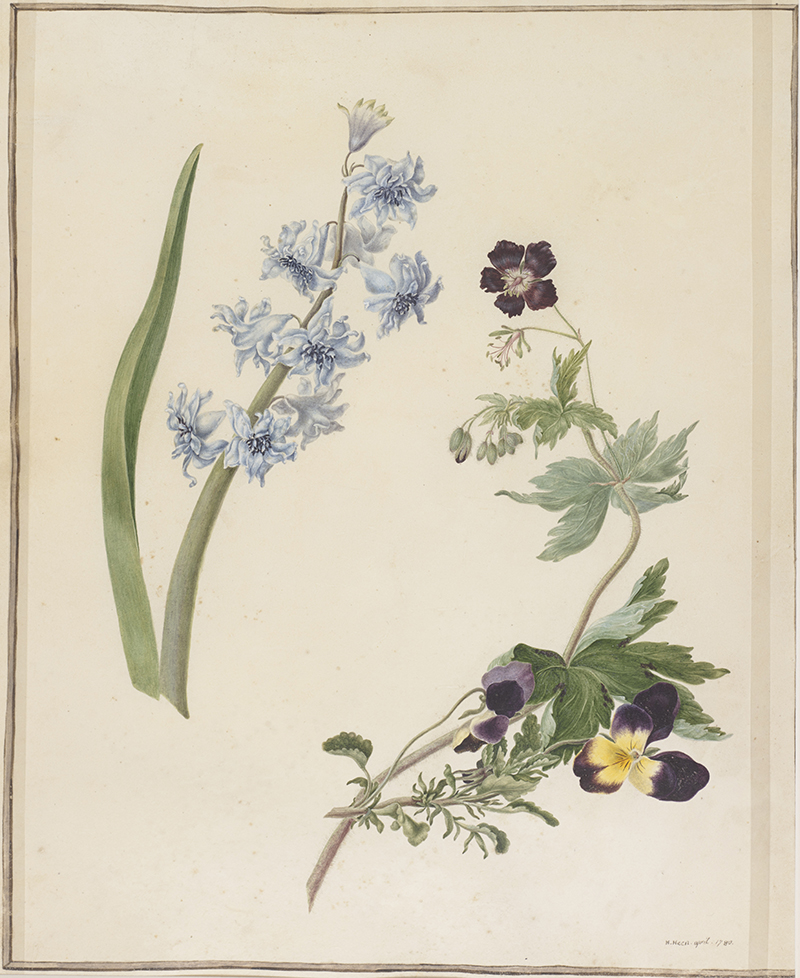
Watercolor of pansy and unknown flower. Reproduced with permission from the Board of Trustees of the Royal Botanic Gardens, Kew, digitized with support from the Oak Spring Garden Foundation.

This post was updated on 22 February 2021 to correct birth and death dates for Meen and a typo in quoted materials from Queen Charlotte’s diary.

References

Blunt, Wilfrid and William T. Stearn. The Art of Botanical Illustration. New York: Antique Collectors Club Press, 1993. Originally published in 1950.

Mabey, Richard. The Flowering of Kew. London, UK: Ebury Press, 1988.

McDonald, Kelly M. “Margaret Meen: A Life in Four Letters.” Academia.edu.

Royal Academy. “Anderson’s Notes on the 1775 Exhibits of James Lambert, William Laranson, P.J. Loutherbourg, William Martin, J. Mauris, Jeremiah Meyer, Margaret Meen and Mary Moser.”

Royal Collection Trust. “Description of ‘Flower piece with bird’s nest.’”

March 14, 2019by Joel Richard
Blog Reel, Campaigns, Her Natural History

Passionate pioneers – increasing access to botanical artwork by women artists

Two BHL contributors – the Royal Botanic Gardens Kew in London, UK and the Oak Spring Garden Foundation in Virginia, USA, have recently embarked on a collaborative project to digitise works of art by women botanical artists. Kew’s Metadata and Digitisation Officer Joanna Durant sheds some light on two of these often under-represented botanical pioneers.

Why Digitise?

Historically, female botanists and botanical artists were rarely given as much credit as their male counterparts. Botanical art was often viewed as a pleasant pastime for women who had time on their hands whilst their husbands were at work, and the contribution that these women made to the advancement of scientific illustration was often undermined.

To highlight the importance of these historically, scientifically and socially significant collections, Kew’s Library, Art and Archives department, in collaboration with the Oak Spring Garden Foundation, is in the process of digitising its out of copyright work by women artists, spanning several centuries.

Kew holds over 200,000 prints and drawings, and this working resource is available to staff and visitors to the department, often providing a reference tool against preserved herbarium specimens. The ultimate aim of this collaborative effort is to ensure that high quality images of illustrations and their associated data is safely stored in digital format for future generations.

The benefits of this process are threefold. We are improving access to our unique collections (the images and data will be available online), we are preventing any potential loss of information (if the worst happened and the collections were somehow lost or damaged), and we are extracting and collating artwork that is currently being stored with specimens in the herbarium. The artwork is then being rehoused in more appropriate storage conditions as the project progresses.

Think of it as a huge inventory, with photography, data transcription and then the upload of digital files to nicely wrap it all up.

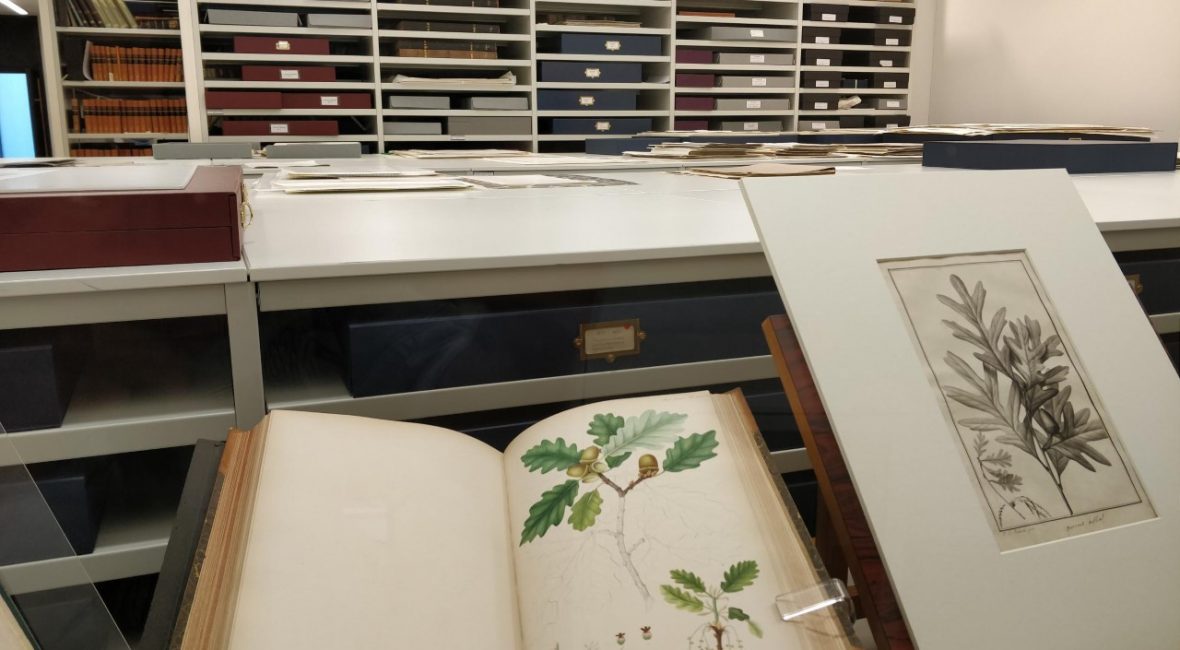
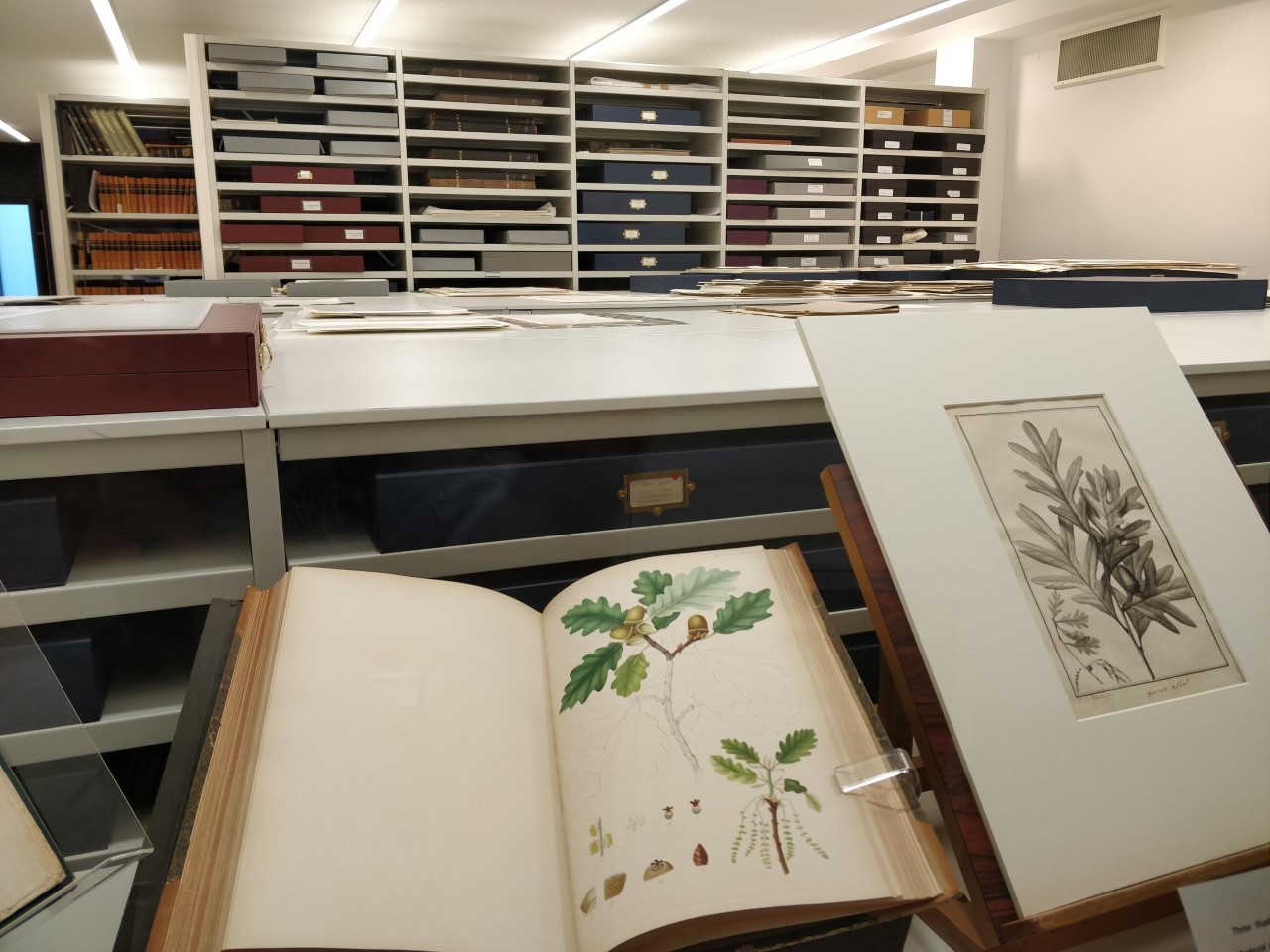
One of Kew’s Library, Art and Archives temperature-controlled Stores used to house illustrations and rare books.

Botanical Pioneers

There seems to be a pattern that emerges when you start to research botanical artwork created by women, particularly those who lived and worked in the 18th, 19th and 20th centuries. “Very little is known about her…” “She published her work anonymously…” or, very commonly, was only known by her husband’s name. There are even instances of artwork not being signed or attributed to any particular artist at all.

These often-unrecognised artists made a huge impact on our current understanding of botany. From the anatomical structure of plants to the habitats in which they grew and the communities that relied on them, women botanical artists were real trailblazers in their field.

Mary Anne Stebbing and the Empty Chair

“Mrs T. R. R. Stebbing” can be found on numerous acquisition labels on illustrations in Kew’s collection. It is actually referring to the early 20th century botanical artist Mary Anne Stebbing (née Saunders), under her zoologist-husband’s name, Thomas Roscoe Rede Stebbing.

Born in around 1845 into a family of keen naturalists, Mary began gathering and sketching plants at an early age, and her ambition was to “illustrate the British flora by water-colour drawings”. Sadly, a fire in 1881 destroyed much of her early work, but her resulting later illustrations took on a more detailed and scientific feel with various anatomical sections of plants and notes on habitats and locations included.

Mary illustrated many species for her husband’s scientific publications, often branching out from botany into Crustacea. Interestingly, she was never credited for her vital contributions, and despite working in scientific collaboration with her husband, the papers were always published in his name. However, in her husband’s obituary in 1926, Nature referred to Mary as “an accomplished botanist”, inferring that by this time she was very much viewed as a botanist in her own right among her peers.

However, there is more to the story of Mary Anne Stebbing than meets the eye, and it is a fascinating glimpse into Edwardian social history.

Mary’s husband, Thomas, was a member of the Linnean Society – a prestigious society dedicated to the study of evolution and natural history and one which was, traditionally, strictly men only. Thomas felt strongly that women should also be accepted as members, and Mary was successfully invited to become one of the first female members in 1905. To mark this occasion, a painting was commissioned by the Treasurer, Frank Crisp, by the artist James Sant.

In the painting, Mary is positioned prominently in the foreground, in front of her husband. Also pictured is Catherine, Frank’s wife, who was also being admitted as a new Society member. In a telegraph from Frank after the painting was completed, his attitude towards the significance of Mary’s position within the artwork can be seen: “we must surely have at the table a lady fellow who has done something, not one without a record”. Whether the absence of Mary’s name on her and her husband’s papers was being referenced, or whether Crisp simply didn’t believe that she was worthy of scientific recognition, we may never fully understand. Press coverage of the painting was scathing – one newspaper advised not missing a glimpse of the picture as it would “make you laugh”. Crisp withheld the artwork until his death in 1919, but by that time, the painting had been altered. Both Mary and Thomas had been painted out, with Mary being replaced by an empty chair.

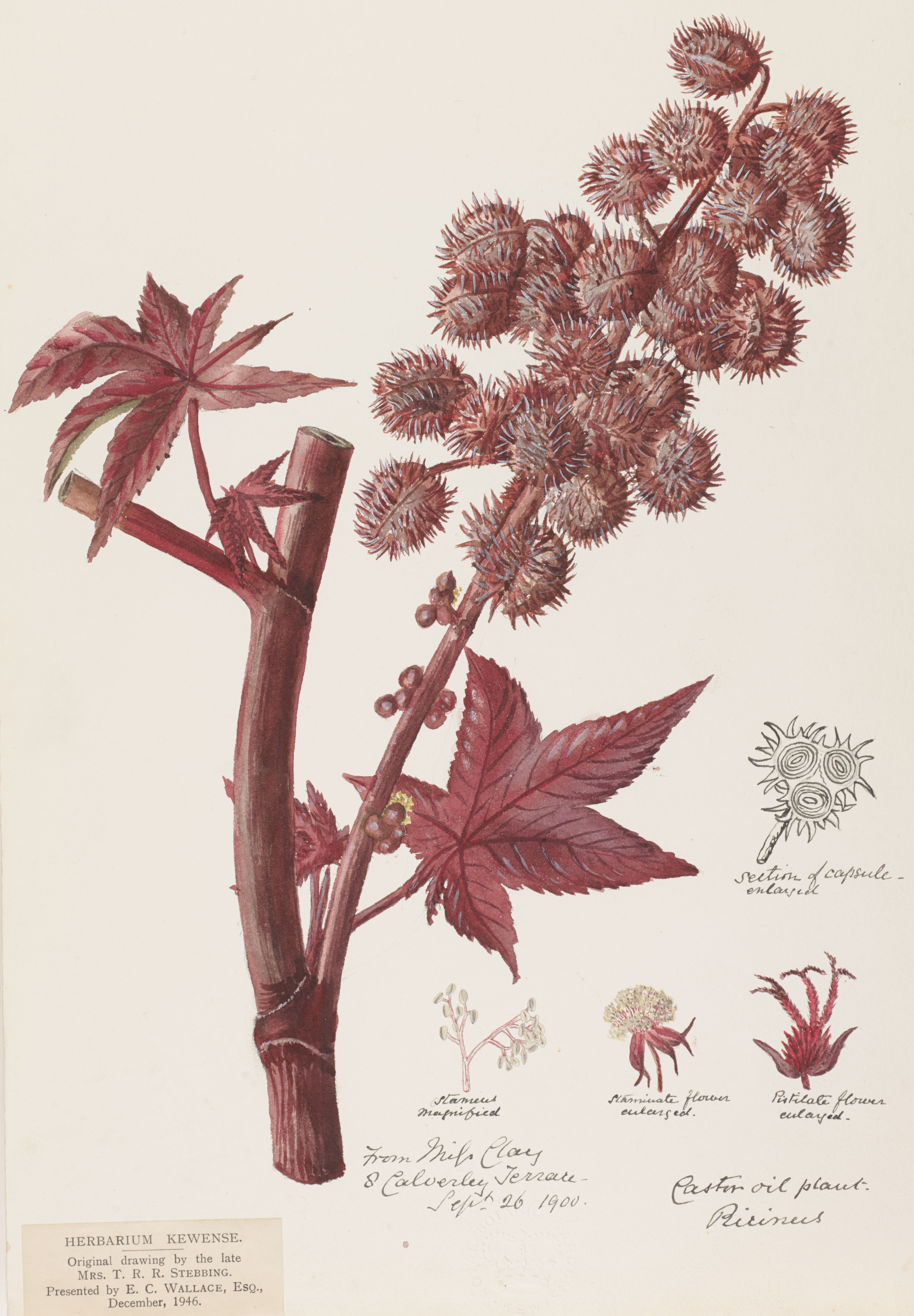
Watercolour of a Castor oil plant (Ricinus communis) showing various enlarged sections by Mary Anne Stebbing (c1845 – 1927). Copyright of Royal Botanic Gardens Kew.

Sarah Anne Drake

An interesting example of an artist of whom very little is known is Sarah Anne Drake (1803 – 1857), or “Miss Drake”, as she often signed her work.

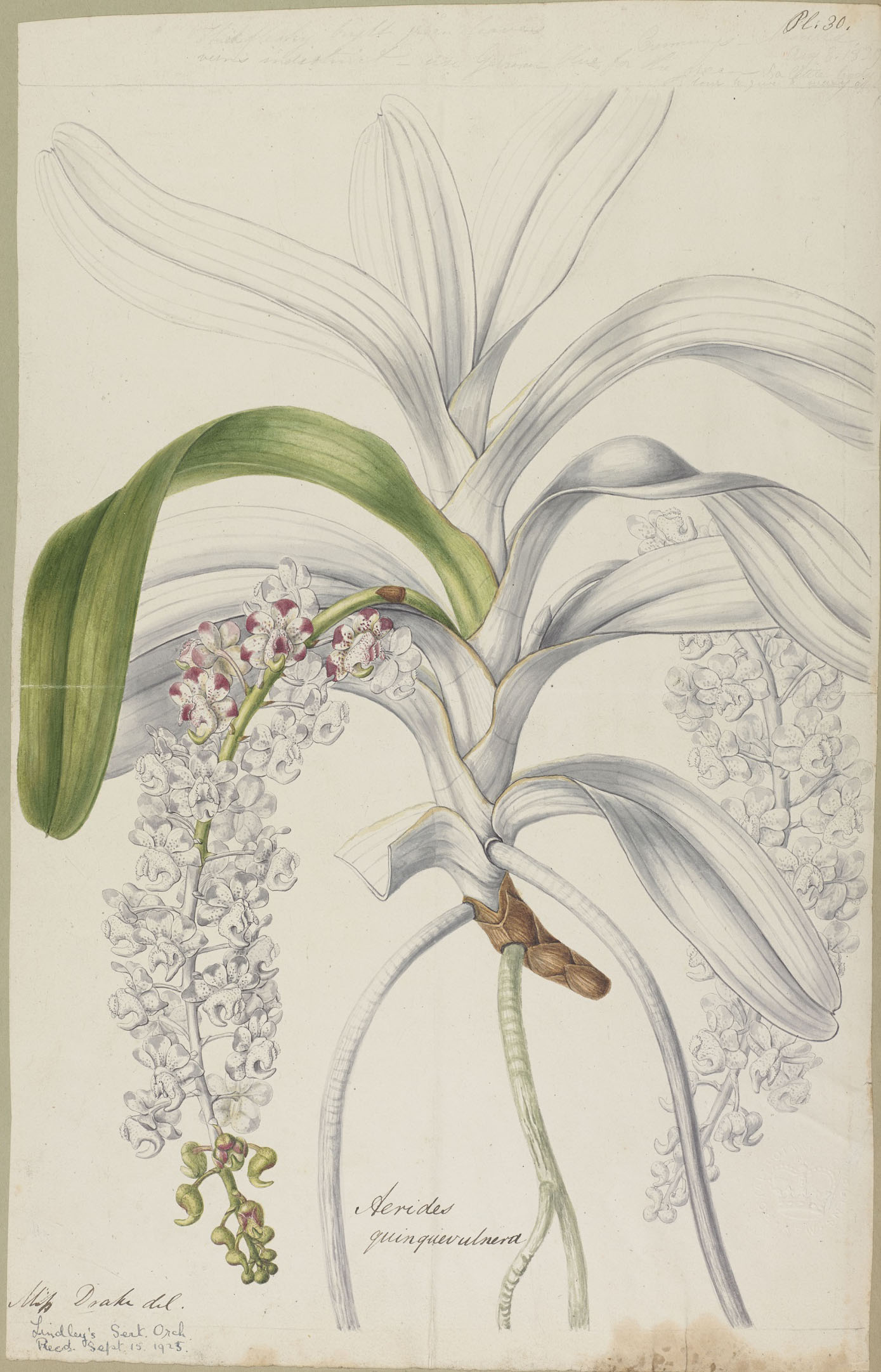
Born in Norfolk, UK, Sarah Anne Drake moved to London in around 1830. Through a family friendship, she was brought into the household (possibly to act as a children’s governess) of John Lindley, the then secretary of the Horticultural Society of London and a keen botanist. John soon recognised that Sarah was an extremely talented artist, and within a few years she had been commissioned to illustrate his famous publication Sertum Orchidaceum (1837 – 1841).

The 19th century saw an explosion of interest in orchids (one might even describe it as an obsession). For the Victorians, orchids represented romance and seduction, and scientists were keen to illustrate these incredible and exotic plants to accompany their publications. Sertum Orchidaceum was indeed a lavish example of this botanical craze.

A plate for Sertum Orchidaceum entitled Aerides quinquevulnera by Sarah Anne Drake (1803 – 1857). Copyright of Royal Botanic Gardens Kew.

John Lindley, Jane Loudon and Ladies botany

Sarah Anne Drake also provided highly technical illustrations for several other publications at the time, including another written by John Lindley, the fascinatingly titled Ladies Botany (1834 – 1837).

John Lindley used this publication in his quest to make botany more “scientific” – he was one of a growing number of scientists and philosophers who became fixated with challenging botany’s reputation for being “unmanly”, “amateur” and above all, feminine. Botany was viewed as a separate discipline distinct from mainstream science, and academics such as John Lindley aimed to defeminise and modernise it. In Ladies Botany, the author attempts to displace the traditional Linnaean system of study (which was viewed as being strongly wedded to the amateur student) with a more natural system. Unfortunately, the rhetoric in the publication is gendered and, when read now, can be described as condescending.

It wasn’t until 1842 that a popular book successfully began to introduce the natural system of study, with the publication of Botany for ladies; or a popular introduction to the natural system of plants by Jane Loudon (1807 – 1858).

This book takes the reader through the botanical orders and introduces de Candolle’s systematic description of species, and opens with a frank statement from the author that as a child she could “never learn botany”. The introduction describes how books on the subject, with the exception of John Lindley’s, were “all sealed to me”, and also includes the following telling sentence: “It is so difficult for men whose knowledge has grown with their growth, and strengthened with their strength, to imagine the state of profound ignorance in which a beginner is, that even their elementary books are like the old Eton Grammar when it was written in Latin – they require a master to explain them.”

The influence of women botanists and botanical artists on the progression of botanical knowledge can be traced back for centuries, and the way that these women were viewed by the male-dominated field of science is a fascinating glimpse into an important part of our social history. It is the aim of organisations such as BHL, Oak Spring and Kew Gardens to document and disseminate the incredible achievements of these women for future generations.

Further Reading and References

Figuring it out: Science, gender and visual culture by Ann B. Shteir and Bernard Lightman

Bloom: The Botanical Vernacular in the English Novel by Amy King

March 13, 2019by Joel Richard
Blog Reel, Campaigns, Her Natural History

Her “Diversion”: The Gardening and Botanical Pursuits of Mary Somerset, Duchess of Beaufort

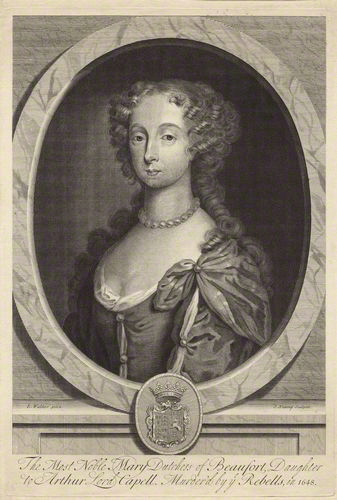
Portrait engraving of the Duchess of Beaufort by Joseph Nutting, after Robert Walker, circa 1690-1722 (image from the National Portrait Gallery, London, via Wikimedia Commons)

Prominent botanist and cataloger of gardens, William Sherard (1659-1728), was hired by an aristocrat to tutor her grandson in botany for “hee loving my diversion so well.” This was Mary Somerset, the first Duchess of Beaufort (1630-1715), an accomplished gardener and botanist in her own right. She sought solace in “natural learning” and tending plants, some cultivated in what she referred to as her “infirmary.” As detailed in landscape historian and conservator Mark Laird’s splendid A Natural History of English Gardening (2015), her gardening activities were a refuge from bouts of depression. She remarked in a letter of her cataloging: “When I get into storys of plants I know not how to get out.”  Laird’s chapter on Mary Somerset, and other recent scholarly investigations, examine her work and help elevate her role in the history of science. Rather than simply a diversion from melancholia, she was dedicated in her studies, blossoming late in her life.

The English noblewoman was born Mary Capel and is also known by the name from her first marriage, Mary Seymour, Lady Beauchamp. She gave birth to nine children and oversaw, with an exacting eye, two estates—Badminton House in Gloucestershire and Beaufort House in London with their famous gardens. Mary Somerset began intensely collecting and cultivating plants in the 1680s. In widowhood, beginning in 1700, it became even more of a consuming passion. Somerset’s specimens, both exotic and domestic, were featured in her and other important gardens.
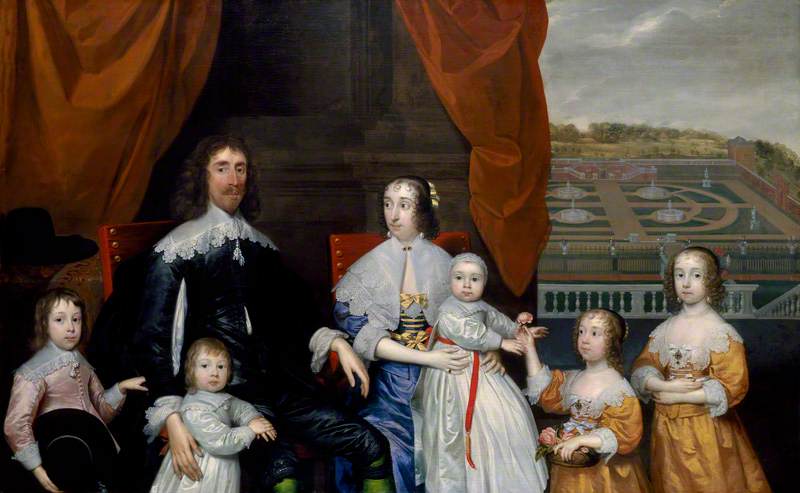
The Capel (also Capell) Family by Cornelius Johnson, circa 1640 (photo: National Portrait Gallery, London; http://www.artuk.org/artworks/the-capel-family-156922). Mary Capell, later the Duchess of Beaufort, is to the far right of this affectionate portrayal. The background landscape provides a glimpse of the family’s Italianate gardens of Hadham Hall in Hertfordshire, where Mary Capel grew up.
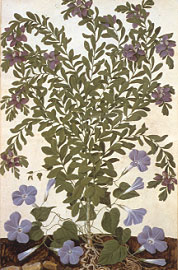
Everhard Kick, Polygala Blue Convolvulvus, Badminton florilegium (image from Wikimedia Commons)

The herbarium Mary Somerset compiled to record her efforts grew to twelve volumes containing her dried plant specimens. She bequeathed this significant work to a great friend, the family physician and neighbor in Chelsea, Sir Hans Sloane (1660-1753), who in turn donated it to the British Museum. The work now is in the Botany Library of the Natural History Museum in London. Another manuscript of her flora is preserved in the paintings of Everhard Kick (also known as Everard Kickius), a Dutch artist, and Daniel Frankcom. They composed a two-volume florilegium (1703-5) in sixty-eight folios of her prized exotics and occasional favored native plants. This catalog remains at Badminton House. These were private undertakings, a record of her individual mind and accomplishments. Apart from these bound works and manuscript collections of letters and records, there are other sources to trace this remarkable woman’s pursuits and how she was viewed by contemporaries.

In the early modern period, plant collecting relied on an informal scientific network—a circle of botanists, nurserymen, gardeners, apothecaries, physicians, and explorers—for information. Although excluded from the culture of the coffeehouse and other intellectual clubs and the Royal Society, Mary Somerset was an active participant in the exchange of botanical knowledge. She was not just a patron but an influential gardener whose analyses of plants were taken seriously by many contemporary scientists who were her correspondents and mutual suppliers of seeds, including John Ray, Jacob Bobart, Samuel Doody, Robert Southwell, George London, and Richard Bradley. Preserved correspondence reveal her contributions, as do mentions of her in important publications of the time.

Explorer, physician, collector, and long-serving President of the Royal Society, Hans Sloane, in his Preface to the first volume of A Voyage to the Islands Madera, Barbados, Nieves, S. Christohers and Jamaica (1707) acknowledges the value of Somerset’s active role in his colonial plant trade. He wrote:

“The Plants themselves have been likewise brought over, planted, and throve very well at Moyra, in Ireland, by the Direction of Sir Arthur Rawdon; as also by the Order of the Right Reverend Dr. Henry Compton, Bishop of London, at Fulham; at Chelsea by Mr. Doudy; and Enfield by the Reverend Dr. Robert Uvedale; and in the Botanic Gardens of Amsterdam, Leyden, Leipsick, Upsal, &c. but especially at Badminton in Gloucester-Shire, where they are not only rais’d some few handfuls high, but come to Perfection, flower and produce their ripe Fruits, even to my Admiration; and that, by the Direction of her Grace the Duchess of Beaufort, who at her leisure Hours, from her more serious Affairs, has taken pleasure to command the raising of Plants in her Garden.”

Mary Somerset received seeds from all over the world, including the Cape of Good Hope, Sri Lanka, Japan, and the West Indies, and tended them with great care. She was one of the early adopters of the late 17th-century innovation, the “tropical stove” or hothouse, to propagate plants. At a time when women, if employed in aristocratic gardens at all, tended to be low-paid weeders, the converted greenhouse at Badminton was presided over by a female assistant, known only as Mary or Martha.

Beaufort House in London had greenhouses as well as expansive gardens. This home of Mary Somerset, and that of Sloane, were nearby to the Chelsea Physic Garden, founded for the promotion of medicinal botany in 1673 by the Society of Apothecaries. There was a mutual trading of specimens and seeds with the four-acre physic garden.
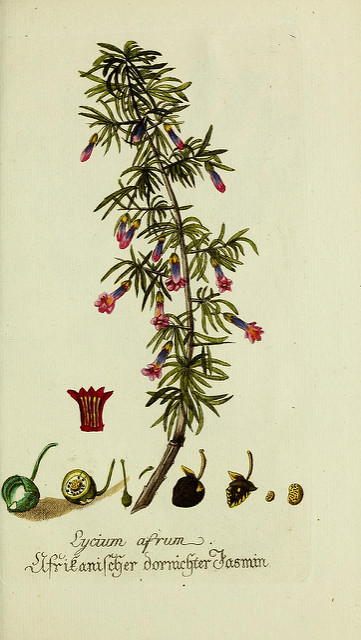
Lycium afrum, one of the plants nurtured in Gloucestershire and Chelsea that Mary Somerset is credited with introducing. Illustration from: Plantarum indigenarum et exoticarum icones ad vivum coloratae. Jarhg. 3 (1790). Contributed in BHL from Harvard University Botany Libraries.

Among the plants nurtured in Gloucestershire and Chelsea that Mary Somerset is credited with introducing were Globe amaranth (native to Asia; in William Townsend Aiton, volume 2, Hortus Kewensis), Comptonia asplenifolia (native to North America; in Encyclopaedia Londinensis 1810), Canarina campanula, Pinus strobus L. (White pine, native to North America), Lycium afrum, and Iva frutescens (John Claudius Loudon, Arboretum et Fruticetum Britannicum, 1838; Philip Miller, The Gardener’s and Botanist’s Dictionary, 1807; and Hortus Collinsonianus, 1843). But she also grew florists’ flowers, such as carnations, nasturtiums, tulips, and auriculas as well as evergreens and oranges, most often in dedicated sections of her vast gardens, and, of course, to adorn her great homes.
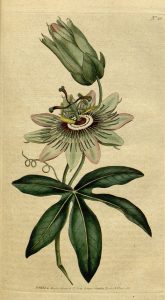
Passiflora caerula. The blue passion flower is another cultivar of the Duchess of Beaufort (see Loudon’s Arboretum et Fruticetum Britannicum).

William Sherard helped instruct Mary Somerset in taxonomic methods of documenting her plants. The botanist had studied with Joseph Pitton de Tournefort in Paris and Paul Hermann in Leiden and helped edit a revision of Caspar Bauhin’s Pinax Theatri Botanici. The requests from numerous scientists and botanical authorities for the tending of seeds at both Badminton and her London gardens was not simply to provide the necessary environment for nurturing specimens, but for her ability to cultivate these exotics and to compare them with native plants, providing details on what thrived and what did not. That is, her observations, descriptions and opinions were respected and sought.

Another correspondent of Somerset’s was botanist James Petiver (1663 or 1664-1718). He wrote a series for the Royal Society’s Philosophical Transactions (1711-14), “Account of Rare Plants Lately Observed in Several Curious Gardens about London and particularly the Company of Apothecaries’ Physic Garden at Chelsea.” Included in this description is Somerset’s neighboring garden in London. Nothing remains of that estate except perhaps some of her specimens that may have ended up in the Physic Garden. Beaufort House at Cheyne Walk was purchased in 1737 by Sloane. After being left vacant for twenty years, he had the home and gardens demolished in 1740.

Philip Miller (1691-1771), who had a distinguished career at the Chelsea Physic Garden, in the Catalogus Plantarum of 1730 notes Somerset’s contributions. The gardener records names of some of the “many learned and curious persons, nobility and gentry” who sought to transform “our former poorly furnish’d gardens.” Included was:

“Her Grace the Dutchess of Beaufort did also collect a numerous quantity of rare Plants into those famous Gardens of Badmington, where she preserved and maintained them with great Care in wonderful Beauty for many years; but as this Collection consisted chiefly of our most tender Exotick Plants, so we shall have Occasion to mention that Noble Person when we come to treat those Plants in another Place.”
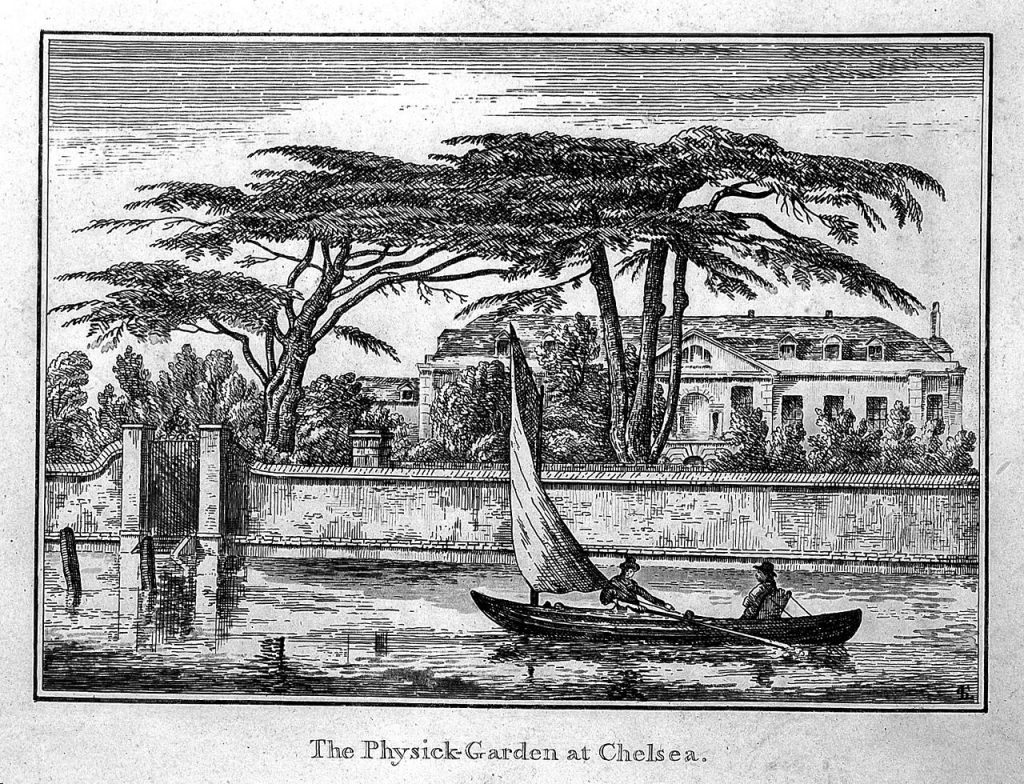
Engraving of the Chelsea Physic Garden, from the Surrey Bank (from Wellcome Images (no. L0003897) via Wikimedia Commons)

It is notable that Mary Somerset, in contrast to many of her fellow botanists, was not just interested in dried specimens and their identification but thoroughly engaged in horticulture—cultivating plants to thrive and creating gardens that were famous in their time. As Stephen Switzer noted in his 1718 Ichnographia Rustica, or, The Nobleman, Gentleman, and Gardener’s Recreation, “how much of her time she virtuously and busily employed in the garden.”
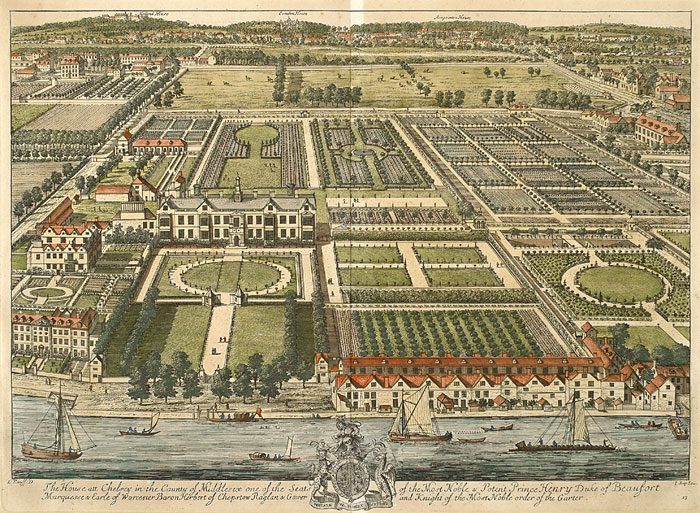
Colored engraving of Beaufort House, occupying part of the former estate of Sir Thomas More, in Chelsea, 1708, by Johannes Kip. From Britannia Illustrata (image from the Museum of London) the bird eye’s view shows the surrounding gardens, orchards and greenhouses.

A more complete survey of printed acknowledgements and identifications of plants which Mary Somerset helped introduce will expand the portrait of a complex woman who sought relief from depression in gardening and horticultural and botanical studies. There is the challenging task of pinpointing more of her plants by comparing the portrayals in the Sloane herbarium and the Badminton florilegium with representations in publications in the pre-Linnaean era. As the Biodiversity Heritage Library makes more of this literature, including landscape history, available online, the ability to explore Somerset’s participation and influence is greatly aided.
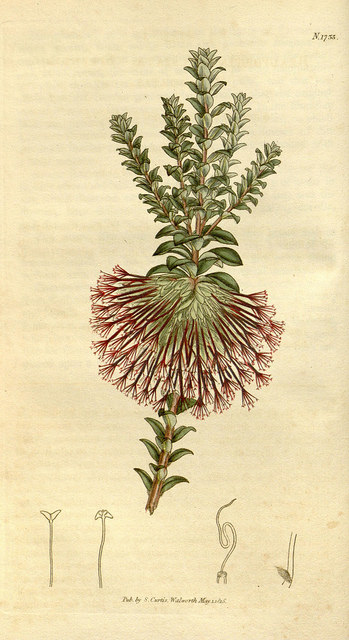
Beaufortia decussata. The genus Beaufortia was named for Mary Somerset, Duchess of Beaufort. Illustration from: Curtis’s Botanical Magazine. v. 42 (1815). Contributed in BHL from the Peter H. Raven Library of the Missouri Botanical Garden.

References

Chambers, Douglas. “‘Storys of Plant'”: The Assembling of Mary Capel Somerset’s Botanical Collection at Badminton,” in Journal of the History of Collections, volume 9, 1997, pages 49-60.

Davies, Julie. “Botanizing at Badminton House: The Botanical Pursuits of Mary Somerset, First Duchess of Beaufort,” in Domesticity in the Making of Modern Science; editor, Donald L. Opitz (2016).

Duthie, Ruth. “The Planting Plans of Some Seventeenth-Century Flower Gardens,” in Garden History, volume 18, no. 2 (Autumn 1990), pages 77-102.

Laird, Mark. A natural history of English gardening, 1650-1800. New Haven: Yale University Press, 2015.

Munroe, Jennifer. “’My Innocent Diverson of Gardening’: Mary Somerset’s Plants,” Renaissance Studies, volume 25, number 1, February 2011, pages 211-123.

March 12, 2019by mckenzie.87
Blog Reel, Campaigns, Featured Books, Her Natural History

Isabella in Hawaii: The Adventures of an Amateur Botanist in the 1860s

This post was originally published on the Chicago Botanic Garden, Lenhardt Library website in November 2014. It is authored by (now retired) Edward J. Valauskas, Curator of Rare Books.

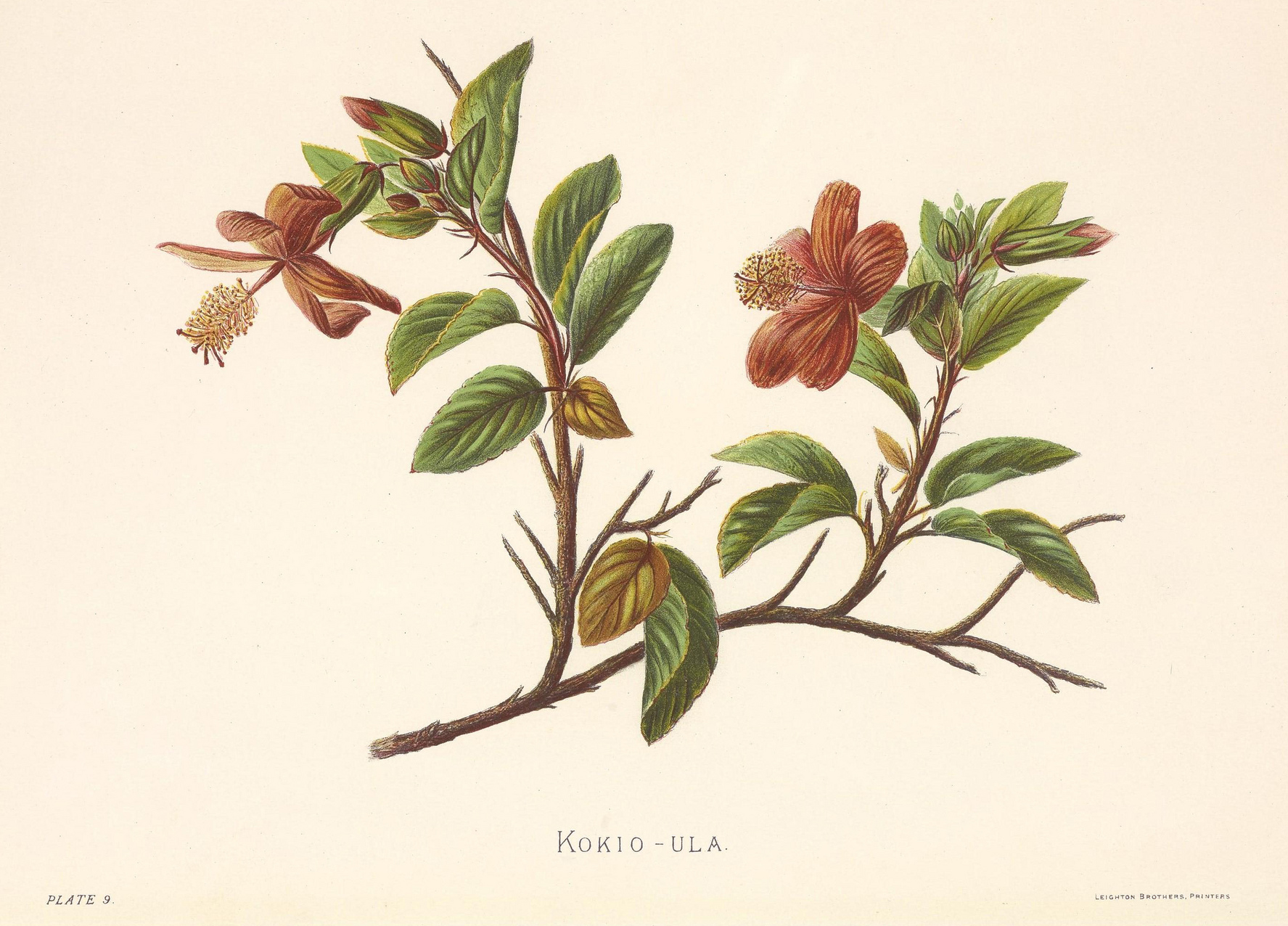
Kokiʻo ʻula. Art by Isabella McHutcheson Sinclair. Indigenous Flowers of the Hawaiian Islands. 1885. Contributed in BHL from the U.S. Department of Agriculture, National Agricultural Library.

How does a young woman create the most important record of Hawaiian flowers in the nineteenth century? Who helps her identify plants and find a London publisher? Why does she leave New Zealand for Niihau, the Forbidden Island? Thanks to a magnificent book in the Rare Book Collection of the Chicago Botanic Garden Library (and a little research), we can answer these questions.

With 44 delightful chromolithographed plates, Indigenous Flowers of the Hawaiian Islands is no ordinary book. Its illustrations introduced the world to an exotic, endemic, and vanishing flora. Indigenous Flowers provides a marker to measure the impact of humans on the fragile ecosystem of two Hawaiian islands, yet another signal of the Anthropocene epoch. Isabella McHutcheson Sinclair (1840–90) was probably the most unexpected ambassador for plant conservation. Her breadth of botanical experiences in the Pacific, in both New Zealand and the Sandwich Islands (better known today as Hawaii), gave her a particular vision to recognize the effects of humans on local flora and fauna.

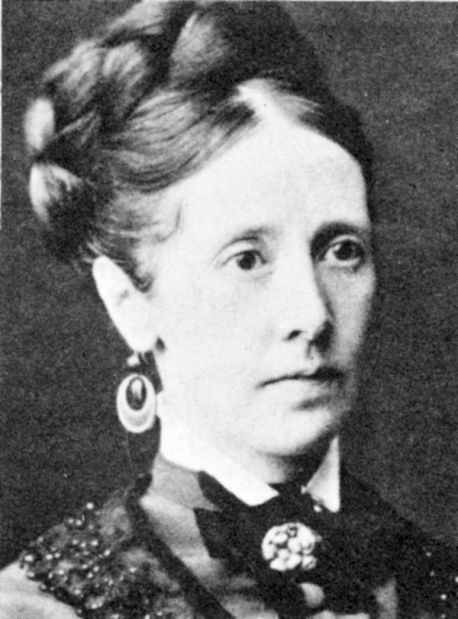
Isabella McHutcheson Sinclair (1840–90)

Isabella McHutcheson Sinclair (1840–90)

Isabella was born in Scotland, and migrated across the globe with her family to Canterbury, New Zealand, in 1861. A little more than 16,000 people of European descent resided in Canterbury at the time, making it the second most populous city in the country. Her father, William McHutcheson (1810–1905), moved to this faraway locale thanks to the energetic efforts of his sister Elizabeth McHutcheson Sinclair (1800–92). Better known as Eliza, she managed family prospects successfully, in part because her husband and son perished at sea in 1846.

After several decades in New Zealand, Elizabeth decided to try her luck elsewhere, moving to British Columbia in Canada in 1863. Eliza and her family found that the natives of British Columbia were quite different from Maori, and the mountainous, wooded terrain was much more difficult to clear and prepare for settlement and agriculture. Eliza decided to abandon Canada for California, but a friend recommended the Sandwich Islands instead.

In September 1863, Elizabeth Sinclair, et al. arrived in Honolulu via a circuitous route on the ship Bessie, starting in Vancouver and stopping in Los Angeles. Moving with speed, Eliza bought the island called Niihau for $10,000 from Kamehameha V (1830–72), the fifth monarch of Hawaii. Niihau, measuring about 70 square miles (or less than a third of Chicago’s 228 square miles), became the base for the expanding Sinclair family, including Isabella who married her cousin Francis.

Isabella and Francis worked with the Sinclair clan on Niihau, but decided to settle on the southern shore of the adjacent island of Kauai in Makaweli. Kauai is a little more than 17 miles southwest of Niihau, so Francis (known also as Frank) could easily move between family duties on the islands. Isabella, fortunately for botanical and artistic posterity, had the time and inclination to explore the vegetation of Kauai and Niihau.

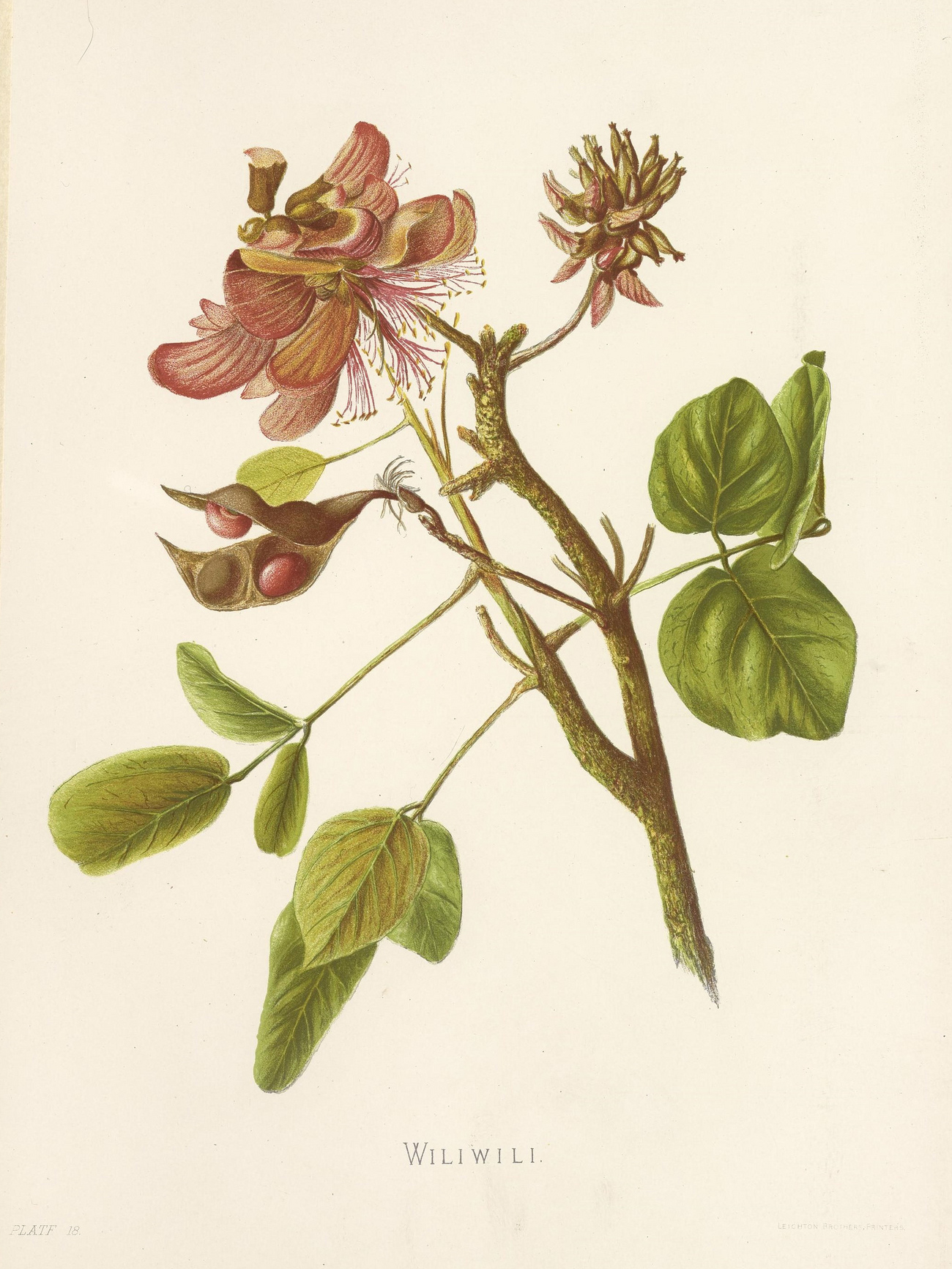
Wiliwili. Art by Isabella McHutcheson Sinclair. Indigenous Flowers of the Hawaiian Islands. 1885. Contributed in BHL from the U.S. Department of Agriculture, National Agricultural Library.

The Sinclair family was respected by natives on both islands, since Eliza, the matriarch, was recognized as a “chiefess.” Isabella, via the locals, was able to secure a great deal of information about her botanical discoveries, including vernacular names and medicinal properties. She explored extensively on Kauai, including Waimea Canyon, some 10 miles long and nearly 3,000 feet deep. Isabella used her specimens to create delicate and detailed watercolors for each plant. She organized her botanical information with notes on habitat and flowering times.

Isabella noticed that many of her Hawaiian flowers had similarities to those she found in New Zealand. She decided to take a bold step and contact the world’s expert on the Pacific flora, Sir Joseph Dalton Hooker (1817–1911). Hooker, director of Kew, was the author of the first descriptions of New Zealand’s flora in Flora novae-zelandiae (1853–55). Hooker collected specimens as a member of the British expedition to the Southern Ocean aboard the HMS Erebus between 1839–43. He quickly recognized the diversity of floras of different localities in the Pacific, but also saw similarities. His phytogeographical speculations were the first to trace botanical links to southern Africa, Asia, and South America.

In Flora novae-zelandiae, Hooker guessed that geology had some role to play in the botanical similarities of widely dispersed plants:

“Beyond the bare fact of the difficulty of accounting by any other means for the presence of the same species in two of the islands, there appeared nothing in the botany of the Antarctic regions to support or even to favour the assumption of a double creation, and I hence dismissed it as a mere speculation which, till it gained some support on philosophical principles, could only be regarded as shelving a difficulty; whilst the unstable doctrine that would account for the creation of each species on each island by progressive development on the spot, was contradicted by every fact.

It was with these conclusions before me, that I was led to speculate on the possibility of the plants of the Southern Ocean being the remains of a flora that had once spread over a larger and more continuous tract of land than now exists in that ocean; and that the peculiar Antarctic genera and species may be the vestiges of a flora characterized by the predominance of plants which are now scattered throughout the southern islands.”

Hooker found that the flora of New Zealand was largely endemic, by his calculations two-thirds “peculiar” (his description) to the islands, while one-third related to Australia or South America. A more recent calculation, in the first volume of Harry Howard Allan’s masterful Flora of New Zealand, finds that 80 percent of the plants are endemic.

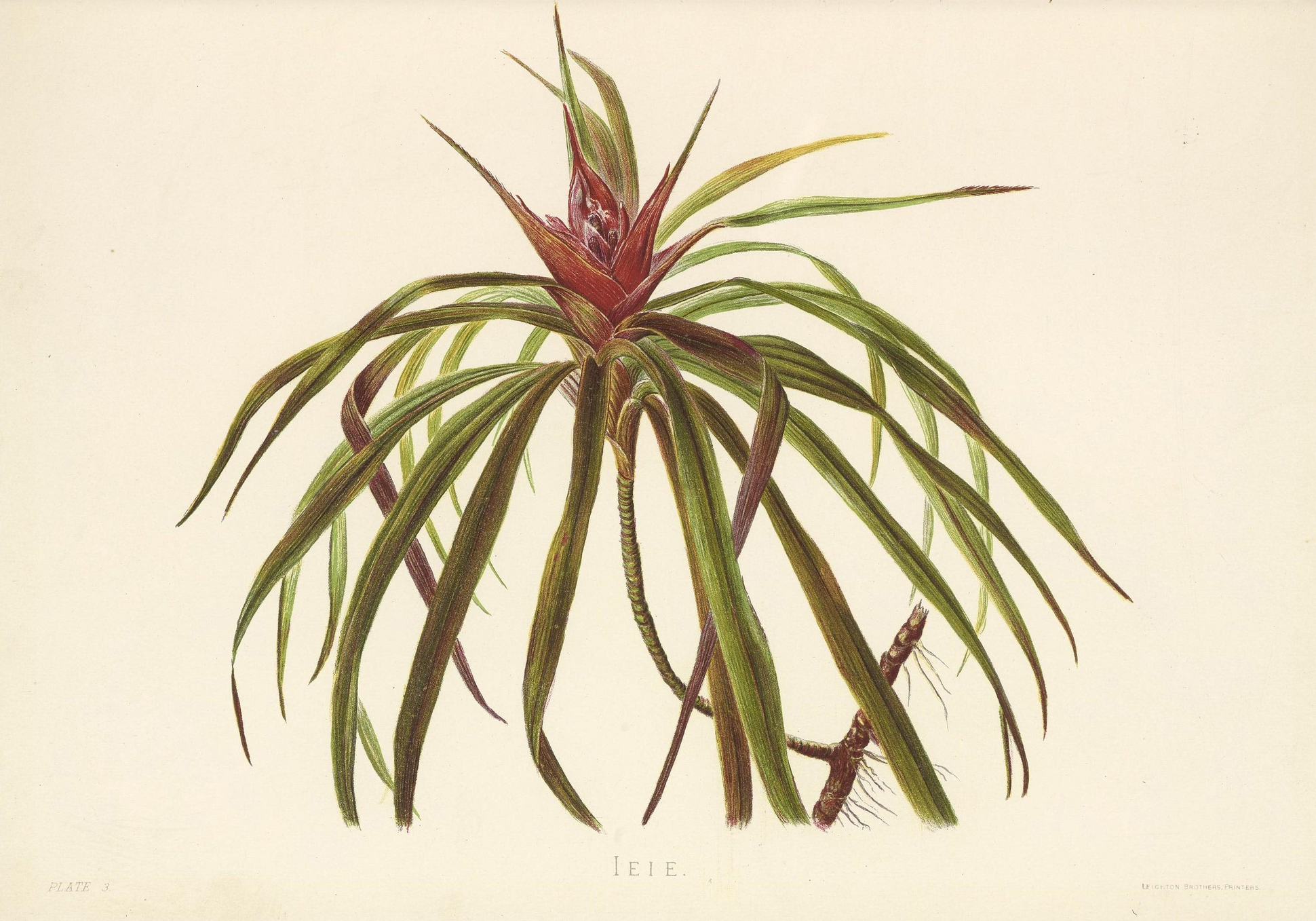
ʻIeʻie. Art by Isabella McHutcheson Sinclair. Indigenous Flowers of the Hawaiian Islands. 1885. Contributed in BHL from the U.S. Department of Agriculture, National Agricultural Library.

Hooker needed more data to confirm his notions of a primeval landmass, which today we know as Gondwana. His duties at Kew certainly prevented him from carrying out more field-work, so he was dependent on his colleagues and talented amateurs, like Isabella in Hawaii. Hooker knew the risks of depending on citizen scientists. In Flora novae–zelandiae, he issued a cautionary reminder:

“The very many aspirants to a knowledge of science whom I have had the pleasure of knowing in the Colonies, though well educated in the ordinary acceptation of the term, have never been trained to habits of observation, or of reasoning upon what they read in the book of nature, nor have they been grounded in the elements of natural science; they are hence prone to rely for information on these speculative subjects (which they seek with avidity) upon a class of works that are, with very few exceptions, by authors who have no practical acquaintance with the sciences they write about, or with the facts they so often distort.”

Imagine Hooker’s surprise when he first heard from Isabella! She sought his taxonomic advice on the scientific names of her discoveries in the northern outposts of the Sandwich Islands. Isabella provided exquisite details on the occurrence of each plant, plus a bonus of amazing watercolors. She was no ordinary observer of flowers, thanks to her New Zealand experiences and connections to both the Maori and Polynesians.

Hooker encouraged Isabella to publish her watercolors and observations in a book on flowers of Hawaii. She must have been both flattered and embarrassed to have one of the greatest botanists on the planet recognize the value of her efforts. Finally in 1884, Isabella and her husband made the long voyage to London to put her findings into print as Indigenous Flowers of the Hawaiian Islands.

Published by Sampson, Low, Marston, Searle, and Rivington in London, Indigenous Flowers was also an experiment. It was one of the earliest books to use “perfect binding” which is anything but perfect. Probably in an effort to reduce costs for the volume, letterpress and chromolithographic plates in Indigenous Flowers were glued rather than sewn to the binding. Given the small press run, this perfect binding has led to copies losing pages and plates over time, probably encouraging some extant copies to move to the guillotine for print merchants. Four years after the appearance of the London edition in 1885, Houghton in Boston published an American version (which is even scarcer than the rare London edition). Hooker pressed Isabella to write as an introduction to her work some impressions of the flora of the islands. With extraordinary prescience, Isabella recognized the fragility of the habitats on her beloved islands:

“The Hawaiian flora seems … to grow in an easy careless way, which, though pleasingly artistic, and well adapted to what may be termed the natural state of the islands, will not long survive the invasion of foreign plants, and changed conditions. Forest fires, animals, and agriculture, have so changed the islands, within the last fifty or sixty years, that one can now travel for miles, in some districts, without finding a single indigenous plant; the ground being wholly taken possession of by weeds, shrubs, and grasses, imported from various countries.”

According to the National Tropical Botanical Garden, the Hawaiian Islands are home to more than 1,300 endemic plant species, of which 100 are extinct and 273 are threatened or endangered. Isabella Sinclair recognized this problem 130 years ago in Indigenous Flowers of the Hawaiian Islands. Her book provides a standard for measuring the flora of those islands as well as providing an artistic expression of the beauty of these special plants.

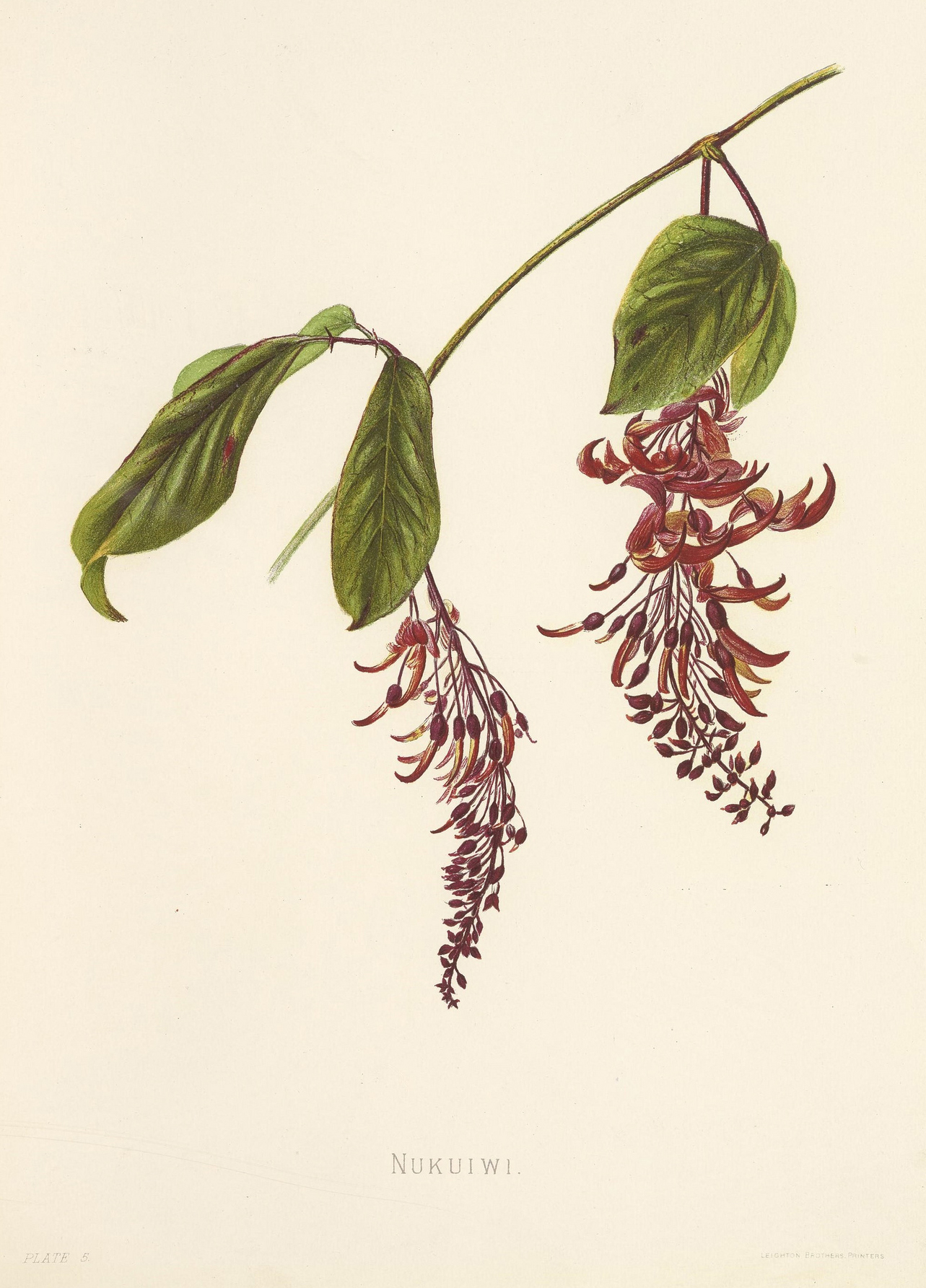
Nukuiwi. Art by Isabella McHutcheson Sinclair. Indigenous Flowers of the Hawaiian Islands. 1885. Contributed in BHL from the U.S. Department of Agriculture, National Agricultural Library.

Harold St. John (1892–1991), professor of botany at the University of Hawaii, analyzed the content of Indigenous Flowers. His resulting paper, published in 1954 in the journal Pacific Science, found that Isabella described in Indigenous Flowers 37 indigenous species. Of these, 23 were native to Kauai but not Niihau, while 15 were found on both islands.

Mark Twain visited Hawaii for several months in 1866 as a reporter for the newspaper The Sacramento Union. He was quite impressed by the beauty of Hawaii and the lives of the natives. Decades later, he wrote:

“For me its balmy airs are always blowing, its summer seas flashing in the sun; the pulsing of its surf is in my ear; I can see its garlanded crags, its leaping cascades, its plumy palms drowsing by the shore, its remote summits floating like islands above the cloud-rack; I can feel the spirit of its woody solitudes, I hear the plashing of the brooks; in my nostrils still lives the breath of flowers that perished twenty years ago.”

Thanks to Isabella McHutcheson Sinclair’s Indigenous Flowers of the Hawaiian Islands, we can experience that magical world, battling for survival.

March 11, 2019by michelle.underhill
Blog Reel, Campaigns, Her Natural History

Transcribe Field Notes by Female Naturalists with the #HerNaturalHistory Transcription Challenge

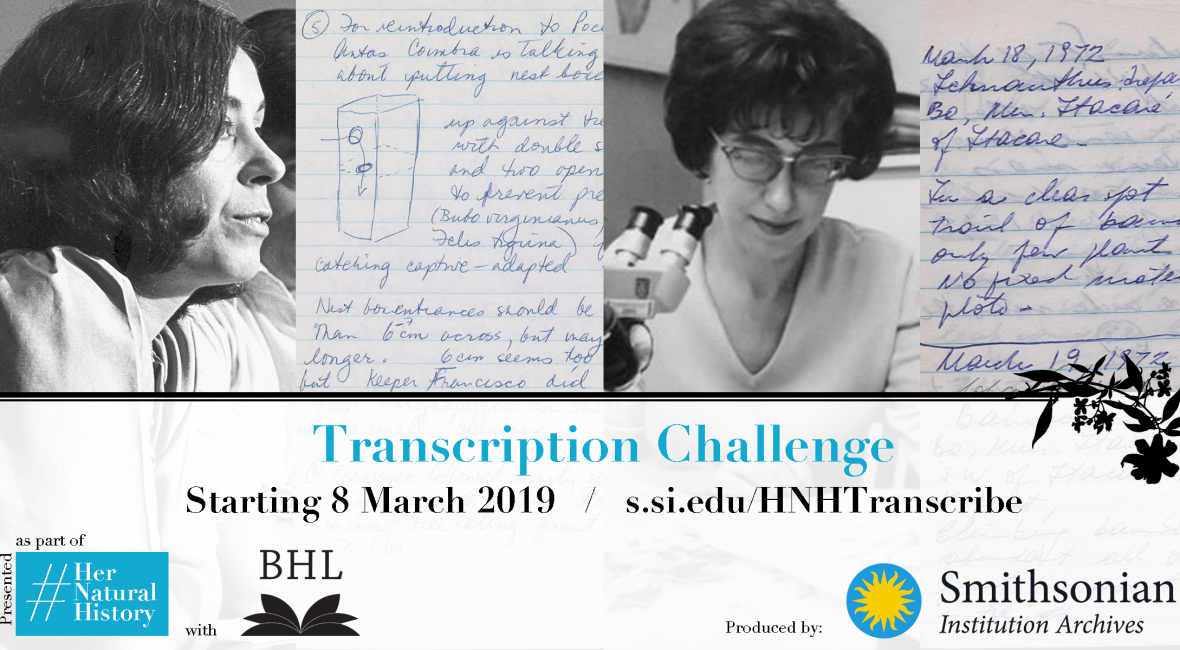
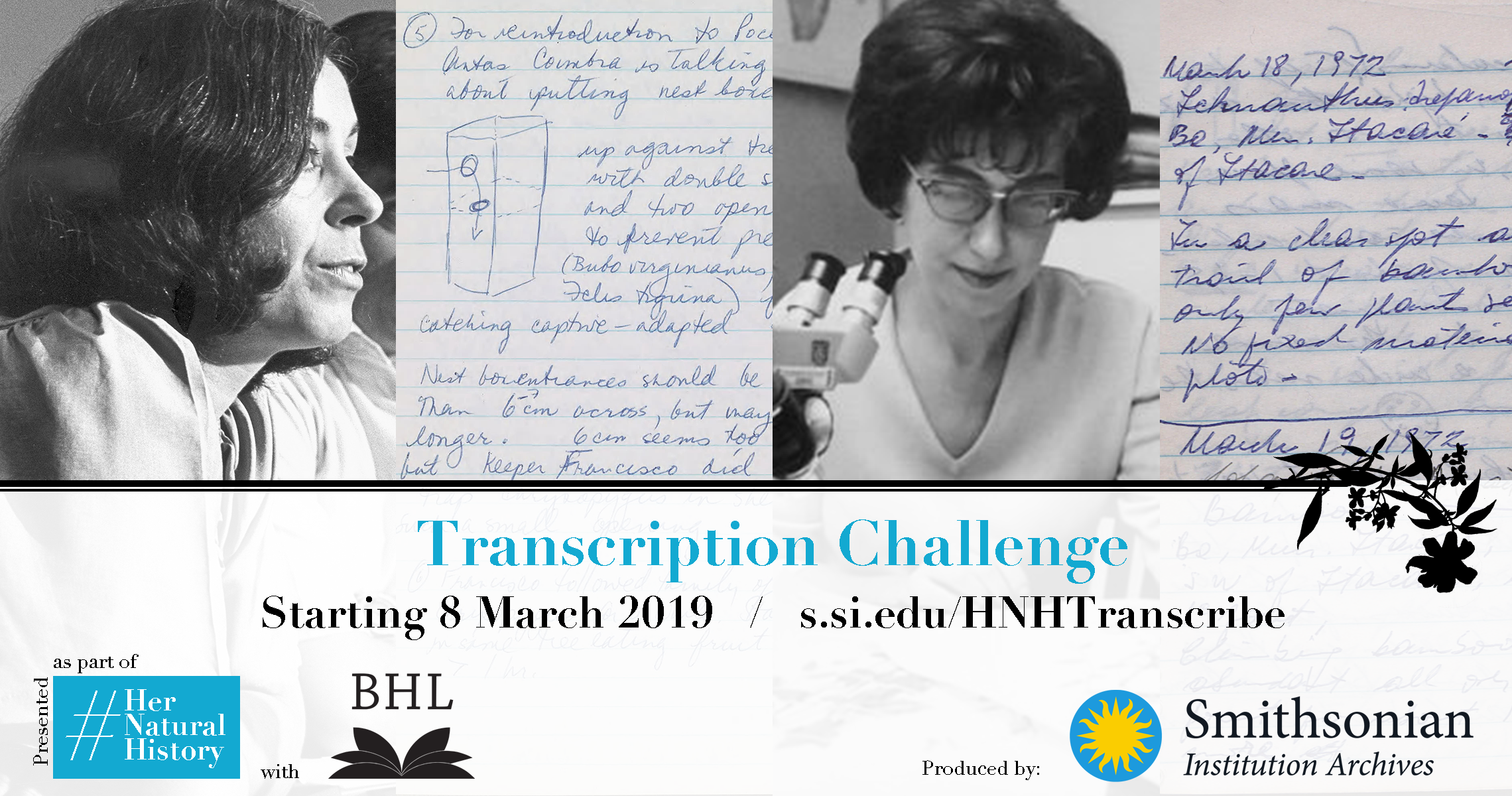
L to R: Photo of Devra Kleiman by Hirshfeld, Max, 1978, Smithsonian Archives – History Div, 94-8340; Page from Kleiman field book (Brazil notebook, 1975-1982); Photo of Cleofé E. Calderón, Smithsonian Institution Archives, SIA Acc. 11-008, Box 02, Image No. OPA-90; Page from Calderón field book (Brasil 1972, 1).

Looking for a challenge? The Smithsonian Institution Archives and the Smithsonian Transcription Center are teaming up for a #HerNaturalHistory-themed transcription challenge. Starting today (8 March), help a team of #volunpeers transcribe field notes from conservation biologist Devra Kleiman and botanist Cleofé Calderón. Dive into observations of golden lion tamarins with Kleiman, who worked at Smithsonian’s National Zoological Park from 1972 to 2001. And head to South America with Calderón to collect grasses for Smithsonian’s Department of Botany.

When? Starting TODAY, 8 March 2019
Where? Smithsonian Transcription Center. The field notes are available on the Smithsonian Institution Archives project page.

The Smithsonian Institution Archives has launched 11 field books on the Smithsonian Transcription Center. Throughout the month, additional field books will be added as others are completed. Our goal is to fully transcribe 18 field books in total (9 from each woman) by the end of March.

These transcriptions will also make the corresponding digitized field books in the Biodiversity Heritage Library more discoverable, as they can be uploaded in place of the automatically-generated OCR text in BHL to allow the field books to be full-text searchable. This will make it easier for researchers and the public to explore these valuable primary source materials and access specific information from their pages.

We hope you’ll join our #HerNaturalHistory transcription challenge to help improve access to and discoverability of the primary research of two female naturalists. Continue reading to learn more about Kleiman and Calderón.

This challenge is presented as part of the #HerNaturalHistory campaign — an international social media campaign produced in collaboration with BHL partners to celebrate women in natural history. Visit the Her Natural History webpage to learn more about this and other events and programming occurring all month long.

Devra Kleiman

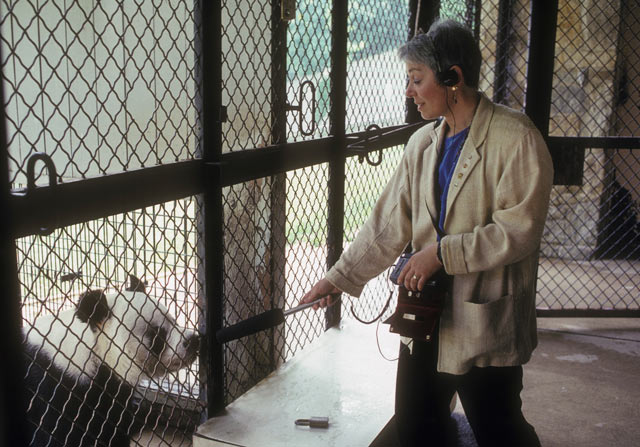
Giant Panda researcher Devra Kleiman records Hsing-Hsing’s vocalizations during breeding season, 1991, by Jessie Cohen, C-type print, National Zoo, Image ID: 614-95JC.

Conservation biologist Devra G. Kleiman (1942-2010) was the first female scientist at the National Zoological Park (NZP). She was hired by NZP in 1972 to manage the zoo’s captive breeding program. Much of her research focused on the captive breeding of giant pandas and the reintroduction of golden lion tamarins to the wild. Over her career at the zoo, she served as Assistant Director for Animal Programs, Assistant Director of Zoological Research and Education, Assistant Director of Research, Assistant Director of Zoological Research, and Senior Scientist. She authored approximately 150 manuscripts and two books.[1]

Smithsonian Institution Archives holds a large collection of archival materials documenting Kleiman’s research and professional activities. Many of her field books have been digitized in the Biodiversity Heritage Library as part of the Smithsonian Field Book Project.

Cleofé Calderón

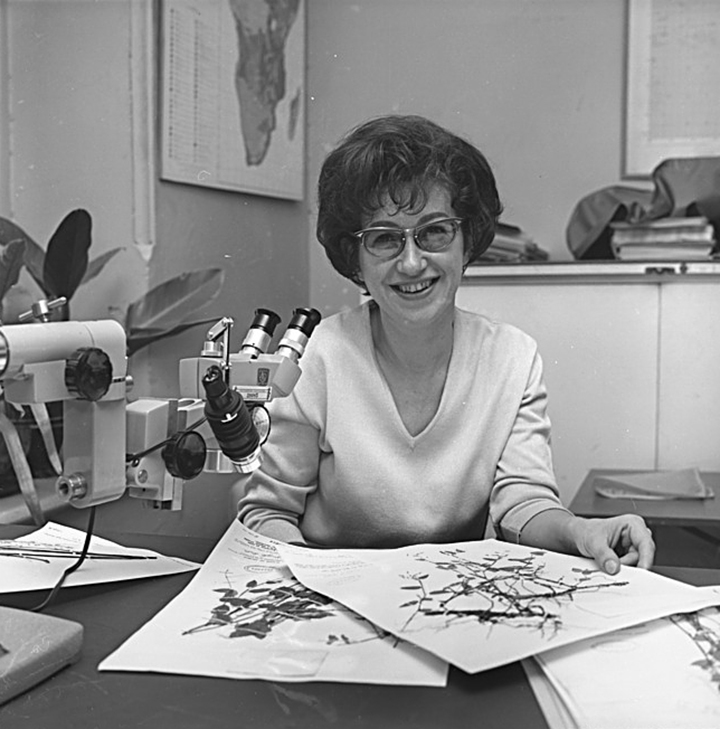
Visiting Argentine botanist Cleo Calderón with plant specimens and microscope. 1965.
From 120mm black and white negative. Smithsonian Institution Archives, SIA Acc. 11-008, Box 02, Image No. OPA-90.

Botanist Cleofé Calderón (1929-2007), born in Buenos Aires, Argentina, studied with renowned agrostologist Prof. Ing. Lorenzo Parodi at the University of Buenos Aires. She was introduced to Dr. Thomas R. Soderstrom, Curator of Grasses in the Department of Botany at the U.S. National Herbarium at the Smithsonian, during a trip to Washington, D.C. in 1961-62. The two began a close collaboration, and Calderón became a prominent botanist specializing in bamboo. With support from the Smithsonian, the Office of Scientific Affairs of the Organization of American States, and the National Geographic Society, Calderón conducted extensive field work in Central and South America, collecting plant specimens in Panama, Costa Rica, Ecuador, Colombia, and Brazil between 1966 and 1982. One of her most significant finds was the “re-discovery” of Anomochloa marantoidea, a small species of bamboo last seen in the late 1840s.[2]

Smithsonian Institution Archives holds a collection of field books documenting Calderón’s botanical research in Brazil, Panama, and Colombia between 1967 and 1981. Many of these have been digitized in the Biodiversity Heritage Library as part of the Smithsonian Field Book Project.

References

[1] Smithsonian Institution Archives. 2018. “Kleiman, Devra G.” Finding Aid, November 5. Accessed on February 28, 2019. https://siarchives.si.edu/collections/siris_arc_302446.

[2] Smithsonian Institution Archives. 2019. “Calderón, Cleofé E.” Collections. Accessed on February 28, 2019. https://siarchives.si.edu/collections/auth_per_fbr_eacp248.

March 8, 2019by michelle.underhill
BHL News, Blog Reel, Campaigns, Her Natural History

Her Natural History: A Celebration of Women in Natural History

Her Natural History
Her Natural History

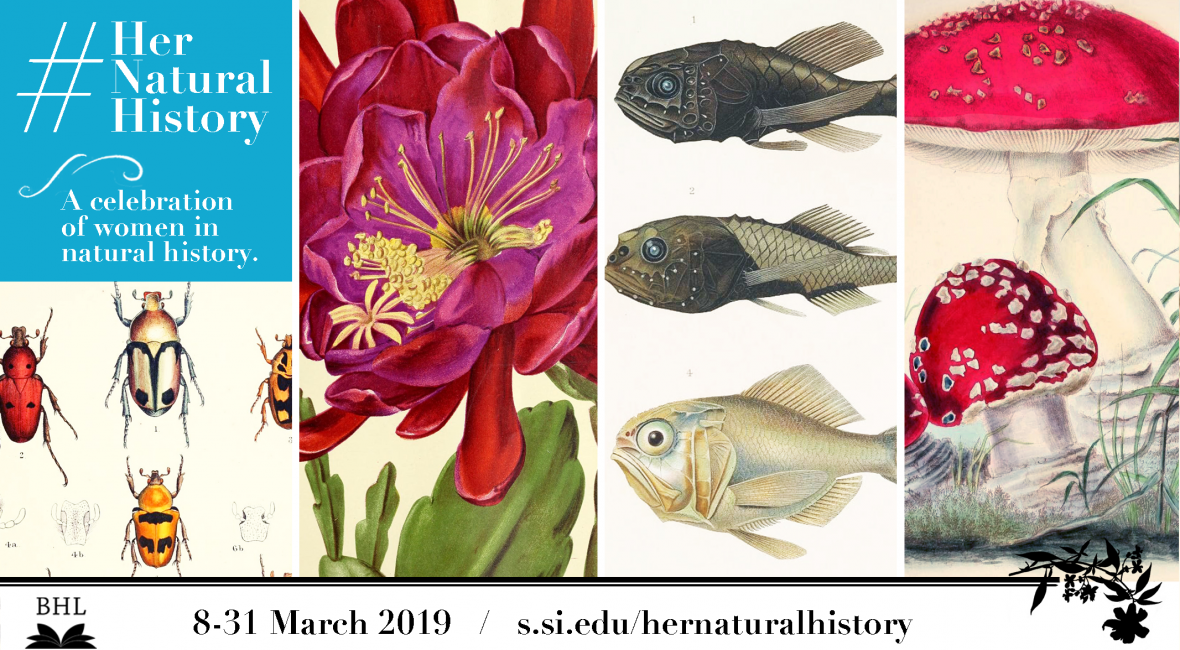
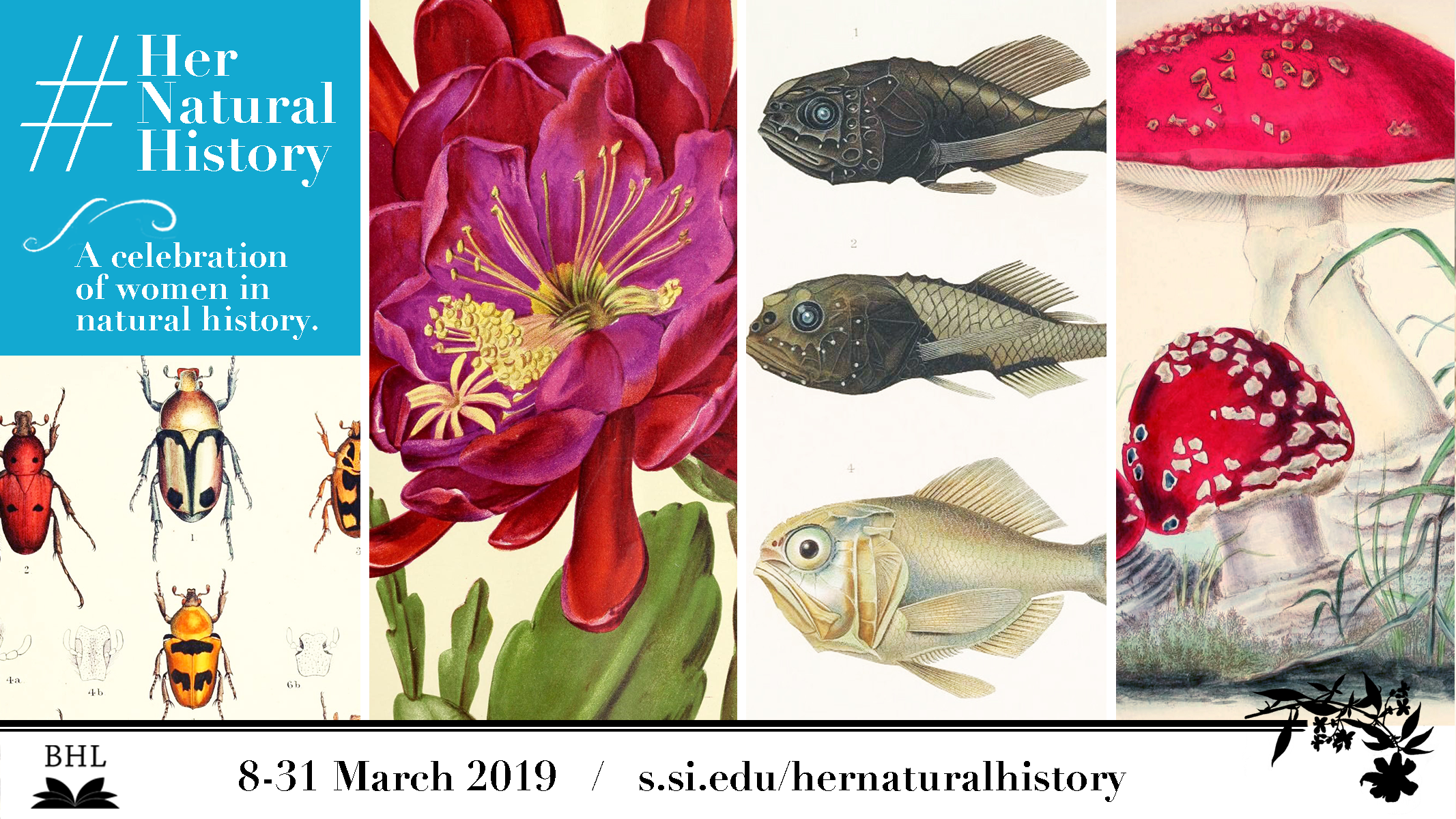
Illustrations in this graphic by female scientific illustrators. Left to right: Maud Horman Fisher (Aid to the Identification of Insects, v. 2, 1882-90); Louise-Cécile Descamps-Sabouret (Revue Horticole, 1899); Emma Kissling (Poissons provenant des campagnes du yacht Princesse-Alice, 1911); Frances Reed (Illustrations of British mycology, ser. 1, 1847).

Women have made remarkable contributions to biodiversity research. From collecting specimens and serving as scientific illustrators to conducting and publishing research, authoring natural history books, and more, women have overcome many social and cultural obstacles and gender barriers to help further our understanding of the natural world. While the work of many remained unacknowledged or under-appreciated during their lifetimes, mounting initiatives to encourage and support women in the sciences have facilitated a growing recognition of the achievements of women in natural history — both past and present.

This Women’s History Month, we are excited to recognize and celebrate the contributions of women to natural history through an international social media campaign produced in collaboration with our partners — Her Natural History: A Celebration of Women in Natural History.

Kicking-off with an all-day social media blitz today, 8 March 2019 (International Women’s Day,) and continuing throughout the month, Her Natural History aims to increase awareness of and information about women in the biodiversity sciences.

Join the campaign by following #HerNaturalHistory on social media (Twitter, Facebook, and Instagram) and using the hashtag to share stories, collections, publications, artworks, archival materials, exhibits, and other resources highlighting women and their contributions to natural history. #HerNaturalHistory is also the #LibrariesOfInstagram challenge topic for March.

In addition to social media posts, BHL and our partners will be producing a series of blog posts, Facebook Live events, and citizen science opportunities throughout the month. We’ll also be highlighting women in the BHL collection with our Women in Natural History Book and Female Illustrators Flickr Collections, featuring publications, archival materials, and illustrations by female naturalists and artists.

Learn more about women in natural history and explore our campaign content and programming in the sections below. Visit the Her Natural History webpage for more information. We look forward to celebrating #HerNaturalHistory with you this month!

Her Natural History: Campaign Content and Programming


Social Media and Blog Posts

  • Follow and join the campaign on Twitter, Facebook, and Instagram using #HerNaturalHistory.
  • #HerNaturalHistory is also the #LibrariesOfInstagram challenge topic for March.
  • Follow the campaign feed on the BHL blog to explore women in natural history in depth with posts contributed by our global partners.

Women in Natural History Book and Image Collections

  • Explore publications and archival materials by female naturalists in BHL’s Women in Natural History Book Collection.
  • Enjoy biodiversity illustrations by female artists in BHL’s Flickr Collection.
  • Color a selection of these illustrations with our free Female Illustrators in Natural History coloring book.

Facebook Live Events

Facebook Live: Maria Martin.
Presented by Field Museum.
Join Chief Curiosity Correspondent Emily Graslie in the Rare Books Room at the Field Museum with Field Librarians Gretchen Rings and Diana Duncan to explore the work of Maria Martin, one of the background painters for Audubon’s Bird’s of America.
When? Friday, 8 March 2019 at 11:00am ET
Where? Event Recording

A Curious Herbal Facebook Live.
Presented by Oak Spring Garden Foundation.
Go behind-the-scenes at Oak Spring Garden Library to explore Elizabeth Blackwell’s groundbreaking illustrated work on medical plants, A Curious Herbal. The Library has several printed editions of the work as well as 73 of the original manuscript paintings Blackwell did for the book.
When? Friday, 8 March 2019 at 2:00pm ET
Where? Event Recording

NYBG #HerNaturalHistory Live.
Presented by The New York Botanical Garden.
Get a behind-the-scenes look at some original botanical art, herbarium specimens, published works, manuscripts, and photographs by women in the natural sciences when The New York Botanical Garden goes behind-the-scenes in their Library & Herbarium.
When? Tuesday, 12 March 2019 at 12:30pm ET
Where? Event Recording

The Art & Life of Elizabeth Gould.
Presented by Smithsonian Libraries.
Get a behind-the-scenes look at the Natural History Rare Book Library at the Smithsonian Libraries as staff explore a selection of works by natural history illustrator Elizabeth Gould.
When? Friday, 22 March 2019 at 1:00pm ET
Where? Event Recording

NYBG’s #HerNaturalHistory in the Lab.
Presented by The New York Botanical Garden.
Join NYBG staff on Facebook to explore the work of some of the women scientists who devoted their lives to the study of plants. Viewers will have the chance to see scientific tools, microscope slides, preserved specimens, and published works shared in the Biodiversity Heritage Library by these outstanding women in botany.
When? Thursday, 28 March 2019 at 12:30pm ET
Where? Event Recording

Maria Sibylla Merian Facebook Live.
Presented by Oak Spring Garden Foundation.
April 2nd is 17th Century artist and naturalist Maria Sibylla Merian’s birthday! Join the Oak Spring Garden Library by Facebook Live for a talk with Merian scholar Kay Etheridge about Merian’s work, influences, and the intersection of art and science.
When? Tuesday, 2 April 2019 at 1pm ET
Where? Event Recording

Citizen Science Opportunities

Women in Natural History Wikipedia Editing Workshop
Join us for the Women in Natural History Wikipedia Editing Workshop hosted by the Biodiversity Heritage Library and Smithsonian Libraries with support from Wikimedia DC. With the help of experienced Wikipedians, attendees will learn to edit Wikipedia and improve or create Wikipedia articles related to women in natural history, drawing on the Biodiversity Heritage Library’s free and extensive online collections as source materials. No editing experience is necessary.

When? 13 March 2019, 10am – 2pm ET
Where? In-person at Smithsonian Libraries (National Museum of Natural History Library, Washington, D.C.) and remotely

Registration Required:

  • Register to attend in-person
  • Register to attend remotely

More Information: Wikipedia Event Page

Attending in person? Laptops are required. Please bring your own. Wikimedia has two laptops to loan. Reserve one by emailing [email protected]. This event is free and open to the public, but space is limited, so register today. Lunch will be provided.

Attending remotely? There will be an option to participate in the editing workshop remotely. For remote participants, the workshop will be live-streamed via YouTube Live here: https://s.si.edu/NHWomenWikiLive. Be sure to register to attend remotely

Transcription Challenge
Looking for a challenge? The Smithsonian Institution Archives and the Smithsonian Transcription Center are teaming up for a #HerNaturalHistory-themed transcription challenge. Beginning on 8 March, help a team of #volunpeers transcribe field notes from conservation biologist Devra Kleiman and botanist Cleofé Calderón. Dive into observations of golden lion tamarins with Kleiman, who worked at Smithsonian’s National Zoological Park from 1972 to 2001. And head to South America with Calderón to collect grasses for Smithsonian’s Department of Botany.

  • When? Beginning 8 March 2019
  • Where? Smithsonian Transcription Center. The field notes will be released on the Smithsonian Institution Archives project page.

Citizen Science at The New York Botanical Garden
The New York Botanical Garden will be hosting two citizen science events around #HerNaturalHistory.

  • #HerNaturalHistory Flickr Workshop
    • When? 12 March, 2-4pm ET
    • Where? The LuEsther T. Mertz Library of the New York Botanical Garden
    • What? Would you like to make information about female artists and scientific illustrators more open and accessible to the world? Come to this workshop in the NYBG Library to transcribe text from illustrations that the Mertz Library has contributed to the Biodiversity Heritage Library’s collection.
    • RSVP here
  • #HerNaturalHistory — Editing Wikidata and Wikimedia Commons
    • When? 13 March, 11am-5pm ET
    • Where? The LuEsther T. Mertz Library of the New York Botanical Garden
    • What? Help create and enhance information in Wikidata and Wikimedia Commons related to the theme of Women in Natural History.
    • More information

References

Data USA. 2016. “Gender Composition.” Biological Scientists. Accessed on 12 February 2019. https://datausa.io/profile/soc/191020/#demographics.

Hart, Andrea. 2014. Images of Nature: Women Artists. London: Natural History Museum.

International Day of Women and Girls in Science. 2019. “About.” https://womeninscienceday.org/WISID_WP/about/.

S. L. Eddy, S. E. Brownell, M. P. Wenderoth. Gender Gaps in Achievement and Participation in Multiple Introductory Biology Classrooms. Cell Biology Education, 2014; 13 (3): 478 DOI: 10.1187/cbe.13-10-0204

Yong, Ed. 2019. The Women Who Contributed to Science but Were Buried in Footnotes. The Atlantic, February 11. Accessed on 12 February 2019. https://www.theatlantic.com/science/archive/2019/02/womens-history-in-science-hidden-footnotes/582472/.

March 8, 2019by michelle.underhill
Blog Reel, Campaigns, Her Natural History

Happy Women’s History Month! Join Us For #HerNaturalHistory Starting 8 March 2019

Her Natural History
Her Natural History

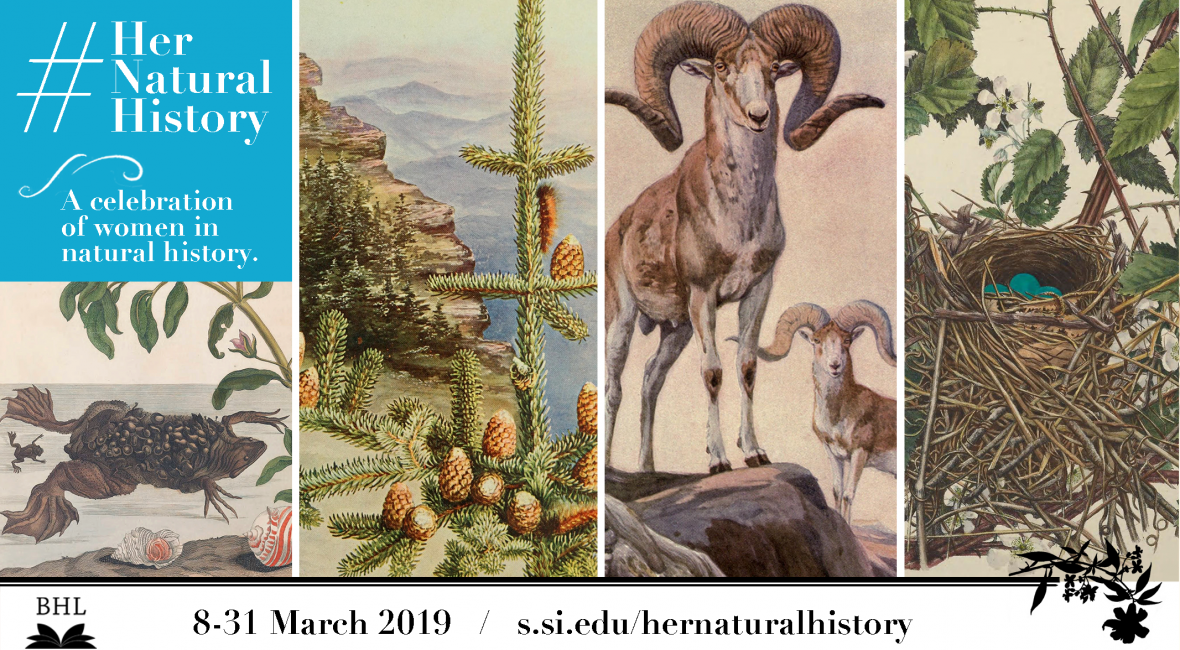
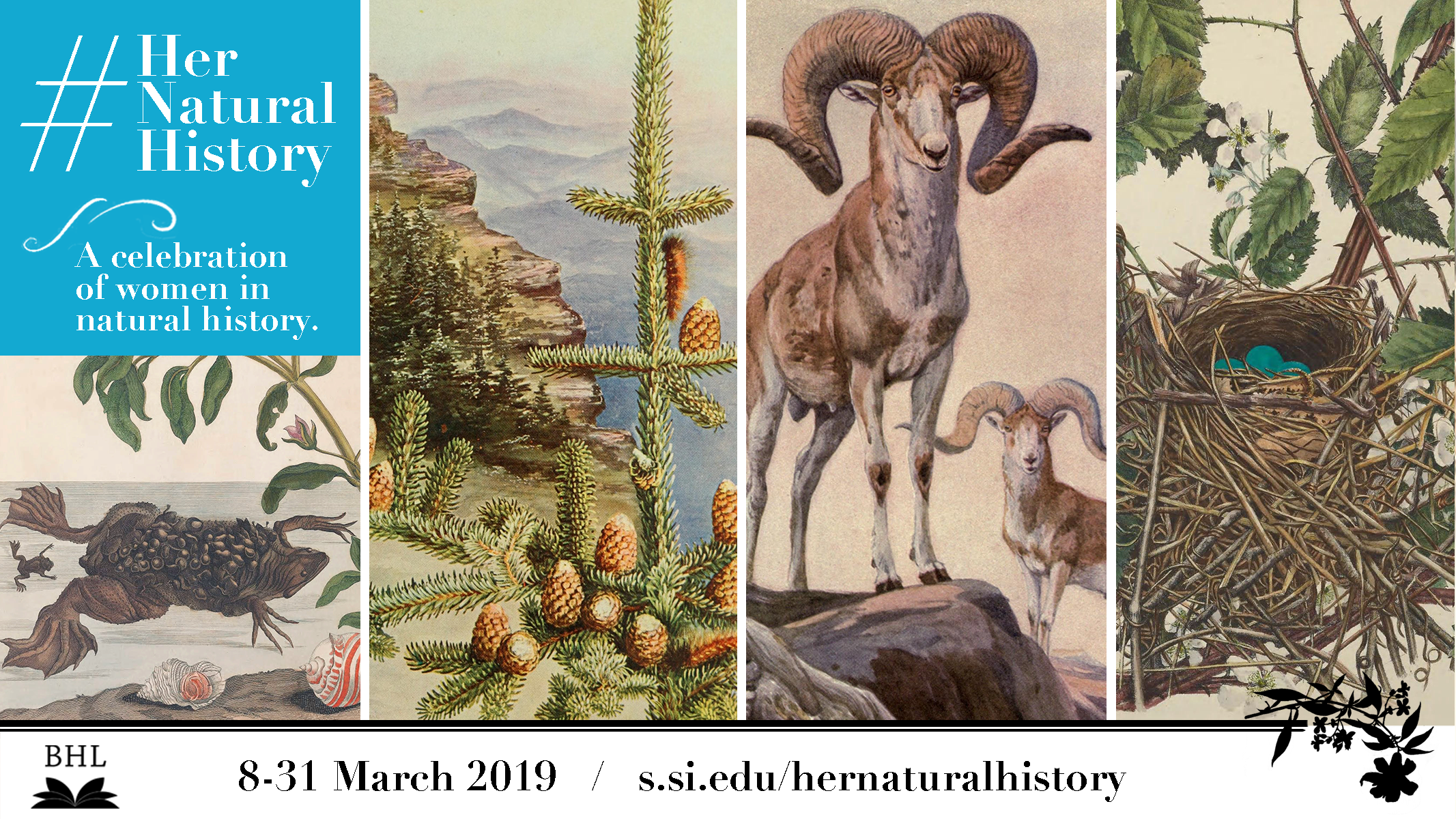
Illustrations in this graphic created by female artists who will be featured during #HerNaturalHistory. L to R: Maria Sibylla Merian, Metamorphosis insectorum surinamensium (1705); Marian Ellis Rowan, Southern Wild Flowers and Trees (1901); Winifred Austen, The Wild Beasts of the World, v. 2 (1909); Virginia Smith Jones, Illustrations of the Nests and Eggs of Birds of Ohio, v. 1 (1886). Illustrations digitized by Smithsonian Libraries, University of Toronto, and North Carolina State University Libraries.

March is Women’s History Month, and we’re celebrating with an international social media campaign produced in collaboration with our partners highlighting women and their contributions to natural history — Her Natural History: A Celebration of Women in Natural History.

Kicking-off with an all-day social media blitz on Friday, 8 March 2019 (International Women’s Day) and continuing throughout the month, Her Natural History aims to increase awareness of and information about women in the biodiversity sciences.

Women have made remarkable contributions to biodiversity research. From collecting specimens and serving as scientific illustrators to conducting and publishing research, authoring natural history books, and more, women have overcome many social and cultural obstacles and gender barriers to help further our understanding of the natural world.

As part of the campaign, we’ll be highlighting women in the BHL collection with our Women in Natural History Book and Female Illustrators Flickr Collections, featuring publications, archival materials, and illustrations by female naturalists and artists. We’ll be sharing these collections and the stories of the women who created them through our blog and on social media using the hashtag #HerNaturalHistory. You can color a selection of illustrations by female artists from BHL’s collection with our free coloring book. #HerNaturalHistory is also the #LibrariesOfInstagram challenge topic for March.

Additionally, there will be citizen science opportunities (including a Wikipedia Editing Workshop and transcription challenge) and a series of Facebook Live events from BHL partners throughout the month. See the sections below for more information about these activities.

We hope you’ll join us for the social media blitz on Friday (8 March) and throughout the month by following #HerNaturalHistory on Twitter, Facebook, and Instagram and using the hashtag to share stories, collections, publications, artworks, archival materials, exhibits, and other resources highlighting women and their contributions to natural history.

Learn more about the campaign on the Her Natural History webpage.

Her Natural History: A Celebration of Women in Natural History

When? 8-31 March, 2019
Where? Social Media (Twitter, Facebook, Instagram)
What? Join us in celebrating women in natural history this Women’s History Month! Follow along and join the campaign using #HerNaturalHistory.
More Information: s.si.edu/hernaturalhistory

Her Natural History Facebook Live Events

Facebook Live: Maria Martin.
Presented by Field Museum.
Join Chief Curiosity Correspondent Emily Graslie in the Rare Books Room at the Field Museum with Field Librarians Gretchen Rings and Diana Duncan to explore the work of Maria Martin, one of the background painters for Audubon’s Bird’s of America.
When? Friday, 8 March 2019 at 11:00am ET
Where? https://www.facebook.com/fieldmuseum

A Curious Herbal Facebook Live.
Presented by Oak Spring Garden Foundation.
Go behind-the-scenes at Oak Spring Garden Library to explore Elizabeth Blackwell’s groundbreaking illustrated work on medical plants, A Curious Herbal. The Library has several printed editions of the work as well as 73 of the original manuscript paintings Blackwell did for the book.
When? Friday, 8 March 2019 at 2:00pm ET
Where? https://www.facebook.com/OakSpringGardenFoundation

NYBG #HerNaturalHistory Live.
Presented by The New York Botanical Garden.
Get a behind-the-scenes look at some original botanical art, herbarium specimens, published works, manuscripts, and photographs by women in the natural sciences when The New York Botanical Garden goes behind-the-scenes in their Library & Herbarium.
When? Tuesday, 12 March 2019 at 12:30pm ET
Where? https://www.facebook.com/NYBotanicalGarden/

The Art & Life of Elizabeth Gould.
Presented by Smithsonian Libraries.
Get a behind-the-scenes look at the Natural History Rare Book Library at the Smithsonian Libraries as staff explore a selection of works by natural history illustrator Elizabeth Gould.
When? Friday, 22 March 2019 at 1:00pm ET
Where? https://www.facebook.com/SmithsonianLibraries

Her Natural History Citizen Science Opportunities

Women in Natural History Wikipedia Editing Workshop
Join us for the Women in Natural History Wikipedia Editing Workshop hosted by the Biodiversity Heritage Library and Smithsonian Libraries with support from Wikimedia DC. With the help of experienced Wikipedians, attendees will learn to edit Wikipedia and improve or create Wikipedia articles related to women in natural history, drawing on the Biodiversity Heritage Library’s free and extensive online collections as source materials. No editing experience is necessary.

When? 13 March 2019, 10am – 2pm ET
Where? In-person at Smithsonian Libraries (Washington, D.C.) and remotely via s.si.edu/NHWomenWikiLive
More Information: Wikipedia event page

Registration is Required:

  • Register to attend in-person
  • Register to attend remotely

Attending in person? Laptops are required. Please bring your own. Wikimedia has two laptops to loan. Reserve one by emailing [email protected]. This event is free and open to the public, but space is limited, so register today. Lunch will be provided.

Attending remotely? There will be an option to participate in the editing workshop remotely. For remote participants, the workshop will be live-streamed via YouTube Live here: https://s.si.edu/NHWomenWikiLive. Be sure to register to attend remotely

Transcription Challenge
Looking for a challenge? The Smithsonian Institution Archives and the Smithsonian Transcription Center are teaming up for a #HerNaturalHistory-themed transcription challenge. Beginning on 8 March, help a team of #volunpeers transcribe field notes from conservation biologist Devra Kleiman and botanist Cleofé Calderón. Dive into observations of golden lion tamarins with Kleiman, who worked at Smithsonian’s National Zoological Park from 1972 to 2001. And head to South America with Calderón to collect grasses for Smithsonian’s Department of Botany.

  • When? Beginning 8 March 2019
  • Where? Smithsonian Transcription Center. The field notes will be released on the Smithsonian Institution Archives project page.
March 1, 2019by michelle.underhill
Page 6 of 17« First...«5678»10...Last »

Help Support BHL

BHL's existence depends on the financial support of its patrons. Help us keep this free resource alive!

search

About BHL

The Biodiversity Heritage Library (BHL) is the world’s largest open access digital library for biodiversity literature and archives. BHL operates as a worldwide consortium of natural history, botanical, research, and national libraries working together to digitize the natural history literature held in their collections and make it freely available for open access as part of a global “biodiversity community.”

Join Our Mailing List

Sign up to receive the latest news, content highlights, and promotions.

Subscribe Now

Subscribe to Blog via Email

Enter your email address to subscribe to this blog and receive notifications of new posts by email.

Join 319 other subscribers

Subscribe to Blog Via RSS

Subscribe to the blog RSS feed to stay up-to-date on all the latest BHL posts.

Access RSS Feed

Inspiring Discovery through Free Access to Biodiversity Knowledge.

The Biodiversity Heritage Library makes it easier than ever for you to access the information you need to study and explore life on Earth…for free, anytime, anywhere.


ABOUT | HARMFUL CONTENT | PRIVACY | SITE MAP | TERMS OF USE