Biodiversity Heritage Library - Program news and collection highlights from BHL
  • Home
  • News
  • Featured Books
    • All Featured Books
    • Book of the Month Series
    • BHL at 20
  • User Stories
  • Campaigns
    • Fossil Stories
    • Garden Stories
    • Monsters Are Real
    • Page Frights
    • Her Natural History
    • Earth Optimism 2020
  • Tech Blog
  • Visit BHL
Home
News
Featured Books
    All Featured Books
    Book of the Month Series
    BHL at 20
User Stories
Campaigns
    Fossil Stories
    Garden Stories
    Monsters Are Real
    Page Frights
    Her Natural History
    Earth Optimism 2020
Tech Blog
Visit BHL
  • Home
  • News
  • Featured Books
    • All Featured Books
    • Book of the Month Series
    • BHL at 20
  • User Stories
  • Campaigns
    • Fossil Stories
    • Garden Stories
    • Monsters Are Real
    • Page Frights
    • Her Natural History
    • Earth Optimism 2020
  • Tech Blog
  • Visit BHL
Biodiversity Heritage Library - Program news and collection highlights from BHL
Blog Reel, Featured Books

Tabernaemontanus: Herbalist and Author Known for Botanical Woodcut Illustrations

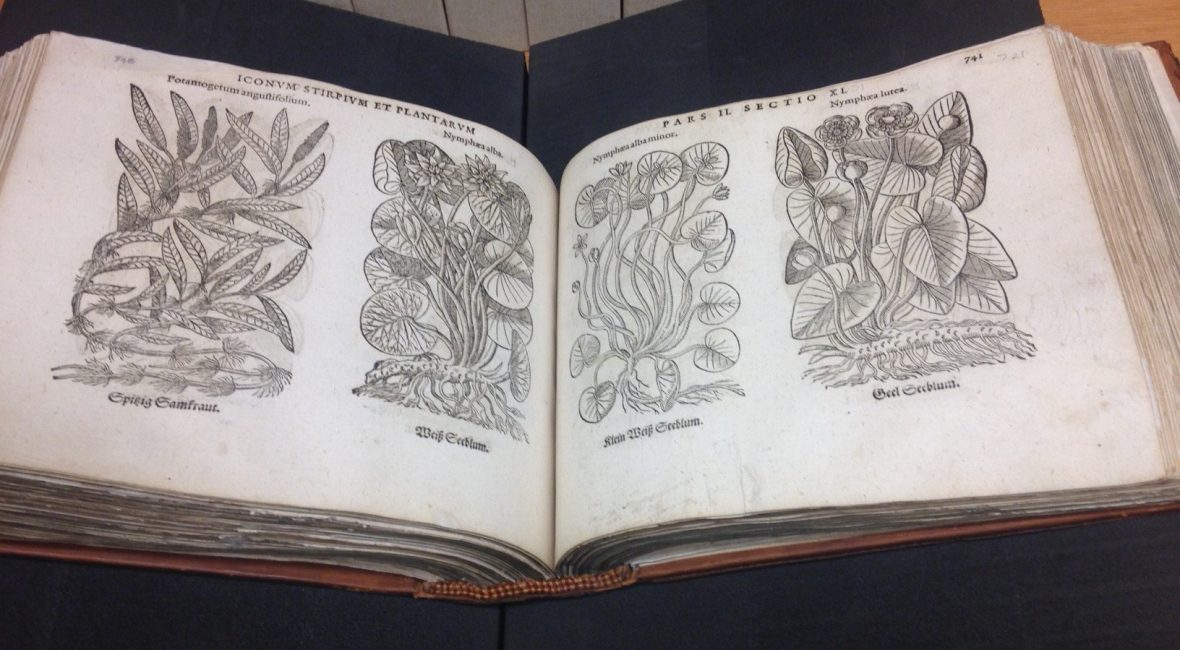
At first glance one notices the unusual oblong-shaped book at 9” x 7” x 3” in a deep brown leather binding.
1. Eicones closed book.jpg

Eicones plantarum… (1590) by Iacobus  Theodorus, in the collection of the Lenhardt Library of the Chicago Botanic Garden. Image credit: Leora Siegel.

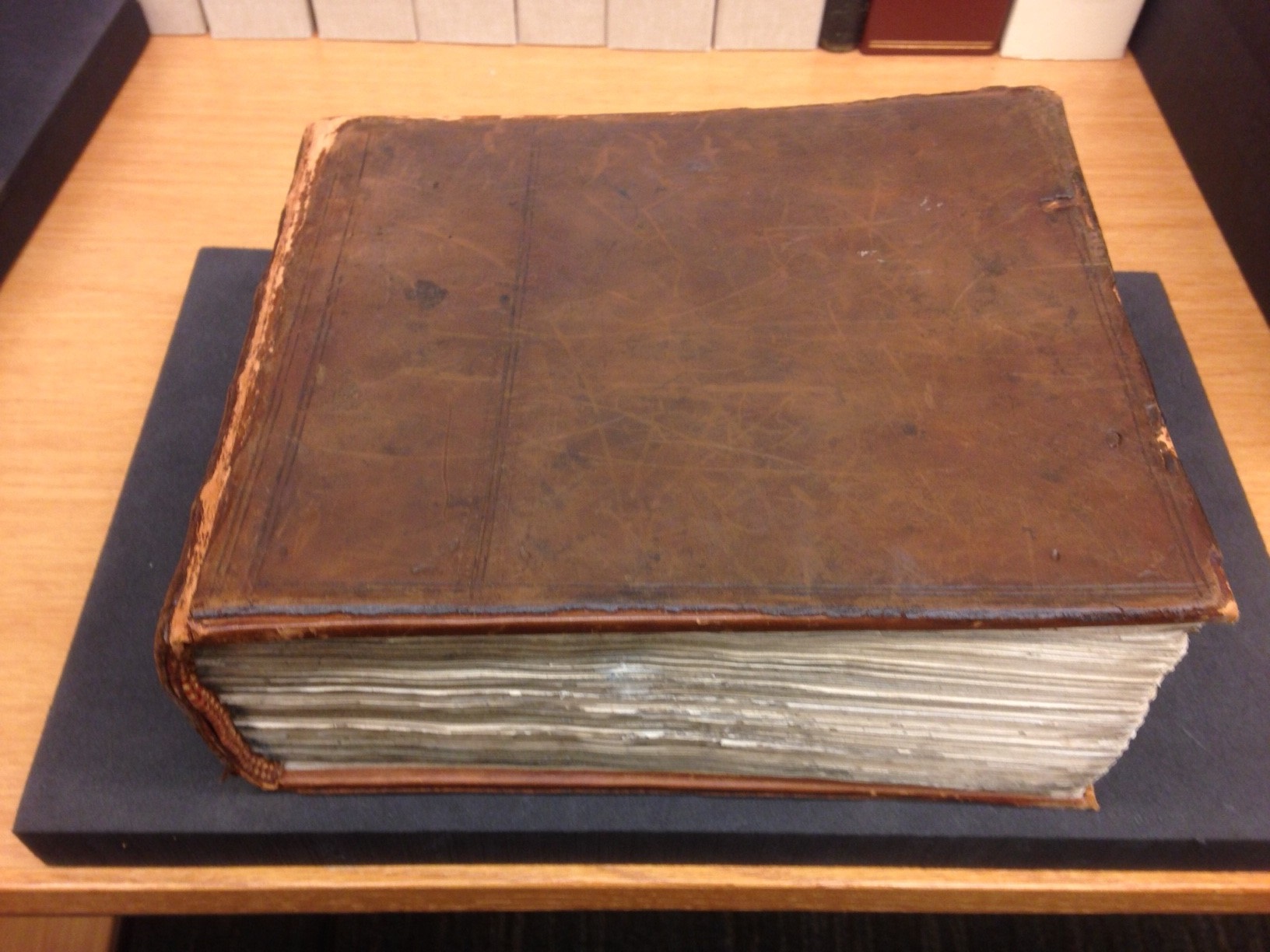
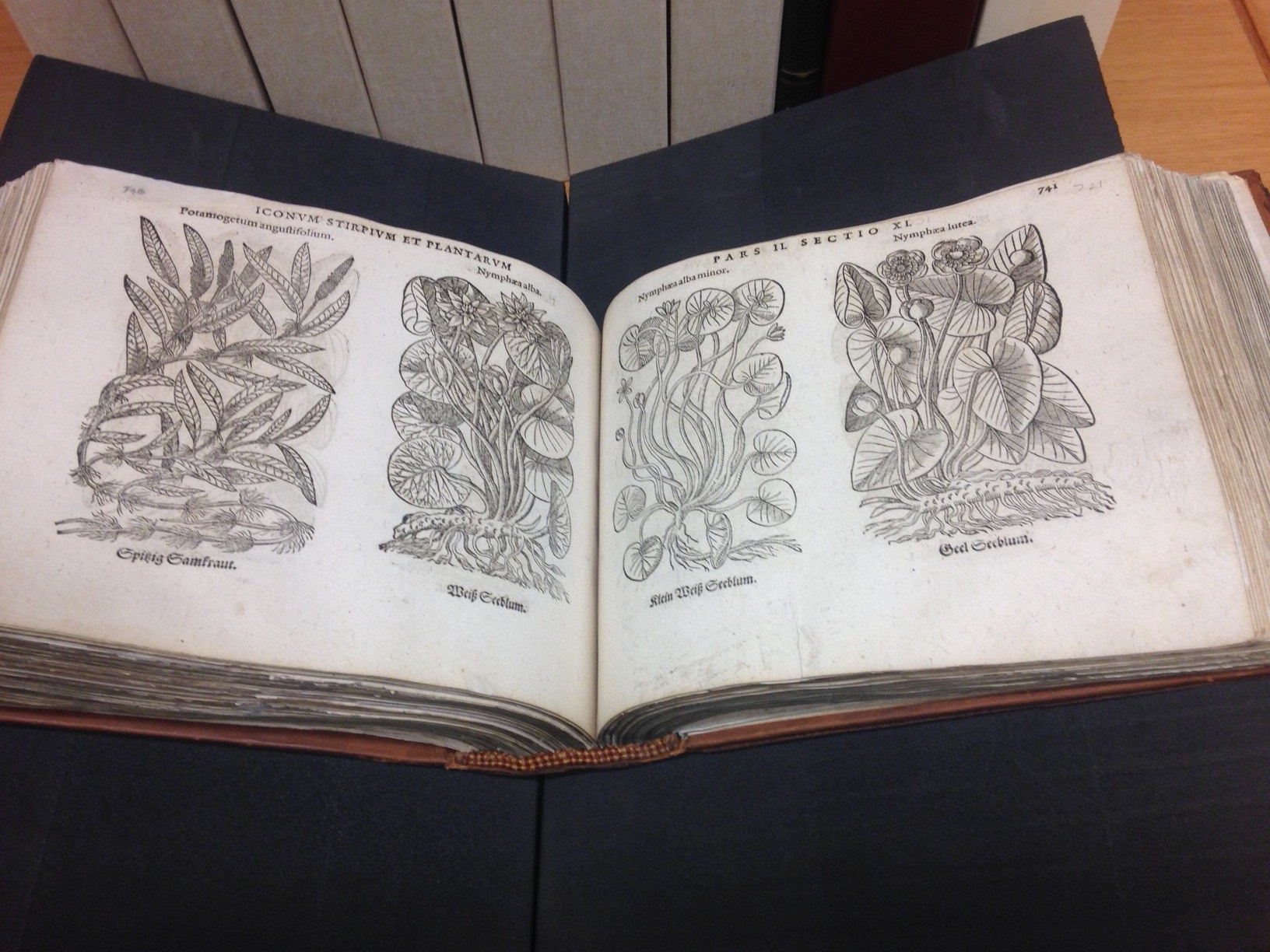
Peeking inside, there are pages and pages of botanical woodcuts – more than 1,020 – each with at least two woodcuts per leaf. For our purposes, a woodcut is an illustration engraved into a block of wood.
2. Eicones side-by-side pages.jpg

A look inside Eicones plantarum… (1590) by Iacobus  Theodorus, in the collection of the Lenhardt Library of the Chicago Botanic Garden. Image credit: Leora Siegel.

What is this copiously-illustrated work?

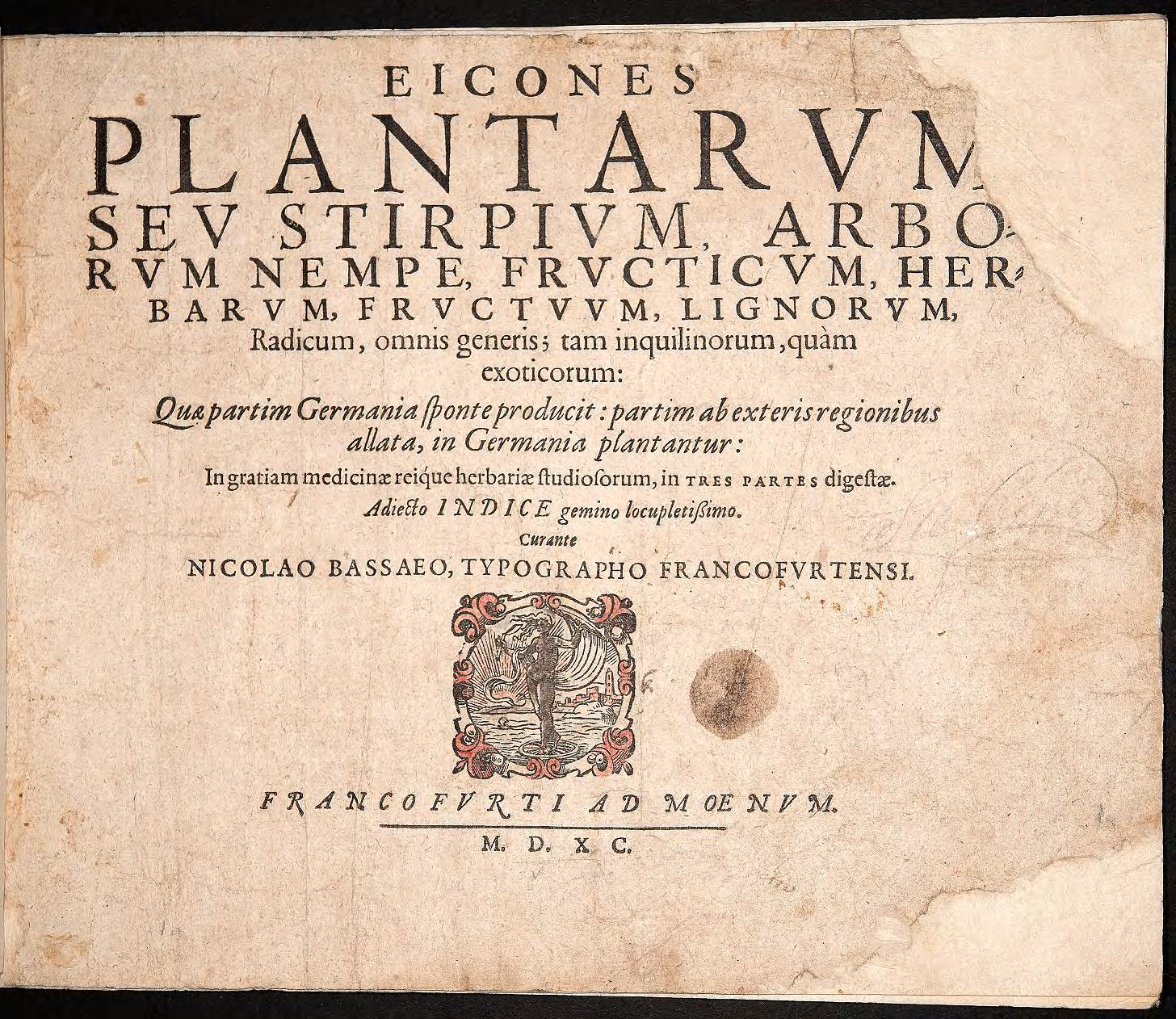
Eicones plantarum seu stirpium, arborum nempe, fructicum, herbarum, fructuum, lignorum, radicum, omnis generis : tam inquilinorum, quàm exoticorum : quæ partim Germania sponte producit, partim ab exteris regionibus allata in Germania plantantur : in gratiam medicinæ reiâque herbariæ studiosorum, in tres partes digestæ : adiecto indice gemino locupletissimo [Francofurti ad Moenum: Nicolao Bassaeo, 1590], by Iacobus  Theodorus (1522 or 1525 – 1590).

Or, using an abridged, summarized, and modernized translated title, “Pictures of plants, trees, herbs, fruits, and roots that are native to Germany and foreign countries, which are used for medicinal purposes, for apothecary students, and divided into three parts with the addition of a double index”.
4.Eicones title page.jpg

Title page from Eicones plantarum… (1590) by Iacobus  Theodorus. Contributed in BHL from the Lenhardt Library of the Chicago Botanic Garden.

Jacobus Theodorus (modern form of Iacobus), born in 1522 or 1525, was a German herbalist and physician. He is known by the name “Tabernaemontanus”, which comes from the Latin version of his hometown in Germany, Berg-Zabern or Tabernae Montanae.
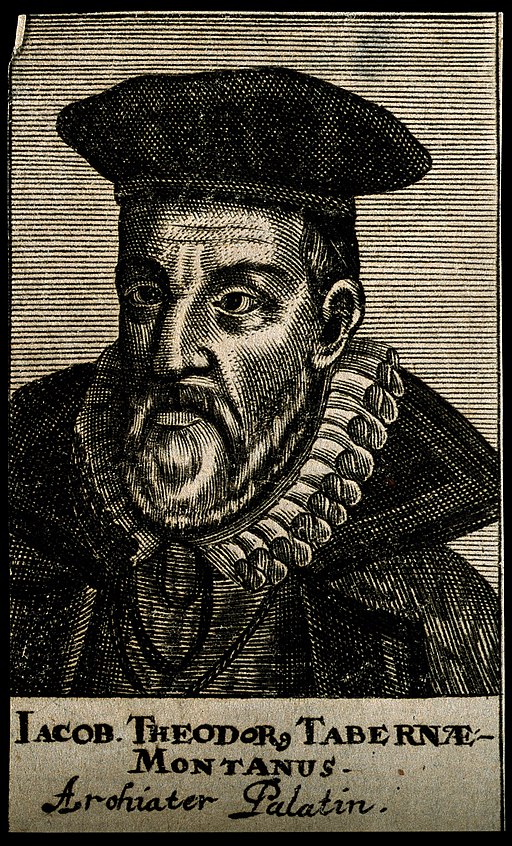
3.Jacobus_Theodorus_Tabernaemontanus._Line_engraving,_1688._Wellcome_V0005711.jpg

Jacobus Theodorus Tabernaemontanus. Line engraving, 1688. Credit: Wellcome Library, London. Wellcome Images.

Tabernaemontanus trained as an apothecary at first, and then changed careers and became a physician, focused on medicinal herbs as remedies. He studied under the great herbalists of his time, including Otto Brunfels and Hieronymus Bock. His seminal work, Neuw Kreuterbuch…, published in 1588, contained over 2,300 botanical woodcut illustrations with descriptions of the plants and their uses. He wrote this work to expand upon his herbalist predecessors and to enhance the knowledge of the time period. In all, he spent 36 years working on the project. Considered one of the fathers of German botany, he died in 1590, the same year Eicones plantarum was published.
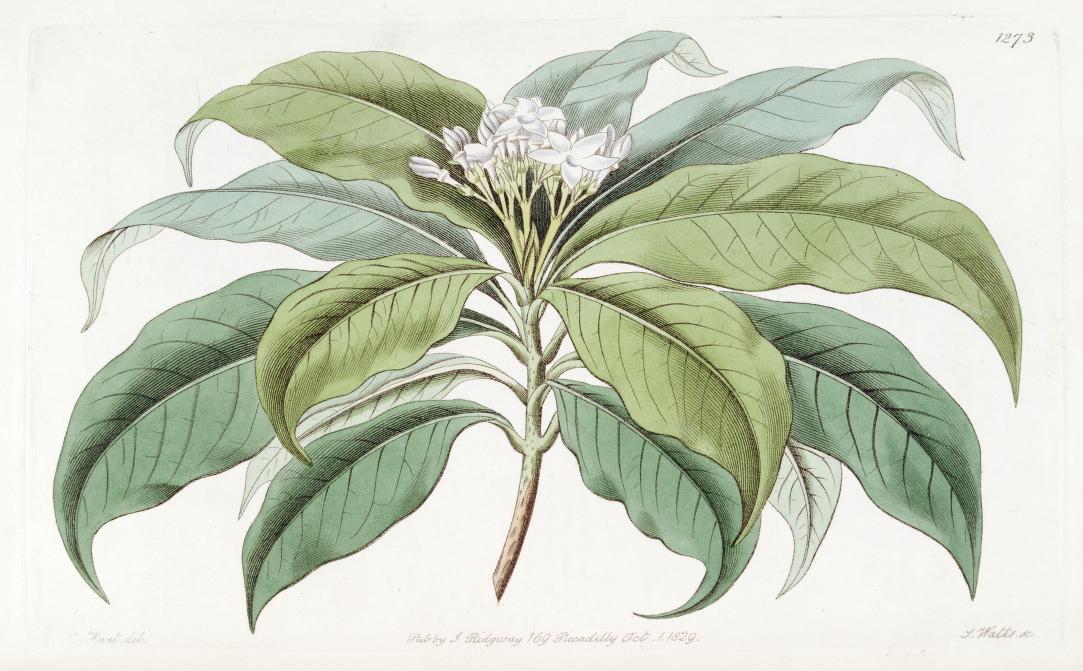
6. Tab flower from Edwards.jpg

Tabernaemontana densiflora (a synonym of Rauvolfia verticillata) was named for Tabernaemontanus. In describing the flower in Edward’s Botanical Register, volume 15, 1829, John Lindley stated that “Tabernaemontanus was a botanist of the 16th century, whose works have long sunk into oblivion.” Illustration of T. densiflora by M. Hart from Edward’s Botanical Register, v. 15 (1829), contributed in BHL from the Peter H. Raven Library of the Missouri Botanical Garden.

Our book, Eicones plantarum…, is an edition of only the botanical woodcuts from Neuw Kreuterbuch. Although it does not have the text, it does includes the names of the plants in Latin and German.

With its content and shape, it must have been published in this way to serve a different purpose that the more typical folios of the time that were larger and comprehensive. As its title indicates, it may have been used as a quick reference guide for botanists, physicians, herbalists, and students to easily flip through to identify unknown plants and their names, in this Pre-Linnean era.
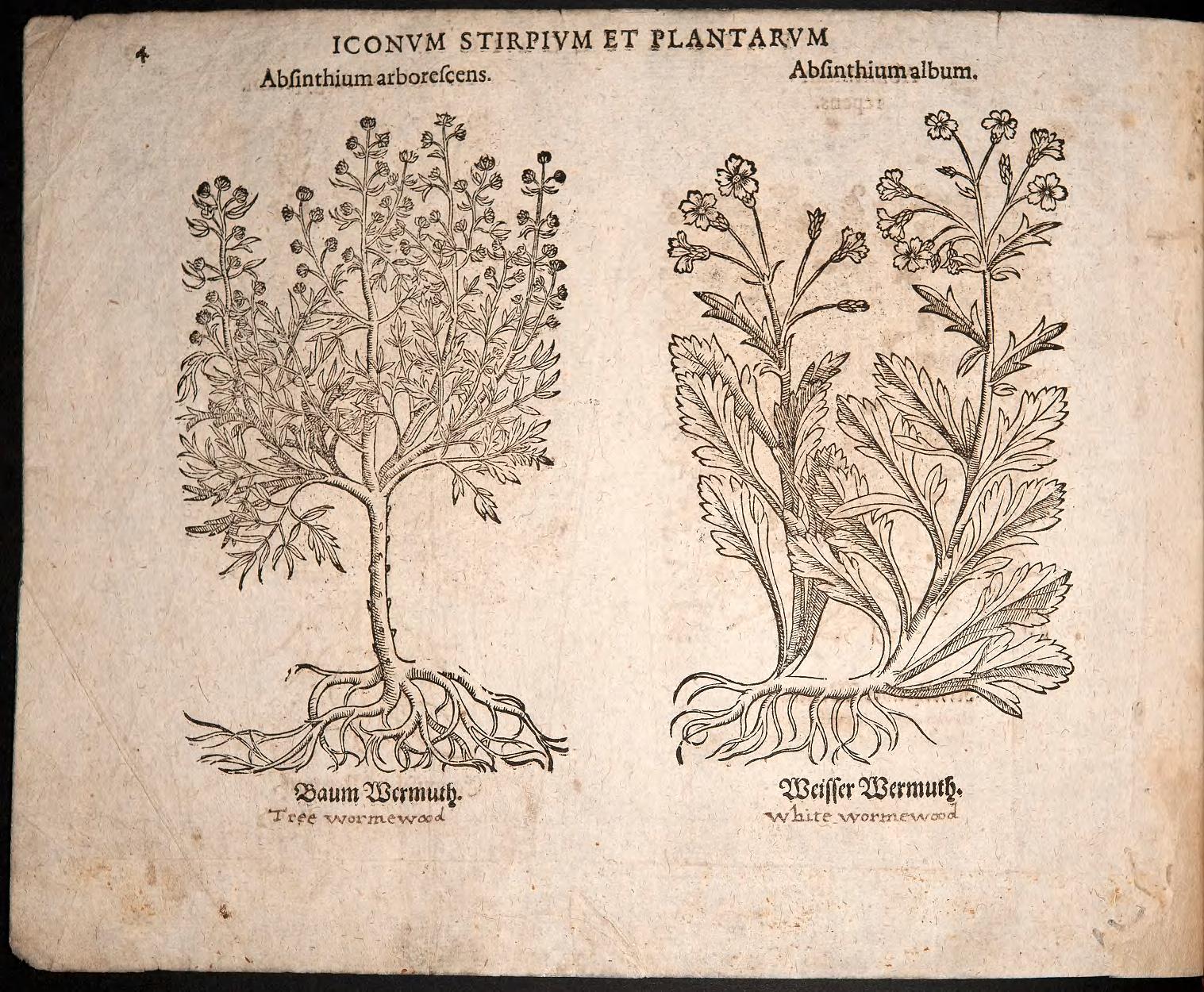
5. Eicones mugwort wormwood.jpg

As highlighted in General Biography; or, Lives, Critical and Historical, of the Most Eminent Persons of all ages, countries, conditions, and professions… by John Aikin and William Johnston (v. 9, 1814, pg. 310), as a physician, the herb Tabernaemontanus often prescribed as a remedy was mugwort. Mugwort (or wormwood) from Eicones plantarum… (1590), contributed in BHL from the Lenhardt Library of the Chicago Botanic Garden.

For those familiar with John Gerard’s The Herball (1597), the woodcuts may look familiar. The well- known English language Renaissance botanical work re-used many of the woodcuts from the books by Tabernaemontanus. John Norton, publisher of The Herball, acquired them from Nicolas Bassaeus, publisher of Eicones plantarum.
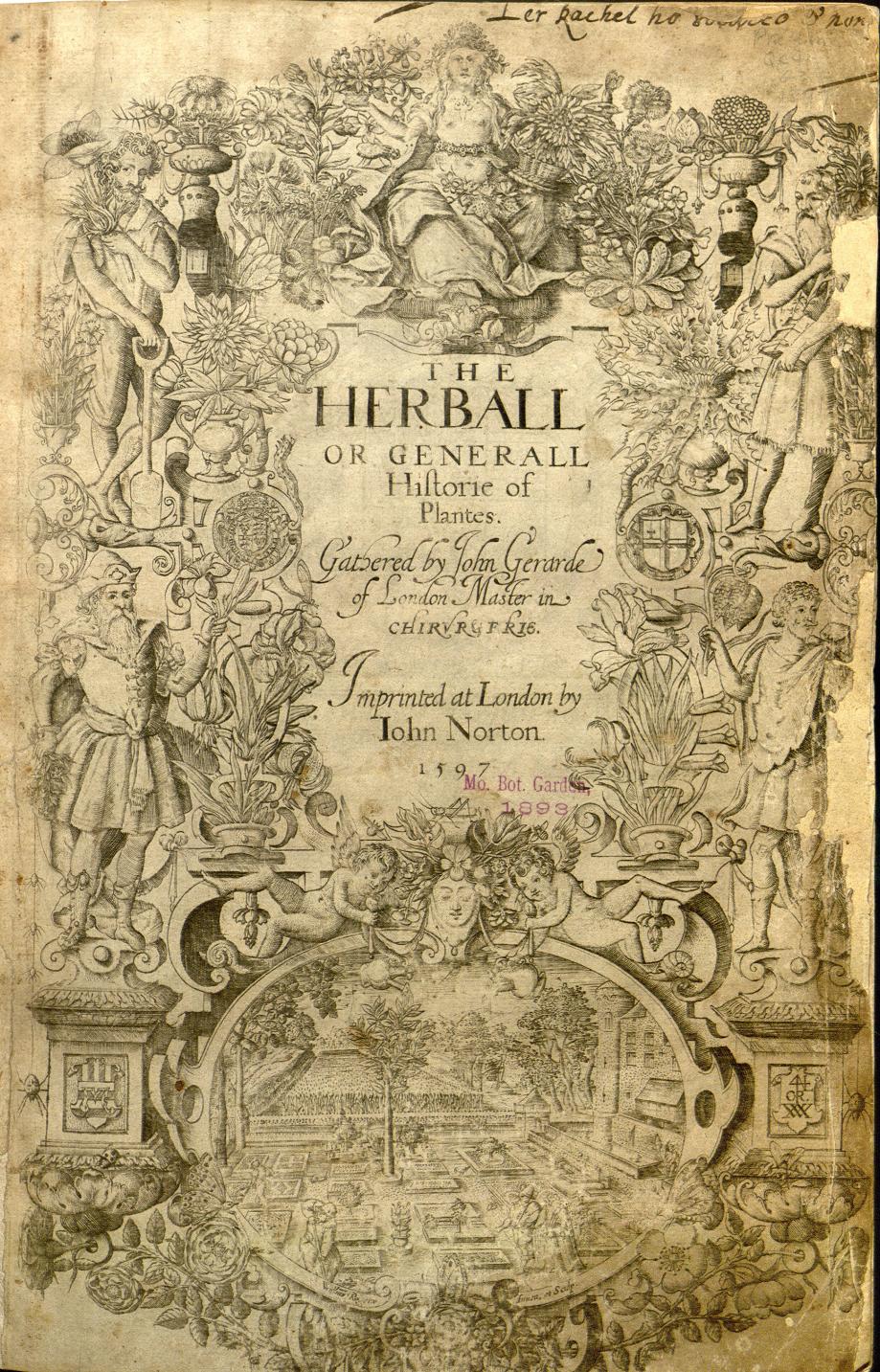
7.Gerard 1597 title page.jpg

Title page from John Gerard’s The Herball (1597), contributed in BHL from the Peter H. Raven Library of the Missouri Botanical Garden.

Digitizing this 428-year-old volume was a labor of love for us in the 21st century. The book was imaged by a team of volunteers over a three-year period. Metadata for each woodcut (including transcriptions of German and Latin names, soon to uploaded to BHL) was assigned by Mary Roback. Mary came to the Lenhardt Library as a Library Science graduate student and stayed on as a volunteer after graduation. She took on the metadata project to keep involved with special collections while undergoing chemotherapy. While she has sadly passed away, her valuable contributions to this project have left a lasting legacy, ensuring that this volume is accessible to readers around the world today and into the future. We are truly grateful for her dedication to this project and are honored to have shared this experience with her.

References

Aikin, John, William Enfield, Nicholson, Thomas Morgan, and William Johnston. General Biography; Or, Lives, Critical and Historical, of the Most Eminent Persons of All Ages, Countries, Conditions, and Professions, Arranged According to Alphabetical Order. London: Printed for G.G. and J. Robinson, 1799.

Arber, Agnes. Herbals: their origin and evolution, a chapter in the history of botany, 1470-1670. 2nd edition. Cambridge: University Press, 1953.

Edwards, Sydenham, and John Lindley. Edwards’s Botanical Register, or, Ornamental Flower-Garden and Shrubbery. London: James Ridgway, 1829.

Johnston, Stanley H. The Cleveland Herbal, Botanical, and Horticultural Collections: A Descriptive Bibliography of Pre-1830 Works from the Libraries of the Holden Arboretum, the Cleveland Medical Library Association, and the Garden Center of Greater Cleveland. Kent, Ohio: Kent State University Press, 1992.

Rohde, Eleanour Sinclair. The Old English Herbals with coloured frontispiece and 17 illustrations. London: Longmans & Co., 1922.

Stearn, William T. Stearn’s Dictionary of Plant Names for Gardeners: A Handbook on the Origin and Meaning of the Botanical Names of Some Cultivated Plants. Portland, OR: Timber Press, 2002.
September 27, 2018by Joel Richard
Blog Reel, Featured Books

Entertaining Royalty: MBLWHOI Library uses BHL volumes, digital tools, and physical volumes in exhibit prepared for visit of His Serene Highness Prince Albert II of Monaco

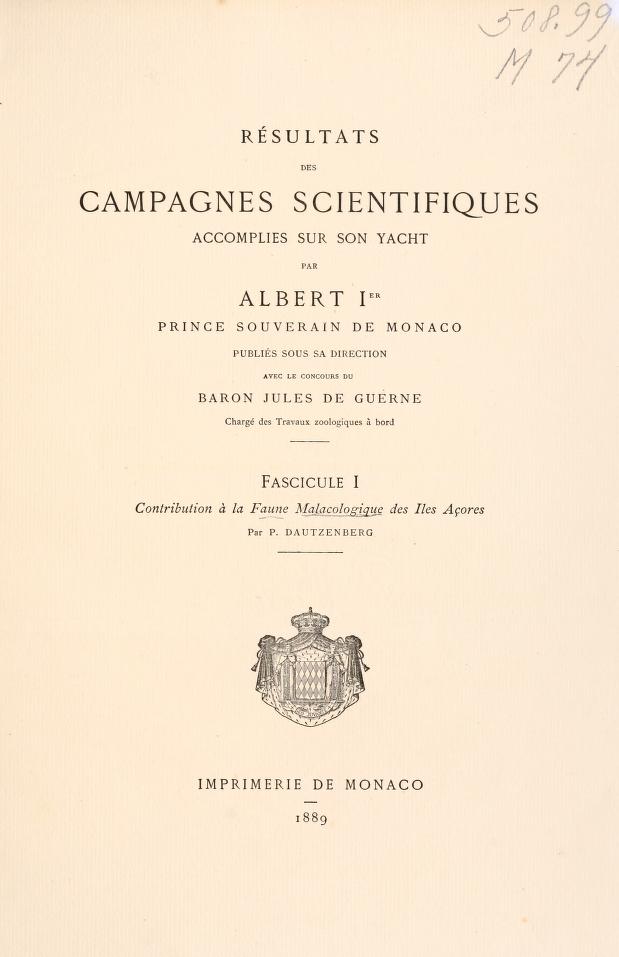
One of the most interesting titles which the MBLWHOI Library has scanned into the Biodiversity Heritage Library is Résultats des campagnes scientifiques accomplies sur son yacht par Albert Ier, prince souverain de Monaco = Results of the scientific campaigns carried out on his yacht by Albert I, sovereign prince of Monaco.

rsultatsdescamv01_1899.jpg

Title page. Résultats des campagnes scientifiques accomplies sur son yacht par Albert Ier, prince souverain de Monaco. Fasc. 1 [Malacologique] (1889). Contributed in BHL from the MBLWHOI Library.

This important book series is part of the MBLWHOI Library Special Collection of the great voyages of scientific exploration. Resultats… brings together the science and data collected by the research expeditions led by Prince Albert I of Monaco (1848-1922) at the end of the 19th and the beginning of the 20th Centuries, and the title consists of 110 volumes published from 1889-1950.

The Prince, in addition to having been the head of state of the Principality of Monaco, was an important figure in the development of the ocean sciences in the decades before and after the turn of the 20th Century. HSH Prince Albert I of Monaco’s pioneering science career included the exploration of the Mediterranean, the south and north Atlantic regions, and polar regions north of Norway known as the Svalbard Archipelago. Prince Albert I of Monaco was also considered a preeminent statesman who understood the importance of the preservation and stewardship of the most fragile areas of our earth, and the importance of science as a source for the foundation of peace on earth: Science: “that force that transforms living conditions, peoples’ mentalities, and international relations.” – Prince Albert I of Monaco (1910)

One hundred and seventy years after his birth, the work of Prince Albert I is today carried on by his great-grandson, the current head of state of Monaco, HSH Prince Albert II.

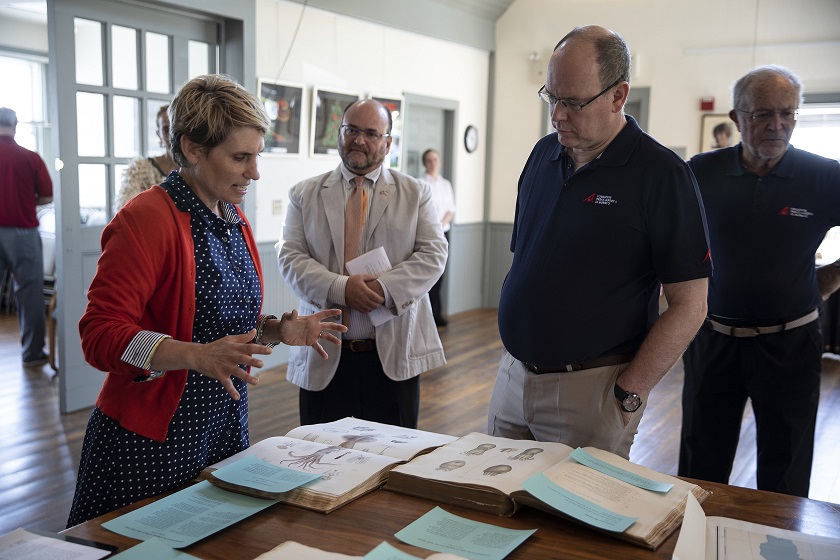
On July 8th of this summer, Prince Albert II of Monaco touched down at Barnstable Airport on Cape Cod, Massachusetts to visit the laboratories and marine work environment of the scientists who work at the Marine Biological Laboratory (MBL, founded in 1888, is an affiliate institution of the University of Chicago.) Activities during the Prince’s visit included laboratory visits, an exploration of the local waters aboard the MBL research vessel Gemma, and a panel discussion held with MBL interim director Neil Shubin and scientists from MBL’s Ecosystems Center: “Adapting to a Climate-Changed World.” The Prince came to MBL also to announce his support, through the Prince Albert II of Monaco Foundation, for the development of a website, SeaBase at MBL, a new open-access infrastructure for integrated data on marine organisms, their genomes, their microbiomes, and the environmental status of their habitats. Later during his visit, HSH Prince Albert II walked down the street to visit the Woods Hole Oceanographic Institutions’ (WHOI was founded in 1930) Center for Marine Robotics “Dunkworks” facility.

Woods Hole has hosted heads of state in the past: in 1975 Emperor Hirohito of Japan, whose life long hobby/profession was as a marine biologist (known for his detailed descriptions of marine species), visited scientists at both the MBL and WHOI as well as making a visit to the collections of the MBLWHOI Library.

exhibit.jpg

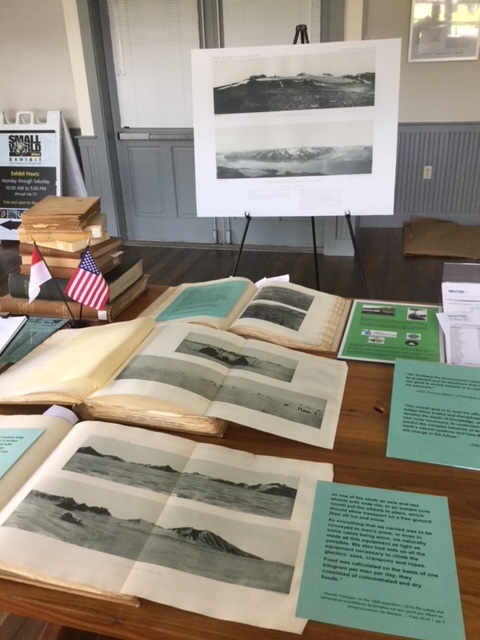
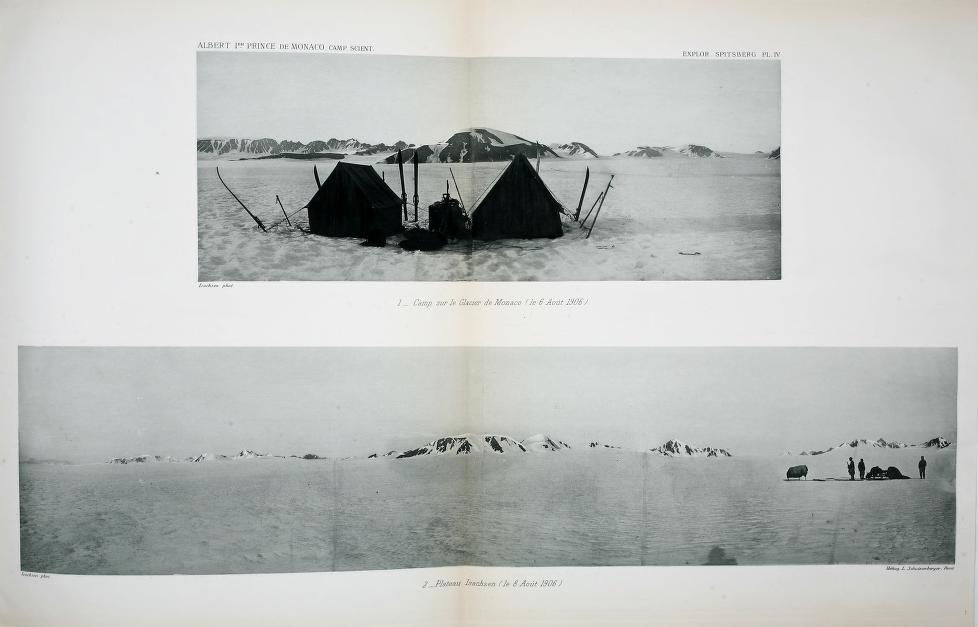
Small exhibition prepared by the MBLWHOI Librarians team for the visit of Prince Albert II of Monaco on July 9, 2018. Volumes 41-44 of Résultats des campagnes scientifiques accomplies sur son yacht par Albert Ier, prince souverain de Monaco. (below, the encampment on Monaco Glacier, Spitsbergen). Photo courtesy of MBLWHOI Library.

rsultatsdescamv401912pl4.jpg

Plate 4. Résultats des campagnes scientifiques accomplies sur son yacht par Albert Ier, prince souverain de Monaco. Fasc. 40 [Exploration pt. 1] (1912). Contributed in BHL from the Smithsonian Libraries.

The MBLWHOI librarians Jen Walton (Co-director/MBL Archivist), Matt Person (Tech Services Coordinator), and Dave Sherman (WHOI Archivist) all played roles among tens of MBL and WHOI staff members who contributed to the planning of Prince Albert II’s historic visit to Woods Hole.

The Librarians prepared a small exhibition for a visit from the Prince on July 9th centered upon the work of Prince Albert I. Librarians Jen Walton and Matt Person researched the past and present connections between Monaco and the MBL, and they also studied specific volumes from Résultats des campagnes scientifiques accomplies sur son yacht par Albert Ier, prince souverain de Monaco (donated to the MBL by Prince Albert I) relative to current MBL environmental and biological research. While the physical volumes were used in the exhibition, the librarians consulted the digital volumes in the BHL for multiple reference purposes.

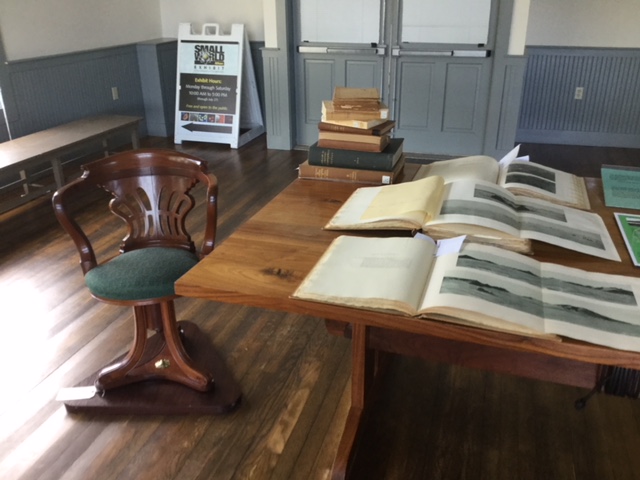
In addition to volumes from Résultats…, the exhibit included a special chair, now a part of the WHOI Archives collection, prepared for the exhibit by current WHOI Archivist Dave Sherman. In 1933, while on a marine biological station tour of Europe, WHOI marine chemist Professor Norman Rakestraw visited the Oceanographic Institute of Monaco and was given a gift of a wooden chair, which had been part of the late 19th Century oceanographic research yacht Hirondelle, owned and operated by Prince Albert I of Monaco. The Hirondelle chair was donated by Rakestraw to WHOI upon his return to the United States.

chair.JPG

Chair from research yacht Hirondelle (circa 1873) displayed on left. Photo courtesy MBLWHOI Library.

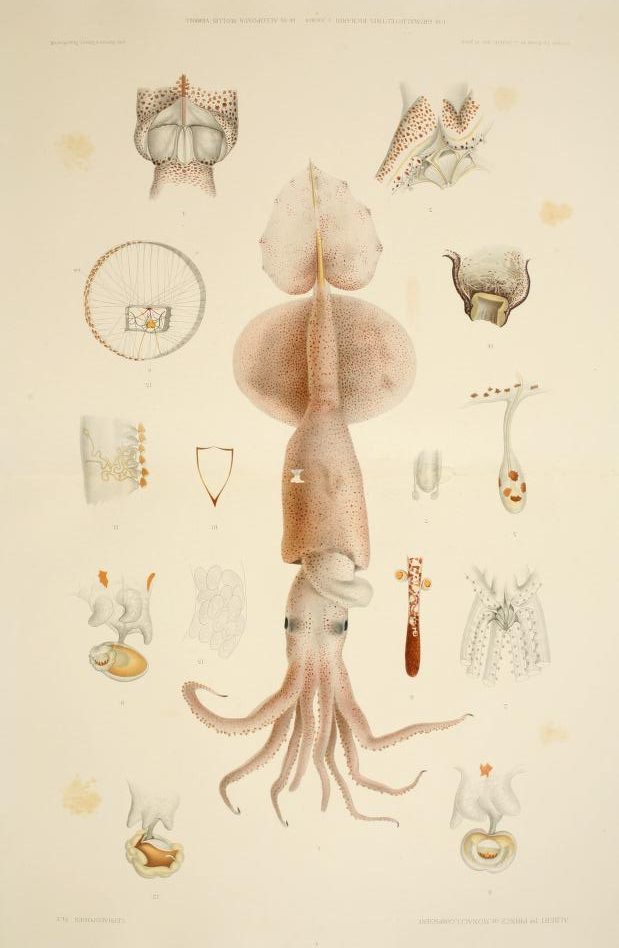
Jen Walton concentrated her research on one of the Cephalopod volumes, Volume 17 (1900), and in particular this image of a large squid which was named in honor of the family of the Princes Albert I and Albert II: Grimalditeuthis richardi.

Cephalopod plate. Résultats des campagnes scientifiques accomplies sur son yacht par Albert Ier, prince souverain de Monaco. Fasc. 17 [Cephalopodes 1] (1900). Contributed in BHL from the MBLWHOI Library.

AlbertIIandJen070918.jpg

(L-R): MBLWHOI Library Co-director Jen Walton, Matt Person, HSH Prince Albert II of Monaco. Photo © 2018 Daniel Cojanu/Undercurrent Productions.

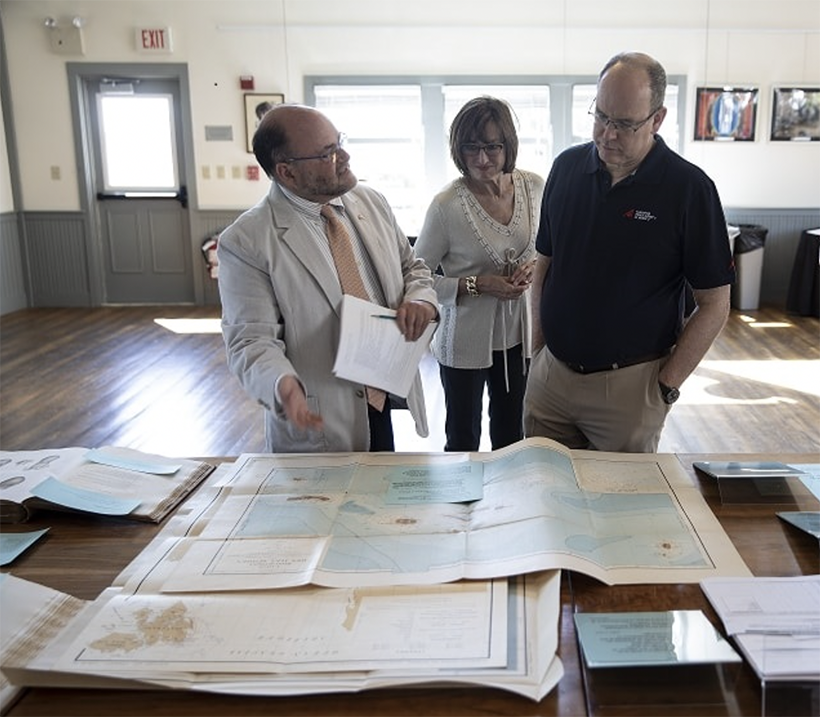
Matt Person told highlights of the story of the four expeditions (through studying Volumes 40-44 of Resultats…) to the Svalbard Archipelago which Prince Albert I led in 1898, 1899, 1906, and 1907. Matt Person also showed Prince Albert II an 1899 bathymetric chart of the Azores Islands and explained how the use of data from multiple sources collected by Prince Albert I over time created a single complete work…and this was compared to current arctic research at the Ecosystems Center of the MBL, which has drawn data over many years from multiple polar region collection sites, to inform global studies of climate change.

Screen Shot 2018-08-22 at 10.06.29 AM.png

Librarian Matt Person shows Prince Albert II of Monaco bathymetric charts which were a result of an 1896 Azores research expedition of Prince Albert I. Photo © 2018 Daniel Cojanu/Undercurrent Productions.

While both Jen Walton and Matt Person used the physical book volumes in the research they performed to become conversant in the work of Prince Albert I , they also employed the full text search and OCR (optical character recognition) files from the Biodiversity Heritage Library and BHL Affiliate the Internet Archive, for which they used an online translation tool to convert French text into English. This translation process was essential to gain a clearer understanding of the text, which informed the illustrations and photographs and narratives of the exhibition as explained to Prince Albert II.

————————————–

The MBLWHOI Library is a Biodiversity Heritage Library founding member, currently an Affiliate, and our staff was part of the development team of the original taxonomic name server, which extracted scientific names from scanned literature. Our staff also formed part of the original “BHL worker bees”, who developed the implementation of much of the day-to-day workflows related to the operation of the online digital library. Matt Person is the Tech Services Coordinator of the MBL WHOI Library and a member of the BHL Collections Committee.

August 23, 2018by Joel Richard
Blog Reel, Featured Books

An Illustrated Natural History of German Frogs: Rösel’s Historia Naturalis Ranarum Nostratium

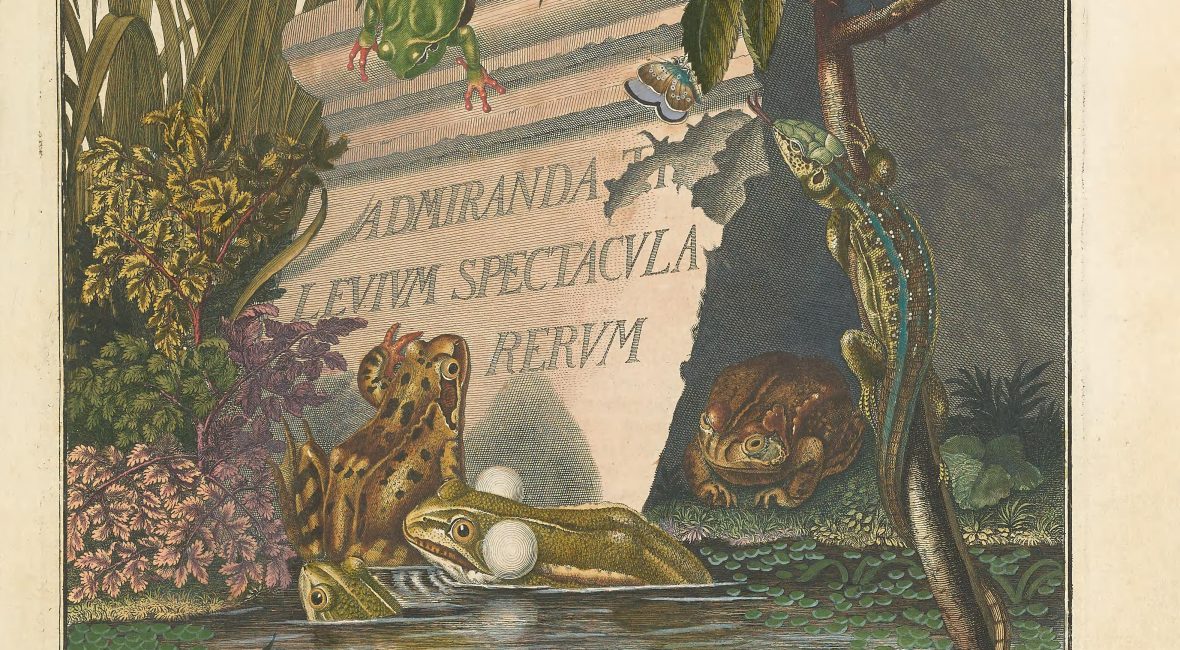
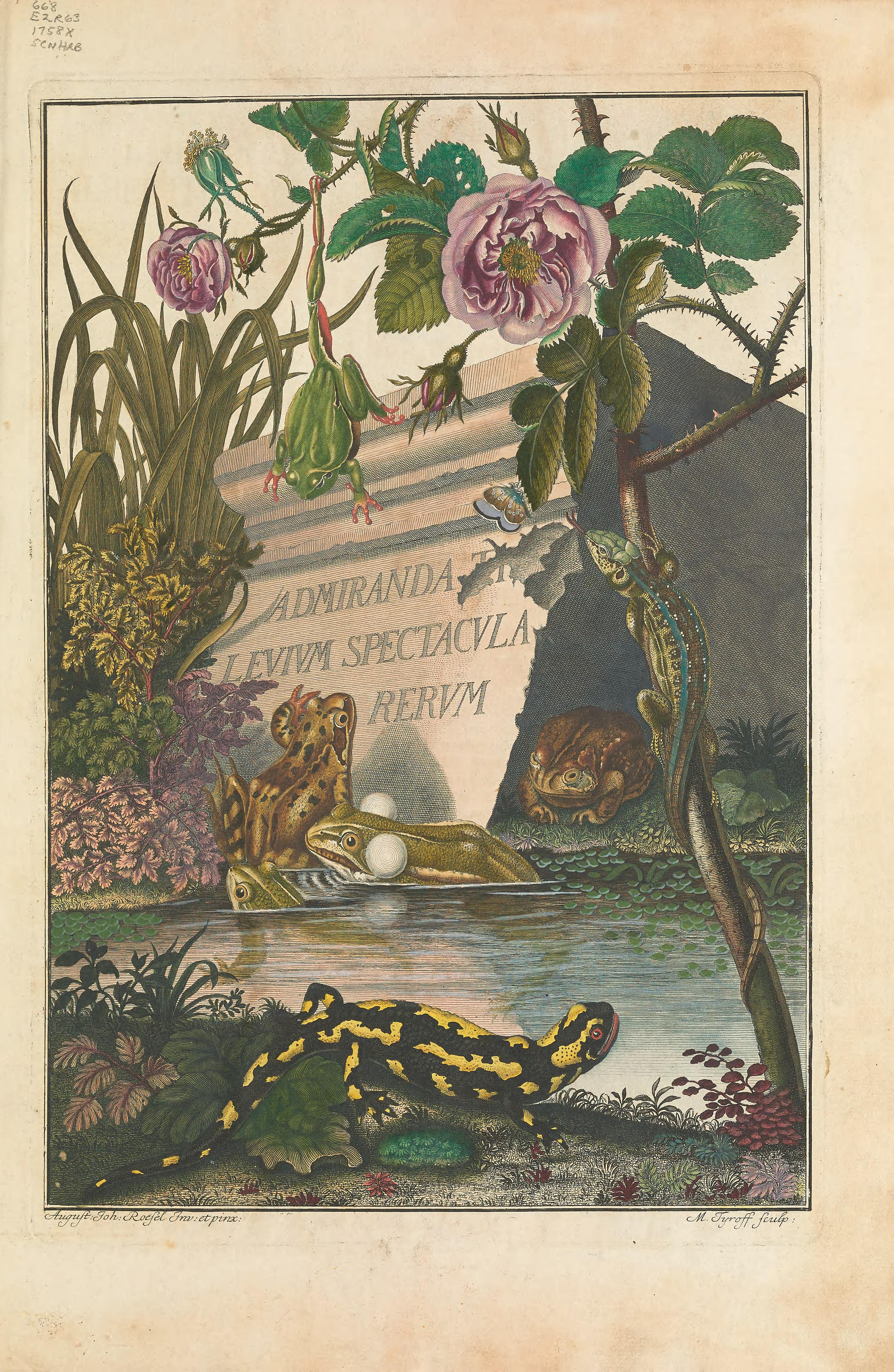
Historia naturalis ranarum nostratium frontispiece

Rösel von Rosenhof, August Johann. Historia naturalis ranarum nostratium. 1758. Contributed in BHL from Smithsonian Libraries.

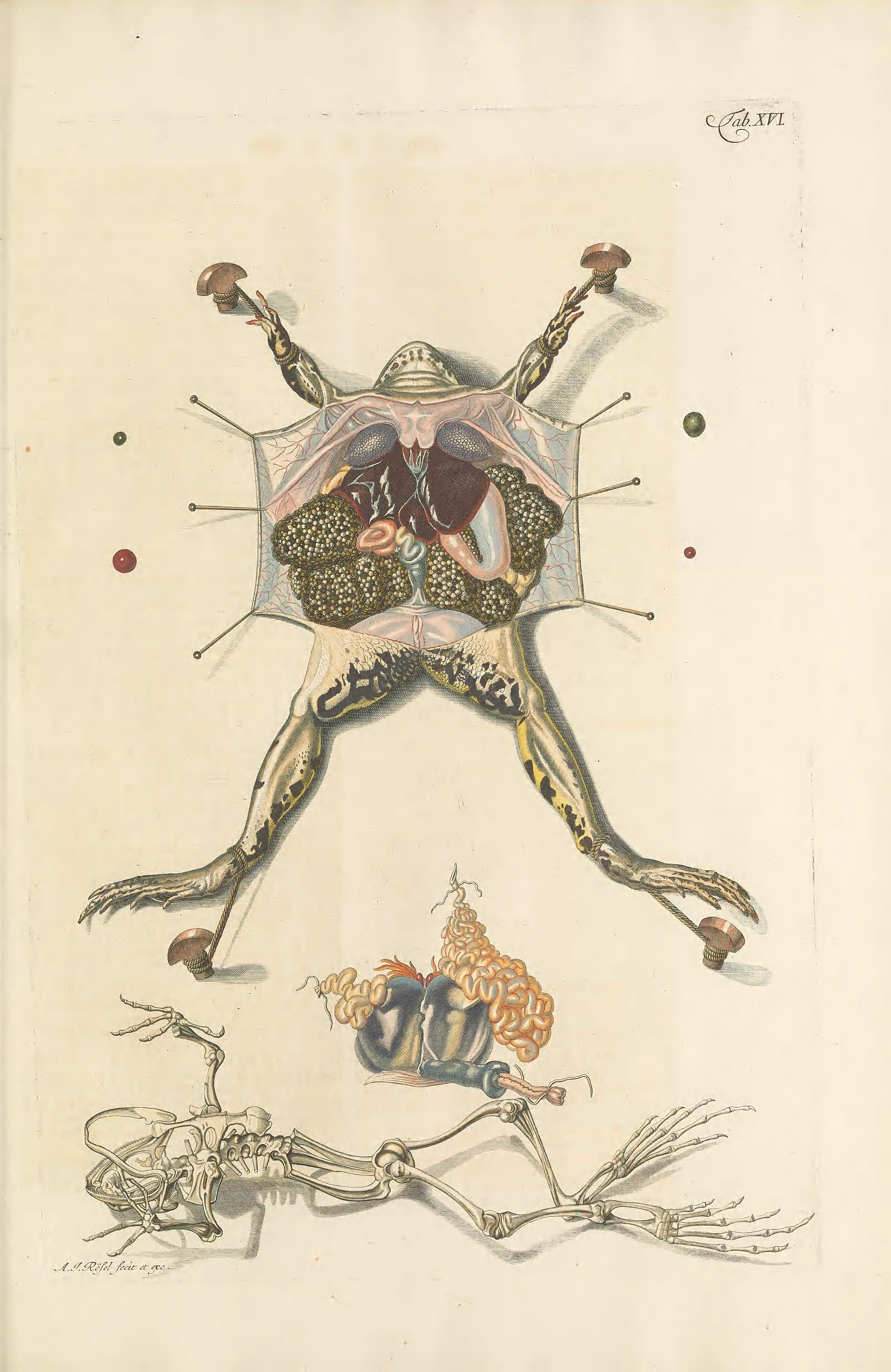
Historia naturalis ranarum nostratium has been described as one of the most beautiful works devoted to frogs and amphibians.

The work of German artist and naturalist August Johann Rösel von Rosenhof, Historia naturalis ranarum nostratium describes the natural history of all then-known frogs and toads indigenous to the Nuremberg region in Germany. The title is noteworthy first for the extensive, accurate information in the text, printed in two columns in both German and Latin. As Darrel Frost, a curator in the Herpetology Department in the Division of Vertebrate Zoology at the American Museum of Natural History, wrote in his essay on the book for Natural Histories, “Rösel’s volume on German frogs represents in a very real sense the beginning of accurate life-history observation in amphibians” (Frost 2012, 38).

frog illustration

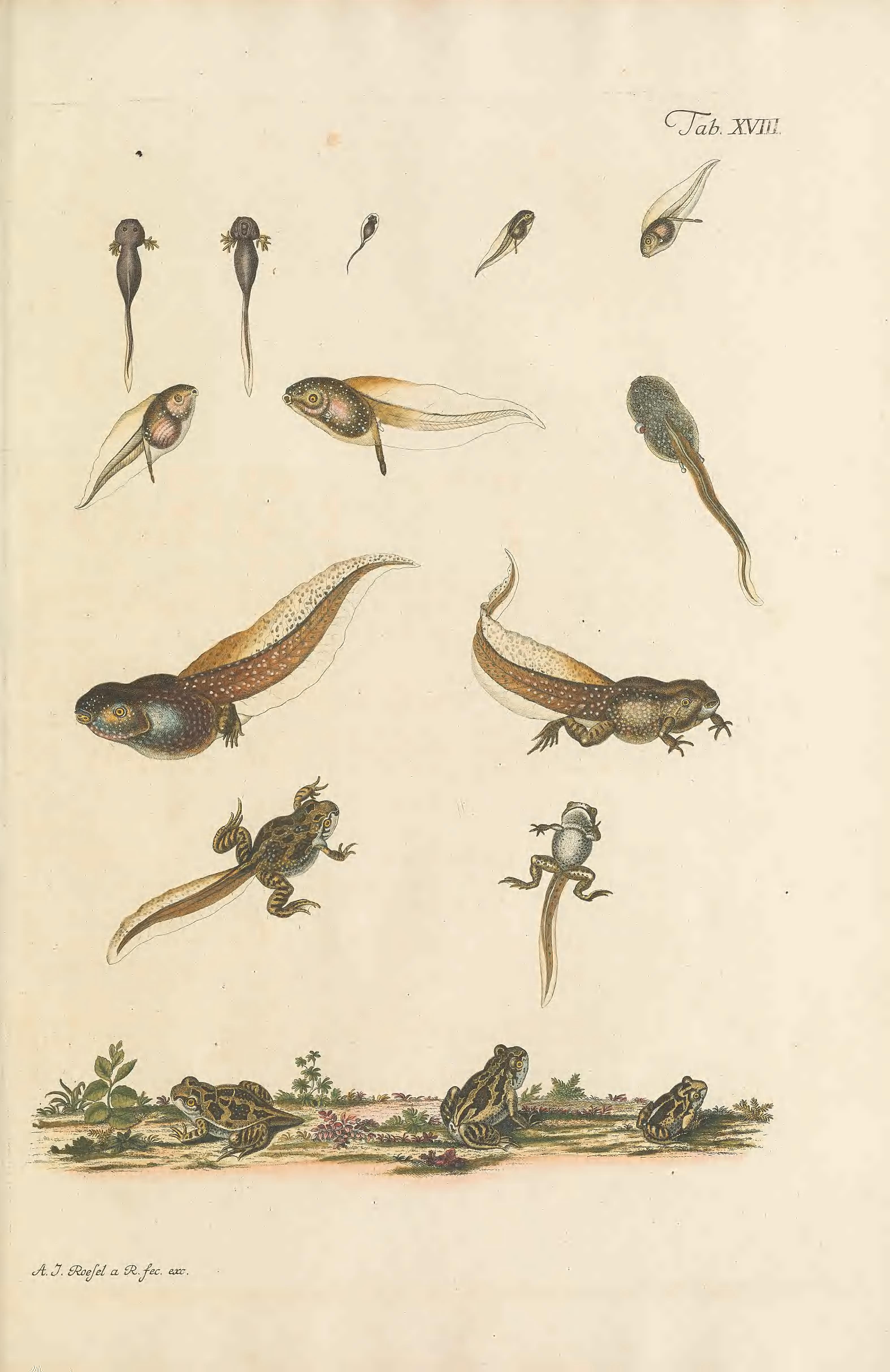
Rösel von Rosenhof, August Johann. Historia naturalis ranarum nostratium. 1758. Contributed in BHL from Smithsonian Libraries.

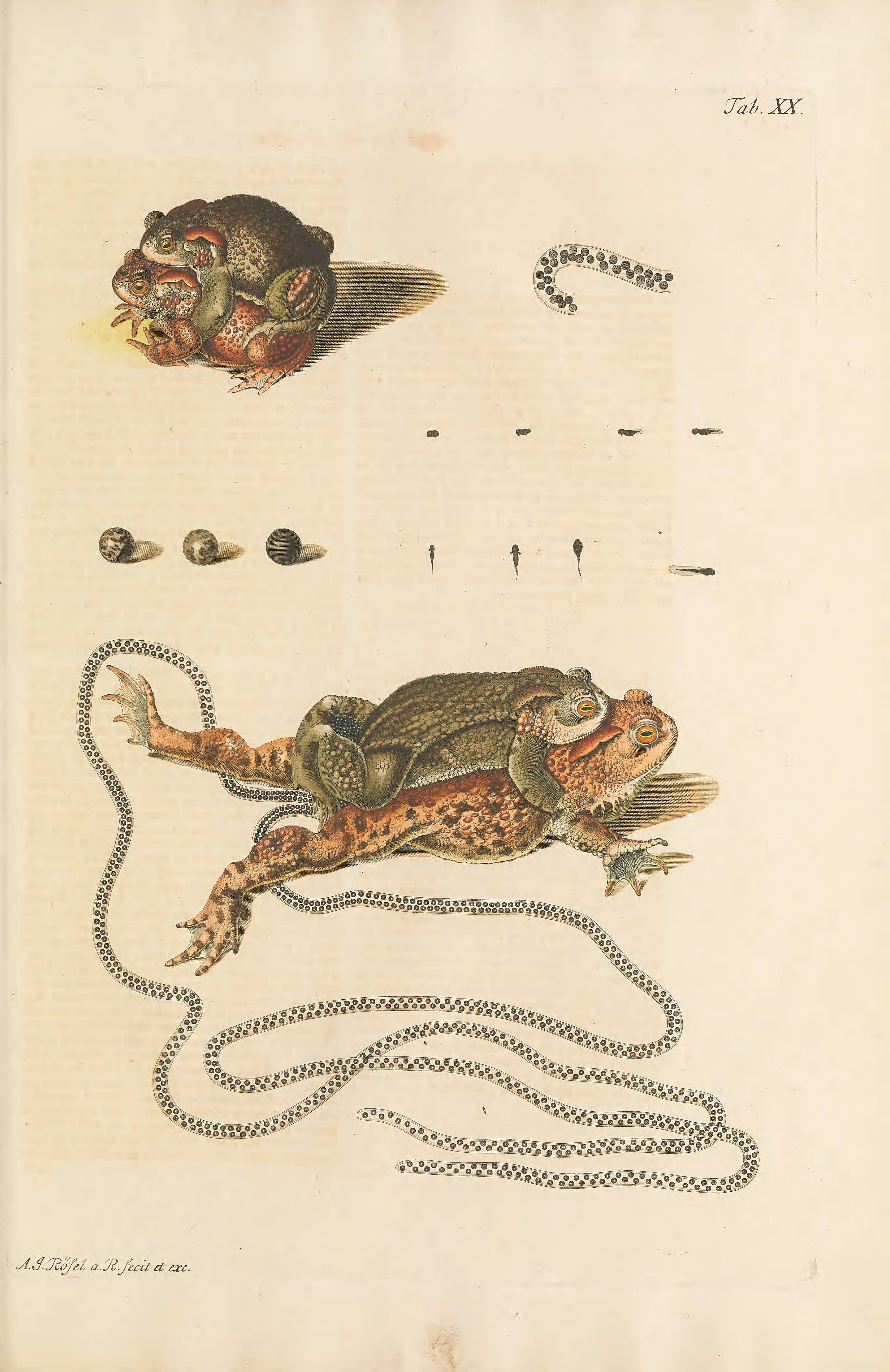
The work is equally (if not more) renowned for its illustrations. The twenty-four folio, hand-colored copper engravings portray habitats, anatomy, reproductive behavior, and larval development stages in intricate detail. The quality of the artwork is not surprising given Rösel’s artistic background.

Johann Rösel von Rosenhof was born in 1705 to a noble Austrian family near Arnstadt in the German principality of Arnstadt-Schwarzburg. Orphaned at a young age, Rösel was sent for training to his uncle, Wilhelm Rösel, an animal and landscape painter, after he showed artistic talent. He eventually became a painter of portraits and miniatures to the Danish Court in Copenhagen before returning to Nuremberg and earning his living as a painter.

frog illustration

Rösel von Rosenhof, August Johann. Historia naturalis ranarum nostratium. 1758. Contributed in BHL from Smithsonian Libraries.

Rösel’s passion for natural history was ignited by the work of Maria Sibylla Merian, a German-born naturalist and illustrator who is recognized as one of the most significant contributors to the field of entomology. Her Metamorphosis Insectorum Surinamensium (1705) depicted the full life cycles of many Suriname insects. Merian was able to portray this life history information because she drew her subjects from life in their natural environments. Most naturalists of the day illustrated species from dead, preserved specimens, which contributed to a lack of knowledge about the true life cycle and origin of insects. Maria also portrayed the host plant for the species she studied and even illustrated the damage the insects left on the plants.

illustration of butterflies

Rösel von Rosenhof, August Johann. Der monathlich-herausgegebenen Insecten-Belustigung. v. 4 (1761). Contributed in BHL from the Naturalis Biodiversity Center.

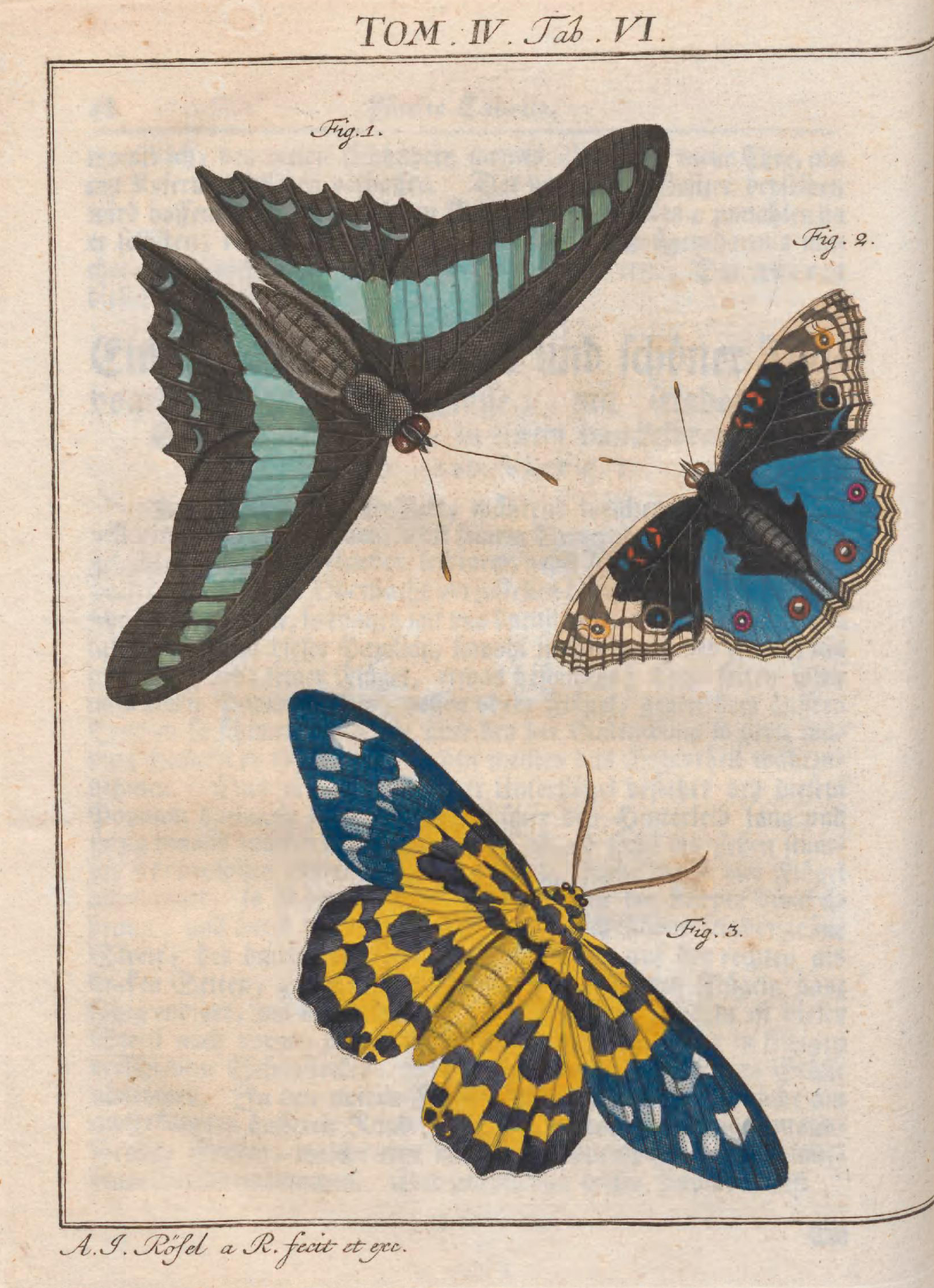
Merian’s work inspired Rösel to study and produce a similar work on German insects. His interest in the natural world also grew to include amphibians and reptiles, and he used his leisure time to collect insect and amphibian eggs and larvae to observe their development. The first part of his first natural history publication, Der monatlich-herausgegebenen Insecten-Belustigung, was published in 1740. Four additional parts appeared over the years, with the final one being published posthumously in 1761. Because of this publication, a copy of which has been contributed in BHL from the Naturalis Biodiversity Center, Rösel is known as one of the fathers of German entomology.

frog illustration

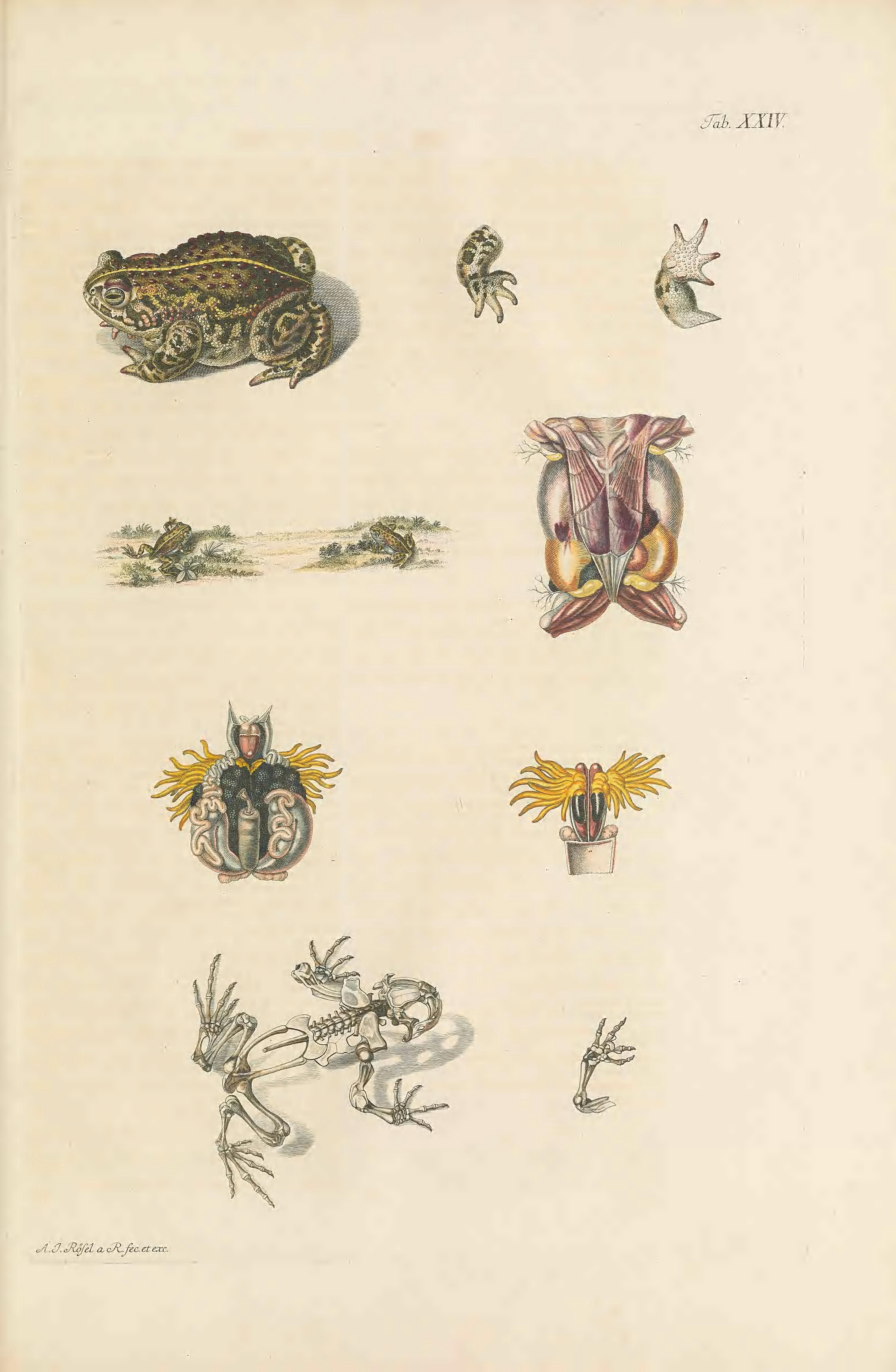
This illustration became the type of Bufo calamita (now Epidalea calamita). Rösel von Rosenhof, August Johann. Historia naturalis ranarum nostratium. 1758. Contributed in BHL from Smithsonian Libraries.

In 1753, Rösel published the first part of his Historia naturalis ranarum nostratium. Completed in 1758, the work is a scientific and artistic marvel, and several of the illustrated frogs, such as Bufo calamita (now Epidalea calamita) and Bufo fuscus (now Pelobates fuscus), became the types for their species. Thanks to the Smithsonian Libraries, everyone in the world can appreciate Rösel’s scientific and artistic contributions to the natural history of German frogs. The Libraries’ copy of Historia naturalis ranarum nostratium, housed in its Joseph F. Cullman 3rd Library of rare books, has recently been digitized for BHL.

As Frost outlines in his essay, Rösel intended to produce a similar work for lizards and salamanders, but sadly was not able to complete it, as he died unexpectedly on March 27, 1759.

Through his natural history publications, Rösel’s scientific legacy lives on and is accessible to everyone through the Biodiversity Heritage Library thanks to the Naturalis Biodiversity Center and Smithsonian Libraries.

frog illustration

Rösel von Rosenhof, August Johann. Historia naturalis ranarum nostratium. 1758. Contributed in BHL from Smithsonian Libraries.

Reference

The information in this post was derived from:

Frost, Darrel. 2012. “Rösel von Rosenhof and His Natural History of Frogs.” In T. Baione (Ed.), Natural Histories: Extraordinary Rare Book Selections from the American Museum of Natural History Library (pp. 37-38). New York: Sterling Publishing.

August 2, 2018by michelle.underhill
Blog Reel, Featured Books

BHL Adds Volumes from Wilson Ornithological Society

52234276.jpeg

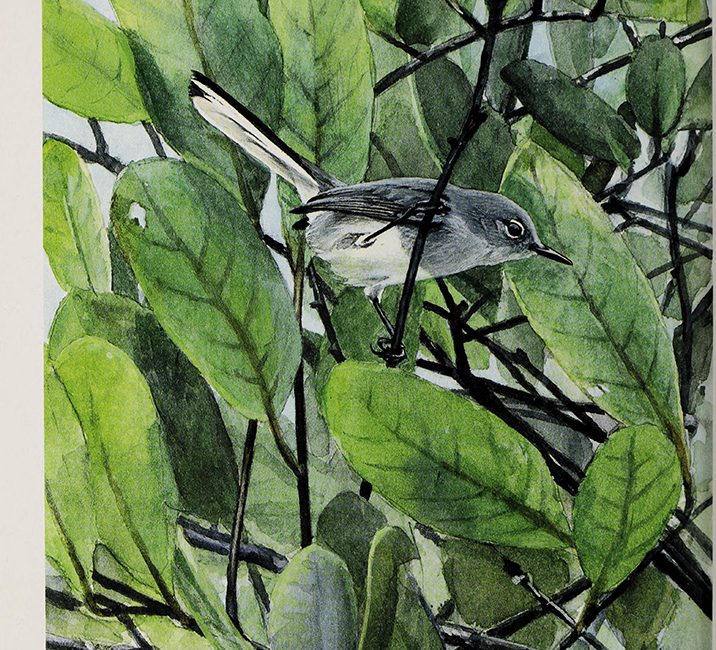
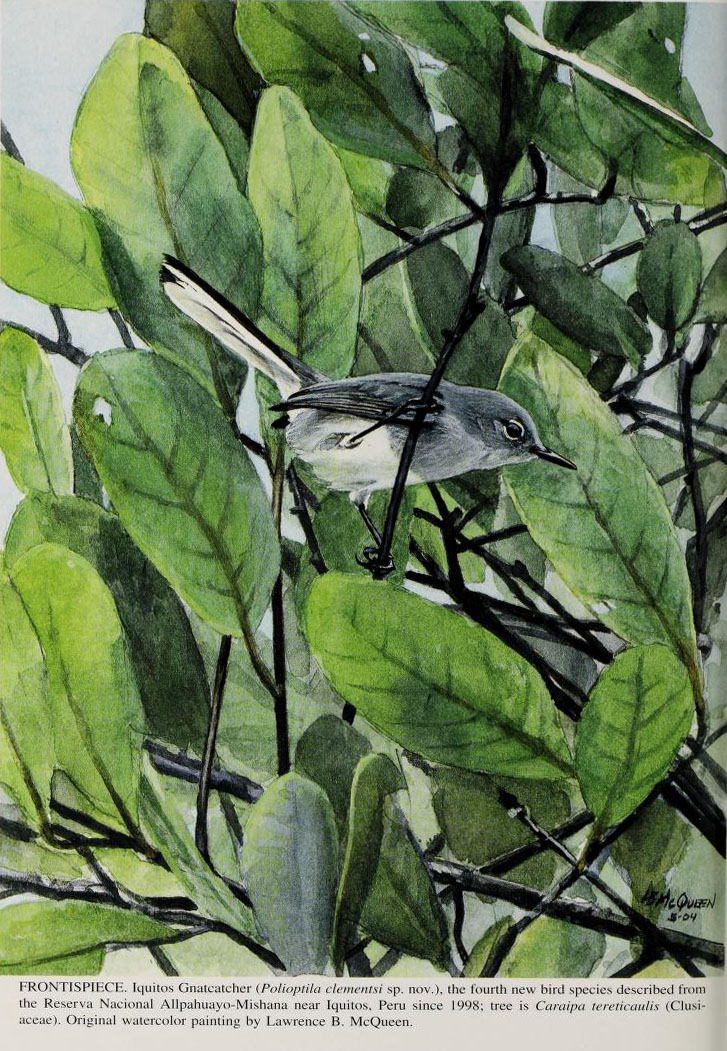
Caption transcription: “Iquitos Gnatcatcher (Polioptila clementsi sp. nov.), the fourth new bird species described from the Reserva Nacional Allpahuayo-Mishana near Iquitos, Peru since 1998; tree is Caraipa tereticaulis (Clusiaceae). Original watercolor painting by Lawrence B. McQueen.” The Wilson Bulletin, v. 117. 2005. Contributed to BHL by the Harvard University, Museum of Comparative Zoology, Ernst Mayr Library with permission from the Wilson Ornithological Society. CC-BY-NC-SA.

More volumes from the Wilson Ornithological Society are now on BHL!  Spanning back to 1893, the publications The Wilson Bulletin and The Wilson Journal of Ornithology are a great example of the kind of legacy literature that distinguishes BHL.

The Wilson Ornithological Society is the second largest ornithological society in North America. The organization of professional scientists and dedicated amateurs is named for Alexander Wilson, known as the “Father of American Ornithology”.

The Wilson Journal of Ornithology is a quarterly peer-reviewed journal that replaces its predecessor, The Wilson Bulletin. BHL had previously added some earlier public domain volumes of The Wilson Bulletin (contributed in BHL by the American Museum of Natural History and Smithsonian Libraries), but was able to expand the collection thanks to the Expanding Access to Biodiversity Literature (EABL) project, funded by the Institute of Museum and Library Services. The Wilson Ornithological Society granted permission to share these titles on BHL with a 5-year embargo on the most recently published volumes, so that now BHL has The Bulletin from 1894-2005 and The Journal from 2006-2010.

52234156.jpeg

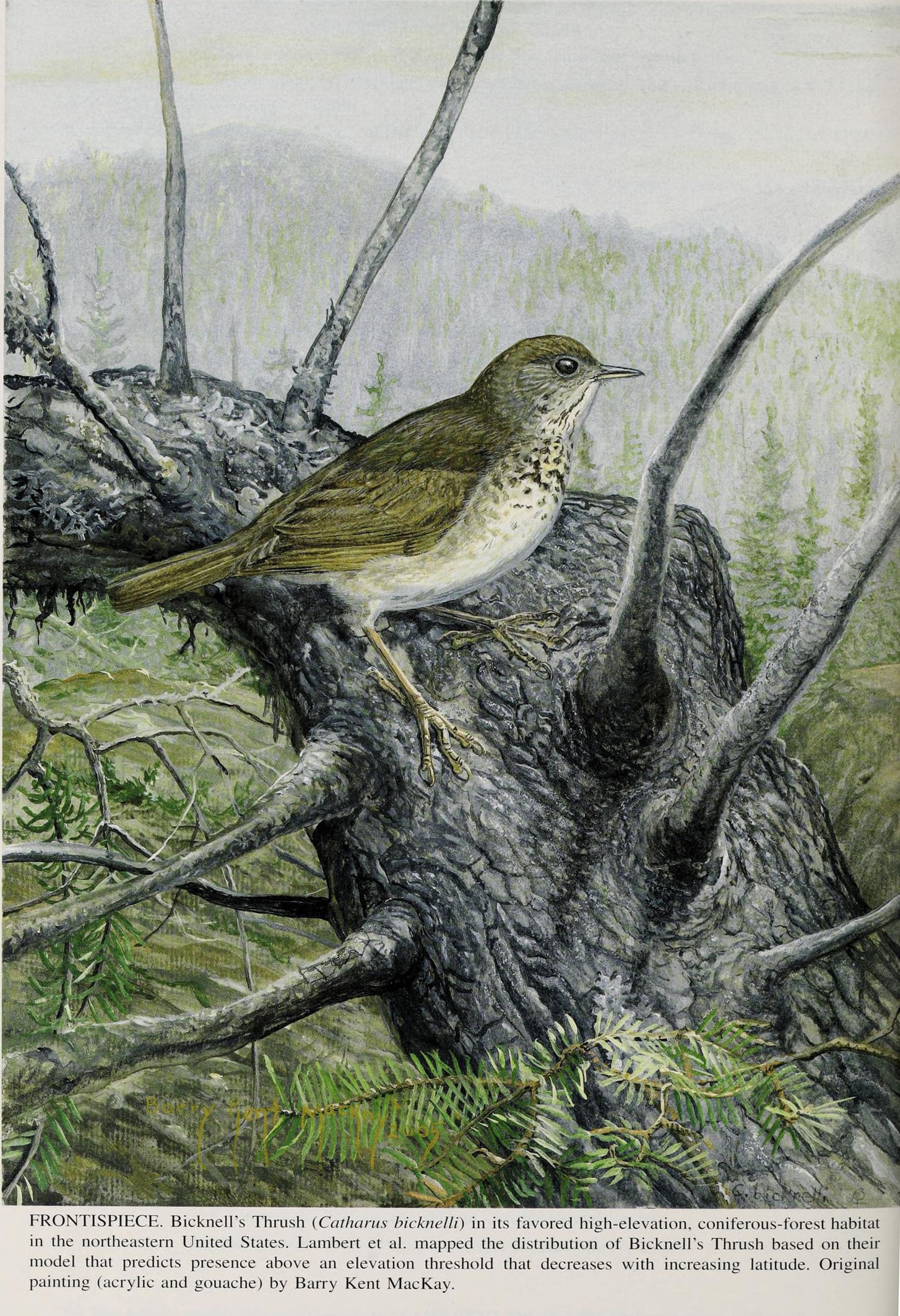
Caption transcription: “FRONTISPIECE. Bicknell’s Thrush (Catharus bicknelli) in its favored high-elevation, coniferous-forest habitat in the northeastern United States. Lambert et al. mapped the distribution of Bicknell’s Thrush based on their model that predicts presence above an elevation threshold that decreases with increasing latitude. Original painting acrylic and gouache by Barry Kent MacKay.” The Wilson Bulletin, v. 117. 2005. Contributed to BHL by the Harvard University, Museum of Comparative Zoology, Ernst Mayr Library with permission from the Wilson Ornithological Society. CC-BY-NC-SA.

The story of the Wilson Ornithological Society begins in 1886 with the ‘Young Ornithologists Association’ founded by L. O. Pindar and J. B. Richards. This group changed names several times, morphing into the Wilson Ornithological Chapter of the Agassiz Association in 1888, to the Wilson Ornithological Club, and eventually the Wilson Ornithological Society (WOS) in 1955. The first five volumes published by the evolving group went by several different titles, all of which are available on BHL (added prior to EABL). They are:

  • The Ornithologists’ and oologists’ semi-annual (v. 1-2 and 3.1, 1889-1891, contributed by Smithsonian Libraries)
  • The Wilson quarterly (v. 4, 1892, contributed by the American Museum of Natural History)
  • The journal of the Wilson Ornithological Chapter of the Agassiz Association (5th volume in WOS series, 1893, contributed by Smithsonian Libraries)

The Wilson Ornithological Society is headquartered at the University of Michigan, where it established the Josselyn Van Tyne Memorial Library in association with the University’s Bird Division Library.

52234941.jpeg

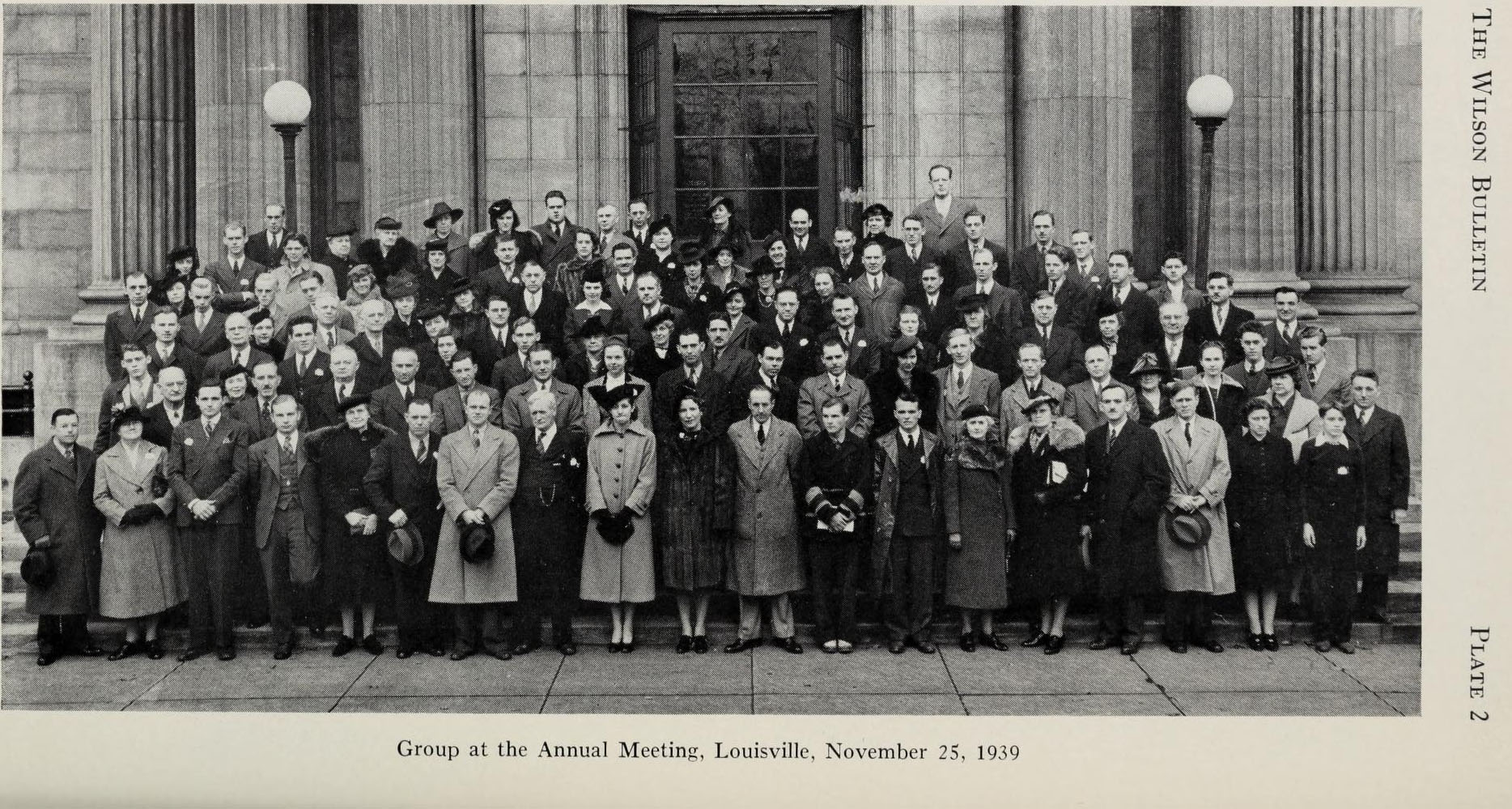
Caption transcription: “Group at the Annual Meeting, Louisville, November 25, 1939.” The Wilson Bulletin, v. 52. 1940. Contributed to BHL by the Harvard University, Museum of Comparative Zoology, Ernst Mayr Library with permission from the Wilson Ornithological Society. CC-BY-NC-SA.

52180336.jpeg

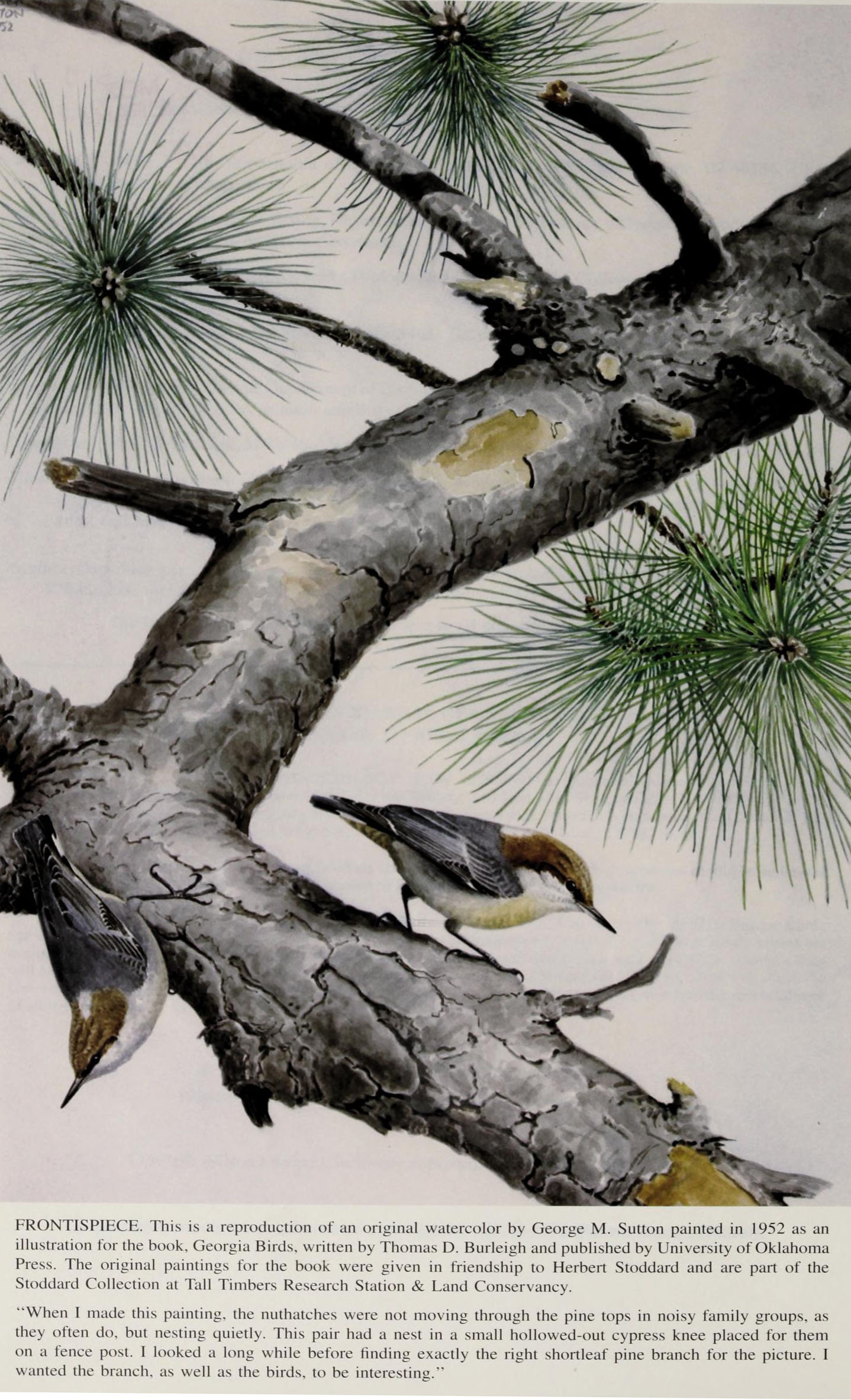
Caption transcription: “FRONTISPIECE. This is a reproduction of an original watercolor by George M. Sutton painted in 1952 as an illustration for the book, Georgia Birds, written by Thomas D. Burleigh and published by University of Oklahoma Press. The original paintings for the book were given in friendship to Herbert Stoddard and are part of the Stoddard Collection at Tall Timbers Research Station & Land Conservancy. ‘When I made this painting, the nuthatches were not moving through the pine tops in noisy family groups, as they often do, but nesting quietly. This pair had a nest in a small hollowed-out cypress knee placed for them on a fence post. I looked a long while before finding exactly the right shortleaf pine branch for the picture. I wanted the branch, as well as the birds, to be interesting.’” Wilson Journal of Ornithology, v. 119. 2007. Contributed to BHL by the Harvard University, Museum of Comparative Zoology, Ernst Mayr Library with permission from the Wilson Ornithological Society. CC-BY-NC-SA.

The Wilson Bulletin and the The Wilson Journal of Ornithology were digitized for BHL as a group effort, with digitized volumes contributed by the Ernst Mayr Library of Harvard’s Museum of Comparative Zoology, the American Museum of Natural History, and The Academy of Natural Sciences of Drexel University.

For a look at digitization behind the scenes, here’s the view from my desk as I work in the Ernst Mayr Library at Harvard’s Museum of Comparative Zoology:

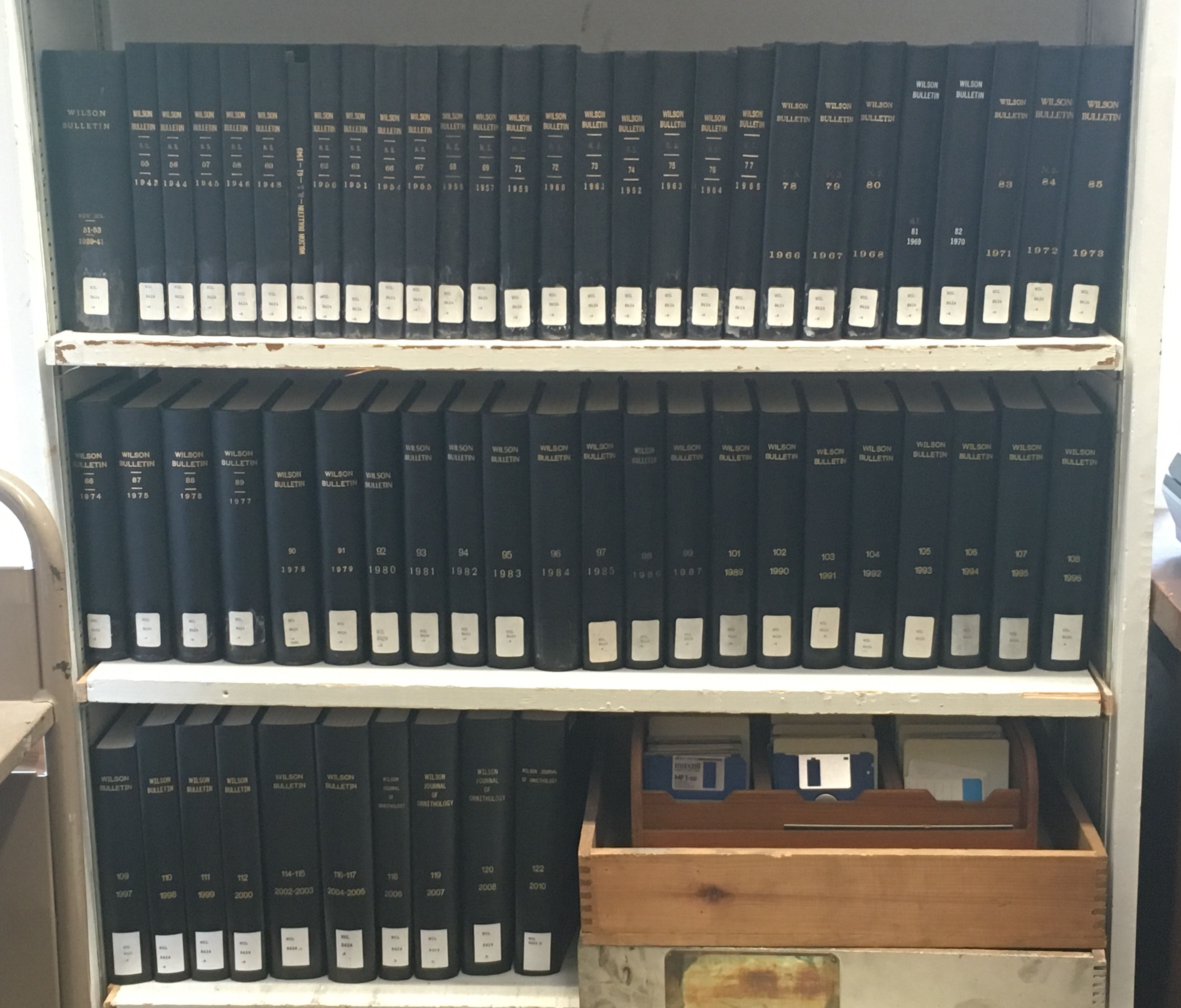
books on a shelf

Bound volumes of the Bulletin and Journal pulled from the shelf at the Mayr Library to be digitized for BHL. Photo credit: Elizabeth Meyer.

These bound volumes (51-122) were pulled from the shelf at the Mayr Library and checked page by page to make sure each was in good condition for scanning: no pages missing or out of order, no extensive damage, and margins wide enough for scanning to capture all of the text. (This is what I do when I’m not writing blog posts!) Some of the volumes were scanned here at the Mayr Library using our Table Top Scribe (see next image), and the rest were sent to Internet Archive scanning facilities. To fill in the gaps where our volumes weren’t suitable for scanning, we reached out to the American Museum of Natural History (v. 51, 54, 76, 86-87, 96) and to The Academy of Natural Sciences of Drexel University (v. 123-124; currently being digitized).

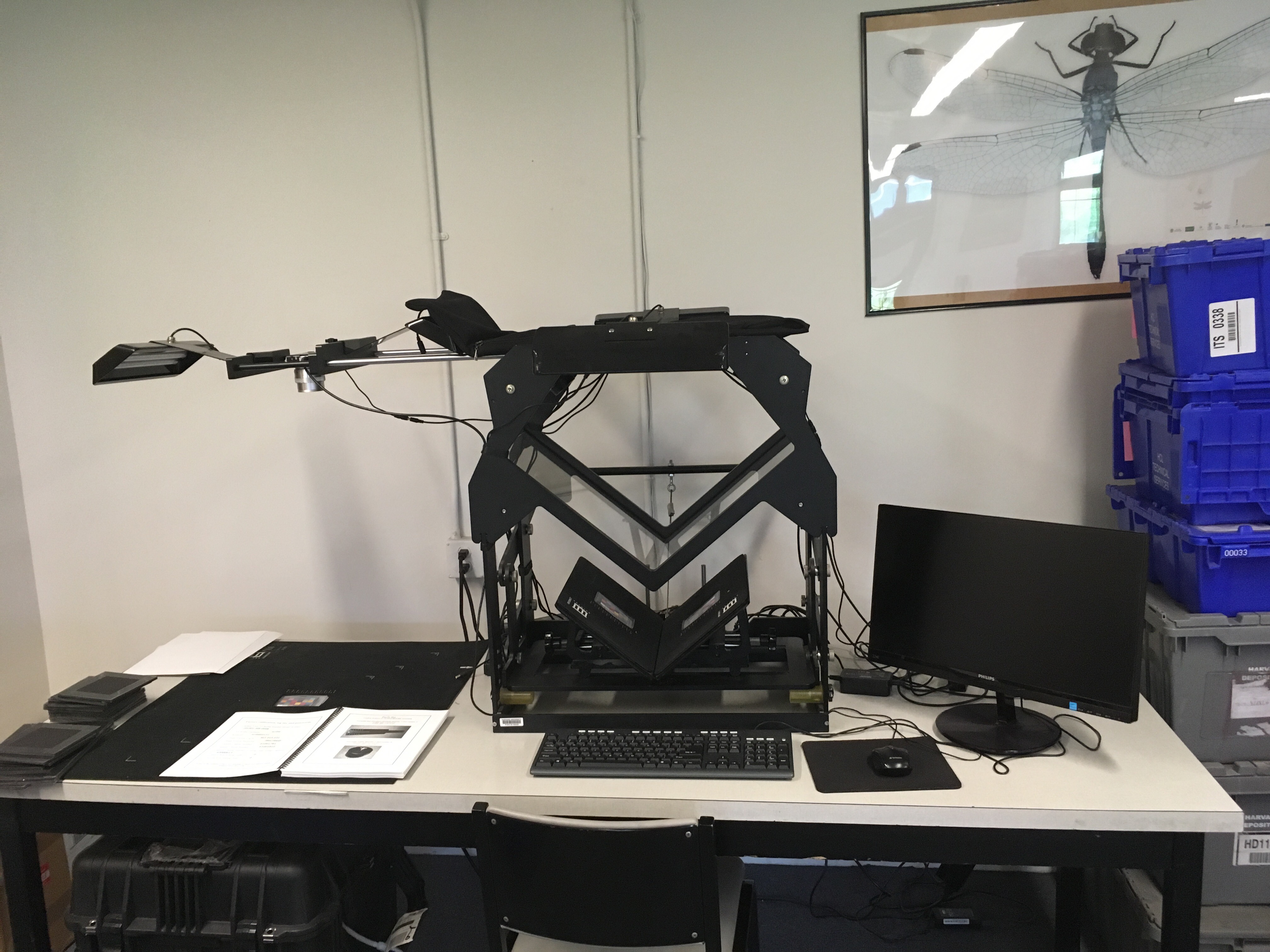
book scanning machine

The Mayr Library has an Internet Archive Table Top Scribe system. The bound item is placed in the lower cradle and lifted up using a foot pedal to press against the angled glass panes. Two cameras simultaneously capture separate images of both pages. Photo credit: Elizabeth Meyer.

Gratitude to Wilson Ornithological Society for granting permission to share these volumes on BHL, and to the Ernst Mayr Library of Harvard’s Museum of Comparative Zoology, the American Museum of Natural History and The Academy of Natural Sciences of Drexel University for digitization!

References

Wilson Ornithological Society

July 26, 2018by Joel Richard
Blog Reel, Featured Books

Bateman’s Orchidaceae: Exploring One of the Rarest – and Largest – Orchid Books

“The Librarian’s Nightmare.” Vignette by George Cruikshank for James Bateman’s The Orchidaceae of Mexico and Guatemala ([1837]-1843). Contributed in BHL by the Peter H. Raven Library of the Missouri Botanical Garden.

A version of this article first appeared in the Council on Botanical and Horticultural Libraries (CBHL) May 2018 Newsletter.

“The Librarian’s Nightmare.” Vignette by George Cruikshank for James Bateman’s The Orchidaceae of Mexico and Guatemala ([1837]-1843). Contributed in BHL by the Peter H. Raven Library of the Missouri Botanical Garden.

“The Librarian’s Nightmare.” Vignette by George Cruikshank for James Bateman’s The Orchidaceae of Mexico and Guatemala ([1837]-1843). Contributed in BHL by the Peter H. Raven Library of the Missouri Botanical Garden.

“The Librarian’s Nightmare.”

Such is the name given to a delightful and quirky vignette found within a very rare, and very special, orchid book: James Bateman’s The Orchidaceae of Mexico and Guatemala ([1837]-1843).

This vignette, the work of caricaturist George Cruikshank, depicts a group of men struggling to lift an enormous book using a pulley system while a harried taskmaster with a megaphone attempts to direct their work and demons dance about with impish glee on the sidelines.

The vignette’s caption, translated from the Greek, reads “a big book is a big evil” (Bleichmar 2017, 179).

The scene is a humorous commentary on the massive size of Bateman’s orchid book. At about 30” x 22” (Cobbledick 2018a) and weighing in at over 38 lbs (Hamilton 1990, 1244), it is the “largest botanical book ever produced with lithographic plates” (Blunt and Stearn 1994, 249).

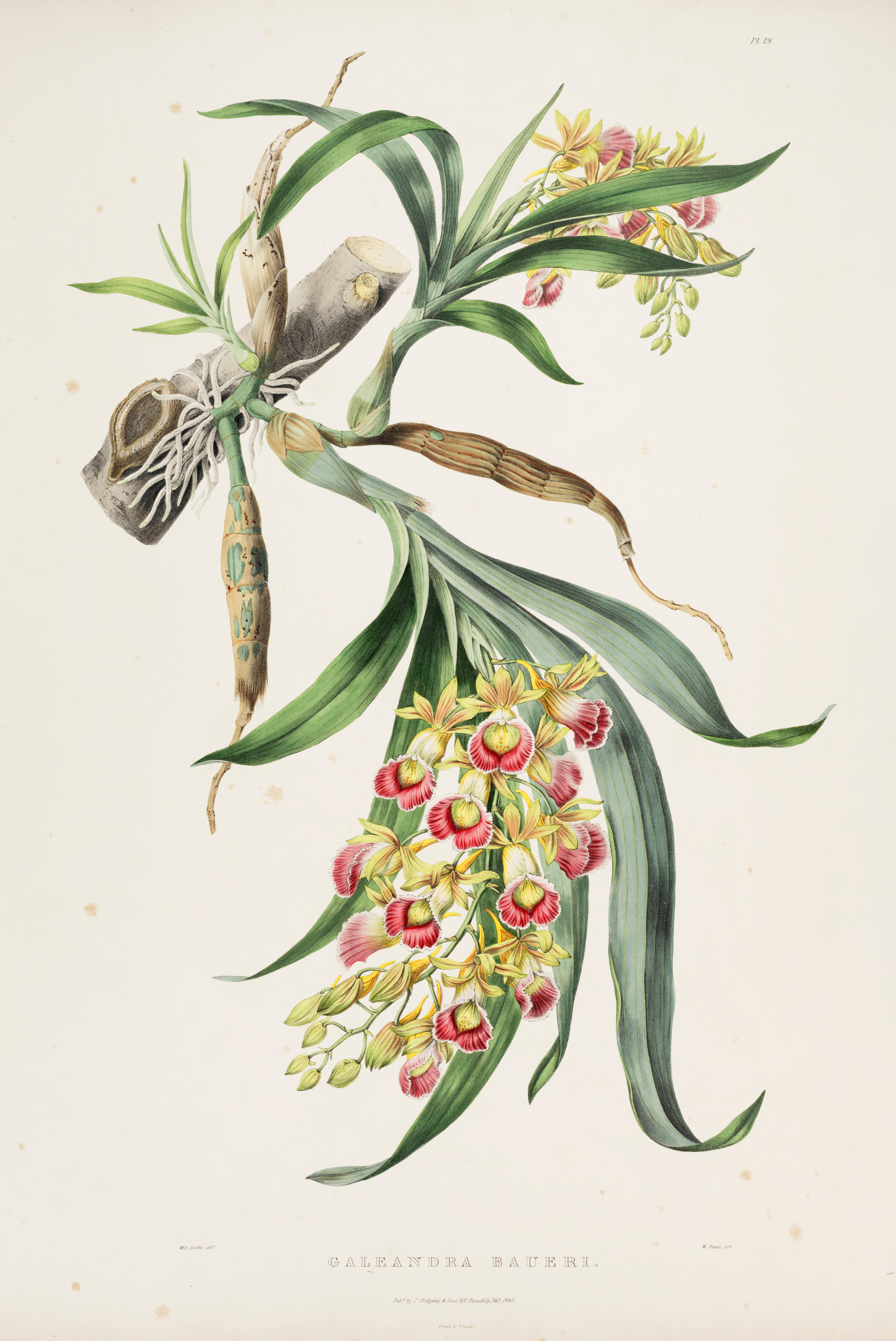
Plate 19. Bateman, James. The Orchidaceae of Mexico and Guatemala. Illustration drawn by Sarah Anne Drake and lithographed by Maxim Gauci. Contributed in BHL by the Peter H. Raven Library of the Missouri Botanical Garden.

Plate 19. Bateman, James. The Orchidaceae of Mexico and Guatemala. Illustration drawn by Sarah Anne Drake and lithographed by Maxim Gauci. Contributed in BHL by the Peter H. Raven Library of the Missouri Botanical Garden.

The Orchidaceae of Mexico and Guatemala was produced in the midst of the Victorian era’s “orchid mania” or “Orchidelirium”, characterized by European obsession with collecting and cultivating exotic orchid species. Wealthy orchid enthusiasts commissioned collectors to travel the world in search of new and rare specimens.

James Bateman was such an enthusiast. A wealthy British landowner and passionate horticulturalist, Bateman employed collectors to obtain new specimens for him, particularly from South and Central America (Sitwell and Blunt 1990, 45). It was his relationship with a merchant operating in Guatemala that enabled Bateman to secure many of the orchids featured in his magnificent folio.

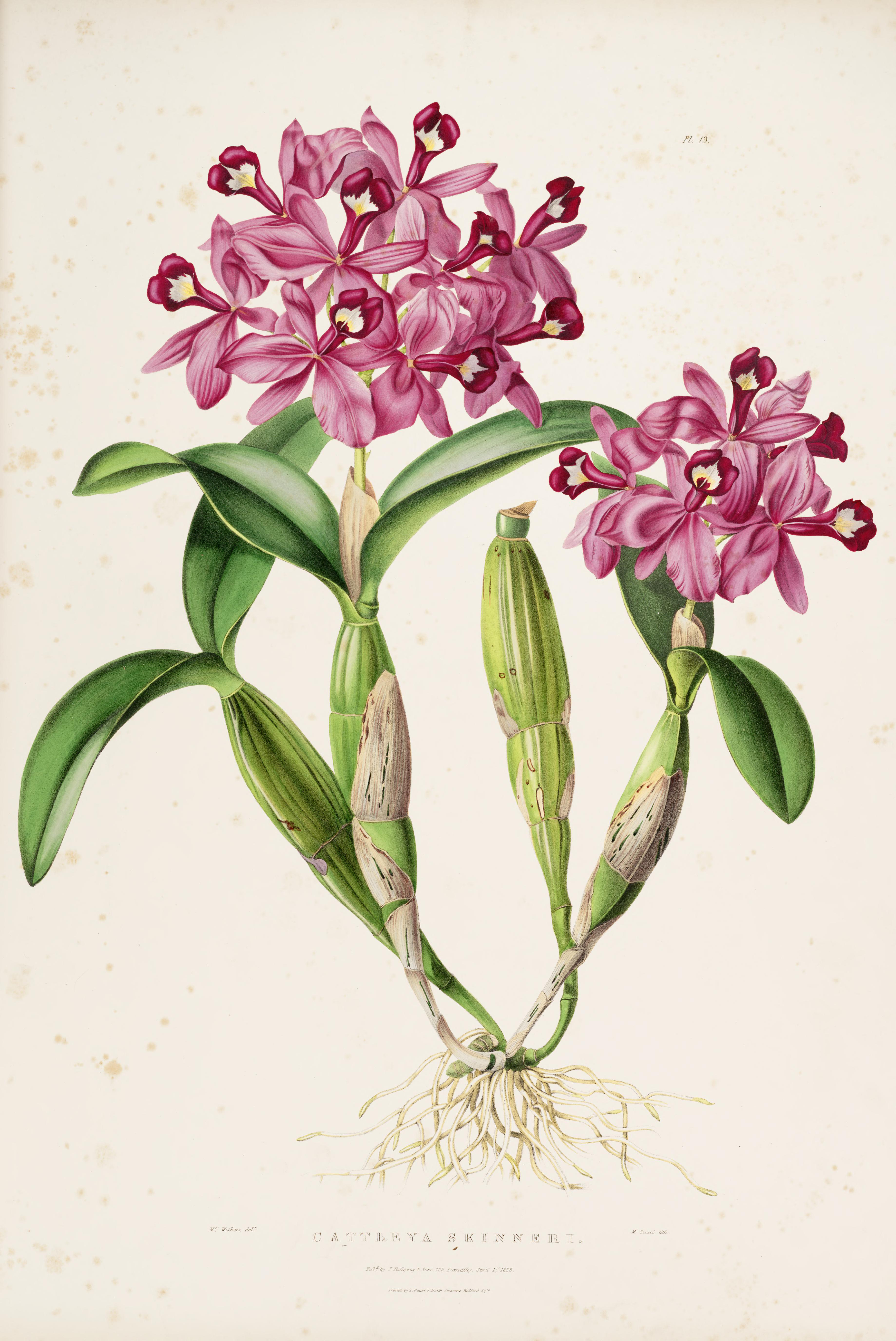
Plate 13. Bateman, James. The Orchidaceae of Mexico and Guatemala. Illustration drawn by Augusta Withers and lithographed by Maxim Gauci. Contributed in BHL by the Peter H. Raven Library of the Missouri Botanical Garden.

Plate 13. Bateman, James. The Orchidaceae of Mexico and Guatemala. Illustration drawn by Augusta Withers and lithographed by Maxim Gauci. Contributed in BHL by the Peter H. Raven Library of the Missouri Botanical Garden.

George Ure Skinner, born into a scholarly English family, established an export business in Guatemala in the 1830s, and in his free time, collected local birds and insects for the Museum of Natural History in Manchester, England. After receiving a letter from Bateman requesting orchids from the region, Skinner began collecting and shipping back new and stunning specimens hitherto unknown to the European public. These specimens formed the foundation of Bateman’s orchid masterpiece (Schmidt-Ostrander 2018).

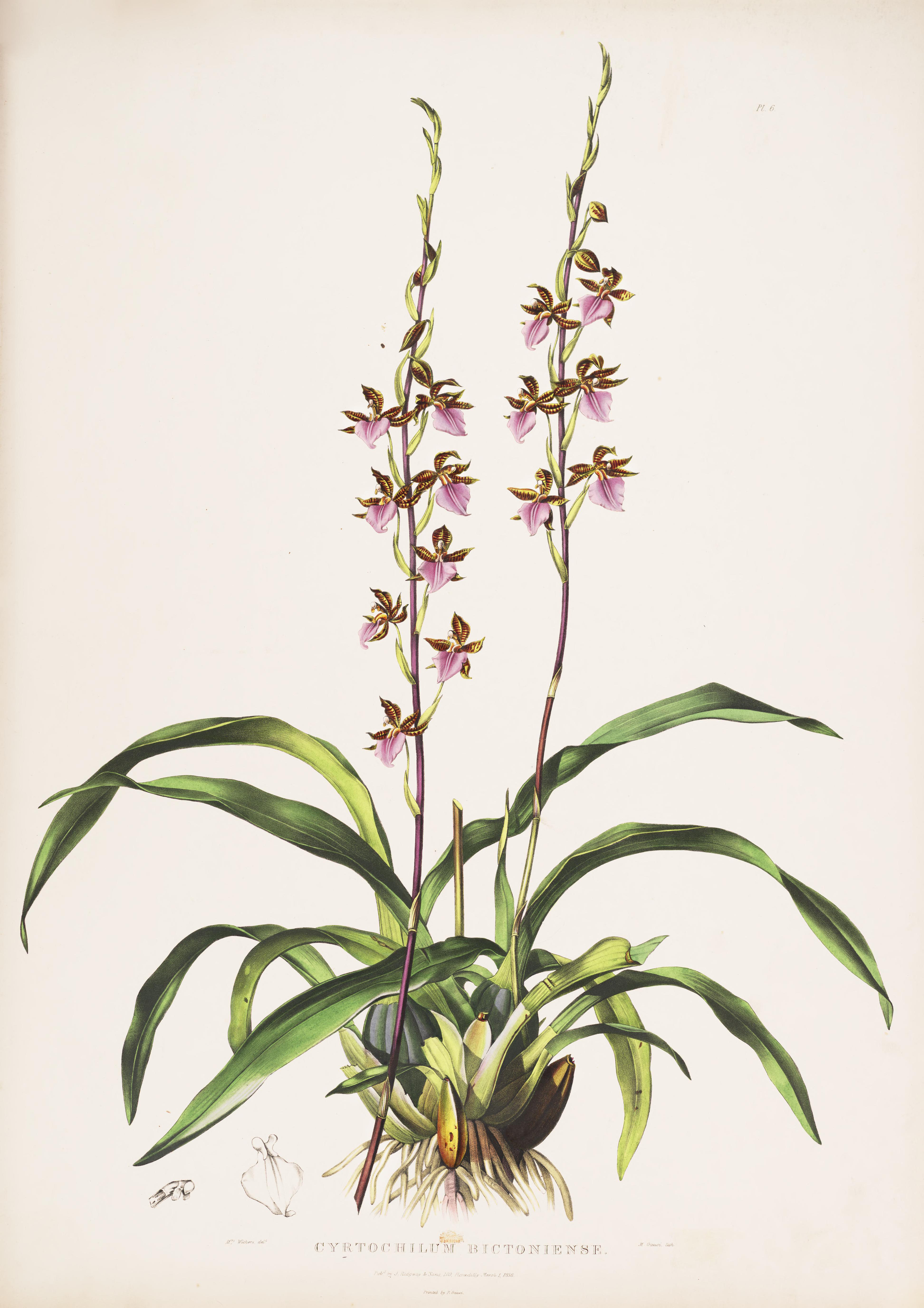
Plate 6. Bateman, James. The Orchidaceae of Mexico and Guatemala. Illustration drawn by Augusta Withers and lithographed by Maxim Gauci. Contributed in BHL by the Peter H. Raven Library of the Missouri Botanical Garden.

Plate 6. Bateman, James. The Orchidaceae of Mexico and Guatemala. Illustration drawn by Augusta Withers and lithographed by Maxim Gauci. Contributed in BHL by the Peter H. Raven Library of the Missouri Botanical Garden.

Within The Orchidaceae of Mexico and Guatemala, Bateman provided scientific descriptions in English and Latin as well as practical cultivation information for the species presented in the book. Also, according to Amy Pool, Curatorial Assistant at the Missouri Botanical Garden, 11 new-to-science species of orchids were validly published in this work. She estimates that it presented the first published illustrations for 90% of the 40 species included.

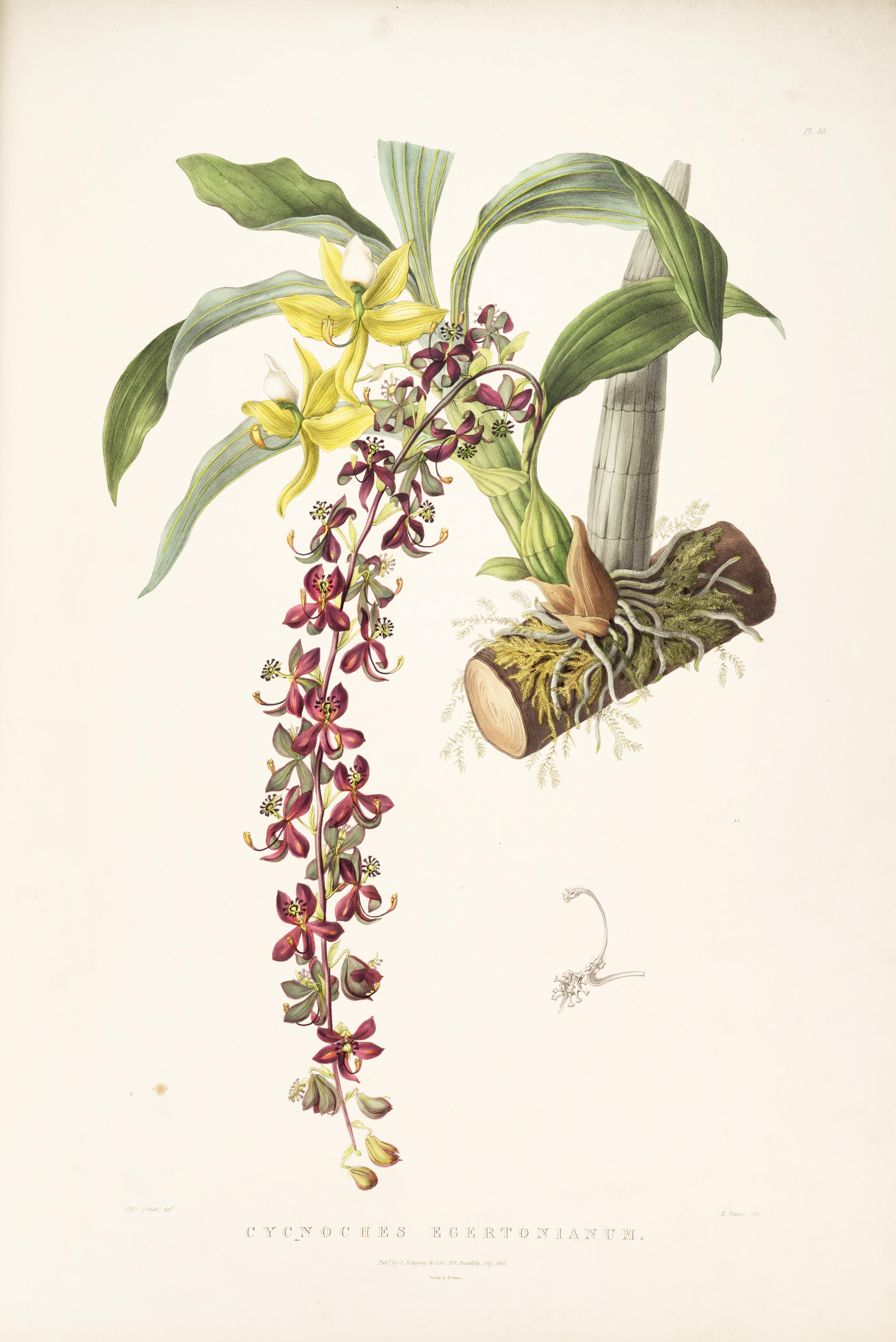
Plate 40. Bateman, James. The Orchidaceae of Mexico and Guatemala. Illustration drawn by Sarah Anne Drake and lithographed by Maxim Gauci. Contributed in BHL by the Peter H. Raven Library of the Missouri Botanical Garden.

Plate 40. Bateman, James. The Orchidaceae of Mexico and Guatemala. Illustration drawn by Sarah Anne Drake and lithographed by Maxim Gauci. Contributed in BHL by the Peter H. Raven Library of the Missouri Botanical Garden.

The work is particularly noteworthy for its colorful (and sizeable) lithographic plates. Numbering 40 in total, these lithographs were executed by Maxim Gauci based on drawings largely by Sarah Anne Drake and Augusta Withers, with two drawings by Jane Edwards and one by Samuel Holden. These illustrations were based on the live specimens in Bateman’s and his friends’ greenhouses. The hand-colored elements of the lithographs add dimension and richness to the orchid forms, particularly through the application of varnish which provides deeper tones (Cobbledick 2018b).

The Orchidaceae of Mexico and Guatemala was issued in parts between 1837-43 and printed in a limited edition of 125 copies sold to subscribers (Bleichmar 2017, 179). Today, fewer than 55 copies are known to exist.

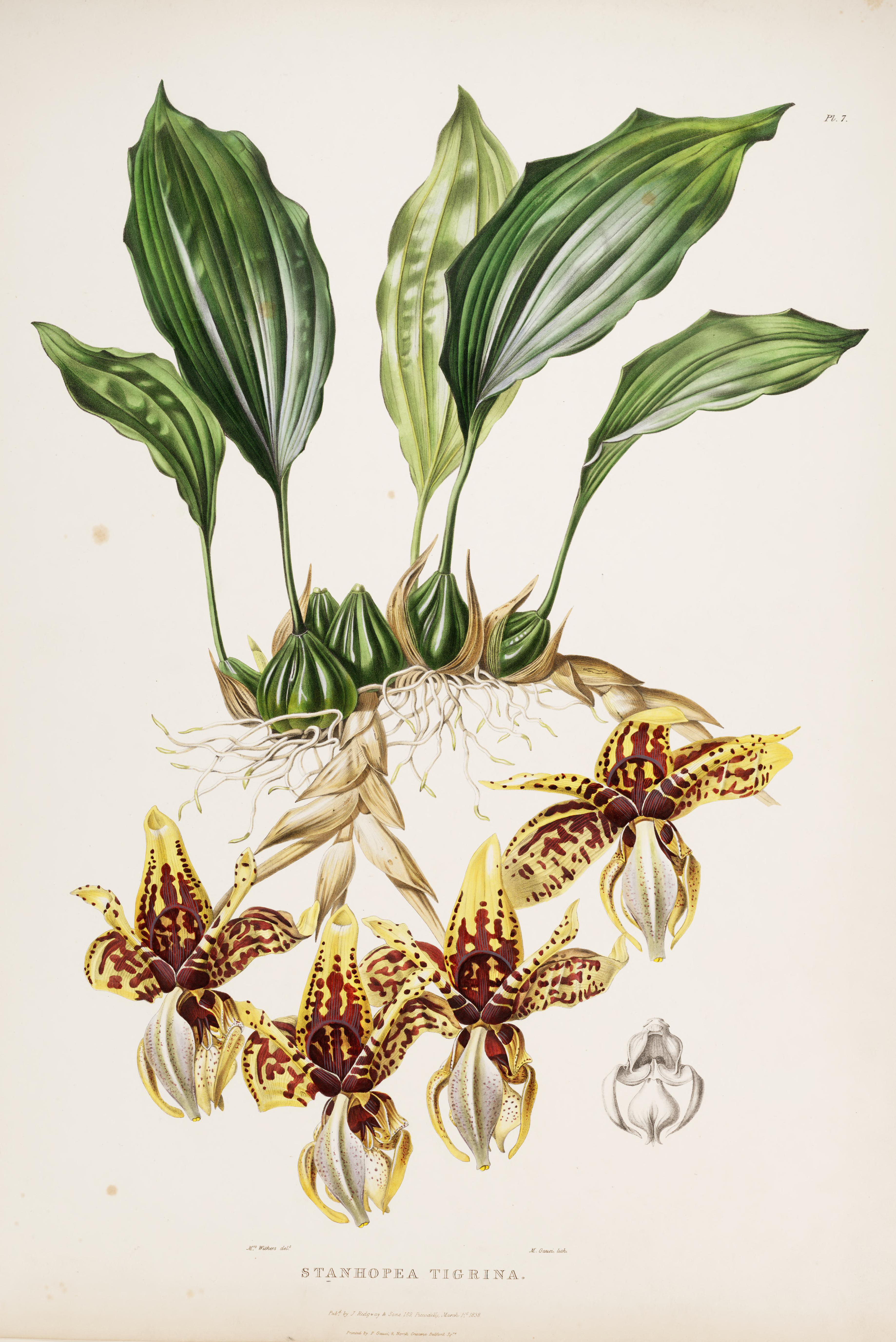
Plate 7. Bateman, James. The Orchidaceae of Mexico and Guatemala. Illustration drawn by Augusta Withers and lithographed by Maxim Gauci. Contributed in BHL by the Peter H. Raven Library of the Missouri Botanical Garden.

Plate 7. Bateman, James. The Orchidaceae of Mexico and Guatemala. Illustration drawn by Augusta Withers and lithographed by Maxim Gauci. Contributed in BHL by the Peter H. Raven Library of the Missouri Botanical Garden.

One of those copies can be found in the world-renowned Rare Book Collection of the Peter H. Raven Library of the Missouri Botanical Garden. Happily, this copy has been digitized in the Biodiversity Heritage Library and is now freely available to the world.

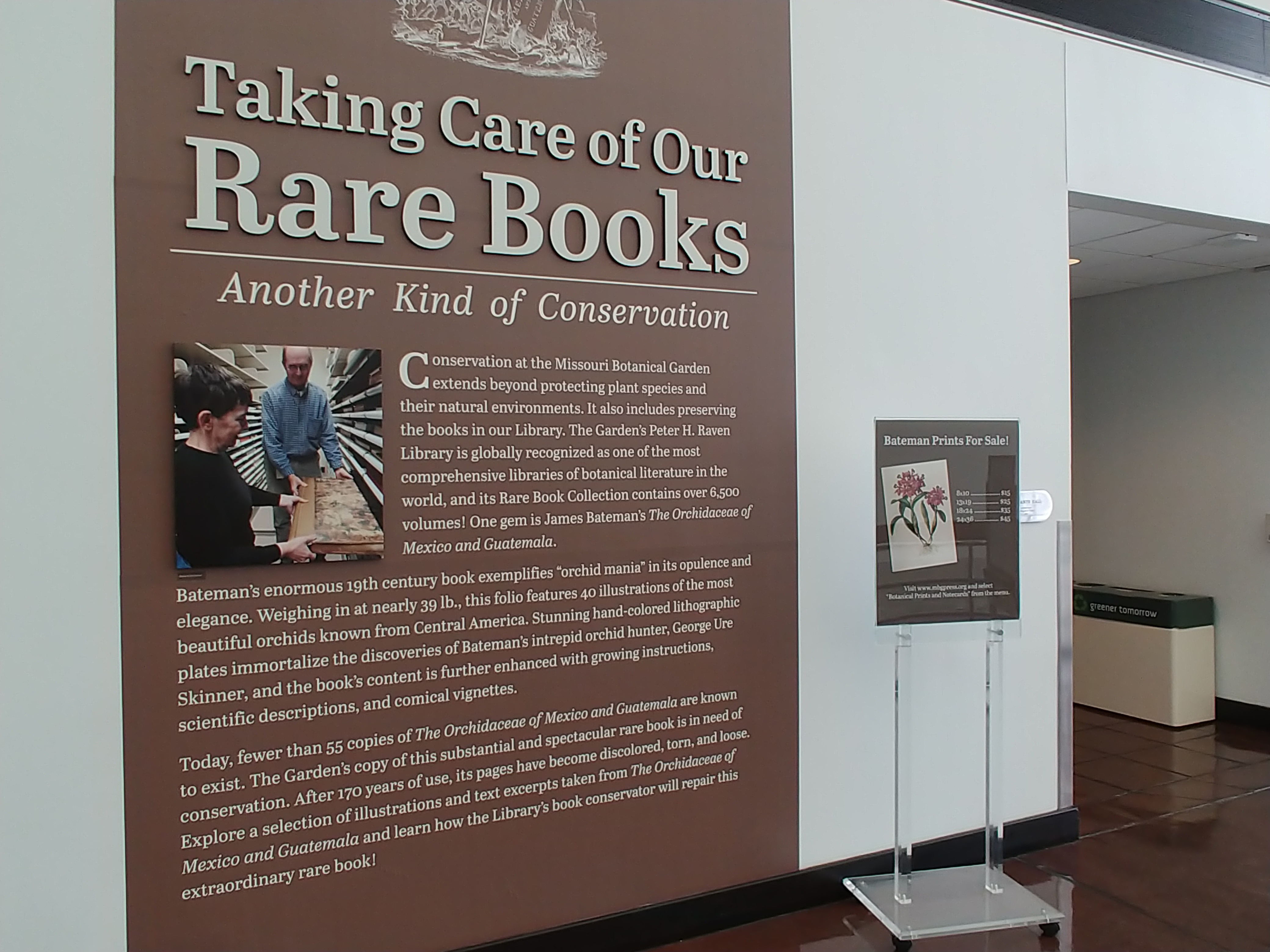
The Missouri Botanical Garden recently featured an exhibit about The Orchidaceae of Mexico and Guatemala. Image credit: Lauren Peters

The Missouri Botanical Garden recently featured an exhibit about The Orchidaceae of Mexico and Guatemala. Image credit: Lauren Peters.

Earlier this year, the Missouri Botanical Garden produced an exhibit on book conservation, entitled: Taking Care of Our Rare Books: Another Kind of Conservation. This ran concurrent with the Garden’s annual orchid show, the 2018 theme being “Orchid mania.” Both featured The Orchidaceae of Mexico and Guatemala. The floral show included numerous images from the book and described its role in “orchid mania”, and the exhibit featured a selection of images and text excerpts from the publication while highlighting book conservation techniques and principles.

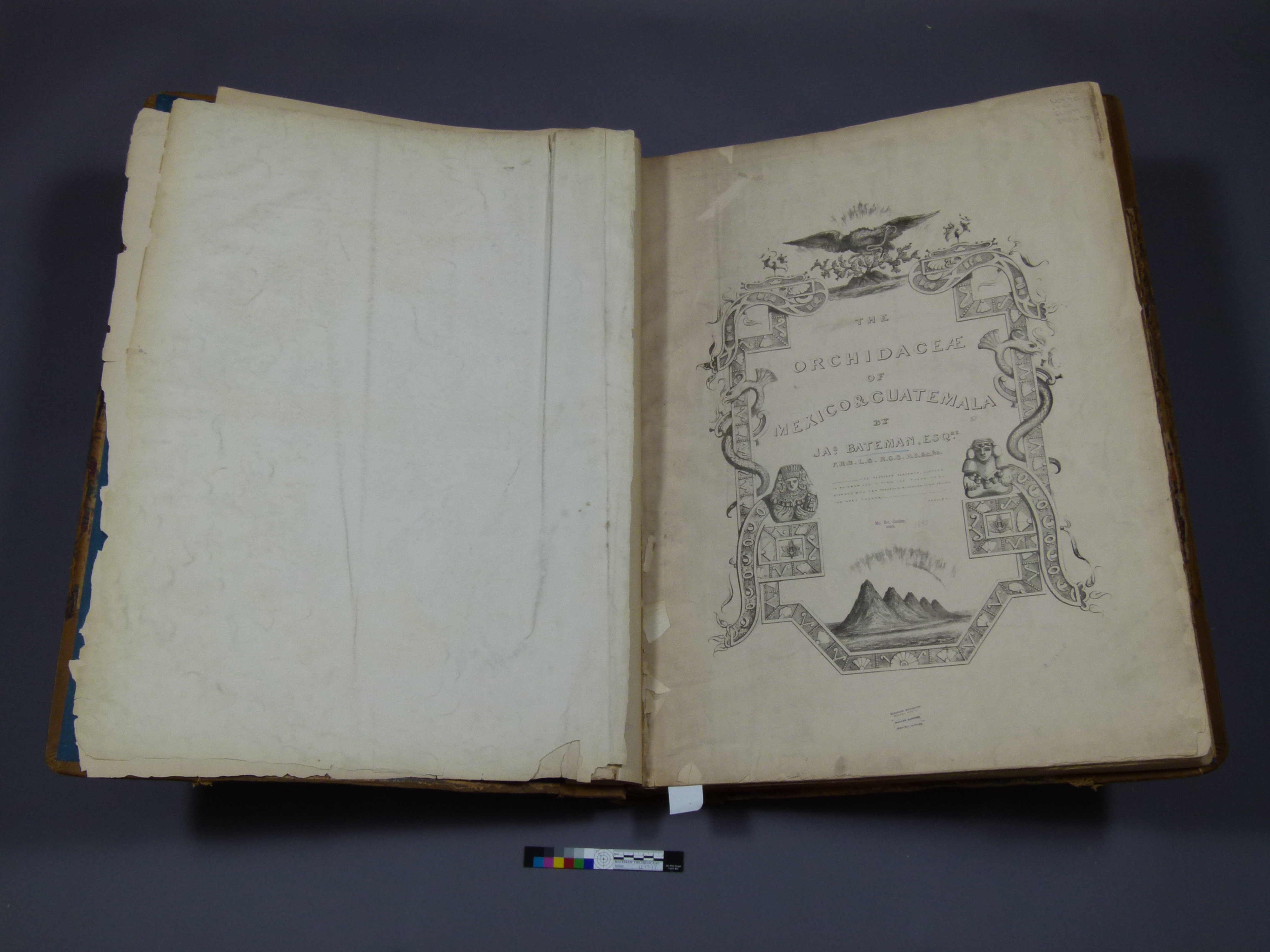
=At nearly 200 years old, and having been acquired by the Library in 1895 during a period of heavy pollution in Saint Louis, it is not surprising that the Missouri Botanical Garden’s copy of Bateman’s work is in poor condition, with ripped and soiled paper, loose pages, and broken binding.

The Missouri Botanical Garden’s copy of The Orchidaceae of Mexico and Guatemala is undergoing an extensive restoration project. Image credit: Susie Cobbledick

The Missouri Botanical Garden’s copy of The Orchidaceae of Mexico and Guatemala is undergoing an extensive restoration project. Image credit: Susie Cobbledick

The Library’s book conservator, Susie Cobbledick, has begun a substantial restoration project for this work. This process was not only highlighted as part of the Garden’s exhibit, but it is also being recorded through a series of posts on the Garden’s Discover + Share website. This process includes repairing the volume’s binding and cleaning and mending the paper.

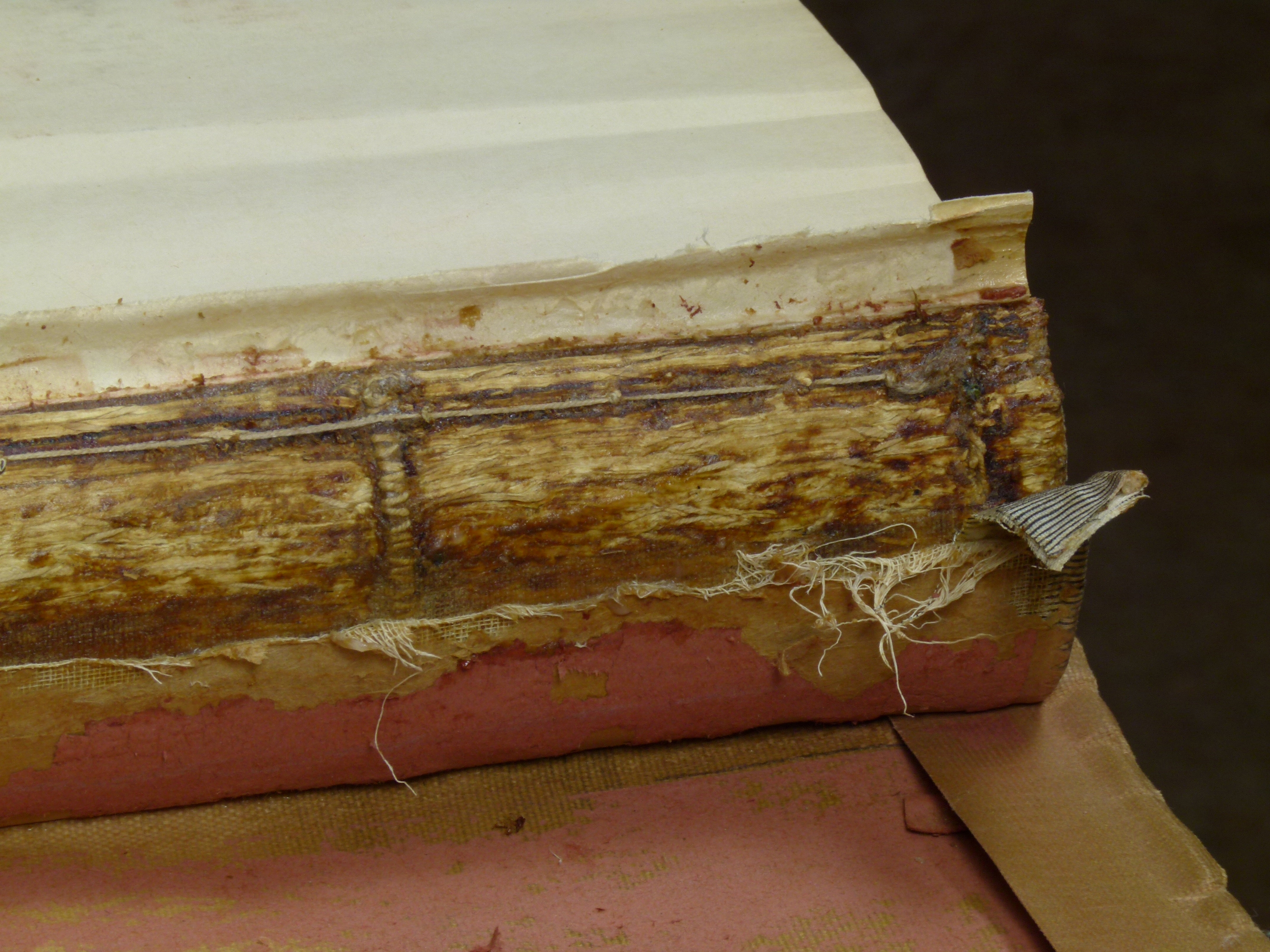
As Cobbledick articulates, the Library’s copy had been rebound at least once, and past attempts to repair the binding have failed under the strain imposed by such a massive volume. Additionally, the original covers were replaced with Masonite board at some point in the 20th century. As part of the Library’s conservation process, a more robust binding structure will be created for this volume, and more appropriate covers may be used to replace the inadequate Masonite (Cobbledick 2018a).

The Garden’s copy of The Orchidaceae of Mexico and Guatemala was originally sewn on linen cords, which would have extended beyond the back of the book to the boards. The fact that these cords have been cut is evidence that the book had been rebound some time in the past. Image Credit: Susie Cobbledick

The Garden’s copy of The Orchidaceae of Mexico and Guatemala was originally sewn on linen cords, which would have extended beyond the back of the book to the boards. The fact that these cords have been cut is evidence that the book had been rebound some time in the past. Image Credit: Susie Cobbledick

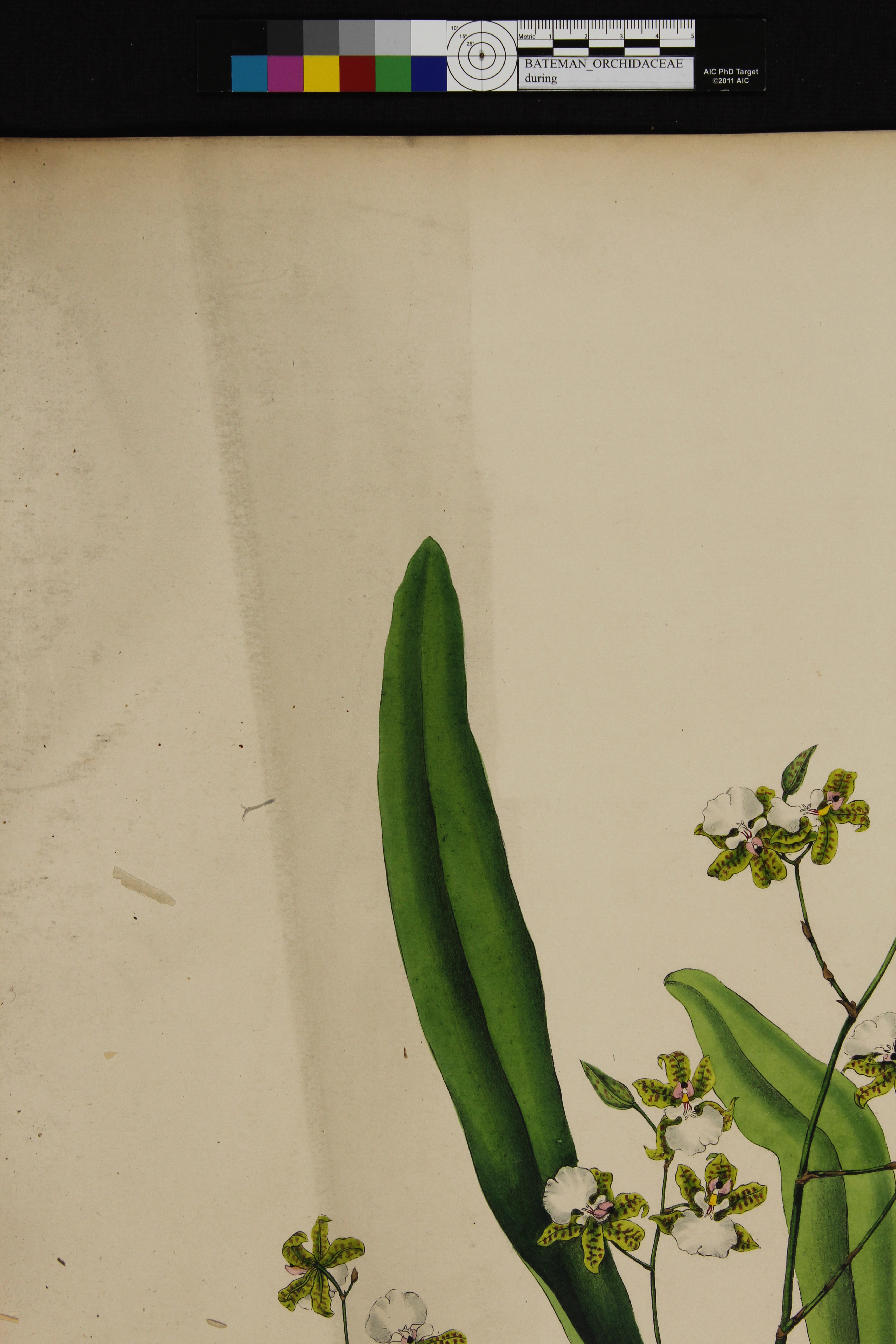
The soiled pages also require special attention. In order to remove the dirt and other residue that has accumulated over the past 170+ years without altering or damaging the lithographs’ fragile surfaces, Cobbledick is employing dry cleaning methods using cosmetic sponges and white vinyl erasers to carefully clean each page. This time-consuming process will take several months to complete (Cobbledick 2018b).

Cosmetic sponges and white vinyl erasers are used to clean the lithographs within the Garden’s copy of The Orchidaceae of Mexico and Guatemala. In this photo, you can see a cleaned (right-hand side) and uncleaned (left-hand side) portion of a plate from the book. Image Credit: Susie Cobbledick

Cosmetic sponges and white vinyl erasers are used to clean the lithographs within the Garden’s copy of The Orchidaceae of Mexico and Guatemala. In this photo, you can see a cleaned (right-hand side) and uncleaned (left-hand side) portion of a plate from the book. Image Credit: Susie Cobbledick.

Conservators have also begun mending the volume’s ripped and damaged paper. As part of this process, they are conducting tests to determine whether the type of sizing (substance added to paper to make it less absorbent) used has contributed to the poor condition of the book’s paper today. The answer may be related to whether or not the paper was machine-made. Explore the testing process and initial outcomes in the most recent “Rebuilding the Bateman Book” post.

To learn more about the restoration process for The Orchidaceae of Mexico and Guatemala and follow the conservation work, explore the entire “Rebuilding the Bateman Book” series on the Garden’s Discover + Share website.

The Orchidaceae of Mexico and Guatemala is truly a scientific, bibliographic, and artistic marvel. Through its unique blend of scientific information, awe-inspiring illustrations, and unexpected humor, Bateman’s orchid masterpiece stands out as a truly remarkable entry in the annals of natural history.

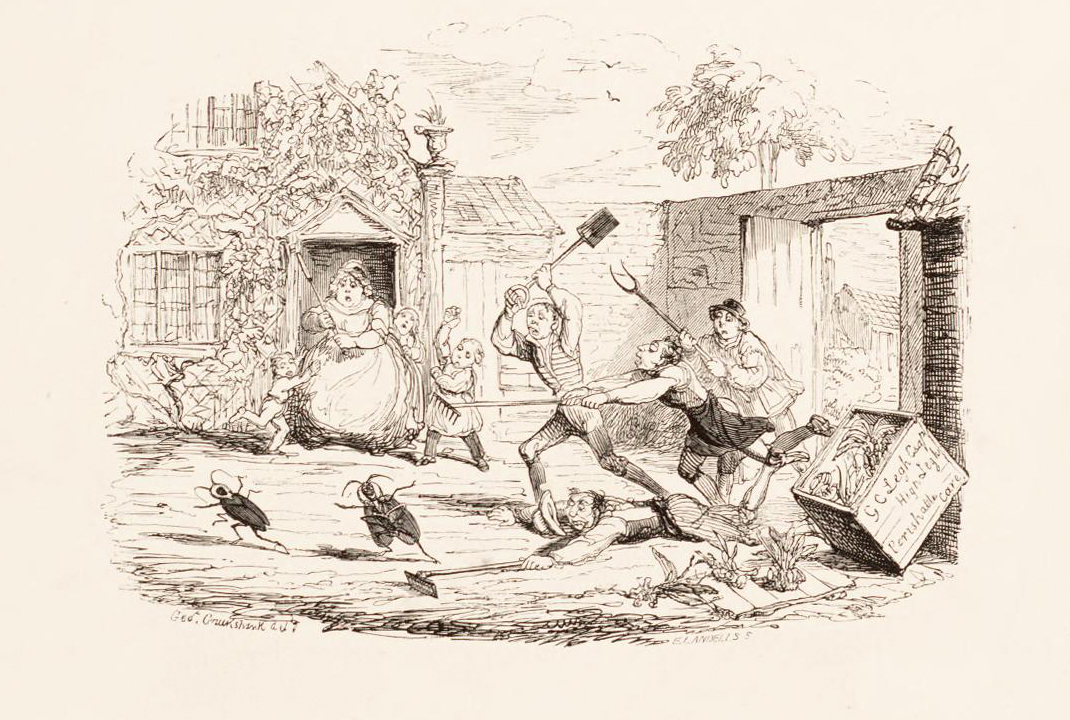
As another example of humor within The Orchidaceae of Mexico and Guatemala, this vignette by George Cruikshank depicts a pair of gigantic cockroaches escaping from a box meant to contain orchid specimens whilst the gardener’s family and assistants chase the unwelcome intruders.

As another example of humor within The Orchidaceae of Mexico and Guatemala, this vignette by George Cruikshank depicts a pair of gigantic cockroaches escaping from a box meant to contain orchid specimens whilst the gardener’s family and assistants chase the unwelcome intruders.

What some might call “The Librarian’s Nightmare”, we call “The Book Lover’s Dream”. We are grateful to the Peter H. Raven Library of the Missouri Botanical Garden for making this title freely available in BHL and are thrilled that the Library’s current conservation efforts will ensure that future generations can enjoy this treasure.

Taking Care of Our Rare Books: Another Kind of Conservation was curated by Missouri Botanical Garden staff Lauren Peters (Science Communication Specialist), Amy Pool (Curatorial Assistant, Herbarium), and Susie Cobbledick (Book Conservator, Library) and designed by Ellen Flesch (Supervisor, Creative Services) based on an exhibit proposal by Doug Holland (Director, Peter H. Raven Library). Learn more about the exhibit.

Post by Grace Costantino (Outreach and Communication Manager, Biodiversity Heritage Library) with significant contributions from Susie Cobbledick (Book Conservator, Peter H. Raven Library of the Missouri Botanical Garden) and Amy Pool (Curatorial Assistant, Herbarium, Missouri Botanical Garden).

References

Bleichmar, Daniela. 2017. Visual Voyages: Images of Latin American Nature from Columbus to Darwin. New Haven, CT: Yale University Press.

Blunt, Wilfrid and William T. Stearn. 1994. The Art of Botanical Illustration. New Edition. Suffolk: Antique Collectors’ Club, Ltd.

Cobbledick, Susie. 2018a. “From the Library: Rebuilding the Bateman Book (Part 1).” Discover + Share. February 17. Accessed March 29, 2018. https://discoverandshare.org/2018/02/17/from-the-library-rebuilding-the-bateman-book-part-1/.

Cobbledick, Susie. 2018b. “From the Library: Rebuilding the Bateman Book (Part 2).” Discover + Share. March 22. Accessed March 29, 2018. https://discoverandshare.org/2018/03/22/from-the-library-rebuilding-the-bateman-book-part-2/.

Hamilton, Robert M. 1990. “Skinner and Bateman – 1: Introduction.” American Orchid Society Bulletin 59, no. 12 (December): 1235-1247.

Schmidt-Ostrander, Ingrid. 2018. “George Ure Skinner (1804 – 1867).” Victorian Orchid Society. Accessed March 29, 2018. http://victoriaorchidsociety.com/Ingrid/Skinner.html.

Sitwell, Sacheverell and Wilfrid Blunt. 1990. Great Flower Books: 1700-1900. New York: The Atlantic Monthly Press.

July 19, 2018by michelle.underhill
Blog Reel, Featured Books

Field Note-Worthy: Thousands of Field Notes Now Available in BHL Thanks to the Field Notes Project!

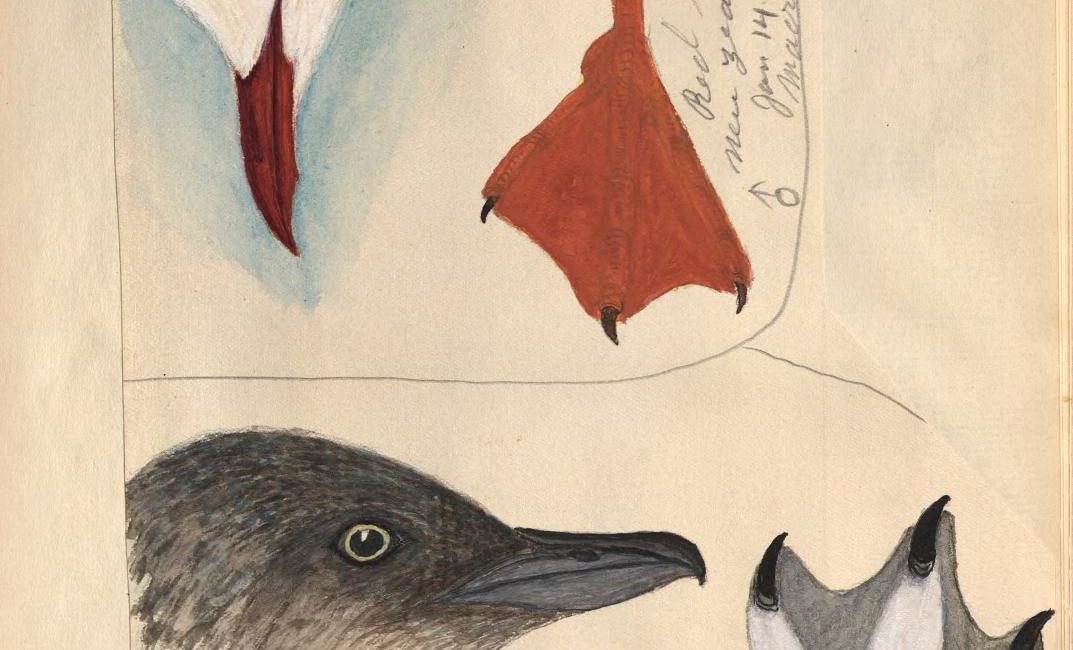
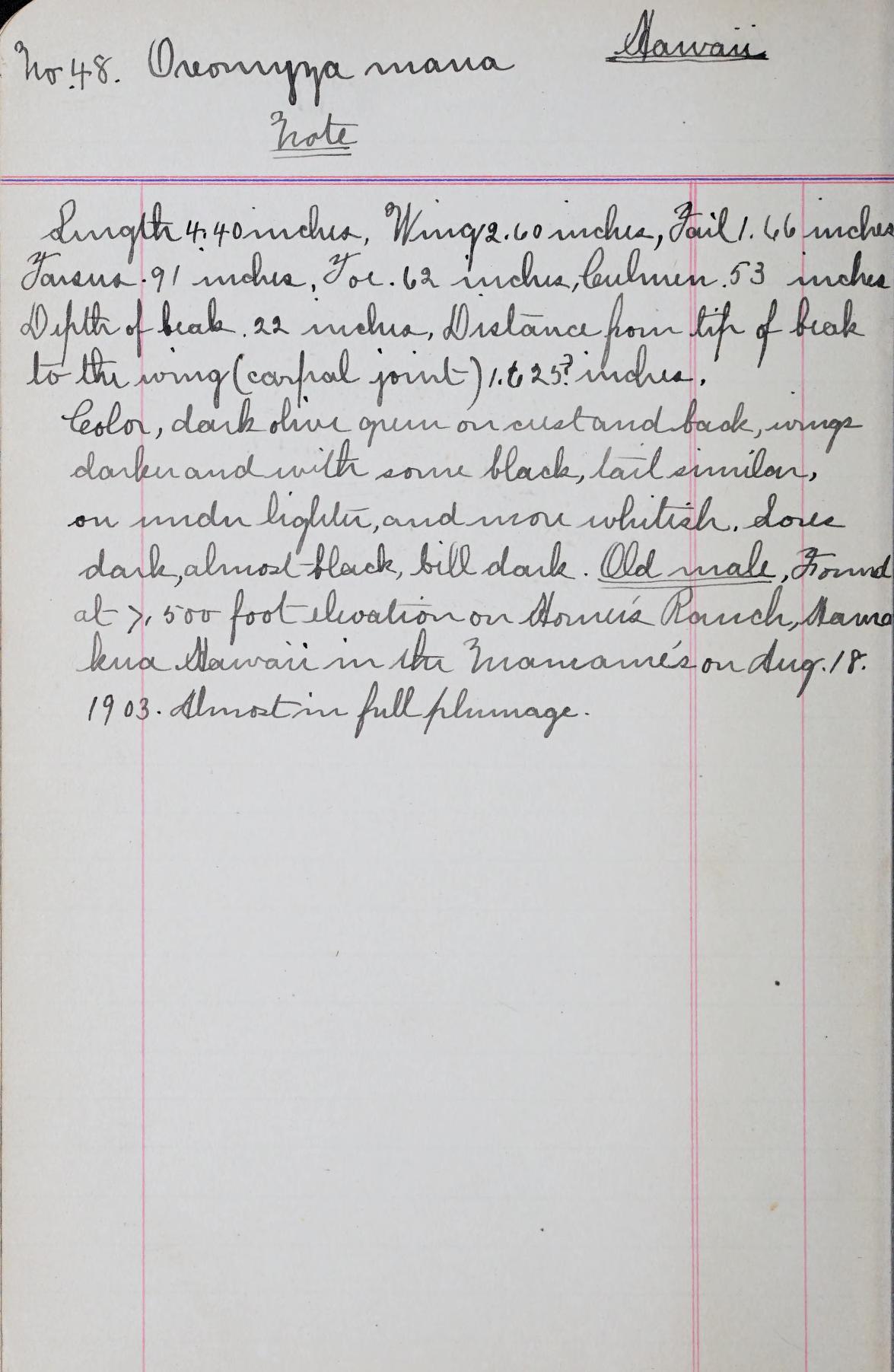
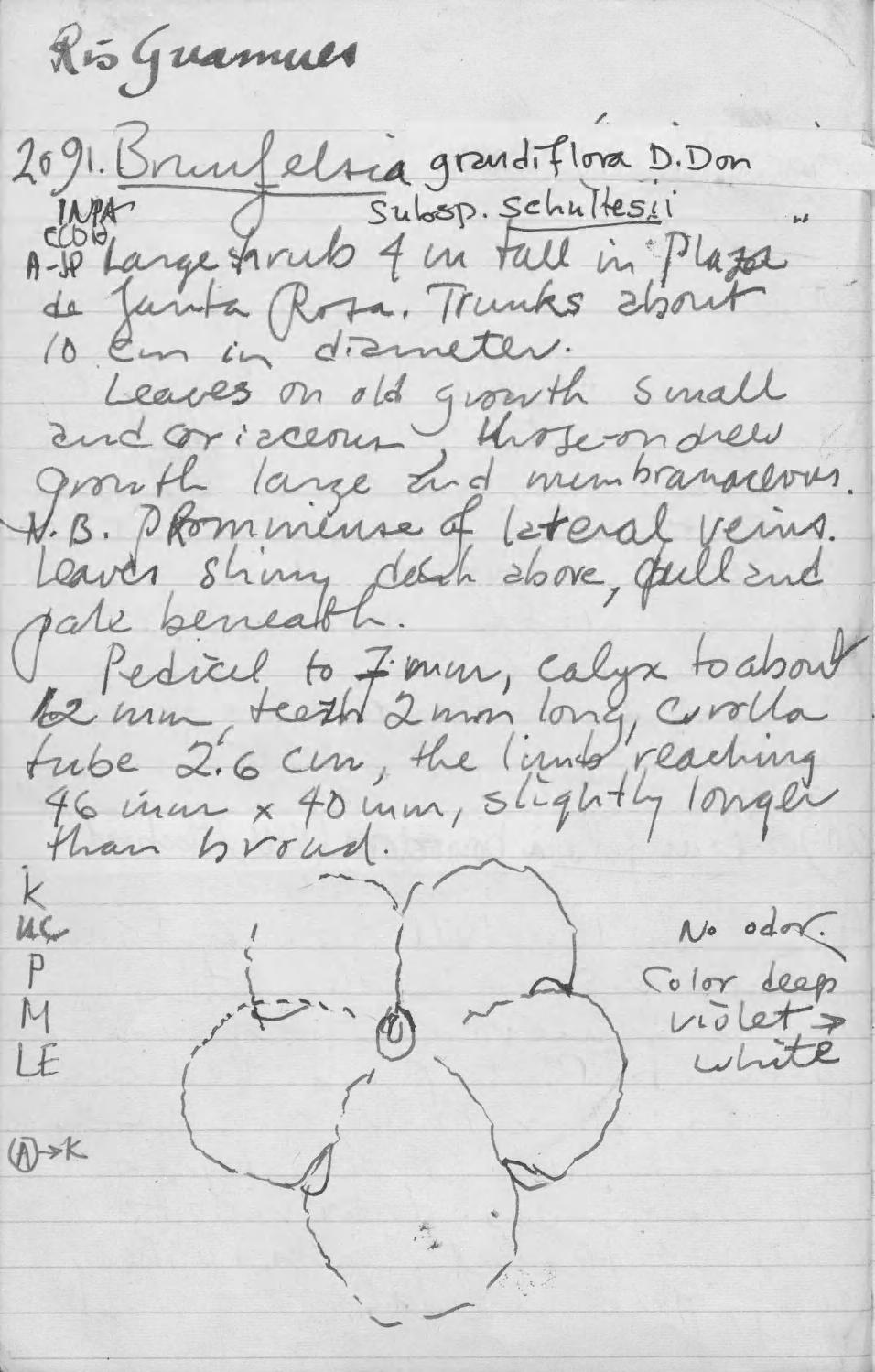
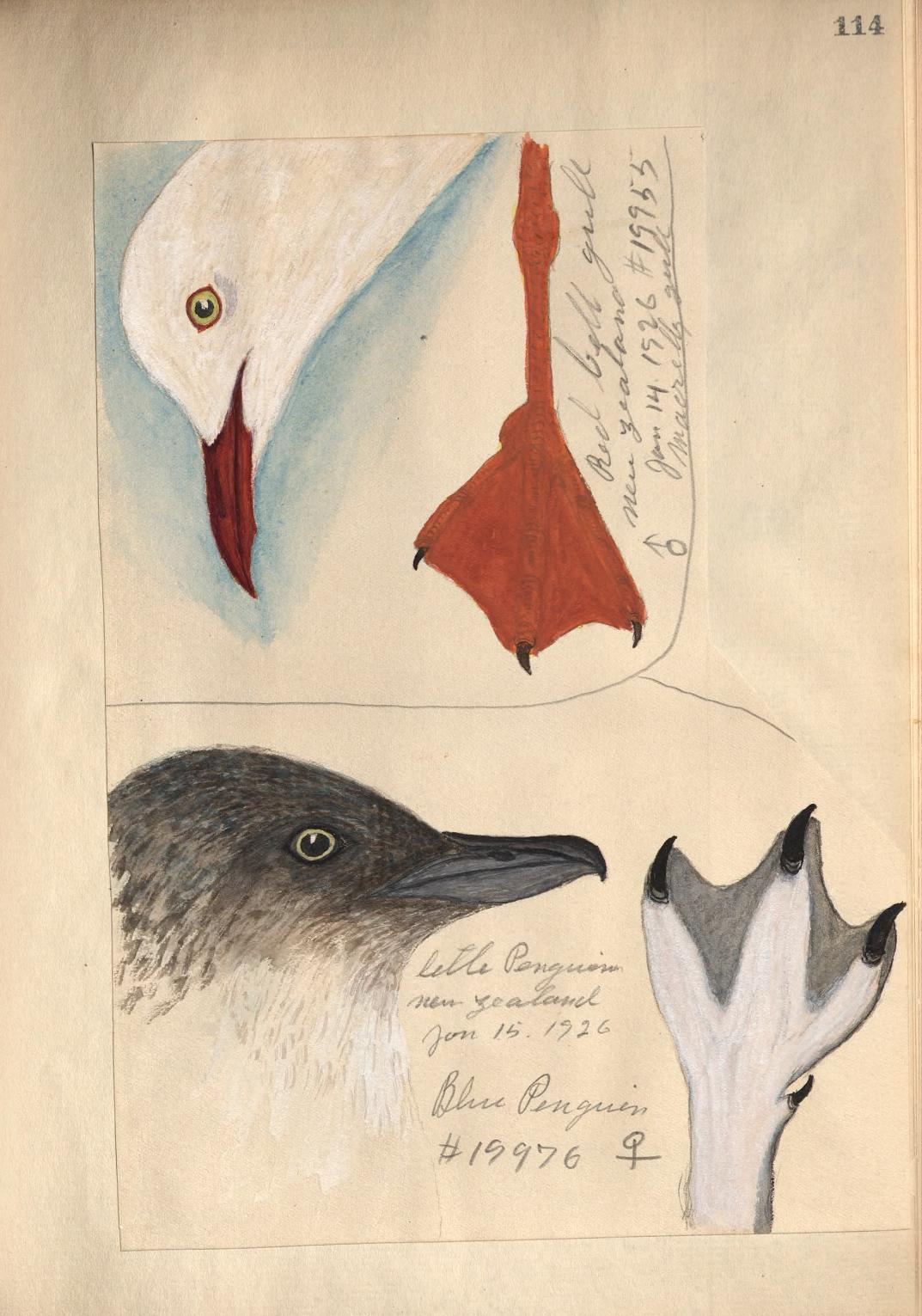
In February 2016, the Biodiversity Heritage Library set out to digitize over 450,000 pages of field notes. While the BHL had already added some archival material to its collection before this project, the Field Notes Project is BHL’s largest undertaking of digitizing field notes to date.

drawingsfungi00tayl_0013.jpg

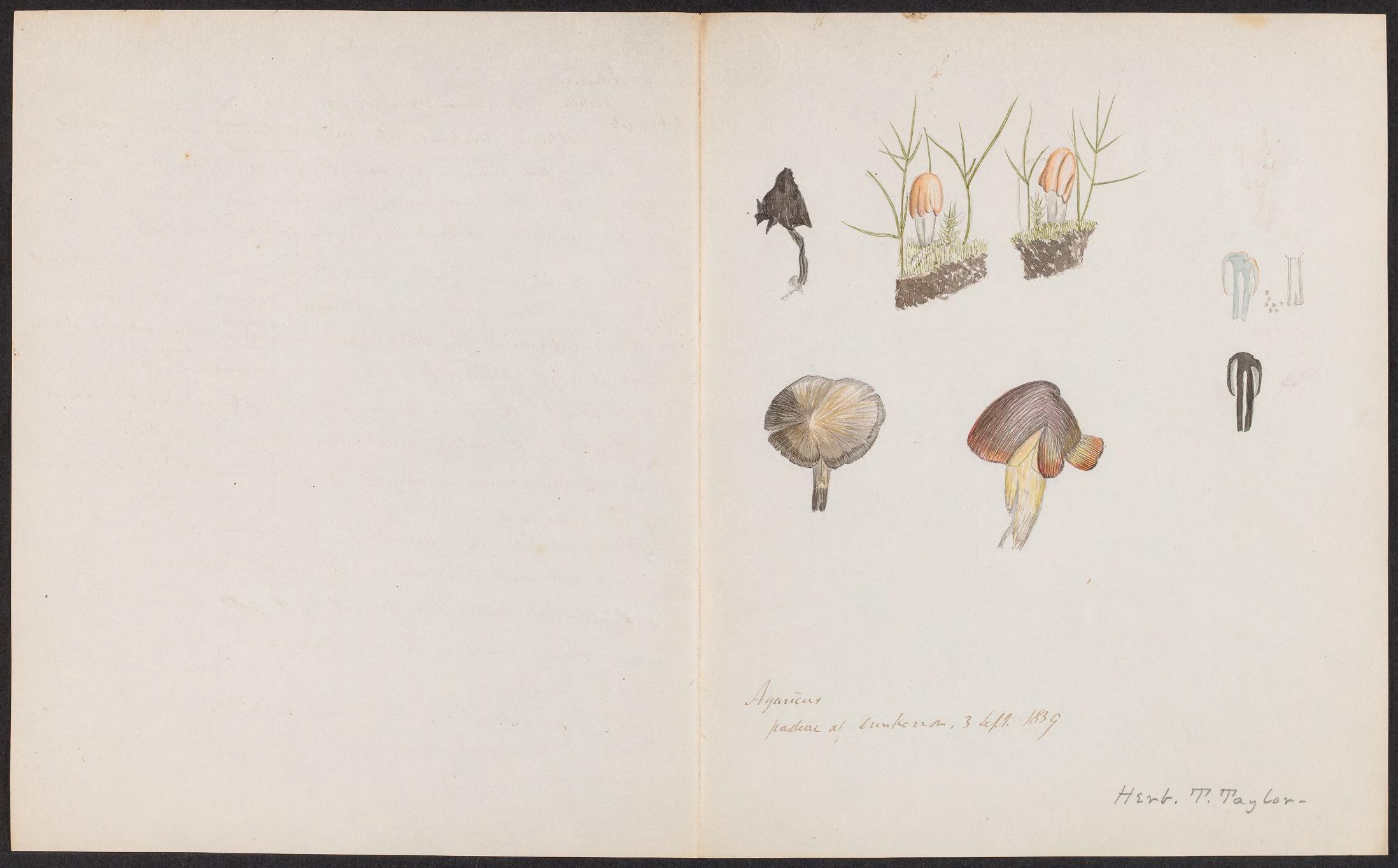
Taylor, Thomas. Drawings of Fungi. Contributed by Harvard University Botany Libraries.

Funded by the Council on Library and Information Resources (CLIR) Digitizing Hidden Special Collections initiative, this was a collaborative project with eleven partners:

  • American Museum of Natural History
  • The Field Museum of Natural History Library
  • Harvard University Botany Libraries
  • Harvard University, Museum of Comparative Zoology, Ernst Mayr Library
  • Internet Archive
  • The New York Botanical Garden, LuEsther T. Mertz Library
  • Missouri Botanical Garden, Peter H. Raven Library
  • Smithsonian Institution Archives
  • Smithsonian Libraries
  • University of California, Berkeley, Museum of Vertebrate Zoology
  • Yale Peabody Museum of Natural History
fieldnotebookma00schu_0031.jpg

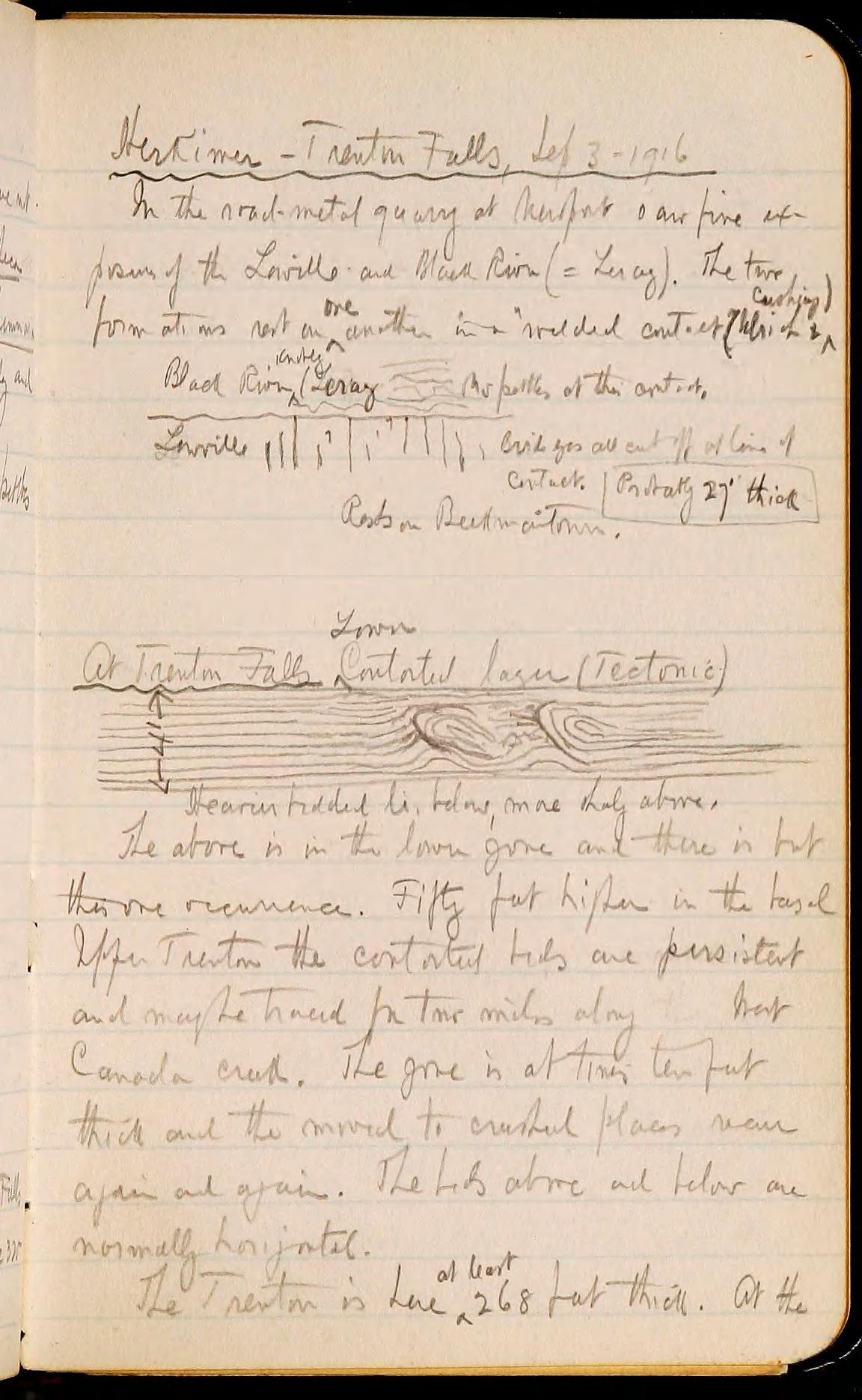
Schuchert, Charles. Field Notebook: Maine, Massachusetts, New Hampshire, New York, Ohio, Rhode Island, Ontario 1916, 1917, 1920. Contributed by Yale Peabody Museum of Natural History Archives.

The importance of field notes is well known to curators, researchers and historians. Diaries, correspondence, journals and photographs serve as records of the flora and fauna of a particular time and place, providing reference points when observing how a habitat has changed. They also offer insight on expeditions, the origins of a museum collections, and contextualize the work through the eyes of the scientists and narratives about how they interacted with the people, land and cultures they studied.

beekeepingarchiv00ches_0064.jpg

Blacow, Chester E. Bee keeping activities and field catalog of birds collected in Hawaii, v4273. Contributed by University of California, Museum of Vertebrate Zoology.

If you have ever used historic field notes for your own research, you may understand why this wouldn’t be a cut-and-dry project. Field notes can pose a number of challenges, and our partners certainly had to manage many of them. Conservation concerns are always at the top of the list, ensuring that field notes are in the proper condition for digitization. Through digitization, we can also reduce the need to refer to the physical object and further protect these unique items. Other concerns stemmed from how researchers took notes, including writing right into the gutter of a notebook or frugal researchers who would start a new notebook by simply flipping a used one and writing in the other direction. Together, the project team was able to overcome these challenges to provide open access to their field notes collections.

timothyplowmanb00plow_0086.jpg

Plowman, Timothy. Timothy Plowman botanical collecting notebook : 1900-2286 : 1968-1969. Contributed by The Field Museum of Natural History Library.

We finished work on the project May 31, 2018 and are pleased to report that the project team digitized over 517,000 pages of field notes! 

Those who follow the blog closely will have read posts from the BHL Field Notes Project series where project partners highlighted their collections and digitization process. With several expeditions, disciplines and institutions represented, we are excited to see what our users discover, and see how they use field notes in their own work. Take a look and delve into field notes digitized for this project in BHL and Internet Archive.

whitneysouthsea2corr_0241.jpg

Correia, José G. Whitney South Sea Expedition of the American Museum of Natural History. Letters and journal of José G. Correia. Volume 2. Contributed by American Museum of Natural History.

The project team and BHL would like to thank the Council on Library and Information Resources for generously funding the BHL Field Notes Project.

June 28, 2018by mkahn
Blog Reel, Featured Books

Myrtle: The Provenance and Meaning of a Plant

Provenance can be defined as the chain of ownership of any type of object from its creation to the present day. The Smithsonian’s Material Culture Forum recently held a lively session of presentations and discussions on this topic, with speakers from across the Institution: the National Zoo; Natural History Museum scientists and researchers in anthropology and paleobiology; archivists of World War II-era material; and curators from the National Museum of American History, the National Air & Space Museum, and the National Museum of African American History and Culture. There were many other subject specialists (such as a horticulturist) who could have participated, given time and world enough, as ownership history is a crucial matter and a commonality in the work of Smithsonian staff. Issues and questions about the history of a collection, transfer of possession, and unlawful appropriation can be applied to a living object (for example, the golden lion tamarin) as well as works of art or rare books.

The provenance of a botanical specimen was recently presented to a world-wide audience, even if they did not quite realize it. One detail of the Royal wedding of Prince Harry and Meghan Markle had commentators confidently offering up the history of the sprig of myrtle used in the bride’s bouquet. This was commonly reported to be from the plant nurtured from the flower used in the marriage ceremony of Queen Victoria and Prince Albert. Every bride in Royal nuptials after Victoria carried on the ritual. If not quite true, it made for a nice, simplified story line.

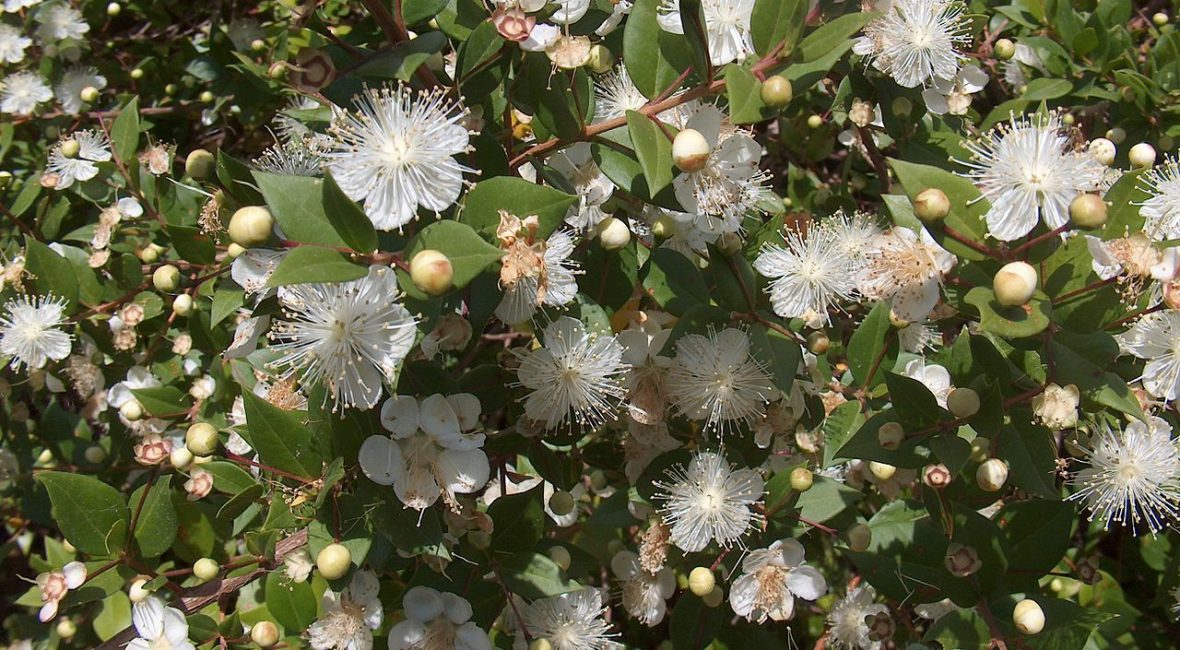
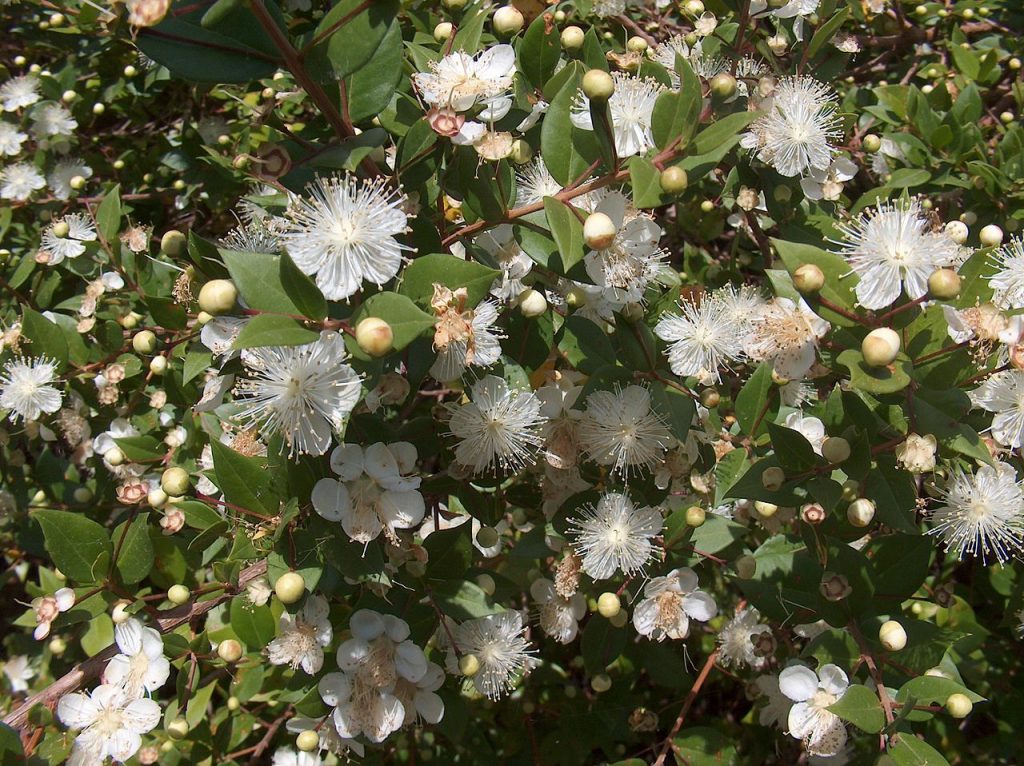
Myrtle growing in Sardinia, Villacidro (photo supplied from Wikimedia Commons)

The tidbit no doubt had some wondering just what myrtle is. In this present age, it is not a common wedding flower nor used much for culinary or medicinal purposes. Some may know myrtle as potted topiary, from its many references in poetry, or as the name of a character in literature—The Great Gatsby or Harry Potter, for instance.

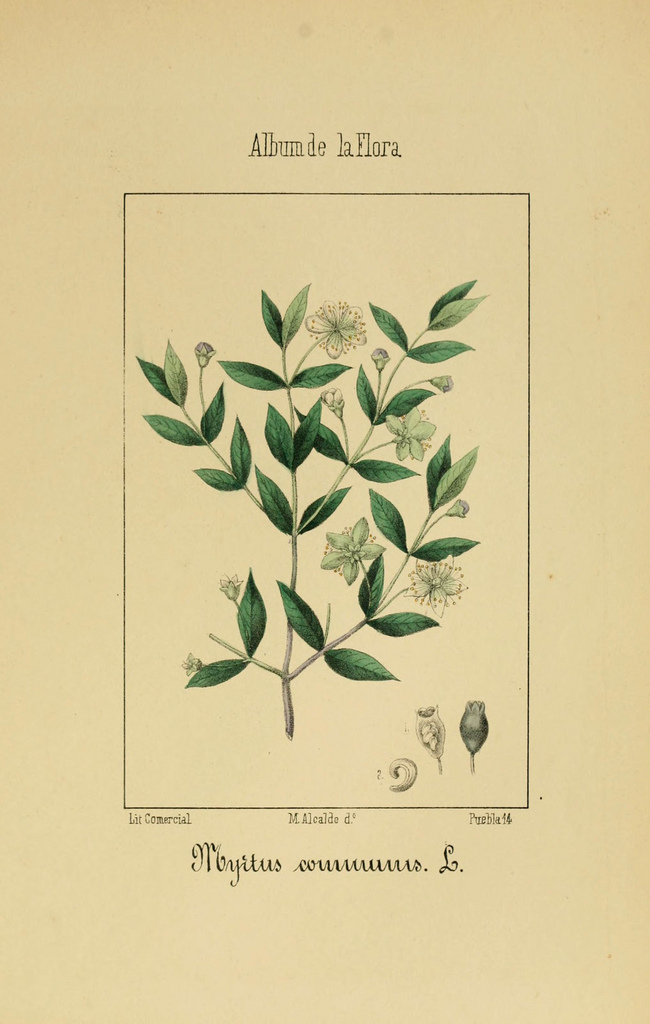
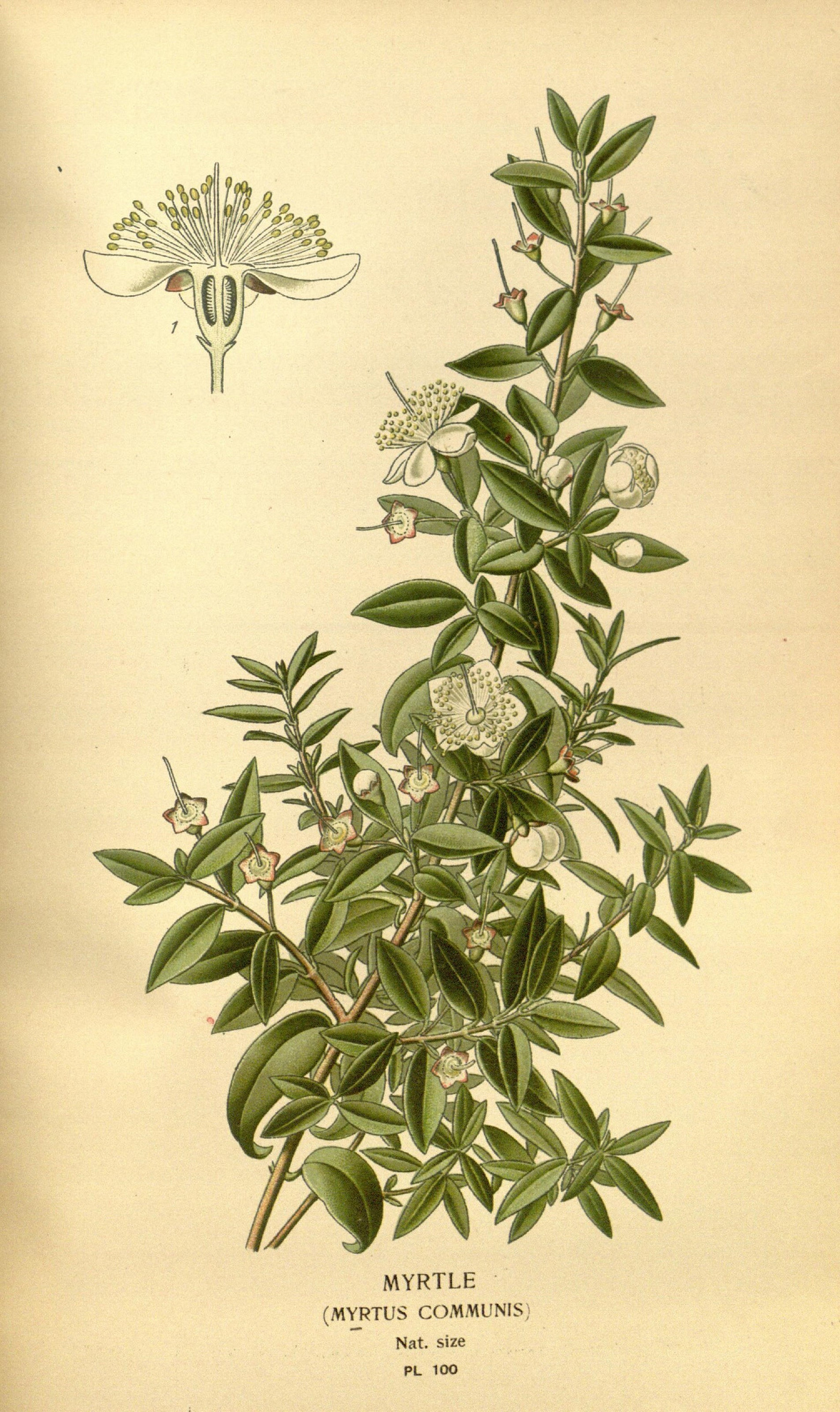
Myrtus communis (true myrtle), of the family Myrtaceae, is a fragrant, evergreen shrub with small, glossy green leaves and white, star-shaped flowers with long stamens, and, after their blooming, purple-black berries. It is native to Mediterranean Europe, North Africa, the Middle East, and Turkey. In these temperate climates it is sometimes clipped as a hedge. As a container plant of topiary, it is often trimmed to look like a fuzzy bowling ball balancing on top of a long stem or a pyramid, and is brought inside in cooler weather.

Myrtus communis (true myrtle). Album de la Flora Médico-Farmacéutica é Industrial, Indígena y Exótica (Madrid, 1862-1864), New York Botanical Garden, LuEsther T. Mertz Library copy

Queen Victoria and Prince Albert of Saxe-Coburg and Gotha were married in 1840. The only flowers adorning her during the ceremony were orange blossoms. In 1843, Princess Augusta of Cambridge (cousin to Victoria), in her wedding to Prince Frederick, Grand Duke of Mecklenburgh-Strelitz, was decorated all over with myrtle: on her dress, train, head-dress, and bouquet. The Court Circular for this ceremony reported that myrtle was “the emblematic flower of Germany.” And a nosegay of myrtle was presented to the Queen in 1845 in Gotha, Germany by her husband’s grandmother. The British Royal tradition of brides carrying myrtle was firmly established when the Queen’s eldest daughter (also named Victoria) married in 1858. The Princess Royal was decked out with so many flounces of myrtle and orange blossoms on her gown that she appeared to be a tiered wedding cake. Queen Victoria commanded that every bride of the Royal family should have myrtle planted at her Osborne House to commemorate each wedding.

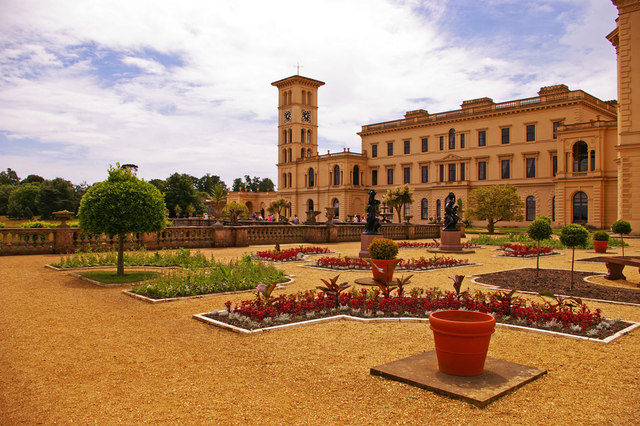
Osborne House (photo source geograph.org.uk Wikimedia Commons)

Myrtle thrived at Osborne House, Victoria and Albert’s beloved country retreat on the Isle of Wight. Long abandoned as a Royal residence (Victoria’s many offspring were not so enamored by the place) and subsequently used as a nursing home and naval college, the home and its 170-year old gardens have been recently restored by English Heritage. There is myrtle growing there today, from descendants of Victoria’s planting.

Myrtle roots easily, and there are probably others of prominent lineage growing in many of the Royal gardens, greenhouses, and orangeries. Apparently, the sprigs in the most recent Royal bouquet either came from the myrtle planted for Queen Elizabeth II in 1947 or the “original” at Osborne House. The myrtle in Camilla Parker Bowles’s wedding bouquet came from Cornwall (Charles, Prince of Wales, is the Duke of Cornwall and Camilla is now Duchess).

What was not as frequently reported about the tradition of the wedding bouquet in the lead-up to the Royal wedding in May, was the ancient history and symbolism of myrtle. Queen Victoria was well-versed in the language of flowers; the interest in floriography was at its peak in England during her reign. Blooms of various flowers were arranged in bouquets, nosegays, and tussie-mussies, a way of conveying a message, sometimes discreetly if need be. Queen Victoria’s presentation to her daughter, the Princess Royal, and, later, to her several other daughters, daughters-in-law, and granddaughters on their wedding days was not incidental. Victoria was both continuing and transforming the long traditions associated with myrtle.

There are many references to myrtle in ancient mythology and the Bible. The Greeks and Romans knew the plant as Myrtos and Myrtus and it was closely associated with the goddesses Demeter and Aphrodite. Venus is described by Ovid as emerging from the sea on her half-shell holding a sprig of myrtle. The wonderfully scented plant was considered an aphrodisiac, known to appear in wedding crowns for either the bride or the groom. In the Greco-Roman world, myrtle in laurels or crowns were sometimes presented to poets and woven into garlands of honor for athletic prizes, and was also worn to sacrifices and banquets. As opposed to laurel wreaths, myrtle signified victory from a bloodless battle. Myrtle wreaths made of gold have been excavated around the ancient world, particularly in Macedonia. Neat of appearance and amendable to clipping, myrtle was a common feature of gardens.

illustration of myrtle (Myrtus communis)

Myrtle (Myrtus communis). Favourite flowers of garden and greenhouse. (v. 2, 1897). Missouri Botanical Garden copy.

The ancient plant had a great ceremonial role in other civilizations. In Judaism, myrtle is known as Hadassah, as one of four sacred plants in the Feast of the Tabernacles, or, Sukkat, in 445 B.C. The Targum Sheni to Esther (2.7) states that “she was called Hadassah (Myrtle) because the righteous are compared to myrtle … As the myrtle spreads fragrance in the world, so did she spread good works.” Myrtle represents the community, thought of as a symbol of peace and of Eden and of marriage. In Christianity, losing its Greco-Roman association with female sexuality, myrtle came to be an emblematic symbol of the purity of the Virgin Mary.

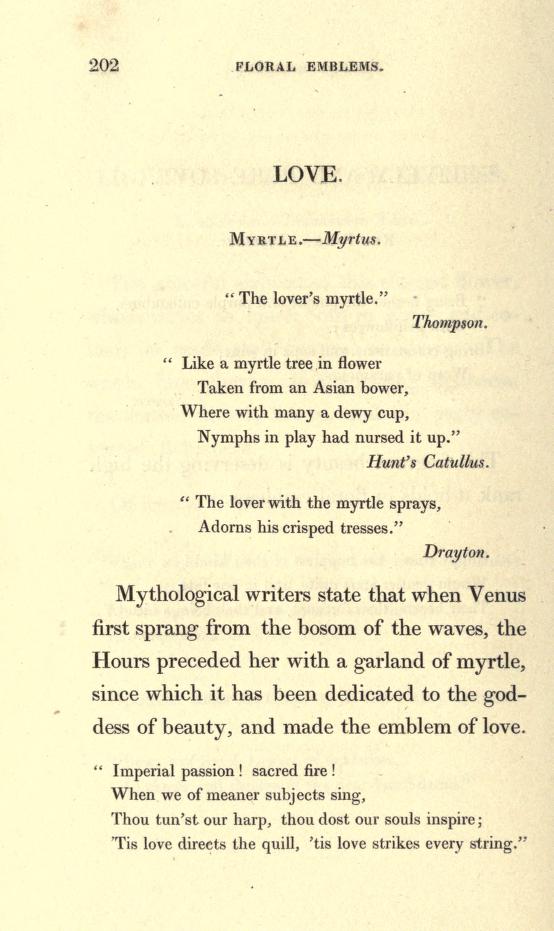
As an ornament for brides, this tradition eventually made its way to Germany, an old custom that Queen Victoria adopted as her own. Publications of her era or earlier, such as Henry Philips’ Floral Emblems (1825), Charlotte de La Tour and Frederic Shoberl’s The Language of Flowers, with Illustrative Poetry (1839), Flora Symbolica, or, the Language and Sentiment of Flowers (1866), and Richard Folkard’s Plant Lore, Legends, and Lyrics (1884), well describe the significance of myrtle. The plant has many, layered meanings—youth, virginity (before marriage), fertility, innocence, immortality, fidelity—but, above all, love.

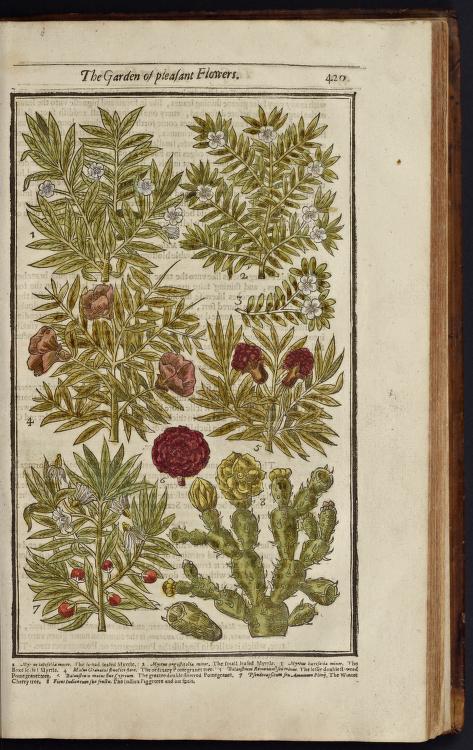
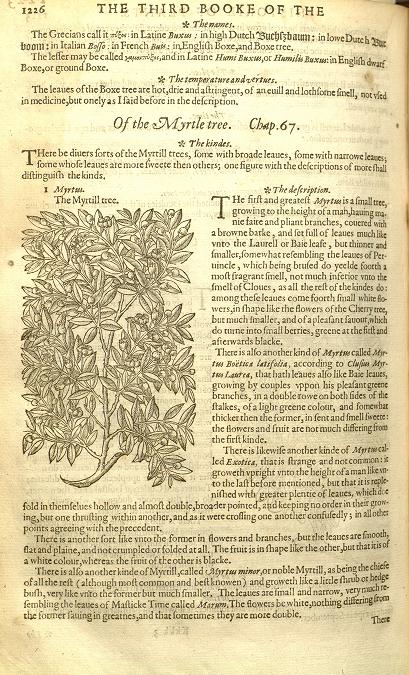
Queen Victoria did not introduce the myrtle plant to England from her visit to Germany. Tradition has Sir Walter Raleigh bringing it back from Spain in 1585, but it may well have been imported earlier. The Islamic gardens of the Iberian Peninsula featured myrtle since the Middle Ages. Unlike the Isle of Wight myrtle, the Alhambra and its Generalife Palace in Granada, Spain still have specimens that are hundreds of years old. John Gerard in his herbal of 1597 identifies six varieties grown in southern England. In the 17th and 18th centuries myrtle was a fashionable potted plant of the aristocracy, brought into the orangery when not adorning a garden. John Parkinson, in his Paradisi in Sole Paradisus Terrestris, or, A Garden of All Sorts of Pleasant Flowers wrote of “mirtle”: “Wee nourse [nourish] them with great care for the beautifull aspect, sweete sent and raritie, as delights and ornaments for a garden of pleasure, wherein nothing should be wanting that art, care and cost might produce and preserve.”

Illustration with myrtle (at top) form Parkinson’s Paradisi in Sole from the copy in the Library of the Getty Research Institute

Myrtle has thrived on a sheltered terrace of Osborne House on the Isle of Wight in the English Channel, overlooking the Solent, a seaside view that reminded Prince Albert of the Bay of Naples. Here, he was free to prove his gardening, architectural design, and landscaping abilities by supervising the building of an Italian-style palazzo and its grounds. On 17 September 1846 Victoria wrote in her journal, “… Albert supervised the transplanting of all the … myrtles … which is a tremendous job; one myrtle required 15 men to move it!” The home was their own creation and a retreat from the stiffness and oppressiveness of the court.

Victoria’s family spent July and August on the Isle of Wight when the myrtle was in bloom. The sprigs planted from successive bridal bouquets signal a continuity that many find reassuring, as attested by news reports to this day. A separate structure at Osborne House, Swiss Cottage, provided the Royal children an area where they were encouraged to learn gardening. For her granddaughter’s wedding, 18 February 1878, Victoria recorded that she “Walked … to the Swiss Cottage & planted a myrtle bush in honour of the day … grown from a sprig of myrtle in Vicky’s wedding bouquet, 20 years ago, of which I have sent a piece for Charlotte’s wedding nosegay.”

Queen Victoria was to see many more plantings of myrtle. She died at Osborne House on 22 January 1901. The provenance and significance of myrtle continues on into the 21st century, at least for British Royalty, as we saw with the bouquet that Meghan Markle carried.

John Gerard, The Herball, or, Generall Historie of Plantes (1597), from the scanned copy in the Missouri Botanical Garden, Peter H. Raven Library


Notes

Page from Henry Philips’ Floral Emblems (1825). Page from copy of the University of California Libraries

For more on bouquets and the language of flowers (link); from Smithsonian Gardens.

Connors, Catherine. “Scents and Sensibility in Plautus’ Casina,” The Classical Quarterly, volume 47, number 1 (1997), pages 305-309.

Lachs, Samuel T. “Hadassah that is Esther,” Journal for the Study of Judaism in the Persian, Hellenistic, and Roman Period, volume 10, number 2 (1979), pages 219-220.

Nelson, E. Charles. “Victorian Royal Wedding Flowers: Orange, Myrtle, and the Apotheosis of White Heather,” Garden History, volume 37, number 2 (Winter 2009), pages 231-236. The author thoroughly examined Court Circulars in The Times for mentions of wedding flowers, dispelling many, persistent myths.

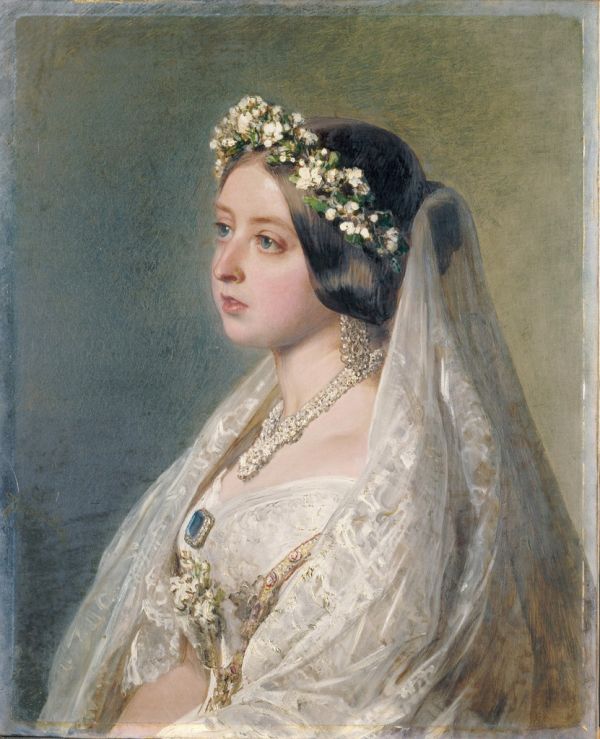
Queen Victoria, in her wedding dress, veil and what appears to be a tiara of myrtle. This charming painting by Franz Xaver Winterhalter, in the Royal Collections, was an anniversary gift to Prince Albert, seven years into their marriage.


June 14, 2018by mckenzie.87
Page 11 of 62« First...«10111213»203040...Last »

Help Support BHL

BHL's existence depends on the financial support of its patrons. Help us keep this free resource alive!

search

About BHL

The Biodiversity Heritage Library (BHL) is the world’s largest open access digital library for biodiversity literature and archives. BHL operates as a worldwide consortium of natural history, botanical, research, and national libraries working together to digitize the natural history literature held in their collections and make it freely available for open access as part of a global “biodiversity community.”

Join Our Mailing List

Sign up to receive the latest news, content highlights, and promotions.

Subscribe Now

Subscribe to Blog via Email

Enter your email address to subscribe to this blog and receive notifications of new posts by email.

Join 319 other subscribers

Subscribe to Blog Via RSS

Subscribe to the blog RSS feed to stay up-to-date on all the latest BHL posts.

Access RSS Feed

Inspiring Discovery through Free Access to Biodiversity Knowledge.

The Biodiversity Heritage Library makes it easier than ever for you to access the information you need to study and explore life on Earth…for free, anytime, anywhere.


64+ Million Pages of
Biodiversity Literature Online.

EXPLORE

Tools and Services
to Transform Research.

EXPLORE

300,000+
Illustrations on Flickr.

EXPLORE

ABOUT | HARMFUL CONTENT | PRIVACY | SITE MAP | TERMS OF USE