Biodiversity Heritage Library - Program news and collection highlights from BHL
  • Home
  • News
  • Featured Books
    • All Featured Books
    • Book of the Month Series
    • BHL at 20
  • User Stories
  • Campaigns
    • Fossil Stories
    • Garden Stories
    • Monsters Are Real
    • Page Frights
    • Her Natural History
    • Earth Optimism 2020
  • Tech Blog
  • Visit BHL
Home
News
Featured Books
    All Featured Books
    Book of the Month Series
    BHL at 20
User Stories
Campaigns
    Fossil Stories
    Garden Stories
    Monsters Are Real
    Page Frights
    Her Natural History
    Earth Optimism 2020
Tech Blog
Visit BHL
  • Home
  • News
  • Featured Books
    • All Featured Books
    • Book of the Month Series
    • BHL at 20
  • User Stories
  • Campaigns
    • Fossil Stories
    • Garden Stories
    • Monsters Are Real
    • Page Frights
    • Her Natural History
    • Earth Optimism 2020
  • Tech Blog
  • Visit BHL
Biodiversity Heritage Library - Program news and collection highlights from BHL
Blog Reel, Featured Books

Osbert Salvin’s Central American Field Diary

Handwritten field notes with a detailed painted illustration of an bird’s head, surrounded by cursive annotations describing the specimen.

This post is part of BHL at 20: Treasures from the Biodiversity Heritage Library, a series contributed by members of the BHL community, highlighting remarkable works from across the collection in celebration of its 20th anniversary.

We uncovered this lovely tome when we were relocating our Museums Victoria Library Collection in 2015-16. It was housed with our run of the Ibis, an important ornithology journal published by the British Ornithologists Union since 1859. However, when we opened it up it was clearly something special. Interleaved between 12 articles on Central American ornithology from the Ibis were sheets of lined blue paper with handwritten annotations and beautiful hand painted illustrations. There was also a bookplate from British naturalist Frederick DuCane Godman (1834–1919).

Bookplate of Frederick DuCane Godman featuring a heraldic crest with shield, motto, and decorative border on a green background.

Bookplate of Frederick DuCane Godman, from [Collected articles from The Ibis on the ornithology of Central America] 1859-1864. Contributed to BHL by Museums Victoria. https://www.biodiversitylibrary.org/page/58147838

The printed articles are all written or co-authored by British ornithologist Osbert Salvin (1835-1898). Godman and Salvin were two of the founding members of the British Ornithologists Union formed in 1858 at Cambridge. As students, they discovered a mutual interest in natural history that grew into a lifelong collaboration, honing their field research skills by observing local birds and butterflies. Later they both travelled extensively, including in Central America, where they collected widely, once again zoning in on birds and butterflies. In many cases, the collectors they worked with during their travels continued to send them specimens years after they had returned to England. Salvin and Godman worked with a range of collectors, including Herbert Huntington Smith and his wife Amelia “Daisy” Woolworth Smith. They also employed an Indigenous collector Mr M. Trujillo.

Inspired by their experience of Central American wildlife, the two scientists decided to publish an encyclopaedia on the fauna and flora of that region. While their initial plans were reasonably modest, the material they gathered was so extensive that Biologia Centrali-Americana eventually ran to 63 volumes and included a whopping 50,263 species.

This unique volume of articles from the Ibis is a wonderful example of how books were customised for use by scientists in their research. Interleaving was an established practice in 19th century education that allowed students to copy the work of more advanced practitioners (the bookish equivalent of a budding artist copying grand masters in an art gallery). This practice carried across into scientific research, leaving us with examples such as this volume, which reveals an intermediate stage in the research and publishing process. The annotations show Salvin revising his work to prepare for the ornithology section of Biologia Centrali-Americana, which he co-authored with Godman.

By comparing the unpublished material with Biologia Centrali-Americana, we can see that the manuscript work fed in directly to the finished work. The original published description of Turdus rufitorques in Sclater and Salvin’s 1859 article ‘On the ornithology of Central America’ records an altitude of 7,000 feet. However, the revised altitude of 12,000 feet in Volcan de Fuego and 10,500 feet at Cordillera above Totonicapam in Biologia Centrali-Americana can be seen in the manuscript material below.

Handwritten notebook page with a painted illustration of a bird’s head and leg, accompanied by scientific notes dated 1873.

Manuscript revisions to the description of Turdus rufitorques in Osbert Salvin’s Central American Field Diary. Contributed to BHL by Museums Victoria. https://www.biodiversitylibrary.org/page/58147817

Printed page from a 19th-century scientific publication describing bird species, with dense text in two columns.

Published revisions to Turdus rufitorques in Biologia Centrali-Americana. Contributed to BHL by Museums Victoria. https://www.biodiversitylibrary.org/page/38446923

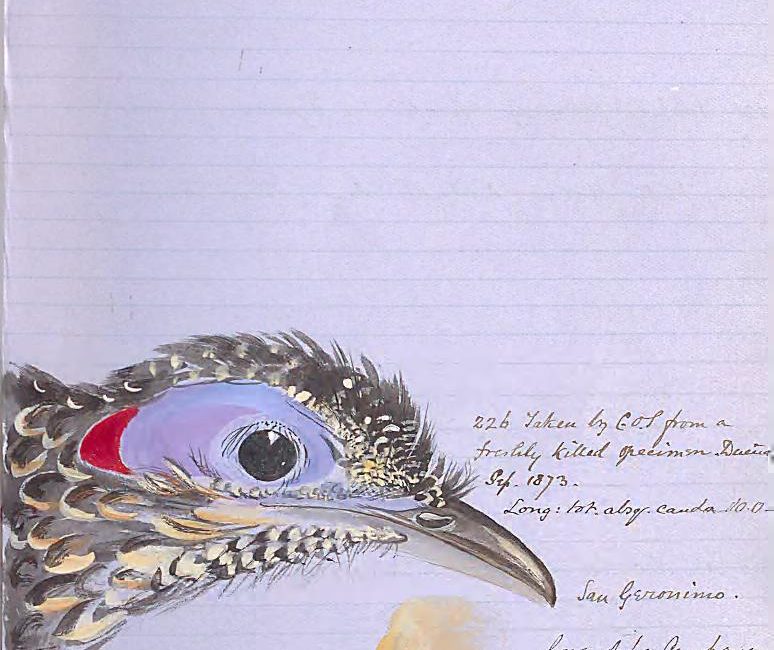
This hand drawn illustration of Geococcyx affinis deftly illustrates the published description of the species, which states “The large space round the eye in life is of a chalky bluish-white colour, and has at its further end a large crescent-shaped patch of vermilion. ‘The legs are of a slate-colour.”

Handwritten field notes with a detailed painted illustration of an bird’s head, surrounded by cursive annotations describing the specimen.

Hand painted illustration of Geococcyx affinis in Osbert Salvin’s Central American Field Diary. Contributed to BHL by Museums Victoria. https://www.biodiversitylibrary.org/page/58147753

Printed scientific text describing a bird species, including habitat and physical characteristics.

Published description of Geococcyx affinis in Biologia Centrali-Americana. Contributed to BHL by Museums Victoria. https://www.biodiversitylibrary.org/page/37639717

The published description of Lophostrix stricklandi is clearly based on the annotations and illustration in our volume, reading “it also occurs in the forests of the mountains trending to the Pacific, whence two birds were brought us on October 11 1873, from the slopes of the V. [Volcan] de Agua, above the village of San Diego. The iris of these fresh specimens was bright yellow and the toes lead-colour.”

Notebook page with handwritten notes and a painted illustration of a bird’s head and foot, documenting observations from field research.

Hand painted illustration of Lophostrix stricklandi in Osbert Salvin’s Central American Field Diary. Contributed to BHL by Museums Victoria. https://www.biodiversitylibrary.org/page/58147850

In Biologia Centrali-Americana the authors discuss two different colourings observed in species of Geotrygon albifacies from different regions, debating whether this difference is pronounced enough to distinguish two different species. Meanwhile the manuscript contains an illustration of the lighter variation from Volcan de Fuego, showing the artist closely observing and recording the bird’s colouration.

Handwritten field notes with a painted illustration of a bird’s foot and brief annotations recording location and date.

Hand painted illustration of Geotrygon albifacies with light colouration in Osbert Salvin’s Central American Field Diary. Contributed to BHL by Museums Victoria. https://www.biodiversitylibrary.org/page/58148008

While it is Godman’s bookplate that appears on the volume, the handwriting more closely matches that of Salvin. The two worked closely together, forming a significant collection and library that Godman oversaw after Salvin died in 1898. They began to donate their scientific collection to the British Museum in 1885, and Godman continued to donate specimens after Salvin’s death as the various parts of Biologia Centrali-Americana were completed. Their shared library stayed in Godman’s possession and was gradually dispersed after Godman’s death in 1919.

Based on the dates that appear alongside the illustrations, the volume appears to have been used as a field diary during Salvin’s trip to Guatemala in 1873-1874. The commentary throughout mainly focuses on localities and altitude, with a view to confirming or revising what Salvin had already published in earlier journal articles. This treasure of the Biodiversity Heritage Library is a significant and unique volume that shows late 19th century field research in practice.

From the Biodiversity Heritage Library

As we celebrate twenty years of open biodiversity knowledge, we are also looking ahead to what comes next. BHL’s future depends on the global community that built it and continues to sustain it. If you value open access to biodiversity literature, we invite you to be part of the next chapter.

Orange button with a heart icon

Acknowledgements

Thanks to former Museums Victoria staff members Gemma Steele and Catriona McPhee for their help in identifying Salvin’s handwriting.

References

‘Biographical Notices of the Original Members of the British Ornithologists’ Union, of the principal Contributors to the First Series of ‘The Ibis’ and of the Officials’ (1909) Ibis, 50, pp. 71-232. https://doi.org/10.1111/j.1474-919X.1909.tb05250.x

British Museum (n.d.) Frederick DuCane Godman, British Museum website, https://www.britishmuseum.org/about-us/british-museum-story/people-behind-collection/frederick-ducane-godman (Accessed 8 January 2026).

‘Godman and Salvin Memorial’ (1923) Science, 58 (1496), pp. 157–157. http://www.jstor.org/stable/1648226

Holland, W. J. (1919) ‘Herbert Huntington Smith’, Science, 49(1273), pp. 481–483. http://www.jstor.org/stable/1641319

Horsham Museum & Art Gallery (2021) A Collector Collected – unique items reveal all, Horsham Museum & Art Gallery website,

https://horshammuseum.org/collections/blog/posts/collectors (Accessed 8 January 2026).

Horsham Museum & Art Gallery (2023) Frederick DuCane Godman: The Legacy of a Collector, Horsham Museum & Art Gallery website https://horshammuseum.org/collections/blog/posts/godman-legacy-of-a-collector (Accessed 8 January 2026).

Jackson, C.E. (1975) Bird illustrators: some artists in early lithography. London: H.F. & G. Witherby.

Jackson, H. J. (2005) Romantic Readers: The Evidence of Marginalia. New Haven: Yale University Press.

‘Osbert Salvin’ in Sidney, L. (ed.) (1901) The dictionary of national biography: founded in 1882 by George Smith Supplement Vol. 3. New York & London: Macmillan & Smith & Elder.

Vitiello, Regina M. (2020) Hidden Women Botanists – Mrs. Herbert Huntington Smith, NYBG Steere Herbarium website, https://sweetgum.nybg.org/science/the-hand-lens/explore/narratives-details/?irn=7427# (Accessed 24 March 2026).

April 8, 2026by nkearney
Blog Reel, Featured Books

Catalogue of All Specimens of Natural History Collected by Mr Blandowski’s Party During an Expedition to the Lower Murray in 1857

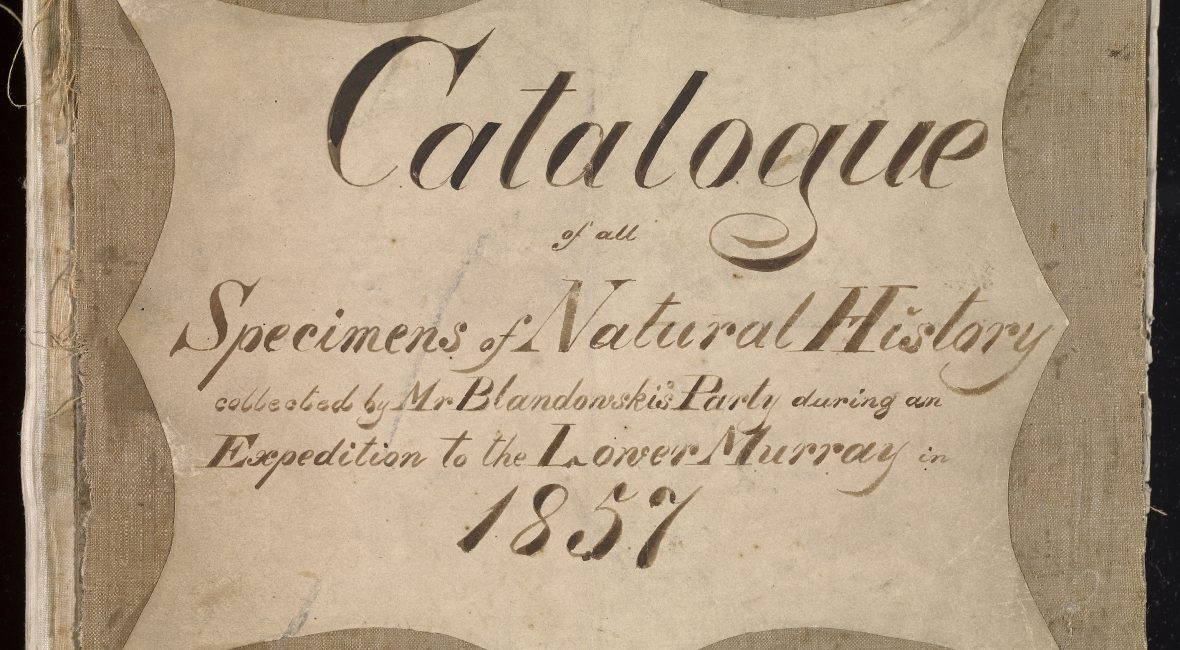
Front cover of 'Catalogue of all Specimens on Natural History collected by Mr Blandowski's Party during an Expedition to the Lower Murray in 1857' by Gerard Krefft

Cropped image of Gerard Krefft’s handwritten cover of Catalogue of all Specimens of Natural History collected by Mr Blandowski’s Party during an Expedition to the Lower Murray in 1857 [referred to as Blandowski’s Catalogue]. Source: Museums Victoria Archives, ARCHIVE-784. Photographer: David Paul.

Blandowski’s Catalogue is one of the most precious items held by the Museums Victoria Archives. It documents natural history specimens collected by William Blandowski (1822-1878) and Gerard Krefft (1830-1881) and colleagues working with First Peoples communities for the National Museum of Victoria (predecessor of Museums Victoria) during an expedition along the Lower Murray and Darling River from December 1856 to December 1857. Murray fishes listed in the Catalogue were later controversially used to describe prominent members of the Philosophical Institute in Blandowski’s 1858 paper Recent Discoveries in Natural History on the Lower Murray. Blandowski refused to hand-over to Professor Frederick McCoy, the National Museum of Victoria’s first Director, many of the specimens collected on the expedition, and associated research notes and illustrations, causing further controversy. Blandowski’s Catalogue has recently been digitised by BHL Australia and is now available to view online.

Black and white photograph of bearded man in overcoat, seated

Self portrait of William Blandowski, 1860. Source: National Gallery of Victoria. Photographer: William Blandowski.

Portrait of a man seated in a suit

Portrait of Gerard Krefft, 1855. Source: Australian Museum. Photographer: unknown.

Blandowski was appointed Government Zoologist in 1854 when the Museum of Natural and Economic Geology (precursor to the National Museum of Victoria, and Museums Victoria) was founded. He had migrated from the Kingdom of Prussia (now Poland) to Adelaide in 1849, then on to the goldfields of Victoria in 1851. Krefft, originally from Duchy of Brunswick (now Germany), immigrated to New York City circa 1850, then to Australia and the Victorian goldfields in 1852. Blandowski was entrusted with an expedition to the Lower Murray; a previous expedition in 1849 had failed under the leadership of Surveyor Edward White. Blandowski had several assistants to accompany him on the expedition, including Gerard Krefft and later James Manson, who joined the expedition in February 1857. Krefft was hired as an artist on the Lower Murray Expedition but also worked on labelling specimens and adding information to Blandowski’s Catalogue, and subsequently employed by McCoy in February 1858 to select specimens to be kept by the National Museum of Victoria.

Encampment on a river with tents and other structures

Illustration of Blandowski’s expedition camp on the Murray River, Mondellimin, also known as Chaffey Landing at Merbein, Victoria, Australia, on the New South Wales border, 6 February 1858. Source: Museums Victoria reproduced from Illustrated Melbourne News.

Mondellimin, name derived from Mondellunddellun used by the local Yarree community, about 480 kilometres from Melbourne, also known as Chaffey Landing at Merbein, near Mildura, was the permanent campsite for the expedition from April to December 1857. “On the 6th of August he [Blandowski] left the camp in charge of Krefft and Manson and proceeded towards Melbourne with his valuable collections of specimens of natural history, which had been accumulating in his tent during his long sojourn at Mondellimin, to the extent of 28 boxes and parcels, containing in all about 16,000 specimens” (South Australian Register, 15 October 1857, p.3). Part of the collection had already shipped from Echuca, and specimens collected after Blandowski returned to Melbourne, came back with Krefft in December 1857. Blandowski attributed the specimens acquired largely due to the collecting skills of the local Indigenous peoples and acknowledged the taxidermy work of Krefft and Manson.

Blandowski’s Catalogue lists 17,434 specimens were collected, under 3389 catalogue numbers. Krefft catalogued specimens 1 to 3389, leaving some lines blank, recording specimen number, name of specimen, description of the specimen (although this was mostly left blank), number of specimens, locality whence obtained, donor’s name (also left blank), and remarks. Each specimen has general locality information allowing scientists to estimate where the specimen occurred at a point in time.

Blandowski’s infamous Murray fishes are described in the Transactions of the Philosophical Institute of Victoria. Figure 19 (N) Brosmius Bleasdalii named after a very prominent member of the Philosophical Institute Council, the Reverend Bleasdale: “A slimy, slippery fish. Lives in the mud. Is of a violent bluish colour on the belly. The whole upper surface is of a dirty olivish-green colour, with numerous irregular dark patches.” Figure 4 (B) Cernua Eadesii named after another very prominent member of the Council, Dr Eades: “A fish easily recognised by its low forehead, big belly and sharp spine.”

Portrait of a bearded man, seated with a book open in his lap

Portrait of Sir Frederick McCoy, c.1870. Source: Museums Victoria, H29553. Photographer: Johnstone, O’Shannessy & Co. Studio.

Blandowski returned to Melbourne from the expedition in August 1857, four months before the rest of the party. To McCoy’s outrage, Blandowski did not return to the National Museum of Victoria (then located at the University of Melbourne, Parkville campus), and held on to field notes, many of the specimens collected on the expedition, and illustrations from the expedition. The matter was brought before the Board of Science, McCoy wrote to the Chief Secretary on 28 April 1858 (MV Archives OS~04400): “…Mr Blandowski should be compelled to give up at once all specimens, books, journals and field observations, and the portfolio of several hundred drawings made by the party under his orders, and all illustrative lists and memoranda connected with the Public Collections, the property of the Victorian Government.”

Eventually all the specimens collected were returned to the Museum, however McCoy exchanged or donated many of the specimens with other museums and many were destroyed by insects over time, leaving about 15% of the total specimens collected on the expedition in Museums Victoria State Collection to this day. To view some of the specimens online, visit Museums Victoria Collections website.


Editor’s Note

This post has been edited to add further details of the expedition, including the roles of participants and more specific dates of their participation in the expedition.

February 24, 2022by [email protected]
Blog Reel, User Stories

Teaching Rare Book Cataloguing During a Pandemic

As I am writing this, Melbourne is at the end of its second wave of COVID-19 and I have been separated from the library collections that I work with at Museums Victoria for six months, 25 days, 21 hours, and around 12 minutes… but who’s counting?!

The pandemic has created a lot of challenges, not least working out how to be a librarian of an overwhelmingly print-based collection from a distance, but this time working from home has also afforded me opportunities to present a handful of webinars, the most recent being a guest lecture on rare book cataloguing for library and information management students.

I can say without a doubt that this would have been a near impossible task without the Biodiversity Heritage Library.

Having a number of items from the Museums Victoria Library digitised and openly available on the BHL website enabled me to access collection items virtually for students and create engaging online content showing real-life examples of features such as collation, signatures, catchwords, and provenance. These are some of the things we look for when cataloguing rare books from the hand-press era, which for Western printing spans roughly from 1440, around the time when the Gutenberg press was invented, to the early 19th century, by which time the machine age was well established and steam-powered machines dominated printing.

Screenshot of the book viewer in BHL with pages from An account of the English colony in New South Wales.

The two-page view on BHL allowed me to flick through books virtually in the same manner as a physical object in order to indicate some of the things we might look for when cataloguing rare books. Plate and text page 299. Collins, David. An account of the English colony in New South Wales, from its first settlement in January 1788 to August 1801. 1804. Contributed in BHL from Museums Victoria.

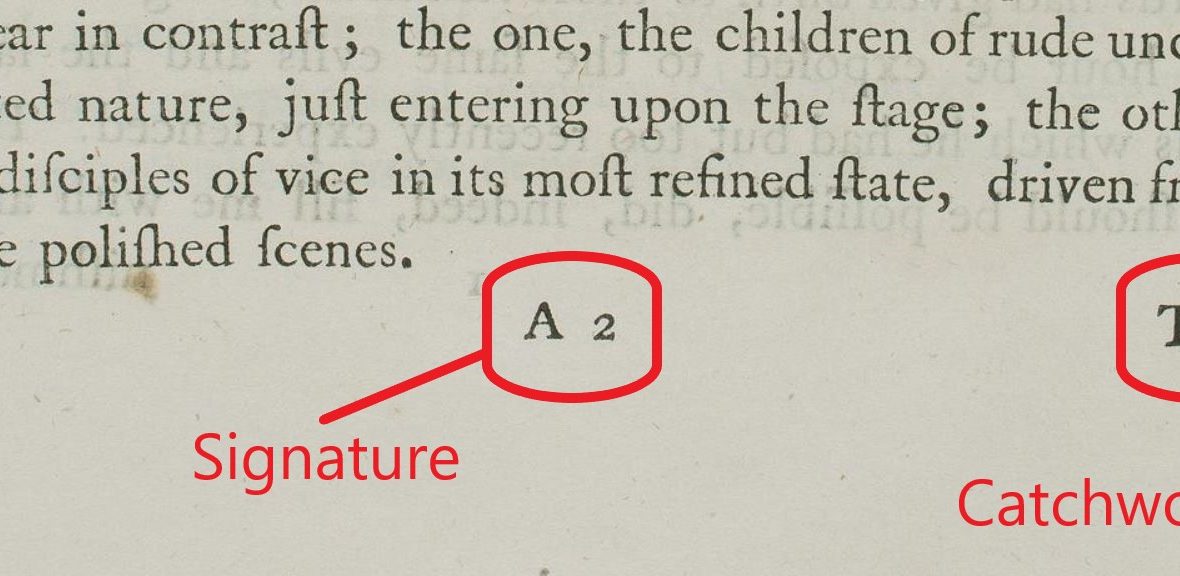
A central part of a bibliographical description is to record the format and the physical structure of the book. In determining a book’s collations—or in other words, how it was put together or assembled—we can look for evidence on books, including the impressions that the paper mould have left on the paper and devices used by printers to keep track of page order such as signatures and catchwords.

A catchword will show the first word on the following page and a signature will indicate how many pages are in each gathering of the book. Both generally appear near the bottom of a page and both are also useful for rare book cataloguers to check that the item they are cataloguing is not missing any pages.

Highlight of signatures and catchwords on a printed page of a rare book.

Close-up of a page indicating the location of the signature and catchword. Preface. Collins, David. An account of the English colony in New South Wales, from its first settlement in January 1788 to August 1801. 1804. Contributed in BHL from Museums Victoria.

During the lecture, I used BHL to flick through David Collins’ published journal, An account of the English colony in New South Wales … (1804), where I could clearly demonstrate to the students what I am referring to when I say “collations”, “signatures” and “catchwords”, and what aspects of the book that I might record in a catalogue record.

Another thing that I touched on was provenance markings and how to record any marks of ownership, custody or location on an item. In the case of books, this can mean autographs or notes written in books, as well as bookplates and stamps—people scribble, affix or slip all sorts of things in or on books! Generally, when cataloguing, I’d aim to note anything in our copy that might deviate from the “perfect” copy, so in other words, anything that’s happened to the book after publication.

Provenance information highlighted on the front flyleaf of a rare book.

The front flyleaf of the Museums Victoria Library copy features several marks of provenance, including an acquisition number, a blind or embossed stamp near the top of the page, and an inscription. Front flyleaf. Scott, G. Firth. The romance of polar exploration. 1909. Contributed in BHL from Museums Victoria.

Once again, BHL delivered the goods on provenance markings. I was able to browse some of the 600+ volumes that Museums Victoria has contributed to find many different kinds of provenance markings, including several marks of provenance in our copy of The romance of polar exploration by G. Firth Scott (1909) as well as bookplates, annotations and even a cheeky manicule! If you are interested to know more about provenance markings in our collections, take a look at this BHL blog post from 2019 by Hayley Webster.

So yes, the pandemic has been challenging, but not always in a bad way. It has certainly forced me to be adaptable and creative around my approach to my job, and I’ve also learned to love and appreciate the digital surrogates of the books in the Museums Victoria Library as much as I do the real thing.

January 14, 2021by Joel Richard
Blog Reel, Campaigns, Earth Optimism 2020

No Egrets: The Story of Fashion and Feathers Through Books

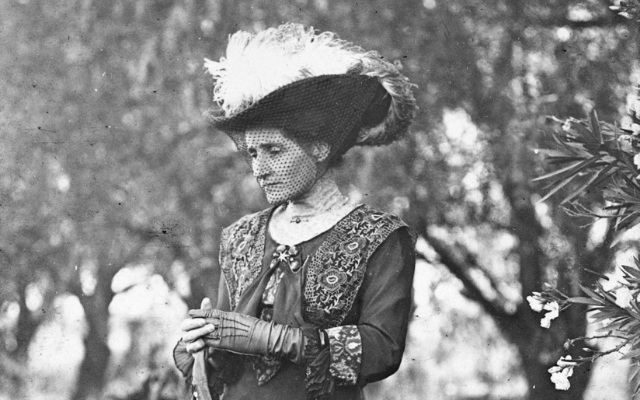
Black and white photo of a woman in a Victorian dress wearing an elaborate adorned with bird feathers. She stands in a forest.

April 2020 marks the 50th anniversary of Earth Day. Organizations around the world have commemorated the occasion by participating in the global Earth Optimism movement — an initiative spearheaded by the Smithsonian to “turn the conservation conversation from doom and gloom to optimism and opportunity”.

Throughout 2020, the Biodiversity Heritage Library (BHL) and our partners are joining the movement by sharing conservation success stories from and made possible by the BHL collection. Follow our blog for conservation stories — past and present — and visit our website for more information and to explore our Earth Optimism book collection.

———————

Feathers have been used in fashion throughout history, but the trend became more widespread from the late 18th century when the Industrial Revolution made luxuries more available to the masses. In the 19th century, new technology improved the speed of production and the millinery industry boomed [1]. Hats with feathers became a status symbol coveted by a new mass market and were produced on an industrial scale.

Birds were hunted around the world to supply plumes to centres of fashion such as London and New York. In 1886, American Museum of Natural History’s ornithologist, Frank Chapman, infamously observed on a walk in New York some 40 native bird species on women’s hats, some with an entire stuffed bird attached [2]. Indeed, women were oft blamed for the trend: in The Ibis in 1887 [3], women were pointed to as “the indirect, but real, instigators of this slaughter”. The author continues: “all that can be hoped for is that the freaks of feminine vanity may take some other and less harmful direction.”

The issue also arises in a letter [4] dated 1865 from ornithologist John Gould to Museum Victoria’s first director, Sir Frederick McCoy, who had previously written to Gould asking him to procure bird specimens for the burgeoning museum’s collections. In the letter, Gould ironically writes:

“The Ladies, the Ladies, have however, so stripped us of birds for their bonnets that but few are now in the market and these of course are high priced.”

Black and white photograph of a woman in Victorian dress with an elaborate hat adorned with bird feathers. She stands in a forest.

Photograph of Flo Tuckfield wearing a hat featuring a large plume of feathers in Merrigum, Victoria, circa 1910s. Credit: Lilian L. Pitts / Source: Museums Victoria, MV000061572.

While women were loudly condemned for their role in consuming feathers, they were also instrumental in the campaigns to raise awareness of the devastating effects of plume hunting on bird populations. For instance, in 1896 the American socialite and amateur naturalist Harriet Hemenway and her cousin Minna Hall led a boycott of feathered hats which attracted 900 participants and led to the formation of the National Audubon Society and passage of the Weeks-McLean Law (aka the Migratory Bird Act), which outlawed market hunting and the interstate transport of birds [5].

As documented by Herbert K. Job in his 1905 book Wild Wings [6], at the turn of the 20th century, an ounce of feathers was worth $32—almost twice as much as an ounce of gold. Job states that during 1902, over 1600 packages of heron plumes were sold at just one London auction house:

“A package is said to average in weight 30 ounces. This makes a total of 48,240 ounces. As it requires about four birds to make an ounce of plumes, these sales meant 192,960 herons killed at their nests, and from two to three times that number of young or eggs destroyed. Is it, then, any wonder that these species are on the verge of extinction?” (p.146)

In Australia, egrets, herons, lyrebirds, bowerbirds and emus were amongst the species targeted by plume hunters.

A brown bird with long, pink tail feathers illustrated on a grassy platform

Illustration of a lyrebird from An account of the English colony in New South Wales by David Collins (1804). Contributed in BHL by Museums Victoria.

Lyrebirds are ancient Australian animals: the Australian Museum in Sydney has fossils of lyrebirds dating back around 15 million years [7]. The Lyrebird reportedly came close to extinction in the early 1900s as it was hunted for its ornate tail feathers. In the 1911 publication, Pros and cons of the plumage bill, bird protectionist James Buckland states that “over 400 lyre-birds were killed in one district in a single season to supply the London plumage market” [8].

In 1901, the Australian Ornithologists’ Union (AOU) was founded to promote the study and conservation of the native bird species of Australia and adjacent regions. One of its members, Tom Tregellas, regularly camped out in a large hollow tree trunk over a period of seventeen years in Sherbrooke Forest, Victoria observing and photographing lyrebirds. Noticing a decrease in the population over time, he crusaded for the protection of lyrebirds and legislation was eventually passed to protect the birds.

The rapid decline of several species whose feathers were used in ladies’ fashion were seen during this period, and some bird species were not as fortunate as the lyrebird. The Huia of New Zealand was declared extinct in 1907, and it is also believed that the use of Great Auk feathers for down partially contributed to its extinction [9].

Periodicals, along with books and public lectures, were one of the key means of circulating information and inspiring action around bird preservation at that time. In volume seven of the journal of the AOU, The Emu, two articles by Australian ornithologist Arthur H. Mattingley are published side-by-side. In the first from November 1906 [10], Mattingley recounts a visit to the Murray River where he photographs egret and heron nests. In the second [11], written only a few weeks later, Mattingley returns to the same area and is horrified to discover that nearly one-third of the birds were killed, with the young left to starve in their nests.

Orphaned baby egrets at nests begging for food.

Photographs accompanying the article “Plundered for their plumes” by A.H. Mattingley, in The Emu, Vol.7 (1907). Contributed in BHL by American Museum of Natural History Library.

The second article, Plundered for their plumes, contains vivid photographs that caused quite a stir internationally. These photos are widely regarded as a tipping point in changing attitudes towards the use of feathers in fashion.

In England, the Royal Society for the Protection of Birds (RSPB) posted the photos on billboards and in shop windows, and in 1911 men carrying enlargements of the story patrolled the West End of London to protest the cruelty of wearing feathers. As a result, the story gained attention throughout the UK, as well as in Paris, Amsterdam, Italy, Spain, Denmark, Australia and the United States [12].

From this point on, the interest of amateur ornithologists changed from bird collection to identification. An Australian Bird Book, by John Albert Leach (1911), and Neville Cayley’s What Bird Is That? (first published in 1931) are two Australian publications that reflect this shift.

Collage of various birds illustrated in color.

Illustration from What bird Is That? by Neville Cayley (1947). Contributed in BHL by Museums Victoria.

Feathered hats did make a reappearance from the 1930s-1960s, but the decades after this saw hats lose popularity as they were no longer a standard item of women’s daywear. Worryingly, feathers have been making a comeback since clothing adorned with marabou and ostrich feathers appeared in a couture runway show in 2017, and PETA have been campaigning against the use of feathers in fashion ever since. The use of down in jackets is also a contentious issue today, and many major international brands have stopped selling down in favour of high-tech synthetics.

While mass market fashion continues to have serious environmental repercussions, this history shows that wide scale attitudinal shifts around such issues are possible. Efforts on this front, however, need to be widespread and sustained.

References

  1. Ehrman, E. (2018) Fashioned from nature, V&A Publishing, London, pp. 97-98.
  2. Callahan, D. (2014) A history of birdwatching in 100 objects, Bloomsbury, London, p.72.
  3. The Ibis (1887) Recently published ornithological works, Ser.5, Vol.5, no.20, p.458, viewed 27 February 2020. https://www.biodiversitylibrary.org/page/8521969.
  4. Letter from John Gould dated 20 December 1865, in Museums Victoria Archives, MV ARCHIVES – NATIONAL MUSEUM OF VICTORIA – Inwards Correspondence – 1863-1876 Gould, J., OLDERSYSTEM~02618.
  5. Souder, W. (2013) How two women ended the deadly feather trade, Smithsonian Magazine, viewed 27 February 2020. https://www.smithsonianmag.com/science-nature/how-two-women-ended-the-deadly-feather-trade-23187277/.
  6. Job, H. (1905) Wild wings; adventures of a camera-hunter among the larger wild birds of North America on sea and land, Houghton, Mifflin & Co, Boston, viewed 27 February 2020. https://www.biodiversitylibrary.org/item/48785.
  7. Boles, W. (2006) ‘The avian fossil record of Australia: an overview’, In: Merrick, J.R. et al. (eds.) Evolution and biogeography of Australasian vertebrates, auscipub, Oatlands, pp.387-411.
  8. Buckland, J. (1911) Pros and cons of the plumage bill, printed by Edmund Evans, p.13, viewed 27 February 2020. https://viewer.slv.vic.gov.au/?entity=IE6076556.
  9. Callahan, D. (2014) A history of birdwatching in 100 objects, Bloomsbury, London, p.72.
  10. Mattingley, A.H. (1907) A visit to heronries, The emu: official organ of the Australasian Ornithologists’ Union, Vol.7, pt.2, pp.[65]-71, viewed 27 February 2020. https://www.biodiversitylibrary.org/page/8517730.
  11. Mattingley, A.H. (1907) Plundered for their plumes, The emu: official organ of the Australasian Ornithologists’ Union, Vol.7, pt.2, pp.71-73, viewed 27 February 2020. https://www.biodiversitylibrary.org/page/8517740.
  12. Cronin, J.K. (2018) Art for animals : visual culture and animal advocacy, 1870-1914, Pennsylvania State University Press, University Park.
October 15, 2020by Joel Richard
Blog Reel, Featured Books

Two Hand-Painted Volumes of Coleoptera Illustrated by Francis du Boulay

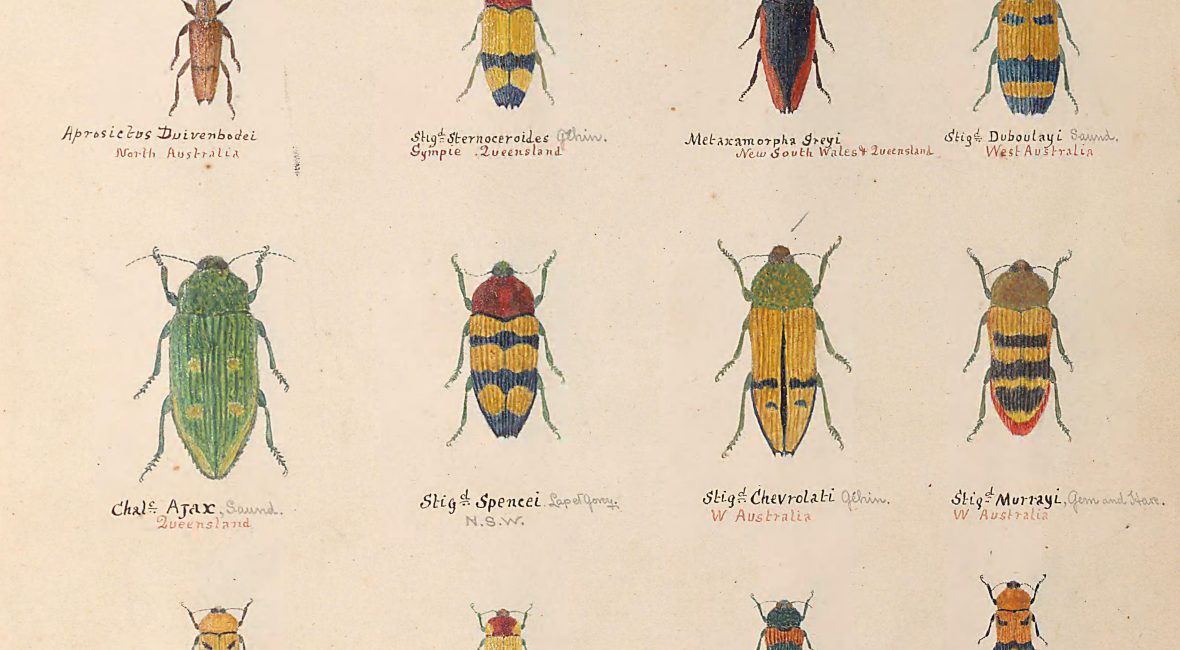
twelve colorful hand-drawn beetles

Seventh page of illustrations in volume one of a hand-painted volume of Coleoptera illustrated by Francis du Boulay, c.1880 – 1890 / Collection: OLDERSYSTEM~03048, Museums Victoria Archives / Source: Biodiversity Heritage Library.

Earlier this year Dr. Simon Leslie, Francis Houssemayne du Boulay’s great-grandson, contacted Melbourne Museum about accessing du Boulay’s hand-painted Coleoptera volumes, held in the Museums Victoria Archives. Dr. Leslie and family accessed the physical volumes in February 2020. While I carefully supervised flipping through the pages of these volumes, I was intrigued by their aesthetic, and scientific and historic, value. Since then, the volumes have been digitised by Biodiversity Heritage Library (BHL) Australia.

black and white portrait of a person with a short beard.

Portrait of Francis Houssemayne du Boulay, n.d. / Photographer: J. Fisher / Source: Accession number 2009.75, National Portrait Gallery, Australia.

Francis Houssemayne du Boulay was born in Sandgate, Kent, on 24 January 1837. As a young man in his early 20s, he migrated to Perth (c.1858). A scientist, entomologist, natural history artist, and Coleoptera (beetle) collector, du Boulay began to collect specimens in locations around Western Australia, Queensland, New South Wales, Victoria, and other parts of Australia. He settled in Beechworth, Victoria, where he lived out the rest of his life; du Boulay passed away on 12 January 1914.

In volume one of du Boulay’s hand-painted Coleoptera volumes, inside the front cover, is a handwritten inscription in ink, “F. H. Du Boulay 1880”. Du Boulay commenced work on the volume in 1880; however, it is likely that the work continued for several years. The cover also features a note handwritten in pencil, “Names in lead pencil inserted by H. M. Giles W. Australia (Du Boulay)”. Annotations inscribed in pencil are corrections by Henry Murray Giles, who assisted du Boulay in identifying scientific names of specimens. Giles worked as a Resident Keeper (1898) and later Head Keeper (1909 – 1910) at the Zoological Gardens, South Perth, Western Australia. Giles wrote an article in the Western Australian Year-Book for 1900-01 entitled “A Glimpse of Western Australian Entomology” (see pp. 285-297).

A total of 179 Coleoptera specimens are illustrated in volume one. Locations are noted where the specimens occur; however, the locations often only indicate the state where they were collected, for example New South Wales, Victoria, Queensland, Western Australia, South Australia; or a town or city, for example Cape York, Cardwell, Rockhampton, Brisbane. Some specimens identify the sex. It would be interesting to note if the colours used are scientifically accurate. Are the specimens drawn to scale? This would require the physical volume and specimens for comparison.

On the back of the volume is a sketch, in pencil, of a childlike illustration of a man, which is accompanied by an inscription, “W. Du Boulay”. This is an illustration of Francis du Boulay’s brother William, who was a fellow naturalist and collector. The yellow cover of the volume inscribed “DRAWING BOOK E. R. COLE BOOKSELLER AND STATIONER, SYDNEY” is well used, worn and has many inkblots. It has evidence of accompanying du Boulay in the field on his collecting trips around Australia.

Volume two is also well worn with inkblots on the cover. It has a leather-bound spine and leather corners protect the cover; otherwise the volume has no distinguishing features or title page. As in volume one, the specimen illustrations are printed, then hand coloured. Not all of the specimens are identified with their scientific names. The illustrations appear to be to scale. Specimens are illustrated from a dorsal perspective. Locations of where the specimens were collected are sometimes documented. Again as in volume one, the location is only noted from which state, for example, Queensland, Western Australia, Northern Territory, South Australia, New South Wales; or towns, cities, waterways or mountain ranges, for example Blue Mountains, Richmond River, Ropes Creek, Thompson River, Cairns, Coopers Creek, Cape York, Cooktown, Princess Charlotte Bay, Cleveland Bay, Port Mackay. The sex of the specimen is also sometimes identified.

six hand-drawn butterfly illustrations

Twelfth page of illustrations in volume two of a hand-painted volume of Coleoptera illustrated by Francis du Boulay, c.1880 – 1890 / Collection: OLDERSYSTEM~03048, Museums Victoria Archives / Source: Biodiversity Heritage Library.

While carefully presenting these volumes to Dr. Leslie, we were both surprised to come across several pages in the second volume containing beautiful Lepidoptera illustrations. Twenty-one Lepidoptera specimens are beautifully illustrated, but unfortunately do not include their scientific names or the locations where they were collected. Simon Hinkley, Collection Manager in Entomology at Museums Victoria, noted that the “Lepidoptera illustrated are detailed enough for identification purposes, for instance, the bottom left corner [see above] is a Caper White and the bottom middle specimen is a Spotted Jezebel.”

rough black ink line drawing of beetles

Fifteenth page, loose rough sketch and inscription by Professor Frederick McCoy, first director of the National Museum of Victoria, interleafed in volume two of a hand-painted volume of Coleoptera illustrated by Francis du Boulay, c.1880 – 1890 / Collection: OLDERSYSTEM~03048, Museums Victoria Archives / Source: Biodiversity Heritage Library.

Dr. Thomas Darragh, Curator Emeritus at Museums Victoria, identified the loose sheet of paper interleafed in volume two, see above, as Professor Frederick McCoy’s handwriting. McCoy was the first director of the National Museum of Victoria, predecessor of Museums Victoria (1854 – 1899). While not an entomologist, he was a paleontologist, geologist, zoologist, academic and keen collector for the National Museum of Victoria, and he was clearly interested in this volume, enough to incorporate a rough sketch of a “Phaneroptera (Serv)”. Simon Hinkley noted the Phaneroptera is an old genus name of katydids in the subfamily Phaneropterinae and was described by Jean Guillaume Audinet-Serville in 1831.

Volume two includes a loose letter with illustrations of beetles from “Mr. Span, Rooke’s Farm, West Drayton, Middlesex”. The letter includes illustrations of two specimens from North Queensland—one from New South Wales and one from the “Interior of Continent.” An inscription below the address on the letter, written in pencil, “Compared with British Mus. Specimens by Mr Span for Mr Du Boulay”, notes that specimens held by the British Museum have been compared with specimens collected by du Boulay. A few pages following the loose letter is a specimen that has been hand-drawn from the dorsal and cross section with inscription “Schizorhina Mnizechii Larry” (an unpublished name), and beside this is an inscription, “Drawings by Mr Span from originals in Brit. Museum”.

Some of the specimen illustrations in volume two include cross-sections of the heads and magnified studies of the legs. Volume two has a total of 220 Coleoptera and 21 Lepidoptera illustrations, compared to a total of 179 Coleoptera specimens illustrated in volume one.

The National Museum of Victoria purchased several Coleoptera specimens from Francis du Boulay and his brother William (1880-1912), such as the beautiful Castiarina erasma (Carter, 1935), Dilochrosis atripennis (Macleay, 1863), and Castiarina balteata (Saunders, 1869).

Du Boulay’s Coleoptera volumes are significant documents of historical collecting with important scientific information for contemporary scientists. Now that the volumes are available on the BHL website, scientists can benefit from the historical and scientific data on Coleoptera collected by Francis du Boulay from locations across Australia in the late nineteenth century.

September 24, 2020by Joel Richard
BHL News, Blog Reel

BHL Australia Turns 10!

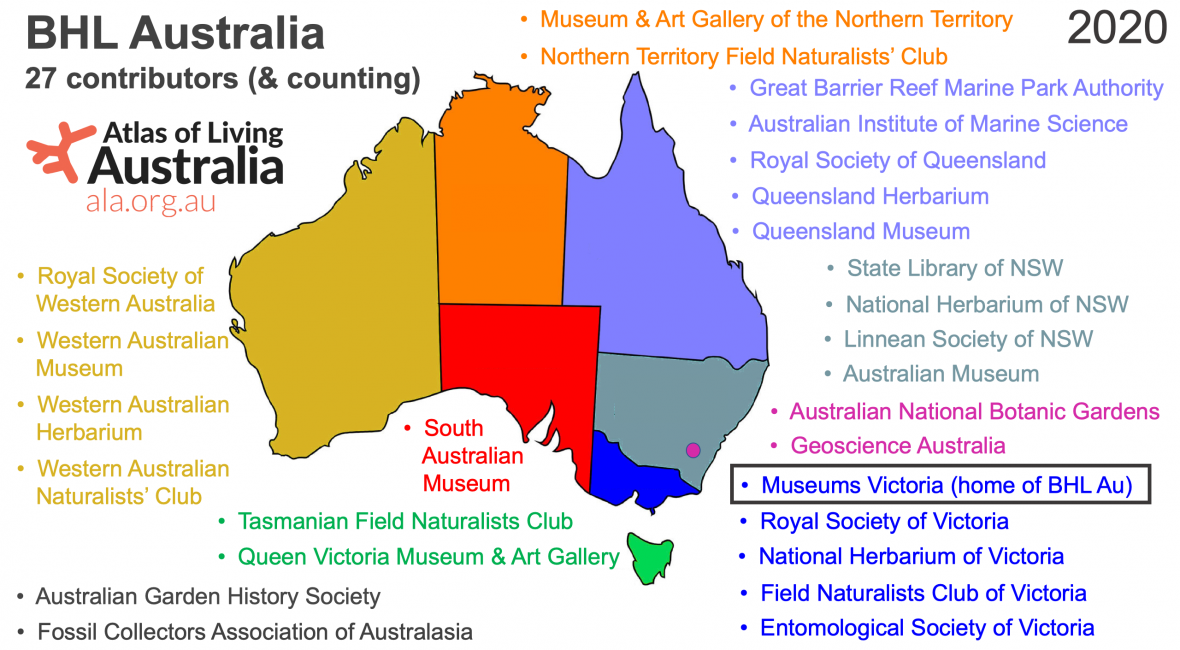
map of australia with BHL Australia contributors highlighted

Ten years ago in June 2010, the Atlas of Living Australia and Museums Victoria signed an agreement with the Biodiversity Heritage Library – and BHL Australia was born.

Signing of BHL agreement.jpg

Dr. Mark Lonsdale (left), the then Chief of the Commonwealth Scientific and Industrial Research Organisation’s (CSIRO’s) Entomology Division, and Martin Kalfatovic (right), BHL Program Director, signing the Relationship Agreement between the Atlas of Living Australia, Museums Victoria and BHL. Image sourced from Martin Kalfatovic.

BHL Australia’s mission is to make Australia’s biodiversity literature freely accessible and discoverable. Ten years ago, we started with a single contributing organisation, Museums Victoria, and a team of five incredibly dedicated volunteers.

Over the past 10 years, BHL Australia has grown considerably. Our operation is still hosted by Museums Victoria (at the Melbourne Museum), but we now digitise literature (and ingest born-digital material) on behalf of 27 organisations across the country.

map of australia with BHL Australia contributors highlighted

We are now a truly national project, representing Australia’s state and territory museums, herbaria, royal societies and field naturalists clubs, as well as government agencies and natural history publishers. Together these organisations have contributed more than 350,000 pages from over 2,400 volumes.

Ely with scanner.jpg

Dr. Elycia Wallis, Project Lead for BHL Australia at the Atlas of Living Australia, with our Zeutschel 16000 Book Scanner, purchased in 2017. Photo Credit: Nicole Kearney.

These volumes include treasures such as George Shaw’s The Naturalist’s Miscellany (1789-1813), Helena Forde and Harriet Scott’s Australian lepidoptera and their transformations, drawn from the life (1890-1898) and John Gould’s A synopsis of the birds of Australia, and the adjacent Islands (1837).

BHL Australia has also uploaded an extensive list of journals onto BHL (they may not be as pretty, but they’re just as important). To peruse all 2,400+ volumes, see our full BHL Australia Collection.

Shaw's Platypus resized.jpg

The Naturalist’s Miscellany includes the first published scientific description and illustration of the Duck-billed Platypus (Ornithorhynchus anatinus). Shaw, George. The Naturalist’s Miscellany. Volume 10. 1799. Contributed to  BHL by Museums Victoria. DOI: https://doi.org/10.5962/p.304567. 

Our volunteer team has also grown since 2010; BHL Australia now has 15 amazing volunteers who do the majority of our scanning, cropping, image processing and metadata addition work, as well as three science communication volunteers. (You may have seen their hugely successful takeover of the BHL Instagram account during #BirdWeek last year.)

Tiziana cropped.PNG

BHL Australia volunteer, Tiziana Tizian, cropping page images in preparation for upload onto BHL. Photo Credit: Nicole Kearney.

Of course, like so many other digitisation operations around the globe, BHL Australia is now in lockdown (and has been since mid-March). But out of adversity comes opportunity. While in lockdown, we’ve switched our focus from physical to born-digital material. We’ve welcomed new contributors and have uploaded journal volumes published as recently as 2020. We’ve also started a major project (in collaboration with BHL superuser Rod Page) to upload article metadata for every Australian journal on BHL (we’re pretty obsessed with discoverability).

Records of WAM.png

The Records of the Western Australian Museum is now complete on BHL from 1910 to 2019 as a result of our efforts (during our COVID-19 lockdown) to upload born-digital material from Australia’s journals.

And, like so many others, we’ve also had to postpone our celebrations. We had planned to invite all our Australian contributors and volunteers to a big BHL birthday bash. That’s on hold for now, but in the meantime, here are our BHL staff — Cerise, Chris, Veronica and myself — waving our thanks to all those who support BHL Australia. To our volunteers, our contributors, the Atlas of Living Australia and our BHL community around the world — thank you for a wonderful 10 years!

BHL staff waving for volunteers

The BHL Australia team: Manager Nicole Kearney (top right); Digitisation Coordinators Veronica Scholes (top left) and Cerise Howard (bottom right); and Technician Chris Healey (bottom left).

June 30, 2020by Joel Richard
Blog Reel, Featured Books

An Annotated Copy of Butterflies of Australia by Waterhouse and Lyell (1914)

Published in 1914, Butterflies of Australia by Gustavus Athol Waterhouse and George Lyell was the first comprehensive work on Australian butterflies to appear in Western scientific literature. It is a thick and rather chunky volume, with descriptions of 332 butterfly species, and was the product of many years of research. The copy held in Museums Victoria’s Rare Book Collection is even thicker than a standard issue, as it is bound with lined pages interleaved throughout. It is an author’s copy, owned and annotated by George Lyell.

1. Inscription Lyell.jpg

Title page of annotated author’s copy of Butterflies of Australia (1914.) Contributed in BHL by Museums Victoria.

Lyell and Waterhouse worked on the book separated by some distance; Lyell’s location in Gisborne, Victoria was 862km (536 miles) away from Waterhouse’s residence in Sydney. They corresponded regularly via mail, and the Museums Victoria Archives now houses some 400 of Lyell’s letters from Waterhouse, which came to the museum with Lyell’s extensive donation of butterflies and moths in 1932. In 2019 a McCoy Seed Fund project enabled further exploration of the archival material to see what it could reveal about the scientists’ collaboration and Lyell’s collection. It also shed some light on the annotated copy in our collection.

The archival material reveals that their publisher, Angus & Robertson, prepared the handsome interleaved copy for Lyell and gave it to Waterhouse to pass on. In a letter dated 28 August 1914 Waterhouse writes “I have the interleaved copy for you, but it is much too bulky & too nicely done to trust to the post” (OLDERSYSTEM~03030, Museums Victoria Archives). Instead Waterhouse entrusted the volume to friend E. H. Proctor to give to Lyell’s brother in Melbourne.

Letter to Lyell.jpg

Letter to George Lyell from his co-author and friend G. A. Waterhouse. Photo Credit: Hayley Webster / Source: Museums Victoria.

Their correspondence also demonstrates how carefully they considered every aspect of the publication. For instance, a letter to Lyell on 20 March 1914 states “I like very much the black headings as they seem to show the divisions at a glance & generally speaking I like the size of the type” (OLDERSYSTEM~03030, Museums Victoria Archives), showing that the typography was carefully considered for readability. Waterhouse was pleased with the plates, writing on 4 Feb 1914 “Dear Lyell, Coloured plate no. 1 is glorious, magnificent drawings, just showed it to [Allan Riverstone] McCulloch who was delighted with it” (OLDERSYSTEM~03030, Museums Victoria Archives).

The illustrations are a combination of original drawings and photographic reproductions: original coloured plates by H. W. Simmonds, drawings of larvae and pupae by Miss J. Kong Sing, and the remaining are from photographs by Henry King. Butterflies of Australia includes 43 plates, and a total of 888 illustrations; its considerable scope and detail was considered very helpful by scientists and collectors when the book was published.

As Museums Victoria Archivist Nik McGrath recounts, Waterhouse destroyed his letters after entering the relevant scientific data onto index cards. While this might seem like a curiously destructive working method, it is not unheard of; researchers working with Charles Darwin’s correspondence have noted that he crossed out personal matters in his letters so he would not be distracted if he needed to return to them for scientific purposes [1]. In this case, in spite of the loss of Lyell’s letters, we retain a lot of the archival material relating to the book including a manuscript, index cards from Waterhouse, notebooks, proofs, black and white photographs of specimens used by illustrators for the book, specimen lists, and newspaper clippings of book reviews.

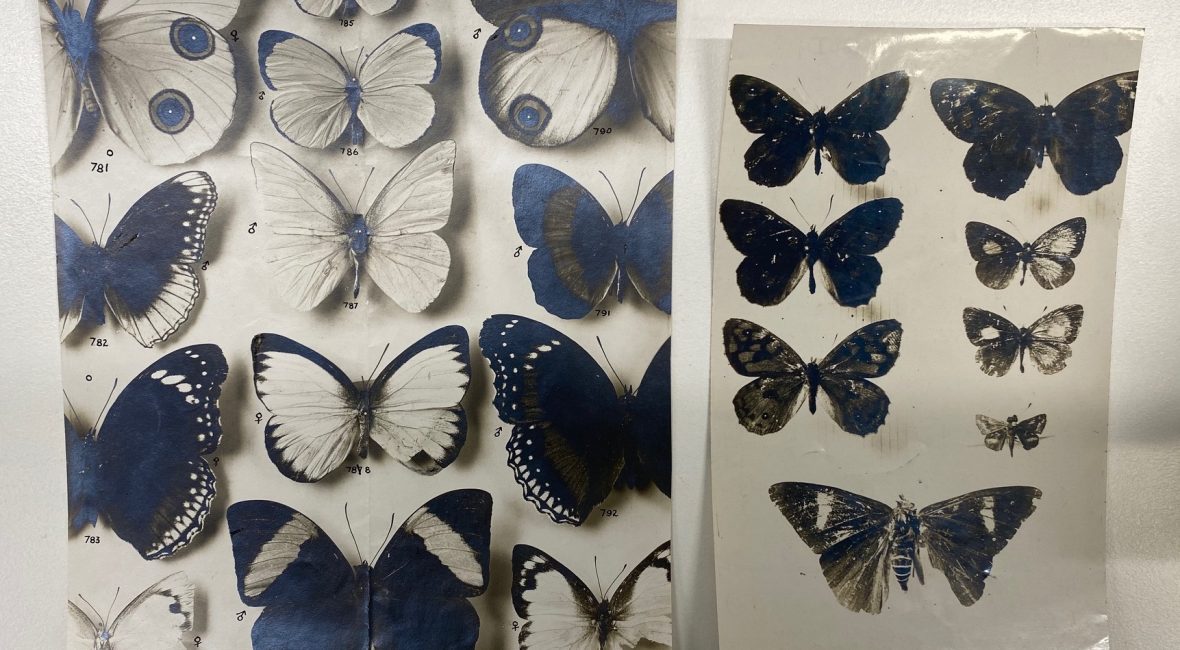
Butterfly photos.jpg

Along with many others, these photographs of butterflies were used to develop the illustrations for Butterflies of Australia. Photo Credit: Hayley Webster / Source: Museums Victoria.

In addition to looking at the archival material, an examination of the book itself is also revealing. Annotations are dated throughout the 1910s and 1920s and most appear to record sightings. In the introduction to the work, Waterhouse and Lyell note of the geographical focus of their study: “We are hoping this work will serve to indicate the need and point to that direction, and so induce collectors to aid us: we are carefully tabulating every verified record reaching us, and will much appreciate dated specimens for examination and return, especially those from points distant from localities given in our list.”

Lyell is systematic in his approach to annotations, including roughly the same information and formatting for each entry. The marginalia primarily consists of locations added to specimen descriptions, often dated, and sometimes includes a number, gender, and occasionally an elevation.

elevation crop.jpg

The initials GAW frequently appear throughout, and refer to Lyell’s co-author Gustavus Athol Waterhouse. Here Lyell notes that the species is “very plentiful at 5000ft diminishing to 4500 none lower, only few at 6000ft”. Annotated copy of Butterflies of Australia. Contributed in BHL by Museums Victoria.

There are also often initials entered next to the information, which relate to the person collecting the data, as you can see in the example above.

The annotations use a similar approach from the beginning to end of the text; Lyell underlines the printed text in pen, circling the relevant figure numbers, and then notes the date, locations and other data on the interleaved pages.

This is a typical example of how Lyell annotated his copy of Butterflies of Australia, underlining the relevant information and then adding details to the opposite interleaved page. Contributed in BHL by Museums Victoria.

Though the method of data entry is reasonably consistent, there are noticeable changes in ink, indicating that Lyell completed the annotations across a period of time. It would appear that Lyell was copying across data from other sources such as his own field notes and correspondence from other scientists as he received it.

Lyell’s marginalia mainly seems to record observational data, but occasionally includes a reference to secondary reference material. One reference appears to have been copied in its entirety—this is Norman Tyndale’s description of Lycaeninae adaluma from the Transactions of the Royal Society of South Australia in 1922. Tyndale’s description references Waterhouse and Lyell’s work, and suggests a placement of the new species within their system. The placement suggested corresponds to where Lyell has copied in the description.

Revised description crop.jpg

The annotation replicates Tyndale’s description of Lycaeninae adaluma and includes a sketch of the species. Annotated copy of Butterflies of Australia. Contributed in BHL by Museums Victoria.

What exactly was Lyell doing with his annotations? It appears he was using the book to record ongoing research by himself and a group of naturalists across the east coast of Australia. H. J. Jackson notes in Romantic Readers that the practice of interleaving in books by scientists originated in earlier educational practices [2]. I have certainly come across other similar examples in the Museums Victoria Library. It is notable that Lyell’s annotations drop off after the early 1930s. He suffered an illness in 1931 that led to his decision to deposit his collection with the National Museum of Victoria. The rest of his life was dedicated to preparing his collection for transfer to the museum, and this seems to correlate to a decline in annotating.

References

  1. Gregorio, Mario A. & Gill, N. (1990) Charles Darwin’s Marginalia Vol. 1, New York, Garland, p. xiv.
  2. Jackson, H. J, (2005) Romantic Readers: the Evidence of Marginalia, New Haven & London, Yale University Press, p. 84.

Bibliography

Administration – George A. Lyell – Internal Correspondence 1891-1947- Waterhouse, G. A – Museums Victoria Archives, National Museum of Victoria OLDERSYSTEM~03030

Gregorio, Mario A. & Gill, N. (1990) Charles Darwin’s Marginalia Vol. 1, New York, Garland.

Jackson, H. J. (2005) Romantic Readers: the Evidence of Marginalia, New Haven & London, Yale University Press.

McGrath, Nik (2019) Kindred Spirits, Museums Victoria Blog, Retrieved from https://museumsvictoria.com.au/article/kindred-spirits/

McGrath, Nik (2019), Butterflies of the night, University of Melbourne Blog, Retrieved from https://blogs.unimelb.edu.au/insect-museum-collection/2019/01/30/butterflies-of-the-night/

February 27, 2020by Joel Richard
Page 1 of 51234»...Last »

Help Support BHL

BHL's existence depends on the financial support of its patrons. Help us keep this free resource alive!

search

About BHL

The Biodiversity Heritage Library (BHL) is the world’s largest open access digital library for biodiversity literature and archives. BHL operates as a worldwide consortium of natural history, botanical, research, and national libraries working together to digitize the natural history literature held in their collections and make it freely available for open access as part of a global “biodiversity community.”

Follow BHL

  • Bluesky logo
  • Instagram logo
  • Facebook logo
  • Flickr logo
  • Twitter logo

Join Our Mailing List

Sign up to receive the latest news, content highlights, and promotions.

Subscribe Now

Subscribe to Blog via Email

Enter your email address to subscribe to this blog and receive notifications of new posts by email.

Join 319 other subscribers

Subscribe to Blog Via RSS

Subscribe to the blog RSS feed to stay up-to-date on all the latest BHL posts.

Access RSS Feed


64+ Million Pages of
Biodiversity Literature Online.

EXPLORE

Tools and Services
to Transform Research.

EXPLORE

300,000+
Illustrations on Flickr.

EXPLORE

ABOUT | HARMFUL CONTENT | PRIVACY | SITE MAP | TERMS OF USE