Biodiversity Heritage Library - Program news and collection highlights from BHL
  • Home
  • News
  • Featured Books
    • All Featured Books
    • Book of the Month Series
    • BHL at 20
  • User Stories
  • Campaigns
    • Fossil Stories
    • Garden Stories
    • Monsters Are Real
    • Page Frights
    • Her Natural History
    • Earth Optimism 2020
  • Tech Blog
  • Visit BHL
Home
News
Featured Books
    All Featured Books
    Book of the Month Series
    BHL at 20
User Stories
Campaigns
    Fossil Stories
    Garden Stories
    Monsters Are Real
    Page Frights
    Her Natural History
    Earth Optimism 2020
Tech Blog
Visit BHL
  • Home
  • News
  • Featured Books
    • All Featured Books
    • Book of the Month Series
    • BHL at 20
  • User Stories
  • Campaigns
    • Fossil Stories
    • Garden Stories
    • Monsters Are Real
    • Page Frights
    • Her Natural History
    • Earth Optimism 2020
  • Tech Blog
  • Visit BHL
Biodiversity Heritage Library - Program news and collection highlights from BHL
Blog Reel, Featured Books

The Life and Work of Robert Alexander Gilbert: Empowering New Insights through Digitization and Transcription of Archival Materials

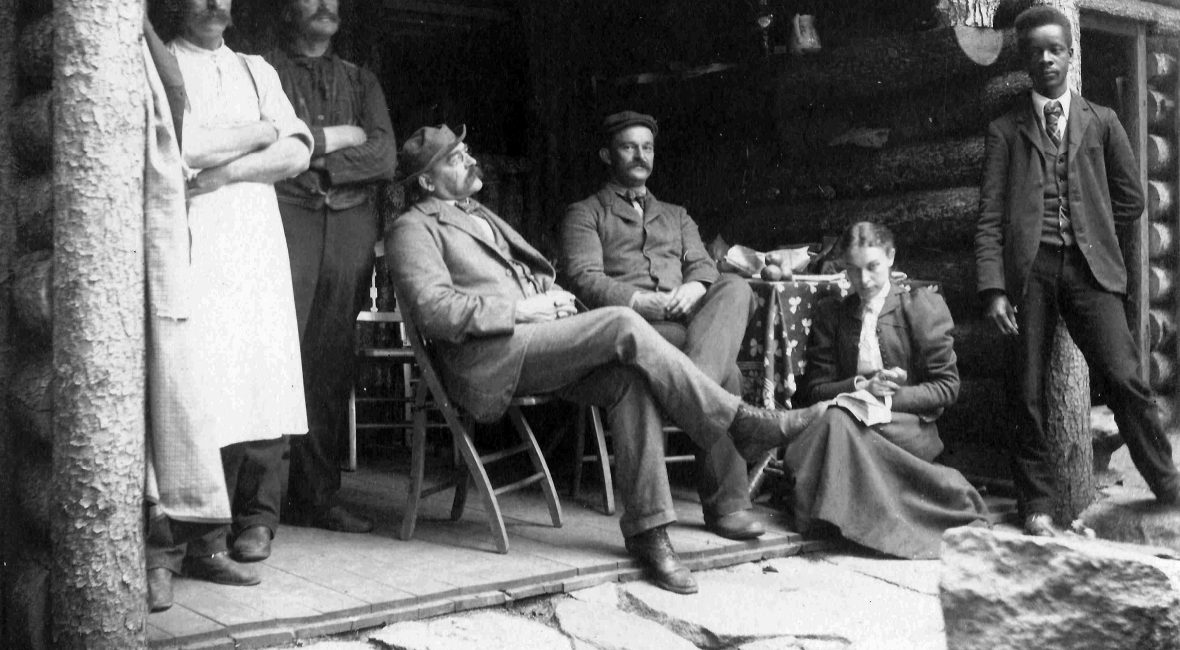
Black and white photo of a group of people standing on the porch of a log cabin.

This post is part of a series from the Ernst Mayr Library exploring the digitization and transcription of ornithologist William Brewster’s archival materials and the insights and scholarship made possible thanks to this work.
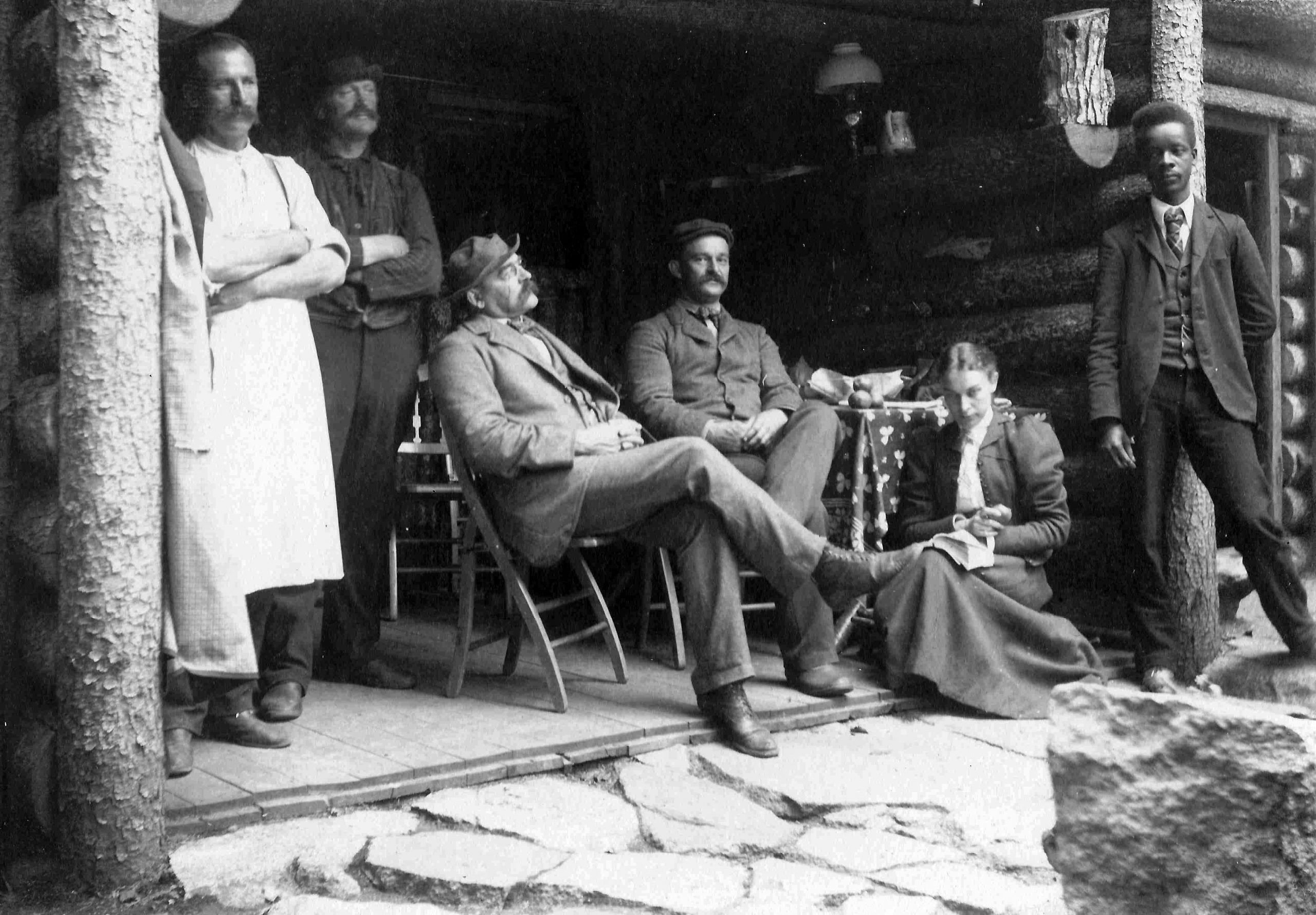
Black and white photo of a group of people standing on the porch of a log cabin.

Robert A. Gilbert, far right, at William Brewster’s cabin at Pine Point, Umbagog Lake, Maine. From the collection of the Museum of American Bird Art, Massachusetts Audubon Society and reproduced with their permission.

Robert Alexander Gilbert (1870-1942) was a Black photographer interested in ornithology and chemistry who worked for ornithologist William Brewster from the mid 1890s until Brewster’s death in 1919 and at various tasks around the Museum of Comparative Zoology (MCZ) at Harvard University beyond 1919. He was an Associate of the American Ornithologists’ Union.

Gilbert was not officially recognized for his photographic work with William Brewster, although Brewster did not claim credit for all the images in his collection. It was assumed that Brewster took all the photographic prints bequeathed to the Ernst Mayr Library and Archives of the MCZ (EMLA) upon his death. However, while conducting research for a book, author John Hanson Mitchell, former editor of the Massachusetts Audubon Society’s (MAS) Sanctuary magazine, discovered over 2000 of Brewster’s glass plate negatives in the attic of a building owned by the MAS. One of the images in particular, a photograph of a young, well-attired Black man standing in front of a rustic cabin in the wilderness, captured his interest. Mitchell was curious as to the identity of this young man. Later, in the mid-1970s, Mitchell had a chance encounter with an Archives Assistant at the MCZ who suggested to him that all of Brewster’s photographs were, in fact, taken by Brewster’s assistant, a young Black man named Robert Gilbert. This piqued Mitchell’s interest and launched his journey to discover more about Gilbert.[1] The quest culminated with the publication in 2005 of Mitchell’s Looking for Mr. Gilbert: the Reimagined Life of an African American. In 2014 an e-book edition was published as well.

Mitchell’s publication helps provide new insight into Robert Gilbert’s life and work. Brewster’s journals and diaries, now digitally available on the Biodiversity Heritage Library (BHL), are also valuable records attesting to Gilbert’s contributions in a variety of areas. While only a handful of Brewster’s photographs in the MCZ collection can be positively attributed to Gilbert, it is clear that Gilbert was with Brewster for photo sessions during the years they worked together. The photographic relationship between Brewster and Gilbert is intriguing. There is new enthusiasm to examine Brewster’s journals and diaries more closely now that they are digitized and being transcribed, to clarify Gilbert’s role in photographic collaboration with Brewster. As a result of identifying connections between the collections in the Museum of American Bird Art at the Massachusetts Audubon Society and the EMLA, a cooperative research project is underway.

Robert Gilbert was born and raised in the rural town of Natural Bridge, Virginia, in the valley of Broad Creek. In 1886, at the age of 16, he moved to Boston, Massachusetts where he would reside for the remainder of his life. Gilbert had an assortment of odd jobs during his first ten years in Boston, including working as a laboratory assistant for Dr. Arthur P. Chadbourne of Harvard Medical School, an amateur ornithologist and acquaintance of William Brewster. The records are unclear as to the actual year, but sometime between 1895 and 1897, work in Chadbourne’s lab slowed down and he recommended Gilbert to Brewster, who was in need of a temporary assistant to help him set up his personal bird museum. Gilbert met with Brewster, who showed him his extensive specimen collection and the tasks at hand, and for the next ten weeks Gilbert helped Brewster establish his new museum on the grounds of his home in Cambridge, MA. Afterward, Gilbert returned to working for Dr. Chadbourne, but shortly thereafter the laboratory experiments were completed whereupon Brewster hired Gilbert as his full-time assistant.[2] Brewster’s first mention of Gilbert in his journals is in his entry for March 31, 1897.
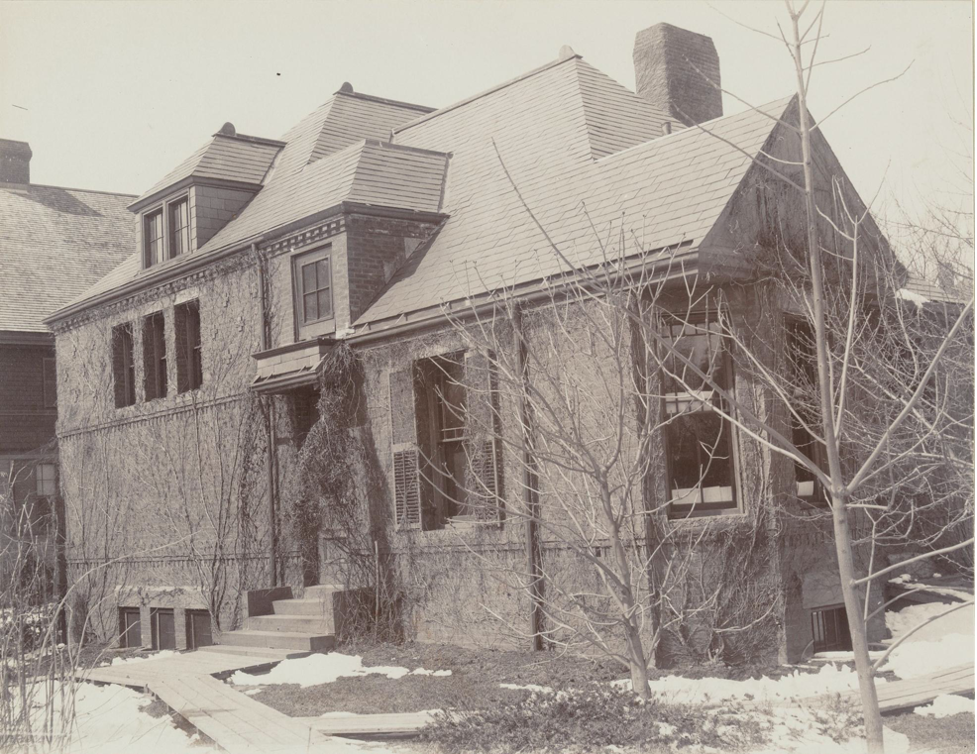
Black and white photograph of a brick house.

Brewster’s museum on the grounds of his home in Cambridge, MA. From the collection of the Ernst Mayr Library of the Museum of Comparative Zoology, Harvard University. Call number bBr 97.70.12.19.

It is clear from Brewster’s diaries and journals that the tasks performed by Gilbert in Brewster’s employ were many and varied. Glover M. Allen, Curator of Mammals at the MCZ, described Gilbert as “Mr. Brewster’s trusted assistant, looking after innumerable details at his museum or his camp, doing everything from photographic work to preparing and serving meals, and always with a quiet dignity and devotion that never for a moment failed.”[3] Gilbert quickly became Brewster’s right-hand man as evidenced by the innumerable references to him from 1897 to 1919 in his diaries and journals. Here are a few examples:

Journal, June 8, 1897. As a field assistant, note Gilbert’s observational skills and attention to detail as he documents the behavior of a Whistler Duck for Brewster:

“Gilbert who had been to the boat for his breakfast came to relieve me and to keep guard while I had mine. It was arranged between us that if the Whistler began taking out her young while I was absent he would shout a few times to let me know of the fact. I had just finished breakfast when I heard this signal and jumping into the St. Lawrence skiff rowed as hard as I could pull for the nest but as soon as I came in sight of it I knew I was too late for Gilbert was standing up in his boat and paddling slowly towards the tree. Here is his account of what happened during my absence: At 6.45 the old Duck appeared at the entrance (the lower hole) to the nest where she sat for five minutes moving her head continually and looking about in every direction included within her field of vision; then she sank back out of sight reappearing at the end of a minute and looking about as before for another five minutes. At the end of this second period of observation she flew down to the water and swam around the stub three times clucking and calling. On completing the third round she stopped directly under the hole and gave a single loud call or cluck when the ducklings at once began scrambling up to the entrance from the nest and dropping down to the water falling on top of one another. In other words the brood literally poured out of the nest much as shot would fall from one’s hand. One or two hesitated or paused for an instant reaching the mouth of the hole but the greater number toppled out over the edge as soon as they appeared. All used their tiny wings freely beating them continuously as they descended. They did not seem to strike the water with much fear.”

Journal, November 5, 1897. Bird observations reported to Brewster: “Gilbert counted fourteen Chickadees in one flock on Ball’s Hill this morning. With them was a Downy, two Tree Sparrows & two Juncos. He also saw five Black Ducks passing over the meadows at evening.”

Journal, March 24, 1898. Work at Brewster’s cabin in Concord, MA: “Spent the forenoon clearing out the path behind the hill, Gilbert helping me.”

Diary, March 6, 1909. Photographic work: “Lizzy Fuller came over at 8 P.M. She with C. & E.R.S. [Caroline and Elizabeth R. Simmons] spent evening in Museum where I showed them about 100 lantern slides that Gilbert has just made.”

Diary, January 9, 1918. Work in Brewster’s museum: “Gilbert is now going through the collections in search of Anthrinae [Anthrenus] & other insect pests. Thus far he has found traces of them in the cans only.”

In the 1890s Brewster was earnestly transitioning from collecting bird specimens with his shotgun to field observation and photography. He had, in Robert Gilbert, an assistant knowledgeable in ornithology and capable with photography and photographic processing. It is unfortunate that in the Ernst Mayr Library collection of over 1,700 of Brewster’s photographic prints, only six have an inscription on the verso stating that the photograph was taken by Robert Gilbert. Below are two such photographs:
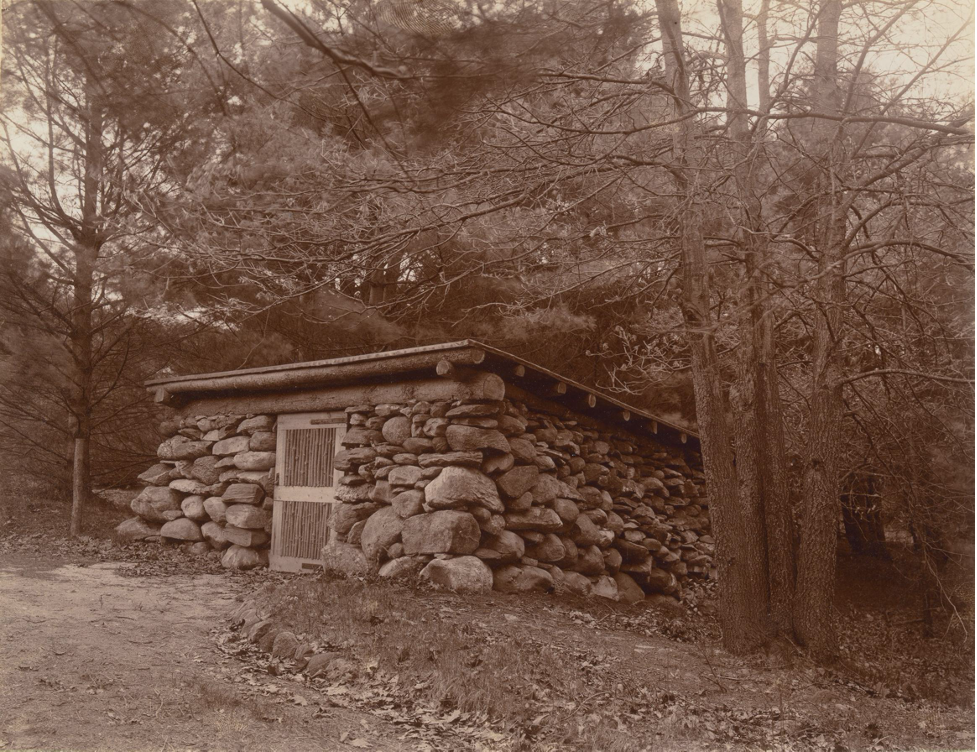
Black and white photograph of a stone wood-house in the woods.

From inscription on verso: “Wood-shed, Hemlock Grove, Concord, Mass., April 1904, taken by R.A. Gilbert.” From the collection of the Ernst Mayr Library of the Museum of Comparative Zoology, Harvard University. Call number bBr 97.70.7.23.
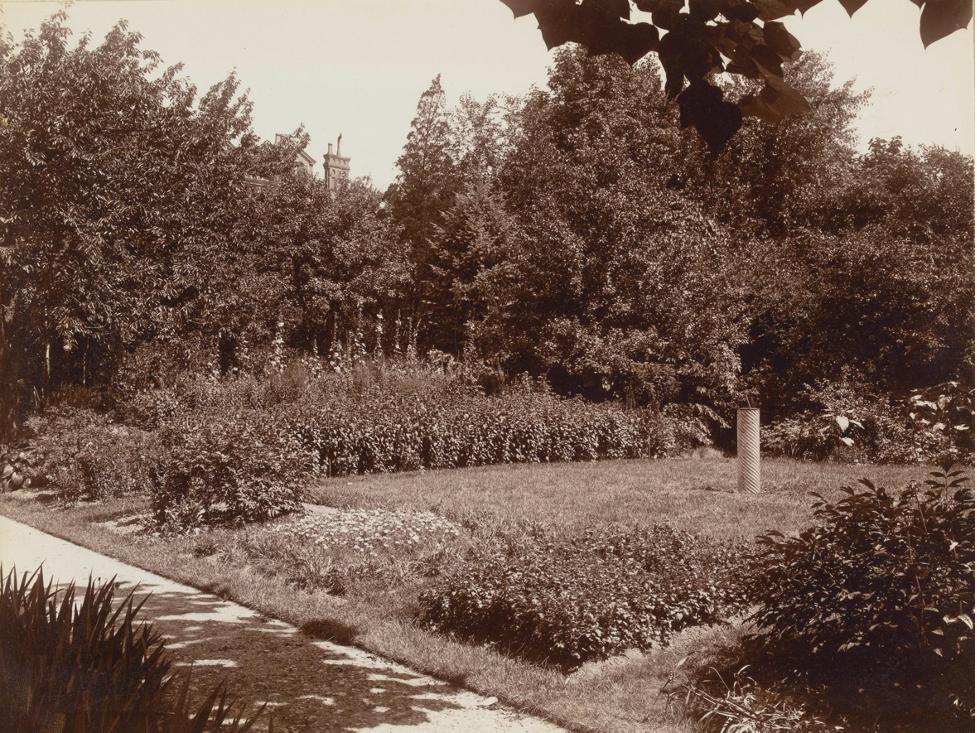
Black and white photograph of a garden.

Brewster’s garden. From inscription on verso: “Garden, Cambridge, Mass. July 30th 1904. Taken by R. A. Gilbert.” From the collection of the Ernst Mayr Library of the Museum of Comparative Zoology, Harvard University. Call number bBr 97.70.12.59.

It is possible that many other photographs were taken by Gilbert, but we don’t know for sure. There are a number of occasions recorded in Brewster’s writings where it is clear that Brewster himself was doing the photography. In his journal entry for May 18, 1897, for example, Brewster writes:

“I visited the Hermit’s nest in the Brown clearing taking five photographs of it. The [female] was on the nest and for a Hermit sat very closely allowing me to set up the camera & focus on her at a distance of about 4 ft. but gliding away just as I was about to expose a second plate. She would not return to her eggs, however, while the camera was in position although I waited for her nearly an hour.”

Whether or not Gilbert was taking the picture, it is clear that he played a major role assisting with various aspects of Brewster’s photography. Inscriptions on the verso of photographic prints reveal that Gilbert owned darkroom apparatus and copied glass plate negatives to make prints. In a journal entry dated May 29, 1897 Brewster writes: “In the forenoon I took several photographs (with Gilbert’s help) in the gulf at the head of Great Island and along the western shore of the Sweat Cove.” Though Brewster was taking the pictures, Gilbert was assisting in some fashion.

It is evident that Gilbert was an invaluable assistant and friend who greatly facilitated Brewster’s ornithological accomplishments. Gilbert remained in Brewster’s employ until the latter’s death in 1919. Brewster arranged for the MCZ to hire Gilbert upon his death, another attestation to Brewster’s high regard for him.

There is little on record describing Gilbert’s tasks at the MCZ, but the Annual Report of the Director sheds some light. In the Report of the Director for 1931/1932 Thomas Barbour writes: “Robert Gilbert, aided by several young men, has done excellent work in rearranging some of the exhibition halls.” In the 1933/1934 Annual Report Glover Allen writes in his Report on Mammals: “In the ever-present work of cleaning skulls and skeletal material French and Gilbert have latterly borne a helpful hand, developing some skill.” Were Gilbert doing similar tasks today, he would likely be given the title Curatorial Assistant in the MCZ. Barbour’s report intimates that, among many other skills, supervision and at least familiarity with exhibit design properly belong on Gilbert’s resume. No doubt, Gilbert’s work in Brewster’s museum prepared him well for his tasks in the MCZ.

Gilbert worked at the MCZ until his death in 1942. In his 1941/1942 Director’s report, Barbour provided the following tribute:

“On January 7, 1942 Robert A. Gilbert died. For years before he came to the Museum he had helped Mr. Brewster in many ways and his sterling personal characters of integrity, affection, courtesy, and loyalty made him not only a [sic] honor to his race but one who was proud to do everything which he did as well as he could do it, and who was beloved by us all.”

Robert Gilbert’s many talents as well as his passion, curiosity and integrity enriched Brewster’s life and pursuits. It is evident that he brought these same qualities to his work at the MCZ.

The Ernst Mayr Library is actively transcribing the digitized journals, diaries and correspondence of William Brewster, enabling full-text searching of these resources in the Biodiversity Heritage Library. It is our hope that this will facilitate digital scholarship and further interest in the life and work of Robert Gilbert. In the next blog post we will discuss this transcription work.
References

[1] Mitchell, John Hanson. 2005. Looking for Mr. Gilbert: The Reimagined Life of an African American. Washington, DC: Shoemaker.

[2] Mitchell, John Hanson. 2014 e-book edition. Looking for Mr. Gilbert: The Unlikely Life of the First African American Landscape Photographer. New York, New York : Open Road Distribution.

[3] Allen, Glover M. 1942. Obituaries. Robert A. Gilbert. The Auk 59.3: 467. JSTOR. Accessed on 25 January 2021. https://www.jstor.org/stable/4079251.

February 23, 2021by michelle.underhill
Blog Reel, Campaigns, Earth Optimism 2020, Featured Books

Nature Conservation and William Brewster: Insights From a Lifetime of Scientific Observations

This post is part of a series from the Ernst Mayr Library exploring the digitization and transcription of ornithologist William Brewster’s archival materials and the insights and scholarship made possible thanks to this work.

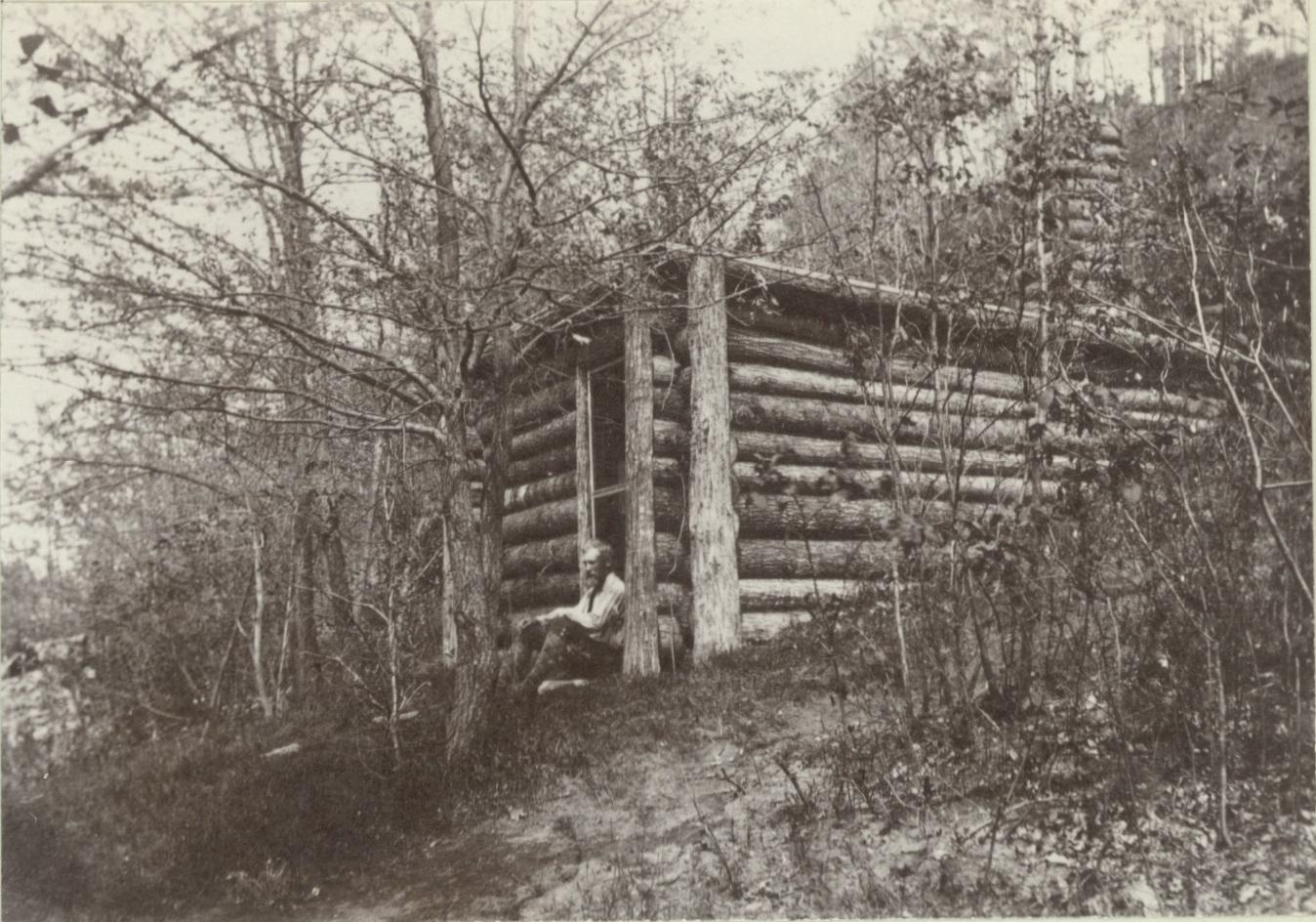
Black and white photo of a man sitting on the doorstep of a log cabin in the woods.

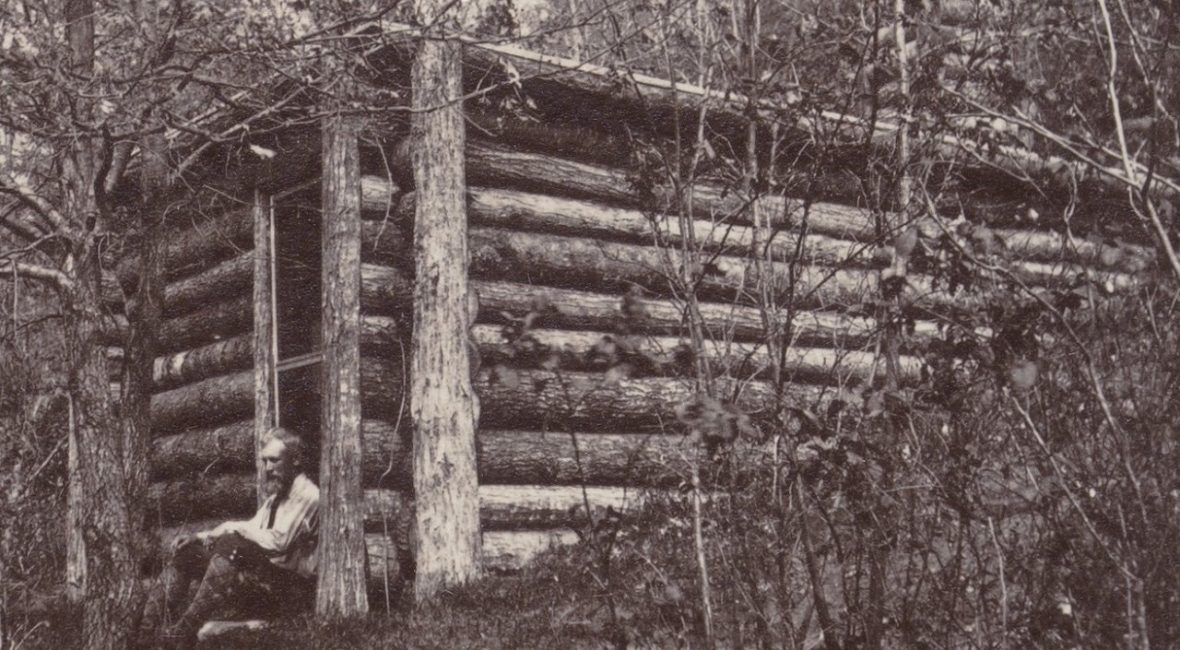
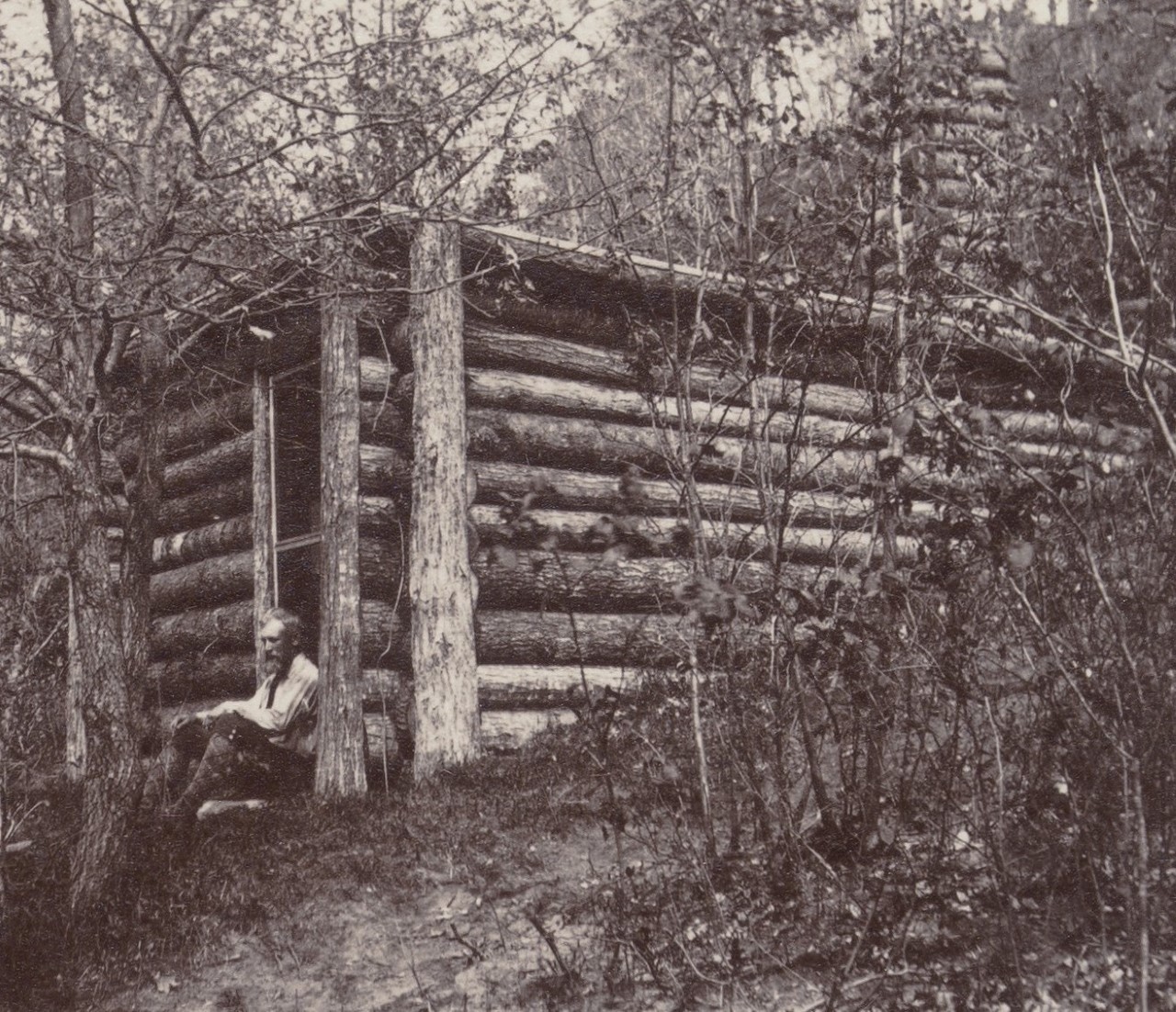
A black and white photograph of William Brewster sitting on the front doorstep of his cabin in Concord, Ma. The small, one-story log cabin is set in a hillside and surrounded by small trees and shrubs. The back of the photograph has the note: “Concord, Mass. May 20, 1892.” (Ernst Mayr Library Special Collections, call no. bBr97.70.7.)

The Ernst Mayr Library and Archives of the Museum of Comparative Zoology (MCZ), Harvard University, holds a unique and extensive collection of photographs, letters, manuscripts and field notes of William Brewster, a prominent ornithologist/naturalist of the late 19th and early 20th centuries. His published work is lauded as providing authoritative and novel additions to ornithology.

Brewster published more than 300 ornithological papers and several books which are widely available in academic and research libraries. He was the first president of the Massachusetts Audubon Society and was a founding member of the Nuttall Ornithological Club, out of which grew the national organization, the American Ornithologists’ Union. Brewster served as President of the American Ornithologists’ Union from 1895 to 1898, and the organization has awarded a medal in Brewster’s name since 1921.

Brewster’s ornithological studies covered the United States, although he worked most extensively in New England. Brewster was a Curator of Ornithology in the Harvard University Museum of Comparative Zoology from 1885 to 1902, continuing to work in the MCZ until his death in 1919. He deposited his bird specimen collection in the MCZ and his associated works such as his journals, diaries, correspondence and some photographic works in the Ernst Mayr Library & MCZ Archives. Brewster’s extensive specimen collection, in combination with his large body of published work, secures his place in ornithological history.

In 2012, the Ernst Mayr Library began digitizing Brewster’s journals, diaries, letters, and photographic prints. Many have been digitized as part of the CLIR-funded BHL Field Notes Project. To date, virtually all of Brewster’s more than 60,000 pages of notes, correspondence and images have been digitized and nearly 10,000 pages of the handwritten notes and diaries have been transcribed. All materials are in the process of being deposited in the Biodiversity Heritage Library, with more than half of the collection, including all of the journals and diaries, now available. The materials have been collated into the William Brewster Papers Collection.

Brewster kept journals and diaries, mostly devoted to his birding activities, for 54 years from the time he was 14 until he died in 1919. These written records afford us a glimpse into the daily inner workings of this scientist’s mind. The Ernst Mayr Library is fortunate to have his full set of journals and diaries, most of his correspondence and some of his photographs and glass negatives. This is indeed a treasure trove of information, now made more accessible as it is digitized and made openly available in BHL. This collection is more than a record of changing landscapes, bird lists, temperature and weather recorded for each day of writing. It shows us how Brewster developed his ideas, how he thought about the world, and how his thinking changed through his life. In his later correspondence with Frank Chapman (a then-young ornithologist that Brewster mentored into a more mature career), they debated about and revised how to do science with less killing of birds.

handwritten page from a field notebook.

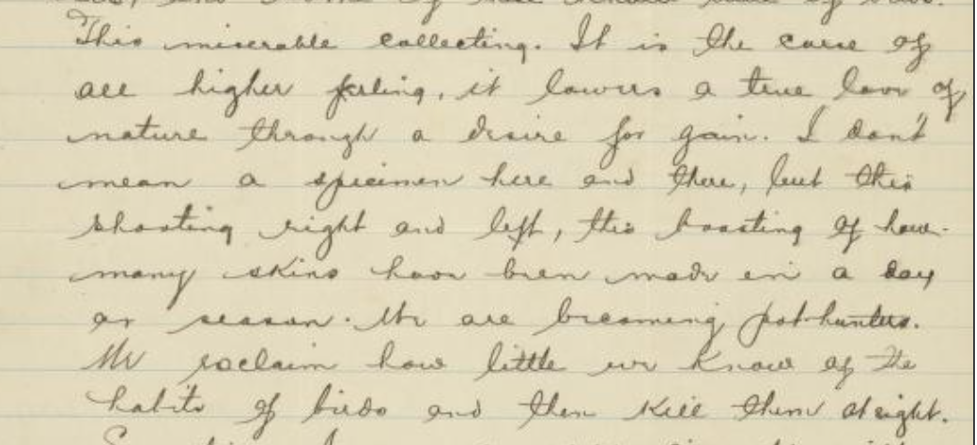
Excerpt of a letter from Frank Michler Chapman to William Brewster. 15 June 1890. Contributed in BHL from the Harvard University, Museum of Comparative Zoology, Ernst Mayr Library.

“This miserable collecting. It is the cause of all higher failing, it lowers a true love of nature through a desire for gain. I don’t mean a specimen here and there, but this shooting right and left, this boasting of how many skins have been made in a day or season. We are becoming pot-hunters. We proclaim how little we know of the habits of birds and then kill them at sight. Sometimes I am completely disgusted with our ways and myself in particular… I long for an outing where the gun will be secondary, recorded observations primary, where I shall be entirely alone or with a companion whose object is my object … The question with me is, how am I going to change this?… Will you embark with me on a novel ornithological expedition, whose aim shall be to really observe birds to learn something of them. Where the gun shall be a servant, not a master, where days may pass without a skin being made, where there will be time to speculate and discuss the habits of birds observed, where systematic observation of certain phaenomena may be attempted.” 15 June 1890, Correspondence, Frank Michler Chapman to William Brewster.

Brewster’s detailed, long-term observations and notes are the key to his published contributions to ornithology and are a unique resource. His diaries, journals and correspondence are a gold mine of unpublished observations, journal notes, sketches, weather reports, specimen lists and travel narratives: these records are primary source data at its most raw and unevaluated. Historical collections of field notes may be the only documentation of a scientist’s thought processes, ideas and observations, particularly if only some of the writer’s material was ever published.

Brewster documented local environmental changes and gradual declines in number and presence of bird species over many years. He was concerned about vanishing wildlife, urbanization and landscape changes. He talked about ecological succession before the concept was officially published.

handwritten page from a field notebook.

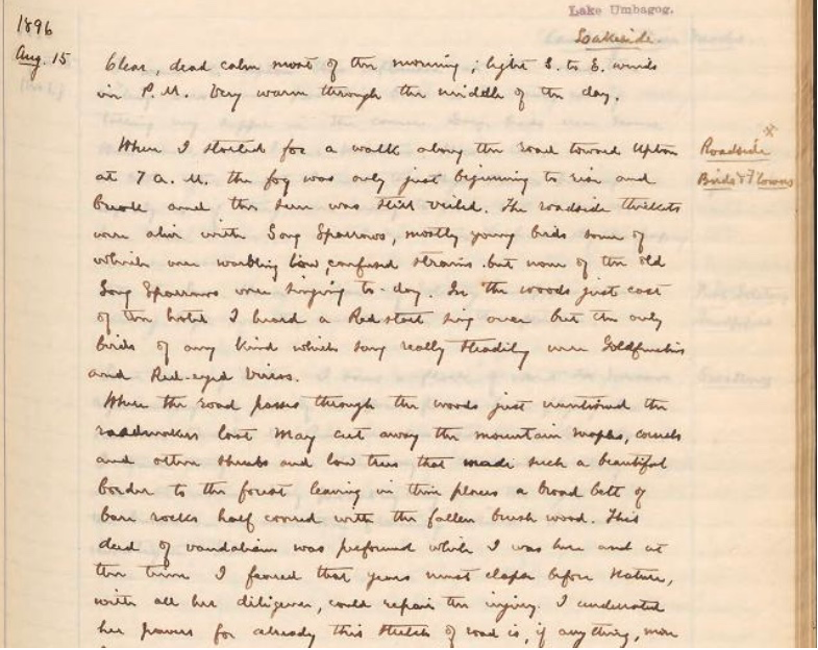
Excerpt of a page from William Brewster’s 1896 journal, in which he documents the impact of roadwork on local wildlife. Contributed in BHL from the Harvard University, Museum of Comparative Zoology, Ernst Mayr Library.

“Where the road passes through the woods … the roadworkers last May cut away the mountain maples, [cornels] and other shrubs and low trees that made such a beautiful border to the forest clearing in their places a broad belt of bare rocks half covered with the fallen brush wood. This deed of vandalism was performed while I was here and at the time I feared that years must elapse before Nature, with all her diligence, could repair the injury. I underrated her powers for already this thicket of road is, if anything, more beautiful than ever. Fire weed, Eupatorium, Impatiens, Asters, Golden rod and several other tall and rank flowering plants have shot up through and almost perfectly concealed the unsightly brush and stone heaps and I have rarely seen a more brilliant or attractive display of wild flowers.” 15 August 1896, Lake Umbagog, Maine, Journals of William Brewster

Brewster helped develop legislation to discourage excessive hunting and the use of feathers in women’s hats, although at the same time advocating for the continued, but regulated, collection of scientific specimens. His conservation work led him to become the first president of the Massachusetts Audubon Society. The photographs and negatives from the collections chronicle landscape changes through time. Brewster’s growing concerns about the killing of wildlife, even for scientific purposes, can be seen developing in his field notes and correspondence.

handwritten page from a field notebook.

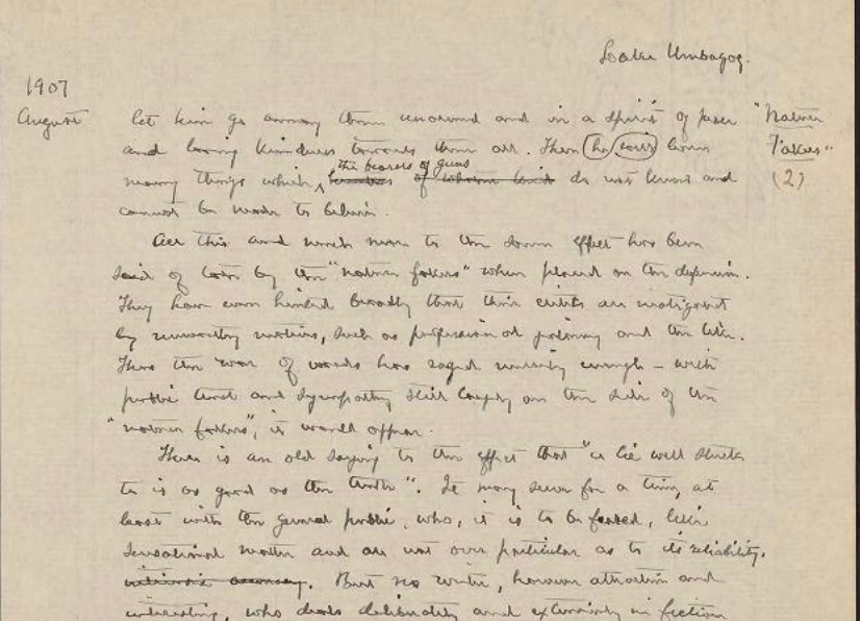
Excerpt of a page from William Brewster’s 1907 journal, which captures his transition from collecting bird specimens with his shotgun to field observation and photography. Contributed in BHL from the Harvard University, Museum of Comparative Zoology, Ernst Mayr Library.

“If he would become really familiar with the wood folk and their ways, let him go among them unarmed and in a spirit of peace and loving kindness towards them all. Then he will learn many things which the bearers of guns do not know and cannot be made to believe.” August 1907, Journals of William Brewster.

The availability of Brewster’s notebooks enhances contemporary studies and makes the entire research cycle of this scientist’s work available for analysis by historians of science, scientists, social scientists and humanists or anyone interested in the process of discovery, by creating a richer and more interactive history of science resource. Brewster’s careful observations enable comparisons of his birding lists with contemporary observations (100 years plus later), helping to document environmental changes that might not be evident otherwise.

References

Emmet, Alan. November-December 2007. William Brewster: Brief life of a bird-lover 1851-1919. Harvard Magazine. https://harvardmagazine.com/2007/11/william-brewster-html

Meyer, Elizabeth. April 5, 2018. From ‘Shotgun Ornithology’ to nature conservation: scientific stories and data from the field notes of William Brewster. https://blog.biodiversitylibrary.org/2018/04/from-shotgun-ornithology-to-nature-conservation-scientific-stories-and-data-from-the-field-notes-of-william-brewster.html

Meyer, Elizabeth. April 6, 2017. Notes from William Brewster: The evolving field of zoology. https://blog.biodiversitylibrary.org/2017/04/notes-from-william-brewster-evolving.html

Meyer, Elizabeth. September 9, 2016. Notes from William Brewster: Ecological change in the Maine woods. https://library.mcz.harvard.edu/blog/notes-william-brewster-ecological-change-maine-woods

Mitchell, John Hanson. 2014 e-book edition. Looking for Mr. Gilbert: The Unlikely Life of the First African American Landscape Photographer. New York, New York : Open Road Distribution.

Mitchell, John Hanson. 2005. Looking for Mr. Gilbert: the Reimagined Life of an African American. Washington, D.C. : Shoemaker & Hoard : Distributed by Publishers Group West

Randall, Patrick. June 5, 2014. Transcribing the field notes of William Brewster. https://blog.biodiversitylibrary.org/2014/06/transcribing-field-notes-of-william.html

Rinaldo, Constance, Linda Ford and Joseph deVeer. 2018. Museum, library and archives partnership: Leveraging digitized data from historical sources. Poster presentation at Society for the Preservation of Natural History Collections, August 2018, Dunedin, New Zealand.

Sears, M. 2020. Celebrating Robert Gilbert. Ernst Mayr Library Blog post: https://library.mcz.harvard.edu/blog/celebrating-robert-gilbert

February 22, 2021by michelle.underhill
Blog Reel, Featured Books

The Untold Story of Virginia and José Correia: Scientific Explorers in Search of Rare Birds

collages illustrations of various bird heads and feet

Digitization projects often shed light on stories hidden in plain sight. This is the story of a husband-and-wife team that served as field collectors for the American Museum of Natural History from 1912–1945¹. They were American immigrants who came from humble beginnings, dreamt of a new life, and found one.

•     •     •

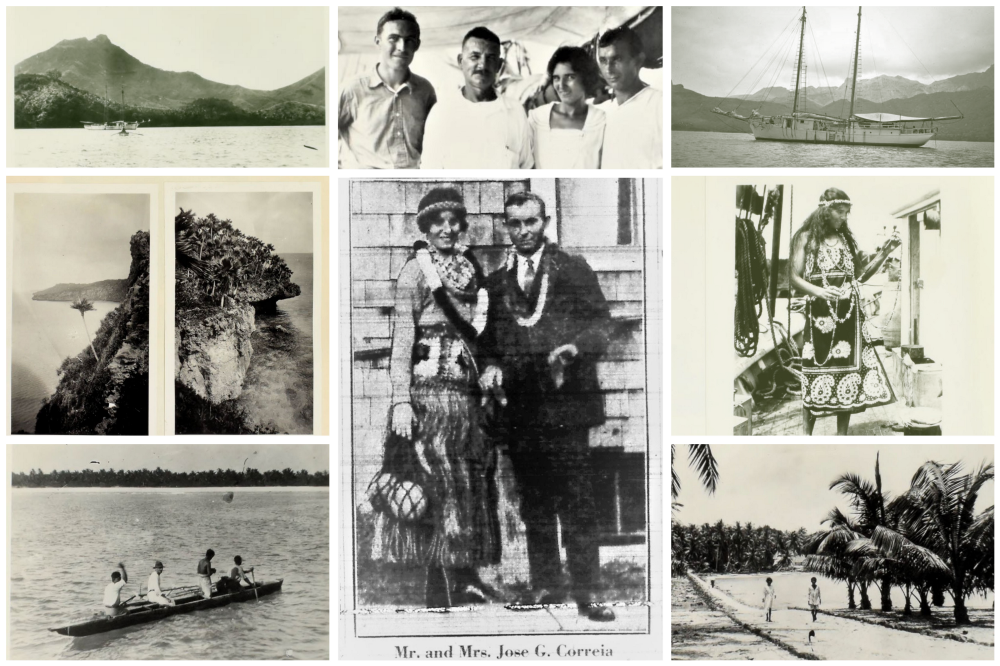
Photo collage of the Correia’s and their travels.

Photo collage of the Correia’s and their travels. Bryan, E. H. (1924) (photographer). Journal of Edwin H. Bryan, Jr. while with the Whitney Expedition of the American Museum of Natural History on the schooner France. Contributed in BHL by the American Museum of Natural History Library. Digitization sponsored by the Council on Library and Information Resources as part of the BHL Field Notes Project.

José and Virginia Correia are one of history’s most prolific bird collecting teams. For over three decades, they participated in many scientific exploring expeditions for the American Museum of Natural History, including the Whitney South Sea Expedition from 1922 to 1926.²

Although the published literature is scant regarding their scientific contributions, their story is certainly worth telling. Described by The Standard-Times (New Bedford) as a “life reading like fiction”,³  their work has emerged from obscurity with the digitization of José’s field notes from the Whitney South Sea Expedition (1920–1941) as part of the BHL Field Notes Project funded by the Council on Library and Information Resources (CLIR). Now audiences far and wide can enjoy this quintessential American story of two immigrants propelled by fate, hard work, and a sincere desire to improve one’s lot in life.

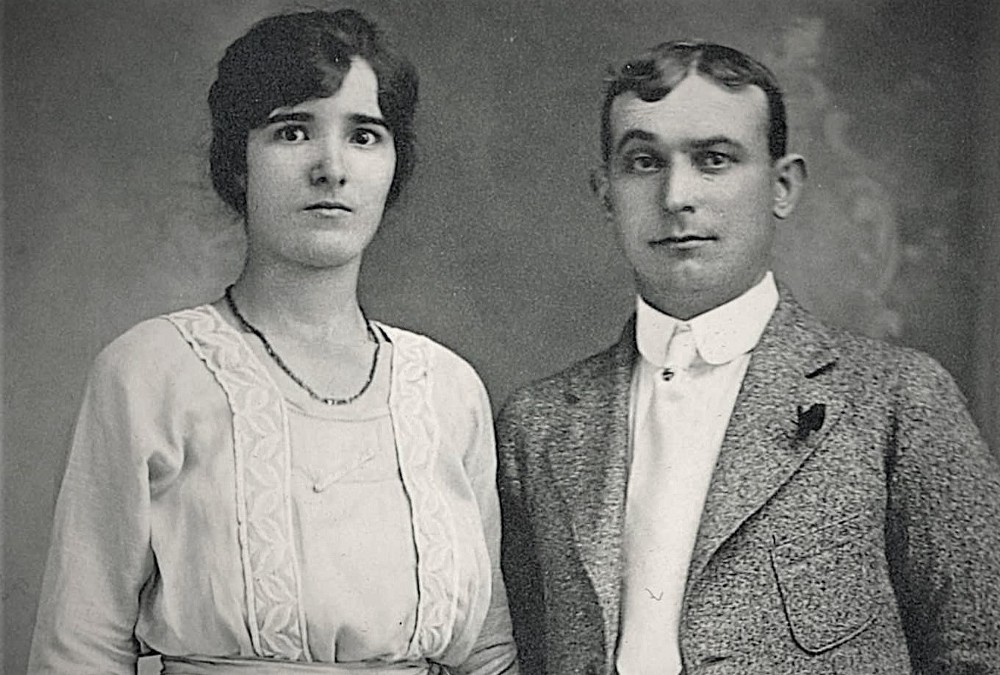
Black and white photo of a man and a women with light skin, dark hair, dressed in early 19th century clothes.

“Virginia and José Gonsalves Correia,” Unknown (photographer). Department of Ornithology Archives, AMNH, accessed September 3, 2020.

From José’s journal entries, we learn what daily life for a field collector was really like. Traveling to exotic locales, encountering Indigenous cultures, and sampling undiscovered flora and fauna might sound alluring, but José’s private notes reveal the harsh realities of turn-of-the-century collecting expeditions.

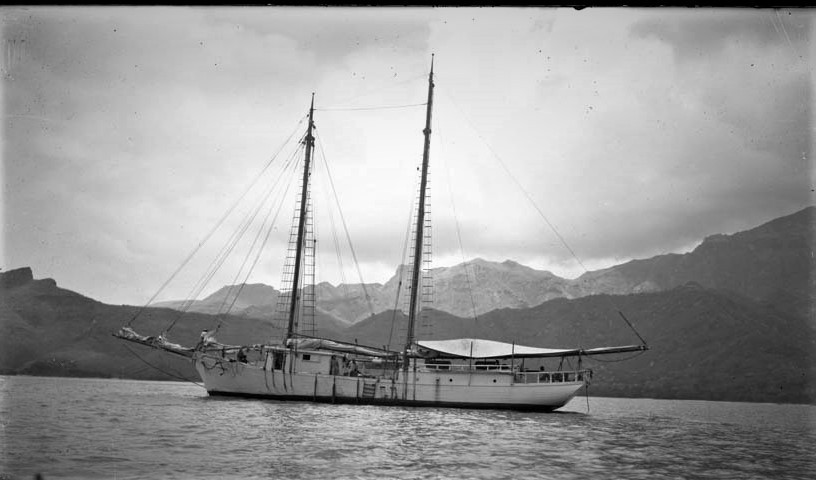
black and white photo of a schooner at sea.

Whitney South Sea Expedition schooner, the France, in the waters of Tuamotu, 1922. Beck, Rollo Howard, 1870–1950 (photographer). AMNH Research Library | Digital Special Collections, accessed November 1, 2020.

The work was hard and the days were long aboard the schooner France. Work typically commenced at dawn in the field and ended at dusk preparing specimens.⁴ Only exceptionally rugged individuals who were able to endure constant and extended deprivations — mind and body — could make such journeys.

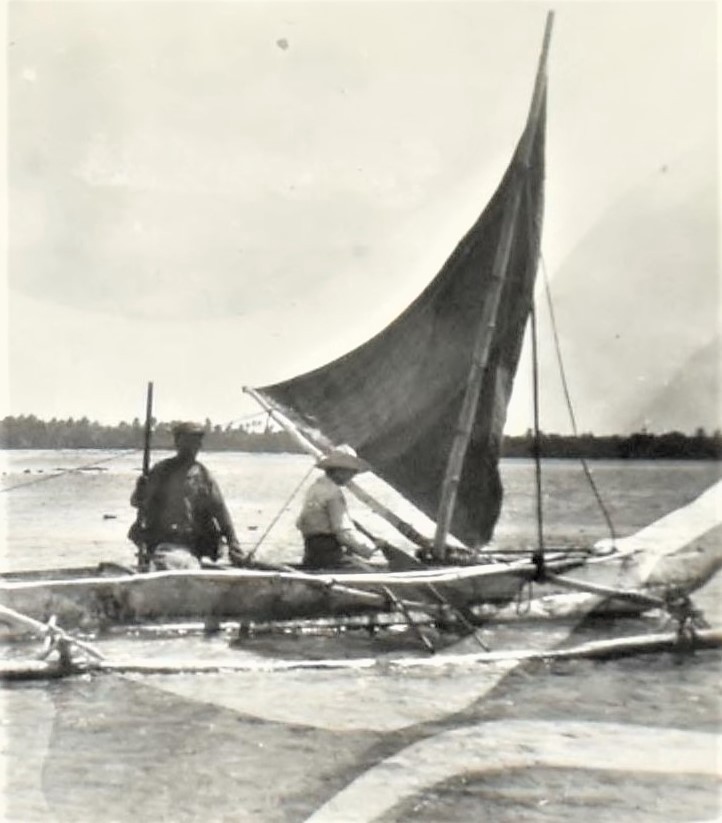
Two people in a canoe.

Mr. and Mrs. Correia are in a canoe ready to start back to Pukapuka from Motu Koe, facing S.W., toward the S.E. bay of the lagoon. Bryan, E. H. (1924) (photographer). Journal of Edwin H. Bryan, Jr. while with the Whitney Expedition of the American Museum of Natural History on the schooner France. Contributed in BHL by the American Museum of Natural History Library. Digitization sponsored by the Council on Library and Information Resources as part of the BHL Field Notes Project.

As if these daily irritations weren’t enough, extreme weather in the form of cyclones, gale force winds, and rogue waves provided plenty of near-death experiences.

“…we ran into the center of a strong cyclone on June 2nd. Everybody in the ship thought that they were never going to see land again, but God did not forget us in the middle of the furious ocean.” June 19, 1926, J. Correia.⁴

Four years and 12,000 miles later, the Correia’s had the misfortune of contracting malaria, effectively ending their service aboard the France in 1926.⁶ But the Whitney South Sea Expedition wasn’t their first field collecting trip, nor would it be their last. They would go on to explore some of the most remote places on Earth.

Illustration of a map with several aquatic locations highlighted.

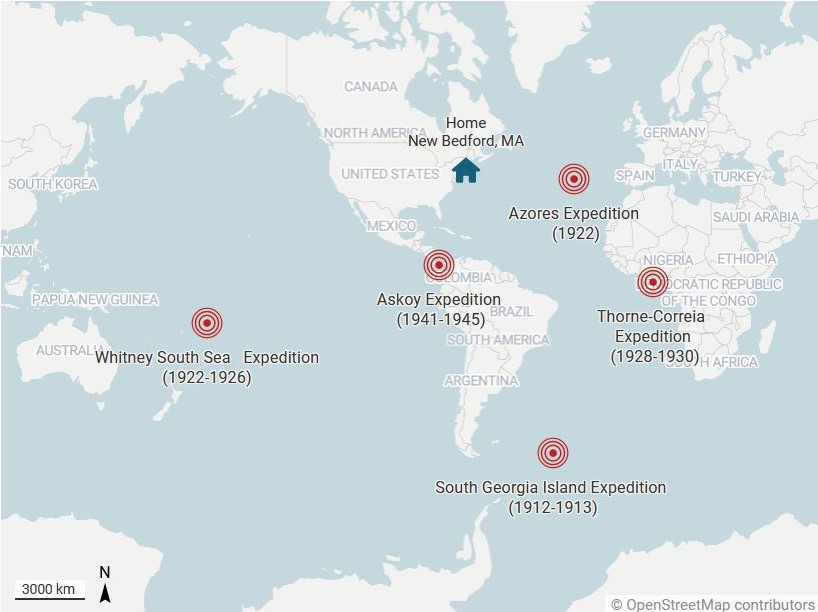
The American Museum of Natural History collecting expeditions took the Correias all over the globe.⁷ Ford, Jacqueline. (2020) Datawrapper: Create Charts and Maps [Software]. Available from https://www.datawrapper.de/.

It’s clear why the Correias continued to endure the hardships of collecting life. Not only did they believe birds held important keys to understanding the natural world, they had become a part of the scientific community who knew that time was running out. Their efforts were likely to be humanity’s only shot at cataloging, describing, and studying unknown bird species.

Black and white portrait of a man in a suit and tie.

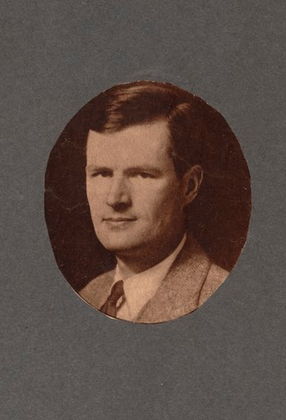
Dr. Robert Cushman Murphy [Photograph]. (1860). Retrieved from https://ark.digitalcommonwealth.org/ark:/50959/g158bt570.

José’s fateful friend, Robert Cushman Murphy, Curator of the American Museum of Natural History’s Ornithology Department, describes the moral imperative driving the Whitney South Sea Expedition:

“That it is high time for such an expedition to obtain examples of the Polynesian life is evidenced by the decrease in the population of birds and other animals at nearly all of the inhabited isles. For many years extinction has been approaching, and it is well known that certain kinds of birds secured by 18th century naturalists, have long since been wiped out of existence.”⁸

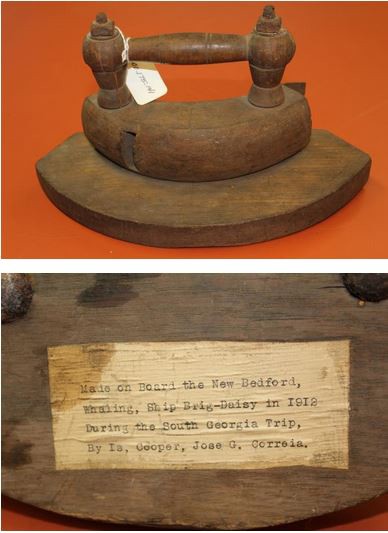
In one of Murphy’s more personal memoirs, A Logbook for Grace, he tells of his first collecting expedition in 1911, working as a field collector on a brig named the Daisy. It’s here that we get a first glimpse of a young José who enlisted as the Antarctic voyage’s cooper — the liquid-tight barrels made under his charge were crucial to the operation, transporting whale spermaceti back to America.

A small Cooper’s Howell plane with a Stanley #3 plane blade.

A small Cooper’s Howell plane with a Stanley #3 plane blade. Note on bottom: “Made on board the New Bedford Whaling Ship, brig DAISY in 1912 during the South Georgia Trip by IS (sk), Cooper José G. Correia.” Correia, J. G. (1912). Cooper’s Howell plane [Photograph]. New Bedford Whaling Museum | Grimshaw-Gudewicz Reading Room and Archives.

Aboard the Daisy, the two men would become fast friends discussing everything from Arabian Nights to the Papacy. Murphy describes José as “profound” and a “voracious reader”⁹ and came to rely on the cooper’s help after realizing his natural drawing aptitude and skill for specimen preparation:

“One day when Dr. Murphy was preparing bird specimens Mr. Correia offered to help. His first attempt was so good that Dr. Murphy placed it in his collection and sought help again and again from the ship’s cooper.”¹⁰

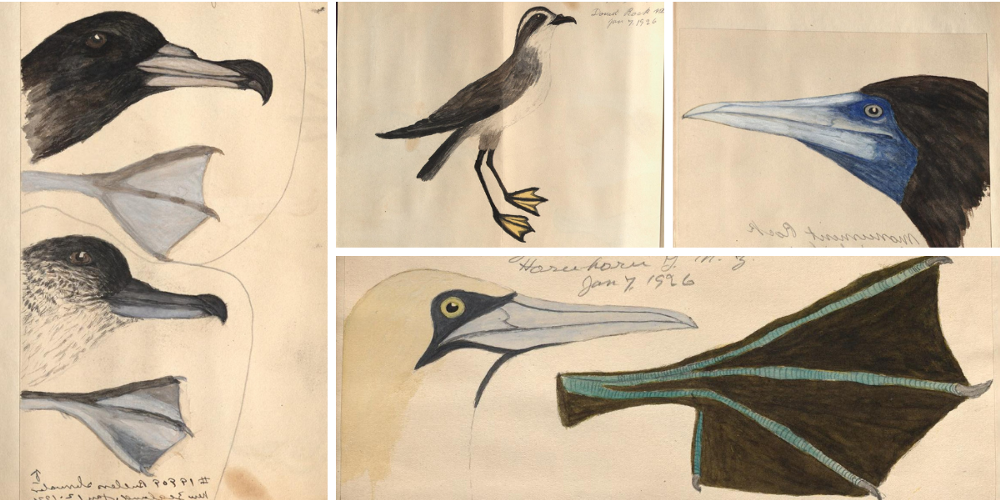
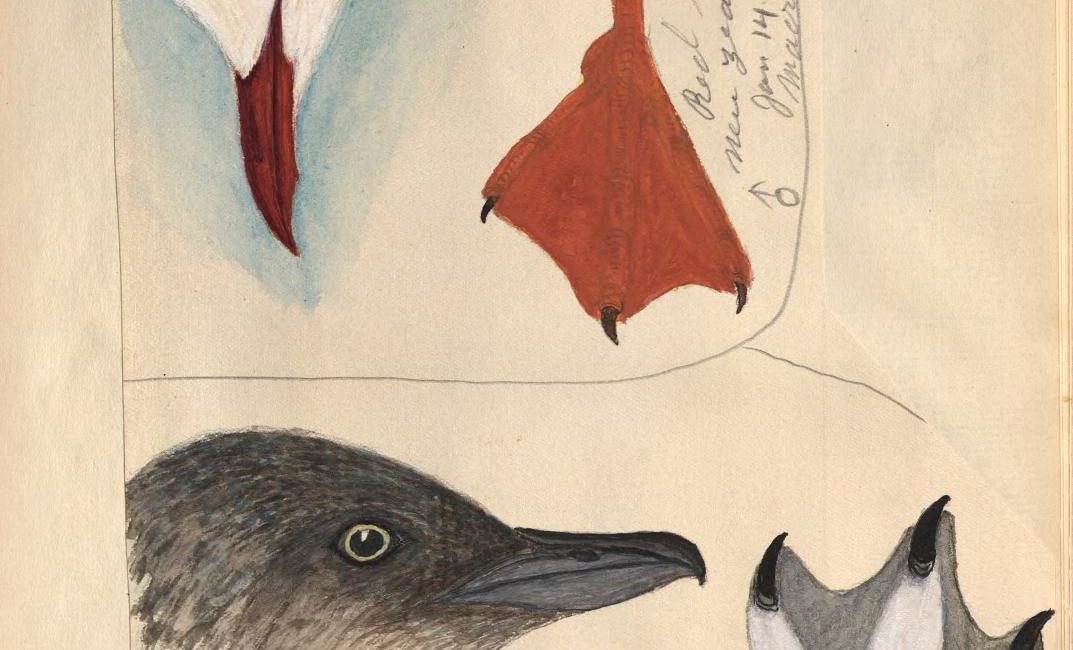
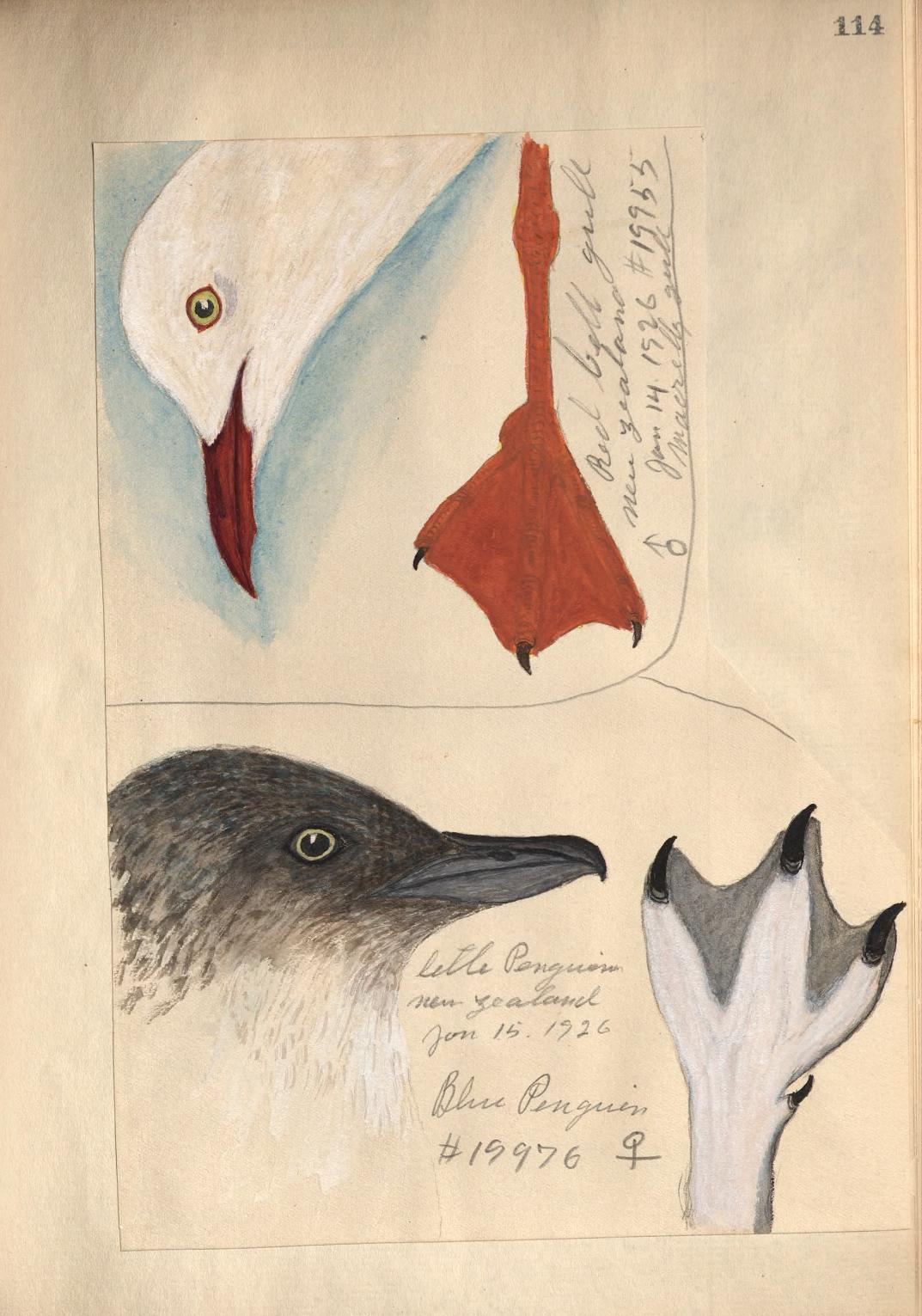
collages illustrations of various bird heads and feet

Correia’s field note illustrations, now available on the Biodiversity Heritage Library. Correia, J. [Illustration](1930–1941). Whitney South Sea Expedition of the American Museum of Natural History, v. 2. Contributed in BHL by the American Museum of Natural History Library. Digitization sponsored by the Council on Library and Information Resources as part of the BHL Field Notes Project.

In 1913, Correia was sought out by the American Museum of Natural History to work as a collector and preparateur on their next expedition after his friend, Mr. Murphy, showed officials at the American Museum Correia’s fine work.³

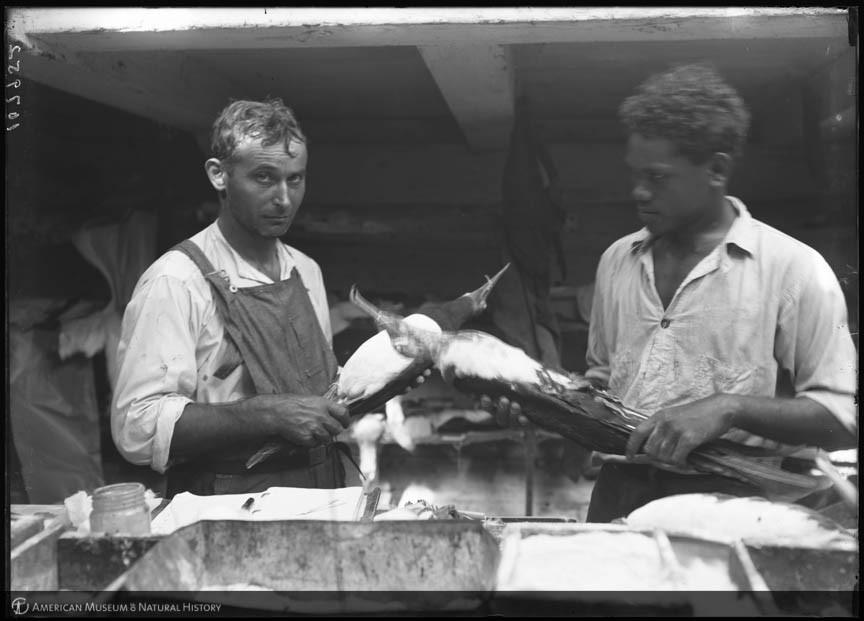
Black and white photo of two men working in a bird specimen preparatory setup.

“A workshop discussion: José G. Correia (left) with bird specimens aboard the France, Tuamotu [1920–1940],” Beck, Rollo Howard, 1870–1950 (photographer). AMNH Research Library | Digital Special Collections, accessed November 1, 2020. https://images.library.amnh.org/digital/index.php/items/show/60749.

From Humble Beginnings

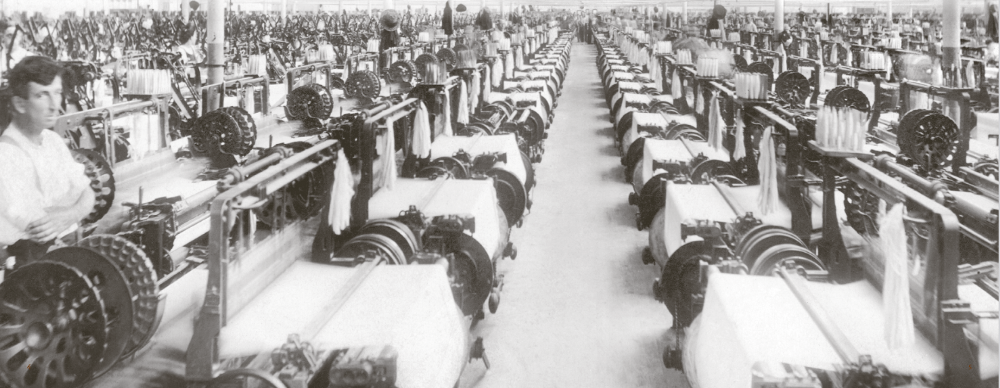
Before embarking on scientific expeditions, José worked as a whaling cooper (where he met Murphy) and a textile worker. In fact, between stints with the American Museum of Natural History, he would unassumingly return to work as an operative at Kerr Mills of the American Thread Company in Fall River, Massachusetts. When asked by fellow workers where he had gone, he would smile and simply reply “just away.”¹⁰

black and white photo of a textile mill weave room.

“Textile mill weave room. New Bedford, 1920”. Thomas, J., Sualniers, A., White, N., McCabe, N., & Avila, J. (Eds.). (2016). A Picture History of New Bedford (Vol. 2). Spinner Publications, Inc.

Correia’s humility came from memories of a very impoverished childhood. In his writings, he remarks that shoes were a luxury, reserved to be worn only “on feast days.” He was born in 1881, in Flamengos, a rural agrarian town on Faial, one of the nine islands in the Azorean archipelago. Like many Azorean youth, he had heard stories of America’s greatness from the Baleeiros (Azorean whalers), and he dreamed of the fabled land of opportunity.¹¹

At the age of 19, he left Faial and found warm welcome in New Bedford, Massachusetts, a burgeoning port city with a booming textile industry. The only thing José brought with him to America was a new suit, a sack of clothing, and his knowledge.¹¹ From his father, he had learnt the precise art of barrel-making and was taught the value of respect, dignity, and hard-work. These characteristics would serve him well throughout his life and helped him deal with both opportunity and tragedy. When he married Virginia in 1920, he was already a widower, having lost his first wife Rosa Silva in 1906 with whom he had one daughter, Mary.¹

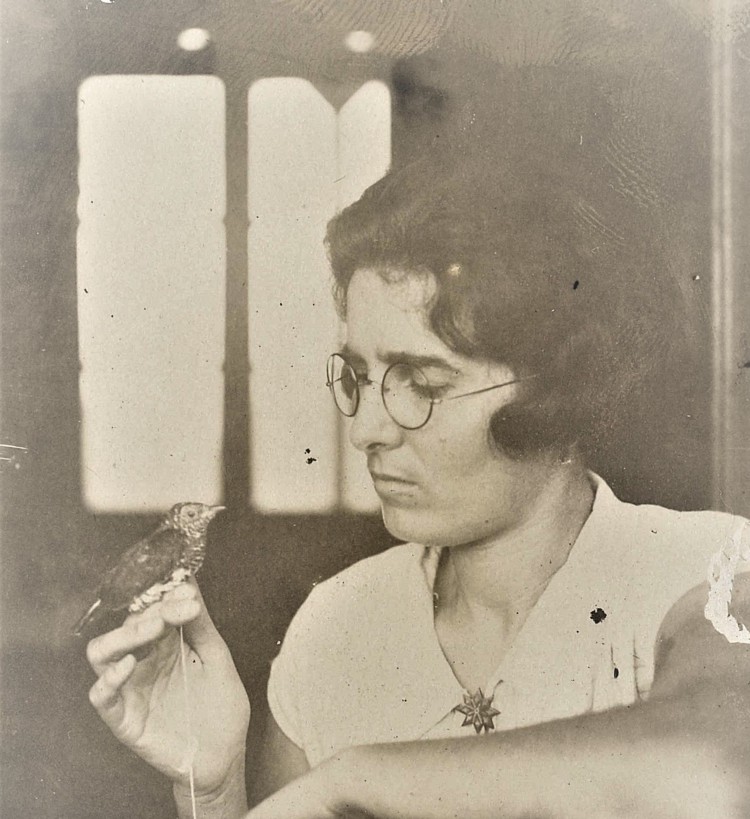
Black and white photo of a woman with short dark hair, wearing glasses, holding a bird.

“Virginia Correia”, Unknown (photographer). Department of Ornithology Archives, AMNH, accessed September 3, 2020.

Of Virginia Correia (née Aguiar), considerably less is known. Born in 1900 in Lajes, Terceira, Azores, she also immigrated to New Bedford at a young age.¹² Certainly she was a dedicated wife, joining her husband on difficult field expeditions and suffering all the aforementioned discomforts these journeys entailed.

Acting as her husband’s field assistant, she trained and became quite adept at the delicate art of preserving specimens. Character details can be gleaned from José’s journals, where he cites her as source of consistent strength and support. For example, during the Whitney South Sea Expedition, José and expedition lead, Rollo Beck, had seething enmity towards one another. José felt greatly disrespected by Beck and thought that the entire crew had turned against him under his influence. With a touch of sadness, he privately wrote, “The only person whom I can count on to help me is my wife. As for the others, I cannot rely on them.”

Nine years after his last expedition to South America20, a 73-year old Correia attended a party in New Bedford’s South End that would be his last. He was stricken by a heart attack and died on 26 April 1954.¹¹ Virginia would live out the rest of her life in their shared New Bedford home at 23 Harrison Street, passing in 1987.¹²

One million North Americans make up the Azorean diaspora — four times the current population of the islands.¹³ José and Virginia are representative of a distinctly intrepid sea-faring culture. In spite of ever-present danger, their adventurous spirit would take them to the farthest reaches of the globe. In that vein, the Correias would go on to build a dichotomous double-life: immigrant factory workers with intermittent scientific travels around the world in search of undocumented bird life.

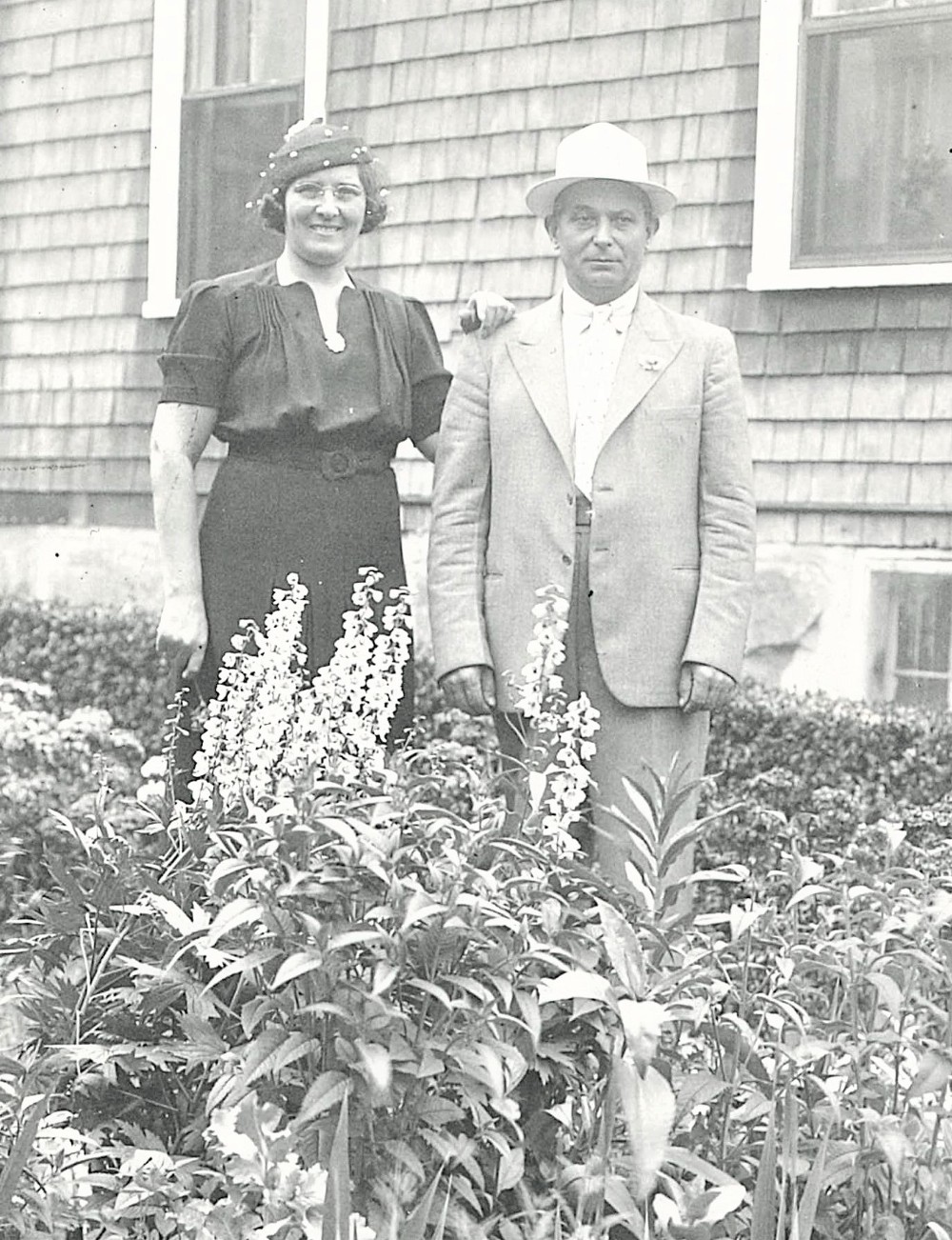
black and white photo of a woman and a man standing in a garden outside of a house.

“Virginia and José posing outside their home at 23 Harrison street, New Bedford, Massachusetts”. Unknown (photographer). Department of Ornithology Archives, AMNH, accessed September 3, 2020.

Despite strong ties to their homeland, they always came back to America — the place that had given them a life that “read like a fiction.”

Preserving the Correia Legacy

Over the course of their career, the Correias collected more than 10,000 bird specimens.¹⁴ Their efforts, alongside other historic field collectors, would help the American Museum of Natural History build one of the largest ornithology collections in the world.¹⁵ While the collection of wildlife specimens is controversial today, no longer done at this scale, these historic collecting efforts have provided the scientific foundation and necessary physical records for effective description and study of a species’ biology.¹⁶

The Whitney South Sea Expedition was the most extensive bird collecting expedition ever conceived at its time.⁷,¹⁷ The expedition spanned two decades, covered roughly one-third of the planet, and brought back over 40,000 specimens to the American Museum of Natural History.¹⁸ The scientific bounty has greatly enriched our understanding of the natural biota from the Pacific region.

Notably, Ernst Mayr’s seminal argument for geography’s role in the origin of new species draws on the study of bird specimens gathered by the expedition.⁷ More than six decades later, Jared Diamond and Ernst Mayr’s book Birds of Melanesia would use the specimens gathered by the expedition to provide the most comprehensive study to-date on how speciation occurs (the process by which new and distinct species evolve).

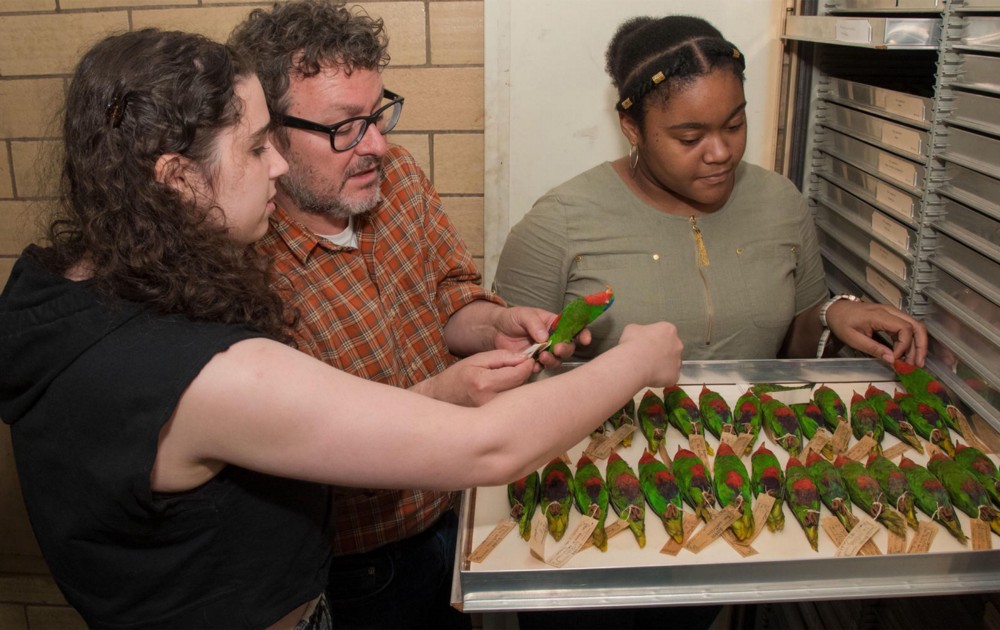
Paul Sweet, American Museum of Natural History’s Ornithology Collection Manager, believes the number of specimens contributed by the couple could be far greater than is currently recorded due to poor labeling. Curation efforts are ongoing to improve data accuracy. One such effort is mentoring high school students to transcribe location data from crew field notes. Through these efforts, the France’s journey through the Pacific is being precisely charted, providing an interactive journey of species sightings. Explore the project here.

three people looking at an open drawer of green and red bird specimens

Regina Hashim (left) and Angelic Henry (right) inspect Blue-crowned Lorikeet specimens collected during the Whitney South Sea Expedition with AMNH ornithology collections manager Paul Sweet (center). Langas, A. (2019, June 6). A Treasure Trove of 40,000 Bird Specimens Brought to Light. Audubon. https://www.audubon.org/news/a-treasure-trove-40000-bird-specimens-brought-light.

Museum specimen collections are, in essence, great libraries of Life — still rich in discoveries waiting to be made and perhaps even holding the keys to understanding our current public health crisis.

“Museum collections contribute unique and invaluable insights to the study of pathogens, vectors of disease, and environmental contaminants. Moreover, these collections have played a crucial role in fields at the forefront of the biological sciences, including the study of biodiversity and its loss, biological invasions, and global climate change. We argue that the storage and maintenance of museum collections is inexpensive compared with the potential costs of their absence.”¹⁹

To honor the great personal sacrifices made by historic field collectors like José and Virginia Correia, the call is being made to support the ongoing maintenance and digitization of museum collections. Their enduring utility should not be forgotten in these uncertain times. Museums across the country are facing difficult decisions and budget shortfalls due to the COVID-19 pandemic, and the ongoing preservation and maintenance of these hard-won collections hangs in the balance.

•     •     •

black and white photo of a man and woman in expedition clothing standing in a jungle.

The Correias about to enter the heart of the African jungle. “New Bedford Man, Off On 4-year Expedition for Museum, Has Life Reading Like Fiction.” (1936, September 16). Standard-Times (New Bedford), p. 3.

If you would like to honor Virginia and José Correia’s life’s work, consider making a gift to BHL to ensure that the historic data contained in field notes and scientific publications are freely available to support ongoing research around the world. You can also support the ongoing maintenance of museum collections by donating to natural history institutions like the American Museum of Natural History.

Acknowledgements

This story was made possible by a CLIR Digitizing Hidden Special Collections and Archives Grant, which provided funding to the American Museum of Natural History (AMNH) and the Biodiversity Heritage Library to digitize the Whitney South Sea Expedition (1920–1941) field notes. A personal thanks to Grace Costantino, BHL’s Outreach and Communication Manager, and Erin Willigan for the opportunity to showcase this untold story. Thanks also to Paul Sweet, Thomas Trombone, and Mai Reitmeyer at AMNH for providing primary source materials, data, and most importantly, their time. To the librarians at the Peabody Essex Museum, the New Bedford Whaling Museum, and the New Bedford Free Public Library, who helped tracked down difficult to find newspaper articles and books, thank you.

References

[1] Shatzman, C. (2016, November 7). Correia, José G., 1881–1954. Retrieved October 10, 2020, from https://data.library.amnh.org/archives-authorities/id/amnhp_1000443.
[2] Correia, J. (1930–1941). Whitney South Sea Expedition of the American Museum of Natural History. The Biodiversity Heritage Library. https://www.biodiversitylibrary.org/bibliography/121444.
[3] New Bedford Man, Off On 4-year Expedition for Museum, Has Life Reading Like Fiction. (1936, September 16). Standard-Times (New Bedford), p. 3.
[4] Correia, J. (1930–1941). Whitney South Sea Expedition of the American Museum of Natural History. v. 2. The Biodiversity Heritage Library. https://www.biodiversitylibrary.org/item/214343.
[5] Mayr, E. (n.d.). Joining the Whitney expedition. Web of Stories. Retrieved October 30, 2020, from https://www.webofstories.com/play/ernst.mayr/13.
[6] Murphy, R. (1936). Oceanic birds of South America : a study of species of the related coasts and seas, including the American quadrant of Antarctica, based upon the Brewster-Sanford collection in the American Museum of Natural History. The Biodiversity Heritage Library. p. 6. https://www.biodiversitylibrary.org/page/12471284.
[7] American Museum of Natural History. (2019). American Museum of Natural History | Research Library | Authorities | Expeditions [Dataset]. https://data.library.amnh.org/archives-authorities/results/?q=recordId:*amnhc_2*.
[8] Beck, R. H. (1930–1941). Whitney South Sea Expedition of the American Museum of Natural History. The Biodiversity Heritage Library. https://www.biodiversitylibrary.org/page/52734313.
[9] Murphy, R. C. (1965). Logbook for Grace. Time, Inc.
[10] Local Mill Operative Also Is Bird Expert for Scientific Expeditions. (1941 July 6). Standard-Times (New Bedford),p. 7.
[11] Agostinho, J. (1952). Um Emigrante Acoriano Jose Goncalves Correia. Boletim Do Instituto Historico, no.10, 204–238. http://ihit.pt/codeigniter/assets/upload/pdf/e3a418659d67d6609e2e58e7210779cb.pdf.
[12] Shatzman, C. (2016, November 7). Correia, José G., Mrs, 1900–1987. Retrieved October 10, 2020, from https://data.library.amnh.org/archives-authorities/id/amnhp_1002477.
[13] Minder, R. (2015, June 4). Azorean Diaspora Can’t Resist the Powerful Pull of Home. The New York Times. https://www.nytimes.com/2015/06/05/world/europe/azores-diaspora-holy-christ-of-miracles.html.
[14] Search: Collector “Correia”. (2006). Retrieved October 10, 2020, from https://sci-web-001.amnh.org/db/emuwebamnh.
[15] Research: Ornithology | AMNH. (2020). American Museum of Natural History. https://www.amnh.org/research/vertebrate-zoology/ornithology.
[16] Newton, B. E. (2017, January 9). Is specimen collecting justified? Lateral Magazine. http://www.lateralmag.com/articles/issue-18/is-specimen-collecting-justified.
[17] American Museum of Natural History. (1923). Annual report of the American Museum of Natural History for the year. Biodiversity Heritage Library. https://www.biodiversitylibrary.org/item/137096.
[18] Giraldo, S. (2016, October 20). Mapping the historical biodiversity of the Solomon Islands with the American Museum of Natural History. CARTO Blog. https://carto.com/blog/mapping-solomon-islands/.
[19] Suarez and Tstutsi. (2004). The Value of Museum Collections for Research and Society. BioScience, 54(1), 66. https://doi.org/10.1641/0006-3568(2004)054[0066:TVOMCF]2.0.CO;2.
[20] Newell, G. (2020, January 8). Askoy Expedition (1941-1945). Retrieved 24 November, 2020, from https://data.library.amnh.org/archives-authorities/id/amnhc_2000430.

December 3, 2020by [email protected]
Blog Reel, Featured Books

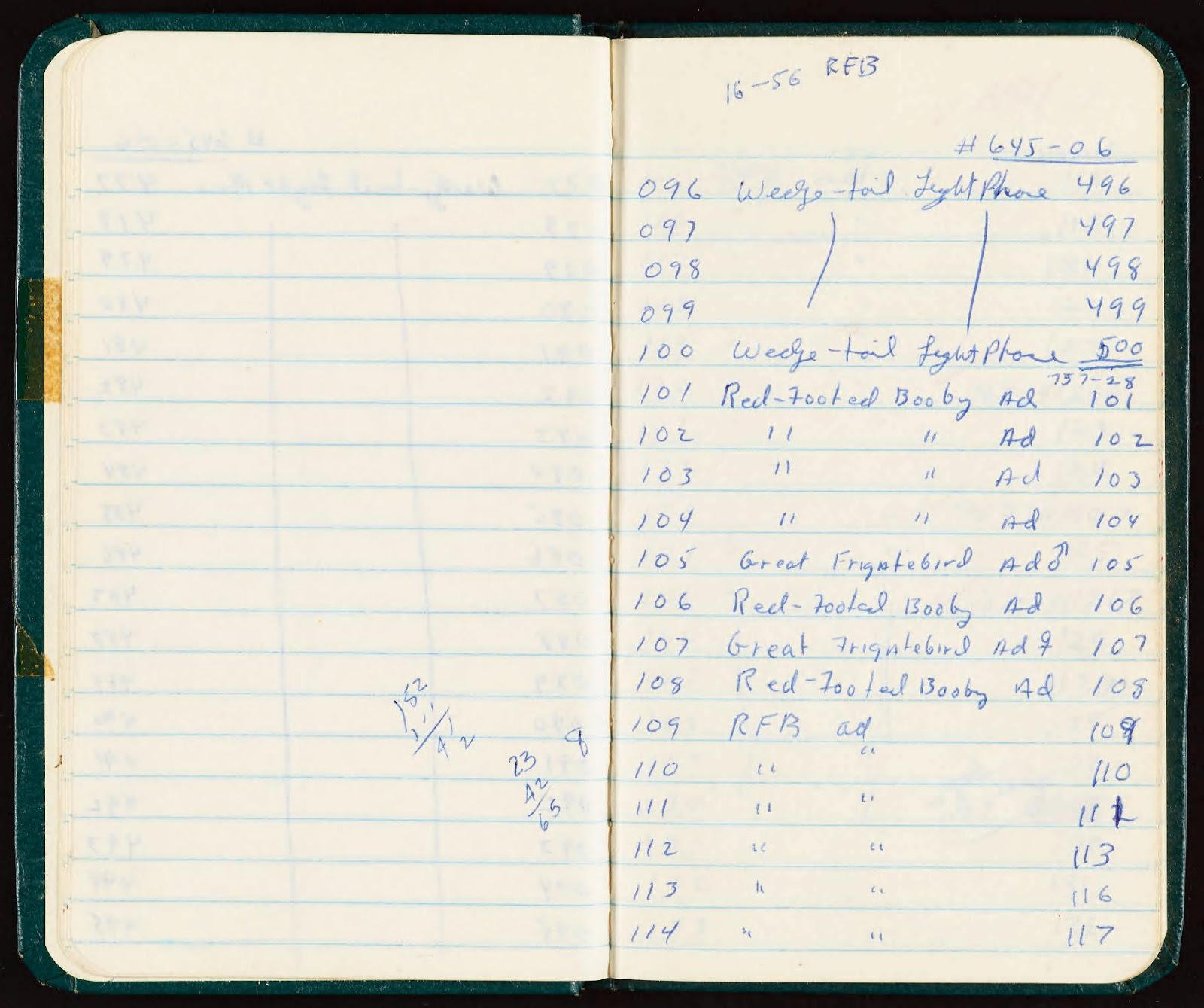
Field Note-Worthy: Thousands of Field Notes Now Available in BHL Thanks to the Field Notes Project!

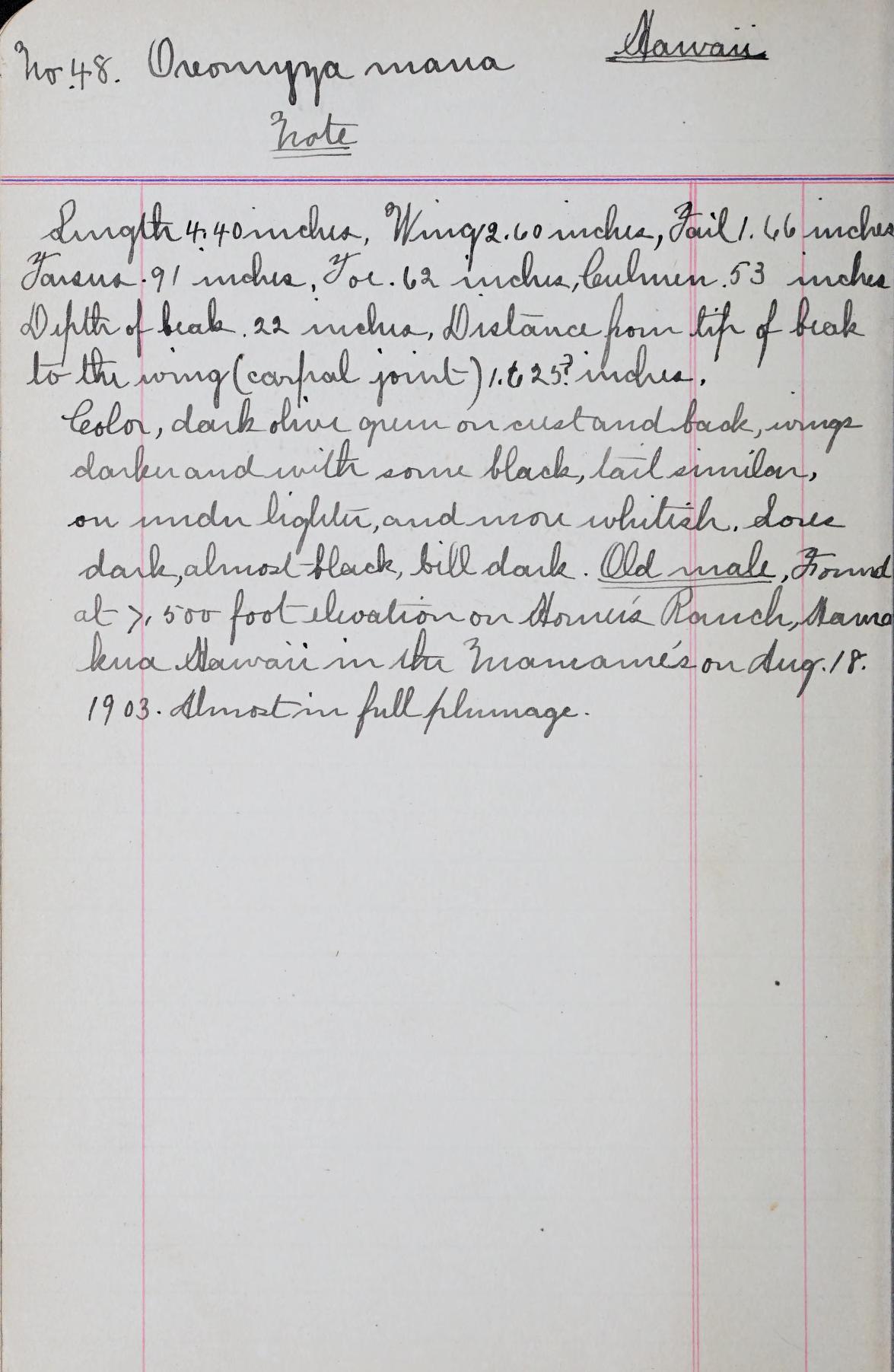
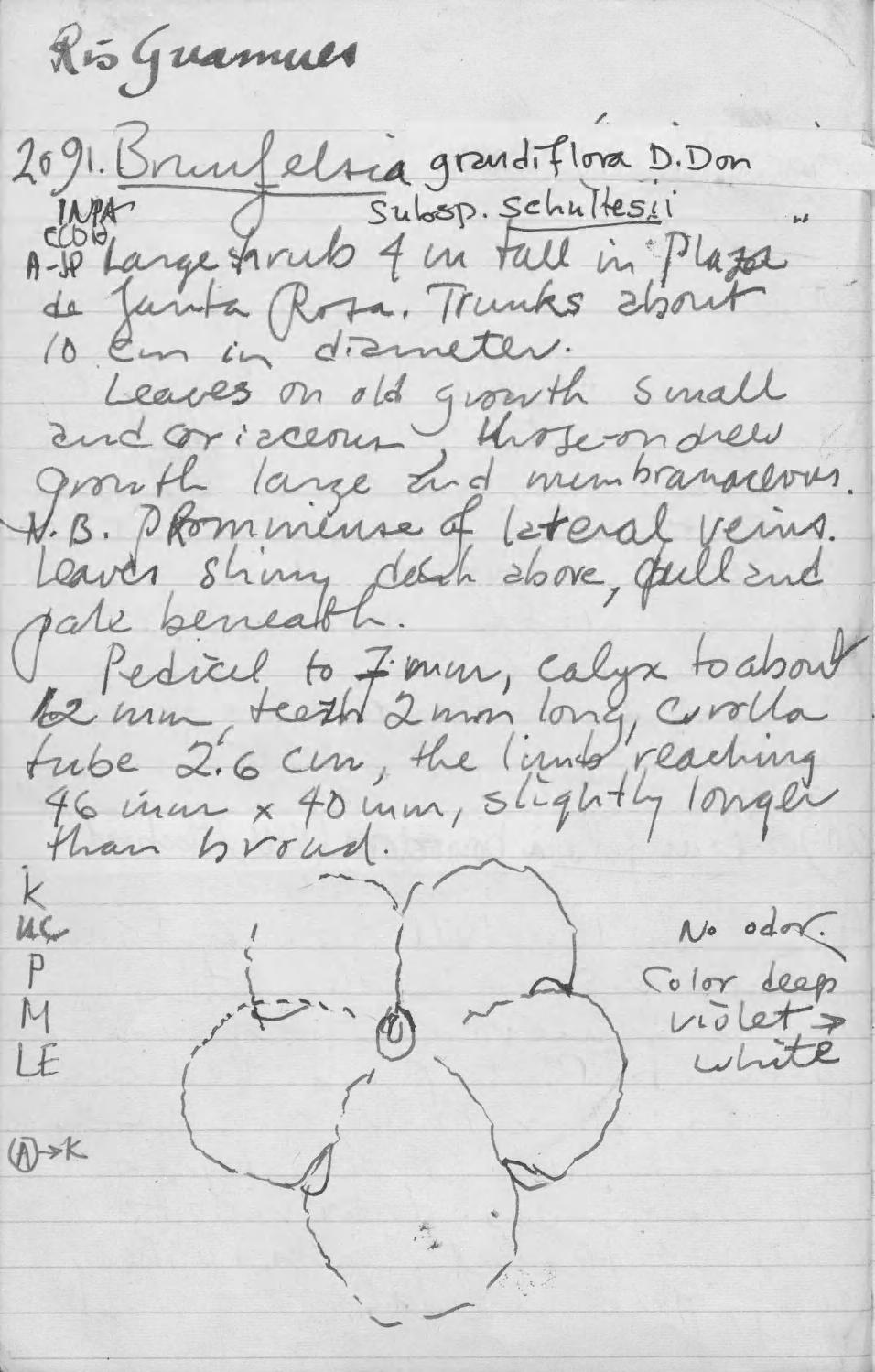
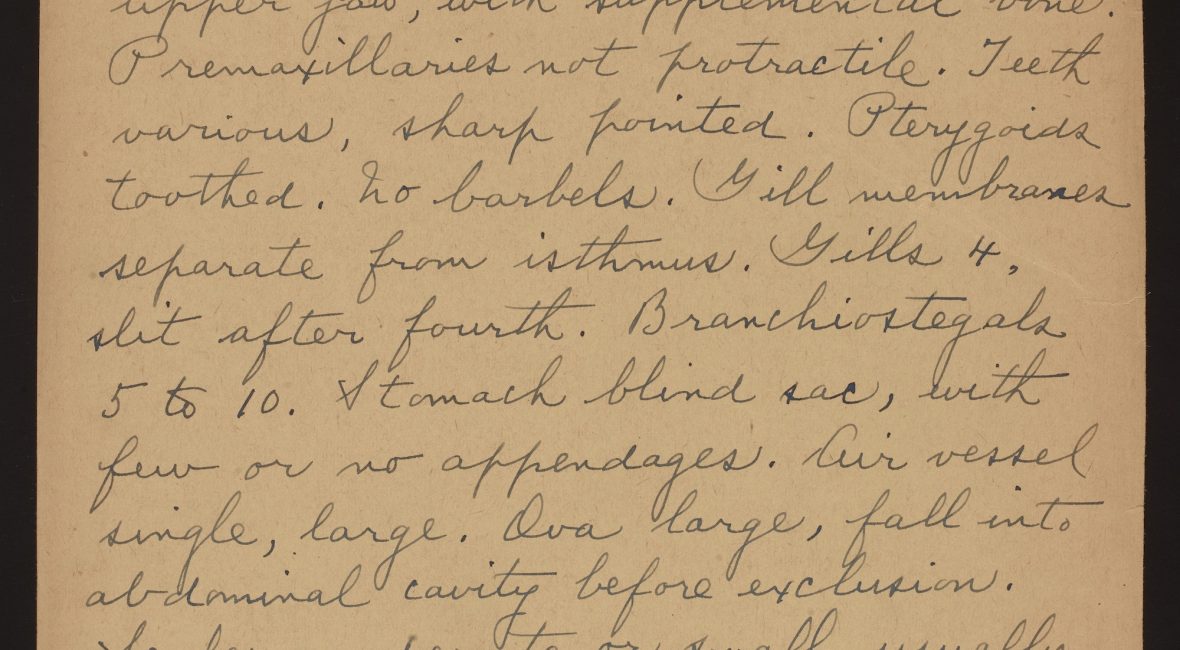
In February 2016, the Biodiversity Heritage Library set out to digitize over 450,000 pages of field notes. While the BHL had already added some archival material to its collection before this project, the Field Notes Project is BHL’s largest undertaking of digitizing field notes to date.

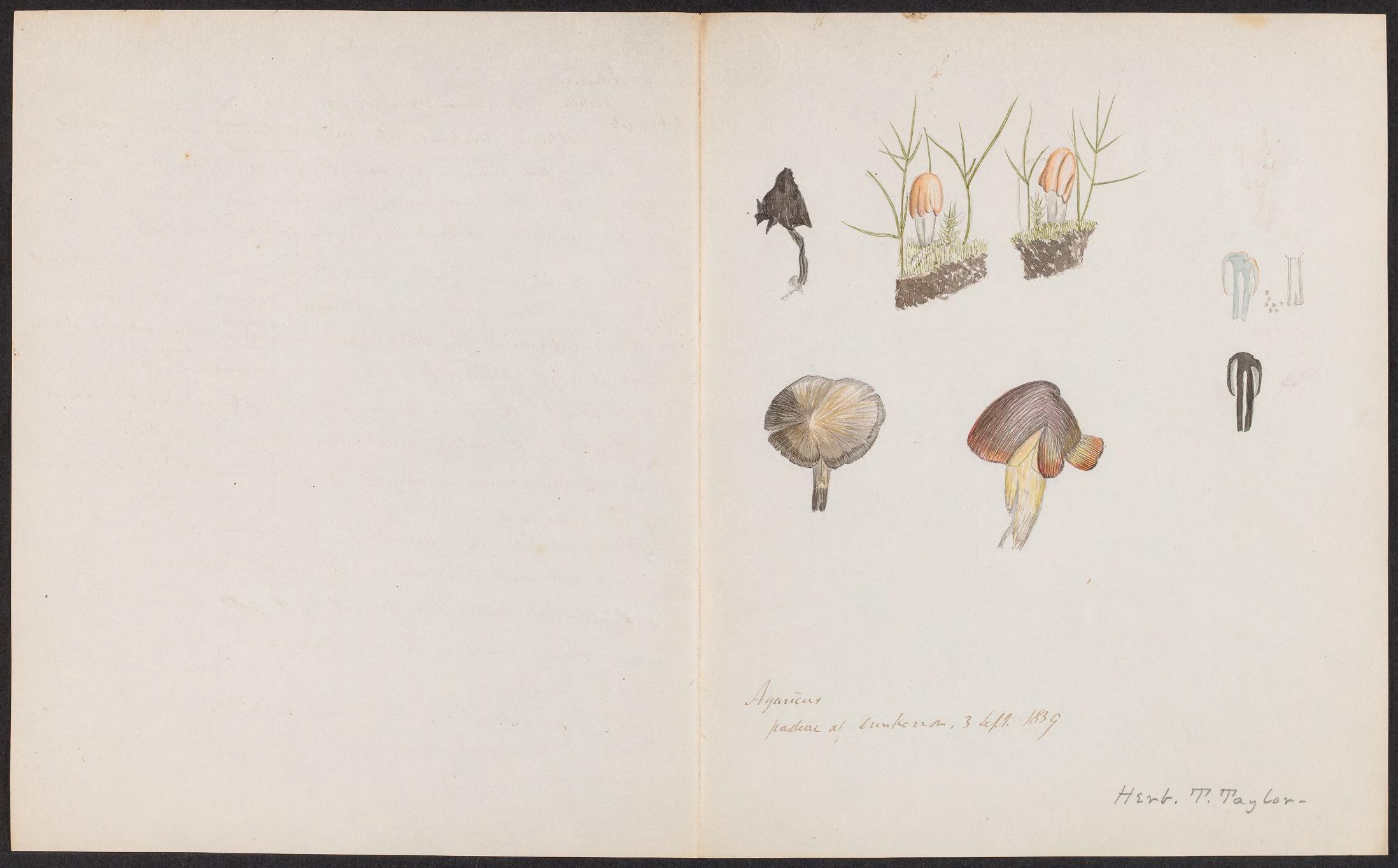
drawingsfungi00tayl_0013.jpg

Taylor, Thomas. Drawings of Fungi. Contributed by Harvard University Botany Libraries.

Funded by the Council on Library and Information Resources (CLIR) Digitizing Hidden Special Collections initiative, this was a collaborative project with eleven partners:

  • American Museum of Natural History
  • The Field Museum of Natural History Library
  • Harvard University Botany Libraries
  • Harvard University, Museum of Comparative Zoology, Ernst Mayr Library
  • Internet Archive
  • The New York Botanical Garden, LuEsther T. Mertz Library
  • Missouri Botanical Garden, Peter H. Raven Library
  • Smithsonian Institution Archives
  • Smithsonian Libraries
  • University of California, Berkeley, Museum of Vertebrate Zoology
  • Yale Peabody Museum of Natural History
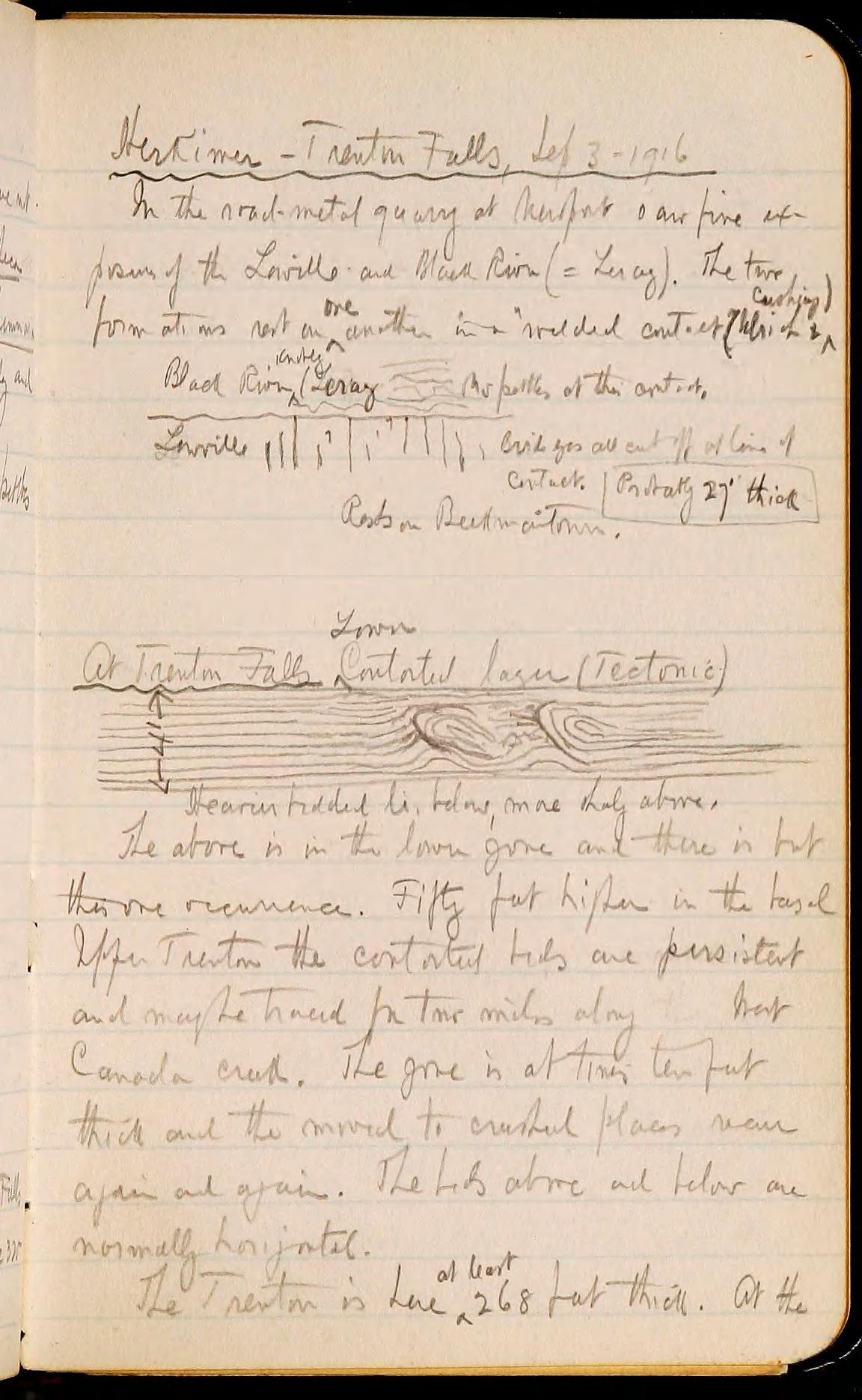
fieldnotebookma00schu_0031.jpg

Schuchert, Charles. Field Notebook: Maine, Massachusetts, New Hampshire, New York, Ohio, Rhode Island, Ontario 1916, 1917, 1920. Contributed by Yale Peabody Museum of Natural History Archives.

The importance of field notes is well known to curators, researchers and historians. Diaries, correspondence, journals and photographs serve as records of the flora and fauna of a particular time and place, providing reference points when observing how a habitat has changed. They also offer insight on expeditions, the origins of a museum collections, and contextualize the work through the eyes of the scientists and narratives about how they interacted with the people, land and cultures they studied.

beekeepingarchiv00ches_0064.jpg

Blacow, Chester E. Bee keeping activities and field catalog of birds collected in Hawaii, v4273. Contributed by University of California, Museum of Vertebrate Zoology.

If you have ever used historic field notes for your own research, you may understand why this wouldn’t be a cut-and-dry project. Field notes can pose a number of challenges, and our partners certainly had to manage many of them. Conservation concerns are always at the top of the list, ensuring that field notes are in the proper condition for digitization. Through digitization, we can also reduce the need to refer to the physical object and further protect these unique items. Other concerns stemmed from how researchers took notes, including writing right into the gutter of a notebook or frugal researchers who would start a new notebook by simply flipping a used one and writing in the other direction. Together, the project team was able to overcome these challenges to provide open access to their field notes collections.

timothyplowmanb00plow_0086.jpg

Plowman, Timothy. Timothy Plowman botanical collecting notebook : 1900-2286 : 1968-1969. Contributed by The Field Museum of Natural History Library.

We finished work on the project May 31, 2018 and are pleased to report that the project team digitized over 517,000 pages of field notes! 

Those who follow the blog closely will have read posts from the BHL Field Notes Project series where project partners highlighted their collections and digitization process. With several expeditions, disciplines and institutions represented, we are excited to see what our users discover, and see how they use field notes in their own work. Take a look and delve into field notes digitized for this project in BHL and Internet Archive.
whitneysouthsea2corr_0241.jpg

Correia, José G. Whitney South Sea Expedition of the American Museum of Natural History. Letters and journal of José G. Correia. Volume 2. Contributed by American Museum of Natural History.

The project team and BHL would like to thank the Council on Library and Information Resources for generously funding the BHL Field Notes Project.

June 28, 2018by mkahn
Blog Reel, Featured Books

28,000 Pages about the Sea: Challenges and Solutions for Digitizing the Fowler Collection

Workflow Meets Deluge

Henry Weed Fowler must have loved fish.

Ichthyology dominated his entire career. He started as a museum assistant at the Academy of Natural Sciences of Philadelphia in 1903. Other experts in his field soon recognized his prolific skill. In 1918, an assistant curator at the Smithsonian, Barton A. Bean, reached out to Fowler (then still an assistant) for help identifying fishes collected by the United States Exploring Expedition. Fowler dove into the work. He delivered a lengthy 750-page manuscript in two years, helping to discover 18 new species of fish in the process.[1]
For reference, the average field book here at the Smithsonian Institution Archives is 110 pages.

In 1925, Bean again sought out Fowler (then an associate curator) to identify fish from a 1907-1910 expedition by the steamer Albatross in the Philippines. Over the next several years, the pair published three manuscripts together (one | two | three), after which Fowler published three more of his own (one | two | three). Then, Fowler additionally completed six massive manuscripts – thousands of pages of independently written material – that were never published. Fowler passed away in 1965 after becoming a Curator of Fishes in 1940.[2] His unpublished manuscripts were transferred to the Smithsonian Institution Archives in 1975.[3]

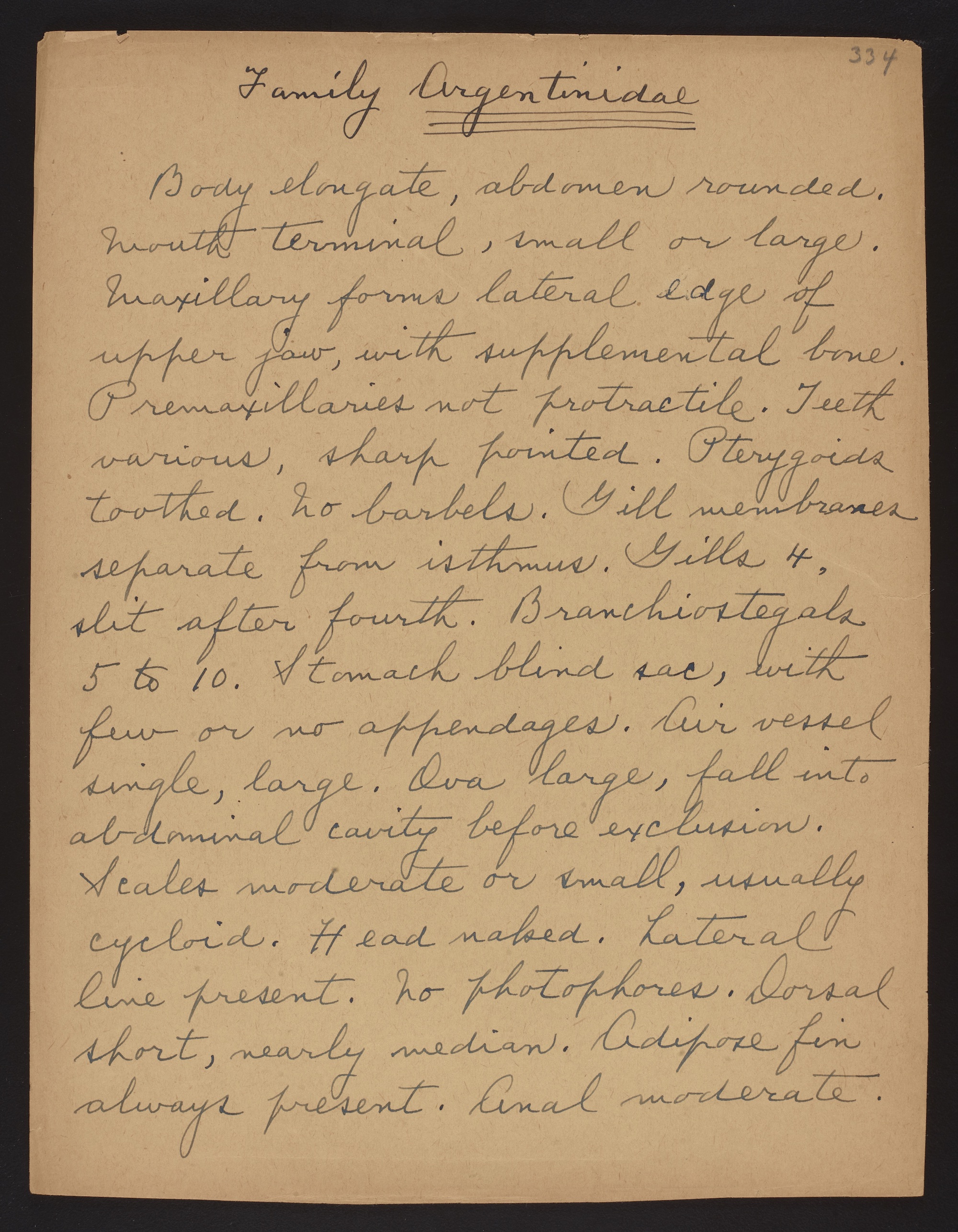
Fowler, Henry Weed. Manuscript of Henry Weed Fowler on the fishes of the Philippines, unpublished, circa 1930-1941. Families Argentinidae and Serpidae. Digitized in BHL by Smithsonian Institution Archives.

Fowler, Henry Weed. Manuscript of Henry Weed Fowler on the fishes of the Philippines, unpublished, circa 1930-1941. Families Argentinidae and Serpidae. Digitized in BHL by Smithsonian Institution Archives. https://biodiversitylibrary.org/page/55806651.

As a part of the BHL Field Notes Project, Smithsonian Institution Archives is digitizing one-of-a-kind field notes and manuscripts so they may be accessed online by researchers who may otherwise not be able to access the material. Logistically, each field book is assigned a unique identifier in the Archive’s Field Book Registry which we use to help track the item throughout the digitization process. On average, one unique identifier means one 110-page field book. We can normally digitize and deliver at least 30 field books per week.

Here’s where it got tricky: Fowler’s six unpublished manuscripts were grouped under a single identifier, MODSI6368. One 28,000-page item, 254-times larger than normal, and estimated 2.5 TB worth of images. One field book to outweigh them all.

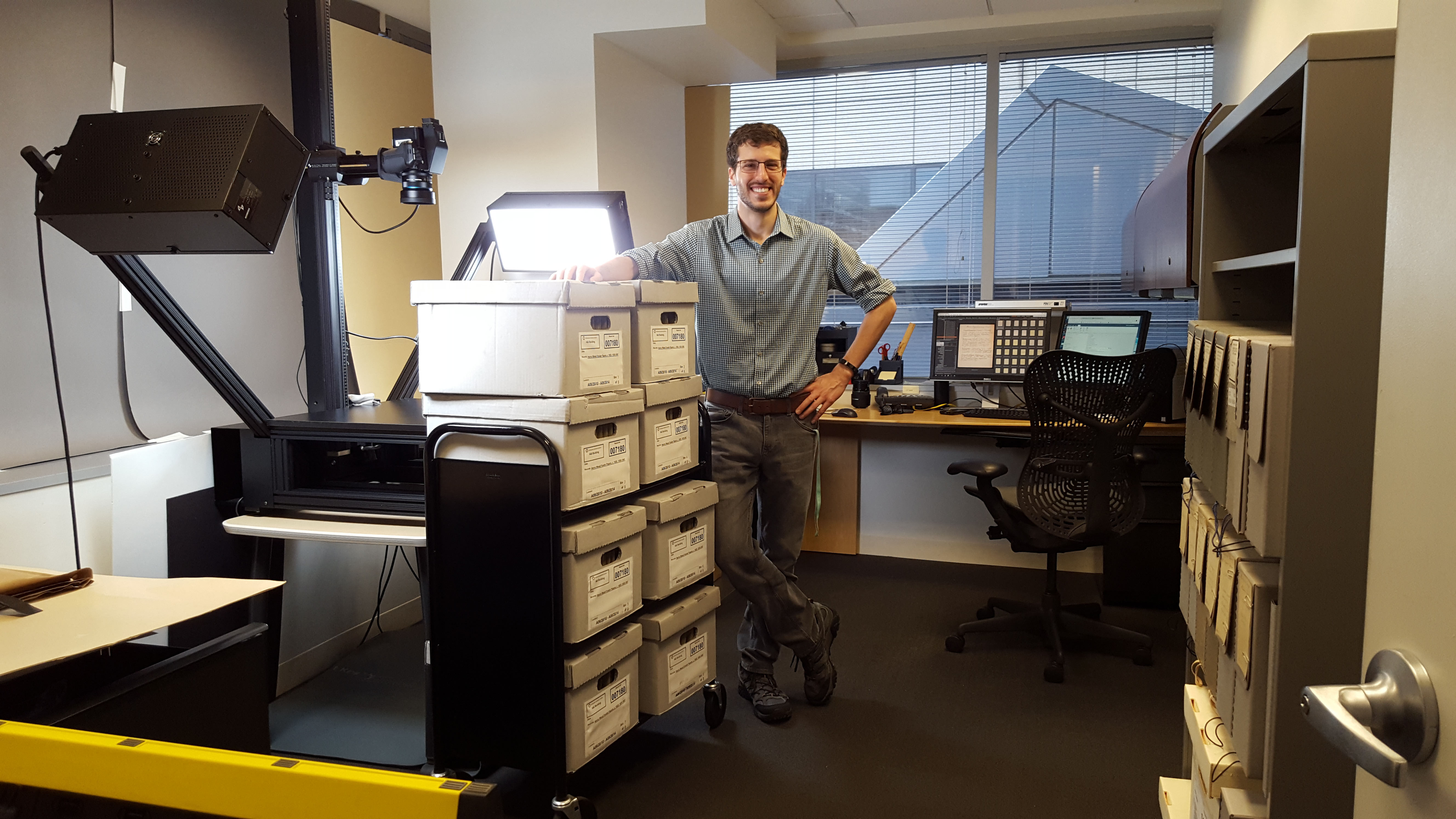
Fowler’s unpublished manuscripts in the digital imaging lab, with imaging tech Charles Zange for scale. Photo by Mignonette D. Johnson. Smithsonian Institution Archives.

Fowler’s unpublished manuscripts in the digital imaging lab, with imaging tech Charles Zange for scale. Photo by Mignonette D. Johnson. Smithsonian Institution Archives.

The eight-Hollinger-box, 153-folder field book arrived in Staging in late February. Our team held a meeting. We needed a new approach.

Logistics of a Tidal Wave

Proceeding as normal would irreversibly skew project deliverables. Loading a 28,000 page manuscript in the BHL portal wouldn’t be the most useful approach for researchers. After detailed discussion, we settled on a plan: break out the manuscript into sub-elements at the folder level instead of the title level, photograph at ~650ppi so we wouldn’t have to adjust the camera during the day, and bulk scan smaller items that required a higher resolution.

This new approach offered several advantages. Adjusting the camera several times a day adds up and slows down imaging; removing the need to adjust constantly would save us time and make imaging the manuscript more efficient. Treating each folder as a separate sub-element would mean creating smaller, more manageable digital objects closer to the average 110 pages we usually work with. This would shorten descriptive metadata per image in our Collections Management System (CMS) records; otherwise we would be embedding page-long collection notes into each image. It would also allow us to take advantage of how BHL manages multi-volume titles. This in particular is a method already successfully implemented by our fellow Field Notes Project partners at the Missouri Botanical Garden on their George Engelmann material, so we knew it could be a user-friendly way to present the extensive Fowler manuscript.

We had a plan. Now we had to see if it would work.
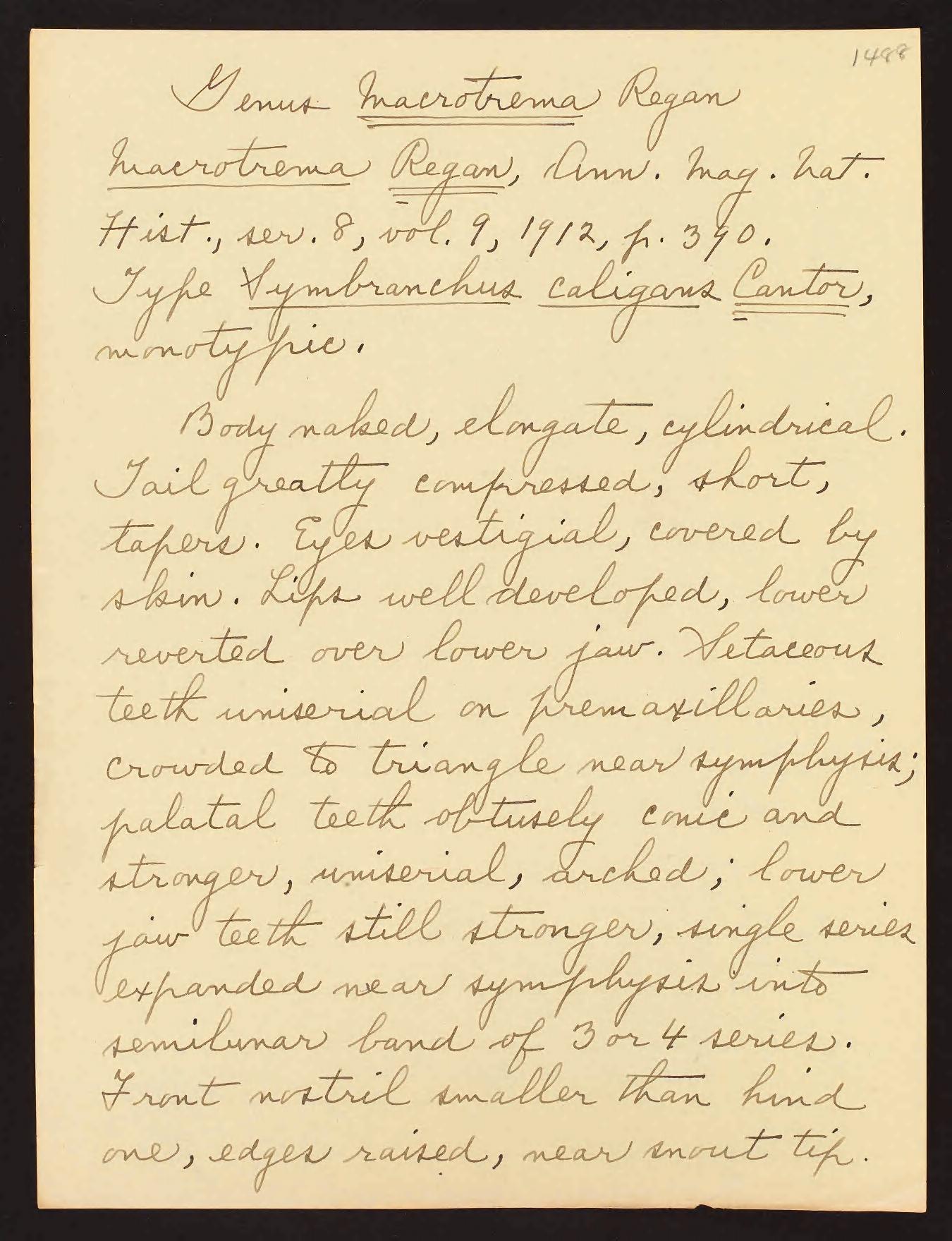
Fowler, Henry Weed. Manuscript of Henry Weed Fowler on the fishes of the Philippines, unpublished, circa 1930-1941. Order Synbranchii. Digitized in BHL by Smithsonian Institution Archives. https://biodiversitylibrary.org/page/55811117

Fowler, Henry Weed. Manuscript of Henry Weed Fowler on the fishes of the Philippines, unpublished, circa 1930-1941. Order Synbranchii. Digitized in BHL by Smithsonian Institution Archives. https://biodiversitylibrary.org/page/55811117.

Results after the Storm

The first Fowler image came through the camera on March 14, 2018. Our team finished photography on April 17th. Delivery to the Biodiversity Heritage Library is ongoing (stay tuned!). Here are a few statistics from the Fowler photography project:

  • Final page count: 28,735
    • 153 folders, average 187.8 pages/folder (1.7 times larger than average field books)
  • 24 days of imaging and metadata processing
    • Average 1197.29 images/day
  • Highest one-day count of photography: 2,415 pages
    • 345 pages/hour (5.75 pages/minute) for 7 hours by one technician
  • 2.59 TB storage footprint
  • Widespread sense of accomplishment

Spread the Word across the Seas!

Fowler has started to make his way online. As the team moves to another collection (Edmund Heller), check out some of the other worldwide journeys by Smithsonian researchers at the Smithsonian Transcription Center and the Smithsonian Field Books Collection. Thank you to our many volunteers, both online and here in the lab, for your passion and dedication in support of this project!

The BHL Field Notes Project is funded by the Council on Library and Information Resources (CLIR).

Citations

[1] “Fowler, Henry Weed, 1878-1965,” Smithsonian Institution Archives

[2] Ibid.

[3] “Henry Weed Fowler Papers,” Record Unit 007180, Collections Management System, Smithsonian Institution Archives 

May 3, 2018by Joel Richard
Blog Reel, Featured Books

From ‘Shotgun Ornithology’ to Nature Conservation: Scientific Stories and Data from the Field Notes of William Brewster

handwritten text on a page with a drawing of a moose

William Brewster (1851-1919) was a renowned American amateur ornithologist, serving as a co-founder of the American Ornithologists’ Union, the first president of the Massachusetts Audubon Society, and a curator at Harvard’s Museum of Comparative Zoology (MCZ). As a part of the CLIR-funded BHL Field Notes Project, MCZ has been digitizing Brewster’s journals, diaries, letters, and photographic prints, which are held in Special Collections at the MCZ’s Ernst Mayr Library.

Most of Brewster’s observations are based in New England, where he split his time between two homes in Cambridge and Concord, Massachusetts. Brewster would stay in a cabin by the Concord River to study nature and escape city life in Cambridge. He also took notes when travelling: his notebooks document trips to the southern USA, the Caribbean, and Europe.

black and white photo of a man sitting in front of a cabin in the woods.

A black and white photograph of Brewster sitting on the front doorstep of his cabin in Concord, Ma. The small, one-story log cabin is set in a hillside and surrounded by small trees and shrubs. The back of the photograph has the note: “Concord, Mass. May 20, 1892.” (Ernst Mayr Library Special Collections, call no. bBr97.70.7.)

Brewster’s writings contain a wealth of information, from data on temperature and weather conditions to descriptions of animal behavior and personal musings. Some of the extensive Brewster collection is already available to view on BHL – here’s a sampling of the kinds of information you’ll find.

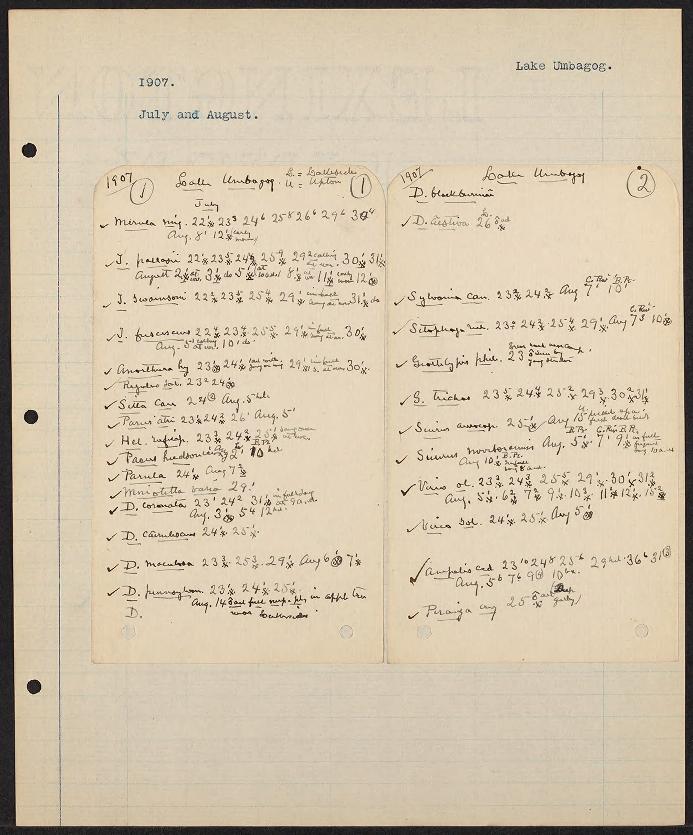
In the warmer months, Brewster often camped at Lake Umbagog (north of the White Mountain National Forest, straddling Maine – New Hampshire border), where he spent his days tracking the progress of bird nests around the lake and making other general observations. Here’s a typical example of one of Brewster’s bird lists, recorded at Lake Umbagog in 1907. The larger numbers are dates, with superscripts indicating the number of individuals counted that day. Asterisks tell us that the bird was heard vocalizing. Some additional details are also penned in (for example, he notes that Dendroica pensylvanica, the Chestnut-sided Warbler, was in an apple tree). [1]

handwritten page from a journal

An image of a page from a journal. Two smaller papers with handwritten, numbered lists are attached to a larger page. The heading reads: “Lake Umbagog, 1907. July and August.” The lists have scientific names of bird species, followed by dates, numbers of birds observed, and some additional notes. (1907. Journals of William Brewster, 1871-1919 (inclusive). Find this journal on BHL.)

Beginning in the 1890s, Brewster’s journals document a transition of focus from mainly specimen-collecting to photography and documenting behaviors. (His journals reveal an interesting story about his increasing ethical conflict and desire to study wildlife without contributing to its decline. You can read more about this in a previous BHL blog post found here.) Earlier in Brewster’s career, his journals list and provide details on species collected – data that is similarly useful to the list above in that it gives an indication of species distribution and abundance. It also corresponds with existing specimens and documents the impact made by scientific collectors of the era.

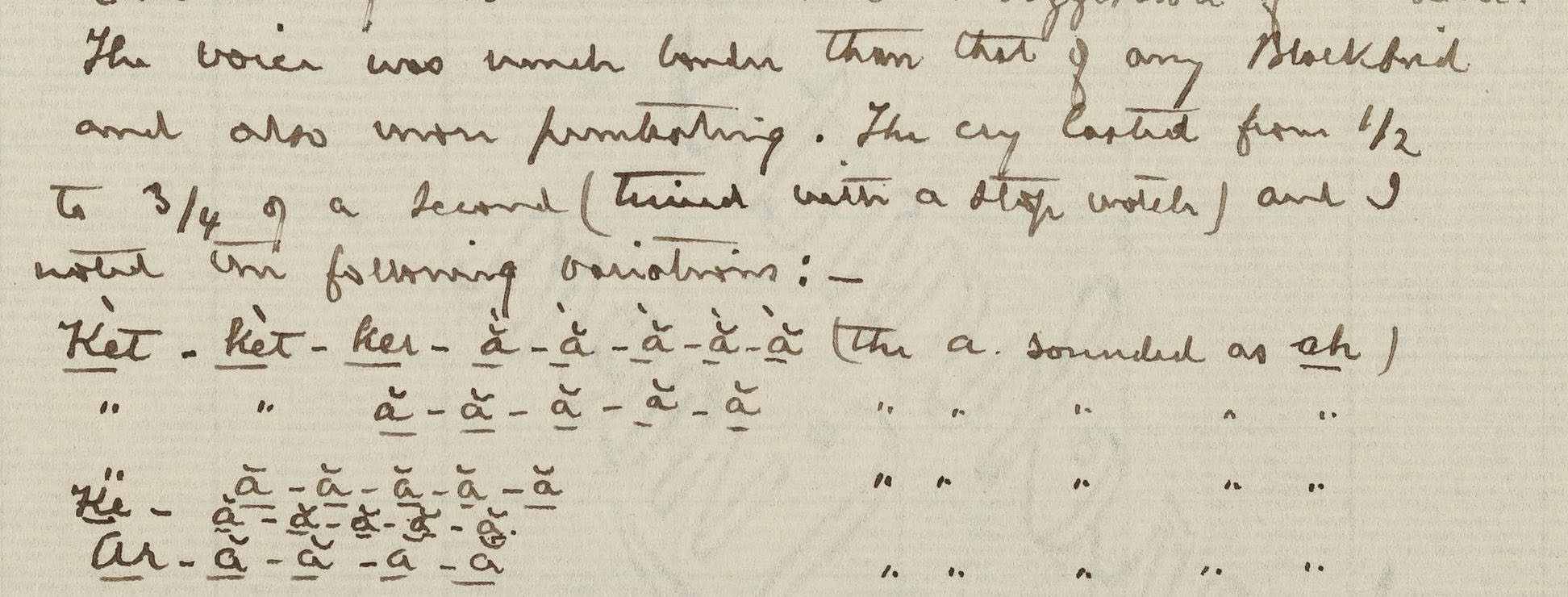
The kinds of data in these journals diversifies as Brewster started devoting more time to documenting animal behaviors. In many ways, this work seems to have been harder than getting a good shot at a bird. Even with today’s apps and audio libraries, figuring out bird calls can be a challenge. Equipped with just pencil, paper, field glasses and ears, studying bird vocalizations is much trickier, as shown by Brewster’s notes below from 1902. [2] Today, we can represent bird vocalizations visually using spectrograms. In order to translate sounds to text, Brewster listened diligently to invent mnemonics, describe patterns, and make comparisons to other more familiar sounds.

handwritten text on a page

An image from one of Brewster’s journals showing his written renditions of an unknown bird’s vocalizations. He writes: “The voice was much louder than that of any Blackbird and was also more penetrating. The cry lasted from ½ to ¾ of a second (timed with a stop watch) and I noted the following variations: Kèt – kèt – kèt – ă – ă – ă – ă – ă (the a sounded as ah) [etc.]” https://s.si.edu/2q6rKGa.

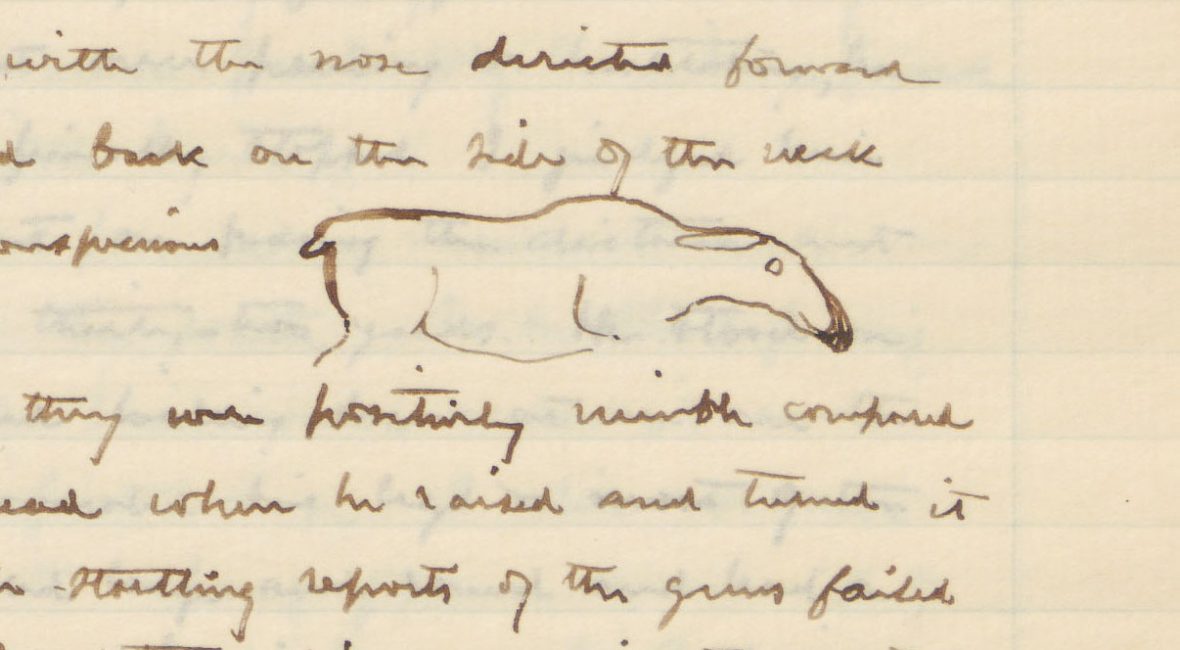
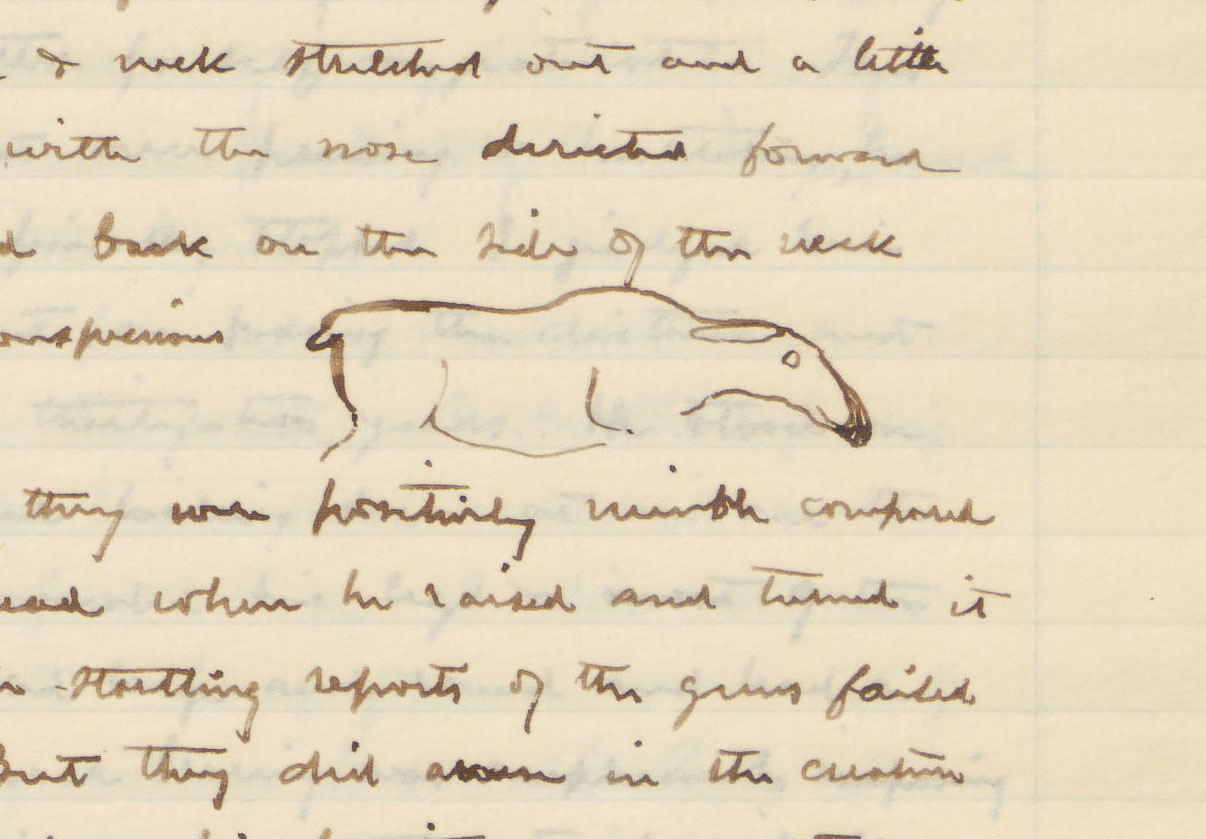
It’s worth mentioning that Brewster’s animal observations weren’t limited to birds, and that a lot of his animal encounters made for interesting stories. Below is a sketch of a moose from Lake Umbagog, observed in August 1869. [3] His impression: “He seemed like some long-forgotten antedeluvian creature which, arousing from a sleep of thousands of years, was wandering aimlessly about in a land so changed that it no longer had any place for such strange monsters.”

handwritten text on a page with a drawing of a moose

A simple ink-sketched outline of a female moose with head held low and ears lying flat back. The sketch is embedded in a paragraph handwritten in cursive script on lined paper. https://s.si.edu/2GD0beA.
As though telling the story to a friend, he recounts following the moose through the wetland in his canoe – sometimes ending up way too close for comfort. After talking to a local guide, he learned that the moose that he’d seen was a mid-sized female, and concluded, “If she was not really a very large one I have no wish to be equally near to a big bull!”

Because he returned to Lake Umbagog year after year, Brewster was able to notice longer-term changes in familiar ecosystems. Increasingly, these changes were man-made disturbances: the clearing of woods, the creation of new roads, and other urbanizing changes. He also recorded how local communities of animals and plants responded after these disturbances. The following passages from Brewster’s field notes document some changes that he saw in the Maine woods as a consequence of logging for paper mills, and include some of his own predictions.

“Where the road passes through the woods … the roadworkers last May cut away the mountain maples, cornels and other shrubs and low trees that made such a beautiful border to the forest clearing in their places a broad belt of bare rocks half covered with the fallen brush wood. This deed of vandalism was performed while I was here and at the time I feared that years must elapse before Nature, with all her diligence, could repair the injury.

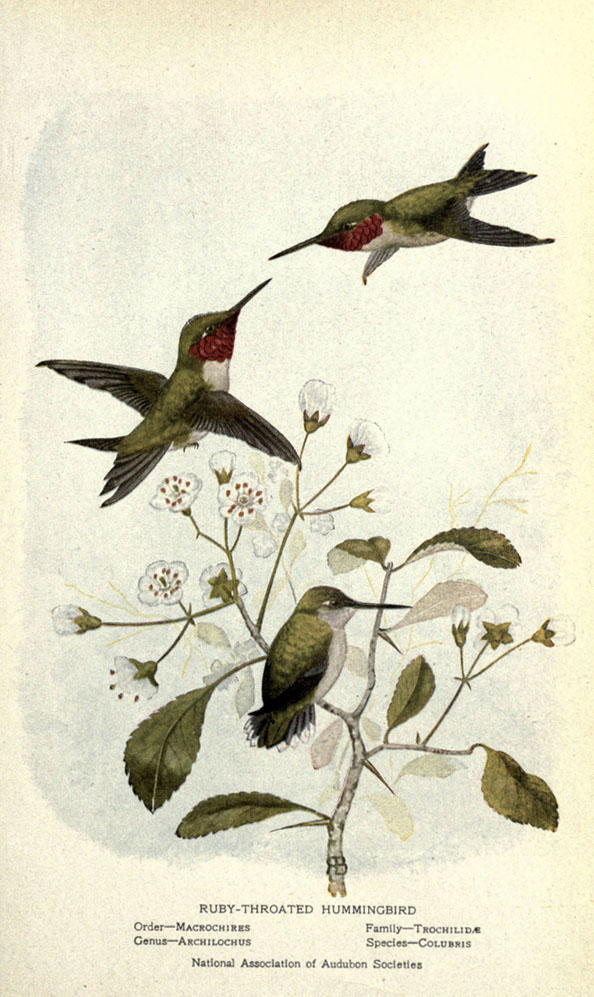
“I underrated her powers for already this thicket of road is, if anything, more beautiful than ever. Fire weed, Eupatorium, Impatiens, Asters, Golden rod and several other tall and rank flowering plants have shot up through and almost perfectly concealed the unsightly brush and stone heaps and I have rarely seen a more brilliant or attractive display of wild flowers. The fire weed is especially tall and fine and the jewel weed grows in solid beds yards in extent. Of course the Humming birds had not overlooked such a feeding ground. There were at least three of them there at once including an adult male with blazing ruby throat at which I fired an ineffectual shot.” [4]

In this instance, Brewster noticed that one year was enough time to see plant growth after the woods had been cleared, that the colonizing plants were different from the ones that characterized the location before, and that they had impacted animal life. He penned these observations on ecological succession just a few years before the first scientific paper on this concept was published (“An Ecological Study of the Sand Dune Flora of Northern Indiana”, Henry Chandler Cowles, 1898.). [5]

illustration of two hummingbirds

A painting of Ruby-throated hummingbirds. Two male birds with red throats are hovering face-to-face with their beaks nearly touching. A female sits below in a branch with white flowers. All the birds are green above with white undersides and have long, narrow beaks. Below the painting is the text: “RUBY-THROATED HUMMING Order – MACROCHIRES Family – TROCHILUS Genus – ARCHILOCUS Species – COLUBRIS National Association of Audubon Societies.” (Portraits and habits of our birds. v.2. New York city: National association of Audubon societies,1920. (See on BHL.)

The following year, he wrote:

“The Lake shore has been sadly marred … by the lumbermen who last winter cut all the spruces and many of the fine, tall white pines all the way from this landing to the deep cove near the Tidswell place. […] Lumbering is a very different business now from what it was twenty years ago. Then only the larger trees were taken; now the pulp mills devour everything and nothing is spared thicker at the base than five inches! […] These changes in the character of the forests must make speedy & considerable changes in the bird fauna. The shore near Crocker’s camp, for instance, has been one of the chief breeding grounds for the Bay breasted Warbler. They will breed there no longer, now that all the spruces are gone.” [6]

Knowing now that local extirpations and even total extinction can occur (this was the decade when the passenger pigeon disappeared from the wild), he would have penned this prediction with heavy heart. To help preserve an area he cared about – his familiar stomping grounds along the Concord River in Concord, Mass. – over time, Brewster purchased 300 acres of the riverfront. His ‘October Farm,’ across the river from Great Meadows National Wildlife Refuge, is now protected land with trails recently opened to the public – while his writings, notes and photographs preserve the region for us as he knew it in the 19th and early 20th centuries.

(If you’re interested in learning more, I write an ongoing series of blog posts on the Brewster collection on the Ernst Mayr Library blog. You might like to see archival and modern photos of October Farm, Brewster’s property in Concord.)

References

[1] July and August 1907. Journals of William Brewster, 1871-1919 (inclusive). Find this journal on BHL.

[2] June 1, 1902. Journals of William Brewster, 1871-1919 (inclusive). Find this journal on BHL.

[3] August 27, 1896. Journals of William Brewster, 1871-1919 (inclusive). Find this journal on BHL.

[4] August 15, 1896. Journals of William Brewster, 1871-1919 (inclusive). Find this journal on BHL.

[5] ‘Henry C. Cowles’. The University of Chicago Centennial Catalogues. Web accessed: https://www.lib.uchicago.edu/projects/centcat/fac/facch14_01.html

[6] May 15, 1897. Journals of William Brewster, 1871-1919 (inclusive). Find this journal on BHL.

April 5, 2018by kmichaelis
Blog Reel, Featured Books

POBSP, how they did it : when science meets military interest

In the middle of the Cold War, the Smithsonian Institution embarked on the Pacific Ocean Biological Survey Program (POBSP) to survey U.S. territory islands and atolls dotting the central Pacific Ocean. From 1963 to 1969, researchers sought to inventory the plants and animals present on the islands, observe seasonal variations in numbers and reproduction, and the distribution of pelagic birds. Over the course of the survey, researchers observed approximately 150,000 pelagic birds at sea, banded 1,800,000 birds, and surveyed the flora and fauna of the islands, the most comprehensive study at the time. An incredible amount of data was collected during the POBSP, drastically increasing information available about the ecology of the small islands. Although it resulted in an incredible amount of data, the survey only spanned three years in part due to questions about the funder’s intentions.

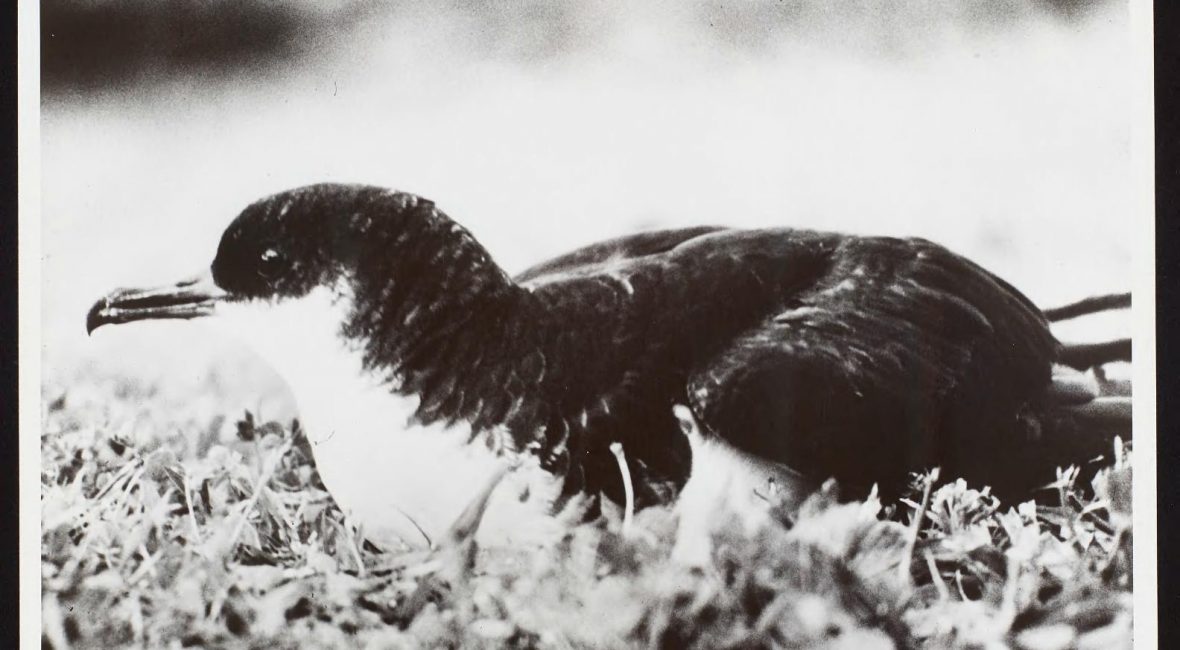
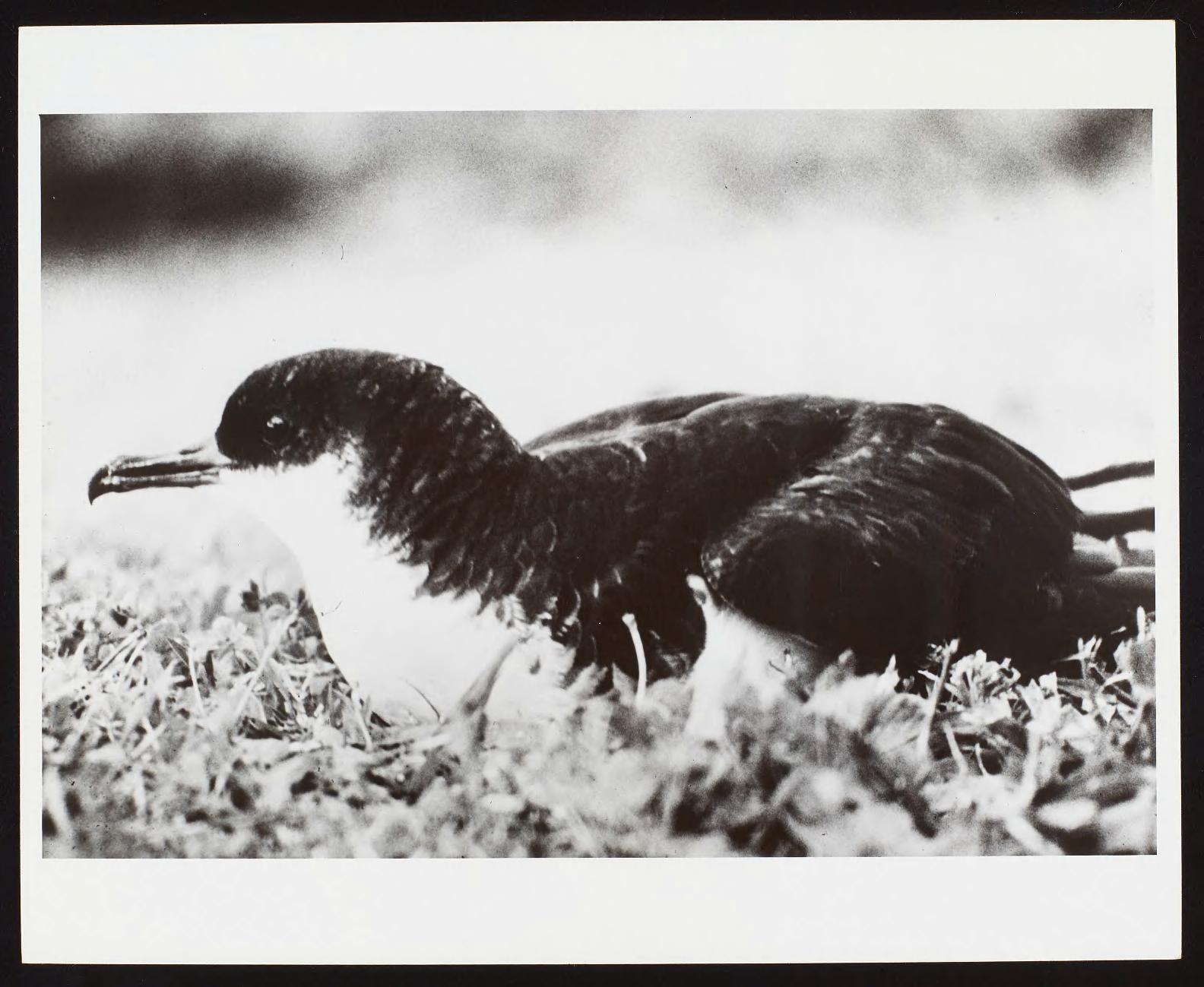
Puffinus newelli (Newell’s shearwater), 1965.
https://www.biodiversitylibrary.org/item/243657

The Smithsonian received grant funds from the Department of Defense for the POBSP. In exchange, the DOD requested basic information about the movements of birds and several thousand blood samples. While the request was unorthodox, it was seen as justified since migratory birds were damaging aircrafts and communications equipment in the Pacific. Smithsonian agreed to the request and embarked on the first stretch of the POBSP in 1963.

Once the survey began, it became clear Smithsonian wasn’t completely aware of what it had signed up for. The military would complete exercises without explanation and kept the Smithsonian staff on a “need to know” basis. There is evidence that some of the researchers tried to get more information on why the military was so interested in the data but didn’t succeed. In the end, the staff accepted requests for secrecy, seeing it as a fair trade for the work they had the opportunity to complete, a task inaccessible to other groups.

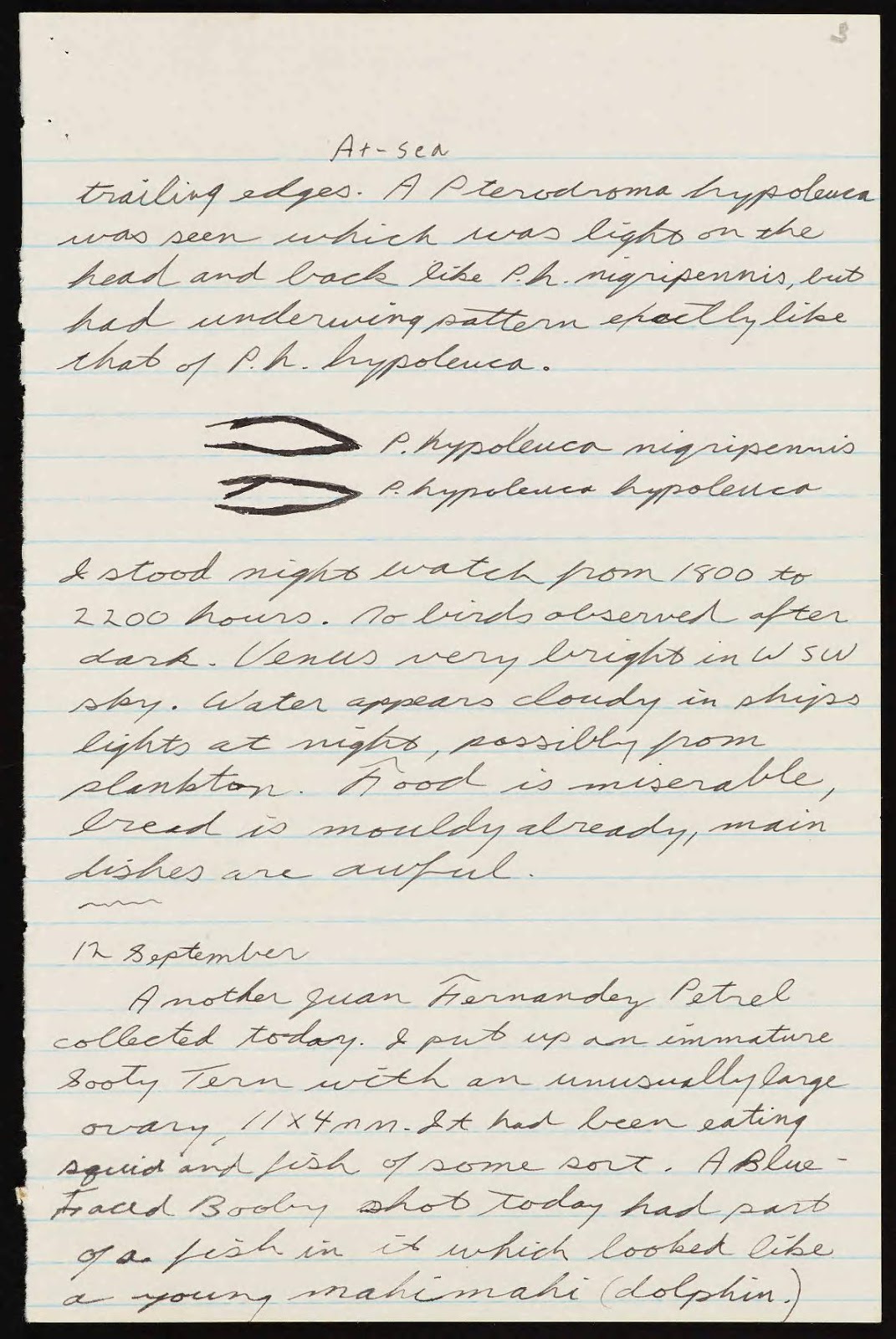
Venus was bright on this particular September night in 1965.
Tordoff, Jeffrey P. 1965. https://biodiversitylibrary.org/page/55214829

We now know that the military conducted germ warfare tests in the Pacific in the 1960s, including The Pacific Project which exposed military personnel and biologists to chemical cleansers and bacteria which have been linked to debilitating conditions. There’s no official connection between the POBSP samples and these tests, and researchers from the Survey have not reported similar health effects as military personnel who were part of the Pacific Project. But the Department of Defense’s interest in the blood samples and migration patterns sparked suspicion which ultimately ended funding for the Survey in 1969.

Considering the political climate at the time, the Smithsonian was perhaps naïve in not considering the implications of the exchange in funds and information with the Department of Defense. The Institution’s researchers were offered the opportunity to complete research in remote areas that were expensive to study and required military cooperation to even get to. The younger biologists were particularly thrilled at the chance to be out in the field for weeks at a time like the biologists before them. What they all saw was a godsend.

List of blood samples collected in 1966.
Laysan Island, October 1966, Blood. https://www.biodiversitylibrary.org/page/54928748

The history of the POBSP and its connection to American military interests of the 1960s is incomplete, and parts of it will likely remain unknown. Despite this dark side to the survey, it is undeniable that Smithsonian’s researchers were able to collect an impressive amount of information during their expeditions to the Pacific. As part of the BHL Field Notes Project, the Smithsonian Institution Archives has taken on the task of digitizing field notes from the POBSP. Considering the shear amount of data collected, it should be no surprise that there are over 1000 field notebooks in the collection, making this SIA’s largest undertaking for the Field Notes Project.

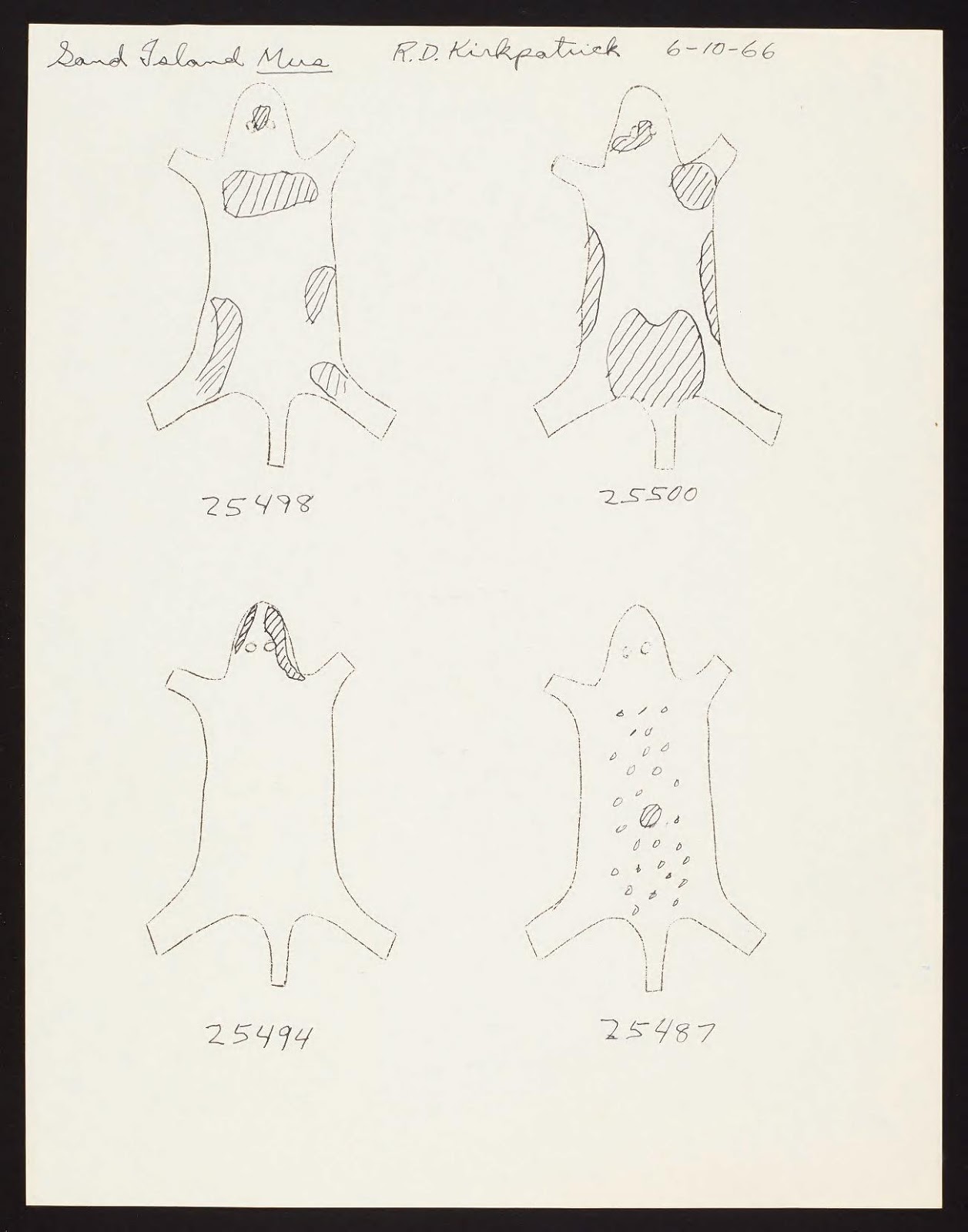
Mus autopsy data, 1966.
https://www.biodiversitylibrary.org/page/55373636

To date, nearly 300 field notes from the collection are readily available in BHL, and many more are in the final post-processing stages in preparation for BHL. Stay tuned for the complete set of notes in the upcoming months.

The BHL Field Notes Project is funded by the Council on Library and Information Resources (CLIR).

References
Finding Aid for “Record Unit 245, National Museum of Natural History, Pacific Ocean Biological Survey Program, Records, circa 1961-1973, with data from 1923”.

MacLeod, R. (2001). “Strictly for the Birds”: Science, the Military and the Smithsonian’s Pacific Ocean Biological Survey Program, 1963-1970. Journal of the History of Biology, 34(2), 315-352.

Rauzon, M J. (2006). “Live Ammo: Testing of Biochemical Agents on U.S. Sailors.” The Asia -Pacific Journal : Japan Focus, 4 (12).

Further Reading
Hunter, E. (2011). “Life in the Field: a Reflection on Cataloging Field Notes in the Pacific Ocean Biological Survey Program.” Smithsonian Field Book Project Blog.

Lamb, J. (2016).  “TheStrange Tale of the Pacific Ocean Biological Survey Program.” JSTOR Daily.

Parilla, L. (2013). “I Found It in a Field Book: Hawaiian Monk Seal Family Images.” Smithsonian Field Book Project Blog.Tennis, A. (2016). “Invasive Pests of the Pacific.” Smithsonian Field Book Project Blog.

March 1, 2018by mkahn
Page 1 of 3123»

Help Support BHL

BHL's existence depends on the financial support of its patrons. Help us keep this free resource alive!

search

About BHL

The Biodiversity Heritage Library (BHL) is the world’s largest open access digital library for biodiversity literature and archives. BHL operates as a worldwide consortium of natural history, botanical, research, and national libraries working together to digitize the natural history literature held in their collections and make it freely available for open access as part of a global “biodiversity community.”

Join Our Mailing List

Sign up to receive the latest news, content highlights, and promotions.

Subscribe Now

Subscribe to Blog via Email

Enter your email address to subscribe to this blog and receive notifications of new posts by email.

Join 319 other subscribers

Subscribe to Blog Via RSS

Subscribe to the blog RSS feed to stay up-to-date on all the latest BHL posts.

Access RSS Feed

Inspiring Discovery through Free Access to Biodiversity Knowledge.

The Biodiversity Heritage Library makes it easier than ever for you to access the information you need to study and explore life on Earth…for free, anytime, anywhere.


64+ Million Pages of
Biodiversity Literature Online.

EXPLORE

Tools and Services
to Transform Research.

EXPLORE

300,000+
Illustrations on Flickr.

EXPLORE

ABOUT | HARMFUL CONTENT | PRIVACY | SITE MAP | TERMS OF USE