Biodiversity Heritage Library - Program news and collection highlights from BHL
  • Home
  • News
  • Featured Books
    • All Featured Books
    • Book of the Month Series
    • BHL at 20
  • User Stories
  • Campaigns
    • Fossil Stories
    • Garden Stories
    • Monsters Are Real
    • Page Frights
    • Her Natural History
    • Earth Optimism 2020
  • Tech Blog
  • Visit BHL
Home
News
Featured Books
    All Featured Books
    Book of the Month Series
    BHL at 20
User Stories
Campaigns
    Fossil Stories
    Garden Stories
    Monsters Are Real
    Page Frights
    Her Natural History
    Earth Optimism 2020
Tech Blog
Visit BHL
  • Home
  • News
  • Featured Books
    • All Featured Books
    • Book of the Month Series
    • BHL at 20
  • User Stories
  • Campaigns
    • Fossil Stories
    • Garden Stories
    • Monsters Are Real
    • Page Frights
    • Her Natural History
    • Earth Optimism 2020
  • Tech Blog
  • Visit BHL
Biodiversity Heritage Library - Program news and collection highlights from BHL
Blog Reel, Featured Books

Frances Sargent Osgood and the Language of Flowers: A 19th Century Literary Genre of Floriography and Floral Poetry

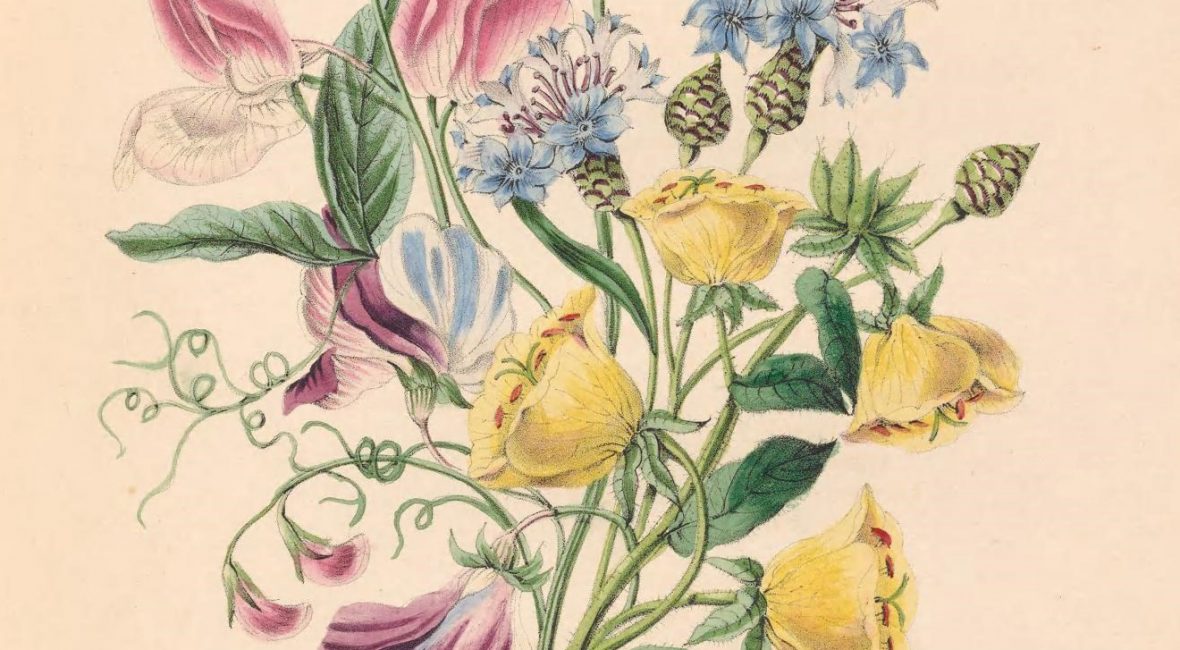
Sweet Pea, Bluebottle Centaury, and Evening Primrose.
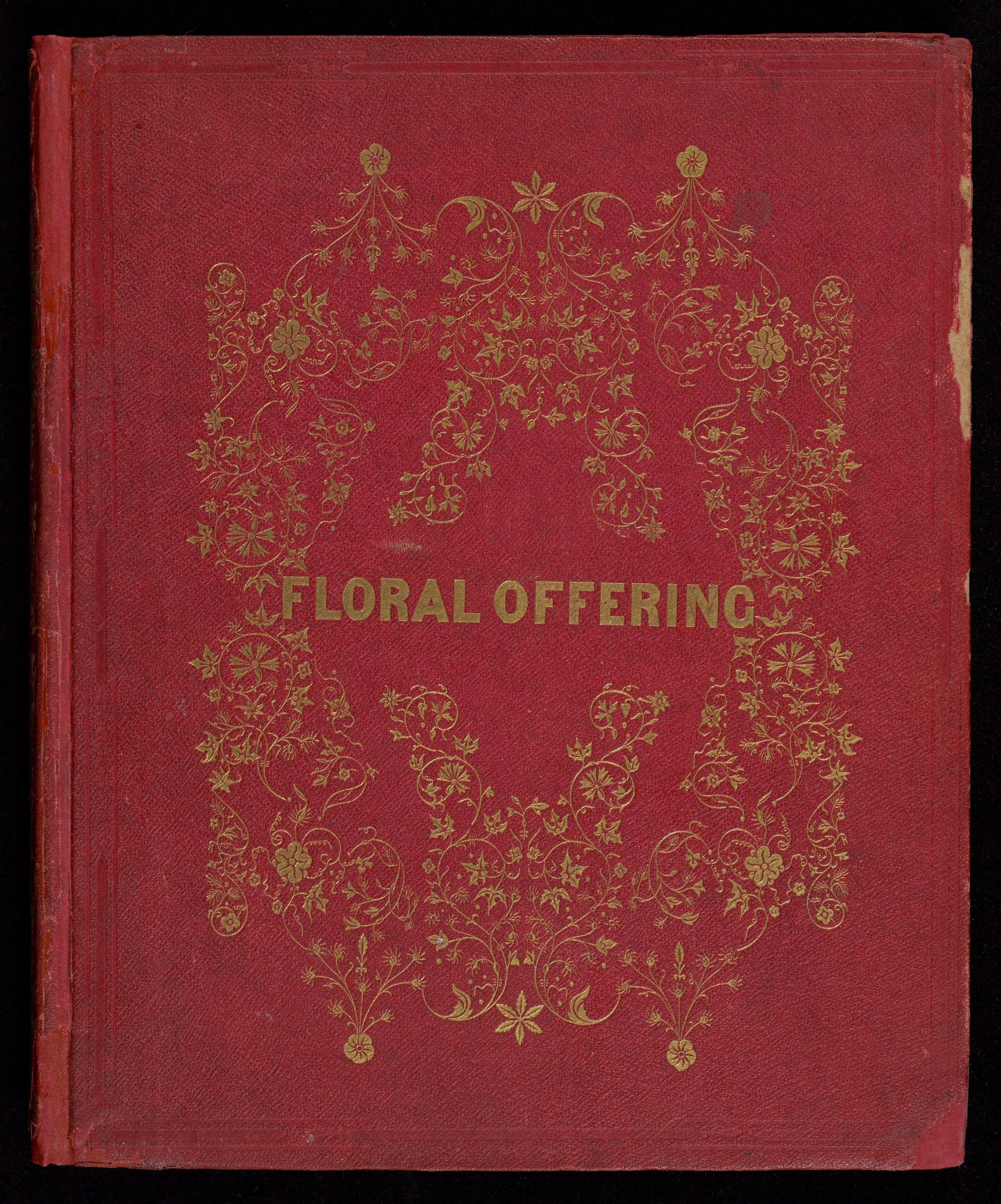
Cover of the book "The Floral Offering"

Cover. Osgood, Frances Sargent (editor). The Floral Offering, A Token of Friendship (1847). Contributed in BHL from Chicago Botanic Garden, Lenhardt Library. Digitization sponsored by the National Endowment for the Humanities (NEH).

The Language of Flowers genre is at the intersection of botany, horticulture, natural history, art, poetry, and women’s studies. This popular literary trend in the 19th century presented the world of botany through dictionaries of flowers and associated meanings, floral poetry, and prose, offering a sentimental view of natural history. A properly arranged bouquet was said to convey a “secret message” for the recipient. The “social media” of its day, this Victorian fad led to many editions of works published, with multiple titles by successful authors.

Frances Sargent Osgood edited two works in this genre: Poetry of Flowers and Flowers of Poetry and The Floral Offering.

Her description of floriography from her introductory poem in the Floral Offering follows:

INTRODUCTORY.

THY EMBLEM FLOWER.

Round every flower there gleams a glory

Bequeathed by antique song or story;

To each, old legends give a name

And its peculiar charm proclaims;

O’er smiling lawn – through shaded grove,

Our dreaming poets pensive rove,

And strive to read their language rare,

And learn the lesson latent there-

Then ‘mid them all, so fair to see,

What flower shall thy fit emblem be?

The Floral Offering, a Token of Friendship was edited by Frances S. Osgood and illustrated by J. Ackerman “with ten beautiful bouquets of flowers, elegantly colored after nature.” The work was published in Philadelphia, PA by Carey and Hart publishers in 1847. It contains poems by Osgood and others, plates with flowers assembled in bouquets, and a floral dictionary at the back containing her definitions of flowers. For example, basil means “I hate you” and olive means “peace be with you.” Osgood uses these definitions to ascribe secret messages. The list of illustrations for the plates provides the “secret message” that each illustrated arrangement is meant to convey.
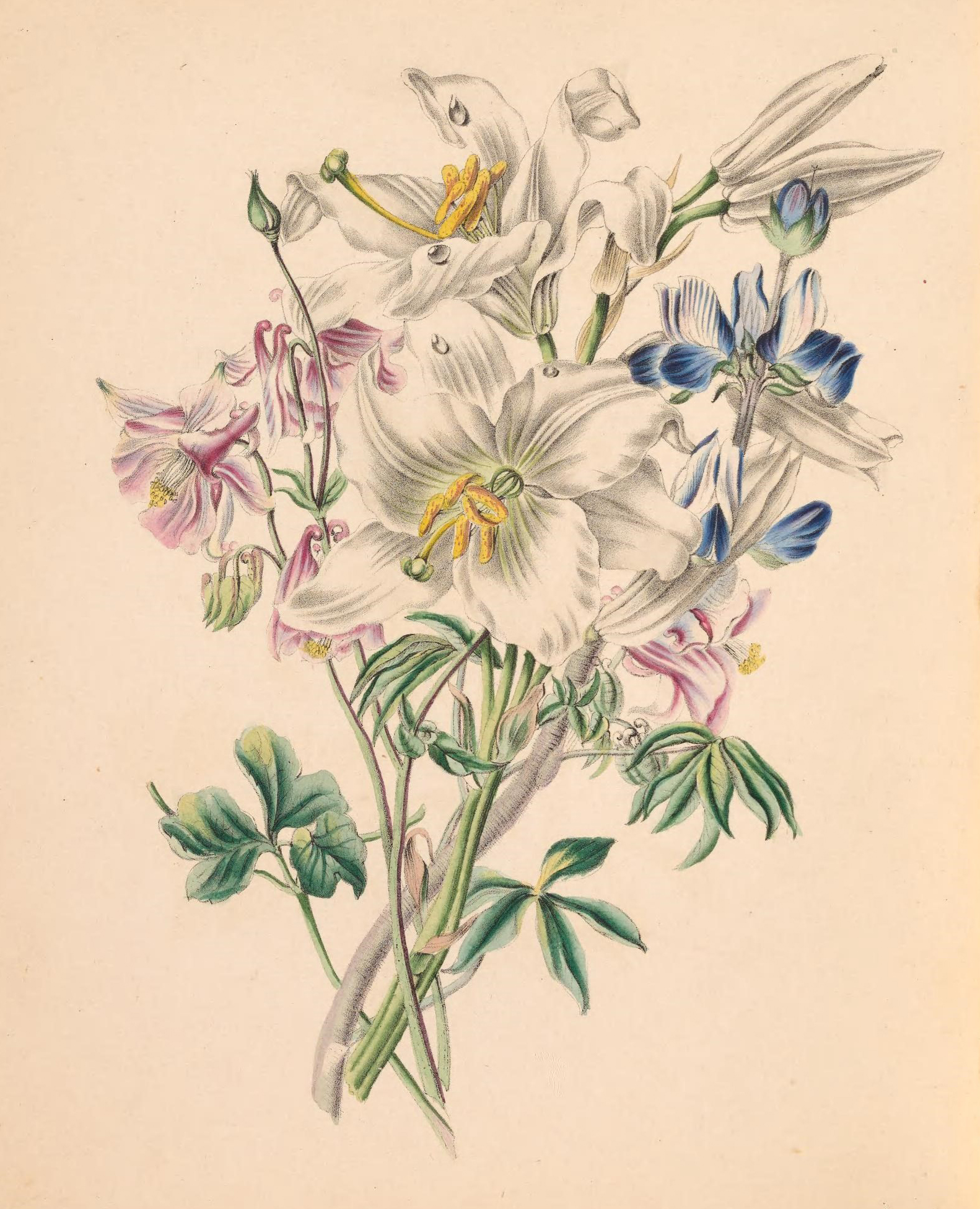
Columbine, White Lily and Lupine.

Columbine, White Lily and Lupine. Secret message: It was a dream of folly, from which I woke to weep. Osgood, Frances Sargent (editor). The Floral Offering, A Token of Friendship (1847). Art by J. Ackerman. Contributed in BHL from Chicago Botanic Garden, Lenhardt Library. Digitization sponsored by the National Endowment for the Humanities (NEH).

Frances Sargent Osgood (1811 – 1850) was one of the most influential American women poets of her time. She was born in Boston to a family of poets together with her brother, sister, and step-sister. Early on, her parents recognized her talent and encouraged her pursuits. Her first poem was published when she was a young teenager. She was a prolific writer and published numerous works in magazines for women and children and also authored and edited several books.

Osgood married a painter, Samuel Stillman Osgood, in 1835. He had previously studied at the Royal Academy, and they moved back to London where he had a successful career painting portraits. During the four years that they lived abroad, Osgood remained active in her craft and in 1839 published a compilation of all her work in a volume entitled Wreath of Wild Flowers from New England. With the unexpected death of her father, the Osgoods returned to the States, first to her family home in Boston and then settling in New York in 1840. While in New York, Osgood published two volumes in the language of flowers genre in 1841 and 1847.
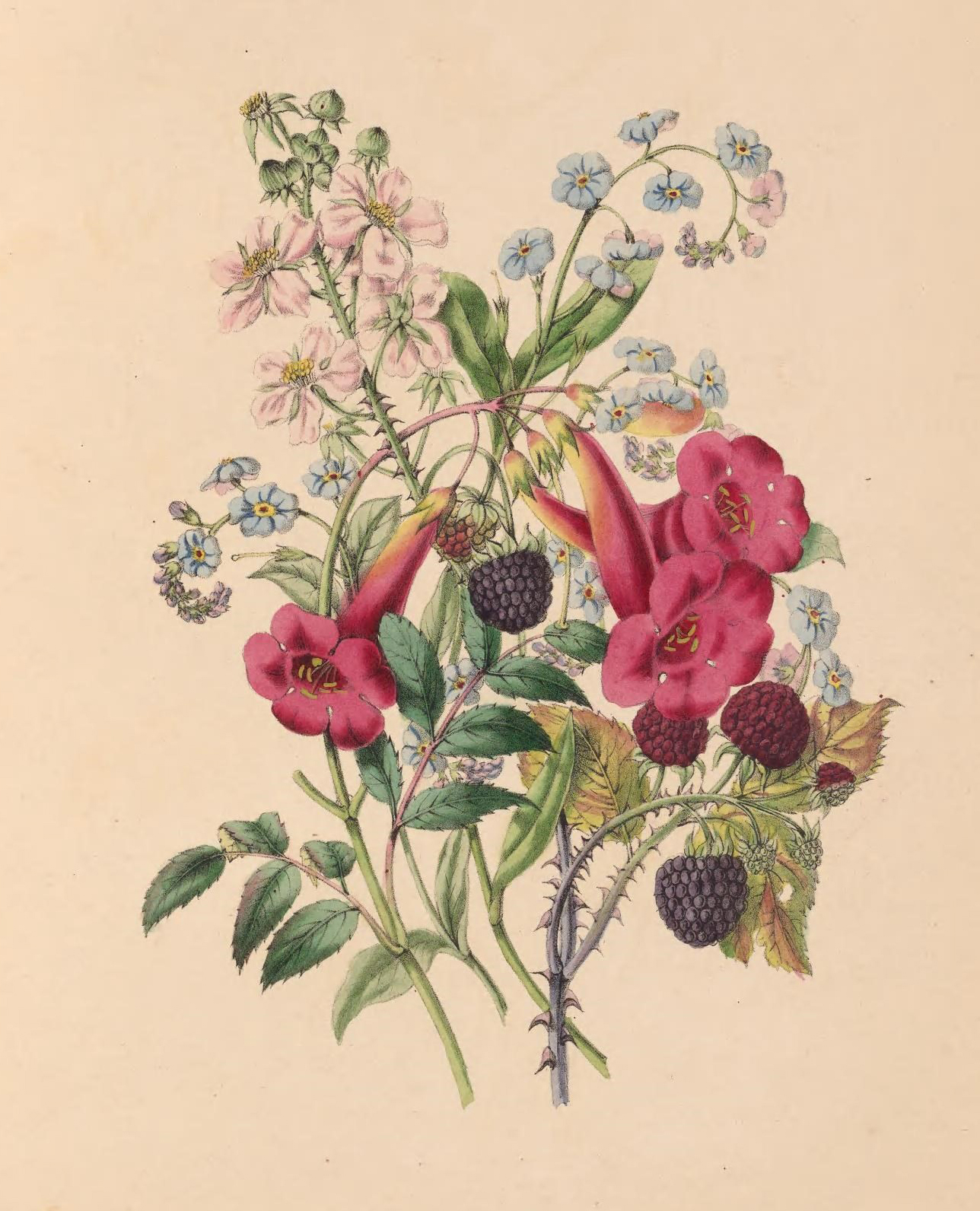
Trumpet.-flower, Forget-Me-Not, and Raspberry.

Trumpet.-flower, Forget-Me-Not, and Raspberry. Secret message: Farewell, be true to thyself, yet sometimes think of me. Osgood, Frances Sargent (editor). The Floral Offering, A Token of Friendship (1847). Art by J. Ackerman. Contributed in BHL from Chicago Botanic Garden, Lenhardt Library. Digitization sponsored by the National Endowment for the Humanities (NEH).

Osgood was very well known during her life-time, such that her biography appears in The American Female Poets; with Biographical and Critical Notices (1848), by Caroline May, and in The Female Poets of America (1849), edited by Rufus Griswold. Her notoriety and embracement of the language of flowers genre may have influenced and encouraged other women to write in the field of horticulture, botany, and natural history.

An interesting side note to her time in New York is Osgood’s association with Edgar Allen Poe. He published her poems and thought highly of her work. Their friendship is rumored to have developed into a love affair.
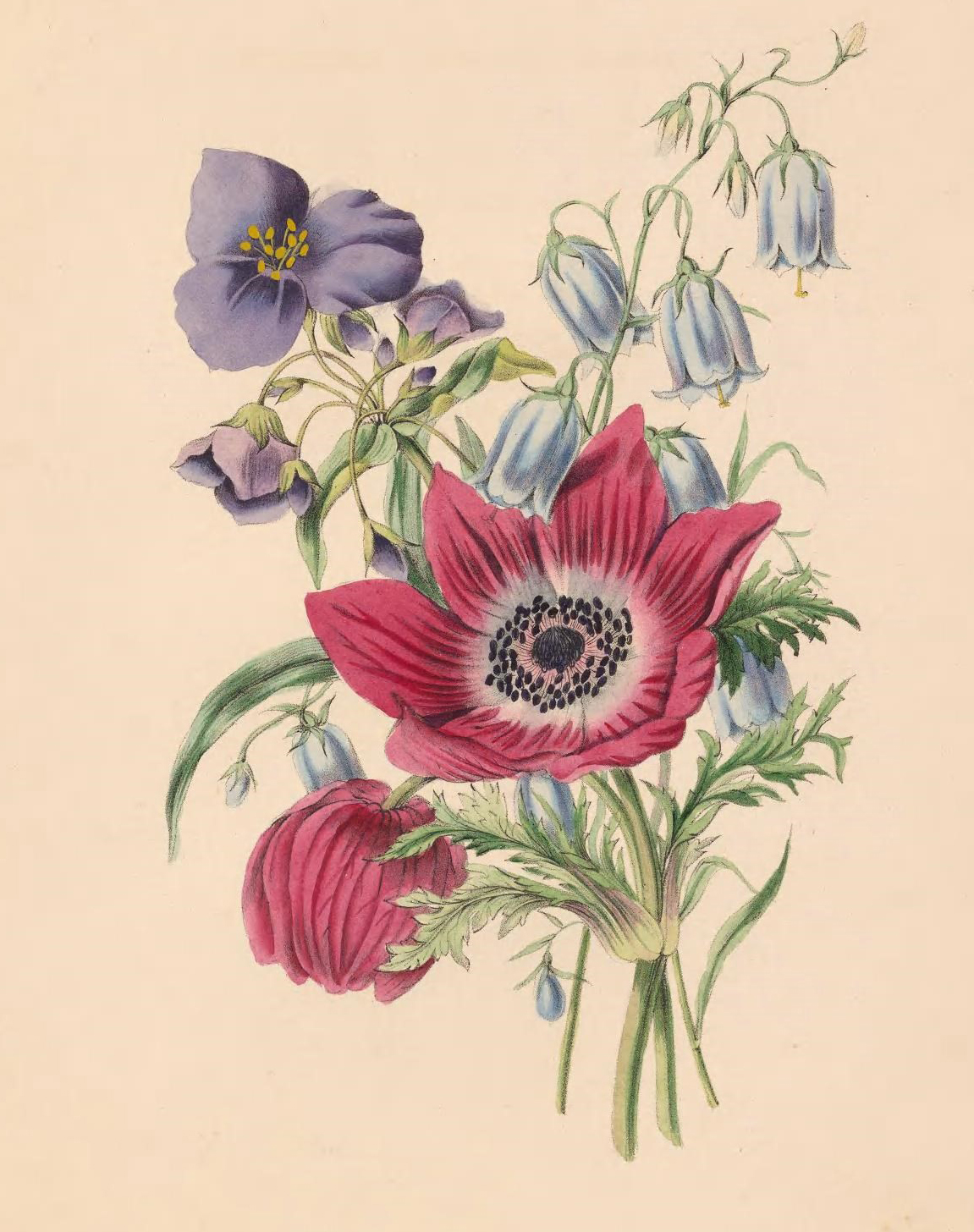
Anemone, Harebell, and Spiderwort.

Anemone, Harebell, and Spiderwort. Secret message: Thou art false, and I resign myself to my fate. Osgood, Frances Sargent (editor). The Floral Offering, A Token of Friendship (1847). Art by J. Ackerman. Contributed in BHL from Chicago Botanic Garden, Lenhardt Library. Digitization sponsored by the National Endowment for the Humanities (NEH).

Frances Sargent Osgood died from tuberculosis in 1850 at 38 years old. She was buried in Mount Auburn Cemetery near Boston with her daughter that preceded her in death. Her other two daughters died just after her in 1851.

The Memorial (1851) by “Friends of the Late Mrs. Osgood” and edited by Mary E. Hewitt was a tribute to her life. Its 346 pages contain numerous pieces by different authors; it is truly an acknowledgement of her importance to her family, friends, and literary colleagues.
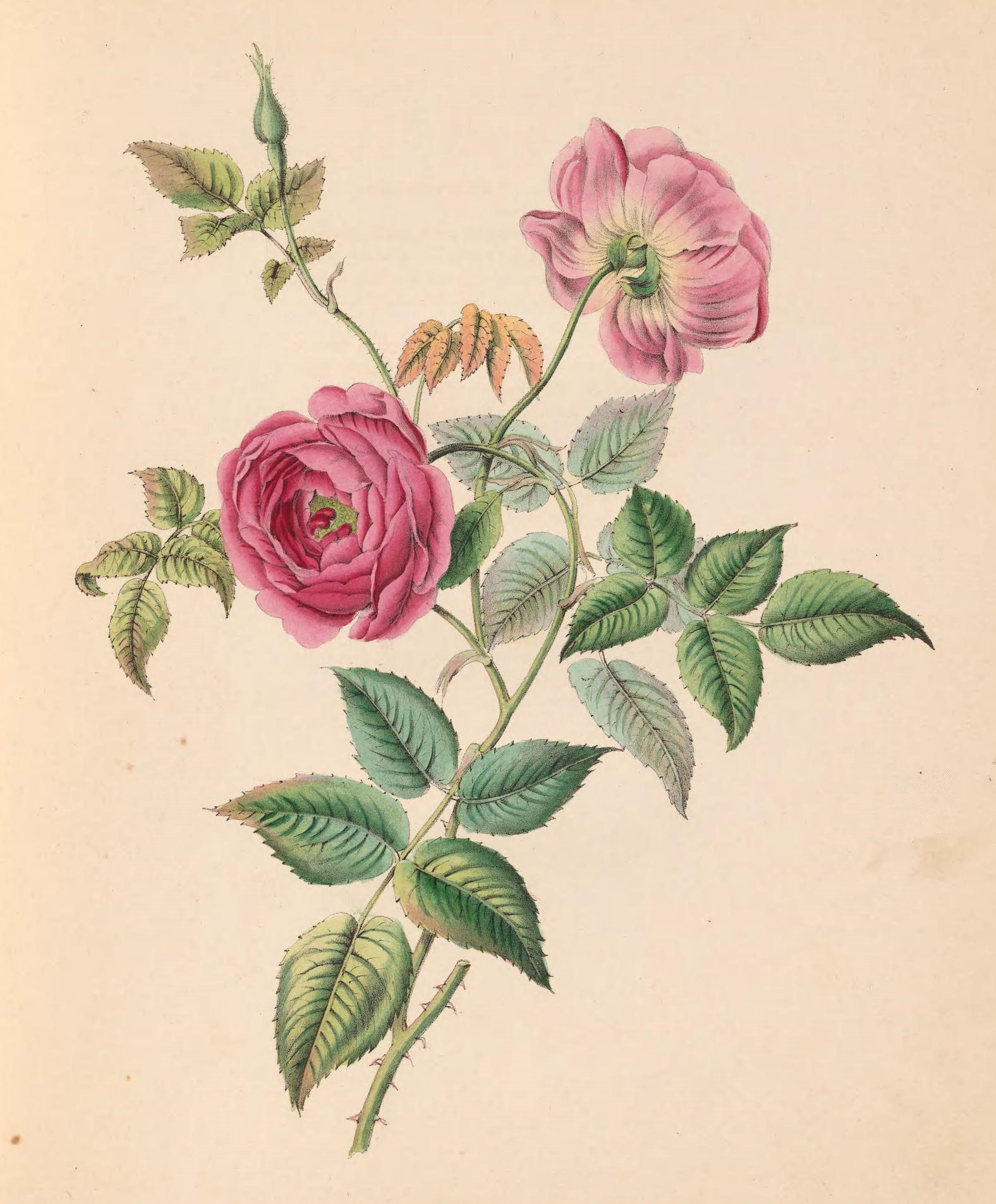
Two roses.

The Rose. Secret message: Beauty and love. Osgood, Frances Sargent (editor). The Floral Offering, A Token of Friendship (1847). Art by J. Ackerman. Contributed in BHL from Chicago Botanic Garden, Lenhardt Library. Digitization sponsored by the National Endowment for the Humanities (NEH).

The Lenhardt Library of the Chicago Botanic Garden is digitizing 62 rare and unique language of flowers volumes published in the 19th century as part of a grant from the National Endowment for the Humanities (NEH) awarded to the Chicago Horticultural Society. Over three-years, the volumes are being conserved and digitized by expert staff at the Northeast Document Conservation Center. The Floral Offering is from the second set of volumes. You can explore volumes from sets one and two as well as other titles in the Language of Flowers collection in BHL. Learn more about other language of flowers volumes digitized as part of this grant in this past blog post.
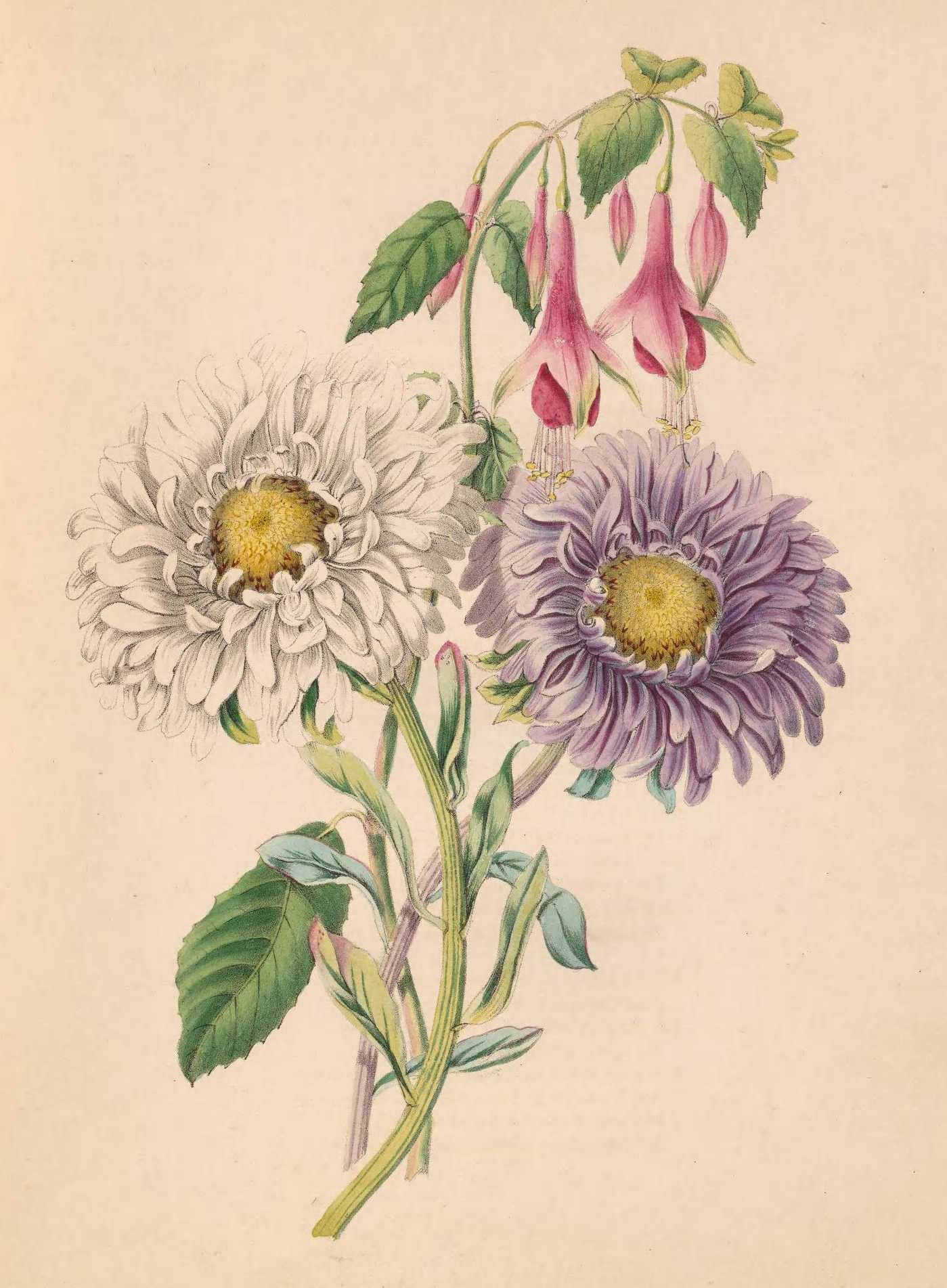
China-Aster and Fuchsia.

China-Aster and Fuchsia. Secret message: Caprice is a woman’s privilege. Osgood, Frances Sargent (editor). The Floral Offering, A Token of Friendship (1847). Art by J. Ackerman. Contributed in BHL from Chicago Botanic Garden, Lenhardt Library. Digitization sponsored by the National Endowment for the Humanities (NEH).
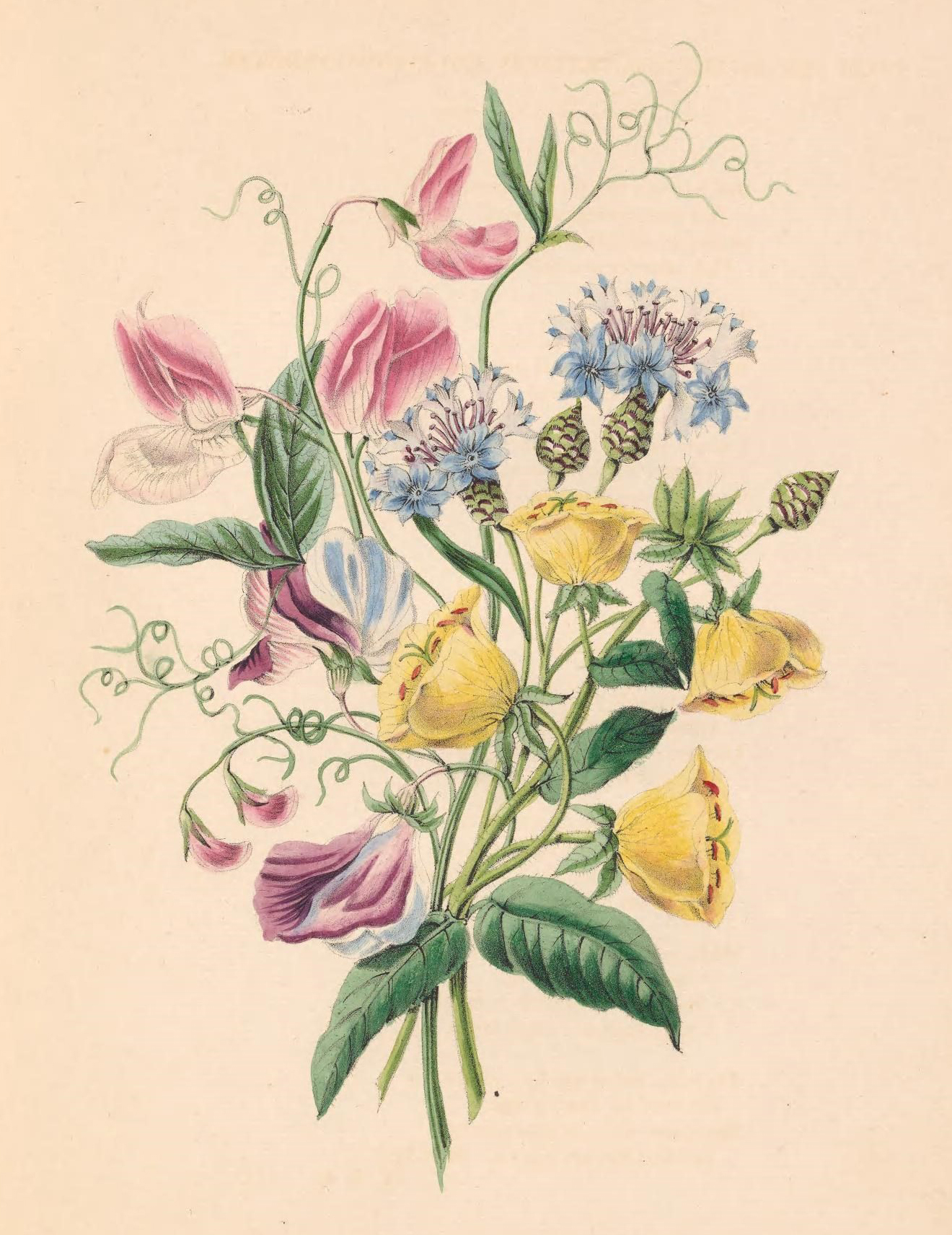
Sweet Pea, Bluebottle Centaury, and Evening Primrose.

Sweet Pea, Bluebottle Centaury, and Evening Primrose. Secret message: Goodbye! Our love was too lovely to last. Osgood, Frances Sargent (editor). The Floral Offering, A Token of Friendship (1847). Art by J. Ackerman. Contributed in BHL from Chicago Botanic Garden, Lenhardt Library. Digitization sponsored by the National Endowment for the Humanities (NEH).

References

Griswold, Rufus W. The Female Poets of America. Philadelphia: Carey and Hart, 1849. Internet resource.

Hewitt, Mary E. M, and Frances S. Osgood. The Memorial. New York: G.P. Putnam, 1851. Internet resource.

May, Caroline. The American Female Poets: With Biographical and Critical Notices. Philadelphia: Lindsay & Blakiston, 1848. Internet resource.
November 19, 2020by michelle.underhill
Blog Reel, Featured Books

Flora Graeca: “The Most Costly and Beautiful Book Devoted to Any Flora”

plants
plants

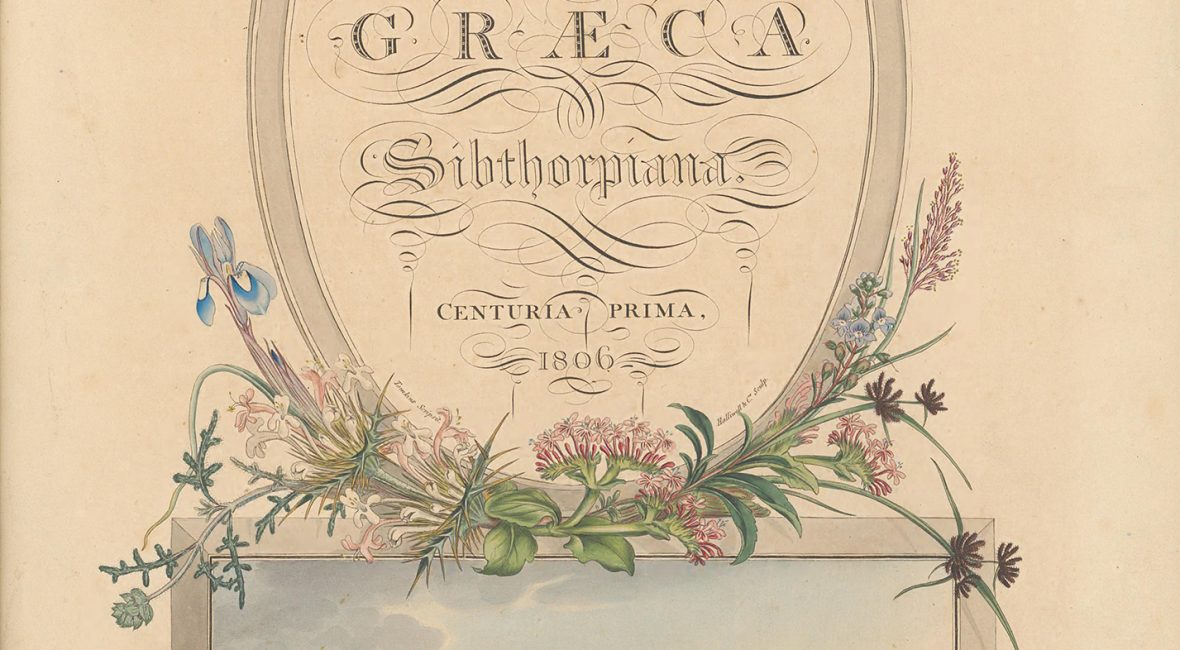
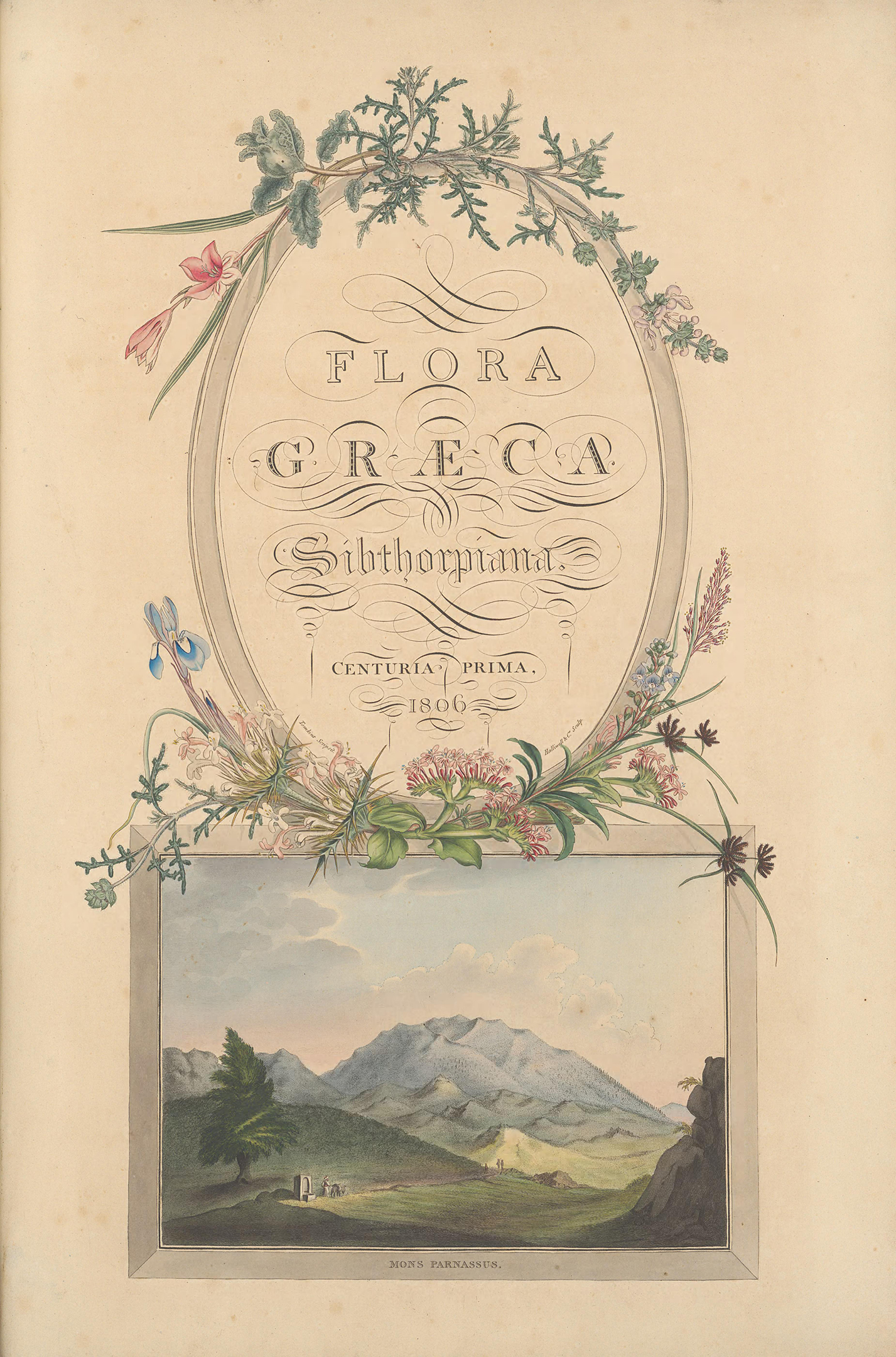
Title page. Sibthorp, John. Flora Graeca. v. 1 (1806). Contributed in BHL from Lloyd Library and Museum. Digitized by Public Library of Cincinnati and Hamilton County.

John Sibthorp’s Flora Graeca (1806-1840) has been described as “the most costly and beautiful book devoted to any flora” [1]. Dedicated to the plants of Greece and the eastern Mediterranean, only 30 subscriptions for the first edition were sold and of those, only 25 were completed. While each copy was sold for £254, the cost to produce each copy was about £620 [2, 176].

Flora Graeca arose out of botanical expeditions carried out by English botanist John Sibthorp in Greece and Asia Minor between 1786-87 and 1794-1795. Sibthorp employed Austrian artist Ferdinand Lukas Bauer to accompany him on the first expedition and serve as illustrator. During the expedition, Bauer created around one thousand plant sketches, using a color coding process to record the exact colors of the specimens he observed in the field, allowing him to produce accurate final drawings based on his field sketches [3].

plants

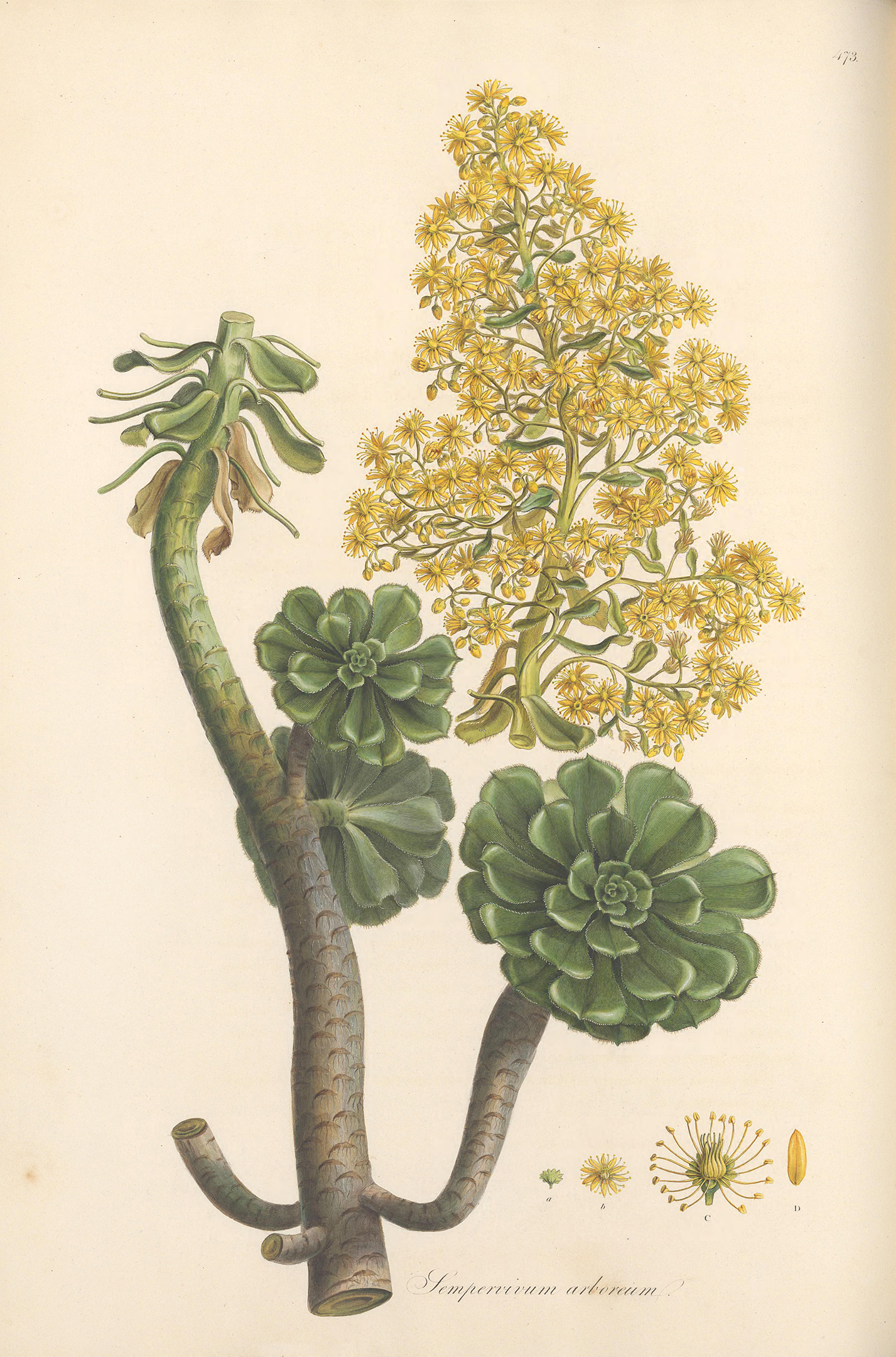
Plate 473. Sibthorp, John. Flora Graeca. v. 5 (1825). Contributed in BHL from Lloyd Library and Museum. Digitized by Public Library of Cincinnati and Hamilton County.

plants

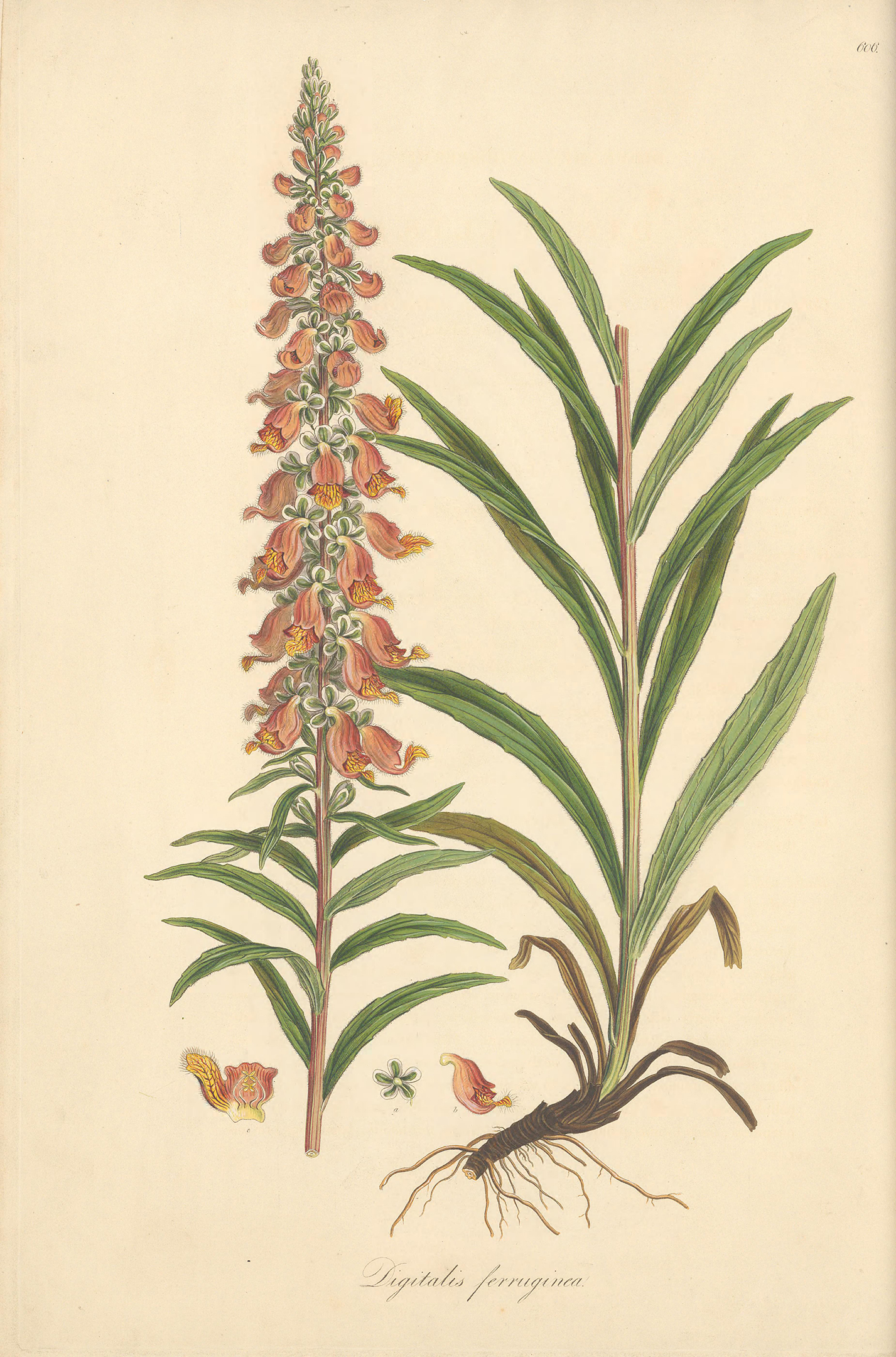
Plate 606. Sibthorp, John. Flora Graeca. v. 7 (1830). Contributed in BHL from Lloyd Library and Museum. Digitized by Public Library of Cincinnati and Hamilton County.

Unfortunately, Sibthrop contracted tuberculosis during the return from his second expedition. He died on 8 February 1796 in Bath, before the work could be completed. His will, however, provided an endowment to ensure the completion of the publication [4].

Sibthorp’s friend and fellow botanist, James Edward Smith, and Sibthorp’s brother-in-law, John Hawkins, oversaw the publication of the first six volumes between 1806-1828. Volume seven was published in 1830, and volumes eight through ten were edited by John Lindley and published between 1833-40. The first nine volumes included 100 plates each, with the final volume consisting of 66 plates [5]. The hand-colored plates were engraved on copper by Bauer, James Sowerby and James de Carle Sowerby after Bauer’s drawings [2, 175].

plants

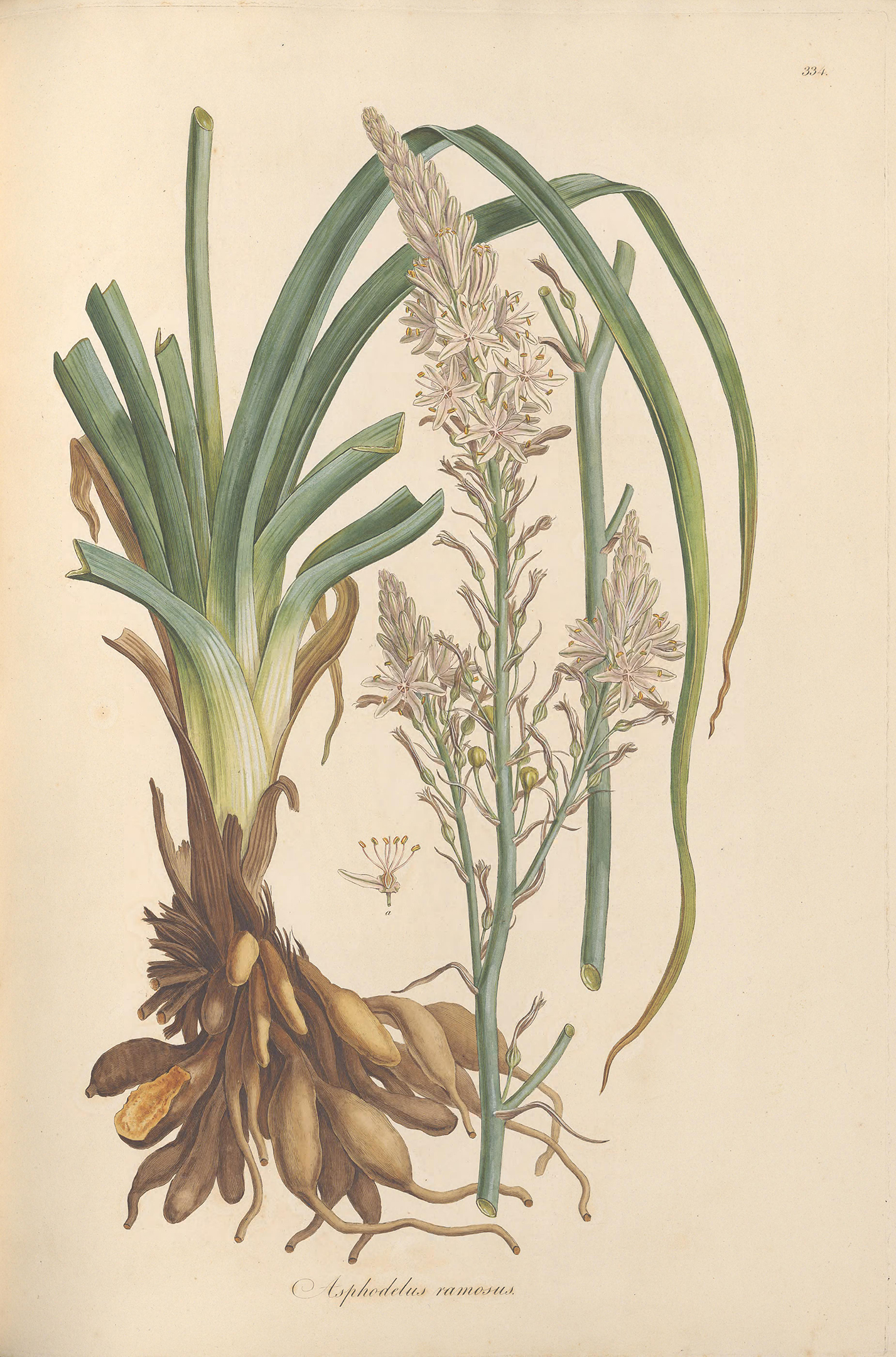
Plate 334. Sibthorp, John. Flora Graeca. v. 4 (1823). Contributed in BHL from Lloyd Library and Museum. Digitized by Public Library of Cincinnati and Hamilton County.

plants

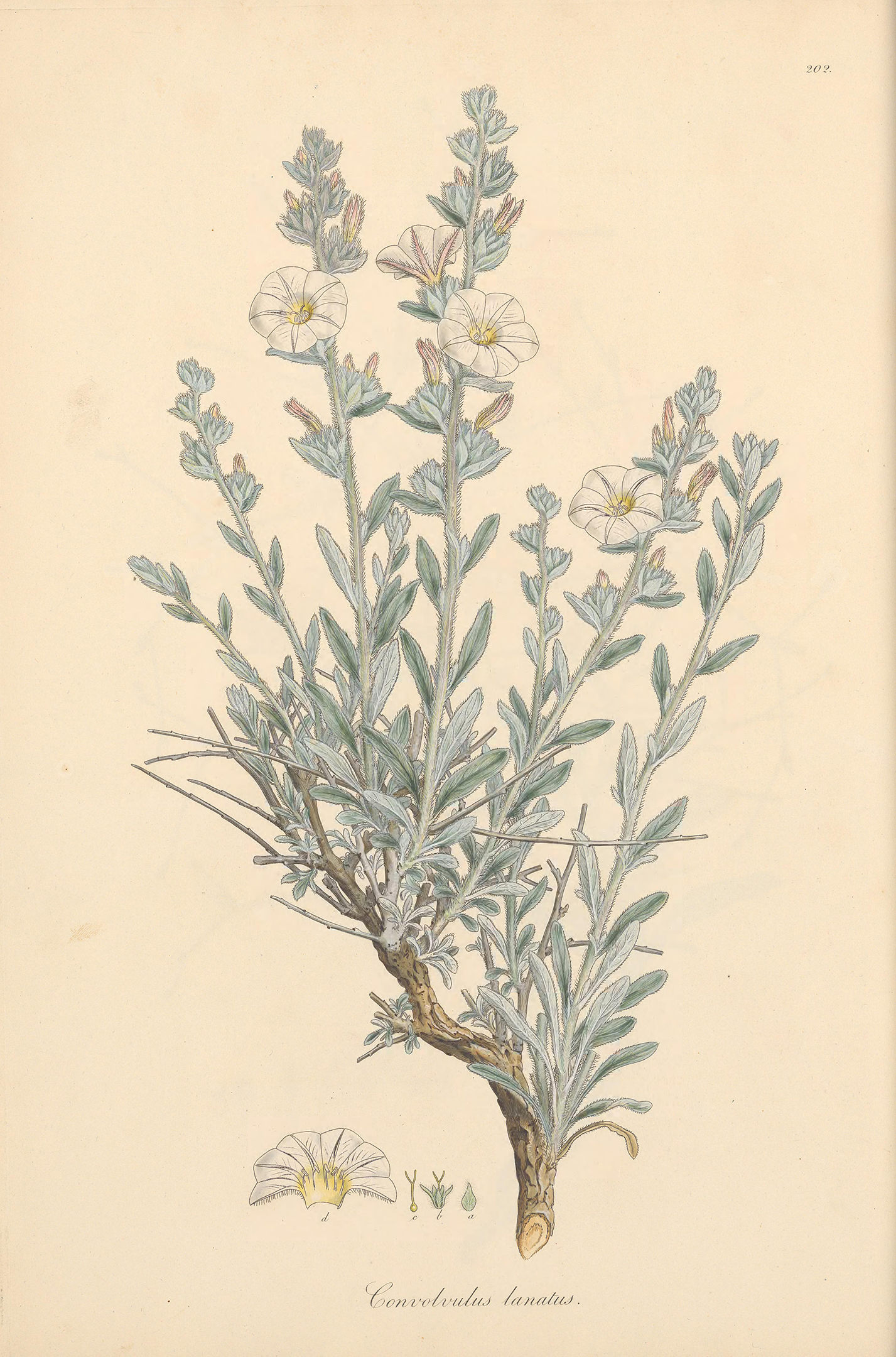
Plate 202. Sibthorp, John. Flora Graeca. v.3 (1819). Contributed in BHL from Lloyd Library and Museum. Digitized by Public Library of Cincinnati and Hamilton County.

The Lloyd Library and Museum is fortunate to own one of the 25 complete copies of the first edition of this title. This copy was digitized by the Public Library of Cincinnati and Hamilton County as part of the BHL Expanding Access to Biodiversity Literature project (funded by the Institute of Museum and Library Services) and is freely available for all to enjoy in the Biodiversity Heritage Library. A volume from this title is also currently on display at the Lloyd Library & Museum as part of the current exhibit Treasures of the Lloyd, which is open until 21 February 2020.

plants

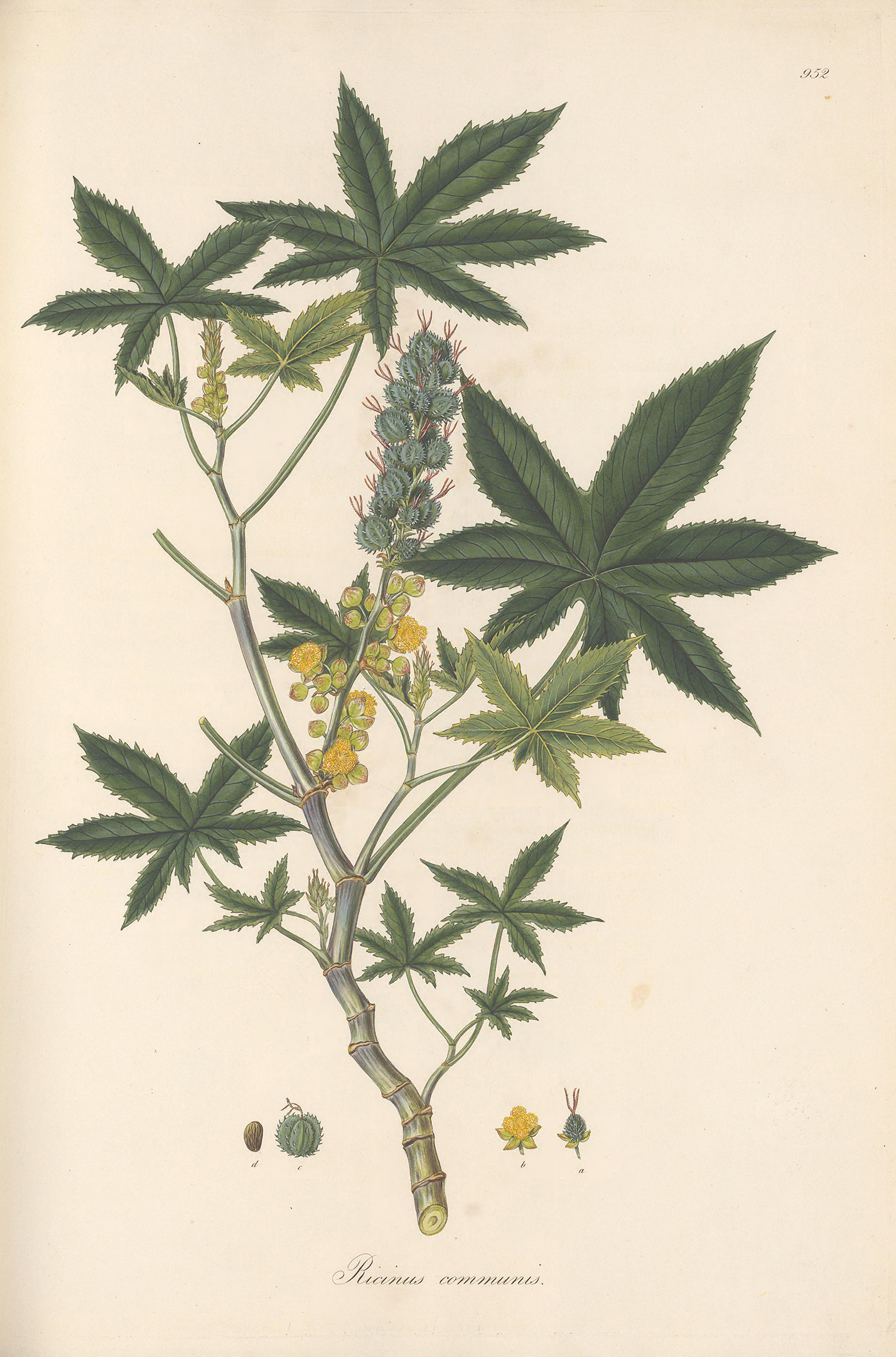
Plate 952. Sibthorp, John. Flora Graeca. v.10 (1840). Contributed in BHL from Lloyd Library and Museum. Digitized by Public Library of Cincinnati and Hamilton County.

plants

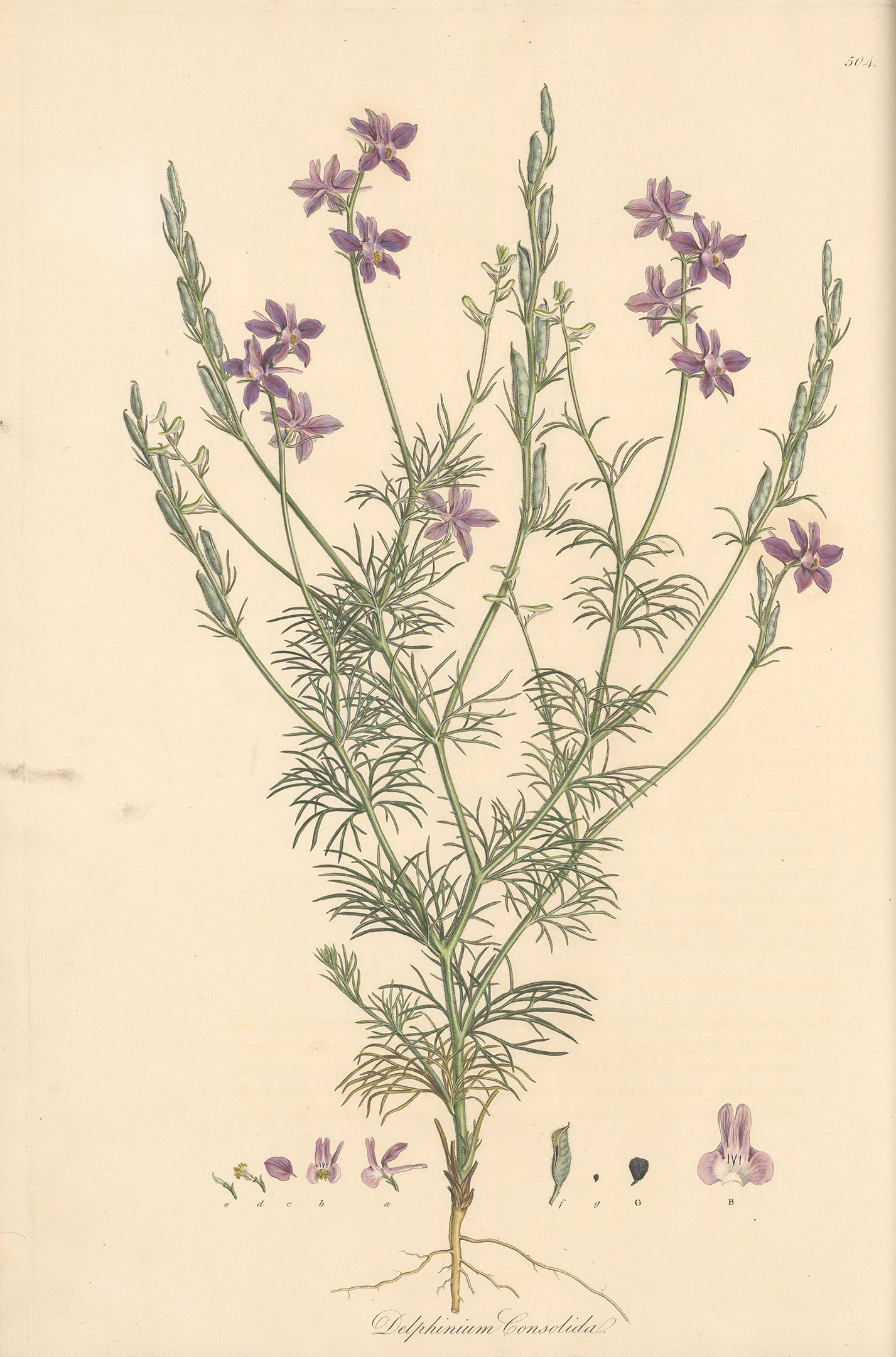
Plate 504. Sibthorp, John. Flora Graeca. v.6 (1828). Contributed in BHL from Lloyd Library and Museum. Digitized by Public Library of Cincinnati and Hamilton County.

plants

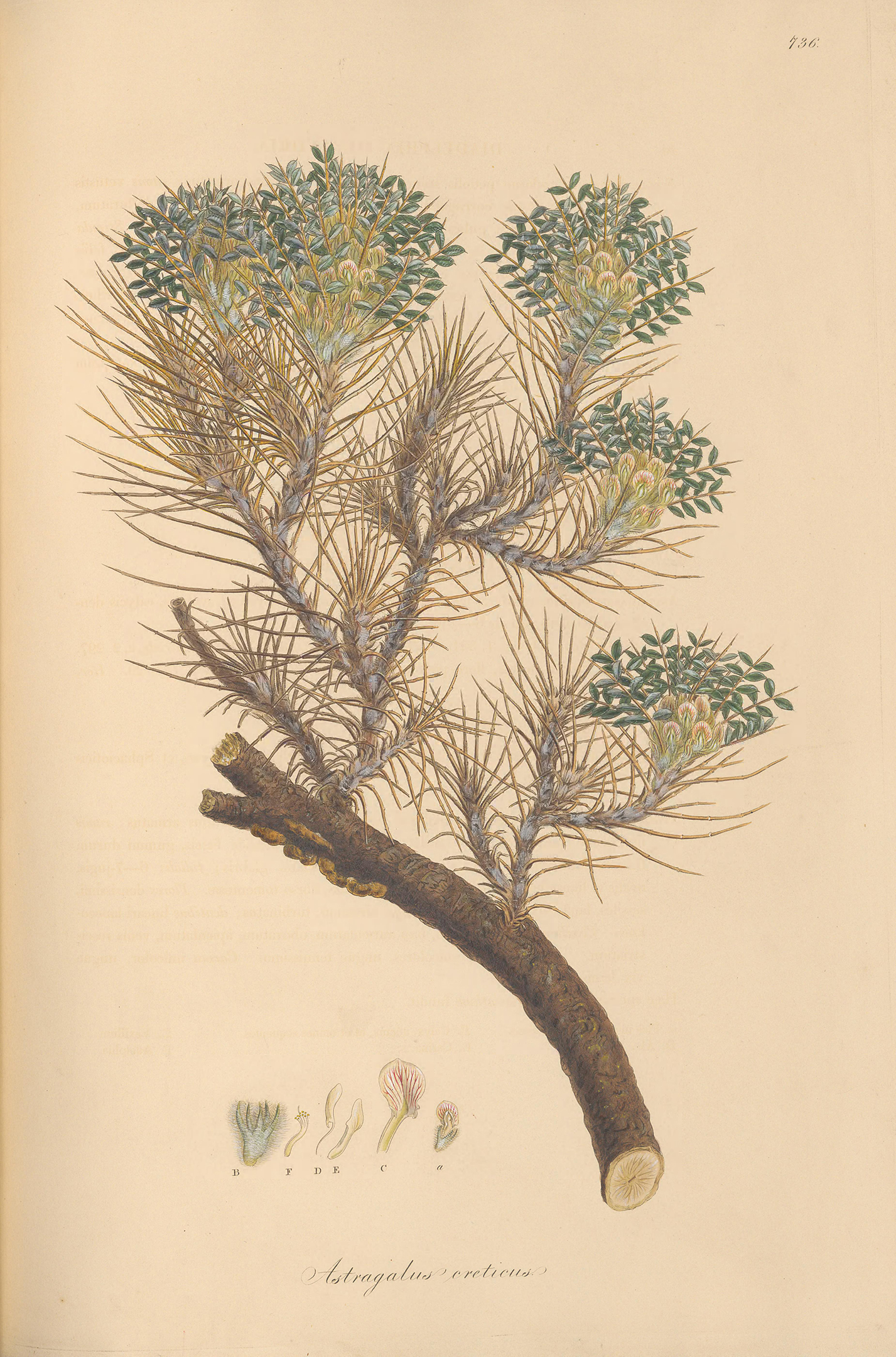
Plate 736. Sibthorp, John. Flora Graeca. v. 8 (1833). Contributed in BHL from Lloyd Library and Museum. Digitized by Public Library of Cincinnati and Hamilton County.

plants

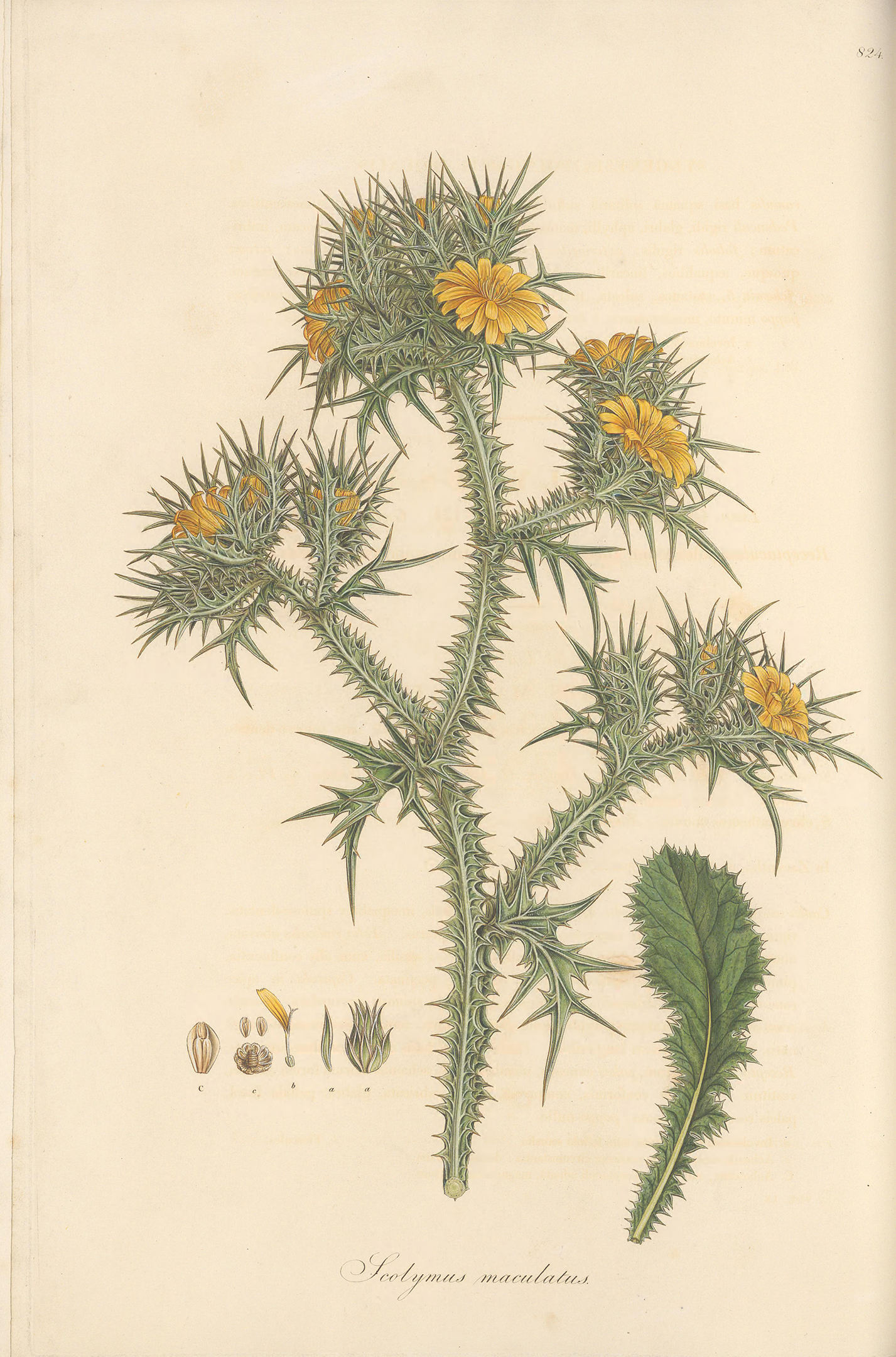
Plate 824. Sibthorp, John. Flora Graeca. v. 9 (1837). Contributed in BHL from Lloyd Library and Museum. Digitized by Public Library of Cincinnati and Hamilton County.

plants

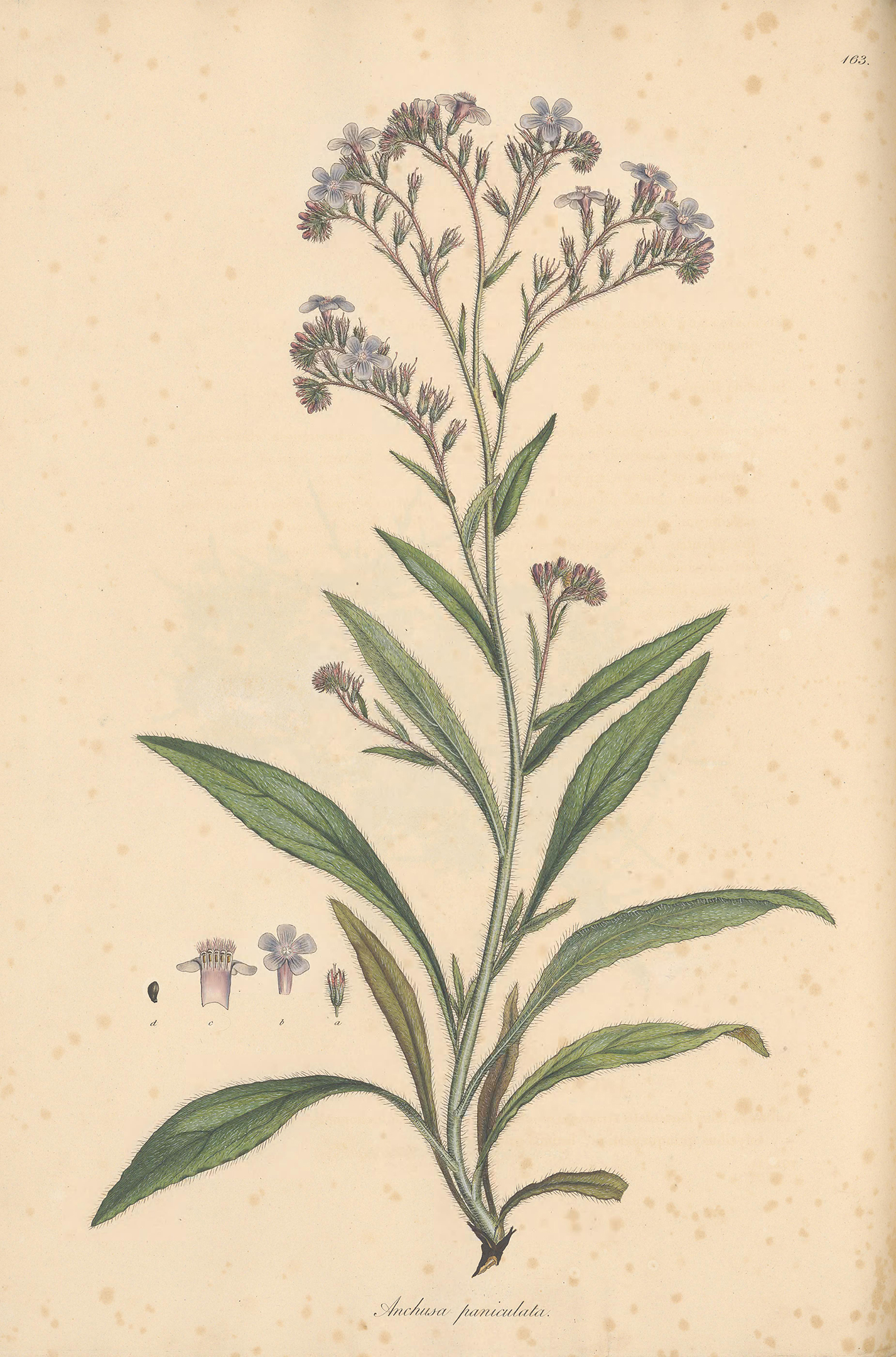
Plate 163. Sibthorp, John. Flora Graeca. v. 2 (1813). Contributed in BHL from Lloyd Library and Museum. Digitized by Public Library of Cincinnati and Hamilton County.

References

[1] Stearn, W. T. (1960). “Franz and Ferdinand Bauer, masters of botanical illustration”. Endeavour 19(73).
[2] Stearn, W. (1967). Sibthorp, Smith, the ‘Flora Graeca’ and the ‘Florae Graecae Prodromus’. Taxon, 16(3), 168-178. doi:10.2307/1216982
[3] Walsh, H. (2003). “Ferdinand Lukas Bauer”. Rare Books from the MBG Library. 23 October. Accessed on 4 February 2020. http://www.illustratedgarden.org/mobot/rarebooks/author.asp?creator=Bauer, Ferdinand Lukas&creatorID=96.
[4] Christie’s. (1997). “Flora Graeca”. Lot 138, sale 8690. Accessed on 4 February 2020. https://www.christies.com/lotfinder/Lot/sibthorp-john-james-edward-smith-and-john-228372-details.aspx.
[5] Europeana. (2020). “Flora Graeca”. Accessed on 4 February 2020. https://www.europeana.eu/portal/en/record/92002/BibliographicResource_1000093325414_source.html.

February 6, 2020by michelle.underhill
Blog Reel, Campaigns, Her Natural History

Dorothea Eliza Smith: Resilient Botanical Illustrator

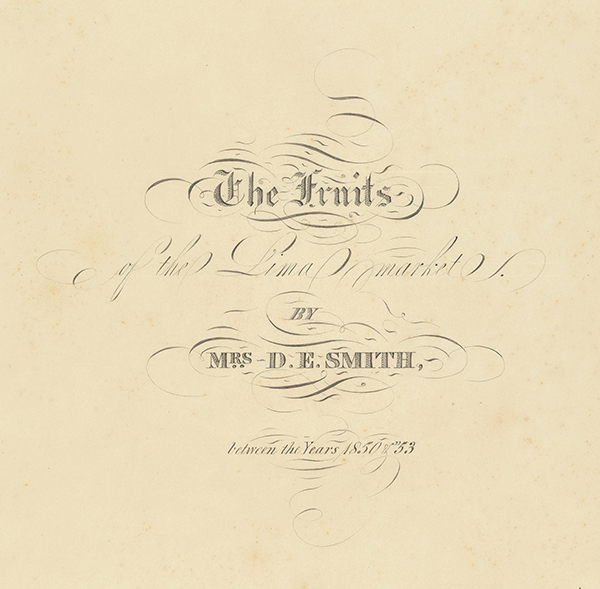
Title page of The Fruits of the Lima Market, a collection of manuscript illustrations by Dorothea Eliza Smith.

As we celebrate the role women have played in the natural history sciences, we can find many examples of successful women who have been under-appreciated for the meaningful work they did during their lives. Women like Maria Sibylla Merian, Mary Margaret Smith, and Evelyn Cheesman significantly advanced a variety of sciences, even if they have only recently been gaining attention for doing so. But historic relegation of women has also meant that countless people throughout history were denied the tools to achieve success in these fields. How many women could have been published artists or scientists, if it weren’t for societal expectations that never gave them the chance?

Within the collections of rare botanical texts and seldom seen manuscripts housed at the Oak Spring Garden Foundation is a beautiful work by a largely unknown artist, Dorothea Eliza Smith. Her Fruits of the Lima Market – a collection of watercolors that she completed between 1850 and 1853 – stands out as an exemplary creation made even more impressive by her relative obscurity and the sparse details of her life.

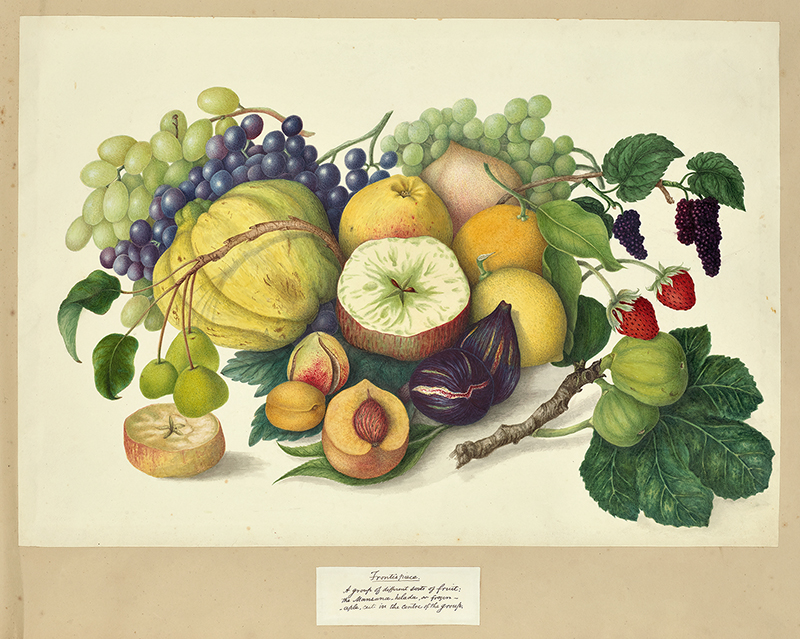
Frontispiece of The Fruits of the Lima Market. These illustrations were never published and would likely have vanished into complete obscurity had the artist’s husband not worked to preserve them in the family collection.

Dorothea was born to Joseph and Dorothy Peers on January 29, 1804, in Wales – the third child and first girl born to the couple. In 1828, when she was twenty-four, she married William Kerr who was a merchant trading primarily out of Caracas, Venezuela, but their marriage was cut short as Kerr seems to have died sometime before 1840. That year, Dorothea married Dr. Archibald Smith, who also had extensive experience living and working in South America.

Smith was born in 1797 in Scotland, received his medical degree from the University of Glasgow in 1820, and moved to Peru five years later. Once there, he was employed by a British mining company to help its workers adjust to the high altitudes at which they worked, but the company’s bankruptcy in 1827 meant that Smith needed to find new work. To this effect, he rented some land and began to grow sugar cane, but by 1830 he had moved to Lima and the next year took a job overseeing the health of British and American sailors stationed in and around the Peruvian capital. (Peru became an independent country in 1824, so the sailors were not part of an occupying force.) At some point during this time he must have become acquainted with Dorothea as they married in Scotland in 1840 where they continued to live for the next few years.

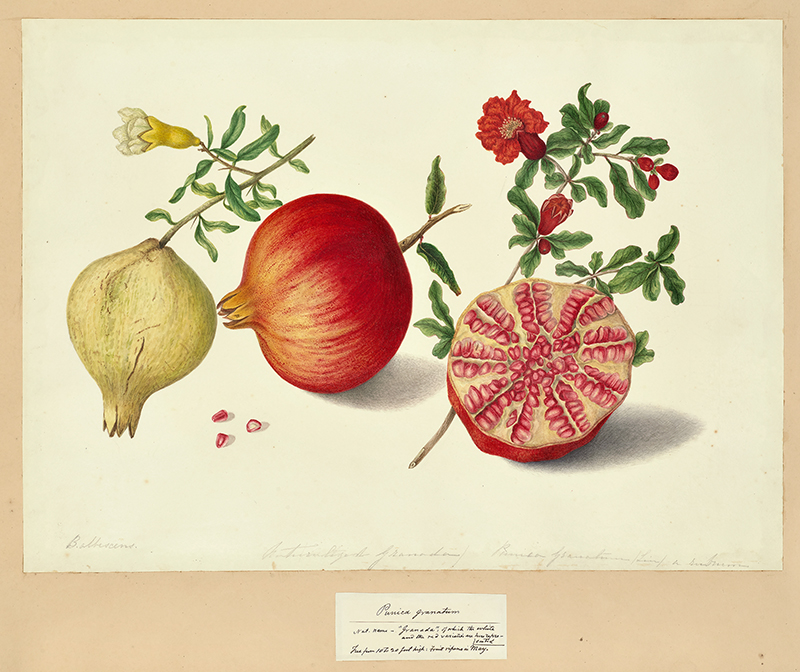
Punica granatum (Pomegranate) by Dorothea Eliza Smith. The folio contains 30 watercolors and eventually made its way to Crewe Hall library, where they were purchased by Rachel and Paul Mellon in 1957.

While their marriage appears to have been strong, they both faced an enormous loss when Archibald and the couple’s daughter Dorothy – who was eight – were shipwrecked off the Peruvian coast, and Dorothy drowned. Dorothea wrote from Liverpool to her husband shortly after the loss in 1849 that “we are all improving in strength not withstanding our recent trial” and would soon join her husband in Peru with their other children – Sophia, Isabella, and John. Interestingly, Dorothea and the children decided to sail around Cape Horn on their journey to South America rather that land in Panama, walk across the isthmus, and catch another ship to Peru. Both trips took similar amounts of time, but supposedly with three children, Dorothea would have rather not tried to keep track of them on an overland trek. The details of the Smiths’ time in Peru are sparse, other than that Dorothea worked on her watercolors of the fruits of the Lima market from 1850 to 1853, and at any rate they all seemed to have returned to the United Kingdom by 1855. Dorothea would die about nine years later, in 1864, and her husband would join her in 1868, both in Edinburgh, Scotland.

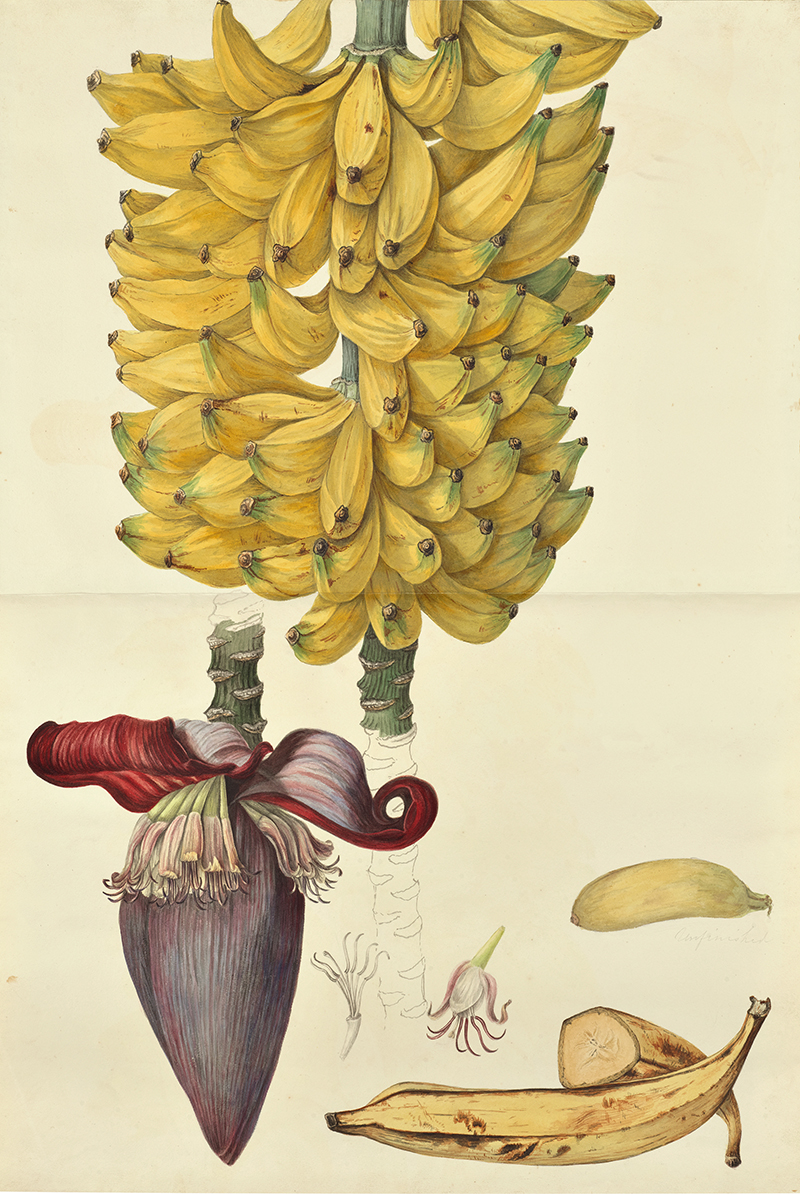
Bananas by Dorothea Eliza Smith. The watercolors are remarkably detailed and include botanical details like cross-sections and seed pods. These details underly observations on the artist’s behalf that go beyond a casual or purely aesthetic purpose.

Dorothea Smith’s The Fruits of the Lima Market are significant and worthy of study both for their quality and for their commentary on botanical science and British economic reach. To begin, Dorothea’s watercolors are impressive in that they are thoughtfully detailed in their depiction and with regards to their associated scientific information (Each painting includes notes on its fruit’s scientific name, local name, height, and fruiting months), and in that they have a refined artistic sensibility to them as pertains to the ways in which Smith plays with the juxtaposition of the different colors of the fruits. Smith also provided drawings of cross-sections of the fruits and their seeds. It is further interesting that Smith chose to draw the fruits of the Lima market as opposed to other flora from the Peruvian countryside. Her choice seems to be wrapped up both in her assumedly easy access to such fruits and in her life as spouse to first a merchant then a medical doctor and one-time farmer who both left Britain for opportunities in South America. Even her trip to arrive in Peru followed established trade and tourist routes from Europe to the western South American coast. Her watercolors work on two levels then – the first as an expression of her high scientific and artistic acumen and secondly as a reflection of her proximity to British commercial interests throughout the world. Smith’s manuscript was maintained by her husband after her death as he worked to make it known to knowledgeable scientists (even citing her in his own work), and as such kept it from disappearing into complete obscurity. Thus, the remarkable work of Dorothea Eliza Smith remains and whose story, though very much incomplete, understates the significant contributions of so many unknown female scientists and illustrators to the collected advancement of Western science.
References

Vega, Fernando, Kimberly Fisher, and Tony Willis. “Dorothea Eliza Smith, artist of ‘The Fruits of the Lima Market’” Archives of Natural History 41.2 (October 2014): 223-229.

March 26, 2019by Joel Richard
Blog Reel, Featured Books

A Pot of Basil in Every Household

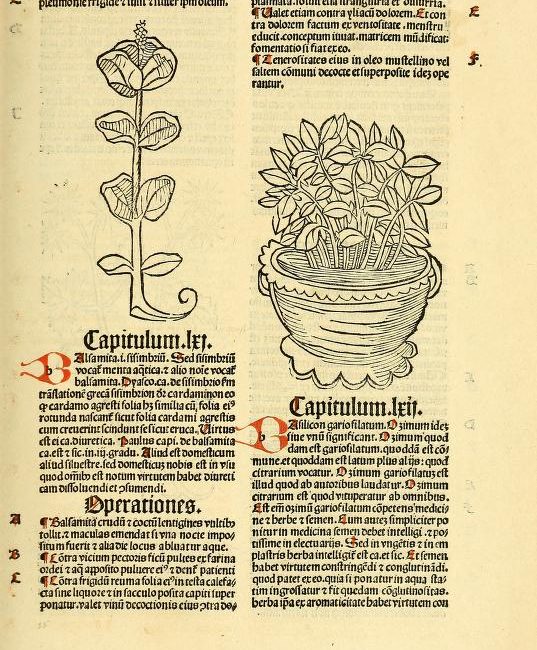
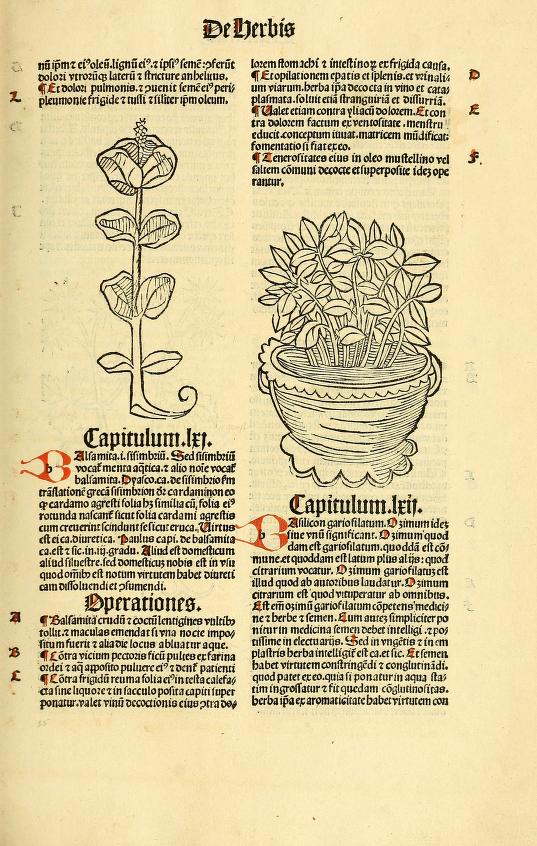
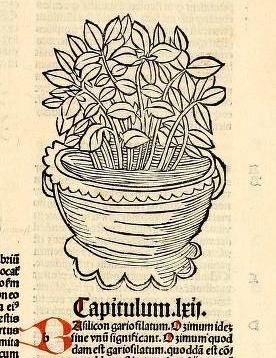
In Johann Prüss’ late 15th-century herbal, Ortus Sanitatis (Garden of Health), a bushy basil plant is portrayed growing in a decorative container. The book, a popular pharmacopoeia of various remedies drawn from ancient and medieval authors, was intended to be practical. The woodcuts are somewhat stylized and simple, meant to be easily identifiable to readers such as a doctor, apothecary, spice merchant, monk, or household member.

This was a manual for ready reference at a time when literacy was not common and earlier written descriptions alone were found to be inadequate. For instance, the all-important roots of the peony, used for infantile epileptic seizure, jaundice, stomach-aches, and kidney and bladder problems, are emphasized rather than its beautiful, fragrant blossoms.
At the time, basil was applied to a number of ailments, including convulsion, deafness, diarrhea and constipation, gout, impotency, colic, and nausea. So is it significant that basil was illustrated in a pot? Medieval and Renaissance art is full of plant symbolism. Or is this portrayal simply a charmingly unexpected domestic detail?

View Full Size Image
Ortus Sanitatis. 1497. Digitized by Smithsonian Libraries. http://www.biodiversitylibrary.org/page/40535862.
Medieval herbals ascribed healing or poisonous ‘virtues,’ the natural properties of plants. Basil is one plant of the garden full of associations, both good and bad, sometimes contradictory. And a pot of basil has a long and colorful history.

Sweet basil (Ocimum basilicum) is an herb of the mint family Lamiaceae. It is native to parts of Asia and Africa. The name may be derived from the Greek βασιλικόν φυτόν (basilikón phutón)—royal or kingly plant. While many culinary authors and cooks consider basil the “king of herbs” for its versatility and dominance in the kitchen (particularly in Italian, Thai, Vietnamese and Laotian cuisines), it long has had royal and religious associations. Ocimum sanctum(holy basil or tulasi) is sacred in the Hindu religion, though not used much in Indian dishes. In Christianity, the herb came to be associated with the Feast of the Cross, celebrating the finding by St. Helena, mother of Emperor Constantine, of the True Cross in a patch of basil.

Ancient Greeks believed basil must be sowed with words of abuse in order to thrive. In both Eastern and Western societies the herb has been associated with death. In ancient Egypt it was applied in embalming rituals. It is also an herb much connected with love and fertility rites, and has been seen as a source of erotic powers. Or, conversely, a sprig of basil would whither in the hands of the impure.

In late Medieval and Renaissance Italy, basil in a pot was a sexy thing: on a windowsill alerts a lover that the lady of the house is available to be entertained. Or, in some accounts, such as in the early 15th-century risqué tales of Sienese Gentile Sermini, its sudden removal was the signal it was safe to come on in. Apparently in some parts of present-day Southern Italy, a family notes the presence of an eligible, virginal daughter by a basil pot in the window.

View Full Size Image
Scorpions. Woodcut from Conrad Gessner, Historia animalium. Liber 2, 1586 (BHL link here)
View Full Size Image
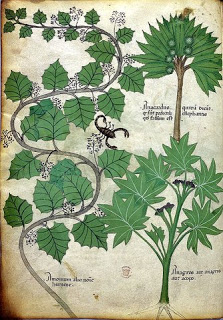
Plants and a Scorpion, in “Herbal” Manuscript folio 3v (Lombardy, Italy, around 1440). British Library Sloane 4016. This illustration indicates that a sting from a scorpion may be soothed by plants.

The Latin basiliskmeans dragon, mythical deadly reptile or serpent, sprouting legends of basil with scorpions. The arachnid with the venomous stinger was said to be bred out of mishandling the cultivated species of Ocimum. Scorpions were believed to favor hiding under a pot of basil, or that a spring of basil under a pot would turn into a scorpion. The Smithsonian’s Floyd W. Shockley, Collections Manager (and scorpion expert) in the Department of Entomology of the National Museum of Natural History, points out that the cool dark underside of the pot is a natural place for scorpions to rest, accounting for their presence and not a particular attraction to the basil.

In the pharmacopoeia on herbal medicine from the surviving writings of the ancient Greek physician and botanist Dioscorides, De Materia Medica, basil is prescribed for application to bites of the sea dragon or stings of the scorpion. Dr. Shockley notes there is some evidence that basil is effective in soothing scorpion stings and that the essential oil in the plant is anti-inflammatory and has pain-relieving enzymes. The plant would work to soothe the bites and stings of many arthropods, but ancient medicinal practitioners really focused on the scorpion relief aspect. Dioscorides observed that Africans would ingest the herb as a preventive measure against the pain of a sting. John Gerard in his famous 16th-century herbal repeated this belief but reported that, as did the 2nd-century physician Galen, basil should not be eaten.

Gerard in the Herball, or Generall Historie of Plantes of 1597, declared “The smell of Basil is good for the heart … it taketh away sorrowfulnesse which commeth of melancholy and maketh a man merry and glad.” Nicholas Culpeper in the 17th century wrote: “And away to Dr. Reason went I, who told me it was an herb of Mars, and under the scorpion, and, perhaps therefore called basilican, and it is no marvel if it carry a kind of virulent quality with it.” And, noting the differing portrayals of the plant: “This is the herb which all authors are together by the ears about and rail at one another (like lawyers).”

View Full Size Image
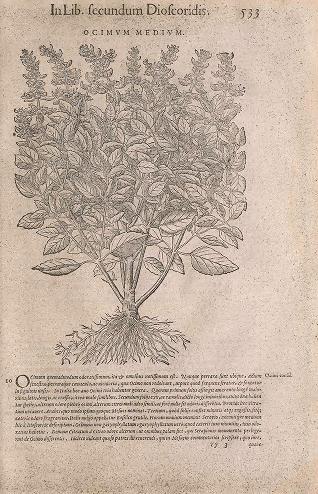
Illustration of one type of basil in the Smithsonian Libraries’ 1565 edition of Mattioli (BHL scan here)

Much of ancient plant folklore was dismissed by Pier Andrea Mattioli (1501-1577) in his commentaries on Dioscorides, Di Pedacio Dioscoride Anazarbeo Libri cinque Della historia, et materia medicinale. The work first appeared in 1544, with illustrations in the 1554 edition, and became the most influential Italian herbal of the 16th century.

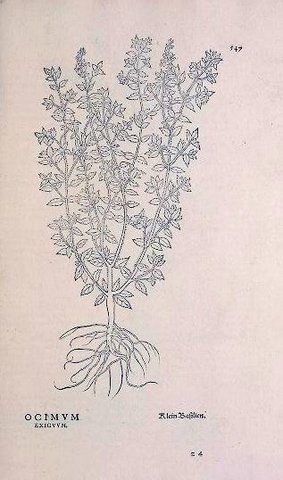
A medical doctor and botanist, born in Siena, the perennially grumpy Mattioli provides the delightful contemporary observation that basil was found to be growing in every Italian household, often in a pot placed by a window or in the garden. However, the finely cut illustrations in his herbal are without any whimsy such as a container. Likewise, Leonhart Fuchs’ splendid De Historia Stirpium (1542) notes this domestic element and illustrates different types of basil, including the roots, leaves, stems, and flowers. These publications are products of the Renaissance, knowledge drawn from direct observation and not legend, although much of the texts still rely on Dioscorides.

View Full Size Image
Fuchs: “Women everywhere raise Ocimun in clay pots on windowsills of their homes, also in gardens.” Smithsonian Libraries’ copy scanned by BHL (link here)
Fuchs wrote that ozimumis Greek for fragrant. Basil has highly aromatic leaves and placed in a pot would serve to sweeten the air. Royal apothecary and botanist John Parkinson in Paradisi is Sole Paradisus Terrestris(1629) wrote that basil was sometimes used in nosegays and made “sweet or washing waters.” (Boston Public Library copy). In the home, the herb acted to keep flies out. Basil is, of course, sensitive to cold temperatures and planted (in Northern Europe) in a container would allow for easy moving to a warm shelter.

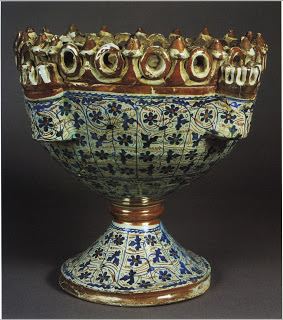
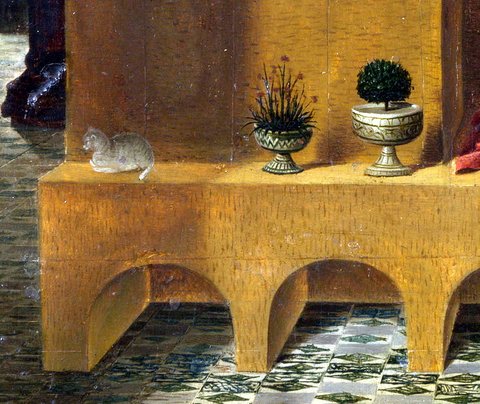
There are surviving examples of actual 15th-century basil pots, known as alfabeguer (derived from the Arabic word for sweet basil). These decorative containers were imported from Valencia, supplying a demand for this luxury item throughout Europe. In the Rothschild collection at Waddesdon Manor is a beautiful one, decorated in lustre and blue, dating from 1440 to 1470.


View Full Size Image
The Rothschild Alfabeguer (this and other illustrations of basil pots here).


View Full Size Image
Detail of Antonello da Messina’s “St. Jerome in his Study,” of alfabeguers (and kitten) approximately 1475 (National Gallery, London)
There is an earlier recording of basil pots used as decoration or furnishing in a home, and readers of Prüss’ herbals may have picked up on the allusion. In Giovanni Boccaccio’s The Decameron (Day IV, Novella 5) of approximately 1353, is the story of Lisabetta and Lorenzo. The lady’s three brothers murdered the lowly born Lorenzo to thwart the forbidden love between the servant and their sister. They buried the corpse in a location that came to her in a dream. Lisabetta dug up the grave, decapitated the head, and, returning home:
There she shut herself up in her room with the head, and kissed it a thousand times in every part, and wept long and bitterly over it, till she had bathed it in her tears. She then wrapped it in a piece of fine cloth, and set it in a large and beautiful pot of the sort in which marjoram or basil is planted, and covered it with earth, and therein planted some roots of the goodliest basil of Salerno, and drenched them only with her tears, or water perfumed with roses or orange-blossoms. And ‘twas her wont ever to sit beside this pot, and, all her soul one yearning, to pore upon it, as that which enshrined her Lorenzo, and when long time she had so done, she would bend over it, and weep a great while, until the basil was quite bathed in her tears.”

The basil thrived with this fertilization and watering, but the distraught Lisabetta did not: the evil brothers discovered poor Lorenzo’s head in the flowerpot and stole it away. She died from further grief.

View Full Size Image
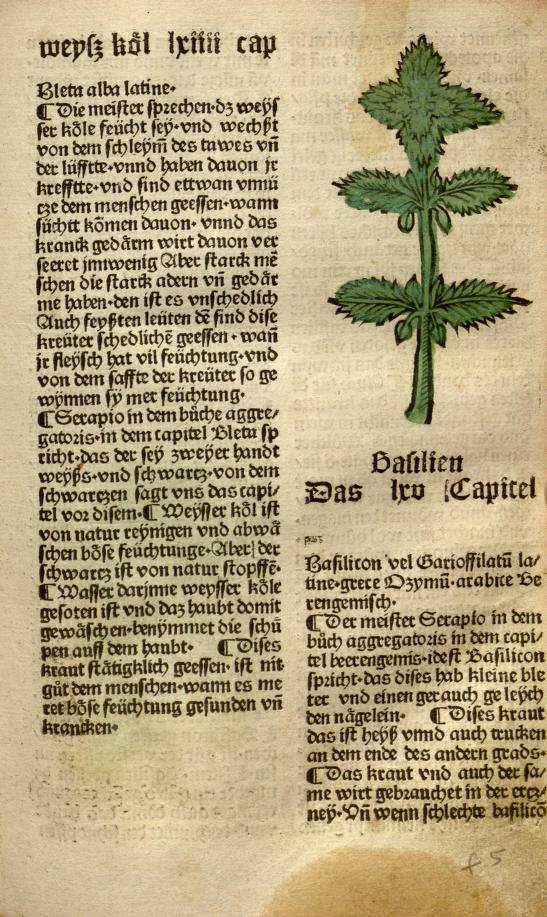
A more typical illustration of basil from an earlier period, showing the plant truncated. The Smithsonian Libraries‘ Gart der Gesundheit [Ulm?: Konrad Dinckmut?, 1487?], often attributed to Johannes von Cuba. The Missouri Botanical Garden’s copy has been scanned by BHL (link here).


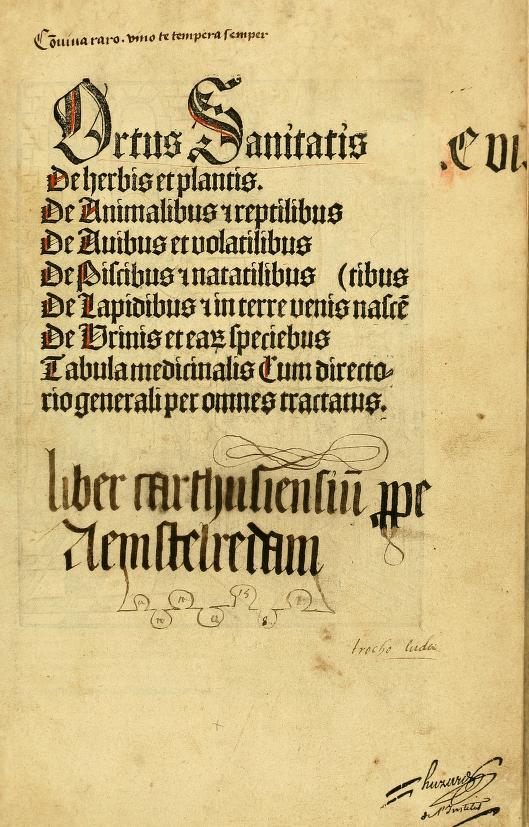
A version of Peter Schöffer’s Ortus ([H]ortus) Sanitatis(1485) was published in 1491 by Jacob Meydenbach of Mainz. Some of the more than a thousand small illustrations were copied rather crudely from Der Gart der Gesundheit (also of 1485), which itself was based on the Latin Herbariusof 1484 (Missouri Botanical Garden copy in BHL). Although there is an occasional genre scene (such as laborers) and landscape setting sprinkled throughout these early printed herbals, most of the plants are simply shown cut off at the stem. The first of Prüss’ editions of Meydenbach’s Ortus Sanitatis, printed in Strasbourg in 1497, is the Smithsonian Libraries’ copy which has been scanned for the Biodiversity Heritage Library.

View Full Size Image

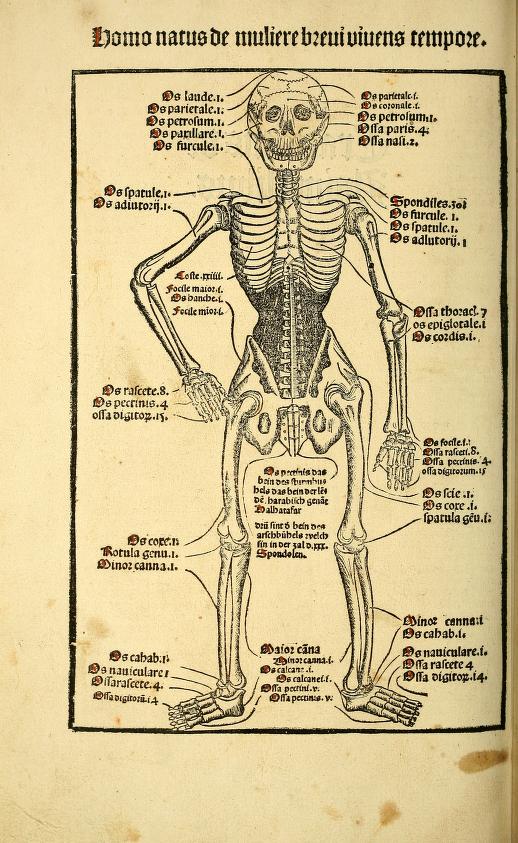
A pot of basil: may this be symbolic or practical, whether signifying divine or earthly love, used as a culinary ingredient or insect repellent, to soothe a sad soul, or just a convenient place to store a lover’s severed head. The iconography of the image in printed books, manuscripts and paintings is yet to be fully explored. The bibliography of early printed herbals—endless editions, translations, fragments, versions, and reuse and copying of woodcuts—is a complex and difficult task to sort out. But the increasing number of scanned early herbals in the Biodiversity Heritage Library allows for easy exploration of these extremely rare works. Perhaps Prüss’ Ortus Sanitatis has a unique basil pot because of an inventive author/illustrator. The book does contain a woodcut of the human skeleton, the first appearance of one in an herbal.

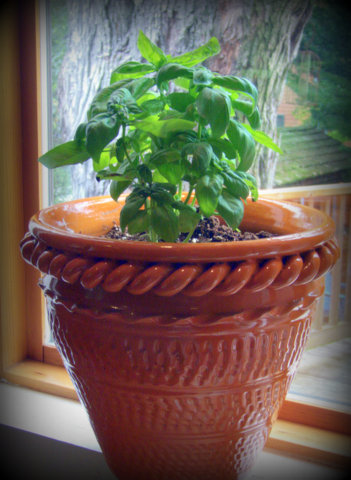
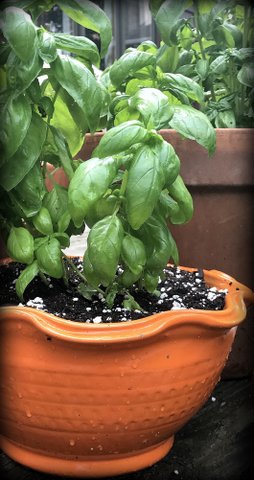
Should you happen upon any, please send me your finds of illustrations of basil in a pot. Or, a picture of the herb growing in a container on your windowsill.

View Full Size ImageView Full Size Image


View Full Size Image

Notes

View Full Size Image
What is old is new again: basil oil from the local grocery store.
The first printed herbal to have illustrations is Macer Floridus’ De Viribus Herbarum (Milan, 1482).
Di Pedacio Dioscoride Anazarbeo Libri cinque Della historia, et materia medicinale first appeared in 1544. It was soon reprinted many times in a variety of languages; there are several of these editions in the Smithsonian Libraries and many digitized versions in the Biodiversity Heritage Library (link to one here).
Blunt, Wilfrid and Sandra Raphael. The Illustrated Herbal. New York: Thames and Hudson, 1994.

Ray, Anthony. “The Rothschild ‘Alfabeguer’ and Other Fifteenth-Century Spanish Lustred ‘Basil-Pots’,” The Burlington Magazine, vol. 142, no. 1167 (June 2000), pages 371-375 (link here).

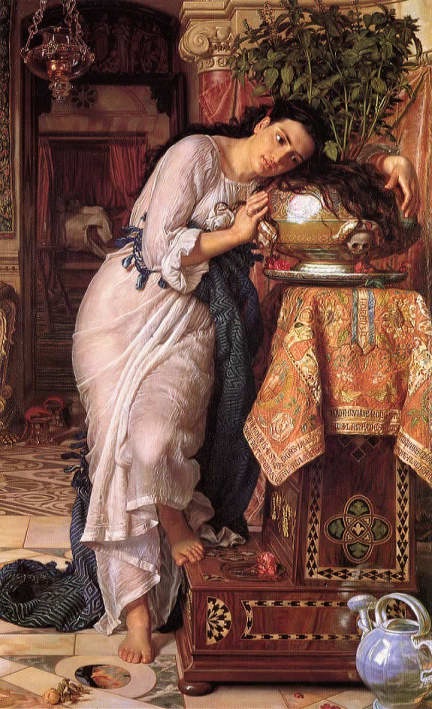
Poet John Keats picked up the narrative in “Isabella or, the Pot of Basil” (1818). In turn, British painters of the 19th century, most notably by the Pre-Raphaelite William Holman Hunt, were greatly inspired by the story.

View Full Size Image
Painting of 1867, by William Holman Hunt. Laing Art Gallery, Newcastle upon Tyne, England (image from Wikimedia Commons)


She wrapp’d it up; and for its tomb did choose
A garden-pot, wherein she laid it by,
And cover’d it with mould, and o’er it set
Sweet Basil, which her tears kept ever wet.
…
And so she ever fed it with thin tears,
Whence thick, and green, and beautiful it grew,
So that it smelt more balmy than its peers
Of Basil-tufts in Florence; for it drew
Nurture besides, and life, from human fears,
From the fast mouldering head there shut from view:
So that the jewel, safely casketed,
Came forth, and in perfumed leafits spread.
View Full Size Image
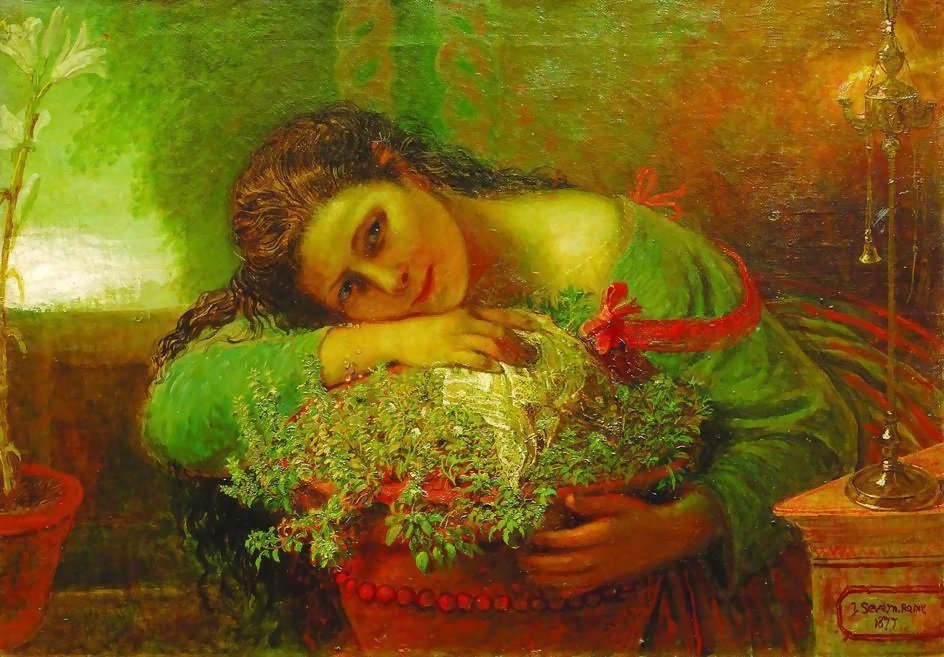
“Isabella, or the Pot of Basil,” painting by Joseph Severn (1793-1879), a close friend of Keats (image from Wikimedia Commons). Guildhall Art Gallery, London.
View Full Size Image
Ocimum basilicum ‘Genovese Verde Migliorato’. The only variety for proper pesto.


June 27, 2017by khage
Blog Reel, Featured Books

Orchidelirium: The Orchid Craze Takes Printed Form

View Full Size Image
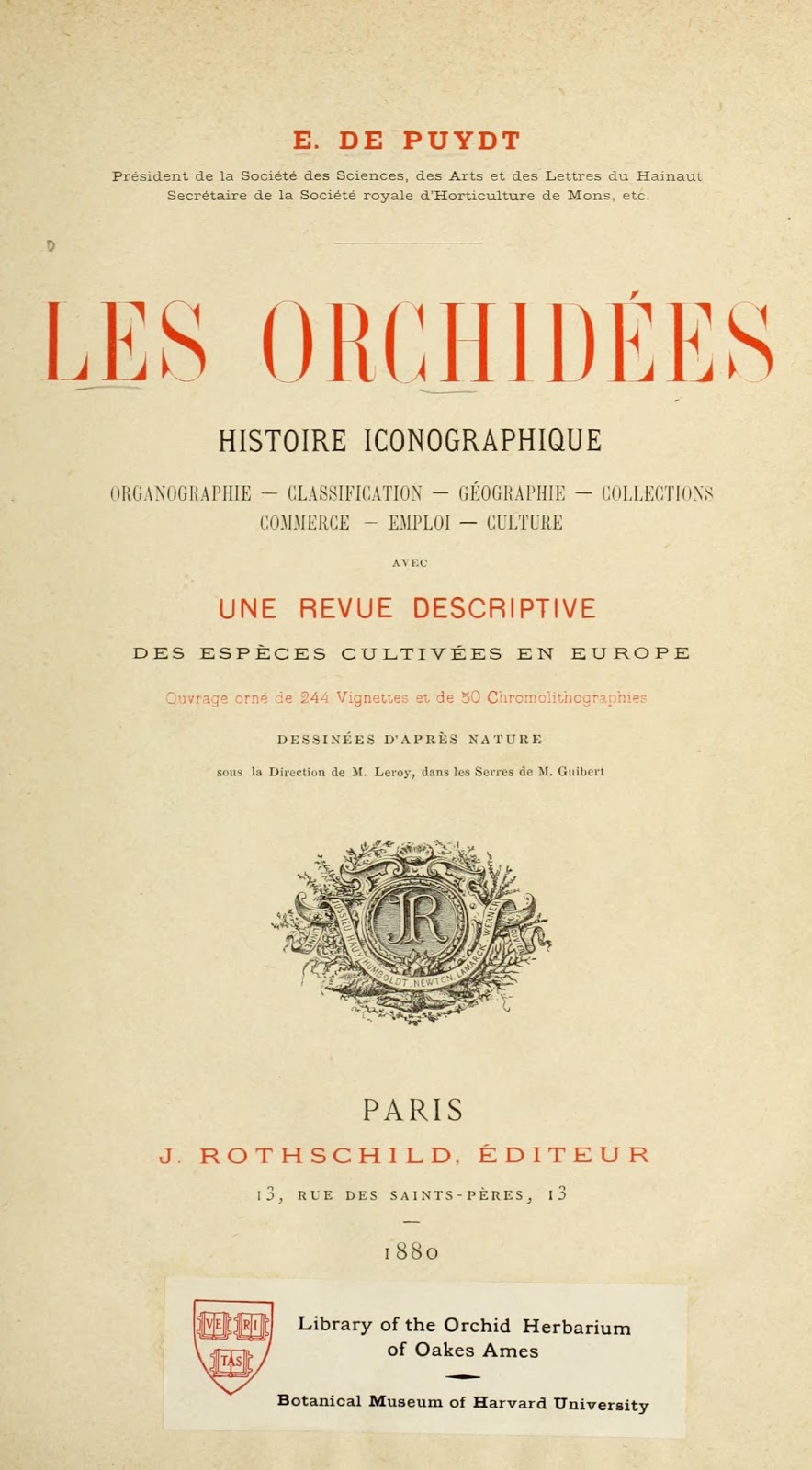
Puydt, Émile de. Les orchidées, histoire iconographique, organographie, classification, géographie, collections, commerce, emploi, culture, avec une revue descriptive des espèces cultivées en Europe. 1880. Digitized by Harvard University Botany Libraries. http://biodiversitylibrary.org/page/43644141.

Walk into most any nursery or florist and you will see beautiful orchids of many colors and sizes, with “easy care” instructions attached right to the pot enabling even the brownest thumb success. Want to shake the winter doldrums? Attend an orchid show or meeting – there are over 500 local groups affiliated with the American Orchid Society alone. Orchids are as diverse as they are beautiful, with over 27,000 accepted species living in nearly every corner of the globe.

View Full Size Image
Puydt, Émile de. Les orchidées, histoire iconographique, organographie, classification, géographie, collections, commerce, emploi, culture, avec une revue descriptive des espèces cultivées en Europe. 1880. Digitized by Harvard University Botany Libraries. http://biodiversitylibrary.org/page/43644221.

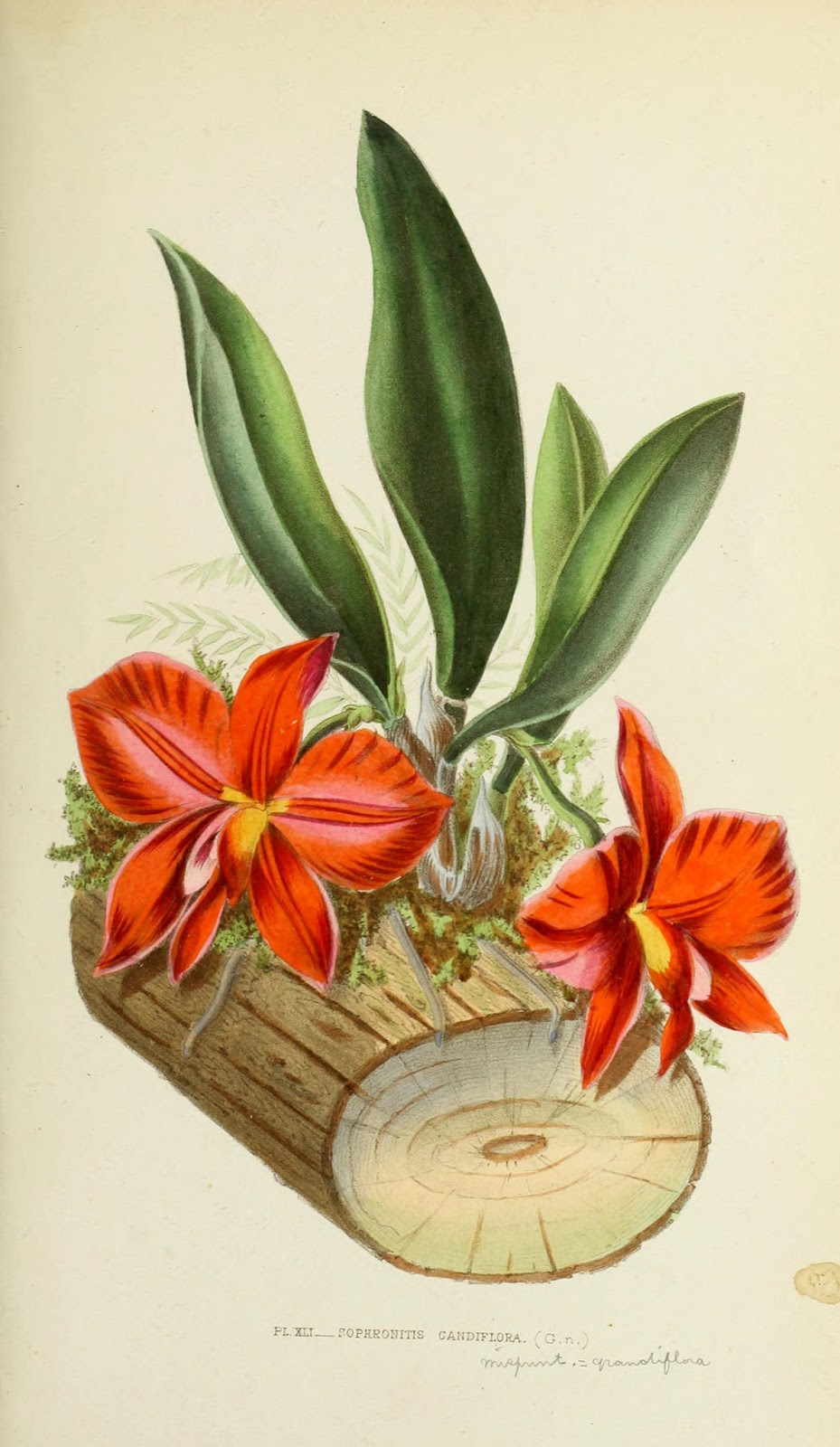
We are not alone in our fascination with orchids. In the nineteenth century, Europe was gripped by what has been named “Orchidelirium.”  The collection of orchids from around the world was booming as the industrial revolution continued to change the economy and reach of Europe. Amateur and professional botanists were frantically developing methods to cultivate these exotic plants under glass.

Capitalizing on the orchid trend, a Belgian botanist named Émile de Puydt published a treatise on orchids in French in 1880, entitled Les orchidées, histoire iconographique, organographie, classification, géographie, collections, commerce, emploi, culture, avec une revue descriptive des espèces cultivées en Europe [Orchids, iconographic history, organography, classification, geography, collections, trade, employment, culture, with a descriptive review of the species cultivated in Europe (tr.)].

View Full Size Image
Puydt, Émile de. Les orchidées, histoire iconographique, organographie, classification, géographie, collections, commerce, emploi, culture, avec une revue descriptive des espèces cultivées en Europe. 1880. Digitized by Harvard University Botany Libraries. http://www.biodiversitylibrary.org/page/43643931.

Les orchidées was published on the tails of another French orchid book directed towards amateurs, entitled L’Orchidophile: traité théorique et pratique sur la culture des Orchidées [The Orchid, theoretical and practical treatise on growing orchids (tr.)] by François du Buysson. Both works contained detailed information regarding orchid culture. However, L’Orchidophile is a hefty book of over 500 pages, with dense text, equipment line drawings, and tables but not a single drawing of these magnificent plants. It appealed to the serious orchid cultivator, but lacked a “wow” factor to make it appeal to a more general French-speaking audience.

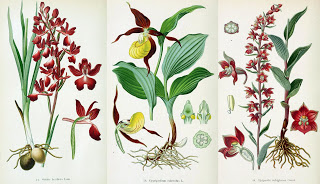
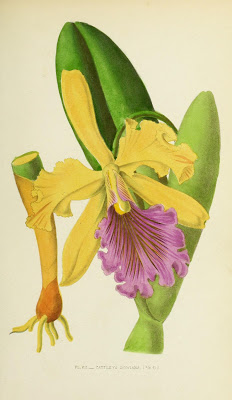
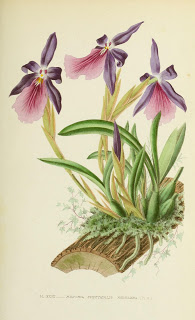
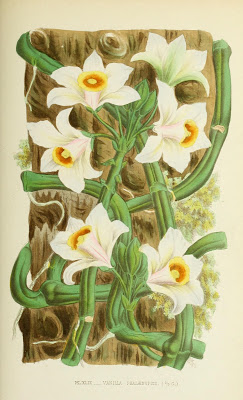
De Puydt’s book changed that. The more scholarly sections of Les orchidées are less than half the length of those in L’Orchidophile, yet they are filled with 237 black and white drawings of orchids, exotic locales, and greenhouses bursting with plants. The final section of Les orchidées contains fifty full-page chromolithographs (by M. Leroy and M. Guibert, of whom little is known) of cultured orchids accompanied by elegant descriptions of each species. De Puydt put his writing talents to great use, describing the orchid species as “beautiful (belle),” “magnificent (magnifique),” “pretty (jolie),” and “very splendid (plus slendide).” The book received awards from the Société d’Acclimatation de Paris and the Société centrale d’Horticulture de Paris.

View Full Size Image
Puydt, Émile de. Les orchidées, histoire iconographique, organographie, classification, géographie, collections, commerce, emploi, culture, avec une revue descriptive des espèces cultivées en Europe. 1880. Digitized by Harvard University Botany Libraries. http://biodiversitylibrary.org/page/43644233.

Following de Puydt’s book, another Belgian botanist specializing in orchids, Jean Jules Linden, began publication of Lindenia: iconograhie des orchidées in 1885. With lavish illustrations and short 1-2 page hints to growers, the work was quickly translated into English and published to reach an even more general audience of orchid-lovers. Linden highlighted orchids available through his business L’Horticulture Internationale as well as commonly cultivated species and new discoveries.

A modern review of Les orchidées, published in 1973, notes that the descriptions of the orchids in this work lack sufficient scientific and cultural details to be a good resource for modern growers. The review author also criticized the limitations of the drawings and considers the value of the book to be primarily for book collectors. While Les orchidées may not be as detailed as L’Orchidophile or as colorful as Lindenia, it is a well written and beautiful historical overview during the time of “Orchidelirium.”

View Full Size Image
Puydt, Émile de. Les orchidées, histoire iconographique, organographie, classification, géographie, collections, commerce, emploi, culture, avec une revue descriptive des espèces cultivées en Europe. 1880. Digitized by Harvard University Botany Libraries. http://biodiversitylibrary.org/page/43644277.

Paul Émile de Puydt (1810-1891) was born and died in Mons, a small city in western Belgium where his father served for four years as governor of Hainaut province. De Puydt founded the horticulture society of Mons and published many articles in scientific journals and newspapers on horticulture.

De Puydt did not confine his interests to botany. He was a writer, novelist, playwright, and political theorist. He coined the term “panarchy” or competitive government, where people choose the government in which they want to be a citizen. Different forms of government compete for citizens in an open market and more than one form of government can exist in the same locale. In modern times, the term panarchy also refers to a conceptual framework to understand stability and change of complex systems.

View Full Size Image
Puydt, Émile de. Les orchidées, histoire iconographique, organographie, classification, géographie, collections, commerce, emploi, culture, avec une revue descriptive des espèces cultivées en Europe. 1880. Digitized by Harvard University Botany Libraries. http://biodiversitylibrary.org/page/43644309.

Resources

  • De Puydt, Émile. Les orchidées, histoire iconographique, organographie, classification, géographie, collections, commerce, emploi, culture, avec une revue descriptive des espèces cultivées en Europe. http://dx.doi.org/10.5962/bhl.title.77404
  • du Buysson, François. L’Orchidophile: traité théorique et pratique sur la culture des Orchidées. http://dx.doi.org/10.5962/bhl.title.15493
  • Linden, Jean Jules. Lindenia: iconograhie des orchidées. http://dx.doi.org/10.5962/bhl.title.64391

Bibliography

  • American Orchid Society. http://www.aos.org/about-us/affiliated-societies.aspx. Accessed 1/11/2017.
  • Comte de Kerchove de Denterghem (1891). “P.E. de Puydt.” Revue d’lhorticultre belge et etrangere. Vol. 17, 147-151.
  •  De Puydt, Paul Emile. Wikipedia. https://en.wikipedia.org/wiki/Paul_%C3%89mile_de_Puydt. Accessed 1/11/2017.
  • Duveen, Denis I. (1973). “Les Orchidees: Histoire Iconographique by E. de Puydt.” Bulletin of the American Orchid Society. Vol. 42, No. 7, pgs. 627-629.
  • Linden, Lucien (1881). “Paul Émile de Puydt.” L’Illustration horticole. v. 28, pg. 105-107.
  • Orchidaceae. Encyclopedia of Life. http://www.eol.org/pages/8156/overview. Accessed 1/11/2017.
  • Sustainable Scale Project. http://www.sustainablescale.org/ConceptualFramework/UnderstandingScale/MeasuringScale/Panarchy.aspx. Accessed 1/11/2017.
  • Zhou, Li (2015). “Orchidelirium, an Obsession with Orchids, Has Lasted for Centuries.” Smithsonian Magazine. http://www.smithsonianmag.com/smithsonian-institution/orchidelirium-obsession-orchids-lasted-centuries-180954060/#kro3ZxCy1rSpeL5J.99. Accessed 1/13/2017.
January 26, 2017by ulib-libraryjobs

Help Support BHL

BHL's existence depends on the financial support of its patrons. Help us keep this free resource alive!

search

About BHL

The Biodiversity Heritage Library (BHL) is the world’s largest open access digital library for biodiversity literature and archives. BHL operates as a worldwide consortium of natural history, botanical, research, and national libraries working together to digitize the natural history literature held in their collections and make it freely available for open access as part of a global “biodiversity community.”

Join Our Mailing List

Sign up to receive the latest news, content highlights, and promotions.

Subscribe Now

Subscribe to Blog via Email

Enter your email address to subscribe to this blog and receive notifications of new posts by email.

Join 319 other subscribers

Subscribe to Blog Via RSS

Subscribe to the blog RSS feed to stay up-to-date on all the latest BHL posts.

Access RSS Feed

Inspiring Discovery through Free Access to Biodiversity Knowledge.

The Biodiversity Heritage Library makes it easier than ever for you to access the information you need to study and explore life on Earth…for free, anytime, anywhere.


ABOUT | HARMFUL CONTENT | PRIVACY | SITE MAP | TERMS OF USE