Biodiversity Heritage Library - Program news and collection highlights from BHL
  • Home
  • News
  • Featured Books
    • All Featured Books
    • Book of the Month Series
    • BHL at 20
  • User Stories
  • Campaigns
    • Fossil Stories
    • Garden Stories
    • Monsters Are Real
    • Page Frights
    • Her Natural History
    • Earth Optimism 2020
  • Tech Blog
  • Visit BHL
Home
News
Featured Books
    All Featured Books
    Book of the Month Series
    BHL at 20
User Stories
Campaigns
    Fossil Stories
    Garden Stories
    Monsters Are Real
    Page Frights
    Her Natural History
    Earth Optimism 2020
Tech Blog
Visit BHL
  • Home
  • News
  • Featured Books
    • All Featured Books
    • Book of the Month Series
    • BHL at 20
  • User Stories
  • Campaigns
    • Fossil Stories
    • Garden Stories
    • Monsters Are Real
    • Page Frights
    • Her Natural History
    • Earth Optimism 2020
  • Tech Blog
  • Visit BHL
Biodiversity Heritage Library - Program news and collection highlights from BHL
Blog Reel, Featured Books

Flora Graeca: “The Most Costly and Beautiful Book Devoted to Any Flora”

plants
plants

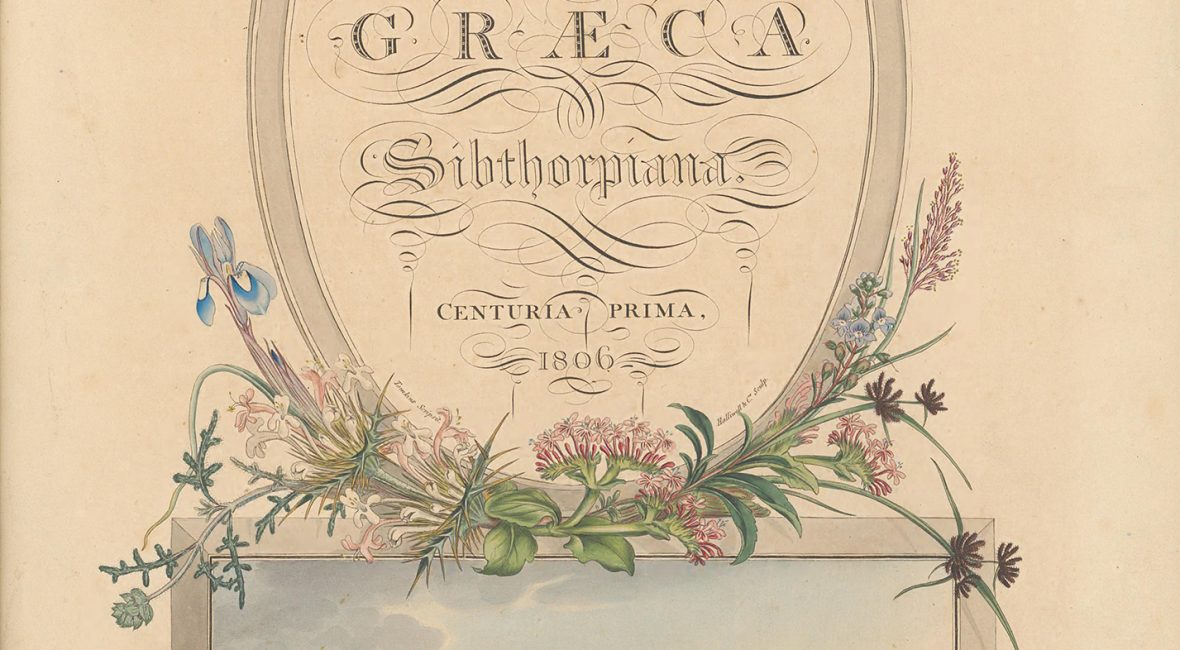
Title page. Sibthorp, John. Flora Graeca. v. 1 (1806). Contributed in BHL from Lloyd Library and Museum. Digitized by Public Library of Cincinnati and Hamilton County.

John Sibthorp’s Flora Graeca (1806-1840) has been described as “the most costly and beautiful book devoted to any flora” [1]. Dedicated to the plants of Greece and the eastern Mediterranean, only 30 subscriptions for the first edition were sold and of those, only 25 were completed. While each copy was sold for £254, the cost to produce each copy was about £620 [2, 176].

Flora Graeca arose out of botanical expeditions carried out by English botanist John Sibthorp in Greece and Asia Minor between 1786-87 and 1794-1795. Sibthorp employed Austrian artist Ferdinand Lukas Bauer to accompany him on the first expedition and serve as illustrator. During the expedition, Bauer created around one thousand plant sketches, using a color coding process to record the exact colors of the specimens he observed in the field, allowing him to produce accurate final drawings based on his field sketches [3].

plants

Plate 473. Sibthorp, John. Flora Graeca. v. 5 (1825). Contributed in BHL from Lloyd Library and Museum. Digitized by Public Library of Cincinnati and Hamilton County.

plants

Plate 606. Sibthorp, John. Flora Graeca. v. 7 (1830). Contributed in BHL from Lloyd Library and Museum. Digitized by Public Library of Cincinnati and Hamilton County.

Unfortunately, Sibthrop contracted tuberculosis during the return from his second expedition. He died on 8 February 1796 in Bath, before the work could be completed. His will, however, provided an endowment to ensure the completion of the publication [4].

Sibthorp’s friend and fellow botanist, James Edward Smith, and Sibthorp’s brother-in-law, John Hawkins, oversaw the publication of the first six volumes between 1806-1828. Volume seven was published in 1830, and volumes eight through ten were edited by John Lindley and published between 1833-40. The first nine volumes included 100 plates each, with the final volume consisting of 66 plates [5]. The hand-colored plates were engraved on copper by Bauer, James Sowerby and James de Carle Sowerby after Bauer’s drawings [2, 175].

plants

Plate 334. Sibthorp, John. Flora Graeca. v. 4 (1823). Contributed in BHL from Lloyd Library and Museum. Digitized by Public Library of Cincinnati and Hamilton County.

plants

Plate 202. Sibthorp, John. Flora Graeca. v.3 (1819). Contributed in BHL from Lloyd Library and Museum. Digitized by Public Library of Cincinnati and Hamilton County.

The Lloyd Library and Museum is fortunate to own one of the 25 complete copies of the first edition of this title. This copy was digitized by the Public Library of Cincinnati and Hamilton County as part of the BHL Expanding Access to Biodiversity Literature project (funded by the Institute of Museum and Library Services) and is freely available for all to enjoy in the Biodiversity Heritage Library. A volume from this title is also currently on display at the Lloyd Library & Museum as part of the current exhibit Treasures of the Lloyd, which is open until 21 February 2020.

plants

Plate 952. Sibthorp, John. Flora Graeca. v.10 (1840). Contributed in BHL from Lloyd Library and Museum. Digitized by Public Library of Cincinnati and Hamilton County.

plants

Plate 504. Sibthorp, John. Flora Graeca. v.6 (1828). Contributed in BHL from Lloyd Library and Museum. Digitized by Public Library of Cincinnati and Hamilton County.

plants

Plate 736. Sibthorp, John. Flora Graeca. v. 8 (1833). Contributed in BHL from Lloyd Library and Museum. Digitized by Public Library of Cincinnati and Hamilton County.

plants

Plate 824. Sibthorp, John. Flora Graeca. v. 9 (1837). Contributed in BHL from Lloyd Library and Museum. Digitized by Public Library of Cincinnati and Hamilton County.

plants

Plate 163. Sibthorp, John. Flora Graeca. v. 2 (1813). Contributed in BHL from Lloyd Library and Museum. Digitized by Public Library of Cincinnati and Hamilton County.

References

[1] Stearn, W. T. (1960). “Franz and Ferdinand Bauer, masters of botanical illustration”. Endeavour 19(73).
[2] Stearn, W. (1967). Sibthorp, Smith, the ‘Flora Graeca’ and the ‘Florae Graecae Prodromus’. Taxon, 16(3), 168-178. doi:10.2307/1216982
[3] Walsh, H. (2003). “Ferdinand Lukas Bauer”. Rare Books from the MBG Library. 23 October. Accessed on 4 February 2020. http://www.illustratedgarden.org/mobot/rarebooks/author.asp?creator=Bauer, Ferdinand Lukas&creatorID=96.
[4] Christie’s. (1997). “Flora Graeca”. Lot 138, sale 8690. Accessed on 4 February 2020. https://www.christies.com/lotfinder/Lot/sibthorp-john-james-edward-smith-and-john-228372-details.aspx.
[5] Europeana. (2020). “Flora Graeca”. Accessed on 4 February 2020. https://www.europeana.eu/portal/en/record/92002/BibliographicResource_1000093325414_source.html.

February 6, 2020by michelle.underhill
Blog Reel

North American Mycological Association Shares Work on Fungi

mycophile 1 57.6.20017.jpg

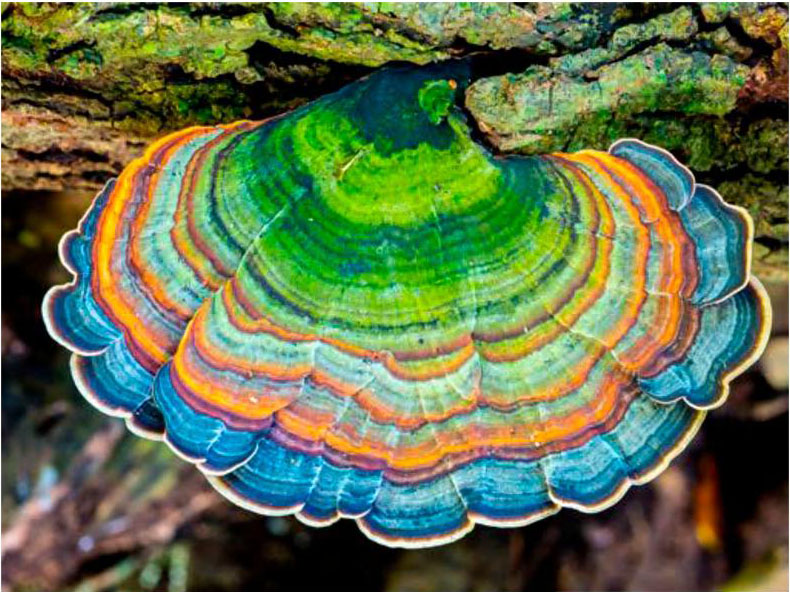
Mycroporus affinis, photo by Robert Gergulics. The Mycophile, v. 57, no. 6. 2017. Contributed to BHL by the North American Mycological Association.

“Birds, flowers, insects, stones delight the observant. Why not toadstools? A tramp after them is absorbing, study of them interesting, and eating of them health-giving and supremely satisfying.” – Charles McIlvaine (1840-1909), mycologist

The North American Mycological Association (NAMA) could be described as a mutualism between citizen scientists and academics who share dedication to the study of fungi. Founded in 1967, the organization of volunteers collaborates with professional mycologists from academic centers. With over 80 affiliated clubs and 1,700 members in the United States, Canada and Mexico, NAMA’s initiatives cover a lot of ground.

“We explore all aspects of fungi, including edibility, toxins, dying fabric, cultivation, using mushrooms to support the environment, potential medicinal applications, and photography,” says NAMA President David Rust. “This working relationship between amateur volunteers and professionals helped self-taught mycologists like Gary Lincoff [author of ‘National Audubon Society Field Guide to North American Mushrooms’] to learn and document developments in the field before such information sharing became routine on the Internet.”

mycophile 2 49.2pg - Copy.jpg

Wool dyed with Cortinarius semisanguineus, photo by Noah M. Siegel. The Mycophile, v. 49, no. 2. 2008. Contributed to BHL by the North American Mycological Association.

In that spirit of collaboration and open access, NAMA licensed its journal McIlvainea (named for mycologist Charles McIlvaine of the epigraph) and newsletter The Mycophile to BHL as a part of the Expanding Access to Biodiversity Literature project, funded by the Institute of Museum and Library Services. NAMA made digital copies of its publications available to project staff members and volunteers at The New York Botanical Garden for uploading into BHL. (The Mycophile is currently available on BHL, with McIlvaninea upcoming.)

“The Mycophile is our bi-monthly report on developments in the field of mycology, in particular amateur mycology; book reviews; club activities; and the accomplishments of our affiliated clubs,” Rust explains. “The newsletter reports on our annual foray, a gathering of approximately 350 mushroom enthusiasts where we collect, document, and voucher specimens of all types of fungi found at that location. These fungi end up in The Field Museum of Chicago and are entered into a database which is now available to the public on their website. NAMA has over 20 years of mushrooms and data available to researchers at The Field. In McIlvainea, we publish an annual report on mushroom poisonings around North America, gleaned from poison control centers and incidents reported by our network of 150 emergency mushroom identifiers. We also publish articles by renowned mycologists on current taxonomic developments and new research.”

“Our newest initiative, the North American Mycoflora Project, will provide a look at all fungi on the continent which have not been properly classified or named,” continues Rust. “It would provide online keys and downloadable applications, up to date distribution maps, links to macroscopic and microscopic images, and links to nucleotide sequences and phylogenetic trees.”

mycophile 3 46.3.jpg

Unfortunately, not all fungi are “health-giving”… image caption reads: “This month’s featured fungus is Amanita muscaria var. Formosa. See inside this issue for NAMA’s Summary of Mushroom Poisonings in 2004 along with lovely photos of ‘the usual suspects’.” The Mycophile, v. 46, no. 3. 2005. Contributed to BHL by the North American Mycological Association.

As well as sharing more recent initiatives, these publications have value as records of past mycological study. In ‘Mycology Meets History: The NAMA Archive’, a 2008 Mycophile article, David W. Rose elaborates on the value of the organization’s record keeping:

“In the case of the NAMA records, there is, for example, a file of documents on every annual foray complete with programs, board agendas and meeting minutes, mushroom collection lists, participants lists, and photographs; and this detailed abundance is a testament to an organization that takes science, history and its educational mission very seriously.”

mycophile 4 47.5.jpg

Small white fungus Christiansenia mycetophila parasitizes Collybia dryophila. The Mycophile, v. 47, no. 4. 2006. Contributed to BHL by the North American Mycological Association.

This article also closes with a punchline on the dangers of mycological work that is just too good not to share.

“The moral about ‘history lost’ bears repeating, in an anecdote that should have special resonance for mycologists. One huge collection that I processed in my archival work at the New York Botanical Garden was the William Jacob Robbins Papers. Robbins was a plant physiologist and Director of the Garden from 1938-1958, and though he is scarcely remembered for his mycology, he conducted a lengthy series of chemical assays of many species of fungi in the 1950s in the attempt to determine potential sources of antibiotics. […] his laboratory notebooks were extensive, and I organized and catalogued them all. All his note-books were clear labeled by genus or by species […] Most were in good condition, some were in bad shape. The final lab notebook in the series was labeled ‘Various Molds,’ and it had been damaged, unfortunately: completely covered by – you guessed it – various molds.”

mycophile 5 57.6.2017.jpg

Schizophyllum commune, photo by Mark Bower. The Mycophile, v. 57, no. 6. 2017. Contributed to BHL by the North American Mycological Association.

Many thanks to NAMA for sharing its publications with BHL, and to David Rust for contributing to this post!

Reference

North American Mycological Association

June 20, 2018by Joel Richard
Blog Reel, Featured Books

BHL Gains Works on the Diverse Plant Genus ‘Hoya’

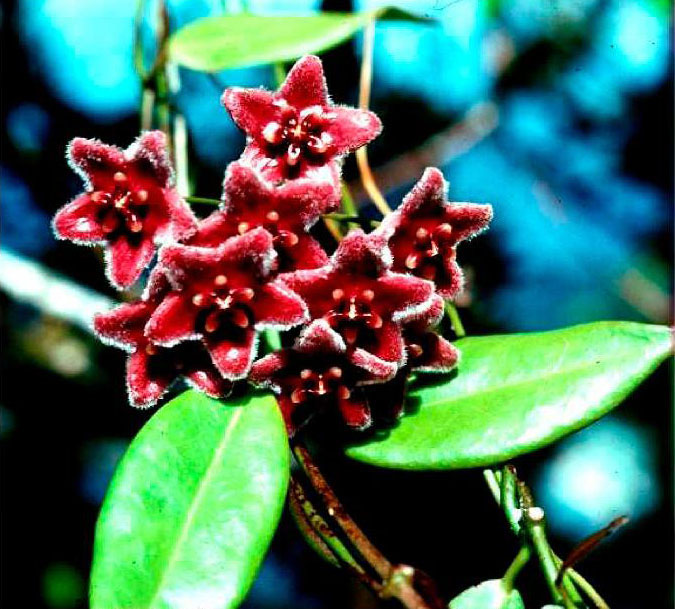
Hoya fetuana on cover of Hoya New, v.6: issue 4, 2017. Photo by Robert Dale Kloppenburg. http://s.si.edu/2BuX7ll.

Robert Dale Kloppenburg is definitely a dedicated botanist. As of January 2018 – when he celebrated his 97th birthday – he has named 234 plant species, mainly in the flowering genus Hoya, which has been his focus for close to forty years since his retirement.

Kloppenburg and the International Hoya Association, of which he is president, have made some generous contributions to the Biodiversity Heritage Library, with funding of the Expanding Access to Biodiversity Literature project. Currently available on BHL are:

  • Fraterna : Official Bulletin for International Hoya Association (1991-2006): Contributed by International Hoya Association and digitized by Harvard University Botany Libraries and The New York Botanical Garden, LuEsther T. Mertz Library.
  • Hoya New (2013-2017): Published and contributed by Robert Dale Kloppenburg.

Fraterna provides a wealth of information on Hoya species and hybrids, for botanists and horticulturalists, as well as the association’s news updates.

Hoya New presents new species descriptions with photos and identification keys.

Also currently available on BHL are Kloppenburg’s titles:

  • Ganges Hoya (2008)
  • Malaysian Hoya Species : A Monograph (2004)
  • Samoan Hoya Species : Preliminary Presentation (2014)
Hoya andalensis on cover of Fraterna v.18: no. 1, 2005. Photo by Kim F. Yap. Contributed by International Hoya Association and digitized by The New York Botanical Garden. http://s.si.edu/2EoGlH0.

The International Hoya Association originated in 1988 as a USA west coast interest group which published a newsletter, first bi-monthly and then quarterly. By the end of their second year, international interest had allowed the group to expand to a non-profit with global membership. An affiliated group, ‘Svenska Hoya Sõllskapet’ based in Borlõnge, Sweden, also publishes a quarterly magazine about hoyas.

What are these plants? The association’s website describes the diverse genus:

“The genus Hoya is found in South East Asia through Australia. They are adaptable plants found everywhere from true rain forests through the slopes of the Himalayas, from semi-arid niches in Australia to damp forests. They range from vines, the most common form, to shrub-like growth. Most are epiphytic [growing on other plants]. Hoyas are in the family commonly known as milkweeds.”

Parts of Hoya bebsguevarre described in Hoya New, v.1: no.4, 2013. http://s.si.edu/2EotCQx.

“What interests me most about hoyas is the vast diversity, the genetic differences and their possible evolutionary significance,” Kloppenburg shared in an interview in Fraterna. “I am of the opinion that we have collected and identified less than 1% of the wild hoya species.”

As an opening message for Hoya New, Kloppenburg explains how the work of horticultural professionals and hobbyists can contribute to the conservation of biodiversity:

“When a species is collected from the wild, I feel it is wise to identify it, propagate it, and name it. In this way it will eventually get into the commercial channels, be distributed to all those interested in the genus and thus be preserved. If in the future the species is lost through natural causes or forest destruction it will still be here on earth in your collection.”

Kloppenburg began studying the genus Hoya in the Philippines in 1981. He had graduated from the University of California, Berkeley, shortly after WWII and worked as a plant breeder research agronomist. Since his retirement in 1986, he has continued to study hoyas, traveling extensively in the South Pacific. His data has been donated to UC Berkeley. In 2016, he reached out to Smithsonian Libraries to offer publications, and agreed to contribute the material to Biodiversity Heritage Library. His assistant, Karen Case, assisted with the permissions process.

“It has been a most exciting journey to be hosted with such a prestigious organization as the Biodiversity Heritage Library, for which I will be eternally grateful,” Kloppenburg says. “I hope my work will help others to become interested in hoyas, and that they will carry on the discovery of new species in the future.”

Meanwhile, he’s still studying plants in the genera Hoya, Dischidia and Eriostemma. “I no longer travel, so I depend on others, mainly in the Philippines, to send me material,” he says.

Many thanks to the International Hoya Association and to Robert ‘Dale’ Kloppenburg for their commitment to sharing biodiversity research, and to Karen Case for helping to facilitate the process.

Sources:

  • International Hoya Association website: http://www.international-hoya.org/aboutus.asp
  • Robert Dale Kloppenburg’s website: http://hoyardk.wixsite.com/kloppenburg
February 15, 2018by ulib-libraryjobs
Blog Reel, Featured Books

John Forbes Royle: Materia Medica and Economic Botany

As part of the Expanding Access to Biodiversity Literature project, an interesting title was added to BHL from Yale University’s Harvey Cushing/John Hay Whitney Medical Library and the online Medical Heritage Library: An essay on the antiquity of Hindoo medicine, including an introductory lecture to the course of materia medica and therapeutics, delivered at King’s College, by physician-botanist John Forbes Royle.

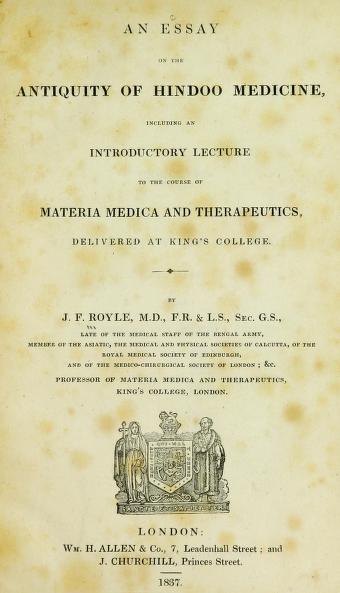
Title page of An essay on the antiquity of Hindoo medicine, including an introductory lecture to the course of materia medica and therapeutics, delivered at King’s College, by Royle, J. Forbes (John Forbes), 1799-1858. London, Allen, 1837. Digitized by Yale University via the Medical Heritage Library. http://s.si.edu/2mtstTx.

This work from 1837 documents the materia medica (pharmacology) of India, and explores the historical exchange of medicinal knowledge between cultural groups of India, Arabia, Persia, Greece and China. Including details in botany, ecology, minerology and astronomy, it’s an intriguing interdisciplinary resource that can also be read for insights on its Western author and this period in time.

John Forbes Royle (1798-1858) traded his plan to join the British army for an unexpected interest in natural history. He was born at Kanpur, India, and would return to India after attending Edinburgh High School and the East India Company’s military academy at Addiscombe. Inspired by the mentorship of physician Anthony Todd Thomson, Royle chose to pursue medicine as a means to further his study of botany. He became an assistant surgeon with the East India Company, and in the following years worked at several locations across northern India, where he studied medicines from bazaars, employed collectors to amass a collection of economic plants, and became superintendent of the garden at Saharanpur. He earned the titles of MD in 1833 and Professor of Materia Medica at King’s College, London, in 1836.

An excerpt from Essay on the antiquity of Hindoo medicine demonstrates Royle’s interconnected thinking on medicine:

“There are, however, two branches of this extensive science [botany], respecting which I am desirous of making a few observations; one is the connexion between the Structure and Natural affinities of plants, and their Physical and Medical properties; and the other is the Geographical distribution, especially as connected with Climate. Both are important subjects, whether we consider them in a scientific or a practical point of view. The one teaches us the laws which influence the distribution of plants; points out the countries and climates which different families affect; and gives us principles for their cultivation, either as medicines, or as objects of agriculture: the other is no less valuable in affording us innumerable indications in every part of the world, for discovering the properties of new and unknown plants, whether as fitting them for food, for medicine, or for any of the arts of life[.]” [Royle, p. 3]

Cinchona, a South American genus. Its bark contains medicinal compounds including quinine, used to treat malaria. Royle recommended that Cinchona be grown in India. Image from BHL book: Icones plantarum medico-oeconomico-technologicarum cum earum fructus ususque descriptione. Wien:herausgegeben von Ignatz Albrecht und verlegt bey Phil. Jos. Schalbaecher, [1800]-1822. Digitized by Missouri Botanical Garden. http://s.si.edu/2iiHgMh.


Cushing/Whitney Medical Library of Yale University

The copy of Royle’s text in BHL belonged to Edward Salisbury, a Yale graduate and professor who encouraged scholarship on West and South Asia. Salisbury donated his “Oriental Library,” a collection of hundreds of rare and early printed books and manuscripts, to the college in 1870. Salisbury’s Oriental Library is foundational to what is now the third-largest collection of Islamic manuscripts in the United States. Last year, Yale celebrated Salisbury’s 175th anniversary as the first professor of Arabic and Sanskrit languages and literature in the Americas.

Essay on the antiquity of Hindoo medicine is now held at the Medical Historical Library of the Cushing/Whitney Medical Library. The library was named for Yale graduates Harvey Cushing, known as the father of neurosurgery, and John Hay Whitney, Herald Tribune editor and patron of the arts. In 1935, Cushing and two other physicians, John F. Fulton and Arnold C. Klebs, donated their personal collections of medical texts to the medical library, beginning its Medical Historical Library. Its collections include materials ranging from the 16th to 20th century, with works from Robert Boyle, Galen, William Harvey, Hippocrates, and Andreas Vesalius. Additionally, the Historical Library also holds prints, a collection of weights and measures, and presents rotating exhibits.

The Cushing/Whitney Library is also home to the Cushing Center, a room in the stacks transformed to display the medical specimens of Cushing’s Brain Tumor Registry. Cushing meticulously documented over 2,200 case studies as he pioneered the field of neurosurgery, and his registry includes specimens preserved from human surgeries and autopsies as well as notes, journal excerpts, photos and negatives.

Harvey Cushing/John Hay Whitney Medical Library Historical Library. Frank Poole, 2004.


Medical Heritage Library

The Medical Heritage Library (MHL) is an online collection of materials that are free and openly accessible through the Internet Archive. Royle’s Essay on antiquity of Hindoo medicine came to BHL via the MHL.

Much like BHL, the MHL is a collaborative effort by medical libraries to promote access to resources (such as rare books, pamphlets, journals and films) that are useful across a spectrum of disciplines. The collection includes over 200,000 titles with fascinating variety – skimming the landing page, one can find herbals, medical dictionaries and papers, as well as video clips of 1960s tobacco commercials and Helen Keller’s autobiography.

The Medical Heritage Library was launched in 2010 by founders The Augustus C. Long Health Sciences Library at Columbia University and Columbia University Libraries/Information Services; The College of Physicians of Philadelphia; The Cushing/Whitney Medical Library at Yale University; The Francis A. Countway Library of Medicine at Harvard University; U.S. National Library of Medicine; and Wellcome Library in London, UK. (For more information about its content contributors, funding and support, please see MHL’s ‘About’ page.)

An essay on the antiquity of Hindoo Medicine is a welcome addition to BHL’s collection of works by John Forbes Royle, which include:

  • Illustrations of the botany and other branches of the natural history of the Himalayan Mountains: and of the flora of Cashmere. London: Wm. H. Allen, 1839. (Digitized by Missouri Botanical Garden)
  • On the culture and commerce of cotton in India and elsewhere; with an account of the experiments made by the Hon. East India Company up to the present time. London: Smith, Elder, 1851. (Digitized by the University of British Columbia Library)
  • The fibrous plants of India, fitted for cordage, clothing, and paper. With an account of the cultivation and preparation of flax, hemp, and their substitutes. London, Smith, Elder, and Co.; 1855. (Digitized by Cornell University Library)
  • A manual of materia medica and therapeutics including the preparations of the pharmacopoeias of London, Edinburgh, and Dublin, with other approved medicines. London: John Churchill, MDCCCLVI [1856]. (Digitized by King’s College London, Foyle Special Collections Library)

Thanks to Melissa Grafe, Ph.D, Head of the Medical Historical Library and John R. Bumstead Librarian for Medical History, who shared how this volume came to the Medical Historical Library.

Sources

  • About (n.d.) Retrieved from http://archive.org/details/medicalheritagelibrary&tab;=about.
  • About (n.d.) Retrieved from http://www.medicalheritage.org/about/.
  • About (n.d) Retrieved from https://salisbury175.yale.edu/about.
  • Harvey Cushing and the Cushing Center (n.d.) Retrieved from http://library.medicine.yale.edu/cushingcenter/history.
  • History of the Library (n.d.) Retrieved from http://library.medicine.yale.edu/about/history.
  • Royle, John Forbes (1837). London, Allen. Retrieved from https://www.biodiversitylibrary.org/item/199214.
  • Woodward, B. B. “Royle, John Forbes (1798–1858).” Rev. Mark Harrison. Oxford Dictionary of National Biography. Ed. H. C. G. Matthew and Brian Harrison. Oxford: OUP, 2004. Online ed. Ed. David Cannadine. May 2010. Retrieved from http://www.oxforddnb.com/view/article/24239.
November 16, 2017by ulib-libraryjobs

Help Support BHL

BHL's existence depends on the financial support of its patrons. Help us keep this free resource alive!

search

About BHL

The Biodiversity Heritage Library (BHL) is the world’s largest open access digital library for biodiversity literature and archives. BHL operates as a worldwide consortium of natural history, botanical, research, and national libraries working together to digitize the natural history literature held in their collections and make it freely available for open access as part of a global “biodiversity community.”

Follow BHL

  • Bluesky logo
  • Instagram logo
  • Facebook logo
  • Flickr logo
  • Twitter logo

Join Our Mailing List

Sign up to receive the latest news, content highlights, and promotions.

Subscribe Now

Subscribe to Blog via Email

Enter your email address to subscribe to this blog and receive notifications of new posts by email.

Join 319 other subscribers

Subscribe to Blog Via RSS

Subscribe to the blog RSS feed to stay up-to-date on all the latest BHL posts.

Access RSS Feed


64+ Million Pages of
Biodiversity Literature Online.

EXPLORE

Tools and Services
to Transform Research.

EXPLORE

300,000+
Illustrations on Flickr.

EXPLORE

ABOUT | HARMFUL CONTENT | PRIVACY | SITE MAP | TERMS OF USE