Biodiversity Heritage Library - Program news and collection highlights from BHL
  • Home
  • News
  • Featured Books
    • All Featured Books
    • Book of the Month Series
    • BHL at 20
  • User Stories
  • Campaigns
    • Fossil Stories
    • Garden Stories
    • Monsters Are Real
    • Page Frights
    • Her Natural History
    • Earth Optimism 2020
  • Tech Blog
  • Visit BHL
Home
News
Featured Books
    All Featured Books
    Book of the Month Series
    BHL at 20
User Stories
Campaigns
    Fossil Stories
    Garden Stories
    Monsters Are Real
    Page Frights
    Her Natural History
    Earth Optimism 2020
Tech Blog
Visit BHL
  • Home
  • News
  • Featured Books
    • All Featured Books
    • Book of the Month Series
    • BHL at 20
  • User Stories
  • Campaigns
    • Fossil Stories
    • Garden Stories
    • Monsters Are Real
    • Page Frights
    • Her Natural History
    • Earth Optimism 2020
  • Tech Blog
  • Visit BHL
Biodiversity Heritage Library - Program news and collection highlights from BHL
Blog Reel, Featured Books

The Life and Work of Robert Alexander Gilbert: Empowering New Insights through Digitization and Transcription of Archival Materials

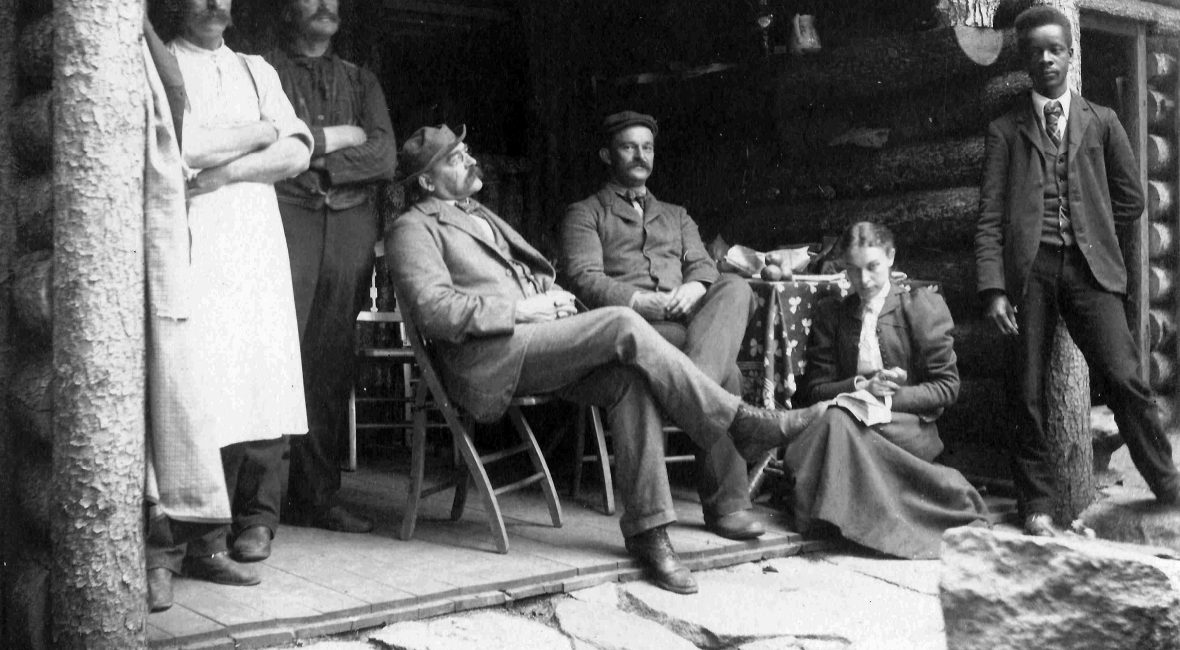
Black and white photo of a group of people standing on the porch of a log cabin.

This post is part of a series from the Ernst Mayr Library exploring the digitization and transcription of ornithologist William Brewster’s archival materials and the insights and scholarship made possible thanks to this work.
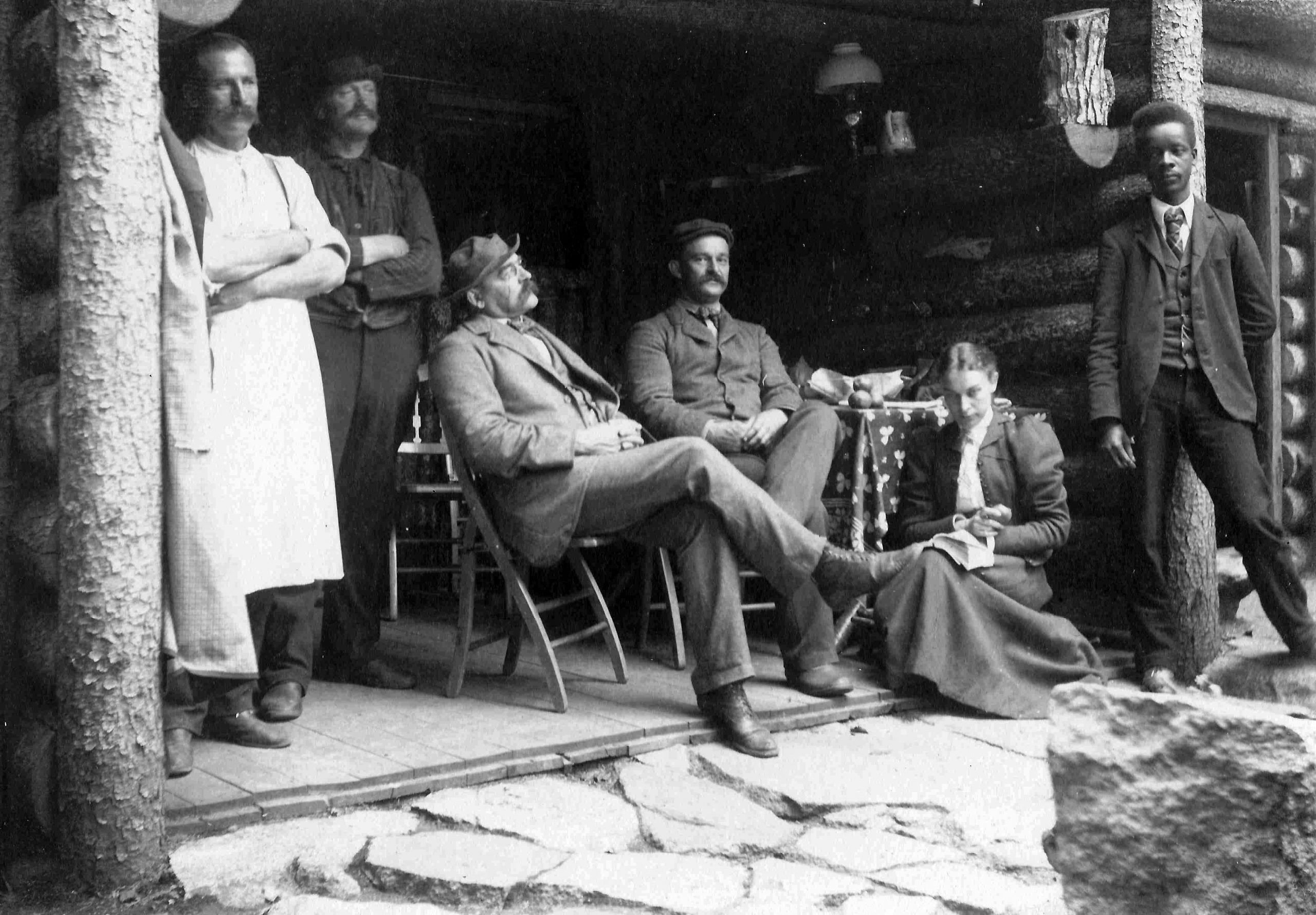
Black and white photo of a group of people standing on the porch of a log cabin.

Robert A. Gilbert, far right, at William Brewster’s cabin at Pine Point, Umbagog Lake, Maine. From the collection of the Museum of American Bird Art, Massachusetts Audubon Society and reproduced with their permission.

Robert Alexander Gilbert (1870-1942) was a Black photographer interested in ornithology and chemistry who worked for ornithologist William Brewster from the mid 1890s until Brewster’s death in 1919 and at various tasks around the Museum of Comparative Zoology (MCZ) at Harvard University beyond 1919. He was an Associate of the American Ornithologists’ Union.

Gilbert was not officially recognized for his photographic work with William Brewster, although Brewster did not claim credit for all the images in his collection. It was assumed that Brewster took all the photographic prints bequeathed to the Ernst Mayr Library and Archives of the MCZ (EMLA) upon his death. However, while conducting research for a book, author John Hanson Mitchell, former editor of the Massachusetts Audubon Society’s (MAS) Sanctuary magazine, discovered over 2000 of Brewster’s glass plate negatives in the attic of a building owned by the MAS. One of the images in particular, a photograph of a young, well-attired Black man standing in front of a rustic cabin in the wilderness, captured his interest. Mitchell was curious as to the identity of this young man. Later, in the mid-1970s, Mitchell had a chance encounter with an Archives Assistant at the MCZ who suggested to him that all of Brewster’s photographs were, in fact, taken by Brewster’s assistant, a young Black man named Robert Gilbert. This piqued Mitchell’s interest and launched his journey to discover more about Gilbert.[1] The quest culminated with the publication in 2005 of Mitchell’s Looking for Mr. Gilbert: the Reimagined Life of an African American. In 2014 an e-book edition was published as well.

Mitchell’s publication helps provide new insight into Robert Gilbert’s life and work. Brewster’s journals and diaries, now digitally available on the Biodiversity Heritage Library (BHL), are also valuable records attesting to Gilbert’s contributions in a variety of areas. While only a handful of Brewster’s photographs in the MCZ collection can be positively attributed to Gilbert, it is clear that Gilbert was with Brewster for photo sessions during the years they worked together. The photographic relationship between Brewster and Gilbert is intriguing. There is new enthusiasm to examine Brewster’s journals and diaries more closely now that they are digitized and being transcribed, to clarify Gilbert’s role in photographic collaboration with Brewster. As a result of identifying connections between the collections in the Museum of American Bird Art at the Massachusetts Audubon Society and the EMLA, a cooperative research project is underway.

Robert Gilbert was born and raised in the rural town of Natural Bridge, Virginia, in the valley of Broad Creek. In 1886, at the age of 16, he moved to Boston, Massachusetts where he would reside for the remainder of his life. Gilbert had an assortment of odd jobs during his first ten years in Boston, including working as a laboratory assistant for Dr. Arthur P. Chadbourne of Harvard Medical School, an amateur ornithologist and acquaintance of William Brewster. The records are unclear as to the actual year, but sometime between 1895 and 1897, work in Chadbourne’s lab slowed down and he recommended Gilbert to Brewster, who was in need of a temporary assistant to help him set up his personal bird museum. Gilbert met with Brewster, who showed him his extensive specimen collection and the tasks at hand, and for the next ten weeks Gilbert helped Brewster establish his new museum on the grounds of his home in Cambridge, MA. Afterward, Gilbert returned to working for Dr. Chadbourne, but shortly thereafter the laboratory experiments were completed whereupon Brewster hired Gilbert as his full-time assistant.[2] Brewster’s first mention of Gilbert in his journals is in his entry for March 31, 1897.
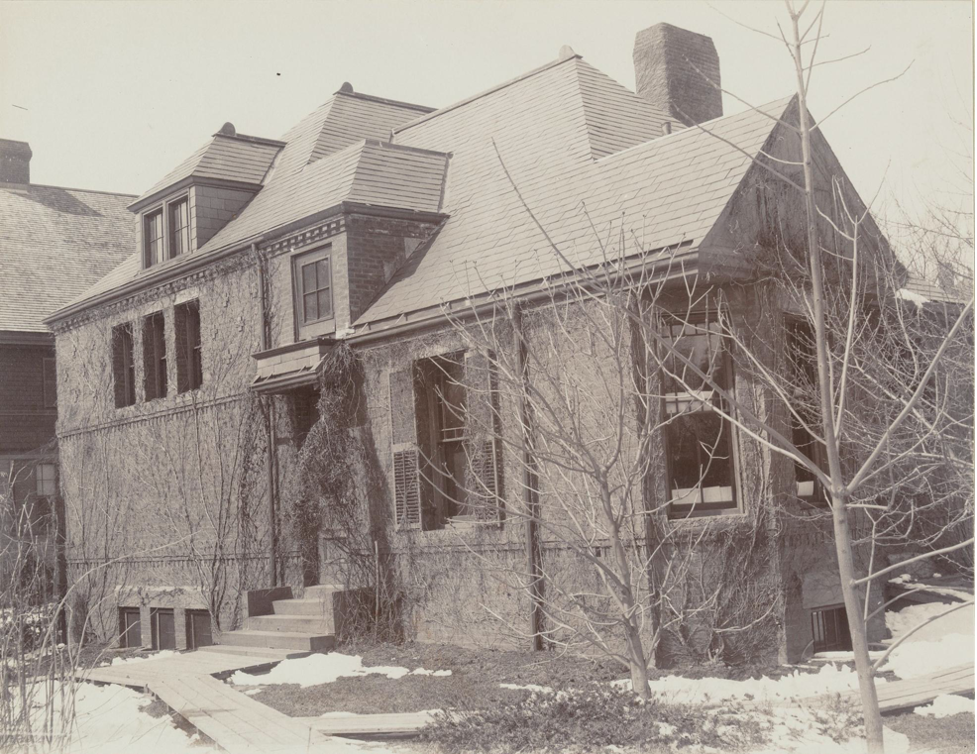
Black and white photograph of a brick house.

Brewster’s museum on the grounds of his home in Cambridge, MA. From the collection of the Ernst Mayr Library of the Museum of Comparative Zoology, Harvard University. Call number bBr 97.70.12.19.

It is clear from Brewster’s diaries and journals that the tasks performed by Gilbert in Brewster’s employ were many and varied. Glover M. Allen, Curator of Mammals at the MCZ, described Gilbert as “Mr. Brewster’s trusted assistant, looking after innumerable details at his museum or his camp, doing everything from photographic work to preparing and serving meals, and always with a quiet dignity and devotion that never for a moment failed.”[3] Gilbert quickly became Brewster’s right-hand man as evidenced by the innumerable references to him from 1897 to 1919 in his diaries and journals. Here are a few examples:

Journal, June 8, 1897. As a field assistant, note Gilbert’s observational skills and attention to detail as he documents the behavior of a Whistler Duck for Brewster:

“Gilbert who had been to the boat for his breakfast came to relieve me and to keep guard while I had mine. It was arranged between us that if the Whistler began taking out her young while I was absent he would shout a few times to let me know of the fact. I had just finished breakfast when I heard this signal and jumping into the St. Lawrence skiff rowed as hard as I could pull for the nest but as soon as I came in sight of it I knew I was too late for Gilbert was standing up in his boat and paddling slowly towards the tree. Here is his account of what happened during my absence: At 6.45 the old Duck appeared at the entrance (the lower hole) to the nest where she sat for five minutes moving her head continually and looking about in every direction included within her field of vision; then she sank back out of sight reappearing at the end of a minute and looking about as before for another five minutes. At the end of this second period of observation she flew down to the water and swam around the stub three times clucking and calling. On completing the third round she stopped directly under the hole and gave a single loud call or cluck when the ducklings at once began scrambling up to the entrance from the nest and dropping down to the water falling on top of one another. In other words the brood literally poured out of the nest much as shot would fall from one’s hand. One or two hesitated or paused for an instant reaching the mouth of the hole but the greater number toppled out over the edge as soon as they appeared. All used their tiny wings freely beating them continuously as they descended. They did not seem to strike the water with much fear.”

Journal, November 5, 1897. Bird observations reported to Brewster: “Gilbert counted fourteen Chickadees in one flock on Ball’s Hill this morning. With them was a Downy, two Tree Sparrows & two Juncos. He also saw five Black Ducks passing over the meadows at evening.”

Journal, March 24, 1898. Work at Brewster’s cabin in Concord, MA: “Spent the forenoon clearing out the path behind the hill, Gilbert helping me.”

Diary, March 6, 1909. Photographic work: “Lizzy Fuller came over at 8 P.M. She with C. & E.R.S. [Caroline and Elizabeth R. Simmons] spent evening in Museum where I showed them about 100 lantern slides that Gilbert has just made.”

Diary, January 9, 1918. Work in Brewster’s museum: “Gilbert is now going through the collections in search of Anthrinae [Anthrenus] & other insect pests. Thus far he has found traces of them in the cans only.”

In the 1890s Brewster was earnestly transitioning from collecting bird specimens with his shotgun to field observation and photography. He had, in Robert Gilbert, an assistant knowledgeable in ornithology and capable with photography and photographic processing. It is unfortunate that in the Ernst Mayr Library collection of over 1,700 of Brewster’s photographic prints, only six have an inscription on the verso stating that the photograph was taken by Robert Gilbert. Below are two such photographs:
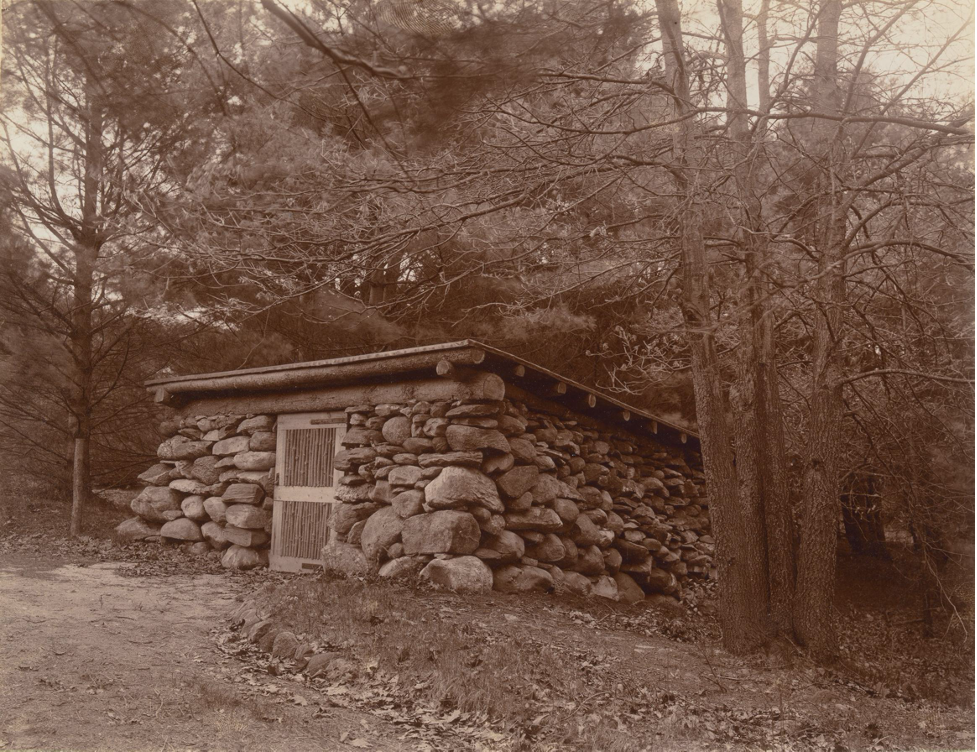
Black and white photograph of a stone wood-house in the woods.

From inscription on verso: “Wood-shed, Hemlock Grove, Concord, Mass., April 1904, taken by R.A. Gilbert.” From the collection of the Ernst Mayr Library of the Museum of Comparative Zoology, Harvard University. Call number bBr 97.70.7.23.
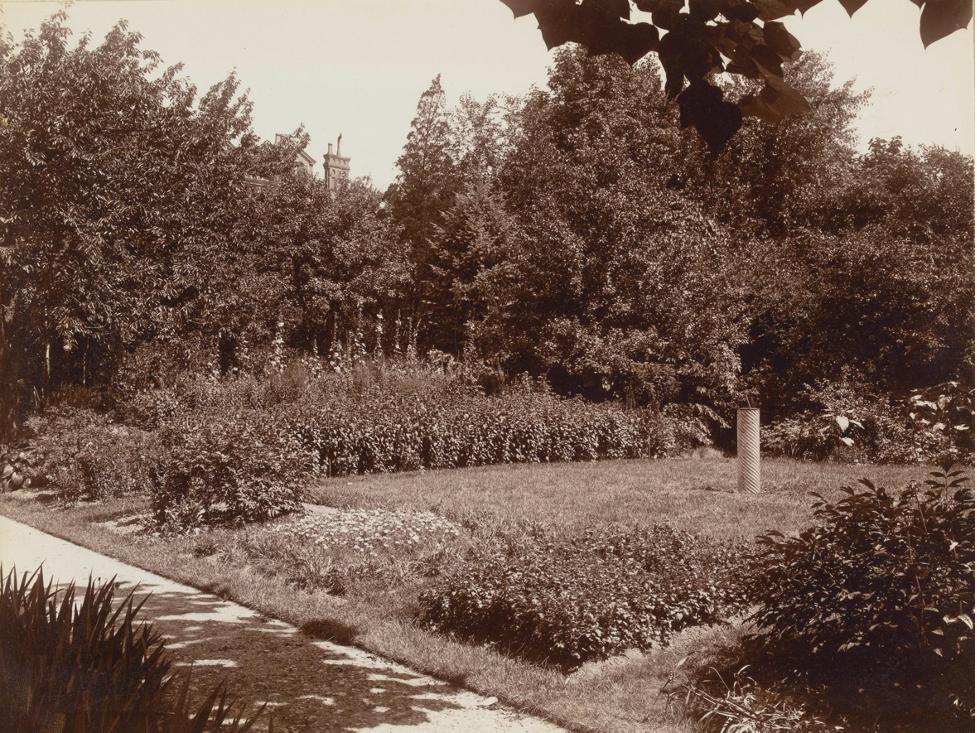
Black and white photograph of a garden.

Brewster’s garden. From inscription on verso: “Garden, Cambridge, Mass. July 30th 1904. Taken by R. A. Gilbert.” From the collection of the Ernst Mayr Library of the Museum of Comparative Zoology, Harvard University. Call number bBr 97.70.12.59.

It is possible that many other photographs were taken by Gilbert, but we don’t know for sure. There are a number of occasions recorded in Brewster’s writings where it is clear that Brewster himself was doing the photography. In his journal entry for May 18, 1897, for example, Brewster writes:

“I visited the Hermit’s nest in the Brown clearing taking five photographs of it. The [female] was on the nest and for a Hermit sat very closely allowing me to set up the camera & focus on her at a distance of about 4 ft. but gliding away just as I was about to expose a second plate. She would not return to her eggs, however, while the camera was in position although I waited for her nearly an hour.”

Whether or not Gilbert was taking the picture, it is clear that he played a major role assisting with various aspects of Brewster’s photography. Inscriptions on the verso of photographic prints reveal that Gilbert owned darkroom apparatus and copied glass plate negatives to make prints. In a journal entry dated May 29, 1897 Brewster writes: “In the forenoon I took several photographs (with Gilbert’s help) in the gulf at the head of Great Island and along the western shore of the Sweat Cove.” Though Brewster was taking the pictures, Gilbert was assisting in some fashion.

It is evident that Gilbert was an invaluable assistant and friend who greatly facilitated Brewster’s ornithological accomplishments. Gilbert remained in Brewster’s employ until the latter’s death in 1919. Brewster arranged for the MCZ to hire Gilbert upon his death, another attestation to Brewster’s high regard for him.

There is little on record describing Gilbert’s tasks at the MCZ, but the Annual Report of the Director sheds some light. In the Report of the Director for 1931/1932 Thomas Barbour writes: “Robert Gilbert, aided by several young men, has done excellent work in rearranging some of the exhibition halls.” In the 1933/1934 Annual Report Glover Allen writes in his Report on Mammals: “In the ever-present work of cleaning skulls and skeletal material French and Gilbert have latterly borne a helpful hand, developing some skill.” Were Gilbert doing similar tasks today, he would likely be given the title Curatorial Assistant in the MCZ. Barbour’s report intimates that, among many other skills, supervision and at least familiarity with exhibit design properly belong on Gilbert’s resume. No doubt, Gilbert’s work in Brewster’s museum prepared him well for his tasks in the MCZ.

Gilbert worked at the MCZ until his death in 1942. In his 1941/1942 Director’s report, Barbour provided the following tribute:

“On January 7, 1942 Robert A. Gilbert died. For years before he came to the Museum he had helped Mr. Brewster in many ways and his sterling personal characters of integrity, affection, courtesy, and loyalty made him not only a [sic] honor to his race but one who was proud to do everything which he did as well as he could do it, and who was beloved by us all.”

Robert Gilbert’s many talents as well as his passion, curiosity and integrity enriched Brewster’s life and pursuits. It is evident that he brought these same qualities to his work at the MCZ.

The Ernst Mayr Library is actively transcribing the digitized journals, diaries and correspondence of William Brewster, enabling full-text searching of these resources in the Biodiversity Heritage Library. It is our hope that this will facilitate digital scholarship and further interest in the life and work of Robert Gilbert. In the next blog post we will discuss this transcription work.

References

[1] Mitchell, John Hanson. 2005. Looking for Mr. Gilbert: The Reimagined Life of an African American. Washington, DC: Shoemaker.

[2] Mitchell, John Hanson. 2014 e-book edition. Looking for Mr. Gilbert: The Unlikely Life of the First African American Landscape Photographer. New York, New York : Open Road Distribution.

[3] Allen, Glover M. 1942. Obituaries. Robert A. Gilbert. The Auk 59.3: 467. JSTOR. Accessed on 25 January 2021. https://www.jstor.org/stable/4079251.

February 23, 2021by michelle.underhill
BHL News, Blog Reel

Introducing the BHL Field Notes Project

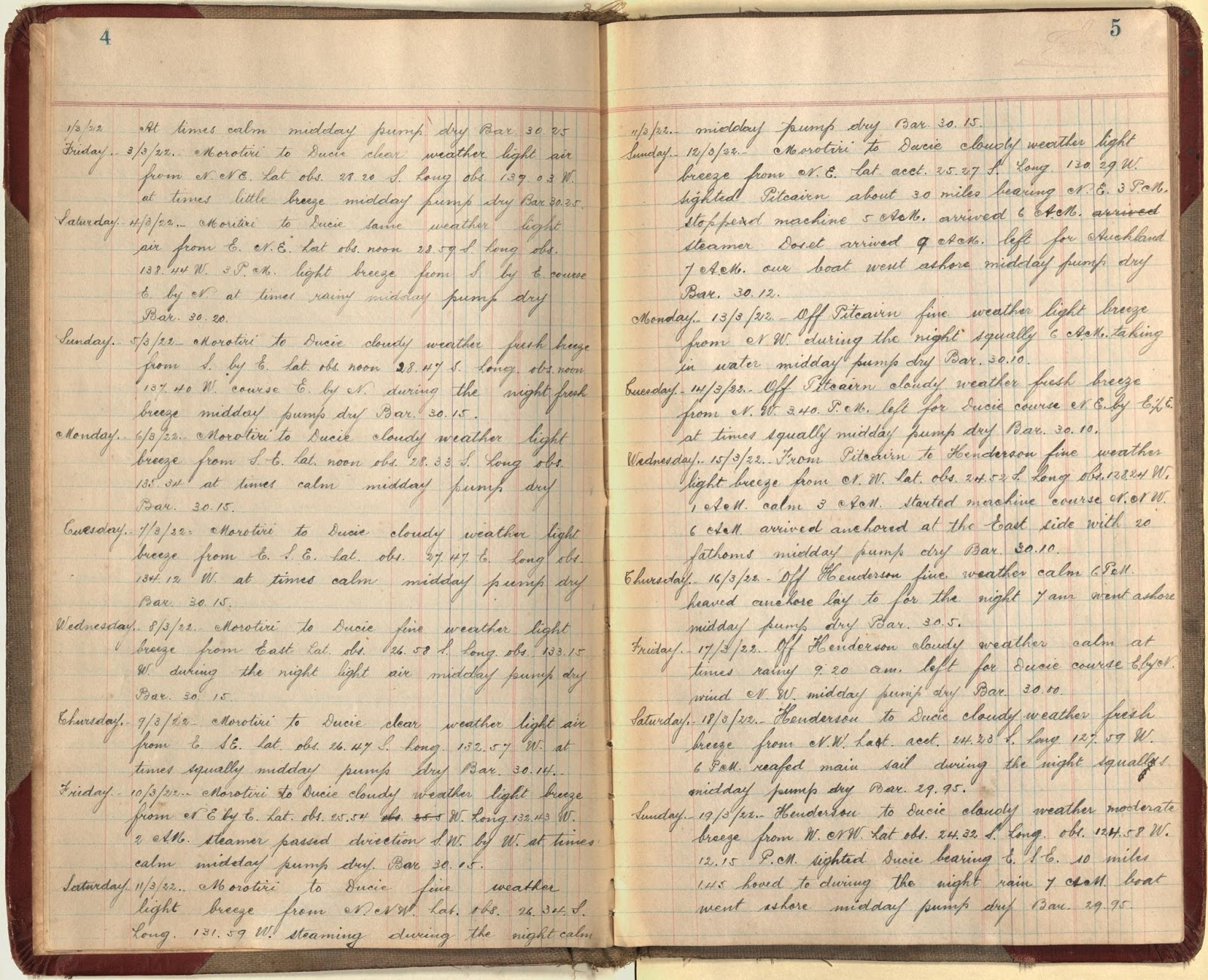
In 2015, the Council on Library and Information Resources awarded the Biodiversity Heritage Library a grant to fund the BHL Field Notes Project. Part of CLIR’s Digitizing Hidden Special Collections and Archives initiative, this project is a collaborative undertaking which will provide open access to field notes from several different institutions. By project end, BHL users will have access to over 450,000 pages of natural history field research material. This rich source of field notes includes diaries, journals, correspondence, and photographs.

View Full Size Image
p.p1 {margin: 0.0px 0.0px 0.0px 0.0px; text-align: center; font: 9.0px ‘Times New Roman’; color: #55677d} span.s1 {text-decoration: underline ; color: #0079cd}

[Logbook of the yacht “France”]. v. 1 (1922-1926). Digitized by the American Museum of Natural History. http://www.biodiversitylibrary.org/page/51514493

The importance of field notes is well known to researchers. To natural scientists, field notes offer records of the flora and fauna of a location at a certain point in time. These records serve as reference points when observing how a certain habitat has changed over time. They can also offer information on expeditions, or the source of museum collection items. Field notes also present narratives that give insight into the scientists as people and their relationship with the locations and cultures they studied, making them an important resource for science historians.

View Full Size Image
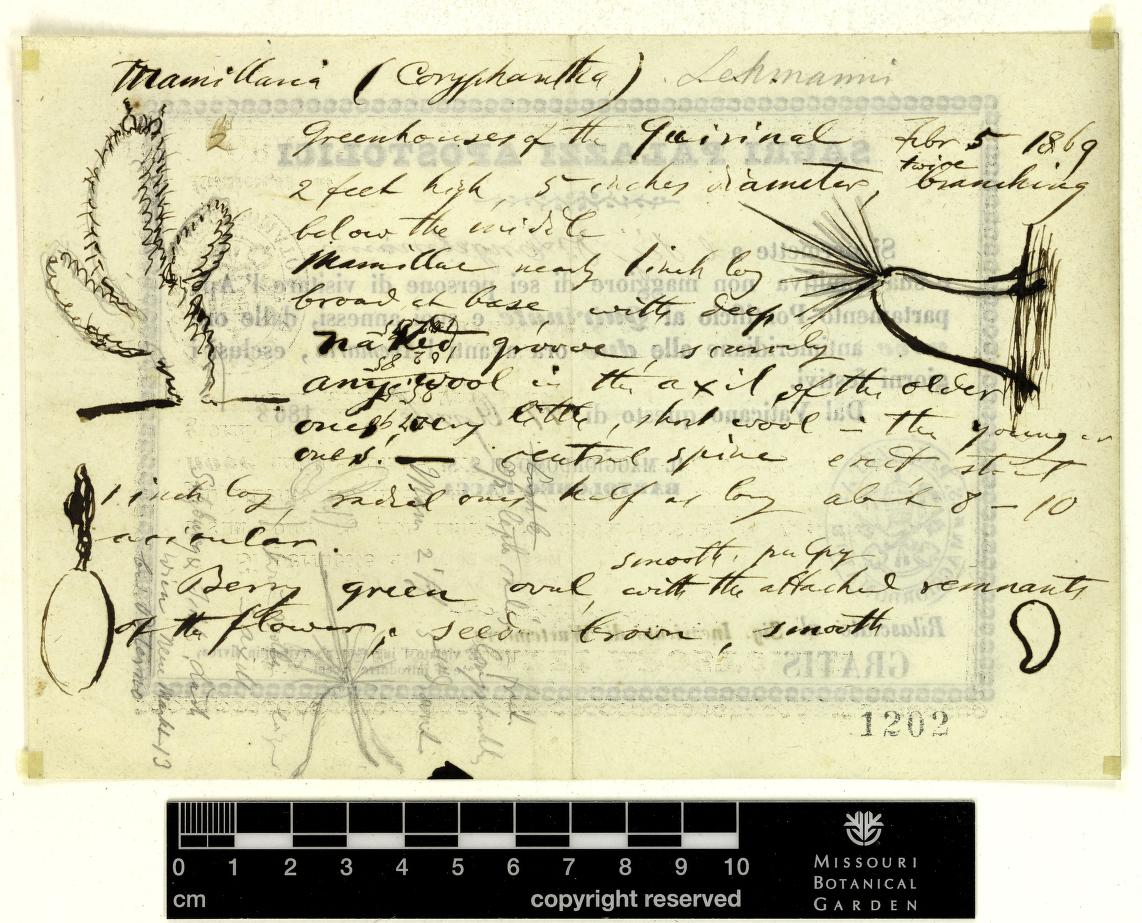
George Engelmann : botanical notebook 5 : Mammilaria, Leuchtenbergia, Discocactus, and Melocactus. Box 3: Folder 13: Cactaceae: Mammillaria: 1857-1883 (1856). http://biodiversitylibrary.org/page/52030722

The BHL has already started adding field notes to its collection, and the Field Notes Project hopes to add great value to the field notes already available. This project brings together the efforts of eleven institutions:

  • American Museum of Natural History
  • Field Museum of Natural History Library
  • Harvard University Botany Libraries
  • Harvard University, Museum of Comparative Zoology, Ernst Mayr Library
  • Internet Archive
  • LuEsther T. Mertz Library, The New York Botanical Garden
  • Missouri Botanical Garden, Peter H. Raven Library & Center for Biodiversity Informatics
  • Museum of Vertebrate Zoology, University of California, Berkeley
  • Smithsonian Institution Archives
  • Smithsonian Libraries
  • Yale Peabody Museum Archives

We are excited to be part of the effort to add more archival material to the BHL. Stay tuned for upcoming features which will highlight contributions from—and go behind-the-scenes at—some of our partners. In the meantime, explore some of the great field notes already digitized in the BHL Field Notes Project collection.

January 5, 2017by mkahn
Blog Reel, Featured Books

Expedition Connection: National Geographic Society Yale University Peruvian Expedition, 1915

This is the fourth in a 4 part joint blog series by the Field Book Project (FBP) and the Biodiversity Heritage Library (BHL), showcasing examples of digital connections between museum specimens, field book catalog records, and the resulting publications.

View post one | View post two | View post three

View Full Size Image
Hiram Bingham (1875-1956). Smithsonian Institution Archives.  Acc. 90-105 – Science Service, Records, 1920s-1970s.

In 1911, Hiram Bingham of Yale University went on an expedition to Peru; during that fateful trip, he “discovered” and studied an early, terraced city that has since fascinated the international public for more than a century, Machu Picchu. Though there is some question as to whether he was the first foreigner to visit the site, Bingham’s archeological work during the expedition enflamed the imaginations of the public and inspired organizations like National Geographic Society to fund several subsequent trips to the site. One of these was the National Geographic Society Yale University Peruvian Expedition, 1915.

The expedition explored and excavated the ruins, and also collected natural history specimens. Expedition staff included those of various disciplines. Though the primary focus may have been the archeological study of Machu Picchu, collected items also included: mammals, birds, fishes, reptiles, amphibians, and insects. The majority of materials collected were kept by Yale University; however specimens like the insects collected by Harry W. Foote were deposited with the US National Museum.

This expedition is a great example of how materials end up in seemingly unexpected places. Though one would anticipate finding field documentation with National Geographic Society or Yale University, amazingly Smithsonian has 23 field books from this expedition–not from Harry Foote, but from the expedition naturalist, Edmund Heller. Edmund Heller collected for numerous institutions over the course of his career, but for some reason, the majority of his field books reside in various departments of the Smithsonian. Field notes from this expedition can be found in links in the Expedition record and located in three collections.

  • Smithsonian Institution Library, NMNH collection Acc. 12-015
  • NMNH Division of Mammals collection Acc. 12-212
  • Smithsonian Institution Archives collection RU 007179

Specimens prove consistently challenging to track down.

View Full Size Image
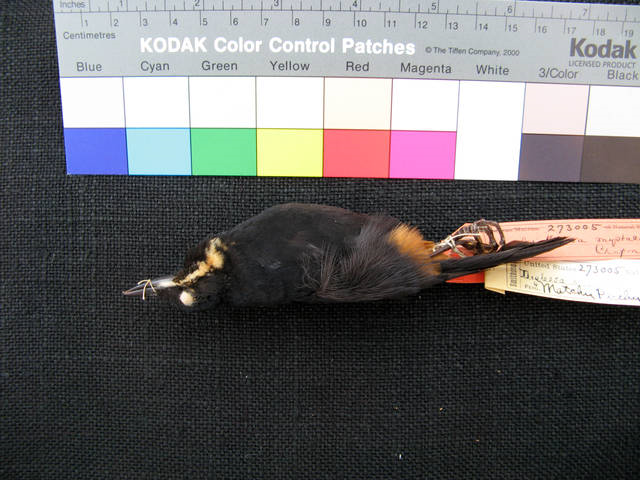
USNM 273005. Diglossa lafresnayii albilinea. One of three collected By Edmund Heller during expedition.

One must often know the collector, location, and/or time period. Out of the NMNH’s ten online specimen databases, only 4 have a field to document if the specimen was collected during an expedition. When specimens were found that indicated they came from the expedition, each used a different version of the expedition name.

Related publications found, include:

  • Amphibians and reptiles from southern Peru collected by the Peruvian expedition of 1914-1915 under the auspices of Yale University and the National Geographic Society http://biodiversitylibrary.org/part/17888
  • Report on the Mammalia collected by Mr. Edmund Heller during the Peruvian Expedition of 1915 under the auspices of Yale University and the National Geographic Society http://www.biodiversitylibrary.org/part/17869
  • The distribution of bird life in the Urubamba valley of Peru; a report on the birds collected by the Yale university National geographic society’s expeditions, http://www.biodiversitylibrary.org/bibliography/60345
  • The Andes of southern Peru; geographical reconnaissance along the seventy-third meridian, http://www.biodiversitylibrary.org/bibliography/52102
View Full Size Image
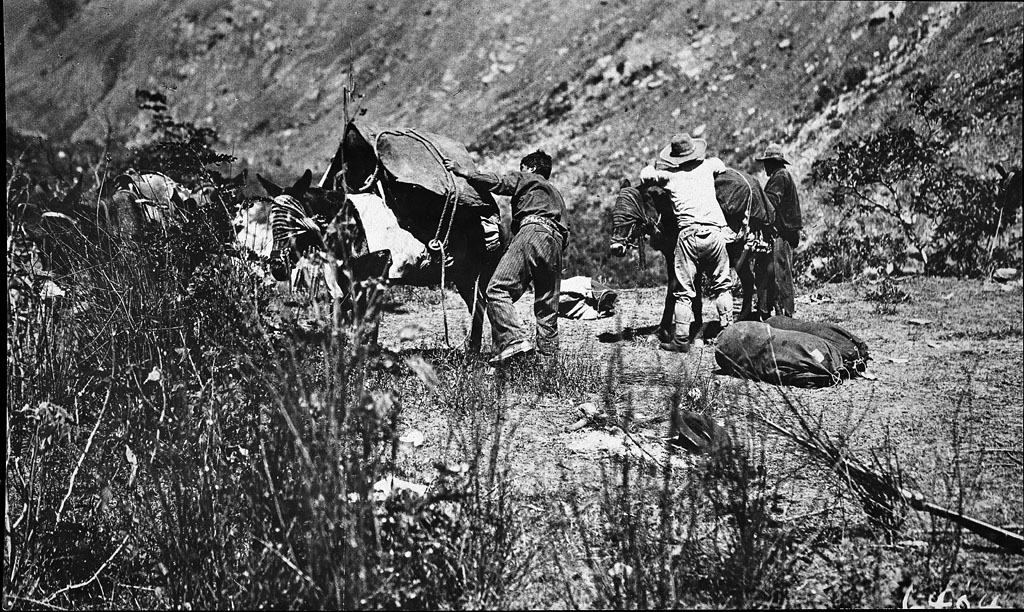
“Narciso and Tomas,” Peruvian guides and helpers packing the mules to go. The photo was taken by Edmund Heller while on the Peruvian Expedition of 1914-15, which was sponsored by Yale University and The National Geographic Society. Smithsonian Institution Archives. Record Unit 7179, Box 8, Folder 18.

The 3 expeditions discussed in this blog series demonstrate just how important cataloging and digitizing the different types of documentation are to understanding the complete story of historical scientific collection events. Take a look at a specimen, and a researcher can make contemporary observations. Take a look at the published materials and a researcher can find a scientist’s detailed study of an expedition’s specimens to compare to those contemporary observations. Take a look at the field books and a researcher can find a wealth of information that led the scientist to those conclusions, and more. Many of these field books include environment description (weather, terrain, vegetation) that may not be needed for a specific type of publication.

The Field Book Project has cataloged in 8 departments of the Smithsonian and is continuing to its work; locating and cataloging books in the stacks of scientific departments, libraries, and archives. Some were located only because Smithsonian staff knew of their existence in departments. There are now more than 7100 field book records from nearly a 100 expeditions and collecting events in Smithsonian’s Collections Search Center with more to come. To date, the BHL is providing free and open access to nearly 114,000 items, many of which record the outputs of these expeditions. In order to understand the full story from the field work to the published work, one must have all three elements of the trifecta available, including the specimens. Many natural history institutions are working hard to provide digital access to their specimen collections, hidden behind closed doors, for researchers and the public. SI has been working for decades to catalog and digitize its scientific specimen collections and they are becoming increasingly more accessible online through efforts separate from the FBP and BHL.

These efforts are all part of a vision shared by the FBP and the BHL to someday involve a cross-disciplinary approach where the complete story of field notes, specimens and publications that make up important scientific collecting events are freely available at users’ fingertips. We encourage you to take a look at some of the materials we’ve identified, and see the potential for yourself.

With contributions from Carolyn Sheffield (Field Book Project Manager) and Bianca Crowley (BHL Collections Coordinator).

May 30, 2013by Kathryn Stine
Blog Reel, Featured Books

The Expedition Documentation Trifecta: Harriman Alaska Expedition (1899)

This is the third in a 4 part joint blog series by the Field Book Project (FBP) and the Biodiversity Heritage Library (BHL), showcasing examples of digital connections between museum specimens, field book catalog records, and the resulting publications.

View post one | View post two

In 1899 Edward Harriman, President of the Union Pacific Railroad, turned a family vacation into a two month foray into Alaska. Originally proposed as a hunting expedition, it was transformed into a scientific exploring expedition on the advice of Clinton Hart Merriam, Chief of the Bureau of Biological Survey. Harriman and his family, accompanied by 126 researchers, traveled to Alaska aboard the S.S. George W. Elder. In the end, the work of the many researchers resulted in vast amounts of valuable scientific data, including the discovery of a new glacier and an array of floral and faunal specimens.

View Full Size Image
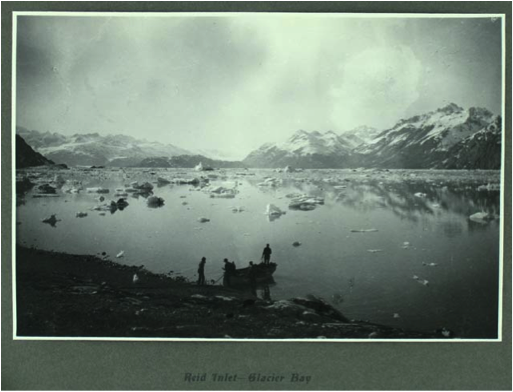
Reid Inlet, Glacier Bay 1899. Photographed by Edward S. Curtis.

Harriman and the Washington Academy of Sciences collaborated to fund the entire expedition, and Harriman chose researchers with diverse scientific backgrounds in order to collaborate on all fields of plant, animal, and earth science. After the expedition had ended, the scientists published a multi-volume Harriman Alaska Series, sometimes simply known as Alaska, of which vols. 6-7 were never published.

The Harriman Expedition is a particular favorite, because among the field documentation at Smithsonian Institution Archives, are two photograph albums of images from during the trip. Many of these images are available to view on Smithsonian Collection Search Center.

For such a large expedition with participants from across the Institution, you would think the field notes would be numerous and comprise their own collection. There are only as few as 6 field books from the Harriman Expedition found across the National Museum of Natural History (NMNH) and Smithsonian Institution Archives (SIA).

The photograph albums mentioned above reside in SIA; field notes of A. K. Fisher are in NMNH, Division of Mammals; T. H. Kearney’s journal is in the Department of Botany’s field book collection housed in the Main NMNH Library. Additionally there is item “Walpole, paintings, 1899 – 1904” whose abstract explains it may contain illustrations from the Harriman Expedition. One would only know this by the abstract or reading the field book content. Additionally these various field notes were cataloged by the Field Book Project, November 2011 – July 2012.

Specimens are equally difficult to track down. Though US National Museum received a collection of mollusks, birds, and plants, many of these specimens do not state they came from the expedition. One must know the collector, location, and/or time period.

Publications resulting from the expedition are a bit easier to locate, given the close relationship between Harriman and the Washington Academy of Sciences. In addition to the Harriman Alaska Expedition series linked above, the Biodiversity Heritage Library provides the following publications:

  • C. Hart Merriam papers : including correspondence, papers relating to career with the United States Biological Survey. http://www.biodiversitylibrary.org/bibliography/60472
  • Proceedings of the Washington Academy of Sciences, vol. 2 http://www.biodiversitylibrary.org/item/35745
  • Proceedings of the Washington Academy of Sciences, vol. 3 http://www.biodiversitylibrary.org/item/35746
  • Proceedings of the Washington Academy of Sciences, vol. 4 http://www.biodiversitylibrary.org/item/35272

Whether an expedition is large or small, its resulting natural history documentation can lose its connections and become increasingly difficult to locate. Cataloging and digitization efforts by Smithsonian and consortiums like the Biodiversity Heritage Library offer researchers increasingly better odds of rediscovering those connections. Stay tuned for the fourth and final blog post in the series.

May 2, 2013by [email protected]
Blog Reel, Featured Books

The Expedition Documentation Trifecta: Biological Survey of Panama

This is the second in a 4 part joint blog series by the Field Book Project (FBP) and the Biodiversity Heritage Library (BHL), showcasing examples of digital connections between museum specimens, field book catalog records, and the resulting publications.

Documentation and specimens from expeditions often end up separated when participants return to their home institutions. The materials’ connections are sometimes inconsistently recorded. Resulting publications can suffer the same fate. These blog posts are snapshots of how these materials are being reunited virtually, through the ongoing work of BHL, FBP, and National Museum of Natural History (NMNH).

The first example of this online reunion is the Biological Survey of Panama, 1910- 1912. This was an amazing survey, conducted before the completion of the Panama Canal. Panama had not yet been fully surveyed; scientists recognized the potential lost opportunity, if the country was not studied before the Canal irrevocably altered the landscape. Smithsonian and affiliated staff who worked on the survey also developed an ongoing interest in the area as a site for long term collecting and research. This eventually resulted in a relationship with the research station on Barro Colorado Island, now known as Smithsonian Tropical Research Institute. Yet, if one looks for publications from this important survey, frequently one must read a portion of text to find the relationship.

Field books from the Survey
  • Catalog records from Field Book Project Field notes of Charles Dwight Marsh in collection RU007260
  • Catalogs and journals of Edward A. Goldman (USBS): January-July 1912; December 1910-June 1911
  • Catalogs of S. F. Hildebrand (US Bureau of Fisheries) in NMNH, Division of Fishes.
  • Correspondence and catalogs of Henri Pittier (USDA) at Smithsonian Institution Archives: Collection 1 and Collection 2
  • Catalog of Albert S. Hitchcock (USDA) at NMNH Main Library from Department of Botany.
  • Catalog of William R. Maxon (USNM) at NMNH Main Library from Department of Botany.

When cataloging field books that result from an expedition, the Field Book Project creates an Enhanced Encoded Archival Context catalog record to describe the expedition. The records are designed to provide official and variant names for a survey, major dates, participants, locations, and overall description of work completed. Details vary depending on available information. These specifics enable researchers to locate publications, field notes, and images of specimens collected during an expedition, even though the connection is not always explicitly stated in records.

By knowing who collected, where, and when, we were able to find records for field notes, publications, and specimens for the Survey of the Panama Canal. The Field Book Project’s item level cataloging facilitated the location of field notes from 5 of the 8 leading participants–several of whom were not employees of the US National Museum. We found several examples of digitized publications from original collectors in BHL, in spite of the fact they sometimes appeared a decade after the fieldwork occurred. These details also enabled the locating specimen images, like the one pictured above.

This is by no means an exhaustive search, but the ease with which these were found is heartening. Resources from expeditions like this are frequently documented only in paper or institutional memory. Publications out of copyright have the chance of being digitized by one of several institutions, but the online presence and availability of specimens and field notes (by nature of their uniqueness) requires additional care, time, and expense that many institutions may not have available. We at the Field Book Project are proud to demonstrate how these pieces can be reconnected online. Stay tuned for more expedition highlights.

Published works in BHL
  • Mammals of Panama (with thirty-nine plates)
  • The marine fishes of Panama
  • Annual report of the Board of Regents of the Smithsonian Institution for 1910 – 1912
  • Report on the Lepidoptera of the Smithsonian Biological Survey of the Panama Canal Zone
  • A century of trees of Panama
  • The Fishes of the Fresh Waters of Panama
  • Amphibians and Reptiles collected by the Smithsonian Biological Survey of the Panama Canal Zone
  • New species of fishes from Panama
  • Descriptions of New Genera and Species of Microlepidoptera from Panama
  • New Genus and Species of Hymenoptera of the Family Braconidae from Panama
  • From Expeditions organized or Participated in by the Smithsonian Institution in 1910 and 1911 pg. 15-26
  • A new catalogue of the fresh-water fishes of Panama
April 5, 2013by [email protected]
Blog Reel

The Digital Specimen, Field Book, and Publication Trifecta

The Field Book Project (FBP) and the Biodiversity Heritage Library (BHL) are pleased to bring you a joint blog series showcasing some of the best examples of digital connections between museum specimens, field book catalog records, and the resulting publications for three notable expeditions. This four part series will continue over the coming months. Ever wonder what it takes to understand the full story of historical expedition science? Read on!

View Full Size Image
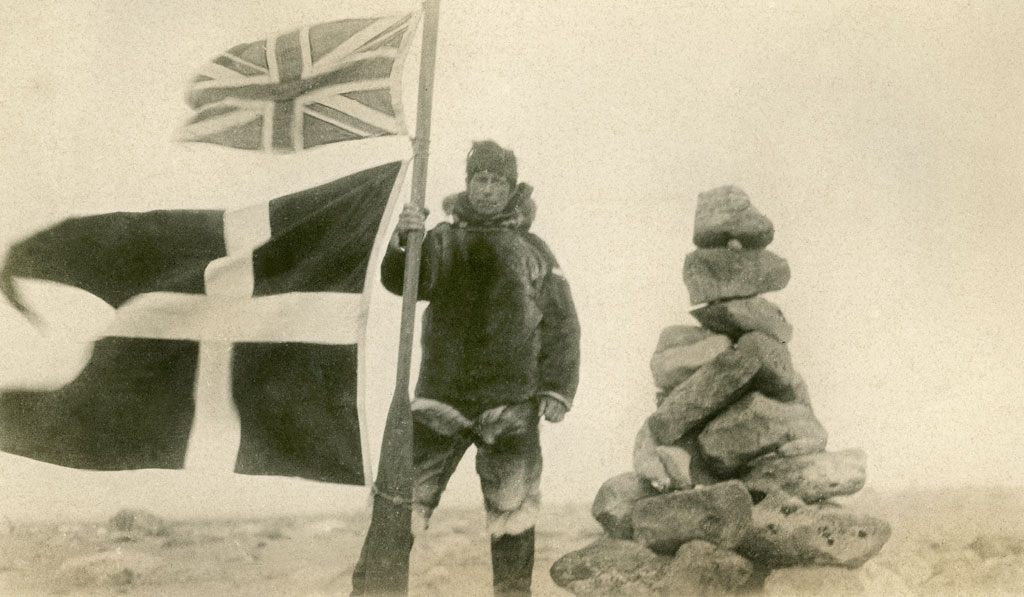
Burying Members of the Franklin Expedition at Starvation Cove, c. 1924. Smithsonian Institution Archives, Science Service Records, RU 007091, Box 409, Folder 2.  2005-8639.


It’s safe to say, everyone has an idea of what an expedition is; I hope all will agree when I say they are fascinating. Expeditions can be a thrilling story of exploration, national pride, thrill-seeking, and personal drama. They have been organized for a myriad of political or personal reasons; whatever these may have been, expeditions frequently yield natural history observations and specimens. Expeditions are also a wonderful source of information about biodiversity. Since expedition participants usually come from multiple institutions and disciplines, more collecting is often possible. This can result in a specimen collection of greater breadth and variety than a typical collecting event. With these characteristics, an expedition can prove a fascinating story and an important source of scientific documentation.

So I’ve been thinking it would be interesting to look at the Field Book Project’s expedition content. FBP was inspired by the challenges a researcher experienced tracking down specimens and field books from an expedition. Those experiences helped shape the cataloging structure FBP developed. We create catalog records for field books, their collections, and their creators (persons, organizations, and expeditions). Since we started, we have cataloged field books from 103 expeditions, some involving well-known individuals or documenting the first time an area was thoroughly studied.

View Full Size Image
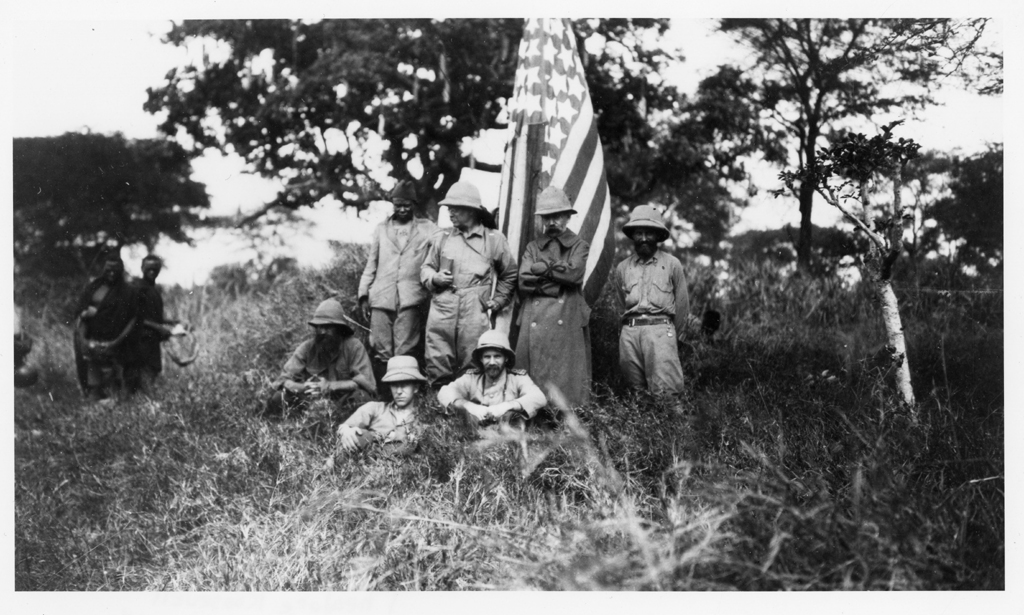
Theodore Roosevelt on African Expedition, 1909. Smithsonian Institution Archives, RU 00095, Box 56, Folder 10. SIA2009-1371.

On December 19th, FBP catalog records were made available through the Smithsonian’s Collection Search Center. This has created what I like to think of as the trifecta. What constitutes the trifecta? There are three major parts to natural history documentation that have proven important to researchers with whom we’ve worked: (1) the specimens, (2) the field books created when specimens were collected, and (3) the publications that resulted from their study. The Smithsonian Institution maintains online databases for many of their specimens. As BHL blog readers know, Smithsonian Libraries has also contributed to the Biodiversity Heritage Library to provide digitized versions of the publications for free access online. The FBP now offers online descriptions of the individual primary documents. The trifecta is growing for a number of Smithsonian sponsored expeditions and collecting events. A researcher now has a better chance of locating a specimen, its related field book, and a publication that cites it.

As a Field Book Project cataloger, I am thrilled to see the last element of the trifecta, our records, now available. While cataloging, we often verify information like location names by searching for digitized publications the creator may have written based on the field books. I find it fascinating to see how a publication can be informed by a primary document and vice versa. A researcher may be able to determine what a creator saw as significant about the collecting through the publication, and see the day-to-day work that the creator used to come to that conclusion in the field book.

Researching an Expedition

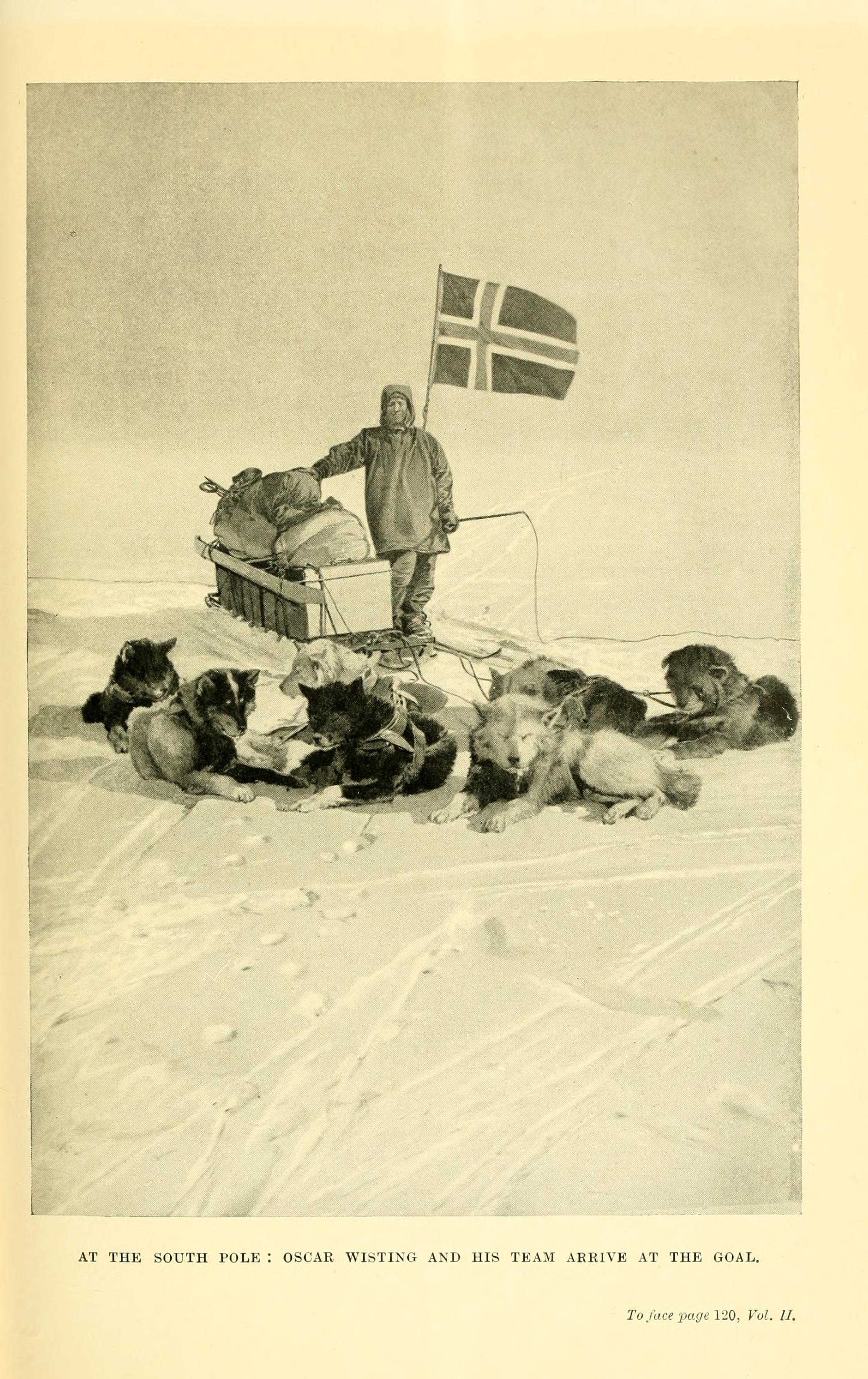
“At the South Pole: Oscar wisting and his team arrive at the goal” from The South Pole by Roald Amundsen, pg 121.  Biodiversity Heritage Library.
What is so challenging about researching specimens and documentation from a historical expedition? When an expedition ends, it can eventually fall from the public consciousness. The specimens and documentation might then be divided. At the very least, specimens go to each institution whose staff collected it. Specimens and documentation may be separated again by type and sent to different departments within an institution (e.g. mammal specimens go to mammalogy, bird specimens to ornithology). The fact that they were collected during the same expedition may not be recorded with each handoff. Each separation makes it harder to guarantee that the expedition connection is still evident.

Publications resulting from expeditions also run a high risk of losing an explicit expedition connection. Book catalog records do not always indicate that a publication documents a certain expedition. A researcher looking for resulting publications might have to search for participants as authors, looking for a period of time after the expedition was completed, then read the publication itself to verify the content is relevant. Some of these issues, like discovery of expedition related publications, may seem pretty straightforward, but this type of search assumes that the researcher knows who took part in the expedition.

How expeditions are documented

Expedition documentation varies widely. In recent years, some universities and museums have used the general appeal of expeditions to highlight some of their own collections online. These can be wonderfully informative websites, but usually only cover a few expeditions of significance to the home institution.

The Smithsonian Institution, as part of its initiative to be a provider of public history, has a detailed list of Smithsonian related expeditions available as an online guide that covers 1878 – 1917, compiled from Smithsonian Annual Reports. The Institution’s annual reports have a long tradition of discussing any major fieldwork. Smithsonian Institution Archives (SIA) also maintains more than 150 individual expedition records. These records are at varied levels of completeness, since Annual Reports sometimes only mention the name of a collecting effort if it was small.

Over the last two years, FBP has documented 103 expeditions relating to field notes. Several were not in the extensive list already kept by SIA, but deeply buried in personal or departmental papers. These can be rich resources, but a researcher would usually not know the information was there without reading the materials, despite the detailed finding aids SIA generates every year.

Researching an expedition is like untangling a very large knot. FBP, BHL, and museum divisions work to increase online documentation so researchers can find the right string to pull. This is by no means a finished process; many of us know what a gnarly tangle the search through materials can become. The digitization of the specimen, field book and publication trifecta can only serve to ease the burden of this twisted ravel of biology, personal history and published record, helping us and our researchers to find the connections.

February 28, 2013by [email protected]
BHL News, Blog Reel

Connecting Content on BHL!

View Full Size Image
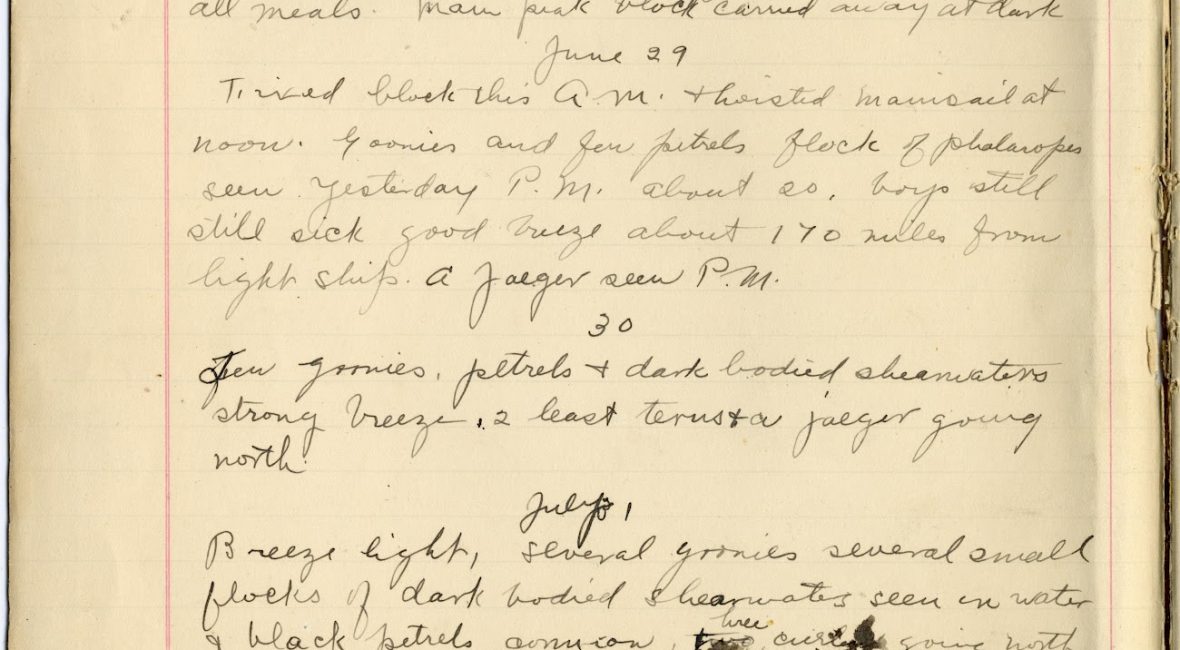
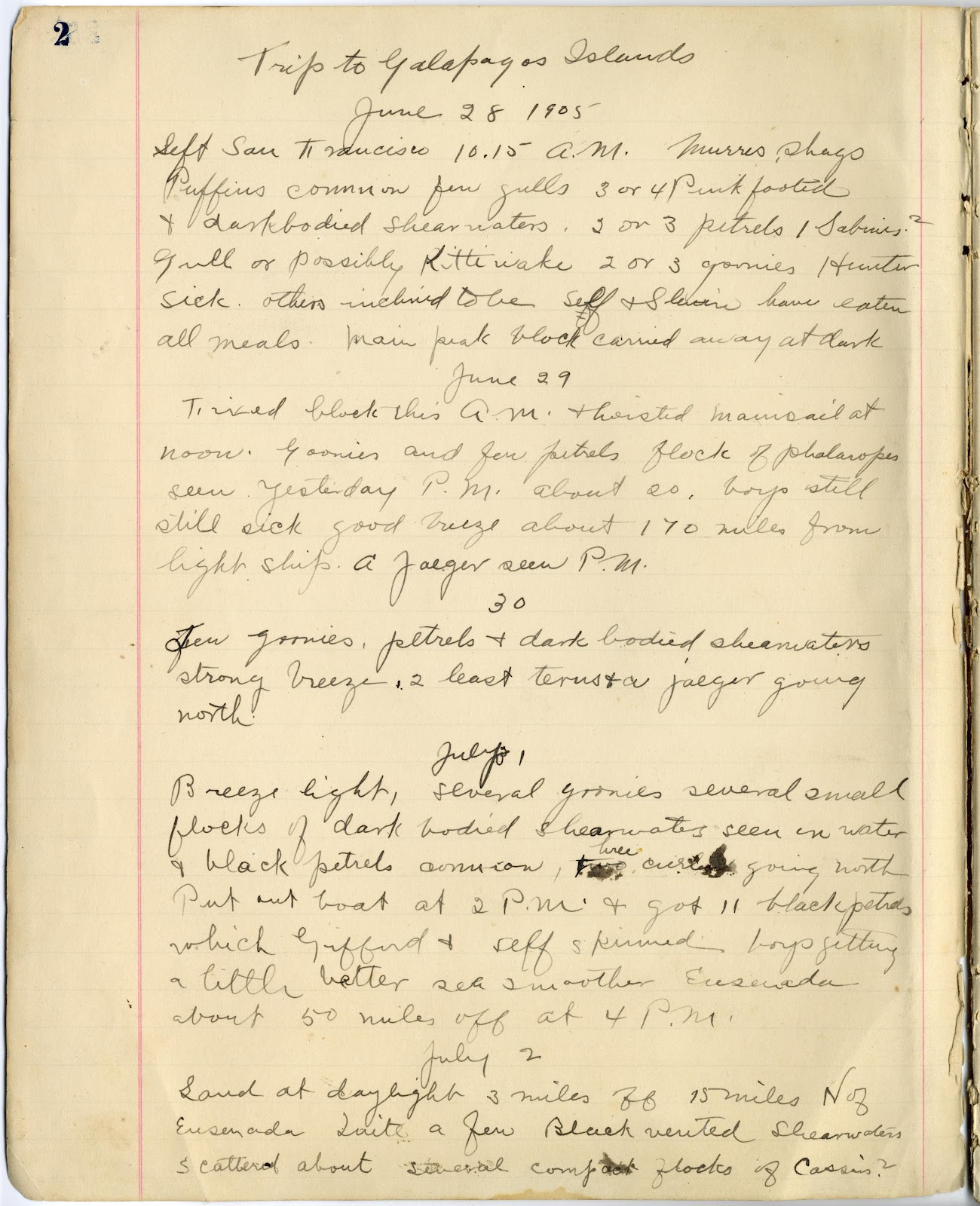
Excerpt from the Rollo Beck Galapagos expedition journal.

The California Academy of Sciences Library (CASL) is pleased to announce that The Rollo Beck Galapagos Expedition Journal is now accessible online via the Biodiversity Heritage Library.  The Beck field notes are the first test submission to the Connecting Content field note scanning project. Their successful inclusion into BHL marks many months of planning, effort, and collaboration between the Academy staff and the amazing Connecting Content partner institutions.

The Connecting Content project, made possible by an IMLS National Leadership Grant, involves digitizing field notebooks and natural history specimen collections, making the results available free for open access, and testing methods to create links between the items. This is the first step in an effort to create linked digital item-level access to archival resources, published literature, and biological data. This project has come together through the combined efforts of multiple institutions and with rigorous planning about how best to create and disseminate content that is discoverable, enduring, and openly accessible.

Rollo H. Beck was the leader of the 1905-06 expedition, and his style of field note taking provided a broader overview and unique perspective of the expedition, which differed from the very specific specimen-collecting notes of the other members of the team. The field notes are quite fragile and much care was needed to scan each page on the CASL flatbed photo scanner. A highlight for those doing the scanning was finding the page that describes the first news of the 1906 earthquake that destroyed much of San Francisco and nearly all of the Academy of Science’s collections. The specimens that the expedition brought back from the Galapagos formed the core of the new Academy.

After digitization, Connecting Content staff had to package the materials for submission to the Internet Archive and ingest into BHL by creating a MARC (MAchine- Readable Cataloguing) record for each item. (Staff would like to recognize and send a HUGE thank-you to the amazing and incredibly bright catalogers who have toiled over this effort! Michelle Abeln at Missouri Botanical Gardens, Lisa Studier at New York Botanical Gardens, Chris Robson at Harvard University Herbaria, and Stella Tang at the California Academy of Sciences.) These records are then combined with a spreadsheet containing page-level metadata, and the corresponding digital files of the scanned pages are submitted to the Internet Archive, and ultimately into BHL.

Project staff are now in the process of preparing several other field notebooks and digitized specimens for the pilot scanning project and have invited partner institutions to begin the process of uploading their field notes in preparation for ingest into BHL. After the materials are scanned, input into the project database, cataloged, exported, and delivered via BHL, staff will use the extrapolated metadata to experiment with mash-ups and make connections between names, dates, localities, and other contextual information, published materials, and specimen data.

The above post republished from the Connecting Content Blog, with permission from project staff.


May 3, 2012by ulib-libraryjobs

Help Support BHL

BHL's existence depends on the financial support of its patrons. Help us keep this free resource alive!

search

About BHL

The Biodiversity Heritage Library (BHL) is the world’s largest open access digital library for biodiversity literature and archives. BHL operates as a worldwide consortium of natural history, botanical, research, and national libraries working together to digitize the natural history literature held in their collections and make it freely available for open access as part of a global “biodiversity community.”

Join Our Mailing List

Sign up to receive the latest news, content highlights, and promotions.

Subscribe Now

Subscribe to Blog via Email

Enter your email address to subscribe to this blog and receive notifications of new posts by email.

Join 319 other subscribers

Subscribe to Blog Via RSS

Subscribe to the blog RSS feed to stay up-to-date on all the latest BHL posts.

Access RSS Feed

Inspiring Discovery through Free Access to Biodiversity Knowledge.

The Biodiversity Heritage Library makes it easier than ever for you to access the information you need to study and explore life on Earth…for free, anytime, anywhere.


64+ Million Pages of
Biodiversity Literature Online.

EXPLORE

Tools and Services
to Transform Research.

EXPLORE

300,000+
Illustrations on Flickr.

EXPLORE

ABOUT | HARMFUL CONTENT | PRIVACY | SITE MAP | TERMS OF USE