Biodiversity Heritage Library - Program news and collection highlights from BHL
  • Home
  • News
  • Featured Books
    • All Featured Books
    • Book of the Month Series
    • BHL at 20
  • User Stories
  • Campaigns
    • Fossil Stories
    • Garden Stories
    • Monsters Are Real
    • Page Frights
    • Her Natural History
    • Earth Optimism 2020
  • Tech Blog
  • Visit BHL
Home
News
Featured Books
    All Featured Books
    Book of the Month Series
    BHL at 20
User Stories
Campaigns
    Fossil Stories
    Garden Stories
    Monsters Are Real
    Page Frights
    Her Natural History
    Earth Optimism 2020
Tech Blog
Visit BHL
  • Home
  • News
  • Featured Books
    • All Featured Books
    • Book of the Month Series
    • BHL at 20
  • User Stories
  • Campaigns
    • Fossil Stories
    • Garden Stories
    • Monsters Are Real
    • Page Frights
    • Her Natural History
    • Earth Optimism 2020
  • Tech Blog
  • Visit BHL
Biodiversity Heritage Library - Program news and collection highlights from BHL
Blog Reel, Featured Books

28,000 Pages about the Sea: Challenges and Solutions for Digitizing the Fowler Collection

Workflow Meets Deluge

Henry Weed Fowler must have loved fish.

Ichthyology dominated his entire career. He started as a museum assistant at the Academy of Natural Sciences of Philadelphia in 1903. Other experts in his field soon recognized his prolific skill. In 1918, an assistant curator at the Smithsonian, Barton A. Bean, reached out to Fowler (then still an assistant) for help identifying fishes collected by the United States Exploring Expedition. Fowler dove into the work. He delivered a lengthy 750-page manuscript in two years, helping to discover 18 new species of fish in the process.[1]

For reference, the average field book here at the Smithsonian Institution Archives is 110 pages.

In 1925, Bean again sought out Fowler (then an associate curator) to identify fish from a 1907-1910 expedition by the steamer Albatross in the Philippines. Over the next several years, the pair published three manuscripts together (one | two | three), after which Fowler published three more of his own (one | two | three). Then, Fowler additionally completed six massive manuscripts – thousands of pages of independently written material – that were never published. Fowler passed away in 1965 after becoming a Curator of Fishes in 1940.[2] His unpublished manuscripts were transferred to the Smithsonian Institution Archives in 1975.[3]

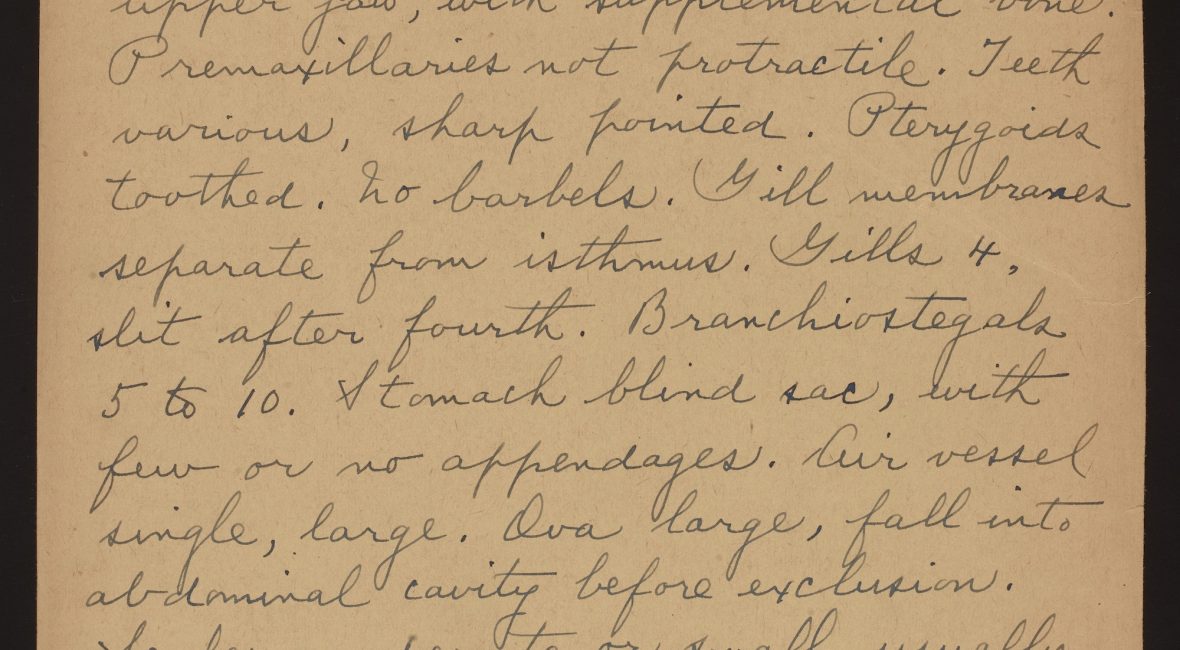
Fowler, Henry Weed. Manuscript of Henry Weed Fowler on the fishes of the Philippines, unpublished, circa 1930-1941. Families Argentinidae and Serpidae. Digitized in BHL by Smithsonian Institution Archives.

Fowler, Henry Weed. Manuscript of Henry Weed Fowler on the fishes of the Philippines, unpublished, circa 1930-1941. Families Argentinidae and Serpidae. Digitized in BHL by Smithsonian Institution Archives. https://biodiversitylibrary.org/page/55806651.

As a part of the BHL Field Notes Project, Smithsonian Institution Archives is digitizing one-of-a-kind field notes and manuscripts so they may be accessed online by researchers who may otherwise not be able to access the material. Logistically, each field book is assigned a unique identifier in the Archive’s Field Book Registry which we use to help track the item throughout the digitization process. On average, one unique identifier means one 110-page field book. We can normally digitize and deliver at least 30 field books per week.

Here’s where it got tricky: Fowler’s six unpublished manuscripts were grouped under a single identifier, MODSI6368. One 28,000-page item, 254-times larger than normal, and estimated 2.5 TB worth of images. One field book to outweigh them all.

Fowler’s unpublished manuscripts in the digital imaging lab, with imaging tech Charles Zange for scale. Photo by Mignonette D. Johnson. Smithsonian Institution Archives.

Fowler’s unpublished manuscripts in the digital imaging lab, with imaging tech Charles Zange for scale. Photo by Mignonette D. Johnson. Smithsonian Institution Archives.

The eight-Hollinger-box, 153-folder field book arrived in Staging in late February. Our team held a meeting. We needed a new approach.

Logistics of a Tidal Wave

Proceeding as normal would irreversibly skew project deliverables. Loading a 28,000 page manuscript in the BHL portal wouldn’t be the most useful approach for researchers. After detailed discussion, we settled on a plan: break out the manuscript into sub-elements at the folder level instead of the title level, photograph at ~650ppi so we wouldn’t have to adjust the camera during the day, and bulk scan smaller items that required a higher resolution.

This new approach offered several advantages. Adjusting the camera several times a day adds up and slows down imaging; removing the need to adjust constantly would save us time and make imaging the manuscript more efficient. Treating each folder as a separate sub-element would mean creating smaller, more manageable digital objects closer to the average 110 pages we usually work with. This would shorten descriptive metadata per image in our Collections Management System (CMS) records; otherwise we would be embedding page-long collection notes into each image. It would also allow us to take advantage of how BHL manages multi-volume titles. This in particular is a method already successfully implemented by our fellow Field Notes Project partners at the Missouri Botanical Garden on their George Engelmann material, so we knew it could be a user-friendly way to present the extensive Fowler manuscript.

We had a plan. Now we had to see if it would work.

Fowler, Henry Weed. Manuscript of Henry Weed Fowler on the fishes of the Philippines, unpublished, circa 1930-1941. Order Synbranchii. Digitized in BHL by Smithsonian Institution Archives. https://biodiversitylibrary.org/page/55811117

Fowler, Henry Weed. Manuscript of Henry Weed Fowler on the fishes of the Philippines, unpublished, circa 1930-1941. Order Synbranchii. Digitized in BHL by Smithsonian Institution Archives. https://biodiversitylibrary.org/page/55811117.

Results after the Storm

The first Fowler image came through the camera on March 14, 2018. Our team finished photography on April 17th. Delivery to the Biodiversity Heritage Library is ongoing (stay tuned!). Here are a few statistics from the Fowler photography project:

  • Final page count: 28,735
    • 153 folders, average 187.8 pages/folder (1.7 times larger than average field books)
  • 24 days of imaging and metadata processing
    • Average 1197.29 images/day
  • Highest one-day count of photography: 2,415 pages
    • 345 pages/hour (5.75 pages/minute) for 7 hours by one technician
  • 2.59 TB storage footprint
  • Widespread sense of accomplishment

Spread the Word across the Seas!

Fowler has started to make his way online. As the team moves to another collection (Edmund Heller), check out some of the other worldwide journeys by Smithsonian researchers at the Smithsonian Transcription Center and the Smithsonian Field Books Collection. Thank you to our many volunteers, both online and here in the lab, for your passion and dedication in support of this project!

The BHL Field Notes Project is funded by the Council on Library and Information Resources (CLIR).

Citations

[1] “Fowler, Henry Weed, 1878-1965,” Smithsonian Institution Archives

[2] Ibid.

[3] “Henry Weed Fowler Papers,” Record Unit 007180, Collections Management System, Smithsonian Institution Archives 

May 3, 2018by Joel Richard
Blog Reel, Featured Books

From ‘Shotgun Ornithology’ to Nature Conservation: Scientific Stories and Data from the Field Notes of William Brewster

handwritten text on a page with a drawing of a moose

William Brewster (1851-1919) was a renowned American amateur ornithologist, serving as a co-founder of the American Ornithologists’ Union, the first president of the Massachusetts Audubon Society, and a curator at Harvard’s Museum of Comparative Zoology (MCZ). As a part of the CLIR-funded BHL Field Notes Project, MCZ has been digitizing Brewster’s journals, diaries, letters, and photographic prints, which are held in Special Collections at the MCZ’s Ernst Mayr Library.

Most of Brewster’s observations are based in New England, where he split his time between two homes in Cambridge and Concord, Massachusetts. Brewster would stay in a cabin by the Concord River to study nature and escape city life in Cambridge. He also took notes when travelling: his notebooks document trips to the southern USA, the Caribbean, and Europe.

black and white photo of a man sitting in front of a cabin in the woods.

A black and white photograph of Brewster sitting on the front doorstep of his cabin in Concord, Ma. The small, one-story log cabin is set in a hillside and surrounded by small trees and shrubs. The back of the photograph has the note: “Concord, Mass. May 20, 1892.” (Ernst Mayr Library Special Collections, call no. bBr97.70.7.)

Brewster’s writings contain a wealth of information, from data on temperature and weather conditions to descriptions of animal behavior and personal musings. Some of the extensive Brewster collection is already available to view on BHL – here’s a sampling of the kinds of information you’ll find.

In the warmer months, Brewster often camped at Lake Umbagog (north of the White Mountain National Forest, straddling Maine – New Hampshire border), where he spent his days tracking the progress of bird nests around the lake and making other general observations. Here’s a typical example of one of Brewster’s bird lists, recorded at Lake Umbagog in 1907. The larger numbers are dates, with superscripts indicating the number of individuals counted that day. Asterisks tell us that the bird was heard vocalizing. Some additional details are also penned in (for example, he notes that Dendroica pensylvanica, the Chestnut-sided Warbler, was in an apple tree). [1]

handwritten page from a journal

An image of a page from a journal. Two smaller papers with handwritten, numbered lists are attached to a larger page. The heading reads: “Lake Umbagog, 1907. July and August.” The lists have scientific names of bird species, followed by dates, numbers of birds observed, and some additional notes. (1907. Journals of William Brewster, 1871-1919 (inclusive). Find this journal on BHL.)

Beginning in the 1890s, Brewster’s journals document a transition of focus from mainly specimen-collecting to photography and documenting behaviors. (His journals reveal an interesting story about his increasing ethical conflict and desire to study wildlife without contributing to its decline. You can read more about this in a previous BHL blog post found here.) Earlier in Brewster’s career, his journals list and provide details on species collected – data that is similarly useful to the list above in that it gives an indication of species distribution and abundance. It also corresponds with existing specimens and documents the impact made by scientific collectors of the era.

The kinds of data in these journals diversifies as Brewster started devoting more time to documenting animal behaviors. In many ways, this work seems to have been harder than getting a good shot at a bird. Even with today’s apps and audio libraries, figuring out bird calls can be a challenge. Equipped with just pencil, paper, field glasses and ears, studying bird vocalizations is much trickier, as shown by Brewster’s notes below from 1902. [2] Today, we can represent bird vocalizations visually using spectrograms. In order to translate sounds to text, Brewster listened diligently to invent mnemonics, describe patterns, and make comparisons to other more familiar sounds.

handwritten text on a page

An image from one of Brewster’s journals showing his written renditions of an unknown bird’s vocalizations. He writes: “The voice was much louder than that of any Blackbird and was also more penetrating. The cry lasted from ½ to ¾ of a second (timed with a stop watch) and I noted the following variations: Kèt – kèt – kèt – ă – ă – ă – ă – ă (the a sounded as ah) [etc.]” https://s.si.edu/2q6rKGa.

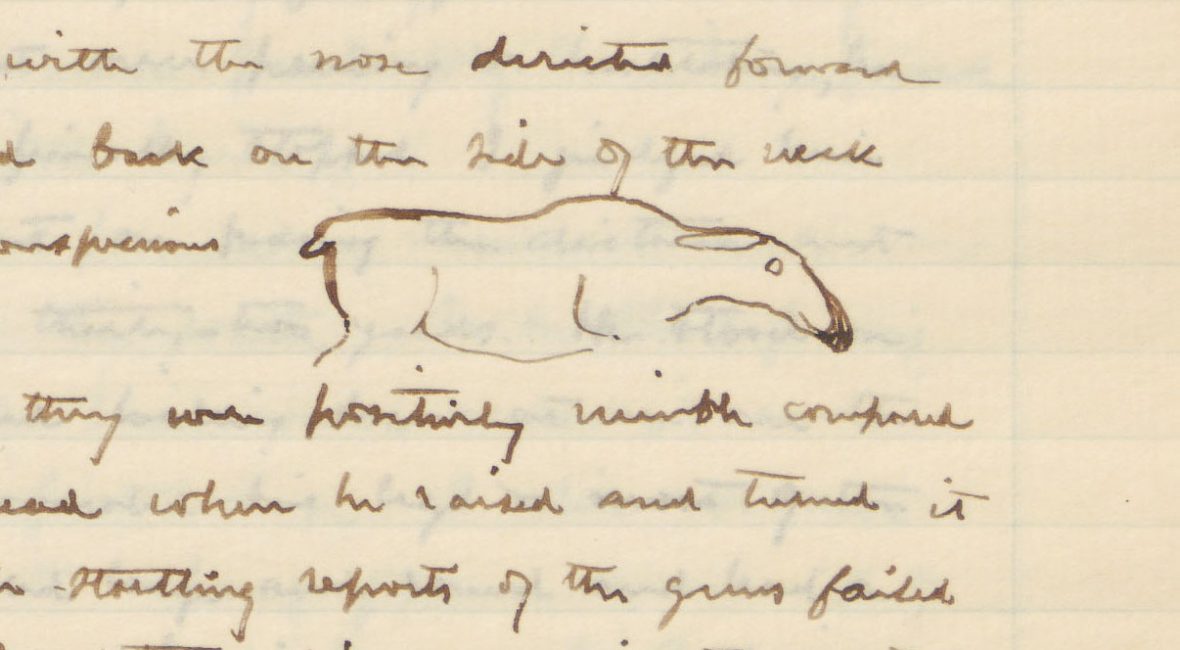
It’s worth mentioning that Brewster’s animal observations weren’t limited to birds, and that a lot of his animal encounters made for interesting stories. Below is a sketch of a moose from Lake Umbagog, observed in August 1869. [3] His impression: “He seemed like some long-forgotten antedeluvian creature which, arousing from a sleep of thousands of years, was wandering aimlessly about in a land so changed that it no longer had any place for such strange monsters.”

handwritten text on a page with a drawing of a moose

A simple ink-sketched outline of a female moose with head held low and ears lying flat back. The sketch is embedded in a paragraph handwritten in cursive script on lined paper. https://s.si.edu/2GD0beA.

As though telling the story to a friend, he recounts following the moose through the wetland in his canoe – sometimes ending up way too close for comfort. After talking to a local guide, he learned that the moose that he’d seen was a mid-sized female, and concluded, “If she was not really a very large one I have no wish to be equally near to a big bull!”

Because he returned to Lake Umbagog year after year, Brewster was able to notice longer-term changes in familiar ecosystems. Increasingly, these changes were man-made disturbances: the clearing of woods, the creation of new roads, and other urbanizing changes. He also recorded how local communities of animals and plants responded after these disturbances. The following passages from Brewster’s field notes document some changes that he saw in the Maine woods as a consequence of logging for paper mills, and include some of his own predictions.

“Where the road passes through the woods … the roadworkers last May cut away the mountain maples, cornels and other shrubs and low trees that made such a beautiful border to the forest clearing in their places a broad belt of bare rocks half covered with the fallen brush wood. This deed of vandalism was performed while I was here and at the time I feared that years must elapse before Nature, with all her diligence, could repair the injury.

“I underrated her powers for already this thicket of road is, if anything, more beautiful than ever. Fire weed, Eupatorium, Impatiens, Asters, Golden rod and several other tall and rank flowering plants have shot up through and almost perfectly concealed the unsightly brush and stone heaps and I have rarely seen a more brilliant or attractive display of wild flowers. The fire weed is especially tall and fine and the jewel weed grows in solid beds yards in extent. Of course the Humming birds had not overlooked such a feeding ground. There were at least three of them there at once including an adult male with blazing ruby throat at which I fired an ineffectual shot.” [4]

In this instance, Brewster noticed that one year was enough time to see plant growth after the woods had been cleared, that the colonizing plants were different from the ones that characterized the location before, and that they had impacted animal life. He penned these observations on ecological succession just a few years before the first scientific paper on this concept was published (“An Ecological Study of the Sand Dune Flora of Northern Indiana”, Henry Chandler Cowles, 1898.). [5]

illustration of two hummingbirds

A painting of Ruby-throated hummingbirds. Two male birds with red throats are hovering face-to-face with their beaks nearly touching. A female sits below in a branch with white flowers. All the birds are green above with white undersides and have long, narrow beaks. Below the painting is the text: “RUBY-THROATED HUMMING Order – MACROCHIRES Family – TROCHILUS Genus – ARCHILOCUS Species – COLUBRIS National Association of Audubon Societies.” (Portraits and habits of our birds. v.2. New York city: National association of Audubon societies,1920. (See on BHL.)

The following year, he wrote:

“The Lake shore has been sadly marred … by the lumbermen who last winter cut all the spruces and many of the fine, tall white pines all the way from this landing to the deep cove near the Tidswell place. […] Lumbering is a very different business now from what it was twenty years ago. Then only the larger trees were taken; now the pulp mills devour everything and nothing is spared thicker at the base than five inches! […] These changes in the character of the forests must make speedy & considerable changes in the bird fauna. The shore near Crocker’s camp, for instance, has been one of the chief breeding grounds for the Bay breasted Warbler. They will breed there no longer, now that all the spruces are gone.” [6]

Knowing now that local extirpations and even total extinction can occur (this was the decade when the passenger pigeon disappeared from the wild), he would have penned this prediction with heavy heart. To help preserve an area he cared about – his familiar stomping grounds along the Concord River in Concord, Mass. – over time, Brewster purchased 300 acres of the riverfront. His ‘October Farm,’ across the river from Great Meadows National Wildlife Refuge, is now protected land with trails recently opened to the public – while his writings, notes and photographs preserve the region for us as he knew it in the 19th and early 20th centuries.

(If you’re interested in learning more, I write an ongoing series of blog posts on the Brewster collection on the Ernst Mayr Library blog. You might like to see archival and modern photos of October Farm, Brewster’s property in Concord.)

References

[1] July and August 1907. Journals of William Brewster, 1871-1919 (inclusive). Find this journal on BHL.

[2] June 1, 1902. Journals of William Brewster, 1871-1919 (inclusive). Find this journal on BHL.

[3] August 27, 1896. Journals of William Brewster, 1871-1919 (inclusive). Find this journal on BHL.

[4] August 15, 1896. Journals of William Brewster, 1871-1919 (inclusive). Find this journal on BHL.

[5] ‘Henry C. Cowles’. The University of Chicago Centennial Catalogues. Web accessed: https://www.lib.uchicago.edu/projects/centcat/fac/facch14_01.html

[6] May 15, 1897. Journals of William Brewster, 1871-1919 (inclusive). Find this journal on BHL.

April 5, 2018by kmichaelis
Blog Reel, Featured Books

POBSP, how they did it : when science meets military interest

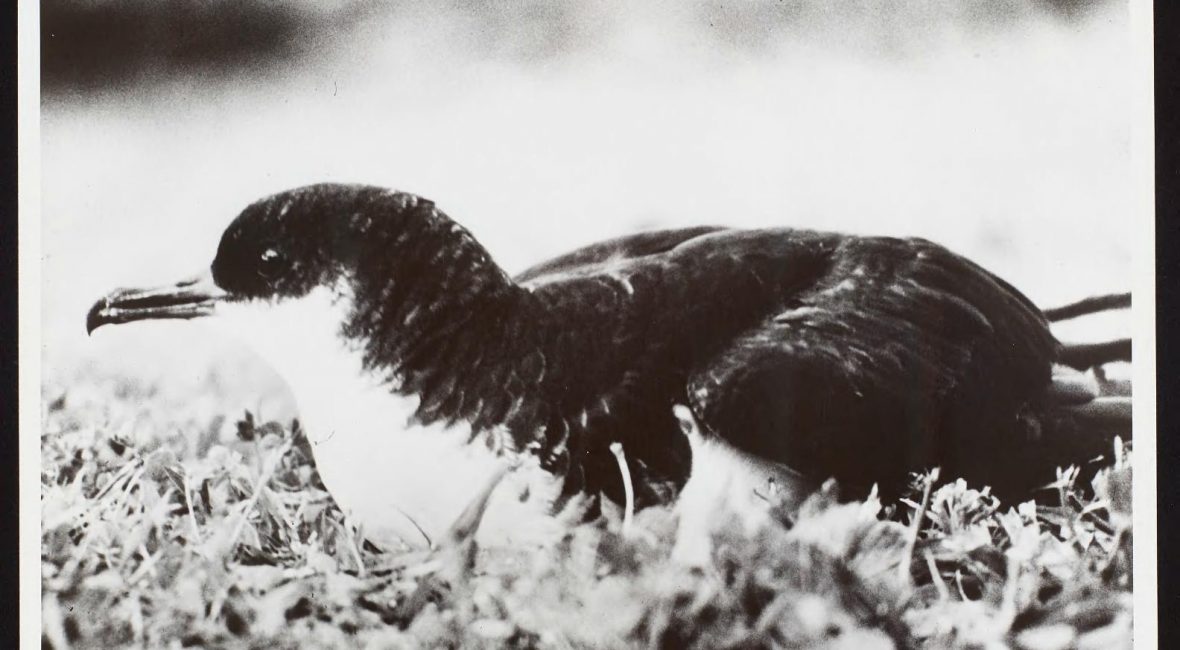
In the middle of the Cold War, the Smithsonian Institution embarked on the Pacific Ocean Biological Survey Program (POBSP) to survey U.S. territory islands and atolls dotting the central Pacific Ocean. From 1963 to 1969, researchers sought to inventory the plants and animals present on the islands, observe seasonal variations in numbers and reproduction, and the distribution of pelagic birds. Over the course of the survey, researchers observed approximately 150,000 pelagic birds at sea, banded 1,800,000 birds, and surveyed the flora and fauna of the islands, the most comprehensive study at the time. An incredible amount of data was collected during the POBSP, drastically increasing information available about the ecology of the small islands. Although it resulted in an incredible amount of data, the survey only spanned three years in part due to questions about the funder’s intentions.

Puffinus newelli (Newell’s shearwater), 1965.
https://www.biodiversitylibrary.org/item/243657

The Smithsonian received grant funds from the Department of Defense for the POBSP. In exchange, the DOD requested basic information about the movements of birds and several thousand blood samples. While the request was unorthodox, it was seen as justified since migratory birds were damaging aircrafts and communications equipment in the Pacific. Smithsonian agreed to the request and embarked on the first stretch of the POBSP in 1963.

Once the survey began, it became clear Smithsonian wasn’t completely aware of what it had signed up for. The military would complete exercises without explanation and kept the Smithsonian staff on a “need to know” basis. There is evidence that some of the researchers tried to get more information on why the military was so interested in the data but didn’t succeed. In the end, the staff accepted requests for secrecy, seeing it as a fair trade for the work they had the opportunity to complete, a task inaccessible to other groups.

Venus was bright on this particular September night in 1965.
Tordoff, Jeffrey P. 1965. https://biodiversitylibrary.org/page/55214829

We now know that the military conducted germ warfare tests in the Pacific in the 1960s, including The Pacific Project which exposed military personnel and biologists to chemical cleansers and bacteria which have been linked to debilitating conditions. There’s no official connection between the POBSP samples and these tests, and researchers from the Survey have not reported similar health effects as military personnel who were part of the Pacific Project. But the Department of Defense’s interest in the blood samples and migration patterns sparked suspicion which ultimately ended funding for the Survey in 1969.

Considering the political climate at the time, the Smithsonian was perhaps naïve in not considering the implications of the exchange in funds and information with the Department of Defense. The Institution’s researchers were offered the opportunity to complete research in remote areas that were expensive to study and required military cooperation to even get to. The younger biologists were particularly thrilled at the chance to be out in the field for weeks at a time like the biologists before them. What they all saw was a godsend.

List of blood samples collected in 1966.
Laysan Island, October 1966, Blood. https://www.biodiversitylibrary.org/page/54928748

The history of the POBSP and its connection to American military interests of the 1960s is incomplete, and parts of it will likely remain unknown. Despite this dark side to the survey, it is undeniable that Smithsonian’s researchers were able to collect an impressive amount of information during their expeditions to the Pacific. As part of the BHL Field Notes Project, the Smithsonian Institution Archives has taken on the task of digitizing field notes from the POBSP. Considering the shear amount of data collected, it should be no surprise that there are over 1000 field notebooks in the collection, making this SIA’s largest undertaking for the Field Notes Project.

Mus autopsy data, 1966.
https://www.biodiversitylibrary.org/page/55373636

To date, nearly 300 field notes from the collection are readily available in BHL, and many more are in the final post-processing stages in preparation for BHL. Stay tuned for the complete set of notes in the upcoming months.

The BHL Field Notes Project is funded by the Council on Library and Information Resources (CLIR).

References
Finding Aid for “Record Unit 245, National Museum of Natural History, Pacific Ocean Biological Survey Program, Records, circa 1961-1973, with data from 1923”.

MacLeod, R. (2001). “Strictly for the Birds”: Science, the Military and the Smithsonian’s Pacific Ocean Biological Survey Program, 1963-1970. Journal of the History of Biology, 34(2), 315-352.

Rauzon, M J. (2006). “Live Ammo: Testing of Biochemical Agents on U.S. Sailors.” The Asia -Pacific Journal : Japan Focus, 4 (12).

Further Reading
Hunter, E. (2011). “Life in the Field: a Reflection on Cataloging Field Notes in the Pacific Ocean Biological Survey Program.” Smithsonian Field Book Project Blog.

Lamb, J. (2016).  “TheStrange Tale of the Pacific Ocean Biological Survey Program.” JSTOR Daily.

Parilla, L. (2013). “I Found It in a Field Book: Hawaiian Monk Seal Family Images.” Smithsonian Field Book Project Blog.Tennis, A. (2016). “Invasive Pests of the Pacific.” Smithsonian Field Book Project Blog.

March 1, 2018by mkahn
Blog Reel, Featured Books

Dr. Arthur Cronquist and his Botanical Field Notes

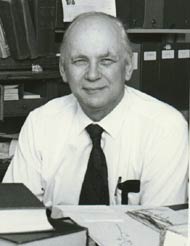
The LuEsther T. Mertz Library at the New York Botanical Garden is one of many partners on the Biodiversity Heritage Library Field Notes Project which was generously funded by the Council of Library and Information Resources (CLIR). As its contribution to the project, NYBG selected 91 field notebooks for digitization. Nine different collectors are represented in the selected volumes. The bulk of the selected volumes — a total of 61 — document the botanical collecting of Dr. Arthur Cronquist (1919-1992), a pre-eminent twentieth-century American botanist who spent most of his career at NYBG. The Cronquist field notes date from 1941 to 1990 and while most document work done in the continental United States, other countries are also represented including the former Soviet Union, a region of great interest to Cronquist.

Dr. Arthur Cronquist 

Arthur Cronquist in his office at NYBG, 1980s.

Cronquist’s professional accomplishments were numerous and varied. He was recognized internationally as an expert in the Asteraceae (also known as Compositae), the largest plant family in terms of number of described species. His other professional achievements include floristic studies, development of a taxonomic classification system and authorship of several widely used botany textbooks. Floristics refers to study of the types, numbers, distributions and relationships of plant species within a given, delimited area. Theodore Barkley wrote about Cronquist:

“Over the years, he was variously connected to nearly every major floristic project in temperate North America (and even one in the Galapagos), whether as author, coauthor, contributor, or consultant.” [1]

The list of projects worked on by Cronquist includes Compositae in The New Britton & Brown Illustrated Flora (Gleason, 1952); Compositae in Flora of Idaho (Davis, 1952), Vascular Plants of the Pacific Northwest (Hitchcock et al., 1955-1969), Manual of the Vascular Plants of the Northeastern United States and Adjacent Canada (Gleason & Cronquist, 1963 [ed. 2, 1991]) and the fifth volume of the multi-volume Intermountain Flora (1994) to name just a few.

Erigeron maguirei, named by Cronquist in honor of Dr. Bassett Maguire, an early mentor. Endemic to Utah, Maguire’s Fleabane is a species of conservation concern and is a member of the Asteraceae, one of Cronquist’s major research foci.

While eulogizing Cronquist at a memorial service held at NYBG in 1992, Dr. Peter Raven compared the botanical achievements of Cronquist to those of Linnæus. [2]  Other scientists have called him the twentieth-century Asa Gray, considered by many to be the most important American botanist of the nineteenth century. Arthur Cronquist died on March 22, 1992, while studying specimens in the herbarium of Brigham Young University in Provo, Utah.

The Field Notes 

Penstemon subulatus Jones, Cronquist 10561,
from Nevada, Arizona, California, 1966, [numbers 10554-10649]. http://s.si.edu/2nQpjqo.

Cronquist’s botanical field notebooks are typical of other botanical field notebooks and show how botanists document their field work and collect specimens. The image above shows one page in a field notebook created by Cronquist in 1966. At the top of the page, the number “10561” is visible. Botanists assign sequential numbers to the specimens that they collect throughout their careers. This number, when appended to the collector’s name, e.g. Cronquist 10561, forms an identifier that is retained when the specimen is subsequently deposited in a herbarium. The descriptive information recorded in the field notebook, e.g. the date, location and elevation, is copied from the field notes to a specimen label. The dried, pressed specimen and the specimen label are then mounted on a large sheet of paper. The image below shows a herbarium sheet for the specimen described on this page in Cronquist’s field notes and comes from the William and Lynda Steere Herbarium at New York Botanical Garden.

Penstemon subulatus Jones, Herbarium Specimen

The entire collection of field notes from all institutions participating in the BHL Field Notes Project is available in the BHL here. The Cronquist field notes contributed by NYBG are located here.

References:
[1] Barkley, Theodore M. (1996). On the Contribution of Arthur Cronquist to Botanical Science at The New York Botanical Garden. Brittonia, 48(3), 372-375. Retrieved from http://www.jstor.org/stable/2807800

[2] Lamont, Eric E. (1994). Arthur Cronquist (1919-1992). Bulletin of the Torrey Botanical Club, 58, 126-129. Retrieved from https://www.biodiversitylibrary.org/part/254875

Further Reading:
University of Florida Herbarium. Preparation of Plant Specimens for Deposit as Herbarium Vouchers. Retrieved from https://www.floridamuseum.ufl.edu/herbarium/voucher.htm 

The BHL Field Notes Project is funded by the Council on Library and Information Resources (CLIR).

February 8, 2018by lmyrick
Blog Reel, Featured Books

From Dayton to Cambridge and Back Again: the field notes of August F. Foerste

Field notes are well known to be essential, primary material that provide details about collections and expeditions that aren’t found in published material or specimen labels. Field notes can also contain diary entries, poems, and sketches which give insight into the lives of the researchers themselves. And now, we can add the candy preferences of August F. Foerste to those insights.

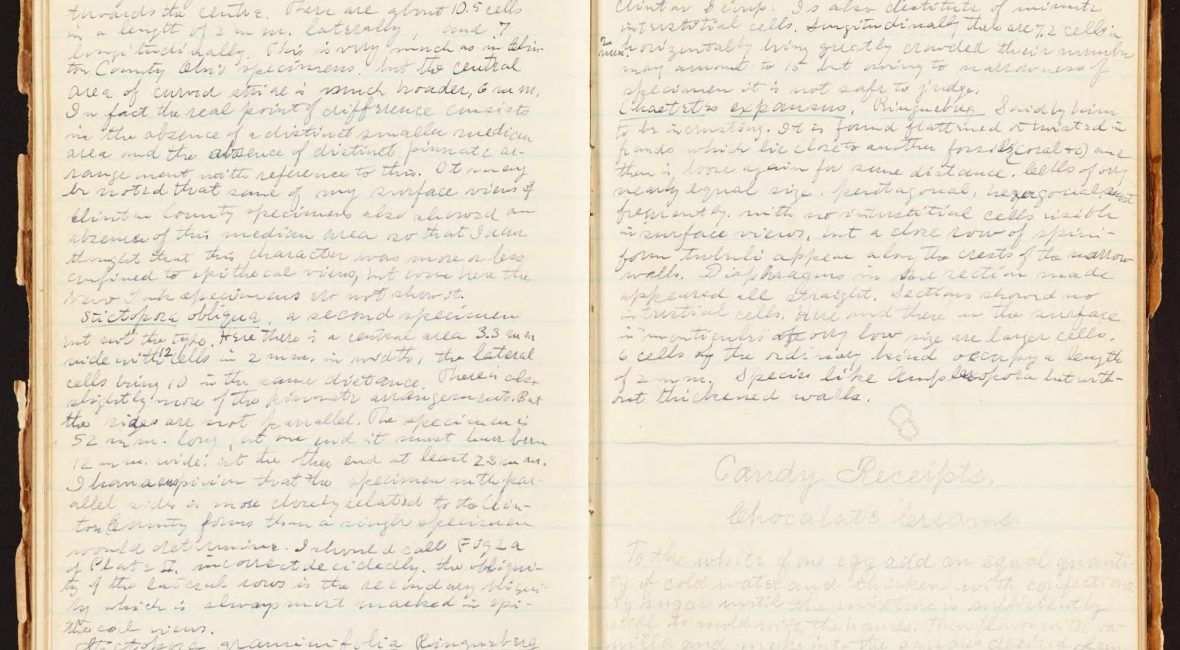
In his Specimen notebook, Ohio, 1887-1888, with no explanation, we find a list of several different candy recipes, including chocolate creams, lemon drops, and Neapolitan creams. Brings up quite a few questions. Who gave him the recipes? Was this the only paper he had available to write them down? Did he try to make them? Why is there a sugar syrup recipe at the end of the chocolate cream recipe with no explanation as to what to do with it? (This last one, admittedly, is more a personal inquiry of mine.)

Specimen notebook, Ohio, 1887-1888.
https://www.biodiversitylibrary.org/item/229964

What we can determine is that they were written down in 1888 when Foerste was completing his master’s degree at Harvard University. In fact, on the facing page, pictured above, we see a note about Harvard’s collections, in particular “microscopic studies of bryozoan, sections of corals, dissected specimens of crinoids, [and] sections of brachiopoda shells.” So while he may have been briefly distracted by confection, he was still focused on his studies. In that same notebook, Foerste includes several illustrations of specimens.

Specimen notebook, Ohio, 1887-1888.
https://biodiversitylibrary.org/item/229964

Foerste was a native of Dayton, Ohio. Like many naturalists, his early interests in science came about from wandering around town and taking note of the fossils, geological formations and stratigraphy of the local area. He completed his bachelor’s degree at Denison University before continuing his studies in Cambridge, Mass. While at Harvard, Foesrte also served as part-time assistant with the United States Geological Survey. As part of the survey, he studied the stratigraphy and petrography of New England.

Illustration by Foerste while in Vermont for the U.S. Geological Survey. Foerste was also studying at Harvard at the time.
Field notes, New England, undated. https://www.biodiversitylibrary.org/page/54118346

After graduating with his Ph.D, Foesrte would return to his hometown, spending most of his career as a teacher at Steele High School. During the summer breaks, he would go out into the field for the U.S. Geological Survey. As part of the BHL Field Notes Project, Smithsonian Institution Archives has digitized many of these notes. In 1932, he was appointed as Associate in Paleontology for the U.S. National Museum (now the National Museum of Natural History) until his death in 1936.

We are excited to share Foerste’s field notes as part of the BHL Field Notes Project. You can view these and other notebooks by Foerste in BHL. And if anyone gives those confection recipes a try, be sure to share with us!

The BHL Field Notes Project is funded by the Council on Library and Information Resources (CLIR).

Sources:
Finding Aid for “Record Unit 7242, Foerste, Aug. F,(Aug. Frederic),1862-1936, Aug. F. (Aug. Frederic) Foerste Papers, 1887-1933 and undated”

“August F. Foerste.” Centreville-Washington History.  

For a transcribed copy of the recipes, check out the Smithsonian Field Book Project’s 2012 Holiday Card, designed by Lesley Parilla.

December 8, 2017by mkahn
Blog Reel, Featured Books

“Access to the original record…wherever we now work”: Highlights from the Museum of Vertebrate Zoology field notes collection

The Museum of Vertebrate Zoology (MVZ) at the University of California Berkeley is a collaborative partner in the Biodiversity Heritage Library Field Notes Project. The MVZ has committed to digitizing 1,500 of its historic field notes as part of this collaborative undertaking.

The MVZ’s storied field notebook collection was a concept developed at the founding of the museum by Joseph Grinnell, the MVZ’s founding director. From its earliest moments, Grinnell and the museum’s benefactress Annie Alexander discussed methods and curatorial best practices for the specimen collections and research. These ideas and principles around the organization of data recorded around collecting events evolved into Grinnell’s methodology for recording field notes. Early letters between Alexander and Grinnell in the later months of 1907 document their thoughtfulness, excitement, and collegial concern for establishing a research museum which would document the land fauna in the Western United States. Grinnell recognized that field notes would be the lasting primary source material that would document the biodiversity of the rapidly changing environment of the west in the early 20th century and in the future. In 1910 Grinnell famously wrote:

“At this point I wish to emphasize what I believe will ultimately prove to be the greatest value of our museum. This value will not, however, be realized until the lapse of many years, possibly a century, assuming that our material is safely preserved. And this is that the student of the future will have access to the original record of faunal conditions in California and the west, wherever we now work.” [1]

The MVZ’s digitized field note book collection is a testament to Grinnell’s enduring legacy. From Grinnell himself, to the life works of Wilbur Mayhew, it is impossible to cover all of the amazing personalities represented but the following selections highlight some of my favorite individuals and collecting efforts from the first 300 books digitized.

Arctic Research Laboratory
Frank A. Pitelka was a UC Berkeley Professor and MVZ Curator of Birds whose prolific career included collaborative research projects at the Arctic Research Laboratory from 1955-1973. Along with his students, Prof. Pitelka’s Barrow, Alaska field notes record distributional data, life histories and behavioral observations of shorebirds, brown lemmings, and other groups across the Alaskan North Slope Borough.

Thomas Custer, Barrow Alaska, circa 1970.

The MVZ Archives has received much interest around field notes from this area and are excited to be able to provide access to this important record of the biodiversity of the Barrow region. Resurvey efforts in Alaska will be greatly supported by the field notes of Richard T. Holmes and the other Pitelka students who participated in the Arctic Research Laboratory.

Richard T. Holmes, Alaska species accounts, part 1, v4220, 1959-1964.
Chester Barlow
Archivists read many obituaries over their careers and every once in awhile, someone’s life shines like a light emanating from the pages of their memoriams, correspondence and photos. Chester Barlow is one of those individuals. Barlow, a good friend and Stanford colleague of Joseph Grinnell, tragically died at the age of 28. Henry Reed Taylor’s published memoriam to Barlow begins with, “Words cannot tell, and the pen falters as a thing which is feeble-and futile in an effort to express all that is comprehended in the simple words, “Barlow is gone.” [2]

And when Walter E. Bryant died in 1905, Walter K. Fisher began his memoriam to Bryant by stating, “Not since the lamented Chester Barlow passed away, nearly three years ago, has the Society suffered so severe a loss as from the recent death of our esteemed honorary member, Walter E. Bryant. [3]

“Chester Barlow in woods.”

Barlow’s field notes and photographs are preserved in the MVZ Archives. His photos and field notes reveal a playful and eager bird enthusiast whose memory lived on in all who knew him. You can read Barlow’s entertaining Farallon Islands notebook on the Internet Archive.

Barlow, Chester. Ornithological Notebook of C. Barlow with Original Observations Only. (1892-1894).

Amelia S. Allen
The MVZ Archives featured Amelia S. Allen in its blog four years ago. Allen was one of the earliest women elected to the membership of the Cooper Ornithological Club. She served as Secretary of the Cooper Club’s Northern Division from 1916 to 1924. She then served as the group’s Vice President in 1925 and then elected President in 1926. Her field notes document the avifauna of the Berkeley region from 1901-1944 and include memoirs of life in Berkeley and membership in the Cooper Ornithological Club.

An example of Allen’s candid reflections from her 1930-1942 Memoir and Field notes volume.


Edward W. Gifford

Edward W. Gifford was the assistant curator of Ornithology at the California Academy of Sciences and later became a curator at the University of California’s Museum of Anthropology. He kept an aviary at his Oakland home and donated his notes and birds to the MVZ throughout his life. But something very interesting caught my eye while prepping his volume for scanning. In his notes, he has a section recording his specimens that were burned in the 1906 San Francisco earthquake and fire. Gifford was participating in the California Academy of Sciences’ Galapagos Expedition when the earthquake and fire destroyed much of San Francisco, including the California Academy of Sciences. The Galapagos specimens collected by Gifford and fellow expedition members would go on to establish the new specimen collections of the newly rebuilt California Academy of Sciences.

Gifford, Edward W. Bird Notes: Aviary birds of the San Francisco Bay Region, v4289. (1904-1911).


Paul Elias

Paul Elias’s Guatemala field catalog and journal is a small and unassuming volume but it recounts an amazing journey filled with discoveries and critical data. Elias made this trip alone in the summer of 1974. He was 18 years old and an undergraduate at UC Berkeley, working at the MVZ. He collected two new genera of salamanders, later named Nyctanolis pernix and Bradytriton silus during this trip. Findings from this trip and the research of Prof. David B. Wake were published in a seminal paper in 1983. [4] It is difficult to imagine a trip like this taking place today. This is really only the beginning of Elias’s work with salamanders. Robin Moore wrote an excellent piece recounting Paul Elias and Jeremy Jackson’s return to the Guatemala’s Cuchumatane mountain range.

The BHL Field Notes Project is funded by the Council on Library and Information Resources (CLIR).

[1] Grinnell, Joseph (1910). “The Methods and Uses of a Research Museum,” Popular Science Monthly, 77, 163–169. https://www.biodiversitylibrary.org/page/1809048

[2] Taylor, Henry Reed (1903). “In Memoriam: Chester Barlow (With Portrait),” The Condor, 5(1), 3-7. https://www.biodiversitylibrary.org/page/53586237

[3] Fisher, W. (1905). “In Memoriam: Walter E. Bryant. Born 14th January, 1861. Died 21st May, 1905,” The Condor, 7(5), 129-131. https://www.biodiversitylibrary.org/page/53610508

[4] Elias, P., & Wake, D. B. (1983). Nyctanolis pernix, a new genus and species of plethodontid salamander from northwestern Guatemala and Chiapas, Mexico. In Advances in herpetology and evolutionary biology. Essays in honor of Ernest E. Williams. https://biodiversitylibrary.org/page/37028275

November 2, 2017by lmyrick
Blog Reel, Featured Books

Charles Schuchert: “[He] mapped the ancient seas and fathomed the geologic past”

The Yale Peabody Museum of History has partnered with the Biodiversity Heritage Library Field Notes Project to digitize a selection of primary natural history field research. Over the last year, the Peabody Museum has made 69 of invertebrate paleontologist Charles Schuchert’s field notebooks available to the public through Internet Archive and BHL.

Schuchert (3 July 1858 – 20 November 1942) was known for his seminal works on brachiopods, his unprecedentedly detailed and accurate paleogeographic maps of North America, devotedly supporting students academically and financially, and an unwavering dedication to his studies that resulted in over 236 published works, 130 paleogeographic maps, and more than 89,000 invertebrate paleontology specimens in the Yale Peabody Museum alone.

View Full Size Image

Lore has it that his affinity for invertebrate paleontology was cemented when a worker digging a ditch near his home in Cincinnati casually tossed 8 year old Schuchert a fossil [1]. Collecting such fossils from the local hills led to what would eventually evolve into the 2nd largest brachiopod collection in the nation [2]. Even in those early years, Schuchert’s scientific rigor was evident as he carefully labeled each specimen under his care (even if his first specimen determination of “petrifaction of a nanny-goat’s horn” did turn out to be a coral) [3]. At some point (sources variously say he was 11 or 17), he purchased The Paleontology of Ohio from a local drugstore and began his study in earnest.

Despite the auspicious early years of this lifelong love affair, Schuchert’s paleontological career began late, and was not without obstacles. During his childhood, Charles’ mother Agatha worked in a sewing factory, and his father Philip managed to start a modest business making parlor tables. Charles juggled chores and homework with opening their shop at 7am and continuing work there after school. Upon completing the 6th grade, Charles left school and devoted his days to working in the furniture factory’s varnish room.

In 1877, when Charles was 19, a fire broke out in the furniture factory and burned it to the ground. After emigrating from Germany and struggling to make ends meet for his small family, the devastation wrought by the fire overwhelmed Philip, and he sickened and died. But Charles, in one of the many instances in which he persevered against great odds, scraped together some $900, rebuilt the furniture business, and over the next few years expanded to become successful.

View Full Size Image
Schuchert, C. Field Notebook: Alabama. (1894). www.biodiversitylibrary.org/page/52997782

In the same year as the fire, Charles befriended Edward Oscar Ulrich, another young man with a love of fossils. Ulrich had some university schooling and was appointed to manage the Cincinnati Society of Natural History collections. Shortly thereafter, Charles visited St. Louis to sell furniture and looked up an expert on crinoids, Dr. G. Hambach. From Hambach, Charles learned lithography, a skill which allowed him to assist Ulrich in publishing material on local brachiopods and bryozoans over the next several years.

In 1884, there was another fire and once again the Schuchert furniture factory burned down. For the next 4 years Charles worked as a laborer in other furniture businesses until the renowned state geologist/paleontologist of New York, James Hall, came to visit Cincinnati. On seeing Schuchert’s collection and expertise, he hired Charles as his assistant.

In Albany, Charles made a number of connections that would serve him well, including one with Charles Emerson Beecher, then faculty at Yale and staff at the Yale Peabody Museum. After some time spent studying Minnesotan brachiopods in Minneapolis, Schuchert joined the staff of the U.S. Geological Survey in Washington in 1893. That April he was sent to the Yale Peabody Museum to assist Beecher in preparing early carboniferous crinoids for display at the Chicago Exposition. Shortly after Schuchert’s return to Washington, he became assistant curator of invertebrate paleontology at the U.S. National Museum.

View Full Size Image
Hand-drawn map to which Schuchert added notes over many years. This map was eventually published in the second edition of Outlines of Historical Geology (plate 28, map 1, page 230).

Upon Beecher’s sudden death in the winter of 1903, Schuchert was hired at Yale as professor of paleontology, curator of collections at Peabody Museum, and a director of the Sheffield Scientific School. At 46 years old with a 6th grade education, he set foot in a college classroom for the first time and taught his first college courses. This unorthodox appointment resulted in uniquely valuable solutions to common problems: when faced with bored students struggling to imagine geographical relationships between places they had never seen, Charles developed extremely detailed paleographic maps.

Although researchers had been drawing paleogeographic maps since James E. Dana popularized them several decades prior [1], Schuchert revolutionized the practice by showing smaller time periods in his maps (on the order of only several million years, as opposed to entire geologic eras, which span several hundred million years). This smaller slice of time allowed Schuchert to represent a geographic area with exponentially greater precision. He argued repeatedly over the course of his career in papers, books, and lectures that mapping too broad a temporal span meant including so many geologic changes that the resulting model did not accurately portray any moment in history at all.

An astute observation about the need for more detailed paleogeographic maps and their utility as stratigraphic teaching tools turned into a lifelong project as Charles undertook trip after trip gathering data, and spent long evenings painstakingly adding details to the array of maps on the custom desk he had built for the task [4].

View Full Size Image
Schuchert, C. Field Notebook: Michigan, New York, Ohio, Ontario. (1895). https://www.biodiversitylibrary.org/page/53191047

Schuchert eventually produced maps of North America spanning all of geologic time. In 1910, he published Paleogeography of North America, which would become the standard text on the subject, and is still in use today [5]. The countless carefully recorded observations that made these feats possible are retained in his field notebooks: a historical record of a historical record.

The Yale Peabody Museum of Natural History is honored to have the opportunity to share these notebooks with you. We hope that they continue to inspire the dreams of budding researchers, and that through them Charles Schuchert’s unflagging devotion to his passion can continue to support the efforts of the scientists to come after him as he did during his years as teacher, mentor, and first and foremost: paleontologist.

View Charles Schuchert’s field notes in BHL here.

[1] Knopf, Adolph. “Biographical memoir of Charles Schuchert, 1858-1942.” National Acad. Sei., Biogr. Mem 27 (1952): 363-389.
[2] http://peabody.yale.edu/collections/invertebrate-paleontology/schuchert-brachiopod-collection
[3] Kaesler, Roger L. “Carl O. Dunbar on Charles Schuchert.” (1987): 406-410.
[4] Schuchert, Charles. Atlas of paleogeographic maps of North America. Wiley, 1955.
[5] Schuchert, Charles. “Paleogeography of North America.” Geological Society of America Bulletin 20.1 (1910): 427-606.
Title quote from: Scientific Notes and News. (1935). Science, 81(2113), 633

The BHL Field Notes Project is funded by the Council on Library and Information Resources (CLIR).

October 5, 2017by lmyrick
Page 1 of 3123»

Help Support BHL

BHL's existence depends on the financial support of its patrons. Help us keep this free resource alive!

search

About BHL

The Biodiversity Heritage Library (BHL) is the world’s largest open access digital library for biodiversity literature and archives. BHL operates as a worldwide consortium of natural history, botanical, research, and national libraries working together to digitize the natural history literature held in their collections and make it freely available for open access as part of a global “biodiversity community.”

Join Our Mailing List

Sign up to receive the latest news, content highlights, and promotions.

Subscribe Now

Subscribe to Blog via Email

Enter your email address to subscribe to this blog and receive notifications of new posts by email.

Join 319 other subscribers

Subscribe to Blog Via RSS

Subscribe to the blog RSS feed to stay up-to-date on all the latest BHL posts.

Access RSS Feed

Inspiring Discovery through Free Access to Biodiversity Knowledge.

The Biodiversity Heritage Library makes it easier than ever for you to access the information you need to study and explore life on Earth…for free, anytime, anywhere.


64+ Million Pages of
Biodiversity Literature Online.

EXPLORE

Tools and Services
to Transform Research.

EXPLORE

300,000+
Illustrations on Flickr.

EXPLORE

ABOUT | HARMFUL CONTENT | PRIVACY | SITE MAP | TERMS OF USE