Biodiversity Heritage Library - Program news and collection highlights from BHL
  • Home
  • News
  • Featured Books
    • All Featured Books
    • Book of the Month Series
    • BHL at 20
  • User Stories
  • Campaigns
    • Fossil Stories
    • Garden Stories
    • Monsters Are Real
    • Page Frights
    • Her Natural History
    • Earth Optimism 2020
  • Tech Blog
  • Visit BHL
Home
News
Featured Books
    All Featured Books
    Book of the Month Series
    BHL at 20
User Stories
Campaigns
    Fossil Stories
    Garden Stories
    Monsters Are Real
    Page Frights
    Her Natural History
    Earth Optimism 2020
Tech Blog
Visit BHL
  • Home
  • News
  • Featured Books
    • All Featured Books
    • Book of the Month Series
    • BHL at 20
  • User Stories
  • Campaigns
    • Fossil Stories
    • Garden Stories
    • Monsters Are Real
    • Page Frights
    • Her Natural History
    • Earth Optimism 2020
  • Tech Blog
  • Visit BHL
Biodiversity Heritage Library - Program news and collection highlights from BHL
Blog Reel, Campaigns, Featured Books

Coloring Our Collections: The Art of Lithography

View Full Size Image

This year for Color Our Collections, we’ve produced a coloring book with illustrations from books that represent the evolution of the art of printing. This week on our blog, we’ll explore the books featured in the coloring book and the printing techniques used for the illustrations.

You can download our 2017 Color Our Collections coloring book here.

Learn more about Color Our Collections here.

The Art of Lithography

The process of lithography was first discovered by a German actor and playwright, Alois Senefelder, in 1796. It was used to varying degrees in the early 19th century, but became increasingly popular from the mid-19th century onward. By the 1880s, it was used widely for printing magazines and advertising.

In the lithographic process, the image is drawn onto a stone with a grease-based ink or crayon. The stone is then processed using a gum Arabic and nitric acid solution. The solution chemically separates the image and non-image areas, making the non-image areas water-receptive and the image areas water repellent. Once the stone has been processed, it is kept damp and an oil-based ink is applied. The ink is repelled by the damp non-image areas and sticks to the fixed image areas. The ink can then be transferred to a sheet of paper using a printing press.

This video from the Minneapolis Institute of Art demonstrates the lithographic process:

Gould’s Australian Bird Lithographs

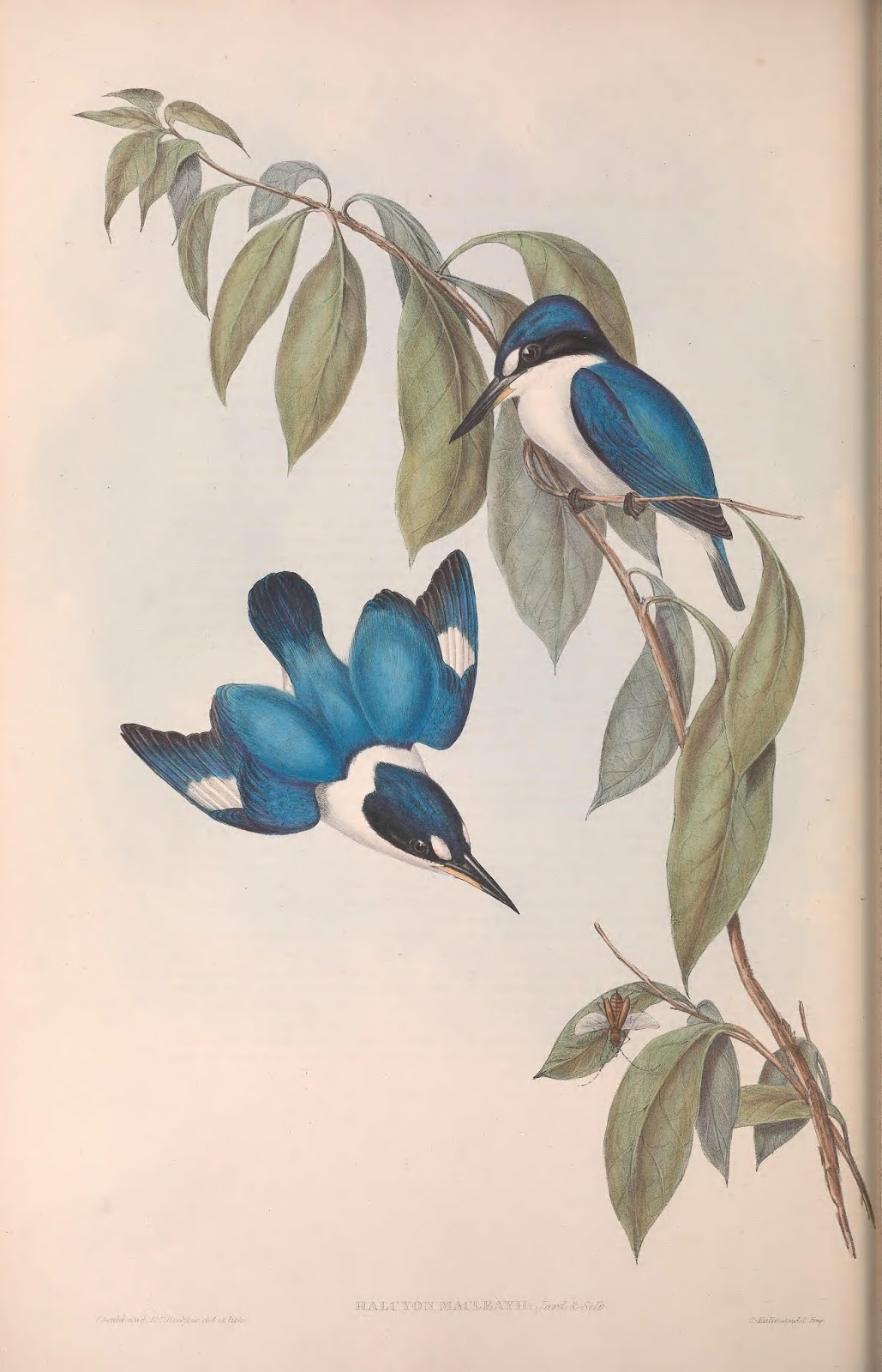
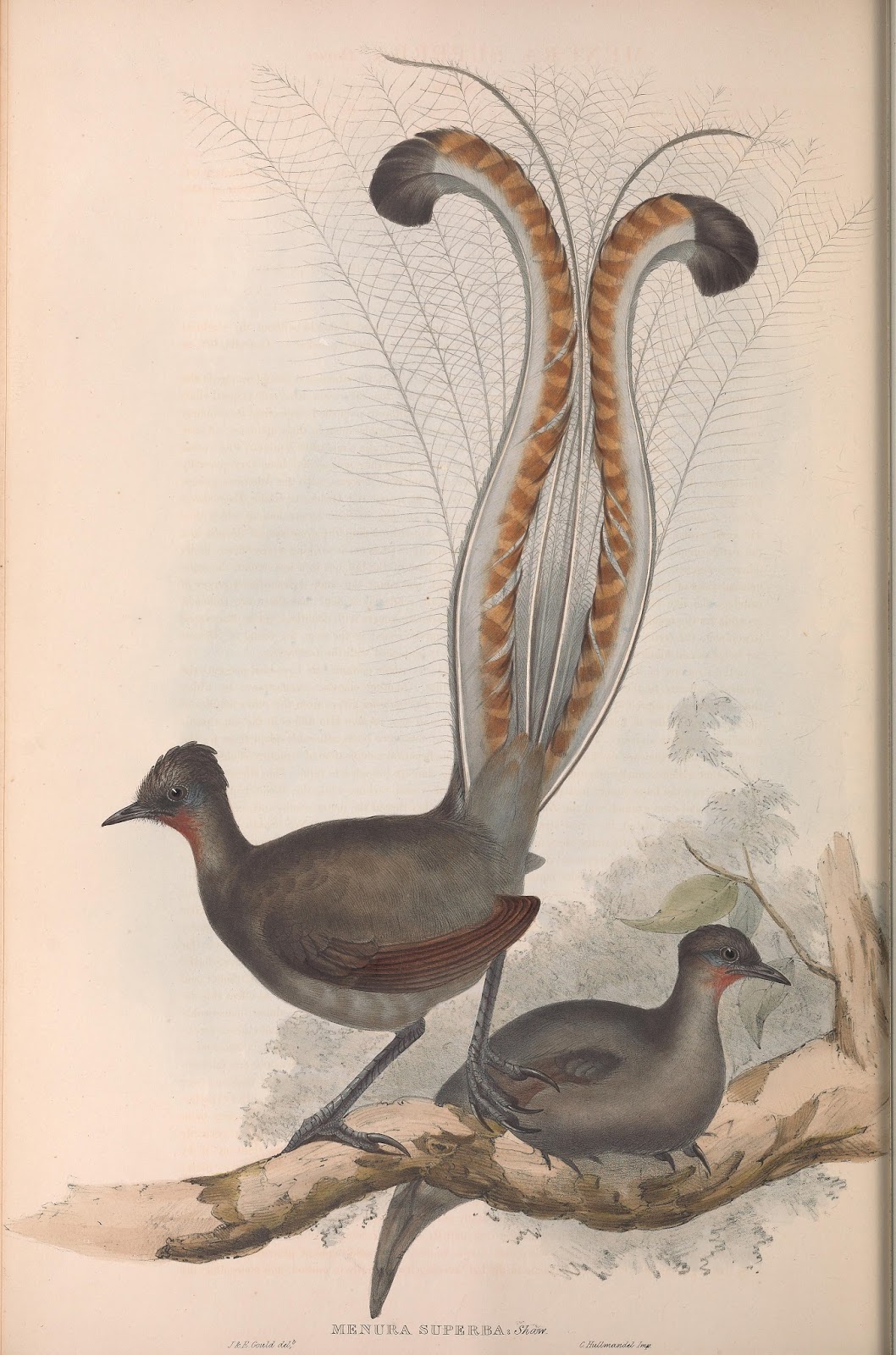
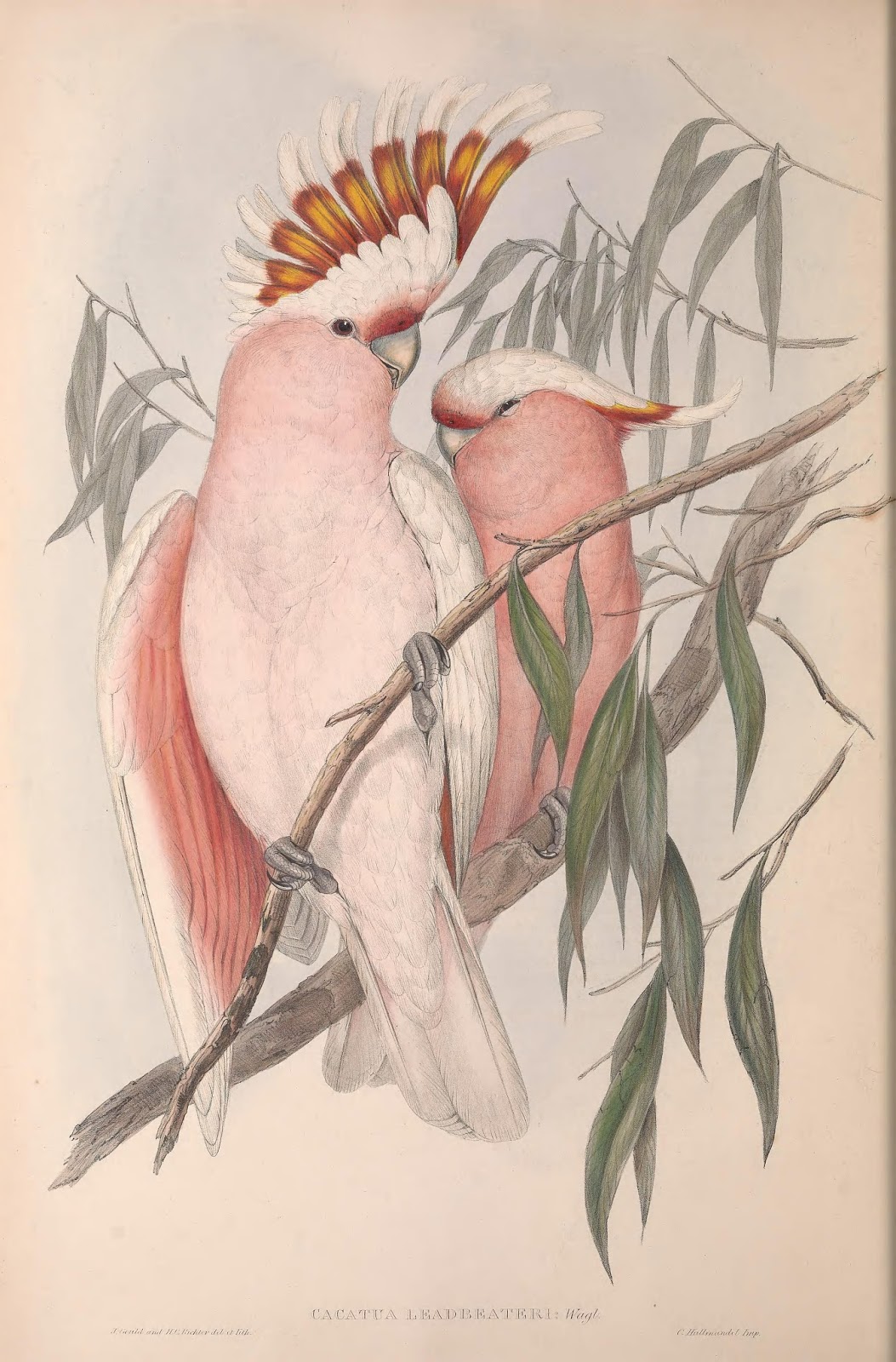
John Gould was an English ornithologist and bird artist who is famous for producing several magnificently-illustrated monographs on birds. One such work is The Birds of Australia, which was originally issued in 36 parts between 1840-48. Taken together, the title consists of 7 folio-sized volumes plus a supplement. It described all of the 681 Australian bird species then known, many of which were scientifically described for the first time. This title was digitized in BHL by Smithsonian Libraries.

View Full Size Image
Illustration by John Gould and H.C. Richter. Gould, John. The Birds of Australia. v. 2 (1848). http://www.biodiversitylibrary.org/page/48200584. Digitized by Smithsonian Libraries.

Gould’s original interest in Australian birds was sparked when his two brothers-in-law, Charles and Stephen Coxen, who had emigrated to Australia, sent him some specimens. Many of these he described in the 1837-38 work A synopsis of the birds of Australia, and the adjacent islands (Digitized in BHL by Museums Victoria).

In 1838, Gould, his wife Elizabeth, their eldest son, their nephew, Gould’s assistant John Gilbert, and two servants set sail for Australia so that Gould could undertake a more extensive work on Australian birds. During the 27 months that they were in Australia, Gould and his assistant collected some 800 bird and 70 quadruped specimens. Some 300 of these at the time were deemed new-to-science, although some of these are now recognized as subspecies.

View Full Size Image
Illustration by John Gould and Elizabeth Gould. Gould, John. The Birds of Australia. v. 3 (1848). http://www.biodiversitylibrary.org/page/48285735. Digitized by Smithsonian Libraries.

After returning to England, work began on the publication. The title’s crowning achievement is the beautiful lithographic illustrations. These were based on rough sketches by Gould that were worked up into paintings that were then reproduced through the process of lithography. The plates were printed in a single color by the firm of Hullmandel and Walton and then hand colored by a Mr. Bayfield.

View Full Size Image
Illustration by John Gould and H.C. Richter. Gould, John. The Birds of Australia. v. 5 (1848). http://www.biodiversitylibrary.org/page/48400938. Digitized by Smithsonian Libraries.

John’s wife Elizabeth, who produced most of the lithographs for John’s earlier works, executed 84 of the plates in this title. Sadly, she died of puerperal fever a year after returning to England. John enlisted Henry Constantine Richter to produce most of the remaining illustrations, although Edward Lear and Waterhouse Hawkins also contributed an illustration each. The first seven volumes were completed in 1848, but additional parts were later produced to form a supplementary volume to describe additional new species.

References

  • American Printing History Association. History of Printing Timeline. https://printinghistory.org/timeline/.
  • Leicester Print Workshop. A Step-by-Step Guide to Stone Lithography. http://www.leicesterprintworkshop.com/printmaking/step_by_step_guide_to_stone_lithography/.
  • The University of Glasgow. Library Special Collections Department. Book of the Month: The Birds of Australia. http://special.lib.gla.ac.uk/exhibns/month/july2005.html.
February 9, 2017by michelle.underhill
Blog Reel, User Stories

The Case of the Mistaken Manakin

Since the end of the twentieth century, the genus name Dixiphia has been associated with the white-crowned manakin. A recent investigation, made possible in part thanks to BHL, demonstrated that Dixiphia did not refer to a manakin at all, but was in fact a junior synonym of the white-headed marsh tyrant (genus Arundinicola).

The white-crowned manakin was in need of its own, new genus-group name.

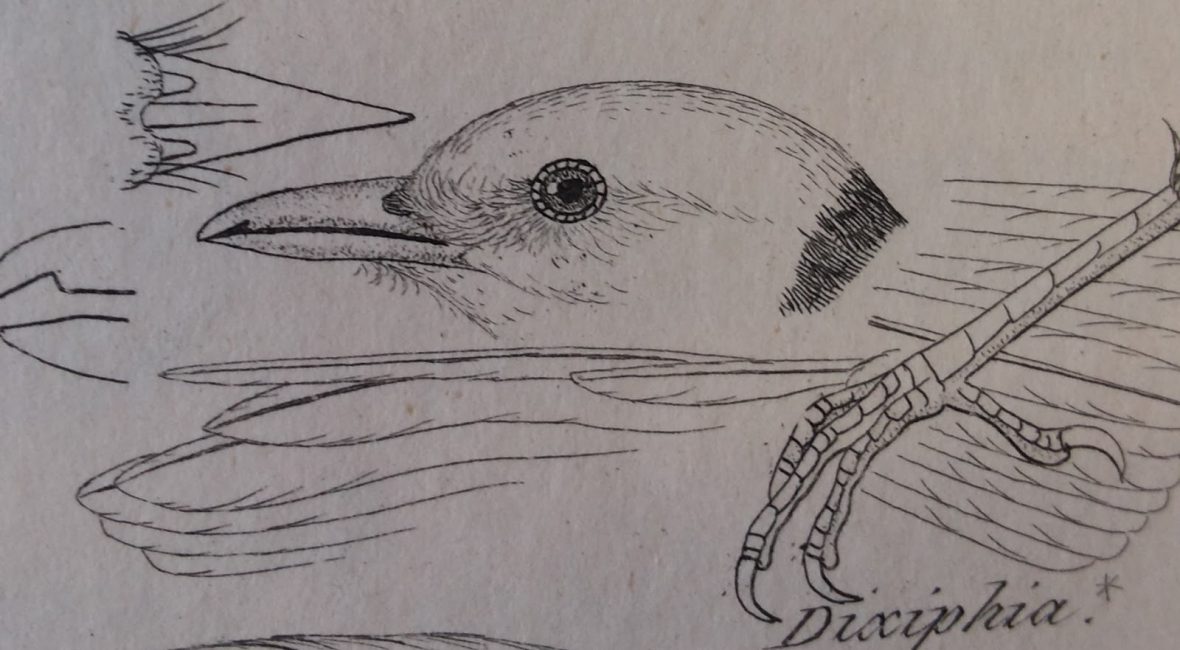
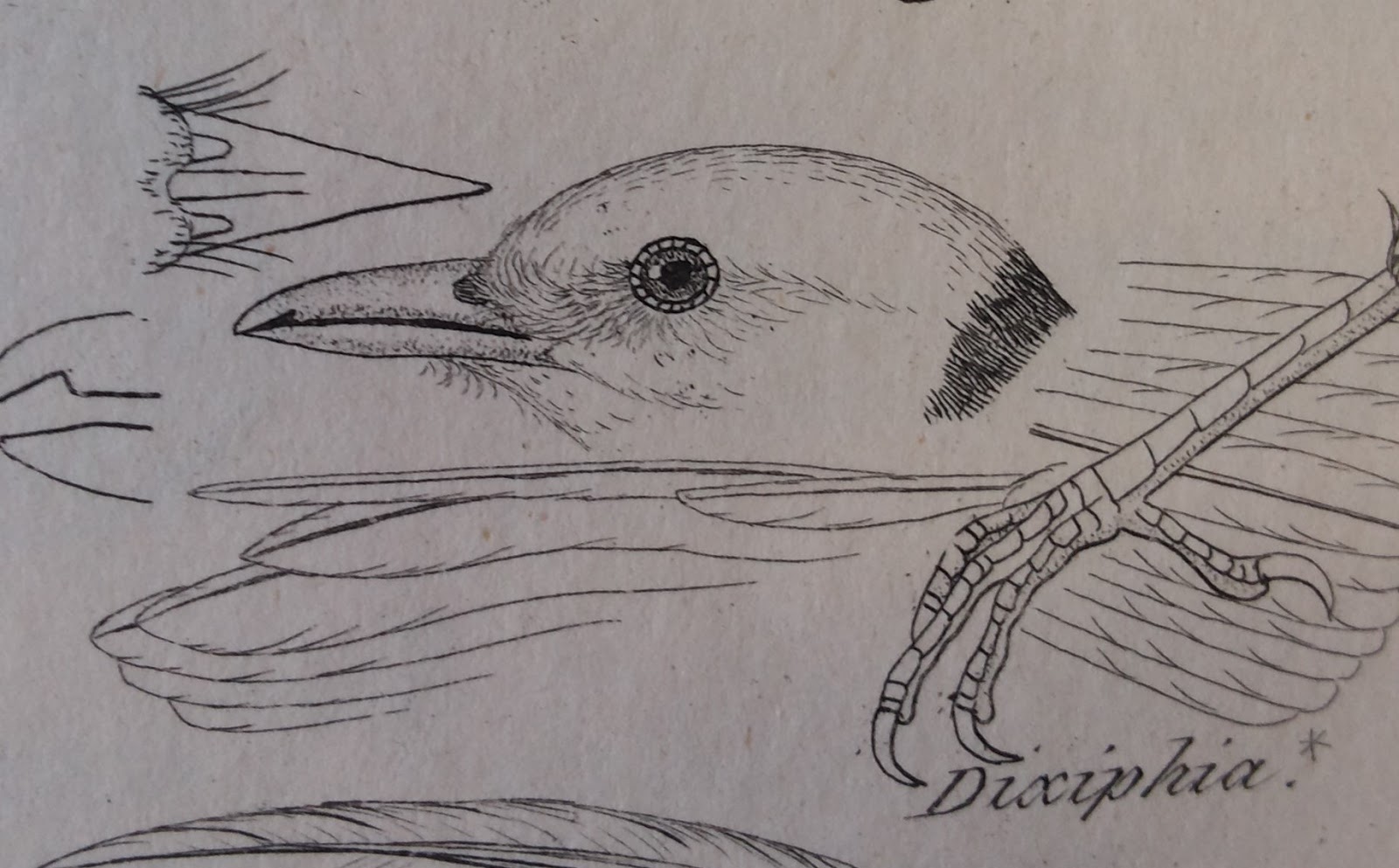
The manakin mystery was first discovered by researchers Guilherme Renzo Rocha Brito and Guy M. Kirwan. Following the publication of a book on Cotingas and Manakins, Brito and Kirwan received an inquiry from James A. Jobling about the absence of any mention in the publication of modified wing feathers in the white-crowned manakin (then called Dixiphia pipra), which were so clearly displayed in Reichenbach’s (1850) Dixiphia illustration. Brito and Kirwan were perplexed by the inquiry, because not only does Reichenbach’s illustration show a bird with an all-white head (which the white-crowned manakin does not have), but the white-crowned manakin also does not have modified wing feathers.

View Full Size Image
Detail from Plate LXIII of Reichenbach (1850) showing the bird that he named Dixiphia; all visible features are those of a male white-headed marsh tyrant Arundinicola leucocephala. Reichenbach, H. G. Ludwig (Heinrich Gottlieb Ludwig). Die vollstèandigste Naturgeschichte der Vèogel. Abt. 2, Bd. 1. (1836-62).http://biodiversitylibrary.org/page/47618489. Digitized by Smithsonian Libraries.

The genus name Dixiphia was first published by Reichenbach in 1850. In 1992, Richard O. Prum assigned the white-headed manakin to the Dixiphia genus after demonstrating that it had long been erroneously attributed to the Pipra genus.

After examining Reichenbach’s illustration following the inquiry regarding modified wing feathers, Brito and Kirwan came to the conclusion that Reichenbach’s illustration was actually that of the white-headed marsh tyrant (Arundinicola leucocephala). They examined specimens in the Museum Nacional’s ornithological collection as well as descriptions in historic publications, many made available to them thanks to the Biodiversity Heritage Library.

View Full Size Image
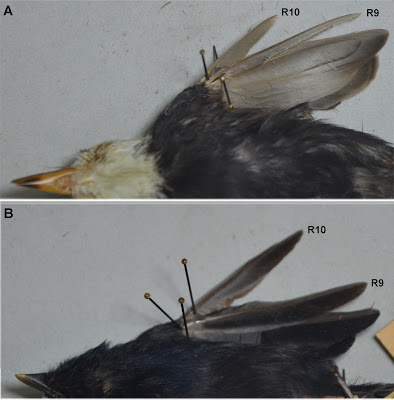
Pinned museum specimens showing the wing feathers (9th and 10th remige – R9 and R10). A – male White-headed Marsh Tyrant B – male White-crowned Manakin.

All of this research culminated in the conclusion that Reichenbach’s illustration was indeed of the white-headed march tyrant, that Dixiphia was actually a junior synonym of Arundinicola (a fact that had first been suggested over a century ago), and that a new genus-group name for the white-crowned manakin was needed.

Brito and Kirwan, along with co-authors Normand David, Steven M.S. Gregory, James A. Jobling, and Frank D. Steinheimer, summarized this research and proposed a new genus name, Pseudopipra, for the white-crowned manakin in the 2016 Zootaxa article “The mistaken manakin: a new genus-group name for Parus pipra Linnaeus, 1758(Aves: Passeriformes: Pipridae)“.

View Full Size Image
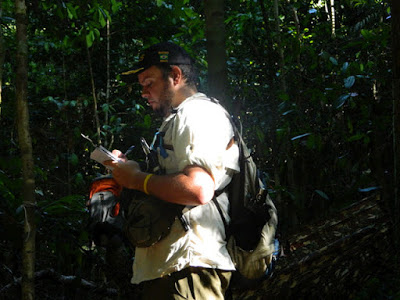
Guilherme R. R. Brito doing field work on the Brazilian Amazon.

Guilherme R.R. Brito, a substitute professor at the Universidade Federal do Rio de Janeiro, is quick to emphasize the role that BHL played in solving this taxonomic mystery – a role that is also highlighted in the acknowledgments section of the Zootaxa article.

“BHL is one of the most important databases for several [subject] areas within the biological sciences,” lauds Brito. “For historical taxonomic purposes, it’s now essential.”

Brito, who has been studying bird anatomy, natural history, taxonomy, and systematics for fifteen years, first discovered BHL shortly after the online portal launched nearly a decade ago. Since then, he has used BHL to access many important and historical publications that were previously very difficult to obtain in Brazil.

“Thanks to BHL, several very rare works are now readily available to any researcher in the world,” explains Brito. “I remember not so long ago that we researchers in Brazil had to wait for colleagues to visit museums and institutions abroad to ask them for some copies of works not available here. These were more difficult times.”

The digital open access provided by the Biodiversity Heritage Library allows scientists to easily access the information they need to study life on Earth and solve taxonomic enigmas like the Dixiphia mystery. No doubt Pseudopipra pipra is grateful to have a name to call its own.

View Full Size Image
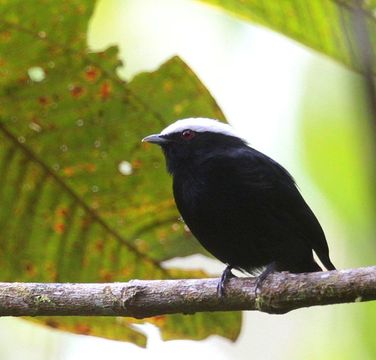
White-crowned manakin (Pseudopipra pipra). Image by Carmelo López Abad. Licensed under a Creative Commons Attribution-NonCommercial License license: http://creativecommons.org/licenses/by-nc/4.0/. Image source: Encyclopedia of Life http://eol.org/data_objects/33609559.
______________________________________

This post may contain the personal opinions of BHL users or affiliated staff and does not necessarily represent the official Biodiversity Heritage Library (BHL) position on these matters.
October 13, 2016by michelle.underhill
Blog Reel, Featured Books

Celebrating the Birds of South America

View Full Size Image
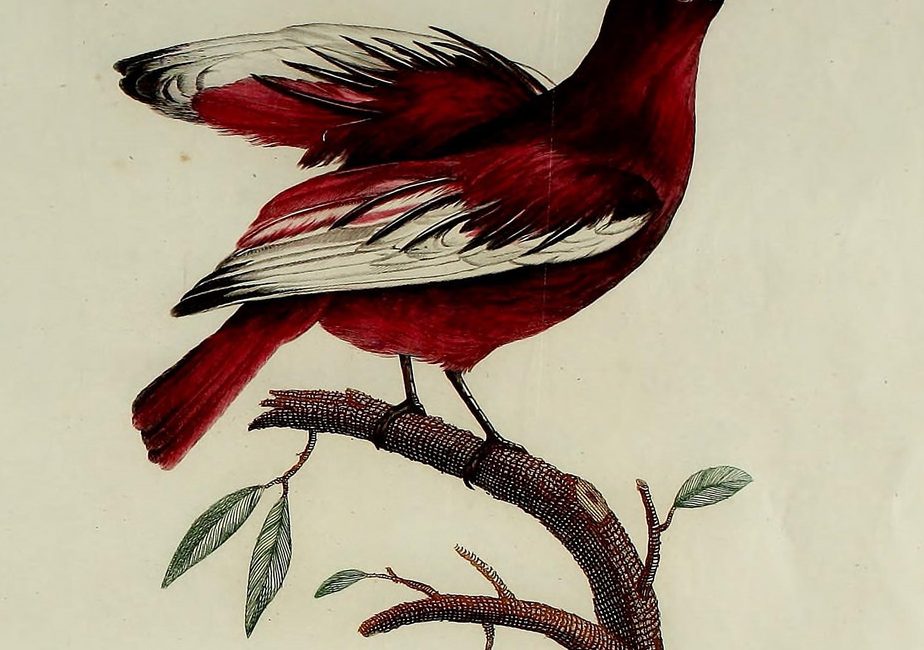
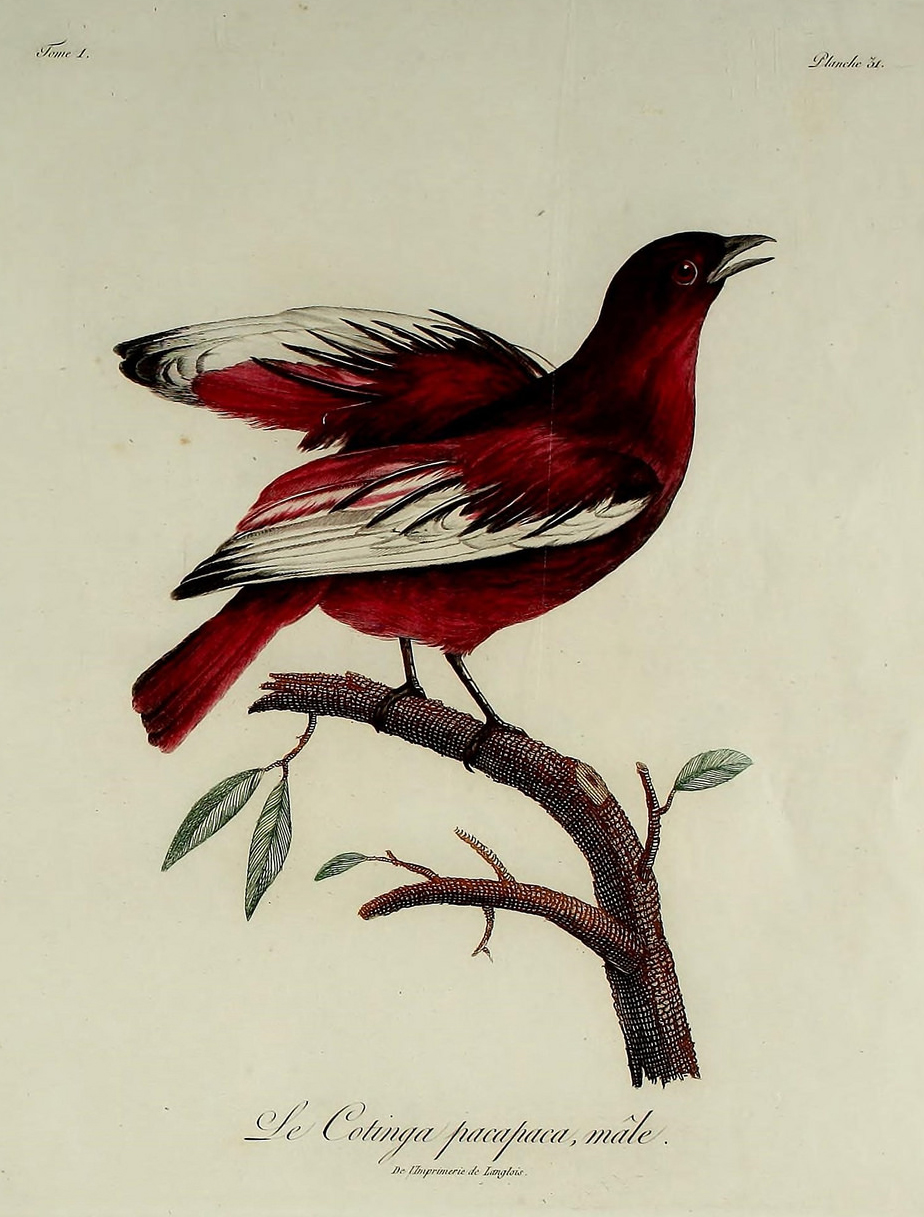
Plate 31: Le Cotinga pacapaca, male. Le Vaillant, François. Histoire naturelle d’une partie d’oiseaux nouveaux et rares de l’Amerique et des Indes. 1801. Digitized by The Field Museum of Natural History Library. http://biodiversitylibrary.org/page/47511750. Description on pages 66-69.

In honor of the first Olympics to take place in Brazil, we are highlighting a book contributed by The Field Museum featuring birds of South America, Le Vaillant’s Histoire naturelle d’une partie d’oiseaux nouveaux et rares de l’Amerique et des Indes (1801). Among several titles chosen for digitization from the Field Museum Library’s impressive Edward E. Ayer Ornithological Library, housed in the collections of the Mary W. Runnells Rare Book Room, the entry for the volume in Catalogue of the Edward E. Ayer Ornithological Library characterizes it as “a work intended to supplement his Hist. Nat. des Oiseaux d’Afrique (q.v.) by describing and figuring birds not properly included in that work.”

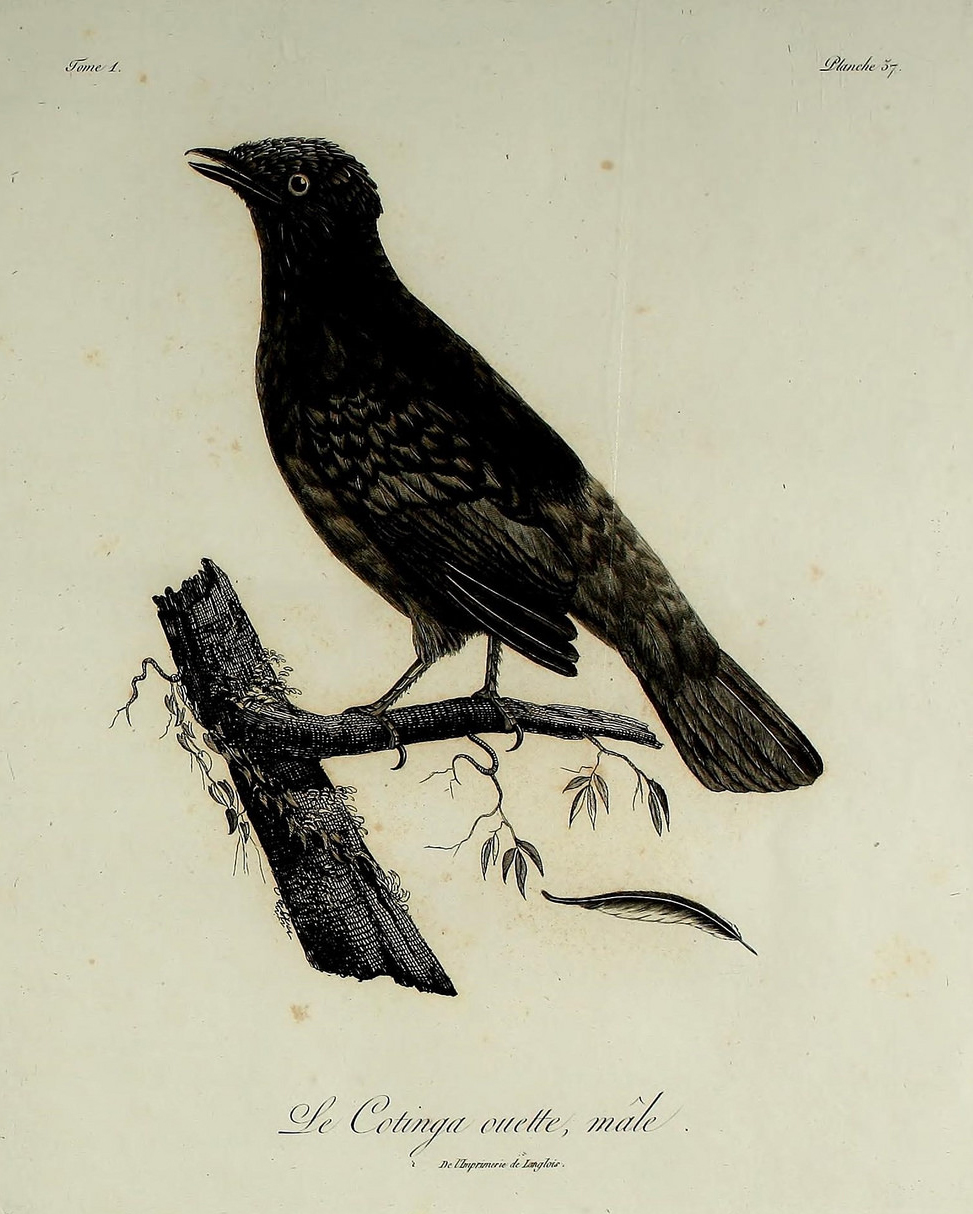
Published in eight parts, Histoire naturelle d’une partie d’oiseaux nouveaux et rares de l’Amerique et des Indes was available as a folio with both colored and uncolored plates; large quarto with colored plates only; and quarto, with uncolored plates only. Originally 240 plates were proposed, but ultimately only 49 were produced of species of Bucerotidae from Malay Archipelago and Cotingidae from South America. The Field Museum’s copy is a folio with both colored and uncolored plates.

View Full Size Image
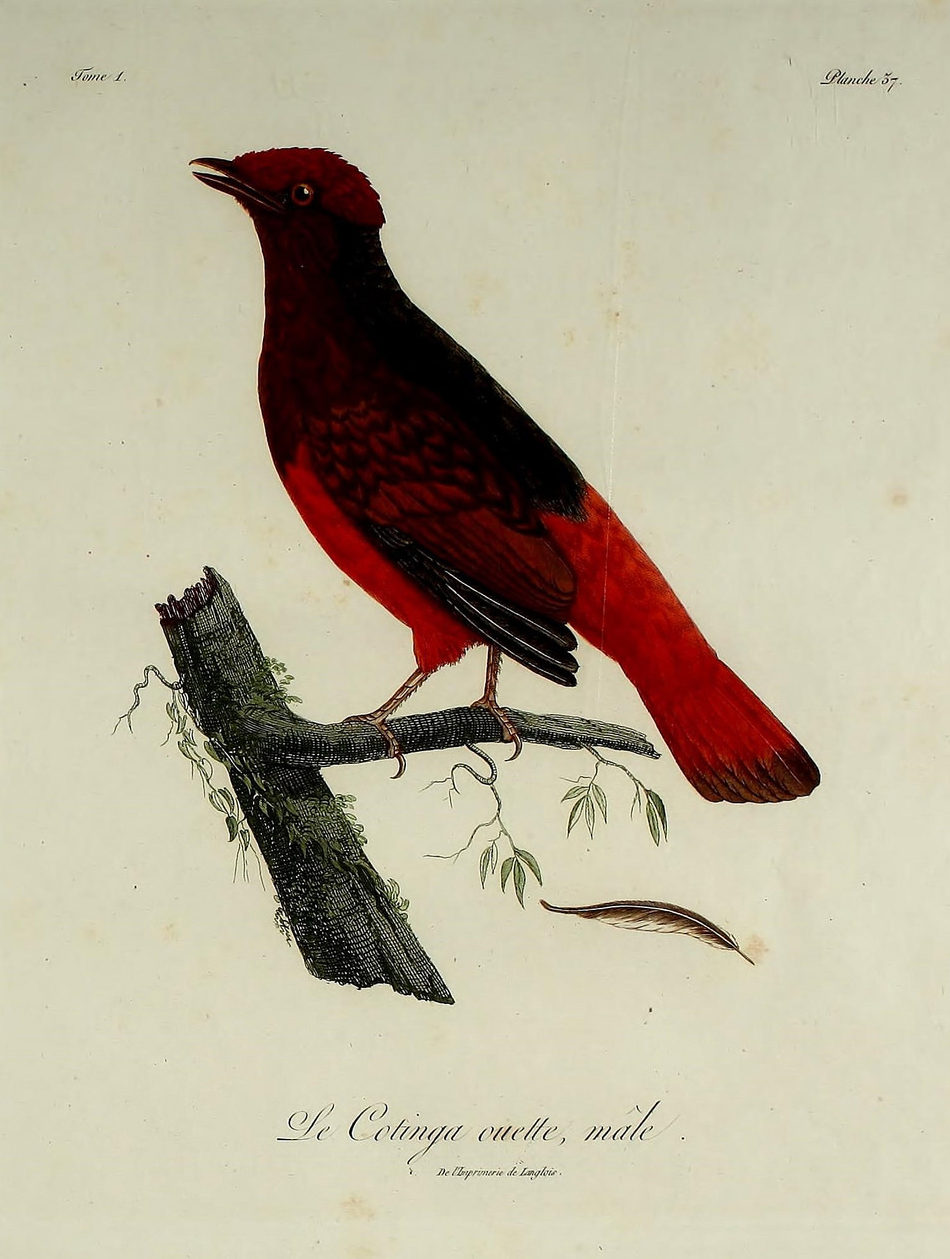
Plate 37, color: Le Continga ouette, male. Le Vaillant, François. Histoire naturelle d’une partie d’oiseaux nouveaux et rares de l’Amerique et des Indes. 1801. Digitized by The Field Museum of Natural History Library. http://biodiversitylibrary.org/page/47511812. Descriptions on pages 81-83.
View Full Size Image
Plate 38, uncolored: Le Continga ouette, male. Le Vaillant, François. Histoire naturelle d’une partie d’oiseaux nouveaux et rares de l’Amerique et des Indes. 1801. Digitized by The Field Museum of Natural History Library. http://biodiversitylibrary.org/page/47511816. Description on pages 81-83.

Born to French naturalists in Paramaribo, Dutch Guiana (Suriname), François Le Vaillant (1753-1824) began collecting bird specimens and building his own “cabinet” (or collection of specimens) before the age of ten. The family returned to France in 1763, where Le Vaillant would eventually make connections with ornithologists, collectors, and patrons who would become supporters of his work.

Le Vaillant was one of the first naturalists to independently embark on long voyages to study subjects in the wild. Previous naturalists had generally conducted such fieldwork as part of larger scientific expeditions. Not an illustrator in his own right, Le Vaillant relied on renowned artist Jacques Barraband (1768-1890) and emerging technologies of the day to produce his books. As authors Sitwell and Buchanan point out: “One interesting and sometimes confusing point is that some famous books are known by the author’s name and not the artist. Le Vaillant…whose name appears on most of the great French bird books of that same period, was a naturalist who travelled far, but never drew any of the pictures for his books…”

Barraband painted the birds that Le Vaillant secured on his voyages in watercolors, which were then assembled using an “elaborate mixture of processes – engraving, etching, colour printing and hand-finishing” (Lambourne). Le Vaillant was fortunate in that Napoléon Bonaparte had imitated a policy of Louis XIV to create a series of publications that were then “sent as presents to crowned heads, men of science, and learned bodies, in evidence of the splendours of the Empire…in this manner many glorious books came into being…The works of Le Vaillant owe their sumptuous character to the same impetus” (Sitwell and Buchanan).

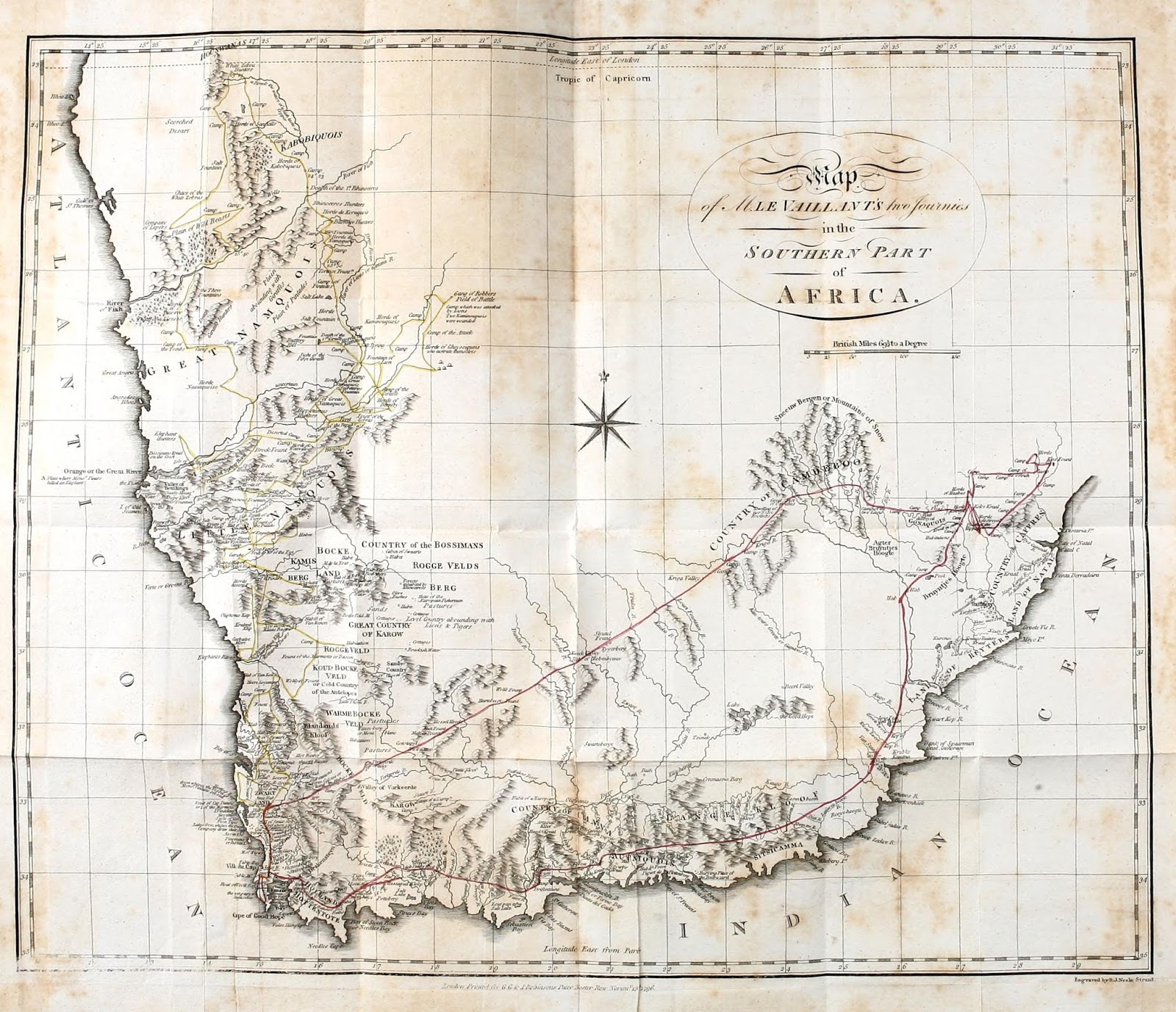
Le Vaillant’s travel memoirs contributed as much to his fame in his lifetime as his illustrated bird books: due to its popularity, Travels into the interior parts of Africa : by the way of the Cape of Good Hope in the years 1780, 8l, 82, 83, 84, and 85 (contributed by Smithsonian Libraries) was translated into English and German. Feeling pressured to write a sequel, New travels into the interior parts of Africa : by the way of the Cape of Good Hope, in the years 1783, 84 and 85 (also contributed by Smithsonian Libraries), contains “an entirely fabricated account of a journey from the Orange River to the Tropic of Capricorn,” though this was not discovered until after his death (Pasquier and Farrand). Ultimately, despite any embellishments, Le Vaillant will be remembered for having produced some of the finest bird books ever created.

View Full Size Image
Map, Foldout: Map of M. Le Vaillant’s Two Journies in the Southern Part of Africa. New travels into the interior parts of Africa : by the way of the Cape of Good Hope, in the years 1783, 84 and 85. Digitized by The Smithsonian Libraries. http://biodiversitylibrary.org/page/47139301.

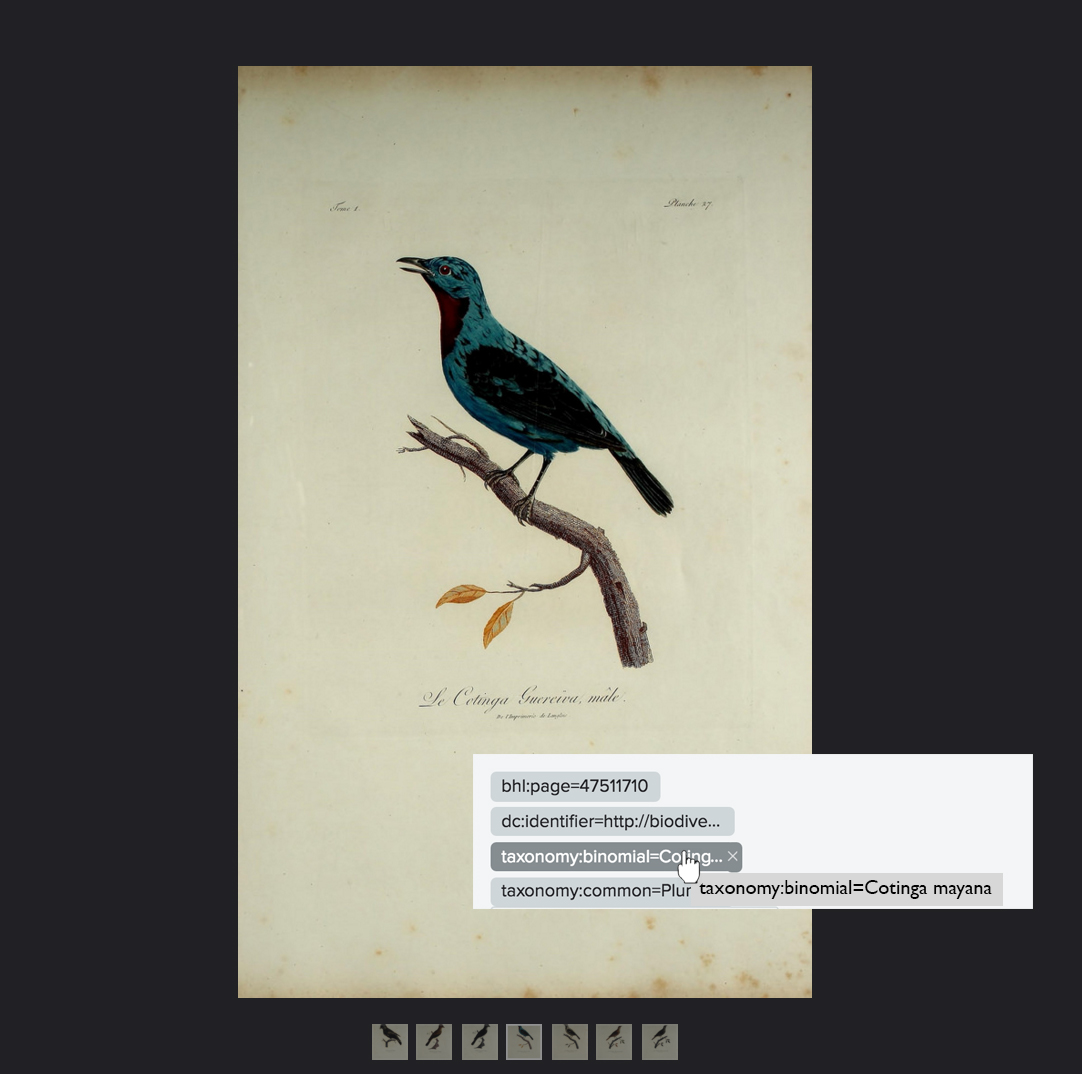
The images from Histoire naturelle d’une partie d’oiseaux nouveaux et rares de l’Amerique et des Indes are available in BHL’s Flickr. Nearly all of them have been taxon tagged by volunteers with the scientific name of the species depicted, allowing you to easily determine the species in the image as well as search Flickr for one of the included species and find the image. Learn more about our citizen science Flickr tagging efforts.

View Full Size Image
Example of a taxon-tagged image from La Vaillant’s Histoire naturelle d’une partie d’oiseaux nouveaux et rares de l’Amerique et des Indes in BHL’s Flickr.

References: 

  • Elphick, Jonathan. (2004). Birds. London: Scriptum Editions.
  • Lambourne, Maureen. (1990). The Art of Bird Illustration. London: Collins.
  • Martin, H. Bradley. (1989). The Library of H. Bradley Martin : Magnificent Color-Plate Ornithology. Sotheby’s Catalogue of Sale. New York, NY: Sotheby’s.
  • Pasquier, Roger F. and John Farrand. (1991). Masterpieces of Bird Art: 700 Years of Ornithological Illustration. New York: Abbeville Press.
  • Sitwell, Sacheverell, Handasyde Buchanan, and James Fisher. (1990). Fine Bird Books: 1700-1900. New York: Atlantic Monthly Press.
  • Stresemann, Erwin and G. William Cottrell. (1975). Ornithology from Aristotle to the Present. Cambridge: Harvard University Press.
July 28, 2016by ulib-libraryjobs
Blog Reel, Featured Books

Digging into the personal writings of a 19th century ornithologist

Tuesday, June 12, 1866 
A.M. pleasant P.M. cloudy. Studied part of P.M. Went to circus in evening & saw a hippopotamus for the first time. Got four warbling vireos before breakfast. The algebra is now rather hard. 
(Diaries of William Brewster). 

View Full Size Image
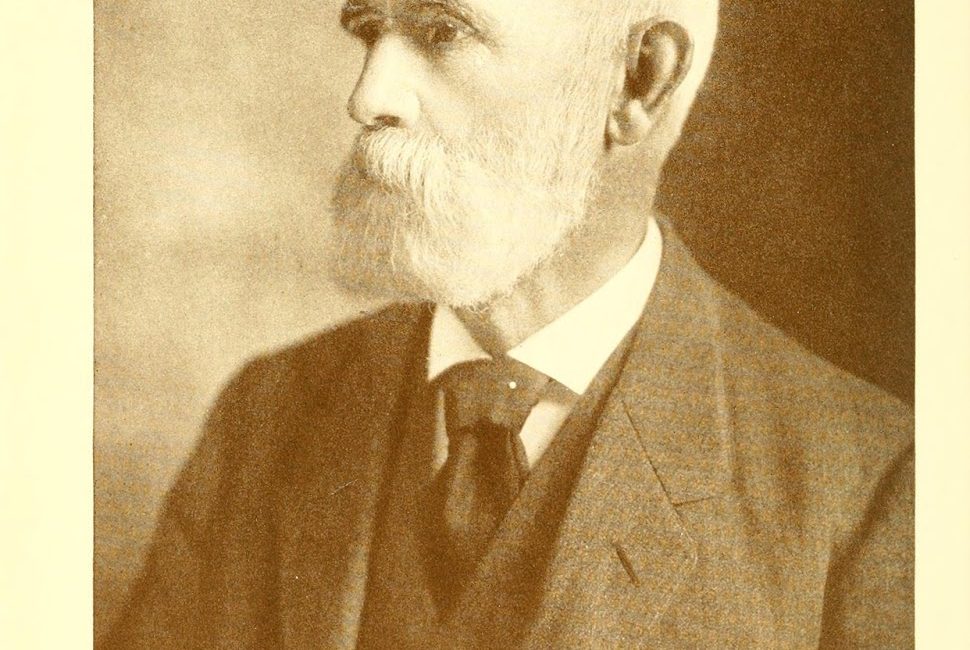
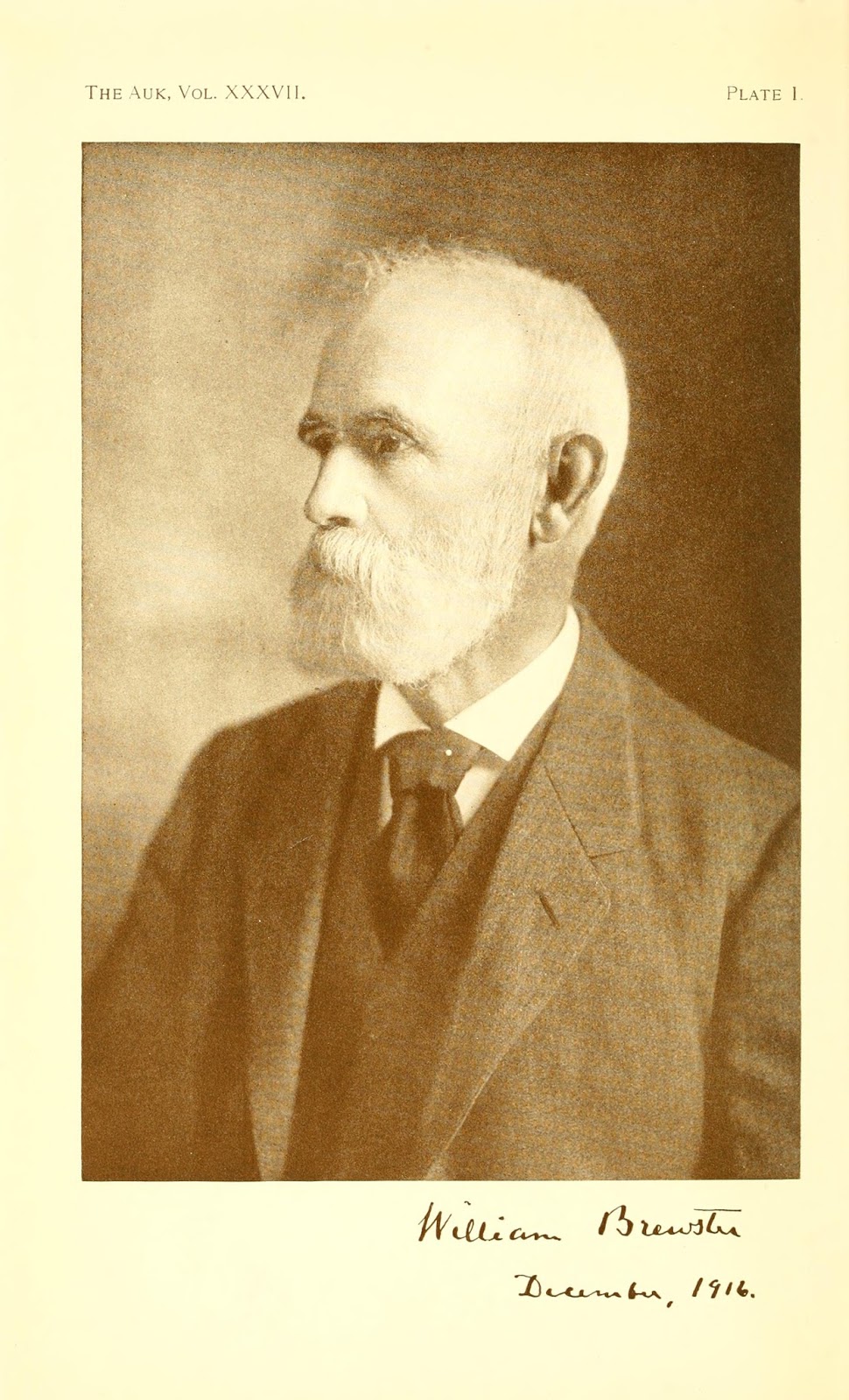
William Brewster. The Auk. v. 37 (1920). Digitized by Smithsonian Libraries. http://biodiversitylibrary.org/page/15938473

As a teen in Cambridge, Massachusetts during the 1860s, William Brewster (1851-1919) woke up early to collect birds before school, practiced taxidermy with friends, and carefully noted the dates when local plants flowered and produce ripened in the family garden.

His early fascination for birds and his observant note-taking laid the groundwork for his career as a prominent amateur ornithologist. He would become the first president of the Massachusetts Audubon Society and a co-founder and president of the American Ornithologists’ Union.

An ongoing project at the Ernst Mayr Library of Harvard University’s Museum of Comparative Zoology has been the digitization and transcription of Brewster’s diaries, field journals, and correspondences. Some of these journals and diaries are available to read on the Biodiversity Heritage Library, and we are working toward making all his notes and correspondences digitally accessible for study.

Over the course of his life, Brewster saw Massachusetts landscape and ecology change dramatically. Cambridge developed from farmland to urban city, and House Sparrows introduced from Europe decimated the farmers’ beloved Eastern Bluebirds. These kinds of observations about land use and animal presence, as well as his notes on plants and weather, make the Brewster collection a valuable resource for scientists studying ecological change.

Brewster published articles prolifically in scientific publications such as the ornithological journal, the Auk. In his field notes and journals, we can find the stories that lie behind those scientific papers: they document the development of a scientist, professionally and personally. They reveal his relationships with other scientists, document in detail what a typical day’s work looked like, and are sprinkled with amusing observations, beautiful scenes, and personal insights that would not necessarily be documented in a scientific publication.

These three bird stories illustrate the value of records where the scientific and the personal overlap.

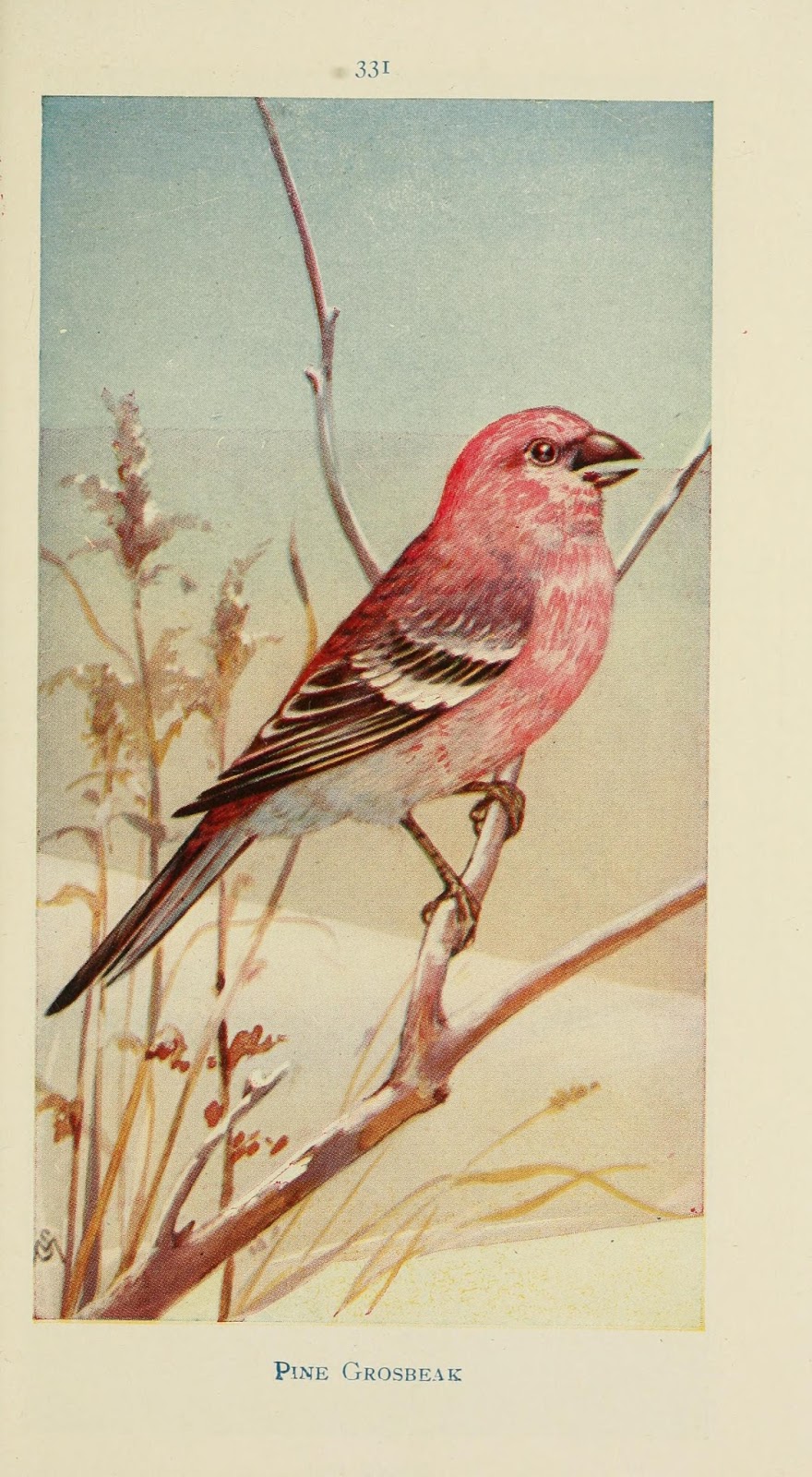
Pine Grosbeak: Nature Writing and Scientific Work

View Full Size Image
Pine Grosbeak illustration from Field book of wild birds and their music. London, G.P. Putnam’s Sons [c1921]. Digitized by Smithsonian Libraries. biodiversitylibrary.org/page/13653735

For a few days in January of 1893, Cambridge and Boston were abuzz with an unfamiliar sight: hundreds of red and gold birds that drew lots of attention from residents.

Brewster recognized them as Pine Grosbeaks. In the winter, large foraging flocks of Pine Grosbeaks often strip entire trees of their fruits, crushing through pulp and seeds and moving on when the food source has been exhausted.

Brewster observes:

“There were a good many Pine Grosbeaks scattered along the line of ashtrees on the ridge to my left and as I approached Mt. Auburn Street their numbers increased until upon reaching Mr. Hayes’s place I found the trees literally alive with them. 

Soon after I stopped to look at them they began flying from every direction into a large white ash which stands near the foot of the avenue. This tree was loaded with fruit and with snow clinging to the fruit clusters and to every twig. In a few minutes it supported also more than a hundred Grosbeaks which distributed themselves quite evenly over every part from drooping lower to the upright upper branches and began shelling out and swallowing the seeds.

The rejected wings floated down in showers and soon began to give the surface of the snow beneath a light brownish tinge.The snow clinging to the twigs and branches was also quickly dislodged by the movements, of the active, heavy birds and for the first few minutes it was continually flashing out in puffs like steam from a dozen different points at once. The finer particles, sifting slowly down, filled the still air and enveloped the entire tree in a gauzy veil or mist tinted, where the sun-beams pierced it, with rose, salmon and orange, elsewhere of a soft, dead white and of incredible delicacy and beauty, truly a fitting drapery for this winter picture- the hardy Grosbeaks at their morning meal. 

They worked in silence when undisturbed and so very busily that at the end of an hour they had actually eaten or shaken off nearly half the entire crop of seeds. Some men employed in a marble cutter’s shop near the tree were neglecting their tasks to watch and discuss them. One of these men told me that a few Grosbeaks were seen in the tree late yesterday afternoon.” (Cambridge, January 10, 1893.) [Edited with paragraph breaks and punctuation for readability.] 

A sudden, unexpected appearance of a large flock non-resident birds is known in the ornithological world as an irruption. (In recent years in Massachusetts, we’ve often heard the word irruption used to describe an unexpected influx of snowy owls that aren’t our usual residents.) Details on a historical irruption of Pine Grosbeaks may be of value to modern day scientists looking back in time for trends.

But while Brewster often recorded bird sightings as lists or in simple, factual paragraphs, some of the scientific observations are rendered with an artistry that carries them into the genre of nature writing. The image of the tree alive with birds, the rosy quality of light in the snowy air, and the excitement of the marble cutters makes these bird notes especially memorable.

The journal entries for these days form the basis of an article he had published in the Auk two years later, ‘A remarkable flight of Pine Grosbeaks (Pinicola enucleator)’. While Brewster’s article reads as somewhat more fact-driven, it’s written as a personal narrative that draws heavily on his notes, and it contains a condensed version of the visual description shared above.

It seems to be fairly normal at that time for published scientific work to include personal narrative and assertions which we would edit out today. But letters between Brewster and ornithologist friends reveal that they critiqued each other’s work not only on the reliability of their data but also on the style of their prose. Brewster’s scientific journals suggest that personal note-taking was a crucial opportunity to practise the art of writing, and digging into these journal entries allows us a glimpse into a scientist’s thinking and writing process.

American Robin: Personal Musings and Anthropomorphization
View Full Size Image
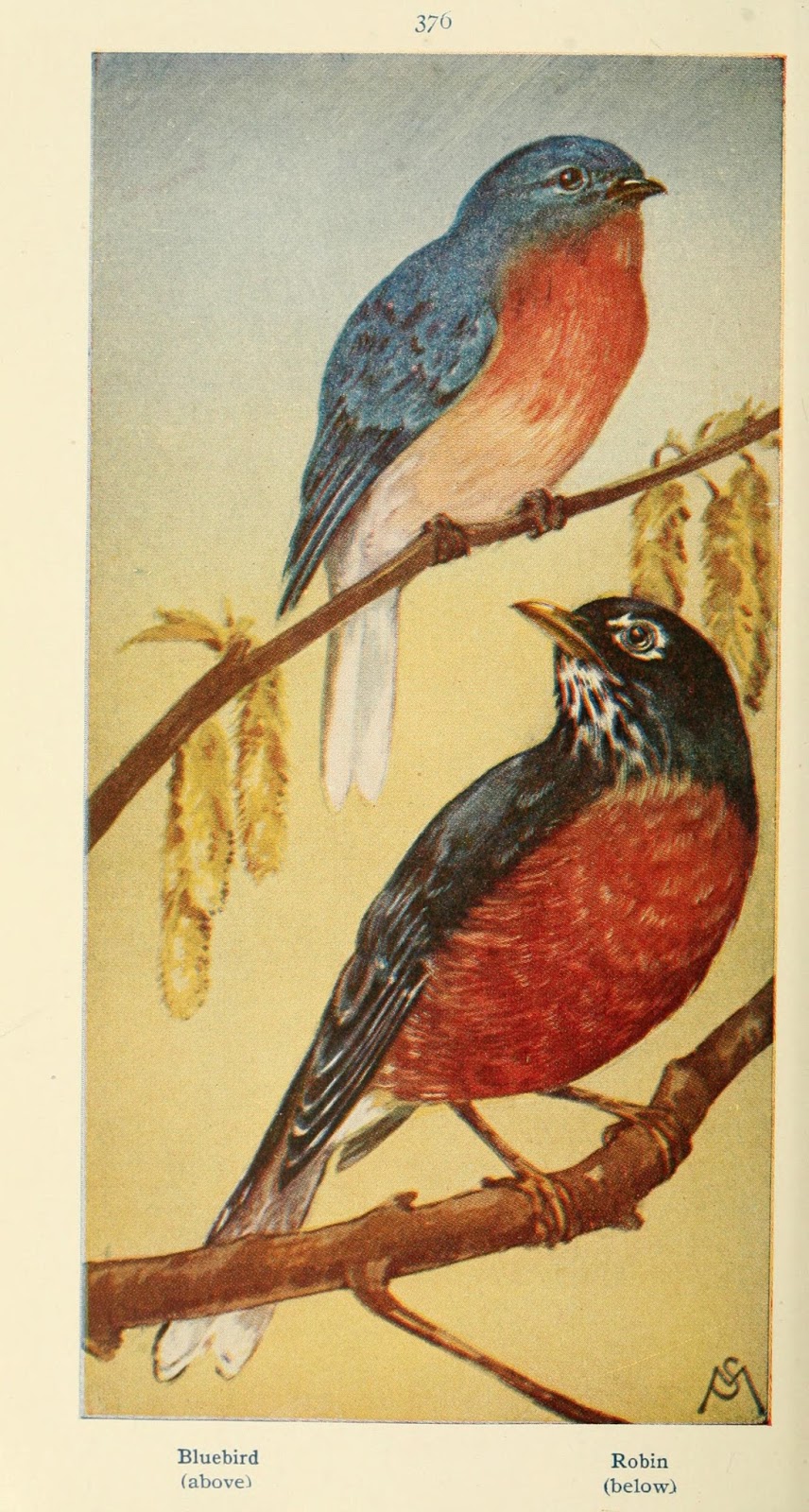
Bluebird and American Robin illustration from Field book of wild birds and their music. London, G.P. Putnam’s Sons [c1921]. Digitized by Smithsonian Libraries. biodiversitylibrary.org/page/13653780

Brewster carefully documented wild encounters with blow-by-blow details about animals’ behavior. Beyond behavioral data, his personal writings also include his interpretations of animal ‘personalities’ that reveal both his scientific perspective on animal cognition, and his personal feelings about interactions with animals.

Take for example this short but resonant excerpt from a letter penned to a friend:

“It is sunset and as I sit in my study in the Museum a Robin is singing in an elm in the garden. What a hopeful, earnest strain! It always cheers and encourages me. Our Robin must have a brave heart and a pure conscience.” (William Brewster, March 26, 1893. Cambridge, Mass. in correspondence to his friend, ornithologist Frank Michler Chapman.) 

His comment on the “brave heart and a pure conscience” certainly isn’t a piece of scientific data (it’s anthropomorphization, an interpretation of animal behaviors using the logic of human emotions) –but it unearths a very human part of the story to consider how a natural scientist reacted emotionally to his subjects in daily life.

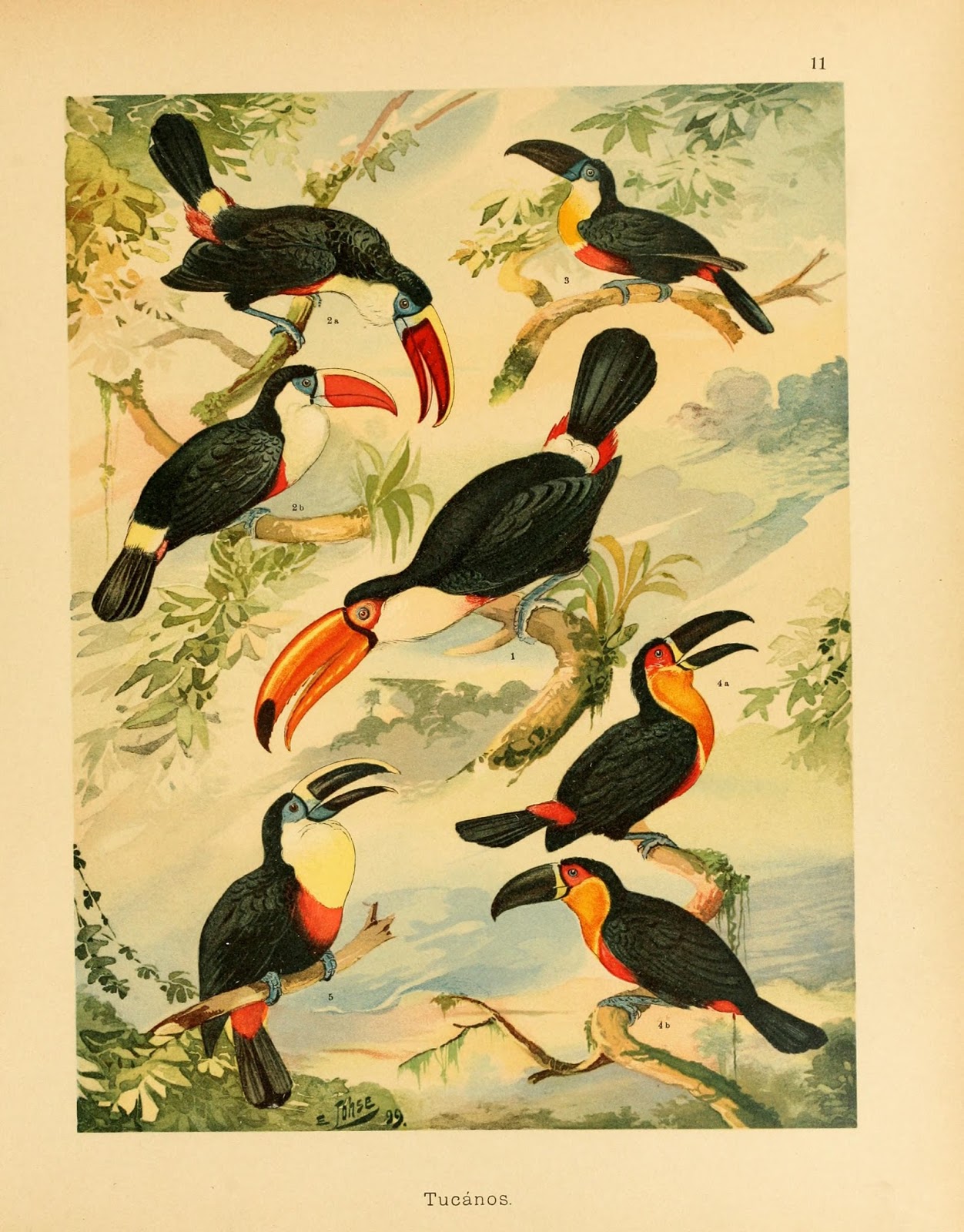
Toucan: Perspectives on Scientific Collecting

View Full Size Image
Toucan illustration from Album de aves amazonicas. Zürich: Impressão do Instituto Polygraphico a.g., 1900-06. Digitized by Smithsonian Libraries. biodiversitylibrary.org/page/13804665

If you’ve ever browsed the galleries at Harvard’s Museum of Natural History, then you’ve passed by Brewster’s life’s work. After working as an animal specimen curator for the museum for many years, he also bequeathed his personal collection of birds and other animals to the museum.

Taxidermy collections like Brewsters’ are the foundation of zoology and are invaluable for scientific researchers today. For example, scientists can analyse DNA samples from historic specimens to track evolutionary changes, and look for traces of environmental chemicals such as pesticides to learn more about their ecological impact. (These are just two of many ways that collections can be used for beneficial research–to learn more, read ‘Natural history collections – why are they relevant?’ on The Guardian, or visit the page ‘Why Collections Matter?’ on the Society for the Preservation of Natural History Collections’ website.)

While Brewster strongly advocated for the importance of scientific collecting, his journals also illustrate changes in his collecting practices over time, including the adoption of complementary methods like photography.

In March 1886, just a month after the Massachusetts Audubon Society for the Protection of Birds had organized, Brewster wrote three letters to an ornithologist friend, describing an early attempt to pass bird protection legislation in Massachusetts. Brewster advocated in court for a bill that would ban the hunting of birds for decorative use on women’s hats, but allow scientific collection by permit-holders.

In one of these letters, he scoffs at the idea of only studying birds observationally:

“One of these [Fish & Game Commissioners]… announced at the beginning that he considered Science a humbug and that the best was to study bird was with an opera glass!” (Cambridge, March 7, 1886. Letter to George Sennet.) 

However, his journals reveal that around the 1890s he seems to have developed some mindfulness of how damaging over-hunting could be for animal populations. Around this time he began to collect birds more sparingly and took up the challenge of wildlife photography in the field.

An interesting example of this shift in his attitude occurred during an 1894 collecting trip to the tropics:

“I started out early this morning with the express intention of shooting a toucan. Rather curiously I had at once an opportunity which I did not improve and shortly afterwards a experience which is probably rare for Mr. Chapman [Frank Chapman] has seen nothing of the kind, nor has Mr. Carr either for that matter. 

It all happened in this [way]. I went first to the ajoupa to get my collecting basket and while there heard a toucan calling apparently at a considerable distance. I started in the direction of the sound but I had gone scarce twenty yards when I became conscious that it came from nearly over head. 

Looking up I at once saw the beautiful great bird sitting in the top of a bois immortel its breast turned towards the rising sun which brought out the brilliant colouring of the plumage, the shining black of the large bill and the blue of the bare skin about the eyes with the greatest distinctness. 

Here was my chance for the bird was not thirty yards off but I simply stood and stared at him with speechless wonder and admiration until he finally flew, when the dense cacao foliage prevented my getting a shot. 

Clearly a case of Toucan “fever” but I did not regret the episode.” (Trinidad, March 20, 1894.) [Edited with paragraph breaks and punctuation for readability.] 

* * *

The Brewster collection, and other field journals and notes, contain a wealth of information beyond useful scientific data. They reveal scientific paradigms, study methods and reasoning; information about working relationships between scientists; and historical and biographical information, including personal thoughts and feelings. Some sections can be fairly dry, but some make for pretty good reading.

If you’ve enjoyed these excerpts, an ongoing blog post series on Mayr Library blog highlights interesting tidbits from Brewster’s writing as we continue to digitize and transcribe the collection.

July 1, 2016by ulib-libraryjobs
Blog Reel, Featured Books

Kingfishers and National Bird Day

Today is National Bird Day, a day to celebrate and raise awareness about birds.

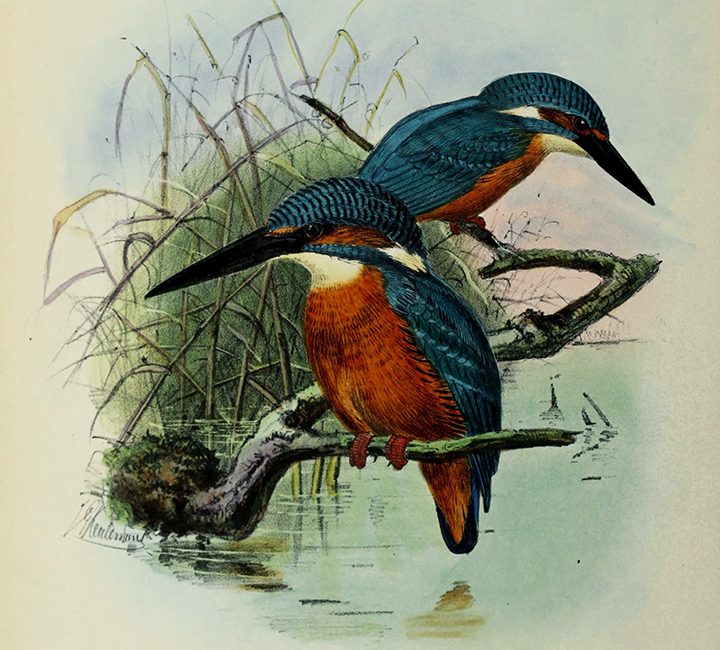
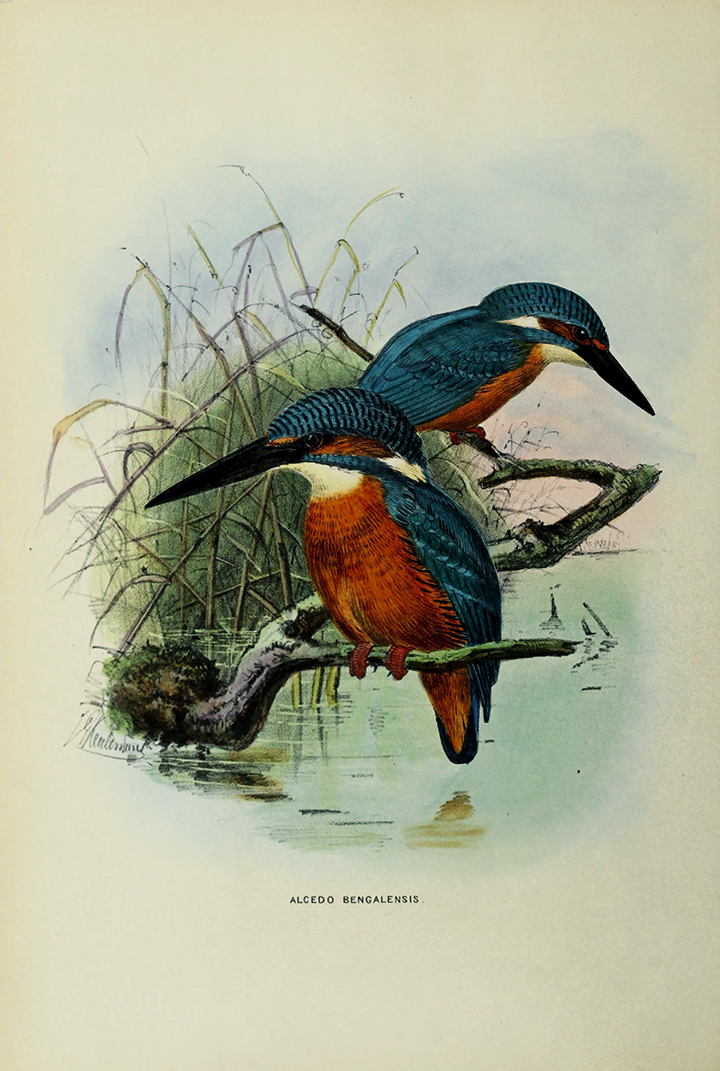
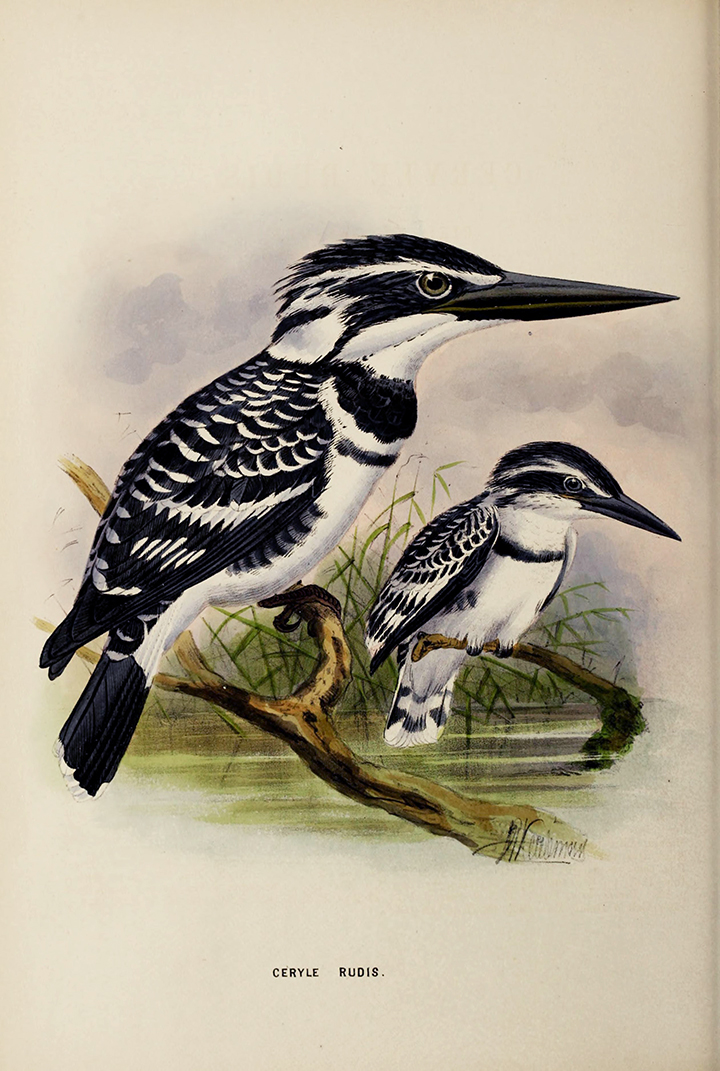
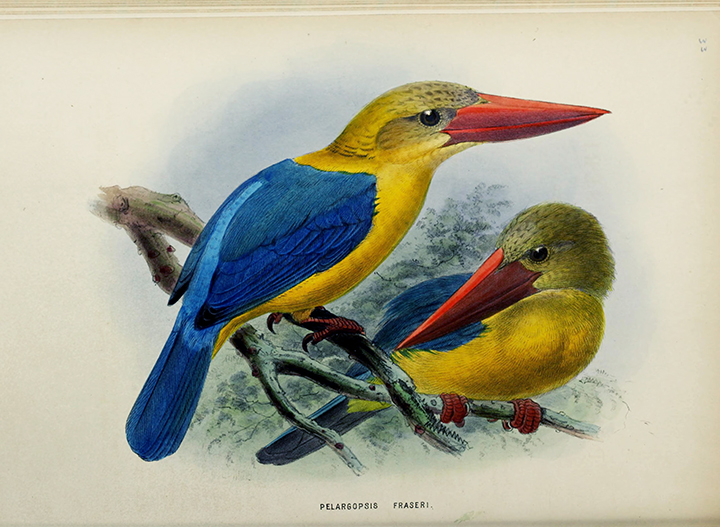
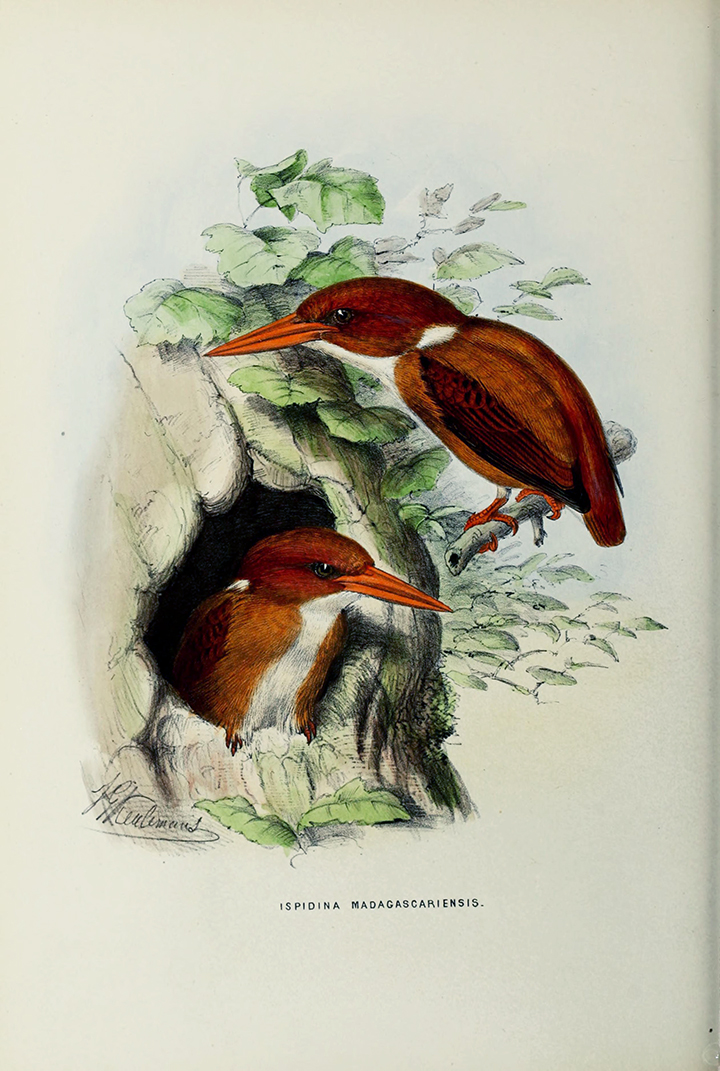
We’re celebrating by highlighting one of the rare ornithology titles in the BHL collection: A monograph of the Alcedinidae : or, family of kingfishers (1868-71) by Richard Bowdler Sharpe. The work contains 120 hand-colored lithographed plates by and after famous Dutch bird illustrator Johannes Gerardus Keulemans. Printing and coloring of the plates was entrusted to Mr. P.W.M. Trap.

View Full Size Image
Sharpe, Richard Bowdler. A monograph of the Alcedinidae : or, family of kingfishers. (1868-71). Art by John Gerardus Keulemans. http://biodiversitylibrary.org/page/43064470.

In April, 2015, a first edition copy of this title sold at a Sotheby’s auction for 10,000 GBP. But you can browse and download this work for free in BHL. Our copy was digitized from the collections of the Ernst Mayr Library of the Museum of Comparative Zoology at Harvard University.

According to the Encyclopedia of Life:

Kingfishers belong to the order Coraciiformes and the family Alcedinidae. Within Coraciiformes, kingfishers are grouped into the suborder Alcidines, with todies (Todidae) and motmots (Motmotidae). Alcedinidae comprises approximately 17 genera and 91 species, and is frequently subdivided into three subfamilies; Alcedininae, which comprises most of the “fishing” kingfishers, Halcyoninae, which comprises the “forest kingfishers” that reside primarily in Australasia, and Cerylinae, which includes all of the New World kingfishers.

Kingfishers are small to medium sized colorful birds with short necks, large heads and long, thick bills. They live primarily in wooded habitats of tropical regions, often near water. Despite their name, not all kingfishers are fishing specialists. While some species do consume primarily fish, most species have unspecialized diets that include a high proportion of insects. Most kingfishers are monogamous, territorial breeders, though a few species breed cooperatively.


View Full Size Image
Sharpe, Richard Bowdler. A monograph of the Alcedinidae : or, family of kingfishers. (1868-71). Art by John Gerardus Keulemans. http://biodiversitylibrary.org/page/43064554.

Richard Bowdler Sharpe was born in London in 1847. At a young age he took an interest in ornithology and desired to write a monograph on kingfishers. In 1865, he joined the Bernard Quaritch bookseller company, which allowed him to begin working on his kingfisher monograph in earnest. He used his small income to help acquire specimens. In 1867, he became a librarian at the Zoological Society of London and over the next couple years (1868-71) issued his first book, A monograph of the Alcedinidae : or, family of kingfishers, in parts.

View Full Size Image
Sharpe, Richard Bowdler. A monograph of the Alcedinidae : or, family of kingfishers. (1868-71). Art by John Gerardus Keulemans. http://biodiversitylibrary.org/page/43064624.

Johannes Gerardus Keulemans was the artist for the work. Keulemans illustrated some of the most well-known ornithological titles of the nineteenth century, including works by Daniel Giraud Elliot, Sir Walter Lawry Buller, and Henry Eeles Dresser. He also regularly provided illustrations for The Ibis and The Proceedings of the Zoological Society. In 1869, Sharpe persuaded Keulemans to not only illustrate his monograph, but also to move to London, where Keulemans lived for the rest of his life.

In 1872, Sharpe joined the British Museum as Senior Assistant in the Department of Zoology, where he took charge of the bird collection. He founded the British Ornithologists’ Club in 1892 and edited its bulletin. He also wrote thirteen and a half of the 27 volumes of the Catalogue of the Birds in the British Museum (1874–1898). He authored many ornithology titles over his career, including Wonders of the Bird World, which we highlighted last week as one of the works illustrated by A.T. Elwes. Sharpe died in 1909 from pneumonia.
View Full Size Image
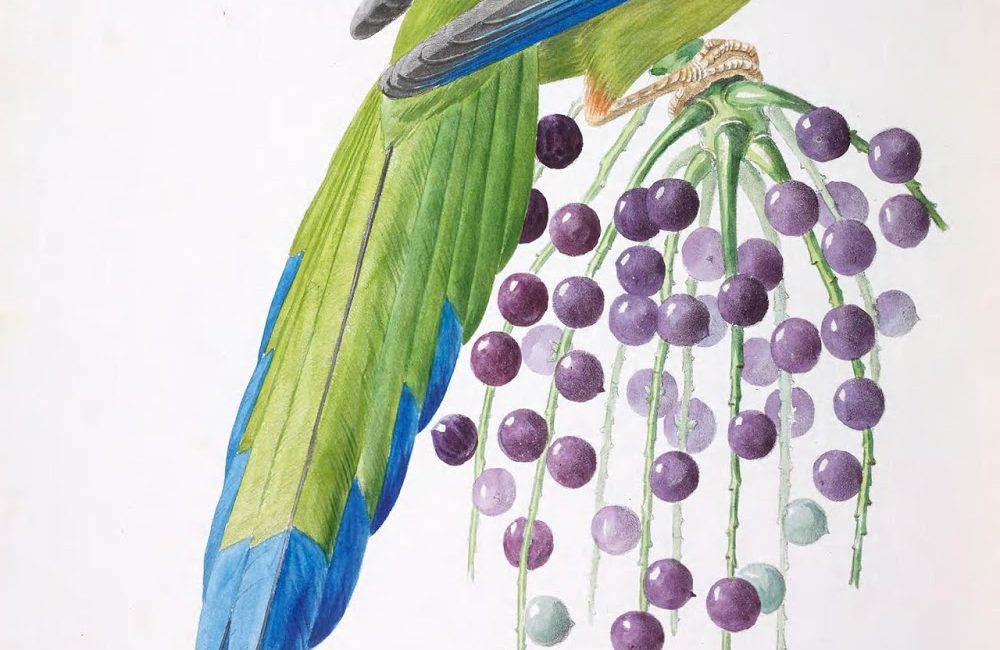
Sharpe, Richard Bowdler. A monograph of the Alcedinidae : or, family of kingfishers. (1868-71). Art by John Gerardus Keulemans. http://biodiversitylibrary.org/page/43064692.

Be sure to explore A monograph of the Alcedinidae : or, family of kingfishers in BHL and the illustrations in Flickr. You can see other works authored by Sharpe in BHL as well. Happy National Bird Day!

January 5, 2016by ulib-libraryjobs
Blog Reel, Featured Books

Brilliant and Remarkable Birds of Brazil

One of the joyous things about being a Librarian caring for special and rare collections is that you frequently find something remarkable and new to you in those collections. Add on the role of BHL staffer and this multiplies through digitization requests posted by users of BHL.

Approximately five years ago a request was posted for a book unknown to me by an artist I had not come across. The catalogue record flagged that it was a folio of coloured plates which consigned the volume to a long queue for bespoke in-house scanning. Time passed and circumstances changed, and earlier this year I was informed that it had been scanned and was ready for loading to BHL. We have access to a new cloud-based system for loading our scans into BHL, and this volume was to be our test subject. A little bit of research indicated that this volume was indeed remarkable.

View Full Size Image
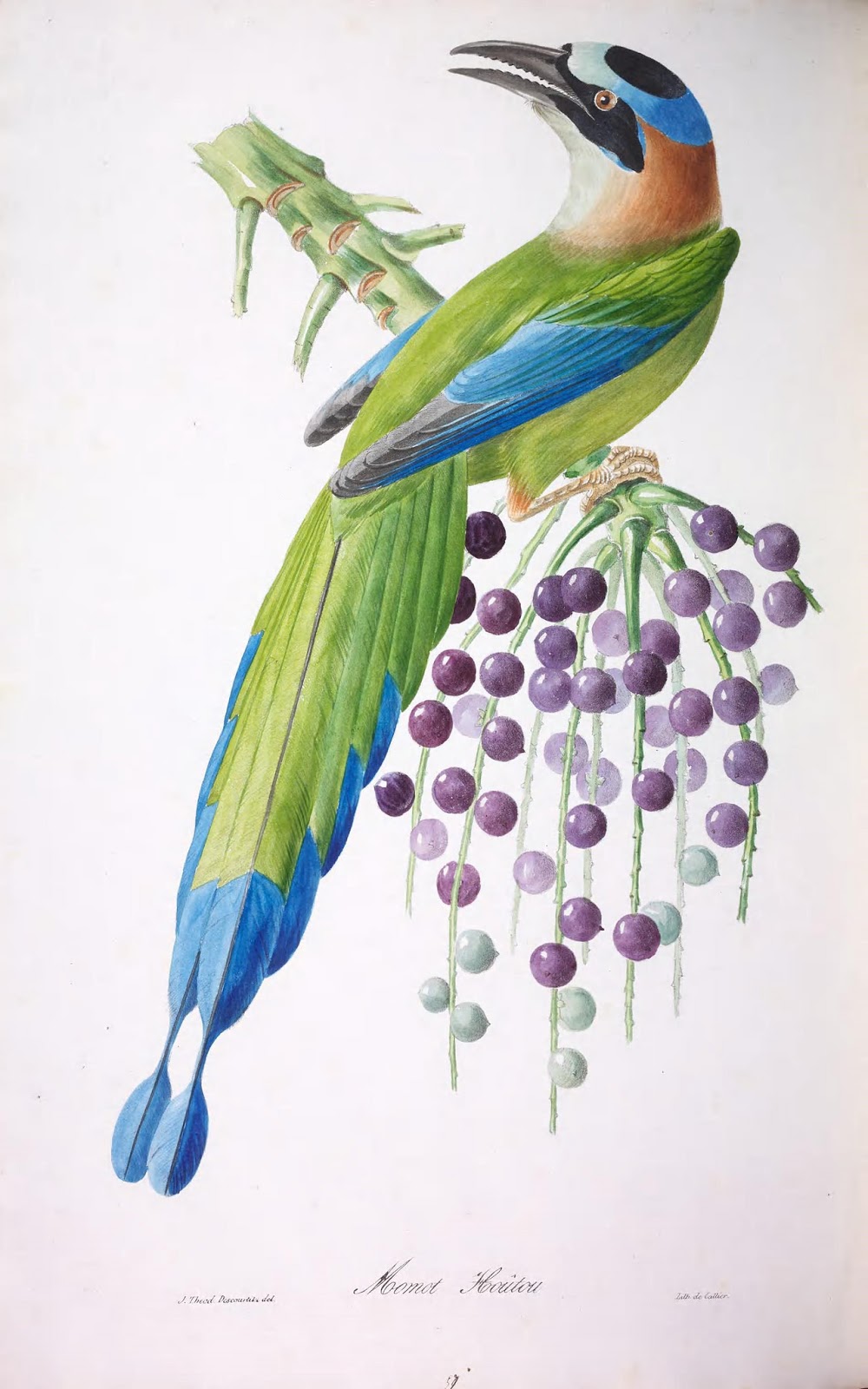
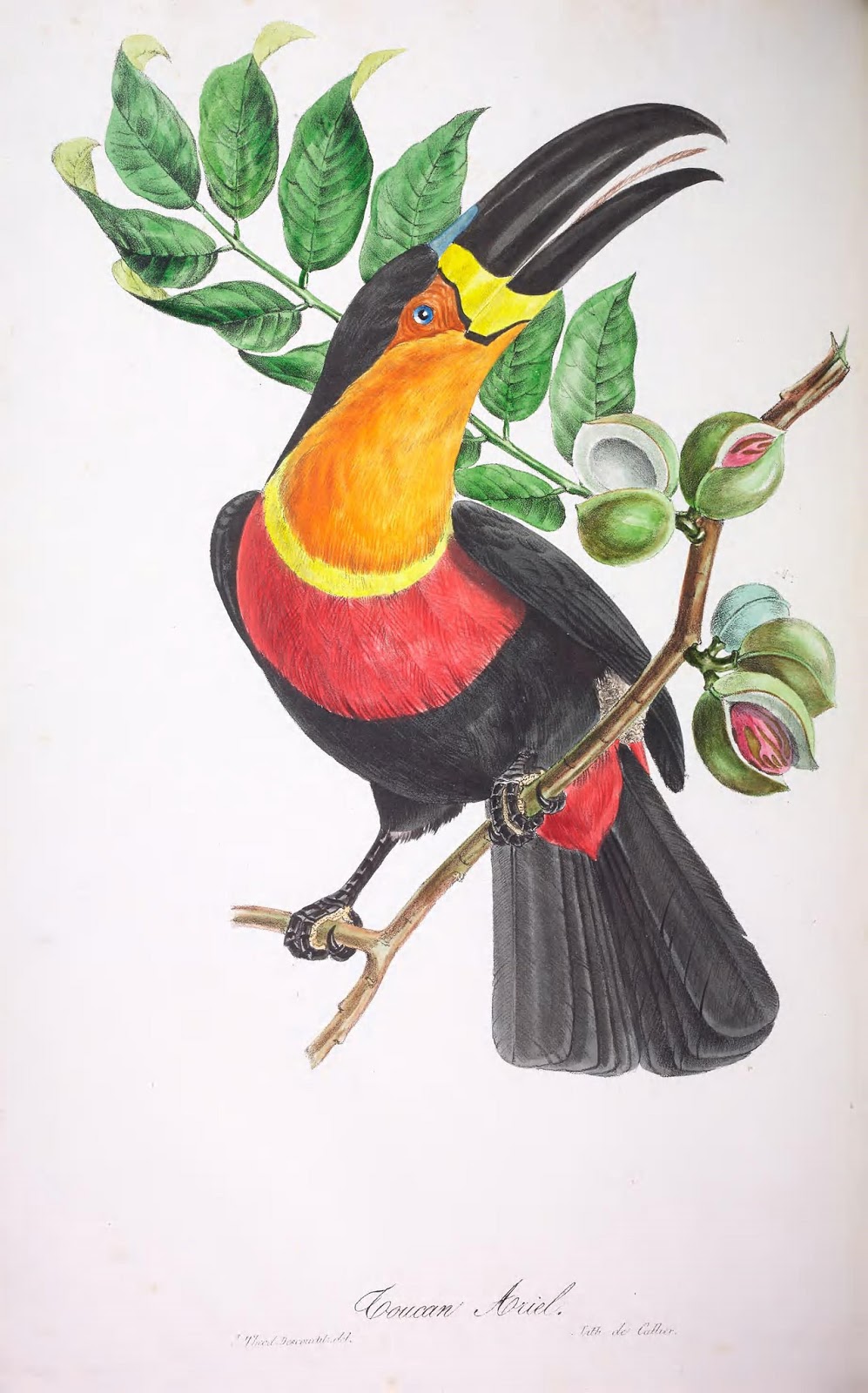
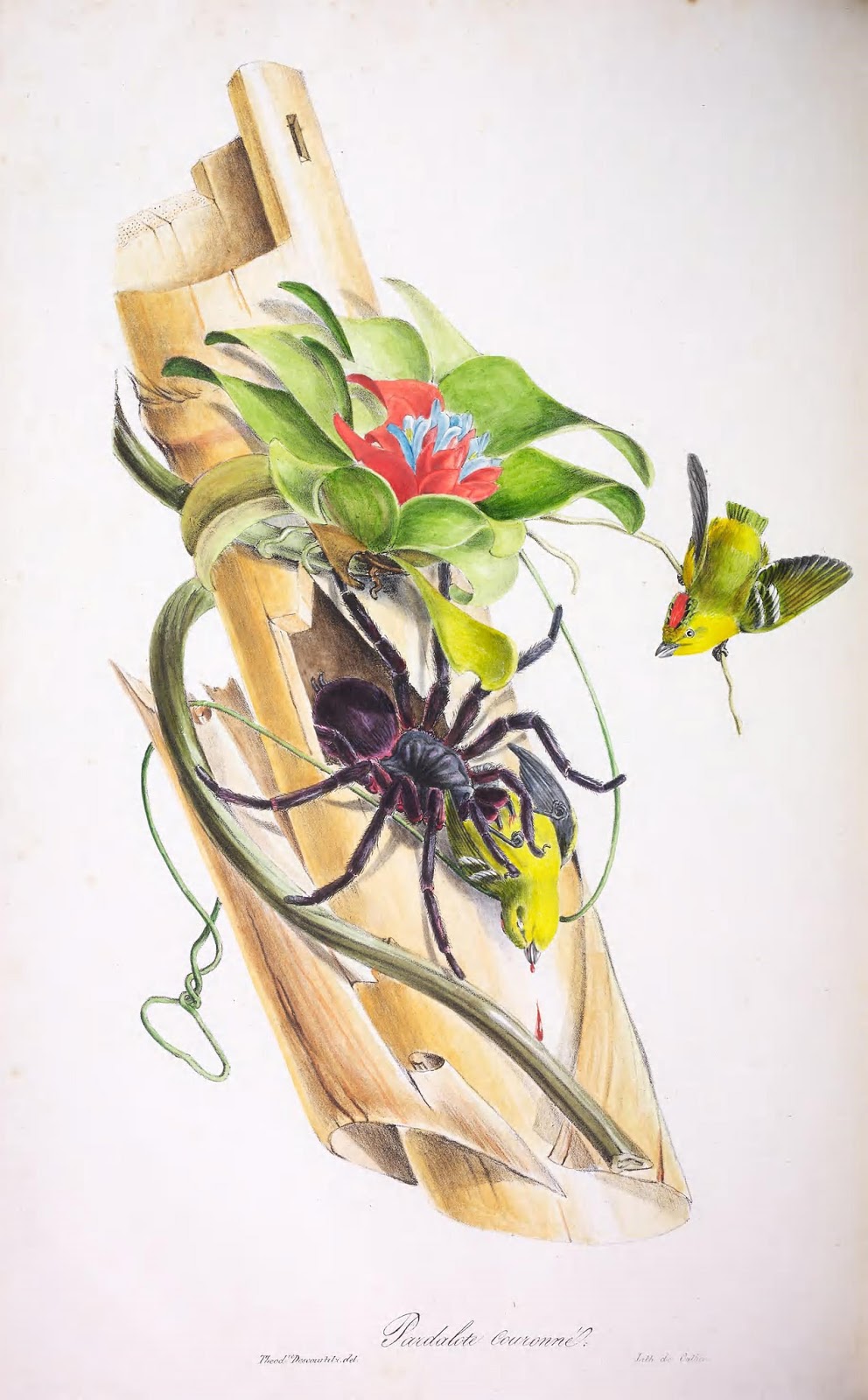
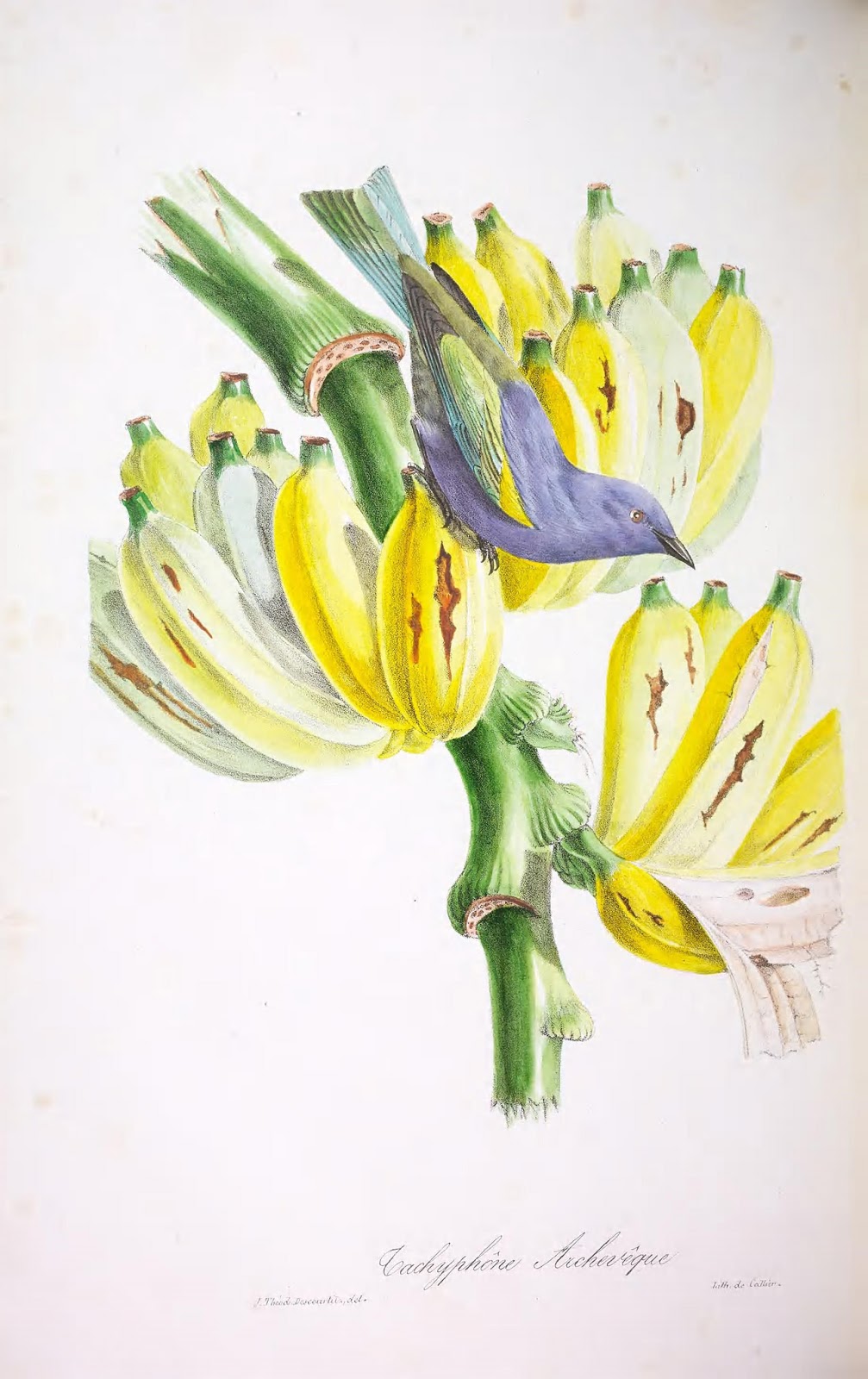
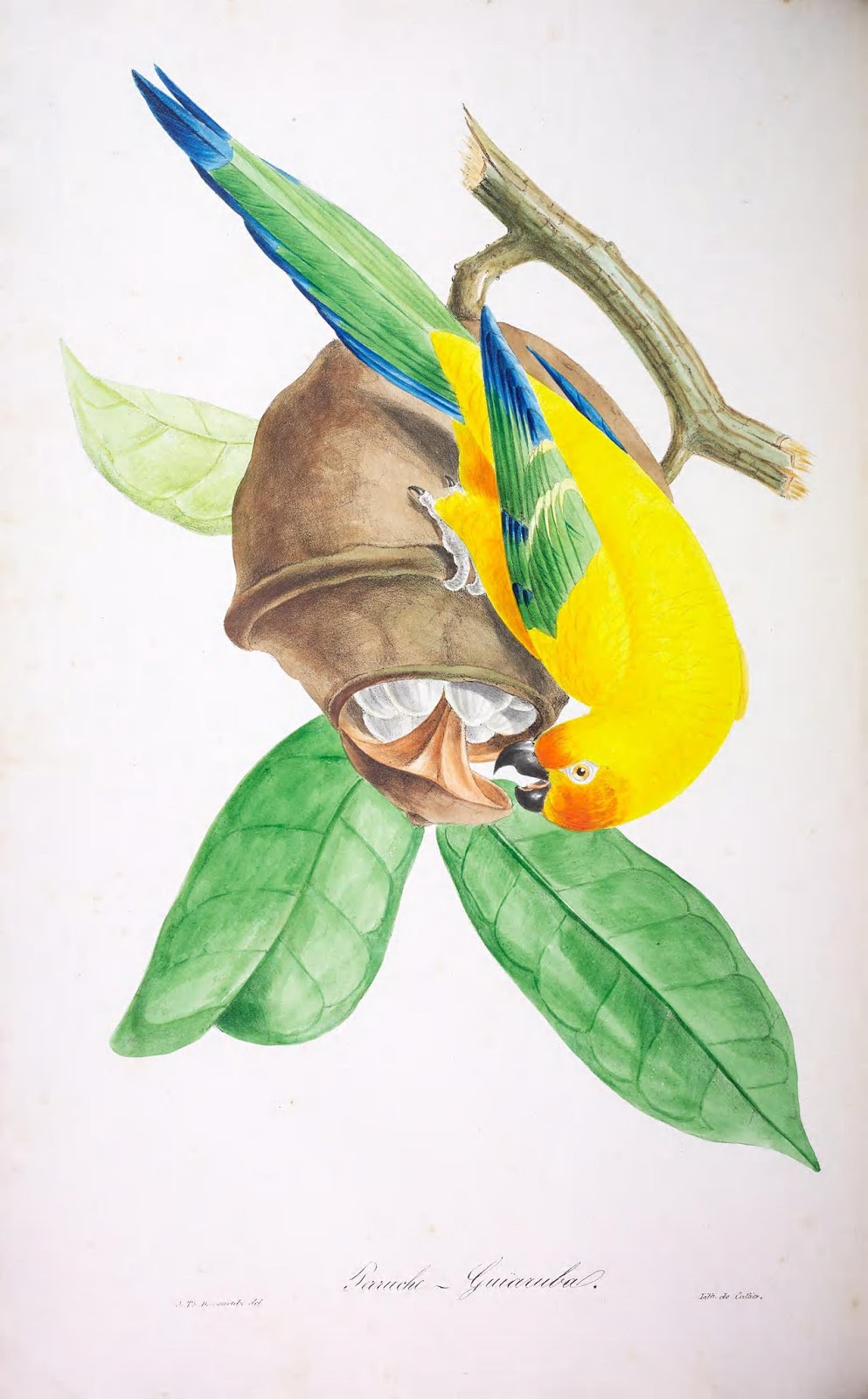
Descourtilz, J. T. (Jean Théodore). Oiseaux brillans du Brésil. (1834). http://biodiversitylibrary.org/page/47697413.

Jean-Theodore Descourtilz was born in 1796 in France, one of eight brothers. His father was Michel Etienne Descourtilz (1775-1836), a physician and botanist who wrote Flore pittoresque et médicale des Antilles (1821-1829). Jean-Theodore produced the 600 plates which illustrate this tome. He seems to have been well travelled with evidence of being in Haiti aged 3 and in the Antilles by 1821 in order to make the illustrations for his father’s book. Jean-Theodore seems to have arrived in Brazil around 1826 and in 1831 had presented a manuscript on hummingbirds to the National Museum in Rio de Janeiro. Histoire des Oiseaux-mouches Habitant des Districts de Rio de Janeiro, Bananal, San-Paulo, Macahé, Canta-Gallo et Ilha-Grande contained full colour illustrations and meticulous notes about the hummingbirds and their habitats. Two of the species were very rare and had been seen only twice by Descourtilz since he arrived in the country. The original paintings were sold by Christies in 1992 for over £85,000 and a facsimile edition was produced in 1960 as limited run entitled Beija-flores do Brasil- Oiseaux-mouches – orthorynques du Brésil.

View Full Size Image
Descourtilz, J. T. (Jean Théodore). Oiseaux brillans du Brésil. (1834). http://biodiversitylibrary.org/page/47697212.

In 1834, Descourtilz published his first book, Oiseaux brillans et remarquables du Brésil, containing 60 beautifully coloured plates lithographed by Callier. There appears to have been no title page or text in the published edition, however the copy held by the Natural History Museum has handwritten title page and a page of text for each illustrated species. It is notable that Descourtilz illustrated the birds on appropriate food plants and captured detailed information on habits, customs, behaviour and habitat as well as the usual dates and location. This book is one of the rarest tomes of birds of the Americas. The Sotheby’s sale catalogue for the H. Bradley Martin Ornithological Library sale in 1989 states there are only four known copies; the copy for sale from H. Bradley Martin, a copy in the Teyler Foundation in Haarlem (Netherlands), a copy in the British Library, and a copy in the Library of Congress. At this time I can state there is a copy in the Natural History Museum (from the Rothschild Collection) and the Teyler Foundation copy was used to produce a facsimile edition Pageantry of Tropical Birds. However I have been unable to confirm that copies are held by the British Library or the Library of Congress, and have no knowledge of the whereabouts of the H. Bradley Martin copy.
View Full Size Image
Descourtilz, J. T. (Jean Théodore). Oiseaux brillans du Brésil. (1834). http://biodiversitylibrary.org/page/47697188.

Between 1852 and 1856, Descourtilz’s book Ornithologie Brésilienne, ou Histoire des Oiseaux de Brésil, remarquables par leur plumage, leur chant ou leurs habitudes was published in four parts. Forty-eight of the plates were developed from Oiseaux brillans du Brésil, and it contains fifteen species and one genus previously undiscovered.

View Full Size Image
Descourtilz, J. T. (Jean Théodore). Oiseaux brillans du Brésil. (1834). http://biodiversitylibrary.org/page/47697281.

The National Museum of Brazil recruited Descourtilz in 1854, but unfortunately he died the next year from arsenic poising while preparing specimens for the Museum. Very little else is known about his life, and he is buried near Aracruz, near the coast of Brazil a few hundred kilometers north of Rio de Janeiro.

View Full Size Image
Descourtilz, J. T. (Jean Théodore). Oiseaux brillans du Brésil. (1834). http://biodiversitylibrary.org/page/47697220.

So five years on Oiseaux brillans du Brésil is available on the Biodiversity Heritage Library! Please enjoy it. You can browse the illustrations from this stunning work in Flickr.

August 27, 2015by ulib-libraryjobs
Blog Reel, Featured Books

I spy something fowl…

Connecting Field Book Observations to Scientific Illustrations

Field books are important primary source materials for biodiversity research. Their pages are the first to document the thoughts, observations, musings, and raw data generated or gathered by a scientist while in the field. They are the foundation upon which published natural history literature is based.

The Field Book Project (FBP) is working to improve access to field books in the Smithsonian’s collections. Digitized versions of these field books are made available in the Biodiversity Heritage Library (BHL). There are currently over 500 field books from FBP in BHL.

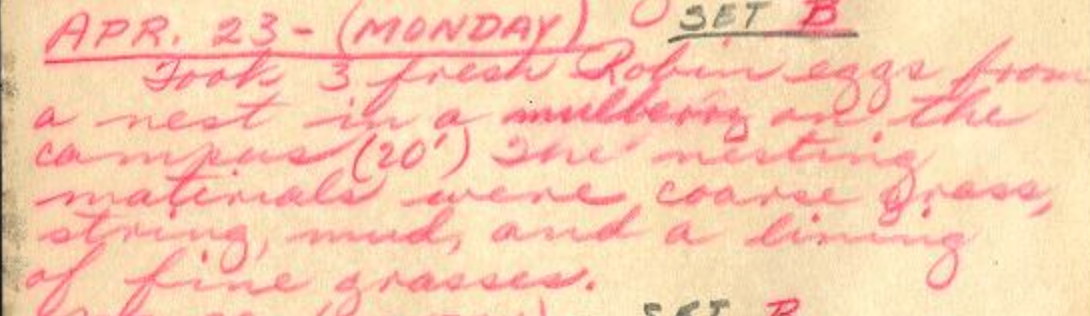
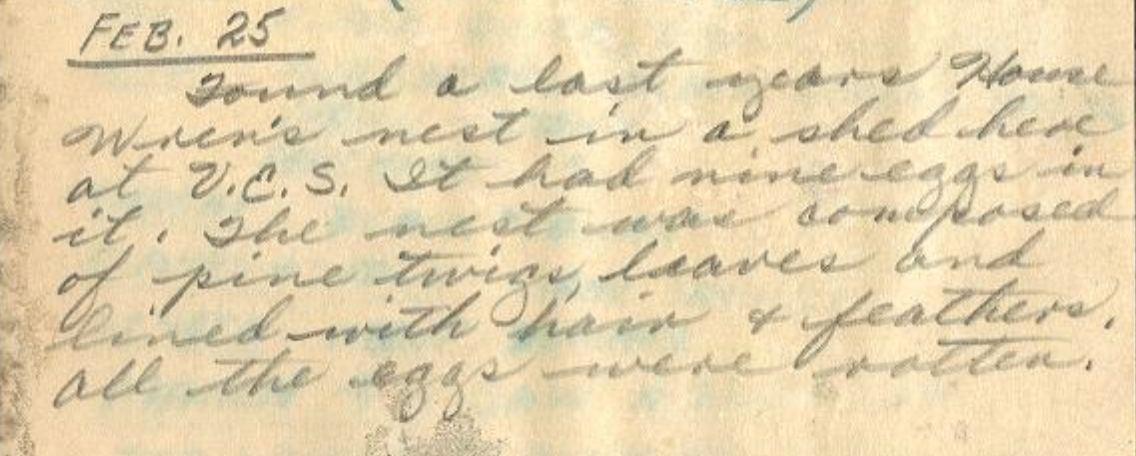
One of these field books was written by Joshua F. B (Fry Bullitt) Camblos (1916-2012). Camblos was a medical doctor with a keen interest in ornithology, and his field books contain details about the birds, eggs, and nests he spied in the woods of Virginia. His field book available in BHL documents these observations from February-April 1934, including descriptions of nests, condition and appearance of eggs, area vegetation, and bird behavior.

Since there is such a strong correlation between field books and published literature, we thought it would be fun to expand on the theme and connect Camblos’ observations to published illustrations of some of the species he described. We turned our spyglass towards the BHL collection to uncover some of our favorite published illustrations. We then present Camblos’ description of the bird, nest, and eggs he found in Virginia in 1934 together with an illustration and a bit of information about the publication it came from.

We hope you enjoy our fowl-focused game of “I Spy” within the published and unpublished literature on BHL. Explore more field books from The Field Book Project in BHL and learn more about the program in this past post.

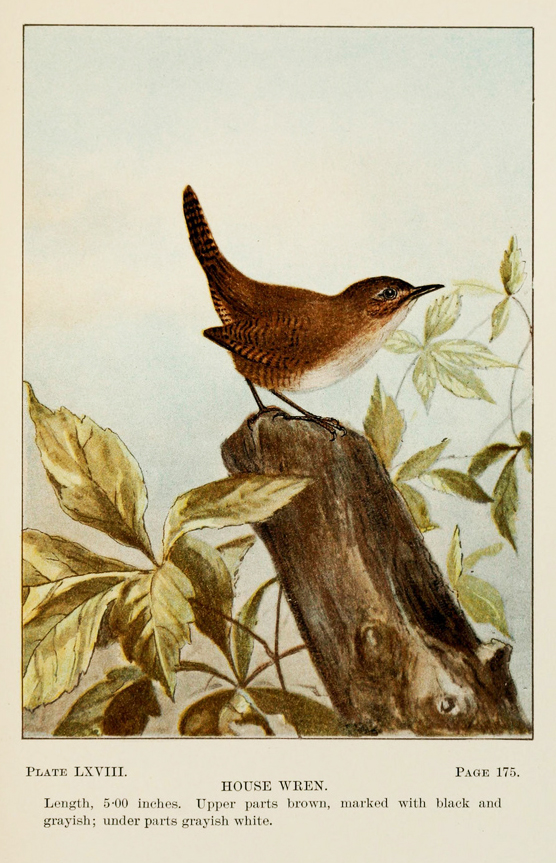
House Wren (Troglodytes aedon)

View Full Size Image

Camblos writes:
“Feb. 25
Found a last years House Wren’s nest in a shed here at V.E.S. It had nine eggs in it. The nest was composed of pine twigs, leaves and lined with hair and feathers. All the eggs were rotten.”

View Full Size Image
Chapman, Frank M. Bird-life: a guide to the study of our common birds. 1900. http://biodiversitylibrary.org/page/7855990.

Frank M. Chapman was an ornithologist, former Curator of Birds at the American Museum of Natural History, and founder of Bird-Lore, which became Audubon Magazine. In 1900 he proposed the idea of the Christmas Bird Count (CBC), an annual census of birds in the Western Hemisphere performed to this day and administered by the National Audubon Society. He also wrote many field guides, such as Bird-life: a guide to the study of our common birds, which was illustrated by wildlife artist Ernest Thompson Seton, who was also one of the founding pioneers of the Boy Scouts of America (BSA).

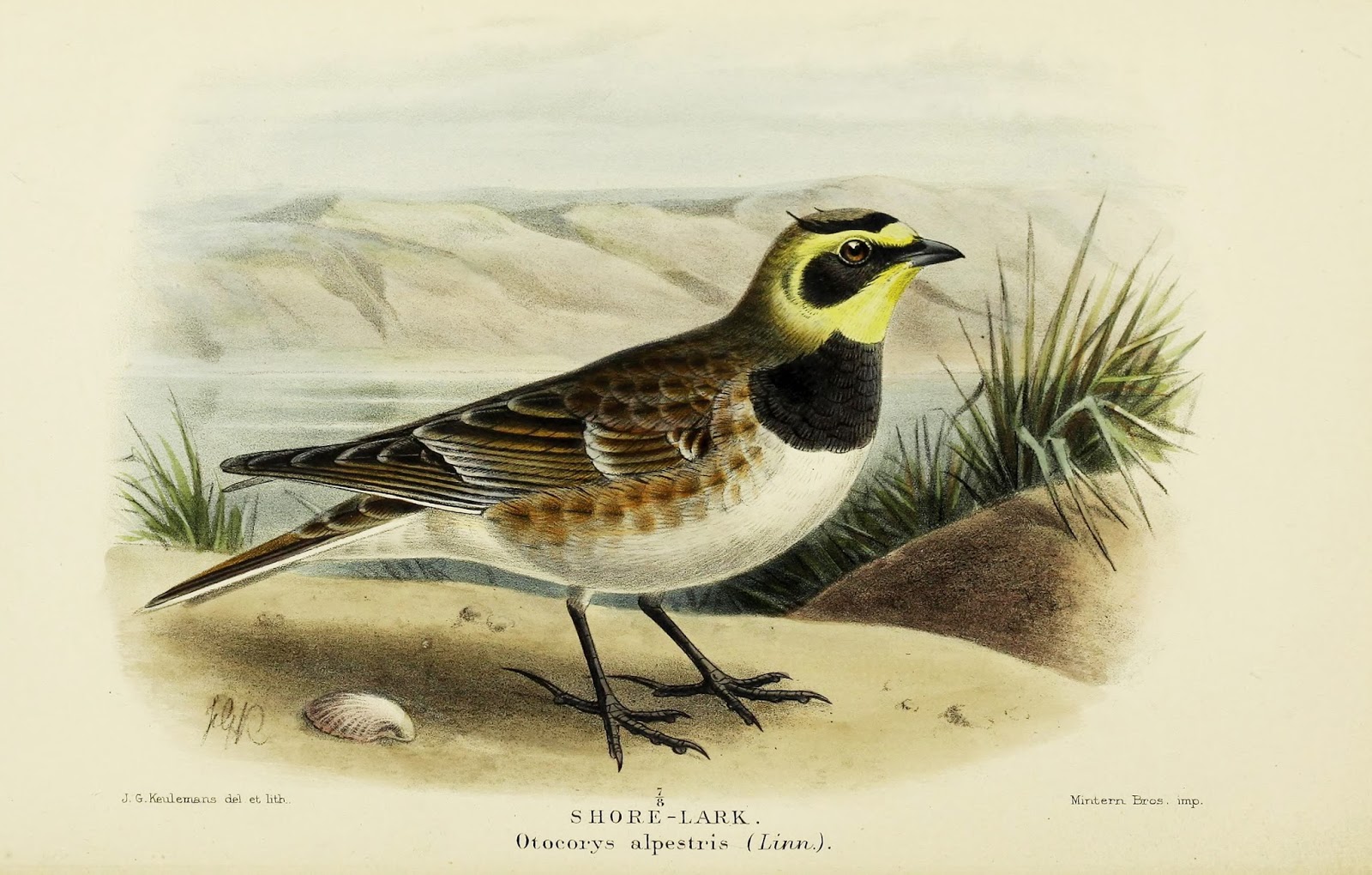
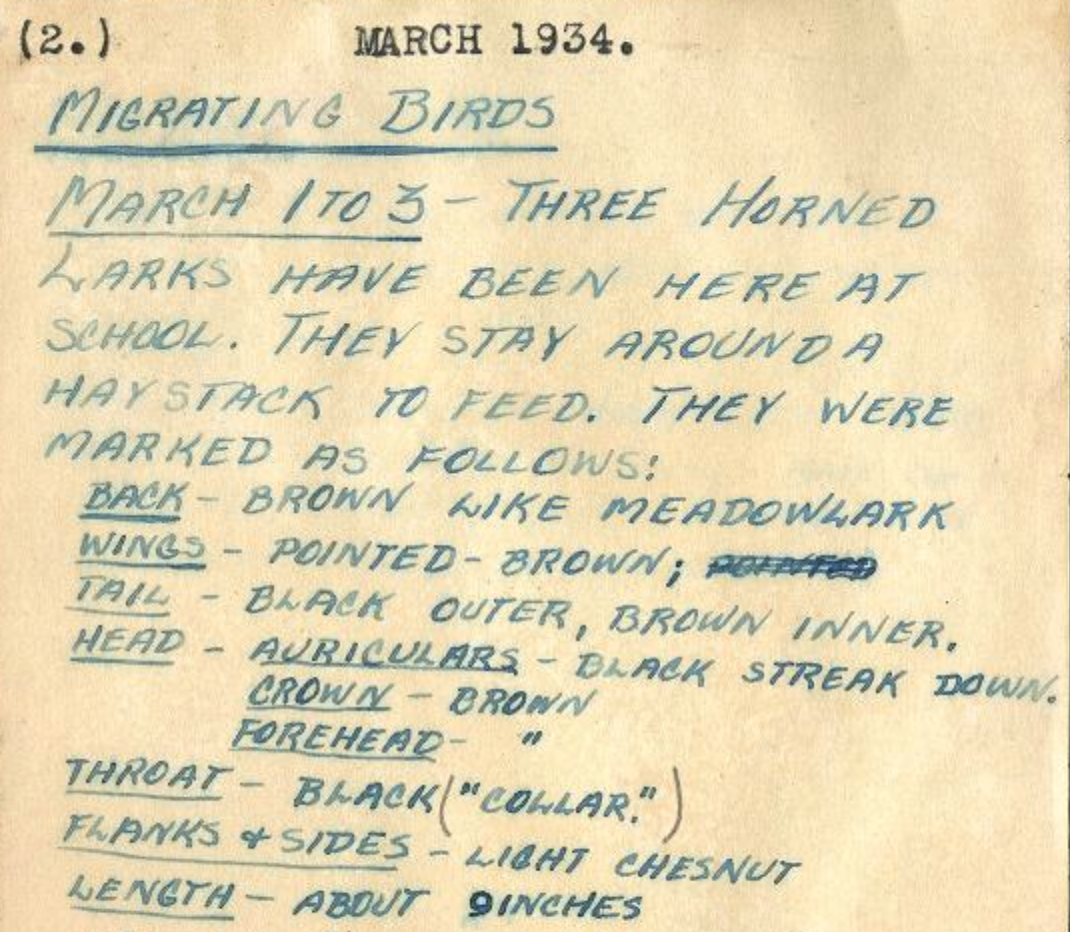
Horned Lark (called shore lark in Europe) (Eremophila alpestris)

View Full Size Image

Camblos writes:
“March 1 to 3 – Three horned larks have been here at school. They stay around a haystack to feed. They were marked as follows:
Back – Brown like meadowlark
Wings – Pointed brown
Tail – Black outer, brown inner
Head – Auriculars – Black streak down.
Crown – Brown
Forehead – ”
Throat – Black (“collar.”)
Flanks and Sides – Light chesnut
Length – About 9 inches.”

View Full Size Image
Lord Lilford. Coloured figures of the birds of the British Islands. v. 4 (1885-97). http://biodiversitylibrary.org/page/43081338.

Thomas Littleton Powys, 4th Baron Lilford, was a British aristocrat and ornithologist. He was one of the eight founders of the British Ornithologists’ Union in 1858 and its President from 1867 until his death. His book Coloured Figures of the Birds of the British Islands, was completed by Osbert Salvin (best known for co-authoring Biologia Centrali-Americana) after his death, and was illustrated by the famous bird artist Johannes Gerardus Keulemans.

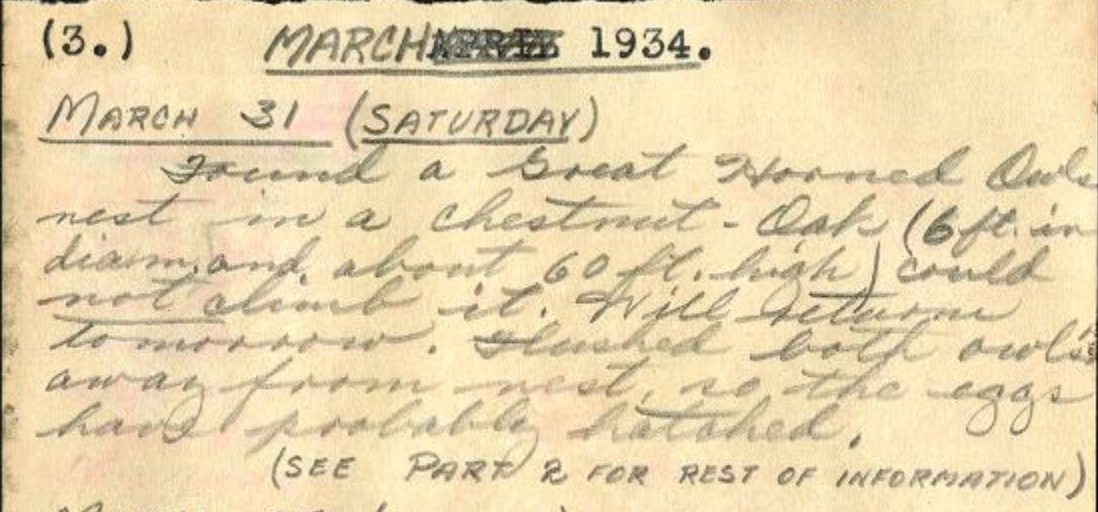
Great Horned Owl (Bubo virginianus)

View Full Size Image

Camblos writes:
“March 31 (Saturday)
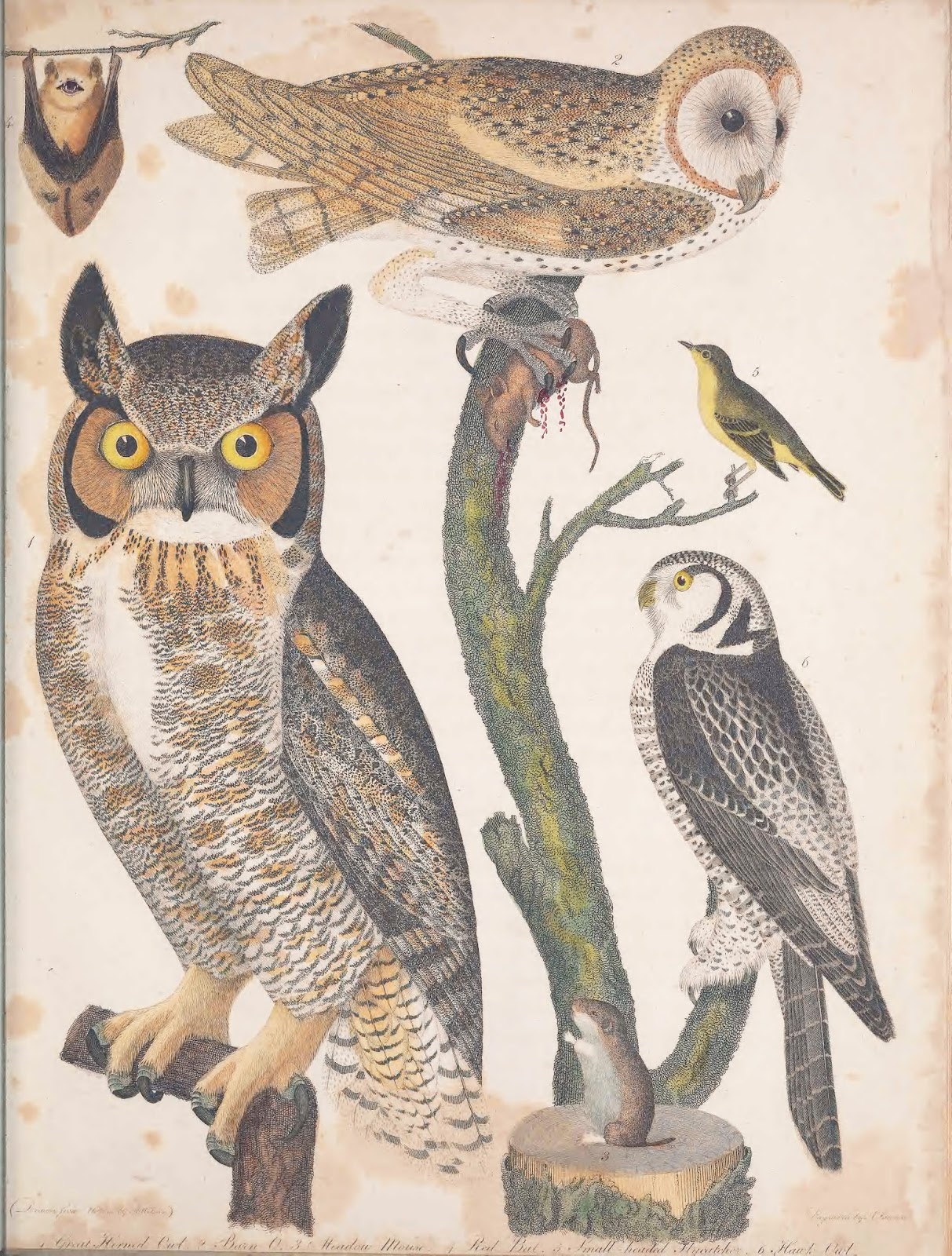
Found a Great Horned Owl’s nest in a chestnut-oak (6 ft. in diam. and about 60 ft. high) could not climb it. Will return tomorrow. Flushed both owls away from nest, so the eggs have probably hatched. (See part 2 for rest of information)”

True to his word, Camblos continues the narrative of the great horned owl the following day, with a story that involves chicks and skeletons. Check it out!

View Full Size Image
Wilson, Alexander. American Ornithology. v. 6 (1812). http://biodiversitylibrary.org/page/46331204.


Here we see the great horned owl (lower left) amongst some of his winged friends (ave and mammal alike!). This illustration hails from Alexander Wilson’s American Ornithology. Wilson, called the “Father of American Ornithology” by some, traveled over 10,000 miles across North America observing and collecting birds, which he chronicled and illustrated in American Ornithology. The publication included over 260 species, 48 of which were new to science, and was published in at least 10 editions over 70 years. Sadly, he died at the age of 47 from dysentery and exhaustion. Learn more about Wilson’s incredible travels, and his other love – poetry – in a past blog post.
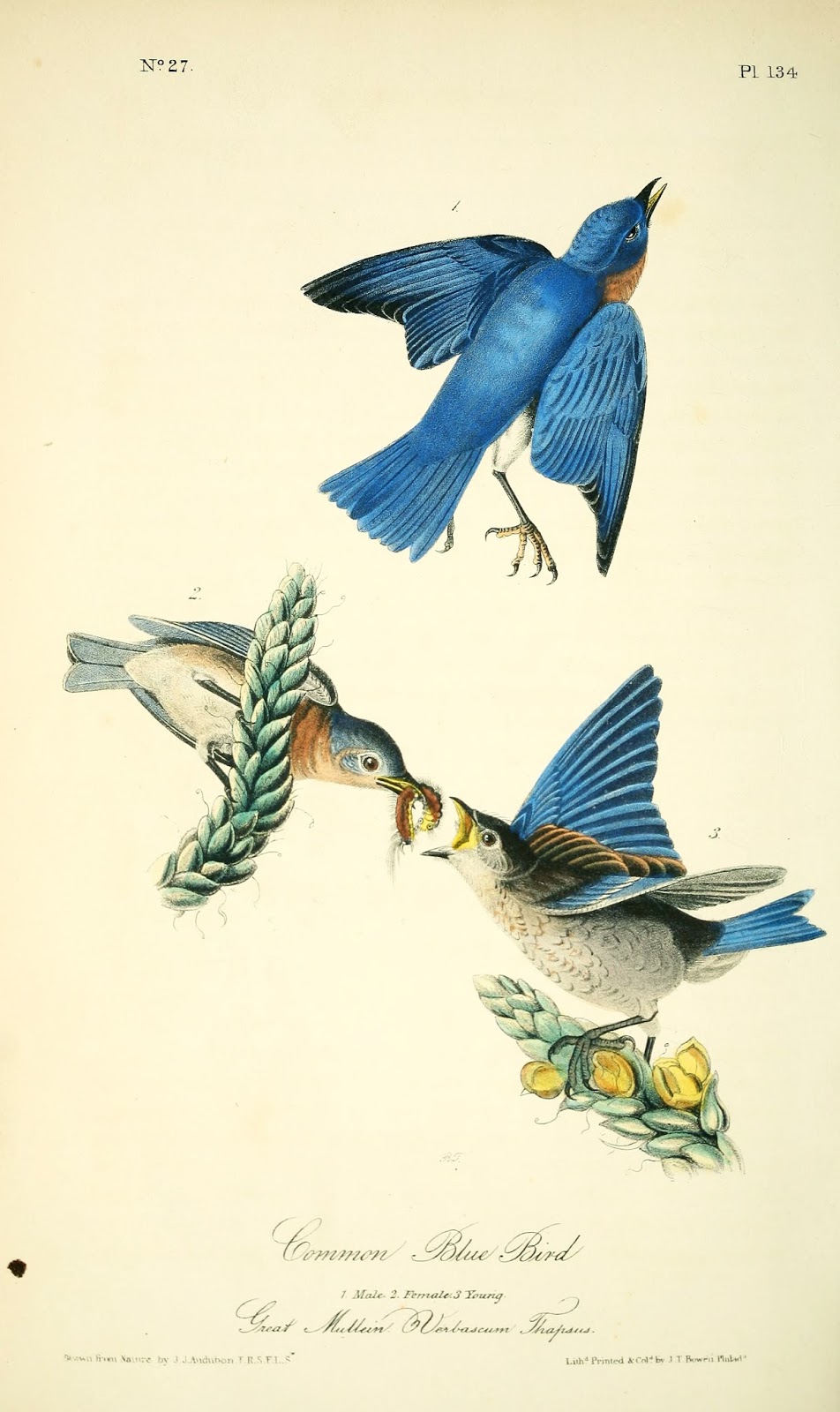
Eastern Bluebird (Sialia sialis)

View Full Size Image

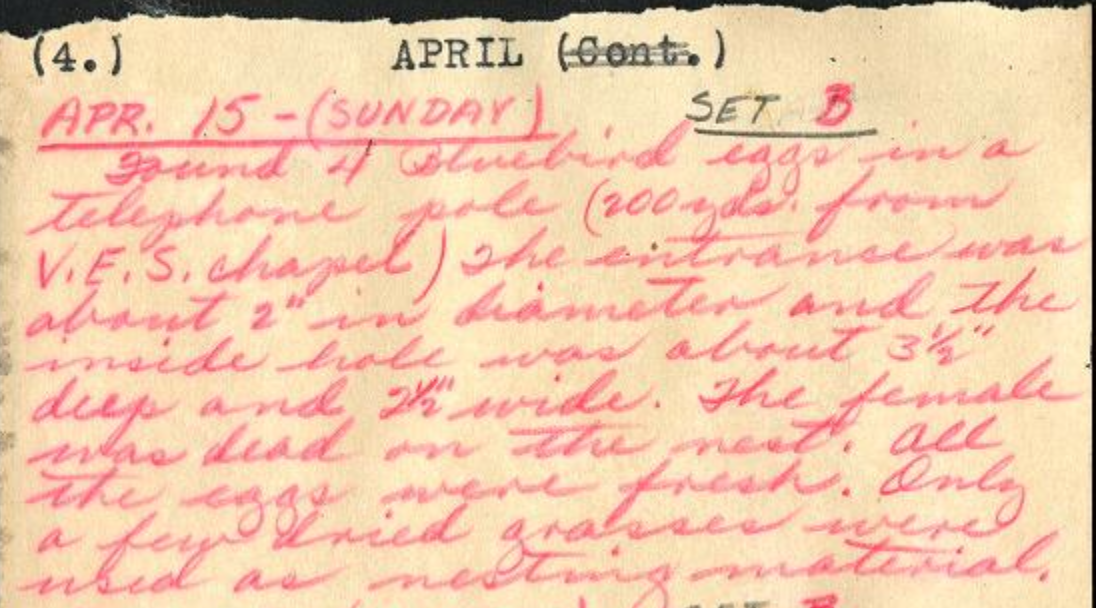
Camblos writes:
“April 15 – (Sunday)
Found 4 bluebird eggs in a telephone pole (200 yds. from V.E.S. chapel). The entrance was about 2″ in diameter and the inside hole was about 3 1/2″ deep and 2 1/2″ wide. The female was dead on the nest. All the eggs were fresh. Only a few dried grasses were used as nesting material.”

View Full Size Image
Audubon, John James. Birds of America. v. 2 (1841). http://biodiversitylibrary.org/page/40383680.

John James Audubon is pretty much a house-hold name. This French-American ornithologist, naturalist, and painter, was responsible for one of the most celebrated ornithological books ever published, Birds of America. After immigrating to the United States, Audubon undertook an expedition in 1820 up the Mississippi in an endeavor to paint all the birds of North America for eventual publication. This ambition later became Birds of America. The work represents more than 14 years of field observations and drawings by Audubon and contains 435 hand-colored, life-sized prints of 497 bird species and presents a total of more than 700 North American bird species. Learn more about the work and Audubon in a past blog post.
American Robin (Turdus migratorius)

View Full Size Image

Camblos writes:
“Apr. 23 – (Monday)
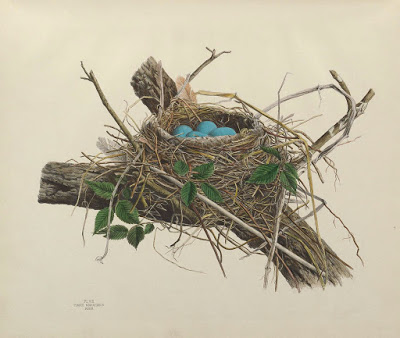
Took 3 fresh Robin eggs from a nest in a mulberry on the campus (20′). The nesting materials were coarse grass, string, mud, and a lining of fine grasses.”

View Full Size Image
Robin’s nest with eggs. Illustrations of the nests and eggs of birds of Ohio. 1886. http://biodiversitylibrary.org/page/34907621.

In 1877, Genevieve Jones decided to create a series of plates for a publication depicting the nests and eggs of Ohio birds. She enlisted the help of close friend Eliza Schulze, and together the two women, amateur artists with no formal training, embarked on the venture. The first three plates, along with the accompanying text by Howard Jones, were sent to publication in 1879. Unfortunately, on August 17th, 1879, Genevieve Jones died of typhoid fever. Desiring to continue the work, Miss Schulze enlisted the help of Genevieve’s mother, Mrs. N. E. Jones. Eventually, Miss Schulze relinquished all of her interests in the title to Mrs. Jones. Determined to move forward, Mrs. Jones undertook the responsibility for all of the illustrations herself, eventually employing three additional artists, Miss Nellie D. Jacob, Miss Josephine Klippart, and Miss Kate Gephart. The final work, entitled Illustrations of the nests and eggs of birds of Ohio, consists of two volumes and 68 plates. Learn more about the work in this past post.

August 6, 2015by ulib-libraryjobs
Page 4 of 7« First...«3456»...Last »

Help Support BHL

BHL's existence depends on the financial support of its patrons. Help us keep this free resource alive!

search

About BHL

The Biodiversity Heritage Library (BHL) is the world’s largest open access digital library for biodiversity literature and archives. BHL operates as a worldwide consortium of natural history, botanical, research, and national libraries working together to digitize the natural history literature held in their collections and make it freely available for open access as part of a global “biodiversity community.”

Join Our Mailing List

Sign up to receive the latest news, content highlights, and promotions.

Subscribe Now

Subscribe to Blog via Email

Enter your email address to subscribe to this blog and receive notifications of new posts by email.

Join 319 other subscribers

Subscribe to Blog Via RSS

Subscribe to the blog RSS feed to stay up-to-date on all the latest BHL posts.

Access RSS Feed

Inspiring Discovery through Free Access to Biodiversity Knowledge.

The Biodiversity Heritage Library makes it easier than ever for you to access the information you need to study and explore life on Earth…for free, anytime, anywhere.


ABOUT | HARMFUL CONTENT | PRIVACY | SITE MAP | TERMS OF USE