Biodiversity Heritage Library - Program news and collection highlights from BHL
  • Home
  • News
  • Featured Books
    • All Featured Books
    • Book of the Month Series
    • BHL at 20
  • User Stories
  • Campaigns
    • Fossil Stories
    • Garden Stories
    • Monsters Are Real
    • Page Frights
    • Her Natural History
    • Earth Optimism 2020
  • Tech Blog
  • Visit BHL
Home
News
Featured Books
    All Featured Books
    Book of the Month Series
    BHL at 20
User Stories
Campaigns
    Fossil Stories
    Garden Stories
    Monsters Are Real
    Page Frights
    Her Natural History
    Earth Optimism 2020
Tech Blog
Visit BHL
  • Home
  • News
  • Featured Books
    • All Featured Books
    • Book of the Month Series
    • BHL at 20
  • User Stories
  • Campaigns
    • Fossil Stories
    • Garden Stories
    • Monsters Are Real
    • Page Frights
    • Her Natural History
    • Earth Optimism 2020
  • Tech Blog
  • Visit BHL
Biodiversity Heritage Library - Program news and collection highlights from BHL
BHL News, Blog Reel

BHL at the Northeast Natural History Conference

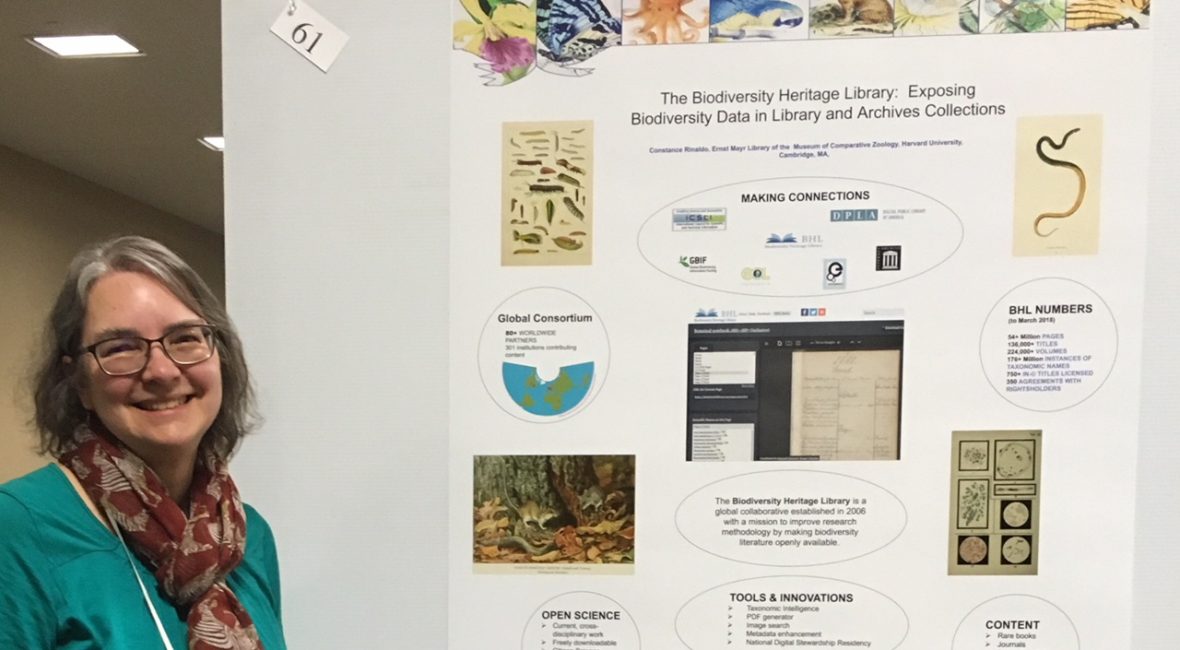
woman in green shirt standing in front of a poster.

The weekend looked promising:  a lovely clear Friday night for a drive to Burlington, Vermont, USA from southern New Hampshire to attend the Northeast Natural History Conference (13-15 April 2018).  What could be better than a hotel humming with botanists and zoologists and activities for them?  The conference was packed—five concurrent sessions (often standing room only) and around 140 posters Saturday and Sunday along with workshops (Bat houses anyone?) and demonstrations throughout the weekend.  Students, faculty and naturalists from colleges, universities and small research or rescue organizations presented posters and talks that focused on New England, New York and Eastern Canadian native vertebrates, invertebrates, plant species diversity and distribution, invasive species and wetland habitats.

woman in green shirt standing in front of a poster.

Constance Rinaldo (Librarian of the Ernst Mayr Library and Museum of Comparative Zoology Archives; Chair of the BHL Executive Committee) standing with her BHL poster at the Northeast Natural History Conference.

Some of the posters that caught my eye (beyond the BHL poster that I presented) included “Restoring Northeast Understory Species: A case of the Primary Literature” presented by Isabel A. Schmitt and Dr. James H. Graves.  They presented a literature review that led to practical methods to reintroduce native species.  Another interesting poster was the “Use of Point-and-Shoot Photography to Compare Regional Differences in Coyote (Canis latrans) Skull Size”.  Osrica Mclean et al developed an online collection of digital images of skulls and calibrated the images so that they could be measured accurately online.

I attended a talk about how specialist and generalist rodents disperse mycorrhizae (Ryan Stephens and Rebecca Rowe) along with a presentation that detailed 42 years of vegetation change on Franconia Ridge in New Hampshire by Charles Cogbill.  Dr. Cogbill used an archive of photographs (from 1860 to present) to identify the effects of hikers on the trail vegetation (much damage is done). Another conference theme was bats and how white nose syndrome has affected bats in New England.   In a talk by Meghan Lout, she described a house in Middlebury, VT from which 550 bats were seen exiting one evening.  The owners were unaware that their house was a haven for bats.

Interacting with so many enthusiastic people studying nature—from observational work to highly experimental research—was inspiring and exciting.  The BHL poster was well received.  University faculty members and naturalists from small organizations stopped by to tell me how much BHL has improved their research workflows. Many students discovered BHL at this conference and were suitably impressed.  I asked for suggestions to enhance BHL and the common theme was “more”.  More content (with some individuals offering resources) and more current materials.  New potential users were surprised that content is available for free download. A few of the more sophisticated users suggested that we needed a taxonomic name authority file so names can be plugged in and the historical names and current names could be viewed as a complete set.

Leaving was somewhat deflating—snow, sleet and freezing rain as only the north country can do it.  Miserable driving, 45 mph tops, cars off the road, 4 hours on the road instead of 3. But so worth it to be among so many people studying the natural world.

May 2, 2018by michelle.underhill
BHL News, Blog Reel

The Impact of Coordinated Social Media Campaigns on Online Citizen Science Engagement

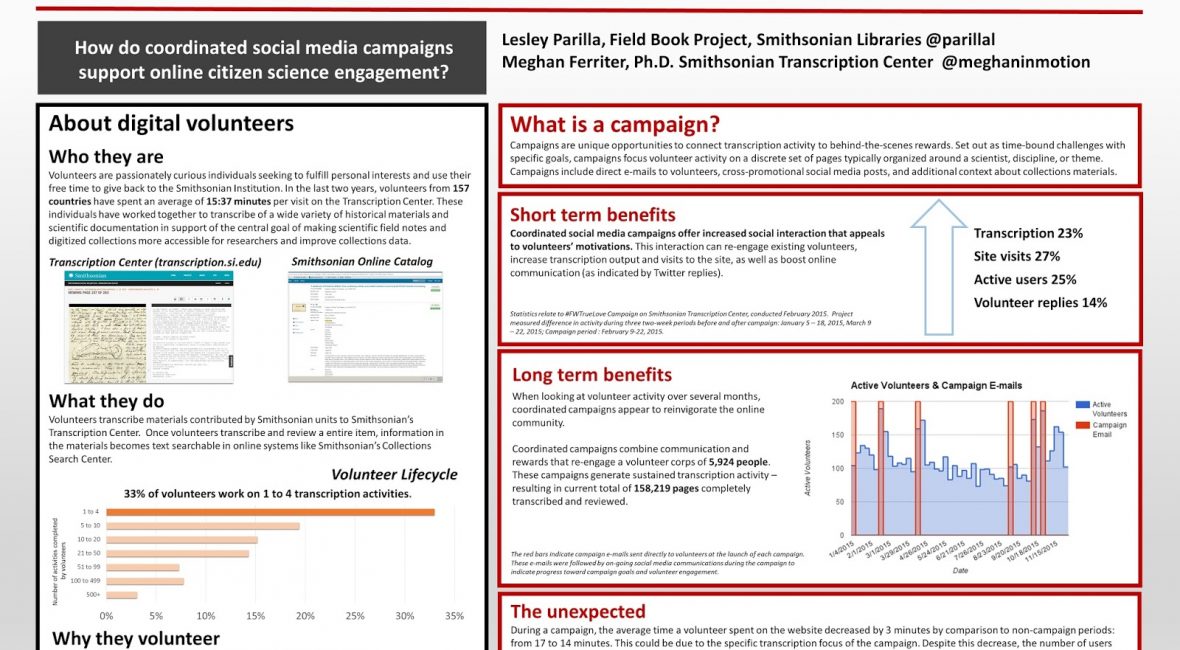
Smithsonian staff members recently presented a poster at the American Association for the Advancement of Science (AAAS) Annual Meeting in Washington, DC, 11-15 February, 2016. The poster, entitled “The Impact of Coordinated Social Media Campaigns on Online Citizen Science Engagement” by Lesley Parilla (Cataloging Coordinator, The Field Book Project) and Meghan Ferriter, Ph.D. (Project Coordinator, Smithsonian Transcription Center), highlighted the impact of a coordinated social media campaign on crowdsourced transcriptions of field notes.

View Full Size Image

The poster outlined the details and outcomes of the #FWTrueLove campaign, a collaboration involving The Field Book Project, the Smithsonian Institution Archives, the Smithsonian Transcription Center, Pyenson Lab, and the Biodiversity Heritage Library. The event challenged volunteers to fully transcribe a selection of field notes by Frederick W. True, held by the Smithsonian Institution Archives and uploaded to the Smithsonian Transcription Center, by the end of the campaign period. Materials for the challenge were identified and selected with Smithsonian Curator of Fossil Marine Mammals Dr. Nick Pyenson and the Smithsonian Field Book Project, a joint initiative of the National Museum of Natural History, Smithsonian Libraries and Smithsonian Institution Archives. The field notes are an important source of natural science data that is difficult to utilize, since they are often handwritten and fragile due to age.

The Transcription Center coordinated the multi-institutional campaign during the month of February 2015. The campaign involved blog posts, Twitter, Instagram, Facebook, and a targeted email to the Transcription Center’s current volunteers, all of which challenged users to completely transcribe 523 pages from F.W. True’s field notes within one week. Updates were posted on: http://nmnh.typepad.com/fieldbooks/fwtruelove/.

As a reward for the successful completion of the challenge, the Transcription Center coordinated Google Hangouts with Curator of Fossil Marine Mammals Dr. Nick Pyenson. Dr. Pyenson discussed the interdisciplinary nature of F.W. True’s scientific pursuits – plus True’s connections with Smithsonian researchers like Leonhard Stejneger and William Healey Dall.

The #FWTrueLove campaign contrasted with a typical experience by focusing on a specific set of materials. The modular design of the Transcription Center’s website, which incorporates multiple collection types, means that a typical volunteer experience is flexible and highly tailored to their individual interests. This flexible design enables volunteers to create their own online experience. This can be expanded with engagement via social media. An analysis of the event showed that coordinated social media campaigns increase volunteer interaction, transcription output, and the number of active users on the Transcription Center. However, there was a decrease in the average length of a visit during the campaign. This may be because new active users are specifically coming to spend time on the projects highlighted in the campaign. This varies from other periods of time on the site, when volunteers come to work on one project but move onto unrelated projects that catch their attention thanks to the site’s open structure. These focused campaigns that appear to work in direct opposition to the flexible nature of the Transcription Center may keep the community growing, serving to reinvigorate the volunteer community as a whole and combat the natural cycling of volunteers out of active participation.

Learn more about the results of the campaign on the AAAS website. See the posted in more detail on BHL’s Pinterest.

February 18, 2016by ulib-libraryjobs
BHL News, Blog Reel

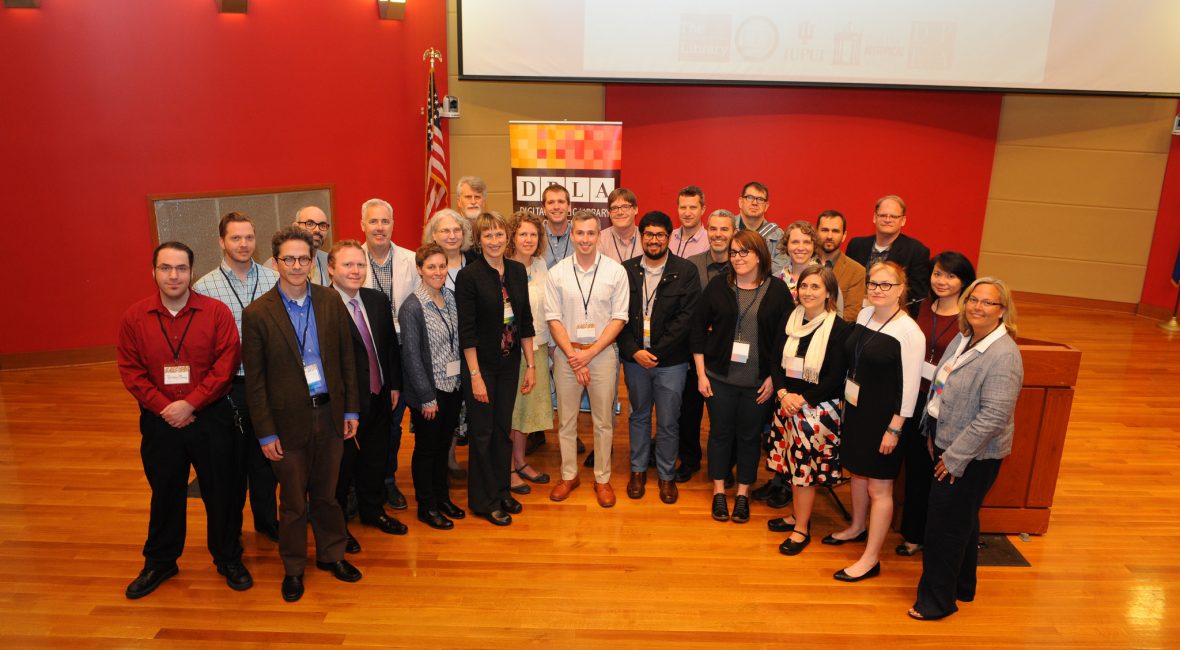
The Biodiversity Heritage Library at DPLAFest 2015

View Full Size ImageBHL Program Director Martin Kalfatovic attended the DPLAFest 2015 in Indianapolis (April 17-18) representing both the BHL content hub and the Smithsonian content hub.

DPLAFest drew over 300 people to the public programs held at the Indianapolis Public Library, the Indiana State Library, IUPUI University Library, and the Indiana Historical Society.

DPLA Director of Content Emily Gore gave important updates on the DPLA hub model and how DPLA hopes that it will evolve over time.

At the open poster session during the reception on the first day of DPLAFest, BHL presented a well-received poster, “45 Million Pages, 150 Million Species Names, Science for the DPLA: The Biodiversity Heritage Library” designed by Grace Costantino. The theme of the poster was: “The BHL is a ‘Vast library of life’ that enriches the DPLA by helping the DPLA community learn more about our non-human neighbors on planet Earth.”

View Full Size Image


April 28, 2015by joelrichard
BHL News, Blog Reel

BHL at the International Association of Agricultural Information Specialists, IAALD World Congress 2013


The IAALD 2013 World Congress of the International Association of Agricultural Information Specialists was hosted by Mann Library, Cornell University in Ithaca, NY, July 21 – 24, 2013.  BHL presented a poster at the event.
IAALD Poster Session
The BHL poster, entitled “Biodiversity Heritage Library: Supporting Research with Open Content,”  was authored by Constance Rinaldo, Bianca Crowley and Boris Jacob and showcased on July 23, 2013.  Presented by Marty Schlabach and Mary Ochs of Cornell University, the poster provided an overview of the BHL and highlighted some of the tools and features which BHL offers.  Some attendees were already familiar with BHL but many more were excited to learn about all that BHL offers as a free, open access project.
We were also very pleased to have global representation with members of BHL-Africa, Gracian Chimwaza and Blessing Chataira, also in attendance.
View Full Size Image
August 12, 2013by brooksm

Help Support BHL

BHL's existence depends on the financial support of its patrons. Help us keep this free resource alive!

search

About BHL

The Biodiversity Heritage Library (BHL) is the world’s largest open access digital library for biodiversity literature and archives. BHL operates as a worldwide consortium of natural history, botanical, research, and national libraries working together to digitize the natural history literature held in their collections and make it freely available for open access as part of a global “biodiversity community.”

Join Our Mailing List

Sign up to receive the latest news, content highlights, and promotions.

Subscribe Now

Subscribe to Blog via Email

Enter your email address to subscribe to this blog and receive notifications of new posts by email.

Join 319 other subscribers

Subscribe to Blog Via RSS

Subscribe to the blog RSS feed to stay up-to-date on all the latest BHL posts.

Access RSS Feed

Inspiring Discovery through Free Access to Biodiversity Knowledge.

The Biodiversity Heritage Library makes it easier than ever for you to access the information you need to study and explore life on Earth…for free, anytime, anywhere.


ABOUT | HARMFUL CONTENT | PRIVACY | SITE MAP | TERMS OF USE