Biodiversity Heritage Library - Program news and collection highlights from BHL
  • Home
  • News
  • Featured Books
    • All Featured Books
    • Book of the Month Series
    • BHL at 20
  • User Stories
  • Campaigns
    • Fossil Stories
    • Garden Stories
    • Monsters Are Real
    • Page Frights
    • Her Natural History
    • Earth Optimism 2020
  • Tech Blog
  • Visit BHL
Home
News
Featured Books
    All Featured Books
    Book of the Month Series
    BHL at 20
User Stories
Campaigns
    Fossil Stories
    Garden Stories
    Monsters Are Real
    Page Frights
    Her Natural History
    Earth Optimism 2020
Tech Blog
Visit BHL
  • Home
  • News
  • Featured Books
    • All Featured Books
    • Book of the Month Series
    • BHL at 20
  • User Stories
  • Campaigns
    • Fossil Stories
    • Garden Stories
    • Monsters Are Real
    • Page Frights
    • Her Natural History
    • Earth Optimism 2020
  • Tech Blog
  • Visit BHL
Biodiversity Heritage Library - Program news and collection highlights from BHL
Blog Reel, Campaigns, Her Natural History

Graceanna Lewis: A Naturalist and Abolitionist

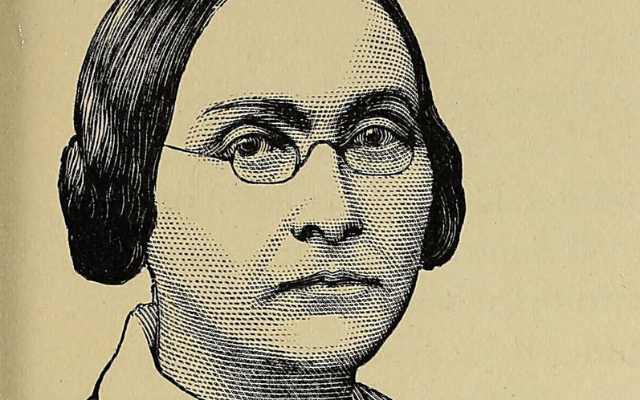
Black and white portrait of a person wearing glasses.

This post originally published on the Smithsonian Libraries and Archives’ blog, Unbound.

“To her mind the truths of science seem revealed.”

That’s how Phebe A. Hanaford, author of Daughters of America (c. 1882), described naturalist Graceanna Lewis, one of the first three woman to be accepted into the Academy of Natural Sciences. But Lewis was not only one of the first professionally acknowledged women naturalists; she was also an abolitionist and social reformer who worked for the advancement of science as well as human rights. Researchers can find many publications by and about this intriguing woman in the Smithsonian Libraries and Archives’ Digital Library and the Biodiversity Heritage Library.

Born in 1821, Lewis benefitted from an egalitarian Quaker upbringing, one that encouraged education in daughters as well as sons. Lewis told Hanaford that she learned to love natural history from her mother, Esther Lewis. Esther had been a teacher before marriage and continued to educate her own young children, sending her daughters to nearby Kimberton Boarding School as they grew. There, Graceanna was influenced by Abigail Kimber, a woman botanist who had discovered and identified several species. In 1842, Lewis’ uncle, Dr. Bartholomew Fussell, started a new boarding school for girls, and Lewis came on board as a teacher. She taught astronomy and botany, among other subjects.

Black and white portrait of a person wearing glasses.

Portrait of Graceanna Lewis. The Underground Rail Road (1872). Digitized by Smithsonian Libraries and Archives.

From her family, Graceanna Lewis inherited not only an interest in science and education but also a deep concern for social issues. Uncle Bartholomew was an active abolitionist, and the family formed a local auxiliary of the American Anti-Slavery Society. The Lewis sisters, Graceanna, Mariann and Elizabeth, were profiled in William Still’s The Underground Rail Road (1872), which described them as “among the most faithful, devoted, and quietly efficient workers in the Anti-slavery cause”.

One of Graceanna’s earliest publications, written in the 1840s, was “An Appeal to Those Members of the Society of Friends Who Knowing the Principles of the Abolitionists Stand Aloof from the Anti-Slavery Enterprise”. It implored fellow Quakers to join the Anti-Slavery movement. The Lewis farm in Pennsylvania became a frequent and successful point on the Underground Railroad, described in detail by Still. The family helped transport those seeking freedom and provided clothes and supplies.

Eventually, Lewis moved away from the family farm to Philadelphia. She had studied birds and other natural sciences on her own, but this move allowed her to take advantage of the specimen and library collections at the nearby Academy of Natural Sciences, and it propelled her into a network of naturalists. In 1862, she met John Cassin, ornithologist and curator of birds at the Academy. Cassin had written, with George N. Lawrence and the Smithsonian’s own Spencer Baird, The Birds of North America (1860), a work Lewis found particularly inspiring.

Cassin would be an invaluable friend and mentor to Lewis, even naming a bird for her, Icterus graceannae, the White-edged oriole. Lewis also corresponded frequently with Baird for years, seeking advice and asking for copies of Smithsonian publications. In 1870, the year after Cassin’s death, Lewis became one of the first three women admitted as members to the Academy.

Icterus graceannae, black and yellow bird.

Icterus graceannae, or white-edged oriole, Plate XI. Ibis. Series 5, Volume 1. No. 1-4. (1883). Contributed in BHL from Smithsonian Libraries and Archives.

Lewis had channeled her interested in ornithology into her first scientific publication, Natural History of Birds : lectures on ornithology, in ten parts (1868). It was intended as an inexpensive overview of American birds for a general audience. In it, she also proposed a new classification scheme based on embryology, the characteristics of eggs. Unfortunately, only the first part was published, as funding for the remaining nine was never secured. She continued to research and publish on birds, alongside the leading naturalists of her time. Her articles in The American Naturalist, “The Lyre Bird” (August 1870) and “Symmetrical Figures in Birds’ Feathers” (November 1871) are available in the Biodiversity Heritage Library.

Lewis’ interests and publications grew beyond ornithology, into the classification of natural history and a “tree of life”, which she exhibited at the Centennial Exhibition in 1876. The Development of the Animal Kingdom (1877), available in the Biodiversity Heritage Library, is a twenty-page overview of her theories. It was prepared for the fourth meeting of the Association for the Advancement of Women. The group was formed in 1868 with the goal of presenting practical methods for improving women’s role in society, including education on a variety of subjects. Unsurprisingly, Lewis was active on the group’s Committee on Science.

Cover, The Development of the Animal Kingdom (1877)

Cover. The Development of the Animal Kingdom. (1877). Contributed in BHL from Smithsonian Libraries and Archives.

Lewis told Phebe A. Hanaford in 1882, “I feel that my life’s work is before me, in lecturing on zoology to girls just blooming into womanhood”. For the next twenty years, Lewis continued to teach and write about various natural history topics. Her article “On the Genus Hyliota”, discussing the distinction of two rare African birds, was published in The Annals and magazine of natural history in 1883. Her social reform interests turned to temperance and suffrage, serving stints as secretary for her local chapter of the Women’s Christian Temperance Union and suffrage association.

Graceanna Lewis died in 1912 in Media, Pennsylvania at the age of 90. Her contributions to both science and social progress leave a remarkable and inspiring legacy.

Further Reading

Baird, Spencer Fullerton, John Cassin and George N. Lawrence. The Birds of North America (1860).

Baird, Spencer Fullerton. Spencer Fullerton Baird Papers. Record Unit 7002. Smithsonian Institution Archives.

Bonta, Marcia. “Graceanna Lewis, Portrait of a Quaker Naturalist”. Quaker History, Volume 74, Number 1, Spring 1985, pp. 27-40.

Hanaford, Phebe A. Daughters of America (1883).

Lewis, Graceanna. “An appeal to those members of the Society of Friends who knowing the principles of the abolitionists stand aloof from the anti-slavery enterprise”. [between 1840 and 1849?].

Lewis, Graceanna. The Development of the Animal Kingdom (1877).

Lewis, Graceanna. “The Lyre Bird”. The American Naturalist (August 1870), pp 321.

Lewis, Graceanna. “On the genus Hyliota”. The Annals and magazine of natural history, Series 5, Volume 12, No. 67, pp. 210-212.

Lewis, Graceanna. “Symmetrical Figures in Birds’ Feathers” . The American Naturalist (November 1871), pp. 675-678.

Lewis-Fussell Family Papers, SFHL-RG5-087, Friends Historical Library of Swarthmore College.

Still, William. The Underground rail road (1872).

Truitt, James. “Digitizing the Papers of Graceanna Lewis, Ornithologist and Activist”. Cassinia. No. 77 (2017-2018), pp. 40-41.

Warner, Deborah Jean. Graceanna Lewis, scientist and humanitarian (1979).

March 30, 2021by Pedro Gonzalez Fernandez
Blog Reel, Campaigns, Featured Books, Her Natural History

Margaret S. Collins: A Legend in Termite Field Biology

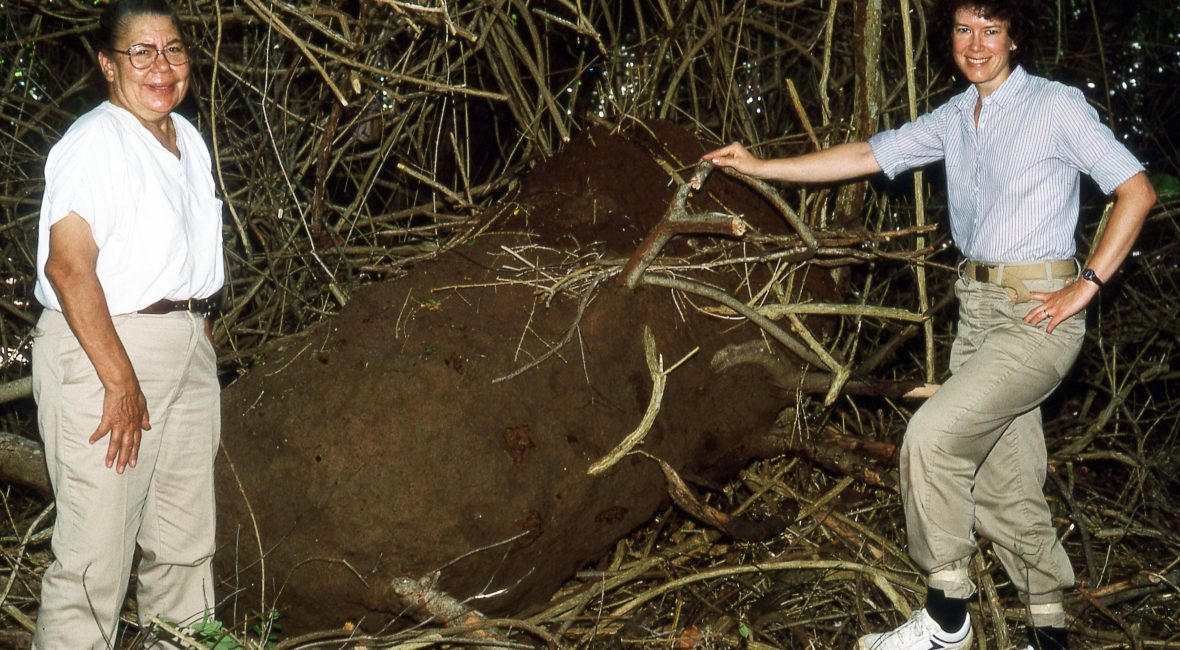
Two scientists researching termites in the British Virgin Islands stand together with a huge termite nest in between them. Photo taken in 1986.

This post was originally published on 2 March 2021 on the Smithsonian Institution Archives blog.

Two scientists researching termites in the British Virgin Islands stand together with a huge termite nest in between them. Photo taken in 1986.

Dr. Margaret S. Collins and Dr. Barbara L. Thorne standing next to a termite (Nasutitermes acajutlae) nest on Guana Island in the British Virgin Islands while studying a variety of termites in 1986. © Dr. Barbara L. Thorne.

Dr. Margaret S. Collins (1922-1996), a renowned expert on termite ecology and distribution, taught as a professor and administrator at Howard University, Florida A&M University, and Federal City College (now University of The District of Columbia) for over 35 years. Upon her retirement from teaching, Collins continued her work on termites at the Smithsonian National Museum of Natural History as a research associate from 1983 to 1996.

Over the course of her career, Collins published more than forty articles spanning the biogeography, physiology, chemical defenses, and taxonomy of termites. Collins also collected specimens in the United States, Mexico, Costa Rica, Colombia, Barbados, Belize, Suriname, the Cayman Islands, Guyana, Guatemala, and Panama. When she contracted dengue fever on an expedition in Guyana in 1983-1984 and was forced into a long hiatus from field work, she turned her focus to updating and preserving the termite specimens at the Smithsonian National Museum of Natural History. Eventually Collins returned to field research in 1994 when she once again traveled to Guyana to collect termites. In April 1996, Collins died while conducting field work in the Cayman Islands.

Collins’ biographers, such as Wini Warren and Vernard R. Lewis, have documented how she faced racism and sexism in her work and life. As one of the first African American women to earn a Ph.D. in entomology, she had to fight to find advisers as an undergraduate at West Virginia State College and to fund her field research during her early career. Additionally, Collins worked in the face of bomb threats and racist remarks as she pursued her career and advocated for equal rights during the civil rights movement.

In fact, Collins’ memorial service pamphlet begins with excerpts from a letter she wrote to the editor of the Tallahassee Democrat during the 1956 Tallahassee bus boycott. During the boycott, sometimes chased by police, Collins drove protestors to and from work. The excerpts included:

The Person who allows himself to be mistreated without protest shares equal responsibility with his abuser for the unjust act…

…We can do little for those of us who have been so conditioned that they back away when the opportunity to stand tall is offered—except be thankful that we are not all as they are. Those who back away need prayers, that they may never have to bear the burden of blocking the growth of other members of their group.

These passages were edited out of Collins’ letter by the newspaper and never printed, but their inclusion in her memorial service offers a sense of the importance Collins placed on standing tall against the challenges she faced in her own life.

The first page of Margaret S. Collins’ memorial service pamphlet.

The first page of Margaret S. Collins’ memorial service pamphlet. Courtesy of Dr. Barbara L. Thorne.

In the face of those challenges, Collins developed a love for field research. To learn more about Margaret Collins’ research, see a selection of her field notebooks, archived at the Smithsonian and digitized in the Biodiversity Heritage Library (BHL), the world’s largest open access digital library for biodiversity literature and archives. Headquartered at the Smithsonian, BHL works with libraries and archives around the world to revolutionize global research by providing free, worldwide access to knowledge about life on Earth.

An open spiral notebook with handwritten notes only on the right page.

Pages 6 and 7 from Margaret S. Collins’ Field Notes: “Combat Data,” Suriname, 1982: SIA Acc. 01-038. Contributed in BHL from Smithsonian Institution Archives.

Collins’ field notebooks were digitized and transcribed with the Smithsonian Transcription Center as part of the Smithsonian Field Book Project. Field notes can provide rich data for researchers to understand how biodiversity has changed over space and time. For example, field notebooks may describe habitats, meteorological events, and personal observations that allow us to reconstruct historical ecologies. The Archives has contributed over 300,000 pages of field notes to the Biodiversity Heritage Library as part of the Smithsonian Field Book Project. Some of Collins’ field books are part of that collection.

There are so many inspiring stories, like Dr. Collins’, about women in science at the Smithsonian in its 175-year history that can educate and embolden future generations, but only if their legacies are discoverable. On Thursday, 25 March 2021 from 1-3pm ET, join us for Wikipedia & Women in Science: Smithsonian Groundbreakers Edit-a-thon, an online Wikipedia editing workshop hosted in conjunction with the Smithsonian American Women’s History Initiative and the Smithsonian Institution Archives, part of Smithsonian Libraries and Archives.

During this training, attendees of all experience levels will learn the basics of how to edit Wikipedia by updating articles related to the history of women in science at the Smithsonian Institution in connection with the Funk List. Presenters will share how editors might research the work of these women in the absence of personal papers and institutional records. Learn more and register.

March 22, 2021by michelle.underhill
BHL News, Blog Reel

Wikipedia & Women in Science: Smithsonian Groundbreakers Edit-a-thon

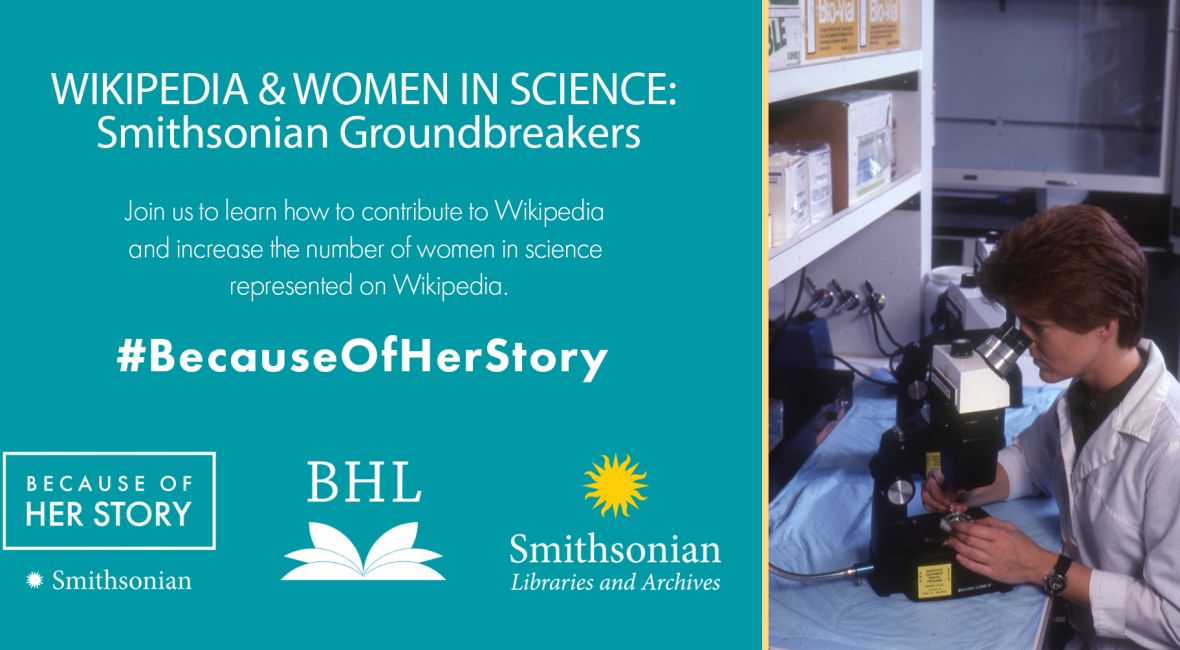
graphic for women in science wikipedia workshop

Photo in graphic shows Dr. JoGayle Howard working with embryos from the National Institutes of Health at the dissecting microscope in 1982. Photo Credit: Smithsonian Institution Archives.

Join us on 25 March 2021 (1-3pm ET) for Wikipedia & Women in Science: Smithsonian Groundbreakers Edit-a-thon, an online Wikipedia editing workshop hosted in conjunction with the Smithsonian American Women’s History Initiative and the Smithsonian Institution Archives, part of Smithsonian Libraries and Archives.

When? 25 March 2021, 1-3pm ET

Where? Online

Register Today!

During this training, attendees of all experience levels will learn the basics of how to edit Wikipedia by updating articles related to the history of women in science at the Smithsonian Institution in connection with the Funk List. Presenters will share how editors might research the work of these women in the absence of personal papers and institutional records.

As one of the web’s most visited reference sites, Wikipedia serves as a starting point for many individuals looking to learn about art, history, and science. However, less than 19% of Wikipedia biographies in English represent women, and less than 10% of Wikipedia editors identify as women. By increasing representation of women scientists on the site, your impact can spark the curiosities of future generations who see themselves in these Smithsonian groundbreakers.

This event is planned in conjunction with the Smithsonian Institution Archives, the Biodiversity Heritage Library, and the Smithsonian American Women’s History Initiative, a multiyear undertaking to document, research, collect, display, and share the history of women in the United States.

March 8, 2021by michelle.underhill
Blog Reel, User Stories

Time Traveling with BHL: Open Access to Historic Data Empowers Modern Research…At Home

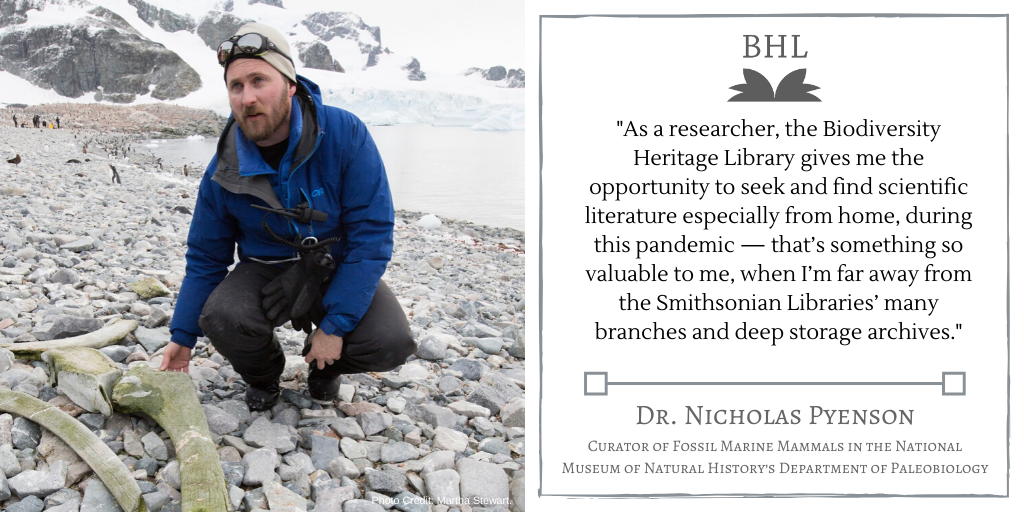
Quote from Dr. Nicholas Pyenson about BHL's impact

As the world’s largest open access digital library for biodiversity literature and archives, the Biodiversity Heritage Library (BHL) has revolutionized global research by providing free, worldwide access to knowledge about life on Earth. BHL’s digital collections provide researchers with the information they need to document Earth’s species, conserve biodiversity, research the history of science, and confront formidable challenges — from extinction crises to climate change and the spread of zoonotic diseases.

Digital access to this essential literature is especially important right now, as the COVID-19 pandemic makes physical access to collections and institutional libraries impossible for many. Open access digital libraries like BHL make continued research possible.

Dr. Nicholas Pyenson, Curator of Fossil Marine Mammals in the National Museum of Natural History’s Department of Paleobiology, has been a longtime user of and advocate for BHL. The historic data accessible through publications in BHL underpins much of his work. For example,  the Discovery Reports, which present the results of groundbreaking investigations into the biology of whales, helped inform Pyenson’s studies on the evolution of cetacean body size and whale hearing.

Man in a blue coat on a beach investigating whale bones

Dr. Nicholas Pyenson at Cuverville Island, Antarctica. Photo credit: Martha Stewart.

While BHL has been a valued resource for Pyenson for many years, digital access to scientific literature has become especially important as research has shifted to a telework environment.

“As a researcher, the Biodiversity Heritage Library gives me the opportunity to seek and find scientific literature especially from home, during this pandemic — that’s something so valuable to me, when I’m far away from the Smithsonian Libraries’ many branches and deep storage archives,” emphasizes Pyenson. “Access to words, images, and ideas that are either decades or centuries old drives so much of my work. It also gives me a sense of connection to people I’ve never met, but nonetheless seem very real for the questions I want to answer.”

Pyenson shares more about BHL’s impact during these unprecedented times on the Smithsonian Libraries’ YouTube channel.

As our understanding of the natural world deepens and grows, trusted, openly available resources become ever more important. BHL’s Secretariat and technical staff, together with our colleagues at BHL’s over 80 partner institutions globally, are committed to ensuring continued access to BHL resources for researchers around the globe. Your support today is deeply impactful to our ability to continue providing support to the thousands of researchers who rely on access to our digital collections.

If you’re able to give, we welcome your contribution.

May 21, 2020by michelle.underhill
BHL News, Blog Reel

Celebrating the Career of Dr. Nancy E. Gwinn, Retiring Director of Smithsonian Libraries

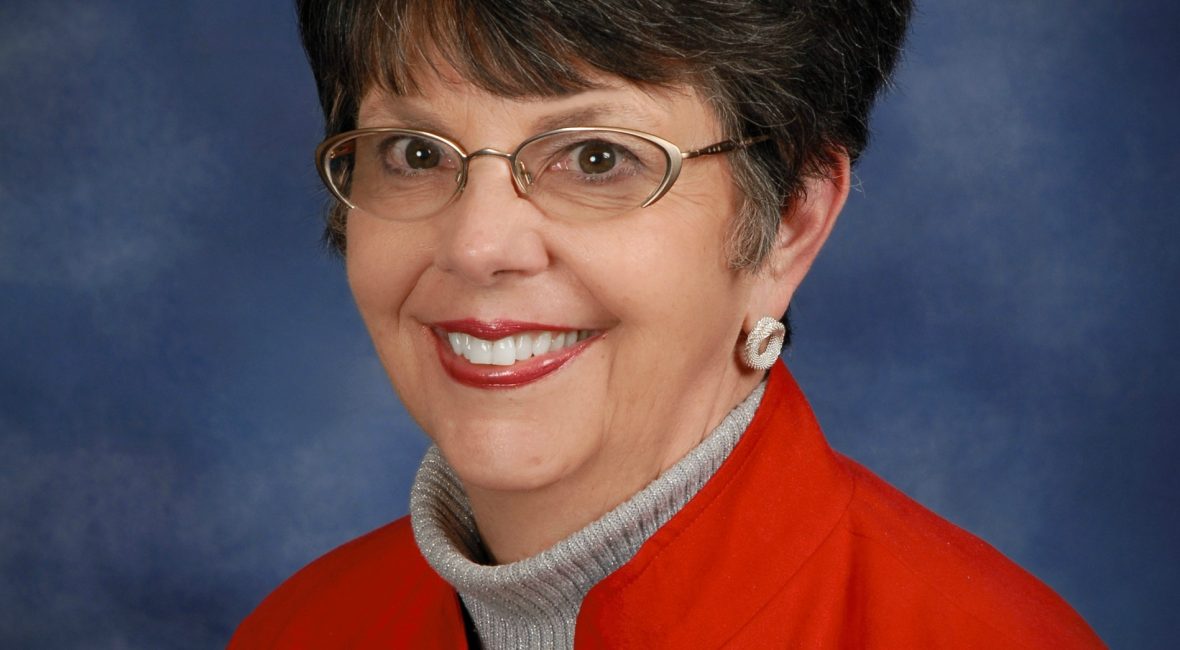
photo of a dark haired person in a red jacket

Dr. Nancy E. Gwinn, Retiring Director of Smithsonian Libraries.

This month, the Smithsonian celebrates the career of Dr. Nancy E. Gwinn, retiring Director of Smithsonian Libraries. Gwinn’s Smithsonian career began in 1984 when she joined the Libraries, becoming director in 1997. During her tenure, she has made significant contributions to the Smithsonian, the global library community, and the Biodiversity Heritage Library (BHL).

As the director of the Smithsonian Libraries, home to BHL’s headquarters, Gwinn has played a vital role in the founding and development of BHL. She was instrumental in securing dedicated funding for the program at Smithsonian Libraries and founding and expanding the BHL Secretariat. Through her service as the Chair (2012-2017) and Immediate Past-Chair (2017-2019) of the BHL Executive Committee, Gwinn provided key leadership for BHL’s strategic direction and the growth and stewardship of the consortium’s partnerships.

Martin R. Kalfatovic, the current BHL Program Director, noted: “In her service to BHL, Nancy provided invaluable direct guidance on many aspects of BHL, particularly in the development of the BHL governance model. My predecessor, Tom Garnett, and I both benefited from Nancy’s ability to see the big picture and keep BHL moving forward. As BHL continues to grow and expand, Nancy’s legacy will remain a motivating force.”

group of people presenting a plaque

BHL Member representatives (L to R) Jane Smith (Natural History Museum, London), Wai Yin Pryke (National Libraries, Singapore), and Constance Rinaldo (Ernst Mayr Library, Harvard University) recognize Dr. Nancy E. Gwinn during a presentation ceremony honoring her five years as Chair of the BHL Executive Committee.

In addition to her significant contributions to BHL, Gwinn’s leadership brought the Smithsonian Libraries to a new level of activity and recognition. During her career:

  • The Libraries became the Smithsonian’s principal resource for digital access to its collections, including the creation of new tools for scholars and students.
  • The preservation program grew beyond the Book Conservation Laboratory to incorporate environmental monitoring and preservation microfilming.
  • The Libraries established its first Advisory Board and inaugurated an energetic advancement program, raising nearly $20,000,000 to support new programs and operations.
  • The Libraries successfully promoted new awareness and use of its unique special collections, world’s fairs and historical trade catalogs.
  • In 1991, the Libraries acquired an exhibition gallery in the National Museum of American History and initiated an exhibition, publication, and outreach program to bring its treasures to a broad audience.
  • The Libraries launched fellowship and intern programs to bring researchers and budding librarians to work with staff and collections.

Please join us in thanking Dr. Gwinn for her dedication and impact on librarianship, the Smithsonian, and BHL. Her passion and leadership will continue to inspire the many who were fortunate to know and work with her. We at BHL send Dr. Gwinn our heartfelt gratitude and best wishes in retirement.

group of people standing around a BHL birthday cake

Gwinn (far right) and fellow BHL representatives celebrate BHL’s 10th anniversary during a “birthday celebration” at the Natural History Museum in London in 2016.

December 17, 2019by michelle.underhill
Blog Reel, Featured Books, User Stories

Smithsonian Libraries, BHL, and My Research on South Asian Mammals

This blog post is part of a series from Smithsonian Libraries highlighting Unearthed, a new collection of paleobiology literature in the Biodiversity Heritage Library curated by Smithsonian Libraries in celebration of the opening of the National Museum of Natural History’s David H. Koch Hall of Fossils – Deep Time exhibit. Follow the series throughout 2019 as Smithsonian scientists and librarians discuss the collection, identify their favorite books within it, and explain the importance of paleobiology literature in research today.

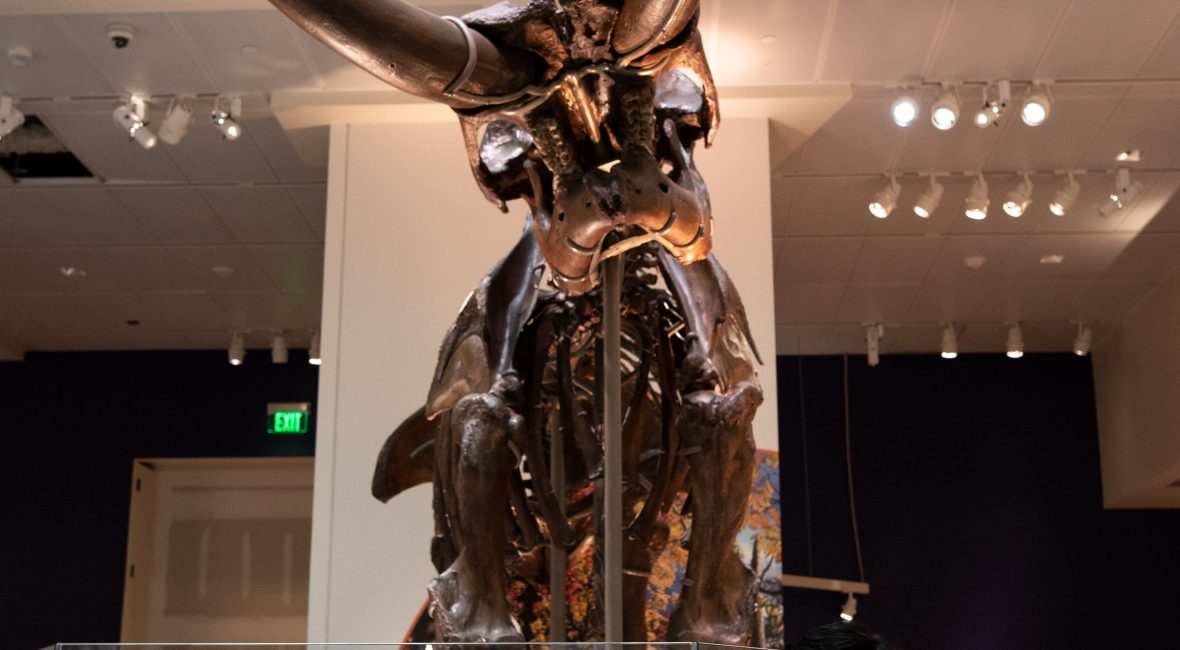
Man standing in front of a mastodon specimen.

Advait Jukar in front of an American Mastodon, Mammut americanum, in the David H. Koch Hall of Fossils – Deep Time.

I’m a Deep Time – Peter Buck Fellow in the Department of Paleobiology at the Smithsonian’s National Museum of Natural History where I study the ecology and evolution of prehistoric vertebrates, especially fossil mammals from the Indian subcontinent. The Indian subcontinent has one of the richest mammalian fossil records anywhere in the world. The Siwalik Hills and surrounding regions in Northwest India and Pakistan have a fossil record ranging from about 23 million years ago to about half a million years ago, making this region an ideal place to study how mammalian communities have changed through time.

Fossil mammals in India were first discovered by British explorers and naturalists in the 1830s and 40s. Hugh Falconer, Proby Cautley, W.E. Baker, and H.M. Durand discovered one of the largest deposits of fossil mammals from the Pliocene and Pleistocene (3.6 million years to 0.6 million years) in the region between the rivers Yamuna and Sutlej. These fossils eventually made their way back to the Natural History Museum in London and form one of the most important fossil collections in the world. These collections form the basis of my research on the reassessment of the taxonomy of fossil mammals from India, the biogeography of South Asian mammals, and paleocommunity change.

Understanding the taxonomy of a particular group in the fossil record (the basis for any study on diversity, biogeography, ecology, etc.) requires a review of the various species that have been named. A species is named when a scientist determines that a particular specimen is different enough from other species. This specimen is then classified as the holotype, or voucher specimen for the species. When a new fossil is found, or additional comparisons are made, some described species are determined to be synonymous, and therefore cease to be valid, or sometimes more than one species is found lumped together under the same name. Therefore, revisory studies require an expansive review of the literature, especially the descriptions of the holotypes.

Despite the excellent fossil record, mammals from India have received comparatively little attention from paleontologists in the past. So, to understand the diversity of fossil mammals in the collection, I had to go back to the original papers and books where they were described. In many cases, the species were named by Falconer, but formally described several years later by Richard Lydekker.

Lydekker was a staff member with the Geological Survey of India from 1877-1881, and thereafter came to work at the Natural History Museum, London in 1882. There, he compiled catalogues of fossil mammals, reptiles, amphibians and birds for Henry Woodward, the then Keeper of Fossils at the Natural History Museum. These catalogues are the first formal descriptive documents on Falconer’s Siwalik fossils and are extremely important for any student of fossil mammals. Lydekker also assigned what are known as lectotype specimens for many of the species (the name given to one specimen from a collection which is to be used as a voucher when a holotype has not been designated). Any taxonomic revision would now require a firm understanding of the lectotypes, other specimens referred to that species, and the original description.

These catalogues (Catalogue of the Fossil Mammalia in the British Museum and Catalogue of the fossil Reptilia and Amphibia in the British Museum by Lydekker) are housed in the paleobiology libraries at the National Museum of Natural History and have been digitized by the Biodiversity Heritage Library. They have become an invaluable resource for me in my research. I used the books as a reference to identify key specimens for comparison and used them to revise the taxonomy and biogeography of three-toed horses in the Pliocene of India. I am currently using the catalogues to sort out the taxonomy and diversity of proboscideans from the Pliocene and Pleistocene of the Indian Subcontinent.

In addition to these catalogues, Smithsonian Libraries also has copies of the Palaeontologia Indica Series X, where Lydekker described many other Siwalik species from specimens housed in the collections of the Geological Survey of India in Kolkata; the Fauna Antiqua Sivalensis, the book of Plates that Falconer and Cautley commissioned to illustrate their collection of Siwalik fossils; and Charles Murchison’s Palaeontological Memoirs of Hugh Falconer, which is a collection of Falconer’s notes and papers on the Siwalik fauna, among other related discoveries. These scientific journals and books have made my research possible, not only for my dissertation, but also for other projects that I have since embarked upon.

JukarBook2.jpg

Plate 22 from Fauna antiqua sivalensis, being the fossil zoology of the Sewalik Hills, in the north of India (1846) by Hugh Falconer. Contributed in BHL from the Ernst Mayr Library of the Museum of Comparative Zoology, Harvard University.


Selected BHL Books from Smithsonian Libraries in Unearthed

Catalogue of the Fossil Mammalia in the British Museum. Part 1-Part 5. 1885-1887. https://www.biodiversitylibrary.org/bibliography/61849

Catalogue of the fossil Reptilia and Amphibia in the British Museum. Part 1-Part 4. 1888-1890. https://www.biodiversitylibrary.org/bibliography/61848.

Indian Tertiary and post Tertiary Vertebrata. Palaeontologia Indica Series X. v.1-v.4. 1874-1902. https://www.biodiversitylibrary.org/bibliography/125505.

Fauna antiqua sivalensis, being the fossil zoology of the Sewalik Hills, in the north of India. 1846. https://www.biodiversitylibrary.org/item/124939.

December 12, 2019by Joel Richard
Blog Reel, Featured Books, User Stories

Building the Smithsonian’s Dinosaurs with Materials from the Smithsonian Libraries and BHL

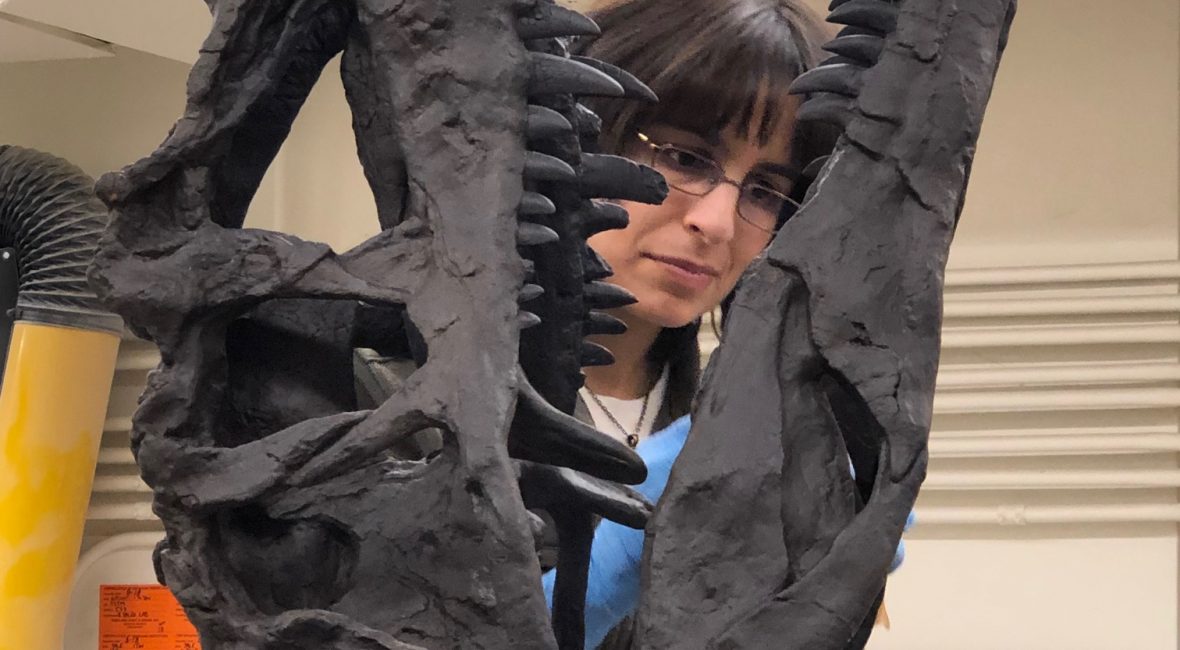
Woman working on a dinosaur skull specimen

This blog post is part of a series from Smithsonian Libraries highlighting Unearthed, a new collection of paleobiology literature in the Biodiversity Heritage Library curated by Smithsonian Libraries in celebration of the opening of the National Museum of Natural History’s David H. Koch Hall of Fossils – Deep Time exhibit. Follow the series throughout 2019 as Smithsonian scientists and librarians discuss the collection, identify their favorite books within it, and explain the importance of paleobiology literature in research today.

My name is Michelle Pinsdorf, and I am a paleontologist and preparator of fossil vertebrates in the Smithsonian National Natural History Museum’s Department of Paleobiology. Preparators’ work can cover a wide variety of duties, from fieldwork to discovering new fossil specimens, freeing those specimens from their surrounding host rock in our laboratories, safely housing specimens for research collections, and helping to build exhibits for specimens going out on display. We call it “grave to cradle” work.

Most of the time you’ll find a fossil preparator leaning over a lab bench with a fine tool in hand, peering through a microscope and exposing the details of a fossil that helps researchers identify and publish about it. But for the past five years, my lab colleagues and I have been working on the renovation of the Natural History Museum’s fossil exhibits. This has involved the dismantling of many previously exhibited fossil mounts to allow for the conservation of the fossils and remounting them in new poses and settings. With the significant scientific value of these fossils, a lot of research and planning happens before each individual specimen is worked on.

Woman working on a dinosaur skull specimen

Michelle Pinsdorf working on the cast model of the Ceratosaurus before it was installed in the David H. Koch Hall of Fossils – Deep Time.

When research is needed in a museum, a research library is essential! A publication of great help to my work is fortunately quickly accessible to me through the Smithsonian Libraries system and the Biodiversity Heritage Library. One of the crown jewels of the Museum’s collections is the nearly complete skeleton of the carnivorous dinosaur Ceratosaurus nasicornis. It is the most complete skeleton of this species found to date, originally named by Othniel Charles Marsh.

When the specimen was mounted for exhibit at the Smithsonian in 1911, it was fully described by curator Charles Whitney Gilmore, and included in the publication Osteology of the carnivorous Dinosauria in the United States National Museum: with special reference to the genera Antrodemus (Allosaurus) and Ceratosaurus, in Bulletin of the United States National Museum, volume 110. Gilmore provided detailed descriptions and illustrations of this unique specimen, figured prior to it being partially embedded in a display plaque for exhibit. Those figures and measurements proved essential to my work to re-prepare the specimen out of the plaster plaque, exposing a side of the fossils no one since Gilmore’s time had been able to see.

Illustration of a dinosaur skull

Plate depicting the skull of Ceratosaurus nasicornis from Osteology of the carnivorous Dinosauria in the United States National museum: with special reference to the genera Antrodemus (Allosaurus) and Ceratosaurus, in Bulletin of the United States National Museum, volume 110 (1920). Contributed in BHL from Smithsonian Libraries.

This fascinating specimen now gets to serve science in multiple ways. With each bone removed and cleaned, the fossils have been once again made available to paleontologists for study. Each bone was molded and cast, so that the casts could be reassembled in a dynamic new pose for public display in the new Deep Time fossil exhibit halls. The digitization of Gilmore’s publication allowed for me to quickly reference it from my workstation, my home computer, even on my phone. And the physical copy is also close at hand in the Natural History Museum itself, for when I need the kind of inspiration that comes with smelling old paper and seeing neat rows of bindings.

I look forward to seeing what new research will come from my work with Ceratosaurus, and the reactions of museum visitors when they get to see the new mount for the first time.

Illustration of a dinosaur skull

Plate depicting the skull of Ceratosaurus nasicornis from Osteology of the carnivorous Dinosauria in the United States National museum: with special reference to the genera Antrodemus (Allosaurus) and Ceratosaurus, in Bulletin of the United States National Museum, volume 110 (1920). Contributed in BHL from Smithsonian Libraries.

November 14, 2019by Joel Richard
Page 1 of 71234»...Last »

Help Support BHL

BHL's existence depends on the financial support of its patrons. Help us keep this free resource alive!

search

About BHL

The Biodiversity Heritage Library (BHL) is the world’s largest open access digital library for biodiversity literature and archives. BHL operates as a worldwide consortium of natural history, botanical, research, and national libraries working together to digitize the natural history literature held in their collections and make it freely available for open access as part of a global “biodiversity community.”

Join Our Mailing List

Sign up to receive the latest news, content highlights, and promotions.

Subscribe Now

Subscribe to Blog via Email

Enter your email address to subscribe to this blog and receive notifications of new posts by email.

Join 319 other subscribers

Subscribe to Blog Via RSS

Subscribe to the blog RSS feed to stay up-to-date on all the latest BHL posts.

Access RSS Feed

Inspiring Discovery through Free Access to Biodiversity Knowledge.

The Biodiversity Heritage Library makes it easier than ever for you to access the information you need to study and explore life on Earth…for free, anytime, anywhere.


64+ Million Pages of
Biodiversity Literature Online.

EXPLORE

Tools and Services
to Transform Research.

EXPLORE

300,000+
Illustrations on Flickr.

EXPLORE

ABOUT | HARMFUL CONTENT | PRIVACY | SITE MAP | TERMS OF USE