Biodiversity Heritage Library - Program news and collection highlights from BHL
  • Home
  • News
  • Featured Books
    • All Featured Books
    • Book of the Month Series
    • BHL at 20
  • User Stories
  • Campaigns
    • Fossil Stories
    • Garden Stories
    • Monsters Are Real
    • Page Frights
    • Her Natural History
    • Earth Optimism 2020
  • Tech Blog
  • Visit BHL
Home
News
Featured Books
    All Featured Books
    Book of the Month Series
    BHL at 20
User Stories
Campaigns
    Fossil Stories
    Garden Stories
    Monsters Are Real
    Page Frights
    Her Natural History
    Earth Optimism 2020
Tech Blog
Visit BHL
  • Home
  • News
  • Featured Books
    • All Featured Books
    • Book of the Month Series
    • BHL at 20
  • User Stories
  • Campaigns
    • Fossil Stories
    • Garden Stories
    • Monsters Are Real
    • Page Frights
    • Her Natural History
    • Earth Optimism 2020
  • Tech Blog
  • Visit BHL
Biodiversity Heritage Library - Program news and collection highlights from BHL
Blog Reel, Featured Books

Notes accompanying collection of useful plants made by W. J. Fisher at [Kodiak] in 1899

In honor of Native American Heritage Month, we would like to highlight a field book that documents Native American knowledge of natural resources. The field book was created by William J. Fisher, who lived in southern Alaska from 1879 until his death in 1903.

Fisher’s notebook documents his final years collecting and looks at the relationship between the Alutiiq (Aleut) and their plants by recording medicinal and food uses for 48 specimens. Only a handful of the specimen entries include the taxonomic names of plants; instead, entries focus on recording the Russian and Sugpiat/Alutiiq names of plants, how the plants were used, and plant distribution. Detail varies, as seen below in entries three and forty-seven.

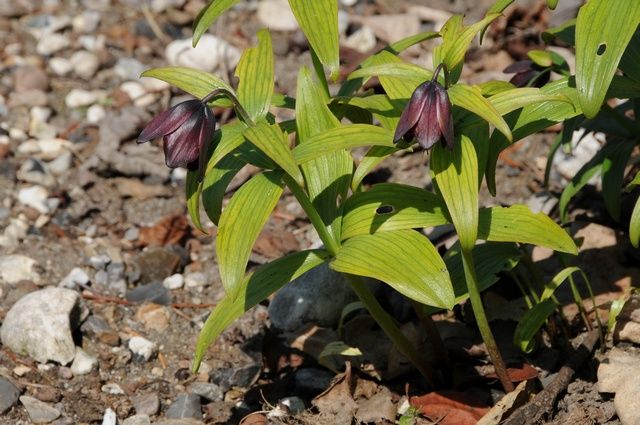
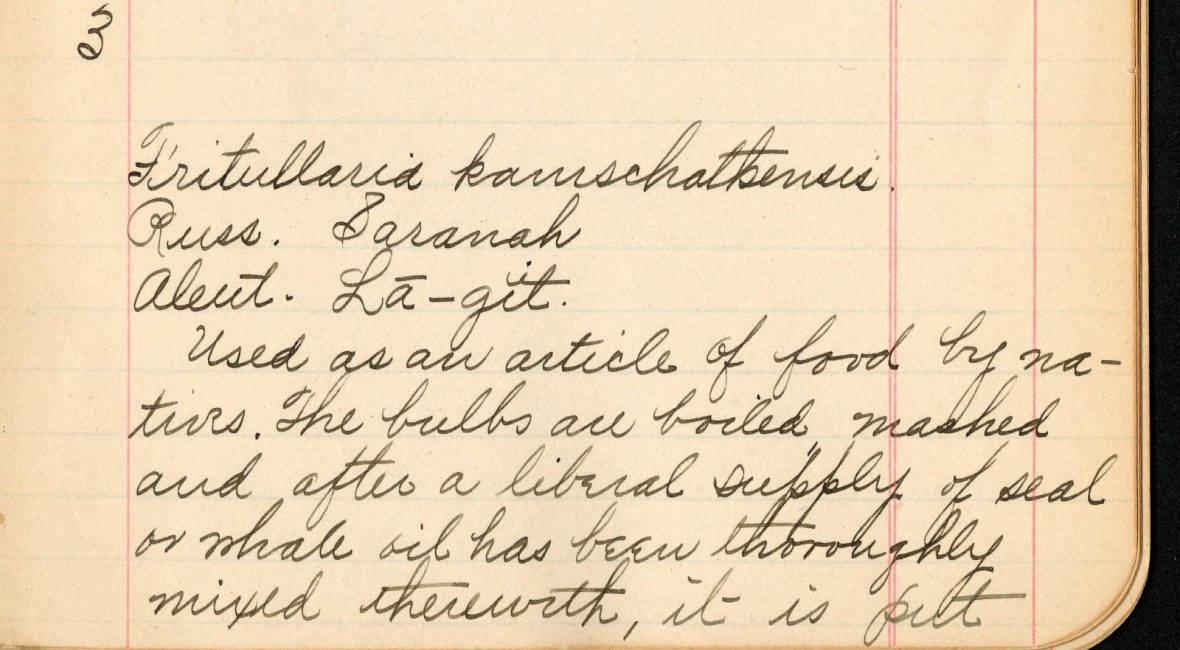
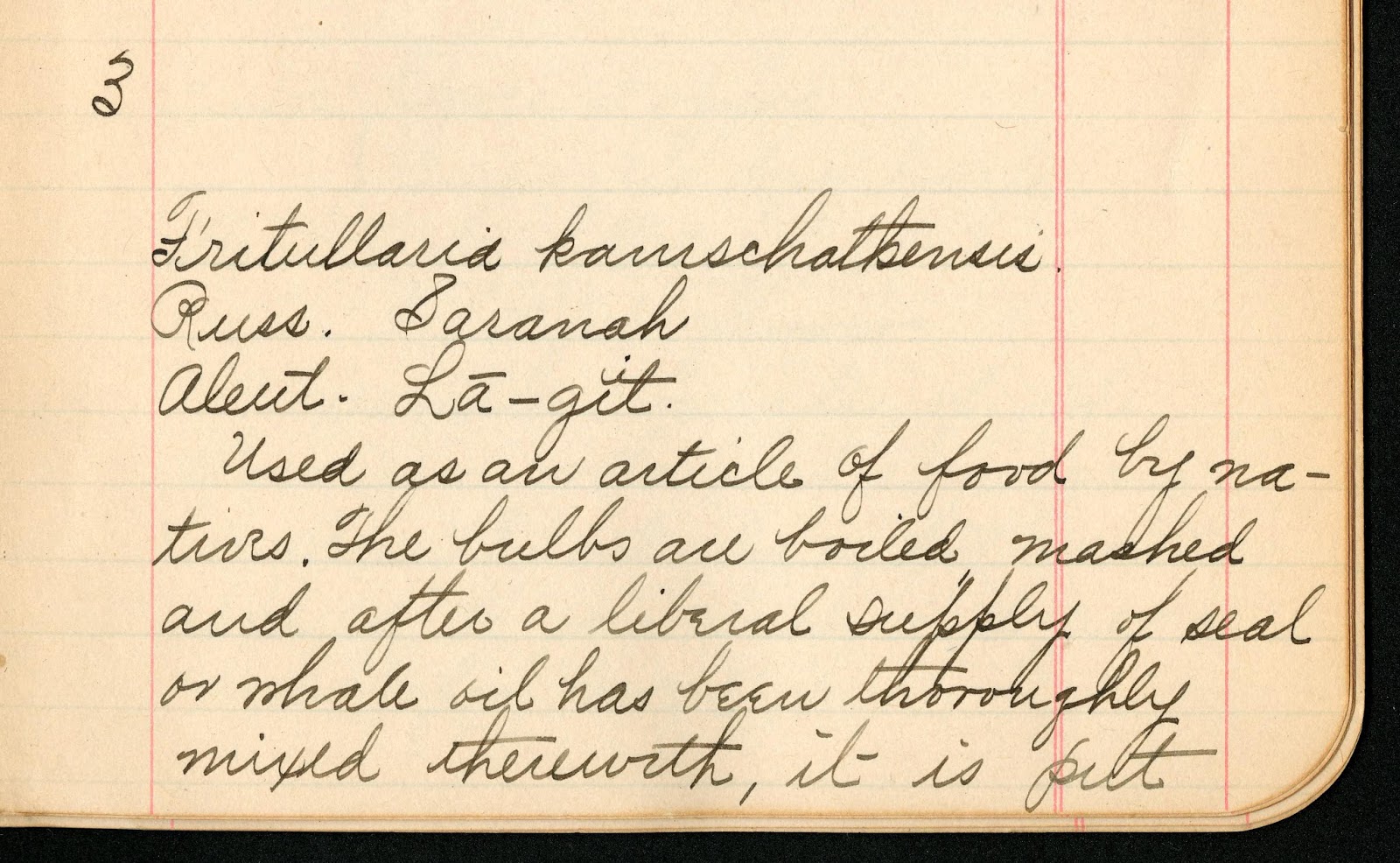
Entry three describes Fritullaria kamschathensis [Fritillaria camschatcensis], also known as the Kamchatka Fritillary, and lists general use and preparation: “Used as an article of food by natives. The bulbs are boiled mashed and after a liberal supply of seal or whale oil has been thoroughly mixed therewith, it is put away for winter’s use.”
View Full Size Image
Specimen entry three from “Notes accompanying collection of useful plants made by W. J. Fisher at [Kodiak] in 1899,” Smithsonian Institution Archives, SIA Acc. 12-038. http://www.biodiversitylibrary.org/page/46428854. Digitized by Smithsonian Institution Archives.
View Full Size Image
Image of Fritillaria camschatcensis from Encyclopedia of Life, provided by Biopix. http://eol.org/data_objects/19162439.

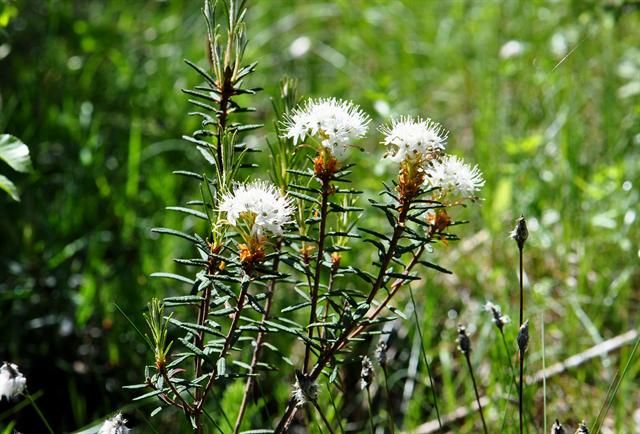
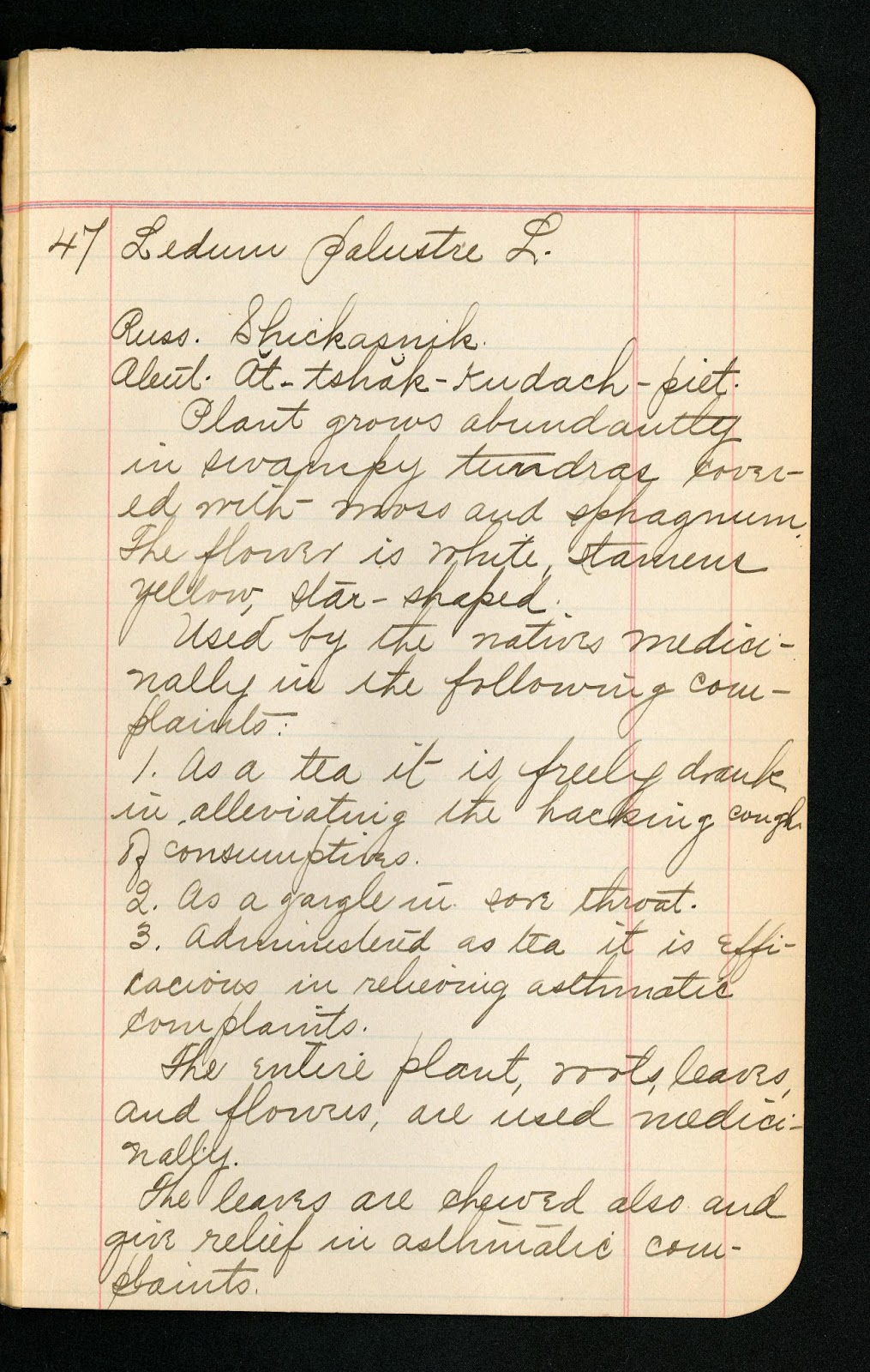
Entry forty-seven for Ledum palustre [Rhododendron tomentosum], also known as Northern Labrador Tea (also pictured below), takes up an entire page describing the plant’s habitat, the appearance of its flowers, and multiple local medicinal applications: “(1) As a tea it is freely drunk in alleviating the hacking cough of consumptives. (2) As a gargle in sore throat. (3) Administered as tea it is efficacious in relieving asthmatic complaints.”
View Full Size Image
Specimen entry forty-seven, from “Notes accompanying collection of useful plants made by W. J. Fisher at [Kodiak] in 1899,” Smithsonian Institution Archives, SIA Acc. 12-038. http://www.biodiversitylibrary.org/page/46428831. Digitized by Smithsonian Institution Archives.
View Full Size Image
Image of Rhododendron tomentosum (Northern Labrador Tea), from Encyclopedia of Life. Image by Biopix. http://eol.org/data_objects/19183248.

Fisher’s ethnographic focus while collecting plants is clear. The field book provides detailed information regarding local names and knowledge, but leaves out basic information often found in botany field books like date and detailed locality information. This lack of information may relate to a note Fisher wrote on the title page: “dried plants with Mr. Kearney, alcoholics in seed collection.” “Mr. Kearney” was Thomas Henry Kearney (1874-1956), a botanist with the Bureau of Plant Industry at the US Department of Agriculture (USDA). Kearney was in Alaska to work with Frederick Coville from April 1898 – August 1899, and along the Northwest Coast from Puget Sound to the Bering Strait in 1899. He then served as a member of the Harriman Alaska Expedition of 1899.

It is unclear how the two men became acquainted. Fisher had a relationship with the Smithsonian Institution; Coville as a USDA employee worked with Smithsonian, and perhaps he introduced the two. Whatever the reason, Kearney’s field notes for his work in Alaska are also available on BHL through the Smithsonian Field Book Project, and they provide a tantalizing overlap in content and geographical coverage.

A field book at the end of a collecting career

Fisher’s field book is also interesting because it document’s his collecting focus and interests as they evolved over a lifetime. Fisher’s initial scientific interest was in marine biology. During the 1870’s he was a curator of conchology at the California Academy of Sciences and served as a marine biologist for the U.S. Fish Commission on several cruises in the Pacific headed by William Healey Dall.

In 1879, Fisher accepted a position as tidal recorder in St. Paul, now known as the city of Kodiak, Alaska. After accepting the position, he wrote to Dall, who was affiliated with the Smithsonian Institution, and offered to collect natural history specimens. The offer was accepted, and Fisher was instructed that the museum was also interested in ethnographic artifacts from the region.

The town of St. Paul where Fisher settled was originally established by the Russians as a center for fur trading. By the time Fisher arrived, it was a town of approximately 500 residents, primarily of Russian and Native Alaskan heritage. According to an article in Arctic Anthropology (no. 1, 1992) the community was still significantly mixed regarding the adoption of European culture in terms of religion, language, and beliefs.

Fisher initially focused on collecting natural history specimens, but as he began to correspond with Smithsonian’s Secretary Spencer Baird, his interest and collecting shifted to ethnography. He even began to commission works by Native Alaskans. Fisher’s main source of income was his position as tidal recorder; Smithsonian was frequently unable to finance his work. This lack of funding apparently did not dim Fisher’s enthusiasm, but it did lead to financial hardship. During an extended collecting trip to Bristol Bay in the summer of 1885, his assistant successfully petitioned for Fisher’s job. Fisher’s collecting came to an end by the 1890’s; the ethnobotany field notes document the end of his work with the Smithsonian Institution.

Interested in learning more? We encourage you to learn about the William J. Fisher collection at the National Museum of Natural History, which was highlighted as part of a book Looking Both Ways: Heritage and Identity of the Alutiiq People, in the online exhibit featuring artifacts created by the Alutiiq people and collected by Fisher during his years in Alaska.

Other resources include:

Aron L. Crowell, 1992, Postcontact Koniag Ceremonialism on Kodiak Island and the Alaska Peninsula: Evidence from the Fisher Collection. Arctic Anthropology 29(1):18-37. Retrieved on November 16, 2016 from https://www.jstor.org/stable/40316240?seq=3#page_scan_tab_contents

Highlights of the William J. Fisher collection at the National Museum of Natural History: http://naturalhistory.si.edu/arctic/features/fisher/collect.html

The field books of William Healey Dall, available on Biodiversity Heritage Library: http://www.biodiversitylibrary.org/search?searchTerm=Dall+%22field+notes%22#/titles

Field Book Project blog post by Sonoe Nakasone: http://nmnh.typepad.com/fieldbooks/2012/02/sharing-culture-through-plants.html
November 22, 2016by ulib-libraryjobs
Blog Reel, Campaigns, Featured Books, Page Frights

Arachnophobes Beware! The Birth of Spider Nomenclature Just in Time for Halloween!

View Full Size Image
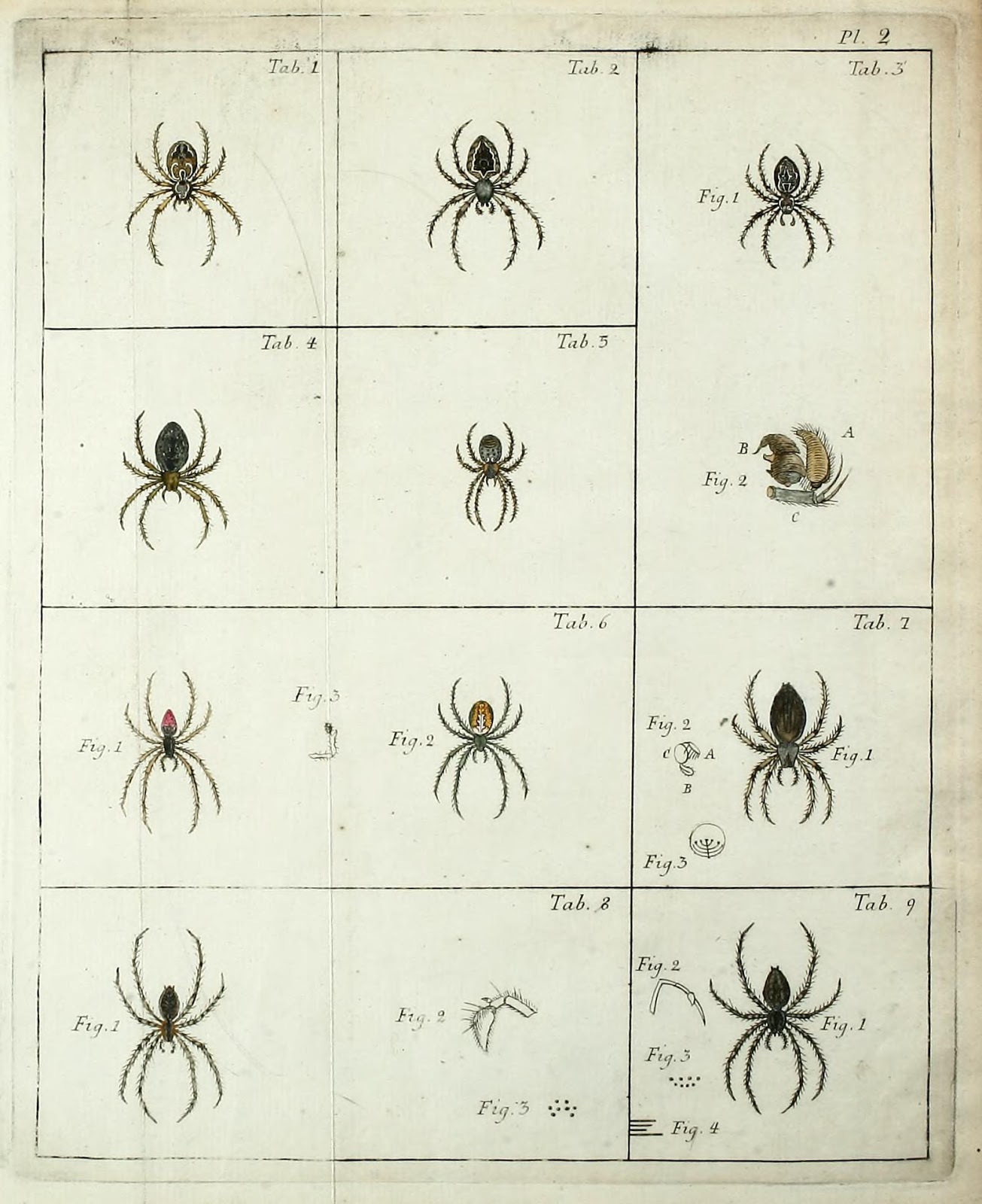
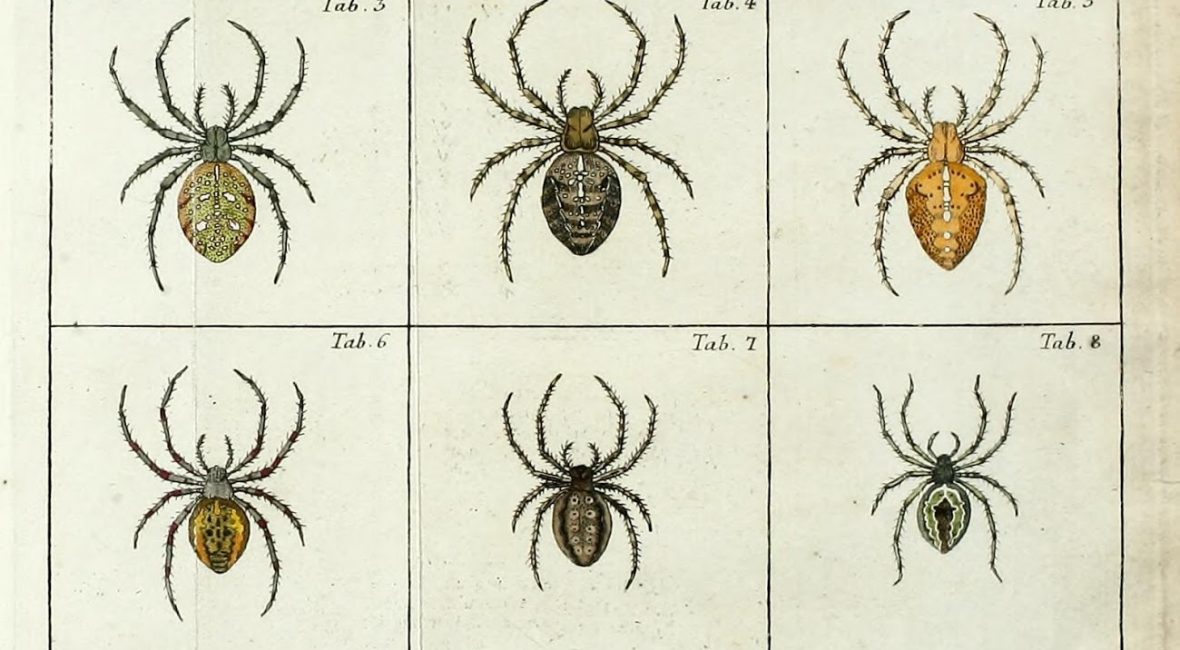
Clerck, Carl. Svenska Spindlar. 1757. Digitized by Smithsonian Libraries. http://www.biodiversitylibrary.org/page/51379398.

Arachnophobia (the fear of spiders and other arachnids) is one of the most prevalent phobias in the world, and some estimates suggest that over 30.5% of people in the United States alone have a fear of arachnids (Health Research Funding 2014).

Given the pervasiveness of this phobia, we thought it only appropriate to spend some time on the subject of spiders as part of our Page Frights celebration. Being the science-focused organization that we are, we decided to look at the topic of arachnids from a taxonomic point of view.

View Full Size Image
Clerck, Carl. Svenska Spindlar. 1757. Digitized by Smithsonian Libraries.  http://www.biodiversitylibrary.org/page/51379410.

The founding text on spider nomenclature is Svenska Spindlar. It was published in 1757 by Carl Clerck, a member of the Swedish nobility. If you’re familiar with the history of taxonomy, you may notice something interesting about the date of this publication. The International Commission on Zoological Nomenclature considers Carl Linnaeus’ Systema Naturae, published in 1758, to be the starting point of zoological nomenclature. How then could a book published in 1757 be considered the starting point of spider nomenclature?

Leslie Overstreet, Curator of Natural History Rare Books at the Smithsonian Libraries (who recently digitized this title for BHL), helped shed some light on the situation.

Clerck became a friend and correspondent of Linnaeus’ after attending Uppsala University, where Linnaeus had received most of his own higher education and served as a professor beginning in 1741. In 1753, Linnaeus applied his binomial system for botanical names within Species Plantarum. When Clerck went to publish his descriptions of the large number of Swedish spiders that he had collected and studied, he did so following Linnaeus’ binomial system. As Linnaeus would not publish his own foundational text on zoological nomenclature until 1758, Clerck’s spiders became the first animals in modern zoology to receive valid scientific names according to the Linnaean system.

View Full Size Image
Clerck, Carl. Svenska Spindlar. 1757. Digitized by Smithsonian Libraries.  http://www.biodiversitylibrary.org/page/51379414.

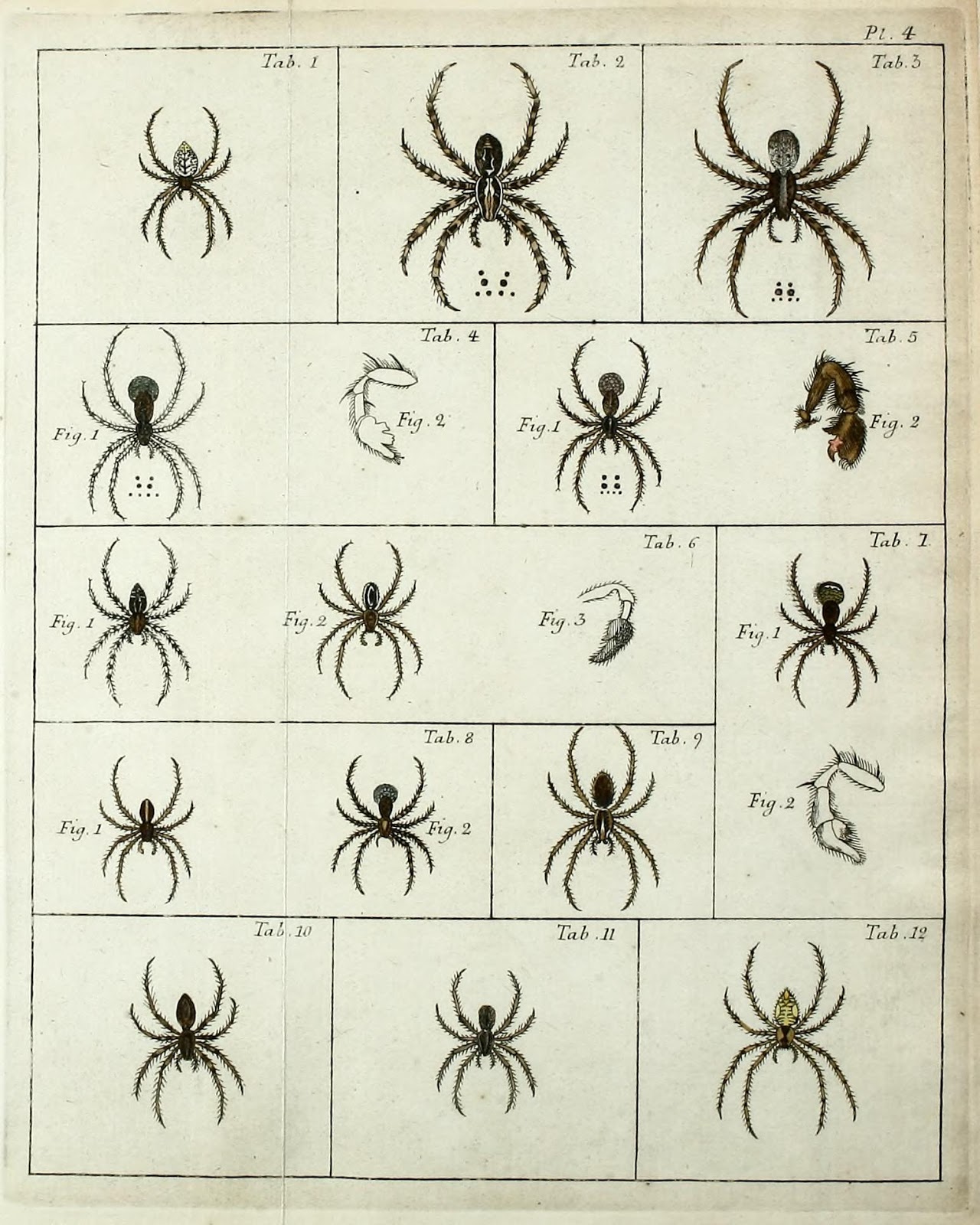
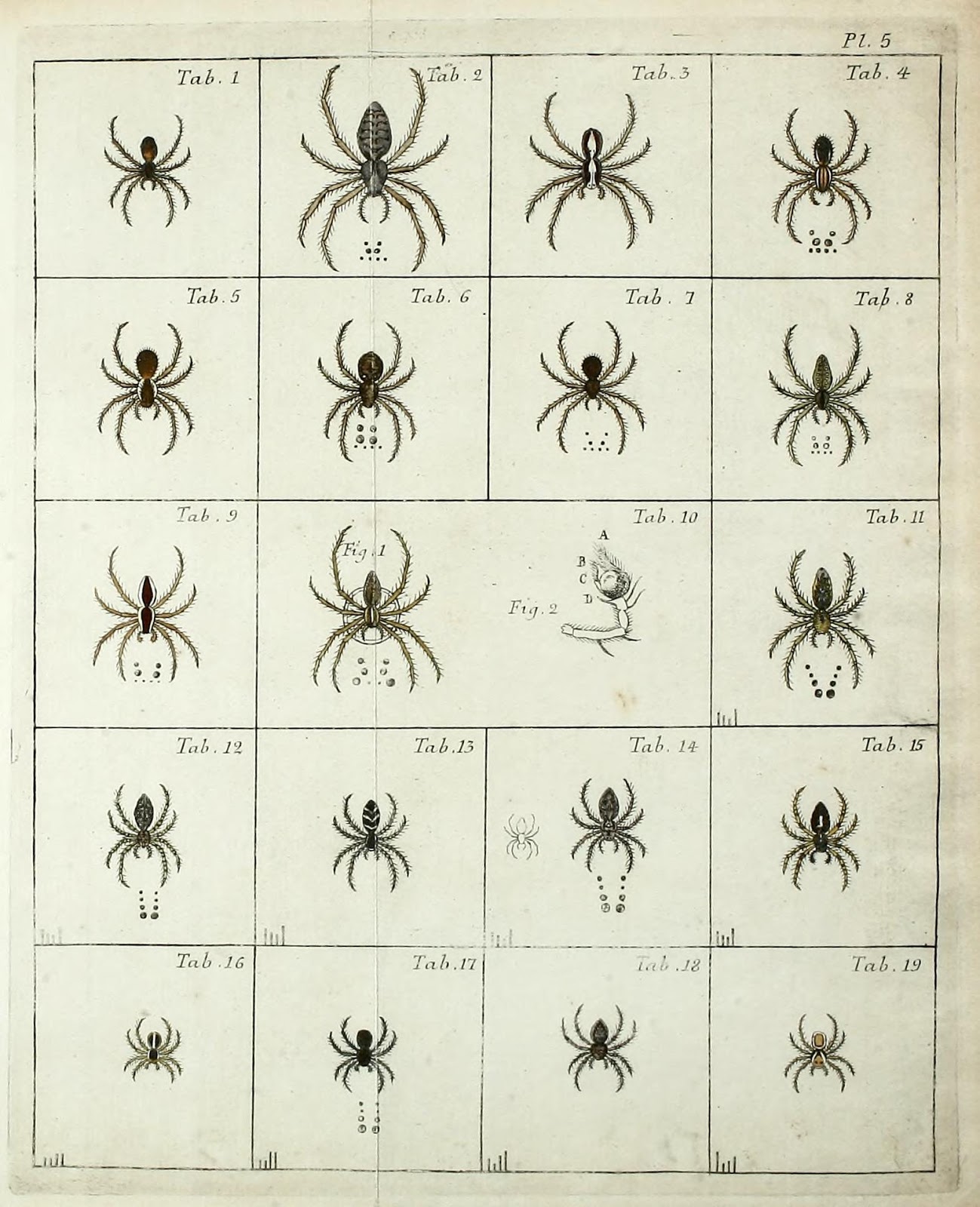
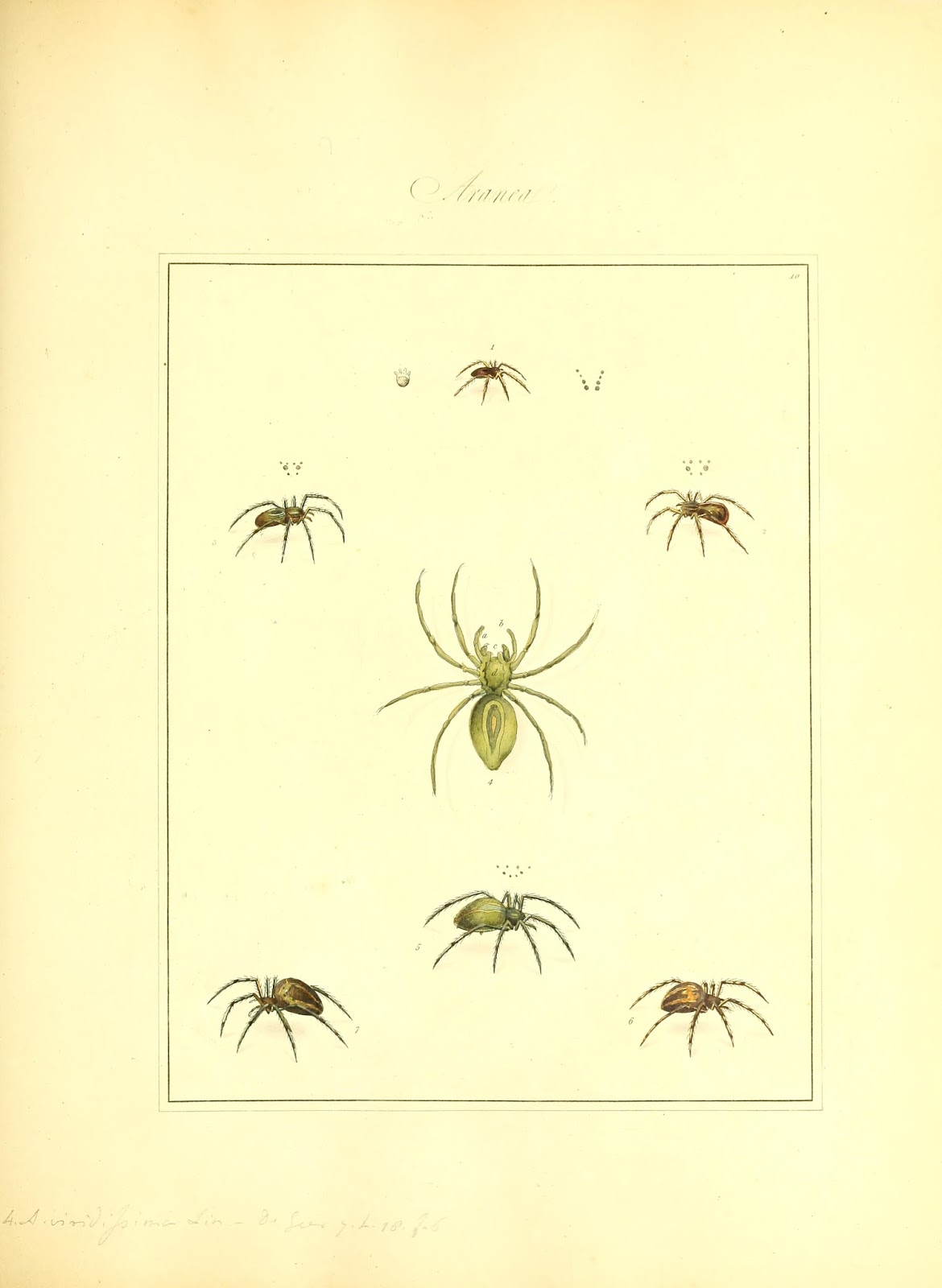
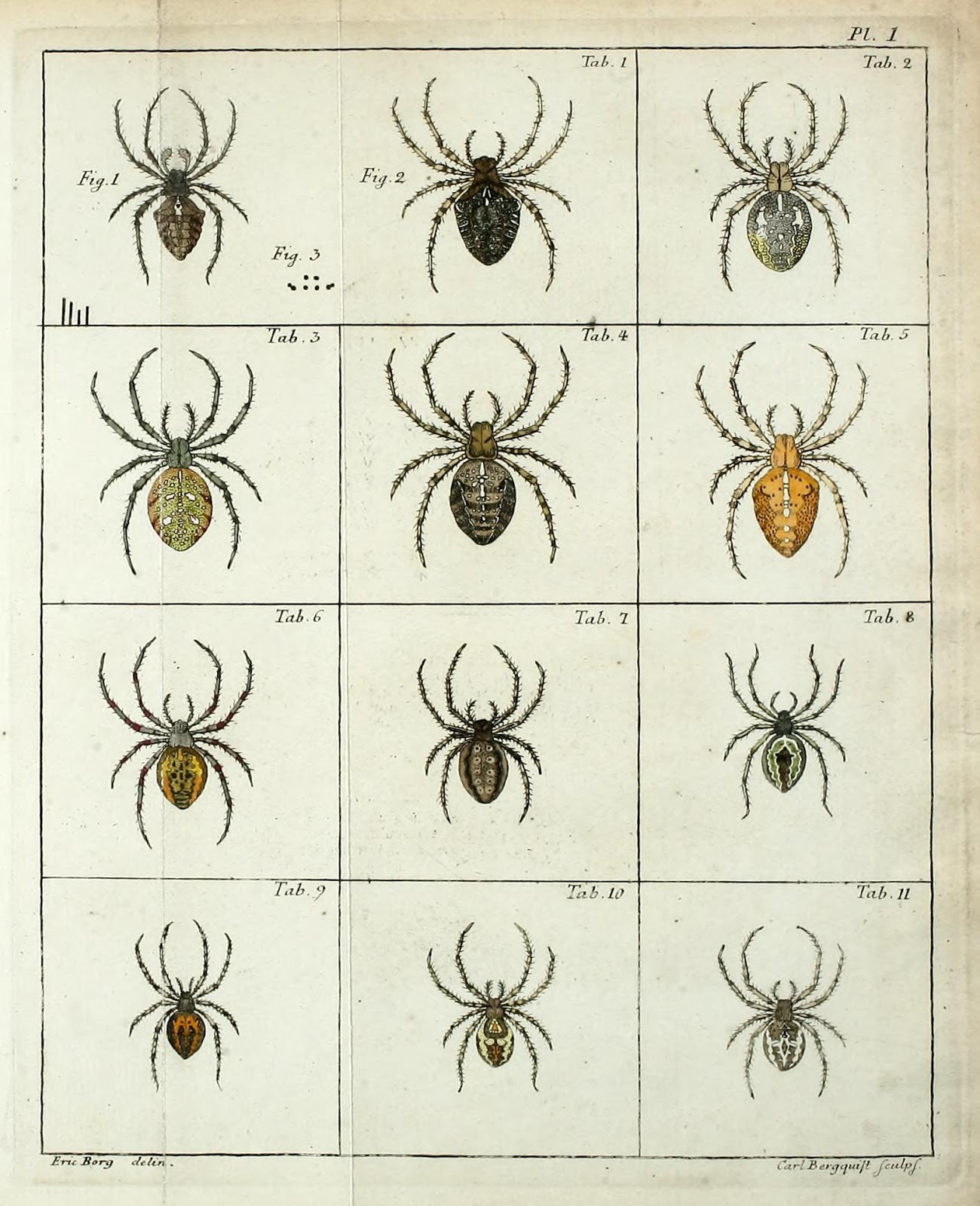
Clerck’s Svenska Spindlar describes and illustrates 70 species and includes 6 hand-colored plates containing 89 figures. Artists for the work include Eric Borg and L. Gottman, and the plates were engraved by Carl Bergquist. The text is printed in both Swedish and Latin, and for each species, Clerck uses the single generic name Araneus followed by a specific, one-word name (constituting the species name).  Clerck then provides detailed information about each species, from the dates that he collected his specimens to descriptions of anatomical features and differences between sexes.

Clerck also restricted his use of the term “spider” to those species possessing eight eyes and separated prosoma and opisthosoma. As such, he, unlike many previous authors, excluded Opiliones (harvestmen) and other arachnids from his treatment of the subject.

View Full Size Image
Clerck, Carl. Svenska Spindlar. 1757. Digitized by Smithsonian Libraries. http://www.biodiversitylibrary.org/page/51379402.

The International Commission for Zoological Nomenclature recognizes Clerck’s names as having precedence over any varieties that may have been proposed by Linnaeus, and as such the names in Svenska Spindlar have the unique distinction of being considered valid despite having been published a year before Linnaeus’ Systema Naturae. For example, while Linnaeus used the generic name Aranea, Clerck’s Araneus is considered the valid generic name.

In 1793, the first English translation of Clerck’s Svenska Spindlar appeared under the title Aranei, or, A natural history of spiders, by Thomas Martyn. Martyn supplemented the text with additional illustrations originally published in Eleazar Albin’s Natural history of spiders (1736).

View Full Size Image
Martyn, Thomas. Aranei, or, A natural history of spiders. 1793. Digitized by Smithsonian Libraries. http://www.biodiversitylibrary.org/page/51378856.

So, as you gear up for Halloween this weekend, take a moment to look through the book that started it all when it comes to spider nomenclature. If you’re one of those 30.5% of U.S. people with arachnophobia, you’re sure to consider it a true Page Frights experience!

Special thanks to Leslie Overstreet, Curator of Natural History Rare Books at Smithsonian Libraries, for providing information about this title for this post.

Reference

Health Research Funding. 2014. “7 Uncommon Arachnophobia Statistics.” September 22. Accessed October 25, 2016. http://healthresearchfunding.org/7-arachnophobia-statistics/.

October 27, 2016by michelle.underhill
BHL News, Blog Reel, Campaigns

Of Dragons and Interns: Meet the Woman Who’s Helping Us Add Dragons and Other Fun Products to the BHL Store!

View Full Size Image
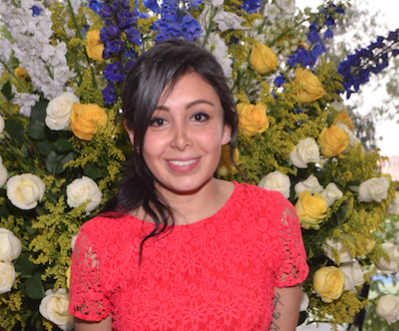
Carolina Murcia. BHL Product Development and Marketing Intern.

BHL is excited to welcome Carolina Murcia, our new Product Development and Marketing Intern!

Over her eight-month internship through the Smithsonian Libraries in Washington, D.C., Carolina will conduct market research and create products and marketing materials for the BHL CafePress store. Coming to us from her home in Colombia, Carolina just finished her bachelor’s degree in industrial design and is excited for this opportunity to build her professional experience and contribute to projects that support the sciences, arts and cultural development.

Carolina has already put her artistic skills to excellent use designing dragon products for the BHL Page Frights CafePress store. Get your own dragon today and help support biodiversity research – 100% of the proceeds will be used to digitize more books for BHL! How does BHL and these digital books help support biodiversity research? Click here to find out!

View Full Size Image
A social media graphic created by Carolina for the BHL Page Frights CafePress store. Shop today!

When she’s not doing design projects, Carolina enjoys long walks, good coffee, home dinners, sci-fi books, spending time with her loved ones, and watching soccer – especially when Colombia’s team is playing! She is especially passionate about architectural photography and looks forward to taking advantage of the wonderful landscapes and buildings in D.C. to pursue this passion.

We’re so excited to welcome Carolina to the BHL team and look forward to seeing our product selection and marketing activities expand thanks to her contributions. Welcome to the family, Carolina!

October 19, 2016by michelle.underhill
Blog Reel, User Stories

Beyond Tunnels & Bigamy: The Scientific Contributions of the Infamous Harrison Dyar

View Full Size Image
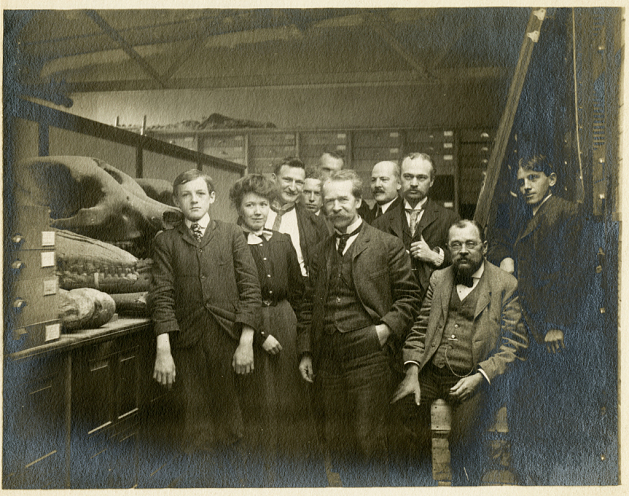
Harrison G. Dyar, Jr., third from right, with Entomology staff of the U.S. National Museum in 1905. Courtesy of Smithsonian Institution Archives.

If you have ever heard of entomologist Harrison Dyar, there’s a good chance that it was in relation to a series of tunnels that he dug beneath Washington, D.C. Or it may have been in relation to his bigamy. But if that’s all you know about Dyar, then you only know the tabloid tales.

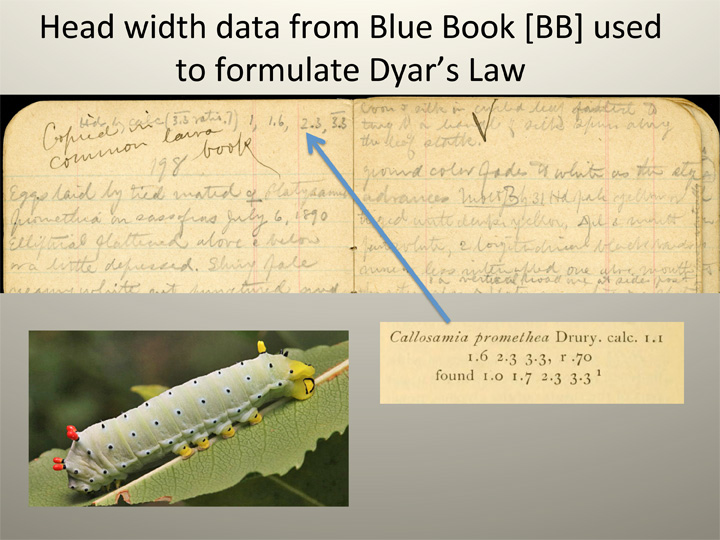
Harrison Dyar was Honorary Custodian of Lepidoptera at the United States National Museum for over 30 years. He studied sawflies, moths, butterflies and mosquitos and described hundreds of species and genera. He also contributed significantly to the study of insect development by formulating Dyar’s Law of Geometric Growth. By observing that the width of caterpillar heads was fixed within each stage of development, Dyar realized that he could use a ratio to predict the width of the head at various stages of development, and that this ratio could in turn be used to differentiate insect instars. By using this law, entomologists can identify the developmental stage of an immature insect.

Dyar’s field notebooks, including his “blue books” and “catalogue” as they’re called, contain valuable information both on Dyar’s scientific research and aspects of his personal life. For instance, they include his scientific observations made while rearing specimens, head width data used to formulate Dyar’s Law, and, on a more personal note, the identity of relatives who helped Dyar collect and rear insects.

View Full Size Image
Image Source: Smithsonian Libraries.

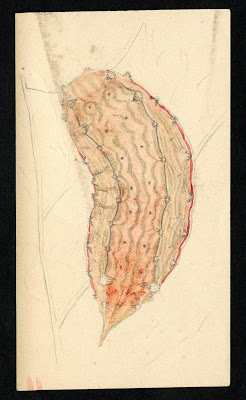
Dyar’s field notebooks, which are held by the Smithsonian Institution Archives, have been digitized as part of The Field Book Project and are available in BHL, making it much easier for researchers around the world to access and study Dyar’s work.

View Full Size Image
Drawing from a Dyar blue book. H. G. Dyar bluebook 575 – 625. 1896-1898. Digitized by Smithsonian Institution Archives. http://biodiversitylibrary.org/page/46194051.

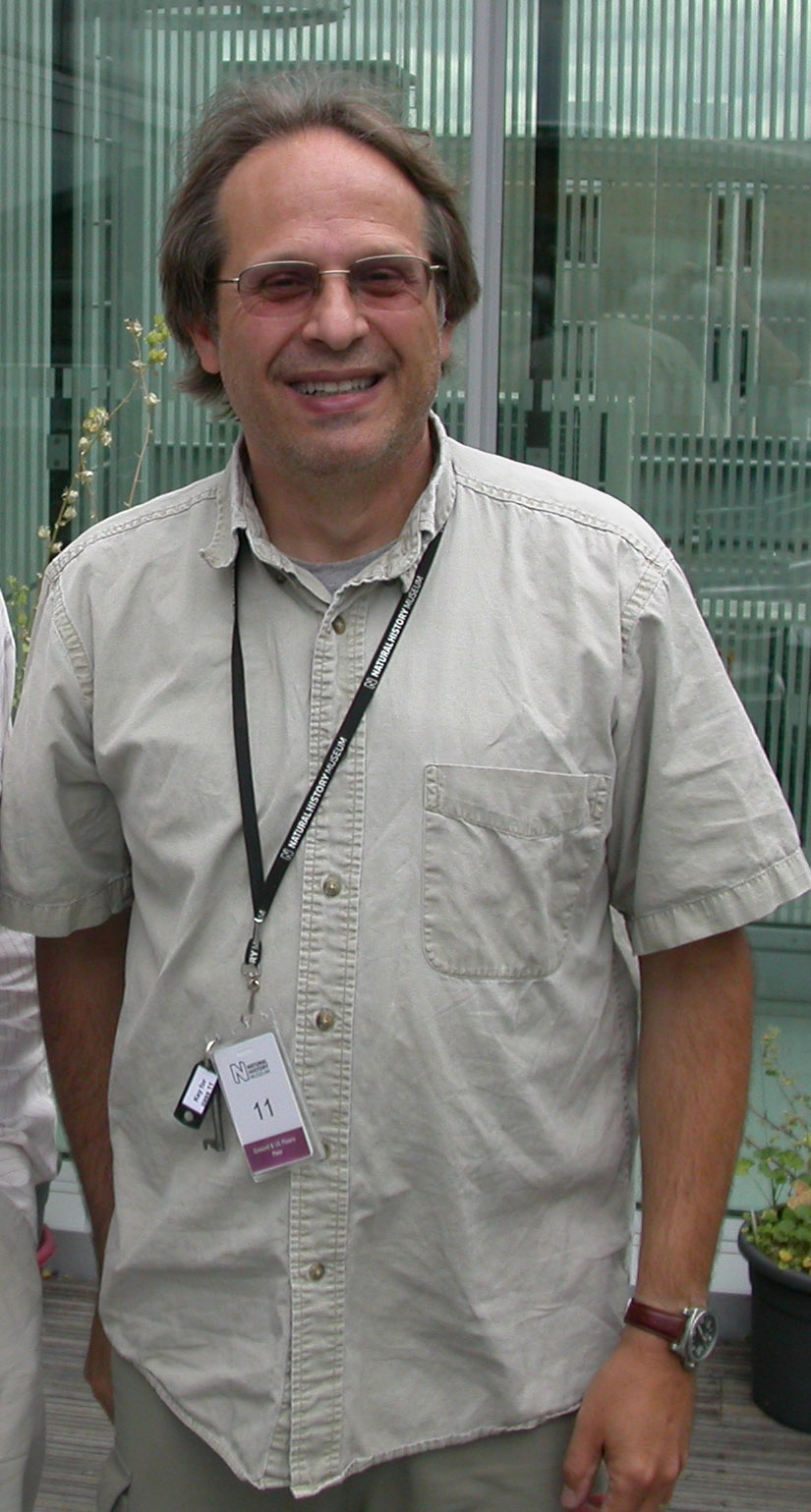
One such researcher that has benefited from online access to this materials is Dr. Marc Epstein, Research Associate at the National Museum of Natural History and Senior Insect Biosystematist (Lepidoptera) at the Plant Pest Diagnostics Center of the California Department of Food and Agriculture. Dr. Epstein has studied Dyar’s work and legacy extensively and has authored a biography on this remarkable entomologist entitled Moths, Myths and Mosquitos:The Eccentric Life of Harrison G. Dyar, Jr.. Marc discovered BHL, thanks to recommendations from his colleagues, around the time that our online library launched. Since then, BHL’s collections have had an immense impact on Marc’s research.

View Full Size Image
Dr. Marc Epstein. Image Source: California Department of Food and Agriculture.

“Even though I’m fortunate to have a good entomology library at the Plant Pest Diagnostics Center in Sacramento, CA, BHL has provided me access to so many journals that I haven’t had easy access to in California since with my move here in 2003,” asserts Marc. “In fact BHL has often provided me with the very copies I used to refer to in the Smithsonian National Museum of Natural History (NMNH) libraries!”

BHL has greatly facilitated Marc’s research on Lepidoptera and more specifically on Harrison Dyar.

“Day to day BHL has helped me do my job to identify Lepidoptera that threaten California agriculture, while providing a tremendous boost to my research projects,” explains Marc. “These have included the completion of Moths, Myths, and Mosquitoes: the Eccentric Life of Harrison G. Dyar, Jr. as well as studies on Costa Rican moths and the evolution of Lepidoptera and their caterpillars.

“Related to the Moths, Myths, and Mosquitoes, it enabled me to much more efficiently transcribe portions of Dyar’s hand-written notebooks, once in my office at NMNH. Prior to the availability of these notebooks on BHL, The Field Book Project at the Smithsonian provided me with electronic files of all of the notebooks, which are now becoming available along with transcriptions made by a corps of volunteers. Having both BHL and the notebooks on my [computer] desktop in Sacramento has enabled me to transcribe portions needed for my research while in Sacramento and saved me valuable time to focus on specimens during my visits to the NMNH entomology collections.”

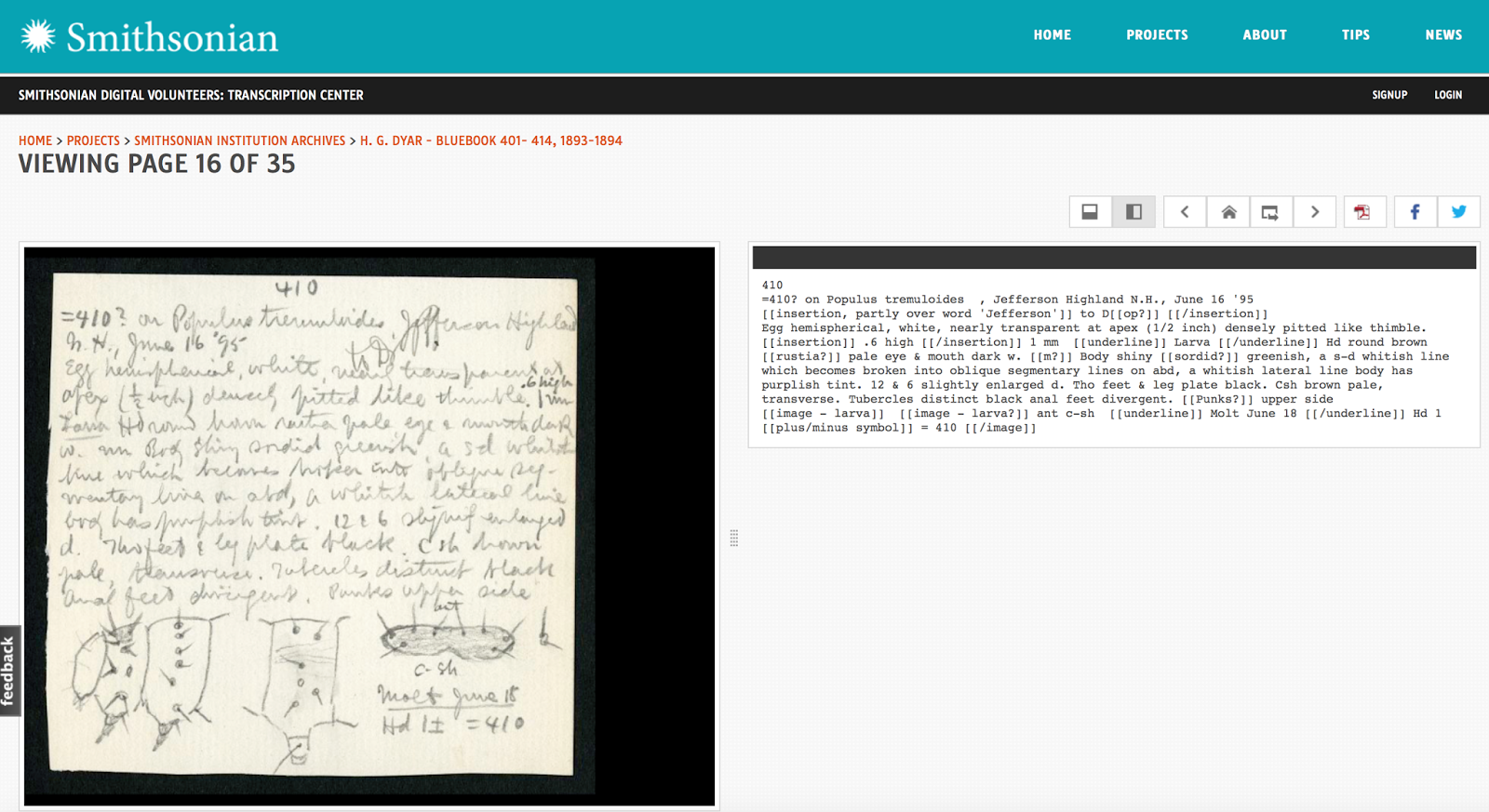
The volunteer transcriptions that Marc refers to were the result of the May 2016 #DigIntoDyar campaign, which challenged volunteers to help transcribe five of Dyar’s blue books within the Smithsonian Transcription Center. The five blue books constituted a total of 169 pages, 60% of which were fully transcribed by over 60 volunteers by the end of May. Today, all 169 pages have been fully transcribed (thank you, citizen science volunteers!). You can browse the transcriptions in the Smithsonian Transcription Center at the links below:

H. G. Dyar – Bluebook 401- 414, 1893-1894 | https://transcription.si.edu/project/8144
H. G. Dyar – Bluebook 415-435, 1893-1894 | https://transcription.si.edu/project/8145
H. G. Dyar – Bluebook 436-450, 1893-1894 | https://transcription.si.edu/project/8146
H. G. Dyar – Bluebook 451-473, 1894 | https://transcription.si.edu/project/8147
H. G. Dyar, Bluebook 474-491, 1894-1897 | https://transcription.si.edu/project/8148

View Full Size Image
A page from H. G. Dyar bluebook 401 – 414 (1893-94), transcribed in the Smithsonian Transcription Center.

Interested in learning more about Harrison Dyar’s work and contributions? Then check out this Google Hangout from Smithsonian Libraries with Dr. Epstein. You can also learn more in this series of blog posts that Dr. Epstein wrote for Smithsonian Libraries as part of #DigIntoDyar.

Harrison Dyar’s contributions to science may often be overshadowed by his intriguing personal life, but hopefully the efforts of Dr. Epstein and others will ensure that his entire legacy is appreciated and remembered. We’re proud to be able to provide free, online access to materials, like the “blue books” and “catalogue,” that make it easier for researchers to study Dyar’s work.

______________________________________

This post may contain the personal opinions of BHL users or affiliated staff and does not necessarily represent the official Biodiversity Heritage Library (BHL) position on these matters.

September 8, 2016by michelle.underhill
Blog Reel, Featured Books

Catesby’s Magnificent Natural History, In Three Editions

View Full Size Image
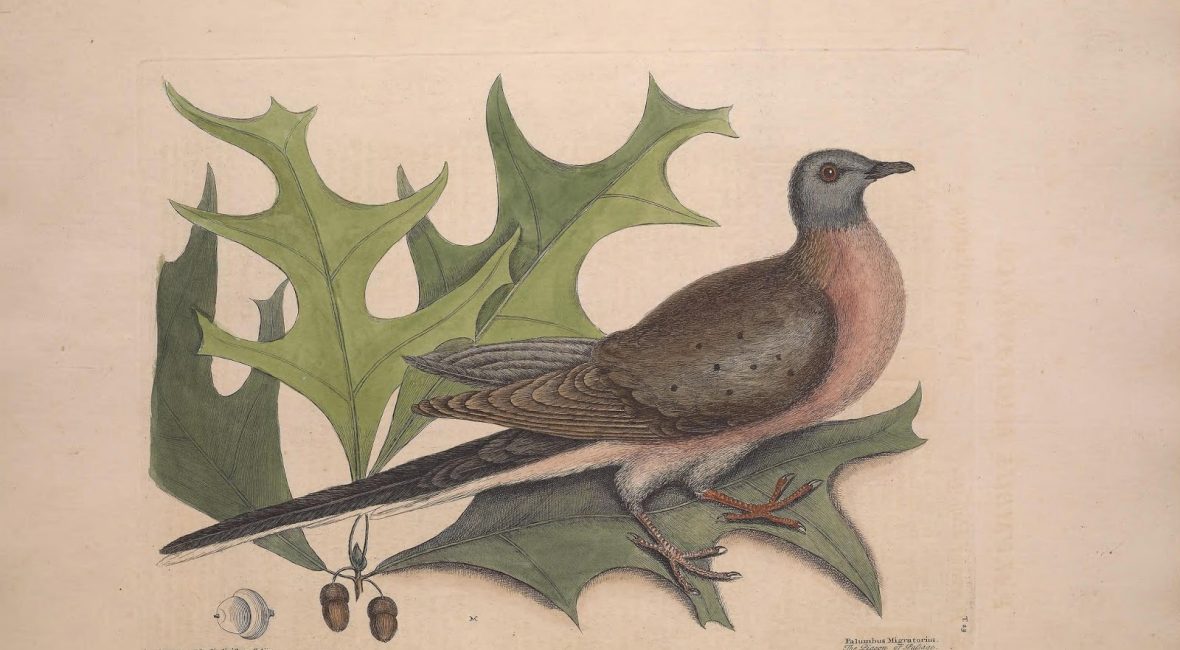
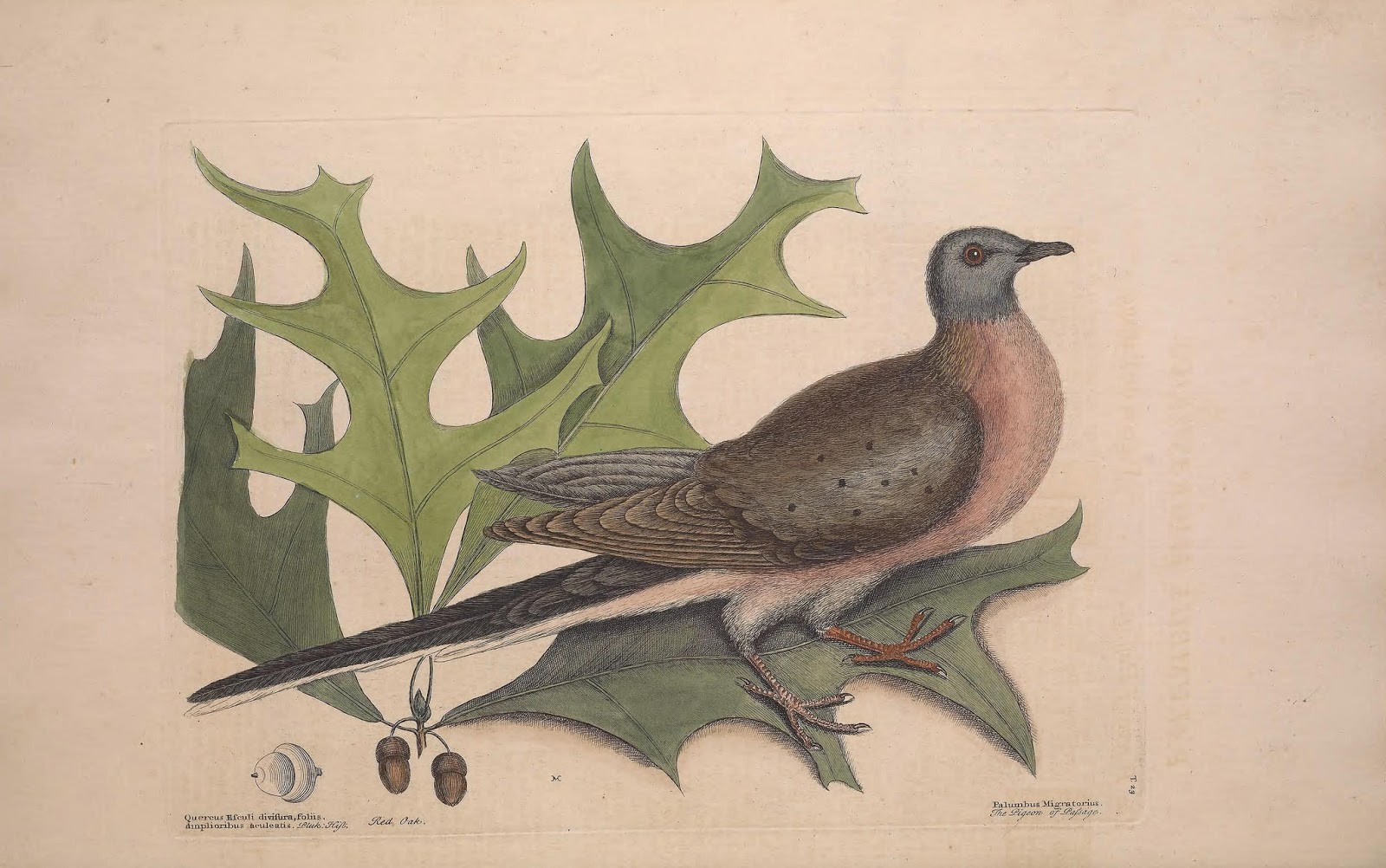
First published illustration of a passenger pigeon (Ectopistes migratorius). Pictured with American turkey oak (Quercus laevis). Catesby, Mark. The Natural History of Carolina, Florida, and the Bahama Islands. v. 1, ed. 1, pl. 23. Digitized by Smithsonian Libraries. http://biodiversitylibrary.org/page/40753186. Taxon tagged in Flickr by Michelle Marshall: https://www.flickr.com/photos/biodivlibrary/26918652441.

In May of 1729, the first part of the first fully illustrated book on the flora and fauna of North America was presented to the Royal Society. Upon the conclusion of the work, Royal Society Secretary Cromwell Mortimer praised it as “the most magnificent Work I know of, since the Art of Printing has been discovered” (Nelson and Elliott, 165).

The work was The Natural History of Carolina, Florida, and the Bahama Islands, and all told it was issued in eleven parts (including an appendix) over an eighteen year period (from 1729-1747). It included 220 plates and accompanying pages of text, a map and account of North America, two indices, a preface, a dedication, and a list of subscribers.

The author of the work was Mark Catesby.

An expansive account of Catesby’s life and work is captured in The Curious Mister Catesby, edited by E. Charles Nelson and David J. Elliott, which received the 2016 CBHL (The Council on Botanical and Horticultural Libraries) Annual Literature Award for Overall Significant Contribution to the Literature of Botany or Horticulture. This work allows us to appreciate the extent of Catesby’s contribution to the study of North American biodiversity.

Mark Catesby was born on 24 March 1682/83 in England (probably in Castle Hedingham, Essex), the (probably) fifth son of John Catesby, a gentleman who became mayor of Sudbury in 1673. When John died in 1703, Mark received a substantial inheritance that included property in Sudbury and London, providing him with a level of security that would allow him to pursue his interest in natural history (Nelson and Elliott, 3-4, hereafter referred to as “N&E;”).

View Full Size Image
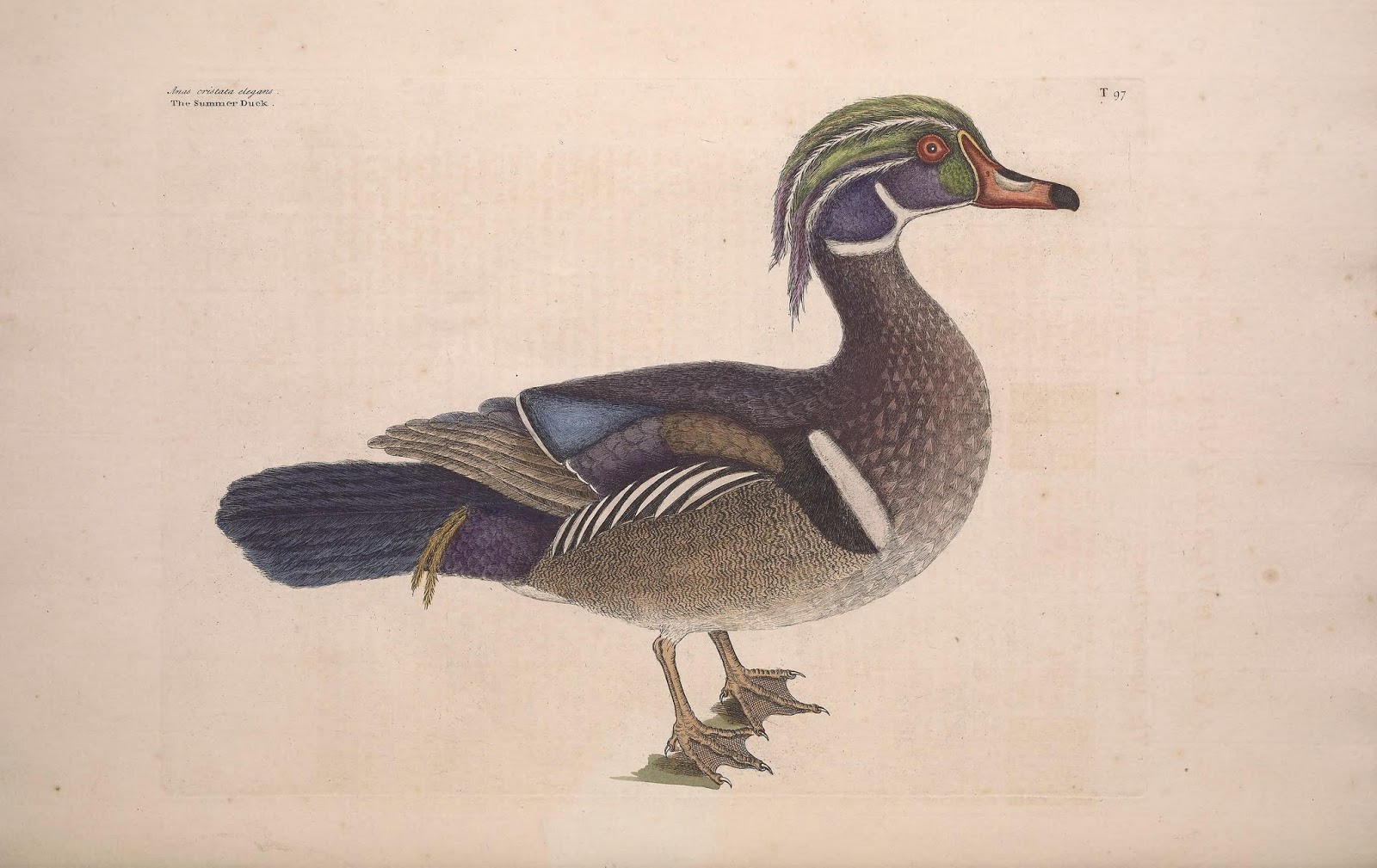
Wood duck (Aix sponsa). Catesby, Mark. The Natural History of Carolina, Florida, and the Bahama Islands. v. 1, ed. 1. pl. 97. Digitized by Smithsonian Libraries. http://biodiversitylibrary.org/page/40753408. Taxon tagged in Flickr by Michelle Marshall: https://www.flickr.com/photos/biodivlibrary/26987327575.

Catesby first set foot in North America in 1712. Serving as chaperone for his sister Elizabeth, whose husband Dr. William Cocke had arrived in Virginia some two years earlier, Catesby was hosted principally by prominent Virginian citizen William Byrd II during this first visit. Shortly after his arrival, Catesby began collecting plants, specimens of which he sent across the Atlantic to Samuel Dale and Dr. Henry Compton (Bishop of London). During these first several years in America, Catesby also visited Jamaica, Bermuda, Hispaniola, and Puerto Rico (N&E;, 8).

Catesby returned to England in 1719, possibly in response to his brother’s death two years earlier (N&E;, 9). He was, however, determined to return to North America and continue his study of the land’s rich flora and fauna. In 1722, he got his wish. This time, his trip was sponsored by members of the Royal Society, who hoped that he would collect specimens from and generally enhance natural history knowledge about this New World. From 1722-early 1725, Catesby explored and collected in South Carolina. The following year, from 1725-26, Catesby ventured to the Bahamas to continue his research (N&E;, 12-13).

View Full Size Image
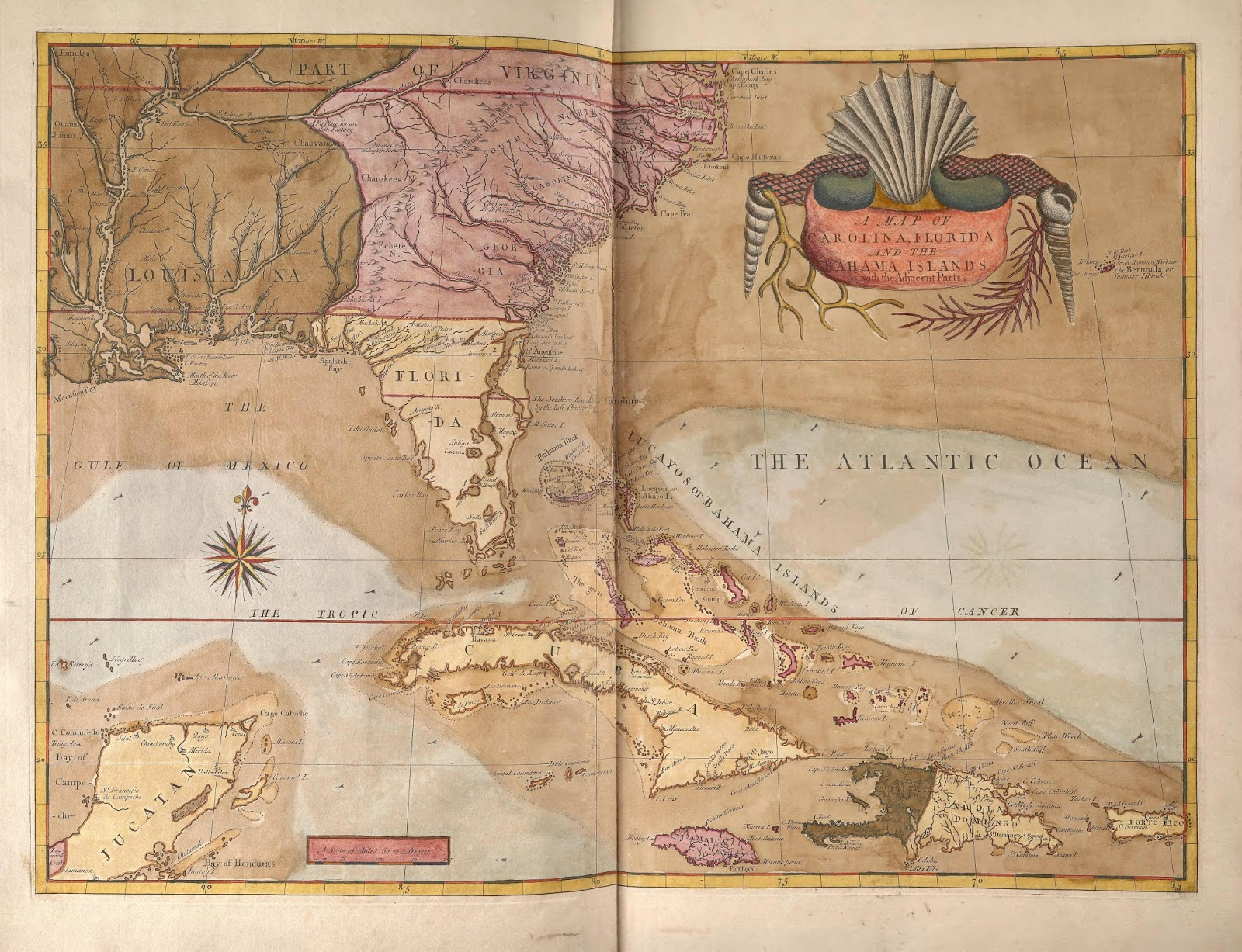
Catesby’s map of Carolina, Florida and the Bahama Islands with the Adjacent Parts.  Catesby, Mark. The Natural History of Carolina, Florida, and the Bahama Islands. v. 1, ed. 1. Digitized by Smithsonian Libraries. http://biodiversitylibrary.org/page/40753095.

During his time in America, Catesby not only collected specimens, many of which he sent back to England, but he also produced sketches and watercolors of the species he encountered. According to Henrietta McBurney, who wrote a chapter for The Curious Mister Catesby on Mark’s preparatory drawings for Natural History, the challenges of transporting the necessary art equipment into the field probably meant that Catesby made field drawings in pen and ink while traveling through the country and then worked up folio-sized watercolors, which would later be translated to etched plates for his publication, back at his lodgings (N&E;, 143). At all times, Catesby placed great emphasis on portraying each species in as life-like a manner as possible, working from live animals when possible and obtaining fresh supplies of specimens, like fish, whose color and appearance change rapidly after death (N&E;, 145).

View Full Size Image
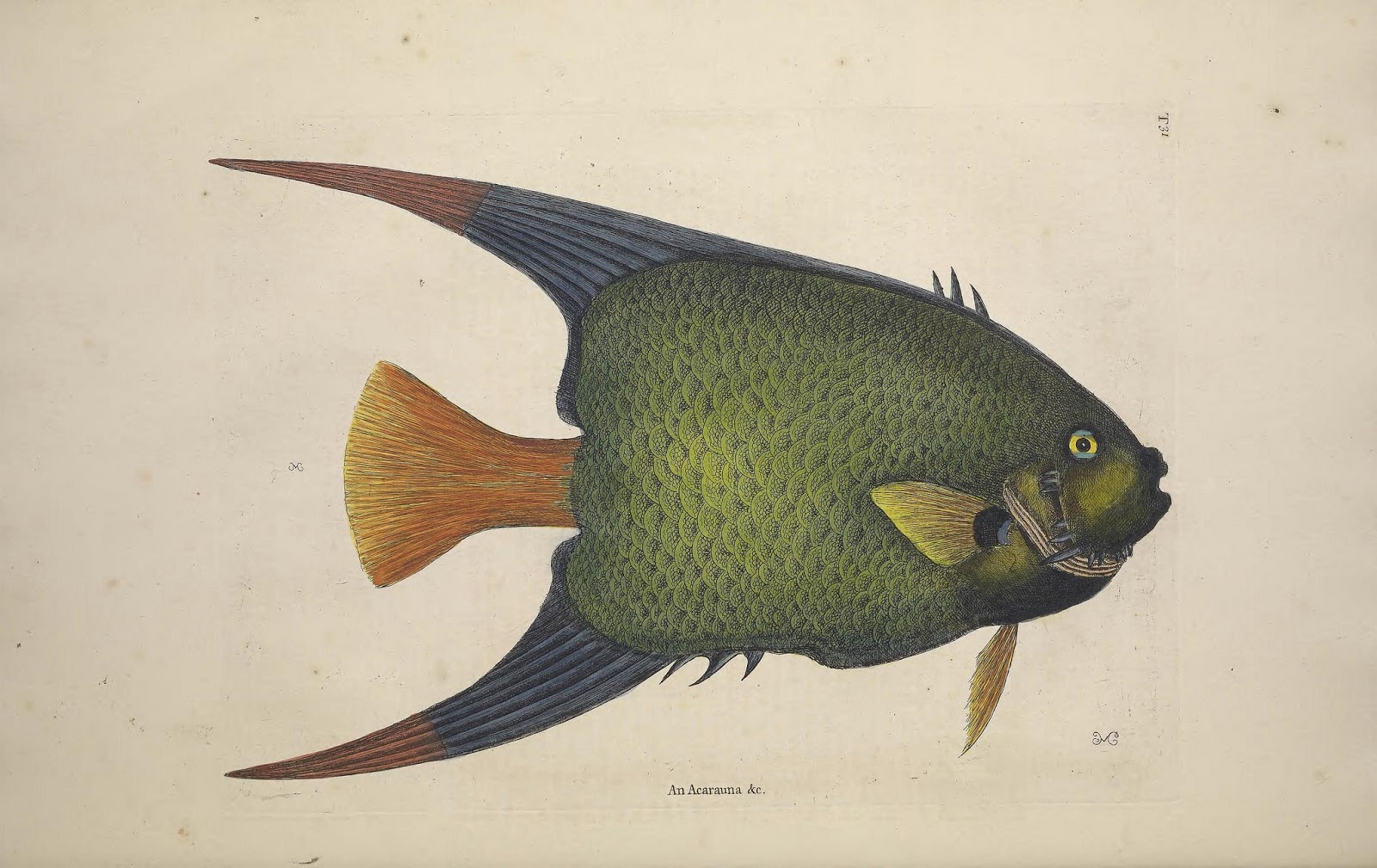
Queen angelfish (Holacanthus ciliaris). Catesby, Mark. The Natural History of Carolina, Florida, and the Bahama Islands. v. 2, ed. 1, pl. 31. Digitized by Smithsonian Libraries. http://biodiversitylibrary.org/page/40680191. Taxon tagged in Flickr by Michelle Marshall: https://www.flickr.com/photos/biodivlibrary/26364199924.

In 1726, Catesby left the Bahamas and returned to England with the intention of publishing his accounts and illustrations in “a large folio on a grand, almost unprecedented scale” (N&E;, 155). Leslie K. Overstreet, Curator of Natural History Rare Books at the Smithsonian Libraries, provides an extensive examination of Catesby’s publication within the twelfth chapter of The Curious Mister Catesby.

According to Ms. Overstreet, Catesby opted to print the work at his own expense. Fortunately, his friend Peter Collinson, a Quaker merchant and Fellow of the Royal Society, agreed to lend Catesby funds to support the publication. These funds were not sufficient to cover the cost of expert engravers, so Catesby hired professional artist Joseph Goupy to teach him how to etch so that Catesby could work up the plates for his publication himself (N&E;, 155).

View Full Size Image
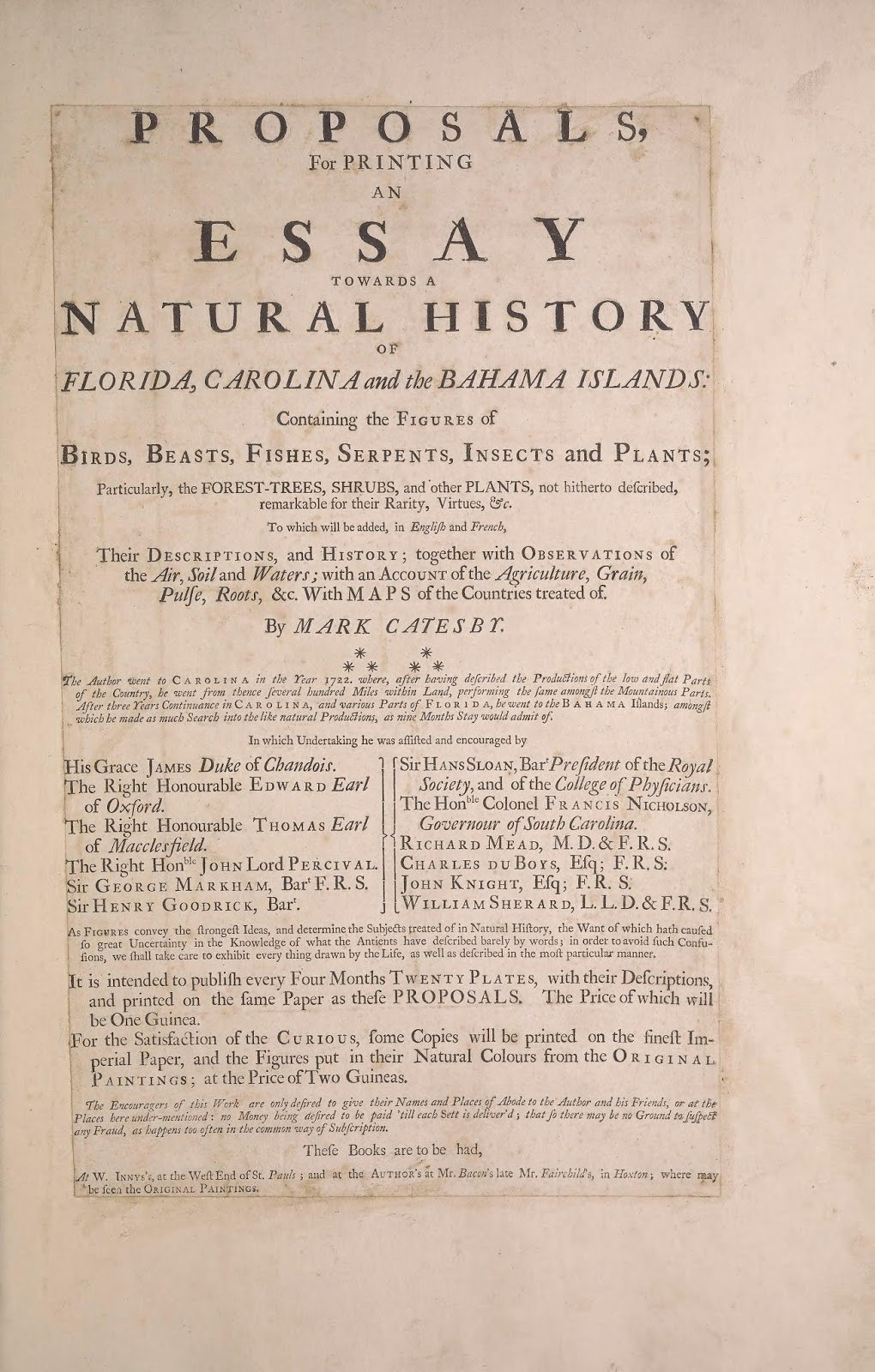
Proposal or prospectus soliciting subscribers for Natural History. Dating from late 1729. Catesby, Mark. The natural history of Carolina, Florida and the Bahama Islands. v. 1, ed. 1. Digitized by Smithsonian Libraries. http://biodiversitylibrary.org/page/40753109.

In order to ensure that enough copies of the work would be sold to justify the cost of its production, Catesby solicited subscribers for Natural History. He distributed a prospectus instructing people who wished to obtain a copy of the work to sign up as subscribers (N&E;, 156). The prospectus indicated that he intended to publish the book in parts of 20 plates and accompanying text issued every four months. Subscribers could elect to receive colored plates for two guineas a part or uncolored plates for one guinea per part (N&E;, 159). The prospectus also directed potential subscribers to view his original artwork, which would be featured in the publication, at Thomas Fairchild’s nursery in Hoxton (N&E;, 147).

All told, Catesby’s final version of the “List of the Encouragers” (a list of the work’s subscribers, which, as was customary at this time, are listed within the publication) includes 155 names (N&E;, 159).

Assured that the book would sell, Catesby set about producing the publication, which included not only etching the copper plates and writing the text, but also hand-coloring (maybe not all) the prints as well (N&E;, 158).  Catesby also enlisted a friend, who requested to remain unnamed, to translate the text into French. The final publication included a column of English text alongside a column of French text (N&E;, 13).

View Full Size Image
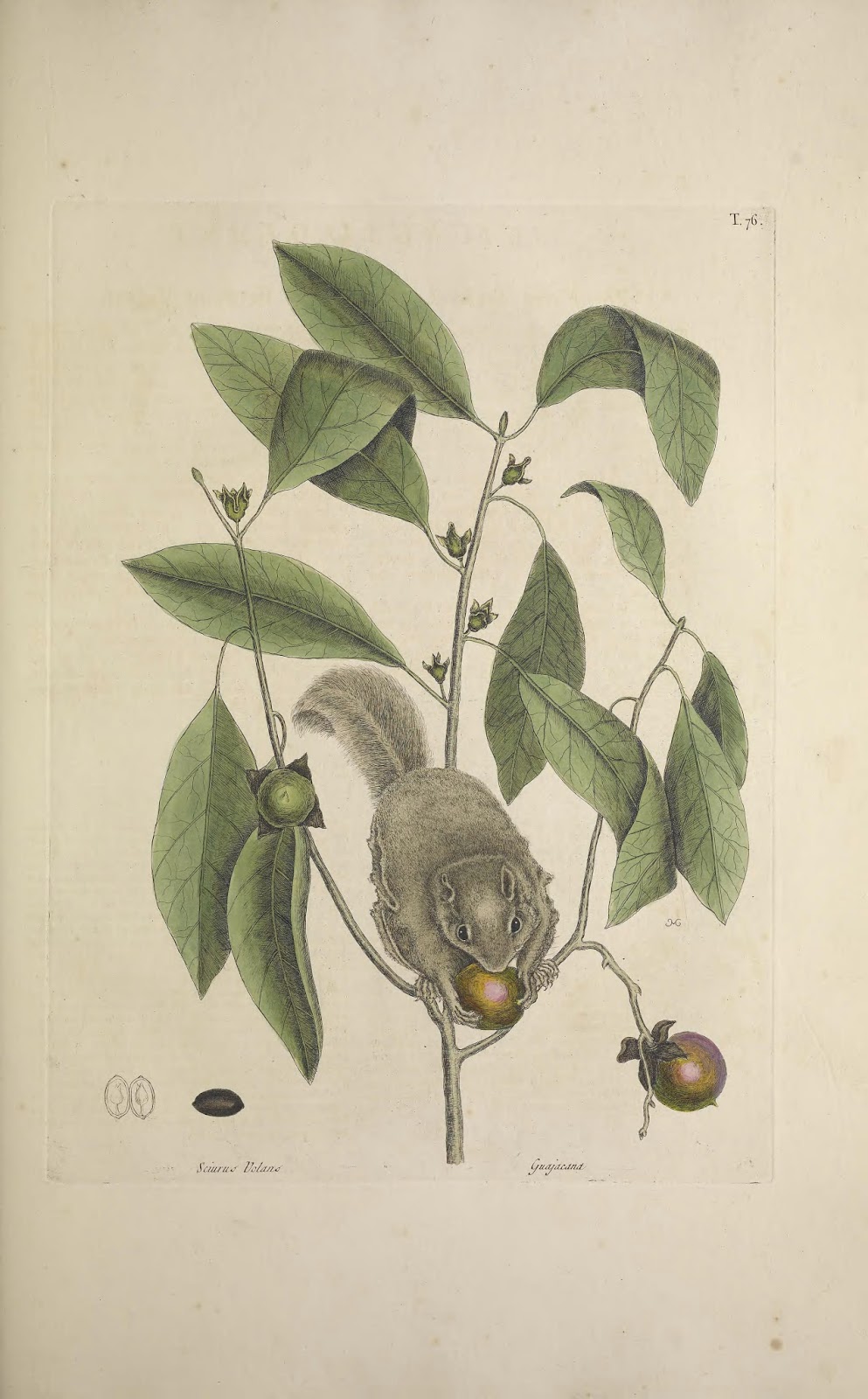
Southern flying squirrel (Glaucomys volans) and American persimmon (Diospyros virginiana). Catesby’s squirrel borrowed from drawing by Everhard Kick. Catesby, Mark. The Natural History of Carolina, Florida, and the Bahama Islands. v. 2, ed. 1. pl. 76. Digitized by Smithsonian Libraries. http://biodiversitylibrary.org/page/40680326. Taxon tagged in Flickr by Michelle Marshall: https://www.flickr.com/photos/biodivlibrary/26696533570.

For the plates, Catesby used his own watercolors and also borrowed and included illustrations from other artists. For example, Catesby’s depiction of the southern flying squirrel in plate 76 was borrowed from Dutch artist Everhard Kick (N&E;, 150-151). Artists Georg Dionysius Ehret and George Edwards also contributed drawings to the work (N&E;, 152-153).

View Full Size Image
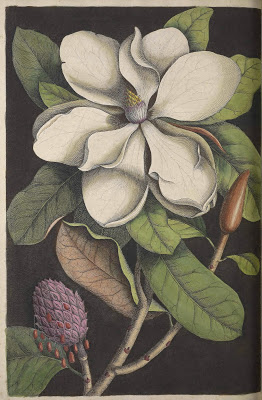
Southern magnolia (Magnolia grandiflora). Illustration etched for Catesby by Georg Dionysius Ehret after Ehret’s own watercolor painting. Catesby, Mark. The Natural History of Carolina, Florida, and the Bahama Islands. v. 2, ed. 1. pl. 61. Digitized by Smithsonian Libraries. http://biodiversitylibrary.org/page/40680281. Taxon tagged in Flickr by Michelle Marshall: https://www.flickr.com/photos/biodivlibrary/26901263141

Due to the amount of work required for the publication, Catesby was not able to adhere to his one part every four months plan. However, he continued to steadily produce new parts, which were sent to his subscribers. The first four parts of the work were issued in numerous typesettings, as Catesby was apparently cautious about ordering too many copies of each part (many subscribers signed up over the life of the publication, so Catesby was not working with a fixed number of “Encouragers”), which in turn required him to order additional copies of the early parts as new subscribers signed on. By the fifth part, however, we see only one typesetting, indicating that Catesby was confident enough in his sales that he ordered sufficient quantities to meet demand (N&E;, 160-163).

In 1743, the last part of volume 2 was presented to the Royal Society. Four years later, in 1747, the appendix, consisting of an additional twenty plates and text, was presented, bringing the first edition to completion (N&E;, 158). Approximately 180-200 copies were produced, only about 100 of which survive. There are only a few known perfect copies of this first edition, and of these, only the Smithsonian Libraries’ copy (which is freely available in BHL) contains “all three pieces of ephemera relating to the production of the work” (N&E;, 165).

View Full Size Image
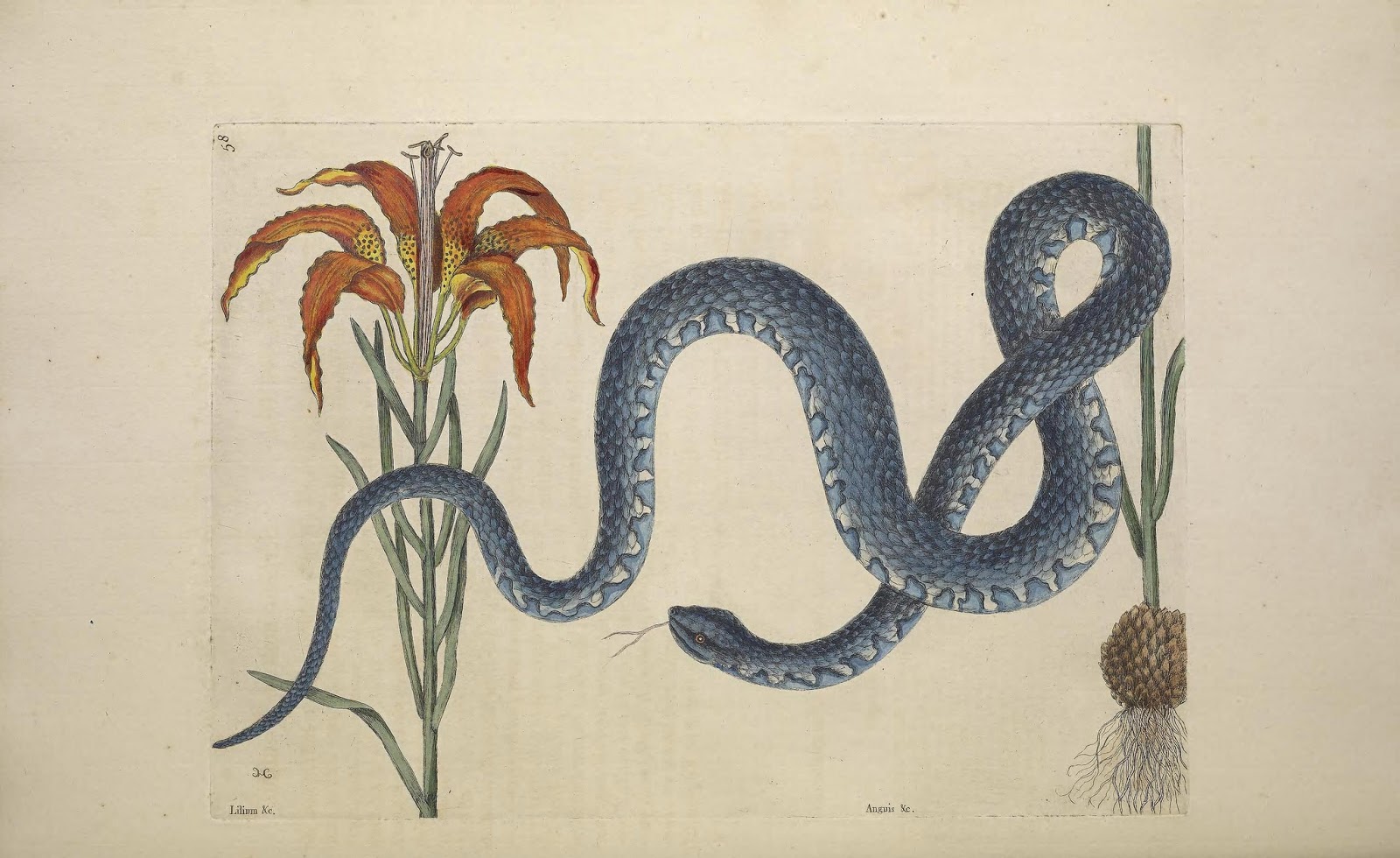
Eastern mudsnake (Farancia abacura) and pine lily (Lilium catesbaei). Catesby, Mark. The Natural History of Carolina, Florida, and the Bahama Islands. v. 2, ed. 1. pl. 58. Digitized by Smithsonian Libraries. http://biodiversitylibrary.org/page/40680272. Taxon tagged in Flickr by Michelle Marshall: https://www.flickr.com/photos/biodivlibrary/26875557812.

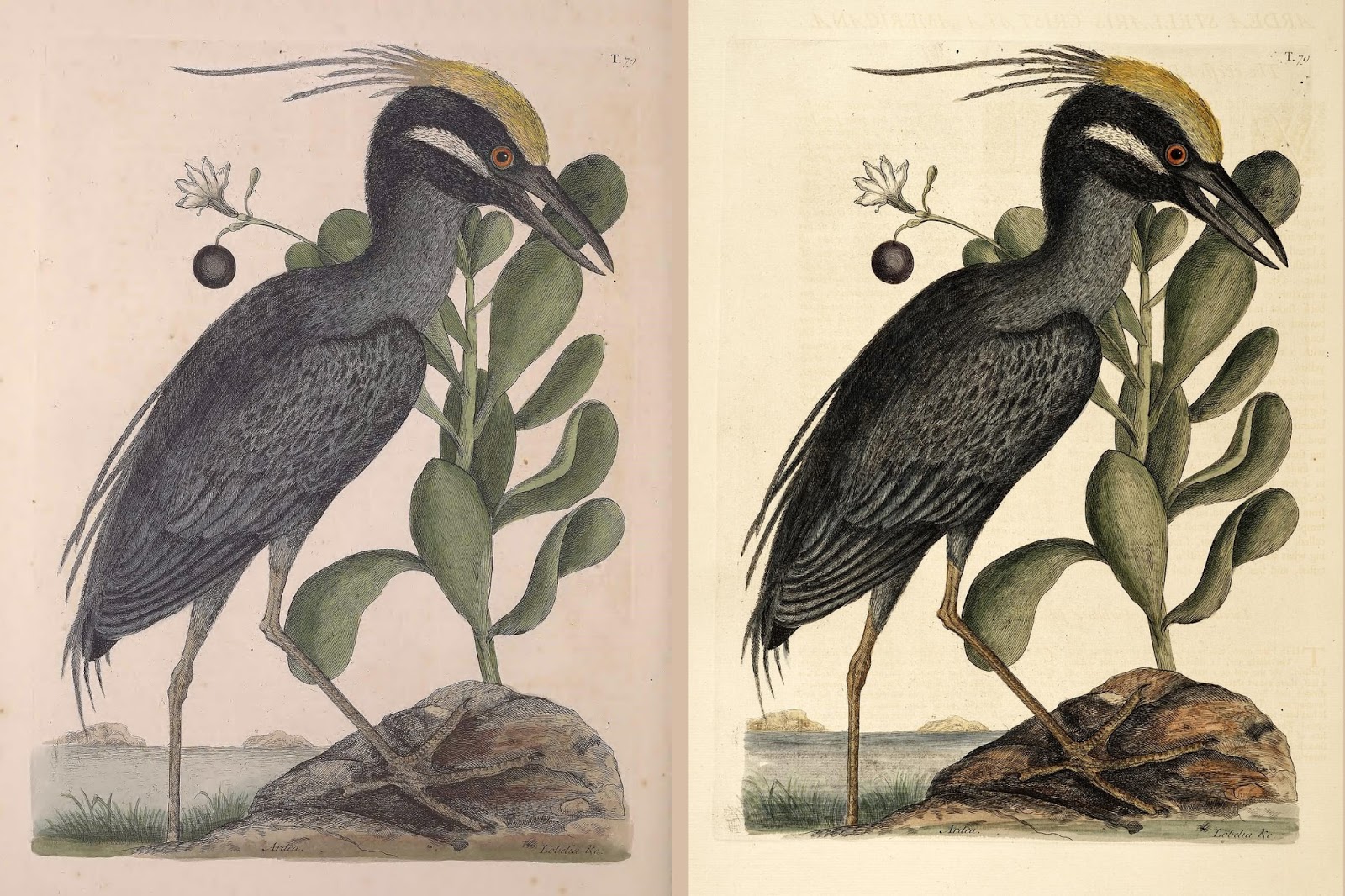
A second edition of Natural History was produced by George Edwards in 1754, five years after Catesby’s death in 1749. This edition is identical to the first, and many copies even include leftover printed sheets from the first edition. The plates for the 2nd edition were produced using Catesby’s original copper plates, but the coloring tends to be brighter than those completed by Catesby himself (N&E;, 166-168). The 2nd edition is freely available in BHL thanks to the Missouri Botanical Garden.

View Full Size Image
Yellow-crowned night heron (Nyctanassa violacea) and gullfeed (Scaevola plumieri). Comparing plate from edition 1 (left) with plate from edition 2 (right). Left: v. 1, ed. 1, pl. 79. Digitized by Smithsonian Libraries. http://biodiversitylibrary.org/page/40753354. Taxon tagged in Flickr by Michelle Marshall: https://www.flickr.com/photos/biodivlibrary/26713640390. Right: v. 1, ed. 2, pl. 79. Digitized by Missouri Botanical Garden. http://biodiversitylibrary.org/page/10900266. Taxon tagged in Flickr by Michelle Marshall: https://www.flickr.com/photos/biodivlibrary/7874637134.

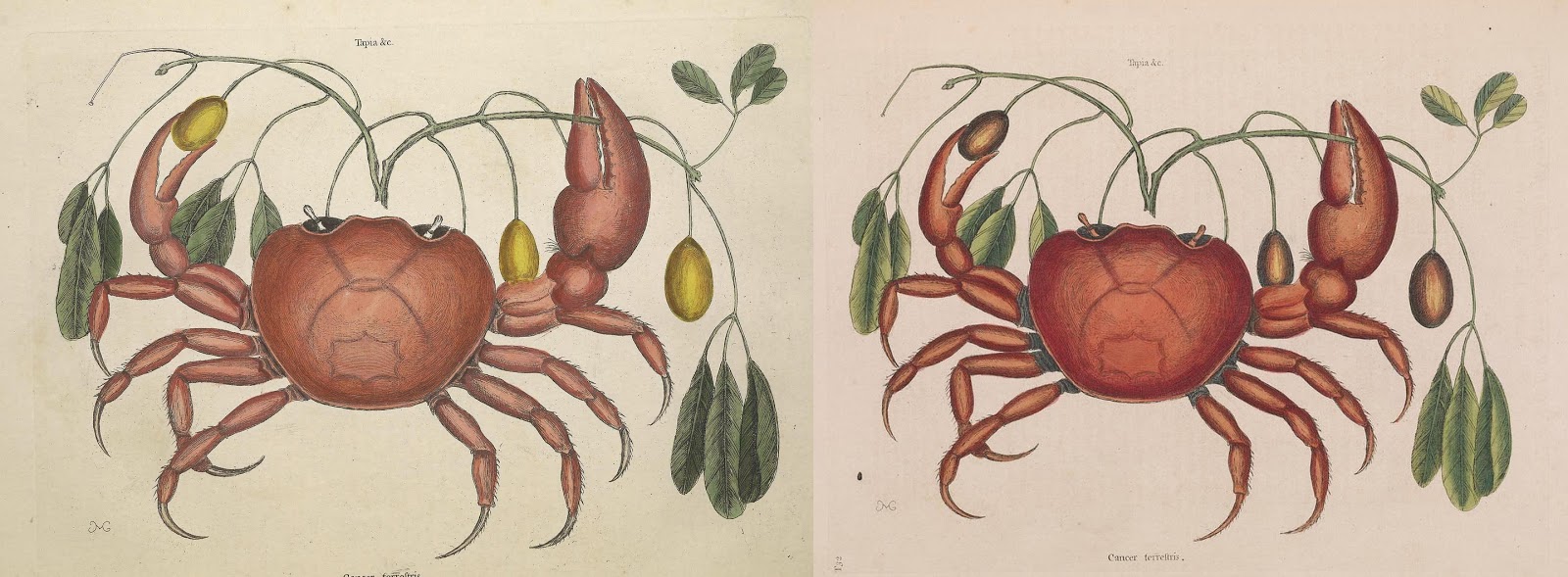
A 3rd edition was published in 1771 by bookseller Benjamin White. This edition is made up of completely reset text and the Linnaean binomials have been added where available. While the edition did use Catesby’s original copper plates, the plates from the 3rd edition are significantly more brightly colored than those of the first edition (N&E;, 168-169). The 3rd edition is freely available in BHL thanks to the University Library at the University of North Carolina, Chapel Hill.

View Full Size Image
Purple land crab (Gecarcinus ruricola) and blackwood (Picrodendron baccatum). Comparing plate from edition 1 (left) with plate from edition 3 (right). Left: v. 2, ed. 1, pl. 32. Digitized by Smithsonian Libraries. http://biodiversitylibrary.org/page/40680194. Taxon tagged in Flickr by Michelle Marshall: https://www.flickr.com/photos/biodivlibrary/26936128596. Right: v. 2, ed. 3, pl. 32. Digitized by University Library, University of North Carolina at Chapel Hill. http://biodiversitylibrary.org/page/38993454. Taxon tagged in Flickr by Michelle Marshall: https://www.flickr.com/photos/biodivlibrary/6829772164.


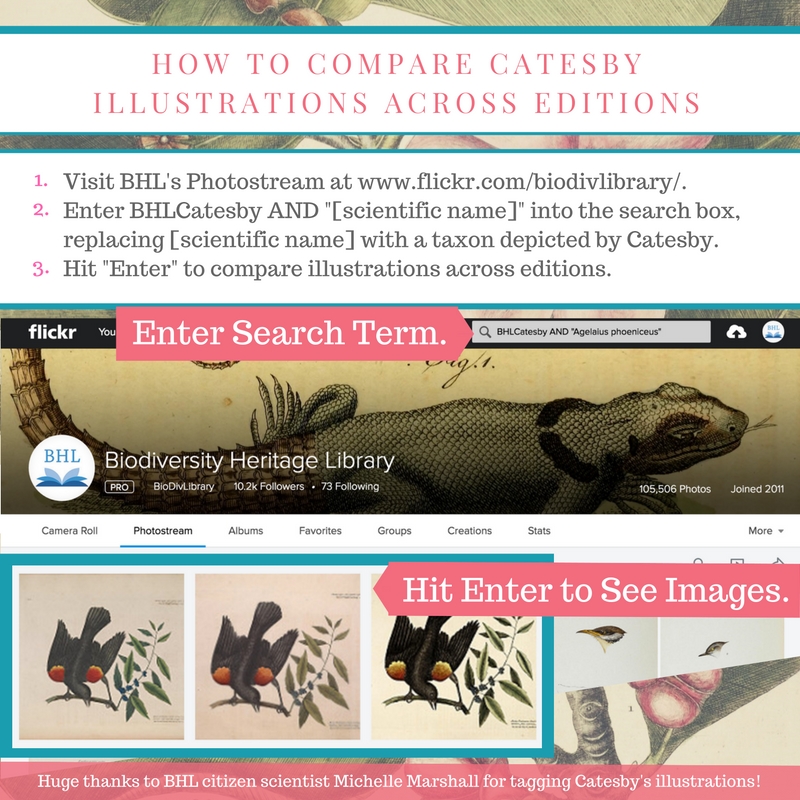
All of the plates from all three editions are available in the BHL Flickr. Thanks to BHL citizen scientist Michelle Marshall (also the curator of BHL’s Instagram), all plates from all editions have been tagged with the common, given and currently accepted scientific names for each species. The Curious Mister Catesby, which includes a species list by James L. Reveal in the book’s appendix (N&E;, 331-341), was used to verify the current accepted name for each species. This not only allows you to search Catesby’s illustrations by taxonomic name, but it also allows us to compare the differences in the illustrations across editions. To compare illustrations across editions, search BHL’s Flickr photostream by BHLCatesby AND “[scientific name]”, inserting the scientific name of a species depicted by Catesby in the brackets where indicated.

View Full Size Image

Catesby’s work, and particularly his illustrations, are significant for a variety of reasons. As the first fully illustrated book on the flora and fauna of North America, this book was the first introduction for many Europeans to much of the biodiversity of the New World. Beyond this, Catesby’s work was a significant resource for Carl Linnaeus, whose binomial system for naming plants (which he introduced in print with his Species Plantarum in 1753) and animals (applied in his Systema Naturae, 1758) is still used today (N&E;, 189).

View Full Size Image
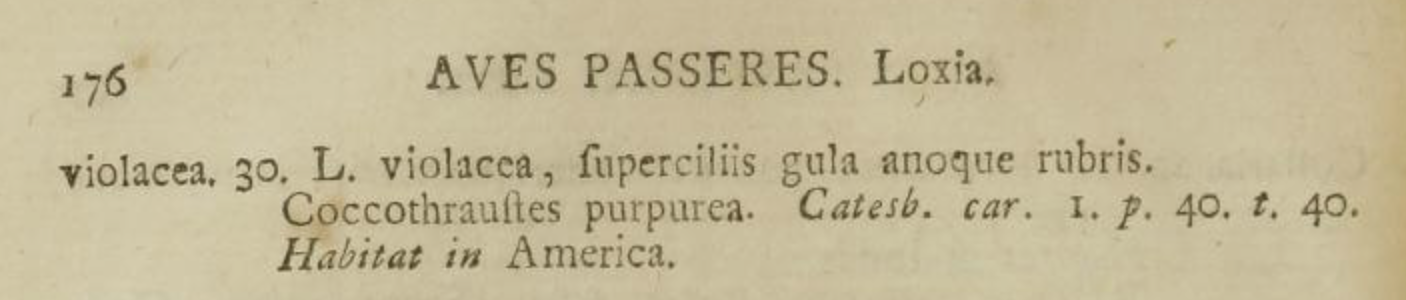
Species description for Greater Antillean bullfinch (Loxigilla violacea, previously Loxia violacea) in Systema Naturae, v. 1 (1758). Catesby is the only reference that Linnaeus cites for this species name. Digitized by the Missouri Botanical Garden. http://biodiversitylibrary.org/page/727083.

Linnaeus cited Catesby extensively in Species Plantarum and Systema Naturae, showing that Natural History enhanced Linnaeus’ understanding of many species. 131 of the 187 plants depicted by Catesby were cited by Linnaeus in Species Plantarum (N&E;, 201). Additionally, Linnaeus referenced Catesby 139 times in Systema Naturae (N&E;, 254-255). For some of these references, Catesby was the sole source of information for Linnaeus on a given species, and Catesby’s illustrations serve as the type for several of Linnaeus’ species names. In Species Plantarum, for example, 17 of Linnaeus’ species entries cite only Catesby, while Catesby’s plates serve as the type for 34 of the species in that work (N&E;, 201). For 52 of the species entries in Systema Naturae, Catesby was Linnaeus’ only reference (N&E;, 255).

View Full Size Image
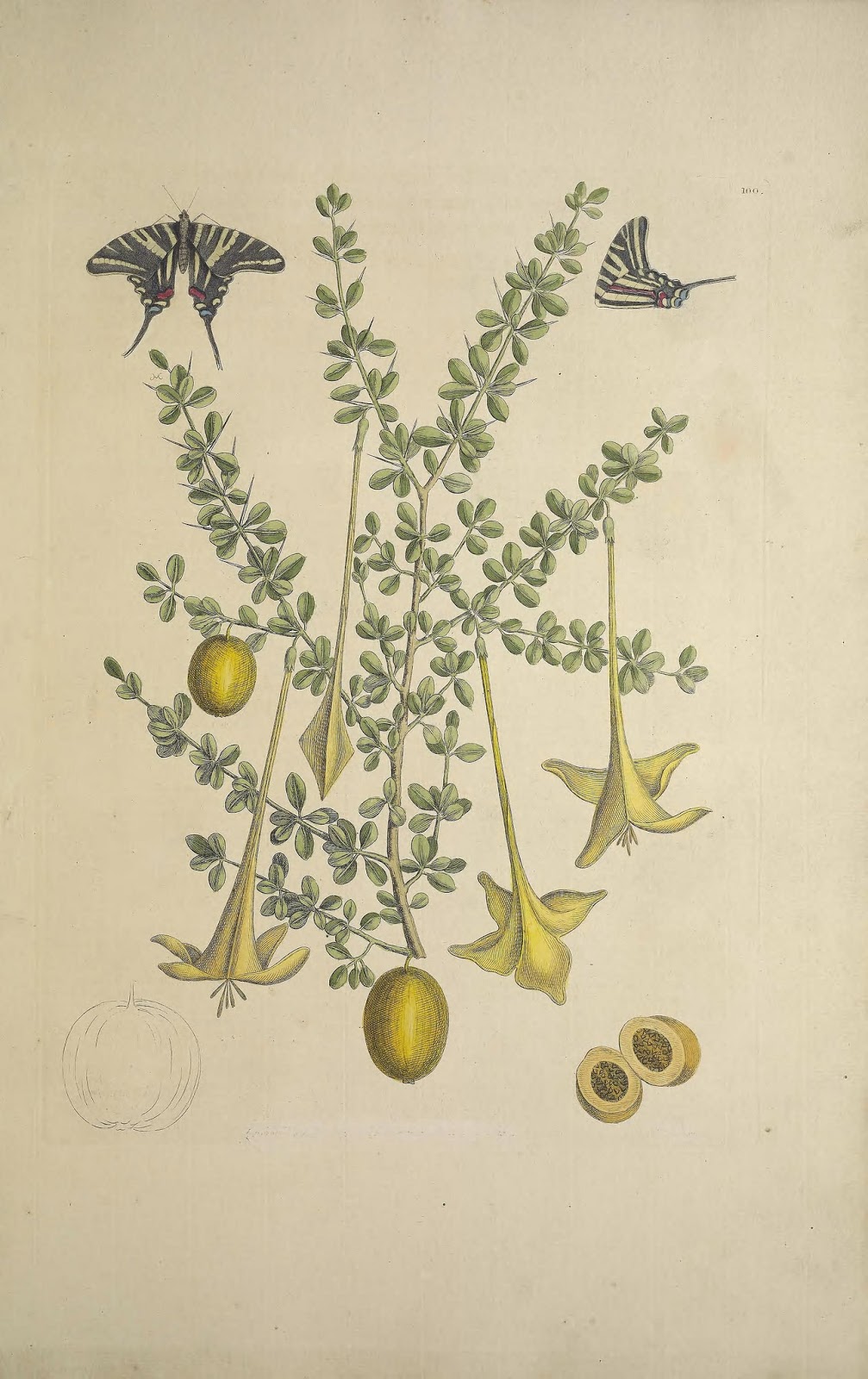
Lily thorn (Catesbaea spinosa). Pictured with zebra swallowtail (Protographium marcellus). Catesby is the only source that Linnaeus cited when naming Catesbaea spinosa in Species Plantarum (1753). This engraving serves as the type for this name. Catesby, Mark. The Natural History of Carolina, Florida, and the Bahama Islands. v. 2, ed. 1. pl. 100. Digitized by Smithsonian Libraries.  http://biodiversitylibrary.org/page/40680398. Taxon tagged in Flickr by Michelle Marshall: https://www.flickr.com/photos/biodivlibrary/26936345516.

The Natural History of Carolina, Florida, and the Bahama Islands represents a milestone in the cultivation of natural history knowledge. We are indebted to this “ingenious” naturalist Mark Catesby who dedicated his life to capturing and describing the biodiverse wonders of the New World. What a wondrously beautiful and curious world we live in.

REFERENCE 
Nelson, E C, and David J. Elliott. The Curious Mister Catesby: A “truly Ingenious” Naturalist Explores New Worlds., 2015. Print.

September 1, 2016by ulib-libraryjobs
Blog Reel, Featured Books

The National Park Service, Historic Surveys, and the Hunt for Documentation

View Full Size Image
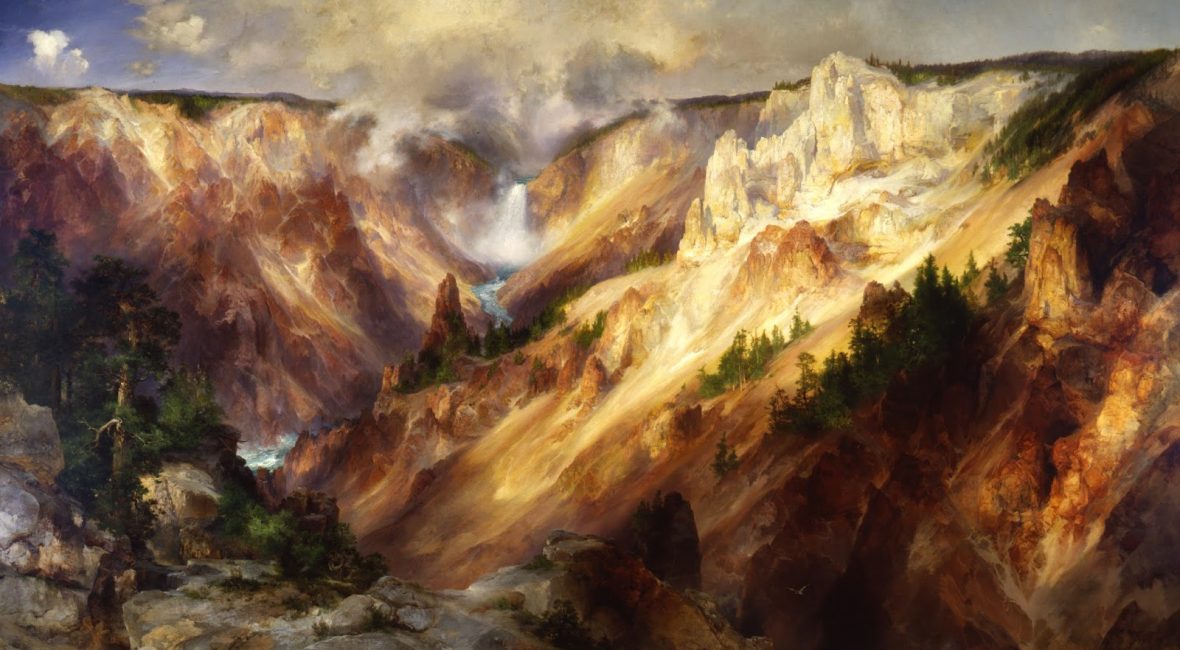
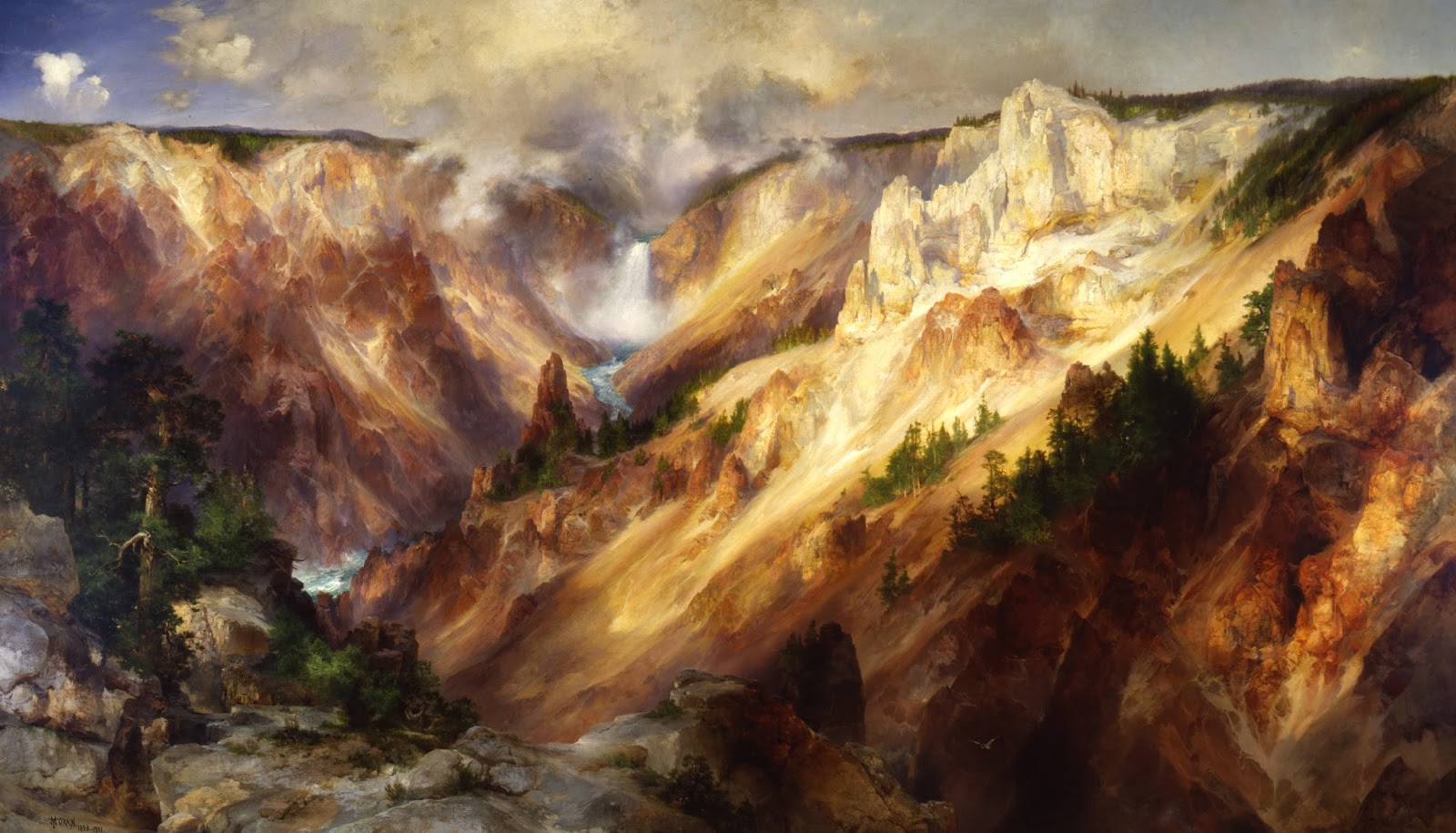
“The Grand Canyon of the Yellowstone” by Thomas Moran, artist for Hayden Survey 1871. Smithsonian American Art Museum, Gift of George D. Pratt. Courtesy of Wikipedia Commons.

This year is the National Park Service’s Centennial anniversary. In recognition, we thought we would take a look at one of the geological surveys that inspired the founding of Yellowstone National Park. In recent months, researchers in increasing numbers have looked for specimens and field documentation relating to Yellowstone, specifically from the Hayden Geological Survey of 1871. This survey is important for a number of reasons. It was the first federally funded survey, and was instrumental in introducing the American public to Yellowstone’s natural wonders. It inspired Congress to establish Yellowstone as the first national park in 1872.

Smithsonian is a repository for specimens and documentation from the Hayden Geological Survey and numerous others relating to the U.S. territories during the nineteenth century. However, it can be surprisingly challenging to find the documentation and specimens from these surveys. This challenge is not unique. Any researcher who has worked with historic material can attest to the challenges of locating materials as decades and centuries pass. Smithsonian Institution was the main repository for the Hayden Geological Survey, but field notes and specimens can end up in many other places. Expedition members may have taken specimens and documentation back to their home institutions, specimens may have been loaned to researchers, others may have been kept as personal mementoes.

The Hayden Survey of 1871 provides an example, because it not only demonstrates the importance of the primary documentation (these specimens and field notes provide a baseline of description for studying Yellowstone’s changing environment), but also how documentation scatter, even when it relates to such a well-known survey. The challenges discussed are prime reasons Natural Sciences institutions around the world are working diligently to make their materials and description available online, so that even if the materials are physically separated, they can be reconnected digitally.

Where are the specimens?

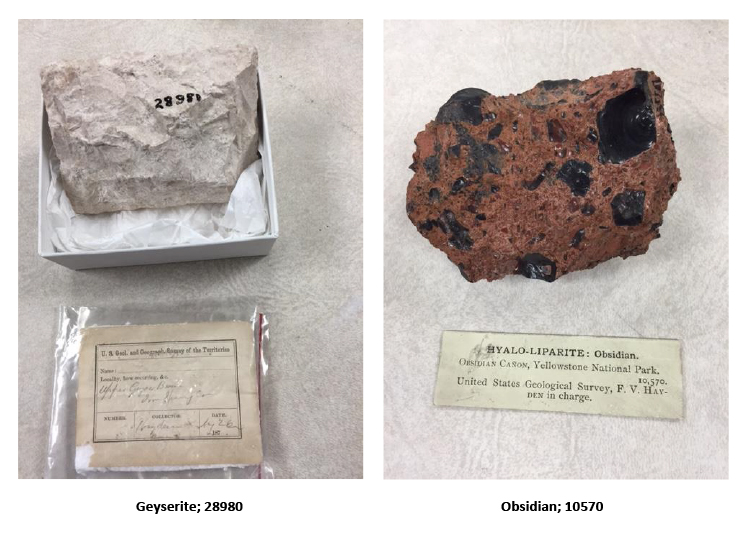
Leslie Hale, Curator at the Division of Mineral Sciences, National Museum of Natural History, shared some of her experience trying to locate these materials for researchers. “By all accounts, every rock they picked up on every Yellowstone expedition of the 1870’s allegedly came here. But I have only located a few drawers full…. I have been able to identify rocks collected in [subsequent Hayden surveys] ’72, ’73, and ’78, but none that I am certain are from that so-important first trip in 1871. There are specimen labels, but that’s it, no field notebooks or any other ancillary documentation.”

View Full Size Image
Geyserite (Catalog number 28980) from upper geyser basin and Obsidian (Catalog number 10570) collected at Yellowstone during the Hayden Geological Surveys. Specimens are part of the Volcanology and Petrology collection at the Department of Mineral Sciences, National Museum of Natural History.

It turns out that the specimens can have a pretty interesting journey of their own, due to changing norms in scientific disciplines and institutions over the decades. During much of the Smithsonian’s history, curator positions could be honorary and thus not always a paid position. Leslie shared, “It was not uncommon for them [curators] to remove specimens as payment. I believe that is what happened to most of these specimens.”

So where are these specimens now? Some went to other institutions, most likely with Survey participants. Some are now in private collections as some institutions have sold off portions of their rock and mineral collections (as did, for example, the Philadelphia Academy of Sciences in 2011).

Where are the field notes?

Hayden used his field notes to compose an extensive report that described the expedition work in the Yellowstone area during 1871. The notes were subsequently lost. This loss has been particularly troubling since other publications prepared from the field notes or Hayden’s personal recollections years later contain errors that cannot be checked against the original source.


View Full Size Image
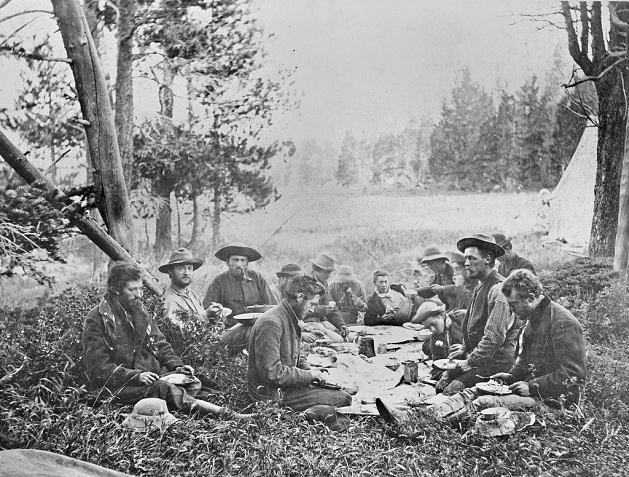
Hayden Survey participants at dinner during 1872. Includes West, Carrington, Taggart, William H. Jackson, Jay Cox, Clifford De V. Negley, and William Henry Holmes. Smithsonian Institution Archives. Record Unit 95, Box 56, Folder 2. 1872.

Luckily other field notes and letters from the expedition exist. However these cannot provide as full a picture as the expedition leader’s notes. In 1999, a book was published by University of Nebraska Press entitled Yellowstone and the Great West: Journals, Letters, and Images from the 1871 Hayden Expedition, which pieced together a description of the expedition from the diaries of George Nelson Allen (geologist) and Albert C. Peale (mineralogist) and correspondence by expedition members. In order to create a comprehensive narrative, Merrill (the book’s editor) relied on correspondence from expedition members found in numerous archives across the country, including the Library of Congress, U.S. Geological Survey Field Registry Library (Colorado), National Archives, Academy of Natural Sciences in Philadelphia, and Oberlin College Archives (Ohio) just to name a few.

This published work only serves to demonstrate how much was lost with Hayden’s notes. According to a review published during 2000 in ISIS, a journal of the history of science society, the selected diary entries and correspondence demonstrate that Hayden was significantly involved in the expedition’s scientific work, far more than initially believed. The fate of Hayden’s field notes was not unique for the survey. Journals from the survey in general are difficult to locate or were also lost. According to the book’s preface, Allen’s and Peale’s journals are the only known unpublished journals to still exist.

Where are the publications?

In 1872, Hayden used his field notes to compose a single report covering the 1871 survey, entitled Preliminary report of the United States Geological Survey of Montana, and portions of adjacent territories : being a fifth annual report of progress, which is available in Internet Archive and will shortly be available in BHL. His final report documented several years’ worth of his surveys in the field.

View Full Size Image
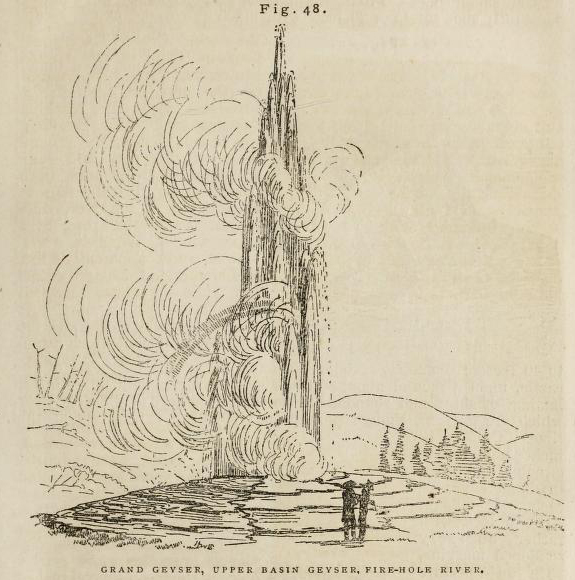
Illustration of the Grand Geyser, the tallest predictable geyser known. It was named by Dr. F.V. Hayden in 1871. Preliminary report of the United States Geological Survey of Montana, and portions of adjacent territories : being a fifth annual report of progress. (1872).

Also available through BHL is a Catalogue and index of the publications of the Hayden, King, Powell, and Wheeler surveys (1904), which provides a list of publications relating to the study of specimens in numerous fields collected during the Survey.

The rest of the story…

The survey of 1871 was one of several that Hayden directed as part of the U.S. Geological and Geographical Survey of the Territories during 1867-1879. He was one of four men, (Clarence King, George Wheeler, and John Wesley Powell) who defined exploration of the western U.S. territories during the 1860’s and 1870’s. Reports describing his explorations and those of Powell, Wheeler and King can be found on the Biodiversity Heritage Library.

View Full Size Image
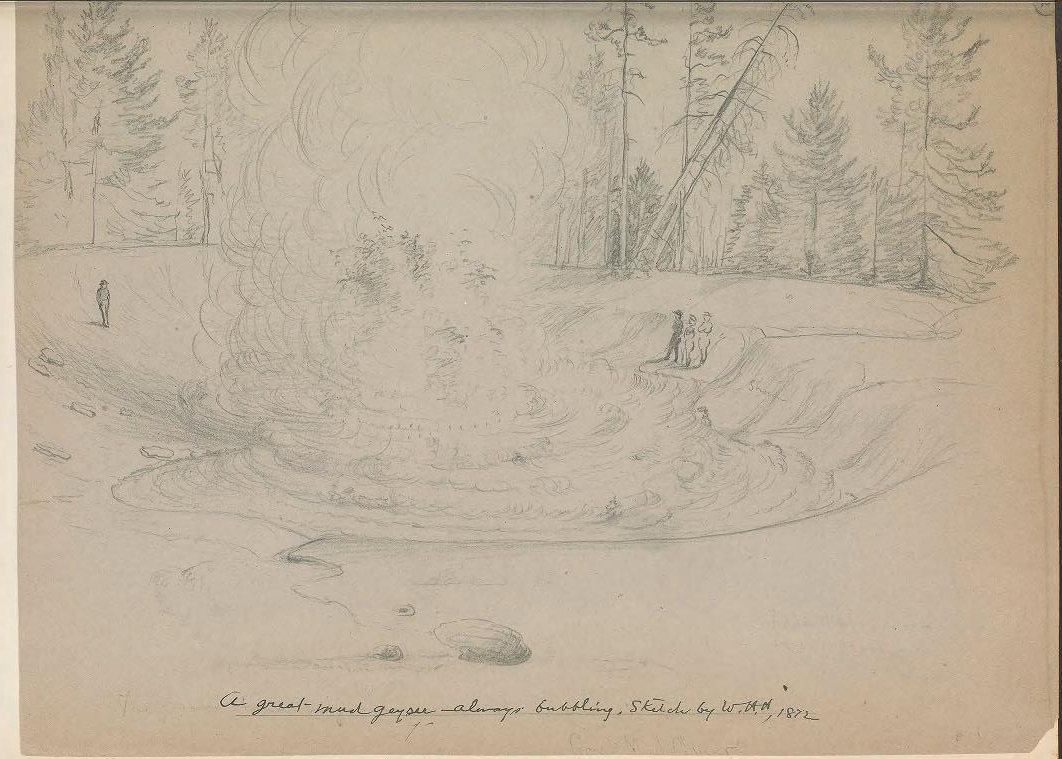
Sketch by William Henry Holmes, drawn during 1872 Hayden Geological Survey. Random records of a lifetime, 1846-1931 [actually 1932]. Digitized by Smithsonian Libraries for The Field Book Project.

Primary source materials from later Hayden surveys to Yellowstone can be found in Smithsonian Institution holdings, including The William Henry Holmes autobiography (typewritten manuscripts detailing Holmes’ life and work), which are held by the American Art and Portrait Gallery Library. Holmes was appointed as the artist-topographer on the Hayden Survey in 1872. In 1874 he was appointed assistant geologist, and he served in this capacity during the 1878 Hayden Survey. Two of Holmes’ volumes have been digitized and are currently available in Internet Archive (vol. 2 | vol. 3). The third volume specifically deals with the 1872 and 1878 Hayden Surveys. Both volumes will be added to the BHL collection soon.

View Full Size Image
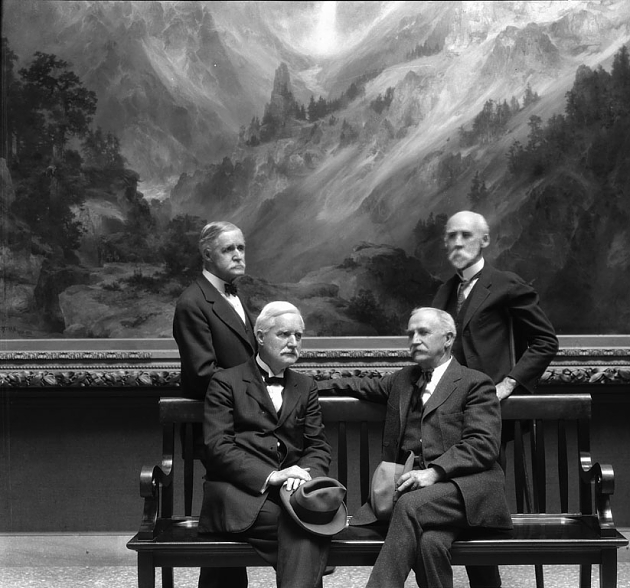
William Henry Holmes with other members of the Hayden Survey, at the U.S. National Museum, circa 1930. Smithsonian Institution Archives, Record Unit 311, Box 27, Folder 7.

The story of the 1871 survey highlights the risks to documentation, even from a historically important expedition that appealed to the public of its day and produced important changes in the nation, including our first national park. Documentation can end up in seemingly disparate locations; through online consortiums these materials are being made available in new ways, restoring important historic context, sometimes lost for decades.

August 25, 2016by ulib-libraryjobs
Blog Reel

How’s your fern and bird coverage, BHL?

“Every one knows what a bird is,” asserts an early 20th century book that I found while browsing the Biodiversity Heritage Library (BHL).

As I’ve learned during my Professional Development Internship with Jacqueline Chapman at Smithsonian Libraries this summer, it’s not always that simple. Taxonomy is ever-changing, especially at the granular level needed by subject specialists around the world who use BHL to conduct research on organisms ranging from mosses to turtles to fungi.

BHL is a consortial digital library whose member libraries digitize works in natural history and botany based on both user requests and subject librarians’ selections. My project for this summer was to refine a collection assessment methodology for BHL using both taxonomic and bibliographic analyses. Along the way, I’ve learned valuable lessons in using library tools, troubleshooting in Python (a computer programming language), and understanding the thought processes of 19th century ornithologists and pteridologists.

View Full Size Image
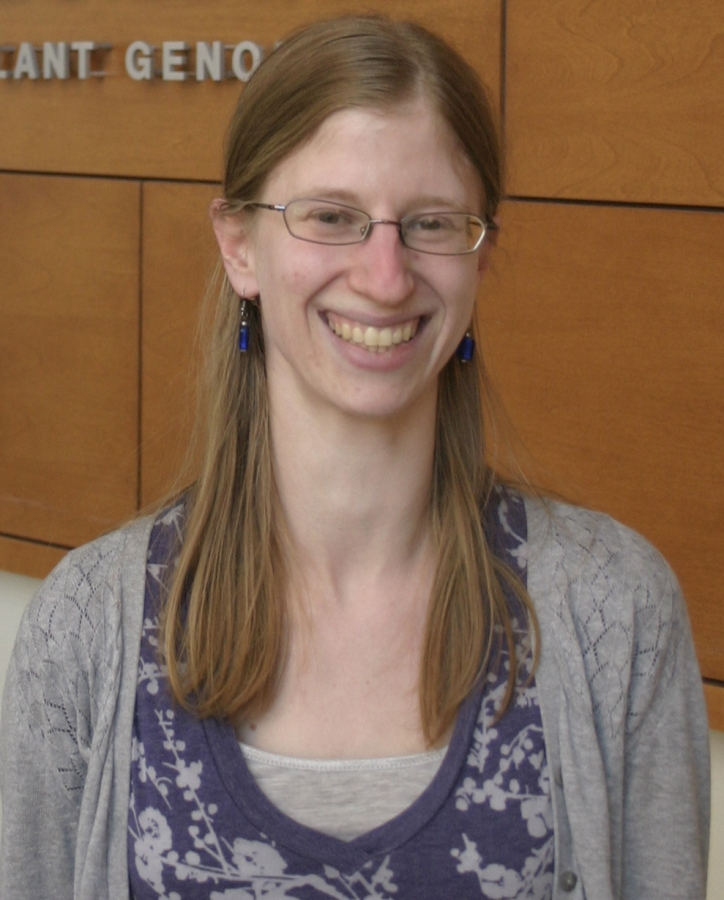
Becca Greenstein

Last year, Jacqueline worked with Robin Everly, the Smithsonian’s Botany and Horticulture Librarian, to conduct a taxonomic and bibliographic analysis to assess the depth of the BHL’s fern and lycophyte literature. They presented their results at an international conference on ferns, Next Generation Pteridology, and had the unique ability to talk with many subject-specialist users from around the world. Jacqueline later shared this proof-of-concept with researchers at TDWG in Nairobi, Kenya.

For the bibliographic portion of the project, Fern Books and Related Items in English before 1900 was used to create a list that could be referenced to determine whether a book was available on BHL, and if not, if we had access to it. A year later, I furthered this analysis by seeing what has changed in the past year and making requests for partner libraries to scan items to add to the collection. I enjoyed gathering data for books with titles such as Greenhouse Ferns and the Romance of Plant Life, Rambles in Search of Ferns, and The Fern Paradise: A Plea for the Culture of Ferns (2nd edition in BHL).

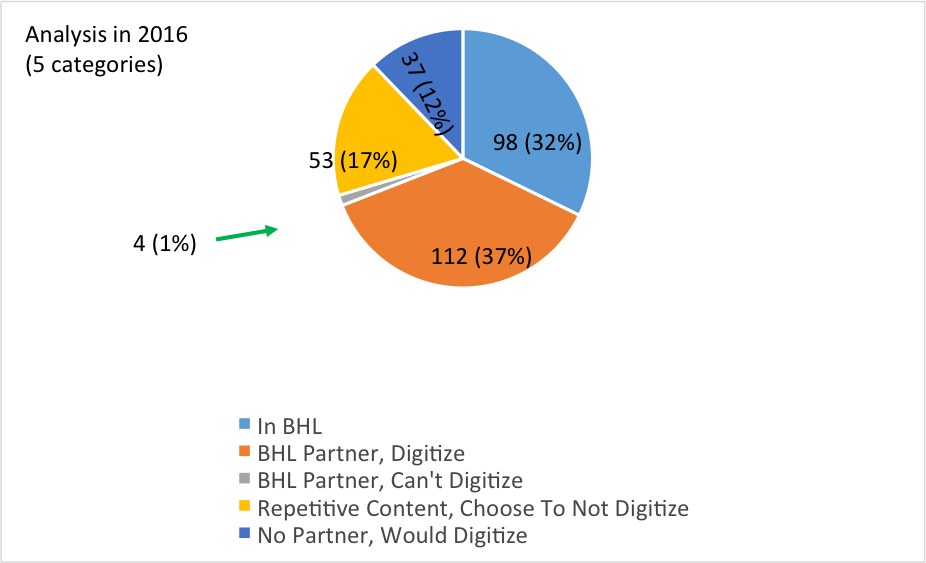
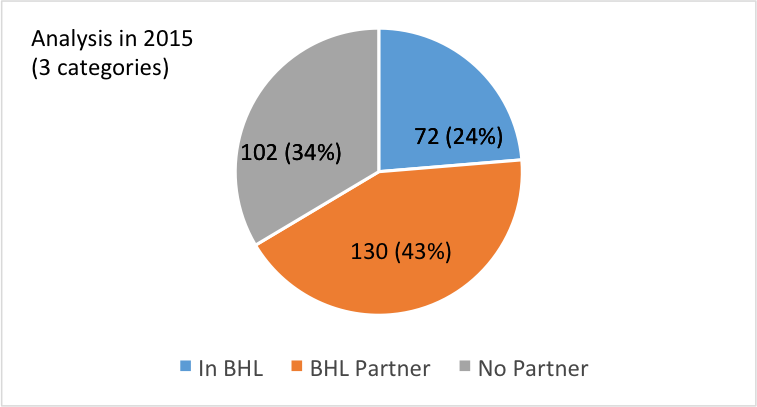
As the bibliography used included all editions of a particular work, regardless of whether the content had changed, I decided to not digitize the 53 works on the list whose content was already in BHL in another edition of the same work. As you can see in the graphs below, the number of fern books on BHL from this list has increased by 36% over the past year. The 112 titles from the list that are not yet in BHL but that we have access to via partner libraries will be in BHL after they are digitized. We lack access to only 37 of the titles on the list that would add content to BHL, and it will be interesting to follow up with this study to see if current partners acquire new resources or if new partners that possess these materials join the BHL Consortium.

View Full Size Image
2015 Bibliographic Analysis: Graph presents percentage of books from the list generated using Fern Books and Related Items in English before 1900 that are in BHL, are not in BHL but are held by a BHL partner, and are neither in BHL nor held by a BHL partner.
View Full Size Image
2016 Bibliographic Analysis, showing that the BHL collection of fern books has increased from 2015 to 2016.

For the taxonomic portion of the project, BHL’s coverage of a particular taxonomic grouping using scientific names was analyzed. The digitized material on BHL is in the form of images, which the computer does not recognize as text. Using Optical Character Recognition (OCR), the images are converted to machine-readable text. Taxonomic Name Recognition (TNR) then searches the OCR to find scientific names using multiple recognized lists of scientific names.

To use this powerful analytical tool to analyze BHL’s literature on birds, I upgraded the Python 2 code used for last year’s analysis to Python 3, the newest version of the programming language. Using my code, I counted the number of mentions in BHL of each genus of birds that appear in Catalogue of Life, as determined by TNR, to identify potential gaps in the BHL collection.

Of the 2234 genera analyzed, 99.6% of them are mentioned in the BHL corpus, 131 individual genera had more than 10,000 mentions in BHL, and 88% of them had more than 100 mentions.

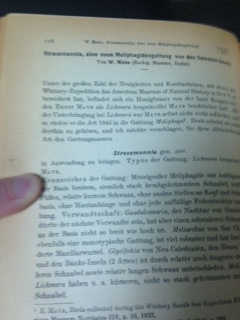
I conducted an in-depth analysis of the 37 genera with fewer than ten mentions in BHL to figure out possible reasons for the paucity of literature. I determined that this lack of literature could be attributed to such things as the more-recent description of some of the genera, such as within the past 20 years, to the locality of some genera, as in some birds being endemic to far-away (to 19th century European ornithologists) places like New Guinea and Mozambique, and to taxonomic changes to the genera over the years. I then looked for the first mention of each of the 37 genera in books and journal articles online and in print, in addition to submitting scan requests for the books we have access to that weren’t already in BHL. There was something surreal about trekking up to the Birds Library, which is tucked away on the sixth floor of the National Museum of Natural History, finding Ornithologische Berichte on the shelf (and no, I don’t speak German), and opening to page 118 to find Wilhelm Meise’s initial description of Stresemannia bougainvillea.

View Full Size Image
Meise’s initial description of Stresemannia bougainvillea is next to my thumb.

My internship lasted six weeks, but it did not feel like that long. I hope that BHL will use my code to analyze larger sets of data and/or data at a higher level (for example, how is BHL doing at collecting literature on Kingdom Animalia?).

Through conducting my project, I’ve learned that things you learn in library school really do apply to the real world, how an academic library at an institution without students functions, and the workflow behind digitizing materials that appear in BHL and on the Smithsonian Digital Library. I’ve learned that library tools we take for granted can be unreliable, but aren’t usually, and that getting help from people who do research on ferns and those who do speak German can be very beneficial. I hope to bring the things I’ve learned back to my final two semesters of library school, as well as into my hoped-for career as a science librarian after I graduate.

________________________

About the Author

Becca Greenstein is getting her Master’s in Library Science at UNC-Chapel Hill. For her Bachelor’s degree, she went to Carleton College, where she majored in Biology and minored in Chinese. After graduating from Carleton, she worked as a lab technician at the University of Minnesota before starting library school. After she graduates, she hopes to continue honing these skills while working in an academic or special library as a science librarian.

August 23, 2016by ulib-libraryjobs
Page 6 of 11« First...«5678»10...Last »

Help Support BHL

BHL's existence depends on the financial support of its patrons. Help us keep this free resource alive!

search

About BHL

The Biodiversity Heritage Library (BHL) is the world’s largest open access digital library for biodiversity literature and archives. BHL operates as a worldwide consortium of natural history, botanical, research, and national libraries working together to digitize the natural history literature held in their collections and make it freely available for open access as part of a global “biodiversity community.”

Join Our Mailing List

Sign up to receive the latest news, content highlights, and promotions.

Subscribe Now

Subscribe to Blog via Email

Enter your email address to subscribe to this blog and receive notifications of new posts by email.

Join 319 other subscribers

Subscribe to Blog Via RSS

Subscribe to the blog RSS feed to stay up-to-date on all the latest BHL posts.

Access RSS Feed

Inspiring Discovery through Free Access to Biodiversity Knowledge.

The Biodiversity Heritage Library makes it easier than ever for you to access the information you need to study and explore life on Earth…for free, anytime, anywhere.


64+ Million Pages of
Biodiversity Literature Online.

EXPLORE

Tools and Services
to Transform Research.

EXPLORE

300,000+
Illustrations on Flickr.

EXPLORE

ABOUT | HARMFUL CONTENT | PRIVACY | SITE MAP | TERMS OF USE