Biodiversity Heritage Library - Program news and collection highlights from BHL
  • Home
  • News
  • Featured Books
    • All Featured Books
    • Book of the Month Series
    • BHL at 20
  • User Stories
  • Campaigns
    • Fossil Stories
    • Garden Stories
    • Monsters Are Real
    • Page Frights
    • Her Natural History
    • Earth Optimism 2020
  • Tech Blog
  • Visit BHL
Home
News
Featured Books
    All Featured Books
    Book of the Month Series
    BHL at 20
User Stories
Campaigns
    Fossil Stories
    Garden Stories
    Monsters Are Real
    Page Frights
    Her Natural History
    Earth Optimism 2020
Tech Blog
Visit BHL
  • Home
  • News
  • Featured Books
    • All Featured Books
    • Book of the Month Series
    • BHL at 20
  • User Stories
  • Campaigns
    • Fossil Stories
    • Garden Stories
    • Monsters Are Real
    • Page Frights
    • Her Natural History
    • Earth Optimism 2020
  • Tech Blog
  • Visit BHL
Biodiversity Heritage Library - Program news and collection highlights from BHL
Blog Reel, User Stories

Time Traveling with BHL: Open Access to Historic Data Empowers Modern Research…At Home

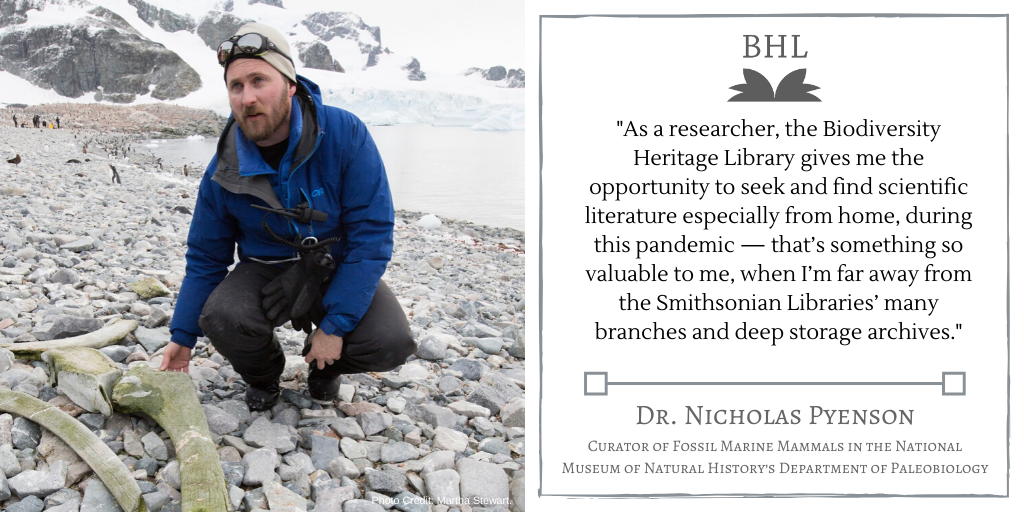
Quote from Dr. Nicholas Pyenson about BHL's impact

As the world’s largest open access digital library for biodiversity literature and archives, the Biodiversity Heritage Library (BHL) has revolutionized global research by providing free, worldwide access to knowledge about life on Earth. BHL’s digital collections provide researchers with the information they need to document Earth’s species, conserve biodiversity, research the history of science, and confront formidable challenges — from extinction crises to climate change and the spread of zoonotic diseases.

Digital access to this essential literature is especially important right now, as the COVID-19 pandemic makes physical access to collections and institutional libraries impossible for many. Open access digital libraries like BHL make continued research possible.

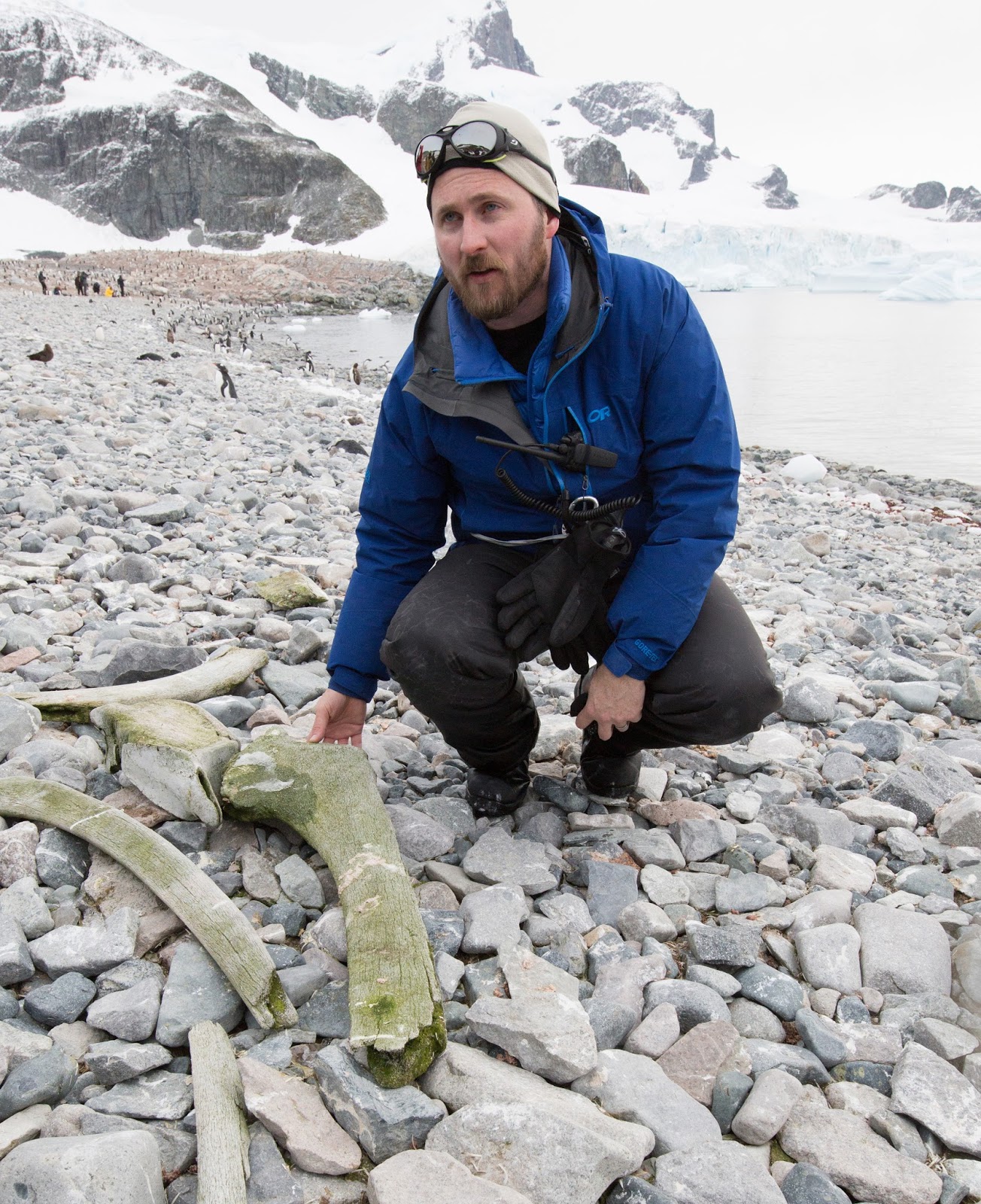
Dr. Nicholas Pyenson, Curator of Fossil Marine Mammals in the National Museum of Natural History’s Department of Paleobiology, has been a longtime user of and advocate for BHL. The historic data accessible through publications in BHL underpins much of his work. For example,  the Discovery Reports, which present the results of groundbreaking investigations into the biology of whales, helped inform Pyenson’s studies on the evolution of cetacean body size and whale hearing.

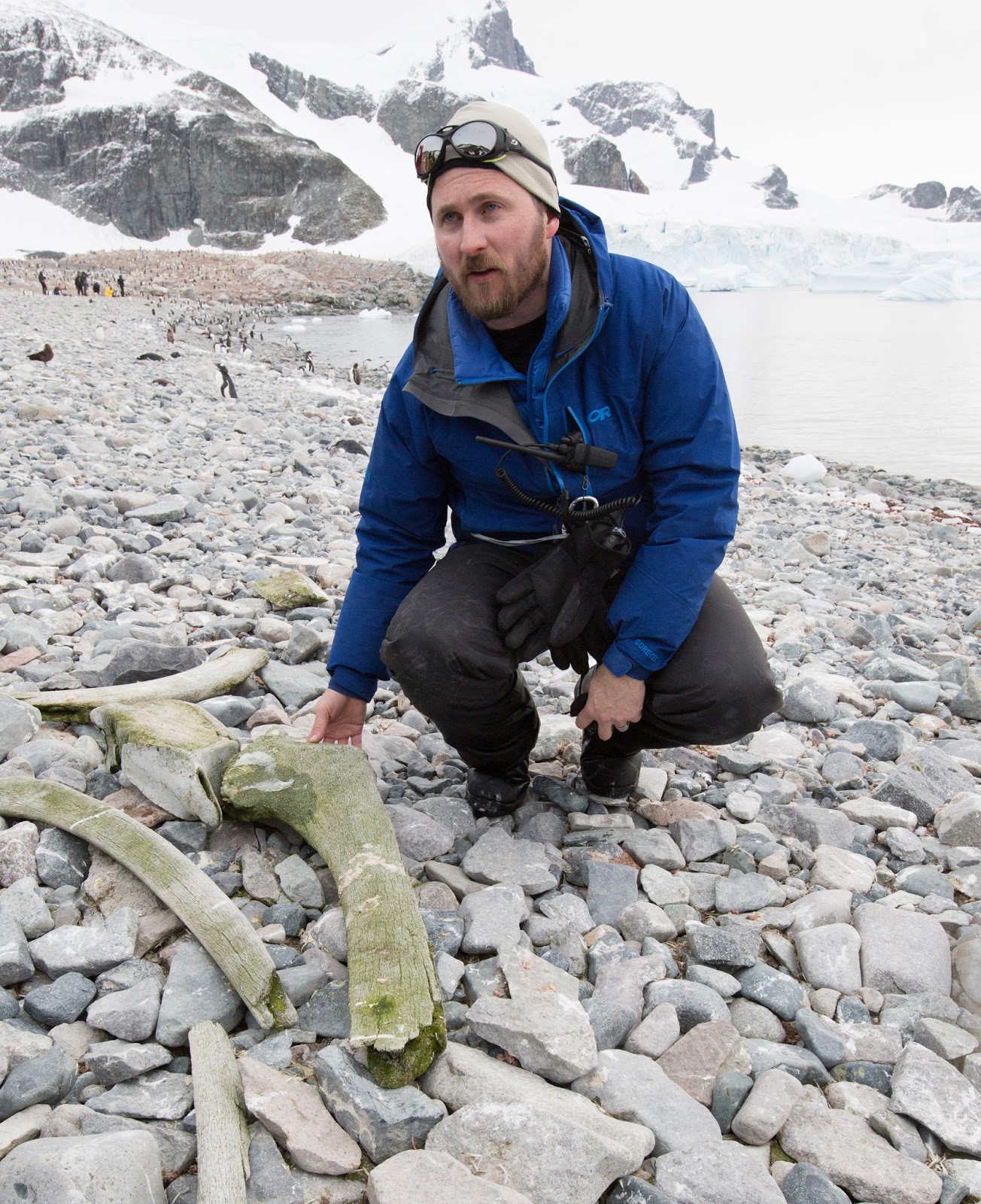
Man in a blue coat on a beach investigating whale bones

Dr. Nicholas Pyenson at Cuverville Island, Antarctica. Photo credit: Martha Stewart.

While BHL has been a valued resource for Pyenson for many years, digital access to scientific literature has become especially important as research has shifted to a telework environment.

“As a researcher, the Biodiversity Heritage Library gives me the opportunity to seek and find scientific literature especially from home, during this pandemic — that’s something so valuable to me, when I’m far away from the Smithsonian Libraries’ many branches and deep storage archives,” emphasizes Pyenson. “Access to words, images, and ideas that are either decades or centuries old drives so much of my work. It also gives me a sense of connection to people I’ve never met, but nonetheless seem very real for the questions I want to answer.”

Pyenson shares more about BHL’s impact during these unprecedented times on the Smithsonian Libraries’ YouTube channel.

As our understanding of the natural world deepens and grows, trusted, openly available resources become ever more important. BHL’s Secretariat and technical staff, together with our colleagues at BHL’s over 80 partner institutions globally, are committed to ensuring continued access to BHL resources for researchers around the globe. Your support today is deeply impactful to our ability to continue providing support to the thousands of researchers who rely on access to our digital collections.

If you’re able to give, we welcome your contribution.

May 21, 2020by michelle.underhill
Blog Reel, User Stories

Old Literature, New Discoveries: BHL Supports Cutting Edge Whale Research

In the early 20th century, the British Colonial Office and the Discovery Committee of the British Government undertook a series of major investigations into the biology of whales in the Southern Hemisphere. Using ship- and shore-based equipment (including whaling stations on South Georgia Island operated by the UK and other nations), these Discovery Investigations, as they were called, significantly advanced human knowledge of whale morphology and ecology.

The results of the Investigations were presented within the 37 volume series entitled the Discovery Reports. Groundbreaking for their time, these Reports are still important for cetacean research today.

“The data collected and published in the Reports were unique because they represented, in every case, a one-time, time-stamped opportunity to record the precise dimensions, weights, gut contents and many other details gathered as part of whaling activities,” explains Dr. Nicholas Pyenson, Curator of Fossil Marine Mammals at the Smithsonian’s National Museum of Natural History (NMNH).

View Full Size Image
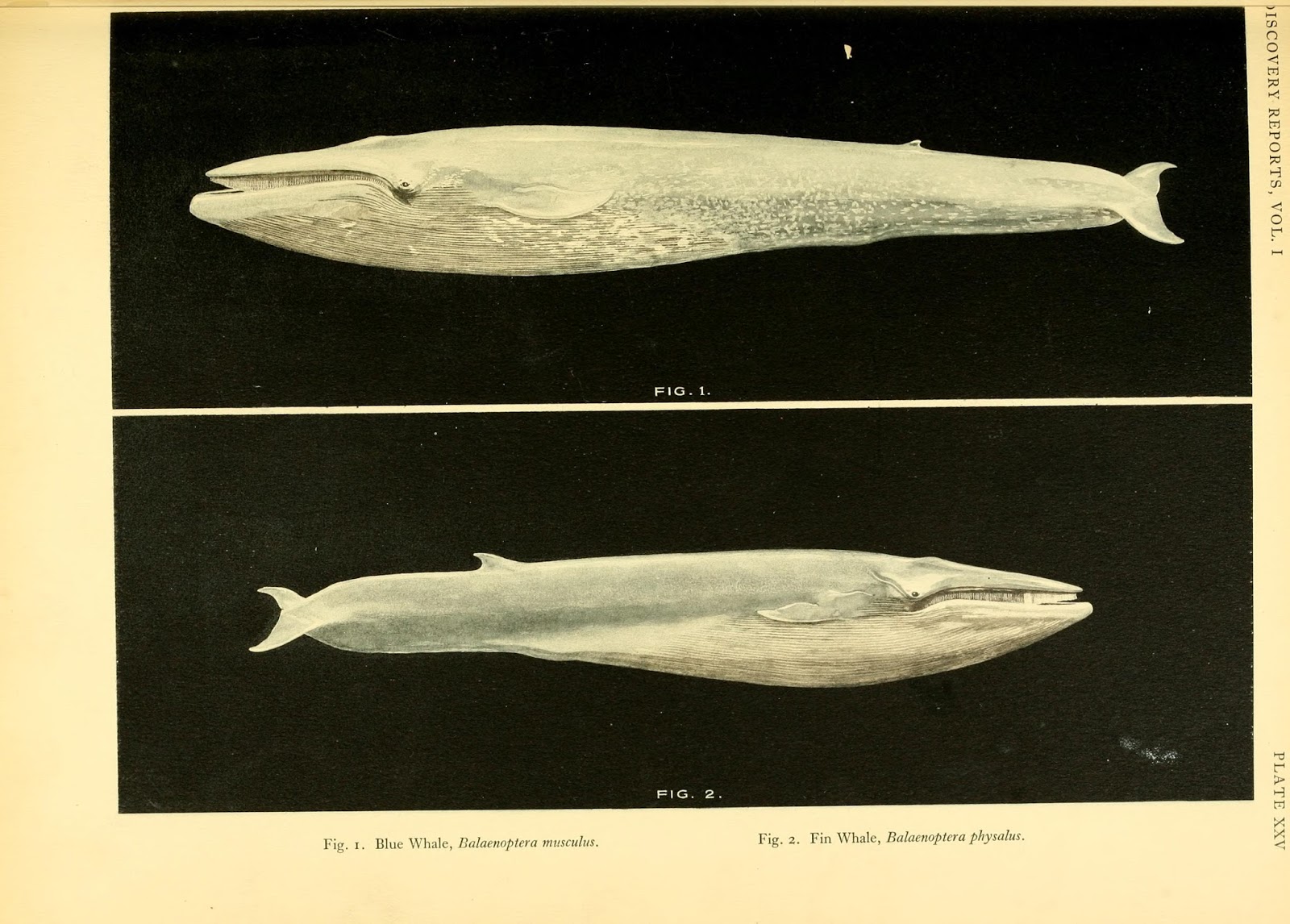
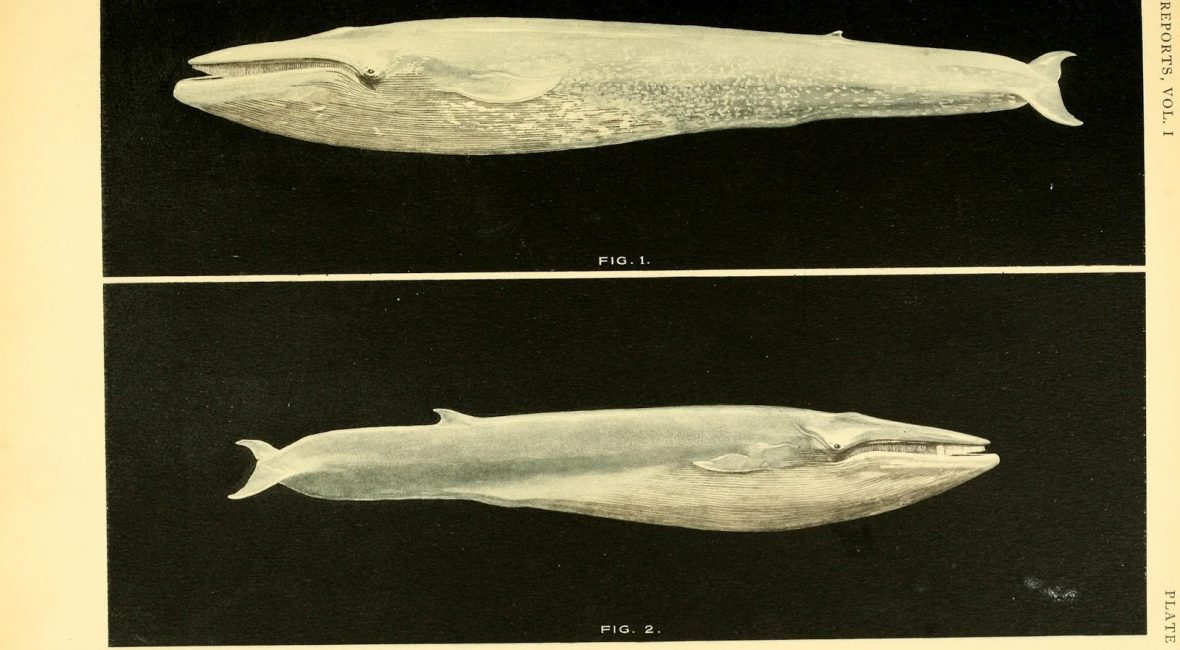
Mackintosh NA, Wheeler JFG (1929) Southern blue and fin whales. Discovery Reports 1:257—510. http://www.biodiversitylibrary.org/page/15917732. Digitized by Smithsonian Libraries.

Pyenson has used the data in the Reports to inform several recent studies. For example, he and colleague Simon Sponberg used data on total length and adult body mass for Southern blue and fin whales, published in 1929 as part of the Discovery Reports, to help develop and test regression methods for reconstructing the body size of extinct whales. Their findings, published in 2011 in the Journal of Mammalian Evolution, provided major insight into studying the evolution of cetacean body size.

View Full Size Image
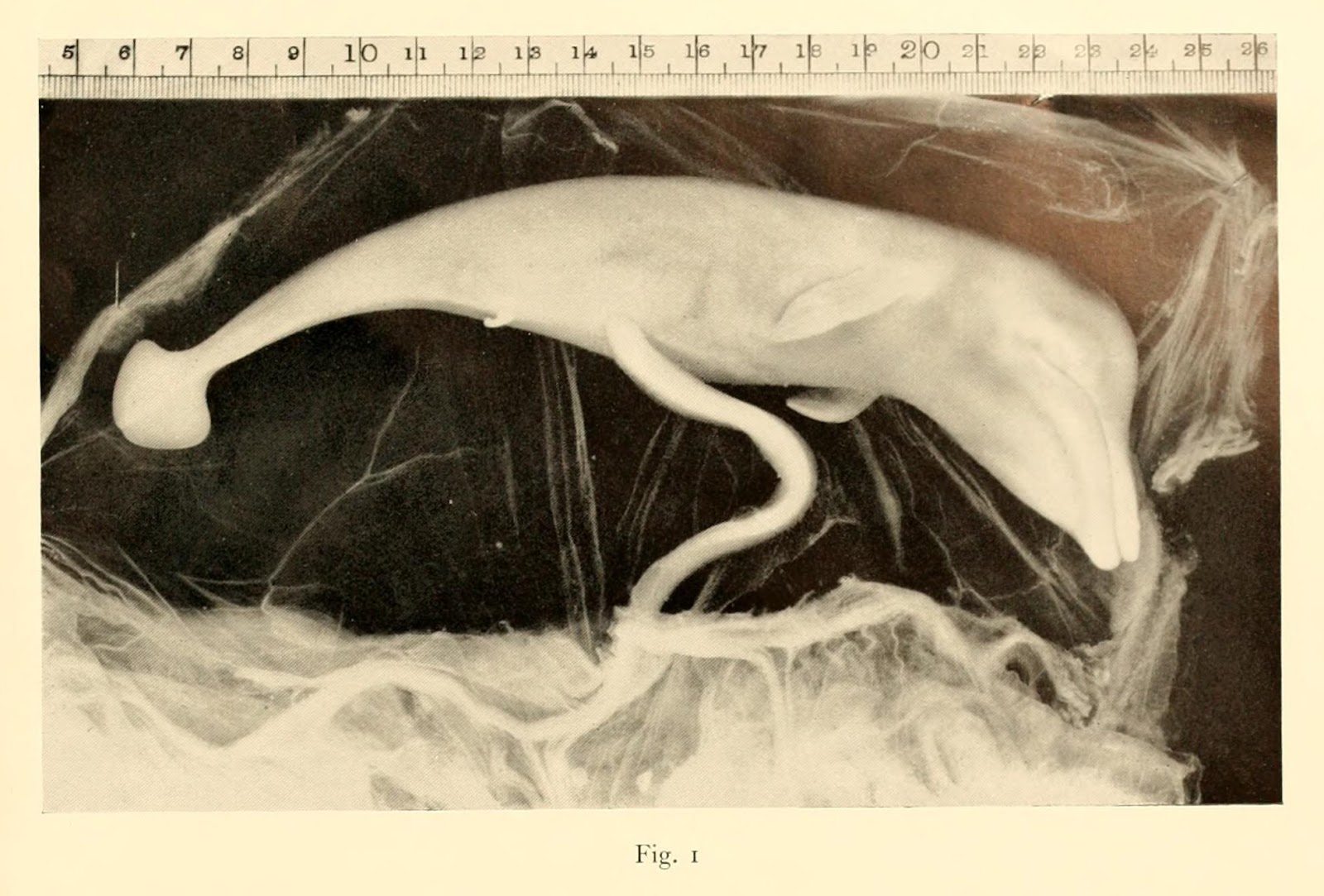
Fin whale fetus. Laws RM (1959) The foetal growth rates of whales with special reference to the fin whale Balaenoptera physalus Linn. Discovery Reports 29: 281–308. http://www.biodiversitylibrary.org/page/5569026. Digitized by MBLWHOI Library.

More recently, while researching the evolution of whale hearing, Maya Yamato and Pyenson used data on the fetal growth rates of whales, published in 1959 as part of the Discovery Reports, to gain insight into the maturation of the ear in baleen and toothed whales. Their research, published in 2015 in PLOS ONE, traces the development of an evolutionarily novel feature in cetaceans – the use of an acoustic funnel, rather than an ear canal, for hearing.

“The historic information in the Reports is so valuable for a variety of questions about the evolution, anatomy, and ecology of large whales,” asserts Pyenson.

View Full Size Image
Dr. Nicholas Pyenson. Selfie from a seakayak in Sitka Sound, Alaska.

Pyenson has been studying marine mammals and other marine vertebrates for over 15 years. He’s published pioneering research on the evolution and diversification of marine mammalian lineages and has used revolutionary techniques like 3D modeling to uncover new insights into the anatomy and transformation of this group. He’s even shared some of his research during past BHL-related events, including live webcasts for the #FWTrueLove and #FossilStories campaigns.

Pyenson’s scientific achievements, including the use of emerging digital tools to expand public access to fossils, earned him the coveted Presidential Early Career Award for Scientists and Engineers (PECASE). He is the first NMNH scientist to receive this award, which is the “highest honor bestowed by the United States Government on science and engineering professionals in the early stages of their independent research careers.”

While Pyenson has embraced many novel research techniques, the historic data found in publications like the Discovery Reports underpins much of his work. Thanks to the digital open access provided by the Biodiversity Heritage Library (BHL), it’s easier than ever to integrate these resources into modern research processes.

“As a free, mobile archive for natural history literature, BHL is ideal for 21st century research, which can happen on the field, in a museum, or at a coffee shop, as long as there’s internet connectivity,” lauds Pyenson.

Pyenson began using BHL nearly ten years ago, and over the past decade, it has had a major impact on his – and his colleagues’ – research.

“BHL supercharges the speed and efficiency of scholarly research, especially in the natural sciences where old literature sometimes contains the only information on a topic, taxon, geographic locality or collector,” says Pyenson. “And because BHL is open-access, I know firsthand that many of my international colleagues have dramatically better access to the literature covered in its database than more recent journals locked behind pay-walls.”

Pyenson uses BHL at least once a week, obtaining descriptions, measurements, and detailed views of morphology on fossil or modern specimens. The usability of the website, and the fidelity and quality of the scans, allow him to access and download information that is critical to his work.

“I think BHL’s interface is really wonderful. The links are crisp and easy to find and share. I especially enjoy the selectivity of being able to download just a few pages or only a specific article from an issue.”

View Full Size Image
Dr. Nicholas Pyenson at Cuverville Island, Antarctica. Photo credit: Martha Stewart.

Given the significant impact that BHL has had on Pyenson’s work, he is anxious that more people be made aware of the vast abundance – and importance – of this free and open access collection.

“We need to get the word out. Old literature matters,” asserts Pyenson.

And matter it does. As Dr. Pyenson’s experience demonstrates, by providing a wealth of data on species morphology, phylogeny, and ecology, historic literature forms the foundation for the investigation of modern and ancient biodiversity. By making this content globally accessible to anyone with an Internet connection, BHL is helping to advance scientific research and inspire discovery of the natural world.

You can help support global research through a tax-deductible donation to BHL. With your help, we can continue to democratize access to information about biodiversity and empower scientific research on a global scale.

______________________________________

This post may contain the personal opinions of BHL users or affiliated staff and does not necessarily represent the official Biodiversity Heritage Library (BHL) position on these matters.

May 11, 2017by ulib-libraryjobs
Blog Reel, Featured Books

In Search of the White Whale: A Legend, a Fossil, a Living Mammal

Portrait version of the Biodiversity Heritage Library logo.
View Full Size Image
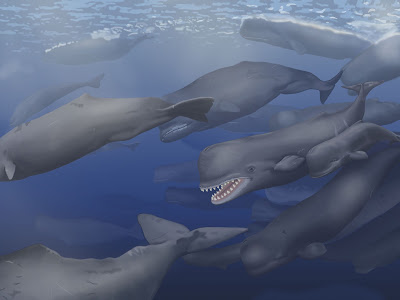
In this reconstruction, a pod of Albicetus travel together through the Miocene Pacific Ocean, surfacing occasionally to breathe. Modern sperm whales are also known for forming these tight-knit groups, composed mainly of females and their calves. Art by A. Boersma for the Smithsonian.

1820. Far west of the Galapagos Islands in the Pacific Ocean. A whaleship pursues a pod of sperm whales. Suddenly, an eighty-five foot long giant charges the ship, ramming it with its head not once, but twice, caving in the bows and sending the ship to a watery grave.

This is the story of the sinking of the Essex, the subject of Ron Howard’s movie adaptation of Nathaniel Philbrick’s novel In the Heart of the Sea, opening this Friday. The sperm whale that sank the Essex also served as one source of inspiration for another literary icon – the infamous white whale Moby Dick.

In addition to the big screen, another “white whale” hits the spotlight on a different stage this week – the scientific stage. Scientists from the Smithsonian Institution have just published new research on an extinct sperm whale that roamed the seas millions of years ago, which they’ve named Albicetus (“white whale”).

Today’s modern sperm whale was first scientifically described by Carl Linnaeus in the tenth edition of his 1758 Systema Naturae, a pivotal work that laid the foundation for our modern system of zoological nomenclature. Within this work, Linnaeus initially described the sperm whale as four separate species: Physeter catodon, Physeter macrocephalus, Physeter microps, and Physeter tursio. Today, we recognize that Linnaeus was actually describing only one species, which is now known by the binomial Physeter macrocephalus.

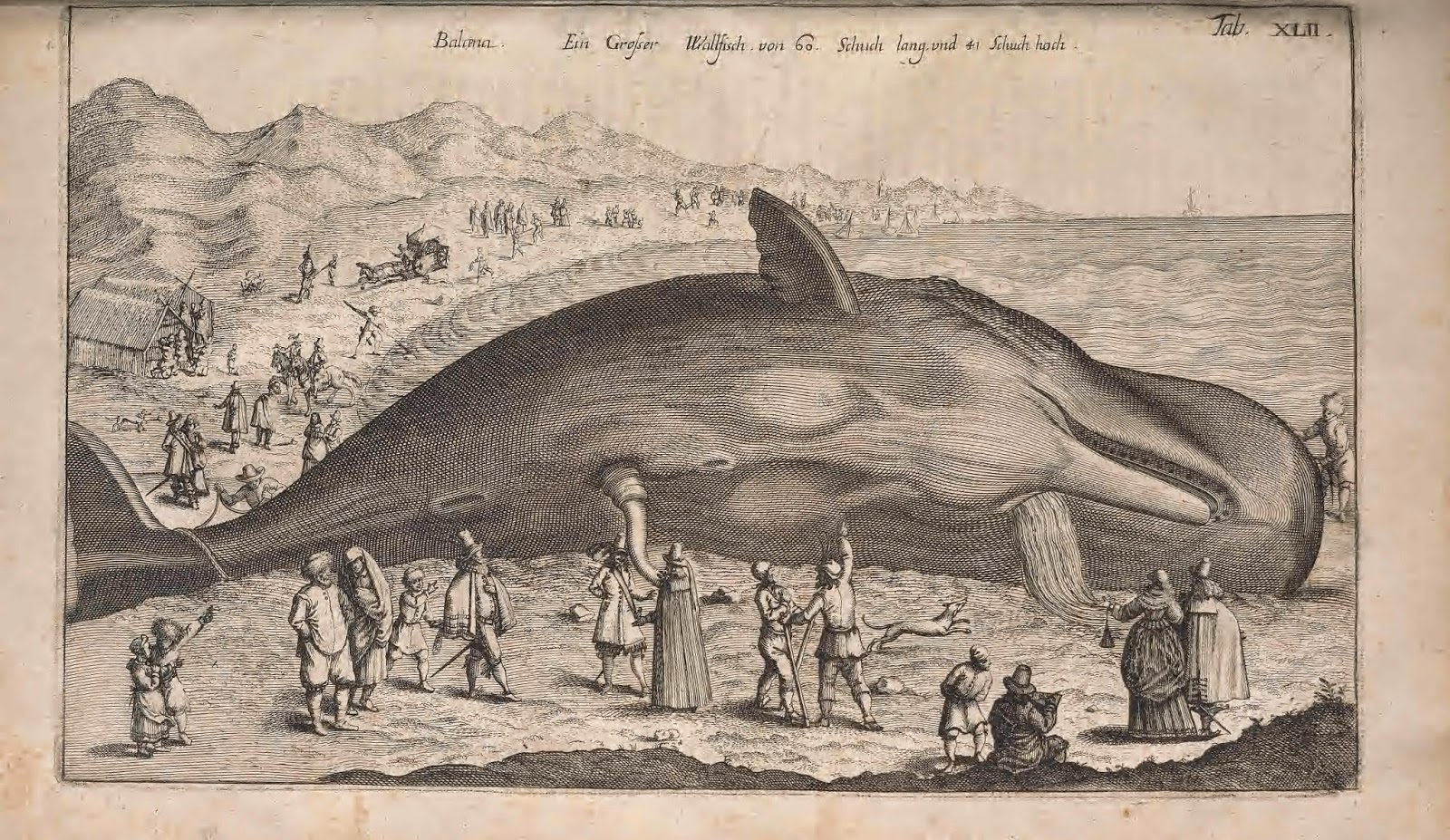
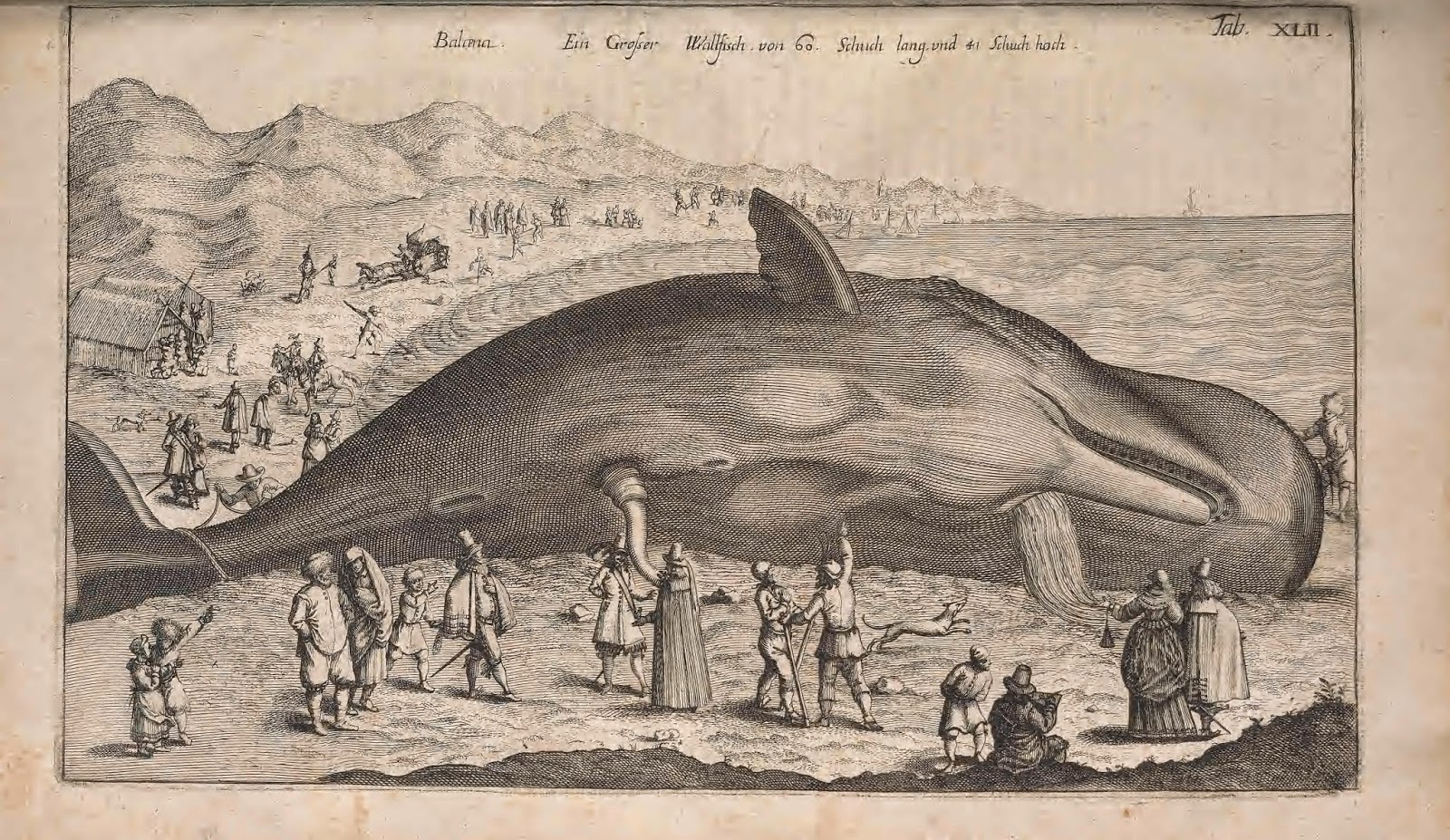
In the years following Linnaeus’ naming of the species, mystery and confusion surrounded the sperm whale, and over a dozen species names and multiple genera were published for the whale by the mid-1800s. Most of what information could be gleaned about the animal came from specimens that washed ashore, such as that depicted in Johann Jonstonus’ 17th century work Historiae naturalis de quadrupetibus libri, and from whaling expeditions.
View Full Size Image
Sperm Whale stranding. Jonstonus, Joannes. Historiae naturalis de quadrupetibus libri. pt. 2-6. 1650. http://biodiversitylibrary.org/page/44040300.

In the 18th, 19th, and early 20th centuries, whaling was an important industry, and the sperm whale, with its spermaceti organ full of valuable sperm oil, was a primary target for whalers.  Despite the threats posed by the industry to whale populations, whalers were perhaps in the best position to learn more about the species they hunted. These expeditions also offered naturalists excellent opportunities to study these cetaceans.

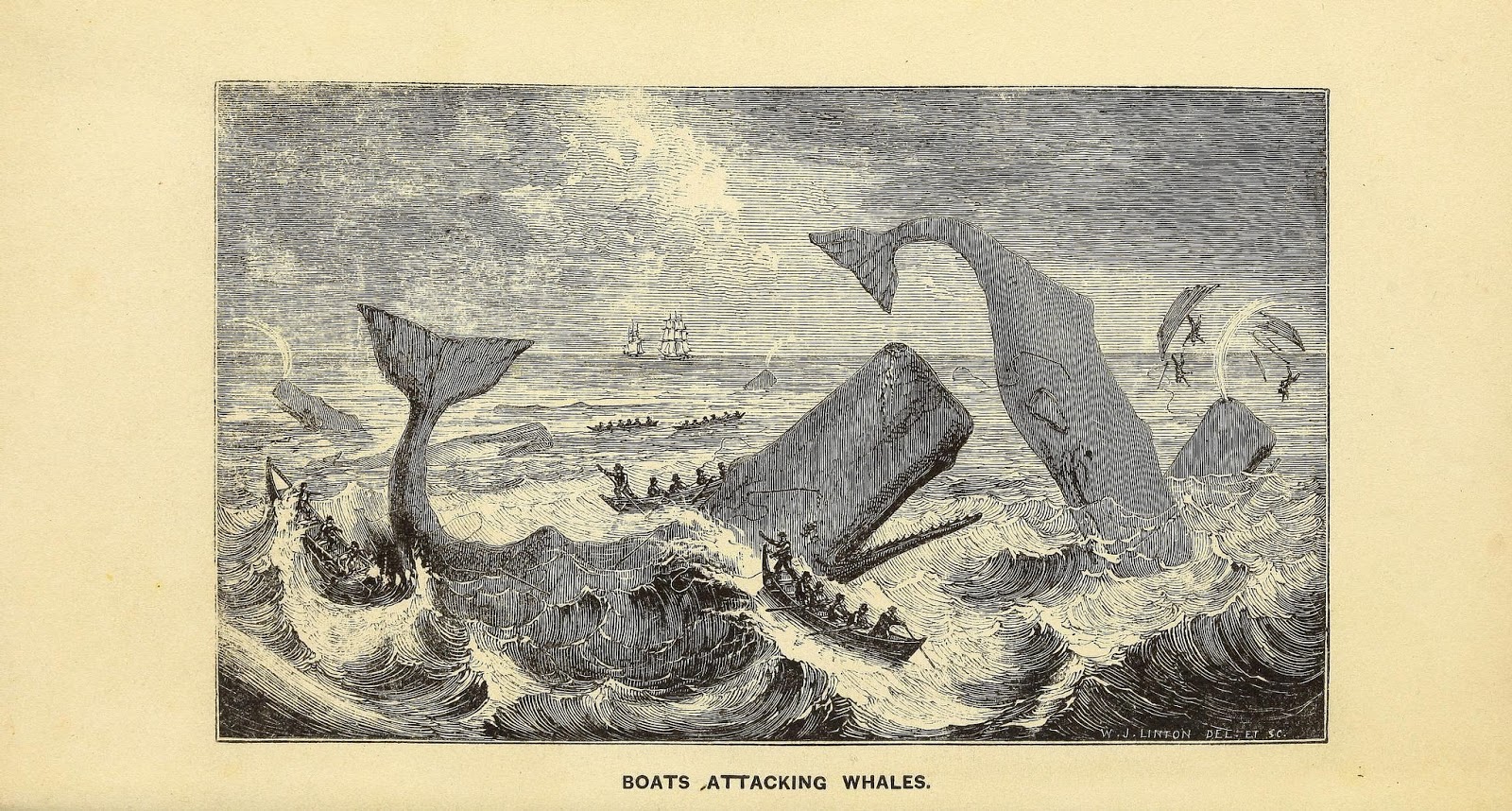
One such individual was Thomas Beale (1807-1849), a British surgeon who, in 1830, joined the London whaling ship Kent as the physician on an expedition to the South Seas. Through his keen observations during the expedition, Beale gathered much information about the sperm whale, and, upon his return to England, published a fifty-eight page booklet for subscribers in 1835 entitled A Few Observations on the Natural History of the Sperm Whale, with an account of the Rise and Progress of the Fishery, and of the Modes of Pursuing, Killing, and “Cutting In” that Animal, with a List of its Favourite Places of Resort. The booklet was so well received that Beale revised, expanded, and republished it in 1839 as The Natural History of the Sperm Whale. This work served as the primary source of what was known about sperm whales at the time, and the Penny Cyclopedia hailed “Mr. Beale…in his excellent work on the ‘Natural History of the Sperm Whale,’ has done more to elucidate its habits and form than any other writer.”
View Full Size Image
Beale, Thomas. The Natural History of the Sperm Whale. 1839. http://biodiversitylibrary.org/page/48976761.

Beale’s work was an important reference for Herman Melville, who acknowledged the book as a primary source of information for the cetological section of Moby-Dick; or, The Whale. Whaling provided additional inspiration for this work; the climax of Melville’s novel is based on the same events recounted within In the Heart of the Sea – the sinking of the Nantucket whaleship Essex. The crew that escaped the sinking of this ship spent three months at sea, covered 4,500 miles, and resorted to tragic lengths to stay alive. Of the 20 men who left the Essex, only 5 survived. Owen Chase, chief mate of the Essex, kept a journal of the events, which was later published as Narrative of the Most Extraordinary Shipwreck of the Whale-ship Essex, of Nantucket; which was Attacked and Finally Destroyed by a Large Spermaceti-whale, in the Pacific Ocean. Melville read Chase’s account of the event, and acknowledged its impact on his writing. The events were circulated within many natural history books, such as in this account within Johnson’s Household Book of Nature (1880).

While today there are only three extant species in the sperm whale family (the sperm whale and its relatives, the pygmy and dwarf sperm whales), their evolutionary history has seen many additional members. One of these, Albicetus oxymycterus, lived around 15 million years ago in the North Pacific Ocean, and now, thanks to research conducted by Dr. Nick Pyenson, curator of fossil marine mammals at the Smithsonian’s National Museum of Natural History, and Smithsonian research student Alex Boersma, we have a better understanding of this animal’s place in its family’s evolutionary history.
View Full Size Image
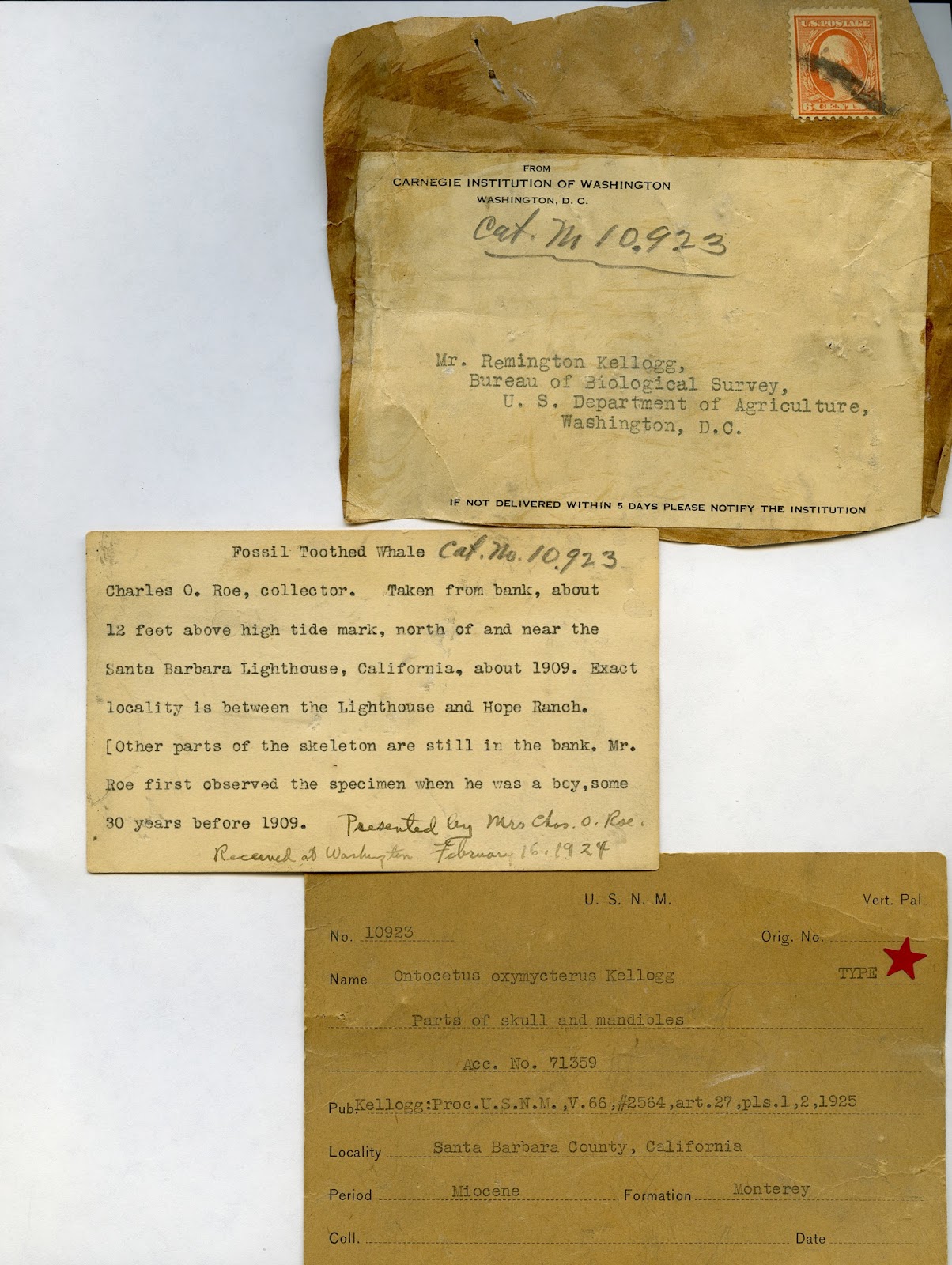
Archival specimen notes for type specimen for Albicetus oxymycterus.

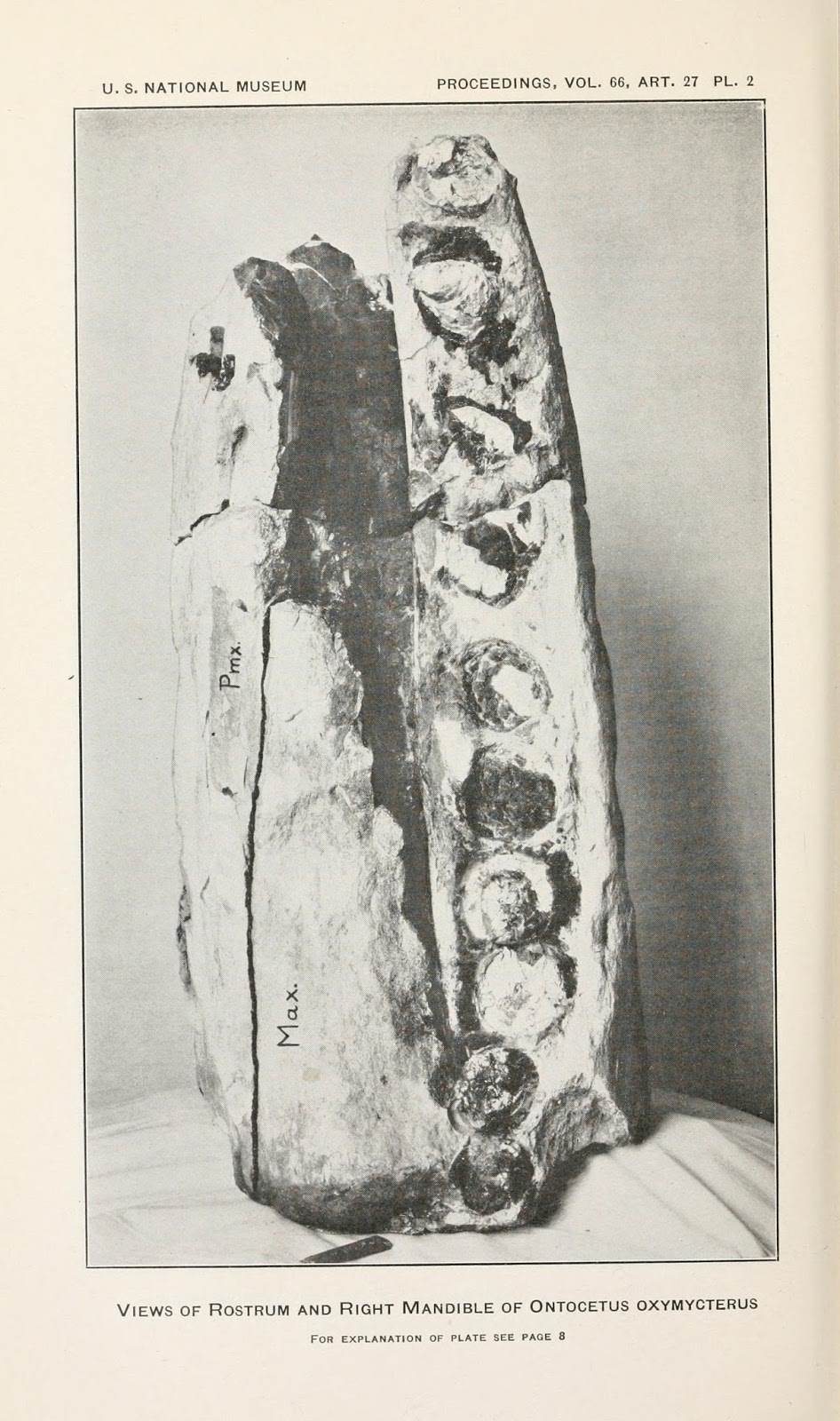
Mr. Charles A. Roe collected the type specimen for Albicetus oxymycterus from the sea cliffs near the original Santa Barbara Lighthouse (known as the Santa Barbara Light) sometime around 1909. Archival typewritten notes at USNM indicate that Mr. Roe had “first observed the specimen when he was a boy, some 30 years before.” After Mr. Roe’s death, his wife presented the National Museum of Natural History (then the United States National Museum) with the specimen in 1924.
View Full Size Image
Albicetus oxymycterus specimen. Kellogg, Remington. Proceedings of the United States National Museum. v. 66 (1926). http://biodiversitylibrary.org/page/7739240.

At the time, well-known naturalist and paleontologist Remington Kellogg had an avid interest in this material (Kellogg would later become curator of vertebrate paleontology at USNM and make extensive contributions to the study of fossil marine mammals). Kellogg took it upon himself to describe the Santa Barbara specimen, and published his findings in 1925. He assigned the specimen to the genus Ontocetus, which was first named by Joseph Leidy on the basis on a large tooth found in the 19th century, which he thought belonged to a large marine mammal, and likely a sperm whale. Kellogg also thought this tooth, Ontocetus emmonsi, resembled the large dentition of his sperm whale specimen, which led him to place the Santa Barbara fossil as a new species in the genus Ontocetus. However, recent authors, weighing in favor of dissenting opinions about Ontocetus since the 19th century, have argued that the original tooth of Ontocetus emmonsi belongs not to a sperm whale, but to an ancient walrus.

In light of our improved understanding of the Ontocetus genus, Pyenson and Boersma re-evaluated the specimen and erected a new genus for it, Albicetus, or “white whale,” in homage to Melville’s Moby Dick.

“Since our specimen is most definitely an ancient sperm whale, we needed to give it a new and more appropriate genus name,” explained Pyenson. “While we don’t know what its skin color in life actually looked like, the color of the fossil is an ashen white. It only seemed appropriate to evoke Melville’s white sperm whale Moby Dick.”
View Full Size Image
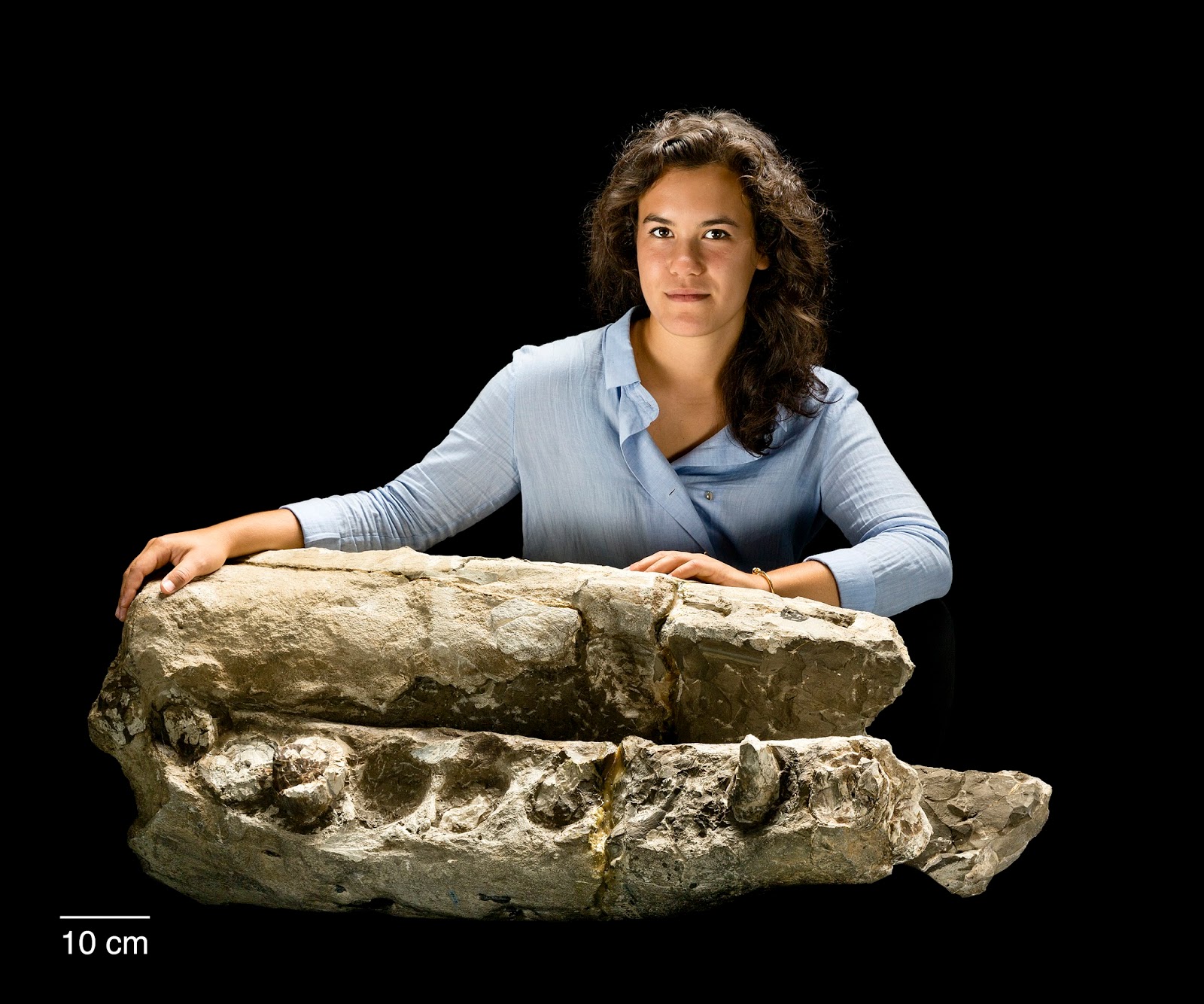
Alex Boersma with the NMNH Albicetus oxymycterus specimen. Photo Credit: James Di Loreto, NMNH Imaging.

Boersma and Pyenson published the name and their accompanying research about the fossil, which includes an estimation of the size of the whale and its place in the sperm whale evolutionary tree, today in the PLOS ONE article “Albicetus oxymycterus, a new generic name and redescription of a basal physeteroid (Mammalia, Cetacea) from the Miocene of California, and the evolution of body size in sperm whales.” The paper helps to resolve questions about how sperm whales have evolved into the singular creatures they are today, with insights on the increase in body size and changes in feeding strategies.

To accompany the redescription, Boersma and Pyenson created a 3-dimensional model of the specimen, available on the Smithsonian X 3D website (http://3d.si.edu). “In addition to making the specimen available for public viewing, the model was also necessary just for us to describe the specimen fully,” confesses Pyenson. “It weighs well over 300 pounds, taking four people just to slowly roll it over. Having the model was crucial for easy examination of the specimen from all angles for description and comparison.”

3D model of Albicetus oxymycterus from Smithsonian X 3D.

Thanks to Herman Melville, the White Whale is arguably one of the most recognizable figures in literary history. It is a figure with many identities. It is a harbinger of death; the personification of evil. It is a symbol of unattainable glory. But today, it is also something more. Today, the white whale is also Albicetus, a majestic, ancient, and complex creature that swam in the heart of the sea millions of years ago.

  • You can browse historic illustrations of the sperm whale in the BHL Flickr.
  • Browse publications about the sperm whale in our White Whale collection on BHL.

With Contributions By:

Nick Pyenson
Curator of Fossil Marine Mammals
Smithsonian National Museum of Natural History

Alex Boersma
Smithsonian Research Student
Smithsonian National Museum of Natural History

December 9, 2015by michelle.underhill
Blog Reel, User Stories

No Flippant Matter: The Re-Invention of the Flipper and Why Ceatacean Flippers Are Unique

Cetaceans are not closely related to other aquatic vertebrates and represent a unique lineage derived from hoofed land mammals that returned to an aquatic lifestyle about 50 million years ago (Thewissen, 1998). The transition from land to water, i.e. the development from weight-bearing forelimb with five hoofed toes to tissue-encased flipper not capable to support locomotion on land, is well documented by fossils (Thewissen et al., 2001, 2009) and very different from other aquatic vertebrates. Consequently many morphological characteristics that cannot be detected in fossils have remained little documented or speculative. Freed from the constraints of gravity and the developmental links to the hind legs, there is also a persistent anatomical plasticity in the flipper of modern cetaceans, showing substantial skeletal disparities sometimes even within the same population or pod (Cooper et al., 2007). Although there are a small number of morphological studies investigating the flipper in extant cetaceans, the understanding of functional morphology in this group has so far remained largely unresolved.

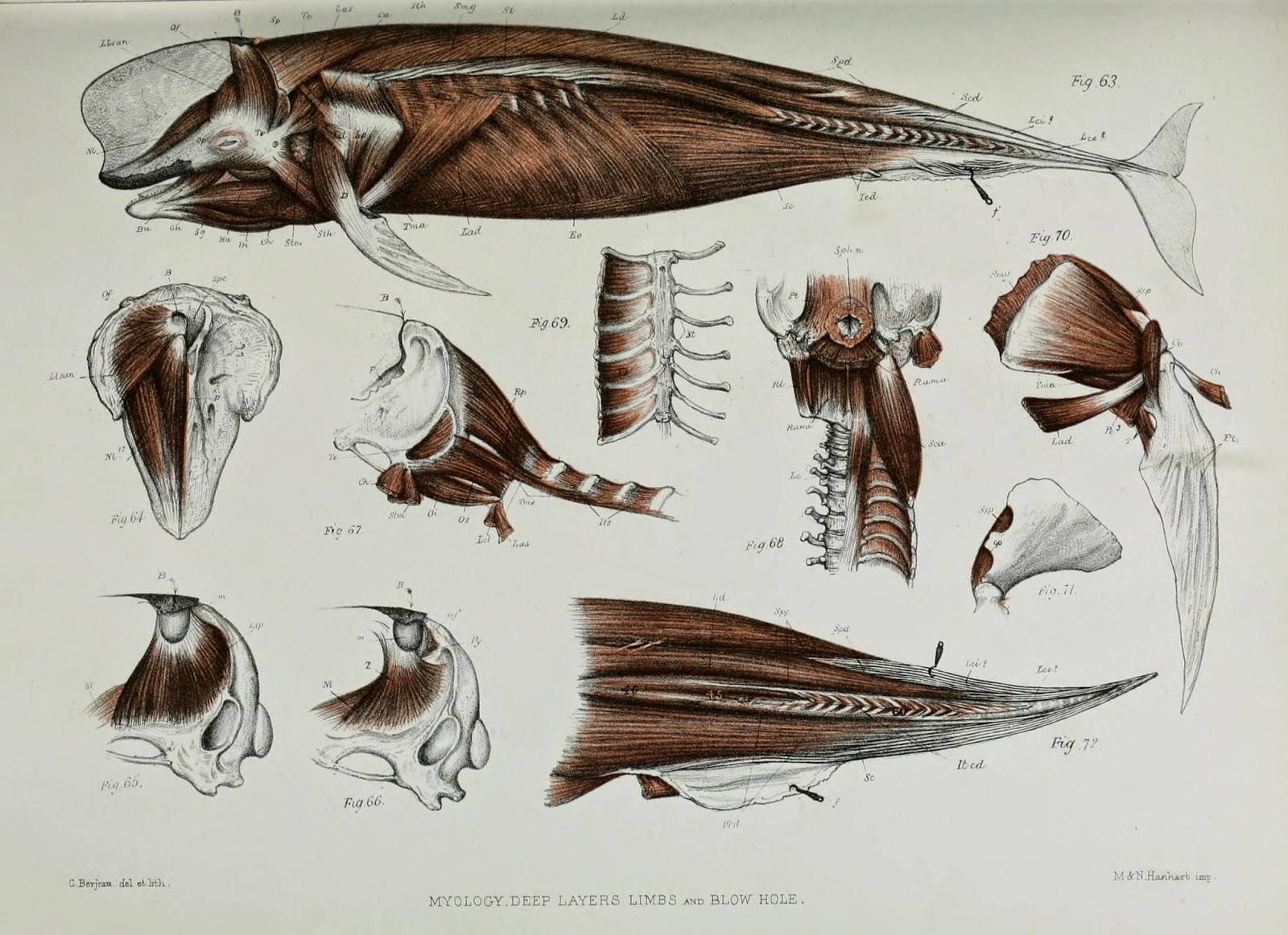
There are less than two dozend studies that include odontocete (toothed whales and dophins) forelimb myology (soft tissue studies). About half are classical works (Howell, 1927, 1930; Murie, 1870, 1873; Schulte and Smith, 1918; Stannius, 1849; Struthers, 1873), most of them available at BHL, and a few are more modern (Benke, 1993; Klima et al., 1980; Pilleri, 1976; Pilleri et al., 1976; Smith et al., 1976; Sokalov and Rodionov, 1974; Strickler, 1978).

View Full Size Image
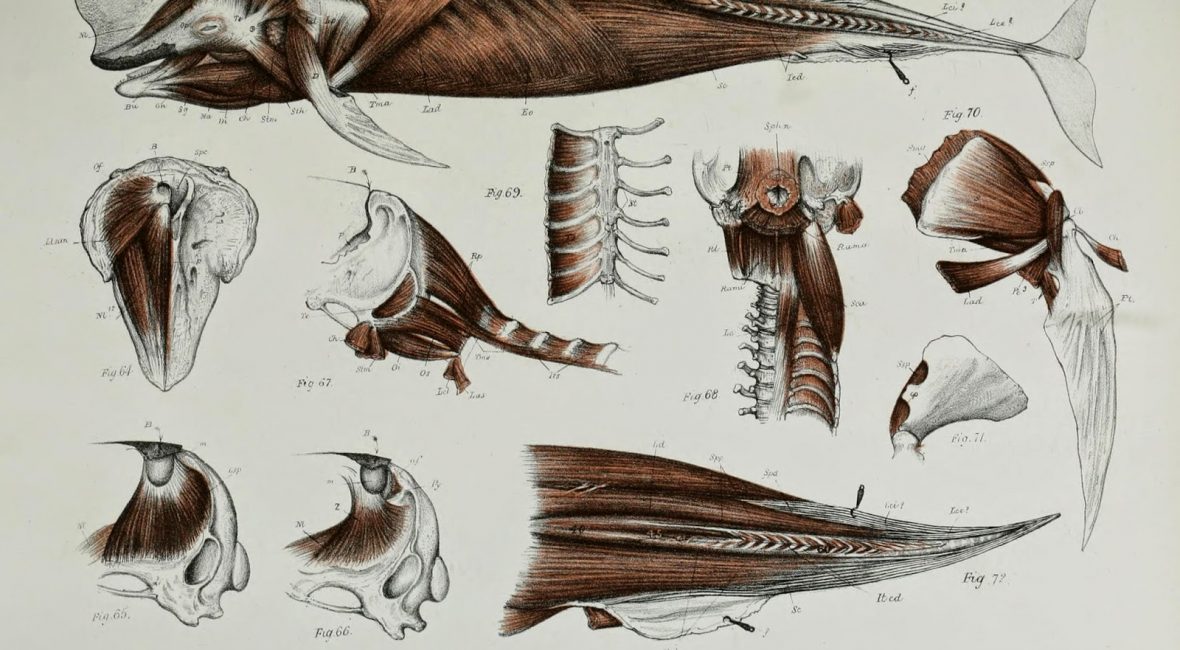
Myology, deep layers, of limbs and blow hole in the long-finned pilot whale (Globicephala melas). Murie, James. “On the Organization of the Caaing Whale, Globiocephalus melas.” Transactions of the Zoological Society of London. v. 8 (1872). http://biodiversitylibrary.org/page/28778656.

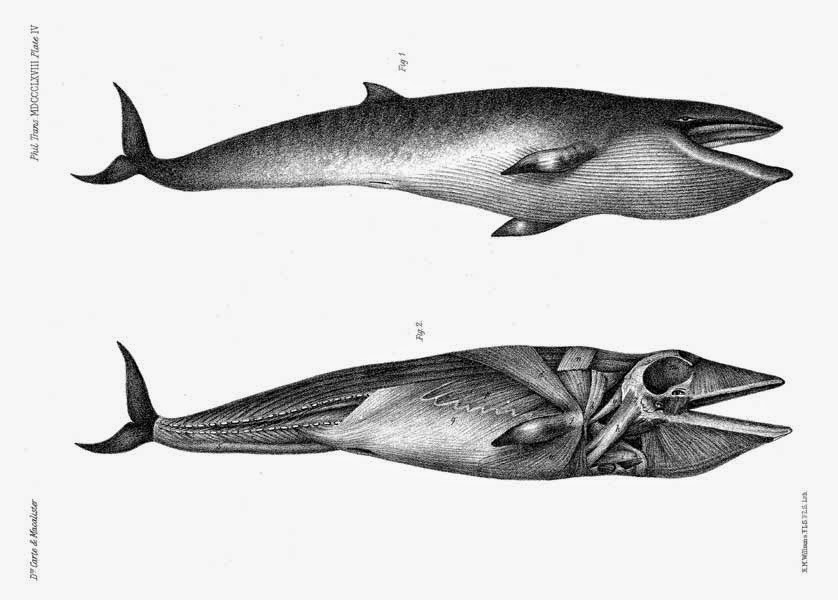
Among mysticetes (balaeen whales) the lack of data is particularly apparent. The few accounts that include soft tissue are limited to rorquals (Benke, 1993; Carte and Macalister, 1868; Kükenthal, 1921; Perrin, 1870; Schulte, 1916; Struthers, 1888, 1889) and right whales (Kükenthal, 1922; Struthers, 1878) – except Benke all are nearly or over a century old.

View Full Size Image
Drawing of and lateral view of myology of Balaenoptera rostrata. Alexander Carte and Alexander Macalister. On the Anatomy of Balaenoptera rostrata. Phil. Trans. R. Soc. Lond. January 1, 1868(158). 201-261. http://rstl.royalsocietypublishing.org/content/158/201.full.pdf+html.

The question of how cetaceans transitioned from a weight-bearing leg to a flipper is one of considerable interest to Moyna K. Müller, a PhD student at the Geology Department, University of Otago, New Zealand.

Müller has been studying cetaceans for the past four years, with particular interest not only in the transition of the weight bearing leg to flipper (evo-devo), but also comparative muscoskeletal arrangement of the shoulder and forelimb and functional analysis of the flipper. Her research requires access to historic literature that forms the basis of her comparative analysis and provides access to data from morphological studies done in the past. Gaining access to this literature used to present a challenge for Müller, until she discovered the Biodiversity Heritage Library.

View Full Size Image
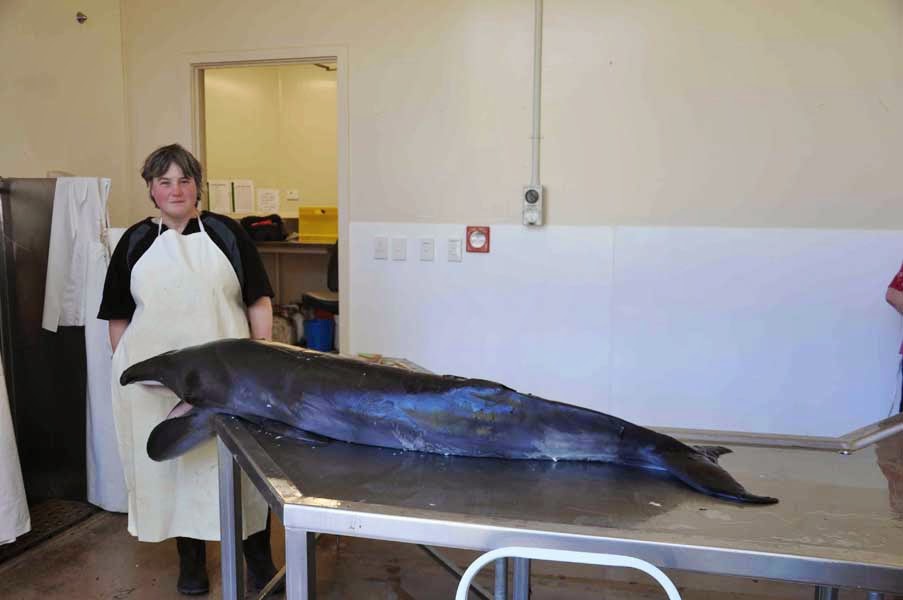
Moyna K. Müller, a PhD student at the Geology Department, Otago University, New Zealand at the Ag research centre Invermay, Mosgiel, with a neonate pygmy right whale. Photo by Cheng-Hsiu Tsai.

“[I discovered BHL] at the beginning of my studies when I couldn’t get an article and in desperation told a fellow student in our group, who then put me onto your website. Since then I felt like a kid in a lolly shop,” praises Müller. “[There are] way too many things to look at distracting me from my studies.”

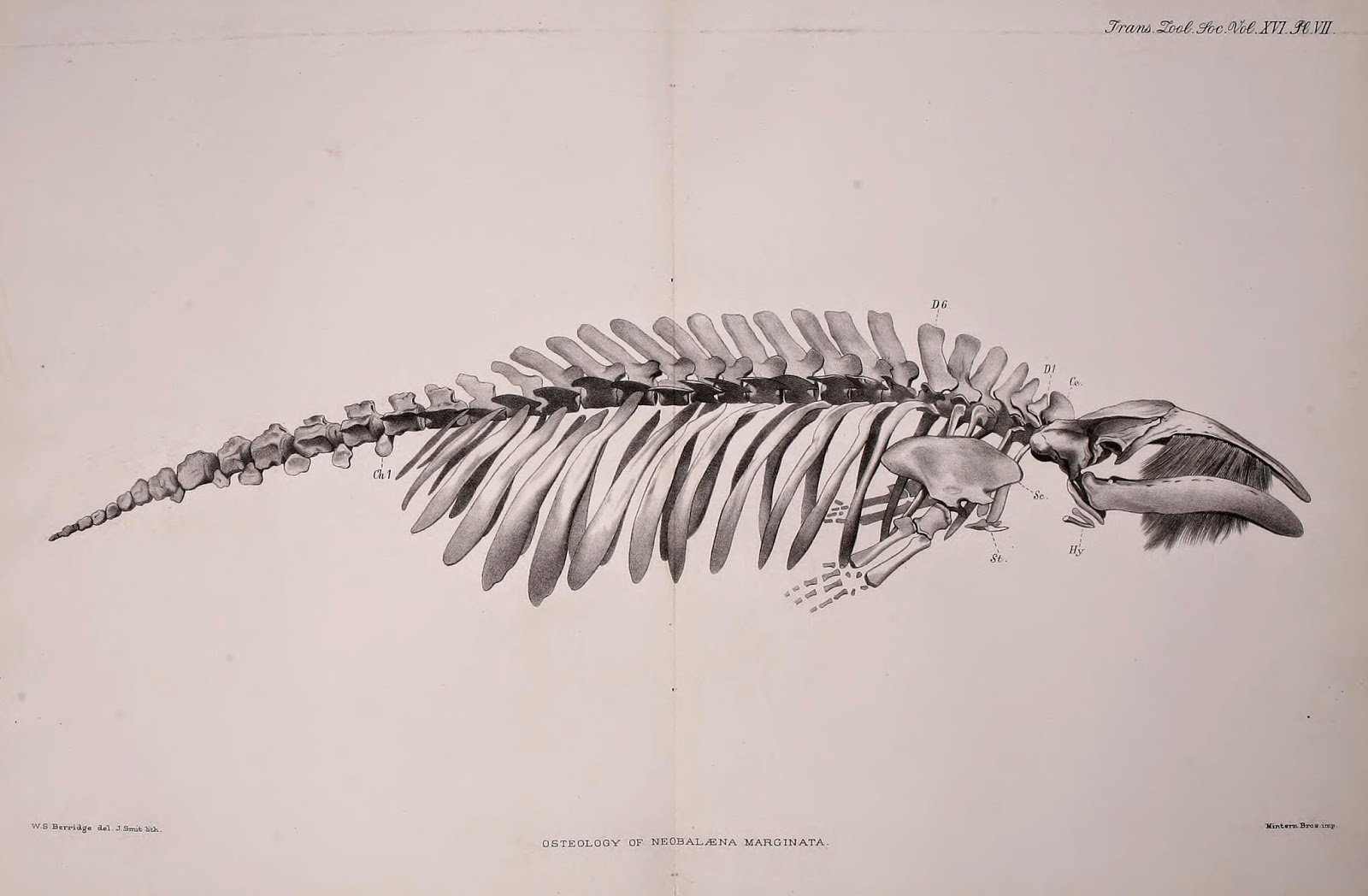
Recently those studies have included work on the pygmy right whale, Caperea marginata, the least known and most elusive of all baleen whales. This species is only known from isolated remains, infrequent solitary strandings, and few sightings, thus sharply contrast with all other baleen whales that are known from a multitude of live observations, captures and strandings (Baker, 1985). The earliest descriptions of this cryptic whale were based on beach-cast fragments associated with a convoluted taxonomy and nomenclature only applied correctly as Caperea marginata from 1930s onwards (Beddard, 1901; Gray, 1873; Rice, 1998). The divergent external appearance and skeletal disparity of the pygmy right whale warrant hereby separation from the true right whales (Balanidae) into a discrete family (Neobalaenidae Gray 1873), separating C. marginata from all other living mysticete families (Balaenidae, Eschrichtiidae and Balaenopteridae). However, only recently has C. marginata also been associated with an otherwise extinct fossil family (Cetotheriidae) (Fordyce and Marx, 2013). It is with this family that the pygmy right whale also shares some of the most striking fatures of the postcranial skeleton, namely the shoulde blade and the ribs (Bouetel and de Muizon, 2006; Gol’din et al., 2013).

View Full Size Image
Osteology of the Pygmy Right Whale Caperea marginata. Beddard, FE. “Contribution towards a knowledge of the osteology of the pigmy whale (Neobalaena marginata).” Transactions of the Zoological Society of London. v. 16 (1901). http://biodiversitylibrary.org/page/32663067.

Müller confides that, to support her work, she uses BHL “too often to count,” downloading PDFs of papers, whole articles, and high resolution images from our collection. The material is invaluable to her research.

“A lot of older literature I cannot get anywhere else, and without it I would sometimes have no basis for comparative analysis or I would not be able to confirm the validity of citations by other authors,” explains Müller. “This was particularly the case when working on the pygmy right whale (Caperea marginata). Apart from the pygmy right whale’s convoluted taxonomy, there are only three detailed descriptions of the shoulder musculature of any baleen whale – two of them (also the most detailed ones) are about a hundred years old (Carte and Macalister 1868 and Schulte 1916).”

When asked to describe her favorite BHL feature, Müller could not narrow it down to a single service (something we love to hear!). She not only finds it easy to locate the journals she needs but also, once she has found a title of interest, quickly determines what volumes are available. She also likes the visually-attractive images displayed throughout the website (even the “stunning fish” displayed on our “item not found” page), as well as the ‘news’, ‘today’s picks’ and ‘featured collections’ components. Finally, she was particularly complimentary of our feedback service (shout-out to Jackie Chapman, our BHL Collections Librarian who triages all of our feedback), describing it as “fast, friendly and very competent.”

View Full Size Image
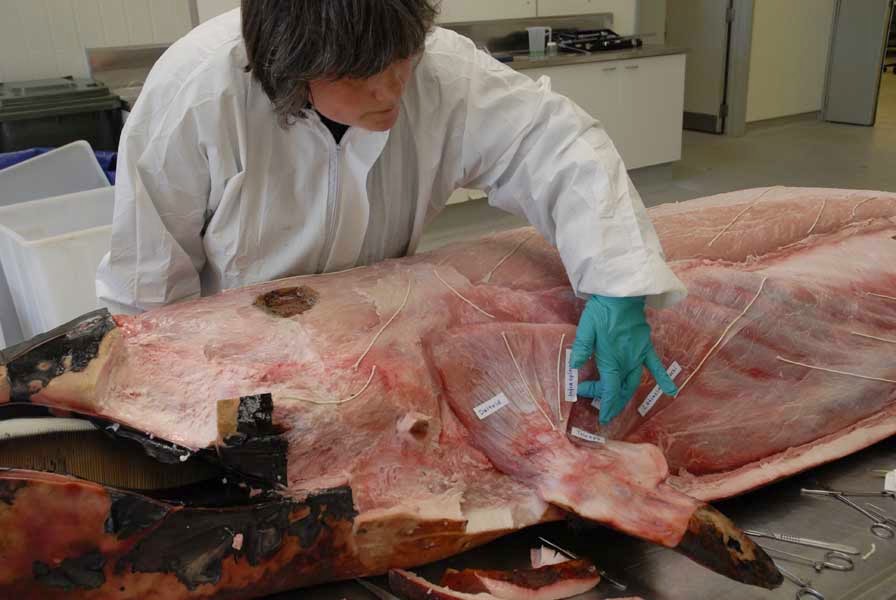
Moyna K. Müller labelling shoulder muscles of a juvenile pygmy right whale at the Museum of New Zealand (Te Papa). Photo by R. Ewan Fordyce.

Likewise, Müller could not name a single-favorite item in BHL. As she describes:

“The problem in my field is that there is no complete work I could use as the fundament for my own work, but rather a host of different articles that cover some aspects, e.g. osteology (van Beneden, 1880, Ostéographie des Cétacés vivant et fossils), or myology (Carte, A. and A. Macalister, 1868, On the anatomy of Balaenoptera acutorostrata or Schulte, H. v. W., 1916, Anatomy of a foetus of Balaenoptera borealis), and equally important the description of little described whales and dolphins (many articles by e.g. W. H. Flower, F. J. Knox, J. Hector, J. E. Gray in various volumes of Transactions and Proceedings of the New Zealand Institute or The Annals and Magazine of Natural History).”

Thus, the ability to retrieve all of these works and more is critical to Müller’s research success. BHL makes that possible.

Finally, Müller did offer a wonderful suggestion for a way to improve BHL, particularly in relation to the many foreign works available.

“You have quite a bit of foreign literature. [It’s] no problem for me to translate e.g. German or French, but it might be worth considering creating an option to upload translations, or a summary created by researchers in that field who do speak that particular language and are familiar with the terminology in their field, since a crude translation or summary is still better than none for somebody who doesn’t speak that language at all.”

As we continue to explore more and more crowdsourcing opportunities within our BHL community, and investigate ways to allow our users to help us improve our collections and services, the ability to add translations, transcriptions, and annotations are just some of the features we’re considering for our next interation of BHL. You can stay up to date with all of our website and service changes and improvements by following us on this blog, Twitter, and Facebook or subscribing to our newsletter. If you have suggestions for ways to improve our website or collections, please send us feedback!

Thank you, Moyna, for taking the time to explain how BHL is useful to you in your daily work! Do you use BHL to support your work? Want to tell us about it? Send us a message at [email protected].

Click here to see cetacean sources cited, used, or otherwise useful, outlined by Moyna K. Müller. 

With Contributions From:
Grace Costantino
Outreach and Communication Manager, Biodiversity Heritage Library

April 9, 2015by ulib-libraryjobs
Blog Reel, Featured Books

True Detective: Frederick W. True’s lifelong dedication to uncovering the natural history of marine mammals

This post is a guest post by John Ososky and Nick Pyenson, originally published on the Pyenson Lab blog.

The Smithsonian Field Book Project is showcasing Frederick William True in February! This post is follows in a series of blogs and social media content from the Biodiversity Heritage Library, Pyenson Lab, Smithsonian Transcription Center, Smithsonian Archives, and Smithsonian Libraries celebrating #FWTrueLove. Click on these links to the first and second posts; the third one, below, is based on a seminar recently presented by John Ososky (OsteoPrep Lab, Department of Vertebrate Zoology, NMNH) and co-written with N. D. Pyenson.

View Full Size Image
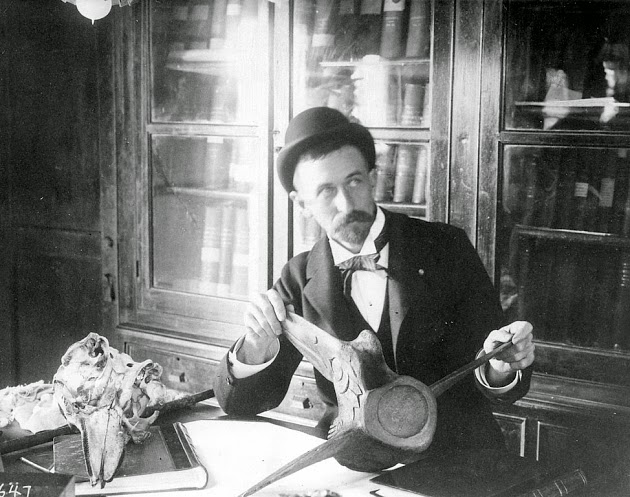
Frederick William True. c. 1880s. Smithsonian Institution Archive. Negative Number 2002-32245.
http://siarchives.si.edu/collections/siris_sic_10688.

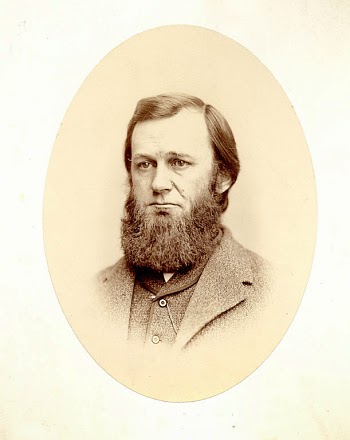
In 1858, the inland port of Middletown, Connecticut, was the largest manufacturer of marine hardware in the United States, at a time when the shipping industry shifted from sails to steam. Frederick W. True was born that year, and unsurprisingly developed a lifelong interest in ships and fisheries, especially as he witnessed the decline of the Yankee whaling industry. After earning a Bachelor of Science degree in 1878, he took a job as clerk with the U.S. Fish Commission, which at the time was headed by the Smithsonian’s second Secretary, Spencer Fullerton Baird.

View Full Size Image
Spencer Fullerton Baird. Smithsonian Archives – History Div, 46853/oval or 2004-60740.
http://siarchives.si.edu/history/spencer-fullerton-baird.

While Secretary of the Smithsonian, Baird also decided to serve as the first Commissioner of the U.S. Fish Commission (a precursor to NOAA’s National Marine Fisheries Service). Under Baird’s guidance, the Commission became a robust scientific enterprise, undertaking extensive surveys of fisheries along all U.S. coastlines, censuses of fishery laborers, and also collecting data on target species and fisheries infrastructure. Baird was strategic about his influence, and he used the expansion of the Commission as an opportunity to hire promising young naturalists — such as True — and get their foot in the door at the Smithsonian.

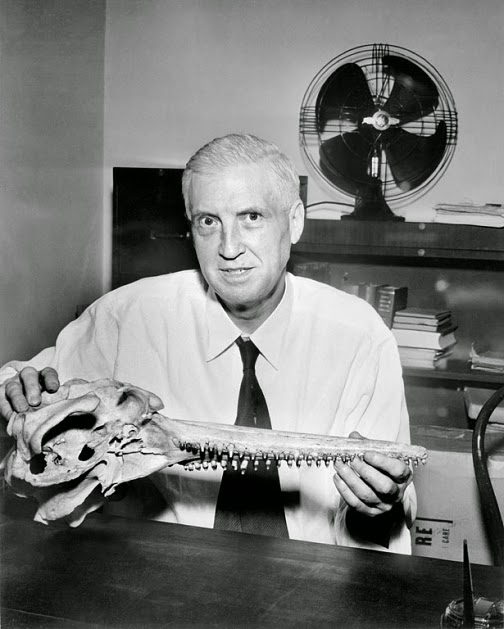
Recruited by Baird, True was initially a special agent for the U.S. Fish Commission, but eventually Baird put him in charge of the joint Smithsonian-U.S. Fish Commission display at the Berlin Fisheries Exhibition of 1880, where many of the specimens collected by special agents for the Commission were put on display. At the time, the Smithsonian lacked an official library (for various historical reasons), and Baird rectified this situation in 1881 by donating his own personal library to form the core of a new research library at the Smithsonian. Baird recognized True’s diligence and acumen as a reseacher, and hired him to lead it. True seized on the opportunity, and improved on the idea immediately, forming divisional libraries to meet the specialized needs of individual curators, which still continue to this day (such as the Kellogg Library of marine mammalogy, named in honor of Remington Kellogg, who never met True but succeeded him as a Smithsonian marine mammalogist).

View Full Size Image
Remington Kellogg. Smithsonian Institution Archives. Image Number 78-3701.
http://siarchives.si.edu/collections/siris_sic_11289.

True sometimes diverged from his role as a librarian to fill a void as acting curator of mammals; Baird, who noted True’s ambition and drive, soon appointed him curator of mammals in 1883. While microscopic descriptions were the rage in natural history at the time, True’s poor eyesight made this type of work difficult. True instead recognized the wealth of marine mammals specimens at the Smithsonian that had been generated in part by Baird’s collections from the Commission, as well as collections made by Captain Charles M. Scammon in the North Pacific Ocean in the 1870s and the prolific Edward Drinker Cope, who had been hired by Baird to write a monograph on cetaceans, which only came to partial fruition. Thus, True had the opportunity and motivation to expand his interest in marine fisheries and take on the study of cetaceans.

At the same time, True recognized the need to expand and grow the collections for the U.S. National Museum (USNM, the forerunner of what today is called the National Museum of Natural History, or NMNH). In a shrewd and practical move, True encouraged keepers of lighthouses and life-saving stations along the U.S. coasts to collect stranded specimens and data on marine mammals. True’s 1884 guide on the topic effectively presaged the logic of the modern marine mammal stranding network, which only formally took effect with the U.S. Marine Mammal Act of 1972.

View Full Size Image
Suggestions to the keepers of the U.S. life-saving stations, light-houses, and light-ships; and to other observers, relative to the best means of collecting and preserving specimens of whales and porpoises. True, F.W.  (1884).
http://biodiversitylibrary.org/page/16177227.

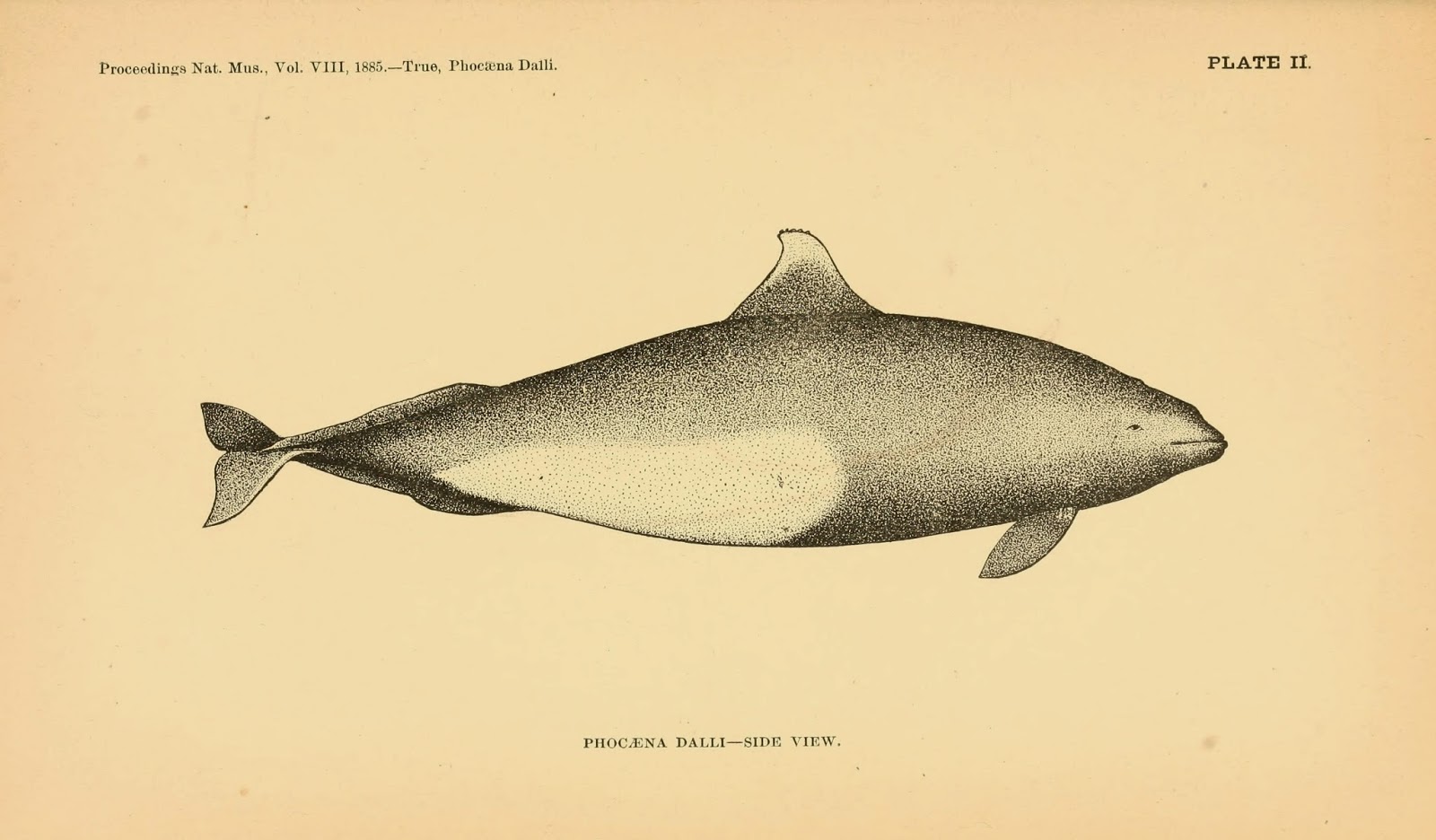
True capitalized on Baird’s support by expanding collecting efforts, both opportunistically as part of industries and fisheries, and with more dedicated expeditions with specific curators at USNM. For example, the Smithsonian’s involvement with the Western Union Telegraph Expedition to Alaska in 1865 brought William H. Dall, a paleontologist who later would work for both the U.S. Geological Survey and the Smithsonian, into the collaborative fold. As a tribute to Dall’s impact, True named Dall’s porpoise, Phocaena dalli (now Phocoenoides dalli) in 1885 based on a description, drawings and specimen collected by Dall in Alaska. Unfortunately, this specimen was initially shipped to the Army Medical Museum by mistake, where rats chewed up the postcranial elements. (The skull is now all that is now left of the holotype specimen).

View Full Size Image
Dall’s porpoise (Phocoenoides dalli). Proceedings of the United States National Museum. v. 8 (1885). http://biodiversitylibrary.org/page/15383677.

In 1895, the U.S. Fish Commission called True back into service for a study on the Northern fur seal industry in the Pribilof Islands, off Alaska. The Commission, lacking confidence in the local Russian naturalist’s conclusion about sustainable yield of fur seal skins from the islands’ rookeries, launched their own investigations. True, as he would in other field expeditions, brought along his father-in-law, D. W. Prentiss, as well as one of his chief preparators, William H. Palmer, who collected specimens while there. (Palmer would also later collect Miocene fossil marine mammals for True in Calvert County, Maryland). En route to the Pribilofs, the team dropped off another Smithsonian curator, Leonhard Stejneger, at the Commander Islands, near the Kamchatka Peninsula of modern-day Russia. Stejneger, who slightly preceded True, collected many marine mammals as well, including a beaked whale specimen that True named for him, Mesoplodon stejnegeri. True’s report on their work at the Pribilofs offered novel conservation strategies for the population, although he viewed a ban on pelagic sealing as the only effective strategy.

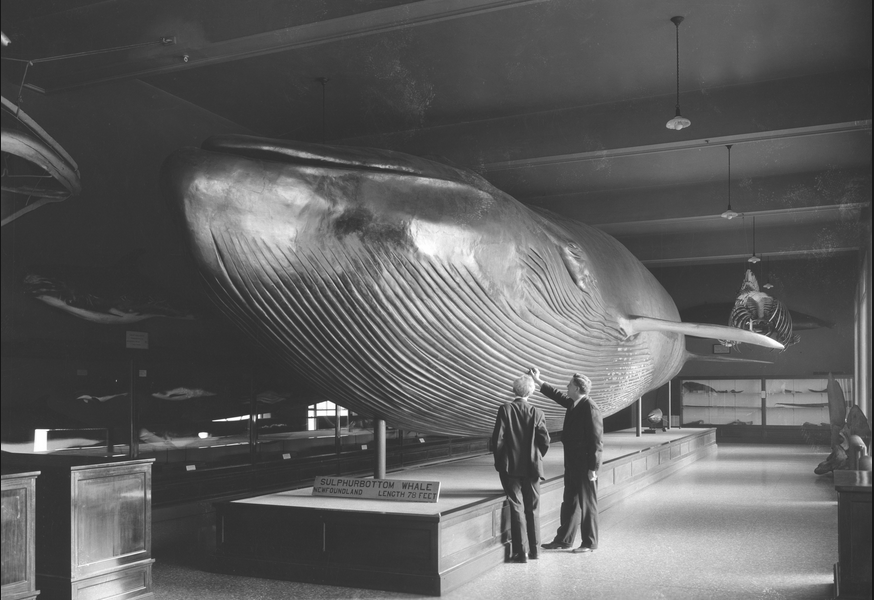
In 1899, True travelled to Newfoundland where a shore based whaling operation had been started by the Cabot Whaling Company at Snooks Arm in Notre Dame Bay. True joined the crew on the steam powered ships as they harpooned and returned to the station fin whales, as well as a smaller number of humpbacks. True observed and photographed the whaling operation, but also participated in crew activities, even including manning the harpoon on a successful fin whale hunt. As whales were flensed and processed, True availed himself of an opportunity to study the whale’s anatomy, especially at a second station that was opened at Balaena Station in Hermitage Bay, Newfoundland, in 1901. There, the primary target species were blue whales, which were too fast and too large for earlier fisheries to tackle. This operation offered an exciting new opportunity to study them, and generated important collections for the USNM, including a full plaster cast of one individual for the St. Louis Exposition of 1903.

View Full Size Image
Remington Kellogg and Leonhard Stejneger with the 1903 blue, or sulphur-bottom, whale, on exhibit in the Natural History Museum, c. 1930s. Image from Smithsonian Institution Archives.

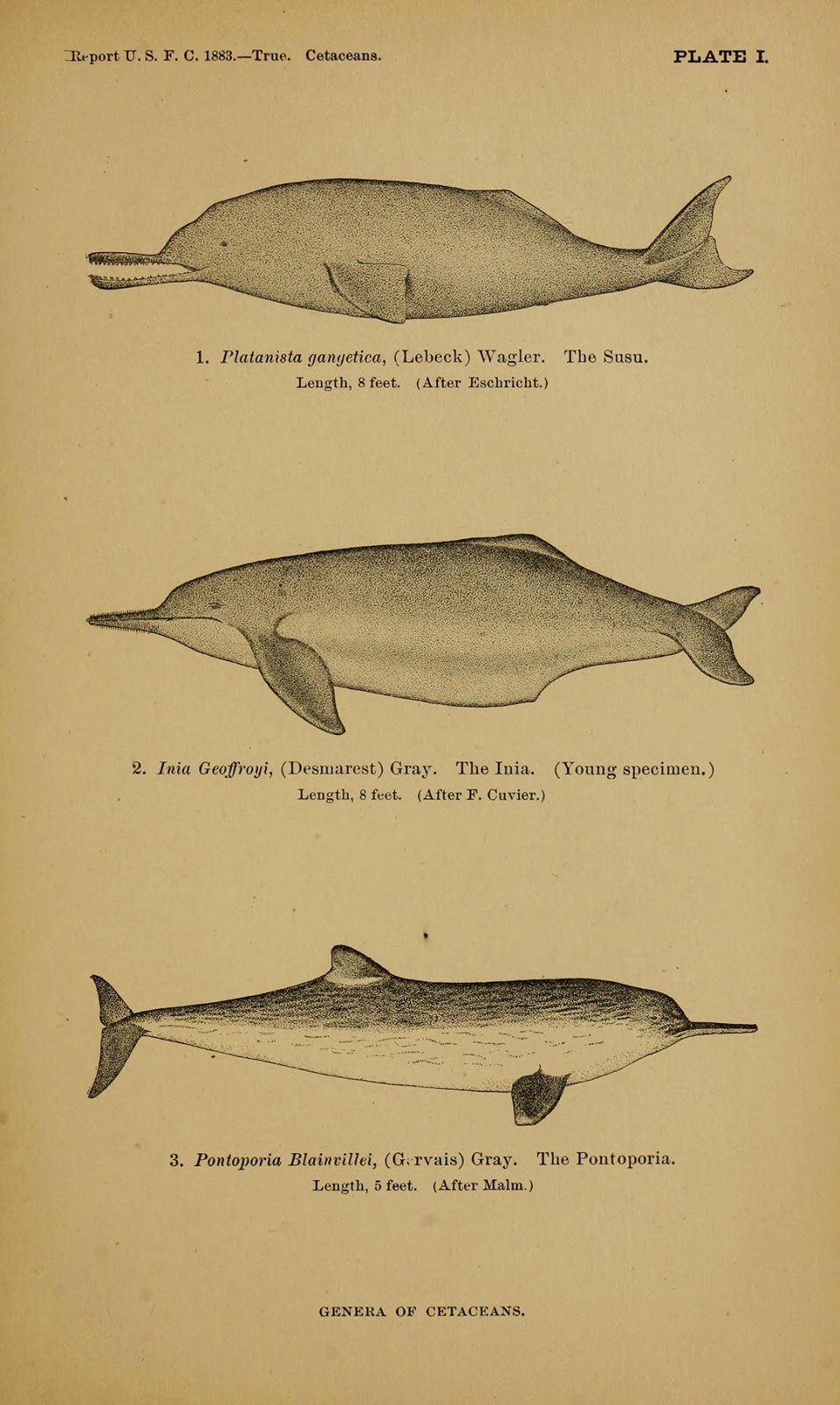
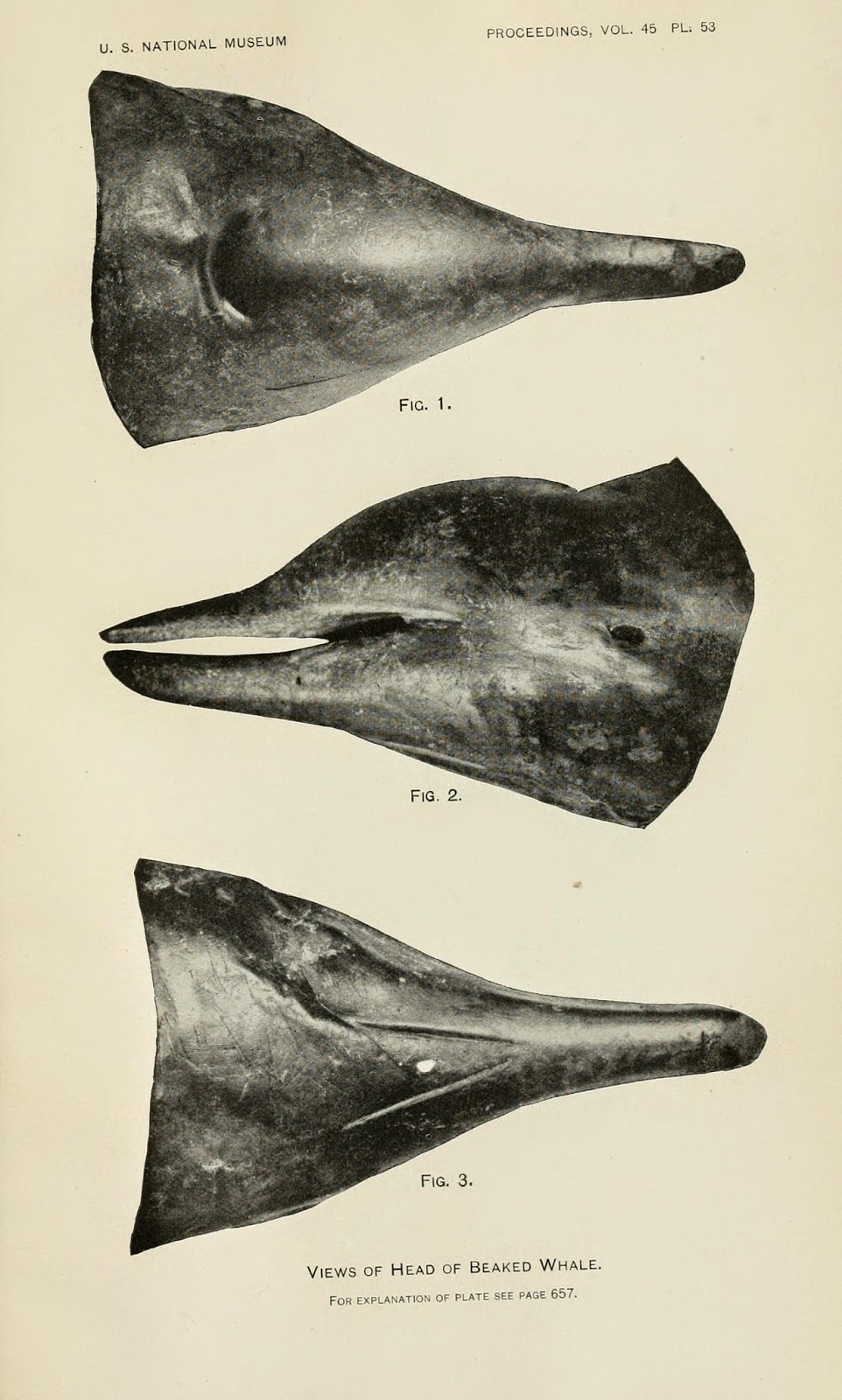
True’s ultimate contributions to marine mammal science were three profound monographs on Cetaceans. Grace Costantino provided a nice summary of his 1899 monograph on oceanic dolphins (A Review of the Family Delphinidae) at BHL’s blog last week. True’s lengthy Whalebone Whales of the Western North Atlantic in 1904 marked the first affirmative answer to whether baleen whales on opposite sides of the Atlantic constituted the same species and populations. To arrive at that conclusion, True provided the first extensive review of the validity of earlier descriptions of American whales by Scammon and Cope, an effort which relied on his own travels to other museum collections, and the rapidly growing one at his home institution (USNM). His 1910 work on beaked whales (An Account of the Beaked Whales of the Family Ziphiidae) similarly cleared up a mess of older taxonomic names for this enigmatic group of toothed whales, which have been a special strength of the Smithsonian since the time of Baird. In the past 100 years, many beaked whale species have been named after Smithsonian curators and other research associates, including: Baird’s beaked whale (Berardius bairdii), Stejneger’s beaked whale (Mesoplodon stejnegeri), True’s beaked whale (Mesoplodon mirus) and Perrin’s beaked whale (Mesoplodon perrini by emeritus curator of marine mammals James G. Mead). For his own contributions, True’s name is bestowed on the common names of two rodent species that he described and published on from Asia.

View Full Size Image
Head of True’s Beaked Whale (Mesoplodon mirus). Proceedings of the United States National Museum. v. 45 (1913). http://biodiversitylibrary.org/page/7307255.

In True’s entry for the Dictionary of American Biography, Alexander Wetmore (an ornithologist, Smithsonian curator, and the sixth Secretary of the Smithsonian) reflected that True was “profound as a student, and exact and punctilious as an administrative officer,” traits that no doubt served him well in his major capacities at USNM. By 1897, True was appointed head curator of the Department of Biology, with broad administrative direction over all biological work at USNM, and served as acting secretary of the entire institution for a short period of time that year. When the natural history collections of USNM moved across the National Mall to the newly built natural history building in 1910 (today, the main museum for NMNH), True became assistant secretary of the Smithsonian in charge of the library and of the international exchange service, a position that he occupied until his death in 1914.

February 13, 2015by ulib-libraryjobs
Blog Reel, Campaigns, Featured Books, Monsters Are Real

A Whale of a Tale…The Leviathan

The Devil Whale

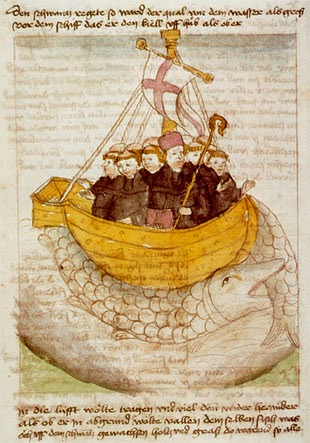
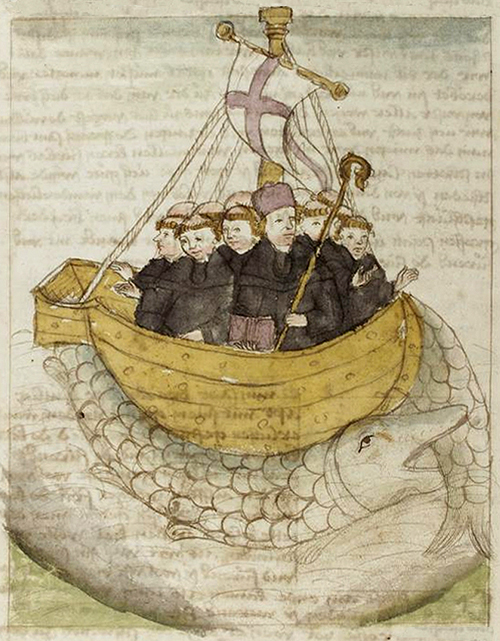
In the 6th century AD, St. Brendan, an Irish cleric, and eighteen other monks, sailed out from Ireland to cross the ocean. Amidst their journey, they came upon a black, treeless island and decided to make camp for the night. Several monks set up a cooking station and lit a fire. And then the island began to move. Terrified, the monks fled back to their boat, leaving the food and fire behind. St. Brandon urged them not to be afraid; it was simply the great fish Jasconius, “which laboreth night and day to put his tail in his mouth, but for greatness he may not” (Navigatio sancti Brendan abbatis, 9th century, translated from Latin).

View Full Size Image
St. Brendan atop Jasconius. Manuscriptum translationis germanicae (ca. 1460, Cod. Pal. Germ. 60, fol. 179v, Universitätsbibliothek Heidelberg). http://www.hs-augsburg.de/~harsch/Chronologia/Lspost10/Brendanus/bre_navi.jpg.

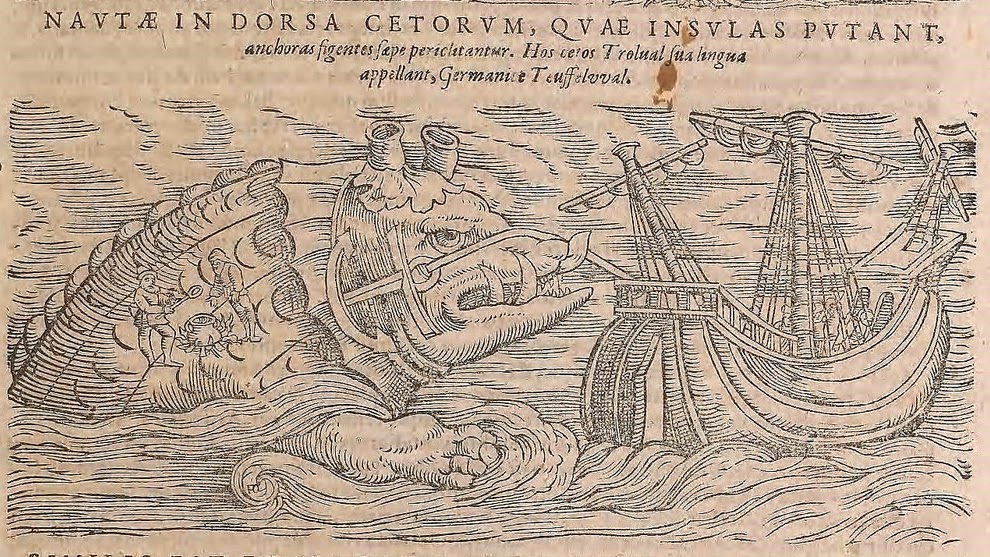
Gessner describes Jasconius by another name: the Trol whale or Devil Whale, which lies asleep in the water and is often mistaken for an island by hapless sailors. Gessner was likely inspired by Magnus, who claims that the whale’s skin is like sand, lending to its confusion with a beach. When the whale is disturbed by the sailors’ dinner fires, it sinks, causing such a whirpool that the ships themselves are often sunk.

View Full Size Image
The Devil Whale, complete with sailors trying to cook a meal on its back. Gessner, Conrad. Historia Animalium. 2nd Ed. 1604. http://biodiversitylibrary.org/page/42165750.

For centuries, men have imagined all manner of aquatic monsters. The ocean was a strange and foreign place, and even several hundred years ago, was very little explored. “If the very body of the ocean presented a fearsome aspect, with its dark, roiling waters, its threatening visage, and its intimidating vistas, its occupants were the quintessence of terror,” wrote marine biologist Richard Ellis in his book Monsters of the Sea. “The landlubbers’ only contact with the large creatures of the sea was at best sporadic and often completely incomprehensible” (Ellis, pgs. 193-194).

This sporadic contact spawned tales of horrible beasts. Quite often, these horrible beasts were, in truth, cetaceans.

The Sperm Whale: Chief Among the Leviathans

Even before sailors encountered whales in the ocean, washed up carcasses, sometimes badly mutilated, ignited a fear of the creatures of the deep. According to Ellis, “the sperm whale, with its mysterious habit of stranding on shallow beaches, was probably responsible for many of the legends and myths of sea monsters.” (pg. 194).

The record of sperm whale strandings is quite dramatic. Quite often, they are stranded en masse. For instance, in 1723, seventeen whales were stranded ashore the Elbe River in Germany. In 1784, thirty-one made landfall in Brittany. In 1888, sixteen washed up in Cape Canaveral, and in 1974, 72 were found on the coasts of New Zealand.

A variety of circumstances can result in a stranding, including rough weather, illness or age, difficulty giving birth, hunting mishaps, or even attempts to rescue another whale in distress.

View Full Size Image
Sperm Whale stranding. Jonstonus, Joannes. Historiae naturalis de quadrupetibus libri. pt. 2-6. 1650. http://biodiversitylibrary.org/page/44040300.

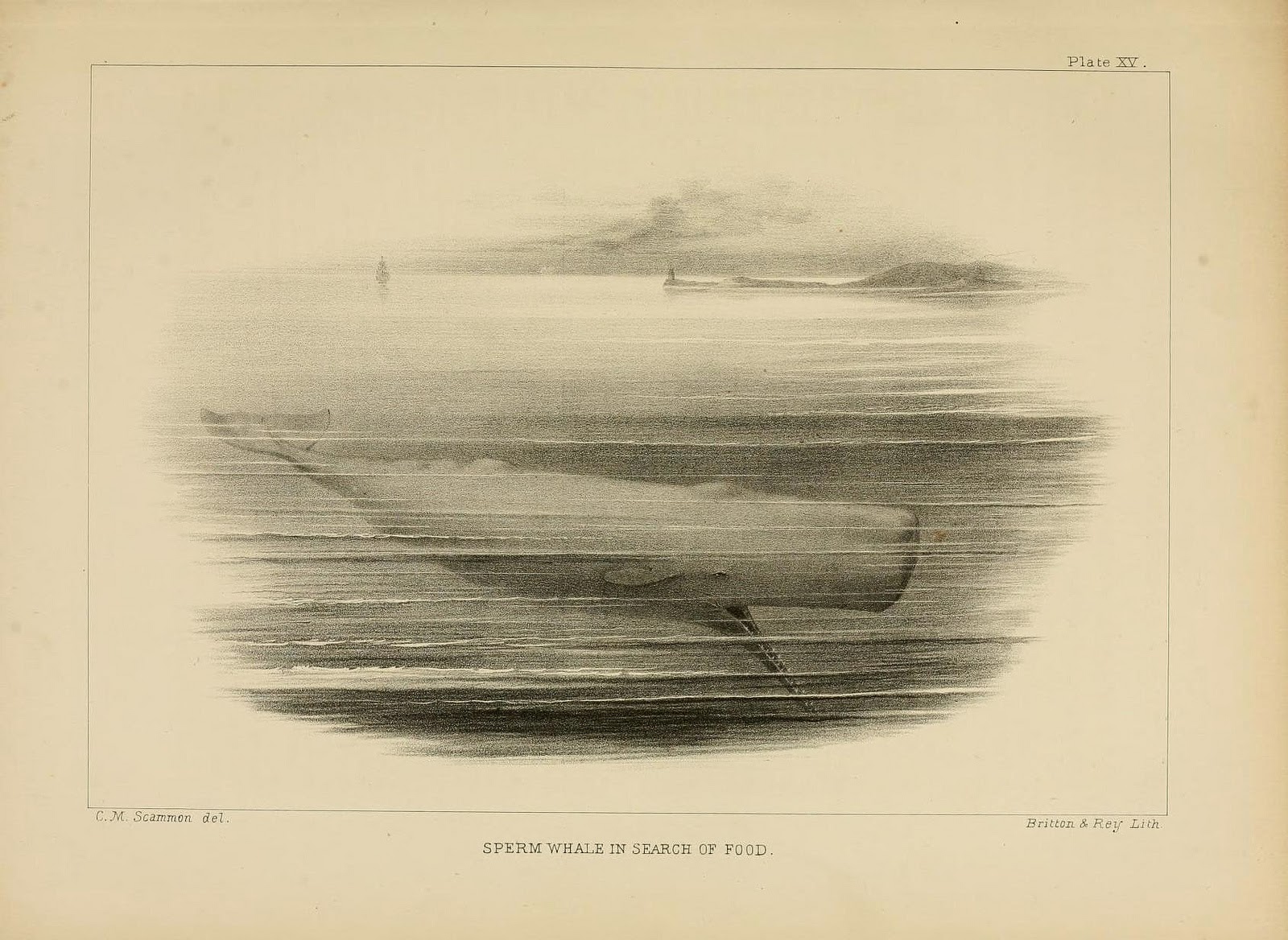
The sperm whale (Physeter macrocephalus) is a strange animal, even among whales. The largest toothed whale, and toothed predator, in the world, the sperm whale holds many records. It has the longest intestinal tract and largest brain in the animal kingdom. It also has the largest nose of any animal and cavities within its head hold reservoirs of liquid wax called Spermaceti. This behemoth can reach up to 67 feet long and weigh as much as 125,000 pounds!

View Full Size Image
A Sperm Whale in search of food. Scammon, C.M. The marine mammals of the north-western coast of North America. 1874. http://biodiversitylibrary.org/page/16226208.

A Whole Order of Leviathan Inspiration

While their strange appearance and prolific beachings likely inspired many monster stories, sperm whales are not the only cetaceans that natural history writers had contact with. For instance, a blue whale – the largest animal to have ever lived – is documented as having come ashore as early as 1692, in Scotland. A 95-foot specimen was placed on exhibit in Europe in 1827, “further enhancing the image of the whale as a gigantic monster” (Ellis, pg. 197). Interactions with right whales, bowheads, baleens, and orcas also inspired Leviathan legends.

Whales From Hell

The range of monsters inspired by cetaceans is charmingly diverse, including many varieties in addition to the Devil Whale. Most are likely the result of an amalgamation of many species, and some (like the Devil Whale) may also have been shaped by religious undercurrents.

Pristers

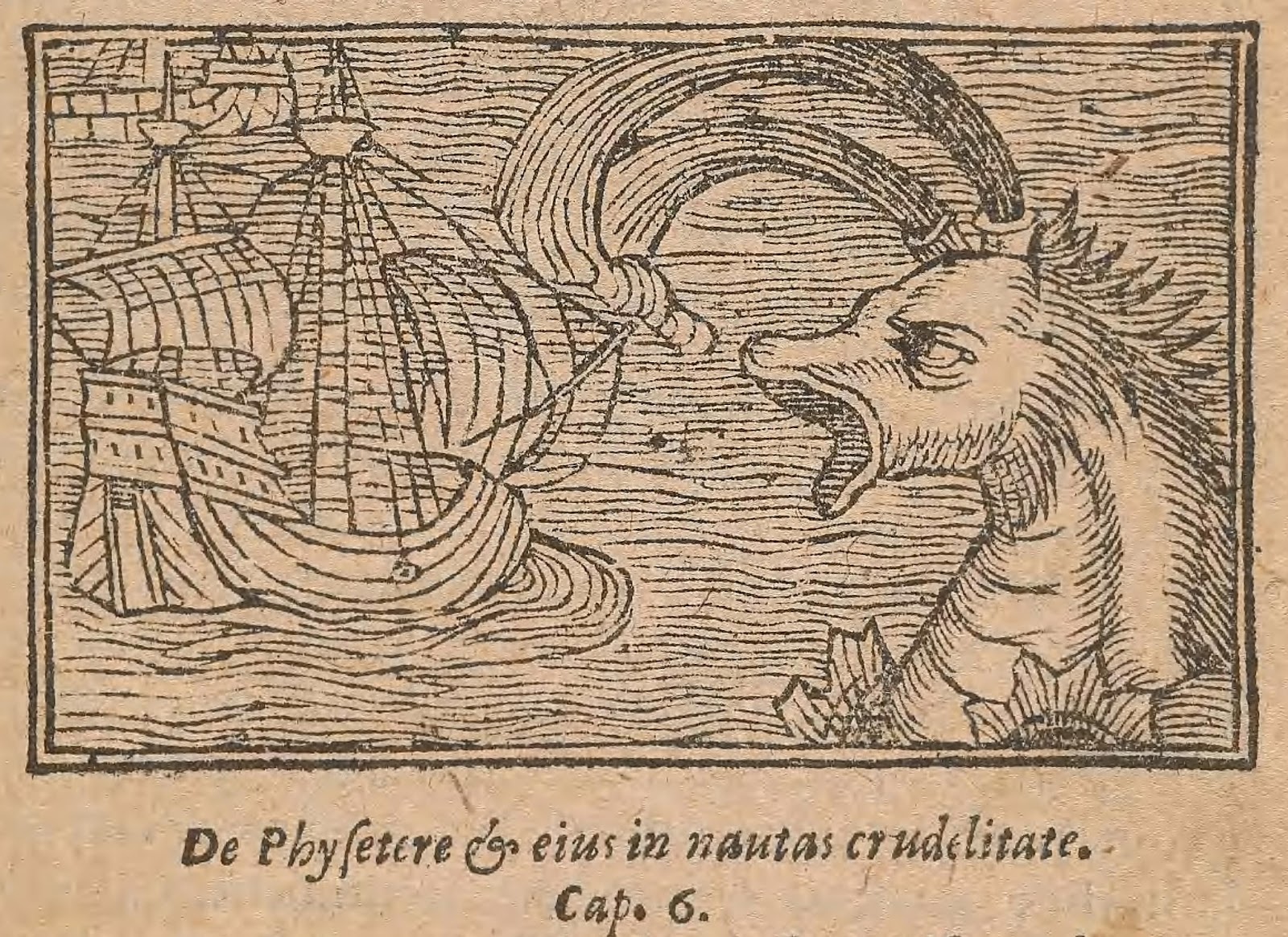
Pristers are found in multiple forms throughout Carta Marina and in many subsequent publications. Magnus actually identified these beasts as whales, describing them as “two hundred cubits long, and very cruel.”

View Full Size Image
Physeter, or Prister. Magnus, Olaus. Historiae de gentibus septentrionalibus. 1555. http://biodiversitylibrary.org/page/41862918.

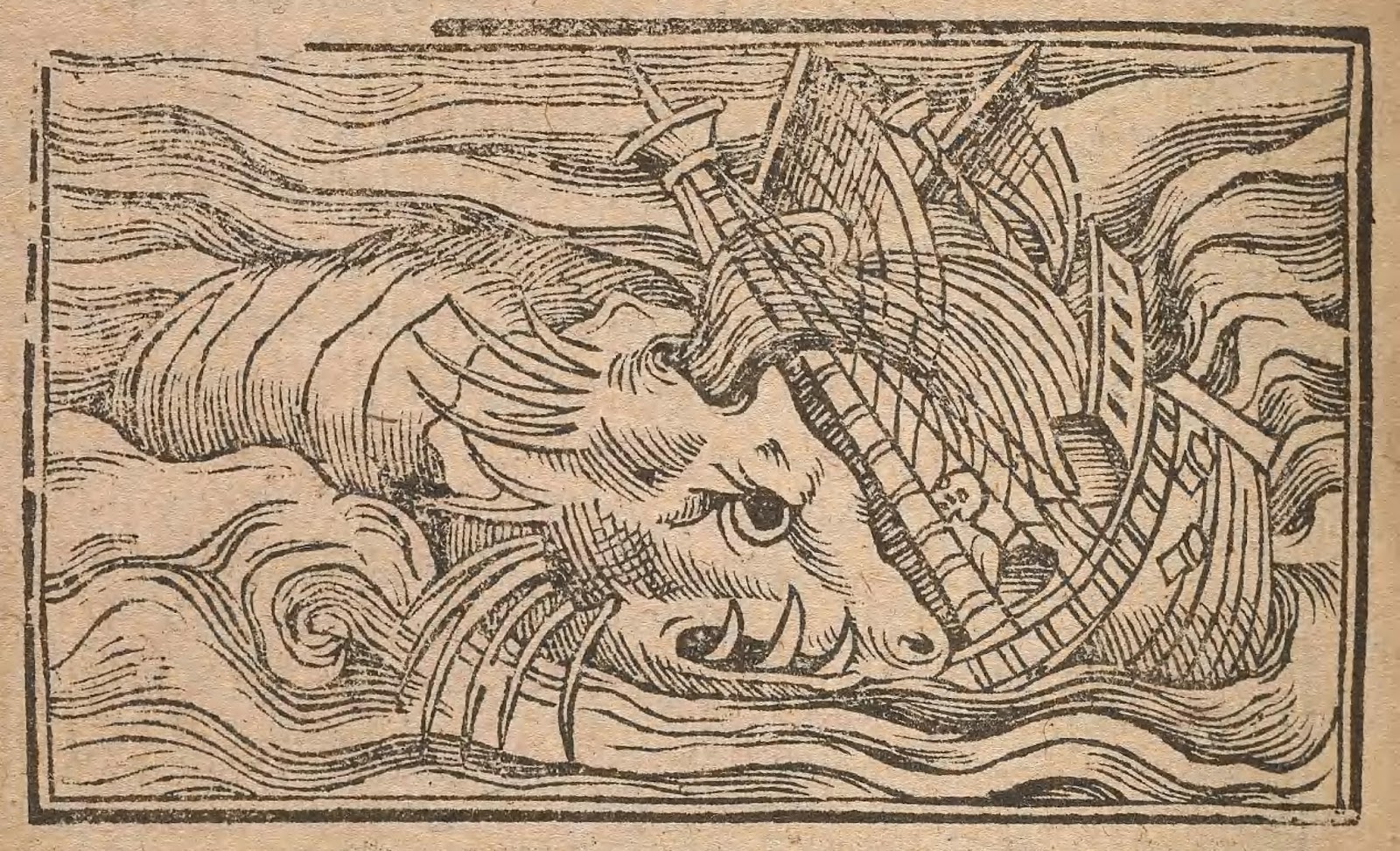
The common feature among them is the presence of two blowholes, most often acting as water cannons drowning unlucky vessels. Magnus warns, “to the danger of Sea men, he will sometimes raise himself beyond the sail yards, and cast such floods of waters above his head, which he had sucked in, that with a cloud of them, he will often sink the strongest ships…Sometimes, not content to do hurt by water only…he will cruelly over throw the ship like any small vessel, striking it with his back, or tail.” If that isn’t bad enough, Magnus also claims that it has a mouth like a Lamprey, “whereby he sucks in his meat or water.”

View Full Size Image
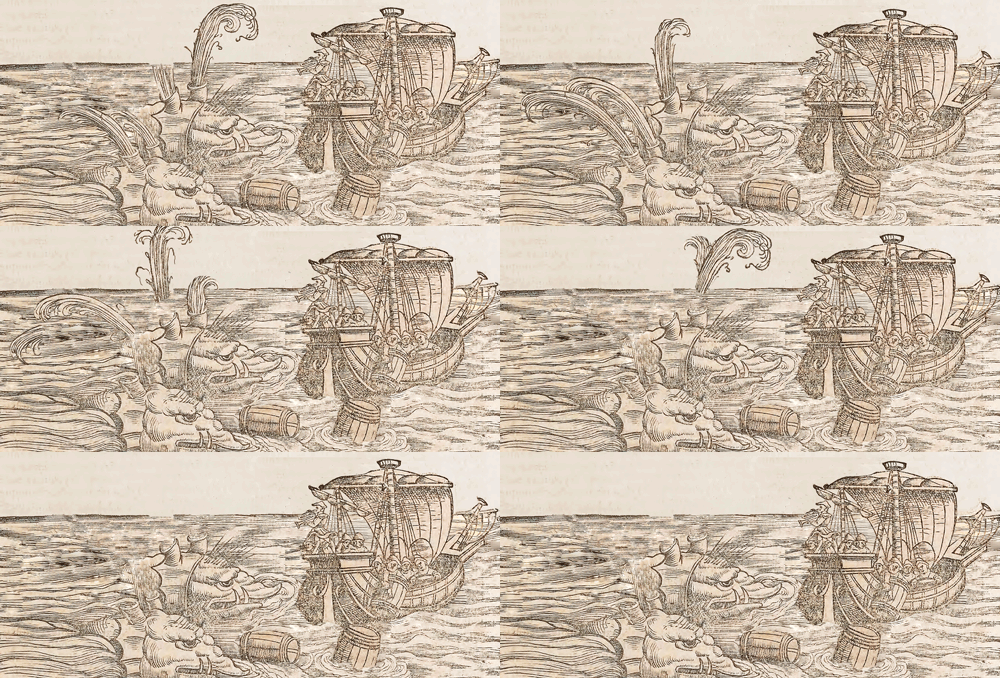
Prister attacking a ship. Magnus, Olaus. Historiae de gentibus septentrionalibus. 1555. http://biodiversitylibrary.org/page/41862919.

How can such a beast be defeated? Not by cannon-fire. Magnus warns that the beast’s layer of fat is too thick for such absurdities. Instead, try sounding a trumpet, which will startle the monster, or dump some empty barrels in the ocean, with which the creature will become distracted and stop to play.

View Full Size Image
The Prister, monsters actually identified as whales in historic publications, are reported to be mighty enough to sink the strongest ships. Cannon-fire was, according to Olaus Magnus, who published three versions of them in 1555, useless against these beasts. Instead, sailors should sound trumpets and throw barrels into the water to distract these monsters. See more fantastic historic monsters come to life on the Smithsonian Libraries’ Tumblr. GIF created by Richard Naples (Smithsonian Libraries), based on Gessner, Conrad. Historia Animalium. 2nd ed. 1604. http://biodiversitylibrary.org/page/42165750.

What species is this monster likely based on? Well, Baleen Whales do actually have two blowholes, and Magnus refers to the beasts as Physeter. The modern-day suberfamily including sperm whales is Physeteroidea.

The Ziphius

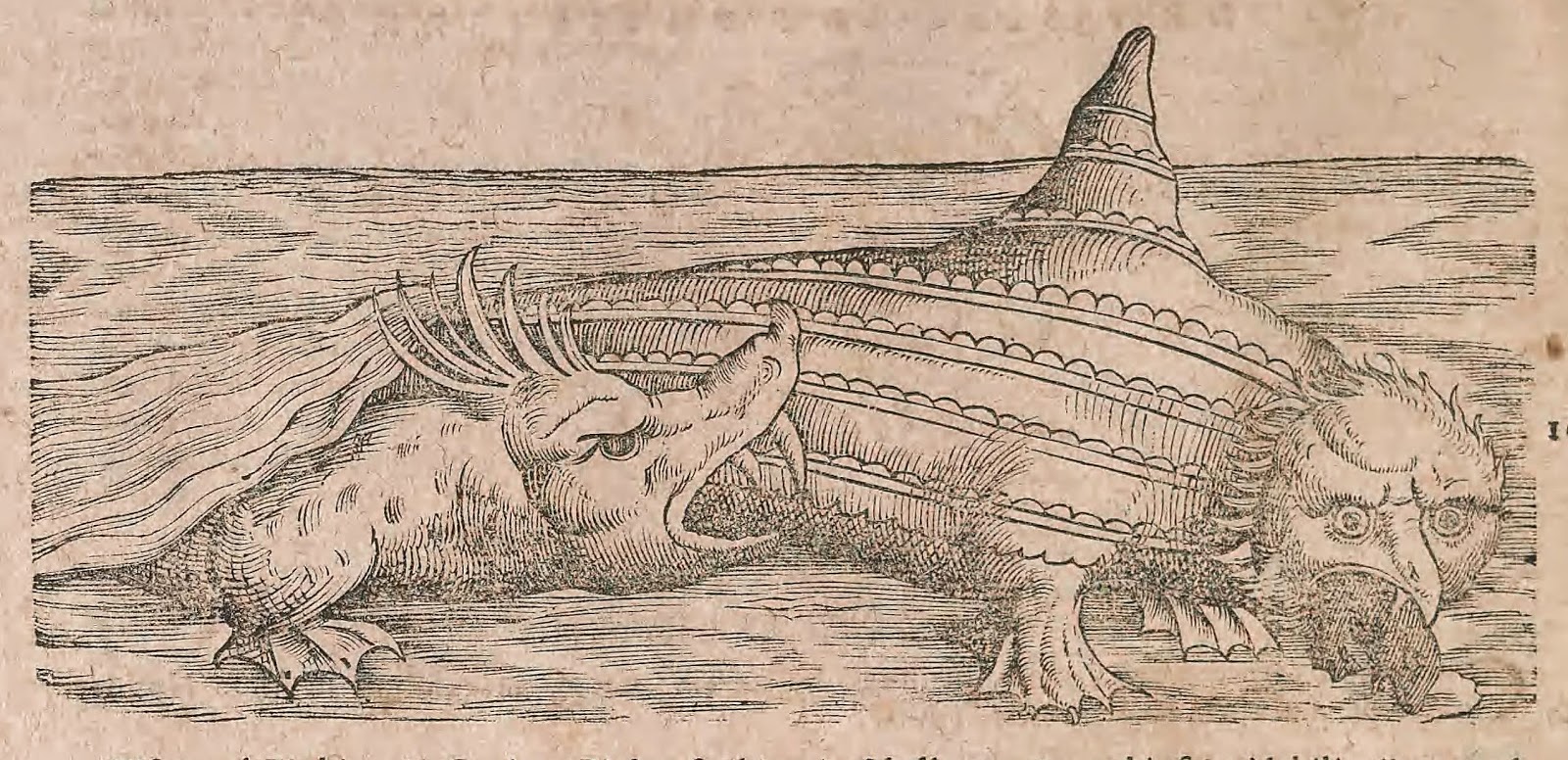
“The sword-fish is like no other, but in something it is like a whale. He hath as ugly a head as an Owl; his mouth is wondrous deep, as a vast pit, whereby he terrifies and drives away those that look into it. His eyes are horrible, his back Wedge-fashion, or elevated like a sword. His snout is pointed. These often enter upon the Northern Coasts as Thieves and hurtful Guests, that are always doing mischief to ships they meet, by boring holes in them, and sinking them.”

View Full Size Image
The Ziphius, after Magnus. Gessner, Conrad. Historia Animalium. 2nd Ed. 1604. http://biodiversitylibrary.org/page/42165841.

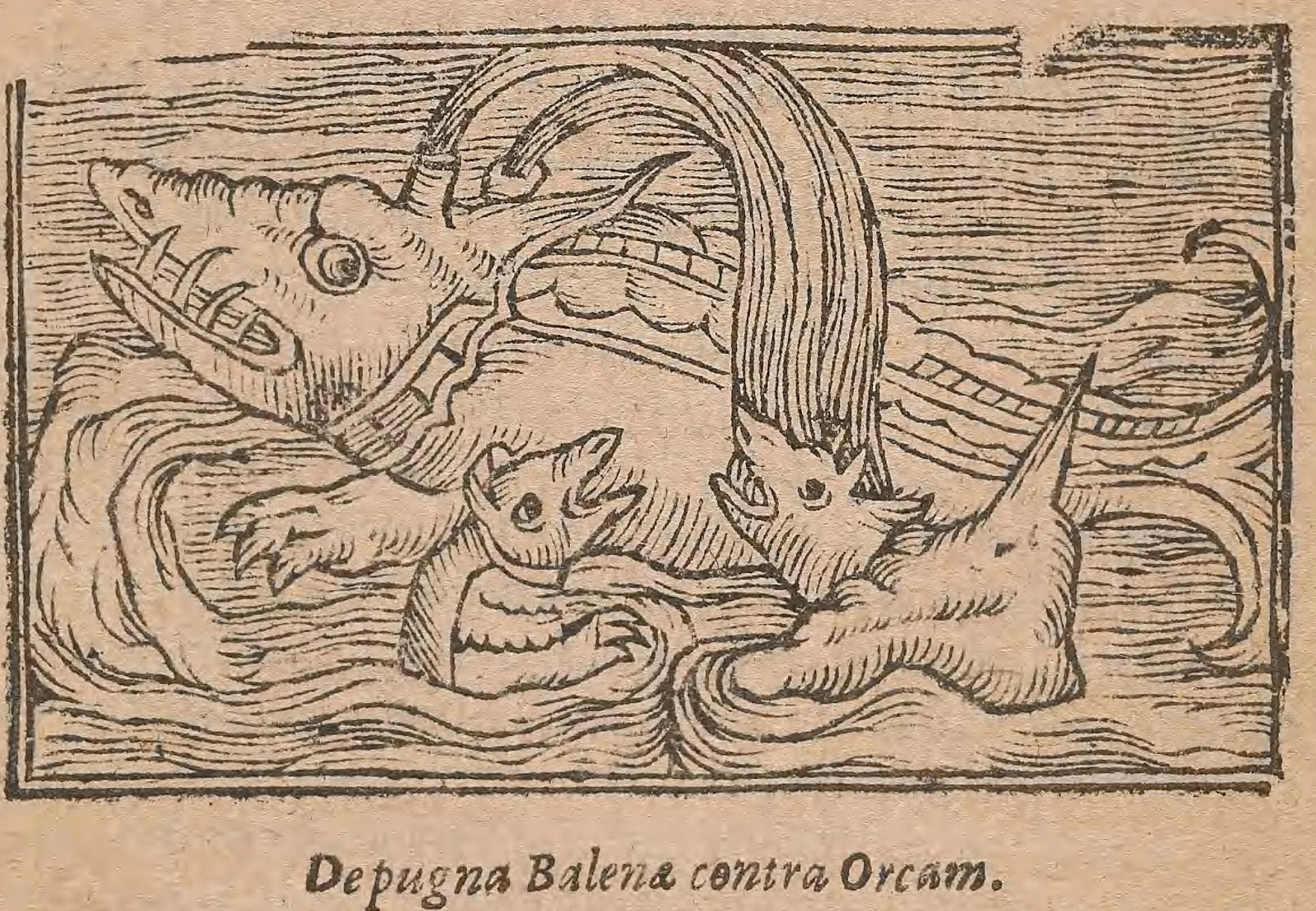
Thus Magnus describes the Ziphius (translation via John Ashton’s Curious Creatures in Zoology (1890)), whose name comes from the Greek xiphias, meaning sword (recall Magnus’ comparison of its fin to a sword). This bizarre, owl-headed creature is depicted with a seal in its jaws. This, and the shape of the fin, suggest that the monster may be based on an Orca. A Great White Shark has also been suggested.

And the porcupine-fish attacking the Ziphius? Jury’s still out on that one…

The Case for the Leviathan

We all know whales are real, and we know that they can grow to extraordinary sizes (the largest size on earth, in fact). They have even been documented to attack and sink ships (for instance, in 1820, the vessel Essex was sunk by a sperm whale), so those crews wishing to harpoon a whale has reason to be cautious.

View Full Size Image
Physeter, or Prister. Magnus, Olaus. Historiae de gentibus septentrionalibus. 1555. http://biodiversitylibrary.org/page/41862920.

Does the Leviathan exist? Yes. Even within the sixteenth century writings of Magnus and Gessner, Leviathan monsters such as Devil Whales and Pristers are identified as whales. However, are you likely to mistake a whale for an island and try to cook your dinner on it? Is a whale prone to kill a human simply for the fun of it? Probably not.

As is the case with all monsters inspired by real animals, limited – and sometimes dramatic (think witnessing a breaching near your boat for the first time, or stumbling upon the decomposing corpse of a sperm whale) – contact with these mammals fueled fear and sensationalism, resulting in harrowing tales of great beasts roaming the oceans.

But, in the end, a Leviathan, by any other name, is simply a whale (or perhaps an Orca) and most definitely not a monster.

  • Follow our blog and #bhlMonstersRreal on Twitter and Facebook all week to learn more about monsters and the animals that inspired them.
  • Browse historic illustrations of leviathans and their whale counterparts on Flickr.
  • Browse the books that portray these historic monsters in BHL.
  • Carve a Leviathan in your Halloween Pumpkin this year! Share your carvings with us on Facebook and Twitter!
  • See some of our favorite monsters come to life on the Smithsonian Libraries’ Tumblr!


References:

  • Ellis, Richard. Monsters of the Sea. New York: Alfred A. Knopp, Inc., 1994. Print.
  • Simon, Matt. “Kraken and Owl Whales: Take a Dip with History’s Most Terrifying Sea Monsters.” Wired. 13.09.13. Web. 20.10.14. http://www.wired.com/2013/09/carta-marina/#slideid-591797.
October 28, 2014by michelle.underhill
Blog Reel, Featured Books

Celebrating Oceans and Marine Biodiversity

50 Fish from American Waters (1870-1900). Allen and Ginter.

The Seafood Picture

View Full Size Image
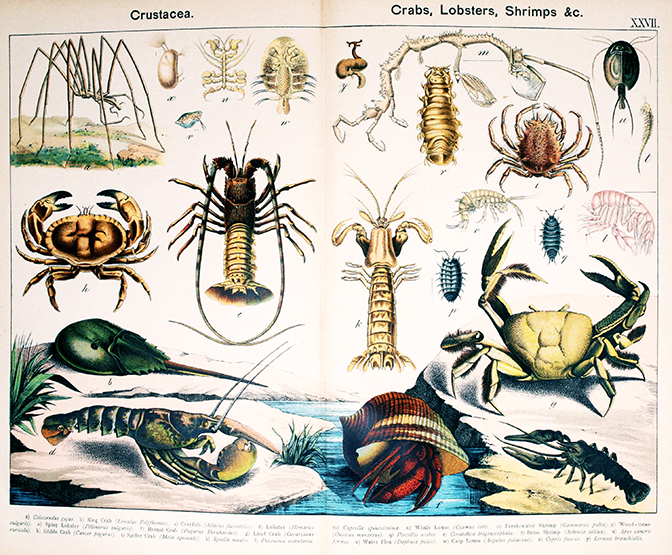
Shrimp (the most-consumed seafood in America) and other Crustaceans. Natural History of the Animal Kingdom for the Use of Young People.

This Saturday, June 8, is World Oceans Day, the UN-designated day for the global community to celebrate and take action to protect Earth’s oceans. 71% of the Earth’s surface is covered with water, and every living thing depends on water to survive. Sadly, according to the United Nations, with the world eating more seafood than ever before, approximately 2/3 of the ocean’s species are overfished.

According to NOAA, in 2009, Americans consumed 4.833 billion pounds of seafood – translating to 15.8 pounds of fish and shellfish per person. Approximately 50% of that seafood was wild-caught, and 50% was farm-raised.  The top ten most-consumed seafood in the U.S. in 2010 was:

  1. Shrimp (4.10 lbs)
  2. Canned Tuna (2.8 lbs)
  3. Salmon (1.84 lbs)
  4. Tilapia (1.34 lbs)
  5. Pollock (1.19)
  6. Catfish (0.92 lbs)
  7. Crab (0.61 lbs)
  8. Cod (0.44 lbs)
  9. Pangasius (0.43 lbs)
  10. Clams (0.341 lbs)
*lbs average per person

50 Fish from American Waters

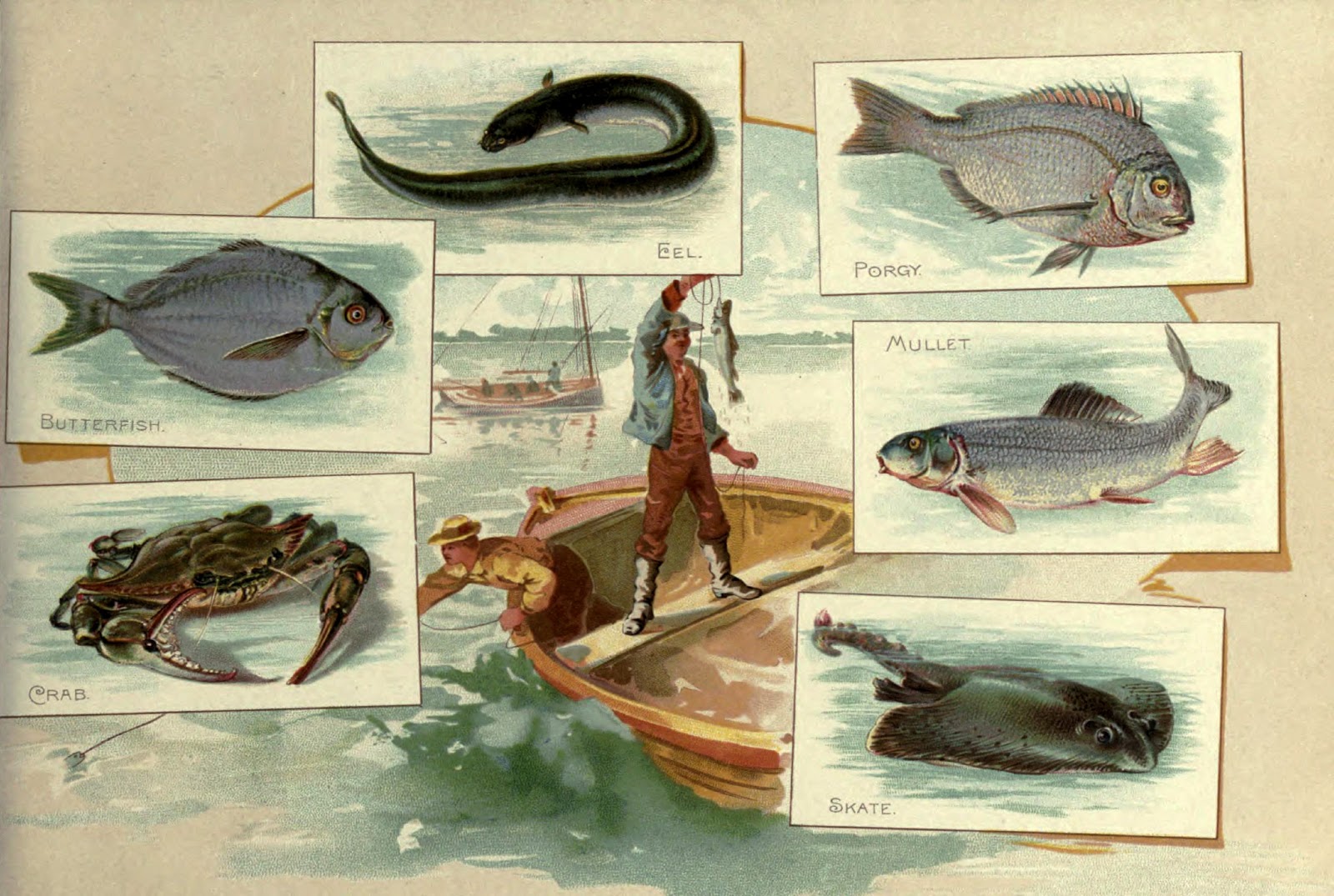
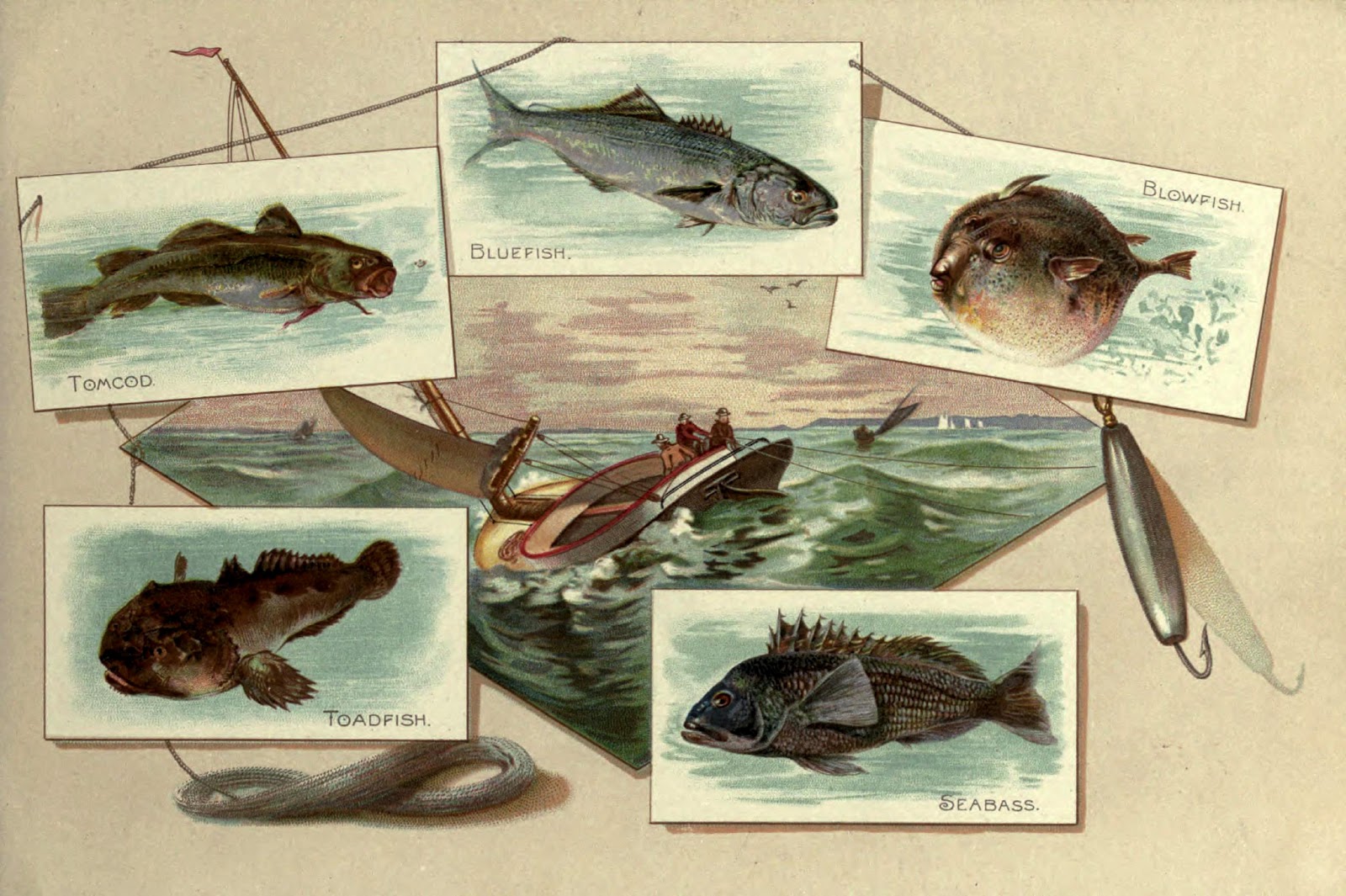
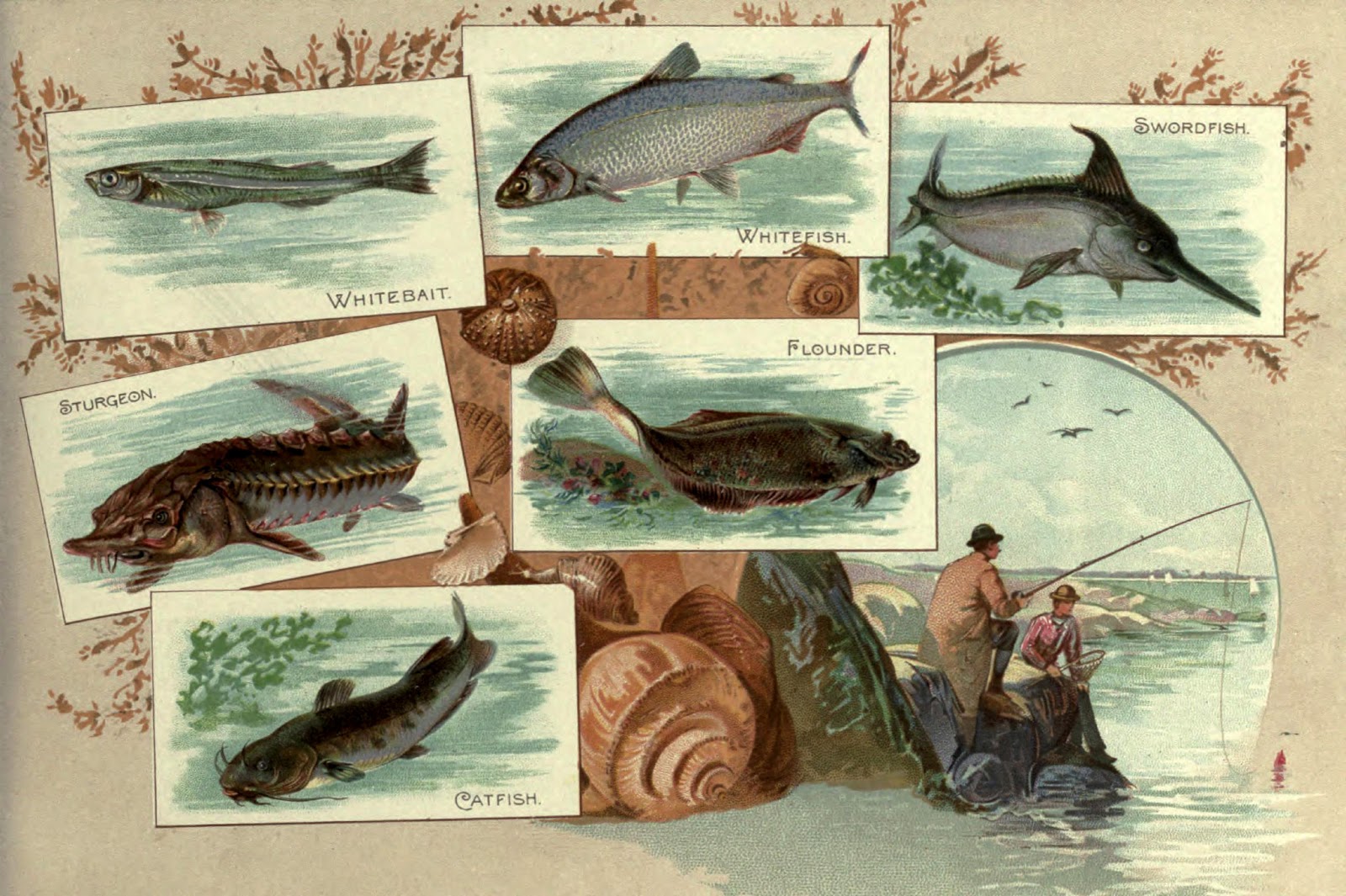
Have you ever wondered what marine species can be found in American waters? While not exhaustive, 50 Fish from American Waters is a pictorial work that presents a delightful collection of such species through illustrations.

Curiously, the fish illustrations in this book were originally published as individual cigarette cards for collecting and trading. The tobacco firm, Allen and Ginter of Richmond, Virginia, was the first firm to use tobacco trading cards as a means of advertisement in cigarette packages, and, between 1870-1900, select packages of Allen and Ginter Virginia Bright cigarettes contained one of the 50 varieties of American fish trading cards (see the poster advertising the cards from Library of Congress). All of the cards were later published in the book 50 Fish from American Waters.

View Full Size Image
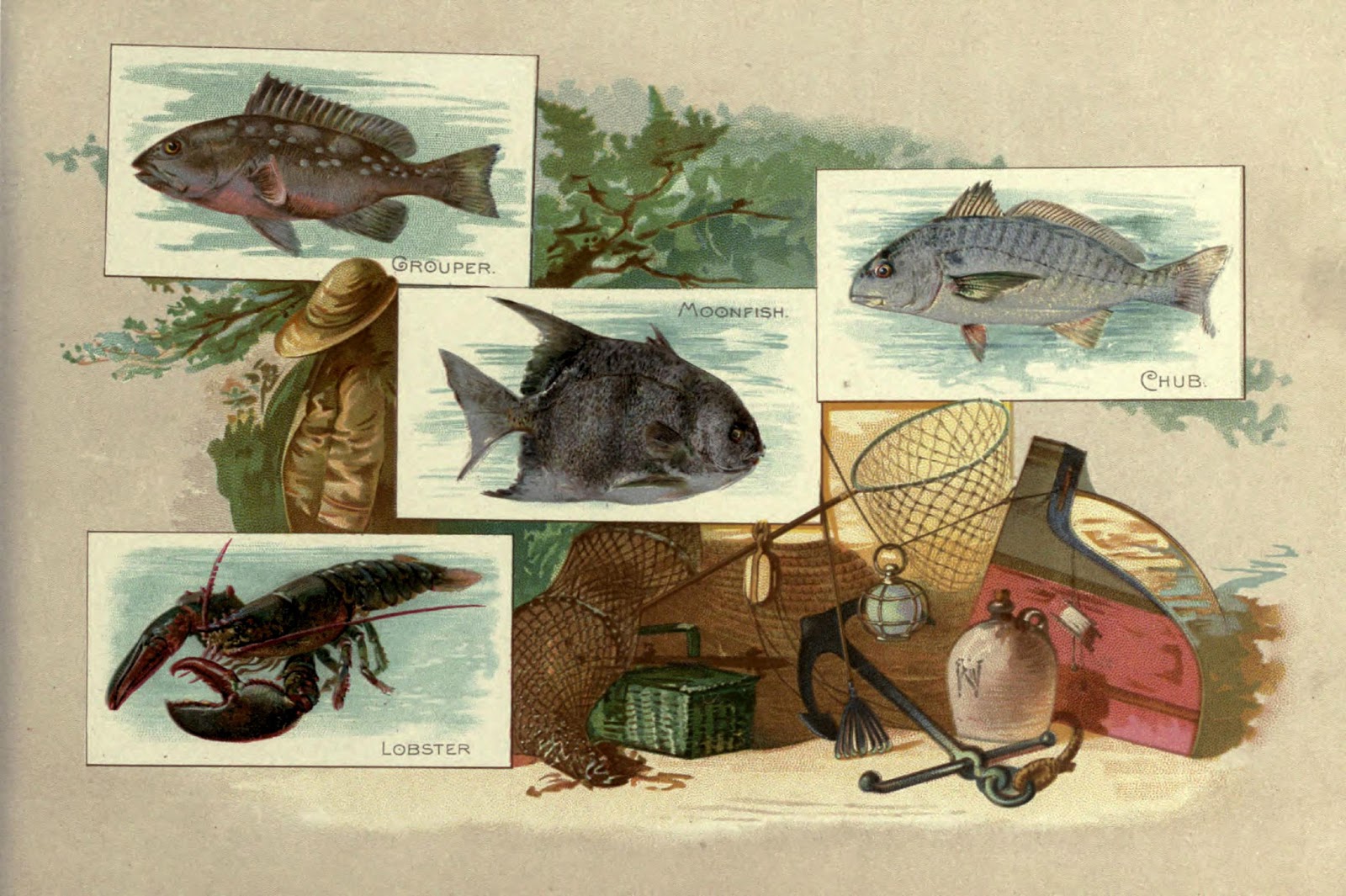
Lobster, Grouper, Moonfish, and Chub. 50 Fish from American Waters.
View Full Size Image
Tomcod, Bluefish, Blowfish, Toadfish, and Seabass. 50 Fish from American Waters.
View Full Size Image
Whitebait, Whitefish, Swordfish, Sturgeon, Flounder, Catfish. 50 Fish from American Waters.
View Full Size Image
Butterfish, Eel, Porgy, Mullet, Skate, Crab. 50 Fish from American Waters.

View all images from 50 Fish from American Waters in Flickr.

What can you do to help?

According to the ongoing The Ocean’s Project survey, most Americans care about the ocean and want to protect it, but many feel that they themselves can make little impact on the ocean’s health and, interestingly, that American waters are less imperiled that foreign waters. While these may be somewhat troubling responses, on the bright side, 22% of the 30,000+ people surveyed said that they are active in the environmental movement and 57% expressed sympathy but not active involvement. Most indicated a high willingness to alter their seafood consumption habits to help protect the oceans.

So, what can you do to help? Worldoceansday.org provides some great examples of small actions you can take to help protect our oceans, including reducing seafood consumption in general, using re-usable grocery bags and water bottles, choosing abundant, farmed, and locally-caught species, reducing meat consumption (which reduces the demand for forage fish), and choosing sustainable seafood buyers and sellers.

Marine Biodiversity and BHL

View Full Size Image
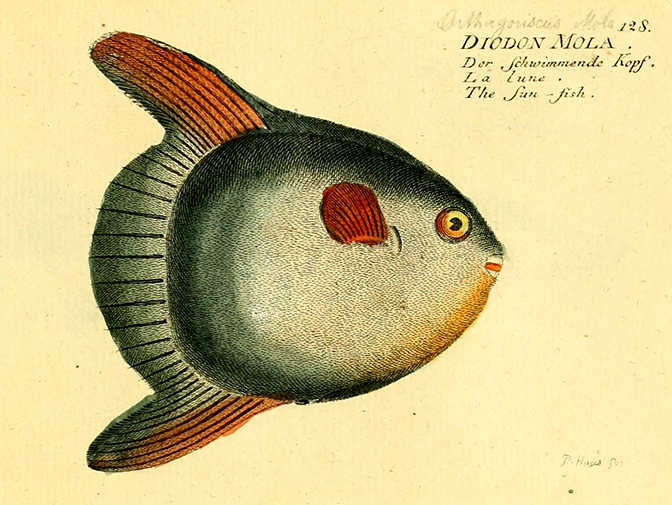
Ocean Sunfish. Ichthyologie.

BHL is celebrating World Oceans Day by highlighting marine biodiversity on Facebook, Twitter, and Flickr.  For instance, did you know that the Gray Whale is more heavily infested with a greater variety of parasites than any other cetacean? Or that the Ocean Sunfish, the heaviest known bony fish, can grow up to 2300 kilograms, and that the Giant Oarfish, at up to 11 confirmed meters (and possibly 17 meters), is the world’s longest bony fish? Or that the adorable Common Blanket Octopus has been known to carry around tentacles of the Portuguese-Man-of-War as a defensive measure and means of capturing prey? Learn more about these species and get other watery factoids on Twitter and Facebook.

Be sure to check out our Marine Biodiversity Flickr collection with free images that you can download and reuse for your own World Oceans Day celebrations!

View Full Size Image
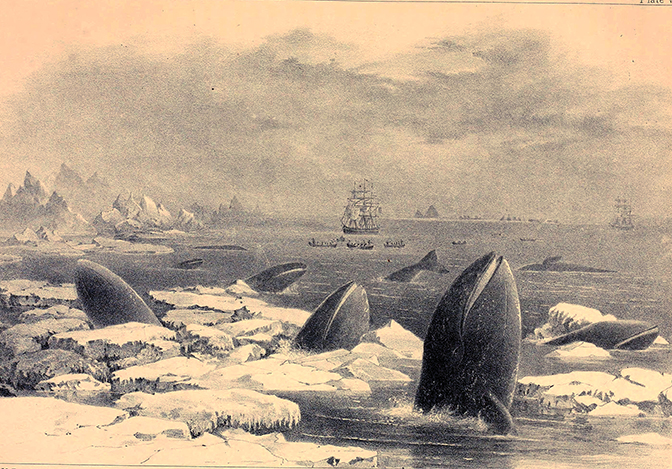
Gray Whales. The Marine Mammals of the North-west Coast of North America.

Are you a whale-lover? Then Smithsonian Libraries, one of BHL’s founding members, has an exhibit for you! Learn about whale research at the Smithsonian, and how research and fossils are translated into publications, in the new Whales: From Bone to Book exhibit at the National Museum of Natural History in Washington, D.C. Check out the books that support the exhibit in the BHL Collection and get fabulous whale illustrations in Flickr.
Remember, every living species requires water to survive, and our oceans play a huge part in our communal ecosystem. No matter where you live, your local water will eventually make its way to the ocean. We each have a responsibility to protect our oceans. Together, we can make a difference!

  • Find some World Oceans Day events near you.
  • Get some great promotional materials for World Oceans Day.
  • You can even get free Dr. Seuss-themed World Oceans Day materials!
June 6, 2013by ulib-libraryjobs

Help Support BHL

BHL's existence depends on the financial support of its patrons. Help us keep this free resource alive!

search

About BHL

The Biodiversity Heritage Library (BHL) is the world’s largest open access digital library for biodiversity literature and archives. BHL operates as a worldwide consortium of natural history, botanical, research, and national libraries working together to digitize the natural history literature held in their collections and make it freely available for open access as part of a global “biodiversity community.”
Join Our Mailing List

Sign up to receive the latest news, content highlights, and promotions.

Subscribe Now

Subscribe to Blog via Email

Enter your email address to subscribe to this blog and receive notifications of new posts by email.

Join 319 other subscribers

Subscribe to Blog Via RSS

Subscribe to the blog RSS feed to stay up-to-date on all the latest BHL posts.

Access RSS Feed

Inspiring Discovery through Free Access to Biodiversity Knowledge.
The Biodiversity Heritage Library makes it easier than ever for you to access the information you need to study and explore life on Earth…for free, anytime, anywhere.


64+ Million Pages of
Biodiversity Literature Online.

EXPLORE

Tools and Services
to Transform Research.

EXPLORE

300,000+
Illustrations on Flickr.

EXPLORE

ABOUT | HARMFUL CONTENT | PRIVACY | SITE MAP | TERMS OF USE