
Biodiversity Heritage Library - Program news and collection highlights from BHL
  • Home
  • News
  • Featured Books
    • All Featured Books
    • Book of the Month Series
    • BHL at 20
  • User Stories
  • Campaigns
    • Fossil Stories
    • Garden Stories
    • Monsters Are Real
    • Page Frights
    • Her Natural History
    • Earth Optimism 2020
  • Tech Blog
  • Visit BHL
Home
News
Featured Books
    All Featured Books
    Book of the Month Series
    BHL at 20
User Stories
Campaigns
    Fossil Stories
    Garden Stories
    Monsters Are Real
    Page Frights
    Her Natural History
    Earth Optimism 2020
Tech Blog
Visit BHL
  • Home
  • News
  • Featured Books
    • All Featured Books
    • Book of the Month Series
    • BHL at 20
  • User Stories
  • Campaigns
    • Fossil Stories
    • Garden Stories
    • Monsters Are Real
    • Page Frights
    • Her Natural History
    • Earth Optimism 2020
  • Tech Blog
  • Visit BHL
Biodiversity Heritage Library - Program news and collection highlights from BHL
Blog Reel, Featured Books

Book of the Week: A Look at the Endangered Species List

The awareness of the need to protect endangered species has grown widely in the past few decades. The decimation of species throughout the world due to both natural and man-made conditions has pushed many species to the brink of extinction. While there are many efforts underway to protect and revive the species on the endangered list today, the struggle of many species to survive is still uncertain. This week’s book of the week, Selected vertebrate endangered species of the seacoast of the United States (1980), published by the U.S. Fish and Wildlife Service, outlines some of the species that were facing this battle for survival thirty years ago.

For this week’s post, we highlight three of the species listed as endangered in this publication, and provide an update about the species’ current status. A link to the Encyclopedia of Life entry for each species is also included, so feel free to dig a little deeper into each of these unique, threatened, and resilient creatures.

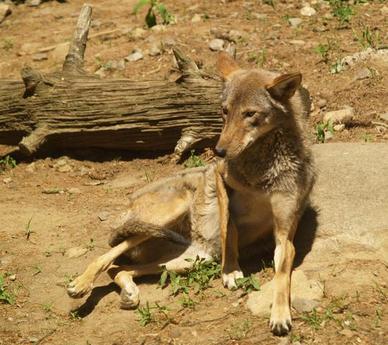
View Full Size ImageThe Red Wolf (Canis rufus)

The Red Wolf was listed as Federally endangered on October 3, 1970 in the states of Delaware, Missouri, Mississippi and Texas. It was threatened due to predator control programs and federal, state, and local bounty hunter activity in these regions, as this species was seen to be a threat to livestock in these areas.

Current Status: In an effort to protect this species, “fourteen remaining red wolves were placed in a captive-breeding facility; they have become the founders of the present red wolf population. Currently, 200+ red wolves exist, and reintroductions are occurring in a few areas, including North Carolina and the Great Smoky Mountains.”

The Red Wolf in EOL.
The Red Wolf in this week’s Book of the Week.

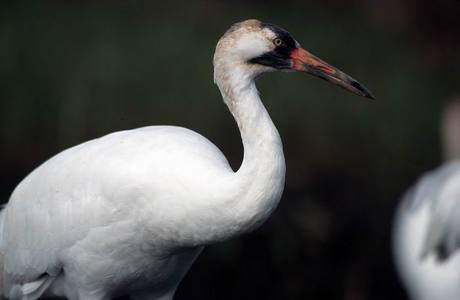
The Whooping Crane (Grus americana)
View Full Size Image
The Whooping Crane was listed as Federally endangered on March 11, 1967 in Colorado, Idaho, Montana, Nebraska, New Mexico, and Texas. The species’ survival was put to the test due to a reduction in breeding and wintering habitats as a result of drainage, agriculture, the Gulf of Intracoastal Waterway, and human settlements. As this week’s book of the week points out, “Whooping cranes avoid areas of human disturbance even if the habitat is otherwise suitable.” In 1977, there were only 75 whooping cranes in the wild and 27 in captivity.

Current Status: With the rescue efforts that began in 1968, the number of whooping cranes gradually increased to 96 in 1995. There are now two populations in the wild.

The Whooping Crane in EOL.
The Whooping Crane in this week’s Book of the Week.
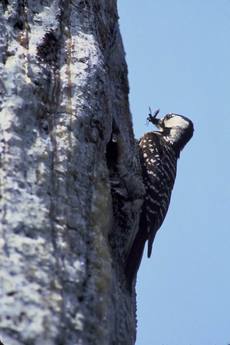
View Full Size ImageThe Red-Cockaded Woodpecker (Picoides borealis)

The Red-Cockaded Woodpecker was listed as Federally endangered on October 13, 1970 in Florida, Georgia, Mississippi, South Carolina, Tennessee and Texas. This species, according to
Selected vertebrate endangered species of the seacoast of the United States, was endangered as a result of a decrease in the quantity and quality of a suitable habitat, primarily due to short-term-rotation timber management. The practice of short-term-rotation timber management “prevents the development of mature, diseased pine trees” which are necessary for this species’ roosting and nesting.

Current Status: While there have been two recovery plans written to restore this population, the first, established in 1979, was never acted upon, and the second, established in 1985, has been criticised, though not revised, and no other plan has been written. “Recently, however, new approaches to conservation including old cavity restoration, artificial cavity construction, and the introduction of females into isolated groups, have made some positive advancments towards the increase in populations. The total population is now estimated at about 7,500 individuals.”

The Red-Cockaded Woodpecker in EOL.
The Red-Cockaded Woodpecker in this week’s Book of the Week.

This week’s book of the week, Selected vertebrate endangered species of the seacoast of the United States (1980), published by the U.S. Fish and Wildlife Service, was contributed by the MBLWHOI library.


February 22, 2010by ulib-libraryjobs
BHL News, Blog Reel

2010 International Year of Biodiversity

View Full Size ImageThe United Nations has been marking years for special observation since 1959. Since then, international relief agencies have rallied around Human Rights (1968), Apartheid (1978/79), Literacy (1994), and other issues that pose a global threat to sustained peace and prosperity. This year, the United Nations has named 2010 the International Year of Biodiversity. The message is pretty simple. Individual lives are dependent on a healthy network of life. Human activity in the form of industry and commerce poses a threat to the health of that network. Coordinated human activity is necessary to reduce that threat.

The umbrella is wide. Stay tuned for more updates about the International Year of Biodiversity as we cover issues ranging from endangered species to the discovery of sustainable alternatives to fuels and energy production. Activities, reports, and inspiration from a wide variety of local and international groups are available through the IYB website found here.
And become a fan of the official Facebook page here to participate in ongoing discussions and connect with others involved in facets of environmental protection that matter to you.

February 19, 2010by jwinberry
Blog Reel

In case you’re wondering…

As you may know, BHL recently acquired tens of thousands additional titles by ingesting open access texts supplied by the Internet Archive. Read the original announcement here.

One title in particular stands out as one of those works that really highlights the passage of time, the evolution of scientific thought, and associative leaps we take for granted is Robert Lee Bates’ 1923 investigation “The effects of cigar and cigarette smoking on certain psychological and physiological functions“.

The author quantifies the effects smoking on the performance of daily tasks that require a variety of cognitive and physiological coordinations. I found the methods of the dart throwing sequence and the description of the darts used particularly interesting (made of wood, six inches long including the feathers). A smoker’s word choice is also considered in free association studies. Do we repeat ourselves more after smoking? Does a non-smoker use more colorful language, favoring ornate description?

While we take for granted that smoking is toxic, we don’t generally think of its effects on cognitive ability in the same way we would a shot of tequila. Should we? What makes a drug a drug? and if smoking interferes with hitting a bull’s eye, what about sugar? For me, the BHL never ceases to provide an opportunity to consider and (re)evaluate our notions of scientific truth.

I won’t give away all the fun and seemingly antiquated bits of scientific inquiry. But, suffice it to say, at the end of the day back in 1923, more study was needed.

🙂 Enjoy.

February 17, 2010by [email protected]

Help Support BHL

BHL's existence depends on the financial support of its patrons. Help us keep this free resource alive!

search

About BHL

The Biodiversity Heritage Library (BHL) is the world’s largest open access digital library for biodiversity literature and archives. BHL operates as a worldwide consortium of natural history, botanical, research, and national libraries working together to digitize the natural history literature held in their collections and make it freely available for open access as part of a global “biodiversity community.”

Join Our Mailing List

Sign up to receive the latest news, content highlights, and promotions.

Subscribe Now

Subscribe to Blog via Email

Enter your email address to subscribe to this blog and receive notifications of new posts by email.

Join 319 other subscribers

Subscribe to Blog Via RSS

Subscribe to the blog RSS feed to stay up-to-date on all the latest BHL posts.

Access RSS Feed

Inspiring Discovery through Free Access to Biodiversity Knowledge.

The Biodiversity Heritage Library makes it easier than ever for you to access the information you need to study and explore life on Earth…for free, anytime, anywhere.


64+ Million Pages of
Biodiversity Literature Online.

EXPLORE

Tools and Services
to Transform Research.

EXPLORE

300,000+
Illustrations on Flickr.

EXPLORE

ABOUT | HARMFUL CONTENT | PRIVACY | SITE MAP | TERMS OF USE
