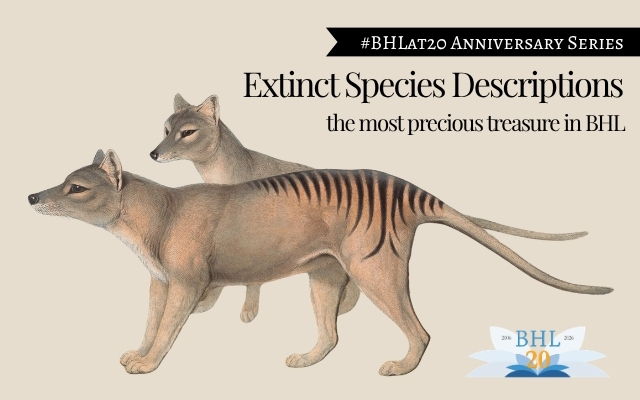
On Australia’s National Threatened Species Day, Nicole Kearney explores extinct species descriptions in BHL and the precious record they preserve of animals lost, threatened, and sometimes rediscovered.
Continue reading
On Australia’s National Threatened Species Day, Nicole Kearney explores extinct species descriptions in BHL and the precious record they preserve of animals lost, threatened, and sometimes rediscovered.
When Field Museum librarian Elizabeth McKinley investigated a rare eighteenth-century work by E.A.W. Zimmermann, she uncovered a fascinating story of scientific revision, zoological nomenclature, and a surprising connection to the Field Museum. Now digitised in BHL, Zimmermann’s Geographische Geschichte can be explored alongside the earlier work it superseded and the ruling that secured its place in the scientific record.
BHL is delighted to welcome Amanda Boczar and Leora Siegel to two newly created positions on its Executive Committee, bringing new capacity, experience, and perspectives to help guide BHL through its next chapter.
Stephen A. Forbes and Charles Robertson were pioneering scientists whose groundbreaking research continues to influence our understanding of the natural world. Forbes advanced the fields of biology and ecology, while Robertson explored bees and their relationships with flowers and other insects. Their careful observations and influential publications laid important foundations for modern biological and entomological research.
Together, the BHL community helped secure our independent future. Now we are inviting supporters to become BHL Sustainers and help provide the dependable monthly support needed to keep biodiversity knowledge free and open.
In 1849, the first volume of the Papers and Proceedings of the Royal Society of Van Diemen’s Land launched a tradition of advancing knowledge that continues to this day. Established in 1843, the Society is Australia’s oldest Royal Society, and for more than 180 years its prestigious journal of scientific and cultural history has captured the changing face of Tasmania, initially called Van Diemen’s Land by British colonists.
The Biodiversity Heritage Library welcomes Senckenberg Gesellschaft für Naturforschung as its newest Member. Dr. Jana Hoffmann reflects on how Senckenberg’s specialized libraries will help connect historical biodiversity literature to the collections, data, and research infrastructures that support science today.
The Biodiversity Heritage Library (BHL) is the world’s largest open access digital library for biodiversity literature and archives. BHL operates as a worldwide consortium of natural history, botanical, research, and national libraries working together to digitize the natural history literature held in their collections and make it freely available for open access as part of a global “biodiversity community.”
Sign up to receive the latest news, content highlights, and promotions.
Subscribe NowSubscribe to the blog RSS feed to stay up-to-date on all the latest BHL posts.
Access RSS Feed