

This month, members of the biodiversity community from across the globe gathered in Bogotá, Colombia, for two major meetings: the Global Biodiversity Information Facility (GBIF) Governing Board Meeting (19–20 October) and Living Data 2025 (21–24 October).
For the Biodiversity Heritage Library (BHL), these back-to-back events were a timely opportunity to share progress on the BHL Transition and to connect directly with the global community that relies on BHL every day.
Why Colombia?
Colombia was a fitting and inspiring location for these global biodiversity meetings. As one of the most biodiverse countries in the world, Colombia embodies the richness of life that BHL’s collections document. Globally, Colombia has the highest number of species of both orchids and birds, and the second highest number of butterflies, frogs, and freshwater fish.
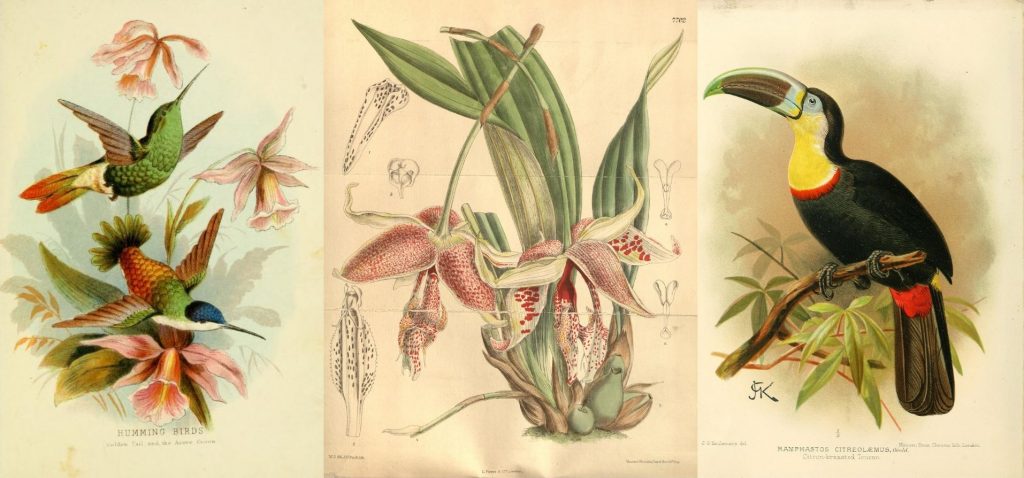
(L-R): Golden-tailed Hummingbird, from Humming-birds (1874); orchid Embreea rodigasiana from Curtis’s Botanical Magazine (1900); and the citron-throated toucan Ramphastos citreolaemus, from A flying trip to the tropics (1895).
Hosting these meetings in Colombia also enabled greater participation from the Global South, helping to amplify the voices of regions that hold so much of the world’s biodiversity, but are often underrepresented in global databases and research networks. Both the GBIF and Living Data meetings reflected this commitment to inclusivity and accessibility – values that resonate deeply with BHL’s mission.
Living Data 2025
More than 1,000 participants, including 718 in-person attendees, took part in the Living Data 2025 conference, a joint conference convened by TDWG (Biodiversity Information Standards), GEO BON (Group on Earth Observations Biodiversity Observation Network), GBIF (Global Biodiversity Information Facility), and OBIS (Ocean Biodiversity Information System).
Under the themes of building standards for data sharing and interoperability, integrating and providing access to diverse information sources, and monitoring progress toward conserving and restoring the planet’s biodiversity, Living Data brought together biodiversity data specialists, scientists, researchers, and practitioners from around the world to explore the standards and collaborations that underpin open biodiversity science.
BHL was represented at Living Data 2025 by:
- Kelli Trei, BHL Transition Director
- Nicole Kearney, BHL Communications Director
- Mike Lichtenberg, BHL Software Engineer
- Richard Wragg, Vice-Chair, BHL Executive Committee
Together, the team ensured that BHL had a strong and visible presence throughout the conference, through formal sessions, the exhibition area, and countless side conversations.
Sharing the BHL Transition
Nicole Kearney presented A New Future for the Biodiversity Heritage Library: from institutional reliance to global resilience as part of the session “Global Infrastructure: Current state, sustainability, and paths forward through data partnerships.”
The talk shared updates on BHL’s transition away from the Smithsonian Institution and toward a more distributed, sustainable, and community-governed future, emphasizing the need for shared responsibility in long-term hosting, governance, and funding.
The timing of the talk could not have been better: just four days after the launch of BHL’s public fundraising campaign and in the first session of the conference. This meant participants heard about the transition early, creating immediate awareness and enthusiasm that carried through the rest of the event.
To support ongoing conversations, the BHL consortium also hosted a booth in the Living Data exhibition hall. BHL staff were on hand throughout to answer questions and provide information. The booth was a visible hub of activity, welcoming a steady stream of visitors, all eager to express support and learn more about BHL and the transition.
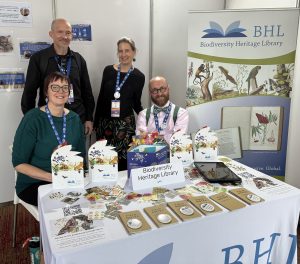
BHL staff at the BHL booth, Bogotá, October 2025, Photo: Nicole Kearney
QR codes linking directly to the BHL fundraising page were shared during Nicole’s talk and displayed at the booth, encouraging attendees to contribute and help amplify the news of the transition. The message spread quickly throughout the conference: BHL is critical infrastructure and a collective responsibility.
BHL representation across the Living Data program
As the foundation of our understanding of biodiversity, BHL content – and the importance of open access to it – featured heavily across the Living Data 2025 program. Many presenters shared projects that relied on BHL, including:
- Ben Hartley (né Scott) (Natural History Museum, London): Mining Botanical Literature with Machine Learning
- Roderic Page (University of Glasgow): The roles of the Biodiversity Heritage Library, Wikidata, and Internet Archive in making taxonomic literature discoverable, accessible, and citable
- Nicky Nicholson (Royal Botanic Gardens, Kew): Developing an open and participatory literature data extraction workflow using Zotero and Large Language Models
- Michael Elliott (University of Florida): AI-assisted exploration, curation, and extension of biodiversity data using iChatBio
- Donat Agosti (Plazi, Switzerland): The Disentis Roadmap: A decadal roadmap for liberating global biodiversity knowledge from scientific literature
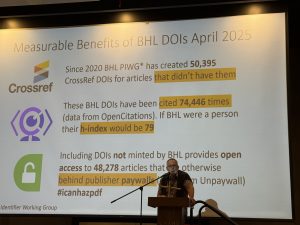
Measurable Benefits of BHL DOIs, from Roderic Page’s presentation The roles of the Biodiversity Heritage Library, Wikidata, and Internet Archive in making taxonomic literature discoverable, accessible, and citable. Photo: Nicole Kearney
Many presentations also included appreciation and messages of support for BHL. In her talk Keeping the integrity of platforms with a worldwide scope in the current complex geopolitical landscape, Patricia Mergen (Meise Botanic Garden, Belgium) announced that Meise is redirecting funds from cancelled non-Open Access journal subscriptions to support BHL, encouraging other institutions to do the same.
BHL and Wikimedia at Living Data
The session featuring the greatest BHL representation was Wikimedia and Biodiversity Data: A Mutualistic Relationship in the Open Knowledge Ecosystem.
This session explored how Wikimedia projects (Wikipedia, Wikidata, Wikimedia Commons, and Wikispecies) intersect with biodiversity infrastructures like GBIF, iNaturalist, and BHL to advance data mobilization, standardization, and open access. It highlighted the growing role of Wikidata as a hub for persistent identifiers, linking the literature in BHL with specimens, authors, collectors, illustrators and expeditions, and expanding the connected biodiversity knowledge graph.
Presentations included:
- Siobhan Leachman (Wikimedia Aotearoa, New Zealand): Integrating research expedition data from the Biodiversity Heritage Library into the Wikiverse
- Sabine von Mering (Museum für Naturkunde Berlin, Germany): Towards a Museum Knowledge Graph: Measuring the Impact of Linked Open Collection Data for the Museum für Naturkunde Berlin
- Mike Lichtenberg (Biodiversity Heritage Library, United States): Linking Biodiversity Literature and Data: Persistent Identifier Exchange Between BHL and Wikidata
- Roderic Page (University of Glasgow, United Kingdom): Using links from wikis to help discover content in the Biodiversity Heritage Library (BHL)
- Giovanna Fontenelle (Wikimedia Foundation, Brazil): The impact of the BHL-Wiki Working Group in making biodiversity heritage knowledge accessible to all
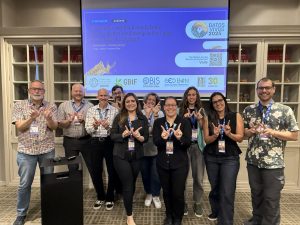
The speakers in the Wikimedia and Biodiversity Data session. Photo: Nicole Kearney
GBIF Governing Board Meeting
Immediately preceding Living Data 2025, Nicole Kearney represented BHL as Head of Delegation at the 32nd GBIF Governing Board Meeting (GB32), also held in Bogotá.
Hosted by SiB Colombia and the Humboldt Institute, GB32 brought together delegates from around the world to discuss global biodiversity information sharing and the future of open data infrastructure.
Nicole delivered a presentation on the BHL Transition, reinforcing BHL’s position as an integral component of the biodiversity data ecosystem and exploring opportunities for continued collaboration between BHL, GBIF, and partner networks.
The alignment of these two events in Bogotá – GBIF’s global governance meeting and the Living Data conference – highlighted the growing recognition that open infrastructures like BHL are essential to a connected, equitable biodiversity data landscape.
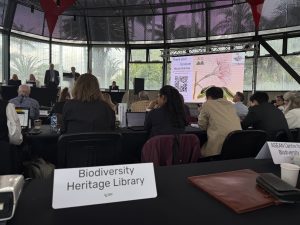
Final slide of Nicole Kearney’s presentation at the GBIF Governing Board Meeting in Bogotá.
Beyond Bogotá
The conversations that began in Bogotá will continue. BHL will maintain momentum through follow-up discussions with potential supporters, collaborators, and funders, and through ongoing outreach as part of our public fundraising campaign.
These efforts build on the work already underway through the BHL Transition, strengthening partnerships, expanding participation, and helping to secure a sustainable, distributed, and modernized future for the world’s biodiversity knowledge.
Across both events, one message was clear: BHL underpins biodiversity science, and its future depends on our entire global community.
Learn More
🧭 Stay up to date about the BHL Transition via the BHL Blog.
💬 Explore the Living Data 2025 program (recordings are now available)
💚 Support BHL’s future: Donate
Discover more from Biodiversity Heritage Library
Subscribe to get the latest posts sent to your email.



Leave a Comment