

BHL is Growing! Announcing the First of Our New Members: University of South Florida Libraries
A wave of support is building behind BHL. As we advance through our transition from long-term hosting by the Smithsonian Institution to a new independent governance and hosting model, one message has become increasingly clear: our global community is stepping forward to strengthen and sustain the world’s largest open-access library of biodiversity literature.
In response to BHL’s Call for Support, we have received a range of commitments from institutions in multiple countries. These include significant institutional donations, major in-kind technical support and expertise, technical hosting, and new organisations joining the BHL Member Council. Today, we are delighted to announce the first of these new Members: the University of South Florida Libraries (USF).

Welcoming the University of South Florida Libraries
The University of South Florida Libraries has expressed strong interest in BHL for some time, and we are thrilled to welcome them as our newest BHL Member. Their decision to prioritise BHL as a key platform for sharing biodiversity-related content reflects a shared commitment to open science, global collaboration, and the long-term accessibility of biodiversity literature and data.
“The USF Libraries are delighted to join the BHL Members Council. As we continue to grow our collections in the areas of environmental and natural history, this initiative perfectly aligns with our areas of emphasis. We are committed to making these unique research materials openly accessible to ensure broader engagement and collaboration across the research community and the general public.”
— Carol Ann Borchert, Senior Associate Dean, University of South Florida
“We are thrilled to welcome University of South Florida Libraries as a new BHL Member and look forward to them further enhancing the wonderfully rich and diverse collections held within BHL. We are also very grateful for their offer of technical support, and excited by the opportunities this new partnership presents.”
— David Iggulden, Chair, BHL Executive Committee
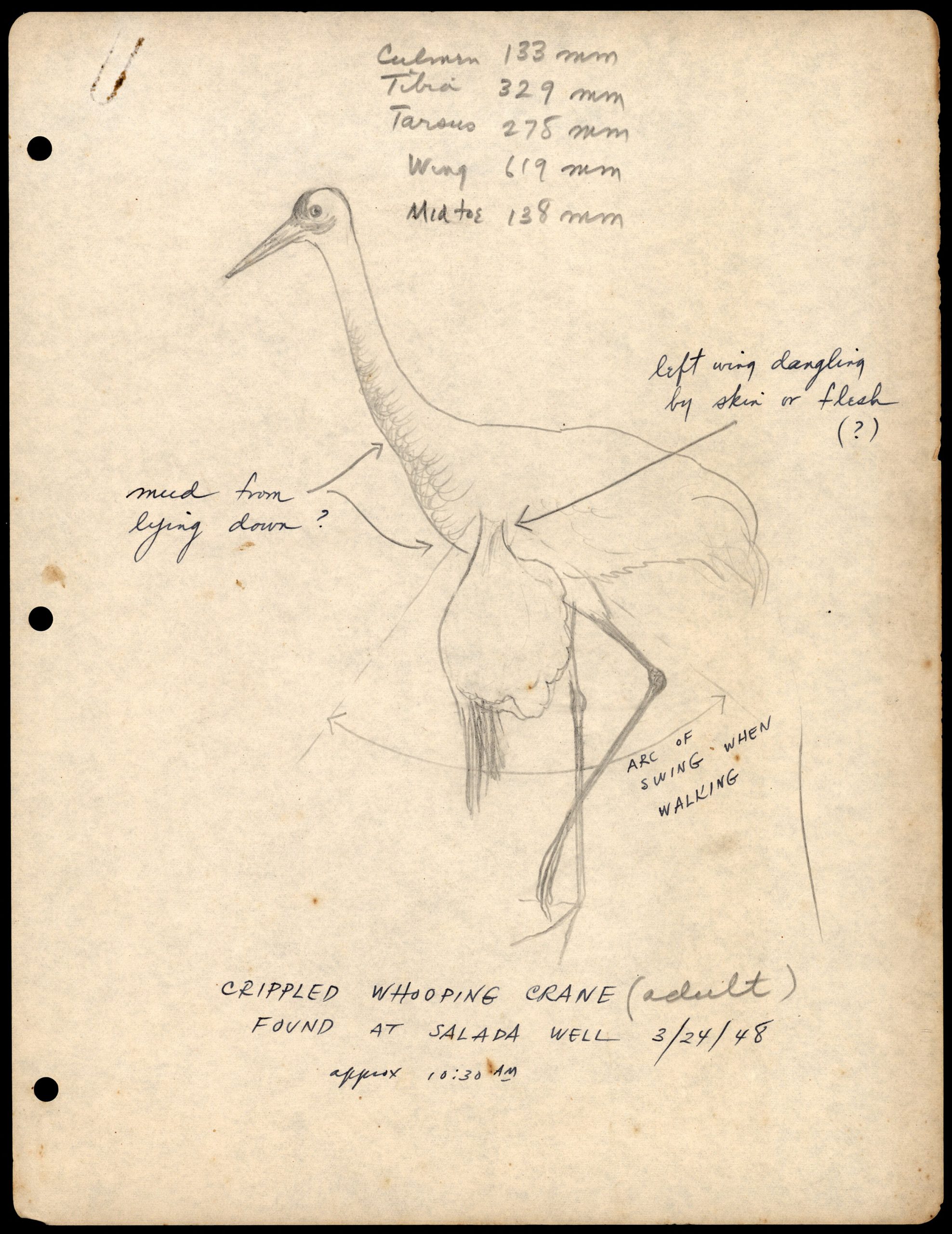
Allen, Robert Porter, “Diagram, Crippled Whooping Crane Sketch, March 24, 1948” (1948). Robert Porter Allen Audubon Collection – Photographs. Image 170. https://digitalcommons.usf.edu/rpa_photographs/170
Rich Collections Supporting Natural History Scholarship
USF’s growing collections will substantially enrich BHL, particularly content from across Florida, the Gulf of Mexico, and the Caribbean. Highlights include:
- Florida Environment and Natural History Digital Collections, containing more than 40 individual collections originating from individuals, scientific societies, and community organizations across Florida. Featured exhibits are hosted on the Florida Environment and Natural History (FLENH) Portal.
- Extensive archival materials documenting environmental history, including serving as the repository of the Florida Audubon Sanctuaries, the Florida Ornithological Society, and others. Highlights include the papers of pioneering ornithologist Robert Porter Allen.
- Searchable Ornithological Research Archive (SORA), now hosted by USF Libraries, providing access to 45 distinct journals and more than 81,000 articles.
- The USF Herbarium, home to more than 270,000 specimens and growing. The Herbarium samples can be viewed via theAtlas of Florida Plants.
With a major digitisation programme underway, these collections will continue to grow, bringing new biodiversity knowledge into BHL for global use.

Fritz-Quincy, Debbie; Florida Audubon Society; and Florida. Department of Natural Resources. Bureau of Education and Information, “Florida’s Manatee, An Educator’s Guide, Third Edition, 1983” (1983). Select Environment and Natural History Publications. 21. https://digitalcommons.usf.edu/envir_publications/21
Strengthening BHL’s Technical Capacity
USF will also contribute significantly to BHL’s technical infrastructure during this crucial period of transition. Their proposed support includes significant Systems Support for MACAW (BHL’s Metadata Collection and Workflow System) for three years, enabling them to:
- Join BHL’s Technical Team
- Build redundancy for specialised system expertise
- Support documentation, training, troubleshooting, and virtual content harvesting
- Potentially undertake future development work
This contribution directly enhances BHL’s resilience, sustainability, and capacity for innovation.
A Growing Community of Support
Today’s news marks the beginning of a series of positive developments that reflect deep community confidence in BHL’s mission and future. Over the coming weeks, we will share additional announcements as our Call for Support commitments are finalised — stay tuned.
“As we move into 2026, I’m pleased to share that BHL remains fully operational and is moving into its next chapter with new partnerships and renewed momentum. In 2026 we will be operating independently under CLIR as our fiscal sponsor as we focus on long-term sustainability and growth.”
— Kelli Trei, BHL Transition Director
Global Support Through Public Fundraising
BHL’s transition has also been met with an extraordinary response from the public. To date, BHL’s Transition fundraising has raised over USD 43,000 through more than 440 donations from supporters in 38 countries, reflecting the truly global reach and impact of the Biodiversity Heritage Library.
Of this total, over USD 38,000 has been raised thus far through our #GiveBHLWings campaign, launched on 18 November 2025 to support BHL’s transition to an independent and autonomous future beyond Smithsonian hosting from 1 January 2026. This campaign alone has attracted more than 370 donations from across the globe, demonstrating strong public confidence in BHL’s ability to thrive independently and sustainably.
This outpouring of public support strengthens the institutional commitments secured through the Call for Support and means BHL’s future is being shaped by a broad, international community of partners, contributors, and supporters.
How You Can Help
BHL’s transition is underway, and community support remains essential. You can help by:
- Sharing our story: spread the word about the #BHLTransition, our Call for Support, and the importance of open biodiversity literature.
- Engaging your institution: if your organisation wishes to join BHL or offer support, we welcome enquiries. Please contact [email protected].
- Donating to our #GiveBHLWings fundraising campaign: every contribution strengthens our services, infrastructure, and long-term sustainability.
Thank you for supporting the Biodiversity Heritage Library. With new members like the University of South Florida Libraries — and more announcements to follow — the future of BHL is bright and growing.
Discover more from Biodiversity Heritage Library
Subscribe to get the latest posts sent to your email.



Leave a Comment