
Biodiversity Heritage Library - Program news and collection highlights from BHL
  • Home
  • News
  • Featured Books
    • All Featured Books
    • Book of the Month Series
    • BHL at 20
  • User Stories
  • Campaigns
    • Fossil Stories
    • Garden Stories
    • Monsters Are Real
    • Page Frights
    • Her Natural History
    • Earth Optimism 2020
  • Tech Blog
  • Visit BHL
Home
News
Featured Books
    All Featured Books
    Book of the Month Series
    BHL at 20
User Stories
Campaigns
    Fossil Stories
    Garden Stories
    Monsters Are Real
    Page Frights
    Her Natural History
    Earth Optimism 2020
Tech Blog
Visit BHL
  • Home
  • News
  • Featured Books
    • All Featured Books
    • Book of the Month Series
    • BHL at 20
  • User Stories
  • Campaigns
    • Fossil Stories
    • Garden Stories
    • Monsters Are Real
    • Page Frights
    • Her Natural History
    • Earth Optimism 2020
  • Tech Blog
  • Visit BHL
Biodiversity Heritage Library - Program news and collection highlights from BHL
Blog Reel, Featured Books

Book of the Week: Halloween Special

View Full Size Image
So, Halloween’s just around the corner, so we at BHL thought it might be appropriate to highlight a species, and a book, appropriate for the season. Most likely, if you had to associate a single species from the animal kingdom with the spine-tingling glee of the Halloween experience, it would be the spider (unless you are a fan of the recent vampire craze, in which case you’ll likely choose a bat). Most people, when they think of a Halloween spider, probably draw to mind images of Black Widows, or simply enormous, generic, black, eight-legged beasts. However, did you ever think to imagine a spider with horns on its body? If not, well, you’re in luck.

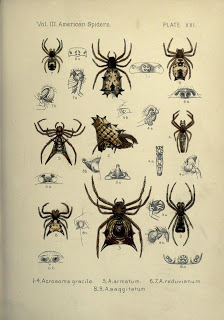
Meet the Spined Micrathena, or Micrathena gracilis (Walckenaer, 1805), formerly known as Acrosoma gracile. This member of the orb-weaver family inhabits the regions east of the Rocky Mountain states in North America. The females reach a length of about 10mm, while the males grow to be only about half that size. They vary widely in color, apparently, according to this week’s book of the week, according to age.

So by now you’re getting excited about the prospect of a new costume design specifically catered to frighten all the little children that come knocking on your door for trick-or-treat goodies. And where might you get a comprehensive description of this most appropriate eight-legged All Hallows’ Eve muse? In this week’s book of the week, volume 3 of American spiders and their spinningwork. A natural history of the orbweaving spiders of the United States, with special regard to their industry and habits, by Henry C. McCook (Spined Micrathena description starting page 212).

And, even if the Spined Micrathena doesn’t quite strike your fancy, or you’re simply worried about inadvertently poking out the eye of an unsuspecting child with your spiky costume adornments, there are plenty of other arachnid species highlighted in this book to choose from. So, in preparation for all your ghastly Halloween needs, let BHL give you a hand. After all, the natural world has much more terrifying imagery than any ghost or goblin story could ever hope to offer! So, from all of us at BHL, have a positively ghastly Halloween. Mwahhha!

This week’s book of the week, volume 3 of American spiders and their spinningwork. A natural history of the orbweaving spiders of the United States, with special regard to their industry and habits (1893), by Henry C. McCook, is contributed by the Smithsonian Institution Libraries.
October 18, 2010by ulib-libraryjobs
BHL News, Blog Reel, Tech Updates

Sample pages & books for OCR analysis

Portrait version of the Biodiversity Heritage Library logo.

As has been previously discussed, BHL has uncorrected text generated by Optical Character Recognition (OCR) software for each of its scanned volumes, and that uncorrected text has implications for data mining and accurate search. OCR results are notoriously poor because the technology hasn’t improved much since it was “solved” for forms processing in the mid-1980’s, which doesn’t really help BHL at all with our challenge of getting accurate text for our heterogeneous digital library spanning more than 500 years of printed publications.

Luckily some new work is happening around OCR and text correction from various projects, including:

  • Rod Page’s examples with Wikisource and a Google-like text selector
  • National Library of Australia’s Trove project (with their code)
  • EU-funded Improving Access to Text (IMPACT) project

The BHL development team and other stakeholders recently highlighted “improvements to OCR text” as an emerging priority for BHL to pursue. Now that we have a sizable repository we’d like to turn development efforts towards enhancing our texts and making them as accurate as possible for our users and data consumers. A subset of BHL is required for various tests and experiments, and that list has begun forming at:
BHL Sample Texts for Retrieval and Evaluation

  • https://spreadsheets.google.com/ccc?key=0AiGG0YxTuAn2dGN4R0ZyTTNTZUhfUlU1cHJ3T2JGdUE&hl;=en

If you encounter other texts that pose a unique challenge, please indicate them either via BHL’s Feedback form or on a comment below.

October 17, 2010by [email protected]
BHL News, Blog Reel

IYB 2010 Supports Young Artists

View Full Size Image
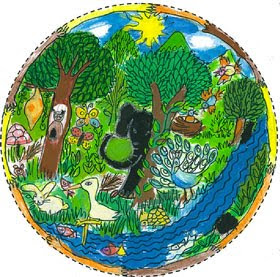
As we know, 2010 is the International Year of Biodiversity. Programming throughout the year in support of all things biodiverse has been wide-ranging. Activities for scientific explorations of climate change and habitat preservation abound as well as opportunities for local involvement and youth directed campaigns, like the 2010 International Biodiversity Art Competition.

On behalf of Secretariat of the Convention on Biological Diversity (CBD), the Food and Agriculture Organization of the United Nations (FAO), the World Association of Girl Guides and Girl Scouts (WAGGGS) and Bioversity International, The Green Wave received over 3000 drawings from children and youth ages 6-20. Illustrating the themes and concerns surrounding biodiversity and the future of inter-connected life on this planet, the competition educates and engages young people in the ongoing discussions surounding the impact of biodiversity. The winning entries will be used as Biodiversity Challenge Badges throughout various educational campaigns.

Pictured above is the entry from 4th place winner in the 6-10 year old category, 9 year old Nethmini Ashinsana Wattetenna from Sri Lanka. Click the image to view winning entries from each age bracket.
–And stay tuned for more reports from the International Year of Biodiversity!

October 12, 2010by jwinberry
BHL News, Blog Reel

Using an iPad to Demo BHL

View Full Size Image

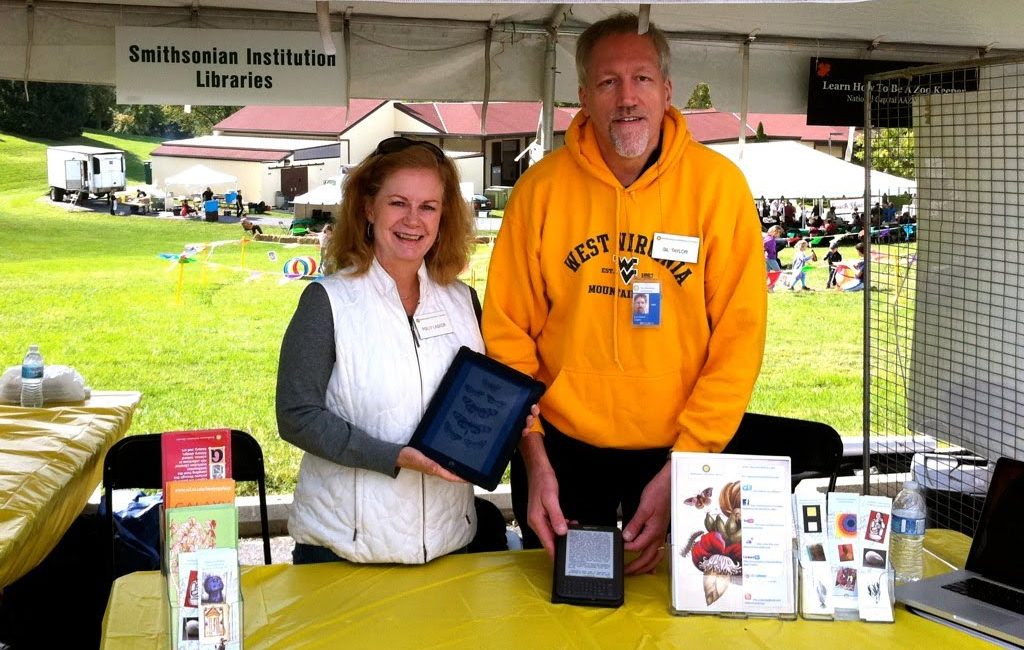
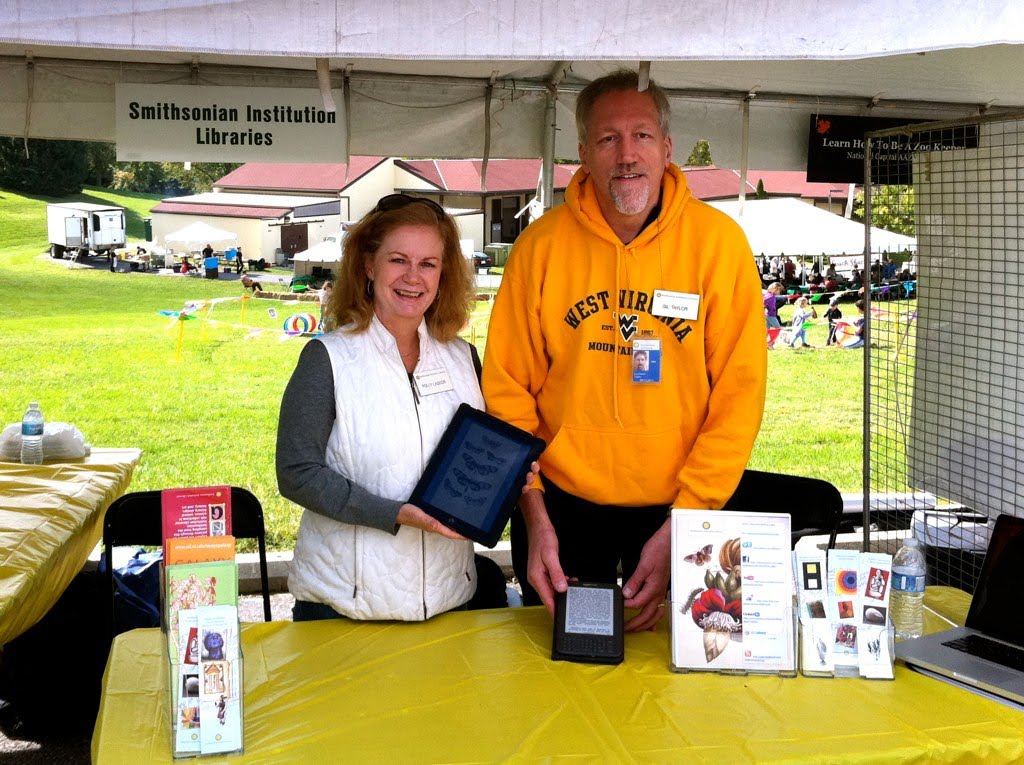
On Saturday October 2nd and Sunday October 3rd, 2010, Smithsonian Institution Libraries staff members Polly Lasker and Gil Taylor, plus volunteer John Hejna (Polly’s husband), promoted the Libraries’ services at a booth during the annual Autumn Conservation Festival at the Smithsonian Conservation Biology Institute (SCBI) near Front Royal, Virginia: http://nationalzoo.si.edu/ActivitiesAndEvents/Celebrations/ACF/default.cfm

The one BHL-scanned book we pre-loaded to an iPad and brought along was big hit with the crowd, “Curiosities of Entomology” http://biodiversitylibrary.org/bibliography/8174 . It was a revelation how well the iPad works for demoing BHL in a face-to-face setting, and the book we selected seemed to work very well with the app, iBooks (Polly and Gil, pictured above, demonstrating BHL book on iPad). Young people, in particular, intuitively knew how to navigate to view the book with the device. Needless to say, we distributed many BHL cards to the nearly 150 people who visited us that weekend.

For photos from the event, please see this Flickr link.

October 5, 2010by ulib-libraryjobs
Blog Reel, Featured Books

Book of the Week: More with Darwin

View Full Size Image
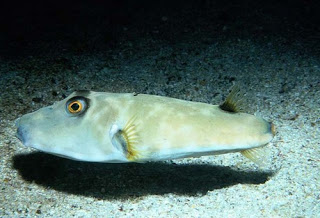
So, our last book of the week took a look at Darwin’s voyage on the H.M.S. Beagle through the eyes of a child. We thought it fitting this week to continue with the theme of the H.M.S Beagle, wrapping it together with one of the featured species on EOL this week, the Sphoeroides angusticeps, or the Narrow-Headed Puffer.

The Narrow-Headed Puffer is endemic to the Galapagos Islands, and indeed was first described in part 4 of The zoology of the voyage of H.M.S. Beagle … during the years 1832-1836, page 154. Upon returning home, Darwin gave his collection of about 137 species of fish gathered during the voyage of the H.M.S. Beagle to his friend, avid beetle collector Rev. Leonard Jenyns, for keeping. While Jenyns worked through this collection to describe it, he “had the most difficult time with the fish, as he knew next to nothing about their anatomy.”

Jenyns, transcribing Darwin’s own description of the specimen, described the Narrow-Headed Puffer fish as “above dull green, base of Pectorals and Dorsal black, a white patch beneath the Pectorals.” However, he noted that “The colors must have very much altered from the action of the spirit, as it now appears of a nearly uniform reddish brown, only paler beneath.” Interestingly, Jenyns originally misidentified the species, calling it Tetrodon aerostaticus. This was corrected to Tetrodon angusticeps, and is now known as Sphoeroides angusticeps.

Take a moment to check out the first descripton of the Narrow-Headed Puffer fish in this week’s book of the week, and be sure to take a look at this species on EOL to find more information.

This week’s book of the week, The zoology of the voyage of H.M.S. Beagle … during the years 1832-1836, part 4 (1842), was contributed by the MBLWHOI library.

October 4, 2010by michelle.underhill

Help Support BHL

BHL's existence depends on the financial support of its patrons. Help us keep this free resource alive!

search

About BHL

The Biodiversity Heritage Library (BHL) is the world’s largest open access digital library for biodiversity literature and archives. BHL operates as a worldwide consortium of natural history, botanical, research, and national libraries working together to digitize the natural history literature held in their collections and make it freely available for open access as part of a global “biodiversity community.”

Join Our Mailing List

Sign up to receive the latest news, content highlights, and promotions.

Subscribe Now

Subscribe to Blog via Email

Enter your email address to subscribe to this blog and receive notifications of new posts by email.

Join 319 other subscribers

Subscribe to Blog Via RSS

Subscribe to the blog RSS feed to stay up-to-date on all the latest BHL posts.

Access RSS Feed

Inspiring Discovery through Free Access to Biodiversity Knowledge.

The Biodiversity Heritage Library makes it easier than ever for you to access the information you need to study and explore life on Earth…for free, anytime, anywhere.


ABOUT | HARMFUL CONTENT | PRIVACY | SITE MAP | TERMS OF USE