Biodiversity Heritage Library - Program news and collection highlights from BHL
  • Home
  • News
  • Featured Books
    • All Featured Books
    • Book of the Month Series
    • BHL at 20
  • User Stories
  • Campaigns
    • Fossil Stories
    • Garden Stories
    • Monsters Are Real
    • Page Frights
    • Her Natural History
    • Earth Optimism 2020
  • Tech Blog
  • Visit BHL
Home
News
Featured Books
    All Featured Books
    Book of the Month Series
    BHL at 20
User Stories
Campaigns
    Fossil Stories
    Garden Stories
    Monsters Are Real
    Page Frights
    Her Natural History
    Earth Optimism 2020
Tech Blog
Visit BHL
  • Home
  • News
  • Featured Books
    • All Featured Books
    • Book of the Month Series
    • BHL at 20
  • User Stories
  • Campaigns
    • Fossil Stories
    • Garden Stories
    • Monsters Are Real
    • Page Frights
    • Her Natural History
    • Earth Optimism 2020
  • Tech Blog
  • Visit BHL
Biodiversity Heritage Library - Program news and collection highlights from BHL
Blog Reel, Featured Books

BHL Adds Volumes from Wilson Ornithological Society

52234276.jpeg

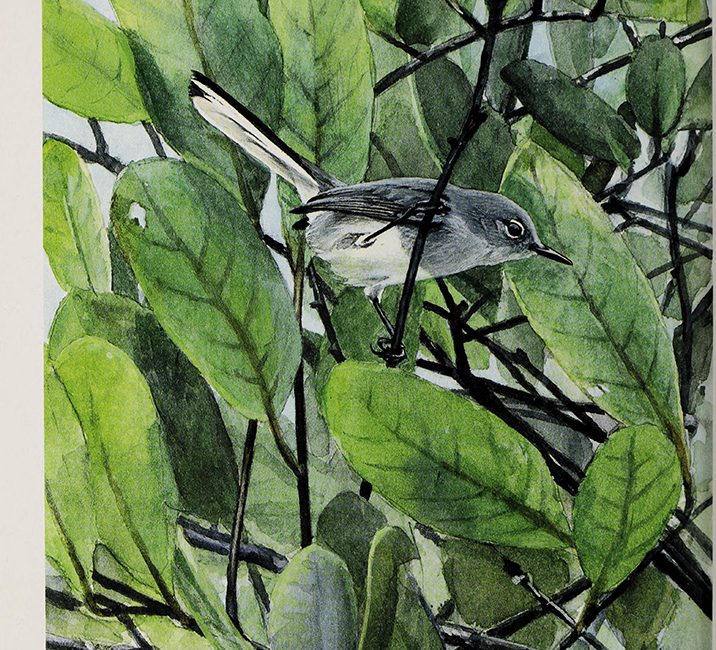
Caption transcription: “Iquitos Gnatcatcher (Polioptila clementsi sp. nov.), the fourth new bird species described from the Reserva Nacional Allpahuayo-Mishana near Iquitos, Peru since 1998; tree is Caraipa tereticaulis (Clusiaceae). Original watercolor painting by Lawrence B. McQueen.” The Wilson Bulletin, v. 117. 2005. Contributed to BHL by the Harvard University, Museum of Comparative Zoology, Ernst Mayr Library with permission from the Wilson Ornithological Society. CC-BY-NC-SA.

More volumes from the Wilson Ornithological Society are now on BHL!  Spanning back to 1893, the publications The Wilson Bulletin and The Wilson Journal of Ornithology are a great example of the kind of legacy literature that distinguishes BHL.

The Wilson Ornithological Society is the second largest ornithological society in North America. The organization of professional scientists and dedicated amateurs is named for Alexander Wilson, known as the “Father of American Ornithology”.

The Wilson Journal of Ornithology is a quarterly peer-reviewed journal that replaces its predecessor, The Wilson Bulletin. BHL had previously added some earlier public domain volumes of The Wilson Bulletin (contributed in BHL by the American Museum of Natural History and Smithsonian Libraries), but was able to expand the collection thanks to the Expanding Access to Biodiversity Literature (EABL) project, funded by the Institute of Museum and Library Services. The Wilson Ornithological Society granted permission to share these titles on BHL with a 5-year embargo on the most recently published volumes, so that now BHL has The Bulletin from 1894-2005 and The Journal from 2006-2010.

52234156.jpeg

Caption transcription: “FRONTISPIECE. Bicknell’s Thrush (Catharus bicknelli) in its favored high-elevation, coniferous-forest habitat in the northeastern United States. Lambert et al. mapped the distribution of Bicknell’s Thrush based on their model that predicts presence above an elevation threshold that decreases with increasing latitude. Original painting acrylic and gouache by Barry Kent MacKay.” The Wilson Bulletin, v. 117. 2005. Contributed to BHL by the Harvard University, Museum of Comparative Zoology, Ernst Mayr Library with permission from the Wilson Ornithological Society. CC-BY-NC-SA.

The story of the Wilson Ornithological Society begins in 1886 with the ‘Young Ornithologists Association’ founded by L. O. Pindar and J. B. Richards. This group changed names several times, morphing into the Wilson Ornithological Chapter of the Agassiz Association in 1888, to the Wilson Ornithological Club, and eventually the Wilson Ornithological Society (WOS) in 1955. The first five volumes published by the evolving group went by several different titles, all of which are available on BHL (added prior to EABL). They are:

  • The Ornithologists’ and oologists’ semi-annual (v. 1-2 and 3.1, 1889-1891, contributed by Smithsonian Libraries)
  • The Wilson quarterly (v. 4, 1892, contributed by the American Museum of Natural History)
  • The journal of the Wilson Ornithological Chapter of the Agassiz Association (5th volume in WOS series, 1893, contributed by Smithsonian Libraries)

The Wilson Ornithological Society is headquartered at the University of Michigan, where it established the Josselyn Van Tyne Memorial Library in association with the University’s Bird Division Library.

52234941.jpeg

Caption transcription: “Group at the Annual Meeting, Louisville, November 25, 1939.” The Wilson Bulletin, v. 52. 1940. Contributed to BHL by the Harvard University, Museum of Comparative Zoology, Ernst Mayr Library with permission from the Wilson Ornithological Society. CC-BY-NC-SA.

52180336.jpeg

Caption transcription: “FRONTISPIECE. This is a reproduction of an original watercolor by George M. Sutton painted in 1952 as an illustration for the book, Georgia Birds, written by Thomas D. Burleigh and published by University of Oklahoma Press. The original paintings for the book were given in friendship to Herbert Stoddard and are part of the Stoddard Collection at Tall Timbers Research Station & Land Conservancy. ‘When I made this painting, the nuthatches were not moving through the pine tops in noisy family groups, as they often do, but nesting quietly. This pair had a nest in a small hollowed-out cypress knee placed for them on a fence post. I looked a long while before finding exactly the right shortleaf pine branch for the picture. I wanted the branch, as well as the birds, to be interesting.’” Wilson Journal of Ornithology, v. 119. 2007. Contributed to BHL by the Harvard University, Museum of Comparative Zoology, Ernst Mayr Library with permission from the Wilson Ornithological Society. CC-BY-NC-SA.

The Wilson Bulletin and the The Wilson Journal of Ornithology were digitized for BHL as a group effort, with digitized volumes contributed by the Ernst Mayr Library of Harvard’s Museum of Comparative Zoology, the American Museum of Natural History, and The Academy of Natural Sciences of Drexel University.

For a look at digitization behind the scenes, here’s the view from my desk as I work in the Ernst Mayr Library at Harvard’s Museum of Comparative Zoology:

books on a shelf

Bound volumes of the Bulletin and Journal pulled from the shelf at the Mayr Library to be digitized for BHL. Photo credit: Elizabeth Meyer.

These bound volumes (51-122) were pulled from the shelf at the Mayr Library and checked page by page to make sure each was in good condition for scanning: no pages missing or out of order, no extensive damage, and margins wide enough for scanning to capture all of the text. (This is what I do when I’m not writing blog posts!) Some of the volumes were scanned here at the Mayr Library using our Table Top Scribe (see next image), and the rest were sent to Internet Archive scanning facilities. To fill in the gaps where our volumes weren’t suitable for scanning, we reached out to the American Museum of Natural History (v. 51, 54, 76, 86-87, 96) and to The Academy of Natural Sciences of Drexel University (v. 123-124; currently being digitized).

book scanning machine

The Mayr Library has an Internet Archive Table Top Scribe system. The bound item is placed in the lower cradle and lifted up using a foot pedal to press against the angled glass panes. Two cameras simultaneously capture separate images of both pages. Photo credit: Elizabeth Meyer.

Gratitude to Wilson Ornithological Society for granting permission to share these volumes on BHL, and to the Ernst Mayr Library of Harvard’s Museum of Comparative Zoology, the American Museum of Natural History and The Academy of Natural Sciences of Drexel University for digitization!

References

Wilson Ornithological Society

July 26, 2018by Joel Richard
Blog Reel, Featured Books

Bateman’s Orchidaceae: Exploring One of the Rarest – and Largest – Orchid Books

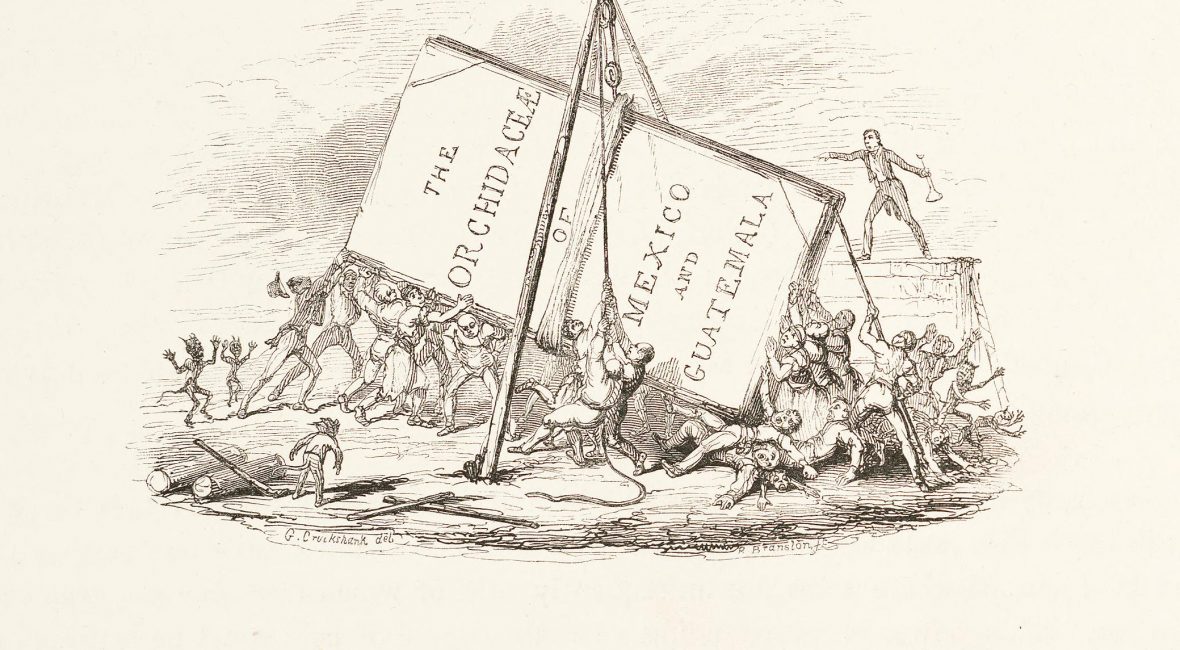
“The Librarian’s Nightmare.” Vignette by George Cruikshank for James Bateman’s The Orchidaceae of Mexico and Guatemala ([1837]-1843). Contributed in BHL by the Peter H. Raven Library of the Missouri Botanical Garden.

A version of this article first appeared in the Council on Botanical and Horticultural Libraries (CBHL) May 2018 Newsletter.

“The Librarian’s Nightmare.” Vignette by George Cruikshank for James Bateman’s The Orchidaceae of Mexico and Guatemala ([1837]-1843). Contributed in BHL by the Peter H. Raven Library of the Missouri Botanical Garden.

“The Librarian’s Nightmare.” Vignette by George Cruikshank for James Bateman’s The Orchidaceae of Mexico and Guatemala ([1837]-1843). Contributed in BHL by the Peter H. Raven Library of the Missouri Botanical Garden.

“The Librarian’s Nightmare.”

Such is the name given to a delightful and quirky vignette found within a very rare, and very special, orchid book: James Bateman’s The Orchidaceae of Mexico and Guatemala ([1837]-1843).

This vignette, the work of caricaturist George Cruikshank, depicts a group of men struggling to lift an enormous book using a pulley system while a harried taskmaster with a megaphone attempts to direct their work and demons dance about with impish glee on the sidelines.

The vignette’s caption, translated from the Greek, reads “a big book is a big evil” (Bleichmar 2017, 179).

The scene is a humorous commentary on the massive size of Bateman’s orchid book. At about 30” x 22” (Cobbledick 2018a) and weighing in at over 38 lbs (Hamilton 1990, 1244), it is the “largest botanical book ever produced with lithographic plates” (Blunt and Stearn 1994, 249).

Plate 19. Bateman, James. The Orchidaceae of Mexico and Guatemala. Illustration drawn by Sarah Anne Drake and lithographed by Maxim Gauci. Contributed in BHL by the Peter H. Raven Library of the Missouri Botanical Garden.

Plate 19. Bateman, James. The Orchidaceae of Mexico and Guatemala. Illustration drawn by Sarah Anne Drake and lithographed by Maxim Gauci. Contributed in BHL by the Peter H. Raven Library of the Missouri Botanical Garden.

The Orchidaceae of Mexico and Guatemala was produced in the midst of the Victorian era’s “orchid mania” or “Orchidelirium”, characterized by European obsession with collecting and cultivating exotic orchid species. Wealthy orchid enthusiasts commissioned collectors to travel the world in search of new and rare specimens.

James Bateman was such an enthusiast. A wealthy British landowner and passionate horticulturalist, Bateman employed collectors to obtain new specimens for him, particularly from South and Central America (Sitwell and Blunt 1990, 45). It was his relationship with a merchant operating in Guatemala that enabled Bateman to secure many of the orchids featured in his magnificent folio.

Plate 13. Bateman, James. The Orchidaceae of Mexico and Guatemala. Illustration drawn by Augusta Withers and lithographed by Maxim Gauci. Contributed in BHL by the Peter H. Raven Library of the Missouri Botanical Garden.

Plate 13. Bateman, James. The Orchidaceae of Mexico and Guatemala. Illustration drawn by Augusta Withers and lithographed by Maxim Gauci. Contributed in BHL by the Peter H. Raven Library of the Missouri Botanical Garden.

George Ure Skinner, born into a scholarly English family, established an export business in Guatemala in the 1830s, and in his free time, collected local birds and insects for the Museum of Natural History in Manchester, England. After receiving a letter from Bateman requesting orchids from the region, Skinner began collecting and shipping back new and stunning specimens hitherto unknown to the European public. These specimens formed the foundation of Bateman’s orchid masterpiece (Schmidt-Ostrander 2018).

Plate 6. Bateman, James. The Orchidaceae of Mexico and Guatemala. Illustration drawn by Augusta Withers and lithographed by Maxim Gauci. Contributed in BHL by the Peter H. Raven Library of the Missouri Botanical Garden.

Plate 6. Bateman, James. The Orchidaceae of Mexico and Guatemala. Illustration drawn by Augusta Withers and lithographed by Maxim Gauci. Contributed in BHL by the Peter H. Raven Library of the Missouri Botanical Garden.

Within The Orchidaceae of Mexico and Guatemala, Bateman provided scientific descriptions in English and Latin as well as practical cultivation information for the species presented in the book. Also, according to Amy Pool, Curatorial Assistant at the Missouri Botanical Garden, 11 new-to-science species of orchids were validly published in this work. She estimates that it presented the first published illustrations for 90% of the 40 species included.

Plate 40. Bateman, James. The Orchidaceae of Mexico and Guatemala. Illustration drawn by Sarah Anne Drake and lithographed by Maxim Gauci. Contributed in BHL by the Peter H. Raven Library of the Missouri Botanical Garden.

Plate 40. Bateman, James. The Orchidaceae of Mexico and Guatemala. Illustration drawn by Sarah Anne Drake and lithographed by Maxim Gauci. Contributed in BHL by the Peter H. Raven Library of the Missouri Botanical Garden.

The work is particularly noteworthy for its colorful (and sizeable) lithographic plates. Numbering 40 in total, these lithographs were executed by Maxim Gauci based on drawings largely by Sarah Anne Drake and Augusta Withers, with two drawings by Jane Edwards and one by Samuel Holden. These illustrations were based on the live specimens in Bateman’s and his friends’ greenhouses. The hand-colored elements of the lithographs add dimension and richness to the orchid forms, particularly through the application of varnish which provides deeper tones (Cobbledick 2018b).

The Orchidaceae of Mexico and Guatemala was issued in parts between 1837-43 and printed in a limited edition of 125 copies sold to subscribers (Bleichmar 2017, 179). Today, fewer than 55 copies are known to exist.

Plate 7. Bateman, James. The Orchidaceae of Mexico and Guatemala. Illustration drawn by Augusta Withers and lithographed by Maxim Gauci. Contributed in BHL by the Peter H. Raven Library of the Missouri Botanical Garden.

Plate 7. Bateman, James. The Orchidaceae of Mexico and Guatemala. Illustration drawn by Augusta Withers and lithographed by Maxim Gauci. Contributed in BHL by the Peter H. Raven Library of the Missouri Botanical Garden.

One of those copies can be found in the world-renowned Rare Book Collection of the Peter H. Raven Library of the Missouri Botanical Garden. Happily, this copy has been digitized in the Biodiversity Heritage Library and is now freely available to the world.

The Missouri Botanical Garden recently featured an exhibit about The Orchidaceae of Mexico and Guatemala. Image credit: Lauren Peters

The Missouri Botanical Garden recently featured an exhibit about The Orchidaceae of Mexico and Guatemala. Image credit: Lauren Peters.

Earlier this year, the Missouri Botanical Garden produced an exhibit on book conservation, entitled: Taking Care of Our Rare Books: Another Kind of Conservation. This ran concurrent with the Garden’s annual orchid show, the 2018 theme being “Orchid mania.” Both featured The Orchidaceae of Mexico and Guatemala. The floral show included numerous images from the book and described its role in “orchid mania”, and the exhibit featured a selection of images and text excerpts from the publication while highlighting book conservation techniques and principles.

=At nearly 200 years old, and having been acquired by the Library in 1895 during a period of heavy pollution in Saint Louis, it is not surprising that the Missouri Botanical Garden’s copy of Bateman’s work is in poor condition, with ripped and soiled paper, loose pages, and broken binding.

The Missouri Botanical Garden’s copy of The Orchidaceae of Mexico and Guatemala is undergoing an extensive restoration project. Image credit: Susie Cobbledick

The Missouri Botanical Garden’s copy of The Orchidaceae of Mexico and Guatemala is undergoing an extensive restoration project. Image credit: Susie Cobbledick

The Library’s book conservator, Susie Cobbledick, has begun a substantial restoration project for this work. This process was not only highlighted as part of the Garden’s exhibit, but it is also being recorded through a series of posts on the Garden’s Discover + Share website. This process includes repairing the volume’s binding and cleaning and mending the paper.

As Cobbledick articulates, the Library’s copy had been rebound at least once, and past attempts to repair the binding have failed under the strain imposed by such a massive volume. Additionally, the original covers were replaced with Masonite board at some point in the 20th century. As part of the Library’s conservation process, a more robust binding structure will be created for this volume, and more appropriate covers may be used to replace the inadequate Masonite (Cobbledick 2018a).

The Garden’s copy of The Orchidaceae of Mexico and Guatemala was originally sewn on linen cords, which would have extended beyond the back of the book to the boards. The fact that these cords have been cut is evidence that the book had been rebound some time in the past. Image Credit: Susie Cobbledick

The Garden’s copy of The Orchidaceae of Mexico and Guatemala was originally sewn on linen cords, which would have extended beyond the back of the book to the boards. The fact that these cords have been cut is evidence that the book had been rebound some time in the past. Image Credit: Susie Cobbledick

The soiled pages also require special attention. In order to remove the dirt and other residue that has accumulated over the past 170+ years without altering or damaging the lithographs’ fragile surfaces, Cobbledick is employing dry cleaning methods using cosmetic sponges and white vinyl erasers to carefully clean each page. This time-consuming process will take several months to complete (Cobbledick 2018b).

Cosmetic sponges and white vinyl erasers are used to clean the lithographs within the Garden’s copy of The Orchidaceae of Mexico and Guatemala. In this photo, you can see a cleaned (right-hand side) and uncleaned (left-hand side) portion of a plate from the book. Image Credit: Susie Cobbledick

Cosmetic sponges and white vinyl erasers are used to clean the lithographs within the Garden’s copy of The Orchidaceae of Mexico and Guatemala. In this photo, you can see a cleaned (right-hand side) and uncleaned (left-hand side) portion of a plate from the book. Image Credit: Susie Cobbledick.

Conservators have also begun mending the volume’s ripped and damaged paper. As part of this process, they are conducting tests to determine whether the type of sizing (substance added to paper to make it less absorbent) used has contributed to the poor condition of the book’s paper today. The answer may be related to whether or not the paper was machine-made. Explore the testing process and initial outcomes in the most recent “Rebuilding the Bateman Book” post.

To learn more about the restoration process for The Orchidaceae of Mexico and Guatemala and follow the conservation work, explore the entire “Rebuilding the Bateman Book” series on the Garden’s Discover + Share website.

The Orchidaceae of Mexico and Guatemala is truly a scientific, bibliographic, and artistic marvel. Through its unique blend of scientific information, awe-inspiring illustrations, and unexpected humor, Bateman’s orchid masterpiece stands out as a truly remarkable entry in the annals of natural history.

As another example of humor within The Orchidaceae of Mexico and Guatemala, this vignette by George Cruikshank depicts a pair of gigantic cockroaches escaping from a box meant to contain orchid specimens whilst the gardener’s family and assistants chase the unwelcome intruders.

As another example of humor within The Orchidaceae of Mexico and Guatemala, this vignette by George Cruikshank depicts a pair of gigantic cockroaches escaping from a box meant to contain orchid specimens whilst the gardener’s family and assistants chase the unwelcome intruders.

What some might call “The Librarian’s Nightmare”, we call “The Book Lover’s Dream”. We are grateful to the Peter H. Raven Library of the Missouri Botanical Garden for making this title freely available in BHL and are thrilled that the Library’s current conservation efforts will ensure that future generations can enjoy this treasure.

Taking Care of Our Rare Books: Another Kind of Conservation was curated by Missouri Botanical Garden staff Lauren Peters (Science Communication Specialist), Amy Pool (Curatorial Assistant, Herbarium), and Susie Cobbledick (Book Conservator, Library) and designed by Ellen Flesch (Supervisor, Creative Services) based on an exhibit proposal by Doug Holland (Director, Peter H. Raven Library). Learn more about the exhibit.

Post by Grace Costantino (Outreach and Communication Manager, Biodiversity Heritage Library) with significant contributions from Susie Cobbledick (Book Conservator, Peter H. Raven Library of the Missouri Botanical Garden) and Amy Pool (Curatorial Assistant, Herbarium, Missouri Botanical Garden).

References

Bleichmar, Daniela. 2017. Visual Voyages: Images of Latin American Nature from Columbus to Darwin. New Haven, CT: Yale University Press.

Blunt, Wilfrid and William T. Stearn. 1994. The Art of Botanical Illustration. New Edition. Suffolk: Antique Collectors’ Club, Ltd.

Cobbledick, Susie. 2018a. “From the Library: Rebuilding the Bateman Book (Part 1).” Discover + Share. February 17. Accessed March 29, 2018. https://discoverandshare.org/2018/02/17/from-the-library-rebuilding-the-bateman-book-part-1/.

Cobbledick, Susie. 2018b. “From the Library: Rebuilding the Bateman Book (Part 2).” Discover + Share. March 22. Accessed March 29, 2018. https://discoverandshare.org/2018/03/22/from-the-library-rebuilding-the-bateman-book-part-2/.

Hamilton, Robert M. 1990. “Skinner and Bateman – 1: Introduction.” American Orchid Society Bulletin 59, no. 12 (December): 1235-1247.

Schmidt-Ostrander, Ingrid. 2018. “George Ure Skinner (1804 – 1867).” Victorian Orchid Society. Accessed March 29, 2018. http://victoriaorchidsociety.com/Ingrid/Skinner.html.

Sitwell, Sacheverell and Wilfrid Blunt. 1990. Great Flower Books: 1700-1900. New York: The Atlantic Monthly Press.

July 19, 2018by michelle.underhill
Blog Reel, User Stories

Uncovering Cryptic Species and More with the Biodiversity Heritage Library

Fernando Á. Fernández-Álvarez taking samples with a van veen grab sampler in the oceanic cruise Formed IV (June 2014).

What does it mean for a species to be “cryptic”?

In the biological sciences, “cryptic species” are morphologically indistinguishable yet distinct species. In other words, two or more organisms may look the same and yet represent different species.

With the rise of molecular genetic techniques, the identification of cryptic species is increasing. Many previously-considered cosmopolitan species are proving to actually be multiple species each occupying segments of the original distribution range. Identifying cryptic species is especially important for conservation and resource management, which operate at the species level and rely on accurate identification of range and population size to effectively implement policies and programs.

The neon flying squid Ommastrephes bartramii (Lesueur, 1821) has long been considered a monotypic, cosmopolitan species. The second-largest representative of the ecologically and commercially important family of squids Ommastrephidae Steenstrup, 1857, the species is currently considered to have global distribution.

Recent research has shown, however, that this “monotypic” species may not be so “mono” after all.

Using molecular species delimitation methods, Dr. Fernando Á. Fernández-Álvarez, an early researcher at the Institut de Ciències del Mar (CSIC) in Barcelona, and his colleagues[1] found that what is currently described as Ommastrephes bartramii actually represents four different species. After examining previous descriptions in the literature, three synonymized names have been proposed for resurrection accordingly. This research comprises one of four chapters in Fernández-Álvarez’s Ph.D. thesis, and the manuscript is currently under preparation for submission to a journal.

Two Ommastrephes spp. specimens

Two Ommastrephes spp. specimens collected in North Atlantic waters during the two oceanographic cruises: MAFIA (left, collected near Cabo Verde 18ºN 20ºW in April 2015) and BATHYPELAGIC (right, collected in the middle of the Atlantic 40ºN, 19ºW, June 2018). Although both specimens basically look the same, each one belongs to a different species. Molecular data revealed that Ommastrephes bartramii is actually a species complex instead of a single species, as previously thought. BHL has been essential for tracking previous synonymized names to resurrect in order to name each species. Image credit: Catarina P. P. Martins & Fernando Á. Fernández-Álvarez (left) and Fernández-Álvarez (right).

The Biodiversity Heritage Library proved to be a vital resource for this research, allowing Fernández-Álvarez to easily locate literature about relevant synonymized names of Ommastrephes bartramii, many of which were published in the 19th century.

“Especially when it comes to historic synonymized names, it is difficult to find literature mentioning a particular name beyond its description,” explains Fernández-Álvarez. “I used BHL’s taxon search tool to look for works that mention each particular name. This tool was very useful for finding many works!”

Fernández-Álvarez has been studying cephalopod phylogenetics, systematics, and taxonomy, among other fields, for four years. Prior to this, he spent six years studying nemertean taxonomy and systematics. It was that research that first led him to BHL.

“During part of my early work on nemertean taxonomy, I struggled with the essential Otto Bürger’s book Die Nemertinen des Golfes von Neapel, which is obviously written in German,” recalls Fernández-Álvarez. “I spent many days with a German-Spanish dictionary and a copied version of the book trying to decipher the meaning of many passages. It was torture. Finally, I googled the book and found it in BHL with the OCR beautifully written out! I copied the passages and used automatic translation tools to read it. It was a huge help!”

Fernando Á. Fernández-Álvarez taking samples with a van veen grab sampler in the oceanic cruise Formed IV (June 2014).

Fernando Á. Fernández-Álvarez taking samples with a van veen grab sampler in the oceanic cruise Formed IV (June 2014).

Over the years, Fernández-Álvarez has used BHL to varying degrees depending on his research focus. Not surprisingly, his favorite feature is the taxon search tool. He typically uses either this tool or an author search to locate relevant literature, reading the titles online and downloading content (with OCR) as needed as a full PDF or using BHL’s custom PDF generator to select specific pages.

“When it comes to systematics or taxonomy, BHL has become a fundamental tool,” affirms Fernández-Álvarez. “When I am focused on these fields, I may use BHL every day each week!”

We are thrilled to know that BHL is empowering discovery around the globe and allowing researchers to access vital materials. User stories are a powerful testament to BHL’s impact.

“I think BHL fulfills a truly important task,” lauds Fernández-Álvarez. “Many of the books in the library are truly difficult to find and now they are freely available around the world. Many of the works I needed to find to advance in my research, I was able to obtain through you. THANKS!!!”

Thank you, Dr. Fernández-Álvarez, for sharing your research and BHL story with us.

In collaboration with our global partners and through an unwavering commitment to open access, we are confident that BHL will continue to transform research in unprecedented ways.

[1] Kathrin S. Bolstad, Heather E. Braid, Manuel Haimovici, Chingiz M. Nigmatullin, Pilar Sánchez, and Roger Villanueva.

July 12, 2018by michelle.underhill
BHL News, Blog Reel

The Biodiversity Heritage Library Adds Lloyd Library & Museum as a New Affiliate

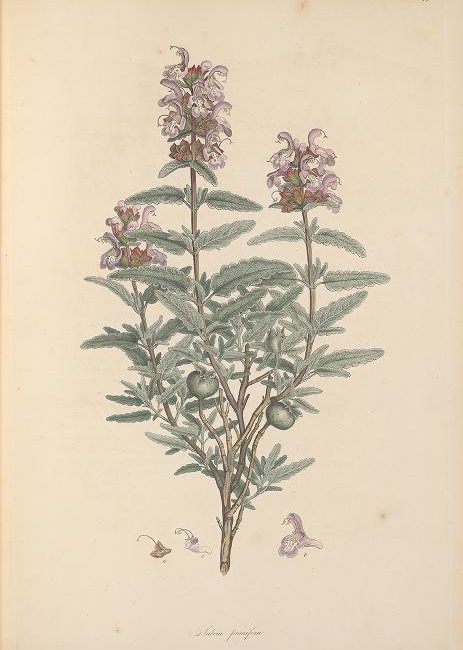
Illustration of a plant

Lloyd Library and Museum logo

The Biodiversity Heritage Library is pleased to welcome the Lloyd Library & Museum as its newest Affiliate.

Founded in the 1870s, the Lloyd Library & Museum’s origins trace back to a collection of reference materials acquired by the brothers John Uri Lloyd (1849-1936) and Curtis Gates Lloyd (1859-1926), both trained pharmacists of the botanical medicine era. The Library, which continues to build its collection thanks to an endowment established by Curtis Lloyd, holds approximately 150,000 volumes on a range of topics, including botany, mycology, herbal medicine, gardening, and horticulture.

Illustration of a plant

Sibthorp, John. Flora Graeca. v. 1 (1806). Contributed in BHL by the Lloyd Library & Museum.

The Lloyd’s affiliation builds upon a successful partnership established during the BHL Expanding Access to Biodiversity Literature (EABL) project, where, in collaboration with Digital Services at the Public Library of Cincinnati and Hamilton County (PLCH), the Library uploaded 26 significant titles to BHL’s collection, including Flora Graeca (1806-1840) and Botanicum Medicinale (1768). As an Affiliate, the Lloyd will contribute additional titles identified from its collection that are not yet in BHL, providing free access to valued resources for both local and global communities.

Illustration of a plant

Sheldrake, Timothy. Botanicum medicinale. 1768. Contributed in BHL by the Lloyd Library & Museum.

“We are excited to welcome the Lloyd Library & Museum as an Affiliate,” affirms BHL Program Director Martin R. Kalfatovic. “Lloyd Library has already contributed significant treasures to BHL as part of the EABL project, and we look forward to expanding our collaborative efforts to enhance the BHL corpus and empower global research through open access to unique and important library collections.”

Explore the Lloyd Library & Museum’s collection in the Biodiversity Heritage Library.

July 5, 2018by michelle.underhill

Help Support BHL

BHL's existence depends on the financial support of its patrons. Help us keep this free resource alive!

search

About BHL

The Biodiversity Heritage Library (BHL) is the world’s largest open access digital library for biodiversity literature and archives. BHL operates as a worldwide consortium of natural history, botanical, research, and national libraries working together to digitize the natural history literature held in their collections and make it freely available for open access as part of a global “biodiversity community.”

Join Our Mailing List

Sign up to receive the latest news, content highlights, and promotions.

Subscribe Now

Subscribe to Blog via Email

Enter your email address to subscribe to this blog and receive notifications of new posts by email.

Join 319 other subscribers

Subscribe to Blog Via RSS

Subscribe to the blog RSS feed to stay up-to-date on all the latest BHL posts.

Access RSS Feed

Inspiring Discovery through Free Access to Biodiversity Knowledge.

The Biodiversity Heritage Library makes it easier than ever for you to access the information you need to study and explore life on Earth…for free, anytime, anywhere.


64+ Million Pages of
Biodiversity Literature Online.

EXPLORE

Tools and Services
to Transform Research.

EXPLORE

300,000+
Illustrations on Flickr.

EXPLORE

ABOUT | HARMFUL CONTENT | PRIVACY | SITE MAP | TERMS OF USE