
Biodiversity Heritage Library - Program news and collection highlights from BHL
  • Home
  • News
  • Featured Books
    • All Featured Books
    • Book of the Month Series
    • BHL at 20
  • User Stories
  • Campaigns
    • Fossil Stories
    • Garden Stories
    • Monsters Are Real
    • Page Frights
    • Her Natural History
    • Earth Optimism 2020
  • Tech Blog
  • Visit BHL
Home
News
Featured Books
    All Featured Books
    Book of the Month Series
    BHL at 20
User Stories
Campaigns
    Fossil Stories
    Garden Stories
    Monsters Are Real
    Page Frights
    Her Natural History
    Earth Optimism 2020
Tech Blog
Visit BHL
  • Home
  • News
  • Featured Books
    • All Featured Books
    • Book of the Month Series
    • BHL at 20
  • User Stories
  • Campaigns
    • Fossil Stories
    • Garden Stories
    • Monsters Are Real
    • Page Frights
    • Her Natural History
    • Earth Optimism 2020
  • Tech Blog
  • Visit BHL
Biodiversity Heritage Library - Program news and collection highlights from BHL
Blog Reel, Featured Books

The Prickly Meanings of the Pineapple

Illustration of a pineapple

The pineapple, indigenous to South America and domesticated and harvested there for centuries, was a late comer to Europe. The fruit followed in its cultivation behind the tomato, corn, potato, and other New World imports. Delicious but challenging and expensive to nurture in chilly climes and irresistible to artists and travelers for its curious structure, the pineapple came to represent many things. For Europeans, it was first a symbol of exoticism, power, and wealth, but it was also an emblem of colonialism, weighted with connections to plantation slavery.

Originating from the region around the Paraná and Paraguay Rivers (present-day Brazil, Paraguay, and Argentina), the pineapple was an important economic plant in the development of Indigenous civilizations in the Americas. The Tupi-Guarani and Carib peoples called the fruit, a staple crop, nanas (“excellent fruit”) and several varieties were grown. As well as food, the pineapple was a source of medicine, fermented to become alcohol, its fibers made into robes and bow strings and thread for cloth.
page of a book with text and woodcut of a pineapple

The Aztec word for pineapple is matzatli as seen here is Francisco Hernández’s, Nova Plantarum, Animalium et Mineralium Mexicanorum Historia (1651). The Mayans also cultivated the plant. Volume contributed in BHL from the John Carter Brown Library.

From South America, the cultivated pineapple spread to Central America, Mexico, and the Caribbean. Christopher Columbus encountered the pineapple (Ananas comosus, of the extensive bromeliad family) in the West Indies on the island he named Guadeloupe in November 1493.

Columbus may have brought one back successfully to Spain, although pineapples tended to rot on the long return voyages across the Atlantic. He called it piña de Indes (“little pine of the Indians”) for its resemblance to the pinecone and declared it “the most delicious fruit in the world.” For the Spanish-Italian historian Pietro Martire d’Anghiera, not unreasonably, the pineapple resembled the artichoke. This author of De Orbe Novo (On the New World, 1530) found it “not unworthy of a king’s table.” The early European explorers and colonizers were enamored with it, often praising the pineapple in their chronicles of their voyages. The first identified published illustration of the pineapple is in the historian Oviedo’s Historia General de las Indias of 1535, where it is again connected with royalty as “the prince of all fruits.”

woodcut of a pineapple

Gonzalo Fernández de Oviedo y Valdés‘ Historia General de las Indias, folio lxxvi (verso) woodcut illustration (Seville, 1535). The author was a keen chronicler of what was new from the New World to Europe. Volume contributed in BHL from the Missouri Botanical Garden, Peter H. Raven Library.

The pineapple became a treasured possession in Europe, but it was of practical use for sailors in tropical regions, who were vulnerable to developing scurvy from a lack of vitamin C during long voyages. They observed the healthful effects of eating pineapple, even though the connection between the devastating disease and diet deficiencies was not yet scientifically understood. The Portuguese introduced the fruit (that they called abaxaci) to their colonies in Africa, India, and perhaps other parts of Asia in the mid-sixteenth century. For Tamil-speaking peoples, pineapples were known as annachi pazham.

It was much later that the intriguing tropical fruit was able to be grown in cold climates with the development, at huge costs, of glass houses and their reliable heating systems to warm the air and soil continuously. The fruit needed a controlled environment, run by complex mechanisms and skilled care, to thrive in Europe. Pineapples, thus, became a class or status symbol, a luxury available only to royalty and aristocrats. The fruit appeared as a centerpiece on lavish tables, not to be eaten but admired, and was sometimes even rented for an evening.

The pineapple was also a symbol of colonialism, one of the trophies brought back from conquered territories.

The pineapple can be said to first appear in England by way of the printed title page of John Parkinson’s Paradisi in sole paradisus terrestris (Park-in-Sun’s Terrestrial Paradise) of 1629. In its representation of the Garden of Eden, the fruit takes prime spot in between the valuable and wildly fashionable tulips. This may be a symbol of temptation for Adam, as there was also an erotic, seductive association in contrast to the staid, old apple. The pineapple was the fruit of the new Eden, the New World. In his Theatrum Botanicum of 1640, the botanist Parkinson provided a description:

“Scaly like an Artichoke at the first view, but more like to a cone of the Pine tree, which we call a pineapple for the forme … being so sweete in smell … tasting … as if Wine, Rosewater and Sugar were mixed together.”

illustrated garden of eden scene

Paradisi in sole paradisus terrestris, or, A garden of all sorts of pleasant flowers (London, 1629). Volume contributed in BHL from the Research Library, The Getty Research Institute.

Richard Ligon, part-owner of a sugar plantation run with enslaved labor, in his A True & Exact History of the Island of Barbadoes (1657), was fascinated with the pineapple he found there:

“When this fruit is grown to a likeness, you shall perceive it by the smell, which is far beyond the smell of our choicest fruits of Europe, as the taste is beyond theirs.”

The kitchen gardens of Caribbean plantations grew pineapples to supply the white households. Ligon tried to import plants back to England, but they did not survive the voyage. Since Columbus, Jamaica had been a possession of Spain, but the British Navy seized the island in 1655. Hans Sloan in his Voyage to the Islands of Madera, Barbados, Nieves, S. Christophers and Jamaica (1707-1725) reported:

“The Fruit is planted and us’d by way of desert (having a very fine flavor and tast[e]) all over the hot West-Indies, either raw or, when not yet ripe, candied, and is accounted the most delicious Fruit these places, or the World affords … The slices are soaked in Canary [a sweet wine] to take the sharpness which commonly otherwise inflames the Throat, and then they are eaten.”

woodcut of a pineapple

A True & Exact History of the Island of Barbadoes, by Richard Ligon (London, 1657). Volume contributed in BHL from the John Carter Brown Library.

In the 1680s, Pieter de la Court, with the help of his gardener, Willem de Vink, attempted to cultivate the tropical plant at an estate near Leiden, and this effort is sometimes credited with being the first for growing one in Europe. But it was the remarkable woman, botanist, collector, and patron Agneta Block who achieved the first success with fruiting the pineapple from a slip. This took place in 1687 in a hothouse at her country house, Vijverhof, located between Amsterdam and Utrecht.

The pineapple can be viewed as an early example of a global commodity. And of slavery with the unfathomable number of enslaved Africans brought to the New World. The Dutch had started exporting the fruit to the Netherlands and Surinam, their colony in Guianas. A ship’s captain first managed to transport the plant to the botanical gardens of Amsterdam and Leiden in 1680. Surinam became wealthy in trading humans and was marked by its brutal plantations. Cash crops grown in the Americas for trade—sugar cane, tobacco, coffee, rice, for example—relied on enslaved labor as well as local expertise. In two successive plates of Metamorphosis insectorum Surinamensium, the famed naturalist and artist Maria Sibylla Merian gave prominence to the fruit. She had sailed to Dutch Surinam in 1699 to study tropical insects. There, for two years, she relied on enslaved African and Indigenous peoples as guides, household help, and sources for botanical information.

illustration of a pineapple with cockroaches

“Pineapple with Cockroaches,” the first plate in Metamorphosis insectorum Surinamensium by Maria Sibylla Merian (Amsterdam, 1705). In the author’s portrayal of insects of Suriname. Volume contributed in BHL from Smithsonian Libraries and Archives.

illustration of a pineapple with butterflies

“Ripe Pineapple with Dido Longwing Butterfly” in Metamorphosis insectorum Surinamensium. Maria Sibylla Merian described Ananas comosus as producing “the most outstanding of all edible fruits.”Volume contributed in BHL from Smithsonian Libraries and Archives.

It was in a German book solely devoted to citrus fruits that the pineapple was illustrated in a manner reflecting its exalted position as symbol of social status and refined collecting. Johann Christoph Volkamer’s Nürnbergische Hesperides (The Garden of Hesperides at Nuremberg) contains wonderfully inspired, dreamlike images from the author’s garden ‘Gostenhof’ and its orangeries. Untethered, fruits float above various etched scenes of elaborate gardens of the Alps and Italy, country landscapes, villas, and seaports. There are five uncolored, double-size plates of pineapple, the “Queen of Fruits,” elements of which show the artist’s debt to Merian and her scientific observations (one almost a mirrored image). However, the Nürnbergische Hesperides is very much of the world of the merchant Volkamer, one of the few of the time who had the means and interests to both nurture exotic fruits and undertake such an opulent publication, a more lasting testament to the aristocrat’s cultivation and refinement.

woodcut illustration of a pineapple with a spider

The pineapple plates of Nürnbergische Hesperides (1708-1714) appear in the second volume, Continuation, here with a hairy spider, a reference to Metamorphosis insectorum Surinamensium. Volume contributed in BHL from the Wellcome Library.

woodcut illustration of a sliced pineapple hovering above ships

One of the imaginative pineapple plates from Nürnbergische Hesperides (volume two of 1714) above a bustling port scene with tall ships, suggesting its importation from foreign lands. Volume contributed in BHL from the Wellcome Library.

The pineapple became fashionable in England after the arrival in 1688 of the Dutch King, William III and Queen Mary, daughter of James II, who were keen horticulturalists and, not incidentally, accompanied by skilled gardeners from the Netherlands. Pineapples were soon grown at Hampton Court. The hothouses in Great Britain became known as pineries. With its distinctive form, the cult of the pineapple extended to architecture and art. Carved representations sit atop the towers of St. Paul’s Cathedral in London and other prominent buildings, perhaps an adaptation or reference to the pinecones used on ancient Roman buildings.

Most famously, John Murray, the fourth Earl of Dunmore in Scotland, had a stone-carved pineapple sitting atop his folly or summerhouse perhaps around 1761. The reason for that massive construction is unknown (although certainly boastful), as is the architect. The fruit had been grown in Scotland since 1732. The hapless, diplomatically inept Dunmore was the last Colonial Governor of Virginia and in that colony’s capital, Williamsburg, the pineapple had also become fashionable and a common motif in decorative arts. It was there that Dunmore incurred the wrath of George Washington in 1775 by proposing to arm his own 56 enslaved people as well to grant freedom to Black Loyalists.

During the 18th century, the pineapple was established as a symbol of hospitality, with its prickly, tufted shape incorporated in gateposts, door entryways and finials and in silverware and ceramics. The motif continues, prevalent in Christmas decorations in Williamsburg today. But with pride of place on the lavish dining tables of enslavers in North America, the pineapple continued its association with slavery. George Washington, who first encountered the pineapple at the plantations of Barbados, had them imported from the West Indies, a port in the triangular trade of enslaved Africans.

pineapple building

The 37-foot-high Dunmore Pineapple, the north front, showing the entrance (photograph by Keith Salvesen from geograph.org.uk, via Wikimedia Commons).

With technological developments in growing and preserving throughout the wealthy 18th century, the tropical fruit, once an expensive novelty, became a more common commodity in Europe. Helping to make the pineapple more accessible by describing cultivation methods in Great Britain were the writings of Richard Bradley, Philip Miller and William Speechly. The Reverend William Smith in A Natural History of Nevis and the Rest of the English Leeward Charibee Islands in America (1745) declared:

“Ananas, or Pine-Apples, are so common at Chelsea and other fine Gardens here in England, that they need no description, and I shall refer you to Laurence Miller, Sir Hans Sloane, and other books that treat of Gardening.”

Returning to the thought of the pineapple as a symbol of globalization, the Spanish had brought the pineapple to Hawaii sometime by the late 18th to early 19th century. The first commercial crop enterprise was established there in 1886 and others soon followed, often settling on land stolen from the Hawaiian people. A plantation system was developed, exploiting workers, both Indigenous and imported. With cheap labor and new canning technology, Hawaii quickly became the dominant market for pineapples in the world. With extensive advertising, the fruit evolved into a cliche of the Islands. But the big agricultural companies began moving their operations out of Hawaii to Asia and Central America for cheaper land, transportation, and labor in the 1970s. The pineapple’s reign as an economically important and popular fruit throughout the world was firmly in place.

The vast literature of accounts of the pineapple by travelers, explorers, plant enthusiasts, those in the plant and nursery trade, and gardeners— so taken with the distinctive plant— can be found and further studied in the Biodiversity Heritage Library. The pineapple’s distribution throughout the world is told in so many works, reflecting a range of histories— botanical, horticultural, historical, cultural, economic, architectural, and art— in a single tropical fruit. There is much for plant scholars, scientists, historians, artists, and others to discover in the digitized works, tracing the biodiversity and meaning of the pineapple. It still evokes a balmy, tropical paradise and the wondrous beauty of the natural world. As the 17th-century Dutch businessman Pieter de la Court declared, “One can never be tire’d with looking at it.”

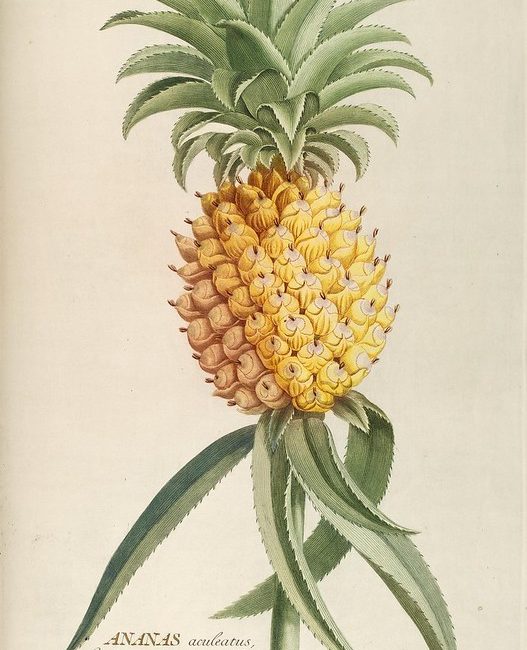
Illustration of a pineapple

Hand-colored engraving by Johann Jacob Haid after Georg Dionysius Ehret. Plantae Selectae Quarum Imagines ad Exemplaria Naturalia Londini, in Hortis Curiosorum Nutrita. (Nuremberg, 1750-1773). Volume contributed in BHL from the Missouri Botanical Garden, Peter H. Raven Library.

Further Reading

For more in-depth information of the pineapple, a few of the works in the Smithsonian Libraries and Archives’ collections:

The pineapple: botany, production and uses, edited by D.P. Bartholomew, R.E. Paull, and K.G. Rohrbach. c. 2003 (link)

Pineapple culture: a history of the tropical and temperate zones, by Gary Y. Okihiro, c. 2009 (link)

Fifty plants that changed the course of history, by Bill Laws. 2010 (link)

Pineapple: a global history, by Kaori O’Connor. 2013 (link)

For further reading on the history of pineapple production: Jesse Rhodes, “It’s Pineapple Season, But Does Your Fruit come from Hawaii?” Smithsonian Magazine (link)

January 28, 2021by mckenzie.87
Blog Reel, User Stories

Teaching Rare Book Cataloguing During a Pandemic

As I am writing this, Melbourne is at the end of its second wave of COVID-19 and I have been separated from the library collections that I work with at Museums Victoria for six months, 25 days, 21 hours, and around 12 minutes… but who’s counting?!

The pandemic has created a lot of challenges, not least working out how to be a librarian of an overwhelmingly print-based collection from a distance, but this time working from home has also afforded me opportunities to present a handful of webinars, the most recent being a guest lecture on rare book cataloguing for library and information management students.

I can say without a doubt that this would have been a near impossible task without the Biodiversity Heritage Library.

Having a number of items from the Museums Victoria Library digitised and openly available on the BHL website enabled me to access collection items virtually for students and create engaging online content showing real-life examples of features such as collation, signatures, catchwords, and provenance. These are some of the things we look for when cataloguing rare books from the hand-press era, which for Western printing spans roughly from 1440, around the time when the Gutenberg press was invented, to the early 19th century, by which time the machine age was well established and steam-powered machines dominated printing.

Screenshot of the book viewer in BHL with pages from An account of the English colony in New South Wales.

The two-page view on BHL allowed me to flick through books virtually in the same manner as a physical object in order to indicate some of the things we might look for when cataloguing rare books. Plate and text page 299. Collins, David. An account of the English colony in New South Wales, from its first settlement in January 1788 to August 1801. 1804. Contributed in BHL from Museums Victoria.

A central part of a bibliographical description is to record the format and the physical structure of the book. In determining a book’s collations—or in other words, how it was put together or assembled—we can look for evidence on books, including the impressions that the paper mould have left on the paper and devices used by printers to keep track of page order such as signatures and catchwords.

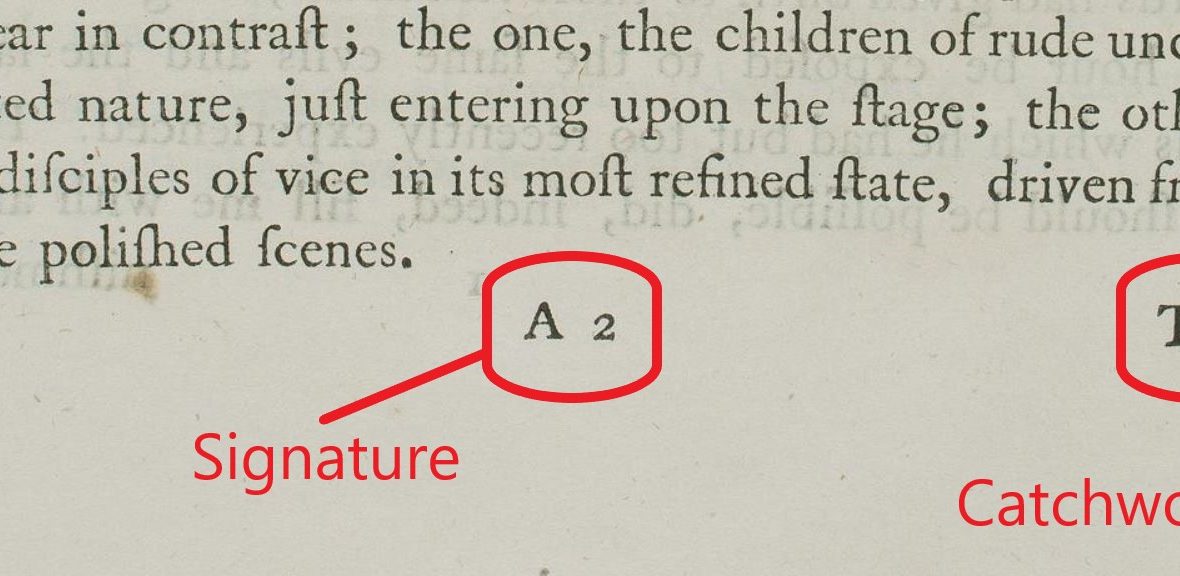
A catchword will show the first word on the following page and a signature will indicate how many pages are in each gathering of the book. Both generally appear near the bottom of a page and both are also useful for rare book cataloguers to check that the item they are cataloguing is not missing any pages.

Highlight of signatures and catchwords on a printed page of a rare book.

Close-up of a page indicating the location of the signature and catchword. Preface. Collins, David. An account of the English colony in New South Wales, from its first settlement in January 1788 to August 1801. 1804. Contributed in BHL from Museums Victoria.

During the lecture, I used BHL to flick through David Collins’ published journal, An account of the English colony in New South Wales … (1804), where I could clearly demonstrate to the students what I am referring to when I say “collations”, “signatures” and “catchwords”, and what aspects of the book that I might record in a catalogue record.

Another thing that I touched on was provenance markings and how to record any marks of ownership, custody or location on an item. In the case of books, this can mean autographs or notes written in books, as well as bookplates and stamps—people scribble, affix or slip all sorts of things in or on books! Generally, when cataloguing, I’d aim to note anything in our copy that might deviate from the “perfect” copy, so in other words, anything that’s happened to the book after publication.

Provenance information highlighted on the front flyleaf of a rare book.

The front flyleaf of the Museums Victoria Library copy features several marks of provenance, including an acquisition number, a blind or embossed stamp near the top of the page, and an inscription. Front flyleaf. Scott, G. Firth. The romance of polar exploration. 1909. Contributed in BHL from Museums Victoria.

Once again, BHL delivered the goods on provenance markings. I was able to browse some of the 600+ volumes that Museums Victoria has contributed to find many different kinds of provenance markings, including several marks of provenance in our copy of The romance of polar exploration by G. Firth Scott (1909) as well as bookplates, annotations and even a cheeky manicule! If you are interested to know more about provenance markings in our collections, take a look at this BHL blog post from 2019 by Hayley Webster.

So yes, the pandemic has been challenging, but not always in a bad way. It has certainly forced me to be adaptable and creative around my approach to my job, and I’ve also learned to love and appreciate the digital surrogates of the books in the Museums Victoria Library as much as I do the real thing.

January 14, 2021by Joel Richard

Help Support BHL

BHL's existence depends on the financial support of its patrons. Help us keep this free resource alive!

search

About BHL

The Biodiversity Heritage Library (BHL) is the world’s largest open access digital library for biodiversity literature and archives. BHL operates as a worldwide consortium of natural history, botanical, research, and national libraries working together to digitize the natural history literature held in their collections and make it freely available for open access as part of a global “biodiversity community.”

Join Our Mailing List

Sign up to receive the latest news, content highlights, and promotions.

Subscribe Now

Subscribe to Blog via Email

Enter your email address to subscribe to this blog and receive notifications of new posts by email.

Join 319 other subscribers

Subscribe to Blog Via RSS

Subscribe to the blog RSS feed to stay up-to-date on all the latest BHL posts.

Access RSS Feed

Inspiring Discovery through Free Access to Biodiversity Knowledge.

The Biodiversity Heritage Library makes it easier than ever for you to access the information you need to study and explore life on Earth…for free, anytime, anywhere.


64+ Million Pages of
Biodiversity Literature Online.

EXPLORE

Tools and Services
to Transform Research.

EXPLORE

300,000+
Illustrations on Flickr.

EXPLORE

ABOUT | HARMFUL CONTENT | PRIVACY | SITE MAP | TERMS OF USE