Biodiversity Heritage Library - Program news and collection highlights from BHL
  • Home
  • News
  • Featured Books
    • All Featured Books
    • Book of the Month Series
    • BHL at 20
  • User Stories
  • Campaigns
    • Fossil Stories
    • Garden Stories
    • Monsters Are Real
    • Page Frights
    • Her Natural History
    • Earth Optimism 2020
  • Tech Blog
  • Visit BHL
Home
News
Featured Books
    All Featured Books
    Book of the Month Series
    BHL at 20
User Stories
Campaigns
    Fossil Stories
    Garden Stories
    Monsters Are Real
    Page Frights
    Her Natural History
    Earth Optimism 2020
Tech Blog
Visit BHL
  • Home
  • News
  • Featured Books
    • All Featured Books
    • Book of the Month Series
    • BHL at 20
  • User Stories
  • Campaigns
    • Fossil Stories
    • Garden Stories
    • Monsters Are Real
    • Page Frights
    • Her Natural History
    • Earth Optimism 2020
  • Tech Blog
  • Visit BHL
Biodiversity Heritage Library - Program news and collection highlights from BHL
Blog Reel, Campaigns, Her Natural History

Graceanna Lewis: A Naturalist and Abolitionist

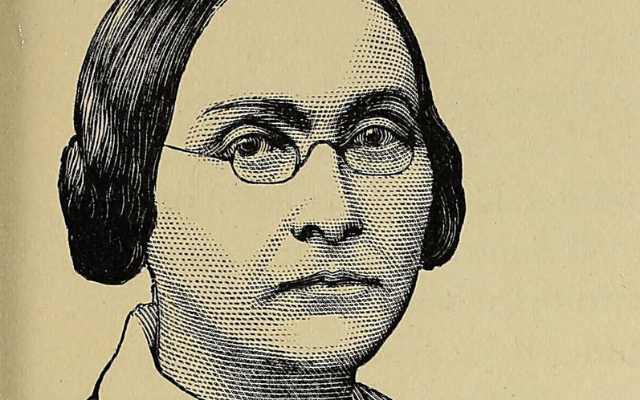
Black and white portrait of a person wearing glasses.

This post originally published on the Smithsonian Libraries and Archives’ blog, Unbound.

“To her mind the truths of science seem revealed.”

That’s how Phebe A. Hanaford, author of Daughters of America (c. 1882), described naturalist Graceanna Lewis, one of the first three woman to be accepted into the Academy of Natural Sciences. But Lewis was not only one of the first professionally acknowledged women naturalists; she was also an abolitionist and social reformer who worked for the advancement of science as well as human rights. Researchers can find many publications by and about this intriguing woman in the Smithsonian Libraries and Archives’ Digital Library and the Biodiversity Heritage Library.

Born in 1821, Lewis benefitted from an egalitarian Quaker upbringing, one that encouraged education in daughters as well as sons. Lewis told Hanaford that she learned to love natural history from her mother, Esther Lewis. Esther had been a teacher before marriage and continued to educate her own young children, sending her daughters to nearby Kimberton Boarding School as they grew. There, Graceanna was influenced by Abigail Kimber, a woman botanist who had discovered and identified several species. In 1842, Lewis’ uncle, Dr. Bartholomew Fussell, started a new boarding school for girls, and Lewis came on board as a teacher. She taught astronomy and botany, among other subjects.

Black and white portrait of a person wearing glasses.

Portrait of Graceanna Lewis. The Underground Rail Road (1872). Digitized by Smithsonian Libraries and Archives.

From her family, Graceanna Lewis inherited not only an interest in science and education but also a deep concern for social issues. Uncle Bartholomew was an active abolitionist, and the family formed a local auxiliary of the American Anti-Slavery Society. The Lewis sisters, Graceanna, Mariann and Elizabeth, were profiled in William Still’s The Underground Rail Road (1872), which described them as “among the most faithful, devoted, and quietly efficient workers in the Anti-slavery cause”.

One of Graceanna’s earliest publications, written in the 1840s, was “An Appeal to Those Members of the Society of Friends Who Knowing the Principles of the Abolitionists Stand Aloof from the Anti-Slavery Enterprise”. It implored fellow Quakers to join the Anti-Slavery movement. The Lewis farm in Pennsylvania became a frequent and successful point on the Underground Railroad, described in detail by Still. The family helped transport those seeking freedom and provided clothes and supplies.

Eventually, Lewis moved away from the family farm to Philadelphia. She had studied birds and other natural sciences on her own, but this move allowed her to take advantage of the specimen and library collections at the nearby Academy of Natural Sciences, and it propelled her into a network of naturalists. In 1862, she met John Cassin, ornithologist and curator of birds at the Academy. Cassin had written, with George N. Lawrence and the Smithsonian’s own Spencer Baird, The Birds of North America (1860), a work Lewis found particularly inspiring.

Cassin would be an invaluable friend and mentor to Lewis, even naming a bird for her, Icterus graceannae, the White-edged oriole. Lewis also corresponded frequently with Baird for years, seeking advice and asking for copies of Smithsonian publications. In 1870, the year after Cassin’s death, Lewis became one of the first three women admitted as members to the Academy.

Icterus graceannae, black and yellow bird.

Icterus graceannae, or white-edged oriole, Plate XI. Ibis. Series 5, Volume 1. No. 1-4. (1883). Contributed in BHL from Smithsonian Libraries and Archives.

Lewis had channeled her interested in ornithology into her first scientific publication, Natural History of Birds : lectures on ornithology, in ten parts (1868). It was intended as an inexpensive overview of American birds for a general audience. In it, she also proposed a new classification scheme based on embryology, the characteristics of eggs. Unfortunately, only the first part was published, as funding for the remaining nine was never secured. She continued to research and publish on birds, alongside the leading naturalists of her time. Her articles in The American Naturalist, “The Lyre Bird” (August 1870) and “Symmetrical Figures in Birds’ Feathers” (November 1871) are available in the Biodiversity Heritage Library.

Lewis’ interests and publications grew beyond ornithology, into the classification of natural history and a “tree of life”, which she exhibited at the Centennial Exhibition in 1876. The Development of the Animal Kingdom (1877), available in the Biodiversity Heritage Library, is a twenty-page overview of her theories. It was prepared for the fourth meeting of the Association for the Advancement of Women. The group was formed in 1868 with the goal of presenting practical methods for improving women’s role in society, including education on a variety of subjects. Unsurprisingly, Lewis was active on the group’s Committee on Science.

Cover, The Development of the Animal Kingdom (1877)

Cover. The Development of the Animal Kingdom. (1877). Contributed in BHL from Smithsonian Libraries and Archives.

Lewis told Phebe A. Hanaford in 1882, “I feel that my life’s work is before me, in lecturing on zoology to girls just blooming into womanhood”. For the next twenty years, Lewis continued to teach and write about various natural history topics. Her article “On the Genus Hyliota”, discussing the distinction of two rare African birds, was published in The Annals and magazine of natural history in 1883. Her social reform interests turned to temperance and suffrage, serving stints as secretary for her local chapter of the Women’s Christian Temperance Union and suffrage association.

Graceanna Lewis died in 1912 in Media, Pennsylvania at the age of 90. Her contributions to both science and social progress leave a remarkable and inspiring legacy.

Further Reading

Baird, Spencer Fullerton, John Cassin and George N. Lawrence. The Birds of North America (1860).

Baird, Spencer Fullerton. Spencer Fullerton Baird Papers. Record Unit 7002. Smithsonian Institution Archives.

Bonta, Marcia. “Graceanna Lewis, Portrait of a Quaker Naturalist”. Quaker History, Volume 74, Number 1, Spring 1985, pp. 27-40.

Hanaford, Phebe A. Daughters of America (1883).

Lewis, Graceanna. “An appeal to those members of the Society of Friends who knowing the principles of the abolitionists stand aloof from the anti-slavery enterprise”. [between 1840 and 1849?].

Lewis, Graceanna. The Development of the Animal Kingdom (1877).

Lewis, Graceanna. “The Lyre Bird”. The American Naturalist (August 1870), pp 321.

Lewis, Graceanna. “On the genus Hyliota”. The Annals and magazine of natural history, Series 5, Volume 12, No. 67, pp. 210-212.

Lewis, Graceanna. “Symmetrical Figures in Birds’ Feathers” . The American Naturalist (November 1871), pp. 675-678.

Lewis-Fussell Family Papers, SFHL-RG5-087, Friends Historical Library of Swarthmore College.

Still, William. The Underground rail road (1872).

Truitt, James. “Digitizing the Papers of Graceanna Lewis, Ornithologist and Activist”. Cassinia. No. 77 (2017-2018), pp. 40-41.

Warner, Deborah Jean. Graceanna Lewis, scientist and humanitarian (1979).

March 30, 2021by Pedro Gonzalez Fernandez
BHL News, Blog Reel

Join Us on 16 April 2021 for Notes from Nature: The Biodiversity Heritage Collections

graphic for "Notes from Nature"

Background image in graphic: Rhopalocera Malayana: a description of the Butterflies of the Malay Peninsula. By William Lucas Distant (1845-1922). Illustrations by Horace Knight (1857-1920). Collection of National Library, Singapore.

Join us for a special closing event presented as part of the 2021 BHL Annual Meeting!

Notes from Nature: The Biodiversity Heritage Collections
Date and Time: Friday, 16 April 2021 @ 1130-1230 UTC
Location: Online (via Zoom webinar)

Discover the natural world through a vast collection of biodiversity knowledge online. Find out how Singapore and France have worked together across boundaries to advance biodiversity literature, digitisation and public outreach efforts.

This discussion is organised by the National Library Singapore and Muséum national d’Histoire naturelle, France in partnership with the Biodiversity Heritage Library, the world’s largest open access online repository of biodiversity knowledge.

Presenters:
Ms Tan Huism, Senior Director, National Library, Singapore
Dr Clément Oury, Head of Conservation, Restauration and Digitization Service, Library of the Muséum national d’Histoire naturelle

This session will be chaired by Ms Constance Rinaldo, Chair of the Biodiversity Heritage Library Executive Committee.

Register today!

Graphic for BHL Day 2021.

In addition to this special closing event on 16 April, we hope you’ll also join us for BHL Day 2021: Reflections in Crises on 14 April (1200-1700 UTC), another virtual, public event offered as part of the 2021 BHL Annual Meeting.

Learn more and register for BHL Day 2021.

March 30, 2021by michelle.underhill
BHL News, Blog Reel

Register Today for the Virtual BHL Day 2021 on 14 April!

Graphic for BHL Day 2021.

Graphic for BHL Day 2021.

Registration is now open for our virtual BHL Day 2021 on 14 April, presented as part of our 2021 Annual Meeting! Themed “Reflections In Crises”, the program will include sessions reflecting on BHL’s roles in addressing the biodiversity crisis, challenges arising from COVID-19, and systemic racism in natural history collections.

Date and Time: 14 April 2021 (1200-1700 UTC)

Location: Online (via Zoom webinar)

Registration: The event is free but registration is required. Register.

Program Details:

BHL Day 2021: Reflections in Crises will include an opening keynote from Dr. Ian Owens (Deputy Director at the National Museum of Natural History, Smithsonian Institution) addressing the biodiversity crisis and a closing keynote from Lidia Ponce de la Vega (Doctoral Candidate in Hispanic Studies at McGill University) discussing how BHL can help decolonise biodiversity collections and archival practices. The program will also include a Partner Reflection Panel with representatives from BHL partner institutions focused on BHL’s impact during the COVID-19 pandemic.

Further program details and the registration link can be found on the BHL Day 2021 event page.

March 29, 2021by michelle.underhill
Blog Reel, Campaigns, Featured Books, Her Natural History

Margaret S. Collins: A Legend in Termite Field Biology

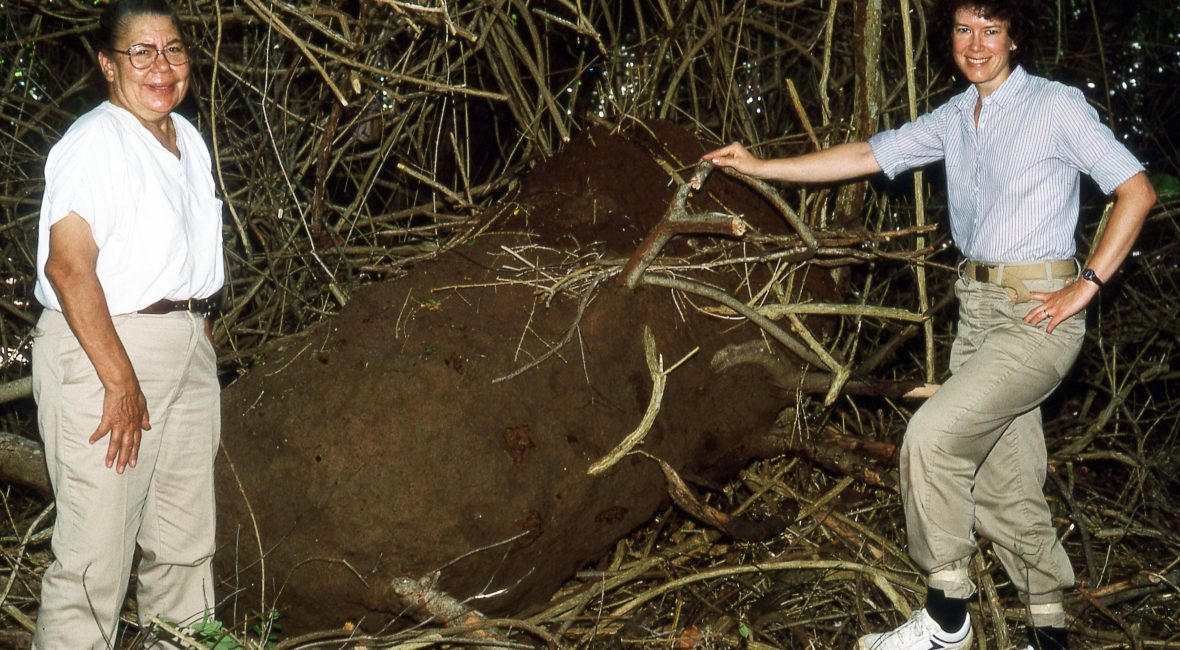
Two scientists researching termites in the British Virgin Islands stand together with a huge termite nest in between them. Photo taken in 1986.

This post was originally published on 2 March 2021 on the Smithsonian Institution Archives blog.

Two scientists researching termites in the British Virgin Islands stand together with a huge termite nest in between them. Photo taken in 1986.

Dr. Margaret S. Collins and Dr. Barbara L. Thorne standing next to a termite (Nasutitermes acajutlae) nest on Guana Island in the British Virgin Islands while studying a variety of termites in 1986. © Dr. Barbara L. Thorne.

Dr. Margaret S. Collins (1922-1996), a renowned expert on termite ecology and distribution, taught as a professor and administrator at Howard University, Florida A&M University, and Federal City College (now University of The District of Columbia) for over 35 years. Upon her retirement from teaching, Collins continued her work on termites at the Smithsonian National Museum of Natural History as a research associate from 1983 to 1996.

Over the course of her career, Collins published more than forty articles spanning the biogeography, physiology, chemical defenses, and taxonomy of termites. Collins also collected specimens in the United States, Mexico, Costa Rica, Colombia, Barbados, Belize, Suriname, the Cayman Islands, Guyana, Guatemala, and Panama. When she contracted dengue fever on an expedition in Guyana in 1983-1984 and was forced into a long hiatus from field work, she turned her focus to updating and preserving the termite specimens at the Smithsonian National Museum of Natural History. Eventually Collins returned to field research in 1994 when she once again traveled to Guyana to collect termites. In April 1996, Collins died while conducting field work in the Cayman Islands.

Collins’ biographers, such as Wini Warren and Vernard R. Lewis, have documented how she faced racism and sexism in her work and life. As one of the first African American women to earn a Ph.D. in entomology, she had to fight to find advisers as an undergraduate at West Virginia State College and to fund her field research during her early career. Additionally, Collins worked in the face of bomb threats and racist remarks as she pursued her career and advocated for equal rights during the civil rights movement.

In fact, Collins’ memorial service pamphlet begins with excerpts from a letter she wrote to the editor of the Tallahassee Democrat during the 1956 Tallahassee bus boycott. During the boycott, sometimes chased by police, Collins drove protestors to and from work. The excerpts included:

The Person who allows himself to be mistreated without protest shares equal responsibility with his abuser for the unjust act…

…We can do little for those of us who have been so conditioned that they back away when the opportunity to stand tall is offered—except be thankful that we are not all as they are. Those who back away need prayers, that they may never have to bear the burden of blocking the growth of other members of their group.

These passages were edited out of Collins’ letter by the newspaper and never printed, but their inclusion in her memorial service offers a sense of the importance Collins placed on standing tall against the challenges she faced in her own life.

The first page of Margaret S. Collins’ memorial service pamphlet.

The first page of Margaret S. Collins’ memorial service pamphlet. Courtesy of Dr. Barbara L. Thorne.

In the face of those challenges, Collins developed a love for field research. To learn more about Margaret Collins’ research, see a selection of her field notebooks, archived at the Smithsonian and digitized in the Biodiversity Heritage Library (BHL), the world’s largest open access digital library for biodiversity literature and archives. Headquartered at the Smithsonian, BHL works with libraries and archives around the world to revolutionize global research by providing free, worldwide access to knowledge about life on Earth.

An open spiral notebook with handwritten notes only on the right page.

Pages 6 and 7 from Margaret S. Collins’ Field Notes: “Combat Data,” Suriname, 1982: SIA Acc. 01-038. Contributed in BHL from Smithsonian Institution Archives.

Collins’ field notebooks were digitized and transcribed with the Smithsonian Transcription Center as part of the Smithsonian Field Book Project. Field notes can provide rich data for researchers to understand how biodiversity has changed over space and time. For example, field notebooks may describe habitats, meteorological events, and personal observations that allow us to reconstruct historical ecologies. The Archives has contributed over 300,000 pages of field notes to the Biodiversity Heritage Library as part of the Smithsonian Field Book Project. Some of Collins’ field books are part of that collection.

There are so many inspiring stories, like Dr. Collins’, about women in science at the Smithsonian in its 175-year history that can educate and embolden future generations, but only if their legacies are discoverable. On Thursday, 25 March 2021 from 1-3pm ET, join us for Wikipedia & Women in Science: Smithsonian Groundbreakers Edit-a-thon, an online Wikipedia editing workshop hosted in conjunction with the Smithsonian American Women’s History Initiative and the Smithsonian Institution Archives, part of Smithsonian Libraries and Archives.

During this training, attendees of all experience levels will learn the basics of how to edit Wikipedia by updating articles related to the history of women in science at the Smithsonian Institution in connection with the Funk List. Presenters will share how editors might research the work of these women in the absence of personal papers and institutional records. Learn more and register.

March 22, 2021by michelle.underhill
BHL News, Blog Reel

Save the Date for BHL Day 2021 on 14 April!

Save the Date graphic for BHL Day 2021: Reflections in Crises

Save the Date graphic for BHL Day 2021: Reflections in Crises

Save the date for a virtual BHL Day 2021 on 14 April, presented as part of our 2021 Annual Meeting! Themed “Reflections In Crises”, the program will include sessions reflecting on BHL’s roles in addressing the biodiversity crisis, challenges arising from COVID-19, and systemic racism in natural history collections.

Date and Time: 14 April 2021 (approx. 1200-1700 UTC, exact session times TBD)

Location: Online (via Zoom webinar)

Registration: The event is free but registration is required. Registration will go live on 29 March 2021 and will be shared via the BHL Day 2021 event page.

Program Details:

BHL Day 2021: Reflections in Crises will include an opening keynote from Dr. Ian Owens (Deputy Director at the Smithsonian’s National Museum of Natural History) addressing the biodiversity crisis and a closing keynote from Lidia Ponce de la Vega (Doctoral Candidate in Hispanic Studies at McGill University) discussing how BHL can help decolonise biodiversity collections and archival practices. The program will also include a Partner Reflection Panel with representatives from BHL partner institutions focused on BHL’s impact during the COVID-19 pandemic.

More Information can be found on the BHL Day 2021 event page. That event page will be updated with further program details over the coming weeks.

March 18, 2021by michelle.underhill
Blog Reel, User Stories

Women in Historical SciArt: BHL Empowers Research on Women in Scientific Illustration

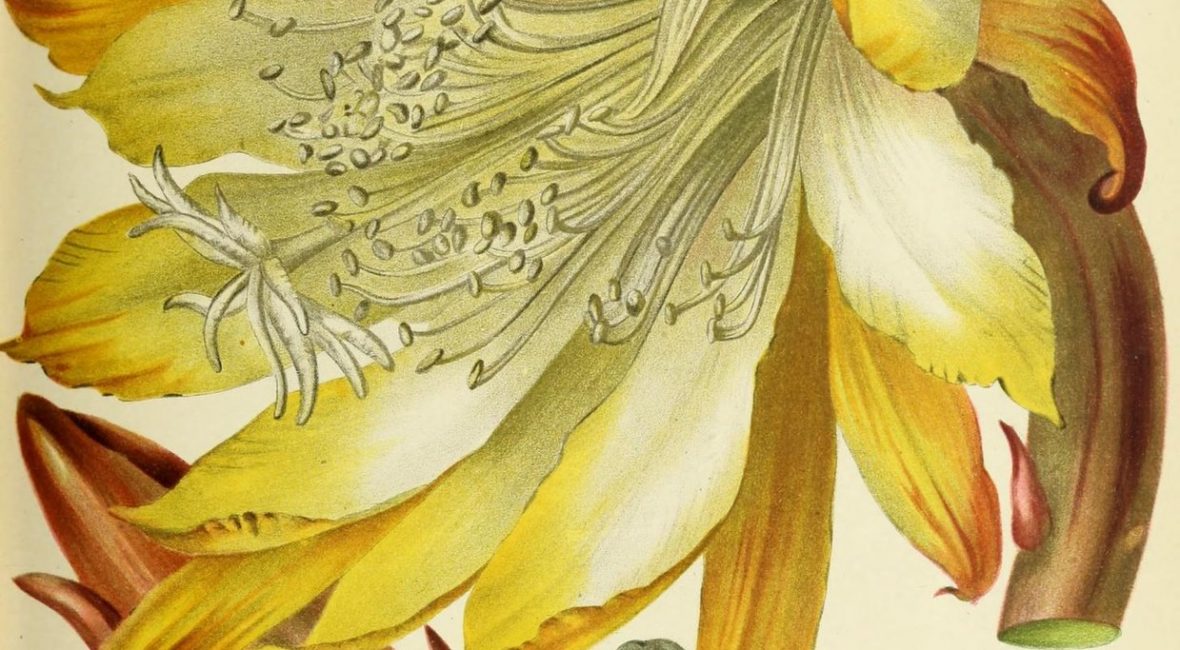
Illustration of a cactus with a yellow flower.

Michelle Marshall is an independent researcher and creator of Historical SciArt, a research initiative dedicated to women in historic scientific illustration. In this guest post, Marshall shares more about how BHL helps empower her research on women in science.

•     •     •

In Fall 2014, I discovered the wonderful world of the Biodiversity Heritage Library. I serendipitously stumbled onto this natural history digital library through collaborations with the Smithsonian Transcription Center, and I joined a group of dedicated volunteers known as BHL citizen scientists, whose work includes researching and adding taxonomy to the scientific illustrations that BHL has uploaded to its account on Flickr.

Illustration of a bird with colors including green, orange, black, pink, purple, and white.

Himalayan Monal, Lophophorus impejanus, illustrated by Elizabeth Gould. Source: A century of birds from the Himalaya Mountains. 1831. Authored by John Gould and illustrated by Elizabeth Gould. Contributed in BHL from Smithsonian Libraries and Archives.

As I started to add scientific and common names to these images, I became curious about the artists. I easily discovered Maria Sibylla Merian and Elizabeth Gould, two of the more famous women natural history illustrators, but it was not until I found Roberta McIntosh that I started to scratch the surface of the multitude of women involved in this area of science.

Illustration of a green annelid worm.

King ragworm, Alitta virens, illustrated by Roberta McIntosh. Source: A monograph of the British marine annelids. v.2, pt.2 (1910). Authored by William Carmichael McIntosh and illustrated by several artists including Roberta McIntosh. Contributed in BHL from Smithsonian Libraries and Archives.

Roberta McIntosh (1843-1869) was the sister of William McIntosh, author of the multivolume publication, Monograph of the British Marine Annelids. She collected annelid specimens along with her brother, and he encouraged her to create scientific illustrations of these specimens for his work. While browsing through the monograph’s images, I noticed that there were other artists’ signatures, including one for A.H.W. In the Preface of this monograph, W. McIntosh identifies “A.H.W.” as “Miss Ada Walker” and also identifies “Miss Burnet of St. Andrews”.  I have been able to identify more information about Ada H. Walker, but Miss Burnet remains a mystery to be illuminated.

Illustration of a variety of annelid worms.

Illustration of marine annelids by Roberta McIntosh and Ada Hill Walker. Source: A monograph of the British marine annelids. v.4, pt.1 (1922). Authored by William Carmichael McIntosh and illustrated by several artists including Roberta McIntosh and Ada Hill Walker. Contributed in BHL from Smithsonian Libraries and Archives.

The discovery of these three women turned a spark into a flame as I realized that there are so many women still to be brought to light in this combined area of science, art, and history research. A few weeks later, I stumbled across Christine Jurine, a French artist who illustrated marine invertebrates and insects, and in the years that have passed, I have uncovered more and more. Cecile Pfulb Kastner is an accomplished French botanical illustrator, and I have written about my research into Kastner on my blog. And then there’s the sublime botanical art of Louise Cécile Descamps Sabouret for Revue Horticole.

Illustration of a cactus with a yellow flower.

Epiphyllum cactus, illustrated by Louise Cécile Descamps Sabouret. Source: Revue horticole. 1898. Contributed in BHL from Harvard University Botany Libraries.

BHL’s digital library is a gold mine of information for discovering more about these women. With the addition of full text searching, I have been able to locate details about these women, including their names, work, other publications, and collaborators. Matching up artists’ signatures with works in BHL has also led to further linking of these women across publications.

Additionally, BHL has actively supported me in making these women more visible. On countless occasions, I have collaborated with BHL staff and their partners to add these women to the BHL catalog by establishing “Creator IDs”. This designation allows other publications affiliated with this woman to be part of one hyperlink within the collection of BHL. This ID also provides “notability” to meet the criteria for inclusion in crowdsourced platforms like Wikidata, where other researchers can discover these women.

I was also pleased to collaborate with BHL and their partners for the #HerNaturalHistory campaign for Women’s History Month in 2019. Through this collaboration, many other researchers have become involved in this area through Wikipedia, and BHL has created the “Women in Natural History” collection of materials showcasing the profound and extensive work that women have done in the biodiversity sciences. These efforts continue to evolve and be updated as more information is uncovered.

Illustration of fungi.

Various fungi illustrated by Mary K. Spittal. Source: Fungi and how to know them. 1909. Authored by Ernest W. Swanton and illustrated by Mary K. Spittal. Contributed in BHL from University of Toronto – Thomas Fisher Rare Book Library.

Through a recent encounter with the Mycological Book Club on Twitter, I was able to collaborate with other researchers to discover the full name and details of Mary Kerr Spittal. In response to tweets in which I posted illustrations done by women in mycology, Clare Blencowe of the Mycological Book Club shared with me an illustration by a not fully identified woman mycologist using the name M. Spittal. Through full text searching in BHL, I was able to find her name as “Mary K. Spittal”, as well as another publication in which she produced scientific illustrations. At this point, I enlisted the help of my long-time collaborator, Siobhan Leachman. Leachman created a Wikidata item for Spittal and also delved into more resources to discover her history. I also enlisted the help of my mother, Shelby Marshall, who is an experienced genealogy researcher. Over the next few hours, Blencowe, Leachman, Marshall, and I created a detailed picture of Mary Kerr Spittal. The next day, Chris Robson, Catalog Librarian at Harvard University Botany Libraries and a member of the BHL Cataloging Committee, responded to my BHL feedback request for a Creator ID for Spittal, linking her name to her works in BHL. Additionally, Madeline Byrne of the BHL Flickr Group responded to my request to upload Spittal’s works to Flickr, where they have been tagged by artist name to further expand the discoverability of Spittal’s artistic contributions to science. This successful collaboration brought to light another remarkable and notable woman involved in the natural history of mycology.

Yesterday I posted about M. K. Spittal, saying I couldn’t find anything about her.

Today, thanks to the power of Twitter and some spontaneous collaboration with @HistSciArt, @SiobhanLeachman & @BioDivLibrary, she has her own wikidata entry ▶️https://t.co/ysuqB0x7QW https://t.co/ZsmRGLHI1C

— The Mycological Book Club (@MycoBookClub) February 12, 2021

For the past four years, I have been fortunate to find more of these women through my individual research and collaborations with so many others. I created the spreadsheet “Women in Historical SciArt” to share my research and to promote further research into the work and lives of these remarkable women. These experiences have enriched my life beyond measure, and my goal is to continue expanding access and knowledge about the contributions of these early women scientists and illustrators.

Without BHL, I would never have discovered these inspiring women in science and their work. I am incredibly grateful to BHL for all the support and encouragement of this research, and their continued updates to their digital library and Flickr collection, which support my ongoing work.

March 16, 2021by Joel Richard
BHL News, Blog Reel

BHL Quarterly Newsletter (March 2021) Now Available!

Screenshot of the March 2021 BHL newsletter

Screenshot of the March 2021 BHL newsletter

Our latest quarterly newsletter is now available! From exciting news about our image collection in Flickr to an upcoming online Wikipedia Editing Workshop on women in science, don’t miss the latest news from the BHL community.

View our March 2021 Quarterly Newsletter.

Be sure to subscribe to our mailing list to keep up to date with all the latest BHL news.

March 9, 2021by michelle.underhill
Page 1 of 212»

Help Support BHL

BHL's existence depends on the financial support of its patrons. Help us keep this free resource alive!

search

About BHL

The Biodiversity Heritage Library (BHL) is the world’s largest open access digital library for biodiversity literature and archives. BHL operates as a worldwide consortium of natural history, botanical, research, and national libraries working together to digitize the natural history literature held in their collections and make it freely available for open access as part of a global “biodiversity community.”

Join Our Mailing List

Sign up to receive the latest news, content highlights, and promotions.

Subscribe Now

Subscribe to Blog via Email

Enter your email address to subscribe to this blog and receive notifications of new posts by email.

Join 319 other subscribers

Subscribe to Blog Via RSS

Subscribe to the blog RSS feed to stay up-to-date on all the latest BHL posts.

Access RSS Feed

Inspiring Discovery through Free Access to Biodiversity Knowledge.

The Biodiversity Heritage Library makes it easier than ever for you to access the information you need to study and explore life on Earth…for free, anytime, anywhere.


64+ Million Pages of
Biodiversity Literature Online.

EXPLORE

Tools and Services
to Transform Research.

EXPLORE

300,000+
Illustrations on Flickr.

EXPLORE

ABOUT | HARMFUL CONTENT | PRIVACY | SITE MAP | TERMS OF USE