Biodiversity Heritage Library - Program news and collection highlights from BHL
  • Home
  • News
  • Featured Books
    • All Featured Books
    • Book of the Month Series
    • BHL at 20
  • User Stories
  • Campaigns
    • Fossil Stories
    • Garden Stories
    • Monsters Are Real
    • Page Frights
    • Her Natural History
    • Earth Optimism 2020
  • Tech Blog
  • Visit BHL
Home
News
Featured Books
    All Featured Books
    Book of the Month Series
    BHL at 20
User Stories
Campaigns
    Fossil Stories
    Garden Stories
    Monsters Are Real
    Page Frights
    Her Natural History
    Earth Optimism 2020
Tech Blog
Visit BHL
  • Home
  • News
  • Featured Books
    • All Featured Books
    • Book of the Month Series
    • BHL at 20
  • User Stories
  • Campaigns
    • Fossil Stories
    • Garden Stories
    • Monsters Are Real
    • Page Frights
    • Her Natural History
    • Earth Optimism 2020
  • Tech Blog
  • Visit BHL
Biodiversity Heritage Library - Program news and collection highlights from BHL
Blog Reel, Featured Books

A Digitization Journey, a Knowledge Journey: Personal and Professional Insights From My Work on Polynesian Researches

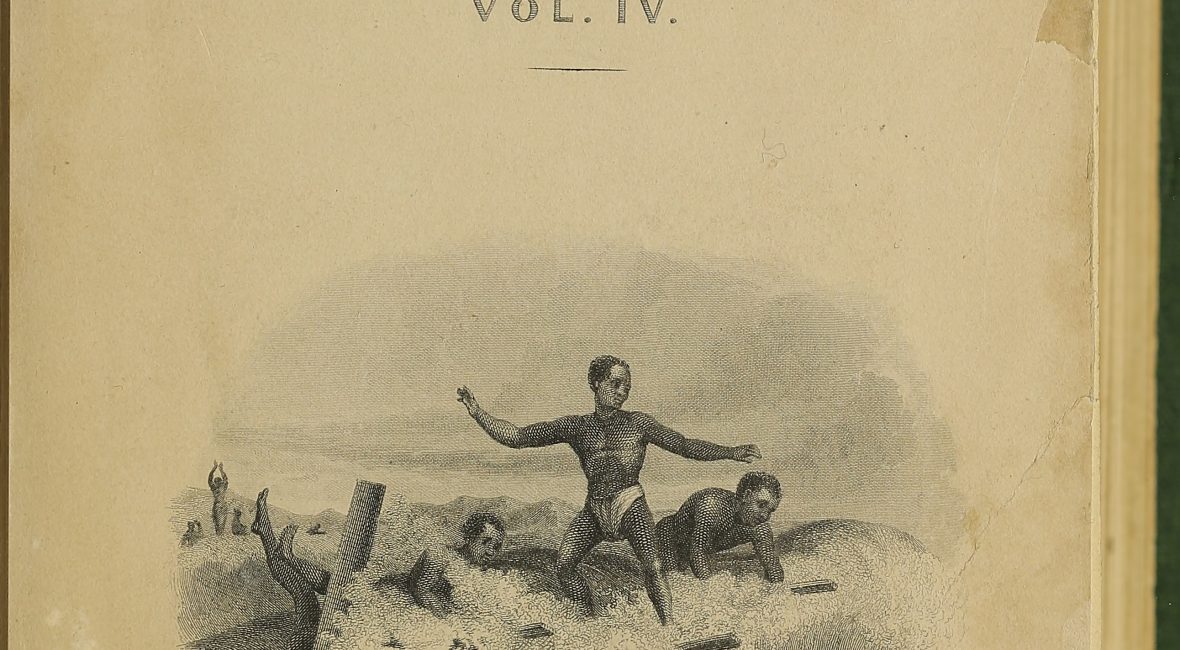
An engraving of ka poʻe kānaka heʻe nalu, indigenous Hawaiians surfing.

Na au iki a me na au nui o ka ʻike: The little and the large currents of knowledge.

In preparation for Asian American Pacific Islander Heritage Month, I chose to reflect on the intersections of my past and present work in Biodiversity Heritage Library (BHL) collections, with historical connections to my home in Hawaiʻi. Part of my primary duties as a Conservation Technician with the Smithsonian Libraries and Archives is to stabilize objects before and after digitization for BHL. When I joined the team in 2018, I was assigned the task of mending the library’s 4 volumes of the 1853 edition of William Ellis’ Polynesian Researches During a Residence of Nearly Eight Years in the Society and Sandwich Islands. The idea was to kick off my new job with a project that would inspire me on a personal level, as an introduction to the value of both the digital and physical preservation responsibilities of our institution.

black and white portrait of a man seated and dressed in 19th century clothes.

Portrait of William Ellis. Narrative of a tour through Hawaii, or Owhyhee with observations on the natural history of the Sandwich Islands, and remarks on the manners, customs, traditions, history, and language of their inhabitants. Third Edition, 1827. Contributed in BHL from Smithsonian Libraries and Archives.

British born William Ellis is considered the “godfather of missionary ethnography.” Polynesian Researches vol. 4 chronicles his time spent in Hawaiʻi while serving under the infamous American Board of Commissioners for Foreign Missions. Credited with bringing Christianity, literacy and western education to Kānaka Māoli (the native Hawaiians), the ABCFM also seeded the islands with the missionary descendants, known as the Committee of Safety, who on 6 July 1887 would hold King Kalākaua at gunpoint to sign a new constitution, effectively granting them control of the government. On 17 January 1893, a group of these same men organized a coup against the last reigning monarch, Queen Liliʻuokalani, using the imposing presence of the U.S. military to overthrow the sovereign Kingdom of Hawaiʻi. Following the overthrow, the provisional government set up by the Committee was recognized as a protectorate without the permission of the U.S. State Department. Finally, on 16 June 1897, in direct violation of previous treaties with the Kingdom of Hawaii, President Mckinley signed a new treaty granting the fraudulent annexation of Hawaiʻi by the United States. On 23 November 1993, the 100 year anniversary of the overthrow, Joint Resolution 103-150 was signed into law by both chambers of congress and President Clinton. The law “acknowledged the historic significance of the illegal overthrow of the Kingdom of Hawaiʻi…” and expressed the U.S. government’s “deep regret.”

Flag of the Kingdom of Hawaii

Flag of the Kingdom of Hawaii. Ellis, William. Polynesian researches during a residence of nearly eight years in the Society and Sandwich islands, v.4 (1853). Contributed in BHL from Smithsonian Libraries and Archives.

The legacy and impact of missionary settler colonialism cannot be divorced from the ethnographic literature it produced. Ellis’ work is important not only for the exceedingly detailed account of early post-contact Hawaiʻi, but also because it offers up the faulty colonizer narrative of the great western savior. Preserving volumes like Polynesian Researches provides historical accounts of endemic and in many cases extinct plant and animal life to researchers studying biodiversity in the Pacific. It may also complicitly privilege that version of information over the Indigenous sources.

I started my treatments with volume 4, specifically because this volume contains early post-contact details of my hometown, Hilo, on Moku o Keawe (The Big Island of Hawaiʻi). My handskills and knowledge of book and paper conservation as a technician are actively developing exclusively from bench training. The Smithsonian Libraries and Archives’ preservation department operates out of two spaces: a larger off-site Book Conservation Lab and a small ”annex” in close proximity to our digitization suite in the National Museum of Natural History. Familiarizing myself with the materials available in our annex space was a challenge in itself. The nature of the repairs in the annex skew more toward improving the durability of an object to withstand the stress of digitization procedures. Treatment materials are limited in variety and custom toned papers must be made in our larger Book Conservation Lab. In my hasty enthusiasm and novice familiarity with the “house style” and availability of materials, I made plenty of well intentioned yet questionable aesthetic compromises, but the project was exciting and meaningful never the less.

An engraving of ka poʻe kānaka heʻe nalu, indigenous Hawaiians surfing.

An engraving of ka poʻe kānaka heʻe nalu (Indigenous Hawaiians surfing). Ellis, William. Polynesian researches during a residence of nearly eight years in the Society and Sandwich islands, v.4 (1853). Contributed in BHL from Smithsonian Libraries and Archives.

One of the great values of these volumes are the maps and engraved frontispieces. Each volume contains a scene depicting some cultural practice of the nations Ellis visited. In volume 4, there is a map of the Hawaiian archipelago and an engraving of ka poʻe kānaka heʻe nalu (Indigenous Hawaiians surfing), which you can learn more about in this previous article by Julia Blakely on the Smithsonian Libraries and Archives’ blog.

Close-up of a repair made on a page in a book.

Close-up of a repair made on the frontispiece. Ellis, William. Polynesian researches during a residence of nearly eight years in the Society and Sandwich islands, v.4 (1853). Contributed in BHL from Smithsonian Libraries and Archives.

I began treatment with the frontispiece. The page had several long tears running through the image, as well as losses around the bottom and foredge. Both are common issues for acidic 19th century paper. I gently re-oriented the edges of either side of the tears using a micro spatula and tweezers. This is to ensure that the fibers of the paper lay as flat and as close to their original direction as possible. I then applied wheat paste to the edges to secure them in place. Thin strips of Japanese paper were torn in the shape of the various tears and adhered to the verso using wheat paste again.

After completing further treatment on the text block and case, the volume was digitized and uploaded to BHL via the Internet Archive. Unfortunately, only v.4 was able to be imaged and uploaded before Smithsonian staff began teleworking full time due to the ongoing COVID-19 pandemic.

One of the silver linings of our COVID-induced telework status is that we have been able to cross-train in other skills, switching gears to improving and promoting the Smithsonian’s digital presence to the public. When I signed on to a new telework project—paginating digitized books (i.e. enhancing metadata at the page-level ) from our digitized collections—Polynesian Researches vol. 4 was again my first step.

Interface in the BHL administrative dashboard for adding page-level metadata to digitized books.

Interface in the back-end BHL administrative dashboard which allows staff to add or enhance page-level metadata for digitized books.

I’ve come full circle in the preservation process, from making stabilizing paper repairs, to ensuring the book can be easily navigated by users. The digital object can be used as a surrogate of the physical, preventing further wear and enabling remote access. And I have worked on this item at the page level both physically and digitally, applying care in my conservation treatments and in my metadata enhancements, both crucial to ensuring access to the volume.

In spite, or perhaps because of, the complicated and painful legacy of settler colonialism that endures in Hawaiʻi, working on this set of Ellisʻ Polynesian Researches was a rewarding introduction to my duties at the Smithsonian Libraries and Archives. The task of preserving these early editions both physically and digitally has contributed to my practical understanding of the value of our digitization and conservation departments. I have found it helpful to reconcile my ethical questions about treating these items by looking at their utility for native communities.

An an image from Polynesian Researches showing romanization of common ʻōlelo Hawaiʻi, Hawaiian words.

An image from Polynesian Researches showing romanization of common ʻōlelo Hawaiʻi (Hawaiian words). Ellis, William. Polynesian researches during a residence of nearly eight years in the Society and Sandwich islands, v.4 (1853). Contributed in BHL from Smithsonian Libraries and Archives.

When I first moved to D.C., I sought comfort in Hālau Hula o Nohona Hawaiʻi, where I could dance and fellowship with other members of the Hawaiʻi diaspora. I shared photos of the things I worked on, and in particular an image from Polynesian Researches showing romanization of common ʻōlelo Hawaiʻi (Hawaiian words). I found it funny, if unsettling, to see how the language sounded to missionary ears so many years ago. One of our alakaʻi (leaders) corrected me and used it as a teaching moment. She discussed with me and the other haumana (students) about the way the language has evolved, and the variation in dialect from island to island and from kupuna to keiki (elders and children). The language I grew up hearing on my island and in my family is not the same as what was spoken on other islands, and in some places is still currently spoken in older generations. My hula sister reminded me that despite my ethical reservations about the work as a whole, there is value to Indigenous communities in using these primary sources.

You can explore the 1853 edition of Polynesian Researches, as well as other editions of the title and other works by William Ellis, in BHL.

References

National Archives. “The 1897 Petition Against the Annexation of Hawaii.” Archives.gov, 15 August, 2016. https://www.archives.gov/education/lessons/hawaii-petition.

Johnston, Anna. “The Strange Career of William Ellis.” Victorian Studies, vol. 49, no. 3, 2007, pp. 491-501.

Silva, Noenoe K. Aloha Betrayed: Native Hawaiian Resistance to American Colonialism. Durham: Duke University Press, 2004, pages 123-163.

United States, Congress. Public Law 103-150. United States Statutes at Large, Vol. 107 – 103rd Congress, 1st Session, 1993. U.S. Government Publishing Office, https://www.govinfo.gov/content/pkg/STATUTE-107/pdf/STATUTE-107-Pg1510.pdf.

May 27, 2021by michelle.underhill
Blog Reel, Featured Books

The Magic of the Magicicada: Exploring Brood X Through Books in BHL

The periodical cicada in various life stages.

On 10 May, I had my first sighting of this year’s periodical cicada in Northern Virginia. For seventeen years, three species of Magicicada, the periodical cicada (M. septendecim, M. cassinii, M. septendecula)[1], have been living about 61 cm (2 feet) underground beneath trees across portions of eastern North America. In May 2021, individuals in Brood X (sometimes known as the Great Eastern Brood) began to emerge in the trillions from their long sojourn when soil temperature reached a consistent temperature of 18 degrees C (64 degrees F) or higher.

The last time Brood X emerged was in 2004. For those who witnessed that appearance, or previous ones, Brood X at times feels like a science fiction movie with the creatures swarming and the loud (up to 90 decibel) mating song of the males drowning out conversations (I wonder how the rest of the world will react to our Zoom call being joined by singing cicadas!).

Magicicada are mostly harmless, neither biting nor stinging. Members of the order Hemiptera, the nymphs spend their underground life harmlessly consuming xylem fluids from the roots of deciduous forest trees; the adult female, which deposits its eggs in small slits cut into the ends of branches, rarely causes damage to mature trees and there is speculation that the cicada pruning leads to more abundant leafing and fruiting the following year.

Nymph of a periodical cicada on a green leaf.

Photos capturing the author’s first observations of the Brood X emergence. Photos show the life cycle of the periodical cicada from nymph to adult. Shown here: Periodical cicada nymph. Photo credit: Martin Kalfatovic.

Immature adult periodical cicada emerging from nymph skin.

Photos capturing the author’s first observations of the Brood X emergence. Photos show the life cycle of the periodical cicada from nymph to adult. Shown here: Periodical cicada shedding its nymph exoskeleton. Photo credit: Martin Kalfatovic.

Immature periodical cicada next to exuviae.

Photos capturing the author’s first observations of the Brood X emergence. Photos show the life cycle of the periodical cicada from nymph to adult. Shown here: An adult periodical cicada that has not yet completed its transformation. Photo credit: Martin Kalfatovic.

Mature adult periodical cicada next to exuviae.

Photos capturing the author’s first observations of the Brood X emergence. Photos show the life cycle of the periodical cicada from nymph to adult. Shown here: An adult periodical cicada next to its nymph exoskeleton (exuviae). Photo credit: Martin Kalfatovic.

Early Accounts

Known to Native Americans for generations, the first known mention of periodical cicada literature is by William Bradford, governor of Plymouth Colony in 1633 (Kritsky 2001, 1). A more detailed (and somewhat inaccurate) account was printed thirty-three years later in the Philosophical Transactions (London) in 1666 by Henry Oldenburgh:

A great Observer, who hath lived long in New England, did upon occasion, relate to a Friend of his in London, where he lately was, That some few Years since there was such a swarm of a certain sort of Insects in that English Colony, that for the space of 200 Miles they poson’d and destroyed all the Trees of that Country; there being found innumerable little holes in the ground, out of which those Insects broke forth in the form of Maggots, which turned into Flyes that had a kind of taile or sting, which they struck into the Tree, and thereby envenomed and killed it. (Oldenburgh 1666, 137)

The first significant documentation by Europeans of what came to be known as Brood X occurred in Philadelphia in 1715 when they were reported by Reverend Andreas Sandel (Kritsky 2021, p.53). In 1748, the Swedish naturalist, Pehr Kalm, travelled to North America to observe the 1749 emergence of Brood X. Kalm comments:

You could hardly find one tree, not in gardens or in the forest, where the trunks were not covered with them. Some had just come out of their shells, while others were still in the process of emerging, so they were half in and half out. Some had started to try their wings. It was remarkable that on the previous day, May 21st there were none to be found. (Kalm 1756, 107; Translation by E.L. Lewis [Davis, J.J 1953])

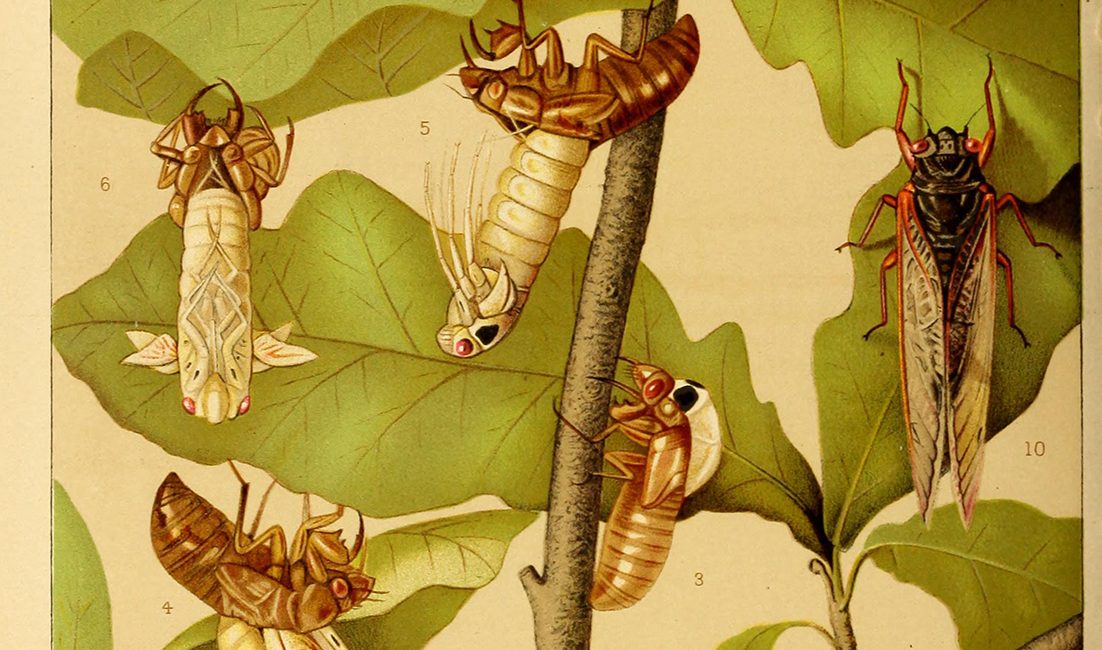
The periodical cicada in various life stages.

The various life stages of the periodical cidada (Magicicada septendecim). Marlatt, C.L. The periodical cicada: an account of Cicada septendecim, its natural enemies and the means of preventing its injury: together with a summary of the distribution of the different broods. U.S. Department of Agriculture—Bulletin no. 14. 1898. Art by C.V. Riley and L. Sullivan. Contributed in BHL from the U.S. Department of Agriculture, National Agricultural Library.

Kalm’s account, published in 1756, became the basis for Linné’s first scientific description and classification of the periodicical cicada in the 1758 edition of Systema Naturae (10th ed.). Linné’s classification of the periodical cicada placed it in the genus Cicada.

Magicicada

Additional investigations in the early 20th century led entomologist William T. Davis to look more closely at the taxonomy of the 13- and 17- year cicadas and propose a new genus, Magicicada, for the (then) two species of 17-year cicada and the four species of 13-year cicada. Davis noted in his paper with this revision that:

It is evident from the foregoing that our well known red-eyed Seventeen-Year Cicada does not belong where it has been placed, in fact Distant states in his 1905 paper, already cited, in describing his Division Tibicinaria, that Tibicina septendecim “possesses several aberrant characters.” The writer therefore proposes that this important and interesting species be the type of a new genus and be called Magicicada septendecim (Linn.). (Davis 1925, 44)

The term “Brood X” evolved from naturalists trying to make sense of the different emergences across the cicada range. C.L. Marlatt in his important work on cicadas notes:

Of the upward of twenty broods which have been differentiated, most of them have been carefully studied, chronological records collected, and the limits of distribution fairly well determined. For convenience of reference, these broods have been designated by Roman numerals, as Brood VI, Brood XXVI, etc. (Marlatt 1898, 19)

Black and white illustrations of the life cycles of the periodical cicada.

Transformation of the periodical cicada (Magicicada septendecim) from the mature nymph to the adult. Snodgrass, R.E. The Periodical Cicada. Insects, their ways and means of living. Smithsonian Scientific Series, v.5 (1930). Art by R.E. Snodgrass. Contributed in BHL from Smithsonian Libraries and Archives.

Magicicada cassinii

Cicada septendecim was the single species of periodical cicada described by Linné in 1758. A second species in the genus, M. cassinii, was described and published by J.C. Fisher in 1852 and named after his friend and fellow observer, the ornithologist, John Cassin. But, should Fischer and Cassin really get full credit for this discovery? In the 9 May 2021 issue of Scientific American, Catherine McNeur argues that Pennsylvania entomologist Margaretta Hare Morris’ contribution has been erased and that she deserves the credit for identifying the species that Fisher named, C. cassinii (McNeur 2021).

Black and white portrait of a woman in a gold frame.

Portrait of entomologist Margaretta Hare Morris. Source: Public Domain via Wikimedia Commons. Caption from Wikimedia Commons: “19th-century cased photograph from the University of Delaware Library’s Special Collections.” Image taken by Evan Krape for the University of Delaware.

As women could not be members of the Academy of Natural Sciences (Philadelphia) at the time, Morris’ paper describing her findings was read by Professor Johnson during the 15 December 1846 meeting of the Academy. She was later admitted to the Academy in 1859 (having previously been admitted to the Association for the Advancement of Science in 1850 along with astronomer Maria Mitchell as the two first women members) (Academy of Natural Sciences 1859, 354). Morris’ 1846 paper is important not just for potentially identifying a new species, but for noting the way the cicada larvae attach themselves to the roots of trees for the extended period of time they are underground. Morris clearly describes, though without an explicit description, what she posits is a new species:

The larvae were enclosed in a compact cell of earth, with no outlet except that in immediate contact with the root, and as there were no galleries or holes leading from these cells, I infer that the grubs never leave the roots they first fasten on; which may account for the great difference of size; the small ones being starved specimens of the same brood: though I am inclined to believe that there are two species, differing sufficiently in size to account for the discrepancy in size of the larvae found. I noticed this difference in 1817, and again in 1834: the note of the smaller variety, or species, is much shriller than that of the larger, and will never be mistaken when noticed. (Morris 1846, 133) [emphasis added]

Fisher’s description, published six years later in the Proceedings of the Academy of Natural Sciences, is a more typical species description:

… the attention of its members was directed by Mr. John Cassin to the fact that two species had been confounded, and that the insect regarded as the smaller variety was in fact a distinct species, a conclusion at which he had arrived during their previous appearance in 1834 … I propose on these grounds to characterize the smaller species as follows: — Cicada Cassinii, nobis. ♂ total length of body, 9-10ths of an inch of the wings, 1 2-10ths inches; ♀ frequently smaller. (Fischer 1852, 272)

Comparison of two periodical cicada species.

Comparison of two 17-year periodical cicada species: Magicicada septendecim (left, A) and Magicicada cassinii (right, B). Marlatt, C.L. The periodical cicada: an account of Cicada septendecim, its natural enemies and the means of preventing its injury: together with a summary of the distribution of the different broods. Bureau of Entomology—Bulletin no. 71. 1907. Contributed in BHL from Smithsonian Libraries and Archives.

Following Fisher’s description, Cassin adds his own note, focusing, like Morris, on the differing calls of the species:

It was therefore highly gratifying to me to have an opportunity of calling the attention of gentlemen of this Academy to the smaller species which Professor Fisher has done me the honor of naming as above, and particularly to its note. This is quite different from the prolonged and loud scream of the larger species, (which is C. septendecim, Linn.) and begins with an introductory clip, clip, quite peculiar. No disposition to associate with each other exists between the two species, and although I have seen both on the same tree, yet most frequently they were entirely separated, and occupied different parts of the woods. (Cassin 1852, 273)

Interestingly, Cassin cites an earlier observation by S.P. Hildreth (published in 1830) that delineates two varieties of periodical cicadas differing by size and song:

There appeared to be two varieties of the cicada, one much smaller than the other: there was also a striking difference in their notes. The smaller variety were more common in the bottom lands, and the larger in the hills. A continual scream was kept up by the males during the day, but they were silent through the night. (Hildreth 1830, 48)

Clearly, observers had noted that the apparent single species, M. septendecim, showed evidence that there were perhaps two varieties (as per Hildreth) or, more significantly, species (as per Morris). Fischer and Cassin clearly knew of and cited Hildreth’s observation, but were either unaware of, or consciously ignoring, Morris’ relatively recent paper (ironically presented just a few years earlier at the very Academy of Natural Sciences where their description was published).

Though Morris’ contributions to entomology (including additional publications on cicadas, e.g. Morris 1851) were recognized in her admission to prestigious scientific organizations, her important observations on what would become M. cassinii were lost for many years and her work deprecated. As late as 1947, in a short note on “Early Feminine Entomologists in America”, it is commented that “Her entomological conclusions were not always correct.” (New York Entomological Society 1947, 280)

As a final note, rounding out the three species of periodical cicadas was the description of the third species, Magicicada septendecula, described in 1962 (Alexander and Moore 1962, 9).

Magicicada 2021

The 2021 Brood X appearance provides a great citizen science opportunity. Cicada Safari has been developed by Dr. Gene Kritsky working with the Center for IT Engagement at Mount St. Joseph University in Cincinnati specifically to enable those in the range of Brood X to help naturalists document the appearance this year.

The periodical cicada as an immature adult next to its shed nymphal skin.

The periodical cicada (Magicicada septendecim) just after emergence from its nymphal skin. Snodgrass, R.E. The Periodical Cicada. Insects, their ways and means of living. Smithsonian Scientific Series, v.5 (1930). Art by R.E. Snodgrass. Contributed in BHL from Smithsonian Libraries and Archives.

Dr. Kritsky told me that he was drawn to the study of periodical cicadas early in his career:

It started the second week of my general entomology course at Indiana University. It was taught by Frank N. Young, Jr. who was the periodical cicada researcher in Indiana. As Frank started to describe these insects, I had the idea that mining the literature for historical records might prove fruitful in understanding the broods and their relationships to each other. So while in Grad School at Illinois, working under Lewis J. Stannard, Jr., the periodical cicada specialist in Illinois, I started searching. When I left in 1977, I had amassed nearly 7,000 historical records of cicadas! have been very gratified that so many of my colleagues and people around the country have embraced my app, CicadaSafari, to help map out this year’s emergence of Brood X. Here it is May 14, the cicadas have not started their major emergence in parts of their range and over 111,000 people are using the app and contributing 5,000+ -photos per day.

Additionally, for our BHL readers who already use iNaturalist for their observations, be sure to keep track of your Magicicada sightings there also.

Being based at the Smithsonian, I also checked in with Floyd Shockley, the collections manager for the Department of Entomology at the Smithsonian’s National Museum of Natural History, and asked what drew him to study the periodical cicada:

As Collections Manager, I am a broadly trained entomologist rather than a specialist on cicadas (my research focus is actually on beetles). However, I grew up on a small farm in rural Missouri and spent a lot of my childhood outside and exploring nature. I was a naturalist and a scientist even then. Cicadas were always a quintessential sign of summer back home, and given their size they were larger than most other insects so it was easy to find them and “study” them. We also have several broods of periodical cicadas that emerge in Missouri so I got to see them more than most. In fact, I’ve personally experienced 9 of the 15 extant broods of periodical cicadas during my life.

In Conclusion

The regular appearance of periodical cicadas over, for most species, what is a significant amount of time means that individual researchers will not have an opportunity to study them over multiple generations. The accumulation of observations and data over decades and even centuries makes the study of periodical cicadas possible.

The importance to researchers of repositories, such as the Biodiversity Heritage Library, that aggregate vast amounts of data gathered over long periods of time is inestimable. BHL allows researchers around the world to access literature that may be difficult or impossible to find locally or easily. Access, whether through metadata or full-text searching, uncover data that might otherwise be lost. As we saw with M. cassinii, it can also help with providing a richer story to the documenting of life on our planet.

A female periodical cicada inserting eggs with her ovipositor into the under surface of an apple twig.

A female periodical cicada (Magicicada septendecim) inserting eggs with her ovipositor into the under surface of an apple twig. Snodgrass, R.E. The Periodical Cicada. Insects, their ways and means of living. Smithsonian Scientific Series, v.5 (1930). Art by R.E. Snodgrass. Contributed in BHL from Smithsonian Libraries and Archives.

References and Additional Suggested Readings

Academy of Natural Sciences (Philadelphia). 1859. Elections in 1859. 1: 354. https://www.biodiversitylibrary.org/page/1653313

Alexander, R.D., Moore, T.E. 1962. The evolutionary relationships of 17-year and 13-year cicadas, and three new species (Homoptera, Cicadidae, Magicicada). Misc. Publs Mus. Zool. Univ. Mich. 121: 1-59. https://deepblue.lib.umich.edu/bitstream/handle/2027.42/56365/MP121.pdf?sequence=4

Cassin, John. 1852. Note on the above species of Cicada, and on the Cicada septendecim, Linn. Proceedings of the Academy of Natural Sciences of Philadelphia. 5: 273-275. https://www.biodiversitylibrary.org/page/26301508

Davis, J.J. May 1953. Pehr Kalm’s Description of the Periodical Cicada, Magicicada septendecim L., from Kongl. Svenska Vetenskap Academiens Handlinger, 17:101-116, 1756, translated by Larson, Esther Louise (Mrs. K.E. Doak). The Ohio Journal of Science. 53: 139–140. https://kb.osu.edu/handle/1811/4028

Davis, W.T., 1925. Cicada tibicen, a South American species, with records and descriptions of North American cicadas. Journal of the New York Entomological Society. 33: 35-51. https://www.biodiversitylibrary.org/page/50783180

Dybas, Henry. (1970). Population explosion — 17-year locust style. Bulletin (Field Museum of Natural History) 41.1: 11-13. https://www.biodiversitylibrary.org/page/2890663

Fisher, J.C. 1852. On a new species of cicada. Proceedings of the Academy of Natural Sciences of Philadelphia. 5: 272-273. https://www.biodiversitylibrary.org/page/26301507

Hildreth, S.P. 1830. Notices and Observations on the American Cidada, or Locust. The American Journal of Science and Arts. 18: 47-50. https://www.biodiversitylibrary.org/page/30953560

Kalm, Pehr. 1756. Beskrifning På et slags Grås-hoppor uti Norra America. Kungl. Svenska vetenskapsakademiens handlingar. 17:101-116. https://www.biodiversitylibrary.org/page/46677076

Kritsky, Gene. 2001. Periodical Revolutions and the Early History of the “Locust” in American Cicada Terminology. American Entomologist, pp. 1-4. https://doi.org/10.1093/ae/47.3.186

Kritsky, Gene. 2021. Periodical Cicadas: The Brood X Edition. Ohio Biological Survey. http://www.worldcat.org/oclc/1246784386.

Linnaei, Caroli. 1758. Insecta. Hemiptera. Cicada. Mannifera. septendecim. Systema Naturae Per Regna Tria Naturae, Secundum Classes, Ordines, Genera, Species, Cum Characteribus, Differentiis, Synonymis, Locis. 1 (10 ed.). Stockholm, Sweden: Laurentii Salvii. pp. 436–437. https://www.biodiversitylibrary.org/page/727347

McNeur, Catherine. May 9, 2021. The Woman Who Solved a Cicada Mystery—but Got No Recognition. Scientific American. https://www.scientificamerican.com/article/the-woman-who-solved-a-cicada-mystery-but-got-no-recognition/

Marlatt, C.L. 1898. The periodical cicada: an account of Cicada septendecim, its natural enemies and the means of preventing its injury: together with a summary of the distribution of the different broods. Publication info: Washington, D.C. :U.S. Dept. of Agriculture, Division of Entomology,1898. https://www.biodiversitylibrary.org/page/48892673

Morris, Margaretta Hare. 1846. Stated Meeting, Dec. 15, 1846. Mr. Vaux in the Chair. Proceedings of the Academy of Natural Sciences of Philadelphia. 3: 131-34. https://www.biodiversitylibrary.org/page/1659400

Morris, Margaretta Hare. 1851. On the Seventeen Year Locusts. Proc. Bos. Soc. Nat. Hist. 4: 110. https://www.biodiversitylibrary.org/page/8870820

New York Entomological Society. 1947. Early Feminine Entomologists in America. Journal of the New York Entomological Society. LV: 280. https://www.biodiversitylibrary.org/page/50768578

Oldenburgh, Henry. 1666. Some Observations of swarms of strange Insects, and the Mischiefs done by them. Philosoph. Trans. London, l(8): 137-38. https://www.biodiversitylibrary.org/page/47594106

Snodgrass, R.E. 1930. The Periodical Cicada. Insects, their ways and means of living. (Smithsonian scientific series, v.5). https://www.biodiversitylibrary.org/page/41170136

Recommended Sites

BugGuide. Genus Magicicada – Periodical Cicadas. https://bugguide.net/node/view/6970

Catalogue of Life. Magicicada. https://www.catalogueoflife.org/data/browse?taxonKey=5K4G

CicadaMania. A commercial site that has good information about cicadas in general as well as the 2021 Brood X appearance. https://www.cicadamania.com/

Cicada Safari. Companion site to the Cicada Safari app, there’s lots of good information here as well. https://cicadasafari.org/

General Periodical Cicada Information (University of Connecticut). https://cicadas.uconn.edu/

And Brood X map https://cicadas.uconn.edu/brood_10/

iNaturalist Periodic Cicadas. The website for the citizen science app for Magicicada. https://www.inaturalist.org/taxa/83854-Magicicada

Smithsonian National Museum of Natural History. Good information from the Smithsonian on cicadas. https://www.smithsonianmag.com/blogs/national-museum-of-natural-history/2021/04/15/what-expect-when-cicadas-emerge-spring/

Wikipedia. Magicicada | M. septendecim (Linnaeus, 1758), M. cassinii (Fisher, 1852), M. septendecula (Alexander & Moore, 1962)

Notes

[1] More information on each of the Magicicada species from GBIF can be found here: M. septendecim (Linnaeus, 1758), M. cassinii (Fisher, 1852), M. septendecula (Alexander & Moore, 1962).

May 20, 2021by
BHL News, Blog Reel

BHL Quarterly Newsletter (May 2021) Now Available!

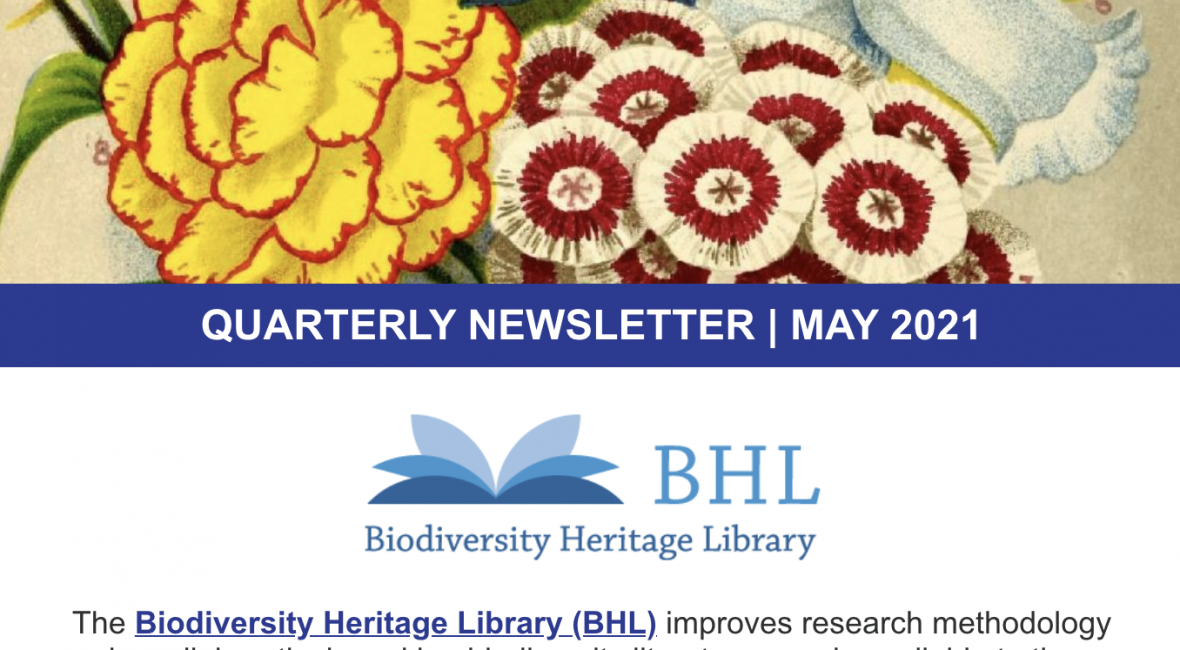
Screenshot of the May 2021 BHL qaurterly newsletter

Screenshot of the May 2021 BHL qaurterly newsletter

Our latest quarterly newsletter is now available! From a recap of the 2021 BHL Annual Meeting to recordings from BHL Day 2021 and an introduction to our new Persistent Identifier Working Group, don’t miss the latest news from the BHL community.

View our May 2021 Quarterly Newsletter.

May 17, 2021by michelle.underhill
Blog Reel, User Stories

This Bird Illustration Does Not Exist: Using Machine Learning and BHL Flickr Images to Produce “New” Bird Images

A set of six images on a grid. Each looks like a scientific illustration of a different bird.

A version of this post was originally published on the Cogapp blog on 30 March 2021.

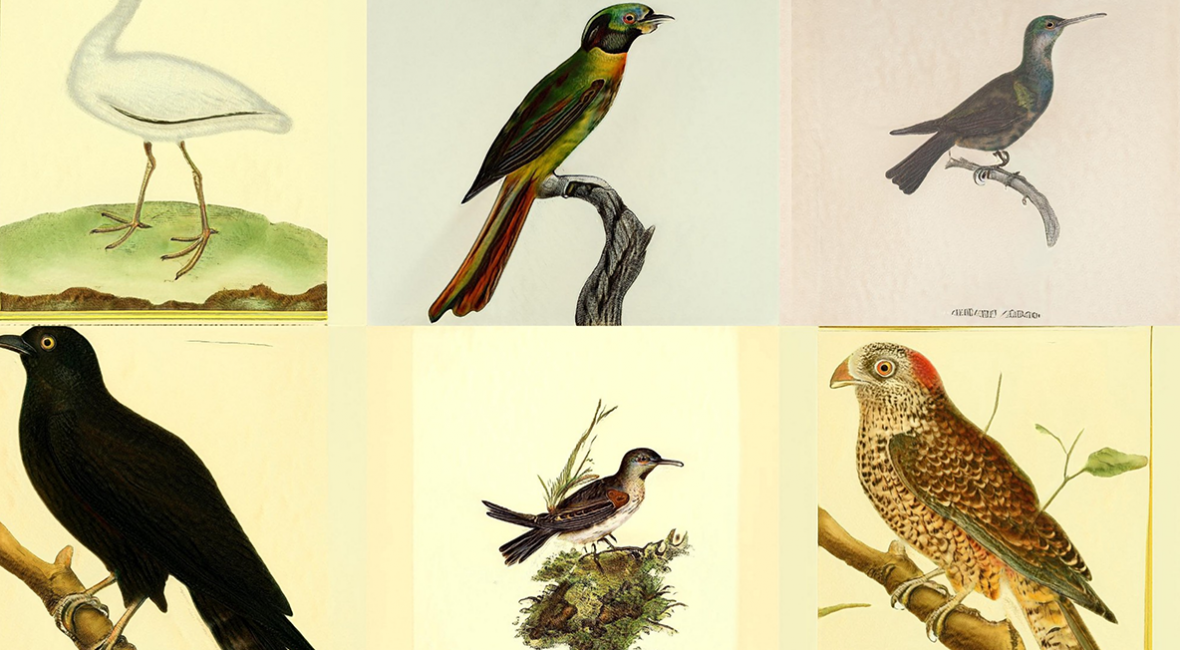
A set of six images on a grid. Each looks like a scientific illustration of a different bird.

AI generated illustrations of birds created with illustrations from the BHL Flickr using machine learning with a StyleGAN.

I work as a web developer for the agency Cogapp, which is based in Brighton, UK. We create websites and other digital services for museums, art galleries, archives and the like, but every couple of months we hold a “hack day.” A hack day involves spending a day working on projects which generally revolve around a particular theme and which ideally we can do in one day. This allows us to get the creative juices flowing and to further our agenda of innovation.

The theme this past hack day at Cogapp was “Museum APIs,” but the looser interpretation was that we were to use open data provided by museums in our projects. I was inspired by the Biodiversity Heritage Library’s Flickr, which is a massive collection of free-to-use scientific images. I immediately knew I wanted to utilise this resource as I love scientific illustrations of nature.

I’ve also had an interest in Machine Learning (ML) for a while, and I recently discovered Derrick Schultz and his YouTube channel Artificial Images. Here, he publishes videos of his Machine Learning courses which he runs for people who want to use ML for creative purposes.

I watched Derrick’s tutorials on training a StyleGAN Neural Network and the things he was saying made a degree of sense to me, plus he had published a handy Google Colab notebook with step-by-step code, so I decided it was something I might be able to have a go at.

What is a StyleGAN?

StyleGAN stands for Style Generative Adversarial Network and was originally developed by NVLabs. The purpose of a StyleGAN is to train and learn from input images and produce its own “fake” images back. You may have seen the site ThisPersonDoesNotExist.com, which features fake photos of people which a StyleGAN has produced. This network has been trained on thousands of images of people’s faces and has in turn learned to produce new images which (for the most part) look like real photographs of people’s faces.

A set of three photos of faces. The first two photos look like real photos, the third one however looks like they might have a headscarf or hat on but when you look at it you realise it’s more of a weird melty abstract shape and the head is floating in space.

Three images from ThisPersonDoesNotExist.com; two successful, one less so…

A StyleGAN does this by processing through the set of real images it is given numerous times during which it also produces its own images. The “adversarial” part of the name refers to the fact that a StyleGAN actually comprises two Neural Networks which work against each other. The first network produces the fake images and the second will look at those images and try to determine whether it thinks they are “real” images or “fake.” The longer each network trains, the better each gets at its job, and the more likely the images produced will trick the second network and ultimately also humans into thinking they’re real.

StyleGAN has been updated a few times and in 2020 StyleGAN2-ADA was released, which now allows us to train a network on very few images, actually as few as 500–1000 as opposed to 10,000s just a couple of years ago, and it will learn to produce good quality fakes in a very short period of time (a few hours of training). This advancement allowed me to feel like I could attempt to train my own, as 1000 images was something I could get and I felt like I could train the model during the course of a hack day and get some kind of result to show at the end.

Creating the dataset

The biggest (active) part of this project time-wise was collecting the images and making them look roughly uniform by cropping them to the same size and having the subject roughly in the same spot in each one. This was important as when training this model I wanted the network to focus on the subject of the image itself and not, for example, where in the image the subject was, as that would waste precious training time.

I looked through the BHL Flickr and decided to use scientific illustrations of birds. I love birds and the style of scientific illustrations, and I was excited at the idea of the new and weird birds my StyleGAN model might produce! I chose illustrations in which the bird was in the centre of the page and the rest of the space was ideally empty. Due to time constraints, I did allow some illustrations with more than one bird in them and some with background features such as grass. This wasn’t ideal for the above reasons, but I decided to give it a go and see what the results would be like anyway.

A contact sheet type layout with 28 real illustrations of different birds of different shapes, colours and positions. Some perching on branches, some on grass.

A contact sheet of “reals” or real images taken from my dataset from the BHL Flickr. This is produced by the StyleGAN at the beginning of training.

Training my model

Once I had my dataset ready to go, I used Derrick’s Google Colab notebook to train my model. In order to run StyleGAN2-ADA, you need “1–8 high-end NVIDIA GPUs with at least 12 GB of GPU memory,” which is more memory than most home computers have, so using something like Google Colab where you’re essentially borrowing their super powerful computers means that even an average joe like me can have a go at running memory-heavy code like this and it’s free for the basic version, which is enough for this purpose! The other benefit is that you can connect it to a Google Drive for storage. This was useful in my case because I needed to store 1000 images to train my model with, and the model outputs large images itself.

The code I was using was set to train a new StyleGAN model based off of one that had already been trained for many hours. A model in Machine Learning is essentially a file that has been trained to recognise patterns. Using a pre-trained model as a starting point like this is called transfer-learning, and it can drastically speed up the time it takes for your StyleGAN to learn from your images and start producing something which looks good. The model you’re using as a base for training a StyleGAN doesn’t have to be similar in subject matter to the images you will be training it with, and in this case I used the ffhq model by NVlabs, which is trained from a set of images of faces. This meant that when it started to train, it initially produced images which looked like a mixture of faces and my illustrations.

After each few iterations through the dataset, the model produced a 7 by 4 grid of sample images so I could see how it was getting on. The image below is the first sample image I got, which shows the original faces mixing with some features of my images!

A contact sheet style set of 28 images. You can recognise faces in most of them, but the faces are washed out in colour and are starting to morph into more abstract shapes. Some features are being exaggerated by the StyleGAN as something which might look like a feature on a bird image, like for example curly hair texture turning into almost like branches on a tree. Other features are being washed out or removed over time as they are not useful for producing images of birds.

Totally not terrifying image produced by the StyleGAN model after one of the first cycles of training.

As time went on, the shapes it was producing started looking more and more bird-like. By the end of the hack day, I had only managed to train my model for about 3–4 hours. But, by that time I was starting to see the faces disappear and bird features appear. Pretty impressive for just a few hours, but also still pretty abstract!

The same contact sheet style 28 images. You can now see almost no face-like features at all. At this stage the images look very abstract. You can see the background colour is a pale beige like on a lot of the illustrations of birds. You can see the model learning that the birds are generally in the centre of the image. But we have abstract blobby shapes in the foreground at the moment, rather than anything that looks like birds. The colours of these blobs are starting to look bird-like, though.

The fakes produced by the end of the hack day in around 3–4 hours of training.

I wanted to see whether the model could produce more recognisable bird images, so I continued to train it after the hack day ended and the images started to look better and better…

The contact sheet of images. Here the foreground shapes in a lot of cases are starting to look bird-shaped! There is no detail like feathers or eyes or legs, but the outlines look like birds in about half of the images. Some are still abstract, though, like just some wavy lines.

The fakes produced after about 3–4 hours more training.

I left the model training over the weekend and the fakes actually did start looking like they could be illustrations of birds in many cases! Below is the final set of sample images I produced with my model. I would guess I spent about 40 hours training to get to this point.

The contact sheet of images. Here if you don’t look closely you think it’s just a collection of real illustrations of birds. Most of them look like birds and we now have details like legs and eyes. In some cases a bird is a bit warped like it’s melting, and in other cases a bird might have three legs or eyes. But for the most part it looks like real bird illustrations.

The final set of sample images generated by the StyleGAN after around 40 hours of training.

Okay, so there are a few images in there that maybe wouldn’t fool a human into thinking they were real illustrations of birds… ahem…

Two screenshots of images the StyleGAN has produced where the birds look a weird shape almost like they’re melting. The legs and tree branches and textures of the birds look okay, but they have many eyes and their shape is all wrong.

A single screenshot of a bird image in which the bird has two legs which look real but the body is tubular and upright unlike any bird I’ve seen. It also has no eyes and one beak on one side of its head and another beak on the other side.

But the majority kind of do look like birds. I’m pretty sure if you didn’t know this was generated by a Neural Network you would have no trouble believing it was a real bird illustration.

A single screenshot of an image produced by the StyleGAN. This looks like a real bird illustration. Its body is almost duck-like and it has two eyes and a beak and its feathers look like a real feather texture. It has two legs and it’s standing on some grass. It does look very happy and alert though…

It does maybe look overly happy for a bird though?

Here are a few more images produced which I think look very convincing.

A set of six images on a grid. Each looks like a scientific illustration of a different bird.

AI generated illustrations of birds created with illustrations from the BHL Flickr using machine learning with a StyleGAN.

This is so impressive considering I only had 1000 images and it was around a couple of days worth of training!

Creating interpolation animations

While learning from the given dataset, a StyleGAN will look for patterns or “features” in the images and organise them into a multi-dimensional graph. This is called latent space.

When I talk about “features,” in the simplest terms I mean things like brown vs white feathers, for example. So, brown feathers might be point A in this space and white feathers is point B. If you move from point A to point B and produce images every so often in between, you would see the feathers turn from brown to white over time. This is called interpolation.

Using another of Derrick Schultz’s Google Colab notebooks, I generated a couple of videos of interpolations through my model. I used the “circular” interpolation which gives a nice “walk” through a few diverse points in the latent space and you see different birds morph into one another. Here is one of the outcomes:

As it “walks” through the latent space, different features morph from one to another.

Conclusion

The fact that with StyleGAN2-ADA you can use such a limited dataset and need so little time, and that you can use a free service like Google Colab to do the training and it still produces results like this is incredibly impressive and opens the word of Machine Learning and StyleGANs to many more people than previously. It is also very exciting to see and think about all of the creative, as well as practical, applications of this technology. Practical applications of GANs include: “image-to-image translation,” which might involve converting a photograph taken in the day time to night time for example, so as a sort of AI-led photoshop; being able to generate higher resolution versions of images; or even generating missing parts of an incomplete image.

I have to obviously shout out to Derrick Schultz for his Colab notebooks and tutorials which also helped lower the barrier. It meant that I was able to get training much quicker than I would have otherwise but the code is still there for me to learn from, amend and dissect. I encourage you to check out his YouTube channel if you’re interested in learning more about training StyleGANs. He also runs regular courses on Machine Learning for creative purposes and you can find out more about them on his website.

I also encourage you to have a look through the Biodiversity Heritage Library’s 250,000+ images on their Flickr. It’s an impressive and incredibly interesting collection of images from the natural world, organised into different categories. It’s the perfect place to find datasets to use in a StyleGAN model or just for inspiration!

I’m looking forward to using this technology with more datasets and seeing what new and weird flora, fauna and other images I might be able to create!

May 13, 2021by michelle.underhill
BHL News, Blog Reel, Tech Updates

What Is BHL’s New Persistent Identifier Working Group DOI’ng?

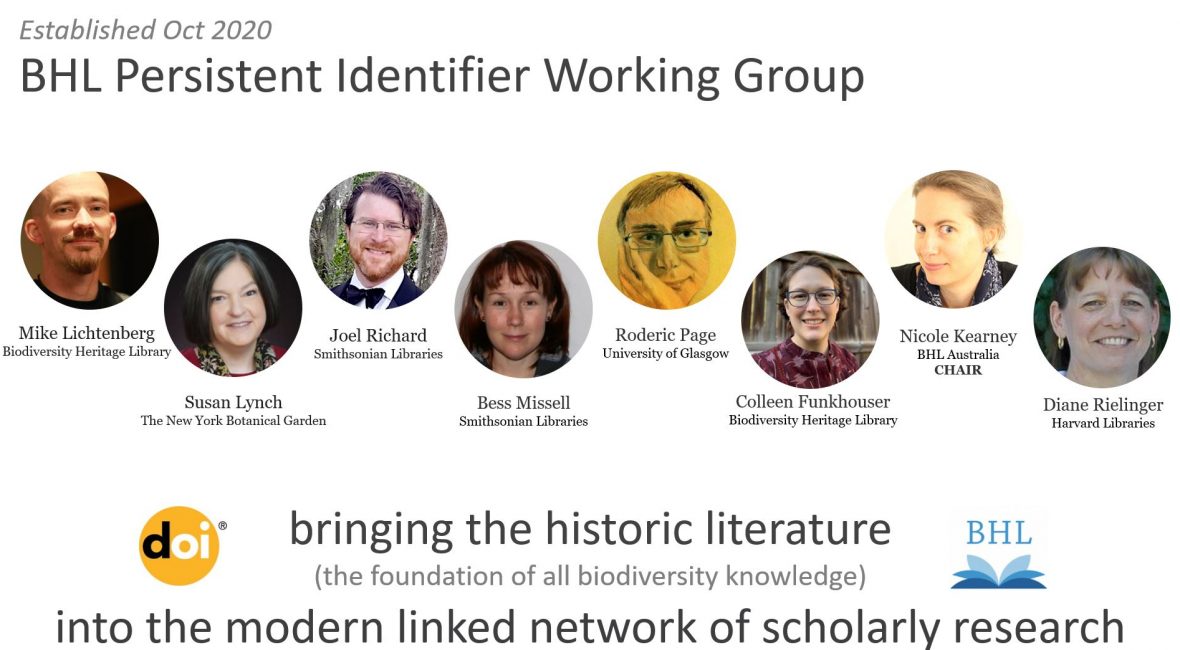
Graphic showing the members of BHL's Persistent Identifier Working Group

In October 2020, BHL launched a new working group with a momentous goal: to make the content on BHL persistently discoverable, citable and trackable using DOIs (Digital Object Identifiers).

Graphic showing the members of BHL's Persistent Identifier Working Group

The members of BHL’s new Persistent Identifier Working Group (PIWG).

A DOI is like an electronic fingerprint in the form of a unique and permanent alphanumeric string that provides a persistent link to a piece of content online. Modern publications receive a DOI at the point of publication. This DOI becomes a key part of a publication’s bibliographic metadata that should be included in any mention or citation of that publication. Reference lists in modern publications are filled with DOIs, which allows readers to click from publication to publication in (in theory) a never-ending chain of knowledge.

This reciprocal linking of DOIs has created a great linked network of scholarly research, but that network is missing the historic literature. The vast majority of historic publications lack DOIs. This means they appear in reference lists as unlinked citations. In our increasingly online world, readers are far more likely to read (and thus cite) publications they can click through to (particularly when libraries are inaccessible during a global pandemic). The upshot of this is that the millions of pages of historic literature on BHL—the foundation of our understanding of biodiversity—is in danger of falling into obscurity.

BHL has been retrospectively minting DOIs for historic publications since 2011, but the focus has primarily been on monographs. BHL’s new Persistent Identifier Working Group (PIWG) is (at least initially) focusing on journal articles. Minting DOIs for articles on BHL is a far more complex and time-consuming task than minting DOIs for monographs. This is because article DOIs need article data: every journal volume uploaded onto BHL must be accompanied by journal and volume data, but there is no requirement that contributors provide article data.

Thankfully, there have been considerable efforts to add article data to BHL (and thereby make it possible to search for the titles and authors of these articles both within BHL and via external engines). A huge proportion of this article data has been contributed to BHL by Roderic Page via BioStor: 75% of the 300,753 articles indexed in BHL as of 4 May 2021 were “defined” by BioStor. It is very difficult to determine how many articles are actually on BHL (hidden within all those journal volumes). But, while we don’t know what proportion of BHL’s journal content still needs to be made discoverable, we know there is still a huge amount of work to do.

COVID-19 provided an unexpected opportunity to make a considerable dent in this work. With no access to scanners or library materials, a number of BHL contributors, including Harvard University Libraries, Muséum National d’Histoire Naturelle and BHL Australia, pivoted from making new content accessible to making their existing content on BHL more discoverable. For example, BHL Australia’s digitisation volunteers gathered, gap filled and checked article-level metadata for over 30,000 articles in 2020.

Once an article has been defined, i.e. it exists as a publication unit in BHL and has its own article landing page (and we’ve checked that the article does not already have a DOI), we can assign a DOI to it. Articles that have recently been assigned BHL DOIs include some very old publications, such as the first scientific description of the Duck-billed Platypus, published in 1799 (https://doi.org/10.5962/p.304567), and the species descriptions from A specimen of the botany of New Holland, the first publication dedicated to Australian flora (1793-5), e.g. https://doi.org/10.5962/p.312432. The PIWG has also started assigning DOIs to in-copyright publications (with permission from the rights holders). These include articles from the Bulletin of the British Museum, e.g. https://doi.org/10.5962/p.310418, and the Bulletin of the African Bird Club, e.g. https://doi.org/10.5962/p.308885.

Screenshot of the landing page in BHL for the description of the The Duck-Billed Platypus, Platypus anatinus.

Shaw, George (1799), The Duck-Billed Platypus, Platypus anatinus, The Naturalist’s Miscellany: https://doi.org/10.5962/p.304567 (illustration by Frederick Polydore Nodder).

If an article on BHL has an existing non-BHL DOI, we add this key piece of bibliographic metadata to the BHL landing page for the article. This ensures that BHL users can link to the definitive version of the article (the one the DOI resolves to), and more importantly, that other parties (and their algorithms) can find our versions from elsewhere. This is particularly important when commercial websites lock their DOI’d versions of public domain articles behind paywalls. Having their DOIs on our freely accessible versions ensures that services like Unpaywall can find them. To learn more about how this works, see our blog post: BHL Journal Articles Are Now Discoverable via Unpaywall.

DOIs not only improve discoverability and enable persistent linking to our historic content; they also allow us to track how BHL content is being used. In the six months following the minting of its new DOI (Oct 2020 to April 2021), the 1799 Platypus description was tweeted by 219 Twitter accounts, referenced in six Wikipedia pages, picked up by one news outlet and cited in one academic paper (data from Altmetric, April 2021). We know this because the article has a DOI.

Screenshot of the Altmetric dashboard for the first scientific description of the Duck-billed Platypus

Altmetric’s overview of attention for the first scientific description of the Duck-billed Platypus (Shaw 1799): https://www.altmetric.com/details/91788579.

The PIWG has spent the past six months creating, refining and testing tools that will allow BHL contributors to do this work themselves. We have also been producing documentation that explains a) how to use the new tools, and b) why this work is so important. These tools will facilitate every step in the article discoverability and DOI assignment process including: downloading existing article data for a given journal title to allow for correction and gap-filling (in development); bulk uploading of article data for new articles (available now); and adding articles and titles to BHL’s (new) DOI Assignment Queue (available now). Our dream is that, whenever anyone uploads a journal volume to BHL, they also provide the data for the articles it contains (and thus take responsibility for making that content discoverable).

The Persistent Identifier Working Group (PIWG) is fueled by the technical expertise, metadata dexterity and incredible passion of:

  • Nicole Kearney, Manager BHL Australia (Chair)
  • Mike Lichtenberg, BHL Lead Developer
  • Susan Lynch, Systems, Digitization & Web Services Librarian, The New York Botanical Garden
  • Bess Missell, Metadata Librarian, Smithsonian Libraries and Archives
  • Roderic Page, Professor of Taxonomy, University of Glasgow
  • Joel Richard, BHL Technical Coordinator | Head of Web Services & IT, Smithsonian Libraries, Smithsonian Libraries and Archives
  • Diane Rielinger, Digital Projects Librarian, Botany Libraries, Harvard University Herbaria
  • Colleen Funkhouser, BHL Program Manager

The specific goals of the group are:

  • To add article-level metadata to journal articles on BHL
  • To add existing DOIs to (new and existing) article landing pages on BHL (particularly for those articles where the DOI’d version is behind a paywall elsewhere)
  • To assign BHL DOIs to articles that lack DOIs

Want to know more about BHL’s Persistent Identifier Working Group? See:

  • Discovering the Platypus: From its scientific description to its DOI, Biodiversity Information Science and Standards (TDWG) Conference, 6 October 2020: https://youtu.be/4UVSEoWsSrw?t=1285
  • #RetroPIDs: making historic Platypus Infinitely Discoverable (PID), PIDapalooza: the Festival of Persistent Identifiers, 28 January 2021: https://youtu.be/CSeQNe5KR5U

For the latest news about BHL’s DOI work, check out #RetroPIDs on Twitter.

May 10, 2021by michelle.underhill
BHL News, Blog Reel

2021 BHL Annual Meeting — Global and Virtual

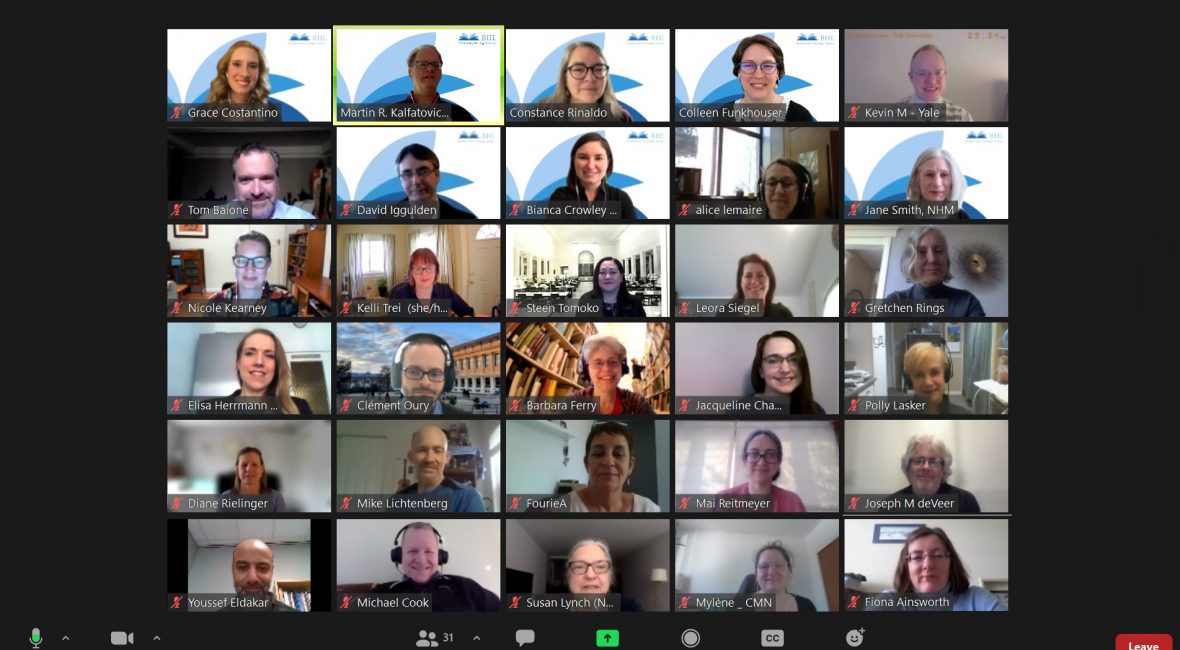
Screenshot of a Zoom meeting interface with a gallery view of people's heads

Group “Zoom” photo of attendees at the virtual 2021 BHL Annual Meeting.

Like many organizations around the world, the Biodiversity Heritage Library was compelled, for the second year in a row, to move the 2021 BHL Annual Meeting to a virtual environment. In consultation with our prospective 2021 host, the Muséum national d’histoire naturelle in Paris, the BHL Executive Committee again made the difficult, yet necessary, decision to move to a virtual meeting, but one that would be much enhanced from 2020 with a goal of trying to recreate the interaction and programmatic content of our in-person meetings.

BHL Day 2021 and Closing Event

BHL Day 2021 graphic

Like many of our previous in-person events, the annual meeting this year included a public, BHL Day 2021. The event, themed Reflections in Crises, featured an opening keynote, “Biodiversity at a Tipping Point”, by Ian Owens (Deputy Director, National Museum of Natural History, Smithsonian Institution). BHL partners spoke on the topic of Finding Opportunities During a Global Pandemic. The day ended with a closing keynote by Lidia Ponce de la Vega (Doctoral Candidate (ABD) and DH Course Lecturer, McGill University), “Decolonizing Strategies for an Equitable Biodiversity Heritage Library.” Event sessions were moderated by Constance Rinaldo (Chair, Executive Committee of the BHL Members’ Council), Gildas Illien (General Director of Collections at Muséum national d’histoire naturelle (MNHN)), and Bianca Crowley (BHL Digital Collections Manager). BHL Day 2021 was our best attended event to date with 187 attendees. See details about the event here. Recordings of the event sessions are available on the BHL YouTube channel.

Screenshot of a man and a women in a zoom meeting.

Dr. Ian Owens (left; Deputy Director, National Museum of Natural History, Smithsonian Institution) presented the Opening Keynote during the virtual BHL Day 2021. The session was moderated by Constance Rinaldo (right; Chair of the Executive Committee of the BHL Members’ Council).

Screenshot of a zoom meeting with several people in attendance.

Representatives from five BHL partner institutions presented during the Partner Reflection Panel at the virtual BHL Day 2021. The session was moderated by Gildas Illien (top left; General Director of Collections at Muséum national d’histoire naturelle (MNHN)). Participants included (from top to bottom, left to right): Alice Lemaire (Director of Libraries and Documentation, Muséum national d’Histoire naturelle (MNHN)); Elisa Herrmann, M.A. LIS (Head of Department Discovery Services and Information Management, Museum für Naturkunde – Leibniz Institute for Evolution and Biodiversity Science); Laurence Bénichou (Head of Museum Science Press, Muséum national d’Histoire naturelle (MNHN)); Tom Baione (Harold Boeschenstein Director, American Museum of Natural History (AMNH) Library); Jacqueline E. Chapman (Head, Digital Library and Digitization, Smithsonian Libraries and Archives); Jane Smith (Outgoing Head of Library and Archives, Natural History Museum, London (NHM)).

Screenshot of two women in a zoom meeting

Lidia Ponce de la Vega (left; McGill University, Doctoral Candidate (ABD) and DH Course Lecturer) presented the Closing Keynote during the virtual BHL Day 2021. The session included an introduction by Constance Rinaldo (Chair of the Executive Committee of the BHL Members’ Council) and was moderated by Bianca Crowley (right; BHL Digital Collections Manager).

A special closing event, Notes from Nature: The Biodiversity Heritage Collections, was organized by our BHL Members, Muséum national d’Histoire naturelle (MNHN) and National Library Singapore, in partnership with BHL. See details about the event here. Recordings of the event presentations by Tan Huism (Senior Director, National Library Singapore) and Clément Oury (Head of Conservation, Restauration and Digitization Service, MNHN Library) are available on the National Library Singapore YouTube channel.

Screenshot of a video showing a woman in a purple flowered top sitting in front of a glass window with plants around.

Ms. Tan Huism (Senior Director, National Library Singapore) presented on the BHL collections in Singapore and spotlighted the new Human x Nature exhibition at National Library during the “Notes from Nature: The Biodiversity Heritage Collections” event, a special closing session presented as part of the 2021 BHL Annual Meeting.

Screenshot of an opening slide from a zoom event.

Dr. Clément Oury (Head of Conservation, Restauration and Digitization Service, MNHN Library) discussed the history of French naturalists in Singapore as well as previous partnerships between France and Singapore during the “Notes from Nature: The Biodiversity Heritage Collections” event, a special closing session presented as part of the 2021 BHL Annual Meeting.

BHL Business Meeting

To provide the best virtual experience for a globally dispersed audience, the Executive Committee and Secretariat’s business meeting reports were provided via pre-recorded presentations followed by a live question and answer period. In all, 43 representatives from BHL partner institutions joined the business and partner sessions of the meeting.

The meeting opened with a presentation by Constance Rinaldo (Chair of the Executive Committee of the BHL Members’ Council and former Librarian of the Ernst Mayr Library, Harvard University) on the state of the BHL as we enter 2021 (Transitions and Collective Resiliency: BHL 2020-2021). As Constance noted in her opening remarks: “By leveraging BHL strengths, we are maintaining the resilience inherent in BHL’s virtual global presence and interconnectivity … this collective resilience is key to the strength of our community. It is the strength of our BHL community that keeps us nimble and valued.”

Secretariat Reports

Martin R. Kalfatovic (BHL Program Director and Associate Director, Digital Programs and Initiatives Division at Smithsonian Libraries and Archives) followed with a report covering BHL’s 2020 program activities, a financial update, and anticipated projects in 2021-22 (Biheli quīndecim: BHL@15).

Though BHL Program Manager Colleen Funkhouser joined BHL right before the 2020 meeting, this was Colleen’s first full meeting. Her Program Manager’s report, Program Manager’s Report: An Eventful First Year, provided insight into the BHL’s finances and other related activities. Bianca Crowley (BHL Digital Collections Manager) and Grace Costantino (BHL Outreach and Communication Manager) provided respectively a BHL Collection Management update (BHL Collection Management: Diving Deeper into a Sea of Content) and a BHL Outreach update (BHL Outreach: Looking Back at 2020).

Also presenting was Joel Richard (BHL Technical Coordinator and Head of Web Services & IT at Smithsonian Libraries and Archives), who provided an overview of the BHL Tech Team’s work (2021 Technical Priorities) and presented the goals of the 2021 BHL Technical Priorities as determined by the BHL Executive Committee in December 2020. Mike Lichtenberg, BHL’s Developer, also participated in the meeting along with Tech Team members, Susan Lynch (Systems, Digitization & Web Services Librarian, The New York Botanical Garden), Nicole Kearney (Manager, BHL Australia), and Elisa Herrmann (Head of Department Discovery Services and Information Management, Museum für Naturkunde).

BHL Executive Committee Election

Graphic with photos of two women and a man and the text "BHL Governance: Executive Committee"

Members of the 2021-2023 Executive Committee of the BHL Members’ Council. Chair: Constance Rinaldo (Retired from the Ernst Mayr Library, Harvard University); Vice-Chair: David Iggulden (Library, Art & Archives at the Royal Botanic Gardens, Kew); Secretary: Kelli Trei (Library, University of Illinois at Urbana-Champaign).

This year was an election year for the BHL Executive Committee. Due to unforeseen circumstances, the election was modified to allow Member representatives to vote to continue Constance Rinaldo for one additional year as Chair, as well as electing a Vice-Chair and Secretary. The vote to continue Constance Rinaldo as Chair was approved; David Iggulden (Library, Art & Archives at the Royal Botanic Gardens, Kew) was elected as Vice-Chair and Kelli Trei (Library, University of Illinois at Urbana-Champaign) was elected as Secretary. You can learn more about the Executive Committee members of the BHL Members’ Council for the 2021-2023 term on the BHL About site.

Tour of the Room: Top Lessons Learned from 2020

To engage our partners in the vision and future of BHL, we again held a tour of the room. Partners were given two questions: “What was your institution’s top lesson learned from 2020 that is most relevant for BHL?” and “How has your thinking about BHL changed in response to the events of the past year?” Written responses were requested ahead of the meeting and a number of participants shared their thoughts live at the meeting. All responses to the Tour of the Room are available to review.

Partner Session

Over the course of 2020, many BHL associated staff worked on finalizing the implementation document for the 2020-2025 BHL Strategic Plan. Leaders from each of the five goals gave brief presentations on their elements of the implementation plan. The partners also had a discussion around Diversity, Equity, Accessibility and Inclusion (DEAI) in relation to BHL collections and related activities.

Thanks and the 2022 BHL Annual Meeting

While we were not able to travel to Paris this year or the last, the BHL Executive Committee and Secretariat would like to note with much appreciation the excellent planning put in by our colleagues at the Muséum national d’Histoire naturelle (MNHN), Gildas Illien (General Director of Collections at Muséum national d’histoire naturelle) and his staff, particularly Clément Oury (Head of Conservation, Restauration and Digitization Service, MNHN Library) and Alice Lemaire (Director of Libraries and Documentation, MNHN), in our planning for the virtual 2021 meeting.

We also had the opportunity to recognize the service to BHL by partner representatives who have retired or moved on to new positions.

Looking forward to 2022, the BHL Annual meeting will be held in conjunction with the Society for the Preservation of Natural History Collections (SPNHC). BHL will coordinate with SPNHC for public programs as the meeting’s international partner, alongside the meeting’s national partner, the NatSCA (Natural Sciences Collections Association). Stay tuned for more details on the June 2022 meeting.

Thanks again to all who participated in our public and business meetings. We look forward to our next year’s meeting.

Business Meeting Reports: Links to the PPTs

    • Chair’s Report (Constance Rinaldo)
    • Program Director’s Report (Martin Kalfatovic)
    • Program Manager’s Report (Colleen Funkhouser)
    • Digital Collections Manager’s Report (Bianca Crowley)
    • Outreach and Communication Manager’s Report (Grace Costantino)
    • BHL Technical Coordinator’s Report (Joel Richard)
    • Tour of the Room
    • Recognition of Partner Representatives
May 6, 2021by

Help Support BHL

BHL's existence depends on the financial support of its patrons. Help us keep this free resource alive!

search

About BHL

The Biodiversity Heritage Library (BHL) is the world’s largest open access digital library for biodiversity literature and archives. BHL operates as a worldwide consortium of natural history, botanical, research, and national libraries working together to digitize the natural history literature held in their collections and make it freely available for open access as part of a global “biodiversity community.”

Join Our Mailing List

Sign up to receive the latest news, content highlights, and promotions.

Subscribe Now

Subscribe to Blog via Email

Enter your email address to subscribe to this blog and receive notifications of new posts by email.

Join 319 other subscribers

Subscribe to Blog Via RSS

Subscribe to the blog RSS feed to stay up-to-date on all the latest BHL posts.

Access RSS Feed

Inspiring Discovery through Free Access to Biodiversity Knowledge.

The Biodiversity Heritage Library makes it easier than ever for you to access the information you need to study and explore life on Earth…for free, anytime, anywhere.


64+ Million Pages of
Biodiversity Literature Online.

EXPLORE

Tools and Services
to Transform Research.

EXPLORE

300,000+
Illustrations on Flickr.

EXPLORE

ABOUT | HARMFUL CONTENT | PRIVACY | SITE MAP | TERMS OF USE