Biodiversity Heritage Library - Program news and collection highlights from BHL
  • Home
  • News
  • Featured Books
    • All Featured Books
    • Book of the Month Series
    • BHL at 20
  • User Stories
  • Campaigns
    • Fossil Stories
    • Garden Stories
    • Monsters Are Real
    • Page Frights
    • Her Natural History
    • Earth Optimism 2020
  • Tech Blog
  • Visit BHL
Home
News
Featured Books
    All Featured Books
    Book of the Month Series
    BHL at 20
User Stories
Campaigns
    Fossil Stories
    Garden Stories
    Monsters Are Real
    Page Frights
    Her Natural History
    Earth Optimism 2020
Tech Blog
Visit BHL
  • Home
  • News
  • Featured Books
    • All Featured Books
    • Book of the Month Series
    • BHL at 20
  • User Stories
  • Campaigns
    • Fossil Stories
    • Garden Stories
    • Monsters Are Real
    • Page Frights
    • Her Natural History
    • Earth Optimism 2020
  • Tech Blog
  • Visit BHL
Biodiversity Heritage Library - Program news and collection highlights from BHL
Blog Reel

In-copyright titles added in the 3rd quarter of 2017

From July to September of this year, BHL received permission for 43 new in-copyright titles, all as part of the Expanding Access to Biodiversity Literature project. This is a slight increase over the numbers added in the first two quarters.

BHL licenses content under a
Creative Commons Attribution-NonCommercial-ShareAlike 4.0 license

Below are the 43 titles added in the second quarter, in the order permission was secured. For those that have already been scanned or uploaded, links are available. Look for the rest as they’re added to the collection; you can check the recent additions, or see all the permission titles available in BHL on the permissions page.

Titles in BHL have been digitized/contributed by the rights holders unless otherwise stated.

Alabama Academy of Science
  • Journal of the Alabama Academy of Science
Denver Botanic Gardens
  • Green Thumb News
  • Green Thumb Newsletter
  • Mountain, Plain, and Garden
  • The Green Thumb
American Association of Zoo Keepers
  • AAZK Bulletin
  • AAZK Newsletter
  • Ruptured Rhino
The Avicultural Society
  • Avicultural Magazine
Oregon Flora Project
  • Oregon Flora Newsletter
Kelly Allred
  • The New Mexico Botanist
New York State Ornithological Association
  • The Kingbird
The Arboretum Foundation

  • Arboretum Bulletin
  • University of Washington Arboretum Bulletin
  • Washington Park Arboretum Bulletin

Lunds Botaniska Förening

  • Opera Botanica, v.42 (1977)
Illinois State Academy of Science
  • Transactions
Brooklyn Botanic Garden
  • A Teaching Guide to the Trees and Shrubs of Greater New York, Including the Kinds Most Commonly Seen in Cultivation (1933 and 1947 editions)
  • Guide to Trees and Shrubs Based on Those of Greater New York: Native, Naturalized, and Commonly Cultivated Exotic Kinds
  • Leaflet / Leaflets
  • Plants and Gardens
  • Plants of the U.S. Military Academy, West Point, New York

Florida Exotic Plant Pest Council and Southeast Exotic Plant Pest Council

Wildland WeedsUniversity of Florida/IFAS Center for Aquatic and Invasive Plants
  • Aquaphyte
International Ornithologists’ Union
  • IXe Congrès Ornithologique International, Rouen, 9 au 13 Mai 1938 (Digitized by Smithsonian Libraries)
Tulane University
  • Tulane Studies in Geology
  • Tulane Studies in Geology and Paleontology
University of Texas Austin Libraries

  • Contributions in Marine Science
  • University of Texas at Austin Bulletins and Publications
African Violet Society of America
  • African Violet Magazine
Ohio Biological Survey
  • Ohio Biological Survey Notes
The Natural History Society of Maryland
  • Bulletin
  • Bulletin of the Maryland Herpetological Society
  • Maryland Naturalist
  • Maryland: A Journal of Natural History
  • Proceedings
Texas Ornithological Society
  • Bulletin of the Texas Ornithological Society
  • Occasional Publications
Desert Botanical Garden
  • Agave
  • Saguaroland Bulletin
  • The Sonoran Quarterly
Torrey Botanical Society
  • Memoirs of the Torrey Botanical Club
American Ornithological Society
  • Proceedings of the XIIIth Ornithological Congress
Museum of Texas Tech University
  • Occasional Papers
  • Special Publications

Department of Malacology, The Academy of Natural Sciences of Philadelphia

  • Tryonia
American Daffodil Society
  • The Daffodil Bulletin
  • The Daffodil Journal

BHL thanks the many individuals and organizations who have so generously allowed their publications to be digitized and made available to the world under open access. If there’s a book or journal you would like to see in BHL, please let us know!

And as always, don’t forget to follow BHL on Facebook, Twitter (@BioDivLibrary), Instagram, Pinterest, and Tumblr.

October 24, 2017by [email protected]
Blog Reel, Featured Books

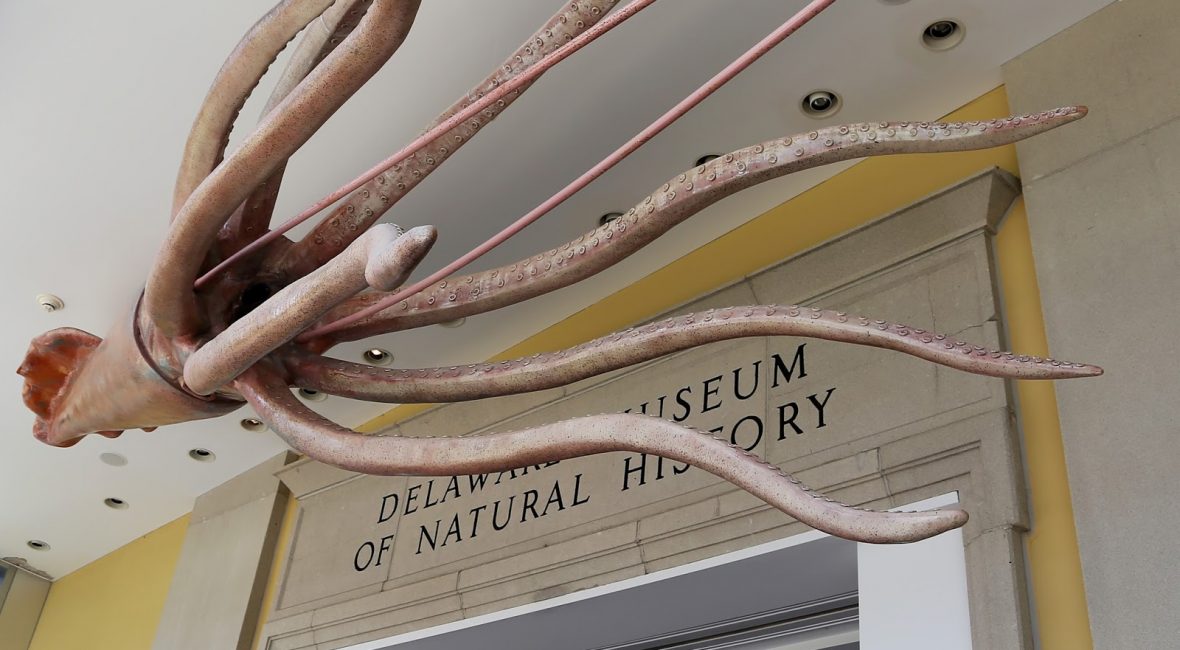
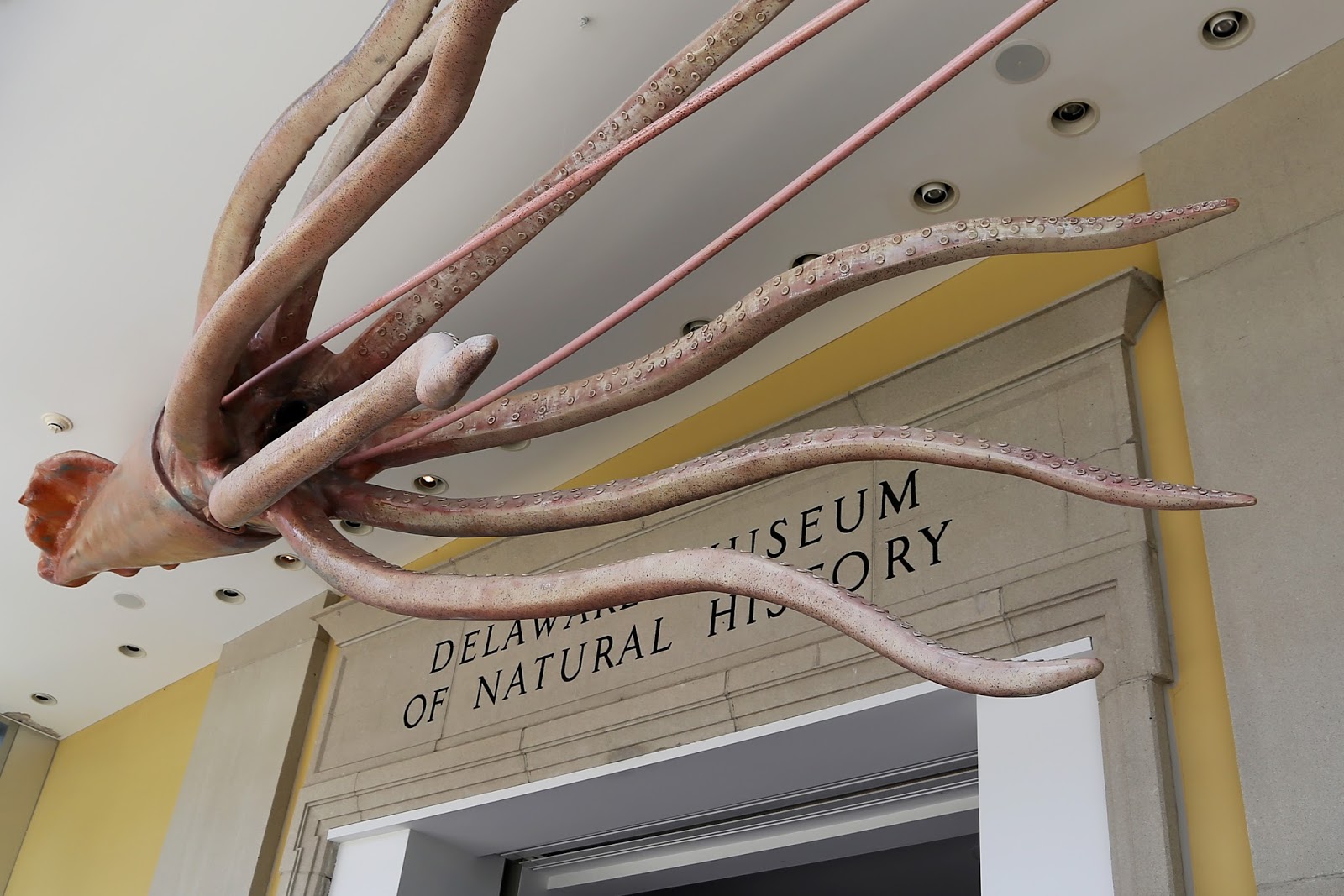
The Delaware Museum of Natural History

View Full Size Image
Image adapted from a photo by Jim, the Photographer. Original on Flickr.
(CC BY 2.0)

History
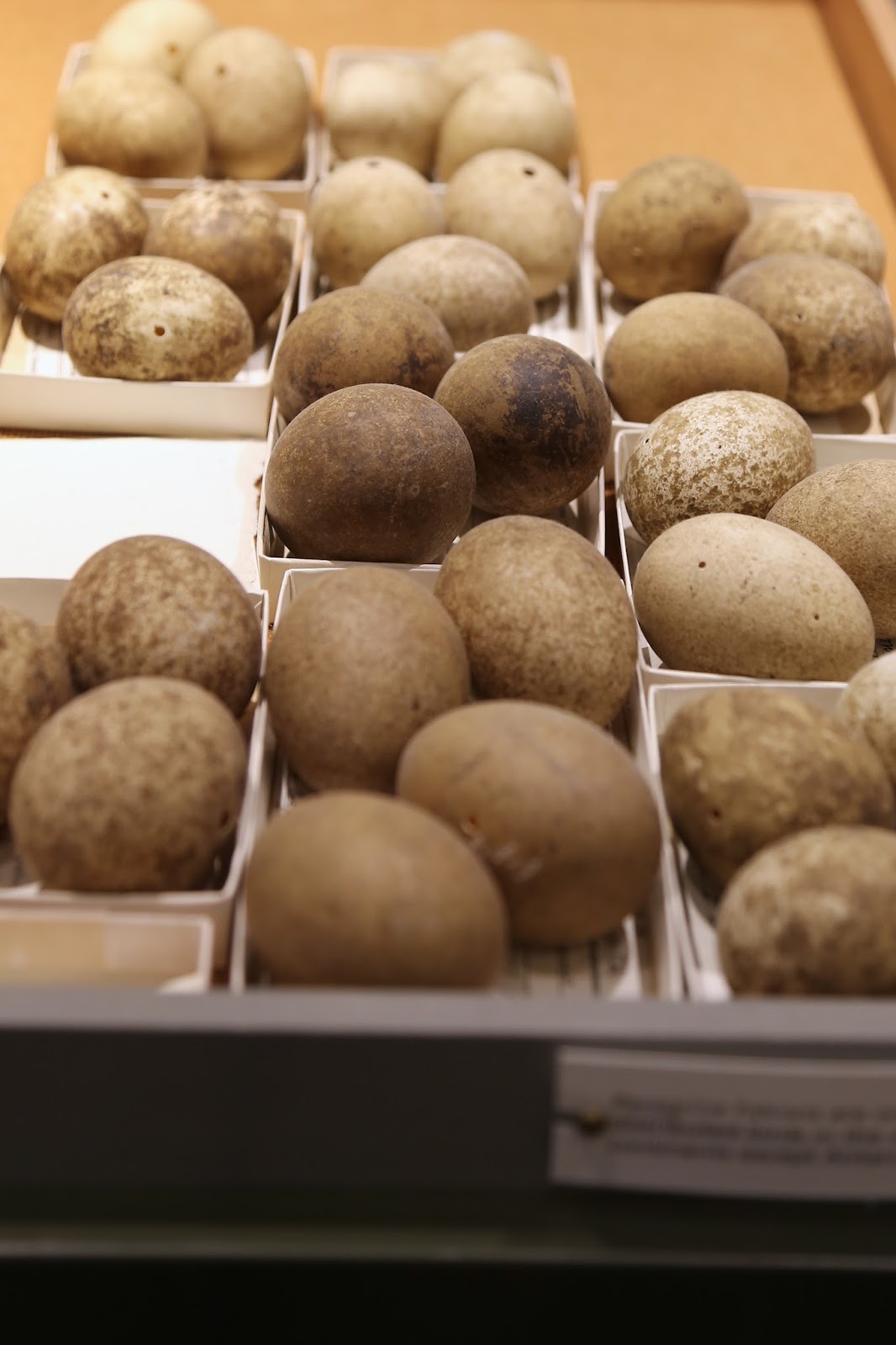
For over 40 years, the Delaware Museum of Natural History (DMNH) has promoted the study of nature, investigated the planet’s flora and fauna, and educated the public with its world-class collections, which are particularly rich in mollusks and birds (DMNH’s collection of bird eggs is the second-largest in North America).

View Full Size Image
“The Egg Collection”
Photo by Jim, the Photographer
on Flickr (CC BY 2.0)

Founded in 1957, the museum began as an idea in the mind of John duPont, heir to the DuPont Chemical fortune. An avid naturalist, duPont travelled the world and amassed a collection of 113,000 birds and 2 million seashells. He used a portion of land from his family’s estate to found the museum that houses his collections. It opened to the public in 1972.

Long after his involvement with DMNH had ended, duPont moved his attention to athletics. He used some of his fortune to open a training center for Olympic athletes on his sprawling estate in Pennsylvania. The athletes, trainers, and coaches who worked for him were known as Team Foxcatcher and enjoyed considerable success. As years went on, however, duPont’s behavior became increasingly erratic. His deterioration came to a head in January of 1996, when, for reasons unknown, he shot and killed his star wrestling coach, Olympic gold medalist Dave Schultz. This tragic story was (loosely) told in the 2014 film Foxcatcher.

Publications and Rare Books

Birds, shells, and mammals aren’t the only things that John duPont put in the DMNH; he also contributed a library with an excellent collection of rare books. DMNH recently contributed some of these books to BHL through the Expanding Access to Biodiversity Literature (EABL) project, which works with organizations across the U.S. to digitize unique and valuable material. The DMNH-contributed books include rare works from the 18th century and publications by the museum, including several works by duPont himself. Below are some highlights; the complete list can be found here and here.

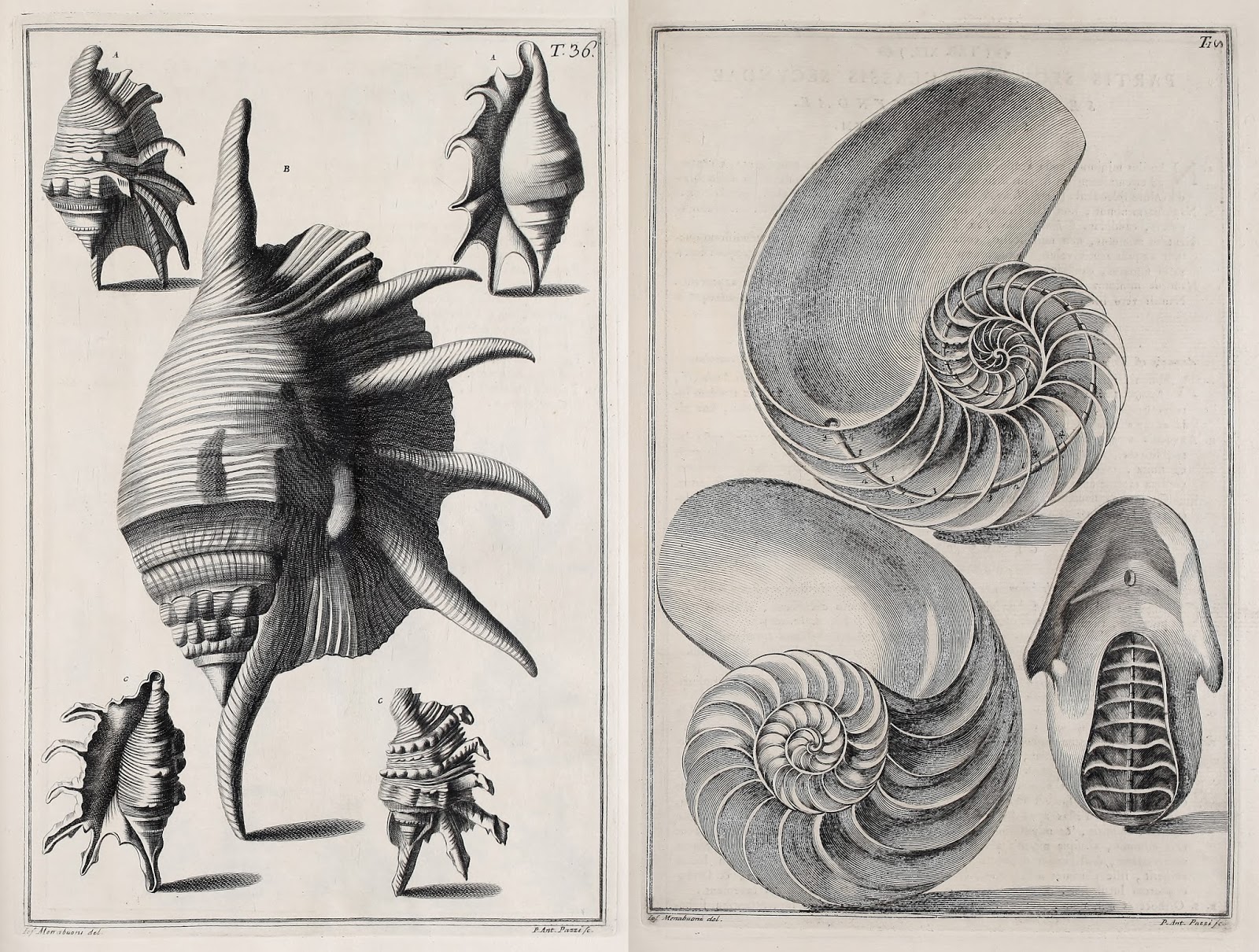
1. Index testarvm conchyliorvm quae adservantvr in mvseo Nicolai Gvaltieri (1742)

Niccolò Gualtieri was an Italian doctor, malacologist, and professor at the University of Pisa, whose collection of shells is the oldest in the university’s natural history museum. Particularly noteworthy in his Index testarvm conchyliorvm are his descriptions of argonauts, also called paper nautiluses.

View Full Size Image
Plates from Gualtieri’s Index: L: T.36, Conch shells (Strombidae);
R: T.18, Nautilus.

2. Woodpeckers of the World (Monograph Series No. 4, 1982)

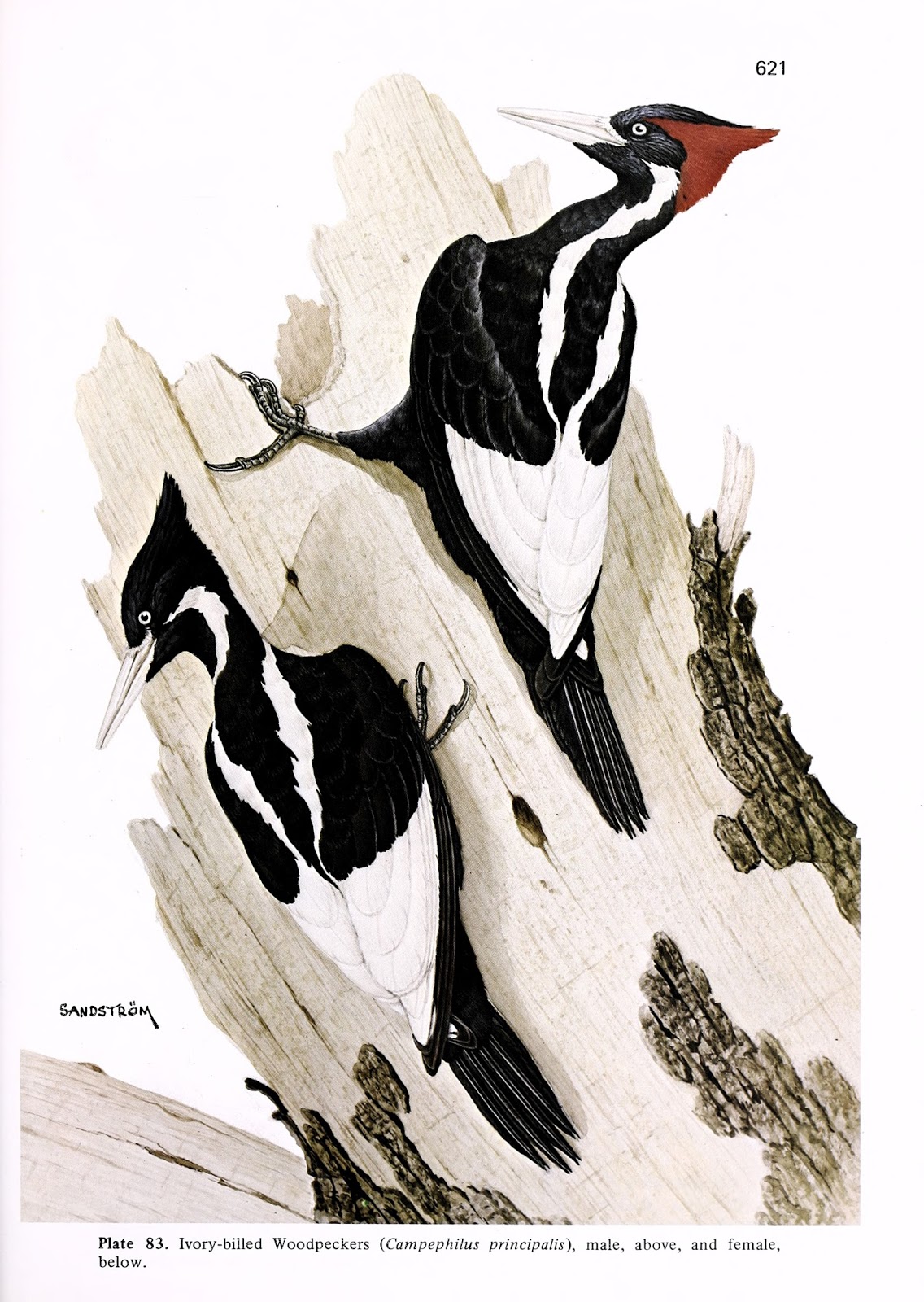
Lester L. Short, born in 1933, is one of the world’s foremost experts on woodpeckers (family Picidae). A former curator of birds at the American Museum of Natural History, Short travelled to over 60 countries documenting woodpeckers and in 1986 was one of the last people to see a Cuban Ivory-billed Woodpecker, Campephilus principalis bairdii, in the wild. The bird is now believed to be extinct.

Short’s Woodpeckers of the World was written with the encouragement and support of John duPont; in fact, duPont arranged for his illustrator, George Sandström, to work with Short to produce the 101 color plates in the book.

View Full Size Image
Ivory-billed Woodpeckers, illustrated by George Sandström.
From Woodpeckers of the World (1982), p. 621:
http://biodiversitylibrary.org/page/53631011

3. Philippine Birds (Monograph Series No. 2, 1971)

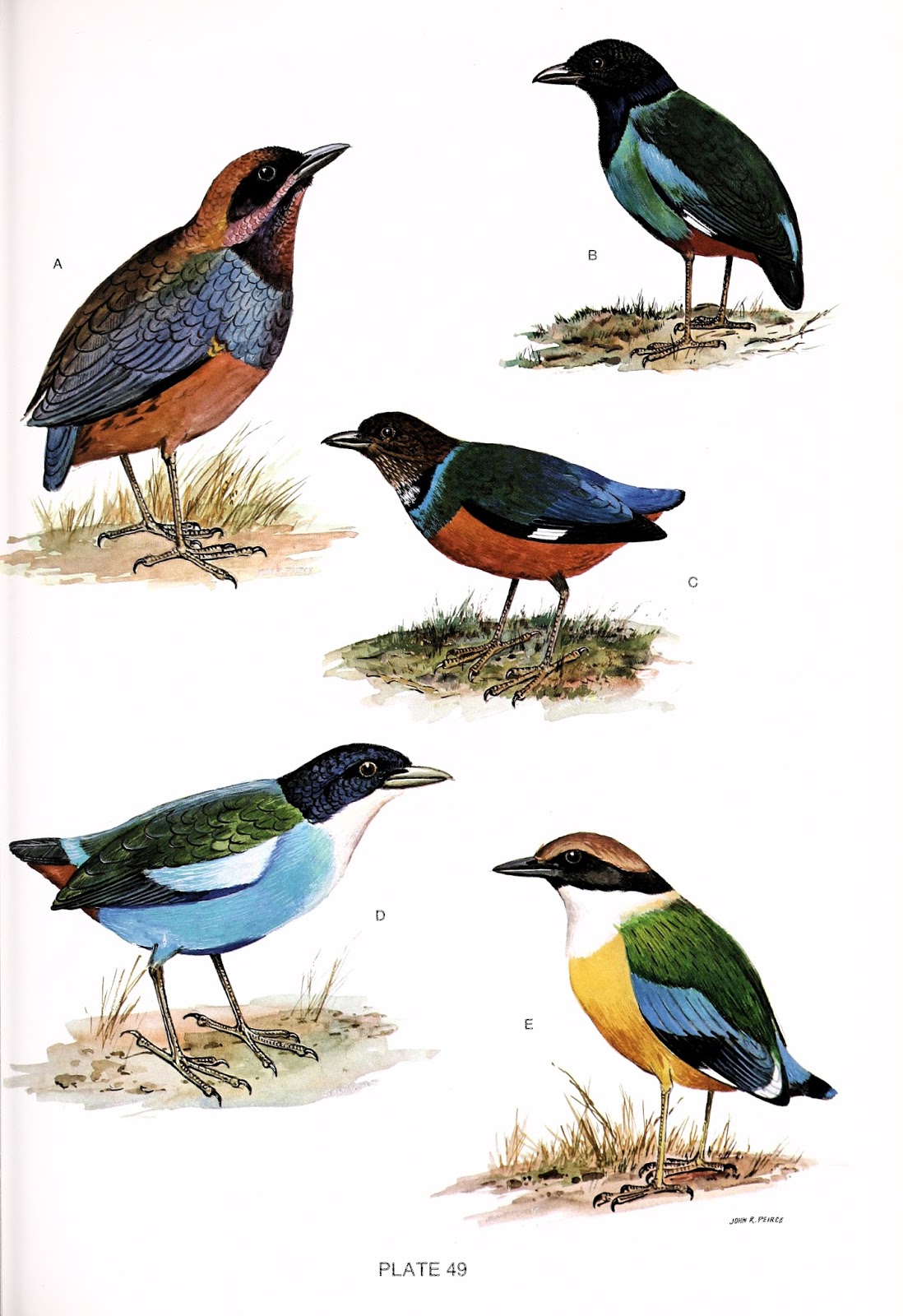
John duPont wrote this book based on his own expeditions to the Philippines, beginning in 1958. In the foreword to the book, ornithologist Dean Amadon writes that “anyone who knows John duPont will realize that, once in the islands, he heads for the nearest mountains and jungles: he is not one to dawdle about in the gardens of local officials.” Philippine Birds was written as an identification guide rather than a comprehensive work, with brief descriptions accompanying color illustrations by George Sandström.

View Full Size Image
Pittas (family Pittidae), illustrated by George Sandström.
From Philippine Birds (1971), plate 49:
http://biodiversitylibrary.org/page/53630110

Jean Woods, Curator of Birds at DMNH, worked with the EABL team to digitize these titles and get them into the BHL collection. Discussing the importance of putting them online, she said, “We’re excited to have the museum’s publications and rare books available through the Biodiversity Heritage Library to be used by researchers that have not previously had access to them.” She added that some of the titles, like Philippine Birds, have been out of print for years and that “many of the rare mollusk books contain original species descriptions which continue to be essential for taxonomic work.”

We are grateful to Jean and to the Delaware Museum of Natural History for so generously sharing their wealth of publications and rare books with the BHL community.

References

About us. (n.d.). Retrieved from http://www.delmnh.org/about-us-2/
Eckholm, E. (1986, May 5). Woodpecker, believed extinct, seen in Cuba. The New York Times. Retrieved from http://www.nytimes.com/1986/05/05/us/woodpecker-believed-extinct-seen-in-cuba.html
Longman, J. (2010, December 9). John E. du Pont, heir who killed an Olympian, dies at 72. The New York Times. Retrieved from http://www.nytimes.com/2010/12/10/sports/olympics/10dupont.html?_r=0
Niccolò Gualtieri’s splendid seashells. (2016, August 26). Retrieved from http://www.italianways.com/niccolo-gualtieris-splendid-seashells/
August 17, 2017by [email protected]
Blog Reel, Featured Books

The Southern Cultivator

The Expanding Access to Biodiversity Literature (EABL) collection has grown rapidly over the last year, with the addition of born digital material and in-copyright titles scanned by various BHL member libraries. It wasn’t until recently, however, that the collection included titles contributed directly by non-BHL members. This process—a significant departure from usual BHL workflows—is part of EABL’s effort to digitize valuable content from organizations outside the consortium. Contributors ship their material to the closest Internet Archive (IA) scanning center, where it is scanned and added to the BHL and EABL IA collections. From there, the metadata is ingested into BHL by the usual process. EABL then reimburses the scanning cost.

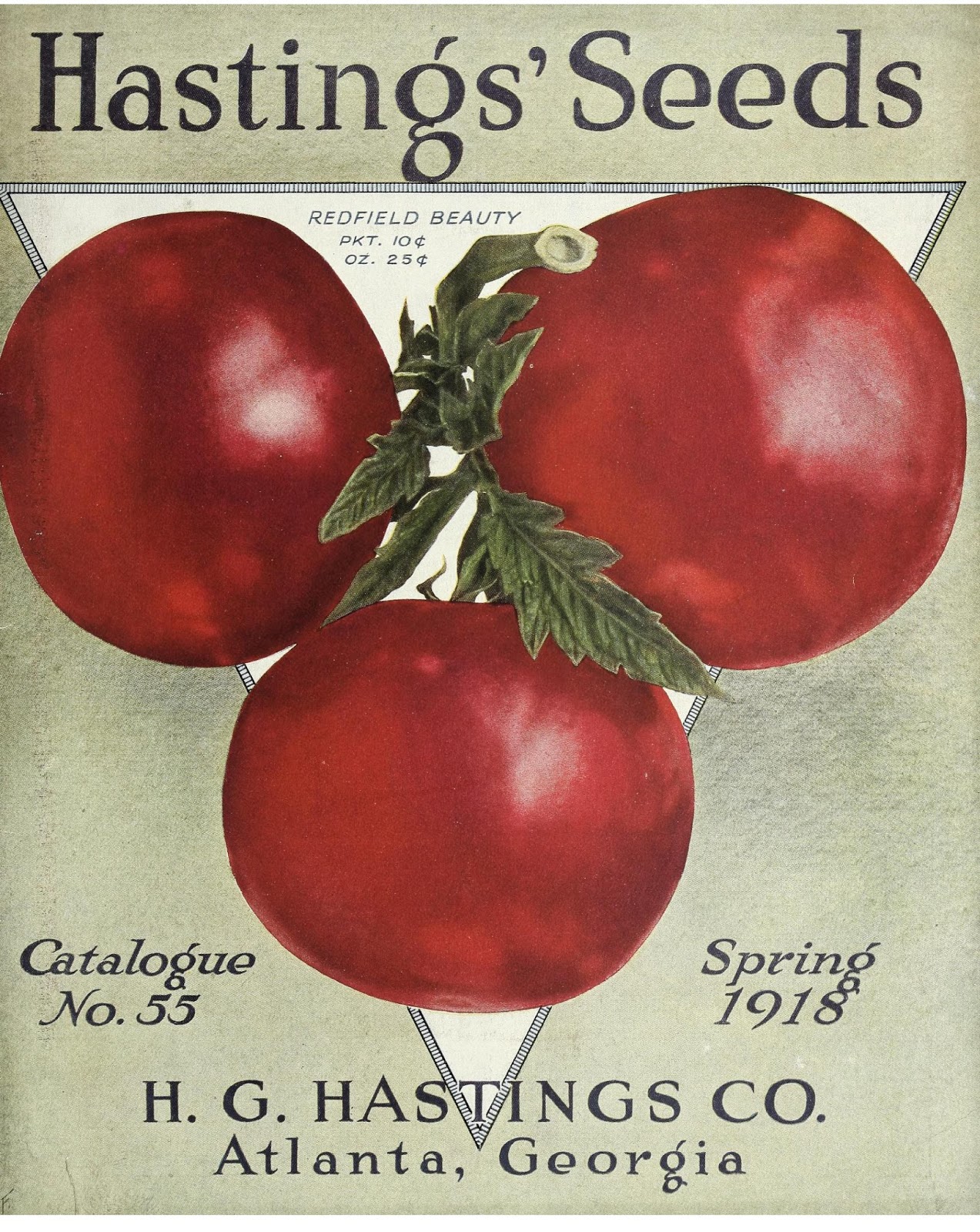
The first organization to digitize in this way through EABL was the Cherokee Garden Library, Kenan Research Center at the Atlanta History Center. They contributed seed catalogs published by H.G. Hastings & Co., a major commercial agricultural company in Atlanta, Georgia, in the early 20th century.

View Full Size Image
Hastings’ Seeds, No.55 (1918). http://www.biodiversitylibrary.org/page/53015794. Digitized by Cherokee Garden Library, Kenan Research Center at the Atlanta History Center.

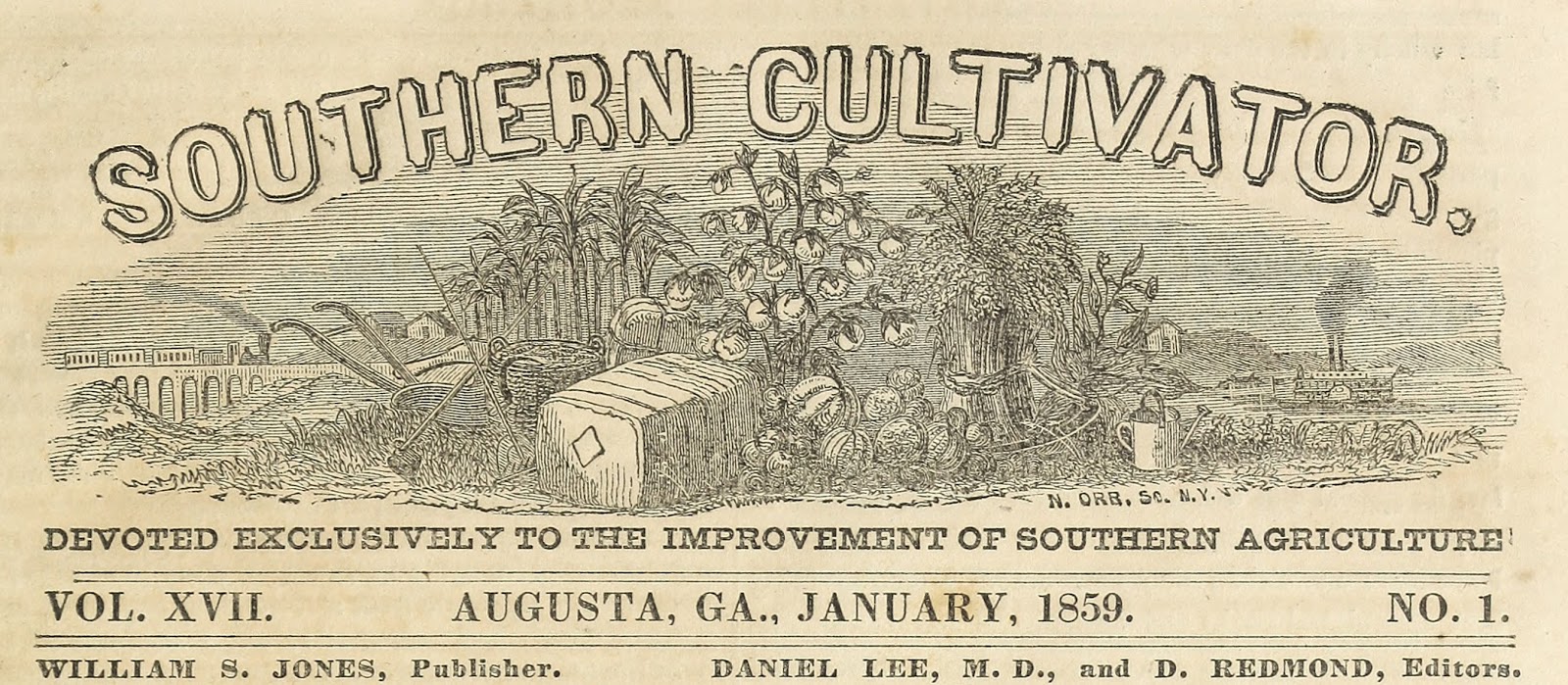
The Cherokee Garden Library also contributed a number of volumes (v.1-4, 1843-1846; v.13-15, 1855-1857; v.17, 1859) of The Southern Cultivator, another Atlanta-based publication that historian Michael T. Bernath called “the Confederacy’s oldest, strongest, and intellectually most impressive agricultural journal.” The journal is important not only as a source of information about the agriculture industry of the antebellum South, but also for its stark depiction of American slavery and the unconscionable role it played in the rise of that industry. It was published from 1843 to 1872.

View Full Size Image
Southern Cultivator. v. 17 (1859). http://www.biodiversitylibrary.org/page/53013665. Digitized by Cherokee Garden Library, Kenan Research Center at the Atlanta History Center.

The editors of The Southern Cultivator minced no words in promoting the practice of slavery; in fact, they saw it as a crucial component in their plan to elevate southern agriculture. In v.1 (1843), they printed an address given by John Belton O’Neall to the Agricultural Society of South Carolina in December of the previous year. In it, Judge O’Neall states that there is one obstacle to realizing the full industrial potential of the state — the “carelessness of her operatives,” i.e., slaves. He continues, “Still, our slaves are capable of more, much more, than we have hitherto had credit for. It is only necessary that they should be taught habits of regularity, economy and thrift, to make them the most effective laborers in the world. This is what we are attempting.” (p.109).

Difficult as it is to read these words—and they are hardly the most racist to appear in the journal’s pages—they provide an unvarnished glimpse into a period of American history in which slavery was a cornerstone of agriculture throughout much of the country. Indeed, The Southern Cultivator shows that it was not southerners alone who believed slavery was vital to the economy. In v.17 (1859), as the tensions that would lead to civil war were quickly rising, the editors reprinted an editorial from the Providence [Rhode Island] Post arguing that the North would suffer equally, if not more, if the South were to secede from the Union or if slavery were abolished. They preface the editorial by saying, completely without irony, that they “seldom dabble in anything that even resembles the ‘dirty water of politics’.” The editorial itself is frank in putting material concerns over principle:

Slavery may be a great outrage against humanity. We look upon it in this light, and have no defence to offer for it. But we remind Northern men, not only that the North clung to while it promised to be profitable…but that Northern merchants and Northern mechanics and Northern manufacturers are dependent on it to-day for their stately ships, their immense store-houses, their splendid dwellings, their paying railroads and their reputation for thrift. (p.107)

View Full Size Image
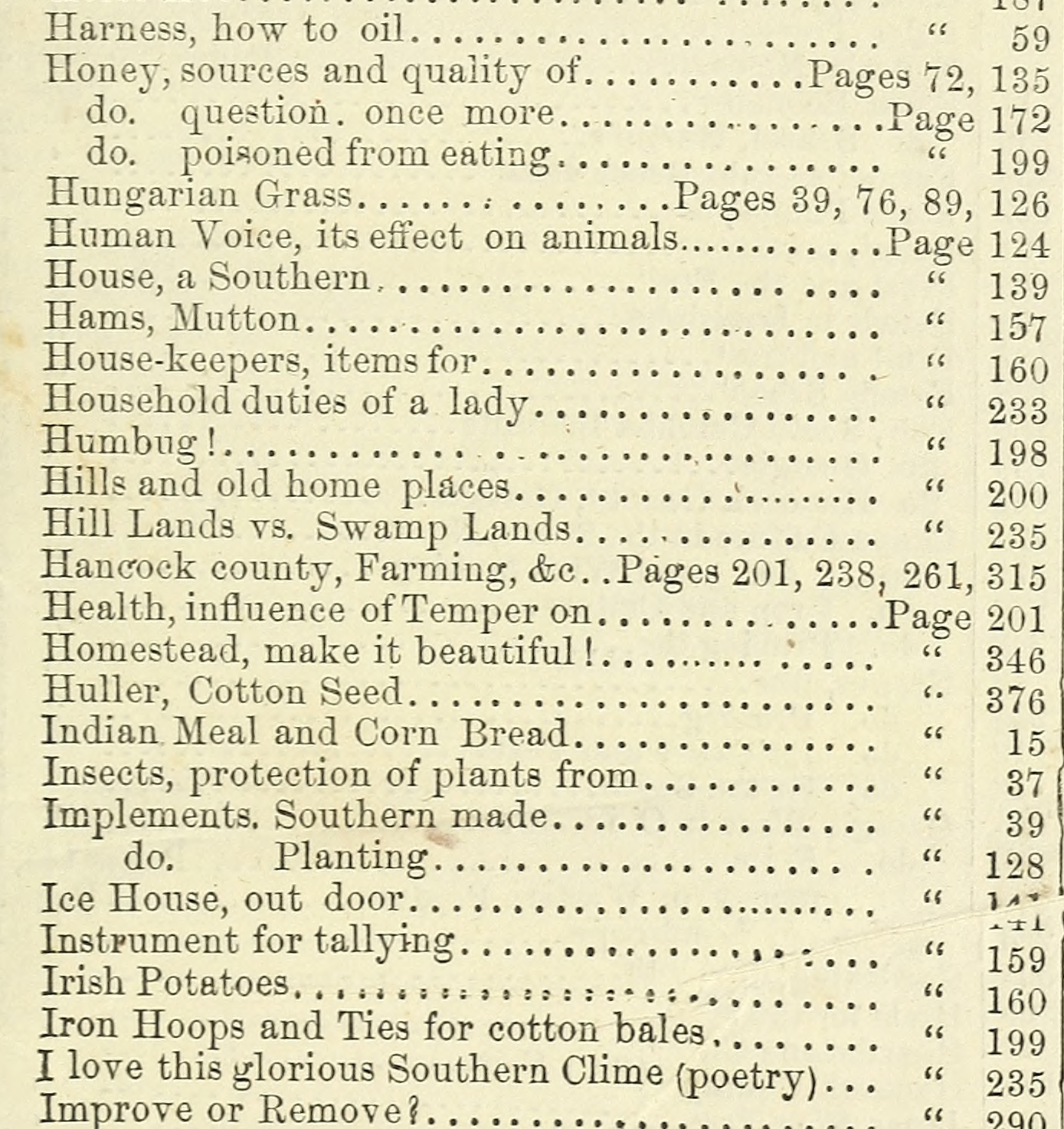
Sample of the index to v.17 (1859),
showing the topical breadth of the journal. http://www.biodiversitylibrary.org/page/53013673. Digitized by Cherokee Garden Library, Kenan Research Center at the Atlanta History Center.

As the United States continues to grapple with the legacy of the Confederacy, slavery, and the aftermath of the American Civil War, the digitization of these volumes is particularly timely. We are grateful to the Cherokee Garden Library, Kenan Research Center at the Atlanta History Center for contributing them through EABL, and we hope that they will be useful to researchers across many disciplines.

To learn more about the Cherokee Garden Library and its work with EABL, see this post from earlier this year.

Reference
Michael T. Bernath, Confederate Minds: The Struggle for Intellectual Independence in the Civil War South, Chapel Hill, North Carolina: University of North Carolina Press, 2010, p. 86.

June 15, 2017by [email protected]
Blog Reel, Featured Books

The Worcester Country Horticultural Society

In the fall of 1840, in Worcester, Massachusetts, two dozen attendees of the Worcester Agricultural Society’s Annual Cattle Show put on a display of local fruits and flowers. The attention it received led to the creation, in 1842, of the Worcester County Horticultural Society (WCHS), the third oldest active society of its kind in the United States.

View Full Size Image
The logo of the WCHS, from Transactions, 1912
(image in the public domain,
from Wikipedia)

Today, the WCHS is based at Tower Hill Botanic Garden, which it established in 1986. While many things have changed since the era of its founding 175 years ago, the WCHS continues to “inspire the use and creation of horticulture to improve lives, enrich communities and strengthen commitment to the natural world.” The history of this effort is documented in the Transactions of the Worcester County Horticultural Society, which is available in BHL’s collection through the work of the Expanding Access to Biodiversity Literature project. Thank you to the WCHS for sharing this valuable publication with BHL and its users.

History of the WCHS


“It is truth, TRUTH—and the Universe was framed to corroborate it—that of all employments, none is better than the Culture of the Earth, none more independent, none more pleasant, none more worthy the dignity of Man!”
-George Jaques, Transactions of the Worcester County Horticultural Society, p.11 (1847)
On September 19, 1840, several men gathered for the purpose of establishing a society that would do for horticulture what the Worcester Agricultural Society had done for agriculture: the “mutual improvement in [its] theoretical and practical branches.” The Agricultural Society’s Annual Cattle Show was chosen as the venue for an initial exhibition. Prior to the show itself, ads were placed in area newspapers soliciting contributions from the gardens and orchards of the public. The exhibit opened the day before the Cattle Show, to popular acclaim and the chagrin of the elder society, which was in danger of being upstaged. A host of new members was admitted (membership was $1), and the nascent horticultural society entered a period of steady growth.
View Full Size Image
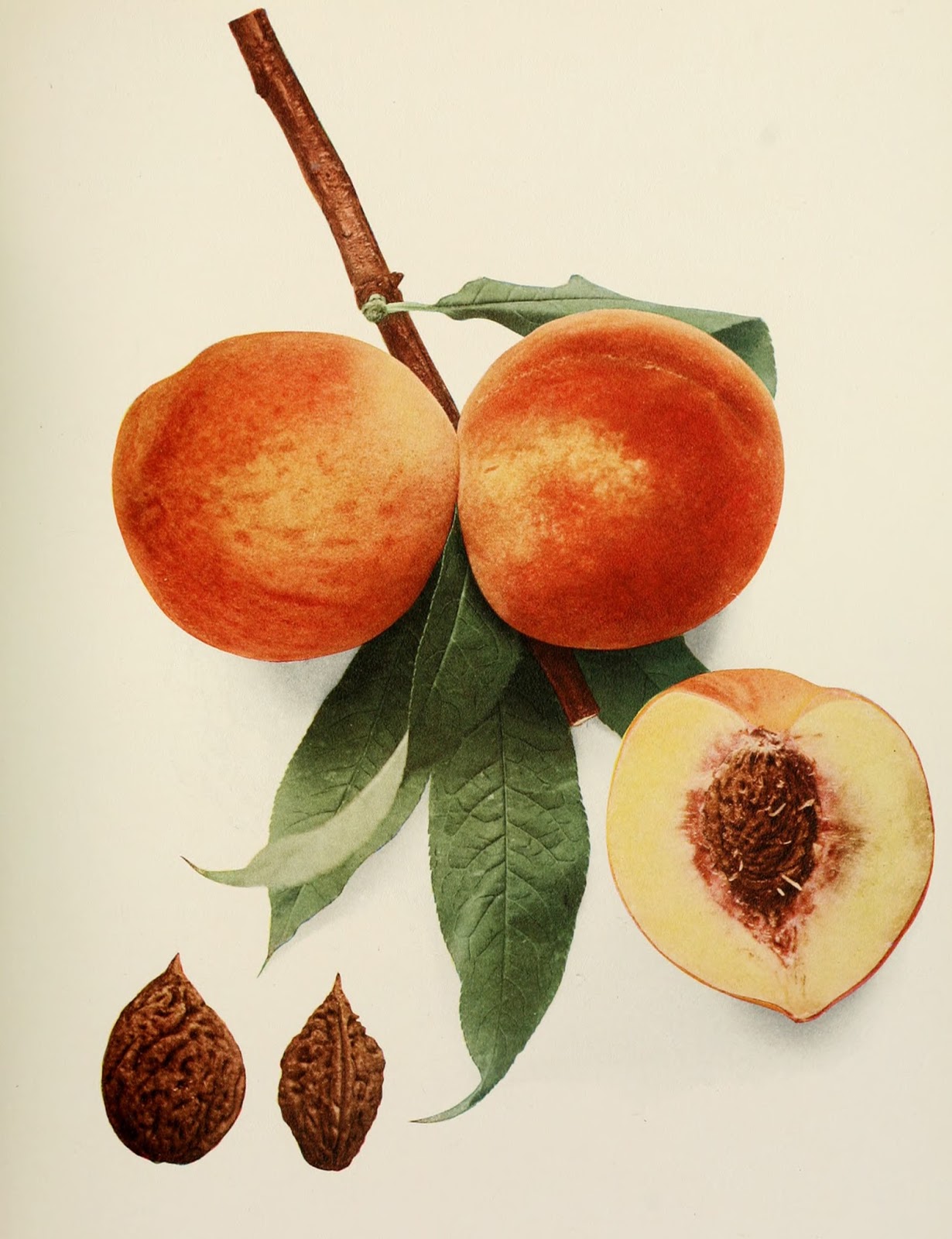
The “Surpasse,” one of the peaches on display at
the Exhibition of 1846, from
The Peaches of New York (1917)

From the beginning, regular exhibitions were the main occupation of the WCHS. Strict rules governed the creation of these exhibits and the conduct of the committees appointed to organize them. Nevertheless, George Jaques lamented in the Transactions (1847):

It may pour balm into some wounds, in certain quarters—wounds which Time—that physician, so eminent for the thorough course that he pursues with his patients—may have failed of healing, to acknowledge the sinfulness of some of the Committees, in venturing upon an infringement of the above Rules, in so far, as to procure the concurrent testimony of the palate, as well as that of the eye, in regard to the character of the subjects of their examination.
 
What Mr. Jaques was admitting, however obliquely, is that committee members were tasting the wares meant for display—bad behavior that, according to the Report on Fruit for the Annual Exhibition of 1847, was not evident in the public:
 
Notwithstanding the hall was constantly thronged with visitors, and many hundreds of samples of beautiful and tempting fruit within reach of every one, yet all seemed to feel and act as if it was placed there to be examined with the eye only. No instance of pilfering, and but little unnecessary handling of the fruit, was known to occur.
View Full Size Image
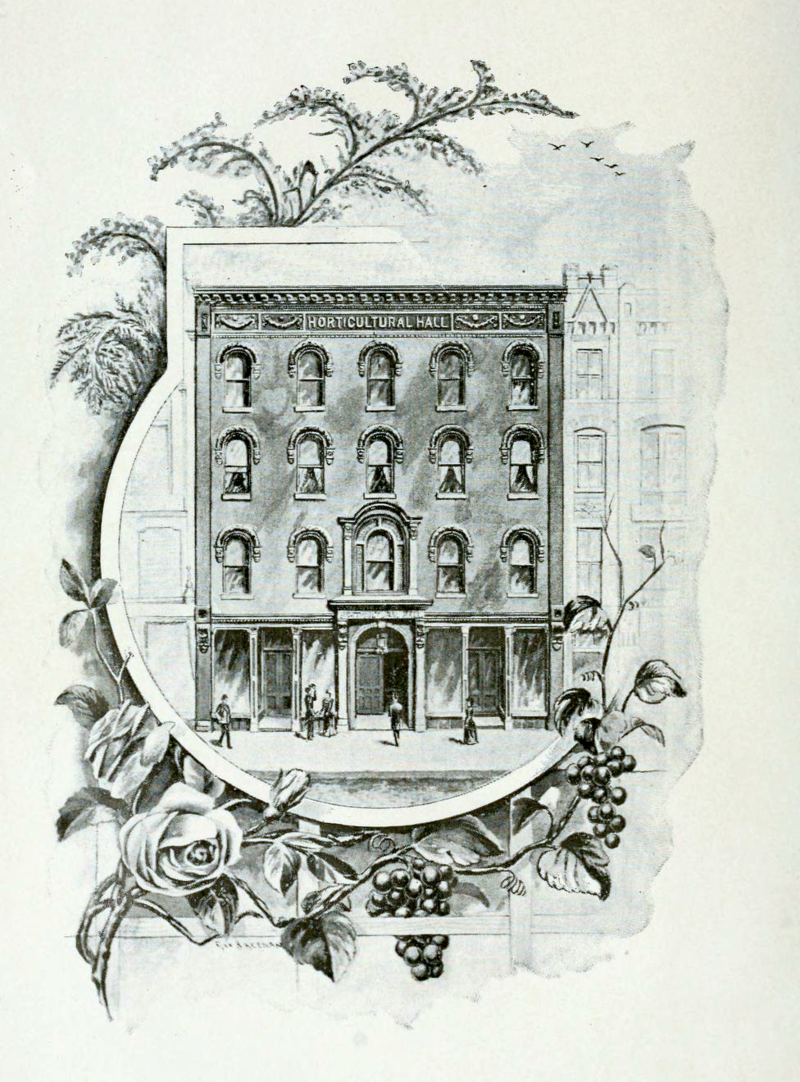
The first Horticultural Hall, from
Transactions, 1891-1892
(image in the public domain,
from Wikipedia)

In 1851, the WCHS built Horticultural Hall, its first permanent residence, on Front Street in the heart of Worcester. Horticultural Hall served as the home of the society until 1928, when the society built a larger structure—with the same name—on Elm Street, just a few blocks away. The second hall served the society until 1983, when it purchased a 132-acre parcel of land in Boylston. Here, at Tower Hill Farm, it created Tower Hill Botanic Garden, its present home.

Exhibits were the primary activity of the WCHS in its first century. While many of the varieties of fruits and vegetables named in the Transactions are no longer familiar, a few have become staples in the U.S. The Report on Vegetables for the Annual Exhibition of 1847 notes the presence of a novel cultivar: 

A solitary specimen of the Cauliflower, as a peculiar species of the Cabbage, was introduced by Mr. D.W. Lincoln, probably to remind the spectators of that esculent, which is said by a recent author, to have “furnished epicures of all countries with some of their greatest luxuries.” 

Similarly, the Committee was pleased to see common potatoes, which were not yet a mainstay of the American diet.

In addition to detailed accounts of each year’s Exhibition, the Transactions records the effects of larger historical and climatological events on horticulture: the Annual Report of 1864 reports that owing to the outbreak of the American Civil War, there was no Annual Exhibition in 1861; the Transactions of 1942 documents the effects of rationing during World War II; and the Report of Judge of Plants and Flowers of 1963 records the effects of the severe drought that gripped Massachusetts for most of that decade. 

View Full Size Image
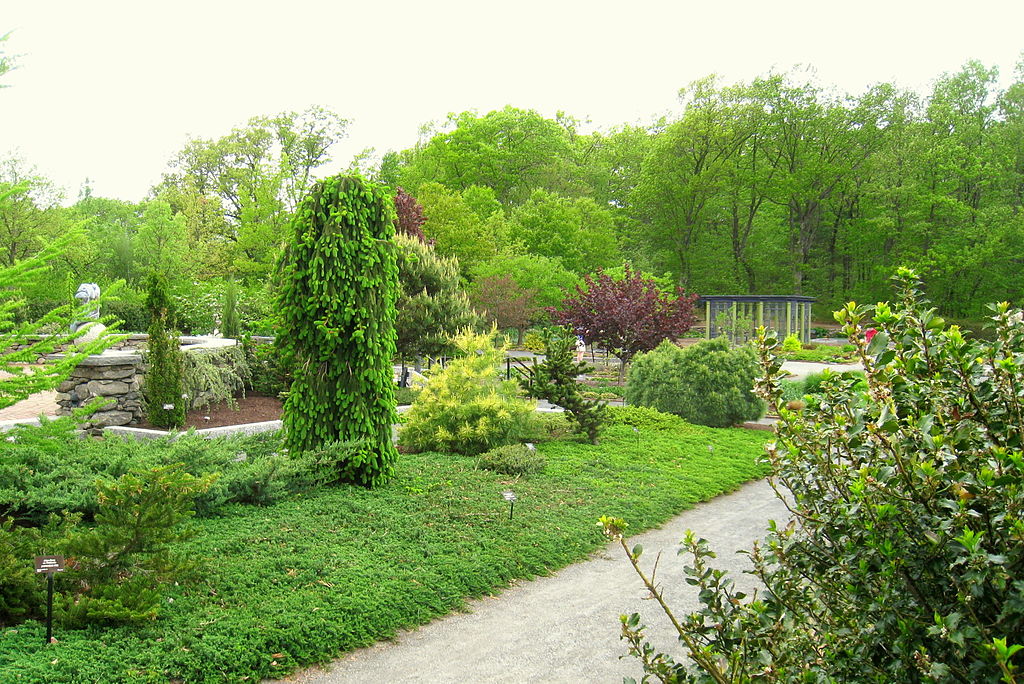
Photo of the Systematic Garden at Tower Hill
(image in the public domain, from Wikipedia)

The Transactions also documents the decline of estate gardens (and the exhibitions they supported) in the 1940s commensurate with the rise of industrial agriculture, large-scale co-ops, and decreasing barriers to foreign imports. Changing with the times, the WCHS eventually shifted its focus to the smaller gardens that most people cultivate today. Tower Hill Botanic Garden still hosts flower shows and grows vegetables and fruit, but it also offers year-round educational programming, including a variety of gardening classes.

In the preface to the Transactions of 1847, George Jaques wrote, “The Horticultural Association, it should be borne in mind, is still but a nursery plant, and these few leaves can give only a faint idea of what its foliage, flowers, and ripened fruits may be in the years to come.” He could not have imagined that 170 years later, the work of the WCHS continues, and that the “nursery plant” has become a garden.

Reference

“Farming in the 1940s.” Wessels Living History Farm. Accessed April 19, 2017. http://www.livinghistoryfarm.org/farminginthe40s/farminginthe1940s.html

“History and Mission.” Tower Hill Botanic Garden. Accessed April 19, 2017. http://www.towerhillbg.org/history-and-mission/

“Life in the year 1842, when the Worcester County Horticultural Society began.” Tower Hill Botanic Garden. (March 1, 2017). http://www.towerhillbg.org/2017/03/01/year-1842-founding-worcester-horticultural-society/

April 20, 2017by [email protected]
Blog Reel, Featured Books

The New York Zoological Society

This is part of a series of monthly posts related to the IMLS-funded Expanding Access to Biodiversity Literature (EABL) grant. The project, which solicits new content through 2017, is aimed at enhancing BHL’s collection by digitizing valuable and unique material from natural-history related organizations in the U.S. that are outside the BHL consortium. Learn more, and find past blogs, at the EABL wiki.

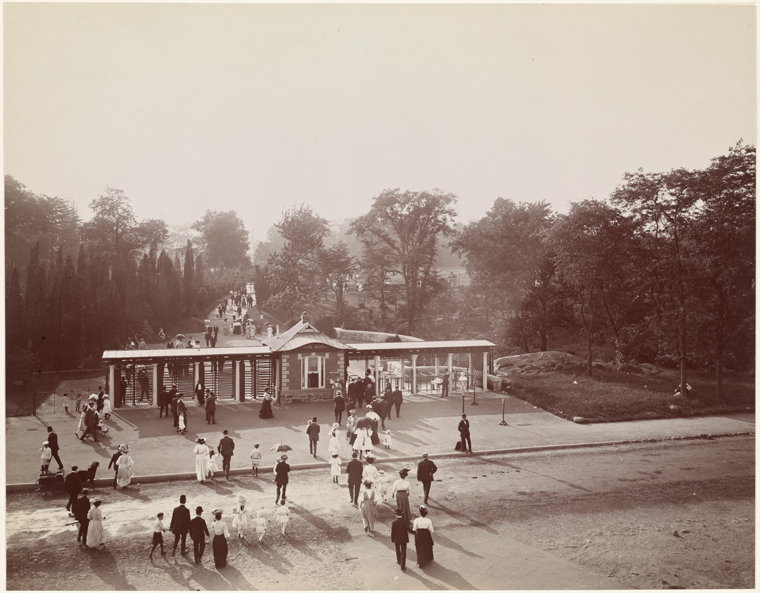
View Full Size Image
Boston Rd. entrance, Bronx Zoo, 1911
(courtesy New York Public Library)

The New York Zoological Society (NYZS) was chartered in 1895. Its founders were Andrew H. Green, planner of some of New York City’s most important cultural institutions; Henry Fairfield Osborn, professor and curator at the American Museum of Natural History; and Madison Grant, a lawyer and conservationist. The latter two were members of the Boone and Crockett Club, a group of hunters and conservationists founded by fellow New York naturalist Theodore Roosevelt. From the start, this influential coalition dedicated itself to the three “objects of the society,” outlined in the first Annual Report of 1897:

  1. The establishment of a free zoological park containing collections of North American and exotic animals, for the benefit and enjoyment of the general public, the zoologist, the sportsman and every lover of nature.
  2. The systematic encouragement of interest in animal life, or zoology, amongst all classes of the people, and the promotion of zoological science in general.
  3. Co-operation with other organizations in the preservation of the native animals of North America, and encouragement of the growing sentiment against their wanton destruction.

The first goal was realized in 1899 with the opening of the Bronx Zoo, originally called the New York Zoological Park. William Hornaday, the founder of the National Zoo, selected the site, chose curators and staff, and became its first director.

View Full Size Image
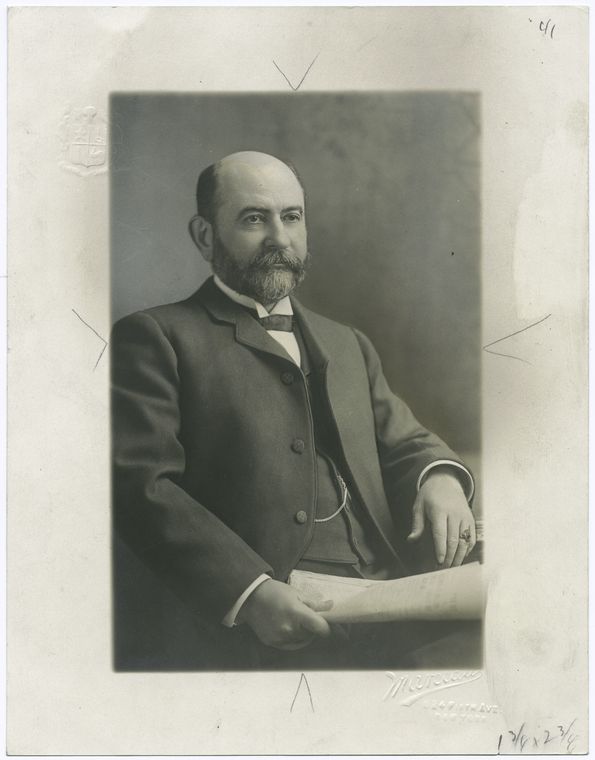
William T. Hornaday
(courtesy New York Public Library)
In 1902, New York City gave the NYZS control of the New York Aquarium, located at the time in Battery Park, Manhattan (and since 1957 in Coney Island, Brooklyn). By 1993, when the NYZS changed its name to the Wildlife Conservation Society (WCS), the city had handed over the reins of three other wildlife parks: the Central Park Zoo, the Queens Zoo, and the Prospect Park Zoo.

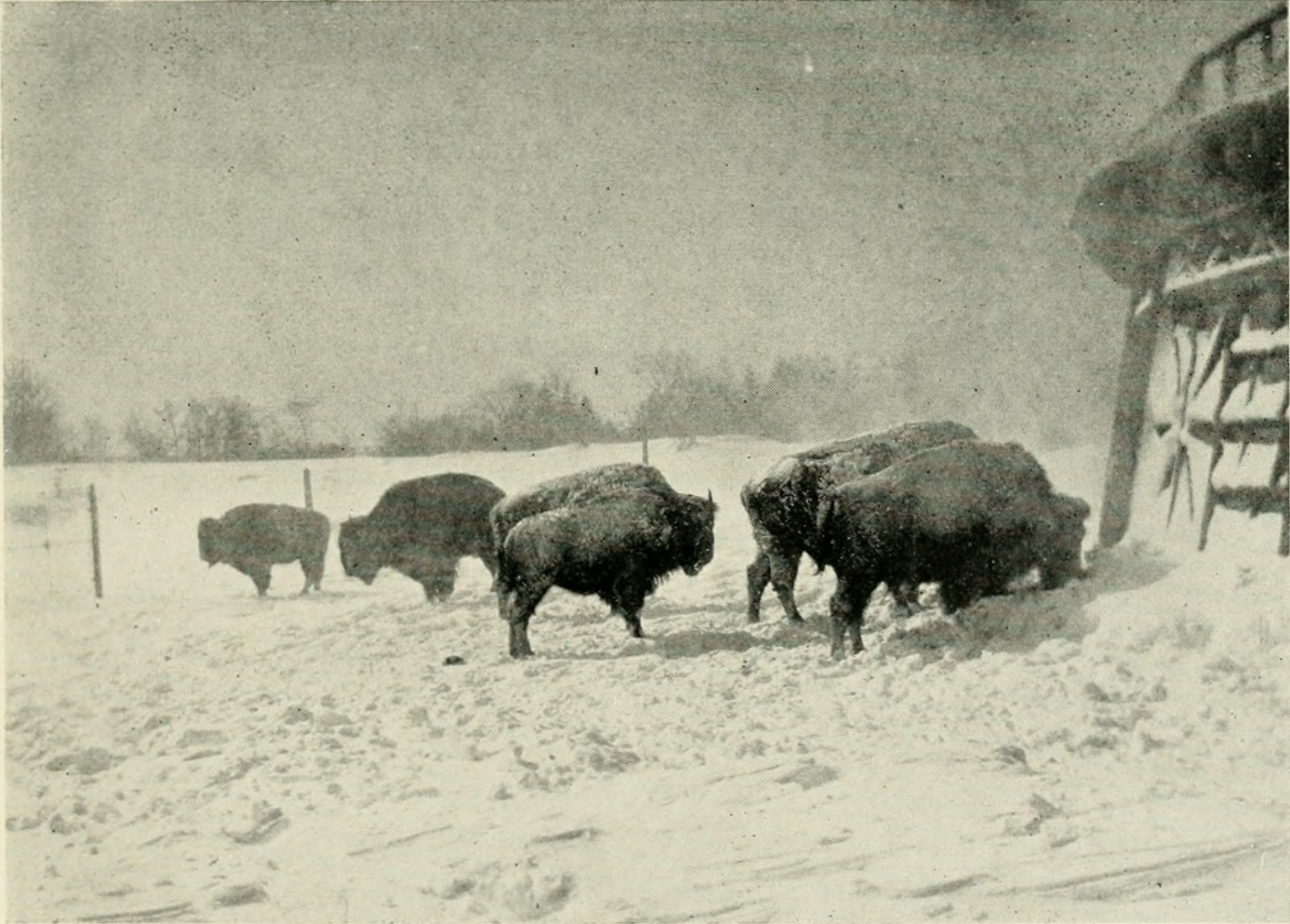
Just as it had wasted no time in opening a “free zoological park,” the NYZS set about accomplishing its second and third goals in short order. On the conservation front, Hornaday was particularly concerned about the state of America’s large mammals, decimated by unchecked hunting. He acquired seven American buffalo (bison) for the Bronx Zoo in 1899; these were used several years later to help reestablish western U.S. populations teetering on the brink of extinction.

View Full Size Image
“Winter on the Buffalo Range,” from
Fourth Annual Report of the New York Zoological Society, 1900, p.50

Also in 1899, Hornaday hired William C. Beebe as curator of ornithology. Beebe traveled the world doing field research for the Zoo, but his interest was not confined to birds; in 1922 he founded a Department of Tropical Research, and in 1934—on behalf of that department—he descended in a bathysphere to observe the deep sea in the waters off Bermuda. Later on, he turned his attention to insects and reptiles. Much of his research is presented in Zoologica, the scientific journal that NYZS published from 1907 to 1973.

View Full Size Image
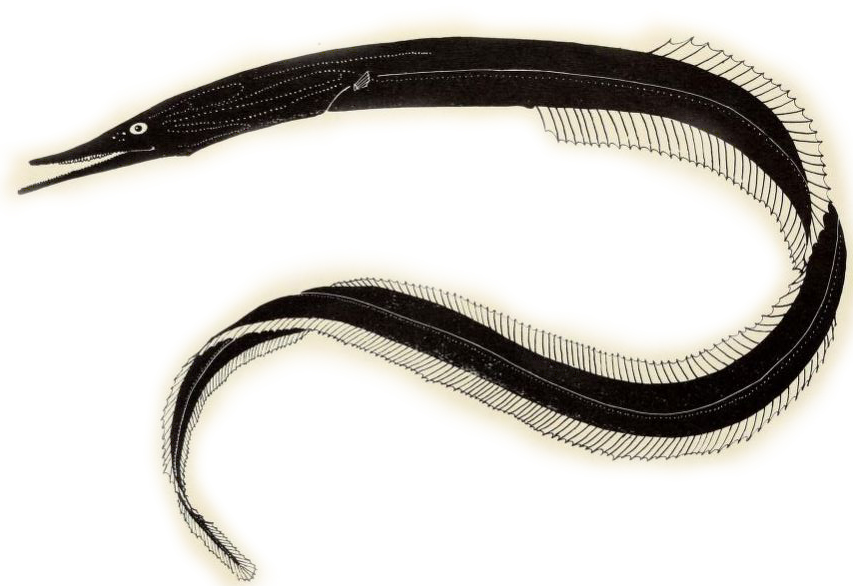
Black sawtoothed eel, Serrivomer brevidentatus,
from Zoologica v.20, no.3, 1936, p.94

In 1940, Henry Fairfield Osborn Jr, son of the NYZS founding member of the same name, was appointed director. Over the next 22 years, he worked to expand the conservation work of the NYZS, establishing programs in Africa and Southeast Asia. William Conway, who took over as director of the zoo in 1962 and president of the NYZS in 1992, used the zoo to breed endangered species. Today, as the Wildlife Conservation Society, the organization is at work in hundreds of conservation programs around the world and continues to attract visitors to its wildlife parks in New York City.

BHL and the EABL team are grateful to the WCS for granting permission to digitize the complete run of Zoologica, a journal of tremendous scientific importance. Zoologica has been digitized by Smithsonian Libraries and the Ernst Mayr Library of the Museum of Comparative Zoology at Harvard University. It is now indexed by article and, together with the other NYZS publications in BHL, chronicles the history and research of one of the world’s most important conservation organizations.

Reference

“History.” WCS Library & Archives. Accessed January 18, 2017.         http://ielc.libguides.com/wcs/archives_history

January 19, 2017by [email protected]
BHL News, Blog Reel

In case you missed it: New in-copyright titles added over the summer

View Full Size Image

Adding to the second quarter’s successful haul, BHL secured permission for 52 titles in July, August and September. That brings 2016’s total to 108 in-copyright titles thus far! As in the previous two quarters, most of these were added as a result of the Expanding Access to Biodiversity Literature project, with significant contributions from the Albany Museum (Grahamstown, South Africa) and the South African National Biodiversity Institute (SANBI).

BHL thanks the many generous content providers—including 19 first-time contributors—who have shared the publications below with our user community and the world. All of the titles are available under a Creative Commons Attribution-NonCommercial-ShareAlike (CC BY-NC-SA) 4.0 license. Some are currently being digitized; check BHL’s recent additions for more in the coming weeks.

  1. Raptor Research Foundation
    1. Wingspan
    2. Raptor Research News
    3. Raptor Research
    4. Journal of Raptor Research
  2. Pennsylvania Horticultural Society
    1. A History of the Pennsylvania Horticultural Society, 1827-1927
    2. America’s Garden Legacy: A Taste for Pleasure
    3. Bulletin of the Pennsylvania Horticultural Society
    4. From Seed to Flower: Philadelphia 1681-1876
    5. Pennsylvania Gardens
    6. Philadelphia Spring Flower Show [title varies]
    7. PHS News
    8. The Green Scene
    9. Yearbook of the Pennsylvania Horticultural Society
  3. New York State Museum
    1. New York State Museum Bulletin
  4. Norfolk and Norwich Naturalists’ Society
    1. Transactions of the Norfolk and Norwich Naturalist’ Society
    2. Norfolk Bird and Mammal Report
    3. The Norfolk Natterjack of the NNNS
  5. Chesapeake Bay Foundation
    1. Annual Reports
    2. Investigative Reports
  6. Christopher Parker
    1. Weeds of Bhutan
  7. Carolina Bird Club
    1. The Chat
    2. CBC Newsletter
  8. Cleveland Museum of Natural History
    1. Kirtlandia
  9. Illinois Native Plant Society
    1. The Harbinger
  10. The African Bird Club
    1. Bulletin of the African Bird Club
  11. Michael Jennings
    1. The Phoenix
  12. Kentucky Ornithological Society
    1. The Kentucky Warbler
  13. Western Society of Malacologists
    1. Occasional Papers
  14. Western Field Ornithologists
    1. California Birds
    2. Western Birds
  15. South African National Biodiversity Institute (SANBI)
    1. Journal of South African Botany
    2. Strelitzia
    3. Memoirs of the Botanical Survey of South Africa
    4. Botanical Survey Memoir
    5. Memoir (Botanical Survey of South Africa)
    6. Annals of Kirstenbosch Botanic Gardens
    7. Flowering Plants of Africa
  16. Tower Hill Botanic Garden
    1. Transactions of the Worcester County Horticultural Society
  17. Forest & Bird
    1. New Zealand Birds
  18. Albany Museum (Grahamstown, South Africa)
    1. Records of the Albany Museum
    2. Annals of the Eastern Cape Museums
    3. Annals of the Cape Provincial Museums
    4. Annals of the Cape Provincial Museums (Natural History)
    5. Annals of the Cape Provincial Museums (Human Sciences)
    6. Southern African Field Archaeology
  19. Association of Southeastern Biologists
    1. SEB Bulletin
    2. Southeastern Biology
  20. Pacific Coast Entomological Society
    1. Memoirs of the Pacific Coast Entomological Society
    2. Proceedings of the Pacific Coast Entomological Society
    3. Pan-Pacific Entomologist
  21. Southern California Academy of Sciences
    1. Memoirs of the Southern California Academy of Sciences
  22. American Birding Association
    1. North American Birds

To learn more about how BHL handles copyright, see the Licensing and Copyright page on the BHL wiki. To see a complete list of in-copyright titles for which BHL has permission, as well as an explanation of how copyright information is displayed in BHL, see the Permissions page. And don’t forget to follow BHL on Facebook and Twitter (@BioDivLibrary) to get updates on new content!

Thanks again to the many organizations who continue to make BHL an invaluable resource by sharing their in-copyright publications.

October 18, 2016by [email protected]
Blog Reel, Featured Books

The New York Entomological Society

View Full Size Image
The New York Entomological Society (NYES), founded in 1892, is one of the oldest, continually active entomological societies in the U.S. The Brooklyn Entomological Society, which predates the NYES by 20 years, merged with it in 1968.
Through the Expanding Access to Biodiversity Literature project, the NYES recently gave BHL permission to digitize its journals—Entomologica Americana (v.1-49, 1885-1975) and the Journal of the New York Entomological Society (v.1-107, 1893-1999)—as well as the Bulletin of the Brooklyn Entomological Society (v.1-60, 1878-1965). Most of the issues have been digitized and are now available in BHL.

History of the NYES

View Full Size Image
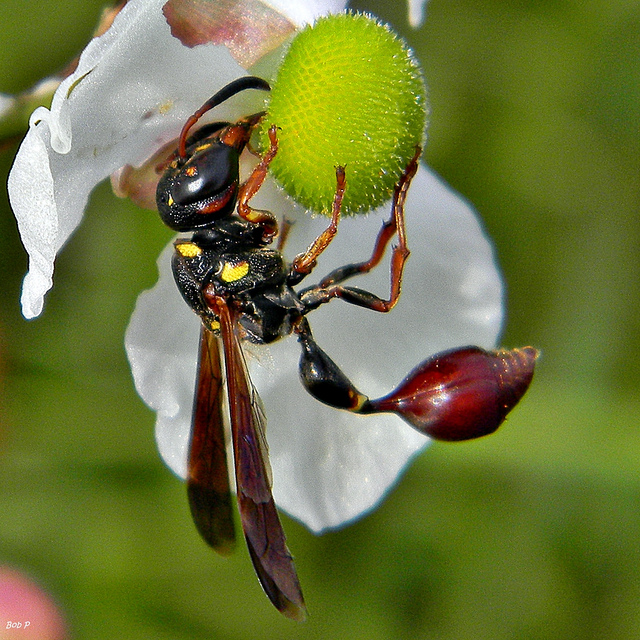
Zethus slossonae, named after Annie Trumbull Slosson
(photo by Bob Peterson, Flickr)
On June 29th, 1892, five men gathered in the home of entomologist Charles Palm (not to be confused with the other Charles Palm, also a New York entomologist) for the first meeting of the NYES. Their first order of business was to elect three members, including Annie Trumbull Slosson (Leng, 130). Years later, she described her first meeting:
I shall never forget the sensation produced by my unexpected entrance into that scientific meeting. Through the smoke of pipes and over mugs of some beverage which foamed in the gas-light in a sudsy sort of way, I saw startled, embarrassed faces … The host himself, good Mr. Palm, seemed somewhat embarrassed. After seating me in the most comfortable chair unoccupied, he hastened away to order coffee for me as more appropriate and fitting drink for a feminine throat (Klots, 139).
Despite taking up entomology in middle age (she was previously a fiction writer) and having no formal education in it, Slosson would become one of the Society’s most accomplished members. She amassed a large specimen collection, now housed at the American Museum of Natural History (AMNH) and has a genus and over 100 species (slossonae) named after her. She also authored numerous articles in the journals of the NYES and other entomological organizations and was instrumental in moving NYES meetings to the AMNH (Seltmann).
View Full Size Image
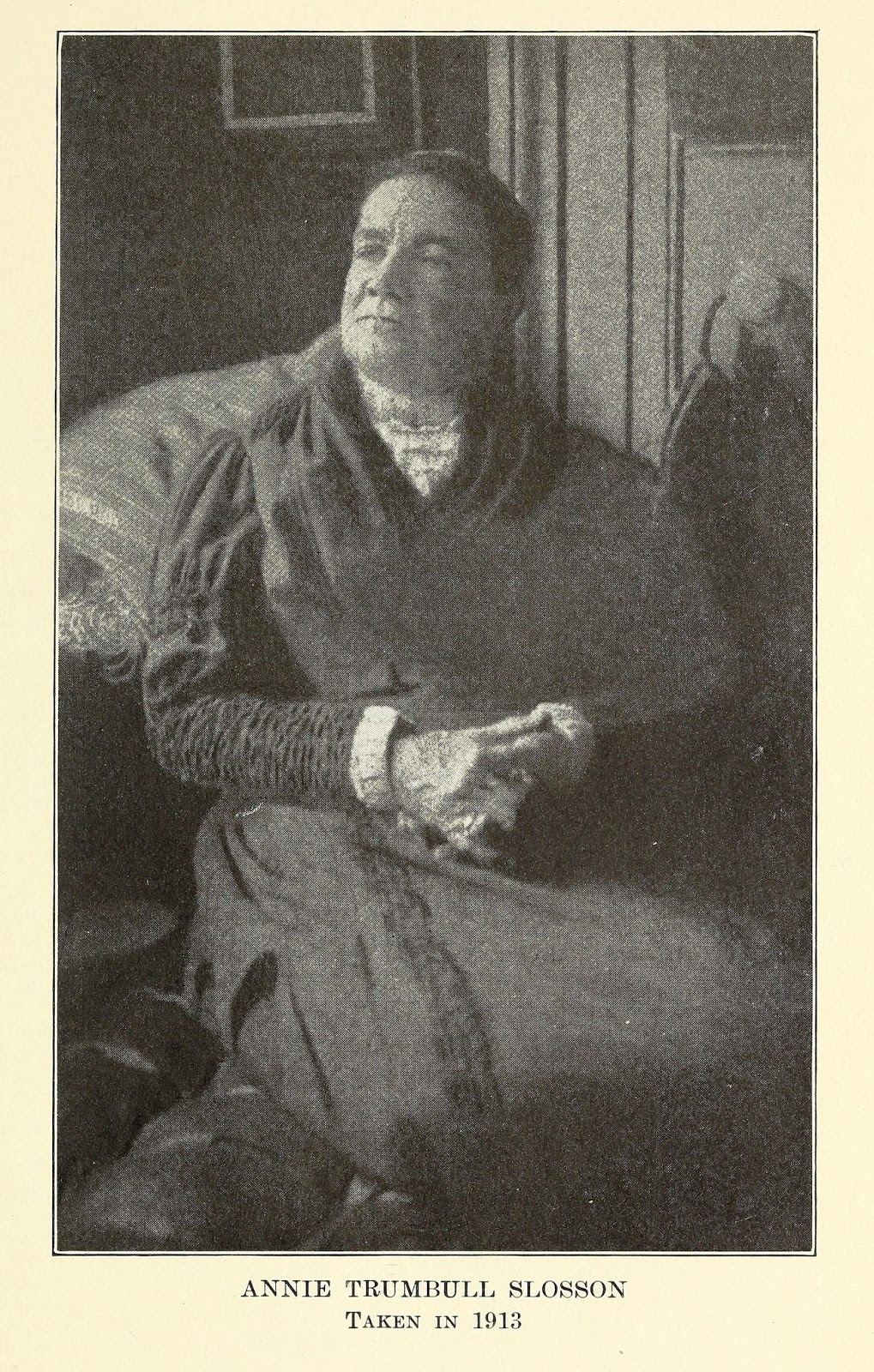
Photo of Annie Trumbull Slosson from
Journal of the New York Entomological Society, v.34 no.4 (1926)
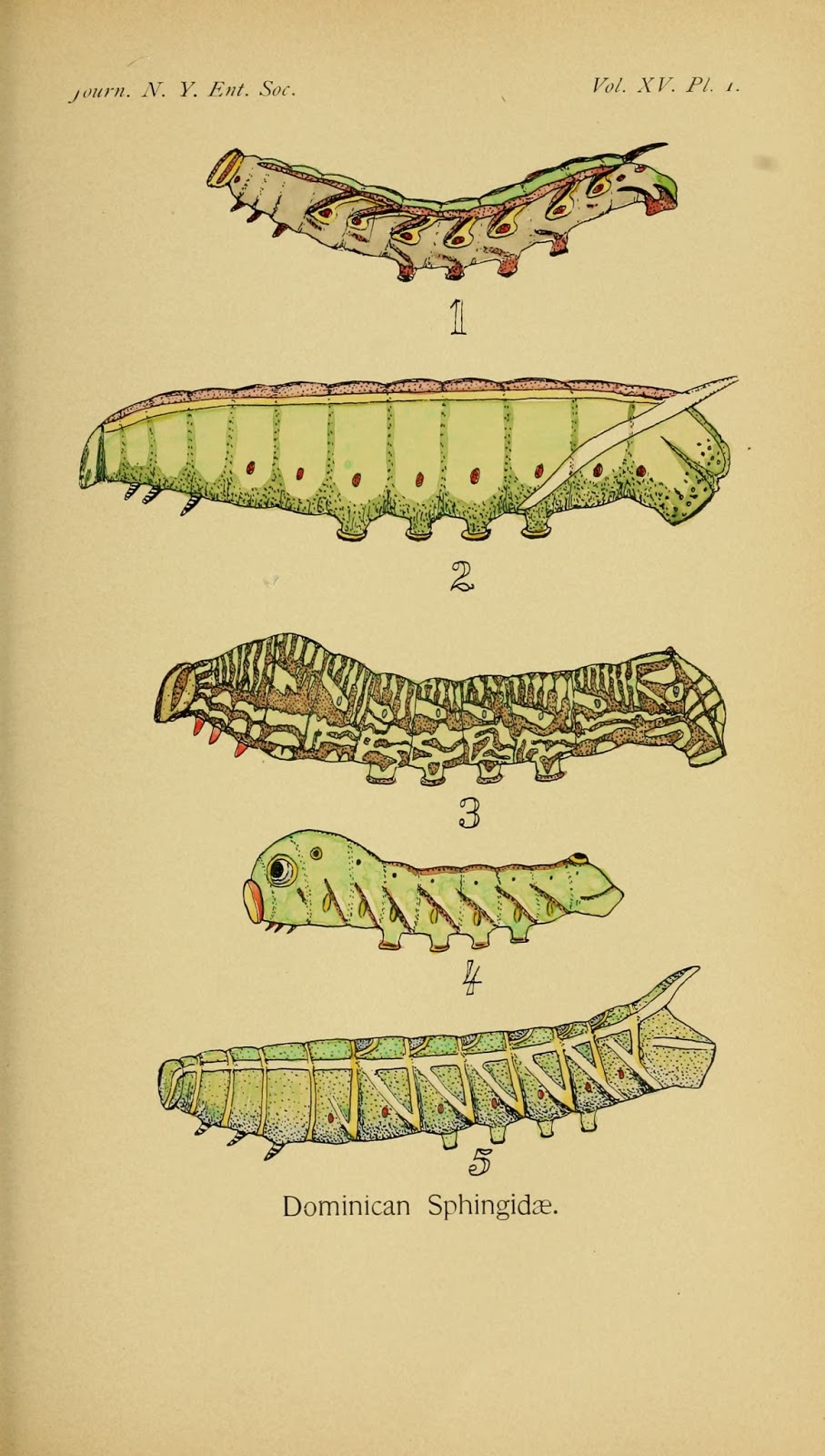
Though NYES membership hovered around ten individuals in the first decade of its existence, the Society began publishing the Journal of the New York Entomological Society in 1893. Slosson was its chief contributor, and the sale of her collected specimens at auction funded the journal and ensured regular publication. Another member who contributed to the journal’s early success was Louis H. Joutel, who, in addition to serving as the Society’s treasurer and secretary, was an accomplished illustrator; his drawings appear throughout early volumes of the journal (Leng, 130).
View Full Size Image
“Dominican Sphingidae”
by Louis Joutel, from
Journal of the New York Entomological Society, v.15 (1907)
Within a few years, the Society had begun to broaden its reach. In 1895 it joined the Scientific Alliance of New York, which included distinguished organizations like the New York Academy of Sciences and the Torrey Botanical Society, and strengthened its relationship with the AMNH, where it enjoyed access to the library and collections in the position of “a non-paying tenant with a generous landlord” (Klots, 146).
By all accounts, Society meetings were an occasion for the sharing of exciting specimen finds as well as good food and drink. Above all, they were informal. Elsie Klots wrote that “During the nineteen thirties and early forties speakers were so often startled by the steady click of knitting needles and the ominous waving of an ear trumpet that it became customary to explain to them, before the meeting, that the occupants of the front row were the faithful wives of some of our elder members and that they were an accepted and beloved part of our meetings” (Klots, 143-144).
In 1942, the NYES celebrated its 50th anniversary, with nearly half of its 26 former presidents in attendance. In 1949, the Society put on a public exhibit of insect photography in Roosevelt Hall, at the AMNH. It proved so popular that a second exhibit the following year was moved to the museum’s foyer. It featured photographs, paintings, drawings, publications by Society members, equipment, and insect origami. In 1964, the NYES convened for a third special meeting to honor four individuals who had been members for over 50 years. Dr. E.R.P. Janvrin, who joined in 1902, held the distinction of longest membership (Klots, 140).
From the beginning, the NYES maintained a close relationship with the Brooklyn Entomological Society, its elder neighbor. Members of each society were invited to the other’s meetings and field trips, and in 1903 the NYES began devoting two pages of its journal to publish the proceedings of the Brooklyn Society (Klots, 145). The incorporation of the Brooklyn Entomological Society into the NYES, celebrated on October 29, 1968 (the 75th anniversary of the NYES) was thus a natural union for two organizations whose activities had converged for a long time.
View Full Size Image
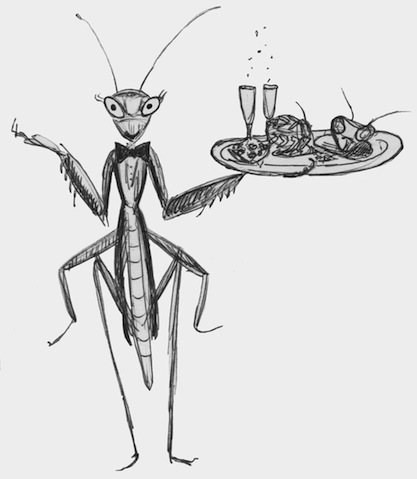
Drawing for a NY Eats Bugs dinner hosted
by the NYES and others in 2015 (unknown artist)
The NYES celebrated its centennial on May 20th, 1992, with a banquet at the Explorers Club in New York City. The major draw of the evening was its theme: insects as food. Guests enjoyed a variety of appetizers and desserts with insects as ingredients, as well as a talk by keynote speaker Dr. Gene DeFoliart of the University of Wisconsin, an expert on the subject (Society History). The NYES has since participated in similar “bug banquets” at the Explorers Club.
Today, the NYES continues to meet at the AMNH on the third Tuesday of every month, September through May (excluding December). Professional and amateur entomologists alike hear talks by invited speakers on topics of entomological and biological significance. The Society also continues to publish its journal, which in 2009 was renamed Entomologica Americana (also the title of the Brooklyn Entomological Society’s journal, which ceased publication in 1975.

We are grateful to the NYES for sharing its rich legacy of entomological scholarship with BHL and with researchers around the world!

Note: this post has been edited to remove the incorrect statement that the NYES is the third or fourth oldest entomological society in the U.S.

Reference

Klots, Elsie B. “The History of the New York Entomological Society.” Journal of the New York Entomological Society 76, no. 3 (1968): 138-155.
Leng, Charles W. “History of the New York Entomological Society, 1893-1918.” Journal of the New York Entomological Society 26, no. 3/4 (1918): 129-133.
Seltmann, Katja. “Collector Spotlight: Annie Trumbull Slosson.” Tri-Trophic Thematic Collection Network. Last modified September 12, 2013. http://tcn.amnh.org/updates/collectorspotlightannietrumbullslosson.
“Society History.” The New York Entomological Society, Inc. Accessed September 14, 2016. http://www.nyentsoc.org/history.
September 15, 2016by [email protected]
Page 1 of 212»

Help Support BHL

BHL's existence depends on the financial support of its patrons. Help us keep this free resource alive!

search

About BHL

The Biodiversity Heritage Library (BHL) is the world’s largest open access digital library for biodiversity literature and archives. BHL operates as a worldwide consortium of natural history, botanical, research, and national libraries working together to digitize the natural history literature held in their collections and make it freely available for open access as part of a global “biodiversity community.”

Join Our Mailing List

Sign up to receive the latest news, content highlights, and promotions.

Subscribe Now

Subscribe to Blog via Email

Enter your email address to subscribe to this blog and receive notifications of new posts by email.

Join 319 other subscribers

Subscribe to Blog Via RSS

Subscribe to the blog RSS feed to stay up-to-date on all the latest BHL posts.

Access RSS Feed

Inspiring Discovery through Free Access to Biodiversity Knowledge.

The Biodiversity Heritage Library makes it easier than ever for you to access the information you need to study and explore life on Earth…for free, anytime, anywhere.


64+ Million Pages of
Biodiversity Literature Online.

EXPLORE

Tools and Services
to Transform Research.

EXPLORE

300,000+
Illustrations on Flickr.

EXPLORE

ABOUT | HARMFUL CONTENT | PRIVACY | SITE MAP | TERMS OF USE