Biodiversity Heritage Library - Program news and collection highlights from BHL
  • Home
  • News
  • Featured Books
    • All Featured Books
    • Book of the Month Series
    • BHL at 20
  • User Stories
  • Campaigns
    • Fossil Stories
    • Garden Stories
    • Monsters Are Real
    • Page Frights
    • Her Natural History
    • Earth Optimism 2020
  • Tech Blog
  • Visit BHL
Home
News
Featured Books
    All Featured Books
    Book of the Month Series
    BHL at 20
User Stories
Campaigns
    Fossil Stories
    Garden Stories
    Monsters Are Real
    Page Frights
    Her Natural History
    Earth Optimism 2020
Tech Blog
Visit BHL
  • Home
  • News
  • Featured Books
    • All Featured Books
    • Book of the Month Series
    • BHL at 20
  • User Stories
  • Campaigns
    • Fossil Stories
    • Garden Stories
    • Monsters Are Real
    • Page Frights
    • Her Natural History
    • Earth Optimism 2020
  • Tech Blog
  • Visit BHL
Biodiversity Heritage Library - Program news and collection highlights from BHL
Blog Reel, Featured Books

A Pot of Basil in Every Household

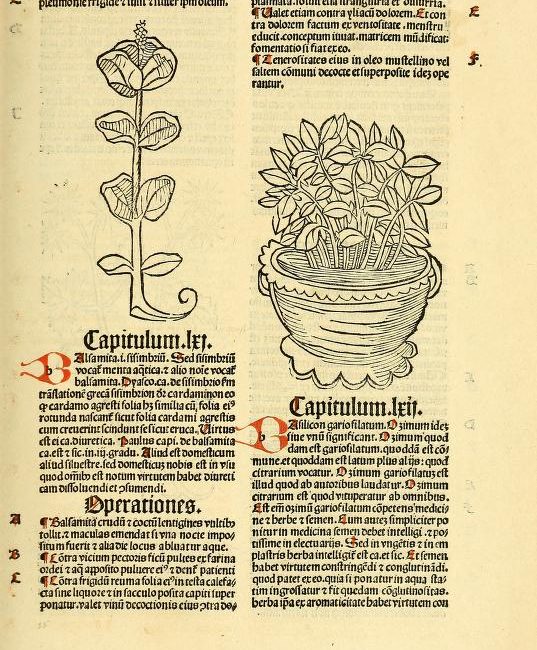
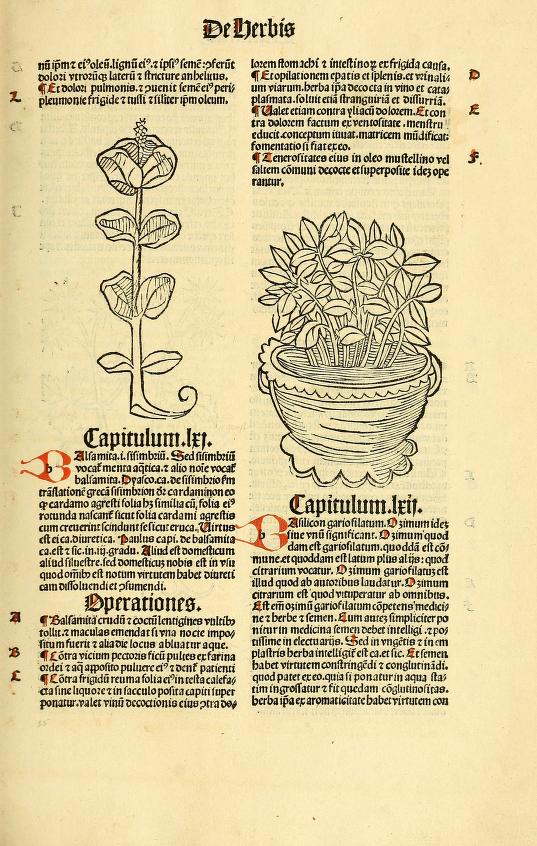
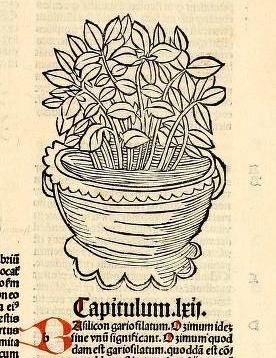
In Johann Prüss’ late 15th-century herbal, Ortus Sanitatis (Garden of Health), a bushy basil plant is portrayed growing in a decorative container. The book, a popular pharmacopoeia of various remedies drawn from ancient and medieval authors, was intended to be practical. The woodcuts are somewhat stylized and simple, meant to be easily identifiable to readers such as a doctor, apothecary, spice merchant, monk, or household member.

This was a manual for ready reference at a time when literacy was not common and earlier written descriptions alone were found to be inadequate. For instance, the all-important roots of the peony, used for infantile epileptic seizure, jaundice, stomach-aches, and kidney and bladder problems, are emphasized rather than its beautiful, fragrant blossoms.

At the time, basil was applied to a number of ailments, including convulsion, deafness, diarrhea and constipation, gout, impotency, colic, and nausea. So is it significant that basil was illustrated in a pot? Medieval and Renaissance art is full of plant symbolism. Or is this portrayal simply a charmingly unexpected domestic detail?
View Full Size Image
Ortus Sanitatis. 1497. Digitized by Smithsonian Libraries. http://www.biodiversitylibrary.org/page/40535862.
Medieval herbals ascribed healing or poisonous ‘virtues,’ the natural properties of plants. Basil is one plant of the garden full of associations, both good and bad, sometimes contradictory. And a pot of basil has a long and colorful history.

Sweet basil (Ocimum basilicum) is an herb of the mint family Lamiaceae. It is native to parts of Asia and Africa. The name may be derived from the Greek βασιλικόν φυτόν (basilikón phutón)—royal or kingly plant. While many culinary authors and cooks consider basil the “king of herbs” for its versatility and dominance in the kitchen (particularly in Italian, Thai, Vietnamese and Laotian cuisines), it long has had royal and religious associations. Ocimum sanctum(holy basil or tulasi) is sacred in the Hindu religion, though not used much in Indian dishes. In Christianity, the herb came to be associated with the Feast of the Cross, celebrating the finding by St. Helena, mother of Emperor Constantine, of the True Cross in a patch of basil.

Ancient Greeks believed basil must be sowed with words of abuse in order to thrive. In both Eastern and Western societies the herb has been associated with death. In ancient Egypt it was applied in embalming rituals. It is also an herb much connected with love and fertility rites, and has been seen as a source of erotic powers. Or, conversely, a sprig of basil would whither in the hands of the impure.

In late Medieval and Renaissance Italy, basil in a pot was a sexy thing: on a windowsill alerts a lover that the lady of the house is available to be entertained. Or, in some accounts, such as in the early 15th-century risqué tales of Sienese Gentile Sermini, its sudden removal was the signal it was safe to come on in. Apparently in some parts of present-day Southern Italy, a family notes the presence of an eligible, virginal daughter by a basil pot in the window.
View Full Size Image
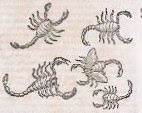
Scorpions. Woodcut from Conrad Gessner, Historia animalium. Liber 2, 1586 (BHL link here)
View Full Size Image
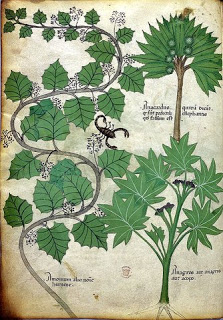
Plants and a Scorpion, in “Herbal” Manuscript folio 3v (Lombardy, Italy, around 1440). British Library Sloane 4016. This illustration indicates that a sting from a scorpion may be soothed by plants.

The Latin basiliskmeans dragon, mythical deadly reptile or serpent, sprouting legends of basil with scorpions. The arachnid with the venomous stinger was said to be bred out of mishandling the cultivated species of Ocimum. Scorpions were believed to favor hiding under a pot of basil, or that a spring of basil under a pot would turn into a scorpion. The Smithsonian’s Floyd W. Shockley, Collections Manager (and scorpion expert) in the Department of Entomology of the National Museum of Natural History, points out that the cool dark underside of the pot is a natural place for scorpions to rest, accounting for their presence and not a particular attraction to the basil.

In the pharmacopoeia on herbal medicine from the surviving writings of the ancient Greek physician and botanist Dioscorides, De Materia Medica, basil is prescribed for application to bites of the sea dragon or stings of the scorpion. Dr. Shockley notes there is some evidence that basil is effective in soothing scorpion stings and that the essential oil in the plant is anti-inflammatory and has pain-relieving enzymes. The plant would work to soothe the bites and stings of many arthropods, but ancient medicinal practitioners really focused on the scorpion relief aspect. Dioscorides observed that Africans would ingest the herb as a preventive measure against the pain of a sting. John Gerard in his famous 16th-century herbal repeated this belief but reported that, as did the 2nd-century physician Galen, basil should not be eaten.

Gerard in the Herball, or Generall Historie of Plantes of 1597, declared “The smell of Basil is good for the heart … it taketh away sorrowfulnesse which commeth of melancholy and maketh a man merry and glad.” Nicholas Culpeper in the 17th century wrote: “And away to Dr. Reason went I, who told me it was an herb of Mars, and under the scorpion, and, perhaps therefore called basilican, and it is no marvel if it carry a kind of virulent quality with it.” And, noting the differing portrayals of the plant: “This is the herb which all authors are together by the ears about and rail at one another (like lawyers).”
View Full Size Image
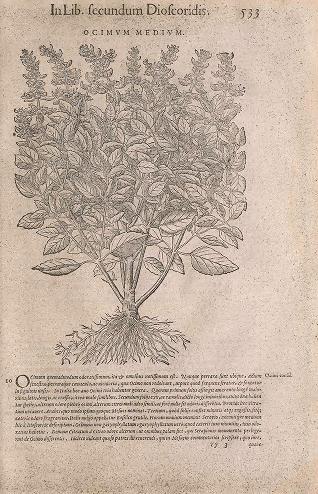
Illustration of one type of basil in the Smithsonian Libraries’ 1565 edition of Mattioli (BHL scan here)

Much of ancient plant folklore was dismissed by Pier Andrea Mattioli (1501-1577) in his commentaries on Dioscorides, Di Pedacio Dioscoride Anazarbeo Libri cinque Della historia, et materia medicinale. The work first appeared in 1544, with illustrations in the 1554 edition, and became the most influential Italian herbal of the 16th century.

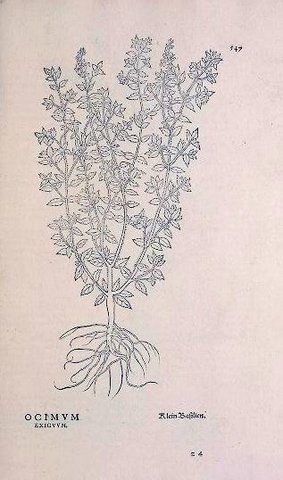
A medical doctor and botanist, born in Siena, the perennially grumpy Mattioli provides the delightful contemporary observation that basil was found to be growing in every Italian household, often in a pot placed by a window or in the garden. However, the finely cut illustrations in his herbal are without any whimsy such as a container. Likewise, Leonhart Fuchs’ splendid De Historia Stirpium (1542) notes this domestic element and illustrates different types of basil, including the roots, leaves, stems, and flowers. These publications are products of the Renaissance, knowledge drawn from direct observation and not legend, although much of the texts still rely on Dioscorides.
View Full Size Image
Fuchs: “Women everywhere raise Ocimun in clay pots on windowsills of their homes, also in gardens.” Smithsonian Libraries’ copy scanned by BHL (link here)
Fuchs wrote that ozimumis Greek for fragrant. Basil has highly aromatic leaves and placed in a pot would serve to sweeten the air. Royal apothecary and botanist John Parkinson in Paradisi is Sole Paradisus Terrestris(1629) wrote that basil was sometimes used in nosegays and made “sweet or washing waters.” (Boston Public Library copy). In the home, the herb acted to keep flies out. Basil is, of course, sensitive to cold temperatures and planted (in Northern Europe) in a container would allow for easy moving to a warm shelter.

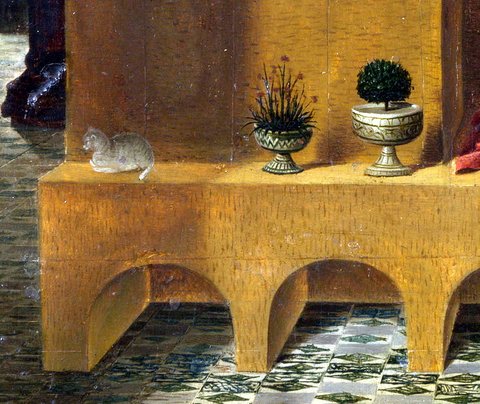
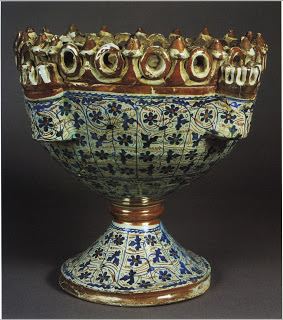
There are surviving examples of actual 15th-century basil pots, known as alfabeguer (derived from the Arabic word for sweet basil). These decorative containers were imported from Valencia, supplying a demand for this luxury item throughout Europe. In the Rothschild collection at Waddesdon Manor is a beautiful one, decorated in lustre and blue, dating from 1440 to 1470.
 

View Full Size Image
The Rothschild Alfabeguer (this and other illustrations of basil pots here).


View Full Size Image
Detail of Antonello da Messina’s “St. Jerome in his Study,” of alfabeguers (and kitten) approximately 1475 (National Gallery, London)
There is an earlier recording of basil pots used as decoration or furnishing in a home, and readers of Prüss’ herbals may have picked up on the allusion. In Giovanni Boccaccio’s The Decameron (Day IV, Novella 5) of approximately 1353, is the story of Lisabetta and Lorenzo. The lady’s three brothers murdered the lowly born Lorenzo to thwart the forbidden love between the servant and their sister. They buried the corpse in a location that came to her in a dream. Lisabetta dug up the grave, decapitated the head, and, returning home:
There she shut herself up in her room with the head, and kissed it a thousand times in every part, and wept long and bitterly over it, till she had bathed it in her tears. She then wrapped it in a piece of fine cloth, and set it in a large and beautiful pot of the sort in which marjoram or basil is planted, and covered it with earth, and therein planted some roots of the goodliest basil of Salerno, and drenched them only with her tears, or water perfumed with roses or orange-blossoms. And ‘twas her wont ever to sit beside this pot, and, all her soul one yearning, to pore upon it, as that which enshrined her Lorenzo, and when long time she had so done, she would bend over it, and weep a great while, until the basil was quite bathed in her tears.”

The basil thrived with this fertilization and watering, but the distraught Lisabetta did not: the evil brothers discovered poor Lorenzo’s head in the flowerpot and stole it away. She died from further grief.
View Full Size Image
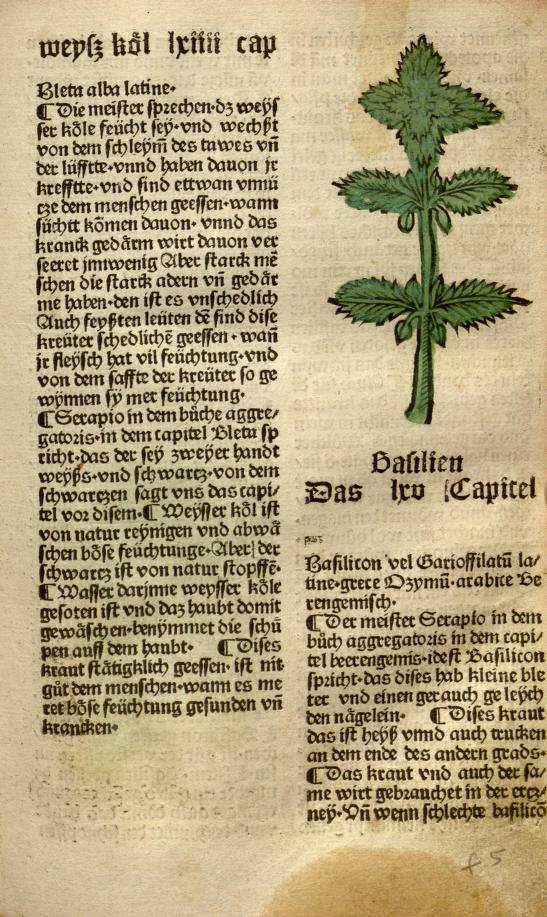
A more typical illustration of basil from an earlier period, showing the plant truncated. The Smithsonian Libraries‘ Gart der Gesundheit [Ulm?: Konrad Dinckmut?, 1487?], often attributed to Johannes von Cuba. The Missouri Botanical Garden’s copy has been scanned by BHL (link here).


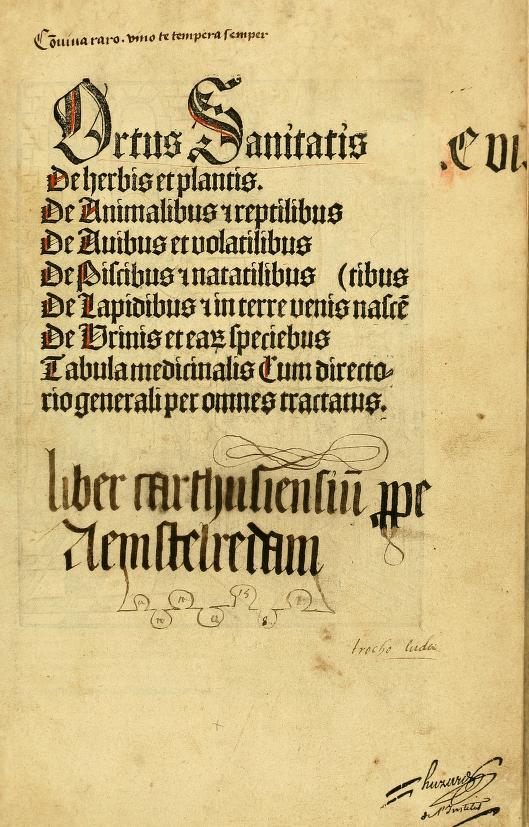
A version of Peter Schöffer’s Ortus ([H]ortus) Sanitatis(1485) was published in 1491 by Jacob Meydenbach of Mainz. Some of the more than a thousand small illustrations were copied rather crudely from Der Gart der Gesundheit (also of 1485), which itself was based on the Latin Herbariusof 1484 (Missouri Botanical Garden copy in BHL). Although there is an occasional genre scene (such as laborers) and landscape setting sprinkled throughout these early printed herbals, most of the plants are simply shown cut off at the stem. The first of Prüss’ editions of Meydenbach’s Ortus Sanitatis, printed in Strasbourg in 1497, is the Smithsonian Libraries’ copy which has been scanned for the Biodiversity Heritage Library.
View Full Size Image

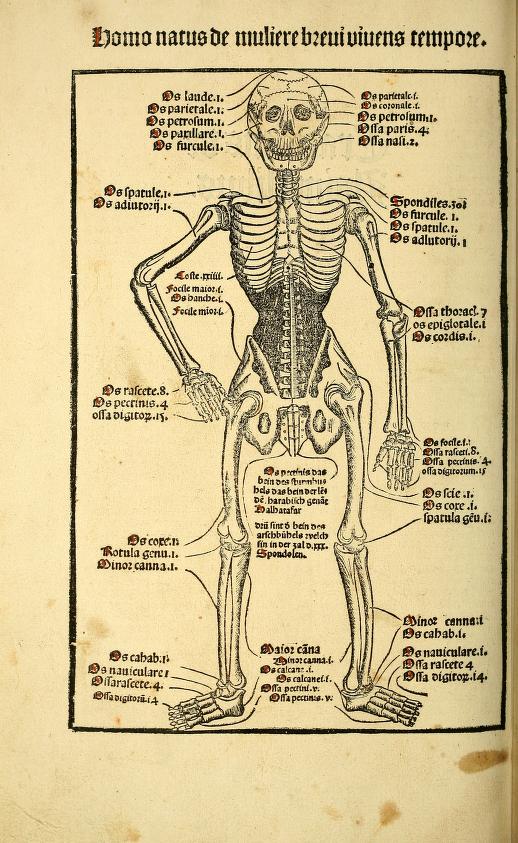
A pot of basil: may this be symbolic or practical, whether signifying divine or earthly love, used as a culinary ingredient or insect repellent, to soothe a sad soul, or just a convenient place to store a lover’s severed head. The iconography of the image in printed books, manuscripts and paintings is yet to be fully explored. The bibliography of early printed herbals—endless editions, translations, fragments, versions, and reuse and copying of woodcuts—is a complex and difficult task to sort out. But the increasing number of scanned early herbals in the Biodiversity Heritage Library allows for easy exploration of these extremely rare works. Perhaps Prüss’ Ortus Sanitatis has a unique basil pot because of an inventive author/illustrator. The book does contain a woodcut of the human skeleton, the first appearance of one in an herbal.

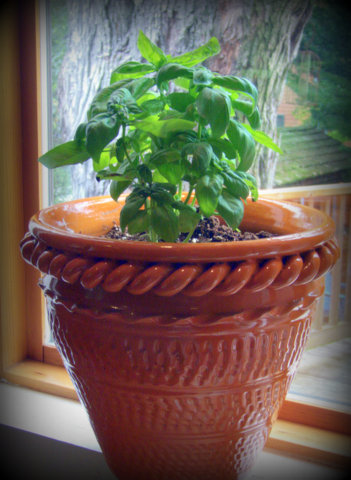
Should you happen upon any, please send me your finds of illustrations of basil in a pot. Or, a picture of the herb growing in a container on your windowsill.
View Full Size ImageView Full Size Image


View Full Size Image

Notes

View Full Size Image
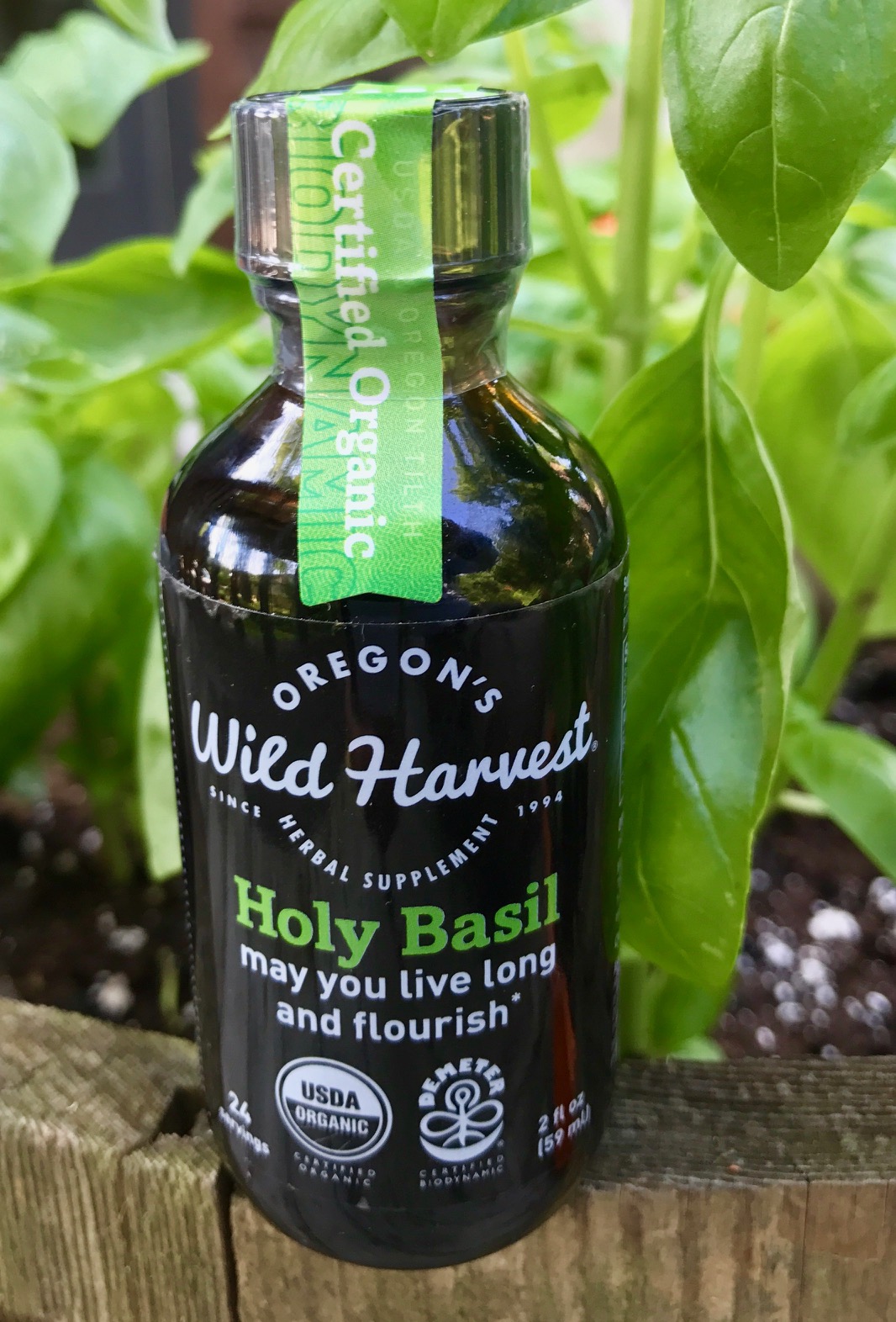
What is old is new again: basil oil from the local grocery store.
The first printed herbal to have illustrations is Macer Floridus’ De Viribus Herbarum (Milan, 1482).
Di Pedacio Dioscoride Anazarbeo Libri cinque Della historia, et materia medicinale first appeared in 1544. It was soon reprinted many times in a variety of languages; there are several of these editions in the Smithsonian Libraries and many digitized versions in the Biodiversity Heritage Library (link to one here).
Blunt, Wilfrid and Sandra Raphael. The Illustrated Herbal. New York: Thames and Hudson, 1994.

Ray, Anthony. “The Rothschild ‘Alfabeguer’ and Other Fifteenth-Century Spanish Lustred ‘Basil-Pots’,” The Burlington Magazine, vol. 142, no. 1167 (June 2000), pages 371-375 (link here).

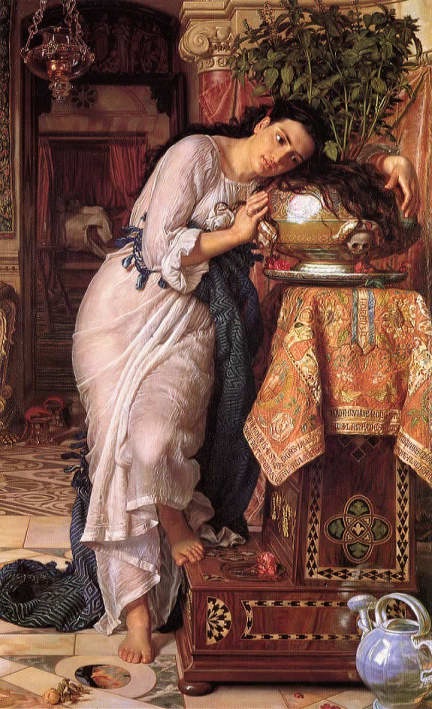
Poet John Keats picked up the narrative in “Isabella or, the Pot of Basil” (1818). In turn, British painters of the 19th century, most notably by the Pre-Raphaelite William Holman Hunt, were greatly inspired by the story.
View Full Size Image
Painting of 1867, by William Holman Hunt. Laing Art Gallery, Newcastle upon Tyne, England (image from Wikimedia Commons)


She wrapp’d it up; and for its tomb did choose
A garden-pot, wherein she laid it by,
And cover’d it with mould, and o’er it set
Sweet Basil, which her tears kept ever wet.
…
And so she ever fed it with thin tears,
Whence thick, and green, and beautiful it grew,
So that it smelt more balmy than its peers
Of Basil-tufts in Florence; for it drew
Nurture besides, and life, from human fears,
From the fast mouldering head there shut from view:
So that the jewel, safely casketed,
Came forth, and in perfumed leafits spread.
View Full Size Image
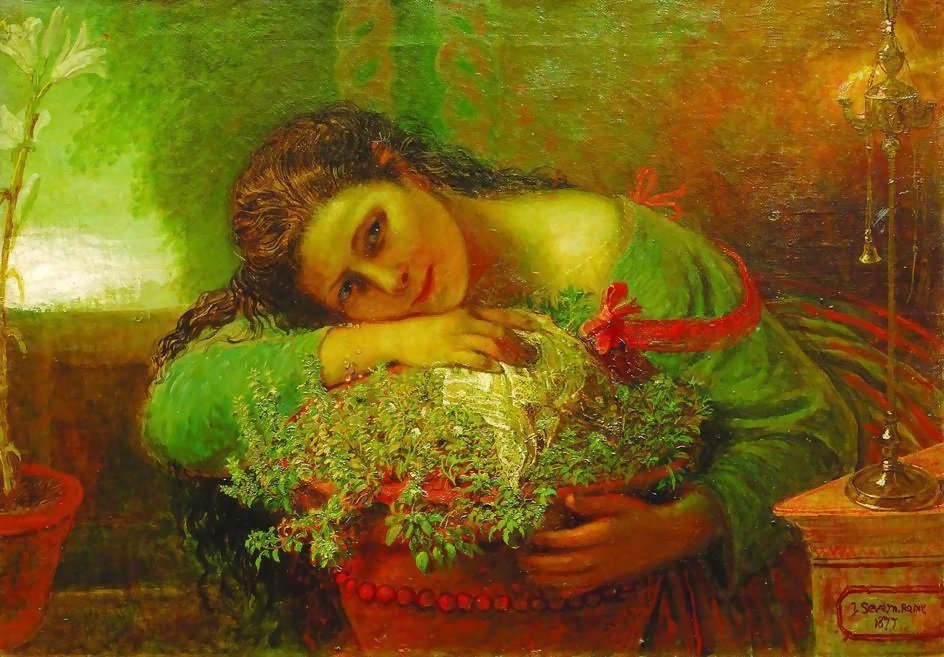
“Isabella, or the Pot of Basil,” painting by Joseph Severn (1793-1879), a close friend of Keats (image from Wikimedia Commons). Guildhall Art Gallery, London.
View Full Size Image
Ocimum basilicum ‘Genovese Verde Migliorato’. The only variety for proper pesto.


June 27, 2017by khage
Blog Reel, Featured Books

When New England was New

Portrait version of the Biodiversity Heritage Library logo.
View Full Size Image
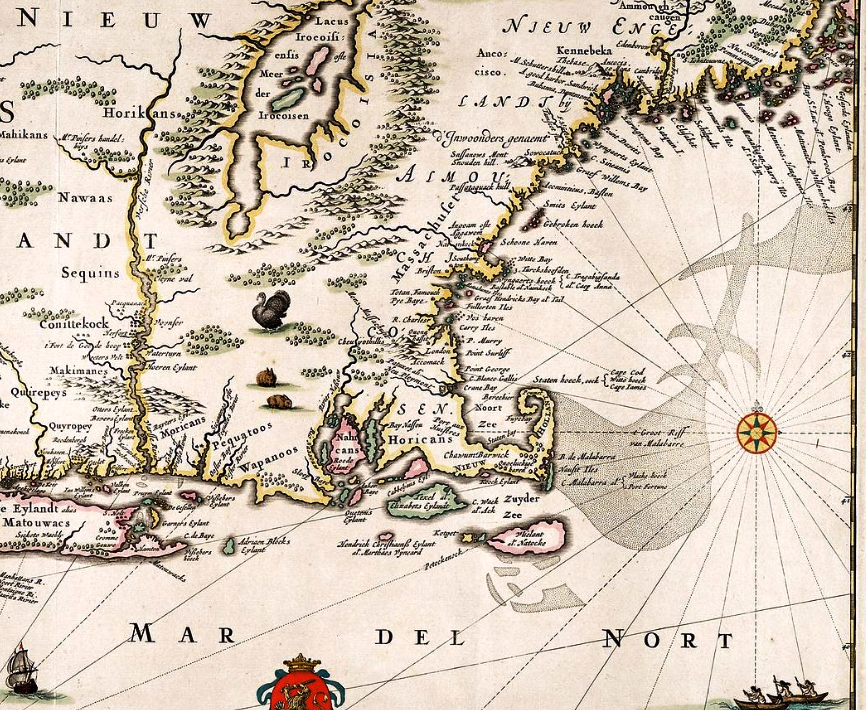
Map of eastern North America. Detail of engraved map by Nicolaes Jansz Visscher, made about 1655, not long after Josselyn’s first journey to the New World. Note the prominent, plump turkey. Gift of Mrs. Francis P. Garvan, National Museum of American History, Smithsonian Institution

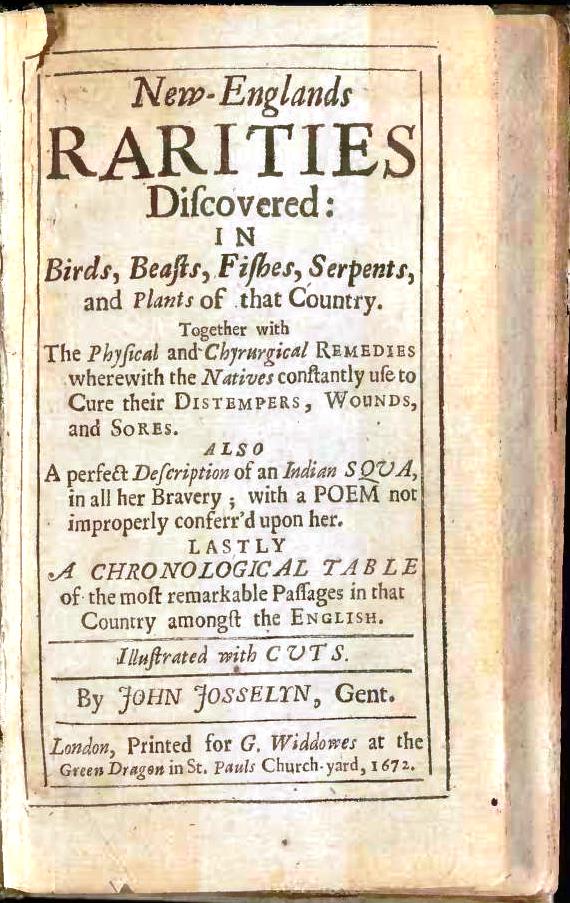
It is a small book, palm-size, with pages of less-than-fine paper, the well-worn letters of the type sometimes carelessly inked. The sparse woodcut illustrations are child-like in their simplicity and straight-forwardness. Yet John Josselyn’s New-Englands rarities discovered, printed in London in 1672, drew me in as I went about cataloging the work. Intrigued by the title and the early date of publication, I found myself reading an account of the landscape of my past, from Boston, “down east” (that is, up the coast as represented in the above illustration) to my place of birth, and points all around. That great bibliography, The Hunt Botanical Catalogue, notes that this book is “particularly interesting to people who are fond of Maine.” Indeed. The text provides a sense of place from the 17th century.

Having refreshed my self here [Boston] for some time, and opportunely lighting upon a passage in a Bark belonging to a Friend of my Brothers, and bound to the Eastward, I put to sea again, and on the Fifteenth of August I arrived at Black-point, otherwise called Scarborow, the habitation of my beloved Brother, being about an hundred leagues to the Eastward of Boston; here I resided eight years, and made it my business to discover all along the Natural, Physical, and Chyrurgical Rarities of the New-found World.

View Full Size Image
BHL digitized copy, supplied by the U.S. Department of Agriculture, National Agricultural Library.

New-Englands rarities is an account of the author’s two journeys to America, the first in 1638 for several months and again in 1663 for a stay of eight years. Despite the autobiographical nature of the work, not much is known of Josselyn, “active” in cataloging parlance, from 1630 to 1675, and born around 1608 in Essex County. The author comes across as a learned, if not terribly discerning, gentleman with possibly a medical background. He describes the topography, customs and the natural history of the country, with great interest in the healing properties of organic materials from recipes used by both native Americans and colonists, leading to speculation that the Englishman was a physician. It may be Josselyn was simply well-read and the curious type. The era of European plant exploration in the New World, for both therapeutic, consumption and ornamental purposes, was underway by the time of Josselyn’s travels. There would be a ready audience for such information, particularly in a relatively accessible and inexpensive publication.

View Full Size Image
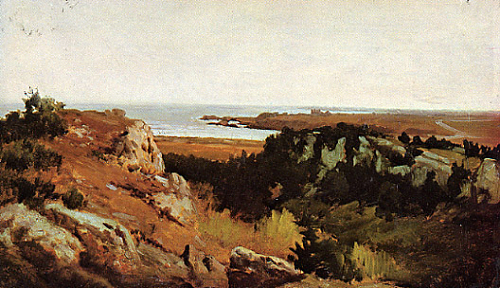
Prouts Neck. Painting by Winslow Homer (1836-1910), Smithsonian American Art Museums

“Scarborow” is the coastal area of Scarborough, incorporated as a town in 1658 in the present state of Maine. One of the area settlements was “Black-point” (originally a patent of 1500 acres) that included the rocky shoreline of present-day Prouts Neck, of artist Winslow Homer-fame (a place now known for exclusiveness). It was here that John Josselyn’s brother Henry lived and worked along the sea, rivers, stretches of salt marshes and sandy beaches. Henry Josselyn was representing the Royal grant of land, Council of Gorges’ Province of Maine, by 1636, and later served as Deputy-Governor.

There is some evidence that Henry Josselyn may have ascended the highest mountain in the Northeast, the 6,288-foot (1,917-meter) Mount Washington. His brother John, as did Giovanni da Verrazano in 1524, observed and recorded the peak (known by various names before European settlement) from shipboard in the Atlantic Ocean as “one stately mountain…surmounting the rest”:

“Fourscore miles (upon a direct line) to the Northwest of Scarborow, a Ridge of Mountains run Northwest and Northeast an hundred Leagues, known by the name of the White Mountains, upon which lieth Snow all year, and is a Land-mark twenty miles off at Sea.”

View Full Size Image
Skiing at Tuckerman’s Ravine, Mt. Washington, N. H. Watercolor by Arnold Holeywell (1923-2010). Smithsonian American Art Museum, gift of the Ford Motor Company

John Josselyn’s further writings indicate that he probably also summited the mountain (as I did one June, when there was still snow on the slopes). Now a not-particularly arduous but long day’s hike in good weather along groomed trails, it was not a casual undertaking in the 1660’s. It is a volatile place with fierce, sometimes unpredictable, weather. The Josselyns probably journeyed along the magnificent Saco River, south of Scarborough, to reach the range. There John Josselyn made meteorological observations (The Mount Washington Observatory on April 12, 1934, recorded the wind at 231 miles per hour, a record that held through the 20th century).

Josselyn liked to compose catalogs and there is humor sprinkled about his lists. In the one on fishes, he prefaced: “Pliny and Isadore write there are not above 144 Kinds of Fishes, but to my knowledge there are nearer 300: I suppose Americawas not known to Pliny and Isadore.” The account of his unfortunate encounter with a wasp nest begins with his belief he was coming across an exotic fruit. And, amusing for readers today, Josselyn was none too fond of the Puritans of the Bay Colony. The Native Americans, on the other hand, were regarded with admiration.

View Full Size Image
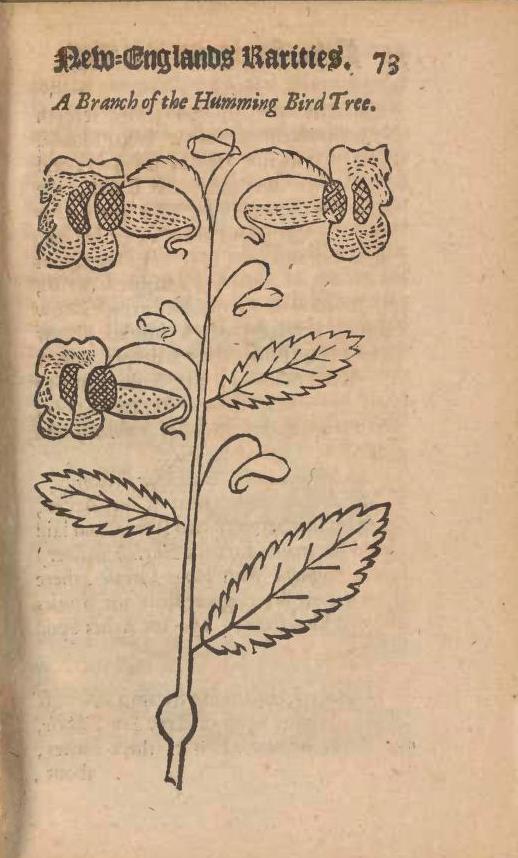
Touch-me-not or Hummingbird tree – a favorite of the bird to feed upon. Josselyn, John. New-Englands rarities. (1672). Digitized by the U.S. Department of Agriculture, National Agricultural Library. http://biodiversitylibrary.org/page/47579388.

For botany researchers there is much information to decipher from New-Englands rarities. Twenty-two invasive species or weeds are listed under a section “Of such Plants as have sprung up since the English Planted and kept Cattle in New-England” (the reference to cows is of their manure). In Josselyn’s identifications, sow thistle, night shade, mallowes, wormwood, bloodwort, and cheek weed are recorded; some are identifiable today, others not. According to noted botanist, ecologist and conservationist Paul Sears, Josselyn provides the first mention of the now-ubiquitous dandelion in America. From the many references, it is evident that the author had with him the hefty 1633 Thomas Johnson’s edition of Herball by John Gerard, “our famous Herbalist.” Josselyn notes the New World plants described by Gerard as well as Parkinson and points out his own discoveries, such as skunk cabbage and the pitcher-plant.

View Full Size Image
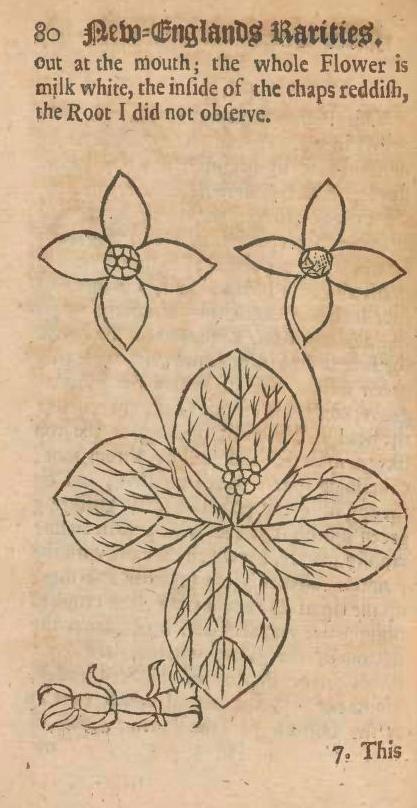
Herb True Love: “the leaves are good to be laid upon hot tumors.” Josselyn, John. New-Englands rarities. (1672). Digitized by the U.S. Department of Agriculture, National Agricultural Library. http://biodiversitylibrary.org/page/47579357.

Recipes, whether for medical purposes or nourishment, are sprinkled throughout the text. The wild turkey is fully described for the first time and what must be one of the earliest records of meat being eaten with cranberries as “it is a delicate Sauce.” Josselyn also mentions “pompions” (pumpkin) pie. The colonists of course learned about the cultivation of pumpkins, squash and corn from the native inhabitants. “Billberries” (blueberries), are reported to be “very good to allay the burning heat of Feavers and hot Agues, either in Syrup or Conserve. A most excellent Summer Dish.” Peas, grown in New England, “are the best in the world.”

View Full Size Image
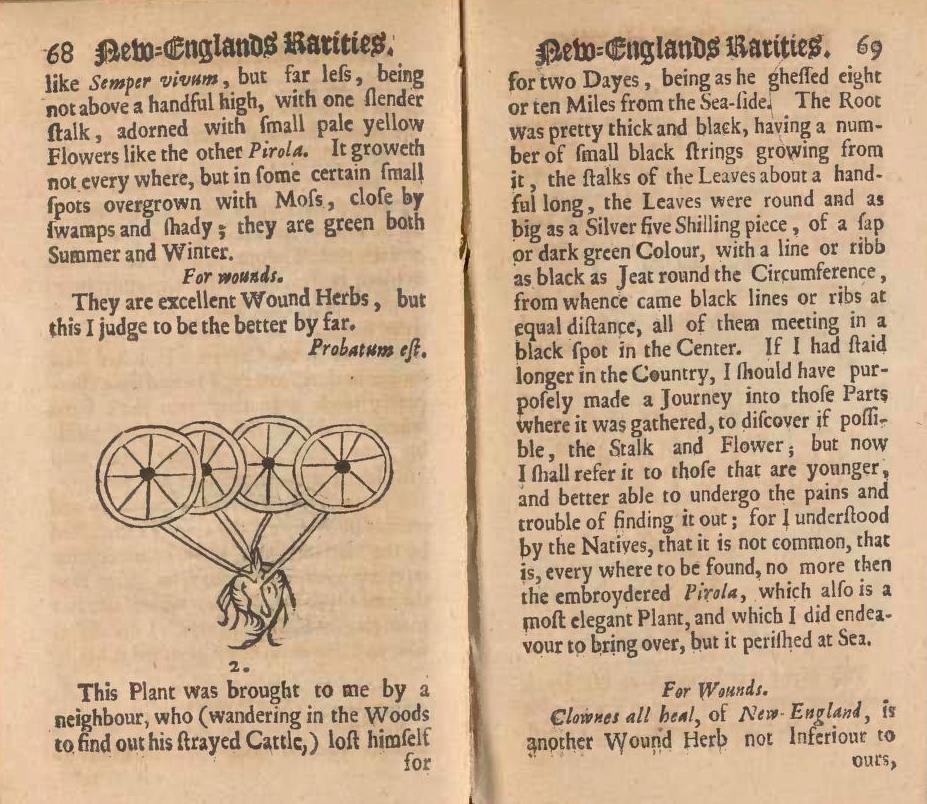
Josselyn, John. New-Englands rarities. (1672). Digitized by the U.S. Department of Agriculture, National Agricultural Library. http://biodiversitylibrary.org/page/47579390.

Josselyn soon expanded New-Englands rarities with An account of two voyages to New England in 1674 (BHL copy digitized from the Smithsonian Libraries). The dedication in this edition is loftier and more ambitious: to the President and Fellows of the Royal Society. A relative of Josseyln’s, Samuel Fortrey, had helped pay for the printing of the earlier work. There is far more detail on the provisioning and crossings of the ships and attendant illnesses and deaths. There is also a disturbing story of the rape of a slave on Noodles Island in Boston Harbor, a horrifying but important testament in the history of slavery in New England.

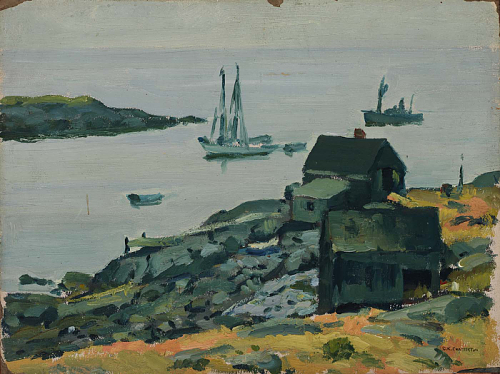
Two voyages to New England provides more scenes of the coast. Monhegan Island, a favorite place of mine, is a speck about ten miles from the nearest mainland. Following European explorers Martin Pring, Samuel de Champlain, George Weymouth, John Smith (and before these sailors, possibly the Vikings), Josselyn reported that Monhegan was filled with fisherman’s houses and shacks, long a staging area for drying fish and post for fur traders to send their goods across the Atlantic. Cod was the great commodity, harvested from the abundant fishing grounds of the Gulf of Maine and along the coast. Since the mid-19th century, Monhegan, spectacularly ruggedly beautiful, has been better known as an artist colony and draw for tourists, at least in the summer.

View Full Size Image
Monhegan Harbor, oil painting by C. K. Chatterton (1880-1973). Smithsonian American Art Museum, bequest of Olin Dows

New-Englands rarities was cited by the great Swedish zoologist and botanist Carl Linnaeus in 1753, attesting to its completeness and authority on flora and fauna for about a century. It also inspired a certain type of travel literature. Henry David Thoreau was an admirer and in A week on the Concord and Merrimack Rivers (1849) wrote of Josselyn’s speaking of “the strong new soil.” Soon after I encountered the book in the Cullman Library of Natural History, I came across a reprinted edition while in Salem, Massachusetts in the gift shop of the House of the Seven Gables. Most valued today for its accounting of plants, the book and its successor, An account of two voyages, have much to offer historians of indigenous cultures about the impact of European settlements, cookery, gardens, religion, folklore, meteorology, geology, and maritime and social norms of the early colonial period in America. Its sense of wonder about the landscape of the New World provides the modern reader with a sense of the place.

Josselyn’s last printed words:

“Now by the merciful providence of the Almighty, having performed Two voyages to the North-east parts of the Western-world, I am safely arrived in my Native Countrey; having in part made good the French proverb, Traveul where thou canst, but dye where thou oughtest, that is, in thine own Countrey.”

Notes
New-Englands rarities has frequently been reprinted. Many of those editions, as well as the National Agricultural Library’s copy of the first, have been digitized by the Biodiversity Heritage Library. The Cullman Library’s copy had been rebound too tightly for it to be safely scanned. It also lacks the last leaf containing the printer’s device.

View Full Size Image
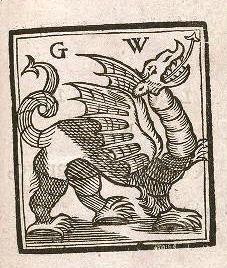
The printer Giles Widdows’ woodcut mark, with his initials and winged dragon. Josselyn, John. New-Englands rarities. (1672). Digitized by the U.S. Department of Agriculture, National Agricultural Library. http://biodiversitylibrary.org/page/47579382.
The BHL digitized copy in Smithsonian Libraries (the Dibner Library) of Josselyn’s later work: An account of two voyages to New-England : wherein you have the settingout of a ship, with the charges; the prices of all necessaries for furnishing aplanter and his family at his first coming; a description of the countrey,natives and creatures, with their merchantil and physical use : the governmentof the countrey as it is now possessed by the English, &c.; : A largechronological table of the most remarkable passages, from the first discoveringof the continent of America, to the year 1673. London : Printed for Giles Widdows, at the Green-Dragon in St. Paul’s-Church-yard, 1674.

Bulletin of the Josselyn Botanical Society of Maine.

Leighton, Ann. Early American gardens “for meate or medicine.” Amherst: The University of Massachusetts Press, 1986.
View Full Size Image
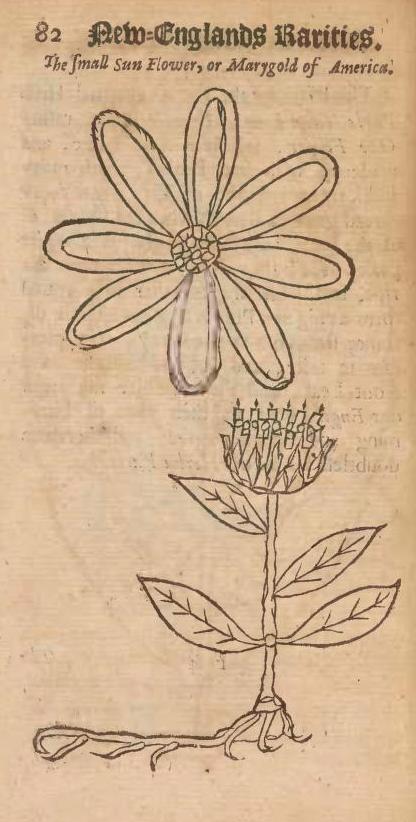
‘The American Sunflower” Josselyn wrote: “The plants in New-England for the variety, number, beauty, and vertues, many stand in Competition with the plants of any Countrey in Europe.” Josselyn, John. New-Englands rarities. (1672). Digitized by the U.S. Department of Agriculture, National Agricultural Library. http://biodiversitylibrary.org/page/47579359.

The Scarborough Land Conservation Trust.

View Full Size Image
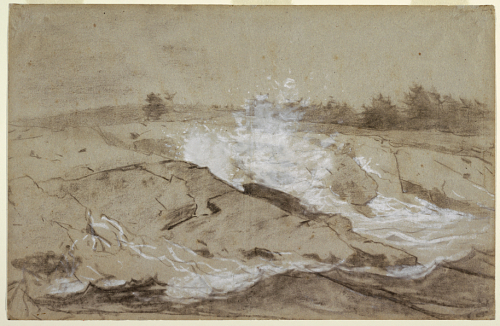
Black Point, Scarborough. Charcoal and chalk drawing of approximately 1884, by Winslow Homer. Cooper Hewitt, Smithsonian Design Museum Collection. Josselyn reported of a spring at Black Point that was “purgative and cures scabs and Itch.” Along with the springs, the Englishman was taken with the curative properties of the waters in the New World.
March 31, 2016by khage

Help Support BHL

BHL's existence depends on the financial support of its patrons. Help us keep this free resource alive!

search

About BHL

The Biodiversity Heritage Library (BHL) is the world’s largest open access digital library for biodiversity literature and archives. BHL operates as a worldwide consortium of natural history, botanical, research, and national libraries working together to digitize the natural history literature held in their collections and make it freely available for open access as part of a global “biodiversity community.”

Join Our Mailing List

Sign up to receive the latest news, content highlights, and promotions.

Subscribe Now

Subscribe to Blog via Email

Enter your email address to subscribe to this blog and receive notifications of new posts by email.

Join 319 other subscribers

Subscribe to Blog Via RSS

Subscribe to the blog RSS feed to stay up-to-date on all the latest BHL posts.

Access RSS Feed

Inspiring Discovery through Free Access to Biodiversity Knowledge.

The Biodiversity Heritage Library makes it easier than ever for you to access the information you need to study and explore life on Earth…for free, anytime, anywhere.


64+ Million Pages of
Biodiversity Literature Online.

EXPLORE

Tools and Services
to Transform Research.

EXPLORE

300,000+
Illustrations on Flickr.

EXPLORE

ABOUT | HARMFUL CONTENT | PRIVACY | SITE MAP | TERMS OF USE