
Biodiversity Heritage Library - Program news and collection highlights from BHL
  • Home
  • News
  • Featured Books
    • All Featured Books
    • Book of the Month Series
    • BHL at 20
  • User Stories
  • Campaigns
    • Fossil Stories
    • Garden Stories
    • Monsters Are Real
    • Page Frights
    • Her Natural History
    • Earth Optimism 2020
  • Tech Blog
  • Visit BHL
Home
News
Featured Books
    All Featured Books
    Book of the Month Series
    BHL at 20
User Stories
Campaigns
    Fossil Stories
    Garden Stories
    Monsters Are Real
    Page Frights
    Her Natural History
    Earth Optimism 2020
Tech Blog
Visit BHL
  • Home
  • News
  • Featured Books
    • All Featured Books
    • Book of the Month Series
    • BHL at 20
  • User Stories
  • Campaigns
    • Fossil Stories
    • Garden Stories
    • Monsters Are Real
    • Page Frights
    • Her Natural History
    • Earth Optimism 2020
  • Tech Blog
  • Visit BHL
Biodiversity Heritage Library - Program news and collection highlights from BHL
Blog Reel

Ole Worm’s Cabinet of Wonder: Natural Specimens and Wondrous Monsters

View Full Size Image
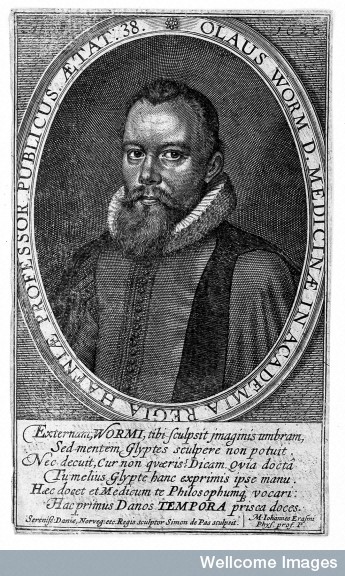
Portrait of Ole Worm (Credit: Wellcome Library, London; Creative Commons)

Ole Worm (1588-1654) was the first, and most well-known, collector in Scandinavia during the Renaissance.  In his homeland, Ole was attributed as the founder of the modern disciplines of archaeology, museology, philology, ethnology, and folklore.  Ole’s cabinet of wonder, documented in a catalog of its holdings, Museum Wormianum (which we highlight in this post), was the foundation for what would become Denmark’s National Museum.

Ole was born in Arhus, Denmark, the son of a mayor, and went to grammar school in his hometown and then in Germany, after which he moved to Emmerich on the Rhine in 1603 to study at a Jesuit school.  He returned to Denmark but set out again in 1605 on a “grand tour” of Europe, visiting important cities, museums, and centers of learning; taking such a grand tour was popular at the time among the sons of nobleman and the newly rich.  While on his grand tour, Ole studied philosophy, anatomy, medicine and theology, acted as a private tutor, and received a doctorate in medicine in 1611 for writing a dissertation on almost all known diseases (at the time) and their cures.

It was while Ole was on his grand tour of European cities of learning and culture that he began collecting objects that would come to inhabit his cabinet of wonder–also interchangeably called cabinets of curiosity during the period, or as he referred to it in a letter, his cabinet of naturalia.  (For more on cabinets of wonder, see our blog post on Ferrante Imperato and his cabinet of wonder here).  Ole visited a well-known collector in Italy in 1609, went to Germany and saw a famous art collection, and in Enkhuizen, the famous collector Bernhard Paludanus gave Ole a coffee bean and an exotic reed–both objects obtained through foreign travels and international trade.  Cabinets of wonder during this period especially valued the exotic, objects that came from America or other faraway lands that were now accessible through foreign trade and colonialist empire-building.
View Full Size Image
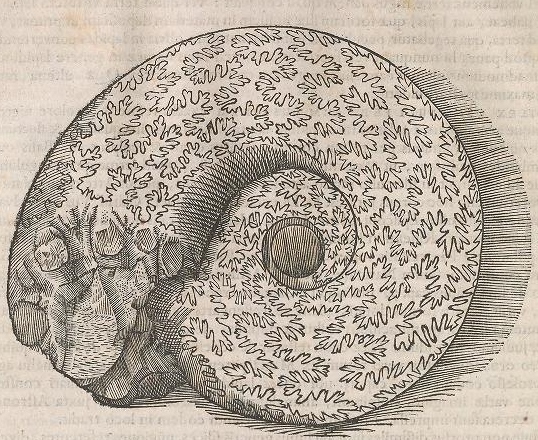
Lapis sceleton serpentis, also known as “snake-stone”, found in the section on stones in Museum Wormianum here.
In the 1600s, some thought snake-stones from India could heal venomous snake bites, and snake-stones are attributed as the divine stones Homer mentioned in The Iliad that healed Philoctete’s wound.

Ole continued to correspond with various European collectors who were famous for their pursuits of knowledge and virtue.  How does collecting objects make one virtuous?  The pursuit of knowledge was a virtue, and collecting physical objects aided in pursuing knowledge.

According to the philosophy of the time, by collecting physical things that reflected God’s creative powers, one was highlighting God’s power.  And those things that were once considered monstrous in the medieval period–Siamese twins, deformed fetuses, strange creatures–now represented God’s omnipotent ability to intervene with creation and produce wondrous rarities worthy of gazing upon and studying in cabinets of wonder.

Since Ole lived during a period after the Reformation (a break with the ways of the medieval church), scholars and wealthier individuals were able to establish themselves as creators of knowledge, collectors and curators of cabinets of wonder, studying by means of a proto-empiricism where knowledge was gained by physical experience with an object (rather than the later definition of empiricism as knowledge gained through experimentation).
View Full Size Image
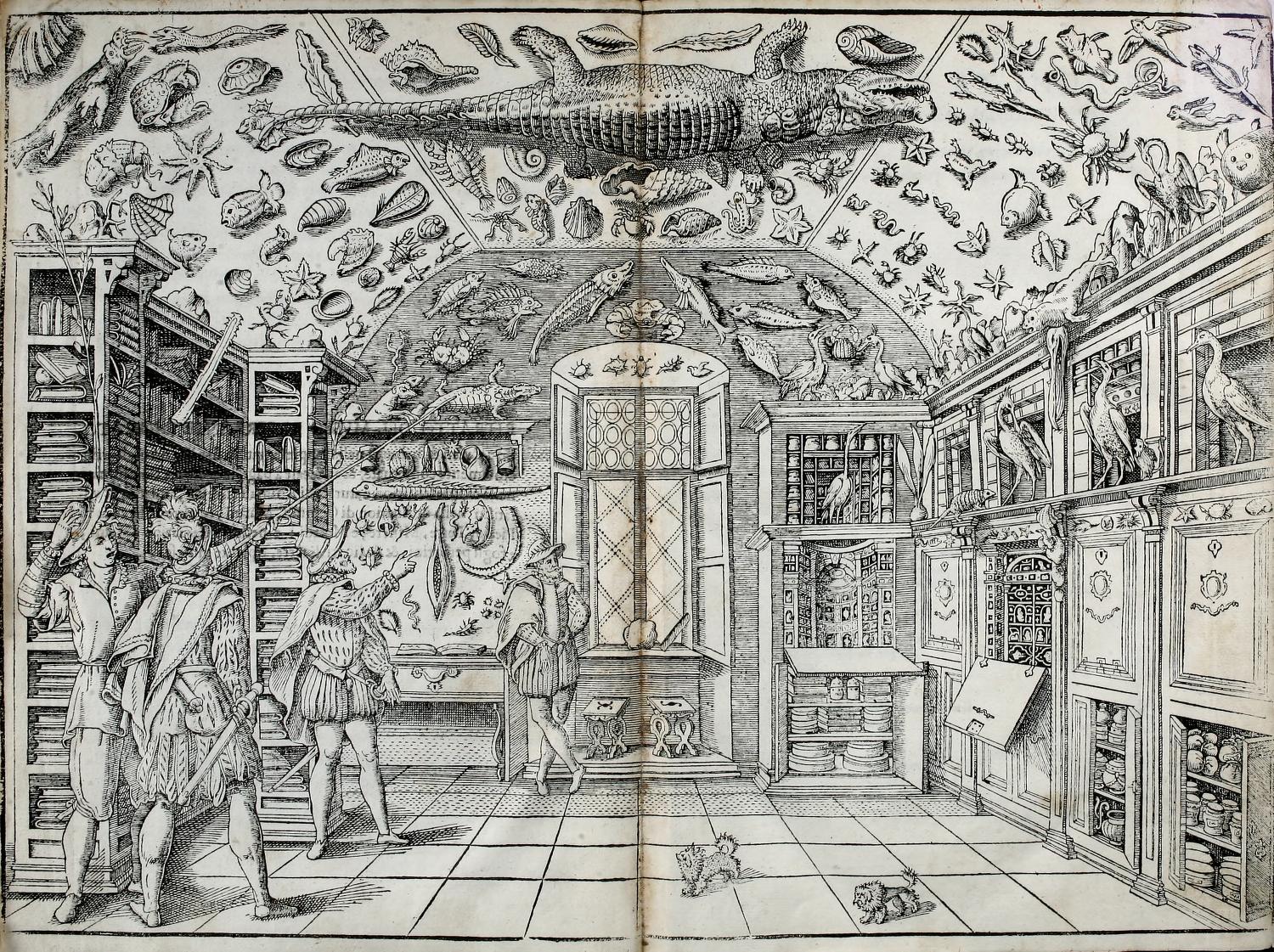
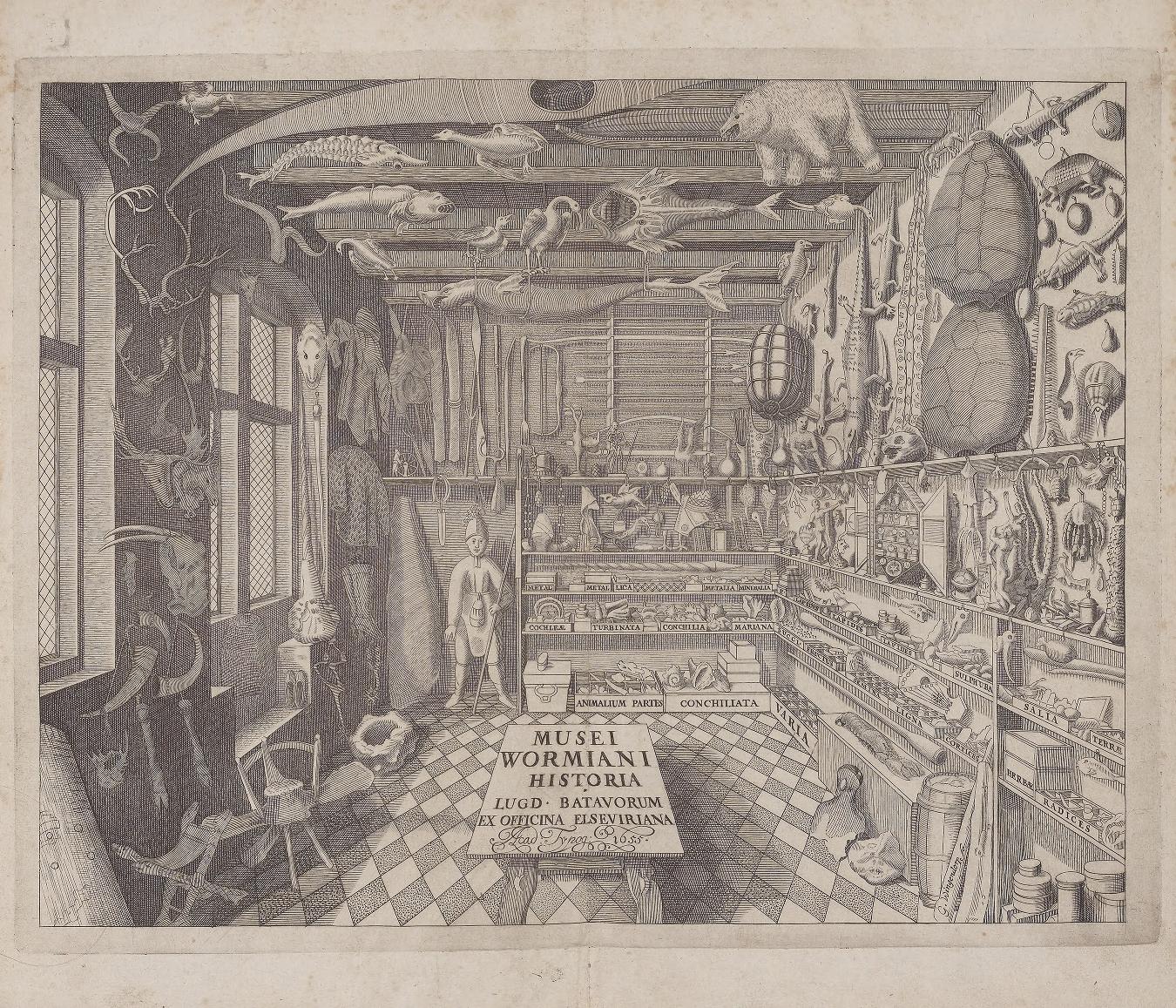
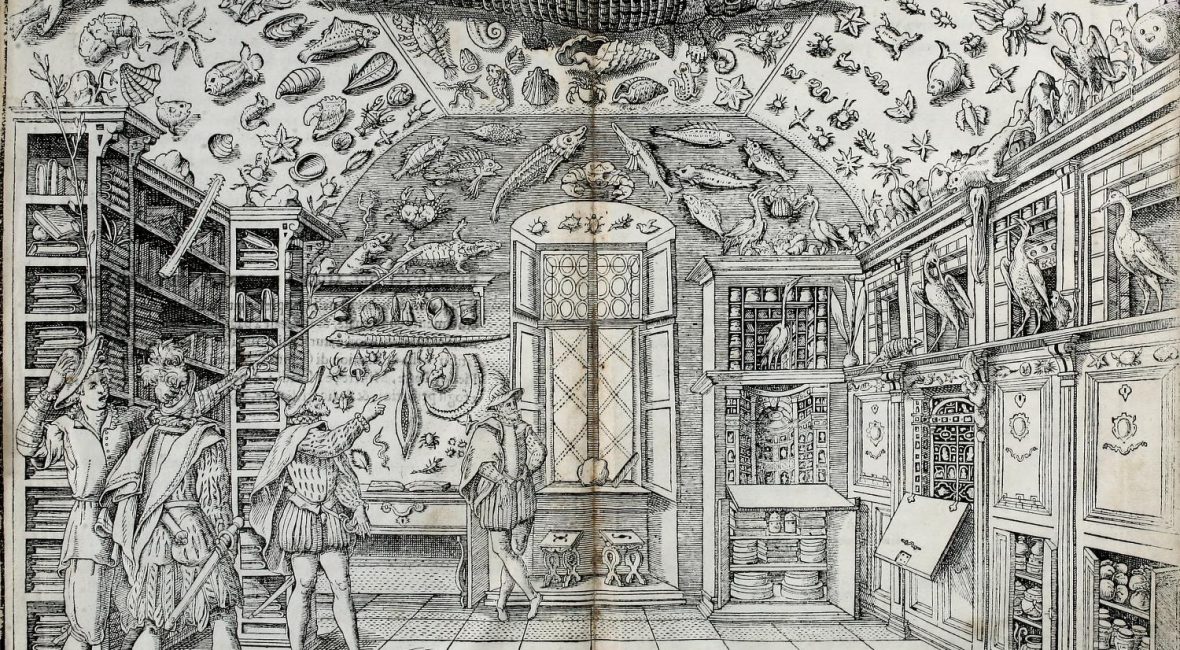
Ole Worm’s cabinet of wonder, from the frontispiece in Museum Wormianum.  The table in the center of the room, where the name of the book is inscribed, is where Ole would have taken down objects for himself, and visitors, to handle and observe.
(View the image here.)

After Ole returned from his grand tour, he took a position at the University of Copenhagen and was the chair of pedagogy, Greek and physics, consecutively, and in 1624 became a professor of medicine.  Around 1620 he began creating his museum, “Museum Wormianum”.

In its nascent form, the museum contained the curiosities Ole collected on his grand tour, mostly geological and biological, along with cultural items.  The majority of his museums holdings, or “wonders”, were donated to Ole from other European collectors whom he met and with whom he corresponded and sometimes asked for items.  By the time Ole died in 1654, his museum was held in high regard and contemporaries wrote that the museum had wonderful, curious and odd rarities that were visited by famous and royal people from all over Europe.

View Full Size Image
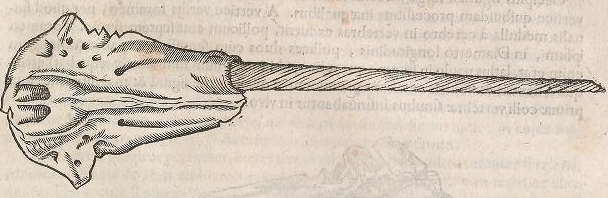
What people in the 17th century, and prior, thought was a unicorn horn.
(View the image in Museum Wormianum here.)
View Full Size Image
During the period, people believed they could purchase “unicorn” horns to use for medicinal purposes. Having never seen a horn attached to a skull, Ole was skeptical.  When presented with this “unicorn skull” by another collector, Ole determined that it likely belonged to a narwhal, and he was correct.
(View the image in Museum Wormianum here.)


View Full Size Image
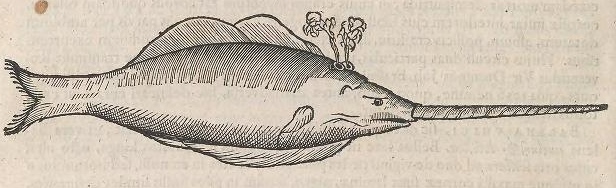
Illustration of a narwhal, whimsical but not completely accurate, in Museum Wormianum, which can be viewed here.

The reason for collecting objects from the natural world, as well as curiosities and antiquities, was to enrich visitors’ own knowledge.  In 1639, Ole wrote of his museum and its “curiosities” saying:

“I have collected various things on my journeys abroad, and from India and other very remote places I have been brought various things: samples of soil, rocks, metals, plants, fish, birds, and land-animals, that I conserve well with the goal of, along with a short presentation of the various things’ history, also being able to present my audience with the things themselves to touch with their own hands and to see with their own eyes, so that they may themselves judge how that which is said fits with the things, and can acquire a more intimate knowledge of them all.”

During this great period of collecting, a new form of literature was created: the catalog.  Collectors used catalogs of their items to promote their collections and display their own wisdom.  Ole published two catalogs (one in 1642 and one in 1645) with inventories of the wonders in his cabinet of curiosity.  However, it was the third catalog, which came to be the version of Museum Wormianum we explore today, published posthumously in 1655 that contained the most information, as well as engravings.

The catalog is divided into four categories: minerals, plants, animals and artificialia (man-made objects); the books go in ascending order from “lowest” form of life, minerals, to “highest” form of life, animals, with the fourth category, artificialia, existing outside that context of the three kingdoms of nature.

Man is cataloged with “animals” in Book III, along with divine monstrosities such as deformed fetuses, a giant tooth and giant skull believed to have come from an ancient race of giant humanoids.  Curiously, mummies, although they are human remains, are cataloged with “minerals” in Book I.

Book II deals with plants, and includes a section on tree “monstrosities”, so-called because they were thought to resemble animals or other objects.
View Full Size Image
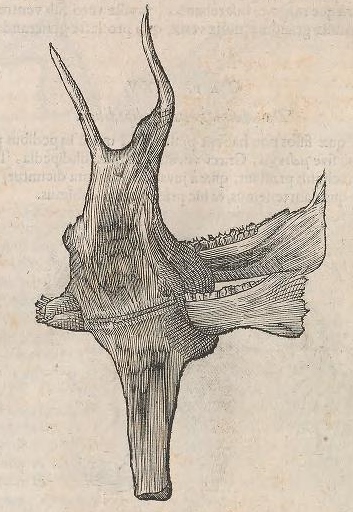
Horse mandible around which a tree has grown, found in Book III, on Animals (including man), in Museum Wormianum.
(View the image here.)

Book IV, De artificiosis, discusses man-made objects in the collection, including both contemporary-but-exotic items like bows, arrows and tobacco pipes from America, and antiquities like Roman and Danish jewelry and metal weapons from India and Norway.

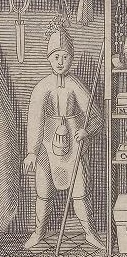
Two of the most amazing man-made creations were wooden automata created by contemporaries: mus rotis actus, a wooden mouse covered with a mouse hide that operated by means of internal clockworks; and statua librata pondere mobilis, a human automaton made of wood with flexible limbs that could imitate human movement by means of a wheel crank.  This figure was dressed in clothes believed to be worn by native peoples in America and given a spear to hold, and is clearly visible in the frontispiece to the book in the middle of the image of Ole’s cabinet of wonder (see image below).

If one views the objects in the frontispiece to Museum Wormianum from right to left, the order of objects mirrors the order of the same objects as they are listed in the books that comprise this work.
View Full Size Image
Humanoid automata, visible in the frontispiece to Museum Wormianum here, could run around and pick things up.  It was dressed to represent what the creator thought native people in America looked like, and held a spear.

Ole Worm inspired future generations of collectors and multitudes of visitors to his cabinet of wonder by showing them curiosities they likely never would have seen otherwise.  For Ole and many of his contemporaries, these items were outward symbols of the divine creative powers of God and of the powerful knowledge and virtue possessed by the scholar who collected them.

Interesting Facts:

Ole was considered a great academe and writer in Europe after publishing a compendium on Danish runestones in 1643, called Danicorum Monumentorum Libri Sex.  To create this work, he sent artists around the Danish kingdom to accurately sketch the monuments and their engraved runes.

In attempting to create a book of medieval Icelandic sagas, Ole worked with a prominent Icelandic historian, Arngrimur Jonsson; when both men had no luck finding the sagas, Arngriumur told Ole that he heard of an old woman who lived on a distant coast who knew about the medieval sagas and could perhaps retell them, and that they could send a poet to her to have them written down.  There is no record of any success in this venture.

During his grand tour of Europe, Ole had an autograph book which he filled with the signatures of famous cultural figures, including professors and dignitaries, whom he met during his travels. 

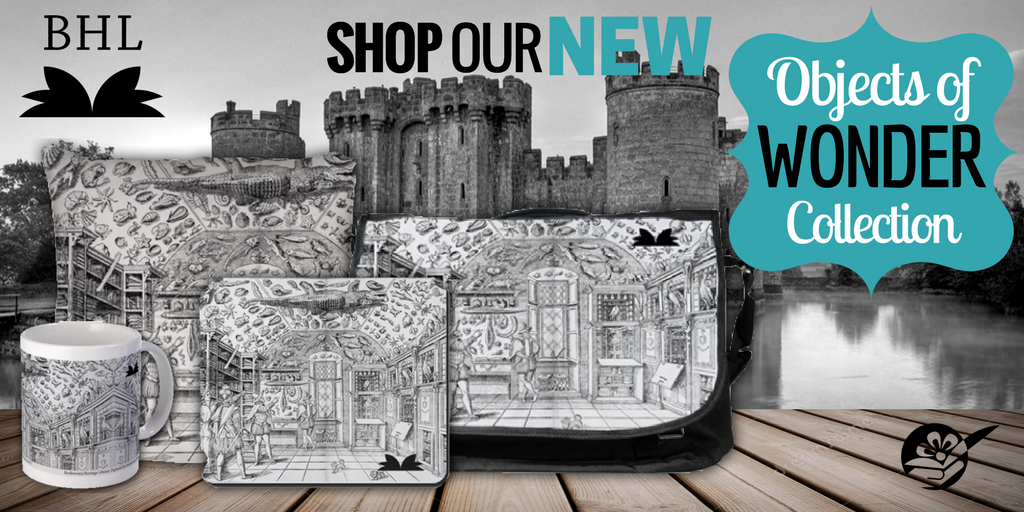
Shop Objects of Wonder in the BHL Store

Ole Worm’s cabinet of curiosity is one of the many wonders you can find in our Objects of Wonder BHL Store collection.
View Full Size Image

Shop today to bring some curiosities home with you.

100% of the proceeds from the sale of products in the store are used to digitize more books for BHL. Learn how these books help save biodiversity.

References:

Barroso, M.D.S. (2013). Bezoar stones, magic, science and art. In Duffin, C.J., Moody, R.T.J., & Gardner-Thorpe, C. (Eds.), A history of geology and medicine (pp. 193-208). London: The Geological Society.

Grice, G. (2015). Cabinet of curiosities: Collecting and understanding the wonders of the natural world. New York, N.Y.: Workman Publishing.

>Hafstein, V. (2003). Bodies of knowledge: Ole Worm & collecting in late Renaissance Scandinavia. Ethnologia Europaea 33(1), 5-20.

Hoskin, D. (2015). Born on this day: Ole Worm — collector extraordinaire. Victoria and Albert Museum Blog. Retrieved from http://www.vam.ac.uk/blog/creating-new-europe-1600-1800-galleries/born-on-this-day-ole-worm-collector-extraordinaire.

Meier, A. (2013). Ole Worm returns: An iconic 17th century curiosity cabinet is obsessively recreated. Atlas Obscura. Retrieved from http://www.atlasobscura.com/articles/ole-worm-cabinet.

Richards, S. (2012). The world in a cabinet, 1600s. The Scientist. Retrieved from http://www.the-scientist.com/?articles.view/articleNo/31897/title/The-World-in-a-Cabinet–1600s/.
May 9, 2017by micahv
Blog Reel, Featured Books

Ferrante Imperato: Step Into His Cabinet of Wonders!

Cabinets of Wonder: What Are They and Why Were They Created?

The term, “cabinet of wonder”, comes from the term “wunderkammer” (literally meaning “wonder chamber”).  The tradition of creating cabinets of wonder began during the Renaissance, the period of time between the 14th and 17th centuries.

In England and France, these cabinet of wonder collections were called “cabinets” or “curiosity cabinets”.  German speaking countries called the collections a variety of more specific terms: kunstkammer (“art cabinets”), schatzkammer (“treasure cabinets”), rüstkammer (history cabinets), and eventually wunderkammer (“marvel or curiosity cabinets”).  People during the Renaissance referred to these collections generically using the terms “wunderkammer” or “curiosity cabinet” interchangeably.

View Full Size Image
The first published pictorial representation of a Renaissance cabinet of curiosity in Ferrante Imperato’s Dell’historia Naturale. (Image digitized by Smithsonian Libraries.)

The Renaissance idea of creating a collection of (formerly) animate, inanimate, and botanical objects, and even odd specimens, came from a human desire to place mankind somewhere within the larger scheme of things.  Formerly, European princes built their own private studiolo or cabinets, which contained rare natural objects and books, and acted as status symbols to impress others.  Then the cabinets came to be used for scientific observation and contained more humble–but important–natural objects and specimens.  During the Renaissance, theorists from all fields of academia were making new scientific and philosophical discoveries, and realized that all of this new knowledge sometimes challenged previous beliefs about existence and mankind’s place within it.

View Full Size Image
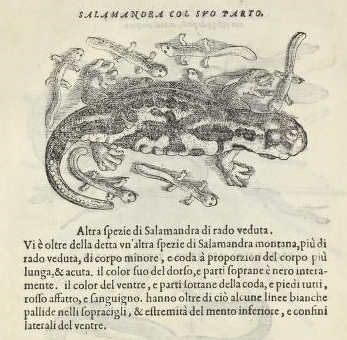
Salamander, from Ferrante Imperato’s Dell’historia Naturale (1599). Digitized by Smithsonian Libraries.

Different from modern museums, wunderkammer were generally created by a single scholar: in our example, Ferrante Imperato (1550-1625), an apothecary and scholar living in Naples.  In addition, the objects were believed to be interconnected by some singular purpose that could shed light on man’s place within existence.

Humanism was one of the most predominant movements in Italy during the Renaissance, and some humanists believed, among other things, in a notion of universalism–the idea that all things and all people were connected by some shared visible and/or invisible similarities, and all created by the divine.

The Renaissance humanists endeavored to use reasoning to explain unknown aspects of nature, which developed into the study of natural history: empirical observations and experimentation were used to make conclusions about the physical world.  Thus the Renaissance, and the creators of cabinets of wonder, were important in setting the stage for extraordinary advances in scientific knowledge in the decades following.

View Full Size Image
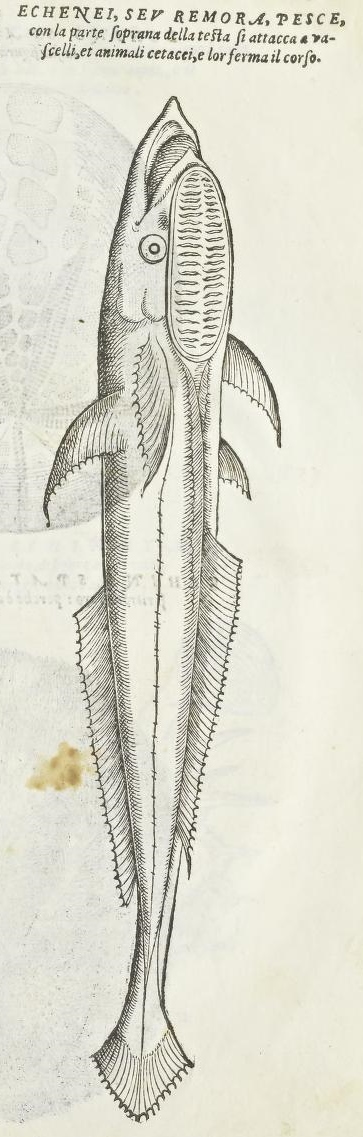
Remora fish, from Ferrante Imperato’s Dell’historia Naturale (1599). Digitized by Smithsonian Libraries.

What Were the Beliefs of Some Creators of Cabinets of Wonder, and Why Was Ferrante Imperato So Important?

Some creators of cabinets of wonder used for scientific observation and experimentation were pietistic, and stressed living a good and helpful life.  For this reason, the cabinets’ creators often wrote of their collections and made them open to the public to make people aware of the beauty of nature and the usefulness of natural objects.  The creators would also observe and experiment on items in their collections in an endeavor to increase knowledge of all aspects of the world.  Additionally, creators of cabinets of wonder often corresponded with, and visited, one another and discussed their collections and findings to increase the collective knowledge about the natural world and existence.

In this vein of sharing knowledge, Ferrante Imperato was convinced by his son, Francesco, and by his own friends, to produce a written account of his cabinet of wonder, in the form of the 28 books which comprise his work Dell’historia Naturale.  The majority of the work’s books are concerned with stones, minerals, gems and earth (i.e., minerology and related fields).  The last two books deal with living organisms: plants and animals.  Imperato especially featured and worked with herbs used to create medicines as an apothecary.

The first version of Dell’historia Naturale, printed in 1599, totaled 791 pages between the 28 books that comprised it, with 119 woodcut illustrations interspersed throughout the text.  One of the first European natural history research collections, Imperato’s cabinet may have contained as many as 35,000 plant, animal and mineral specimens.  Imperato quoted other authors at the beginning of his subject sections and discussed what he thought of the authors’ ideas, and then launched into his own beliefs about the subjects based on his experimentation on, and observation of, specimens in his cabinet of wonder.

View Full Size Image
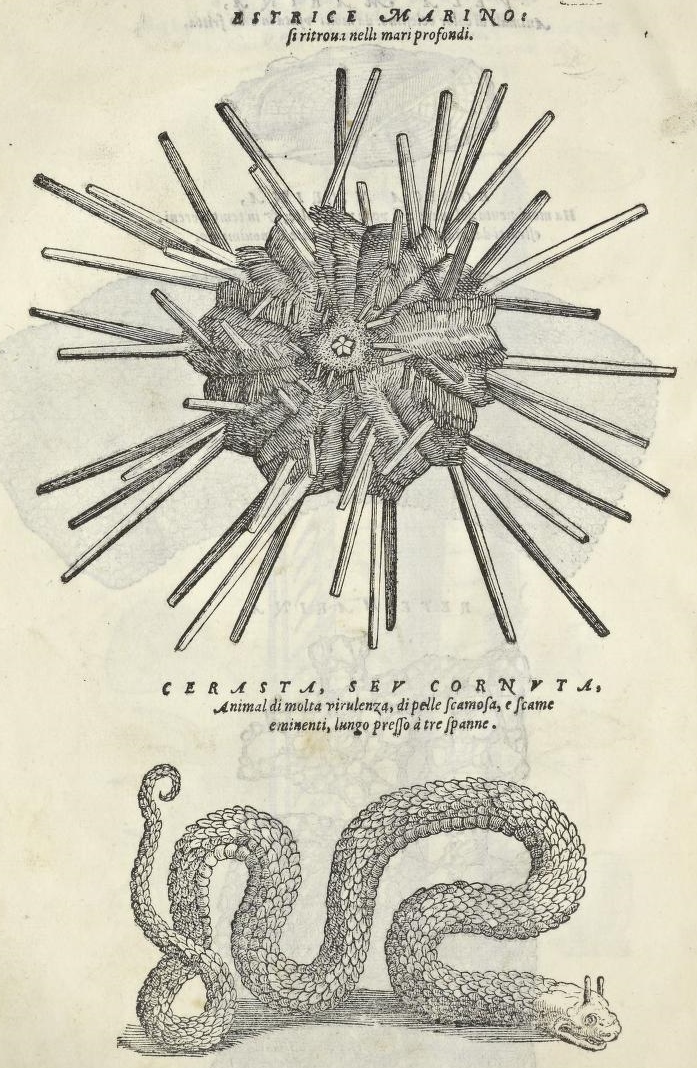
Marine creature and Horned Viper, from Ferrante Imperato’s Dell’historia Naturale (1599). Digitized by Smithsonian Libraries.

Many creators of these cabinets were drawn to collecting specimens in an endeavor to make life more comfortable for people in acts of piety, either by collecting herbs and natural materials like Imperato did in order to create medicines, or by collecting natural materials believed to be alchemical or metallurgical in order to experiment with new recipes (“segreti”, or “secrets”) to ease human ailments. Sometimes piety, however, was considered heretical by the Catholic Church in Italy at this time due to pietism’s emphasis on individual religious devotion (which leaves room for the idea that the Church may not be needed).

Imperato’s friend and scientific rival, Giovanni Battista Della Porta, who practiced pietism, created the Academia Secretorum Naturae (“Accademia dei Segreti”), which translates to “The Academy of the Mysteries of Nature”, in order to study and share information about natural science with like-minded scholars.  In 1579, Della Porta’s Accademia was accused of sorcery and disbanded by the Pope.

View Full Size Image
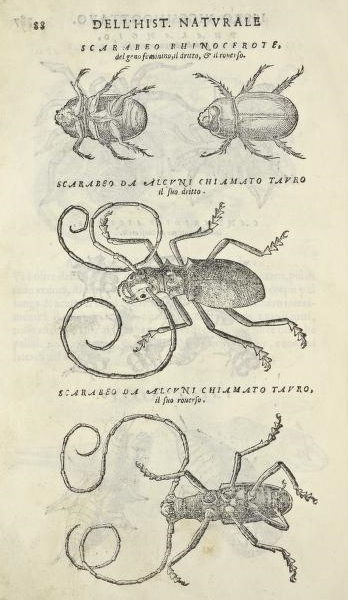
Insects from Ferrante Imperato’s Dell’historia Naturale (1599). Digitized by Smithsonian Libraries.
View Full Size Image
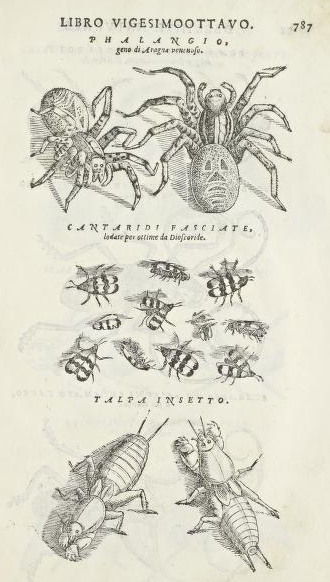
Arachnids and other insects from Ferrante Imperato’s Dell’historia Naturale (1599). Digitized by Smithsonian Libraries.

Some humanist scholars did, in fact, possess objects in their cabinets of wonder believed to have magical properties based on arcane knowledge, and these items included magical lanterns, speaking tubes, and distorting mirrors.  So the humanist sharing of “secrets of nature” did include, for some, secret of a magical (heretical) sort.

Imperato saw his cabinet of wonder as a place to derive knowledge directly from the artifacts before him, rather than trying to apply secret knowledge from arcane ancient and contemporary manuscripts to the objects in order to try and produce a result, like other scholars of his time, such as Girolamo Ruscelli (who had his own Accademia Segreta).

When Imperato’s Dell’historia Naturale was being printed in 1599, and more people knew about the pietism, and beliefs in magical properties of some items in some cabinets of wonder, Imperato’s son, Francesco, feared his father’s text might lead to heresy charges.  Francesco thus quickly printed another shorter version of his father’s text with many references to saints and Christian writers.

Imperato was not charged by the Church with heresy or sorcery when his full text, in all 28 books, came out, and this text became the first to feature an illustration of a cabinet of wonder, and the first work on natural history completely written in Italian (rather than scholarly Latin).

View Full Size Image
An experiment with asbestos, from Ferranto Imperato’s Dell’historia Naturale (1599). Digitized by Smithsonian Libraries.

Interesting Facts:

Some of the scholars and knowledgeable men with whom Ferrante Imperato corresponded included: Ulisse Aldovrandi, Gaspard Bauhin, Pierandrea Mattioli, and Fabio Colona.

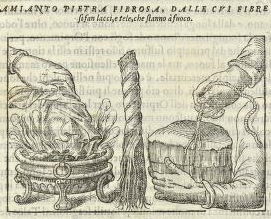
Imperato was amazed by asbestos, which was a relatively new substance at the time, with paradoxical and malleable qualities.  Imperato experimented with asbestos and included an illustration of one of his experiments with it in Dell’historia Naturale (fig. 18)–the only experiment depicted in the work.

In order to argue that a toad’s skull was actually a stone unlike any other natural stones, Imperato captured a pregnant viper and gathered many toads to prove that the viper could not penetrate the toad’s skull, and called the toad’s skull “toadstone” (pietra di rospo).

In 1611, Galileo demonstrated for other scholars the luminescent nature of a stone called the “Bologna stone” (lapis Bononiensis), or the “solar sponge”.  When Imperato heard about this stone, he was fascinated but thought it qualified as natural magic and claimed: “I believe that it is not natural but artificial”.

Cabinets of wonder often included fossils–Imperato had many–and humanist debate in Italy in the early fifteenth century led to subsequent discussions about what the existence of fossils meant; European students visiting Italy spread this debate throughout many regions when they returned to their home towns.

Ferrante Imperato’s Dell’historia Naturale contains medical folklore such as the ideas that wearing amethyst in the navel prevents drunkenness, sapphire cleans the eyes in such a way as to prevent lust, and jasper worn as an amulet can stop bleeding.

References:

Dion, M. (n.d.). History of the wunderkammern (cabinet of curiosities). Mark Dion: Tate Thames Dig. Retrieved from http://www.tate.org.uk/learn/online-resources/mark-dion-tate-thames-dig/wunderkammen

Duffin, C.J., Moody, R.T.J., & Gardner-Thorpe, C. (Eds.). (2013). A history of geology and medicine. Geological Society: Special Publication, 375, 23-24.

Findlen, P. (1994). Possessing nature: Museums, collecting, and scientific culture in Early Modern Italy. Berkeley, C.A.: University of California Press.

Grice, G. (2015). Cabinet of curiosities: Collecting and understanding the wonders of the natural world. New York, N.Y.: Workman Publishing.

Guitard, E. (1937). Ferrante Imperato. Revue d’histoire de la pharmacie, 25(100), 196.

Mottana, A. (n.d). The first modern translation of Theophrastus’ “On Stones” (pi epsilon rho Anot sign lambda AI omega I1/2; De lapidibus): Ferrante Imperato (1599). Rendiconti Lincei-Scienze Fisiche E Naturali, 21(1), 1-25.

Philippe, J. (2003). Les curiosités de trois apothicaires. Revue d’histoire de la pharmacie, 91(340), 603-610.

Rosenberg, G.D. (Ed.). (2009). The revolution in geology from the Renaissance to the Enlightenment. GSA Memoir Series, 203, 84.

Vai, G. B., & Cavazza, W. (2006). Ulisse Aldrovandi and the origin of geology and science. The origins of geology in Italy: GSA special papers, 411, 43-63.

March 13, 2017by micahv
Blog Reel, Campaigns, Featured Books, Page Frights

Monsters in Nature: Frightful Tales from the 19th Century

Today’s book is truly filled with Page Frights! Sea and Land: An Illustrated History of the Wonderful and Curious Things of Nature Existing Before and Since the Deluge, by James W. Buel (1849-1920), highlights some truly horrific creatures and plants, with colorful tales and an abundance of amazing illustrations.  You can read about, and see images of, giant prehistoric and contemporary land, air and sea creatures, sometimes in battle with one another and sometimes battling humans–including early man.

Some of the creatures covered and treated with illustrations read like a carnival of monstrosities: Animals not destructible by fire!  The monster sea-elephant!  The terrible water-spout!  The sea-serpent of ancient legend!  There are many gruesome tales, fables, and even ghost tales!  We will highlight a few of Buel’s tales of monsters in nature, in his own words, with accompanying illustrations.

It is important to remember that this book is a reflection of the culture of its time, and scientific inquiry has yielded much more information about these species and helped demystify many of the myths and legends that are sensationalized in the book.  Bearing that in mind, get ready for some fantastic and frightful tales and images!

The Tale of a Kraken Attacking a Ship!

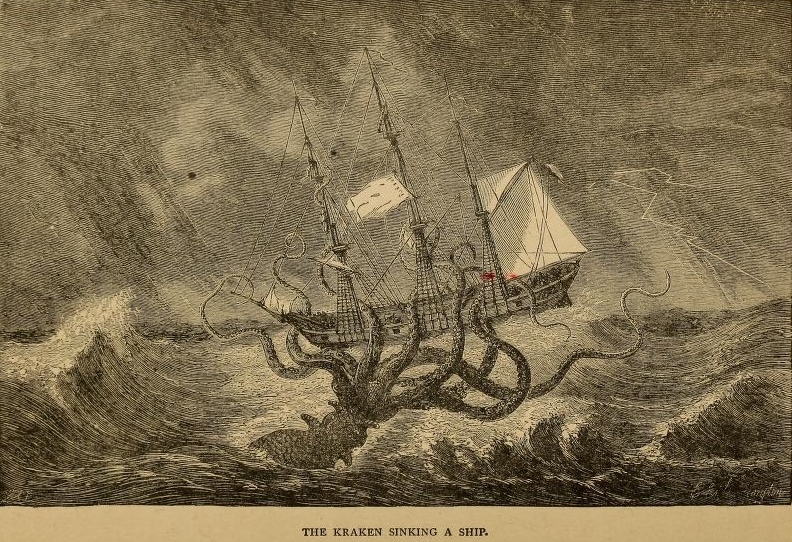
Adventures with the Frightful Squid [Kraken]. Account below from Buel’s Sea and Land:

“In olden times sailors were harassed by many groundless fears, superstitions being abundant and ignorance general.  The early Spanish poetic chroniclers, who delighted in telling the story of Columbus’ voyages, invariably disfigured their narratives with miracles and wonders.  In those days Jack, looking over the side of his vessel, was prepared to see anything, and to this willing disposition may be attributed the creation of mermaids, sea-serpents, grinning or winking monsters, and leviathans big enough to swallow a ship.  There was the squid which, as the sepia octopus, we know in these days to be an extremely large and most diabolically unpleasant beast; but in the olden times this animal was reckoned to be larger than a cathedral, in proof of which the following story is recited:

“A big ship was on the West African Coast; the men were getting the anchor, when a squid arose and wreathed its fearful snake-like limbs around the vessel’s spars.  The tips of these limbs soared quaveringly high above the mastheads, and the weight of the cuttle drove the ship down on to her beam ends.  Here now was a lively situation.  The crew plied axes and knives, but in vain, whereupon they invoked the aid of their patron saint, Thomas.  Eventually the wounded monster grew alarmed and sank, and the crew afterward, to commemorate their deliverance, marched in a body to the Church of St. Thomas, where subsequently there was hung up a painting, representing the unparalleled conflict. […]

“Pliny, the ancient, relates the history of an enormous cuttle-fish that haunted the coast of Spain and destroyed fishing ground.  He asserts that this creature was finally captured, and weighed seven hundred pounds, and that its arms were thirty feet in length.  As the cuttle-fish was esteemed by the ancients a most savory dish, the head of this formidable monster was given to Lucullas to whom it belonged rightfully by reason of his exalted rank” (Buel, 1887, pp. 75-77).

View Full Size Image
Adventures with the Frightful Squid, also called “Kraken” (see image here)

A Giant, Man-Attacking Crab!

Monster Sea-Spiders. Account below from Buel’s Sea and Land:

“From an article in a recent number of St. Nicholas, I condense the following interesting information about crabs:

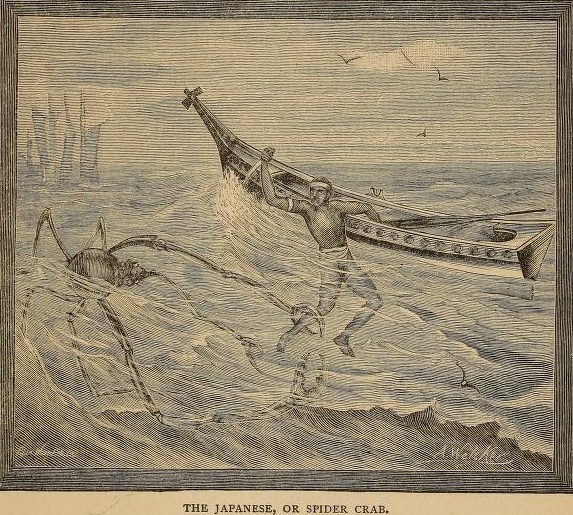
“Among the most remarkable, and the largest of crabs, is the Japanese sea-spider, highly esteemed in the Orient as an excellent article of food.  Its principal claws are each five feet in length, measuring from ten to twelve feet between the tips of the nippers, and presenting an astonishing spectacle when entangled in the nets and hauled aboard the boats.  With their slow, measured movements and the powerful weapons of defense, these crabs are the giants of the spiders of the sea.  Professor Ward, who has collected them in Japan, states that they have a remarkable habit of leaving the water at night and crawling up the banks presumably to feed, and that there they are sought by the crab-hunters.  A story is told of a party of fishermen who had camped out on a river bank, and one of whom aroused the others in the night by yells and screams.  Running to the spot they found that one of these monster crabs, in wandering over the flats, had accidentally crawled over him with his great claws, frightening him almost to death” (Buel, 1887, pp. 64-65).

View Full Size Image
Japanese Spider Crab (see image here)

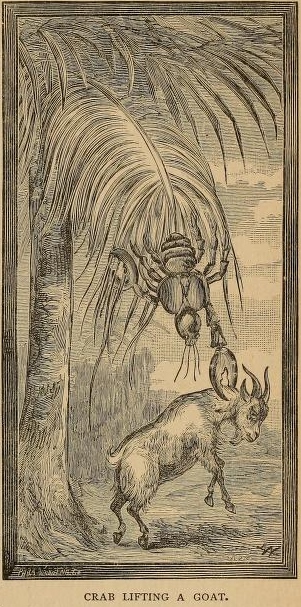
“The robber-crab, peculiar to the Samoan Islands. . .lives principally in the branches of the cocoanut tree.  It exercises no little intelligence in getting at the fruit, which it accomplishes by carrying the nut to the very top of the tree, and then dashing it down with force enough to break the shell.  A gentleman relates that upon an occasion, while he was walking in a Samoan forest, he saw a robber-brab reach down its claws from a thick palm branch and seize a goat by the ears that was passing underneath.  So powerful was the crab that it lifted the goat almost clear from the ground” (Buel, 1887, pp. 65, 67).

View Full Size Image
Robber-Crab lifting a goat off the ground (see image here)

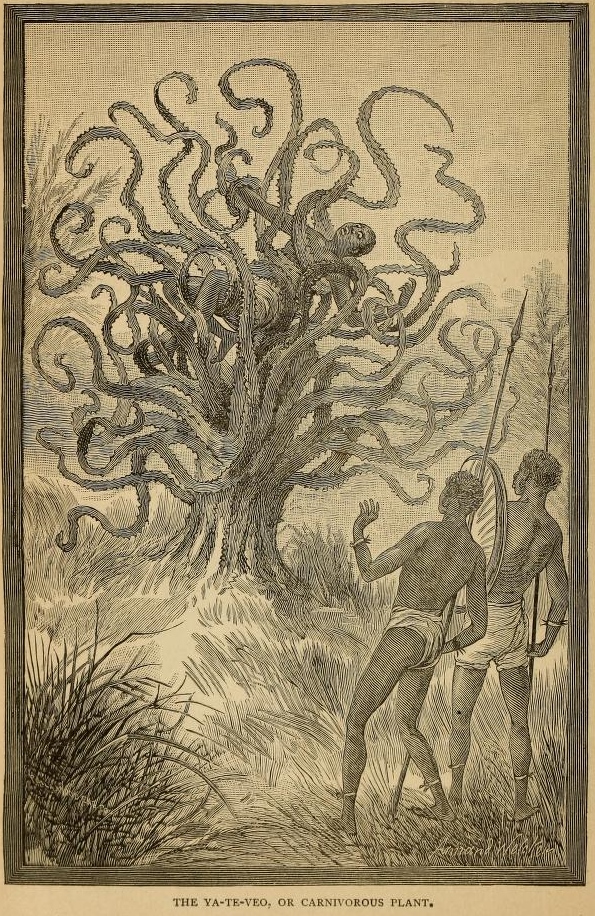
A Horrifying Man-Eating Tree!

A Man-Eating Plant. Account below from Buel’s Sea and Land:

“Travelers have told us of a plant, which they assert grows in Central Africa and also in South America, that is not contented with the myriad of large insects which it catches and consumes, but its voracity extends to making even humans its prey.  This marvelous vegetable Minotauris represented as having a short, thick trunk, from the top of which radiate giant spines, narrow and flexible, but of extraordinary tenaciousness, the edges of which are armed with barbs, or dagger-like teeth.  Instead of growing upright, or at an inclined angle from the trunk, these spines lay their outer ends upon the ground, and so gracefully are they distributed that the trunk resembles an easy couch with the green drapery around it.  The unfortunate traveler, ignorant of the monstrous creation which lies in his way, and curious to examine the strange plant, or to rest himself upon its inviting stalk approaches without a suspicion of his certain doom.  The moment his feet are set within the circle of the horrid spines, they rise up, like gigantic serpents, and entwine themselves about him until he is drawn upon the stump, when they speedily drive their daggers into his body and thus complete the massacre.  The body is crushed until every drop of blood is squeezed out of it and becomes absorbed by the gore-loving plant, then the dry carcass is thrown out and the horrid trap set again.

“A gentleman of my acquaintance, who, for a long time, resided in Central America,, affirms the existence of such a plant as I have here briefly described, except that instead of the filaments, or spines, resting on the ground he says they move themselves constantly in the air, like so many huge serpents in an angry discussion, occasionally darting from side to side as if striking at an imaginary foe.  When their prey comes within reach the spines reach out with wonderful sagacity (if I may be allowed to apply the expression to a vegetable creature), and grasp it in an unyielding embrace, from whence it issues only when all the substance of its body is yielded up.  In its action of exerting pressure upon its prey, this dreadful plant resembles the instrument used in the dark ages for inflicting a torturous death.  It was made of two long iron cylinders, on the inside of which were sharp, projecting pikes.  The victim was placed inside, and the two cylinders then brought forcibly together, thus driving a hundred or more of the pointed pikes into all parts of his body and producing a frightful death.  Generally this inquisitorial instrument was made, somewhat crudely, to represent a woman, hence the name applied to it was “The Maiden,” by which it is still known.

“Dr. Antonio Jose Marquez, a distinguished gentleman of the city of Barranguilla, in the United States of Colombia, in describing this wonderful plant to the author, affirms that when excited it violently agitates its long, tentacle-like stems, the edges of which, rasping upon each other, produce a hissing noise which resembles the Spanish expression, ya-te-veo, the literal translation of which is “I see you.”  The plant is therefore known, in South America, by the name Yataveo” (Buel, 1887, pp. 475-477).

View Full Size Image
The Man-Eating Tree (see image here)

Click here to read the book, and more of its frightful tales!  Here are some wickedly monstrous illustrations to lure you to this special collection of Page Frights!

View Full Size Image
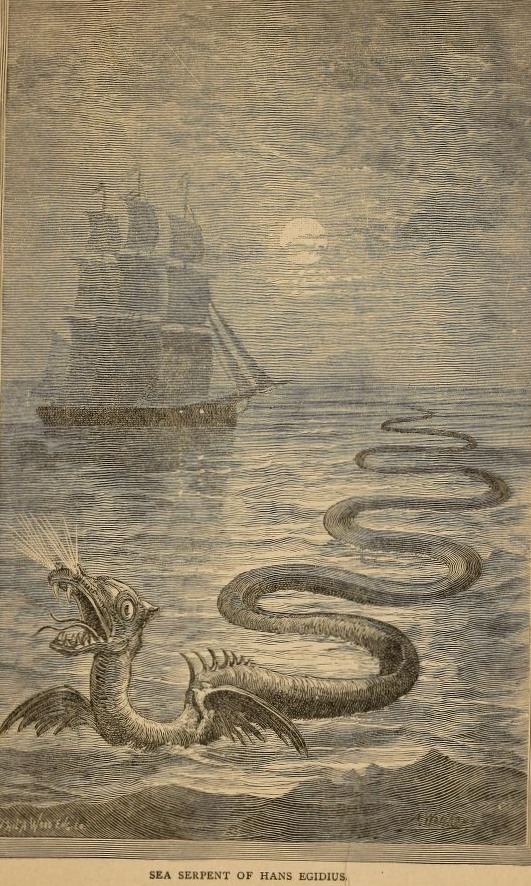
Sea Serpent (see image here)
View Full Size Image
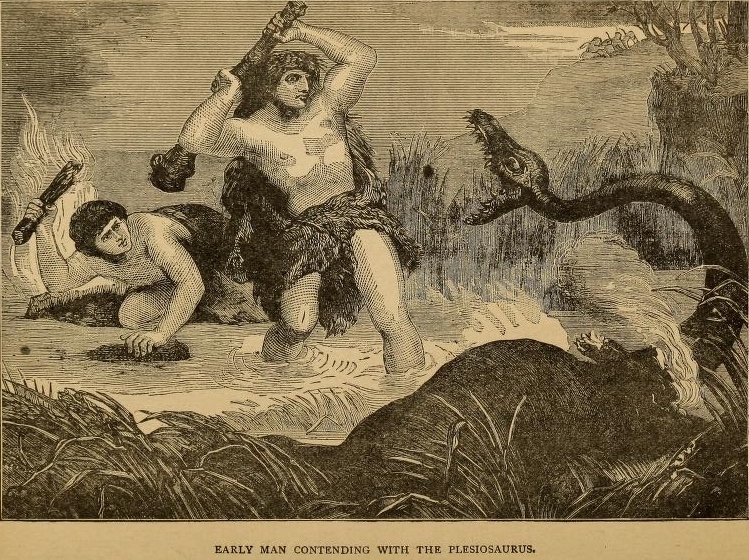
Imagined battle between early man and Plesiosaurus (see image here)
View Full Size Image
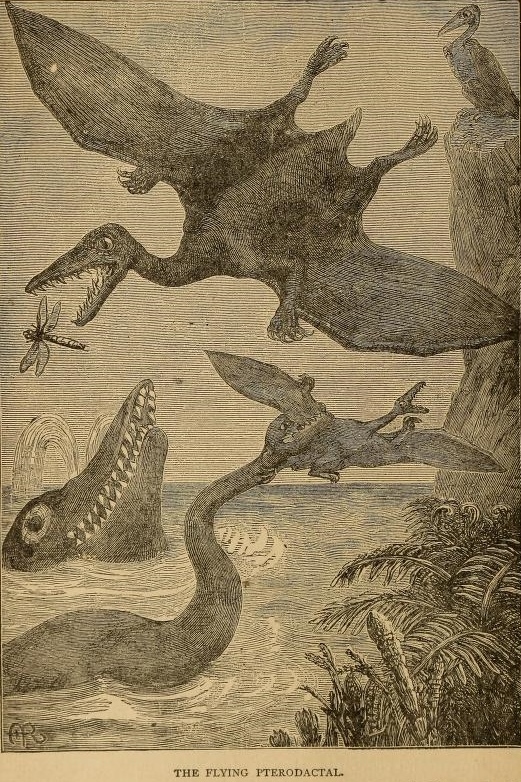
Pterodactyl and sea dinosaurs (see image here)

What is your favorite image or story from today’s #PageFrights book?

October 11, 2016by micahv
BHL News, Blog Reel

Earth Day 2016!

Happy Earth Day!  This special day for recognizing and fighting the serious and negative effects of climate change began on April 22nd, 1970.  On that first Earth Day, 20 million Americans peacefully demonstrated to shine light on the devastating effects of modern life and production on wildlife and the climate.  Soon after this the Clean Air Act, Clean Water Act, Endangered Species Act, and other laws meant to protect the environment were passed by the government.  By the 1990s Earth Day expanded and came to be celebrated by over 200 million people in 141 countries–and now more than 1 billion people all around the world participate on Earth Day in order to help the environment.
Climate change refers to changes happening to the world climate, which are linked to rising sea levels, melting glaciers, and shifting flower and plant blooming times.  Contributions to human-induced climate change include the burning of fossil fuels, which releases heat-trapping gases into the air.  Climate change affects biodiversity of all kinds and in all areas of the world, often by depriving animals of their habitats and food sources, or changing their living conditions dramatically and dangerously.
Deforestation, another driving cause of climate change, is the cutting down of trees on a very large scale, and it happens most often due to agricultural reasons, financial reasons, or human expansion into new areas to live.  Millions of species lose their habitats as a result of deforestation.  In addition, without the trees to provide a forest canopy to block the sun during the day and capture heat at night, extreme temperature swings result and can negatively impact plants and animals in the area.  
View Full Size Image
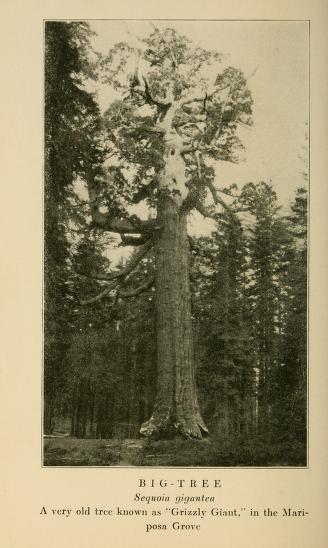
Let’s preserve our beautiful forests–and plant new ones! Image at BHL here.
There are lots of things that you can do this Earth Day to help fight climate change.  One of the most important things people and organizations do is plant trees.  This short read, Trees Are the Answer. . .to America’s Growing Environmental Concerns, is just as relevant today as when it was published.  Trees fight climate change by absorbing excess CO2 from the atmosphere.  CO2 is harmful to the climate and is created by such things as car emissions.  In one year, an acre of mature trees can absorb enough CO2 to make up for a car that drove 26,000 miles (source).  In addition to absorbing CO2, trees absorb other climate pollutants such as nitrogen oxide and ammonia, and act as a filter to capture harmful particulates in their leaves and bark.  In addition to planting trees, you can take part in cleaning local parks and streams, start composting to turn food waste into soil, eat less meat to reduce greenhouse gas emissions that are a byproduct of the meat industry, stop using disposable plastic which can kill wildlife and destroy ecosystems, buy local produce to reduce the carbon emissions needed to drive in non-local produce, drive less to reduce your carbon footprint (try biking for some healthy fun!), sign up to stop receiving junk mail which wastes paper, and recycle electronic devices which are normally thrown into landfills that pollute the environment.
View Full Size Image
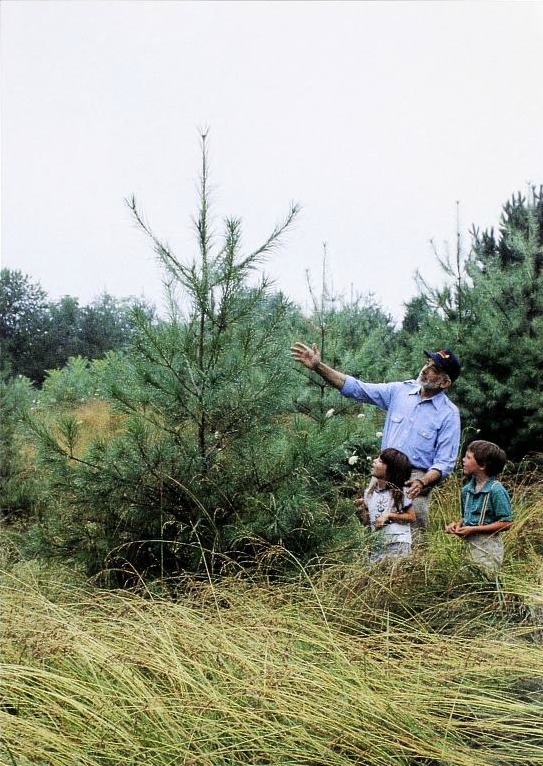
Planting trees will help combat climate change. Image at BHL here.
If you are a budding naturalist, you can help the climate and biodiversity by becoming a Citizen Naturalist–anyone can do this, including kids!  Citizen Naturalists monitor their local ecosystems and threats to wildlife and submit their observations to citizen science programs.  There are many groups dedicated to wildlife observation to help protect wildlife and fight climate change, and some of the fun animals you can help observe include frogs, birds, fireflies, and Monarch Butterflies.  If you want to work alongside a professional scientist, you can become a Citizen Science volunteer, where you assist scientists in their research to help analyze and combat the effects of climate change.  Check out the National Wildlife Federation’s page about Citizen Naturalists and Scientists for more information about groups to join and project ideas: NWF Citizen Science Resources.  You can also get involved with Citizen Science through BHL: Click Here for BHL Citizen Science Information!
View Full Size Image
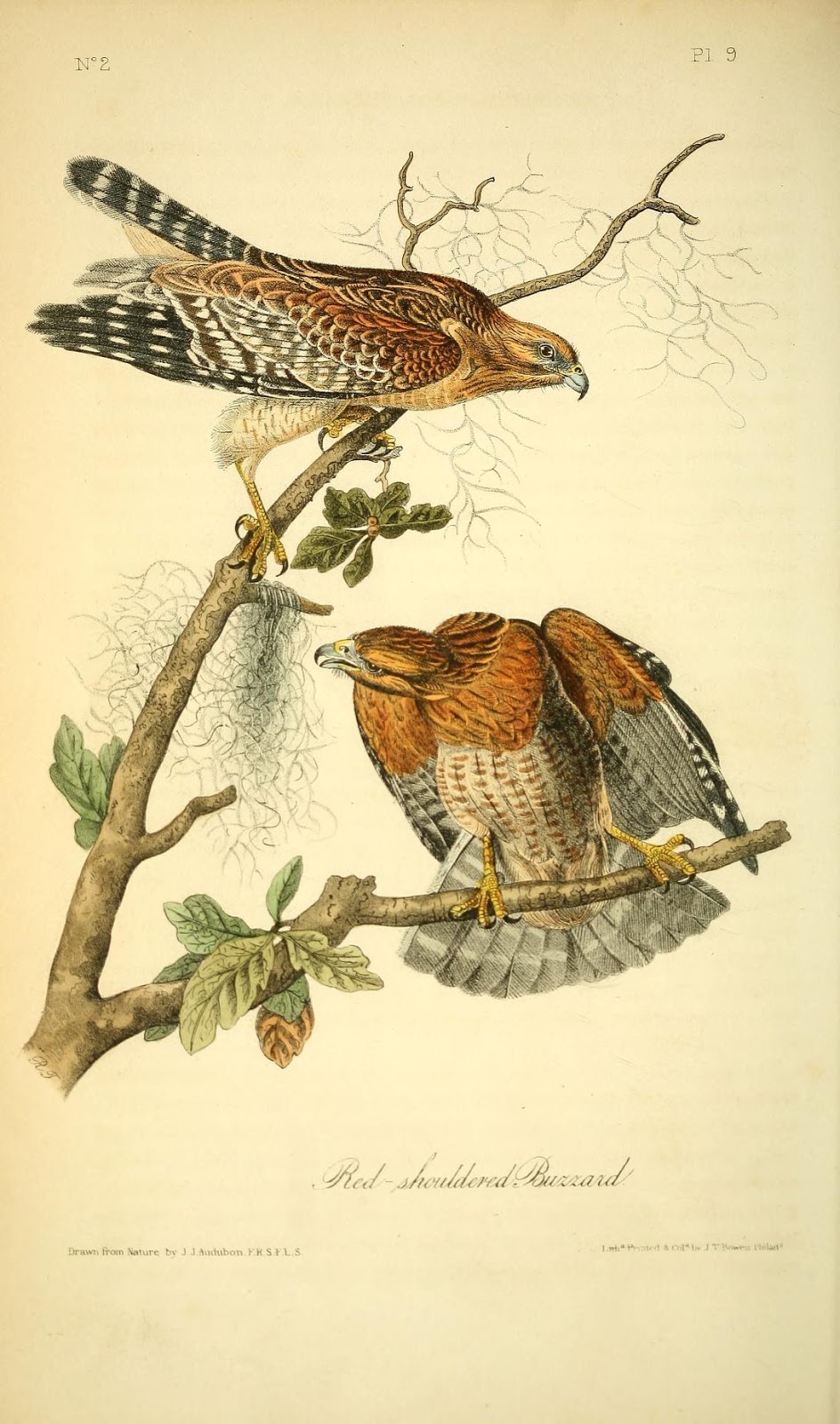
Citizen Naturalists and Citizen Scientists can take note of the wildlife in their backyards and local parks. Image at BHL here.
How do you plan to get involved this Earth Day?  Tell us below!
www.earthday.org
https://www.epa.gov/earthday
https://www.nwf.org/Wildlife/Wildlife-Conservation/Citizen-Science.aspx
http://environment.nationalgeographic.com/environment/global-warming/deforestation-overview/
http://climate.nasa.gov/
April 22, 2016by micahv
Blog Reel, Featured Books

Ancient Myths Inspired by Fossils

The study of mythology associated with fossils is a relatively new field, which Adrienne Mayor (2005) terms “the folklore of paleontology”; she continues by saying that “[c]ombining oral traditions and paleontology, and drawing on history, archaeology, anthropology, and mythology, the investigation of fossil legends offers a new way of thinking about pre-Darwinian encounters with prehistoric remains” (Preface, p. xxiv). Drawing from several resources, one can create a dynamic picture of what a large variety of cultures around the world and throughout time have thought were the myths associated with dinosaur, bird, and other prehistoric fossils.

Due to extensive travel, Greeks and Romans discovered fossils throughout the Mediterranean and into India (Mayor, 2000b, p. 8). The fossils of dinosaurs, mastodons, mammoths and other creatures were pervasive parts of the natural landscape in the Greek and Roman periods, helping to account for why Greeks and Romans developed mythologies about giant creatures as they sought to understand the presence of these remains (Mayor, 2000b, p. 8). Some highlights from Greek and Roman mythology include the following accounts.

View Full Size Image
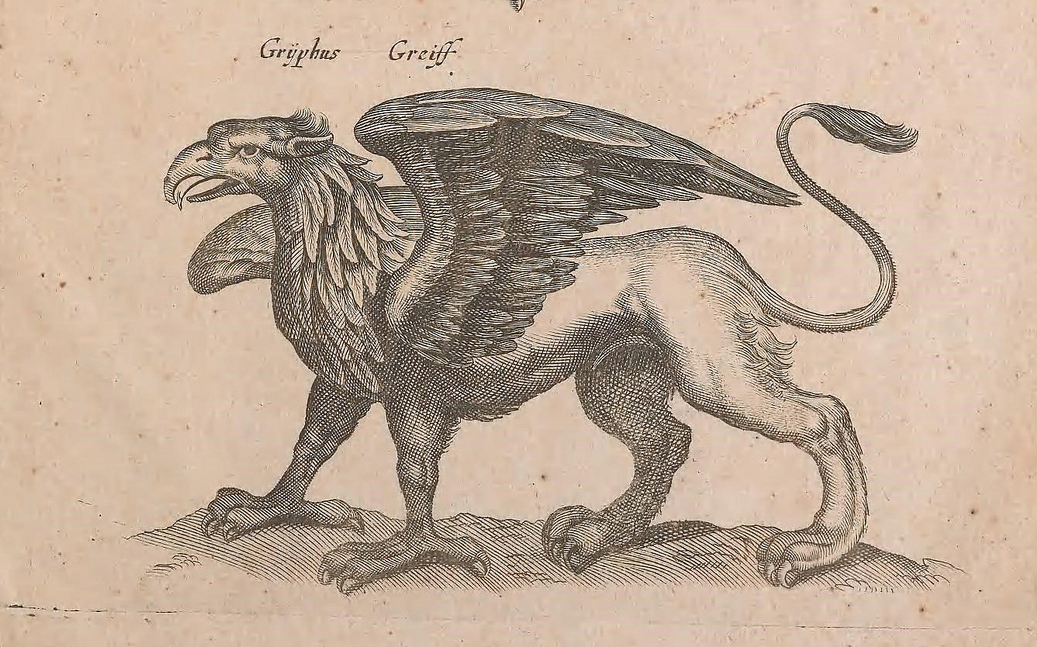
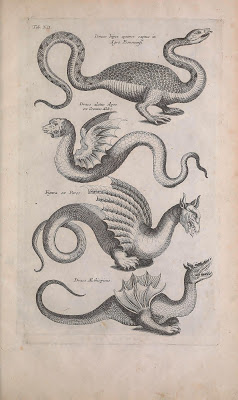
Griffin, likely inspired by encounters with fossils. Jonstonus, Joannes. Historiae naturalis de quadrupedibus libri. pt. 6 (1657). http://biodiversitylibrary.org/page/40913115. Digitized by Smithsonian Libraries.

In 675 B.C. when the Greek traveler, Aristeas, visited Scythian nomads in the Gobi deserts, the nomads told him about an area beyond Issedonia where griffins defended gold from the nomads (Mayor, 2000b, pp. 22-3). Aristeas wrote that the nomads would battle the griffins and that Issedonian accounts portrayed these creatures as lion-sized, with curved beaks like eagles (Mayor, 2000b, p. 23). Near Eastern cultures have been depicting such creatures since 3000 B.C. (Mayor, 2000b, p. 23). In the thirteenth century, the Chinese in Turfan and Lop Nur feared the surrounding deserts—which used to be Issedonian lands that were thought to be haunted by demons and dragons. In particular, the people feared the large bones in these deserts, calling them “dragon bones” (Mayor, 2000b, p. 38). In 1922, American adventurer Roy Chapman Andrews followed caravan trails through China to the Gobi desert and found the fossilized remains of Protoceratops (the size of a lion) and Psittacosaurus (which has a prominent beak); these fossil bones combine to form the image of the griffin, as described by the Scythian nomads and later the Greeks, Romans and other cultures (Mayor, 2000b, pp. 39-40).

View Full Size Image
Various dragon forms. Dragon myths may have been inspired in part by encounters with fossils. Jonstonus, Joannes. Historiae naturalis de quadrupedibus libri. pts. 2-5 (1657). http://biodiversitylibrary.org/page/40918325. Digitized by Smithsonian Libraries.

In North Africa during the third to second century B.C., Carthaginians were digging trenches when they came upon two fossilized skeletons, each about 34 feet long (Mayor, 2000b, p. 153). The skeletons were assumed to be those of mythic giants, and Phlegon of Tralles, who served Hadrian (reigned between A.D. 117-38) at the time, claimed that the skeletons were proof that all life forms were becoming smaller (Mayor, 2000b, p. 149). This area, Ancient Carthage on the Gulf of Tunis, is rich with mastodon fossils, deinotheres, and mammoths (Mayor, 2000b, pp. 153-4), which paleontologists believe to be the source of the giant myths. Mayor provides evidence of the similarity between prehistoric fossils and Greek and Roman mythical creatures by citing contemporary Greek and Roman oral (transcribed) and written histories, as well as artwork produced during these periods.

View Full Size Image
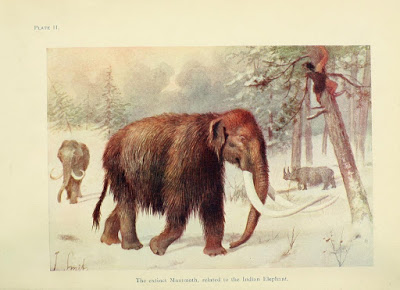
Mammoths may have inspired many Native American myths. Westell, William Percival. The book of the animal kingdom. (1910). http://biodiversitylibrary.org/page/10102652.

Not to be ignored are Native American fossil mythologies from the Americas, also treated by Mayor (2005) in another work. She addresses tribes from North and South America and those mythologies believed to be based on prehistorical fossils by analyzing oral, Native American fossil lore preserved by various people during the colonial period, the sixteenth to eighteenth century, and the nineteenth and twentieth centuries (Preface, pp. xxxvi-xxxviii). Additionally, she interviewed scholars and Native Americans willing to discuss important myths concerning large creatures and monsters that she—and they—associate with fossilized creatures. Included in her findings are myths about monster bison, giants that were neither man nor animal (but were probably based on mastodon bones), a giant monster that promised its own extinction (thought to be a mammoth), giants in Tlaxcala, Mexico believed to have killed all the ancestors of the Tlaxcalteca people (presumed to be inspired by Colombian mammoth fossils), bird monsters (that were probably fossilized prehistoric birds of prey), giant lizards (assumed to be Triceratops) and sea creatures that battled flying creatures (assumed to be the marine fossils of mosasaurs and the fossils of the flying Pteradons, respectively). Each of these mythological creatures, and many more, addressed by Mayor, come from different Native American cultures throughout the Americas, though there are some overlaps occasionally in mythological themes, and the connection between myth and creature is largely supported by the actual presence of fossils in the region of the myth that reflect the appearance of the mythological creature being addressed.

Want to learn more about the connection between ancient myths and fossils? Then check out these resources (also cited above):

  • Greer, A., Dermitzakis, M. and Vos, J. (2008). Fossil folklore from India: The Siwalik Hills and the Mahâbhârata. Folklore, 119(1), 71-92.
  • Lyons, S. L. (2009). Species, serpents, spirits, and skulls: Science at the margins in the Victorian age. Albany, N.Y.: State University of New York.
  • Mayor, A. (2000a). A time of giants and monsters. Archaeology, 53(2), 58-61.
  • Mayor, A. (2005). Fossil legends of the first Americans. Princeton, N.J.: Princeton University Press.
  • Mayor, A. (2000b). The first fossil hunters: Dinosaurs, mammoths, and myth in Greek and Roman times. Princeton, N.J.: Princeton University Press.

Tune in all week for more great fossil fun with our Fossil Stories event, including:

  • Tweets and Facebook Posts
  • Blog Posts highlighting milestones and key publications in the history of fossil research
  • A Flickr Collection with hundreds of historic fossil illustrations
  • A Pinterest Collection featuring a selection of our favorite fossil illustrations
  • A BHL Collection containing seminal publications in the history of paleontology
  • A series of live webcasts at BHL partner institutions
  • A citizen science challenge in collaboration with The Field Book Project, the Smithsonian Transcription Center, and Smithsonian Institution Archives
Follow #FossilStories on Twitter and Facebook to learn more.
October 13, 2015by micahv
Blog Reel, Campaigns, Featured Books, Garden Stories

Antique Seed Catalogs and Heirloom Gardening

On Heirloom Plants

When you think of an “heirloom plant”, you may be imagining a plant that has changed little in over a hundred years—something our great- great-grandparents would have farmed and eaten.  However, the definition of an heirloom plant is a bit more fluid than that, and not only includes edibles but also plants such as flowers, herbs, bulbs, and shrubs.  In fact, there is no singular consensus on how many years a plant has to have remained unchanged to be considered an heirloom.  Some groups use cut-off dates—meaning dates after which the plant has not changed.  For instance, 1940 is the cut-off date used by the Southern Exposure Seed Exchange in Virigina.  The Heirloom Garden at the National Museum of American History uses a cut-off date of 1950.  Plants can be considered heirloom if they have not changed in 50, 75, and 100 years; there is not a single date used by a single, overriding authority.

Interestingly, the genetic make-up of an heirloom plant is also not necessarily unchanged over time, as one might assume.  While heirloom plants are plants that breed true to seed by open-pollinated, natural means, i.e., wind, water, insects, animals, etc., a certain amount of genetic crossing can take place naturally and the plant will still be considered an heirloom.  In technical terms, an open pollinated heirloom plant will seem extremely similar to its parent plant in looks and genetic composition, but will not necessarily have the exact same genetic make-up as the parent.  Sometimes flowering plants, mainly food crops, need to be isolated to prevent cross-breeding with neighboring plant species.  However, sometimes hybrid plants containing crossed characteristics from two different parent plants can be considered heirlooms if they are open pollinated and become stabilized over a long enough period of time (at least eighty years). Learn more about hybrids in our previous post.

View Full Size Image
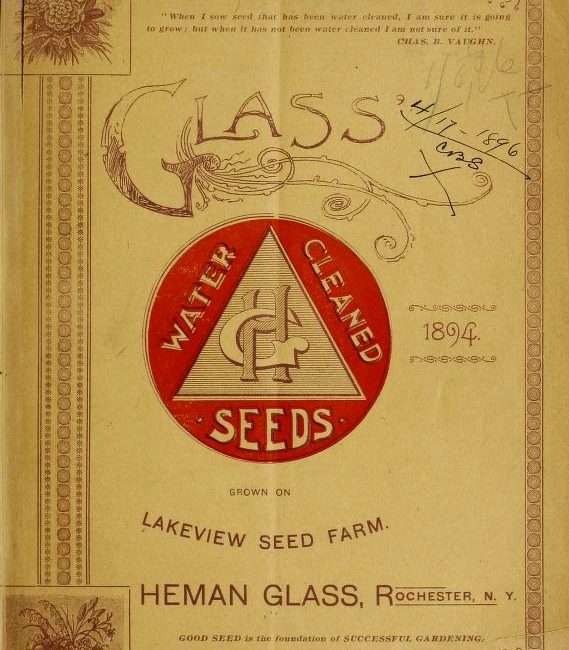
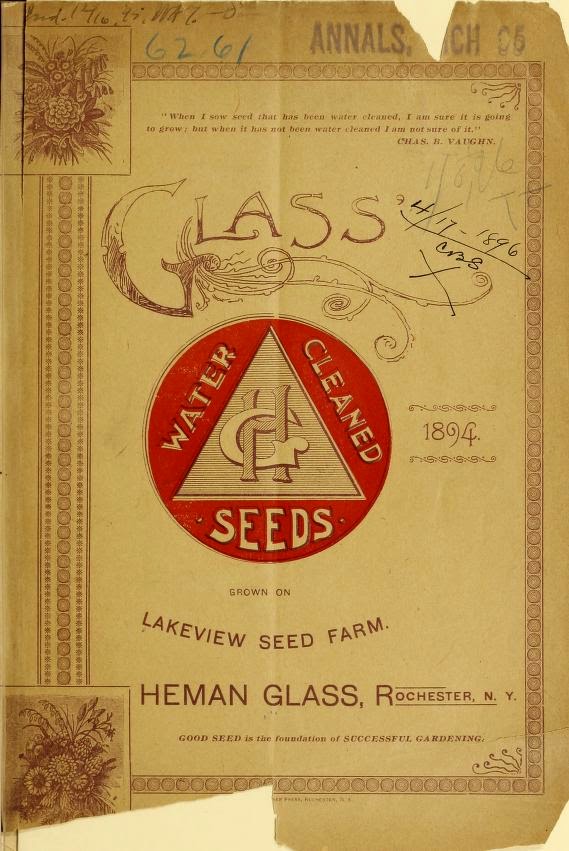
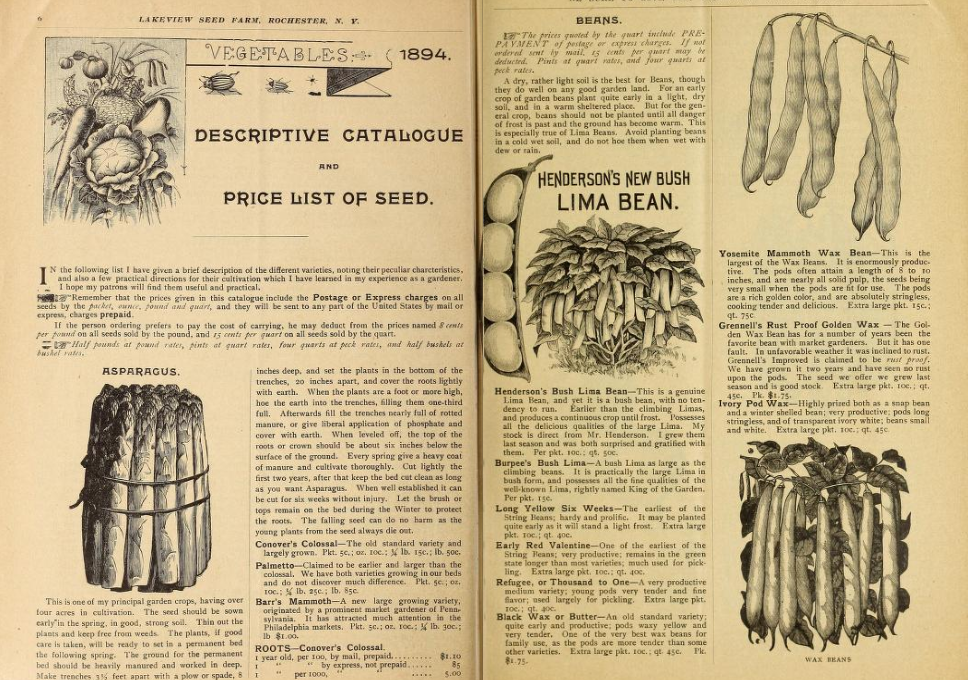
Seed Catalog: Glass’ Water Cleaned Seeds Grown on Lakeview Seed Farm, by Heman Glass, Published 1894.  Courtesy of the United States Department of Agriculture National Agricultural Library.  View full catalog here.
View Full Size Image
Image of Available Vegetable Seeds from Glass’ Water Cleaned Seeds Grown on Lakeview Seed Farm, by Heman Glass, Published 1894.  Courtesy of the United States Department of Agriculture National Agricultural Library.  View full catalog here.

Heirloom vegetables have been passed down over generations, often being 50, 75 or 100 years in cultivation.  Heirloom gardeners use seed saving techniques or buy seeds from heirloom seed companies.  You can explore various antique seed catalogs in the Biodiversity Heritage Library’s collection here to see the types of seeds our ancestors used, some of which are now heirloom varieties if they have been carefully preserved over time to maintain the same genetic traits (as explained above).  Aside from vegetables, people have also preserved flowers over time, creating heirloom varieties.  The Heirloom Garden at the Smithsonian National Museum of American History contains shrubs, perennials, annuals, bulbs and tropicals grown in American gardens prior to 1950.

Prior to, and during, WWII, many people grew their own vegetables in backyard gardens.  When many hybrid plants were produced after the War, creating plants with desirable traits and increased yields, a large number of people wanted to preserve their own seed because they missed old varieties of plants.  This led to the beginning of the heirloom gardening movement.  The first use of the term “heirloom” in relation to plants appears to be in describing edible crops, most likely bean seeds, in the 1940s: Professor J. R. Hepler at the University of New Hampshire told John Withee, prominent bean seed collector, about some beans given to him by friends and described them as “heirloom”.  Widespread use of the term was cemented in 1981 when Kent Whealy, co-founder of Seed Savers Exchange, gave a speech in Tucson using the term after obtaining permission to use it from John Withee.

Seed Catalogs and Heirloom Gardening

View Full Size Image
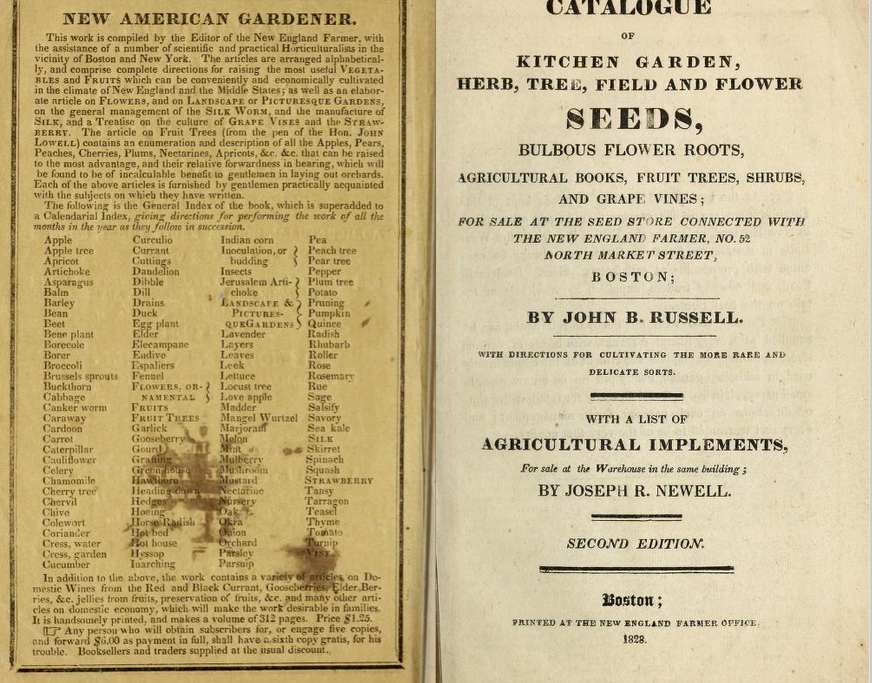
Early Seed Catalogue: Catalogue of Kitchen Garden, Herb, Tree, Field and Flower Seeds, Bulbous Flower Roots, Agricultural Books, Fruit Trees, Shrubs, and Grape Vines, by Joseph R. Newell, Published 1828.  Courtesy of the United States Department of Agriculture National Agricultural Library.  View full catalog here.

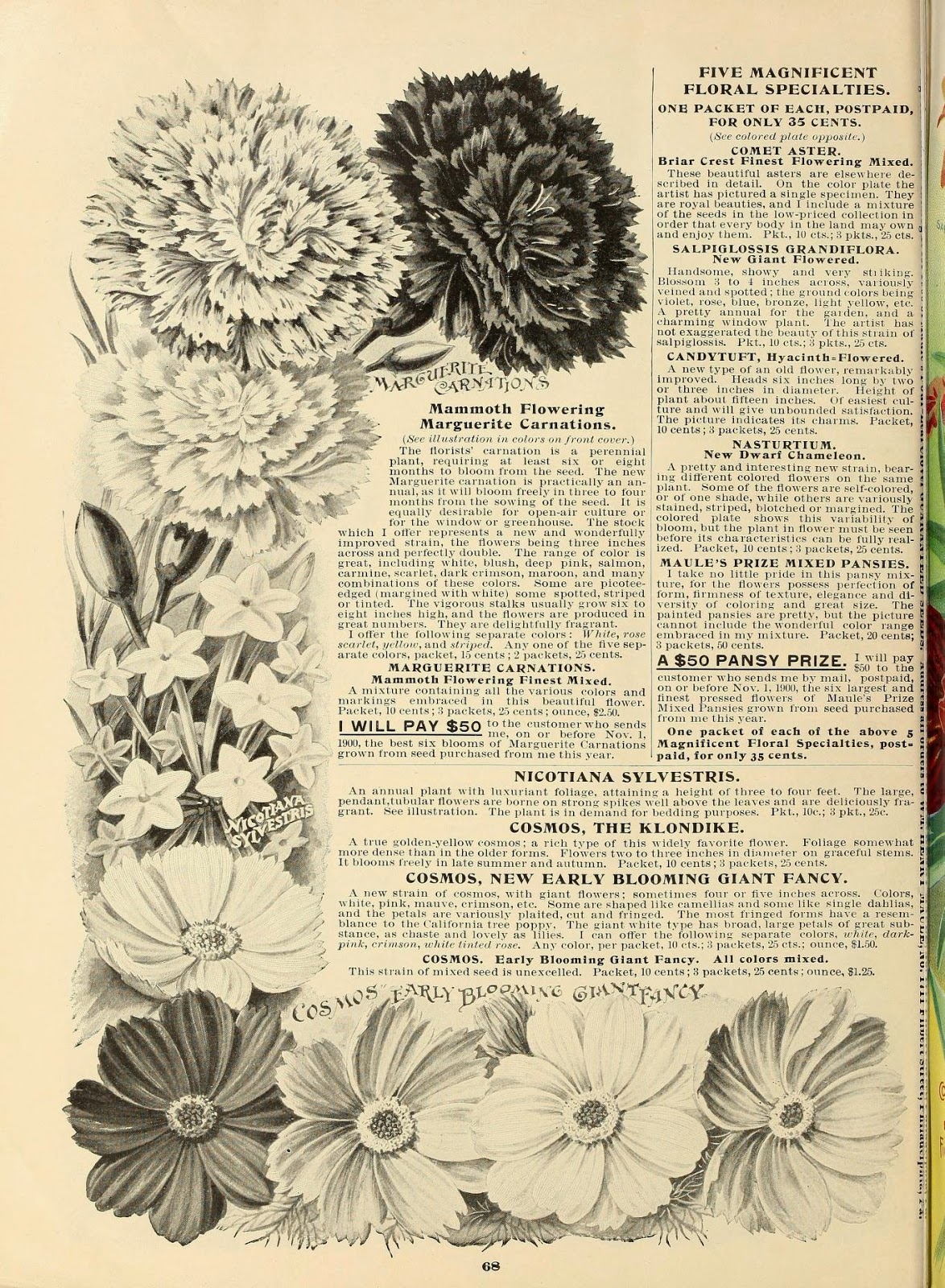
Many heirloom plants are available through seed catalogs.  A majority of these catalogs are currently held in different collections, and by looking at images and reading descriptions of plants in these catalogs, one can determine when certain heirloom varieties which still exist today were first introduced.  You can search the Biodiversity Heritage Library for heirloom plants by scientific name (the genus and specific epithet) and find old catalogs, magazines and publications containing that name. For instance, search for Nicotiana sylvestris in the Biodiversity Heritage Library catalog and you will find the beautifully-illustrated Maule’s Seed Catalogue from 1900.  Below is an image of the Maule’s page featuring Nicotiana sylvestris (click here to view that page in the catalog online).  Nicotiana sylvestris is a night scented tobacco plant, also called “Woodland Tobacco”, that grows up to five feet tall with three-to-four inch hanging trumpet-shaped white blossoms that open in the evening to release a sweet scent–and you can learn more and still purchase this heirloom plant today at places like Seed Saver’s Exchange!

View Full Size Image
Seed Catalog: Maule’s Seed Catalogue, by Maule, Published 1900. This page features a listing of Nicotiana sylvestris seeds for sale (an heirloom still available today). Courtesy of the United States Department of Agriculture National Agricultural Library.  View full catalog here.
View Full Size Image
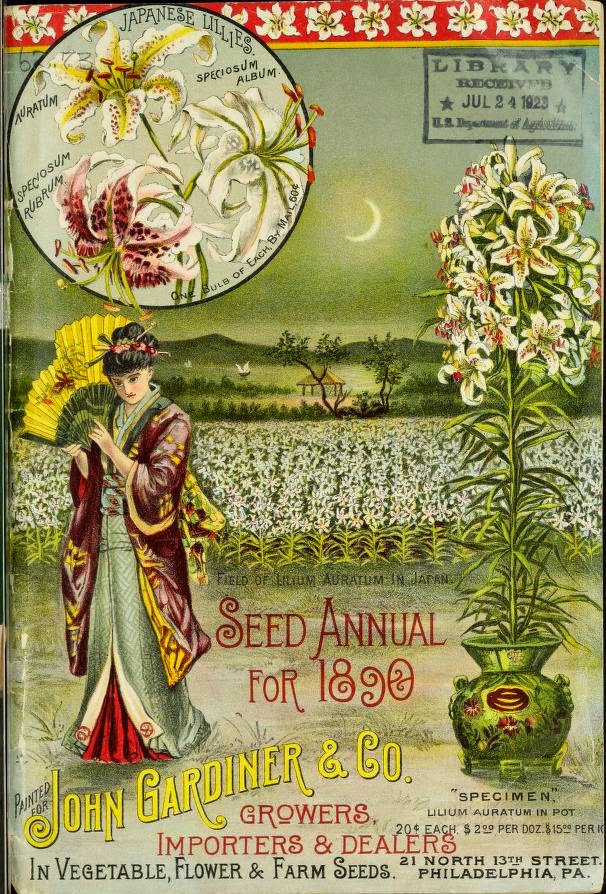
Seed Catalog: Seed Annual for 1890, by John Gardiner and Co., Published 1890.  Courtesy of the United States Department of Agriculture National Agricultural Library.  View full catalog here.

Older seed catalogs are especially helpful to the modern heirloom gardener—peruse the catalogs to discover the plants you might like to have in your garden, and then search for heirloom seed varieties of those plants at modern companies such as Seed Savers Exchange and Southern Exposure Seed Exchange.  Check out the beautiful seed catalogs available at the Biodiversity Heritage Library here.

Happy seed catalog viewing and heirloom gardening!

Garden Stories: A Week Long Event for Garden Lovers

All this week, we’ll be exploring the fascinating world of gardening, including garden history topics such as the development of hybrids, heirloom gardening, women in the seed industry, revolutions in garden marketing through art, and the vital role the Shakers played in the American seed industry. We’ll also be sharing great gardening tips and plant factoids with help from our BHL members and affiliates. And we’ll be using the over 14,000 seed and nursery catalogs in BHL to help tell these stories. Join in all the gardening fun by:

  • Follow our blog and #BHLinbloom on Twitter and Facebook (or go directly to BHL’s Twitter and Facebook) this week as we explore the fascinating world of gardening, from its history to plant factoids and practical gardening tips.
  • Browse over 14,000 seed and nursery catalogs in our collection.
  • Browse over 2,500 seed and nursery catalog images in our Flickr collection.
  • Explore select seed catalog art, and stunning bookmarks and postcards developed by Cornell Library, on Pinterest.
  • See historic gardening come to life on the Smithsonian Libraries’ Tumblr.
  • Purchase your very own Garden Stories T-Shirt through T-Fund. All proceeds will go to help us digitize more pages for BHL. Our goal is to sell enough shirts to digitized 5,000 pages. Can you help us get there?
  • Help us improve access to seed and nursery catalogs by transcribing some today as part of our the Institute of Museum and Library Services (IMLS)-funded Purposeful Gaming project!
  • Find great online gardening resources, tips, and help on the BHL Gardening Resources Page.

Special thanks to Joseph Brunetti and Erin Clark at the Smithsonian National Museum of American History HeirloomGarden for their significant contributions.

References:

  • Adams, Denise Wiles.  Restoring American Gardens: An Encyclopedia of Heirloom Ornamental Plants, 1640-1940.  Portland, OR: Timber Press, 2004.
  • Weaver, William Woys.  Heirloom Vegetable Gardening: A Master Gardener’s Guide to Planting, Seed Saving, and Cultural History.  New York, NY: Henry Holt and Company, 1997.
March 24, 2015by micahv
Blog Reel, Featured Books

Early Women In Science: Trekking Through Nature, Trailblazing Their Way Through History

The sixteen women featured in the “Early Women In Science” exhibition are each extraordinary for unique reasons.  One trait they all share is that they were doing work in scientific fields reserved for men. They sometimes had to fight for recognition of their work—or went completely unrecognized for some of their major contributions. For instance, Maria Emma Gray (1787-1876) was a talented natural history illustrator. She not only contributed to the work of her husband, zoologist John Edward Gray, but also saw him through his nervous breakdown, eventually helping him to work again. Despite her contributions to his studies, however, she is not credited in his works.

View Full Size Image
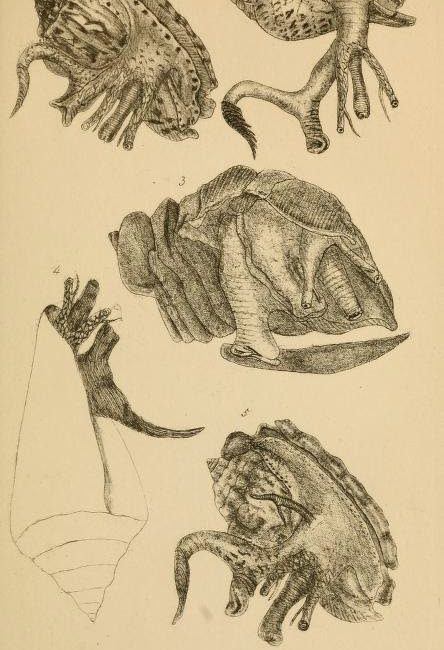
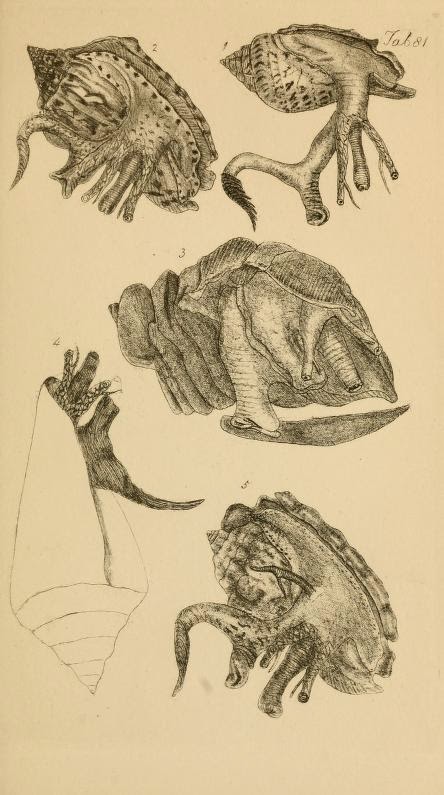
Illustration by Maria Emma Gray, from Figures of Molluscous Animals, Selected from Various Authors. Etched for the Use of Students by Maria Emma Gray, vol. 2, 1859 | Smithsonian Biodiversity Heritage Library

Even when the male scientific community did praise the contributions of their feminine peers, many of the earliest women scientists remained resistant to any form of boasting or taking credit, since that was considered unseemly in women. Not so with bold scientists like Ynes Enriquetta, Julietta Mexia, or Alice Eastwood, who rightfully took credit for their amazing accomplishments.

Alice told her contemporary, Agnes Chase (agrostologist, 1869-1963): “the most proper [honor] is that officially the name of the Herbarium is the Alice Eastwood Herbarium of the California Academy of Sciences” since she built it herself “with no help” from 1912 to 1930.And in truth, Alice did manage this effort with little help. Furthermore, prior to the new herbarium’s construction, Alice risked her life to save the Academy’s collections during the San Francisco Earthquake of 1906. Despite fires in the surrounding buildings and a caved-in stairwell, Alice climbed into the previous herbarium and managed to save the most irreplaceable of the herbarium specimens with a rope and pulley and the help of one other man.

View Full Size Image
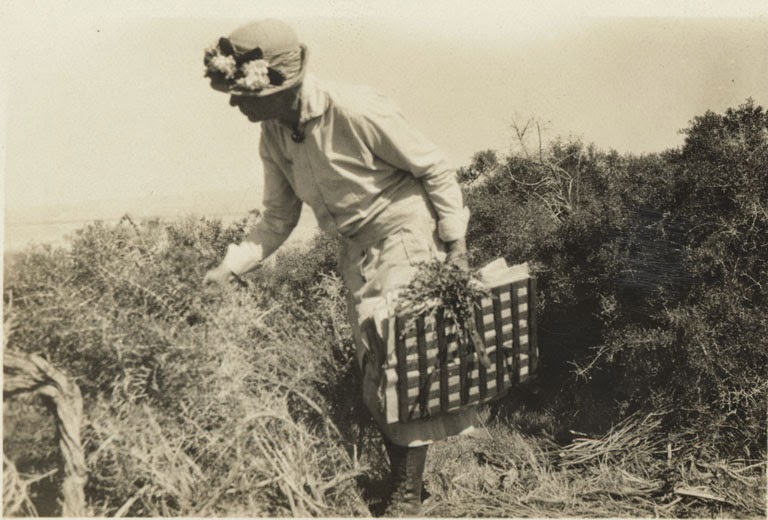
Alice Eastwood collecting Festuca eastwoodae grass, courtesy of the California Academy of Sciences Archives

These women were brave. Not only did they enter their respective fields at a time when women were meant to remain in the domestic sphere, but they often solitarily braved harsh wilderness conditions to explore, observe, and collect flora, fauna and other specimens.  Katherine Brandegee(1844-1920) was a botanist, and in her journeys she survived shipwrecks, seclusion with bears, wolves and coyotes, and encounters with potentially dangerous men in the uninhabited areas she trekked. All the while, collecting and preserving specimens, rather than her own safety, were her primary concerns.

Many of the women in the exhibit shared a courage, a sense of adventure, and a love of nature that allowed them to push through the difficulties—whether physical or mental—of becoming scientists.Some were self-taught, while others were accepted to prestigious schools. Most of them were given honorary degrees and other awards. Some, like Susan Fenimore Cooper (1813-1894), were multi-talented, engaging not only in scientific pursuits, but other artistic endeavors like fiction writing.Furthermore, many of these women demonstrated exceptional foresight, warning that neglect and abuse of our natural environment would result in dire consequences. They were right.

Enjoy the fascinating stories, illustrations and books from and about “Early Women In Science” in our new exhibit here.

December 9, 2014by micahv

Help Support BHL

BHL's existence depends on the financial support of its patrons. Help us keep this free resource alive!

search

About BHL

The Biodiversity Heritage Library (BHL) is the world’s largest open access digital library for biodiversity literature and archives. BHL operates as a worldwide consortium of natural history, botanical, research, and national libraries working together to digitize the natural history literature held in their collections and make it freely available for open access as part of a global “biodiversity community.”

Join Our Mailing List

Sign up to receive the latest news, content highlights, and promotions.

Subscribe Now

Subscribe to Blog via Email

Enter your email address to subscribe to this blog and receive notifications of new posts by email.

Join 319 other subscribers

Subscribe to Blog Via RSS

Subscribe to the blog RSS feed to stay up-to-date on all the latest BHL posts.

Access RSS Feed

Inspiring Discovery through Free Access to Biodiversity Knowledge.

The Biodiversity Heritage Library makes it easier than ever for you to access the information you need to study and explore life on Earth…for free, anytime, anywhere.


64+ Million Pages of
Biodiversity Literature Online.

EXPLORE

Tools and Services
to Transform Research.

EXPLORE

300,000+
Illustrations on Flickr.

EXPLORE

ABOUT | HARMFUL CONTENT | PRIVACY | SITE MAP | TERMS OF USE