Join us for Seeds in the Stacks, a Facebook Live tour at the USDA National Agricultural Library! We’ll go behind-the-scenes to explore selections from the Library’s collection of over 200,000 seed and nursery catalogs.
Continue reading
Join us for Seeds in the Stacks, a Facebook Live tour at the USDA National Agricultural Library! We’ll go behind-the-scenes to explore selections from the Library’s collection of over 200,000 seed and nursery catalogs.
Status Update: 20:45 ET 29 October: Internet Archive is back online. Page images are correctly displaying in BHL. Thanks for your patience!
At the end of the eighteenth century, the “father of German ornithology” began publishing a German translation of General Synopsis of Birds, an important work by John Latham, the “grandfather of Australian ornithology”. This German edition, entitled Johann Lathams Allgemeine Uebersicht der Vögel ([1792] 1793-1812), was translated and edited by Johann Matthäus Bechstein (1757-1822).
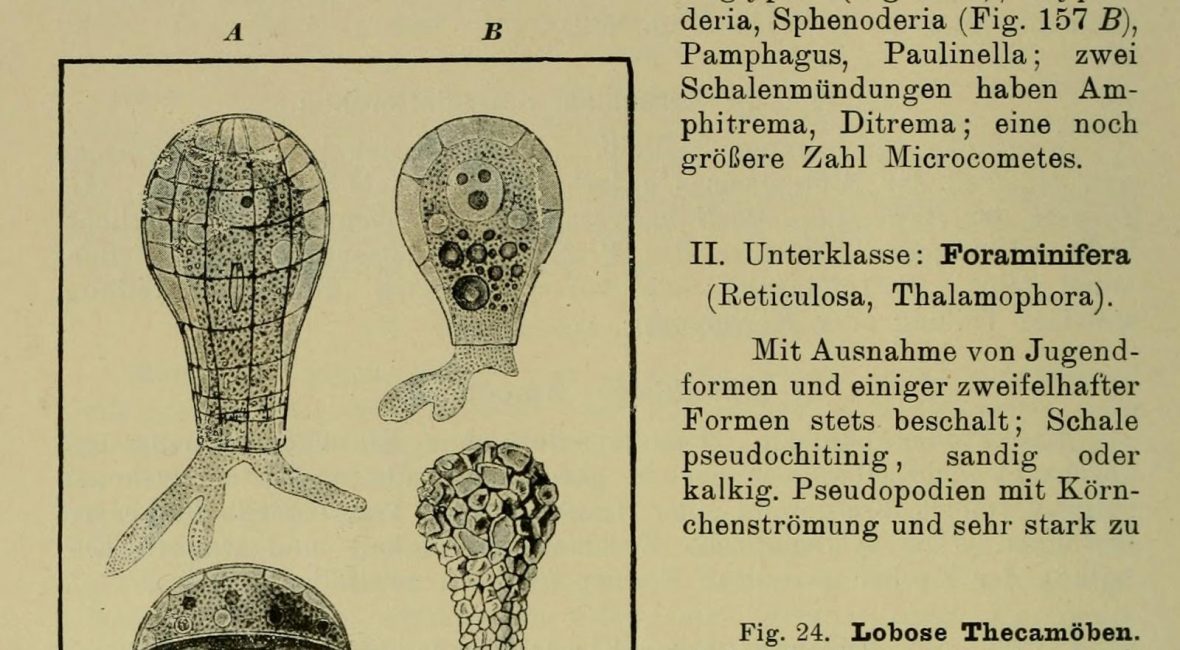
Amoebozoans are believed to have existed for hundreds of millions of years. These ancient protists are characterized by the presence of pseudopodia, cytoplasm-filled projections that are used for locomotion and feeding. Today, over 2,000 species of Amoebozoa are recognized. The phylum itself was first scientifically described by Max Lühe, a professor at the University of Königsberg (Germany), in 1913. Dr. Leigh Anne Riedman, a NASA Astrobiology Postdoctoral Fellow at Harvard University (Department of Earth and Planetary Sciences), specializes in Precambrian paleontology.
Another close relative of the aphids, Daktulosphaira vitifoliae, has also caused extensive damage as a destructive pest. The grape phylloxeran (D. vitifoliae), originally native to eastern North America, feeds on the roots of Vitis vinifera grapes, stunting the growth of or killing its vines.
Conrad Gesner (1516-1565) was a Swiss naturalist whose Historia Animalium is considered the starting point of modern zoology. 26 March is the anniversary of his birth, and institutions around the world will celebrate #GesnerDay by highlighting his publications and contributions on social media.
BHL’s existence depends on the financial support of its patrons. Help us keep this free resource alive!
The Biodiversity Heritage Library (BHL) is the world’s largest open access digital library for biodiversity literature and archives. BHL operates as a worldwide consortium of natural history, botanical, research, and national libraries working together to digitize the natural history literature held in their collections and make it freely available for open access as part of a global “biodiversity community.”
Sign up to receive the latest news, content highlights, and promotions.
Subscribe NowSubscribe to the blog RSS feed to stay up-to-date on all the latest BHL posts.
Access RSS Feed