Biodiversity Heritage Library - Program news and collection highlights from BHL
  • Home
  • News
  • Featured Books
    • All Featured Books
    • Book of the Month Series
    • BHL at 20
  • User Stories
  • Campaigns
    • Fossil Stories
    • Garden Stories
    • Monsters Are Real
    • Page Frights
    • Her Natural History
    • Earth Optimism 2020
  • Tech Blog
  • Visit BHL
Home
News
Featured Books
    All Featured Books
    Book of the Month Series
    BHL at 20
User Stories
Campaigns
    Fossil Stories
    Garden Stories
    Monsters Are Real
    Page Frights
    Her Natural History
    Earth Optimism 2020
Tech Blog
Visit BHL
  • Home
  • News
  • Featured Books
    • All Featured Books
    • Book of the Month Series
    • BHL at 20
  • User Stories
  • Campaigns
    • Fossil Stories
    • Garden Stories
    • Monsters Are Real
    • Page Frights
    • Her Natural History
    • Earth Optimism 2020
  • Tech Blog
  • Visit BHL
Biodiversity Heritage Library - Program news and collection highlights from BHL
Blog Reel, Campaigns, Her Natural History

Graceanna Lewis: A Naturalist and Abolitionist

Black and white portrait of a person wearing glasses.

This post originally published on the Smithsonian Libraries and Archives’ blog, Unbound.

“To her mind the truths of science seem revealed.”

That’s how Phebe A. Hanaford, author of Daughters of America (c. 1882), described naturalist Graceanna Lewis, one of the first three woman to be accepted into the Academy of Natural Sciences. But Lewis was not only one of the first professionally acknowledged women naturalists; she was also an abolitionist and social reformer who worked for the advancement of science as well as human rights. Researchers can find many publications by and about this intriguing woman in the Smithsonian Libraries and Archives’ Digital Library and the Biodiversity Heritage Library.

Born in 1821, Lewis benefitted from an egalitarian Quaker upbringing, one that encouraged education in daughters as well as sons. Lewis told Hanaford that she learned to love natural history from her mother, Esther Lewis. Esther had been a teacher before marriage and continued to educate her own young children, sending her daughters to nearby Kimberton Boarding School as they grew. There, Graceanna was influenced by Abigail Kimber, a woman botanist who had discovered and identified several species. In 1842, Lewis’ uncle, Dr. Bartholomew Fussell, started a new boarding school for girls, and Lewis came on board as a teacher. She taught astronomy and botany, among other subjects.
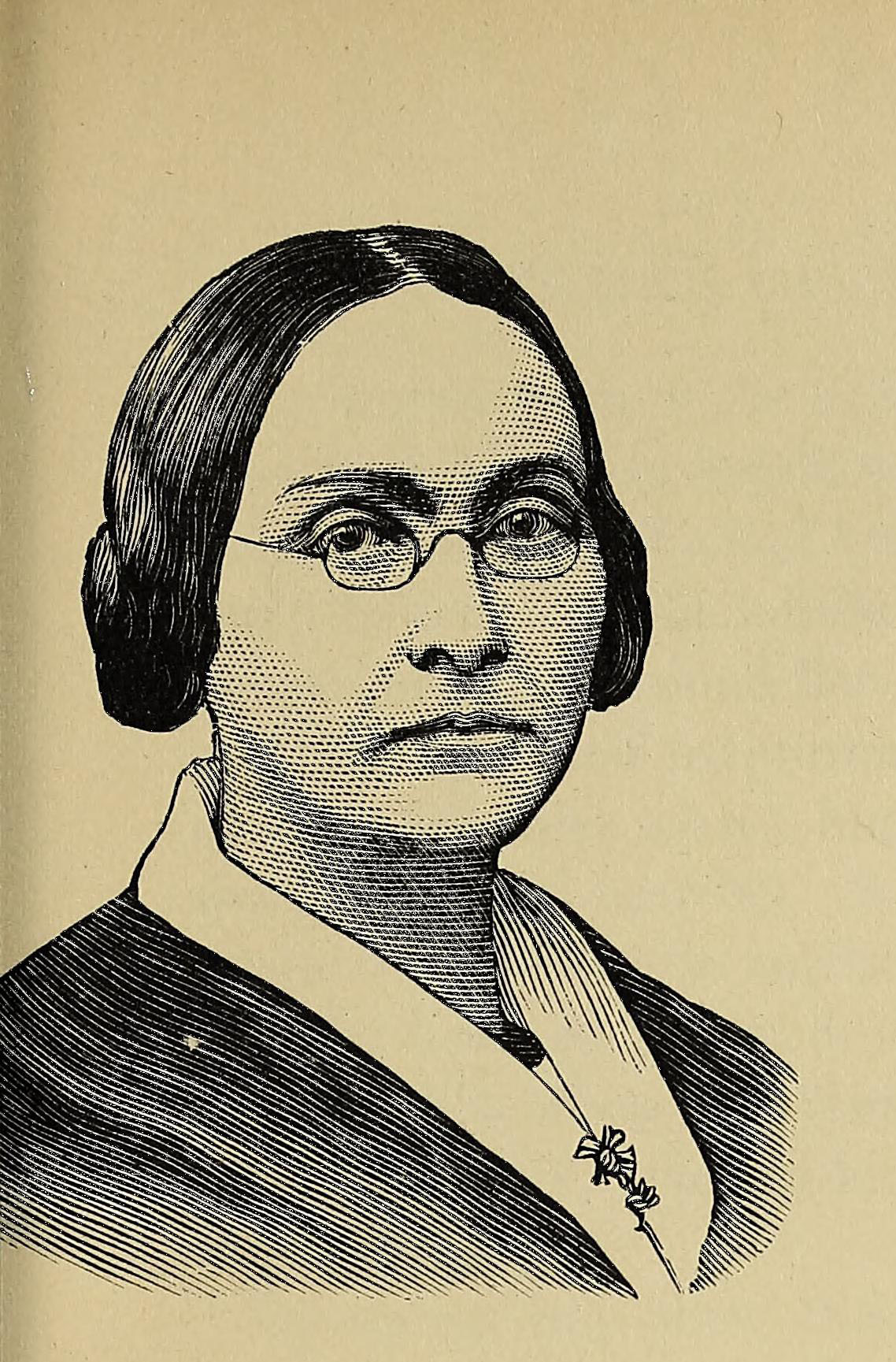
Black and white portrait of a person wearing glasses.

Portrait of Graceanna Lewis. The Underground Rail Road (1872). Digitized by Smithsonian Libraries and Archives.

From her family, Graceanna Lewis inherited not only an interest in science and education but also a deep concern for social issues. Uncle Bartholomew was an active abolitionist, and the family formed a local auxiliary of the American Anti-Slavery Society. The Lewis sisters, Graceanna, Mariann and Elizabeth, were profiled in William Still’s The Underground Rail Road (1872), which described them as “among the most faithful, devoted, and quietly efficient workers in the Anti-slavery cause”.

One of Graceanna’s earliest publications, written in the 1840s, was “An Appeal to Those Members of the Society of Friends Who Knowing the Principles of the Abolitionists Stand Aloof from the Anti-Slavery Enterprise”. It implored fellow Quakers to join the Anti-Slavery movement. The Lewis farm in Pennsylvania became a frequent and successful point on the Underground Railroad, described in detail by Still. The family helped transport those seeking freedom and provided clothes and supplies.

Eventually, Lewis moved away from the family farm to Philadelphia. She had studied birds and other natural sciences on her own, but this move allowed her to take advantage of the specimen and library collections at the nearby Academy of Natural Sciences, and it propelled her into a network of naturalists. In 1862, she met John Cassin, ornithologist and curator of birds at the Academy. Cassin had written, with George N. Lawrence and the Smithsonian’s own Spencer Baird, The Birds of North America (1860), a work Lewis found particularly inspiring.

Cassin would be an invaluable friend and mentor to Lewis, even naming a bird for her, Icterus graceannae, the White-edged oriole. Lewis also corresponded frequently with Baird for years, seeking advice and asking for copies of Smithsonian publications. In 1870, the year after Cassin’s death, Lewis became one of the first three women admitted as members to the Academy.
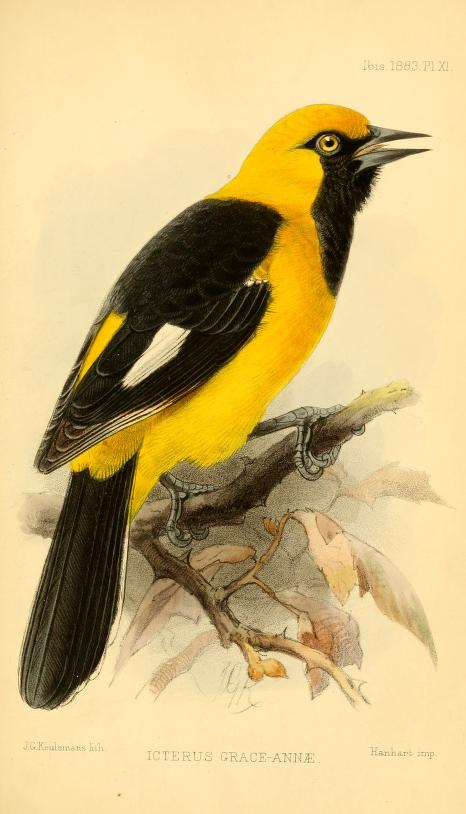
Icterus graceannae, black and yellow bird.

Icterus graceannae, or white-edged oriole, Plate XI. Ibis. Series 5, Volume 1. No. 1-4. (1883). Contributed in BHL from Smithsonian Libraries and Archives.

Lewis had channeled her interested in ornithology into her first scientific publication, Natural History of Birds : lectures on ornithology, in ten parts (1868). It was intended as an inexpensive overview of American birds for a general audience. In it, she also proposed a new classification scheme based on embryology, the characteristics of eggs. Unfortunately, only the first part was published, as funding for the remaining nine was never secured. She continued to research and publish on birds, alongside the leading naturalists of her time. Her articles in The American Naturalist, “The Lyre Bird” (August 1870) and “Symmetrical Figures in Birds’ Feathers” (November 1871) are available in the Biodiversity Heritage Library.

Lewis’ interests and publications grew beyond ornithology, into the classification of natural history and a “tree of life”, which she exhibited at the Centennial Exhibition in 1876. The Development of the Animal Kingdom (1877), available in the Biodiversity Heritage Library, is a twenty-page overview of her theories. It was prepared for the fourth meeting of the Association for the Advancement of Women. The group was formed in 1868 with the goal of presenting practical methods for improving women’s role in society, including education on a variety of subjects. Unsurprisingly, Lewis was active on the group’s Committee on Science.
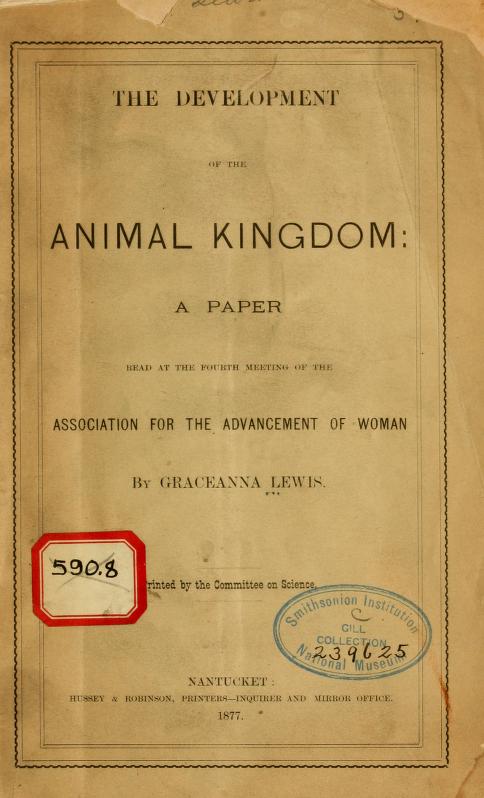
Cover, The Development of the Animal Kingdom (1877)

Cover. The Development of the Animal Kingdom. (1877). Contributed in BHL from Smithsonian Libraries and Archives.

Lewis told Phebe A. Hanaford in 1882, “I feel that my life’s work is before me, in lecturing on zoology to girls just blooming into womanhood”. For the next twenty years, Lewis continued to teach and write about various natural history topics. Her article “On the Genus Hyliota”, discussing the distinction of two rare African birds, was published in The Annals and magazine of natural history in 1883. Her social reform interests turned to temperance and suffrage, serving stints as secretary for her local chapter of the Women’s Christian Temperance Union and suffrage association.

Graceanna Lewis died in 1912 in Media, Pennsylvania at the age of 90. Her contributions to both science and social progress leave a remarkable and inspiring legacy.

Further Reading

Baird, Spencer Fullerton, John Cassin and George N. Lawrence. The Birds of North America (1860).

Baird, Spencer Fullerton. Spencer Fullerton Baird Papers. Record Unit 7002. Smithsonian Institution Archives.

Bonta, Marcia. “Graceanna Lewis, Portrait of a Quaker Naturalist”. Quaker History, Volume 74, Number 1, Spring 1985, pp. 27-40.

Hanaford, Phebe A. Daughters of America (1883).

Lewis, Graceanna. “An appeal to those members of the Society of Friends who knowing the principles of the abolitionists stand aloof from the anti-slavery enterprise”. [between 1840 and 1849?].

Lewis, Graceanna. The Development of the Animal Kingdom (1877).

Lewis, Graceanna. “The Lyre Bird”. The American Naturalist (August 1870), pp 321.

Lewis, Graceanna. “On the genus Hyliota”. The Annals and magazine of natural history, Series 5, Volume 12, No. 67, pp. 210-212.

Lewis, Graceanna. “Symmetrical Figures in Birds’ Feathers” . The American Naturalist (November 1871), pp. 675-678.

Lewis-Fussell Family Papers, SFHL-RG5-087, Friends Historical Library of Swarthmore College.

Still, William. The Underground rail road (1872).

Truitt, James. “Digitizing the Papers of Graceanna Lewis, Ornithologist and Activist”. Cassinia. No. 77 (2017-2018), pp. 40-41.

Warner, Deborah Jean. Graceanna Lewis, scientist and humanitarian (1979).

March 30, 2021by Pedro Gonzalez Fernandez
BHL News, Blog Reel, Tech Updates

BHL Moves to HTTPS

HTTPS? What does it mean? HTTP is the language that your browser uses to communicate to BHL and the S stands for Secure, encrypted, unreadable, or at least much, much harder to read.

The web is moving to encrypted connections across the board. In 2014 Google announced that their page rank algorithm that decides the order of your google.com search results will now rank insecure pages slightly lower than secure pages. From security to rankings, encrypted connections are better for everyone.

View Full Size Image
(Source: Sean MacEntee via Wikimedia Commons (CC-BY 2.0))

“What does it mean for how I use BHL?” you ask.

Well, not much. If you go to a link that uses http://, you will invisibly be redirected to https:// almost immediately.

“What does it mean for my bookmarks or catalog?”

Those still work, too. If you wish, you may update your bookmarks to use https:// and if it’s simple, your catalog and databases, as well. However, the old http:// will continue to redirect indefinitely and forever.

“Why would I want to encrypt my work on BHL? We’re not doing top secret work here.”

Encryption of the communication between your computer and BHL prevents malicious activity, such as intercepting the content, inserting some nasty code onto the page, and happily sending it along to your browser to wreak havoc on your day.

“How do I know it’s really working?” 

You’ve seen it already: a green padlock icon, sometimes with the text “Secure” beside it. This indicates that the site and all of its content are fully encrypted and hidden from prying eyes and hackers.

“What if I use the BHL API? Do I need to do anything?”

After a minor hiccup this morning, no, there’s nothing you need to do. Going forward, however, the best action to take is to update your code to use https://.

“Psst! This very blog post isn’t encrypted. Did you forget it?”

Good eye for detail! We are in the process of updating the blog, and website encryption will be part of the relaunch later in 2017.

“And what about all those wiki pages that still refer to http://?”

We’ll be updating those as we can. Thanks for your patience, but the links all still work!

In summary, carry on as you would and continue the great work you do. If you have specific questions, please feel free to send us feedback here.

October 3, 2017by Pedro Gonzalez Fernandez
BHL News, Blog Reel, Tech Updates

Information about Upcoming Changes to BHL API

Portrait version of the Biodiversity Heritage Library logo.

The BHL API will be updated on 25 July 2016 to support changes to the BHL site. These changes will accommodate identifying additional Contributors for Items and Parts of items.

First are changes to the API that may affect your existing processes.

The Contributor and ContributorID elements in the result sets of API methods that return “Part” information will move. ContributorID will be included as a PartIdentifier in the Identifiers list. Contributor will be included in a new Contributors list.

These changes are being made to accommodate more than one contributor per part.  For example, if one institution researches/compiles the data and a second institution facilitates the inclusion of that data in BHL, both institutions may be listed as a contributor.  Initially, no more than two contributors per part will be allowed, but by adopting these changes to API responses we allow for additional (unlimited, actually) contributors in the future.

Here is an example that shows how the API responses are changing.  The examples shown here are an output of the GetPartMetadata method, and have been abbreviated for clarity.

Original API Results – highlighted elements are being moved:

<Response>
 <Status>okStatus>
 <Result>
 <PartUrl>
        http://www.biodiversitylibrary.org/part/1
 PartUrl>
 <PartID>1PartID>
 <ItemID>22498ItemID>
 <StartPageID>3190776StartPageID>
 <SequenceOrder>1SequenceOrder>
 <Contributor>BioStorContributor>
 <ContributorID>4443ContributorID>
 <GenreName>ArticleGenreName>
 <Title>
      Notes on certain species of Tetragnatha 
      (Araneae, Argiopidae) in Central America 
      and Mexico
 Title>
 <ContainerTitle>BrevioraContainerTitle>
 <Volume>67Volume>
 <Date>1957Date>
 <PageRange>1--4PageRange>
 <StartPageNumber>1StartPageNumber>
 <EndPageNumber>4EndPageNumber>
 <Authors> [...] Authors>
 <Subjects />
 <Identifiers>
 <PartIdentifier>
 <IdentifierName>ISSNIdentifierName>
 <IdentifierValue>0006-9698IdentifierValue>
 PartIdentifier>
 Identifiers>
 <Pages> [...] Pages>
 <RelatedParts />
 Result>
Response>

Updated API Results – Highlighted elements are the new locations of the moved data:

<Response>
 <Status>okStatus>
 <Result>
 <PartUrl>
        http://www.biodiversitylibrary.org/part/969
 PartUrl>
 <PartID>1PartID>
 <ItemID>22498ItemID>
 <StartPageID>3190776StartPageID>
 <SequenceOrder>1SequenceOrder>
 <GenreName>ArticleGenreName>
 <Title>
        Notes on certain species of Tetragnatha
        (Araneae, Argiopidae) in Central America
        and Mexico
 Title>
 <ContainerTitle>BrevioraContainerTitle>
 <Volume>67Volume>
 <Date>1957Date>
 <PageRange>1--4PageRange>
 <StartPageNumber>1StartPageNumber>
 <EndPageNumber>4EndPageNumber>
 <Authors> [...] Authors>
 <Contributors>
 <Contributor>
 <ContributorName>BioStorContributorName>
 Contributor>
 Contributors>
 <Subjects />
 <Identifiers>
 <PartIdentifier>
 <IdentifierName>BioStorIdentifierName>
 <IdentifierValue>4443IdentifierValue>
 PartIdentifier>
 <PartIdentifier>
 <IdentifierName>ISSNIdentifierName>
 <IdentifierValue>0006-9698IdentifierValue>
 PartIdentifier>
 Identifiers>
 <Pages> [...] Pages>
 <RelatedParts />
 Result>
Response>

Additionally, there will be two additions to the Item metadata.

The new data elements are: RightsHolder and ScanningInstitution.
These will optionally be displayed if there is data for the relevant organizations.


<Response>
 <Status>okStatus>
 <Result>
 <ItemID>59382ItemID>
 <PrimaryTitleID>20770PrimaryTitleID>
 <ThumbnailPageID>17605914ThumbnailPageID>
 <Source>Internet ArchiveSource>
 <SourceIdentifier>bulletin5160hatcSourceIdentifier>
 <Volume>v.51-60 1898-99Volume>
 <Year/>
 <Contributor>
      UMass Amherst Libraries (archive.org)
 Contributor>
 <RightsHolder>
 Biodiversity Heritage Library
 RightsHolder>
 <ScanningInstitution>
 Smithsonian Institution Libraries
 ScanningInstitution>
 <Sponsor>UMass Amherst LibrariesSponsor>
    [...]
 Result>
Response>

Detailed documentation for the BHL APIs is available at http://www.biodiversitylibrary.org/api2/docs/docs.html.  It will be updated to reflect these changes after they are moved into production on 25 July 2016.

Go to http://www.biodiversitylibrary.org/getapikey.aspx to get an API key for BHL.

Information about other BHL developer tools can be found at http://biodivlib.wikispaces.com/Developer+Tools+and+API.

If you have questions, please feel free to submit feedback via this form.

July 12, 2016by Pedro Gonzalez Fernandez

Help Support BHL

BHL's existence depends on the financial support of its patrons. Help us keep this free resource alive!

search

About BHL

The Biodiversity Heritage Library (BHL) is the world’s largest open access digital library for biodiversity literature and archives. BHL operates as a worldwide consortium of natural history, botanical, research, and national libraries working together to digitize the natural history literature held in their collections and make it freely available for open access as part of a global “biodiversity community.”

Join Our Mailing List

Sign up to receive the latest news, content highlights, and promotions.

Subscribe Now

Subscribe to Blog via Email

Enter your email address to subscribe to this blog and receive notifications of new posts by email.

Join 319 other subscribers

Subscribe to Blog Via RSS

Subscribe to the blog RSS feed to stay up-to-date on all the latest BHL posts.

Access RSS Feed

Inspiring Discovery through Free Access to Biodiversity Knowledge.

The Biodiversity Heritage Library makes it easier than ever for you to access the information you need to study and explore life on Earth…for free, anytime, anywhere.


64+ Million Pages of
Biodiversity Literature Online.

EXPLORE

Tools and Services
to Transform Research.

EXPLORE

300,000+
Illustrations on Flickr.

EXPLORE

ABOUT | HARMFUL CONTENT | PRIVACY | SITE MAP | TERMS OF USE