Biodiversity Heritage Library - Program news and collection highlights from BHL
  • Home
  • News
  • Featured Books
    • All Featured Books
    • Book of the Month Series
    • BHL at 20
  • User Stories
  • Campaigns
    • Fossil Stories
    • Garden Stories
    • Monsters Are Real
    • Page Frights
    • Her Natural History
    • Earth Optimism 2020
  • Tech Blog
  • Visit BHL
Home
News
Featured Books
    All Featured Books
    Book of the Month Series
    BHL at 20
User Stories
Campaigns
    Fossil Stories
    Garden Stories
    Monsters Are Real
    Page Frights
    Her Natural History
    Earth Optimism 2020
Tech Blog
Visit BHL
  • Home
  • News
  • Featured Books
    • All Featured Books
    • Book of the Month Series
    • BHL at 20
  • User Stories
  • Campaigns
    • Fossil Stories
    • Garden Stories
    • Monsters Are Real
    • Page Frights
    • Her Natural History
    • Earth Optimism 2020
  • Tech Blog
  • Visit BHL
Biodiversity Heritage Library - Program news and collection highlights from BHL
Blog Reel, Featured Books

Book of the Week: The Iconic Biodiversity of Africa

Africa. It is the second largest continent in the world, as well as the second most populous. It is commonly regarded to be the location in which the human species originated. It is the only continent to stretch from the northern to southern temperate zones, making it home to a wide variety of life. Furthermore, it has the largest number of megafauna species in the world (megafauna being literally “large animals,” typically considered those weighing greater than 100 or 220 pounds). As such, it is home to some of the most iconic species alive today, including elephants, lions, giraffes, and gorillas.

One of the most recent items added to our Flickr account is Great and Small Game of Africa (1899), and the stunning illustrations within the work have already inspired a great deal of chatter on the twitterverse.

While this volume was originally written as a guide for sportsmen, much of the biodiversity knowledge we hold in written format today was supplied in part by the observations and experiences of these individuals. This volume collects as much information about the species described within as was available and practical at the time of publication and presents it in a highly accessible format. For an added element of excitement for the reader, “Many of the articles have been written in the depths of Africa itself.”

We present the illustrations and accompanying prose that we found most enticing. You can see all of the illustrations from this book on our Flickr account, and experience for yourself all the captivating accounts of these great fauna within the pages of the work itself.
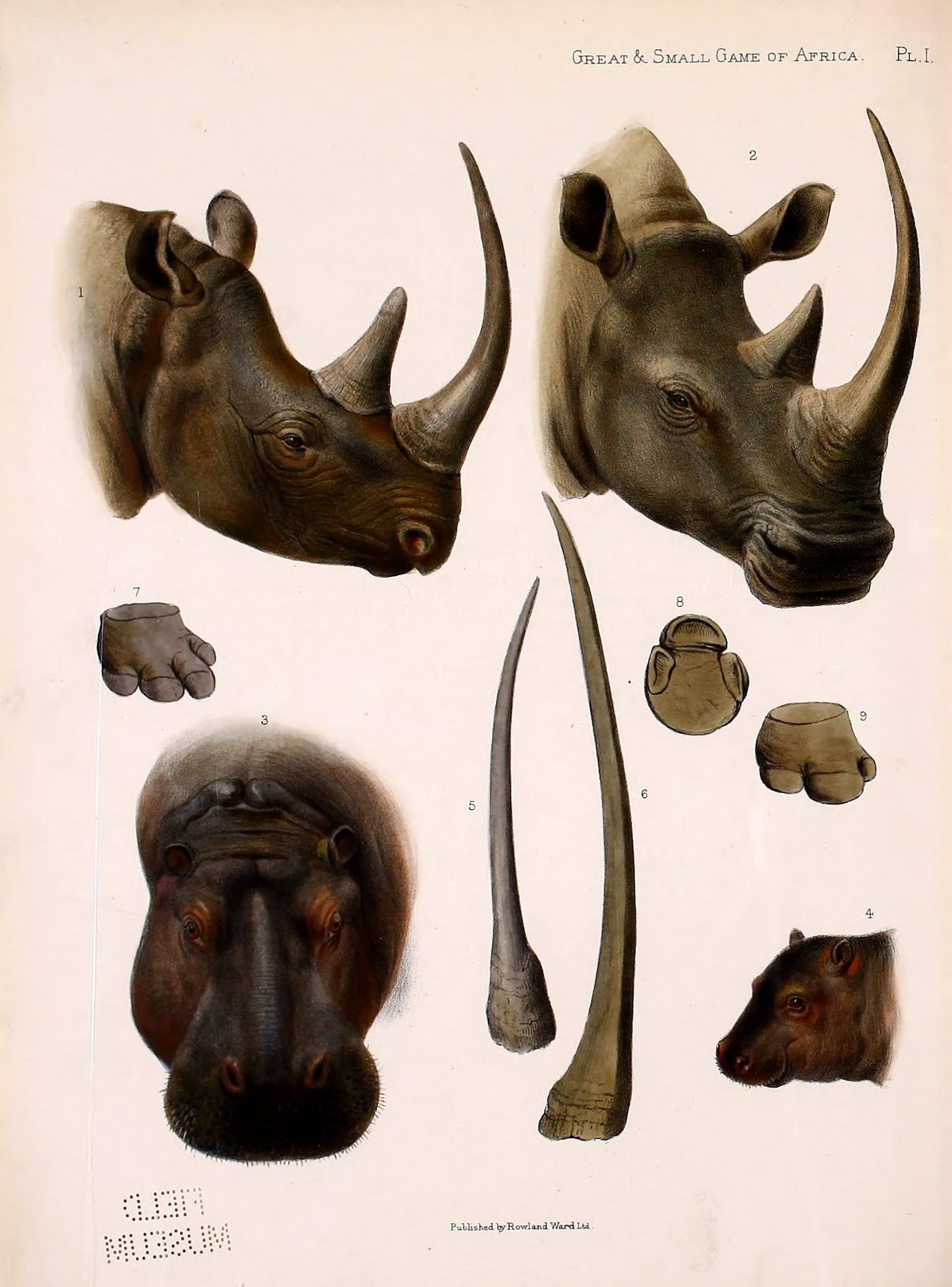
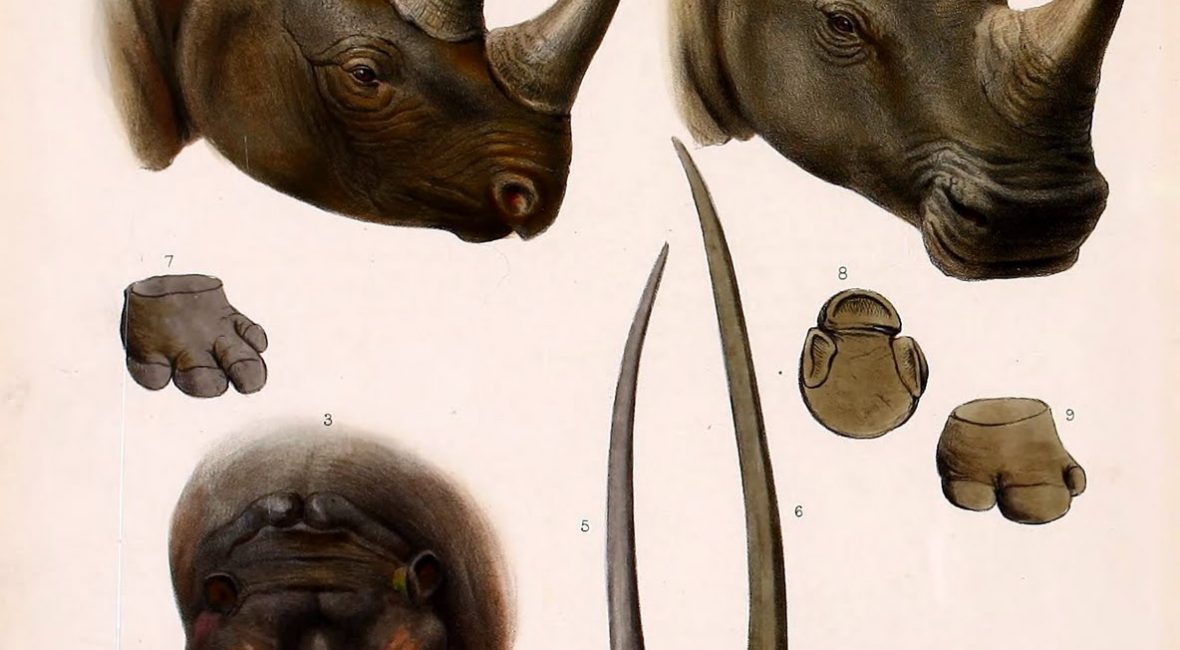
View Full Size ImageThe Rhinoceros

“At present day the group is restricted to Africa and the warmer parts of Asia. In Africa it is represented by the widely-spread common or black rhinoceros (R. bicornis [now Diceros bicornis]), the nearly extinct Burchell’s, or white rhinoceros (R. simus [now Ceratotherium simum]) of the Cape and south-eastern regions, and the little-known Holmwood’s rhinoceros (R. holmwoodi [determined to be the Black Rhinoceros in Tanzania]) of East Africa. All three are distinguished from their Asiatic relatives by their smooth skins and the absence of front teeth; and all have two horns. Burchell’s rhinoceros, which is a grass-feeder, differs, however, very widely from the common species in the structure of its cheek-teeth. Holmwood’s rhinoceros is at present known only by the horns and may prove not to be a distinct form.”
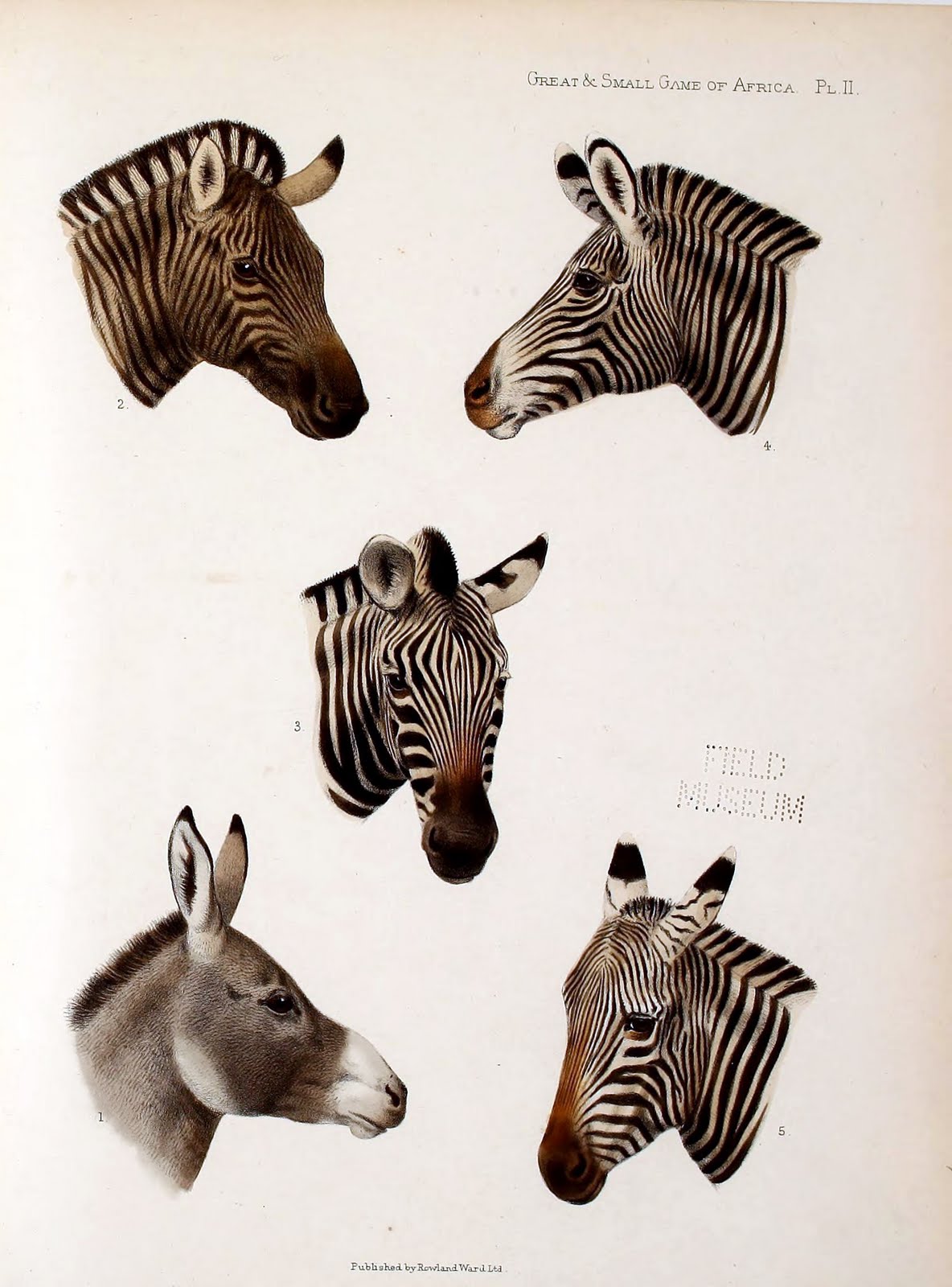
View Full Size ImageThe Zebra

“The zebras (sub-genus Hippotigris), which range over the open districts south of the Sahara, and are peculiar to Africa, differ from the asses in that at least the head and fore-part of the body are striped; the stripes in some cases extending over the whole animal. Four well-marked species may be recognised, viz.:- the quagga (E. quagga quagga [extinct subspecies of E. quagga]), now extinct, Burchell’s zebra (E. burchelli), Grevy’s zebra (E. grevyi), and the true or mountain zebra (E. zebra). Of the second of these at least seven more or less well-marked local races or sub-species may be distinguished, differing from one another in the arrangement of the stripes on the body, the presence or absence of intermediate ‘shadow-stripes,’ and the extent to which the striping extends on to the legs.”
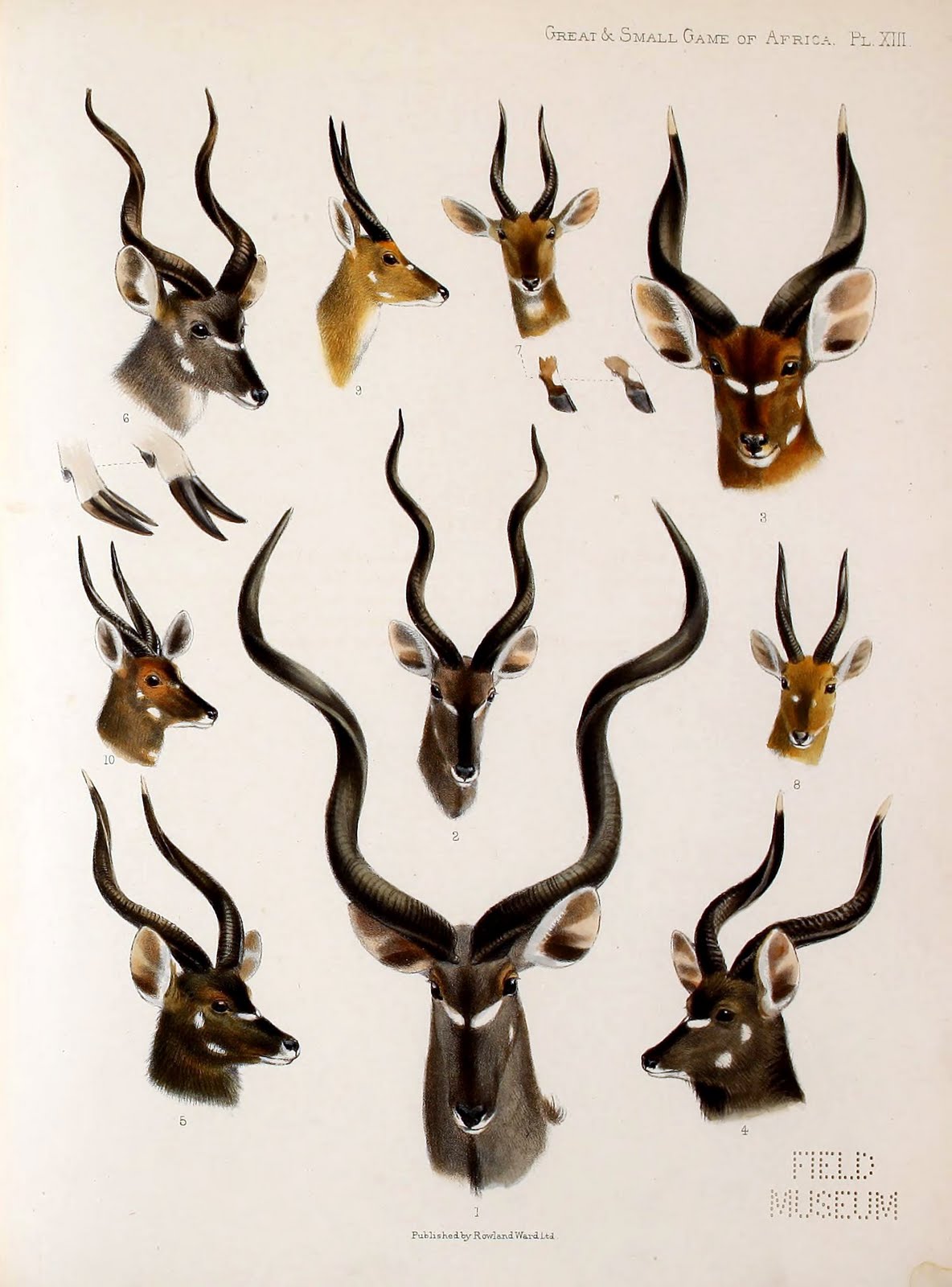
View Full Size ImageThe Koodoo

“Koodoo, the name by which one of the most beautiful animals in the whole world is known to European sportsmen, must be, I think, a word of Hottentot origin, since it is not Dutch, nor does it at all resemble any of the many equivalents for the same animal used by the various Bantu tribes inhabiting South and South Central Africa.

This splendid antelope was once widely distributed through the southern portion of the African continent. Two conditions are necessary to its existence – water and bush…And wherever in South Africa these two conditions were fulfilled – with the single exception of the forests of Knysna – I believe that koodoos were once to be found. In the early part of the present century, koodoos were numerous in many parts of the eastern province of the Cape Colony, but they had become exceedingly rare in those districts at the date of my first visit to South Africa in 1871. Since that time, thanks to wise legislation on the part of the Cape Government, and the loyal support given to the gamelaws by the British and Dutch farmers, koodoos have lately very much increased in numbers in some of their old haunts within that territory.”
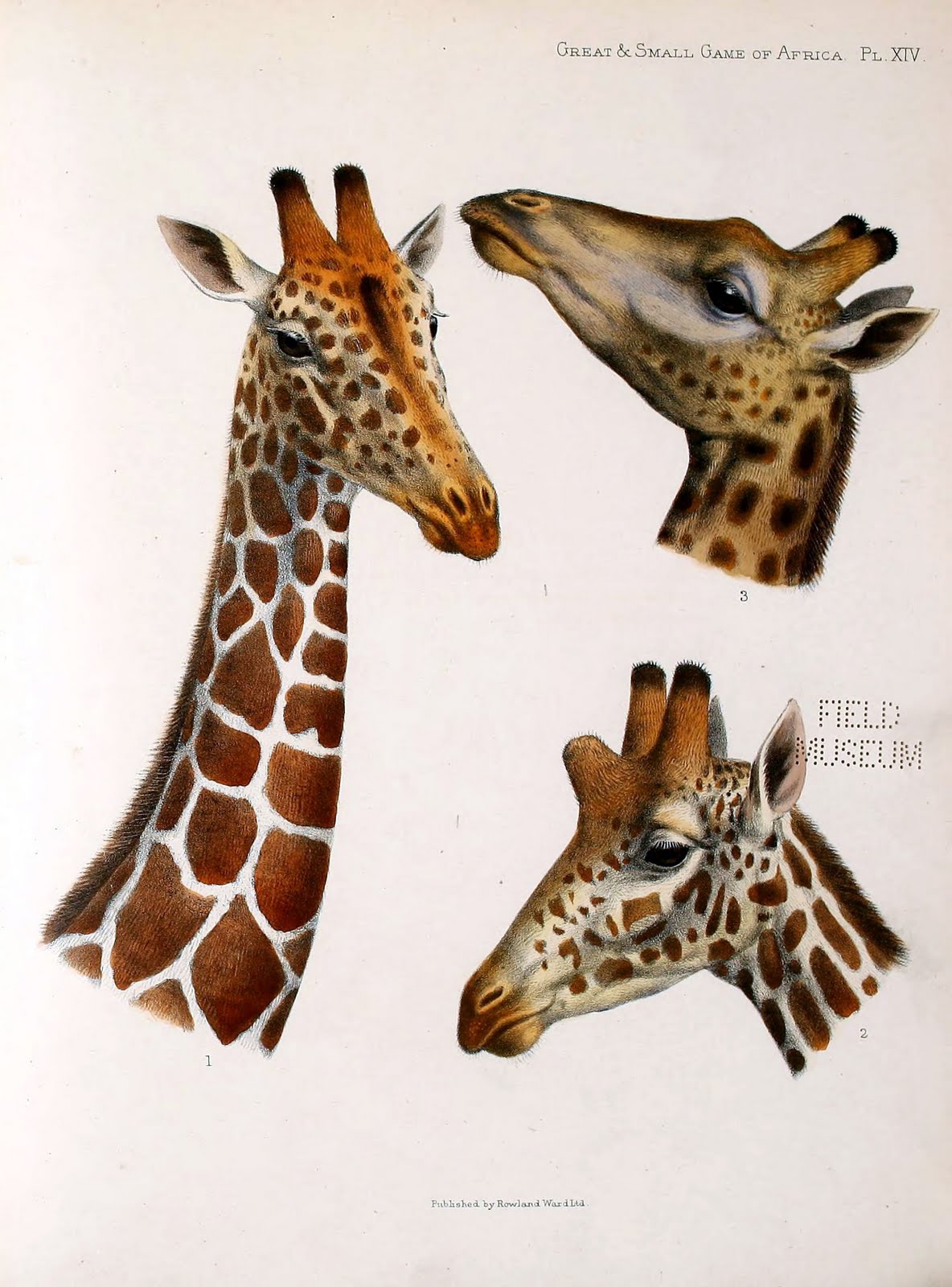
View Full Size ImageThe Giraffe

“These animals are very difficult of approach, in a general way, for they are extremely keen-sighted, and their towering height enables them to command a wide view…I do not think that lions very often succeed in killing these animals, defenceless though they be; and when they do, I believe it is generally a solitary giraffe (individuals of either sex are often seen alone) that has been surprised and pulled down by a party of lions.

Tick-birds – the same that so generally accompany the rhinoceros – often visit them, and it is curious to see these little guests running up and down their long necks, clinging to their sides and bellies, or sitting contentedly upon their heads while emitting their soft, querulous chirruping.

I have never heard giraffes make any sound, nor have I heard or read anywhere that their cry, if they have one, has ever been noticed.”


January 19, 2012by ulib-libraryjobs
Blog Reel, User Stories

BHL and Our Users: Dr. Kanchi Gandhi

View Full Size ImageThis week, we feature a colleague who combs the botanical literature for new plant names, determines their validity and contributes them to the International Plant Name Index (IPNI). Meet Dr. Kanchi Gandhi, who has been recognized by the American Association of Plant Taxonomists (ASPT) for his countless pieces of nomenclatural advice provided to taxonomists worldwide and for keeping classical expertise in the practice of taxonomy alive.

What is your title, institutional affiliation, and area of interest?

I have been the Senior Nomenclatural Registrar at the Harvard University Herbaria (HUH) in Cambridge, MA since 1995. I compile New World plant names for the IPNI and manage the HUH authority files for generic names, authors’ names, and publication titles.

My interests are in the areas of plant nomenclature, plant morphology, and plant taxonomy.

How long have you been in your field of study?

I began my first botanical project in 1970 as a scientific assistant at St. Joseph College in Bangalore, India, working on a survey of local flora in collaboration with the Smithsonian Institution. That is how I met Smithsonian botanist, Dan Nicolson, with whom I continued to work with for nearly 40 years. I taught plant taxonomy at The National College, Bangalore. I was awarded a Ph.D. from Texas A&M; University in 1989.

When did you first discover BHL?

The Harvard botany librarians introduced me to BHL in 2005.

What is your opinion of BHL and how has it impacted your research?

I use it to consult materials that are not in our library and it is especially useful to me when my library is closed. I use it for the many reference questions that come to me to verify plant names and associated data. BHL is also very useful in communicating with international colleagues who cannot access Google-scanned material.

How often do you use BHL?

Every day, nearly 365 days a year!

How do you usually use BHL (read the titles online/download whole PDFs/Select Pages to Download for a custom PDF/etc.)?

I primarily use it as an online resource and refer others to it by forwarding URLs.

What are your favorite features/services on BHL?

The new search page works very well, especially for finding scientific names.

If you could change one thing about BHL, what would it be, or what developmental aspect would you like the BHL team to focus on next?

I would prefer to have a simpler way to download a page or a segment of a page as one can do via the Real Jardín Botánico site or via the page delivery service (PDS) in Harvard’s online catalog, HOLLIS.

If you had to choose one title/item in BHL that has most impacted your research, or one item that you prefer above any other in BHL, what would it be and why?

In my case the digitization of early Indian floras would be very useful.

Conclusion:

Thank you, Dr. Gandhi, for giving us a brief glimpse into your work and use of the BHL! It is exciting to hear from one of our users that has taken advantage of BHL since its inception. We are constantly working to improve our user interface, and your comments about improving ease of download is valuable feedback for our developers.

To learn more about Dr. Gandhi, visit his webpage.

January 17, 2012by ulib-libraryjobs
BHL News, Blog Reel

BHL and EOL at ALA Midwinter 2012!

View Full Size ImageThe American Library Association’s 2012 Midwinter Meeting in Dallas, Texas, is just around the corner. January 20th-24th, thousands of librarians and other interested parties will descend upon the city to participate in the five day conference focused on everything you could possibly want to talk about regarding libraries. For more information about the conference, visit the ALA Midwinter 2012 website.

With the prospect of such an appropriate audience gathered in one place, we at BHL, along with our friends at Encyclopedia of Life (EOL), decided that this would be the perfect opportunity to share a little bit about BHL and EOL with the rest of the world. How so? By hosting a booth at the conference.

The booth (booth number 1157), which will be open beginning at 5:30pm, Friday, Jan. 20th, until 2:00pm, Monday, Jan. 23rd, will be manned by various members of the BHL and EOL staff, all of whom will be ready and waiting to answer any questions or engage in any conversations you might have about either project, or the broader digital landscape in general. We’ll also be live demoing both websites (BHL and EOL), showcasing our fabulous Flickr site, and handing out some great swag, including buttons, pens, brochures, business cards, and more. Plus, we’ll be holdings raffles for even more snazzy things, including tote bags and tumblers. Oh, and of course, there will be candy!

So, to recap, if you’re going to be at ALA Midwinter next week, stop by the BHL and EOL booth. And if you’re not going to ALA, well, now that you know we are, you’re making your travel plans, right? 😉

  • What? BHL and EOL booth at ALA Midwinter, Dallas, TX, Jan. 20th-24th (For more information on the booth, click here and search under “E” for Encyclopedia of Life/Biodiversity Heritage Library)
  • Where? Exhibit Hall, Booth #1157
  • When? Booth will be open from 5:30pm, Friday, Jan. 20th – 2:00pm, Monday, Jan. 23rd (see exhibit site for more details on hours)
  • Why? Learn all about BHL and EOL with your chance to ask questions of staff, engage in lively conversations, and view live demos of the sites and affiliated content. Plus, we’ll be handing out great free stuff! Don’t miss it!
January 12, 2012by Grace Costantino
Blog Reel

My Life as a BHL Staffer: Gilbert Borrego

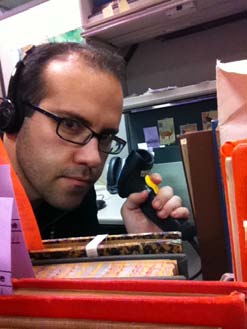
View Full Size ImageTo kick off the new year, we here at BHL are starting a new monthly series titled “My Life as a BHL Staffer.” Each month, we will showcase a different BHL staff member and give an overview of what tasks and duties that person performs. We kick off the series with me, Gilbert Borrego, BHL staff member from the Smithsonian Institution. While I have a lot of different duties to perform for BHL, I can group them into three main areas: Social Media (which includes Flickr and Facebook), the pagination of BHL materials, and lastly, the pulling and returning of the physical items that will be scanned and eventually show up on BHL. I’ll start with the fan favorite:

BHL Flickr:

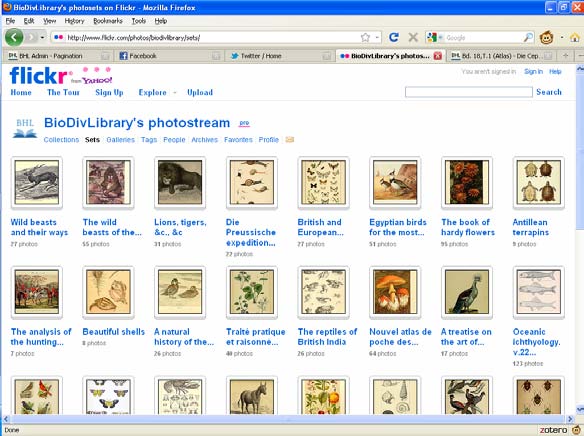
The goal of having a BHL Flickr page (http://www.flickr.com/photos/biodivlibrary/sets/) is to have a means to showcase BHL content in a new and fun way. We want to supply a pool of image content for dissemination through multiple social media sites like Facebook and Twitter, and for other potential BHL projects. We also use it to provide BHL content to the Encyclopedia of Life (http://eol.org) as part of their practice to automatically pull images from Flickr to include on EOL taxon pages. Lastly, we want to use it a way to connect with you, the BHL and Flickr communities!

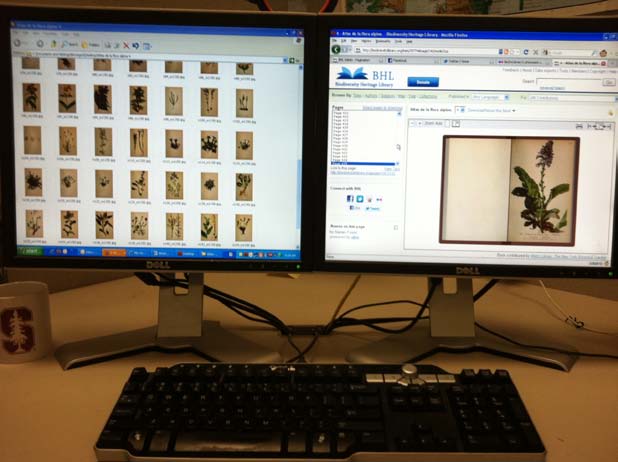
We started making a real concerted effort to populate and utilize Flickr in July 2011 and it just took off! I usually choose the items that I want to post on Flickr based on what items come across my desk, looking at items on the BHL recent addition feed (http://biodiversitylibrary.org/Recent.aspx), or doing keyword searches on BHL (http://biodiversitylibrary.org/). I look for the most visually stunning, interesting or intricate plates that I can find. I download all the images from an item, one image at a time.

View Full Size Image

Believe me, the two monitor set up is necessary!

I then upload them into Adobe Bridge which enables me to attach the all important metadata to all of the images. The metadata includes the filename, the creator, the source, descriptive information, keywords, credits, and copyright information. After that, I upload the whole batch to the BHL Flickr page and assign it to various categories including the contributing institution, the classification of the animals or plants pictured, and whether the item was used as a Book of the Week for this blog.

View Full Size Image
Beautiful, huh? 🙂

We also provide BHL content to the Encyclopedia of Life (http://eol.org). Images from our Flickr page are added to EOL when tagged with the proper machine tags with scientific names. You can learn more about machine tags here:
http://www.flickr.com/groups/encyclopedia_of_life/rules/
And guess what? YOU can add machine tags to our images too! In fact, we would love for some assistance in getting even more of our images into EOL! Learn how to do it with this snazzy tutorial:
http://www.slideshare.net/eoleducation/eol-flickr-tutorial

We currently have over 22,000 images on Flickr and will continue to keep adding more and more! If you know of any items in BHL with images that are screaming to be added to Flickr, please let us know via FlickrMail or leave us some feedback ([email protected]).

I also post everyday on Facebook: https://www.facebook.com/pages/Biodiversity-Heritage-Library/63547246565 We typically provide news and information that would be of potential interest to our Facebook followers. We try to change up the look of our page when we can, which means changing the profile picture often. Most importantly, we try to engage our users by being as interactive as we can. We love replying to comments and questions, so please be active and participate on our quizzes and make plenty of comments about anything we post!

Pulling and Returning Items:

SIL’s scanning process begins with the selection of material to scan. Material is selected for scanning based on three key areas: content identified by the systematic scanning of a biodiversity discipline topic (i.e. Entomology, Ornithology, Botany, etc.), institutional publications, and content identified through BHL’s issue tracking system, called Gemini, which includes user-submitted feedback. You can submit a scan request (or any other type of question or feedback here:

http://biodiversitylibrary.org/Feedback.aspx

Staff members work to resolve this feedback by assigning them to various BHL institutions to address. We also have a system in place that helps to help make sure different institutions do not scan the same items. Once items have been selected for scanning, I will retrieve the items from the appropriate library branch which are located throughout the Smithsonian Natural History Museum building.

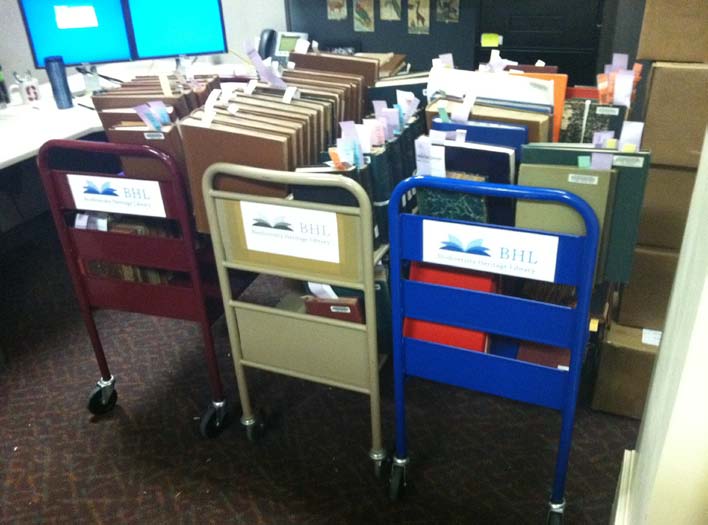
Once the items have been scanned and the books are sent back to us, I review the quality of the scans by performing a statistical sampling of books from the shipment or scanning batch. The process of quality assessment can be time consuming as it involves clicking through the scanned page images while turning the physical pages of the book at the same time. However, it is very important that we provide high quality scans that are not missing pages or that have pages that are cut off. After the assessment, the items are checked back in and reshelved.

View Full Size Image

Yikes, that is a lot of books!

Pagination:

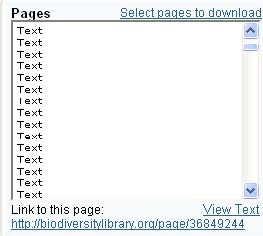
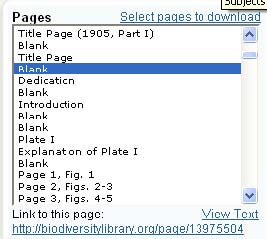
Pagination is the process of dividing our content into discrete pages in order to more easily find the information researchers need to help them do their work in a timely manner without having to search for information page by page. Basically, pagination includes indicating things such as page numbers, volume and issue numbers, tables of content, indices, identifying plates and figures and anything else to make searching through online items easy and quick. My position requires me to do quite a bit of pagination as it is an important component to using BHL for research. In the end, I want to make something that looks like this…
View Full Size Image

…to look a little more like this.

View Full Size Image

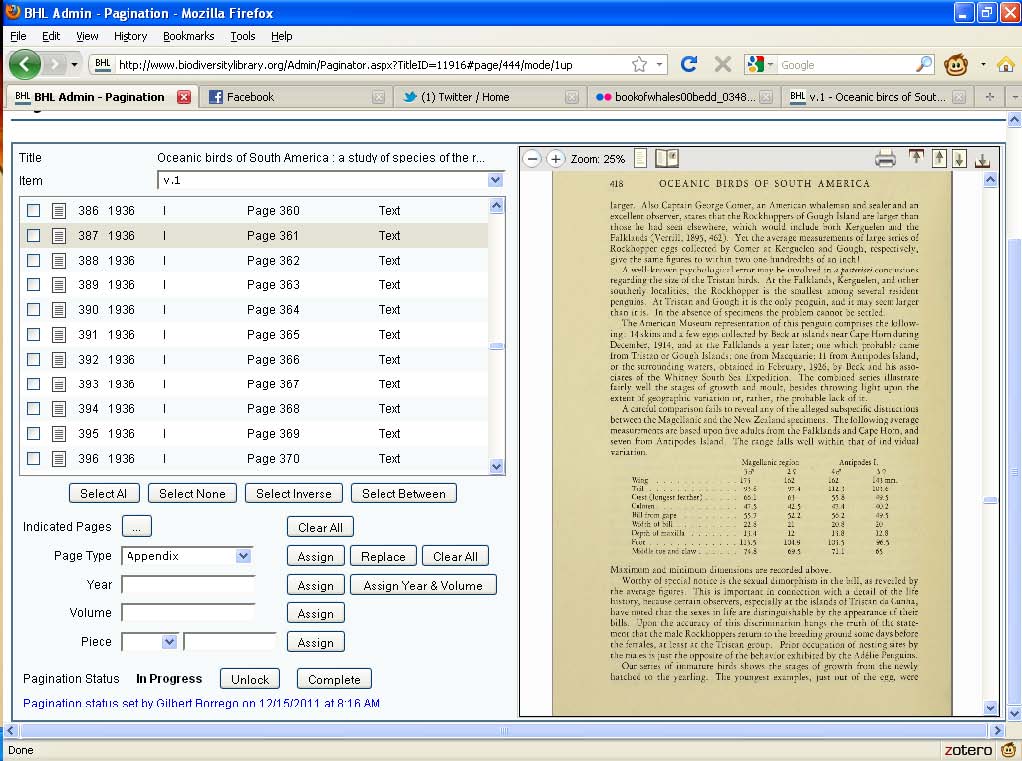
My pagination work screen looks like this:
View Full Size Image

I can manipulate multiple items at one time by checking the appropriate boxes, (for example, finding and checkmarking all the plates and have them numbering sequentially). If this looks like it takes a long time, it does! I have to look at every single page to verify what it is and give it the correct information. An item may take anywhere from 30 minutes to several hours, and certain series may take WEEKS, so be patient with us! 🙂

Seriously, we are looking at various ways to make the pagination process more automated, but for now, we have to manually manipulate each page. We prioritize pagination based on requests from users and we try to finish them up as soon as we can. So, if you know of an item in BHL that you would like paginated, please let us know (http://biodiversitylibrary.org/Feedback.aspx). We will be happy to do it, just give us a little time to get it done.

Well, that is a very brief and simplified description of what I do for BHL. Hopefully it was both interesting and informative! You would not believe how hardworking and committed every BHL staffer is and how committed everybody is to this ambitious project and I am still amazed that I get to play a role in it! Be sure to look out for our next BHL member profile next month and learn more about us!

January 9, 2012by jjdipasquale
Blog Reel, Featured Books

Book of the Week: Celebrating that Delightful Fungus Known as the Mushroom

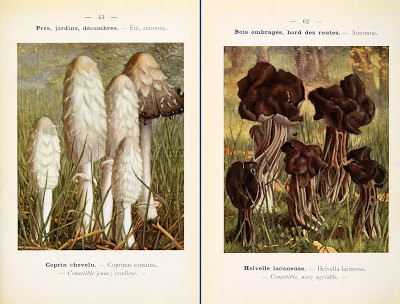
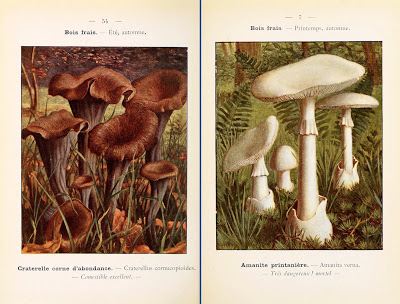
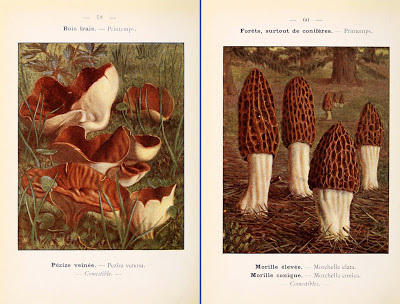
Fliegenpilz. Krötenstuhl. Mousseron. Frogge Stole. Paddocstol. Toadstool. What do all of these words have in common? They are all various names that have been applied to mushrooms over the centuries. Today, we’re celebrating these curious, tasty, and sometimes deadly organisms with our book of the week, Nouvel Atlas de Poche des Champignons Comestibles et Vénéneux, (1911-12), v. 1. Fungi never looked as good as it does in the illustrations in this little gem…except, of course, perhaps between two pieces of bread at dinner last night…

The term “mushroom” refers to the “fleshy, spore-bearing fruiting body of a fungus.” “Mushroom” is most often applied to fungi with a stem, cap, and gills or pores, though it can also be more universally applied to fungi of the Phylum Ascomycota, or “Sac Fungi,” which are often woody or leathery in appearance.

The identification of mushrooms is a skill that takes many forms, from traditional methods including odors, tastes, colors, habitats, and seasons of occurrence, to more modern methods involving molecular investigation. A perhaps more interesting technique, however, involves mushroom spores. Mushrooms reproduce via spores, which are produced from basidia in the gills on the underside of a mushroom cap. These spores fall from the cap, and as a result, if the mushroom cap is cut from the stem and placed on a piece of paper overnight, the spores will fall en masse and reveal the mushroom’s spore color. The spore color can help narrow down the genus of the specimen. Such deposits are referred to as “Spore Prints.”

Mushrooms play a large role in the cuisine of cultures all across the globe, particularly in the foods of China, Korea, Europe and Japan. China, in fact, is the world’s leading producer of edible mushrooms. The most popular commercially-grown species is Agaricus bisporus, which includes the well-known Portobello variety. However, despite their popularity as food, there are a number of toxic species, and telling the harmless from the harmful can be difficult as there is no universally-held trait among all poisonous or non-poisonous varieties. Even those species deemed non-poisonous can produce mild to severe allergic reactions in some individuals. As another concern for European varieties, since mushrooms are capable of absorbing heavy materials, many specimens in Europe may still be contaminated from the Chernobyl disaster.

Below are some of our favorite illustrations from our book of the week, “>Nouvel Atlas de Poche des Champignons Comestibles et Vénéneux, (1911-12), v. 1. You can see all of the illustrations from this book on our Flickr site. As a challenge to our readers, one of the species below is poisonous. Which one?

View Full Size Image

January 5, 2012by michelle.underhill
Blog Reel, User Stories

BHL and Our Users: Aaron Sims

Portrait version of the Biodiversity Heritage Library logo.

View Full Size Image This week, we feature a rare plant botanist for the California Native Plant Society whose first words after discovering BHL for the first time were “this is amazing!” We thrive on these incredible moments of serendipitous discovery we so often hear about from our users, and we’re proud to share one of them with you today in our feature on botanist Aaron Sims!

What is your title, institutional affiliation, and area of interest?

I am the Rare Plant Botanist for the California Native Plant Society (CNPS), and manage the Rare Plant Program and Online Inventory of Rare and Endangered Plants of California (Inventory).In addition to rare plants and field botany, my areas of interest are photography, kayaking, hiking, and pretty much anything involving the outdoors.

How long have you been in your field of study?

My love for the plant sciences started in college after having some very influential and knowledgeable botany teachers that were always enthusiastic and charismatic about the subject, in addition to genuinely caring about their students. Then after taking David Keil’s field botany class at Cal Poly State University in 2005, it was clear to me that botany is where I belong, and I assisted with David’s class until 2010, over three years after I had already graduated. In 2007 I began working for California State Parks on the Central Coast where I performed rare plant and vegetation surveys, in addition to various other tasks pertaining to natural resources. Then after completing the Atlas of Sensitive Species of the Morro Bay Area in 2010 (available at: www.mbnep.org/library), I moved to Sacramento and started working for CNPS.

When did you first discover BHL?

I first discovered BHL sometime in 2010 while researching plants for the Inventory. When a plant needs to be evaluated for inclusion, deletion, or change in rarity status in the Inventory, we initially start contacting people that may have knowledge on the subject taxon and immediately begin an in-depth research through various web resources. BHL came up through one of my searches for the original description of a rare plant taxon, and was the only site that had the actual full original description available for immediate download in PDF format. Awesome! I am pretty sure I exclaimed “this is amazing!” out loud as soon I discovered BHL, and I immediately bookmarked it in my browser.

What is your opinion of BHL and how has it impacted your research?

BHL is an excellent resource that regularly helps the CNPS Rare Plant Program obtain original descriptions for plants during their review and assessment for inclusion/change/deletion in the Inventory. I feel so privileged to be working in a day in age when such resources are so readily available and easy to obtain. As a non-profit society, CNPS doesn’t have sufficient funds to subscribe to online journal databases, nor the time or resources to physically seek out every historical reference regarding rare plants in the Inventory.BHL helps fill this void by providing such resources free and readily available to the public.

How often do you use BHL?

The CNPS Rare Plant Program uses BHL weekly, if not nearly daily while drafting status reviews for changes in the Inventory.

How do you usually use BHL (read the titles online/download whole PDFs/Selecting Pages to Download for a custom PDF/etc.)

We typically use BHL to download whole PDFs that include the entire original description for plants that are being evaluated for the Inventory.

What are your favorite features/services on BHL?

The search functions are simple, accurate, and easy to use.Furthermore, I like the check boxes that accompany a scientific journal which allows one to easily click through subfolders of years, volumes, and issues while still showing the parent directory.

If you could change one thing about BHL, what would it be, or what developmental aspect would you like the BHL team to focus on next?

Perhaps an obvious and routine task, but adding more references is greatly desired.

If you had to choose one title/item in BHL that has most impacted your research, or one item that you prefer above any other in BHL, what would it be and why?

I cannot choose one title of higher impact over another. All scientific journals and references that include botanical information, contain original plant descriptions, or any other pertinent information on plants we review for the Inventory are invaluable to the CNPS Rare Plant Program.Thank you for providing such an important resource and keep up the good work!

January 3, 2012by ulib-libraryjobs
BHL News, Blog Reel

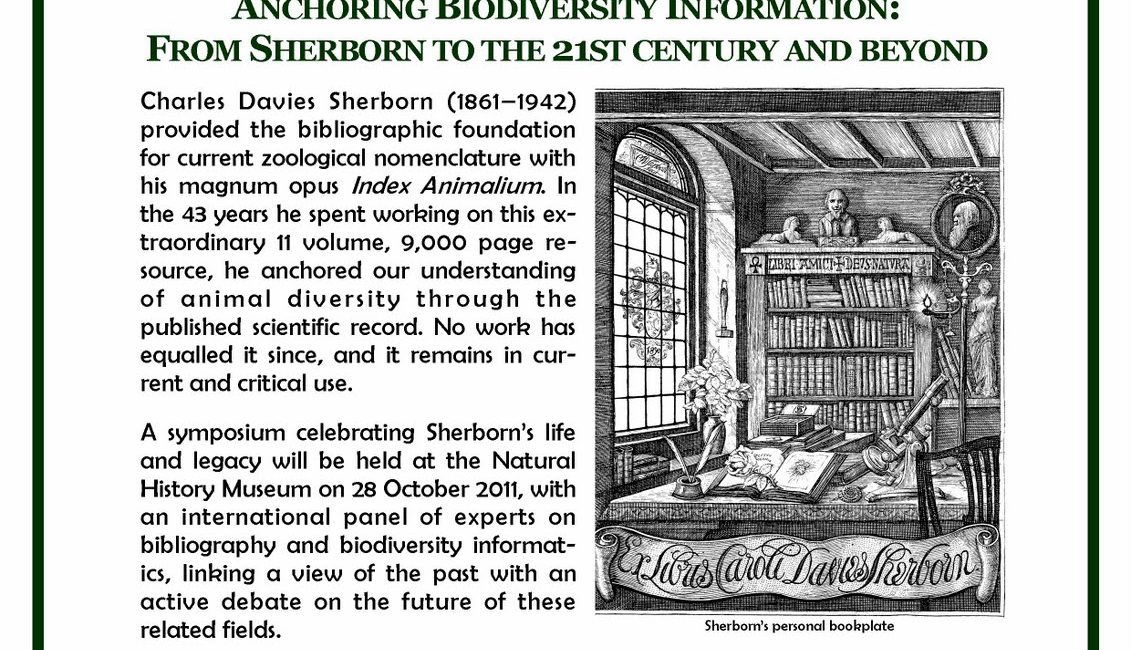
Celebrating the Life and Contributions of Charles Davies Sherborn

View Full Size Image
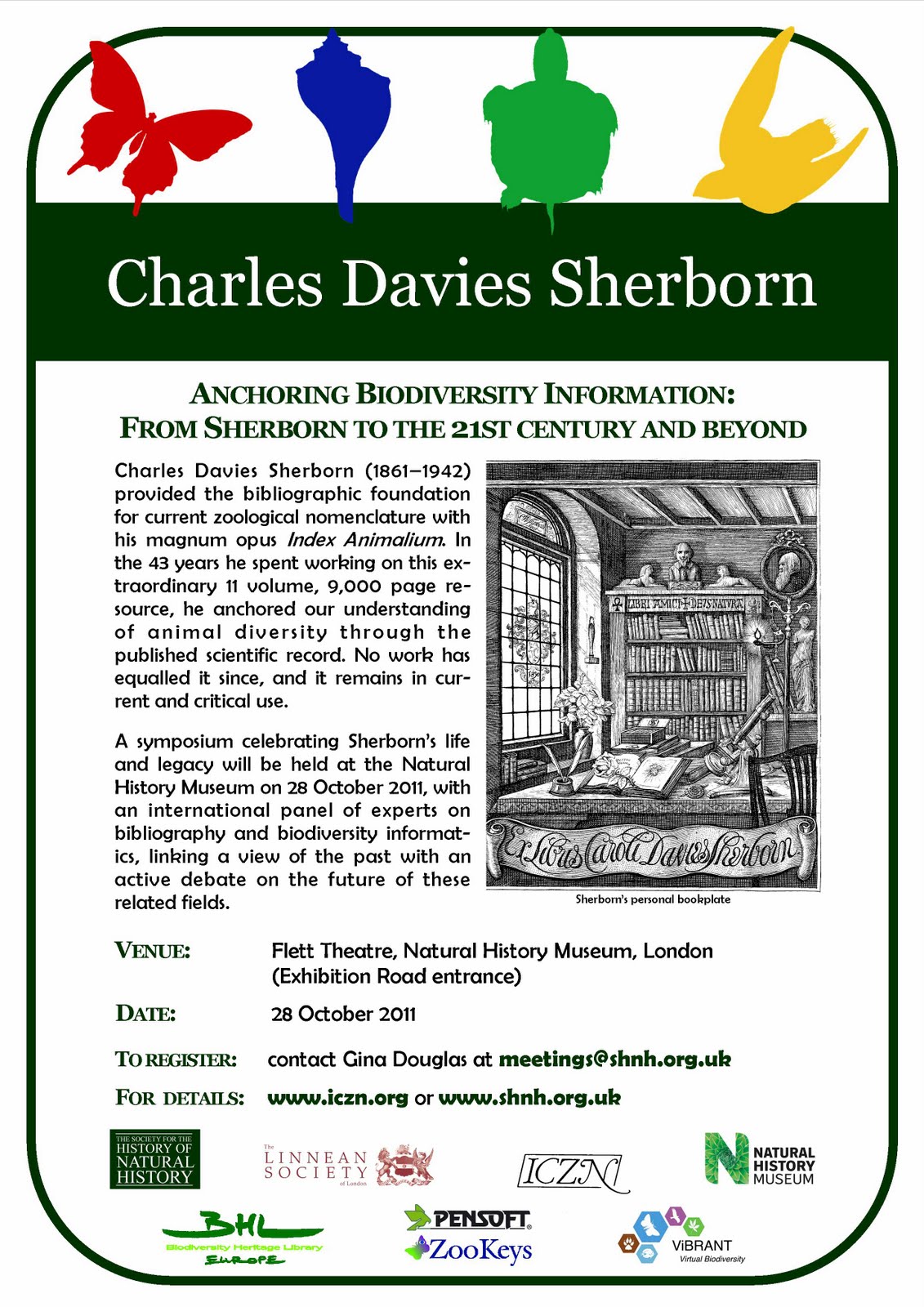
On October 28, 2011, the ICZN (International Commission on Zoological Nomenclature), in collaboration with the Society for the History of Natural History and others, hosted a symposium at the Natural History Museum, London, “Anchoring Biodiversity Information: From Sherborn to the 21st century and beyond,” honoring the 150th anniversary of the birth of Charles Davies Sherborn. Sherborn, 1861-1942, played a critical role in the biodiversity world by being the first to successfully index every living or extinct animal discovered and documented between 1758 and 1850. His greatest work, Index Animalium, took over 43 years to complete but is still referred to by taxonomist around the world. The one-day event, held at the Flett Theatre at the Natural History Museum, London, celebrated the incredible achievements of Sherborn and the ramifications for taxonomic research yesterday, today, and tomorrow.

Several BHL-affiliated staff members presented at the symposium, including BHL Technical Director Chris Freeland and Smithsonian Institution Libraries’ (SIL) staff member and BHL metadata guru Suzanne Pilsk. SIL staff members Grace Costantino (Digital Collections Librarian for BHL) and Leslie Overstreet (Curator of the Joseph F. Cullman 3rd Library at SIL, from which many BHL rare books have been scanned) also presented a poster at the event.

Approaches to preserving digitized taxonomic data

View more presentations from Chris Freeland

Chris Freeland’s presentation (pictured above) at the symposium, entitled “Approaches to preserving digitized taxonomic data: prints, manuscripts, specimens,” addressed methodologies for responsible curation of digitized prints, manuscripts, and specimens, and outlined best practices for safeguarding digitized taxonomic data to ensure longevity of resources. Such discussions are timely, as the availability of digitized taxonomic data has increased dramatically over the past twenty years as a result of increased support from national funding agencies and the declining cost of scanning devices. As such, natural history museums and libraries have taken on new responsibilities for managing electronic information as ways of providing enhanced opportunities for educational outreach and scholarly dissemination. Museums and libraries have to consider how best to create and care for electronic resources given a volatile technology landscape with rapidly changing file formats and display devices.

Unlocking indexanimaliumstatic

View more presentations from SCPilsk

SIL’s Suzanne Pilsk explained the role Smithsonian Libraries has played in bringing the critical work Index Animalium out of the library and off the page with a talk titled “Unlocking the Index Animalium: From paper slips to bytes and bits” (pictured above). Pilsk represented the work done to date by SIL staff, interns and volunteers to create an online version of the work. Smithsonian Libraries’ goal was to provide better access to the Index than was previously available and connect the researcher to the level of information needed. Over the span of years, staff has evolved the project from the initial vision of discovering where the text was located within the library walls, to linking to the scanned text via BHL.

View Full Size Image

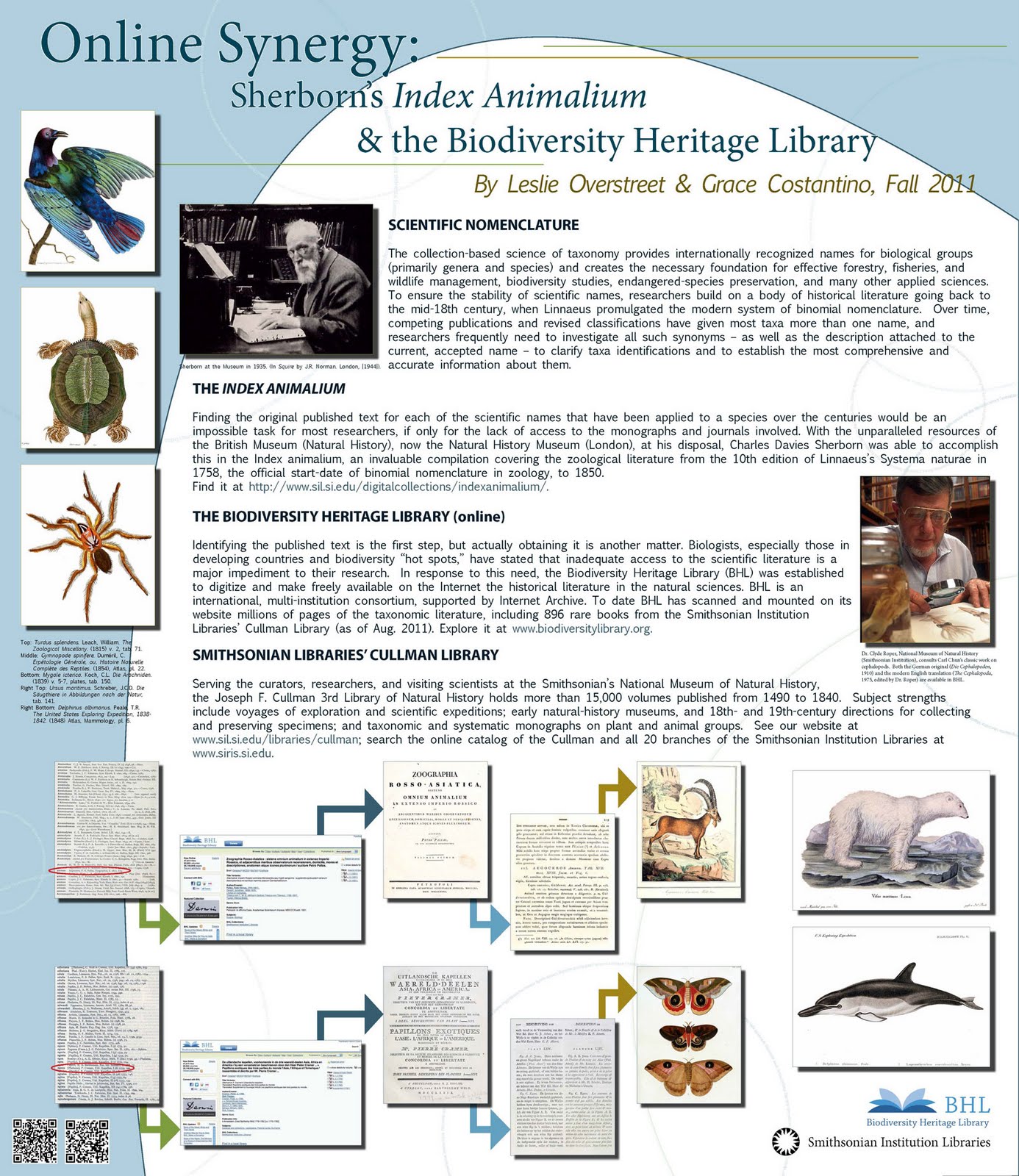
Finally, the poster presented by Grace Costantino and Leslie Overstreet, entitled “Online Synergy: Sherborn’s Index Animalium and the Biodiversity Heritage Library,” delved into the link between SIL’s online version of Index Animalium and the digitized volumes within BHL. SIL’s online version of the Index Animalium allows researchers to search the entire multi-volume work by name, epithet, or other keyword. With the citation thus provided, researchers can then access the cited text itself on BHL, finding not only the species citation but, in many cases, remarkable illustrations as well.

The talks and posters from the symposium can be viewed here, and to find out more about the incredible life of Charles Davies Sherborn, take a look at the feature on him and the symposium in The Telegraph. You can also view photos from the event on Flickr.

December 22, 2011by michelle.underhill
Page 141 of 173« First...102030«140141142143»150160170...Last »

Help Support BHL

BHL's existence depends on the financial support of its patrons. Help us keep this free resource alive!

search

About BHL

The Biodiversity Heritage Library (BHL) is the world’s largest open access digital library for biodiversity literature and archives. BHL operates as a worldwide consortium of natural history, botanical, research, and national libraries working together to digitize the natural history literature held in their collections and make it freely available for open access as part of a global “biodiversity community.”

Join Our Mailing List

Sign up to receive the latest news, content highlights, and promotions.

Subscribe Now

Subscribe to Blog via Email

Enter your email address to subscribe to this blog and receive notifications of new posts by email.

Join 319 other subscribers

Subscribe to Blog Via RSS

Subscribe to the blog RSS feed to stay up-to-date on all the latest BHL posts.

Access RSS Feed

Inspiring Discovery through Free Access to Biodiversity Knowledge.

The Biodiversity Heritage Library makes it easier than ever for you to access the information you need to study and explore life on Earth…for free, anytime, anywhere.


64+ Million Pages of
Biodiversity Literature Online.

EXPLORE

Tools and Services
to Transform Research.

EXPLORE

300,000+
Illustrations on Flickr.

EXPLORE

ABOUT | HARMFUL CONTENT | PRIVACY | SITE MAP | TERMS OF USE