Biodiversity Heritage Library - Program news and collection highlights from BHL
  • Home
  • News
  • Featured Books
    • All Featured Books
    • Book of the Month Series
    • BHL at 20
  • User Stories
  • Campaigns
    • Fossil Stories
    • Garden Stories
    • Monsters Are Real
    • Page Frights
    • Her Natural History
    • Earth Optimism 2020
  • Tech Blog
  • Visit BHL
Home
News
Featured Books
    All Featured Books
    Book of the Month Series
    BHL at 20
User Stories
Campaigns
    Fossil Stories
    Garden Stories
    Monsters Are Real
    Page Frights
    Her Natural History
    Earth Optimism 2020
Tech Blog
Visit BHL
  • Home
  • News
  • Featured Books
    • All Featured Books
    • Book of the Month Series
    • BHL at 20
  • User Stories
  • Campaigns
    • Fossil Stories
    • Garden Stories
    • Monsters Are Real
    • Page Frights
    • Her Natural History
    • Earth Optimism 2020
  • Tech Blog
  • Visit BHL
Biodiversity Heritage Library - Program news and collection highlights from BHL
Blog Reel, Campaigns, Featured Books, Page Frights

Monsters in Nature: Frightful Tales from the 19th Century

Today’s book is truly filled with Page Frights! Sea and Land: An Illustrated History of the Wonderful and Curious Things of Nature Existing Before and Since the Deluge, by James W. Buel (1849-1920), highlights some truly horrific creatures and plants, with colorful tales and an abundance of amazing illustrations.  You can read about, and see images of, giant prehistoric and contemporary land, air and sea creatures, sometimes in battle with one another and sometimes battling humans–including early man.

Some of the creatures covered and treated with illustrations read like a carnival of monstrosities: Animals not destructible by fire!  The monster sea-elephant!  The terrible water-spout!  The sea-serpent of ancient legend!  There are many gruesome tales, fables, and even ghost tales!  We will highlight a few of Buel’s tales of monsters in nature, in his own words, with accompanying illustrations.

It is important to remember that this book is a reflection of the culture of its time, and scientific inquiry has yielded much more information about these species and helped demystify many of the myths and legends that are sensationalized in the book.  Bearing that in mind, get ready for some fantastic and frightful tales and images!

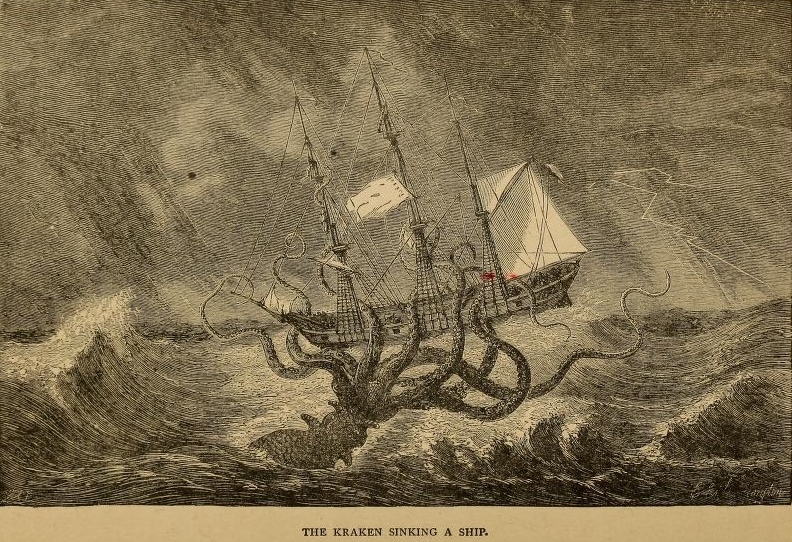
The Tale of a Kraken Attacking a Ship!

Adventures with the Frightful Squid [Kraken]. Account below from Buel’s Sea and Land:

“In olden times sailors were harassed by many groundless fears, superstitions being abundant and ignorance general.  The early Spanish poetic chroniclers, who delighted in telling the story of Columbus’ voyages, invariably disfigured their narratives with miracles and wonders.  In those days Jack, looking over the side of his vessel, was prepared to see anything, and to this willing disposition may be attributed the creation of mermaids, sea-serpents, grinning or winking monsters, and leviathans big enough to swallow a ship.  There was the squid which, as the sepia octopus, we know in these days to be an extremely large and most diabolically unpleasant beast; but in the olden times this animal was reckoned to be larger than a cathedral, in proof of which the following story is recited:

“A big ship was on the West African Coast; the men were getting the anchor, when a squid arose and wreathed its fearful snake-like limbs around the vessel’s spars.  The tips of these limbs soared quaveringly high above the mastheads, and the weight of the cuttle drove the ship down on to her beam ends.  Here now was a lively situation.  The crew plied axes and knives, but in vain, whereupon they invoked the aid of their patron saint, Thomas.  Eventually the wounded monster grew alarmed and sank, and the crew afterward, to commemorate their deliverance, marched in a body to the Church of St. Thomas, where subsequently there was hung up a painting, representing the unparalleled conflict. […]

“Pliny, the ancient, relates the history of an enormous cuttle-fish that haunted the coast of Spain and destroyed fishing ground.  He asserts that this creature was finally captured, and weighed seven hundred pounds, and that its arms were thirty feet in length.  As the cuttle-fish was esteemed by the ancients a most savory dish, the head of this formidable monster was given to Lucullas to whom it belonged rightfully by reason of his exalted rank” (Buel, 1887, pp. 75-77).

View Full Size Image
Adventures with the Frightful Squid, also called “Kraken” (see image here)

A Giant, Man-Attacking Crab!

Monster Sea-Spiders. Account below from Buel’s Sea and Land:

“From an article in a recent number of St. Nicholas, I condense the following interesting information about crabs:

“Among the most remarkable, and the largest of crabs, is the Japanese sea-spider, highly esteemed in the Orient as an excellent article of food.  Its principal claws are each five feet in length, measuring from ten to twelve feet between the tips of the nippers, and presenting an astonishing spectacle when entangled in the nets and hauled aboard the boats.  With their slow, measured movements and the powerful weapons of defense, these crabs are the giants of the spiders of the sea.  Professor Ward, who has collected them in Japan, states that they have a remarkable habit of leaving the water at night and crawling up the banks presumably to feed, and that there they are sought by the crab-hunters.  A story is told of a party of fishermen who had camped out on a river bank, and one of whom aroused the others in the night by yells and screams.  Running to the spot they found that one of these monster crabs, in wandering over the flats, had accidentally crawled over him with his great claws, frightening him almost to death” (Buel, 1887, pp. 64-65).

View Full Size Image
Japanese Spider Crab (see image here)

“The robber-crab, peculiar to the Samoan Islands. . .lives principally in the branches of the cocoanut tree.  It exercises no little intelligence in getting at the fruit, which it accomplishes by carrying the nut to the very top of the tree, and then dashing it down with force enough to break the shell.  A gentleman relates that upon an occasion, while he was walking in a Samoan forest, he saw a robber-brab reach down its claws from a thick palm branch and seize a goat by the ears that was passing underneath.  So powerful was the crab that it lifted the goat almost clear from the ground” (Buel, 1887, pp. 65, 67).

View Full Size Image
Robber-Crab lifting a goat off the ground (see image here)

A Horrifying Man-Eating Tree!

A Man-Eating Plant. Account below from Buel’s Sea and Land:

“Travelers have told us of a plant, which they assert grows in Central Africa and also in South America, that is not contented with the myriad of large insects which it catches and consumes, but its voracity extends to making even humans its prey.  This marvelous vegetable Minotauris represented as having a short, thick trunk, from the top of which radiate giant spines, narrow and flexible, but of extraordinary tenaciousness, the edges of which are armed with barbs, or dagger-like teeth.  Instead of growing upright, or at an inclined angle from the trunk, these spines lay their outer ends upon the ground, and so gracefully are they distributed that the trunk resembles an easy couch with the green drapery around it.  The unfortunate traveler, ignorant of the monstrous creation which lies in his way, and curious to examine the strange plant, or to rest himself upon its inviting stalk approaches without a suspicion of his certain doom.  The moment his feet are set within the circle of the horrid spines, they rise up, like gigantic serpents, and entwine themselves about him until he is drawn upon the stump, when they speedily drive their daggers into his body and thus complete the massacre.  The body is crushed until every drop of blood is squeezed out of it and becomes absorbed by the gore-loving plant, then the dry carcass is thrown out and the horrid trap set again.

“A gentleman of my acquaintance, who, for a long time, resided in Central America,, affirms the existence of such a plant as I have here briefly described, except that instead of the filaments, or spines, resting on the ground he says they move themselves constantly in the air, like so many huge serpents in an angry discussion, occasionally darting from side to side as if striking at an imaginary foe.  When their prey comes within reach the spines reach out with wonderful sagacity (if I may be allowed to apply the expression to a vegetable creature), and grasp it in an unyielding embrace, from whence it issues only when all the substance of its body is yielded up.  In its action of exerting pressure upon its prey, this dreadful plant resembles the instrument used in the dark ages for inflicting a torturous death.  It was made of two long iron cylinders, on the inside of which were sharp, projecting pikes.  The victim was placed inside, and the two cylinders then brought forcibly together, thus driving a hundred or more of the pointed pikes into all parts of his body and producing a frightful death.  Generally this inquisitorial instrument was made, somewhat crudely, to represent a woman, hence the name applied to it was “The Maiden,” by which it is still known.

“Dr. Antonio Jose Marquez, a distinguished gentleman of the city of Barranguilla, in the United States of Colombia, in describing this wonderful plant to the author, affirms that when excited it violently agitates its long, tentacle-like stems, the edges of which, rasping upon each other, produce a hissing noise which resembles the Spanish expression, ya-te-veo, the literal translation of which is “I see you.”  The plant is therefore known, in South America, by the name Yataveo” (Buel, 1887, pp. 475-477).

View Full Size Image
The Man-Eating Tree (see image here)

Click here to read the book, and more of its frightful tales!  Here are some wickedly monstrous illustrations to lure you to this special collection of Page Frights!

View Full Size Image
Sea Serpent (see image here)
View Full Size Image
Imagined battle between early man and Plesiosaurus (see image here)
View Full Size Image
Pterodactyl and sea dinosaurs (see image here)

What is your favorite image or story from today’s #PageFrights book?

October 11, 2016by micahv
Blog Reel, Campaigns, Featured Books, Page Frights

Sea Monks and Other Page Frights: Celebrate Halloween, Library and Archives Style!

View Full Size Image

Welcome to Page Frights, a month-long social media celebration of Halloween!

All this month (1-31 October), libraries and archives around the world will be sharing spooky, creepy, frightening, and otherwise Halloween-related books and images from their collections on social media with the hashtag #PageFrights.

Follow along and join the conversation on Twitter, Instagram, Facebook, Tumblr, and other social media sites and visit the Page Frights website to learn more.

We have lots of great content planned for BHL this month as part of Page Frights. Would you like a taste of what you can expect? If so, please allow us to introduce the sea monk!

Piscis monachi habitu, “Fish with the habit of a monk”

In the 1540s (probably in 1546), a mysterious creature was caught in the Øresund, the strait between the island of Sjælland (Denmark) and Sweden. The creature was described as a sea monk (or monk fish) with “a human head and face, resembling in appearance the men with shorn heads, whom we call monks because of their solitary life; but the appearance of its lower parts, bearing a coating of scales, barely indicated the torn and severed limbs and joints of the human body” (Paxton & Holland, 39).

View Full Size Image
The monk fish, pisces monachus. Belon, Pierre. De Aquatilibus. 1553. http://biodiversitylibrary.org/page/4770183.  Digitized by the Ernst Mayr Library, Museum of Comparative Zoology, Harvard University.

The discovery was described by several naturalists of the day, including Pierre Belon (who described it as the monk fish, pisces monachus, in his 1553 publication De Aquatilibus), Guillaume Rondelet (who described it as piscis monachi habitu, “fish with the habit of a monk”, in his 1554 publication Libri de Piscibus Marinis), and Conrad Gesner (who summarized Rondelet and Belon’s accounts and referenced additional drawings by Georg Fabricius and a Hector Mythobius in his 1558 Historia Animalium). None of these men had actually seen the specimen that they described, and Belon and Rondelet’s accounts were obtained from as yet unidentified German source material (Paxton & Holland, 40, 46).

View Full Size Image
Piscis monachi habitu, “fish with the habit of a monk”. Rondelet, Guillaume. Libri de Piscibus Marinis. 1554. http://biodiversitylibrary.org/page/42089971. Digitized by Smithsonian Libraries.

While these publications were clearly linked to a 16th century encounter with a mysterious zoological specimen, they are not the earliest known references to a sea monk. Sea monks were referenced as early as the late 12th or early 13th centuries, such as in Alexander Neckham’s De Naturis Rerum (which includes the statement “other fish resemble monks”) and in Albertus Magnus’ De Animalibus (which references Monachus maris, “the sea monk…a fish occasionally seen in the British sea…[which] entices those travelling on the sea until it lures them in. It then seeks to the bottom and takes its fill of their flesh”) (Paxton & Holland, 43).

What species could have been the inspiration for such a mysterious creature? Many theories have been proposed. Danish zoologist Japetus Steenstrup proposed in his 1855 publication ‘Om den i Kong Christian IIIs tid i Øresundet fanget Havmund (Sømunken kaldet)‘ that the Øresund specimen was a giant squid (Paxton & Holland, 42). Other suggestions include various seal species or even a walrus. More recently, it was suggested that the Øresund monkfish was actually an angelshark species, possibly Squatina squatina (Paxton & Holland, 43).

View Full Size Image
Comparison of Rondelet and Belon’s sea monks with a giant squid. Steenstrup, Japetus. Om den i Kong Christian IIIs tid i Øresundet fanget Havmund (Sømunken kaldet). Dansk Maanedsskrift. v. 1 (1855). Obtained via Google Books.

Identifying an origin species for the monkfish is further complicated by the fact that these representations were also possibly influenced by religious tensions of the period. The association between clerical figures and monsters may be seen as a commentary on these tensions, with religious elements being imposed on natural entities.

Since the original Øresund specimen is lost, pisces monachus will likely forever remain shrouded in mystery – a frightening entry in the chronicles of natural history.

Celebrate Halloween, Library & Archives Style with Page Frights

We invite you to join us for Page Frights this month as we highlight other fascinating, frightening, and/or Halloween-related natural history images and publications. BHL content will include:

  • Social media posts on Twitter, Facebook, and Instagram
  • Blog posts
  • Page Frights image collections in Flickr and Pinterest
  • A collection of “monster” natural history books in our Monsters Are Real BHL collection
  • Pumpking carving patterns inspired by BHL images in the Page Frights Pumpkin Pattern Gallery

Also as part of Page Frights, joining this year’s GIF IT UP fun by encouraging you to create creepy GIFs inspired by #PageFrights images. Learn more.

View Full Size Image
“Attack of the Sea Monster!” In 1555, Olaus Magnus published an image and description of the Soe Orm, which he claimed was a giant sea serpent 200 feet in length that lived near the shore or Bergen and came out at night to eat the farmers’ livestock. His image and description was republished for centuries. See more fantastic images come to life as part of GIF IT UP. GIF created by Richard Naples (Smithsonian Libraries), based on Gessner, Conrad. Historia Animalium. 2nd ed. 1604. http://biodiversitylibrary.org/page/42166517.

Get Your Own Sea Monster & Support Biodiversity Research

View Full Size Image
Shop the BHL Page Frights CafePress Collection today!

With our Page Frights CafePress collection, you can purchase your very own piece of the Page Frights fun and help support scientific research at the same time! 100% of the proceeds from product sales will be used to digitize more books for BHL.

Start shopping today!

Learn more about how free and open access to natural history publications on BHL can help save biodiversity and transform research.

Reference

Paxton, C. G. M. & R. Holland. Was Steenstrup Right? A New Interpretation of the 16th Century Sea Monk of the Øresund. – Steenstrupia 29 (1): 39–47. Copenhagen, Denmark. November 2005. ISSN 0375-2909.

October 1, 2016by ulib-libraryjobs
BHL News, Blog Reel, Campaigns, Page Frights

Page Frights Is Coming This October!

View Full Size Image

Get ready for a ghoulishly good time this October…Page Frights is coming!

From 1-31 October, libraries, archives, and other cultural institutions around the world will be gearing up for Halloween by sharing spooky, creepy, or otherwise frightening books and images from their collections on social media using the hashtag #PageFrights. Follow along and join the conversation on Twitter, Instagram, Facebook, Tumblr, and other social media sites. Visit pagefrights.org to learn more.

We’ll also be inviting you to carve pumpkins using patterns inspired by #PageFrights content. Participating institutions will create pumpkin carving patterns based on images from their collections, and these patterns will be freely available to download from the Page Frights website starting in October. We encourage you to share your carved pumpkins on social media using the #PageFrights hashtag.

View Full Size Image
Image from: Denys de Montfort, Pierre. Histoire naturelle, générale et particulière des mollusques. t. 2 (1801). http://biodiversitylibrary.org/page/35755564. GIF created by Richard Naples of Smithsonian Libraries.

Finally, we’re joining the Digital Public Library of America (DPLA) GIF IT UP fun and encouraging you to create GIFs based on #PageFrights images. GIF IT UP is a challenge to find the best GIFs created from copyright-free heritage materials found in DPLA, DigitalNZ, Trove, or Europeana. BHL serves as a digital content hub for DPLA. Learn more on the Page Frights website.

Page Frights was inspired by the 2015 #creepyarchives campaign launched by the Medical Historical Library at Yale University. #PageFrights is spearheaded by the Biodiversity Heritage Library, The New York Academy of Medicine, the Medical Historical Library at Yale University, and Smithsonian Libraries. Visit the website to see a full list of participating institutions to date.

If you’re an institution interested in participating in Page Frights, we’d love for you to join us! Find out how you can join the Page Frights fun.

So be sure to follow #PageFrights on social media starting this October and visit the website for more great content…if you dare!!

September 19, 2016by ulib-libraryjobs
Blog Reel, Campaigns, Featured Books

Celebrating our Collections, #BHLat10 Style

2016 marks the 10th anniversary of the Biodiversity Heritage Library. We’re kicking off our year-long celebrations with our #BHLat10 campaign this week, 11-15 April 2016. The campaign celebrates BHL’s impact on the global science community, our history and growth, and our collections. Content is being published on our blog, Twitter, Facebook, Flickr, Pinterest, and BHL. Learn more: http://www.biodiversitylibrary.org/collection/BHLat10

One of our objectives for the #BHLat10 campaign is to celebrate our collections around our 10th anniversary themes and highlight contributions from our Members and Affiliates. So, we pulled together some “Top 10” lists as well as collections of “top” content from our Members and Affiliates. Explore some highlights below and check out our website for the full content.

View Full Size Image
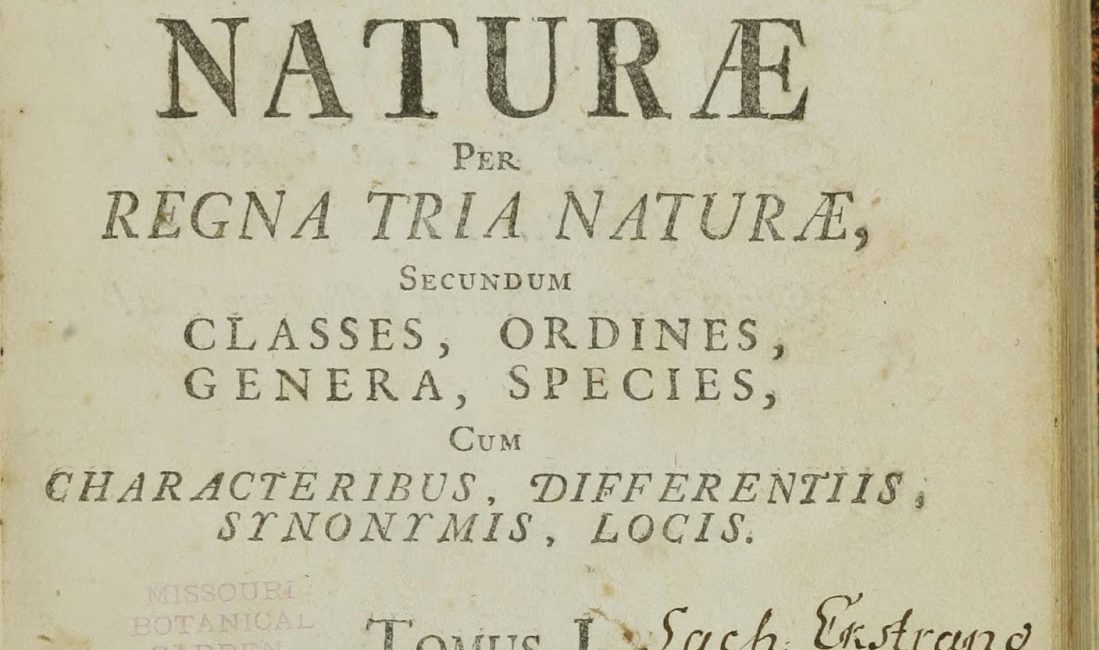
The most-viewed book in BHL. Linné, Carl von. Caroli Linnaei…Systema naturae per regna trip naturae. v. 1 (1758). http://biodiversitylibrary.org/item/10277. Digitized by the Missouri Botanical Garden.

Top 10 Viewed Books in BHL

  • Systema naturae per regna tria naturae, v. 1
  • Annales de l’Institut océanographique, v. 6
  • Dictionnaire d’histoire naturelle, qui concerne les testacées ou les coquillages de mer, de terre & d’eau-douce, t. 2
  • Latreille’s Naturliche Familien des Thierreichs
  • Taxonomic literature, v. 1
  • Caroli Linnaei … Species plantarum, v. 1
  • Das Pflanzenreich :regni vegetablilis conspectus, heft 1
  • Nomenclator botanicus, seu, Synonymia plantarum universalis
  • Caroli Linnaei … Species plantarum, v. 2
  • Bulletin of the British Museum (Natural History), v. 5
View Full Size Image
The most-downloaded book in BHL. Bergey, D. H. (David Hendricks). Bergey’s manual of determinative bacteriology. (1957). http://biodiversitylibrary.org/item/41848. Digitized by the MBLWHOI Library.


Top 10 Downloaded Books in BHL

  • Bergey’s manual of determinative bacteriology
  • America : being the latest, and most accurate description of the New World
  • Insects, their ways and means of living
  • On growth and form
  • Fish hatchery management
  • Plant names, scientific and popular, including in the case of each plant the correct botanical name in accordance with the reformed nomenclature, together with botanical and popular synonyms
  • Poultry diseases, causes, symptoms and treatment, with notes on post-mortem examinations
  • A text-book of entomology, including the anatomy, physiology, embryology and metamorphoses of insects, for use in agricultural and technical schools and colleges as well as by the working entomologist
  • Birds in legend, fable and folklore
  • The art of scientific investigation

Member and Affiliate Contribution Highlights

  • View the top downloaded book from each of our Members and Affiliates
  • Explore our Member and Affiliates’ most viewed albums in Flickr in our BHL at 10 Image Collection (slideshow of the images from these albums below)
  • View selections from our Members and Affiliates’ top-viewed Flickr albums in Pinterest


Get the flash player here: http://www.adobe.com/flashplayer

var so = new SWFObject(“http://www.db798.com/pictobrowser.swf”, “PictoBrowser”, “500”, “500”, “8”, “#EEEEEE”); so.addVariable(“source”, “sets”); so.addVariable(“names”, “BHL at 10 (View All)”); so.addVariable(“userName”, “BioDivLibrary”); so.addVariable(“userId”, “61021753@N02”); so.addVariable(“ids”, “72157666033761310”); so.addVariable(“titles”, “on”); so.addVariable(“displayNotes”, “on”); so.addVariable(“thumbAutoHide”, “off”); so.addVariable(“imageSize”, “medium”); so.addVariable(“vAlign”, “mid”); so.addVariable(“vertOffset”, “0”); so.addVariable(“colorHexVar”, “EEEEEE”); so.addVariable(“initialScale”, “off”); so.addVariable(“bgAlpha”, “90”); so.write(“PictoBrowser160331083942”);

We hope you’ll join us in celebrating our 10th anniversary this week and all year long! Follow #BHLat10 on social media to catch all of our great content and tell us how BHL has impacted your work by posting with the hashtag or leaving a comment on this blog.

View Full Size Image

To help ensure that BHL continues to provide free and open access to biodiversity literature for decades to come, we’ve launched a CafePress store with products celebrating our 10th anniversary and featuring images from our collection. We’ve launched the store with a small selection of images from BHL, but we’ll be expanding this selection in the future as we continue to develop our store. 100% of the proceeds that BHL receives from the sale of these products will be used to digitize more books for BHL. Check out the store today!

And if merchandise isn’t your thing, but you want to help support BHL’s future, consider making a tax-deductible gift to help us continue to support science and research around the world.

Finally, don’t forget to sign our birthday card and tell us what BHL means to you!

Happy Birthday, BHL!

April 15, 2016by ulib-libraryjobs
BHL News, Blog Reel, Campaigns

BHL at 10: Celebrating Our History

2016 marks the 10th anniversary of the Biodiversity Heritage Library. We’re kicking off our year-long celebrations with our #BHLat10 campaign this week, 11-15 April 2016. The campaign celebrates BHL’s impact on the global science community, our history and growth, and our collections. Content is being published on our blog, Twitter, Facebook, Flickr, Pinterest, and BHL. Learn more: http://www.biodiversitylibrary.org/collection/BHLat10

We also have programming all week tying into our #BHLat10 themes. Learn more.

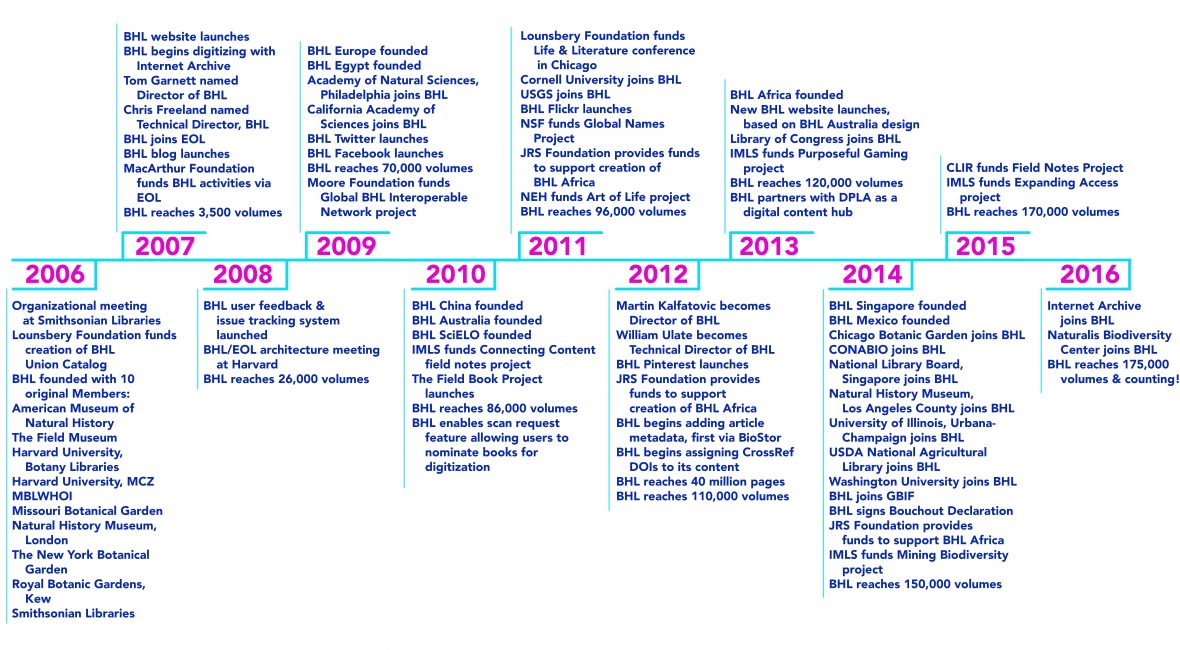
One of the themes of our #BHLat10 campaign is to celebrate our history. To do so, we’ve created a timeline highlighting some of our major milestones and provided an in-depth narrative of our history on our website.

View Full Size Image(Click to Enlarge)
BHL officially launched in 2006 during the program’s first organizational meeting at the Smithsonian Libraries. The meeting, and hence BHL, grew out of discussions that occurred a year earlier during the 2005 meeting “Library and Laboratory: The Marriage of Research, Data, and Taxonomic Literature” at the Natural History Museum in London.

At the time of its formation, BHL included ten member organizations in the U.S. and the U.K. Tom Garnett, then Associate Director of Smithsonian Libraries, was named Program Director of BHL in 2007. The Smithsonian also assumed administrative responsibility for the program, establishing the BHL Secretariat. The Missouri Botanical Garden took on the program’s technical operations under Chris Freeland’s guidance as BHL’s Technical Director. Martin R. Kalfatovic, Associate Director of Digital Programs and Initiatives at Smithsonian Libraries and BHL’s current Program Director, took on the BHL directorial role after Garnett’s retirement in 2012. William Ulate served as Technical Director from 2012-2015, following Freeland’s departure from the Missouri Botanical Garden. Today, BHL’s technical development is led by a team of Technical Advisors comprised of staff from BHL’s Member institutions under the direction of Kalfatovic.

View Full Size Image

In 2007, the BHL website launched with just over 300 titles, largely comprised of collections already digitized by BHL’s Members. Over the ten years since its formation, BHL’s collections have grown to over 48 million pages, constituting over 175,000 volumes and over 106,000 titles. The consortium has also grown from 10 founding institutions to over 60 Member, Affiliate, and Partner institutions on every continent except Antarctica. Since its launch, BHL has served over 4.9 million people in 240 countries and territories. On average, BHL receives more than 161,000 visits per month, constituting over 9.4 million visits over the library’s lifetime. Additionally, BHL has made over 100,000 of the illustrations within its collection available in Flickr, which in turn have been viewed over 161 million times.

View Full Size Image

Over the past ten years, the Biodiversity Heritage Library has become the world’s largest open access digital library for biodiversity literature. It now serves as a standard for taxonomic literature aggregation, discovery and presentation as well as a model for other digital library initiatives. By engaging with the scientific community to identify user needs, incorporating tools that facilitate data discovery and reuse, and continuing to grow collections under open access principles by fostering existing and establishing new partnerships with libraries and data providers around the world, BHL has become an unparalleled resource that is transforming the way scientists, researchers, and the public understand and study the natural world.

Learn more about our history on our website.

We hope you’ll join us in celebrating our 10th anniversary this week and all year long! Follow #BHLat10 to catch all of our great content and tell us how BHL has impacted your work by posting with the hashtag or leaving a comment on this blog.

View Full Size Image

To help ensure that BHL continues to provide free and open access to biodiversity literature for decades to come, we’ve launched a CafePress store with products celebrating our 10th anniversary and featuring images from our collection. We’ve launched the store with a small selection of images from BHL, but we’ll be expanding this selection in the future as we continue to develop our store. 100% of the proceeds that BHL receives from the sale of these products will be used to digitize more books for BHL. Check out the store today!

And if merchandise isn’t your thing, but you want to help support BHL’s future, consider making a tax-deductible gift to help us continue to support science and research around the world.

Finally, don’t forget to sign our birthday card and tell us what BHL means to you!

Happy Birthday, BHL!

April 13, 2016by ulib-libraryjobs
BHL News, Blog Reel, Campaigns

Happy 10th Anniversary, BHL!

2016 marks the 10th anniversary of the Biodiversity Heritage Library (BHL, www.biodiversitylibrary.org)!

View Full Size Image
Since 2006, the Biodiversity Heritage Library has transformed the way scientists, researchers, and librarians around the world access knowledge about and study life on Earth. In order to document Earth’s species and understand the complexities of swiftly-changing ecosystems in the midst of a major extinction crisis and widespread climate change, scientists need something that no single library can provide – access to the world’s collective knowledge about biodiversity. Beyond the scientific realm, such information also allows scholars to answer complex research questions related to human exploration, culture, and the history of science. Through a worldwide partnership of natural history and botanical libraries, BHL has become the largest open access digital library for biodiversity literature, allowing everyone, everywhere to freely access library collections from across global and empowering research like never before.

We’re celebrating our anniversary with our #BHLat10 campaign this week, 11-15 April 2016. The campaign highlights BHL’s impact on the global science community; our history, growth, and Member and Affiliate contributions; and collections that highlight our 10th anniversary theme. Content will be published through our blog, Twitter, and Facebook. We also have a Flickr collection made up of the most-viewed albums from our Members and Affiliates,  and a Pinterest board with selections from those albums. Finally, check out the most-downloaded books from each of our Members and Affiliates in our BHL book collection. Learn more about our campaign here: http://www.biodiversitylibrary.org/collection/BHLat10

We’ll also have programming throughout the week that celebrates our 10th anniversary and highlights our #BHLat10 themes. Check out our full list of programs below:

From Shelf to Screen

In the past 10 years, BHL’s collections have grown to over 48 million pages! Find out how a book goes from a library’s shelves to BHL by going behind-the-scenes at the Smithsonian Libraries’ Conservation and Digitization Annex!
When? 10am EDT/3pm BST, 11 April 2016
Where? www.periscope.tv/biodivlibrary

BHL Day at the Natural History Museum, London

A programme highlighting BHL’s impact on the global science community and featuring speakers from biodiversity-related disciplines.
When? 8am-1pm EDT/1-6pm BST, 12 April 2016
Where? Follow #BHLDay on Twitter to join the live tweeting of this event.

Let’s Talk Impact: An Interview with Rod Page at the Royal Botanic Gardens, Kew

Join us for a live interview at the Royal Botanic Gardens, Kew, with Martin R. Kalfatovic (@UDCMRK), BHL Program Director, and Rod Page (@rdmpage), creator of BioStor (@biostor_org), for a discussion about BHL’s impact on science and possibilities for the future.
When? 11am EDT/4pm BST, 13 April 2016
Where? Google Hangouts: http://bit.do/BHLLetsTalkImpact

Behind the Scenes at Tring

BHL’s partner libraries are full of amazing treasures. Join us for a behind-the-scenes look at selections from the Ornithology and Rothschild Libraries’ incredible collections at the Natural History Museum at Tring.
When? 6am EDT/11am BST, 15 April 2016
Where? www.periscope.tv/biodivlibrary

It’s a great week to celebrate our 10th anniversary because it’s also the American Library Association’s National Library Week. This year’s NLW theme is #LibrariesTransform. BHL has been transforming scientific research for 10 years, helping scientists identify, describe, and save Earth’s biodiversity. Explore interviews with actual users to see how BHL supports science and education (and even humanities research in history and art!). Visit our website to learn more about the tools, services, and citizen science initiatives that BHL provides and supports to help further transform biodiversity research around the world.

View Full Size Image

To help ensure that BHL continues to transform biodiversity research for decades to come, we’ve launched a CafePress store with products celebrating our 10th anniversary and featuring images from our collection. We’ve launched the store with a small selection of images from BHL, but we’ll be expanding this selection in the future as we continue to develop our store. 100% of the proceeds that BHL receives from the sale of these products will be used to digitize more books for BHL. Check out the store today!

View Full Size Image

And if merchandise isn’t your thing, but you want to help support BHL’s future, consider making a tax-deductible gift to help us continue to support science and research around the world.

We hope you’ll join us in celebrating our 10th anniversary this week and all year long! Follow #BHLat10 on social media to catch all of our great content and tell us how BHL has impacted your work by posting with the hashtag or leaving a comment on this blog. And don’t forget to sign our birthday card and tell us what BHL means to you!

Happy Birthday, BHL!

April 11, 2016by michelle.underhill
BHL News, Blog Reel, Campaigns

Join us Next Week as we Celebrate 10 Years of Inspiring Discovery

View Full Size Image

2016 marks the 10th anniversary of the Biodiversity Heritage Library. Founded in 2006, BHL inspires discovery and supports global scientific research by providing free, online access to biodiversity literature from libraries around the world.

We’re kicking off our year-long celebrations with our #BHLat10 campaign next week, 11-15 April 2016. The campaign will highlight BHL’s impact on the global science community; our history, growth, and Member and Affiliate contributions; and collections that highlight our 10th anniversary theme. Content will be published through our blog, Twitter, Facebook, Flickr, and BHL itself. Learn more here: http://www.biodiversitylibrary.org/collection/BHLat10

We’ll also have programming throughout the week that celebrates our 10th anniversary and highlights our #BHLat10 themes. Check out our full list of programs below:

View Full Size Image
(click to enlarge)

We hope you’ll join us in celebrating our 10th anniversary next week and all year long! Follow #BHLat10 on social media to catch all of our great content and tell us how BHL has impacted your work by posting with the hashtag or leaving a comment on this blog.

Happy Birthday, BHL!

April 7, 2016by ulib-libraryjobs
Page 9 of 17« First...«891011»...Last »

Help Support BHL

BHL's existence depends on the financial support of its patrons. Help us keep this free resource alive!

search

About BHL

The Biodiversity Heritage Library (BHL) is the world’s largest open access digital library for biodiversity literature and archives. BHL operates as a worldwide consortium of natural history, botanical, research, and national libraries working together to digitize the natural history literature held in their collections and make it freely available for open access as part of a global “biodiversity community.”

Join Our Mailing List

Sign up to receive the latest news, content highlights, and promotions.

Subscribe Now

Subscribe to Blog via Email

Enter your email address to subscribe to this blog and receive notifications of new posts by email.

Join 319 other subscribers

Subscribe to Blog Via RSS

Subscribe to the blog RSS feed to stay up-to-date on all the latest BHL posts.

Access RSS Feed

Inspiring Discovery through Free Access to Biodiversity Knowledge.

The Biodiversity Heritage Library makes it easier than ever for you to access the information you need to study and explore life on Earth…for free, anytime, anywhere.


64+ Million Pages of
Biodiversity Literature Online.

EXPLORE

Tools and Services
to Transform Research.

EXPLORE

300,000+
Illustrations on Flickr.

EXPLORE

ABOUT | HARMFUL CONTENT | PRIVACY | SITE MAP | TERMS OF USE