Biodiversity Heritage Library - Program news and collection highlights from BHL
  • Home
  • News
  • Featured Books
    • All Featured Books
    • Book of the Month Series
    • BHL at 20
  • User Stories
  • Campaigns
    • Fossil Stories
    • Garden Stories
    • Monsters Are Real
    • Page Frights
    • Her Natural History
    • Earth Optimism 2020
  • Tech Blog
  • Visit BHL
Home
News
Featured Books
    All Featured Books
    Book of the Month Series
    BHL at 20
User Stories
Campaigns
    Fossil Stories
    Garden Stories
    Monsters Are Real
    Page Frights
    Her Natural History
    Earth Optimism 2020
Tech Blog
Visit BHL
  • Home
  • News
  • Featured Books
    • All Featured Books
    • Book of the Month Series
    • BHL at 20
  • User Stories
  • Campaigns
    • Fossil Stories
    • Garden Stories
    • Monsters Are Real
    • Page Frights
    • Her Natural History
    • Earth Optimism 2020
  • Tech Blog
  • Visit BHL
Biodiversity Heritage Library - Program news and collection highlights from BHL
Blog Reel, Featured Books

Of Birds and Poetry: Alexander Wilson and The Foresters

View Full Size Image
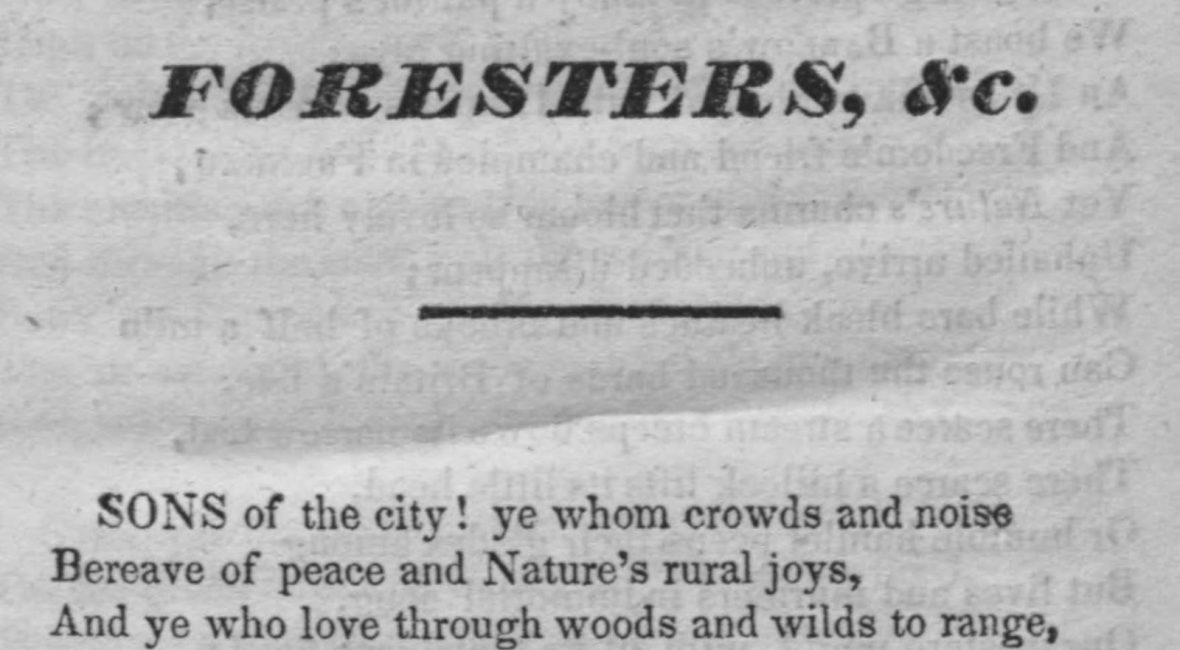
Wilson, Alexander. The Foresters. 1838. http://biodiversitylibrary.org/page/42435615.

210 years ago, in an autumn not unlike our own today, Alexander Wilson set out with two companions on a 1,300 mile trek, mostly on foot, from Philadelphia to Niagara Falls. Enchanted by the natural beauty of his adopted homeland, Wilson, Scottish by birth, detailed his two-month-long adventure in an epic 2,219 line poem entitled The Foresters: A Poem Descriptive of a Pedestrian Journey to the Falls of Niagara in the Autumn of 1804.

View Full Size Image
Portrait of Alexander Wilson. American Ornithology. http://biodiversitylibrary.org/page/41411265.

Wilson was born in Paisley, Scotland in 1766, but he emigrated to the United States in 1794 with his nephew, William Duncan. Although today known as one of the greatest ornithologists America has ever seen, Wilson’s interest in poetry was deeply rooted in his youth. During his time in Scotland, he wrote a great deal of poetry, much of which was satirical. In fact, it was after his arrest and imprisonment for writing a severely satirical poem against a local mill owner that Wilson decided to move to America.

Poetry and ornithology were not the only hats Wilson wore throughout his life. He was somewhat of a jack-of-all-trades. He earned his living as a weaver in Scotland, and upon moving to America he worked as a schoolteacher, peddler, engraver, surveyor, and editor. Nature, birds, and poetry, however, were his true passion.

In 1798, four years after they had moved to America, Wilson and his nephew William Duncan, purchased a farm in Ovid between Seneca and Cayuga Lakes, New York, securing 150 acres of uncleared land for $750. Wide-spread outbreaks of yellow fever in Philadelphia, where they had been living, and family ties in upstate New York, prompted their relocation to this rich, largely untapped land in the Finger Lakes region. After the purchase, Duncan began clearing the land for farming while Wilson resumed his teaching activities in a school in Milestown near Philadelphia and accepted odd jobs such as surveying to raise money for the farm.

View Full Size Image
A farmhouse in Genesee Country, perhaps like what Wilson and Duncan would have had. Sutcliff, Robert. Travels In Some Parts of North America, In the Years 1804, 1805 and 1806. York [England]: Printed by C. Peacock … for W. Alexander, and sold by him, 1811.

In late October, 1804, Wilson, Duncan, and one of Wilson’s students, Isaac Leech, embarked on their great adventure through the Western Frontier, leaving from Philadelphia and heading west through Pennsylvania towards Niagara Falls.

The journey was an ambitious, enlightening, and multi-faceted one. Within his Foresters poem, Wilson provides descriptions of the homes, taverns, and inns they stayed in, reflects upon the virtues of teaching (a profession he clearly believes is under-valued), and describes in vivid narrative the natural beauty and wildlife they encounter. His writings also reveal the progression of human settlement and land development along the Susquehanna, with Wilson remarking on how changed the wilderness was since last he visited it.

View Full Size Image
Niagara Falls. Dow, Charles M. Anthology and Bibliography of Niagara Falls. Albany [N.Y.]: State of New York, 1921. Vol 1. http://biodiversitylibrary.org/page/39062520.

Finally, in late November, the travelers reach the climax of their expedition: Niagara Falls. The Falls, a nearly inaccessible wonder of the New World in the early 1800s, is a thing of matchless beauty in Wilson’s mind.

“Fixed to the rock, like monuments we stood,
On its flat face, above th’ outrageous flood,
There, while our eyes th’ amazing whole explored,
The Deep loud roar our loudest voice devoured.
 
High o’er the wat’ry uproar, silent seen,
Sailing sedate, in majesty serene,
Now ‘midst the pillard spray sublimely lost,
And now, emerging, down the rapids tost,
Swept the gray eagles, grazing calm and slow,
On all the horrors of the gulf below;” (pg. 75-76)

With their purpose accomplished, Wilson, Duncan, and Leech set their sights homeward. On December 7, 1804, Wilson returned once again to Philadelphia, penniless but enthused by his adventure. Wilson published his poem in serial form in 10 issues of “The Port Folio,” a leading literary magazine in Philadelphia, from 1809-10. The poem was first published in book format in 1818 and again in 1838, with little difference between the editions. The 1838 edition of The Foresters is available in BHL from Cornell University Library.

The adventure represented not only an important literary venture for Wilson, but solidified in him the desire to pursue his dream to classify, describe, and illustrate all bird species in the United States. Wilson, in fact, viewed this trip as an opportunity to collect and observe American birds. Early on in the poem, Wilson indicates that he came prepared to sketch, bringing along “colors, paper, and pencils.” What’s more, he frequently describes hunting various birds, including ducks, egrets, herons, eagles and geese, which he would later use as reference for his great masterpiece, American Ornithology.

View Full Size Image
Wood Thrush, Robin and Nuthatches. Wilson, Alexander. American Ornithology. http://biodiversitylibrary.org/page/41411340.

At the age of 40, just seven years before he died of dysentery and exhaustion, Wilson left teaching and spent the rest of his life traveling over 10,000 miles observing and collecting birds, which he chronicled and illustrated in American Ornithology. The publication included over 260 species, 48 of which were new to science, and was published in at least 10 editions over 70 years.

View Full Size Image
Ivory-Billed, Red-Headed, and Pileated Woodpeckers. Wilson, Alexander. American Ornithology. http://biodiversitylibrary.org/page/41424289.

Alexander Wilson was a remarkable man who laid the foundations for American ornithology. Though his formal education ended at the age of thirteen, his natural intelligence, creativity, and curiosity propelled him to explore his natural world and fueled a thirst for knowledge that rivaled the greatest intellectuals of the day. His wonderful poetic descriptions within The Foresters offer a unique opportunity to experience Wilson at a personal level and appreciate the awestruck wonder he felt within the wilds of America.

Far spreading forests from its shores ascend;
And tow’ring headlands o’er the flood impend;
These, deep below, in softened tints are seen,
Where Nature smiles upon herself serene,
O lovely scenes! In ecstasy I cried,
That sink to nothing all the work of pride! (pg. 52)

Learn more about Alexander Wilson, his Niagara adventure, and ornithological contributions in Cornell University Library’s Majesty Sublime exhibition.

View Full Size Image
Ducks. Wilson, Alexander. American Ornithology. http://biodiversitylibrary.org/page/41423704.

This post by Grace Costantino based on a presentation by Marty Schlabach (Food and Agriculture Librarian, Mann Library, Cornell University) entitled “Of Birds and Poetry: Alexander Wilson’s 1804 Expedition to Niagara Falls,” presented to the Buffalo Ornithological Society on November 9, 2005. Additional information obtained from the Majesty Sublime exhibition by Ashley Miller (Mann Library, Cornell University).

November 25, 2014by ulib-libraryjobs
Blog Reel, Featured Books

Alexander Wilson and the Catbird

View Full Size Image

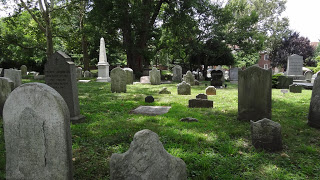
A tiny corner of green in a bustling city landscape, the cemetery of Philadelphia’s Gloria Dei Church is the resting place of Alexander Wilson, who died 200 years ago today at the age of 47, his great American Ornithology almost finished.

Gloria Dei—formerly Old Swedes’ Church, the most ancient house of worship still standing in the state of Pennsylvania—offers the modern tourist a welcome spot of shade, but it would certainly not have been Wilson’s choice of final destination. Even in 1813, this Southwark neighborhood of Philadelphia was a busy one, and Wilson had, as his executor, George Ord (1781-1866), reports:

“expressed a wish to be buried in some rural spot, sacred to peace and solitude, whither the charms of nature might invite the steps of the votary of the Muses, and the lover of science, and where the birds might sing over his grave.”

Unfortunately, Wilson was unable to repeat that wish in the ten days of agony that preceded his death; “otherwise,” writes Ord, “it should have been piously observed.” Instead, the dust of the Father of American Ornithology still lies in a weathered marble tomb beneath the shadow and the roar of I-95.

But the votaries of the Muses still come, and the lovers of science. And the birds still sing over Alexander Wilson’s grave.

View Full Size Image

_*_*_*_

Urban Philadelphia’s bird life has changed, of course, since 1813. The voices that rise most prominently today above the whoosh and rumble of traffic are the homely chirping of House Sparrows, and the whistles of European Starlings, both species that Wilson knew well from his youth in Scotland, but neither of which would appear in Pennsylvania for decades to come.

View Full Size Image
European Starling in Pennant’s British Zoology

The House Finch, too, whose cheerful buzzes tumble down from the steeple of Gloria Dei, was unknown in Philadelphia two centuries ago—and indeed, still believed to be restricted to Mexico,was not recorded in the western United States until ten years after Wilson’s death.

Native birds persist, though, even in this most urban of Philadelphia neighborhoods, and each summer, just as in Wilson’s day, still yields a modest crop of American Robins, Chipping Sparrows, and Common Grackles. But the real specialty of Gloria Dei is the Gray Catbird. More typical of forest edges and wooded suburbs, these sleekly elegant mimics sing and feed and nest in the cemetery, producing young that are as noisy as they are endearingly scruffy.

View Full Size Image

Alexander Wilson would have approved.

*_*_*_*

The Gray Catbird had been known to European science for nearly a century by the time Wilson first encountered the species. Mark Catesby (1683-1749) painted the bird for his Natural History of Carolina, Florida, and the Bahama Islands, noting that its English and French names derived from its signature call, “which resembles the Mewing of a Cat.” Catesby was responsible, too, for the long-persistent classification of this species among the European muscicapids: he headed his account “Muscicapa vertice nigro,” the black-crowned flycatcher.

View Full Size Image

Mathurin Brisson (1723-1806) relied completely, it seems, on Catesby and his painting for his description of the same bird; like his English predecessor, Brisson considered the catbird a flycatcher, a “gobe-mouche,” but the formal Latin (and non-binomial) name he gave it focused not on the bird’s head pattern but on its overall color and geographic origin: “Muscicapa Virginiana fusca” he called it, echoing precisely the French designation “Gobe-mouche brun de Virginie.”

The Count de Buffon (1707-1788) followed Brisson and Catesby by calling it the “moucherolle de Virginie”, but he for the first time acknowledged some taxonomic uncertainty with his observation that the catbird combined the size of the American tyrant flycatchers with the “straight and nearly hookless bill” of their Old World counterparts.

Thanks to the stubborn French resistance to the modern binomial system, it fell to Linnaeus to give Catesby’s catbird an “official” name, a task he completed in 1766, in the 12th edition of the Systema.

View Full Size Image

The Archiater retained the generic designation Muscicapa, but for his epithet selected none of the obvious alternatives already suggested by Catesby and by Brisson: the catbird would be not “vertice-nigro,” not “virginiana,” not even “fusca,” but carolinensis, ostensibly because the species “inhabits Carolina” (Catesby’s Virginian type locality notwithstanding), but more likely because the great nomenclator could not resist another opportunity to memorialize, even obliquely, his own given name.

The mistaken notion that the catbird was a flycatcher trickled into the English-language ornithology of the eighteenth century. John Latham (1740-1837) called it the “Cat Flycatcher” in his General Synopsis of Birds, and Thomas Pennant (1726-1798) (who was able to extend the species’ known range as far north as New York) retained the name when he listed the species in his Arctic Zoology.

*_*_*_*

Exalted as all those authorities are, none of them added substantially to the little life history information Catesby had given his readers in 1729:

View Full Size Image

In the mid-1770s, though, the Philadelphia naturalist and writer William Bartram (1739-1823) undertook his own journey through the American south, retracing in part Catesby’s route—and gently correcting his predecessor’s errors and misapprehensions in the book that Bartram would publish in 1790, the Travels.  

View Full Size Image

Bartram was particularly surprised by Catesby’s “detraction of the fame due” the catbird as a singer. Where the earlier explorer had claimed that it produced only a single note—that well-known eponymous meowing—Bartram found that “the cat bird” was in reality … one of our most eminent songsters, little inferior to the philomela or mock-bird; and in some remarkable instances, perhaps, exceeds them both, in particular as a buffoon or mimick; he endeavours to imitate every bird and animal, and in many attempts does not ill succeed, even in rehearsing the songs, which he attentively listens to, from the shepherdess and rural swain, and will endeavor and succeed to admiration, in repeating the melodious and variable airs from instrumental music, and this in his wild state of nature.

*_*_*_*

Alexander Wilson met William Bartram in Philadelphia in 1802, and the unlikely pair quickly became friends. The intellectual stimulation and emotional support that Wilson—a perennially impoverished schoolteacher—found in Bartram and his family inspired him to devote himself entirely to the project that would become the American Ornithology.

View Full Size Image

Wilson also, it seems, came to share his friend and mentor’s admiration for the Gray Catbird, and his account of the species is one of the finest and most complete in the American Ornithology, showing Wilson at his brilliant best as writer and observer.

Here as elsewhere, Wilson, with the immigrant’s zeal, sets the knowledge gained from experience—he was after all a child of the Scottish Enlightenment—against the bookish speculations of the cabinet naturalists of Old Europe. Note how he invokes not mere static structure but the behavior of the living bird in rejection of the venerable Anglo-French tradition of assigning this bird to the muscicapids:

This bird has been very improperly classed among the Fly-Catchers. As he never seizes his prey on wing, has none of their manners, feeds principally on fruit, and seems to differ so little from the Thrushes, I think he more properly belongs to the latter tribe than to any other genus we have. His bill, legs and feet, place and mode of building, the colour of his eggs, his imitative notes, food and general manners, all justify me in removing him to this genus.

Wilson pointedly ignores the Linnaean epithet carolinensis to call his bird Turdus lividus, the “bluish thrush,” honoring his Philadelphia colleague Bartram, who had coined that specific name in his Travels.

Where Catesby and his followers could say only that the catbird leaves Virginia in the winter, Wilson, reckoning backward from the species’ February arrival in Georgia, deduced that the wintering grounds lay “not far distant, probably in Florida.” Returning in April to Pennsylvania, the birds have built their nests by early May, in “a thicket of briars or brambles, a thorn bush, thick vine, or the fork of a small sapling.”

Celebrated by his compatriot Sir William Jardine as the first who truly studied the birds of North America in their natural abodes, and from real observation, Wilson found the Gray Catbird an especially obliging subject for experimentation. Curious about the extent to which a breeding pair could recognize its own eggs and young, the naturalist took two eggs from one [catbird] which was sitting, and in their place put two of the Brown Thrush, or Thrasher…. In a minute or two the male made his approaches, stooped down and looked earnestly at the strange eggs … [and] with the greatest gentleness took out both the Thrasher’s eggs, first one and then the other, carried them single about thirty yards, and dropt them among the bushes…. Soon after the female resumed her place on the nest as before.

Placing two half-fledged chicks in another catbird’s nest had a similar result: “She soon turned them both out”; happily, catbirds bounce, and soon enough the father bird was feeding them on the ground “with great assiduity and tenderness.” On another occasion, Wilson moved a nest and its four well-advanced eggs from one side of a thicket to the other; in less than half an hour, the female was once again incubating her displaced clutch.

*_*_*_*

Wilson also took advantage of his close acquaintance with the catbird to weigh in on the venerable controversy of the “fascination” of birds by snakes—a matter still unresolved for some a century later. Never one to mince words, he blames “credulity and ignorance” for the “absurd” belief that a snake, with [its] eyes, breath, or any other known quality he possesses, should be capable of drawing a bird, reluctantly from the tree tops to its mouth; in all of the encounters between snakes and catbirds “personally witnessed” by Wilson, the bird, he says, was the actual “assailant,” attacking the reptile in an effort to drive it away from its nest and young.

*_*_*_*

Wilson joined his careful observation of the catbird with a genuine affection for the species. That fondness was, as he reports, not shared by all of his contemporaries; blinded by “illiberal and persecuting prejudice,” the farmer of Wilson’s day protected his strawberries, his early cherries, and his “finest ripe mellow pears”

by shooting [the catbird] down with his gun, as he finds old hats, wind-mills and scarecrows are no impediments in his way to these forbidden fruits…. The boys are now set to watch the cherry trees with the gun; and thus commences a train of prejudices and antipathies that commonly continue through life.

For Wilson, though, as for all “the generous and the good, the lovers of nature and of rural charms,” the confidence which this familiar bird places in man by building in his garden, under his eye, the music of his song, and the interesting playfulness of his manners, will always be more than a recompence [sic] for all the little stolen morsels he snatches.

I’d like to think that the catbirds of Gloria Dei are even today repaying the compliment.

View Full Size Image

August 23, 2013by Kathryn Stine

Help Support BHL

BHL's existence depends on the financial support of its patrons. Help us keep this free resource alive!

search

About BHL

The Biodiversity Heritage Library (BHL) is the world’s largest open access digital library for biodiversity literature and archives. BHL operates as a worldwide consortium of natural history, botanical, research, and national libraries working together to digitize the natural history literature held in their collections and make it freely available for open access as part of a global “biodiversity community.”

Join Our Mailing List

Sign up to receive the latest news, content highlights, and promotions.

Subscribe Now

Subscribe to Blog via Email

Enter your email address to subscribe to this blog and receive notifications of new posts by email.

Join 319 other subscribers

Subscribe to Blog Via RSS

Subscribe to the blog RSS feed to stay up-to-date on all the latest BHL posts.

Access RSS Feed

Inspiring Discovery through Free Access to Biodiversity Knowledge.

The Biodiversity Heritage Library makes it easier than ever for you to access the information you need to study and explore life on Earth…for free, anytime, anywhere.


64+ Million Pages of
Biodiversity Literature Online.

EXPLORE

Tools and Services
to Transform Research.

EXPLORE

300,000+
Illustrations on Flickr.

EXPLORE

ABOUT | HARMFUL CONTENT | PRIVACY | SITE MAP | TERMS OF USE