
Biodiversity Heritage Library - Program news and collection highlights from BHL
  • Home
  • News
  • Featured Books
    • All Featured Books
    • Book of the Month Series
    • BHL at 20
  • User Stories
  • Campaigns
    • Fossil Stories
    • Garden Stories
    • Monsters Are Real
    • Page Frights
    • Her Natural History
    • Earth Optimism 2020
  • Tech Blog
  • Visit BHL
Home
News
Featured Books
    All Featured Books
    Book of the Month Series
    BHL at 20
User Stories
Campaigns
    Fossil Stories
    Garden Stories
    Monsters Are Real
    Page Frights
    Her Natural History
    Earth Optimism 2020
Tech Blog
Visit BHL
  • Home
  • News
  • Featured Books
    • All Featured Books
    • Book of the Month Series
    • BHL at 20
  • User Stories
  • Campaigns
    • Fossil Stories
    • Garden Stories
    • Monsters Are Real
    • Page Frights
    • Her Natural History
    • Earth Optimism 2020
  • Tech Blog
  • Visit BHL
Biodiversity Heritage Library - Program news and collection highlights from BHL
BHL News, Blog Reel

Visual Riches of BHL Dazzle those Outside the Biodiversity Domain

View Full Size Image
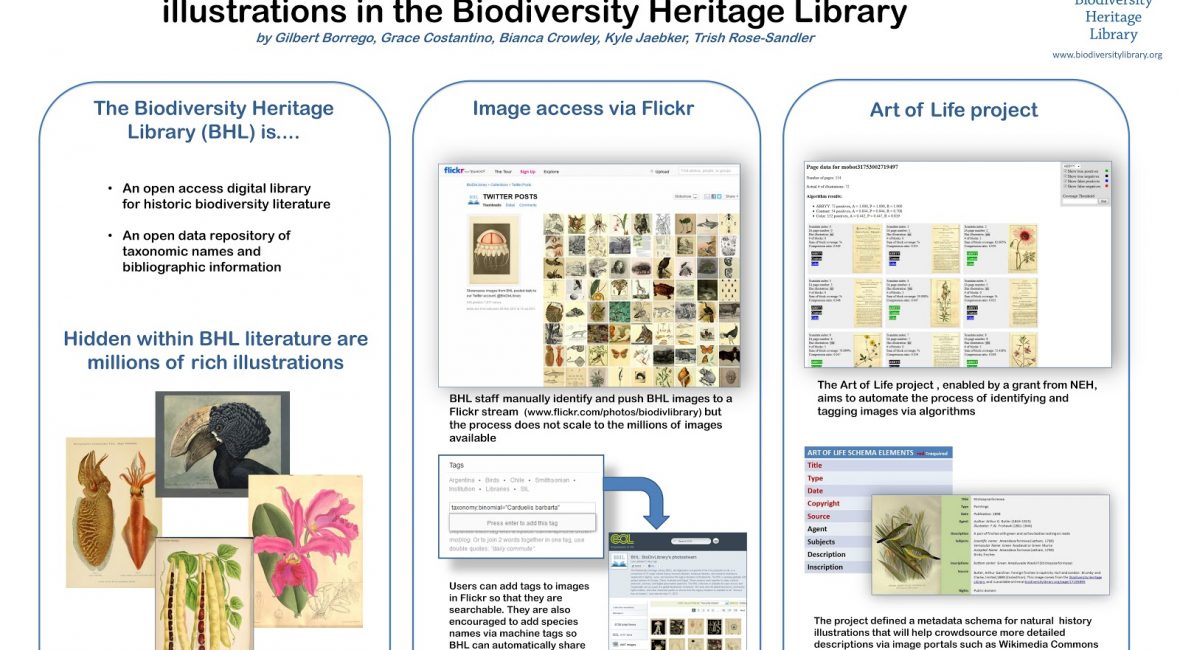
Museums and the Web poster. Trish Rose-Sandler.

This spring BHL staff member Trish Rose-Sandler participated in two conferences which were outside of the biodiversity community but whose attendees were very much interested in the natural history illustrations found within the pages of BHL books and journals. These included the Visual Resources Association (VRA) annual conference held in Providence, Rhode Island, April 3-5, and the Museums and the Web (MW) conference held in Portland, Oregon, April 17-20.

Attendees at the VRA conference are image curators, librarians, and archivists who support scholars in arts and humanities departments within universities or museums. Rose-Sandler’s talk at VRA was part of a session on how visual resource collections are reaching out to new audiences through promotion of their content and collaboration with other disciplines. Much in the same way, BHL is reaching out to new audiences through its image content which has a broad appeal among many different fields of research.
View Full Size Image
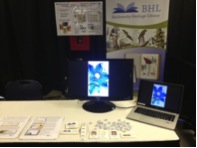
MW Demo Table.

The MW conference is attended by folks who work on the technology side of cultural heritage organizations, mostly museums, but also some libraries and historical societies. The story of BHL and its images was told through a one hour demo session that included a poster, one page handouts, and a slideshow of the illustrations. Rose-Sandler and her Art of Life colleague, Kyle Jaebker, explained the challenges BHL faces in identifying the location of millions of images, how we are providing limited access via Flickr, as well as how the Art of Life project is helping scale this effort by automating their identification and crowdsourcing their description. These visually-oriented professionals were enamored of the image content we possess. One visitor at MW, a scientific illustrator from Prague, commented that her students had used images from the BHL Flickr stream for a scientific illustration course she taught. Other visitors were interested in the algorithms we were developing for automatically identifying the location of images within text resources.

Most of the attendees at both conferences were completely unaware of BHL. Those who had heard of BHL were surprised to learn we provided access to natural history illustrations. VRA and MW provide unique opportunities for us to showcase the BHL content to communities who might not have heard of us otherwise. Natural history illustrations provide common ground where the art and scientific communities intersect. If you have any suggestions for other conferences or venues we should be present at, please send us feedback or email us at [email protected].

View Handouts from the Museums and the Web Conference:
  • The Art of Life Project
  • Uploading Images to Flickr
  • Tagging Images in Flickr
  • The Art of Life Algorithm
May 15, 2013by Kathryn Stine
BHL News, Blog Reel

BHL and Culturomics

On December 16, 2010 Science released a paper, “Quantitative Analysis of Culture Using Millions of Digitized Books” that describes data mining research using a vast textual archive created by the Google Books. The abstract reads, “We constructed a corpus of digitized texts containing about 4% of all books ever printed. Analysis of this corpus enables us to investigate cultural trends quantitatively. We survey the vast terrain of “culturomics”, focusing on linguistic and cultural phenomena that were reflected in the English language between 1800 and 2000. We show how this approach can provide insights about fields as diverse as lexicography, the evolution of grammar, collective memory, the adoption of technology, the pursuit of fame, censorship, and historical epidemiology. ‘Culturomics’ extends the boundaries of rigorous quantitative inquiry to a wide array of new phenomena spanning the social sciences and the humanities.”

The paper and subsequent commentary has accelerated nascent efforts at macroscopic, algorithmic questioning of large historical textual data sets. Can similar methods be applied fruitfully to the BHL corpus?

Already, Rod Page, bioinformatician and developer of BioStor, has demonstrated suggestive evidence in the affirmative by tracking a small sample of species names for the same organism in BHL texts through time and plotting the number of citations. The graph may be a visual representation of scientific debate and usage. Many other uses are possible, including:

  • Co-occurrence of place names with species
  • Frequency of co-occurrence of species names esp. with key words such as host, prey, predator, symbiont etc.
  • Tracking trends in zoological and botanical research by tracking methodological terminology through time.
  • Identification of taxonomically significant “events” in the literature based on textual cues.

Much of the follow-on activity to the Science paper is occurring in the “Digging into the Data” program. Thus, on May 9, the BHL made its data available for researchers in the Digging into the Data program.

View Full Size Image

BHL Director, Tom Garnett, will be attending the conference, “Digging into the Data” in June where speakers, including the authors of the Science article, will address issues of and opportunities in data mining of large textual corpora. With suitable partners, it is possible that we can seek NSF or Google funding for the unique use case our increasing text corpus presents. The framework for a proposal would be a team of biologists and a team of computer scientists posing research questions for the BHL corpus that would be amenable to algorithmic investigation. Even if funding is not forthcoming, if third party researchers use the BHL corpus to produce scientifically or historically salient results, it will enhance the value and use of the BHL, which can lead to further collaborations.

May 16, 2011by ulib-libraryjobs

Help Support BHL

BHL's existence depends on the financial support of its patrons. Help us keep this free resource alive!

search

About BHL

The Biodiversity Heritage Library (BHL) is the world’s largest open access digital library for biodiversity literature and archives. BHL operates as a worldwide consortium of natural history, botanical, research, and national libraries working together to digitize the natural history literature held in their collections and make it freely available for open access as part of a global “biodiversity community.”

Join Our Mailing List

Sign up to receive the latest news, content highlights, and promotions.

Subscribe Now

Subscribe to Blog via Email

Enter your email address to subscribe to this blog and receive notifications of new posts by email.

Join 319 other subscribers

Subscribe to Blog Via RSS

Subscribe to the blog RSS feed to stay up-to-date on all the latest BHL posts.

Access RSS Feed

Inspiring Discovery through Free Access to Biodiversity Knowledge.

The Biodiversity Heritage Library makes it easier than ever for you to access the information you need to study and explore life on Earth…for free, anytime, anywhere.


64+ Million Pages of
Biodiversity Literature Online.

EXPLORE

Tools and Services
to Transform Research.

EXPLORE

300,000+
Illustrations on Flickr.

EXPLORE

ABOUT | HARMFUL CONTENT | PRIVACY | SITE MAP | TERMS OF USE

