Biodiversity Heritage Library - Program news and collection highlights from BHL
  • Home
  • News
  • Featured Books
    • All Featured Books
    • Book of the Month Series
    • BHL at 20
  • User Stories
  • Campaigns
    • Fossil Stories
    • Garden Stories
    • Monsters Are Real
    • Page Frights
    • Her Natural History
    • Earth Optimism 2020
  • Tech Blog
  • Visit BHL
Home
News
Featured Books
    All Featured Books
    Book of the Month Series
    BHL at 20
User Stories
Campaigns
    Fossil Stories
    Garden Stories
    Monsters Are Real
    Page Frights
    Her Natural History
    Earth Optimism 2020
Tech Blog
Visit BHL
  • Home
  • News
  • Featured Books
    • All Featured Books
    • Book of the Month Series
    • BHL at 20
  • User Stories
  • Campaigns
    • Fossil Stories
    • Garden Stories
    • Monsters Are Real
    • Page Frights
    • Her Natural History
    • Earth Optimism 2020
  • Tech Blog
  • Visit BHL
Biodiversity Heritage Library - Program news and collection highlights from BHL
BHL News, Blog Reel, Tech Updates

Announcing Altmetric and MyTweeps on BHL!

Have you ever wanted to learn more about the books in BHL? Or maybe find out what people are saying on social media about our collections? Or perhaps you’d like to connect with other BHL-enthusiasts?

We’re excited to announce that today, as part of our Mining Biodiversity project, we’ve launched two new features on BHL that will allow you to do all of the above! These features are Altmetric and MyTweeps.

Altmetric

Altmetric is a UK-based company that offers tools to help track online mentions of a library, publisher, or other entities’ content. Sites such as Twitter, Facebook, Wikipedia, Reddit, Google+, and Mendeley, as well as other online sources like blogs and news outlets, are indexed.

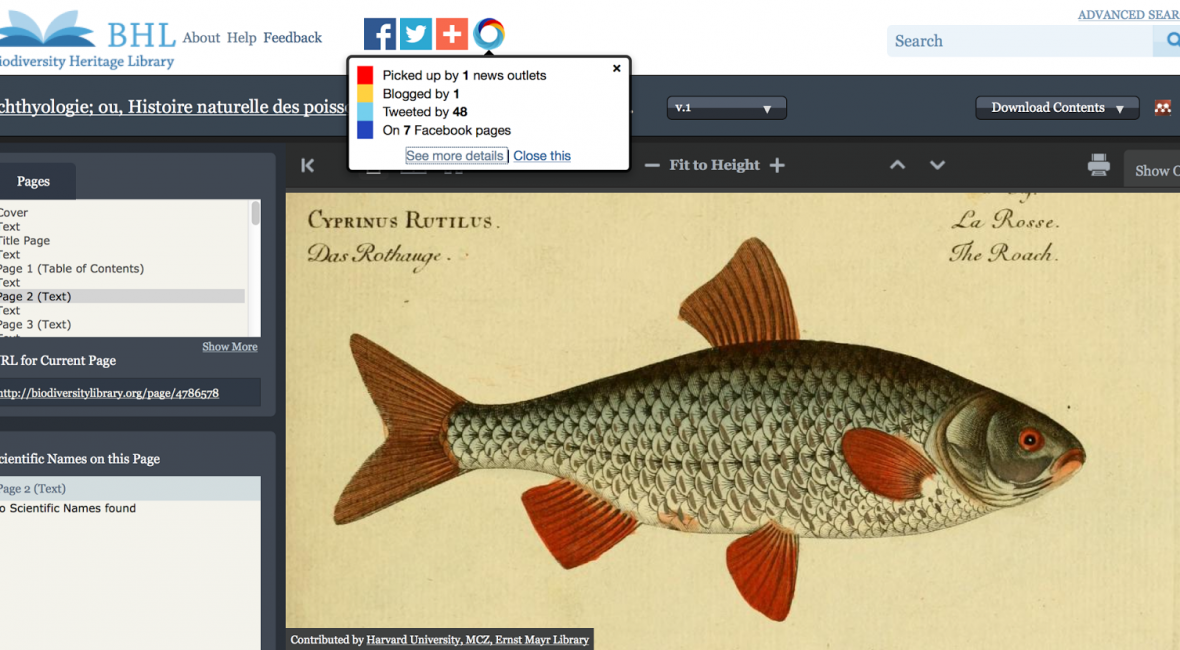
We worked with Altmetric* to track online conversations that include links to BHL books and articles. All mentions** of an individual book (which include a link to the book itself or a link to a page within that book***) are aggregated together into a single dashboard that allows you to explore all of the conversations happening about that item in one place. Each book’s individual dashboard is accessible by clicking on the Altmetric badge (a colorful, donut-shaped icon) in the book viewer header or the “see more details” link in the information box that pop-ups when you hover over the Altmetric badge (see below) in BHL.

View Full Size Image
The Altmetric badge in the BHL book viewer. Click on the badge itself, or the “See More Details” link in the pop-up box that appears when you hover over the badge, to see the Altmetric dashboard aggregating conversations about this item.


Within the dashboard, you can explore the specific tweets, Facebook posts, news articles, Wikipedia articles, or blogs that talk about that particular book. Each indexed site is represented by a different color (i.e. Twitter is teal; Facebook is navy blue; etc.), so a simple glance at the Altmetric donut will tell you which sites people have mentioned that item on.

View Full Size Image
Example of the Altmetric dashboard, accessed by clicking on the donut-shaped icon or information box illustrated above, for a book in BHL.

The Altmetric icon will appear in the book viewer header for any book that has been mentioned (and where that mention includes an actual link to that book or a page within that book) on one of the indexed online sites. If there is no Altmetric icon in the book viewer header, then there have not yet been any online conversations (with a link) about that book (but you can change that!).

Altmetric dynamically tracks new online mentions of BHL books. That means that if you tweet or post about a book in BHL (and include the link to it), Altmetric will subsequently index that post and make it available in BHL via the described Altmetric icon. Thanks to the social sharing buttons we’ve added to BHL (see below), it’s easier than ever to share your thoughts, expertise, or comments about a BHL book on social media. And thanks to our Altmetric implementation, it’s also now easier than ever for others to find those comments in BHL and benefit from your knowledge!

View Full Size Image
The social media sharing buttons on the BHL website. Simply click on the desired social site to share a link to the page you are viewing in BHL.

Altmetric picks up new mentions on Twitter, news outlets, and blogs on a daily basis. Mentions on Wikipedia, Google+, and Facebook are picked up and indexed via the described dashboards every 2-3 days.

Here are links to just a couple of BHL books that have been indexed by Altmetric. Click on the donut icon in the book viewer header to explore the fascinating conversations about each item. You can contribute directly to the online conversations using our social sharing buttons in BHL (see above), or by clicking on the appropriate links in the Altmetric dashboard (see below). Or start your own conversations about BHL books and see them appear (note the time lag for indexing on various sites above) in BHL!


  • Ichthyologie; ou, Histoire naturelle des poissons : En six parties avec 216 planches dessinées et enluminées d’après nature.
  • Caroli Linnaei…Systema naturae per regna tria naturae :secundum classes, ordines, genera, species, cum characteribus, differentiis, synonymis, locis.
  • The marine mammals of the north-western coast of North America, described and illustrated; together with an account of the American whale-fishery.
  • Conradi Gesneri medici Tigurini Historiae animalium liber IV : qui est De piscium & aquatilium animantium natura : cum iconibus singulorum ad viuum expressis ferè omnibus DCCXII.


View Full Size Image
Contribute to a Twitter conversation you discover in Altmetric simply by hovering over the tweet in the Altmetric dashboard and then choosing “Reply,” “Retweet,” or “Favorite.”


View Full Size Image
Clicking on any one of the Facebook posts you discover in the Altmetric dashboard will take you directly to that post in Facebook. From there you can comment, like, or share the post within Facebook itself.


MyTweeps

Love biodiversity, books, or natural history? Want to find others who like it too? Or perhaps you’d like to find an easy way to connect with other BHL fans? Are you on Twitter?

Then look no further than MyTweeps on BHL.

MyTweeps is a tool developed by the Social Media Lab at Ryerson University, one of our Mining Biodiversity grant partners. The tool allows you to explore an individual Twitter network (those who follow a certain account on Twitter).

We’ve included a link to the BHL MyTweeps dashboard on the homepage of BHL. Simply click on the “BHL Twitter Community” button at the bottom of the homepage, beneath the BHL Twitter feed, to access the dashboard.

View Full Size Image
The link to the BHL MyTweeps dashboard on the BHL homepage.

The BHL MyTweeps dashboard displays the latest tweets from the Twitter accounts that follow BHL, trending hashtags and trends over time from those followers, geographic location of BHL’s tweeps (i.e. followers), and the connectivity of the BHL network (i.e. who mentions whom among the BHL community of followers). We’ve also included an Altmetric dashboard in the lower left-hand corner of the MyTweeps page that shows the most popular BHL books on social media that week.

View Full Size Image
The BHL MyTweeps Dashboard, accessed by clicking on “BHL Twitter Community” at the bottom of the BHL homepage.

Take a look and discover a whole new network of biodiversity and BHL enthusiasts to connect, converse, and collaborate with. Or simply use MyTweeps as a way to stay informed about the topics and issues that are important to our community.

We hope you’ll explore and enjoy our new social media tools and take the opportunity to learn more awesome information about our collections. If you have any questions or comments about the tools, please don’t hesitate to send us feedback!

Happy socializing!

View Full Size Image


This project is made possible by a grant from the Institute for Museum and Library Services [Grant number LG-00-14-0032-14].

*Traditionally, Altmetric tracks only DOI (Digital Object Identifiers) mentions, but for this project our team worked with Altmetric to pioneer the tracking of URIs (Unique Resource Identifiers) via Altmetric. In exchange, Altmetric has granted us free access to their license and services.
**Mentions of BHL content on social media sites (i.e. Twitter, Facebook, Google+, Reddit, and Mendeley) are captured from June 2014-onwards. Mentions of BHL content on blogs and news articles are captured since the launch of BHL onwards.
***Indexed conversations are those that include links that start with “http://biodiversitylibrary.org/item/” or “http://biodiversitylibrary.org/page/” or “http://biodiversitylibrary.org/part/.” We are not tracking mentions with links that start with “http://biodiversitylibrary.org/bibliography/” due to Google Scholar tag guidelines, which form the basis of Altmetric’s tracking ability.

July 20, 2015by ulib-libraryjobs
BHL News, Blog Reel

Some Reflections on Social Media and Society

What are the impact and implications of social media on society?

View Full Size Image

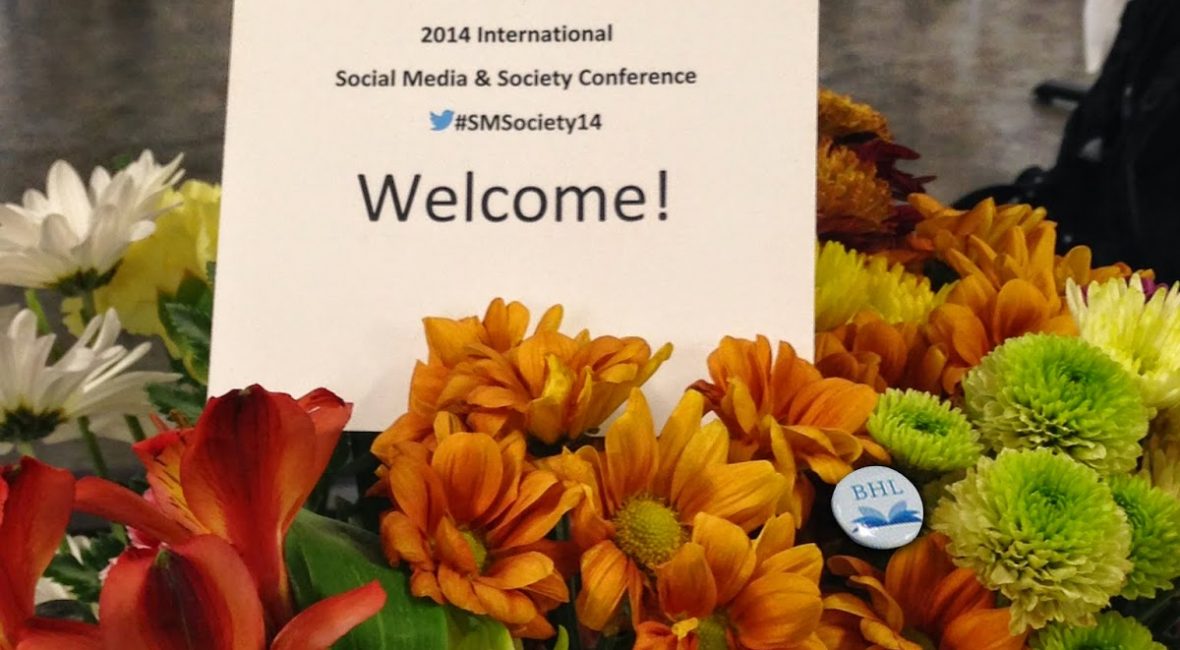
This question was the fundamental discussion point of the Social Media and Society 2014 conference in Toronto, Canada, Sept. 27-28, 2014. Now in its fifth year, the conference, organized by the Social Media Lab at Ryerson University (a partner in the Mining Biodiversity project funded by the IMLS Digging Into Data Challenge, of which BHL is also a participant), brings together researchers and practitioners across a broad range of social media related fields to discuss current research and best practices in social media, as well as its application to society at large.

BHL Outreach and Communication Manager, Grace Costantino, was invited to attend the conference. As the manager of BHL’s social media networks (Twitter, Facebook, blog, Flickr, Pinterest), she was eager to connect with other professionals, discover current trends, and investigate best practices and new directions for BHL social media.

The conference discussed a variety of topics, including social media’s effect on relationships and voice; differences among genders in social media participation; privacy; deciphering influence within social media; social media as a marketing platform; use of social media within science communication; how scholars use social networks; and altmetrics.

Several interesting findings and further questions emerged within these topics.

View Full Size Image
From Keith Hampton’s talk. Social Media and cloud computing are as revolutionary (and for some scary) as electricity was in the past.

Keith Hampton, keynote speaker for day one, related his research regarding social media’s effect on relationships, voice, and gender. Common lore asserts that extensive adoption of social media results in increased alienation and more fleeting relationships within society. Conversely, Hampton’s research found that social media results in more persistent relationships and an increased awareness of the activities of one’s social ties through digital technology.

Along another avenue of research involving social media and politics, Hampton found that social media does not make people more inclined to engage in political conversations online. While 86% of surveyed participants expressed a willingness to discuss a political topic offline, only 42% were willing to share their opinions online, and only .3% said they were willing to discuss them online but not offline. The reason for this may be the persistent nature of social media; once an opinion is voiced, it is very difficult to erase it. People were also more willing to share when they believed that their network of followers were sympathetic to their viewpoints.

Finally, in regards to stress and social media, Hampton found that women who use social media felt less psychological stress but more social stress, while men generally did not display any correlation between social media use and stress (though they may feel some social stress when hearing about a friend’s demotion or interaction with a crime).

One panel within the conference presented research investigating the facets of influence within social media, and how to identify influential users. The general definition of influence in this context was those individuals most likely to disperse information within a network. Elizabeth Dubois of the Oxford Internet Institute proposed four facets of influence (popularity, interaction, knowledge, and social embeddedness), and depending on the facet used, different influencers emerged. Weiai Xu of the University of Buffalo found that opinion leaders on Twitter are generally those most connected and involved. K. Hazel Kwon of Arizona State University also found that people were more likely to share or engage with a topic or event that many of their friends also followed, suggesting that anonymity (once touted as a benefit of online interactions) is detrimental to increasing awareness via social media.

View Full Size Image

The discussion on privacy and social media raised many good questions for researchers and practitioners. How much privacy should users expect on social media, particularly in regards to their public tweets being retweeted or shared via media outlets? This discussion was largely centered around the @SteenFox “What Were you Wearing” debate. Twitter is a public platform, but the speakers noted that a full awareness of the “public” nature of public tweets was sometimes lacking among users. The thought-provoking question of “are hashtags the antithesis to an expectation of privacy,” given that by their use you join a very public, sometimes global conversation outside of your own network, was raised by Siobhan O’Flynn from the University of Toronto. The main take-away from the panel was that more education is needed regarding what privacy means in social media.

Interesting particularly for BHL were the discussions regarding the role of Twitter in science topics and scholars’ use of social media. Moritz David Buchi of the University of Zurich presented on “How does the representation of science topics differ between news and tweets?” He found that, in general, news outlets were more objective while tweets were more dramatic. Science tweets are also largely not intended to be self-contained, but instead linked to larger news articles. These tweets also operated mostly on a broadcasting model, involving little dialogue. Retweets were most prominent, producing a diffusion of knowledge effect.

Two separate panels discussed scholars’ use of social media. Anabel Quan-Haase, Kim Martin, and Lori Mccay-Peet cited Gruzd and Goertzen’s paper “Wired Academia: Why Social Science Scholars are Using Social Media,” which outlines three main motives for social media use among scholars: information gathering; collaboration; and socializing and information dissemination. Bonnie Stewart found that scholars participated in social media to voice an opinion and contribute to a discussion, though traditional “power factors” like institutional affiliation affected how well these voices were heard. George Veletsianos of Royal Roads University found that while scholars use social media for knowledge creation (like crowdsourcing) and dissemination, they still struggle with issues of copyright restrictions; negotiating personal and professional boundaries; and a lack of frameworks in academia to evaluate the legitimacy of networked activities, which results in pressure to engage in traditional outreach and dissemination activities. Related to this was a presentation by Heidi Julien from the University of Buffalo, which discussed the use of almetrics (alternatives to the traditional journal impact factor and personal citation indices) to inform tenure decisions. Her experience shows that institutions are still a long way from incorporating altmetrics into these decisions.

View Full Size Image
Richard Naples of Smithsonian Libraries, with his poster.

BHL partner Smithsonian Libraries also presented a poster at the conference entitled “The GIF That Keeps on Giving,” by Richard Naples. The poster presents the library’s use of animated GIFs in Tumblr, and the increased exposure and reach that this “culture remix” enables. Many of the GIFs are from books digitized for BHL.

Overall, the conference was an excellent learning and engagement opportunity, with many applications for BHL. Ms. Costantino developed a better understanding of the types of posts users are more likely to engage with; how better to craft social media campaigns around storytelling to excite curiosity; why scholars (one of BHL’s core audiences) are using social media and what they hope to find via these outlets; how to better understand, track, and engage with BHL’s online community; and how to help contribute to the case for altmetrics.

View Full Size Image

The BHL Outreach and Communication Manager position, and this conference attendance, are made possible in part through funding from the Institute of Museum and Library Services (Grant number LG-00-14-0032-14).

September 30, 2014by ulib-libraryjobs

Help Support BHL

BHL's existence depends on the financial support of its patrons. Help us keep this free resource alive!

search

About BHL

The Biodiversity Heritage Library (BHL) is the world’s largest open access digital library for biodiversity literature and archives. BHL operates as a worldwide consortium of natural history, botanical, research, and national libraries working together to digitize the natural history literature held in their collections and make it freely available for open access as part of a global “biodiversity community.”

Join Our Mailing List

Sign up to receive the latest news, content highlights, and promotions.

Subscribe Now

Subscribe to Blog via Email

Enter your email address to subscribe to this blog and receive notifications of new posts by email.

Join 319 other subscribers

Subscribe to Blog Via RSS

Subscribe to the blog RSS feed to stay up-to-date on all the latest BHL posts.

Access RSS Feed

Inspiring Discovery through Free Access to Biodiversity Knowledge.

The Biodiversity Heritage Library makes it easier than ever for you to access the information you need to study and explore life on Earth…for free, anytime, anywhere.


64+ Million Pages of
Biodiversity Literature Online.

EXPLORE

Tools and Services
to Transform Research.

EXPLORE

300,000+
Illustrations on Flickr.

EXPLORE

ABOUT | HARMFUL CONTENT | PRIVACY | SITE MAP | TERMS OF USE