
Biodiversity Heritage Library - Program news and collection highlights from BHL
  • Home
  • News
  • Featured Books
    • All Featured Books
    • Book of the Month Series
    • BHL at 20
  • User Stories
  • Campaigns
    • Fossil Stories
    • Garden Stories
    • Monsters Are Real
    • Page Frights
    • Her Natural History
    • Earth Optimism 2020
  • Tech Blog
  • Visit BHL
Home
News
Featured Books
    All Featured Books
    Book of the Month Series
    BHL at 20
User Stories
Campaigns
    Fossil Stories
    Garden Stories
    Monsters Are Real
    Page Frights
    Her Natural History
    Earth Optimism 2020
Tech Blog
Visit BHL
  • Home
  • News
  • Featured Books
    • All Featured Books
    • Book of the Month Series
    • BHL at 20
  • User Stories
  • Campaigns
    • Fossil Stories
    • Garden Stories
    • Monsters Are Real
    • Page Frights
    • Her Natural History
    • Earth Optimism 2020
  • Tech Blog
  • Visit BHL
Biodiversity Heritage Library - Program news and collection highlights from BHL
BHL News, Blog Reel

Birds De-Evolving?

View Full Size Image

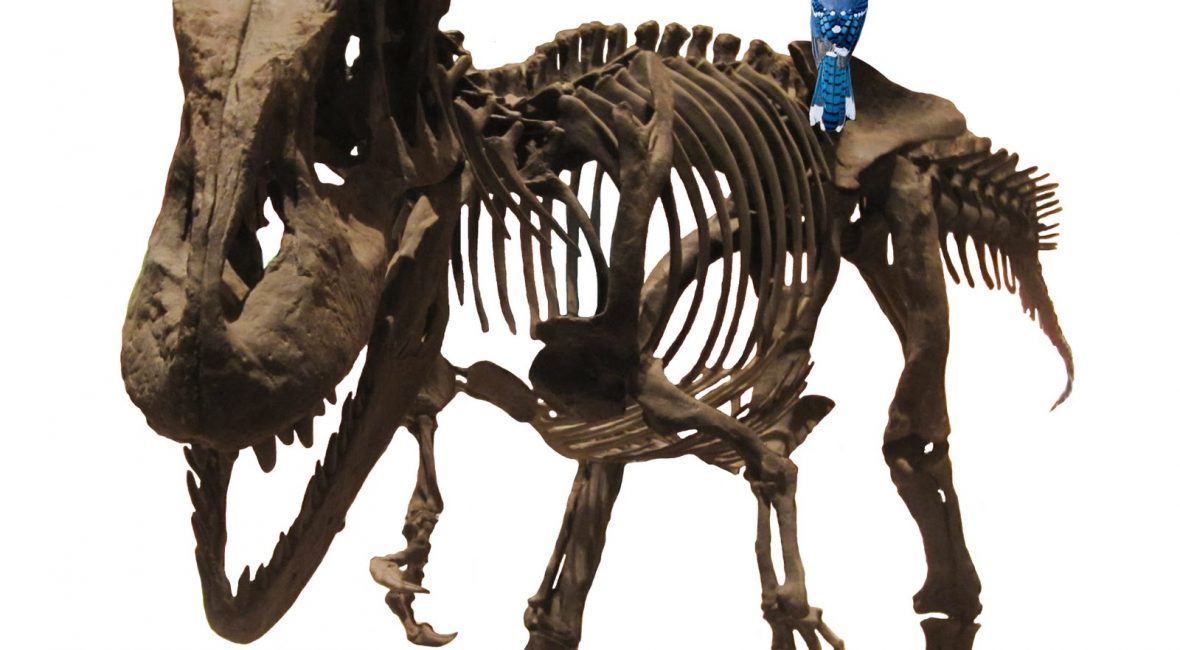
Scientific Breakthrough Alert! Recent studies have revealed that we may soon be seeing dinosaurs again in our modern age! How is this possible? One scientist has found that birds, the closest living relatives to the behemoths that have so completely captured the imagination of humans, are showing signs of de-evolution, reverting back to the forms of their dinosaur ancestors.

The evolutionary relationship between birds and dinosaurs is based upon their commonality in several distinct areas. Take, for instance, feathers. Many “feathered dinosaurs,” such as Archaeopteryx, have been discovered, displaying features intermediate between modern birds and modern reptiles. Such feathered dinosaurs are often considered the missing link between birds and dinosaurs. Recent discoveries regarding “protofeathers” even suggest that the Tyrannosauroids may have had feathers.

Skeletal evidence also supports the link between birds and dinosaurs. Bird and dinosaur skeletons display similarities in the neck, pubis, wrist, arm, pectoral girdle, shoulder blade, clavicle and breast bone. Furthermore, theropod dinosaurs, like birds, have been discovered to have hollow sacs in their skeletons into which air is pumped. And, of course, most people are aware of the similarity between dinosaurs and birds regarding their hollow skeletons.

So, while the development of dinosaurs to birds is well-established, what is happening now to suggest de-evolution back to dinosaurs? Dr. John Hammond believes he has the answer.

Dr. Hammond, in his studies on the Cyanocitta cristata, commonly known as the Blue Jay, has found that they are beginning to display dinosaur characteristics. In his recent study, many of the young he studied possessed on average fewer feathers and a stronger disposition to avoid flight in favor of hunting for food on the ground, using their legs instead of their wings. Their legs are also on average bulkier and stronger than those of their predecessors, while their wings display a decidedly weaker muscular structure. The blue jays are instead using their wings for “wing-assisted incline running,” which, in the past, may have led to the development of flight in the dinosaur-bird transition.

More importantly, however, Dr. Hammond has discovered what appears to be the beginnings of a raised sickle claw on the second toe of the Cyanocitta cristata young. Such an appendage was an iconic feature of the Velociraptors, and, in light of this in addition to the discoveries discussed earlier, Dr. Hammond believes that we may be witnessing a de-evolution of the Blue Jay back to something resembling the Rahonavis. Further study on this species and additional species of birds is needed, and there are still no concrete hypotheses as to why birds would be reverting back to their dinosaur roots.

In light of these discoveries, we felt it only appropriate to feature a book on our dinosaur friends, particularly if we will soon be sharing our planet with them. Thus, we feature Extinct Monsters: A Popular Account of Some of the Larger Forms of Ancient Animal Life (1893), by Rev. H.N. Hutchinson. Are we entering another Age of the Dragons, as our book of the week describes it? Will we remain on the top of the food chain? Will the nightmarish scenes of dinosaurs hunting and tearing humans limb from limb, which are so commonly depicted in film, become a brutal reality for the human race? Only time will tell, but learning more about our ferocious competitors, for instance by exploring our book of the week, may help even the odds. Good luck!

Oh, and, by the way, April Fool’s! 😉

This week’s book, Extinct Monsters: A Popular Account of Some of the Larger Forms of Ancient Animal Life(1893), by Rev. H.N. Hutchinson, was contributed by Harvard University, MCZ, Ernst Mayr Library.

– Special thanks to Erin Thomas for her assistance with this post.

April 1, 2011by michelle.underhill

Help Support BHL

BHL's existence depends on the financial support of its patrons. Help us keep this free resource alive!

search

About BHL

The Biodiversity Heritage Library (BHL) is the world’s largest open access digital library for biodiversity literature and archives. BHL operates as a worldwide consortium of natural history, botanical, research, and national libraries working together to digitize the natural history literature held in their collections and make it freely available for open access as part of a global “biodiversity community.”

Join Our Mailing List

Sign up to receive the latest news, content highlights, and promotions.

Subscribe Now

Subscribe to Blog via Email

Enter your email address to subscribe to this blog and receive notifications of new posts by email.

Join 319 other subscribers

Subscribe to Blog Via RSS

Subscribe to the blog RSS feed to stay up-to-date on all the latest BHL posts.

Access RSS Feed

Inspiring Discovery through Free Access to Biodiversity Knowledge.

The Biodiversity Heritage Library makes it easier than ever for you to access the information you need to study and explore life on Earth…for free, anytime, anywhere.


64+ Million Pages of
Biodiversity Literature Online.

EXPLORE

Tools and Services
to Transform Research.

EXPLORE

300,000+
Illustrations on Flickr.

EXPLORE

ABOUT | HARMFUL CONTENT | PRIVACY | SITE MAP | TERMS OF USE