

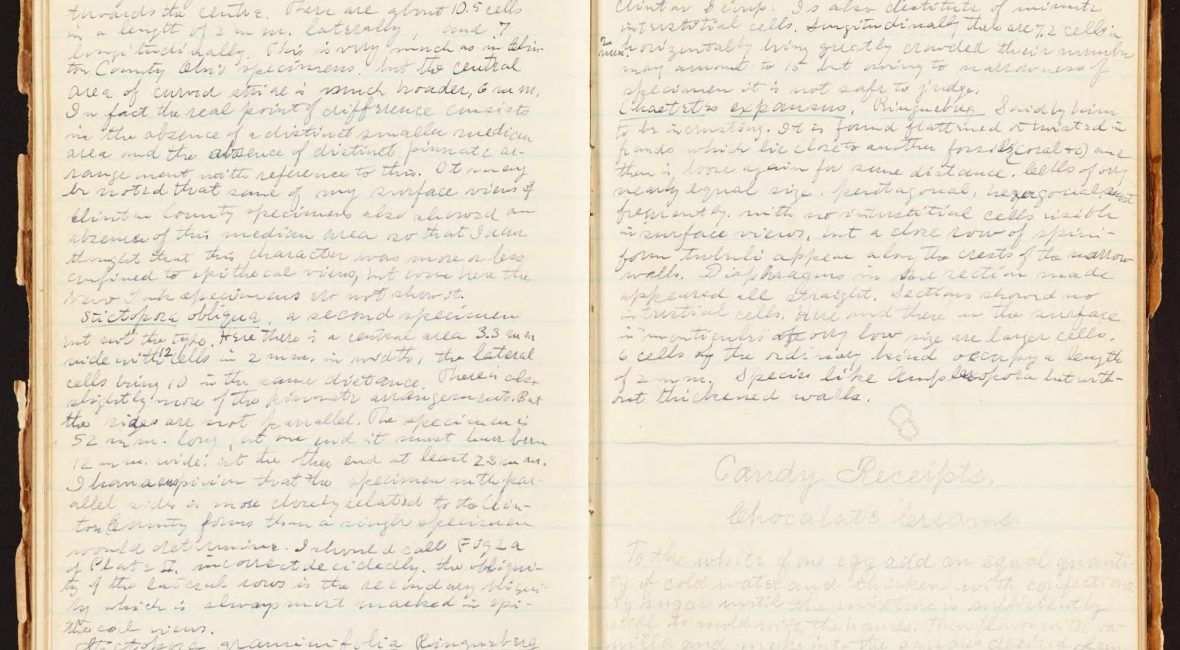
Field notes are well known to be essential, primary material that provide details about collections and expeditions that aren’t found in published material or specimen labels. Field notes can also contain diary entries, poems, and sketches which give insight into the lives of the researchers themselves. And now, we can add the candy preferences of August F. Foerste to those insights.
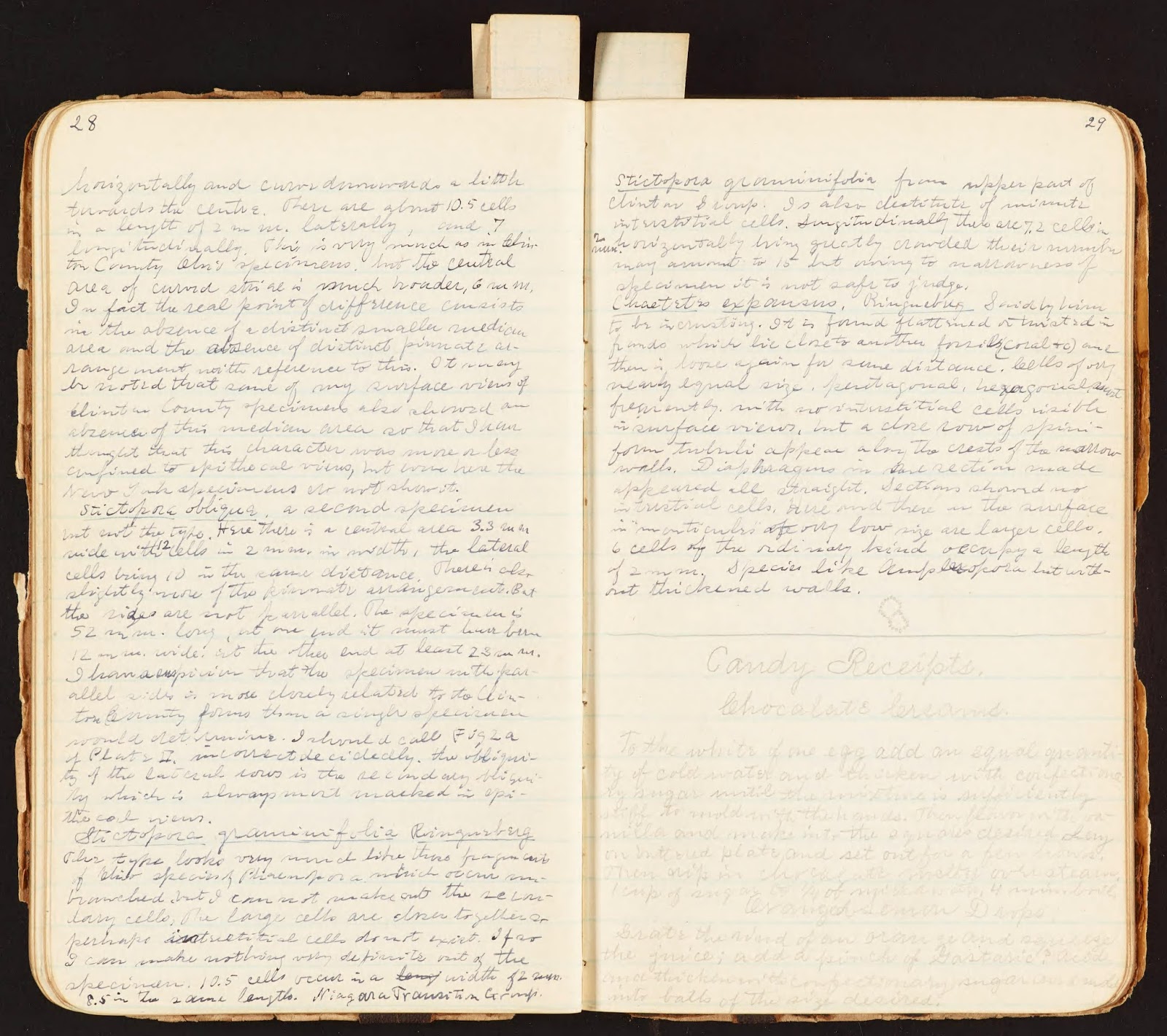
In his Specimen notebook, Ohio, 1887-1888, with no explanation, we find a list of several different candy recipes, including chocolate creams, lemon drops, and Neapolitan creams. Brings up quite a few questions. Who gave him the recipes? Was this the only paper he had available to write them down? Did he try to make them? Why is there a sugar syrup recipe at the end of the chocolate cream recipe with no explanation as to what to do with it? (This last one, admittedly, is more a personal inquiry of mine.)
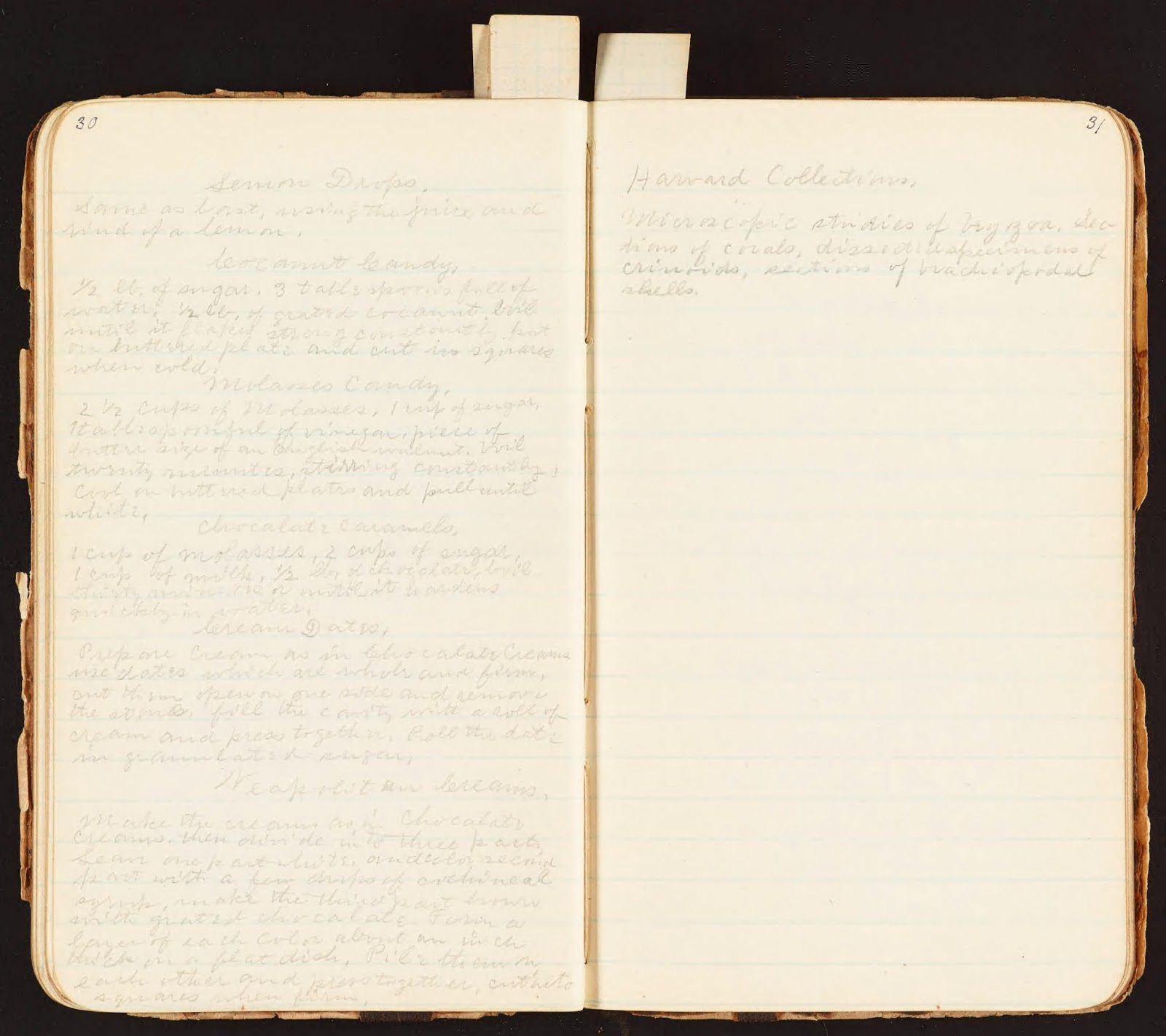 |
| Specimen notebook, Ohio, 1887-1888. https://www.biodiversitylibrary.org/item/229964 |
What we can determine is that they were written down in 1888 when Foerste was completing his master’s degree at Harvard University. In fact, on the facing page, pictured above, we see a note about Harvard’s collections, in particular “microscopic studies of bryozoan, sections of corals, dissected specimens of crinoids, [and] sections of brachiopoda shells.” So while he may have been briefly distracted by confection, he was still focused on his studies. In that same notebook, Foerste includes several illustrations of specimens.
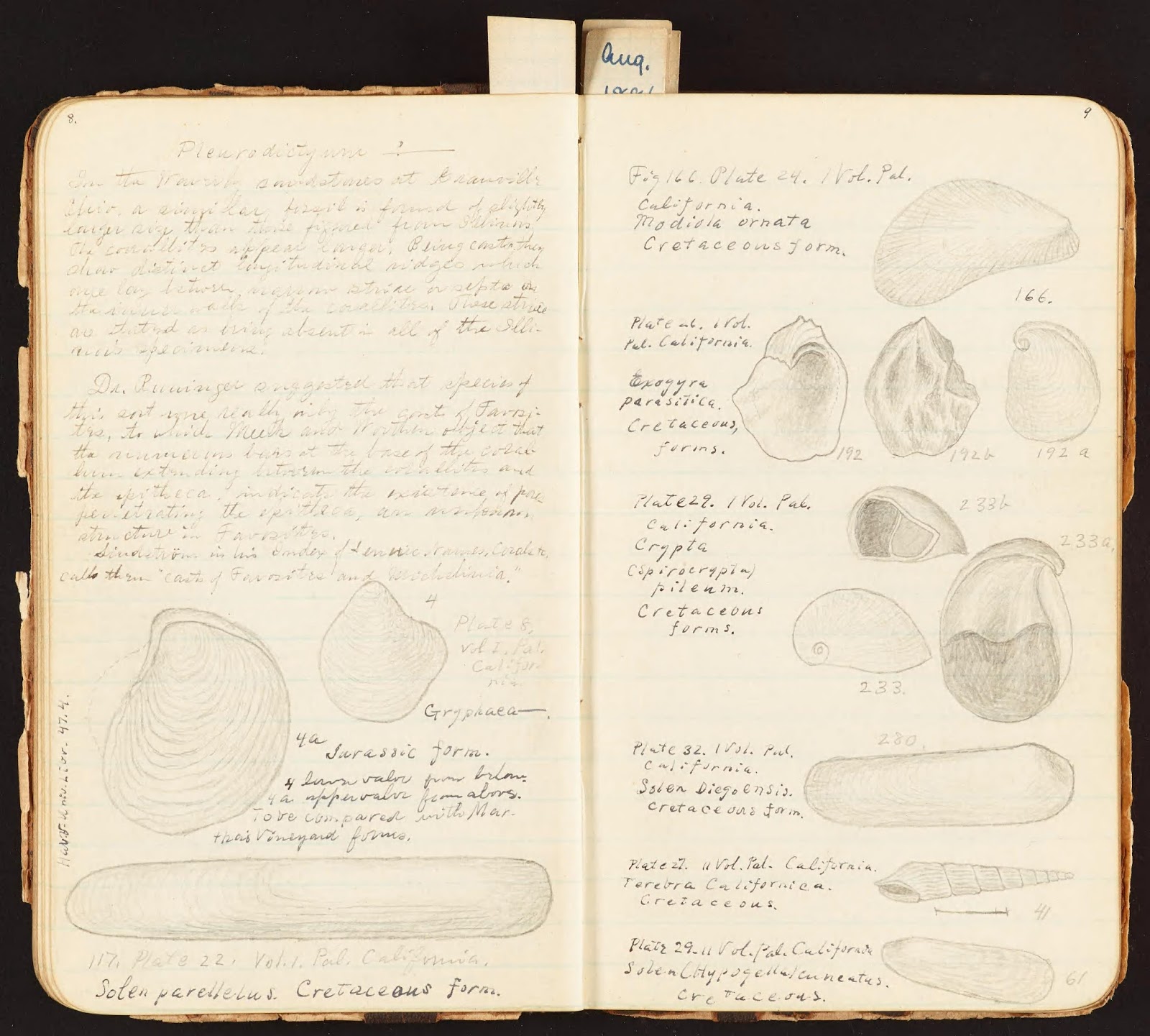 |
| Specimen notebook, Ohio, 1887-1888. https://biodiversitylibrary.org/item/229964 |
Foerste was a native of Dayton, Ohio. Like many naturalists, his early interests in science came about from wandering around town and taking note of the fossils, geological formations and stratigraphy of the local area. He completed his bachelor’s degree at Denison University before continuing his studies in Cambridge, Mass. While at Harvard, Foesrte also served as part-time assistant with the United States Geological Survey. As part of the survey, he studied the stratigraphy and petrography of New England.
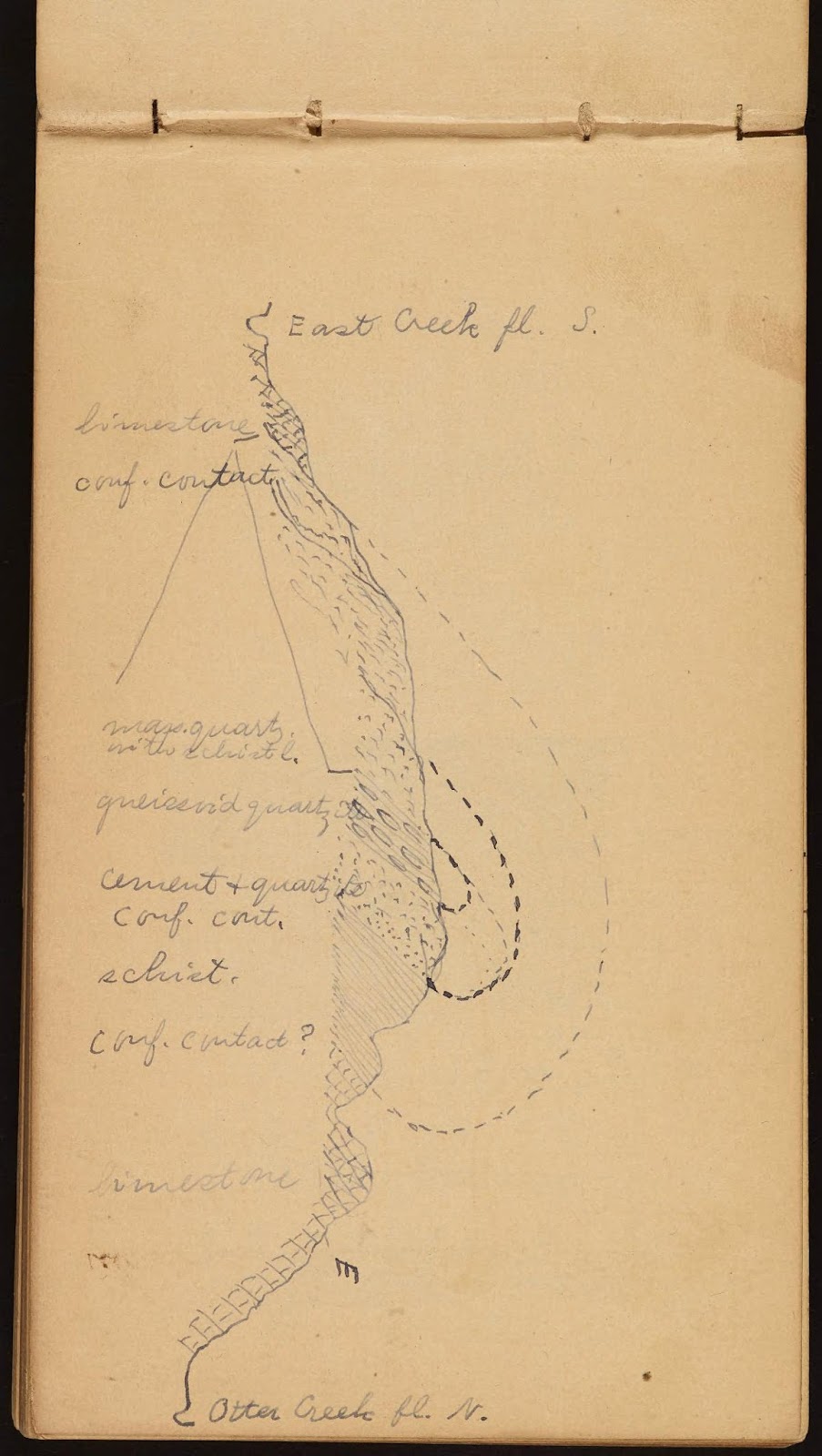 |
| Illustration by Foerste while in Vermont for the U.S. Geological Survey. Foerste was also studying at Harvard at the time. Field notes, New England, undated. https://www.biodiversitylibrary.org/page/54118346 |
After graduating with his Ph.D, Foesrte would return to his hometown, spending most of his career as a teacher at Steele High School. During the summer breaks, he would go out into the field for the U.S. Geological Survey. As part of the BHL Field Notes Project, Smithsonian Institution Archives has digitized many of these notes. In 1932, he was appointed as Associate in Paleontology for the U.S. National Museum (now the National Museum of Natural History) until his death in 1936.
We are excited to share Foerste’s field notes as part of the BHL Field Notes Project. You can view these and other notebooks by Foerste in BHL. And if anyone gives those confection recipes a try, be sure to share with us!
The BHL Field Notes Project is funded by the Council on Library and Information Resources (CLIR).
“August F. Foerste.” Centreville-Washington History.
For a transcribed copy of the recipes, check out the Smithsonian Field Book Project’s 2012 Holiday Card, designed by Lesley Parilla.
