Biodiversity Heritage Library - Program news and collection highlights from BHL
  • Home
  • News
  • Featured Books
    • All Featured Books
    • Book of the Month Series
    • BHL at 20
  • User Stories
  • Campaigns
    • Fossil Stories
    • Garden Stories
    • Monsters Are Real
    • Page Frights
    • Her Natural History
    • Earth Optimism 2020
  • Tech Blog
  • Visit BHL
Home
News
Featured Books
    All Featured Books
    Book of the Month Series
    BHL at 20
User Stories
Campaigns
    Fossil Stories
    Garden Stories
    Monsters Are Real
    Page Frights
    Her Natural History
    Earth Optimism 2020
Tech Blog
Visit BHL
  • Home
  • News
  • Featured Books
    • All Featured Books
    • Book of the Month Series
    • BHL at 20
  • User Stories
  • Campaigns
    • Fossil Stories
    • Garden Stories
    • Monsters Are Real
    • Page Frights
    • Her Natural History
    • Earth Optimism 2020
  • Tech Blog
  • Visit BHL
Biodiversity Heritage Library - Program news and collection highlights from BHL
Blog Reel

The Collector Connection: organizations and the individual collectors who shaped them

This is the first of a joint blog series by the Field Book Project (FBP) and the Biodiversity Heritage Library (BHL), showcasing examples of digital connections between collectors, field book catalog records, and the resulting publications of collecting events.

Over the summer the Field Book Project and Biodiversity Heritage Library examined some of the fascinating stories and natural history documentation that resulted from major expeditions. In the past, expeditions were the best way to expediently collect in many regions of the world.  Expeditions still occur today, but they were far more common before the advent of major changes in transportation. Expeditions tend to generate great stories; the mix of personalities, challenges, and exotic locations seem to make it inevitable.  For much of the nineteenth century, expeditions were often organized as needed; they could be heavily influenced by the temperaments of the people leading them.  Strong personalities among the leaders sometimes led to serious conflicts (curious to learn more?  Check out the US Geological Survey’s (USGS) biography on John Wesley Powell, the Survey’s second director, and its discussion of the Powell, Hayden, King, and Wheeler Surveys).  These conflicts and the US government’s growing need for more consistent information about its natural resources eventually led to fundamental changes in the way collecting was completed.  Eventually the US federal government established organizations like the US Bureau of Fisheries, US Geological Survey, US Biological Survey whose primary purpose was to routinely collect, document, and eventually oversee some of the nation’s natural resources.

These organizations and their first collectors often involve great stories, but also provide wonderful examples of the types of field work documented.  Additionally, their efforts were for the United States’s benefit, and the resulting reports and publications are now available through resources like the Biodiversity Heritage Library.  This new blog series is a chance to highlight the different types of collectors that formed these organizations.

United States Biological Survey (USBS)
The first story highlights the beginnings of the US Biological Survey (USBS), originally formed by C. Hart Merriam under the US Department of Agriculture (USDA).  The story forms around two individuals of note—C. Hart Merriam (first chief of USBS) and Vernon Bailey (USBS’s first major specimen collector and naturalist).  These individuals each had unique ways of coming to their field of study, method of work, and differing output, but each was an important contributor to their discipline.  Their catalog records and publications are also available through FBP and BHL (see content links below).
View Full Size Image
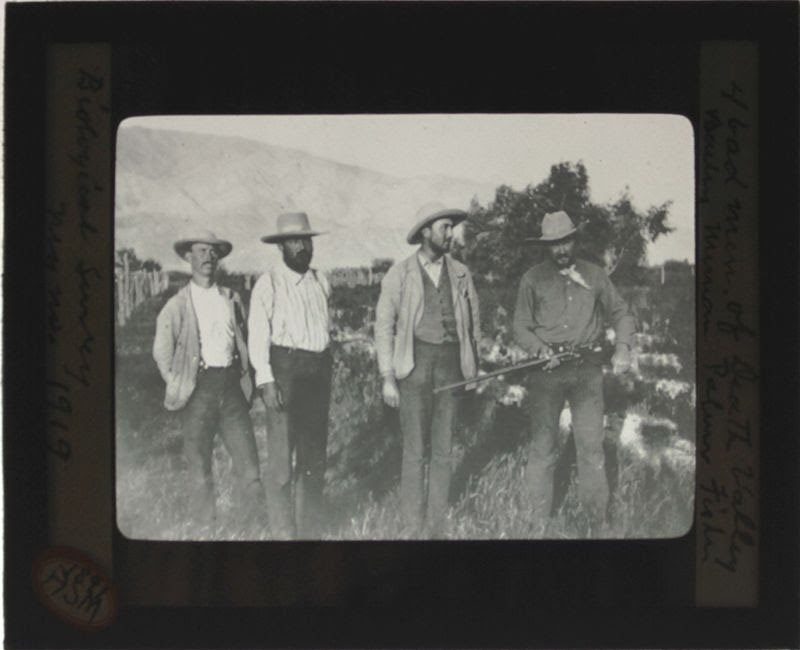
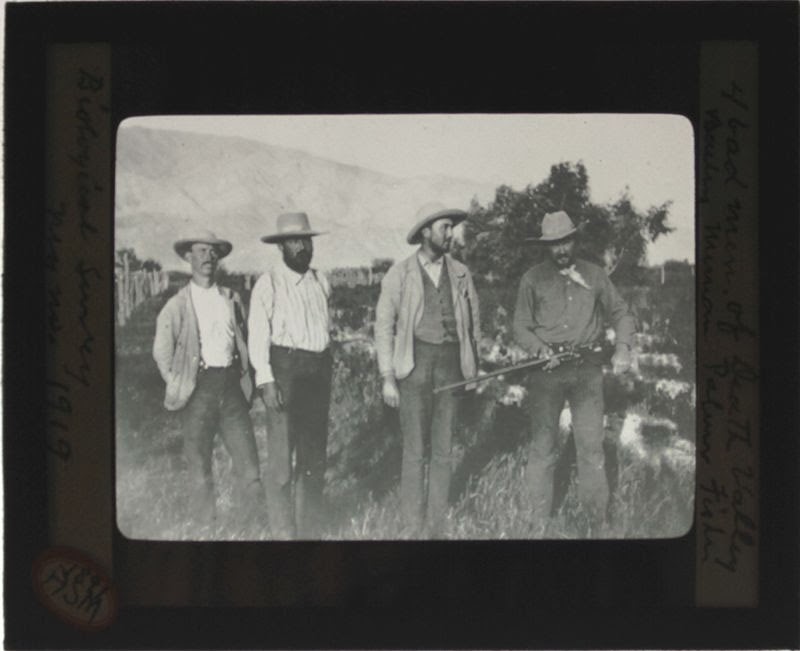
US Biological Survey staff, including Vernon O. Bailey and C. Hart Merriam, 1919.

C. Hart Merriam was a biologist, whose work at the end of the 19th century was instrumental in the emerging field of ecology. His field work and affiliation with the USDA led to his “life zones” concept. In 1885 he was chosen to head the Section of Economic Ornithology in the USDA.  His vision for the section eventually shifted its focus from only birds to include mammals.  By 1896 it became the USBS, later merging with other federal entities to form the US Fish and Wildlife Service.

In 1883, C. Hart Merriam began corresponding with a young man in Minnesota with an interest in collecting, named Vernon Bailey.  This relationship developed over the decades, and proved an important influence on the shaping and growth of the USBS.   Merriam had a strong educational background in science and was well established in the USDA.  But for the USBS to develop, he needed people in the field.  Bailey did not have a formal education in the sciences, but showed a natural aptitude for collecting that Merriam mentored through their correspondence.   In 1885, Bailey began sending collections to Merriam, and in 1887, Merriam hired Bailey as the first field agent for Division of Economic Ornithology and Mammalogy (what would become USBS).  Bailey went on to collect for over 50 years, and became the first and only chief field naturalist of the USBS in 1890, a position he held until his death in 1933.
View Full Size Image
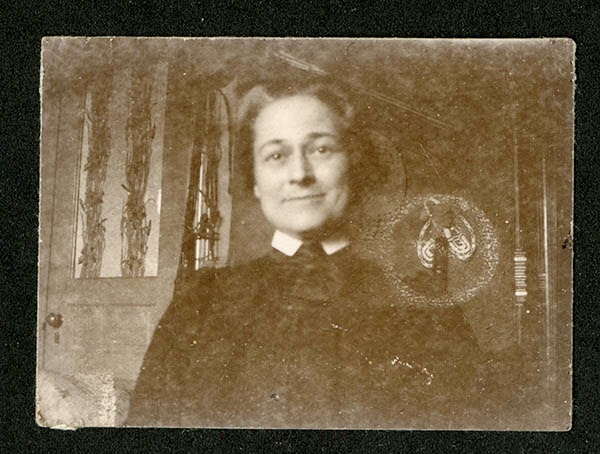
Florence Merriam Bailey, taken shortly after her wedding, March 1900.  Smithsonian Institution Archives.  SIA 007267, Box 2, Folder 14.

Their relationship proved important on a personal level as well.  During one of Bailey’s visits to Washington, DC, he stayed at Merriam’s home. This provided a chance to meet Merriam’s sister, Florence Merriam Bailey, who was a distinguished naturalist in her own right. Vernon and Florence would marry in 1899.  Throughout their marriage they completed field work together and co-wrote natural sciences publications.

Perhaps the best way to see how these individuals’ styles of work and interests differed, is to examine their field books and publications.

Field Books from the Field Book Project:

  • US Biological Survey (its subsequent iteration as US Fish and Wildlife)
  • C. Hart Merriam
  • Vernon O. Bailey
  • Florence Merriam Bailey

Publications at Biodiversity Heritage Library:

  • US Biological Survey
  • C. Hart Merriam (includes correspondence housed at the Bancroft Library, University of California, Berkeley
  • Vernon O. Bailey
  • Florence Merriam Bailey

We invite you to check out our next post, and find out more the background of these fascinating individuals, organizations, and how you can learn more about their research online.

December 12, 2013by [email protected]
Blog Reel, Featured Books

Documenting Scientific Knowledge One Handwritten Note at a Time

Connecting Content: The Wonderful World of Field Books

The California Academy of Sciences and our partners (all of whom are also BHL member institutions) are in the midst of a 3 year IMLS National Leadership Grant titled “Connecting Content: A Collaboration to Link Field Notes to Specimens and Published Literature.” This project aims to digitize published scientific findings, their related field books and specimens, and metadata for these items, link all of these resources, and make them available for harvesting, reuse, and repurposing without cost. At this point, the bulk of the field books selected for this project have been digitized and made available through the Biodiversity Heritage Library. (*You can see the sixty-one titles digitized for this project by searching for “Connecting Content” in the BHL search box.) You can download a selection of these field book for free via the latest BHL iTunes U Collection: Connecting Content through Archival Field Notes.

Field books (or field notes) are the original documents which chronicle specimen collection and the events and observations that led to scientific discovery.  Field books are unique unto the creator and vary greatly from book to book. Here are a selection of highlights from the collection which demonstrate the wealth of information and styles found throughout the selection of field books:

William Whitman Bailey and the USGS Exploration of the 40th Parallel

View Full Size Image
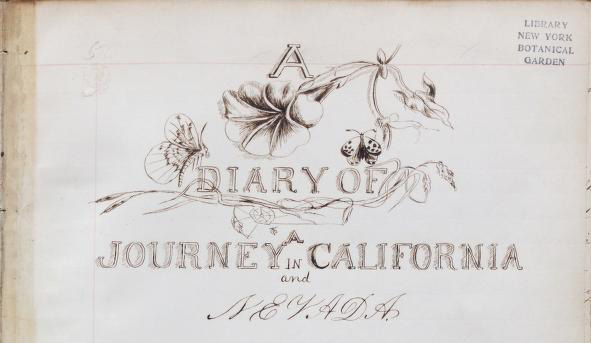
Page One. A diary of a journey in California and Nevada. William Whitman Bailey.


View Full Size Image
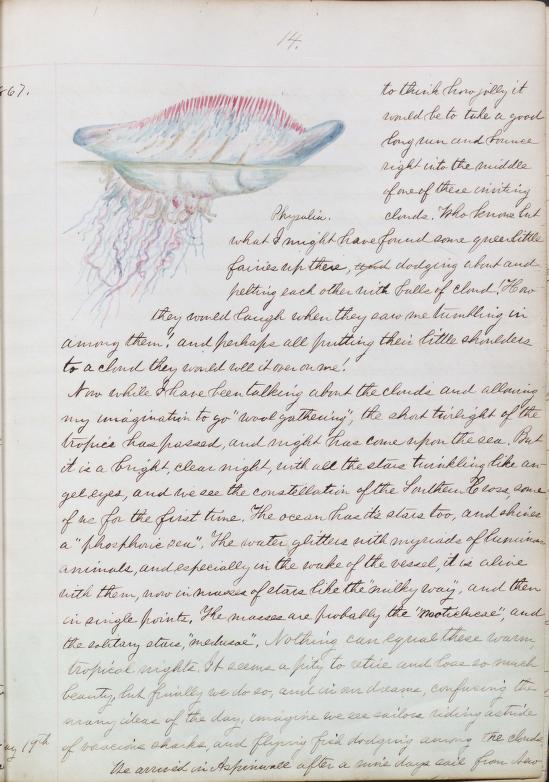
Portuguese Man of War. Bailey.
View Full Size Image
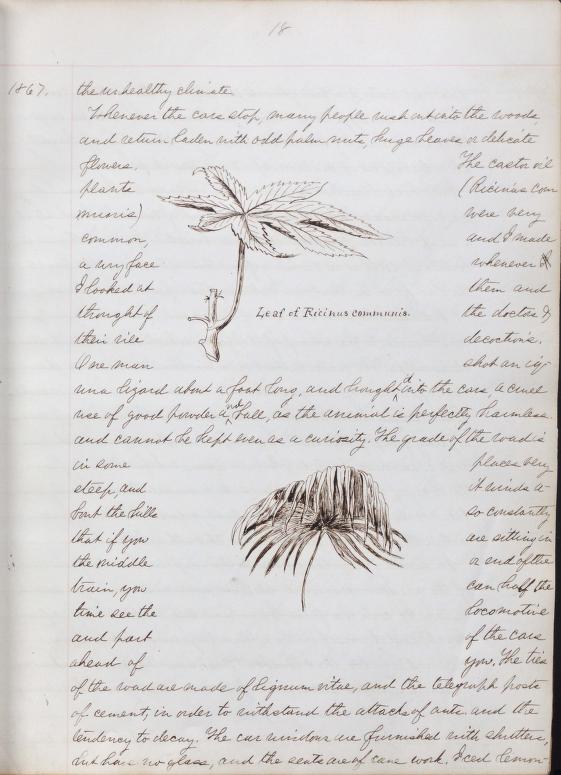
Riccinus communis. Bailey.

William Whitman Bailey’s life story reads like a blockbuster movie plot. When young William was just nine years old, he and his family took an ill fated boat trip aboard the 198 foot side-wheeler, the Henry Clay. On this fateful day, the Henry Clay was involved in a minor collision with another vessel, but pressed onwards as it seemed that the ship has sustained little damage. However, about an hour outside of its final New York destination, the ship beached itself on shore near Yonkers as a result of a fire that had been burning unnoticed since the collision. The lucky passengers on the bow of the ship were either thrown or able to jump onto land, but the Baileys were not so fortunate. Separated from land by 140 feet of water and a wall of fire, the Baileys had no choice but to jump into the water as the fire approached. William’s mother and sister succumbed to the depths and his father barely survived. William managed to grab hold of a floating wicker chair and was eventually picked up by a passing ship, but the experience would leave him with permanent health problems.

However, this tragic setback did not lessen Bailey’s enthusiasm for adventure and curiosity about the natural world. Bailey would eventually study under Dr. Asa Gray at Harvard University and at 24 years old, he became the botanist for the United States Geological Exploration of the 40th Parallel. The field book for this expedition chronicles Bailey’s journey through California and Nevada in a flowing prosaic style with beautiful illustrations and photographs of Bailey’s observations. The very first page of Bailey’s journal opens with a beautiful demonstration of his illustrative pen and ink style. Bailey’s rich descriptions are paired with exquisite drawings that seem to jump off the page whether he is waxing poetic about the Portuguese Man of War or closely observing the leaf of the Riccinus communis. Bailey’s flowing narrative style and gorgeous illustrations make this field book a charming and informative look at the exploration of the 40th parallel that will surely captivate readers.

Washington H. Ochsner and the Galapagos Islands


View Full Size Image
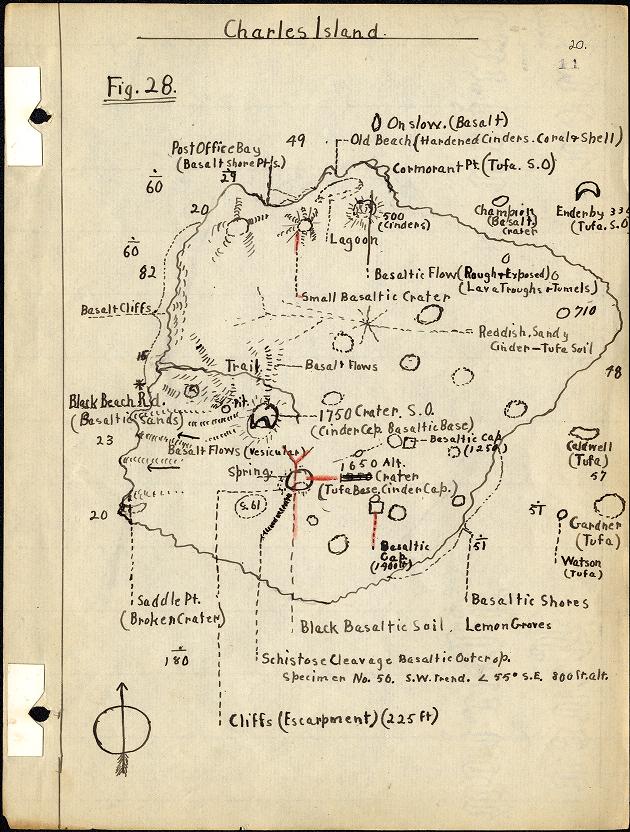
Charles Island. Ochsner.

In 1905, the California Academy of Sciences sent 11 men off for a year and a day on an eighty-five foot schooner destined for the Galapagos Islands. While the expedition was underway, the California Academy of Sciences would fall into ruin during the great San Francisco earthquake of 1906. The specimens gathered during the Galapagos expedition would come to form the crux of the new California Academy of Sciences’ collections. Of the young men on that voyage, 26 year-old Washington Henry Ochsner travelled as the expedition’s geologist. His journals are more technical than Bailey’s in what they intended to capture and often included geological survey information, as well as inferences about how the geological features were formed. Ochsner also drew detailed surveys of the island terrains like this map of Charles Island. Ochsner’s field books have a scientifically focused structure and tend to be not-so-much a diary but a close and careful record of his scientific observations.

The Diaries of William Brewster, 1865- 1919

View Full Size Image
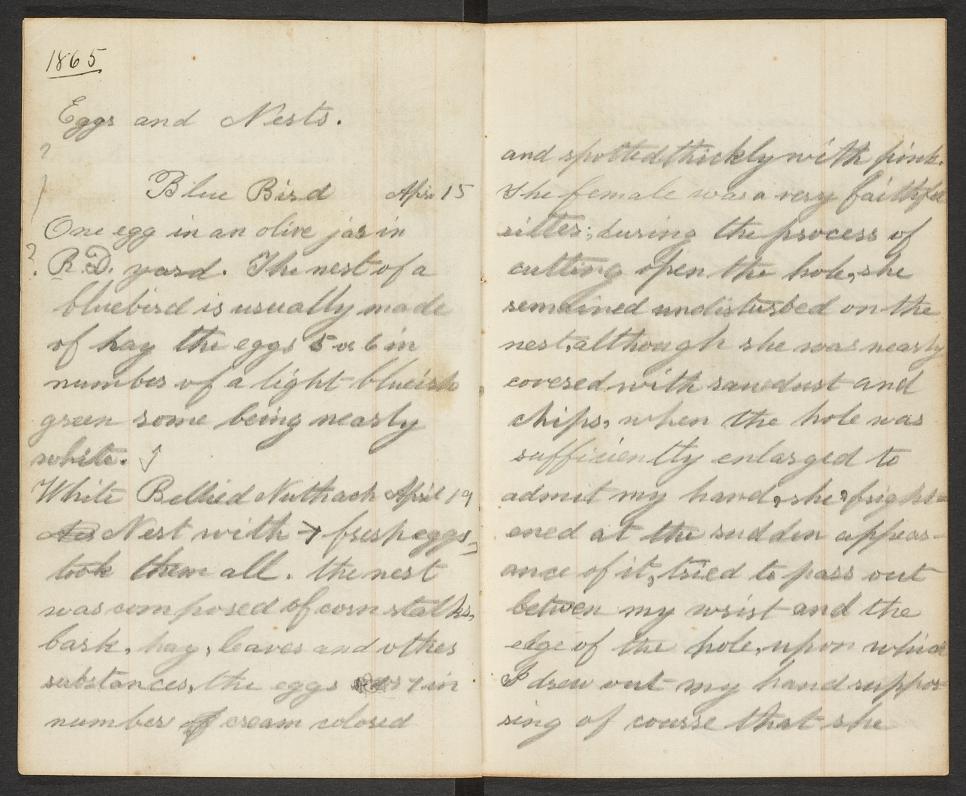
Eggs and Nests. Brewster.

Renowned ornithologist William Brewster mused over his daily observations in a personal and often humorous way. William Brewster’s love of ornithology blossomed early, and he kept careful records of the birds he observed throughout his life. These journals begin when Brewster was 14 years old, and it is interesting to see how his hand, knowledge, and confidence all develop over time.  In his later journals, Brewster takes care to write in a colloquial manner, and these notes provide unique insight into the daily life of a researcher over a 54 year span. This collection of journals also provide an enticing perspective on the detrimental changes to the environment and bird populations as a result of industrialization and the growth of urban centers.

All of the field books digitized for the Connecting Content project offer inimitable insight into how scientific data is gathered, synthesized, and extrapolated. It is the hope that by sharing these unique resources, researchers can better understand scientific findings and that the insights gained from this will promote further inquiry and the spirit of discovery.

Want more Field Book Content?

View 61 field books digitized by the Connecting Content grant in BHL

Download a selection of these books for free on iTunes U

Find out more about the link between expeditions, field books, and publications in our previous blog posts with Smithsonian’s Field Book Project: Post One | Post Two | Post Three

May 9, 2013by Kathryn Stine

Help Support BHL

BHL's existence depends on the financial support of its patrons. Help us keep this free resource alive!

search

About BHL

The Biodiversity Heritage Library (BHL) is the world’s largest open access digital library for biodiversity literature and archives. BHL operates as a worldwide consortium of natural history, botanical, research, and national libraries working together to digitize the natural history literature held in their collections and make it freely available for open access as part of a global “biodiversity community.”

Join Our Mailing List

Sign up to receive the latest news, content highlights, and promotions.

Subscribe Now

Subscribe to Blog via Email

Enter your email address to subscribe to this blog and receive notifications of new posts by email.

Join 319 other subscribers

Subscribe to Blog Via RSS

Subscribe to the blog RSS feed to stay up-to-date on all the latest BHL posts.

Access RSS Feed

Inspiring Discovery through Free Access to Biodiversity Knowledge.

The Biodiversity Heritage Library makes it easier than ever for you to access the information you need to study and explore life on Earth…for free, anytime, anywhere.


64+ Million Pages of
Biodiversity Literature Online.

EXPLORE

Tools and Services
to Transform Research.

EXPLORE

300,000+
Illustrations on Flickr.

EXPLORE

ABOUT | HARMFUL CONTENT | PRIVACY | SITE MAP | TERMS OF USE