Biodiversity Heritage Library - Program news and collection highlights from BHL
  • Home
  • News
  • Featured Books
    • All Featured Books
    • Book of the Month Series
    • BHL at 20
  • User Stories
  • Campaigns
    • Fossil Stories
    • Garden Stories
    • Monsters Are Real
    • Page Frights
    • Her Natural History
    • Earth Optimism 2020
  • Tech Blog
  • Visit BHL
Home
News
Featured Books
    All Featured Books
    Book of the Month Series
    BHL at 20
User Stories
Campaigns
    Fossil Stories
    Garden Stories
    Monsters Are Real
    Page Frights
    Her Natural History
    Earth Optimism 2020
Tech Blog
Visit BHL
  • Home
  • News
  • Featured Books
    • All Featured Books
    • Book of the Month Series
    • BHL at 20
  • User Stories
  • Campaigns
    • Fossil Stories
    • Garden Stories
    • Monsters Are Real
    • Page Frights
    • Her Natural History
    • Earth Optimism 2020
  • Tech Blog
  • Visit BHL
Biodiversity Heritage Library - Program news and collection highlights from BHL
Blog Reel, Featured Books

Earth Day 2021: Exploring Earth’s Biodiversity through Books

background of yellow, white and red flowers with text "Happy Earth Day 2021"

Since its inaugural event on 22 April 1970, Earth Day has grown into an international annual celebration of the Earth and a movement to raise awareness about and support for environmental protection. This year’s theme, Restore Our Earth, emphasizes that, “As the world returns to normal, we can’t go back to business-as-usual.” As we face widespread climate change and unprecedented biodiversity declines—with one million species threatened with extinction—immediate, online access to essential literature is ever-more important, allowing scientists to conduct research more quickly and efficiently and improving our ability to respond to these crises. For fifteen years, the Biodiversity Heritage Library (BHL) has worked as a global consortium to provide this vital access, empower research, and make a real difference in our ability to improve the health of our planet for every species that calls it home.

This year, several of our global partners have selected a few titles from the BHL collection to commemorate Earth Day. From exploring Asia’s vast and unique biodiversity to inspiring conservation through a popular publication on birds, providing practical methods for conducting surveys and using the data to support conservation practices, and marveling at the extraordinary biodiversity of past ages, these titles highlight the richness of our planet’s biodiversity and remind us of the importance of protecting the wonderful, wild, and beautiful life on Earth.

Asian Biodiversity: An Essential Contributor to Our Beautiful Earth

By Zheping Xu, Xuejuan Chen, and Tian Jiang (National Science Library, Chinese Academy of Sciences)

Biodiversity is essentially everywhere, ubiquitous on Earth’s surface and in every drop of its bodies of water [1]. Biodiversity conservation makes great contributions to the restoration of the earth.

As a continent with the largest area and the most population, Asia holds vast biodiversity, from the equatorial region to the Arctic area, and from the coast of the western Pacific to the borders of Europe and Africa. Here, we introduce several books that review Asian biodiversity, from mammals and insects to some distinctive species from the continent.

Mammals of Eastern Asia (1947) is the first general work on mammals of eastern Asia [2]. The book’s carefully prepared chapters and fine original pen sketches are interesting, useful and invaluable to the amateur as well as the professional zoologist regarding the habitats, relationships, life histories and idiosyncrasies of the widely diversified faunas.
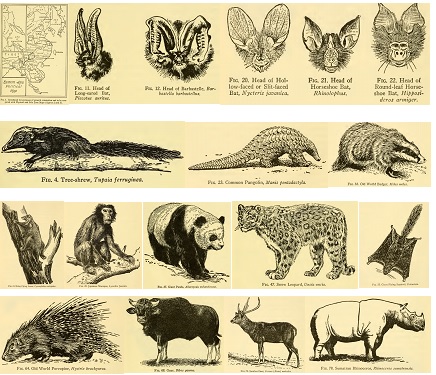
Map of Eastern Asia and pen sketches of some mammals.

Map of Eastern Asia and pen sketches of some mammals. Source: Tate, G. H. H. (George Henry Hamilton). Mammals of Eastern Asia. 1947. Contributed in BHL from MBLWHOI Library.

Cerambycidae of Northern Asia (1988) describes the morphology, geographic distribution, and biology of cerambycid beetles in Northern Asia of four sub­families (Prioninae, Disteniinae, Lepturinae, and Aseminae), comprising 124 species. Many cerambycid species are invasive pests of environmental concern, causing severe damage to forests and crops. Long-term field investigations were conducted on the composition and biology of cerambycids in different parts of northern Asia. Tens of thousands of larvae, pupae, and adult insects were raised in the laboratory for experiments. Keys to taxa of the family Cerambycidae based on different developmental stages are presented in this work for the first time. This book provides important information for informing broad theoretical principles and in resolving practical problems of pest infestation in forests.
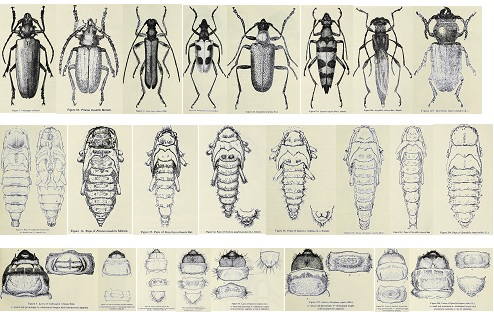
Cerambycidaes: adult insects with their larvas and pupas.

Cerambycidaes: adult insects with their larvas and pupas. Source: Cherepanov, A. I. (Aleksei Ignatevich). Cerambycidae of Northern Asia. 1988. Contributed in BHL from Smithsonian Libraries and Archives. CC-BY-NC-SA.

Asia is home to endemic and highly distinctive focal species. Tracking tigers (Published in 1998) gives a comprehensive overview of the wild status of the Tiger, Asian Elephant, Gaur and Banteng in Indochina. On this basis, it recommends future survey and management needs, and provides background discussion on issues to be addressed by national action plans. The Philippines’ fauna is characterized by large numbers of endemic and highly distinctive species. During the 1980s, the extent of rain-forest habitat destruction became apparent and underscored the need for extensive and detailed documentation of biological diversity to guide development and conservation for the benefit of both wildlife and the human population of the Philippines. The Mammals and birds of Camiguin Island, Philippines, a distinctive center of biodiversity (published in 2006) presents studies of Camiguin Island, a small island province in the Philippines and an ideal natural laboratory in which to investigate many aspects of the evolution and conservation of biological diversity.
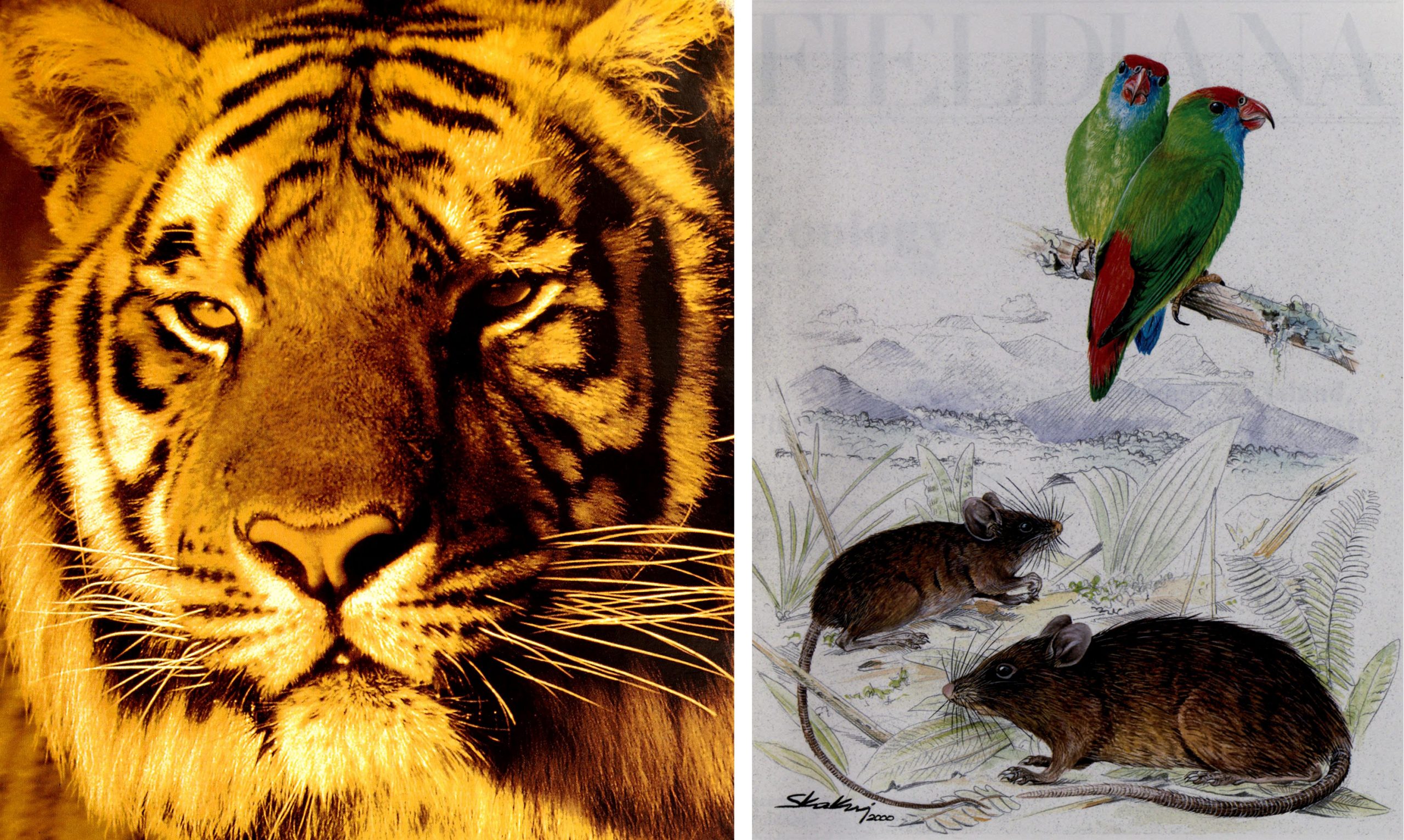
photo of a tiger and illustration of green and red birds and brown rodents

Left: The tiger in Indochina. Source: Duckworth, William and S. Hedges. Tracking tigers. 1998. Contributed in BHL from Smithsonian Libraries and Archives. CC-BY-NC. Right: “Two species of mammals and one species of bird live only on Camiguin Island: Apomys sp. ([…] center left), Bullimus gamay ([…] lower right), and Loriculus sp. ([…] upper center). The distinctive volcanic peaks of Camiguin form the background.” Source: Heaney, Lawrence R. The Mammals and birds of Camiguin Island, Philippines, a distinctive center of biodiversity. 2006. Contributed in BHL from University Library, University of Illinois Urbana Champaign. CC-BY-NC-SA.

Biological species in Asia are important components of Earth’s biodiversity. Biodiversity is closely related to human well-being, but human activities caused rapid changes in biodiversity over the past decades. To restore our Earth, we must identify and assess drivers of biodiversity loss, including habitat change, climate change, invasive alien species, overexploitation, and pollution [1].

[1] Duraiappah, A. K., Naeem, S., Agardy, T., Ash, N. J., Cooper, H. D., Diaz, S., Faith, D. P., Mace, G., McNeely, J. A., Mooney, H. A., Oteng-Yeboah, A. A., Pereira, H. M., Polasky, S., Prip, C., Reid, W. V., Samper, C., Schei, P. J., Scholes, R., Schutyser, F., & Van Jaarsveld, A. (2005). Ecosystems and human well-being: biodiversity synthesis; a report of the Millennium Ecosystem Assessment. World Resources Institute. http://www.millenniumassessment.org/documents/document.354.aspx.pdf.

[2] -S., T. Mammals of Eastern Asia. Nature 161, 188 (1948). https://doi.org/10.1038/161188e0.

Our Southern Birds and Emma Bell Miles: Inspiring Appreciation for and Protection of Birds

By Tomoko Y. Steen, Ph.D. and Alison Kelly, MLIS (Science, Technology & Business Division, Library of Congress)
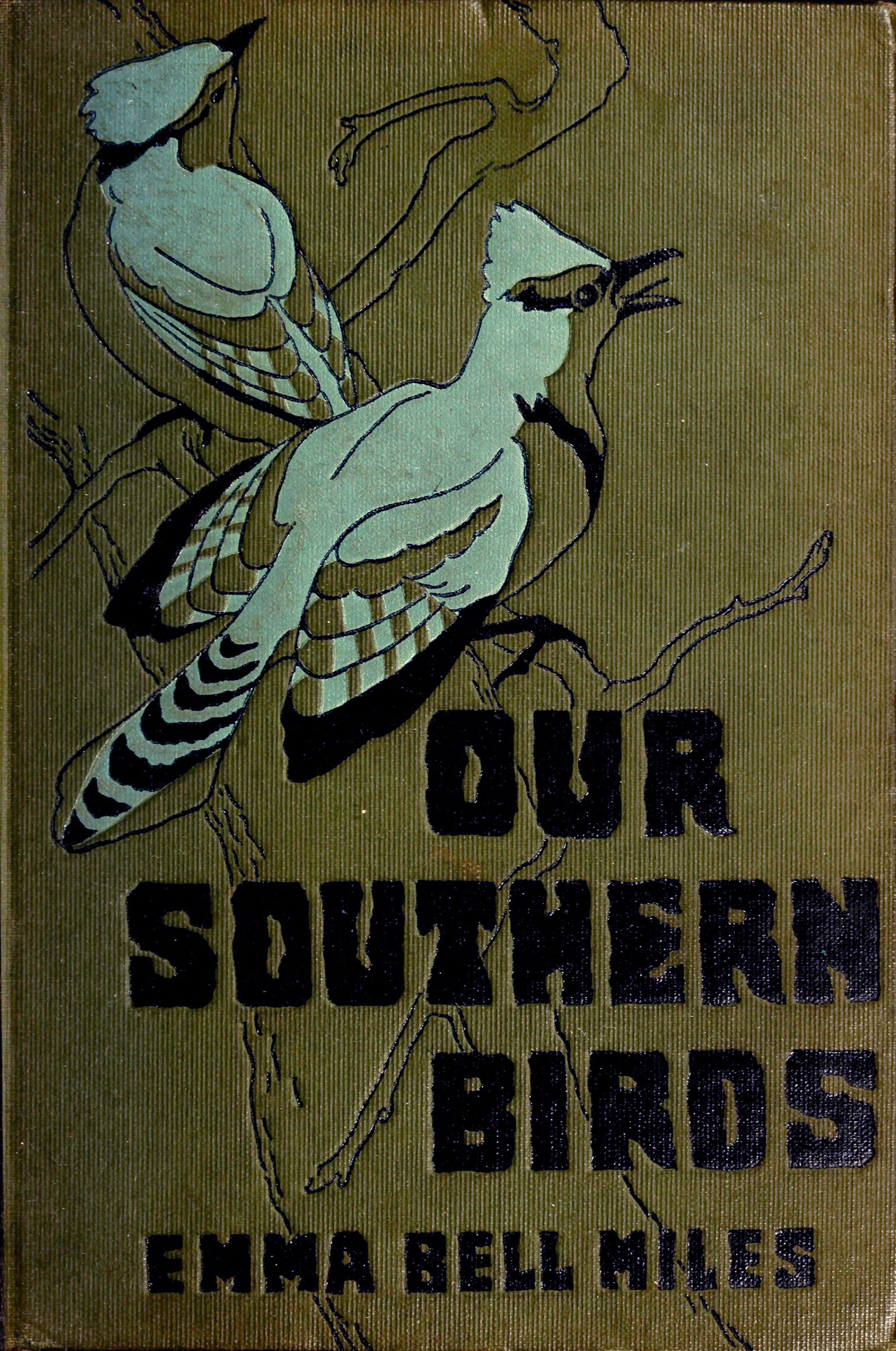
Illustrated book cover featuring two birds and title "Our Southern Birds"

Cover. Miles, Emma Bell. Our Southern Birds. Copyright 1919. Contributed in BHL from Library of Congress.

Emma Bell Miles (1879-1919) was a talented artist, writer and naturalist whose writings reflect her love of the Tennessee mountains where she spent most of her life. In Our Southern Birds, copyrighted in 1919, she recorded her detailed observations and knowledge of the birds of Appalachia, an area that had received little attention in the popular publications on birds until that time. Through this and her other works capturing the essence of natural life in the Southern mountains, Emma Bell Miles drew attention to the importance of preserving biodiversity and habitat.
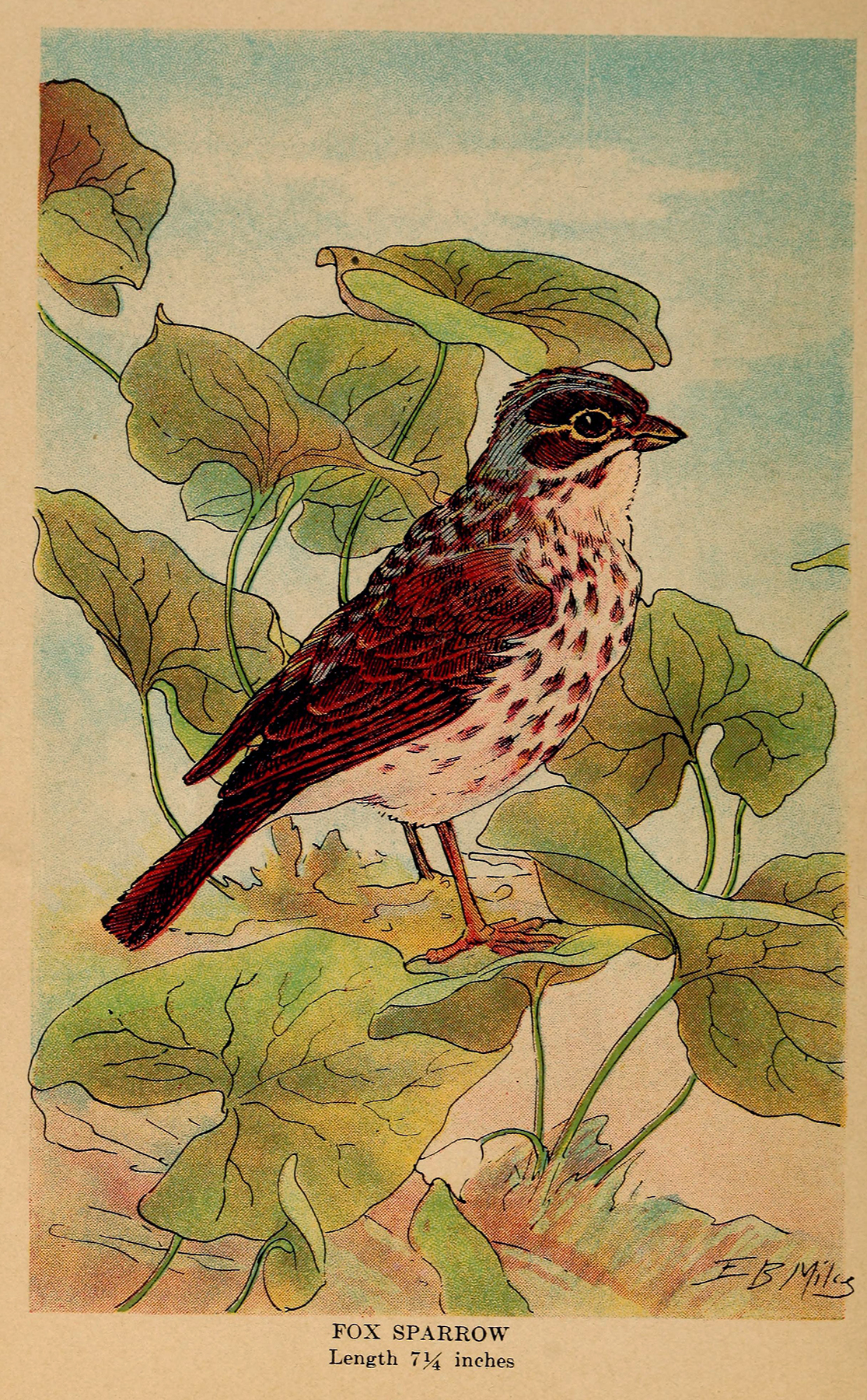
colored illustration of a bird, fox sparrow, brown with blue head and cream belly sitting on branch with green leaves

Fox sparrow. Miles, Emma Bell. Our Southern Birds. Copyright 1919. Art by Miles. Contributed in BHL from Library of Congress.

In the introduction to this, her last book, she stated:

…while the scientific study of birds is beyond most of us, yet an intimate understanding of them and their ways is within reach of everyone, and may enrich life with a new depth of interest… Go out alone in early morning, keep the sun at your back, be careful to do nothing that will startle these timid creatures, and see what you will see.

Our Southern Birds includes many beautiful illustrations by Miles, who, as a young woman, left her home in the mountains to study art in St. Louis. Plagued by homesickness for the mountains, she returned to Appalachia after two years and married a mountaineer. Their marriage was a difficult one, marked by poverty and illness, and she was often the sole supporter of the family by selling her writings, art and poetry.

Written for all levels of readers, this engaging book will appeal to anyone with an interest in birds. Part of the genius of Emma Bell Miles’ work is that she succeeds in presenting not only a careful description of over 100 birds and their habitats, but captures the individual personalities and demeanor of any given species through words and pictures. Her desire to recruit readers to active birdwatching is shown in the inclusion of blank pages for recording observations.
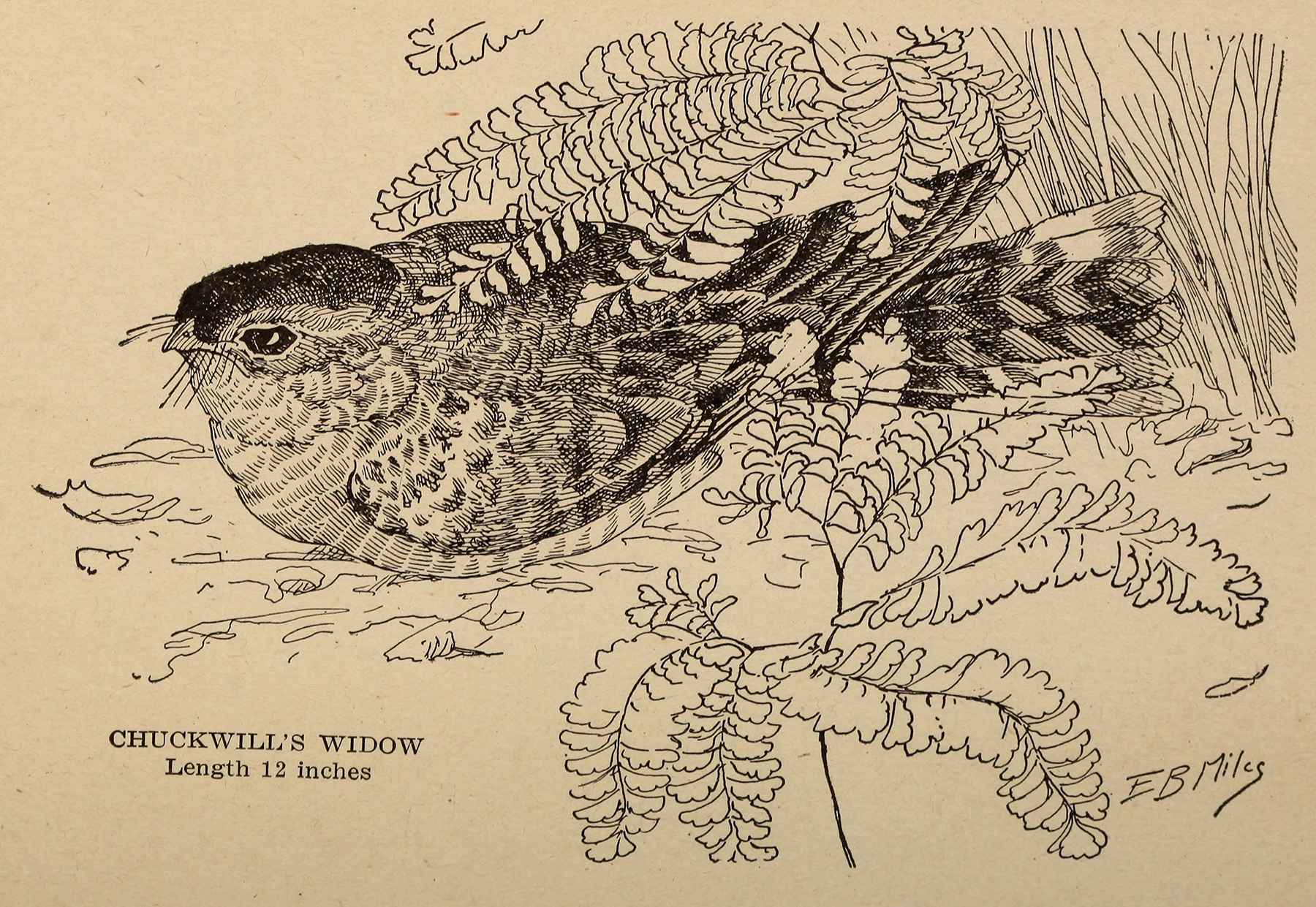
black and white illustration of a bird, chuckwill's widow, hiding within foliage

Chuckwill’s widow. Miles, Emma Bell. Our Southern Birds. Copyright 1919. Art by Miles. Contributed in BHL from Library of Congress.

“Shadows from the Past,” the final chapter of the book, mentions several species that are extinct or close to extinction. “Let the disappearance of these winged lives from their one-time haunts lead us to set a higher value on those that remain,” she writes. In poetic language she goes on to describe the tragic extinction of the passenger pigeon, concluding with an appeal that we can learn from the past: “…it is not too late to learn from the mistakes of our fathers, and though we have lost some valuable species, we may yet save others that are following these to extinction”.

In celebration of Earth Day we want to shine a light on Emma Bell Miles, whose skills in observing and recording the natural world around her will inspire readers to appreciate and preserve biodiversity in their own special place on Earth.

Environmental Evaluations Using Birds and Their Habitats

By Samantha Lindgren (University Library, University of Illinois Urbana-Champaign)
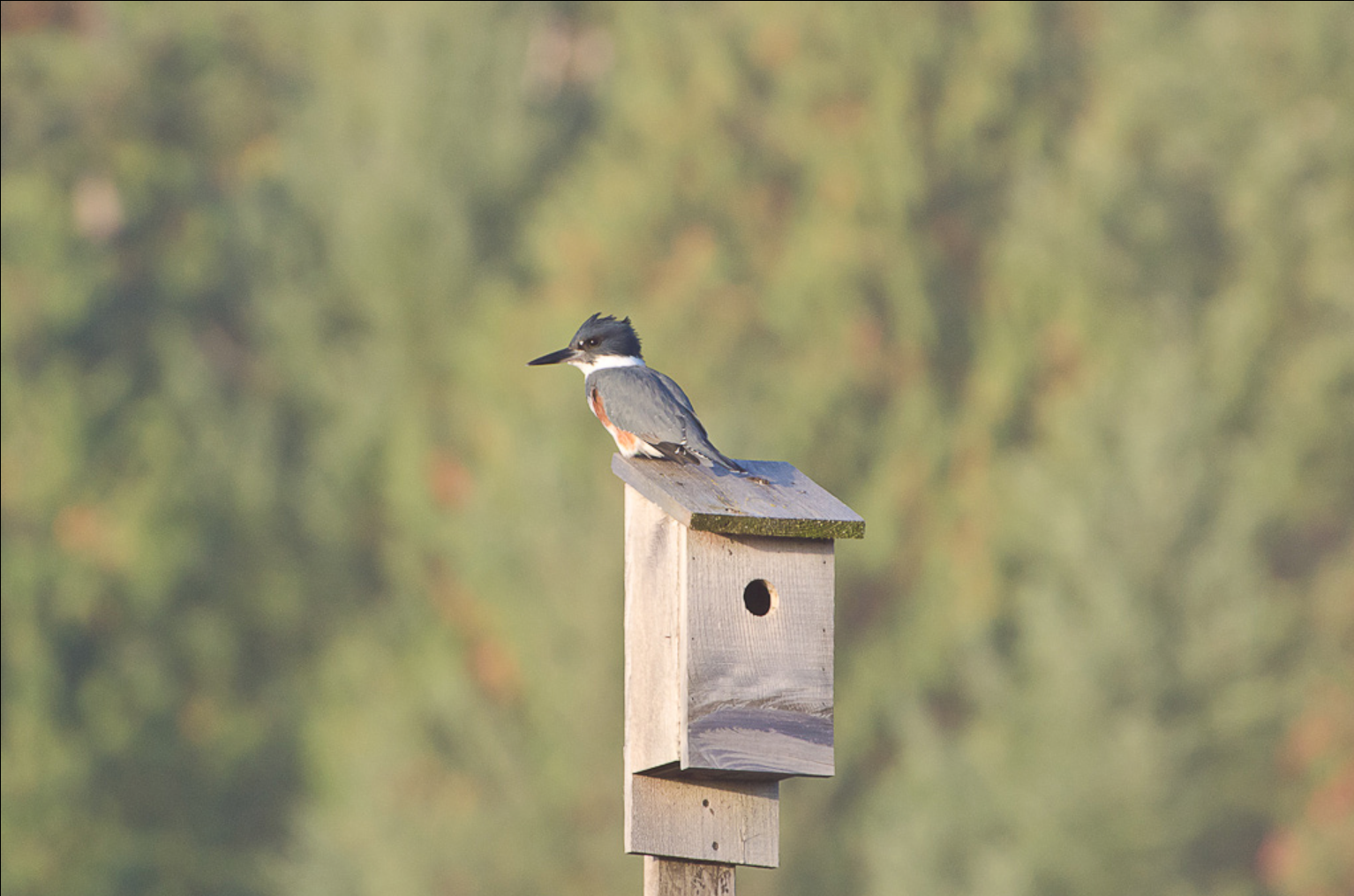
A blue and white bird sitting on a birdhouse roof with a background of trees.

A female Belted Kingfisher. Courtesy of Tyler Ingram, CC BY-NC-ND.

In their 1976 book, Environmental Evaluations Using Birds and Their Habitats, Jean and Richard Graber offer practical methods for surveying birds in Illinois with the purpose of curating data for environmental impact statements. Published as one of the Illinois Natural History Survey’s Biological Notes, the book details the data they have collected from these methods, including bird populations and habitat acreage. Throughout the book are also tables, graphs, and images supporting their methods and findings. While the book was published 45 years ago, it came at a time when concerns for environmental protection was just beginning to affect change, and it remains relevant in its advocacy for environmental conservation and restoration.

Earth Day 2021’s theme is Restore Our Earth. This theme resounds throughout the book in details of habitat surveying and restoration. As the authors posit, Illinois is a large state with diverse habitats and niches, some of which are difficult to redevelop once they are threatened. The authors discuss seven categories of gross habitats found throughout the state: forest, shrub, marsh, residential, grassland, small-grain fields, and row-crop fields. Some of these habitat types are more specific to regions of Illinois than others—such as natural marshes occurring most frequently in northeastern Illinois—however each mention comes with information on habitat replacement cost (the time required for restoration of a habitat or community), acreage data, and associated flora and fauna. Alongside this information, the authors also describe their experimental surveying methods. Through these factors, the authors garner concern for habitat conservation and restoration.
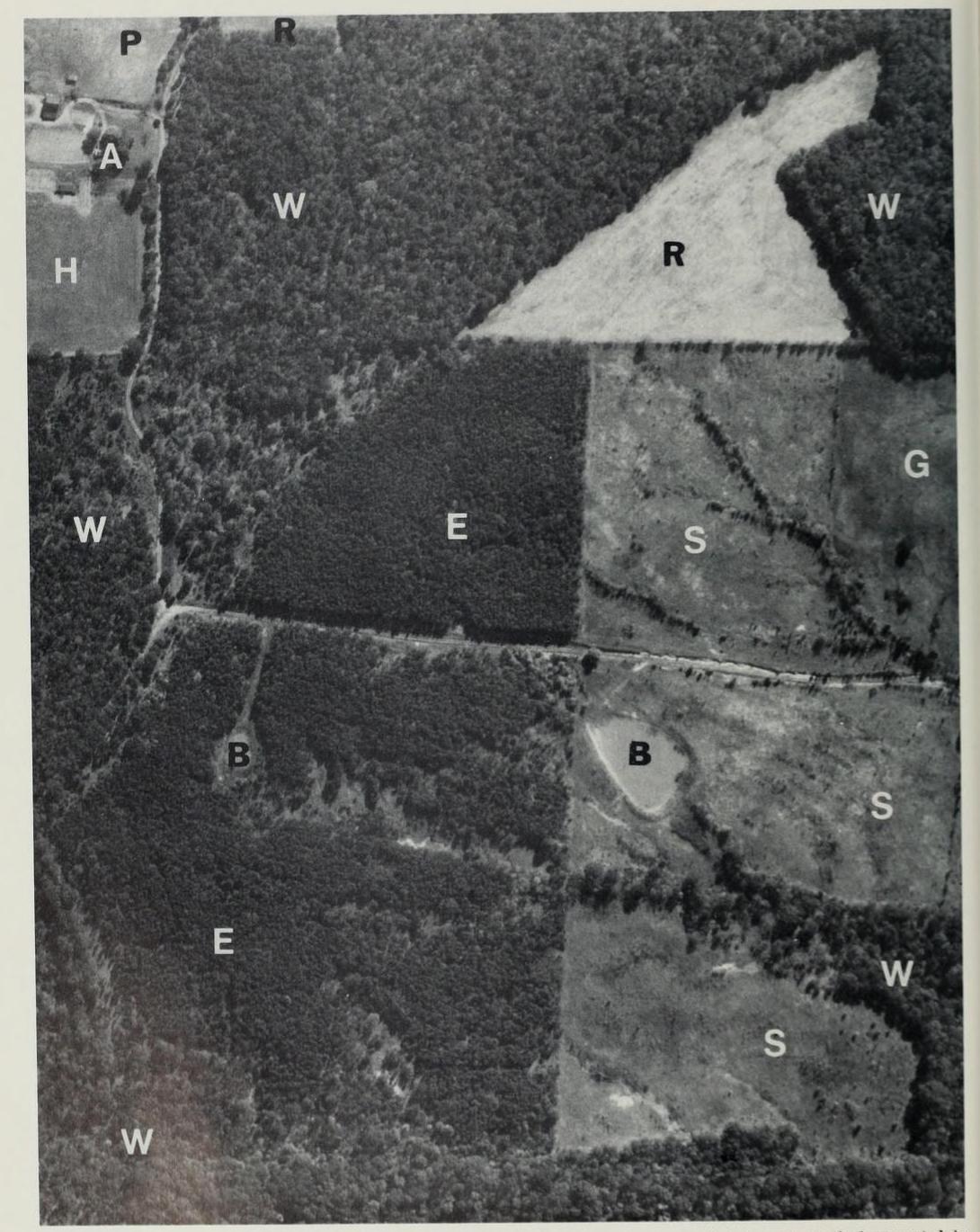
black and white aerial photo

“Fig. 8 – Aerial photograph showing a portion of the experimental impact area used to test the method presented in this paper.” Graber, Jean W. and Richard R. Environmental evaluations using birds and their habitats. 1976. Contributed in BHL from University Library, University of Illinois Urbana Champaign. CC BY-NC.

The methods discussed for collecting data on bird populations garner this concern as well. As the authors state, “…in the conservation of species we must be concerned for the welfare of all the populations that comprise the species” (11). In the context of this book, this means assigning a fair value to birds when applying an avifaunal index during surveying. However, this sentiment can be applied to Earth Day 2021 as well; in the restoration of our Earth, we must be concerned with the welfare of all aspects of Earth. Moreover, the authors supplement discussions of how and why to collect data on bird populations by speaking in-depth about the derivation of their models, and using them in practice. In this way, the authors are not only advocating for conservation and restoration, they are also providing tangible means to implement conservation and restoration practices.

Environmental Evaluations Using Birds and Their Habitats is a great representation of how to turn concern for Earth’s restoration into meaningful action, and should serve as an example that all levels of skills and fields of interest can be utilized to help Restore Our Earth.

Description of the Skeleton of an Extinct Gigantic Sloth

By Cat O’Carroll (Natural History Museum Library & Archives, London)
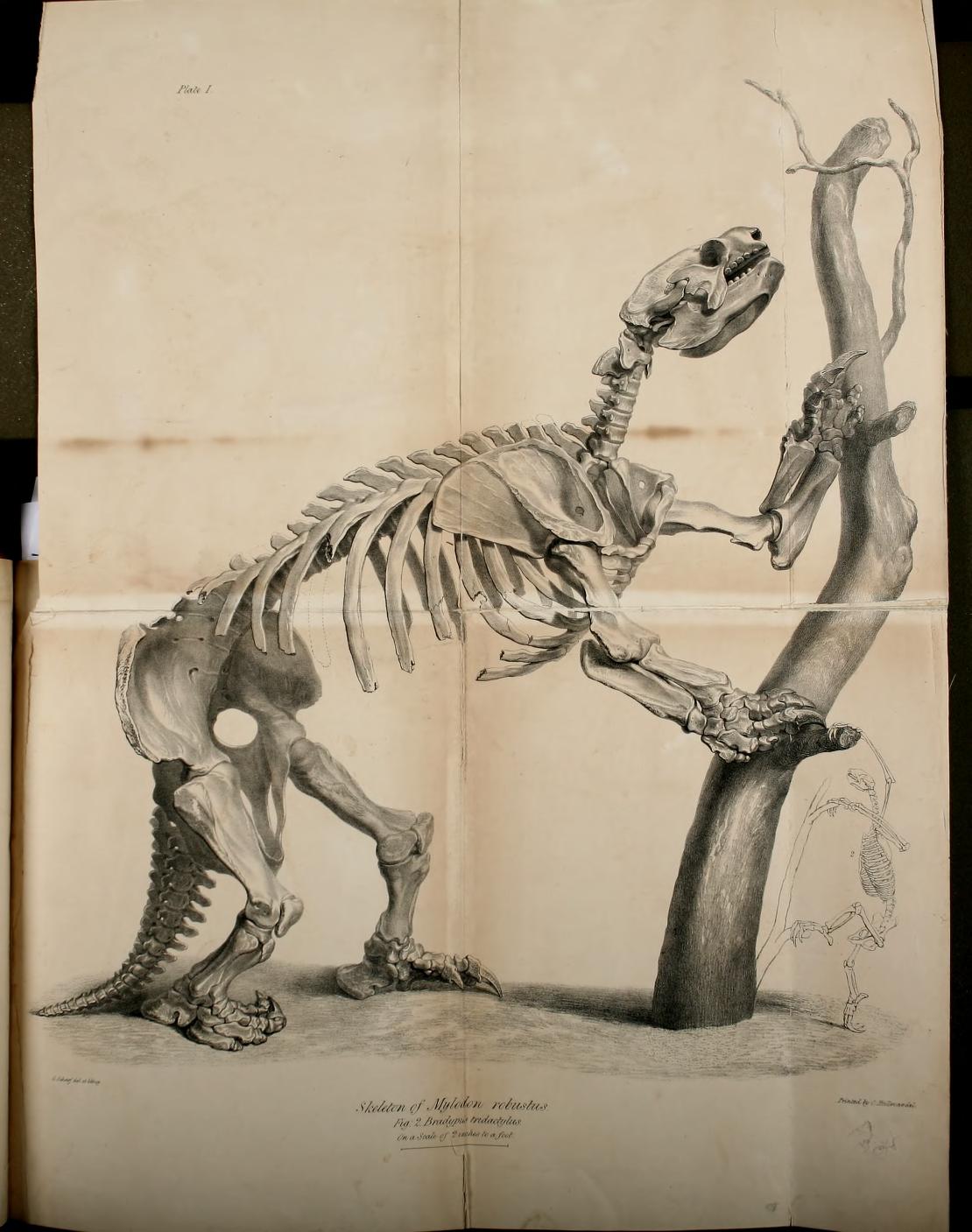
Side-view of the skeleton of the Mylodon robustus

Plate One. Side-view of the Mylodon robustus. Owen, Richard. Description of the skeleton of an extinct gigantic Sloth, Mylodon robustus, Owen, with observations on … Megatherioid quadrupeds in general. 1842. Contributed in BHL from the Natural History Museum Library & Archives.

In the year 1841, a discovery by M.Pedro de Angelis in Argentina unearthed the skeletal remains of a long extinct species……

Following on from the theme of Earth Day 2021 to Restore Our Earth, and raising issues of climate change, I’ve reflected on a title which highlighted a once extraordinary species which used to roam the earth, Description of the skeleton of an extinct gigantic Sloth, Mylodon robustus, Owen, with observations on … Megatherioid quadrupeds in general by Richard Owen (1842).

Owen, once curator at the Hunterian Museum, Royal College of Surgeons, was later in his career put in charge of the British Museum (Natural History) collections. As a result, he campaigned that a new building was needed to house the ever-expanding collections, which later built in 1881, became the Natural History Museum (NHM) in London as we know it today.

After exhuming the finds of the Mylodon robustus, it was then purchased by the Royal College of Surgeons and shipped over to London. In November 1841, it arrived in many pieces and fragile, in need of much restoring. Fossils discovered by Charles Darwin indicated several species of large quadrupeds had become extinct in South America. Owen compares descriptions of fossil remains of the Mammalia, which were collected by Charles Darwin during the voyage of the Beagle and accounted in The zoology of the voyage of H.M.S. Beagle … during the years 1832-1836.
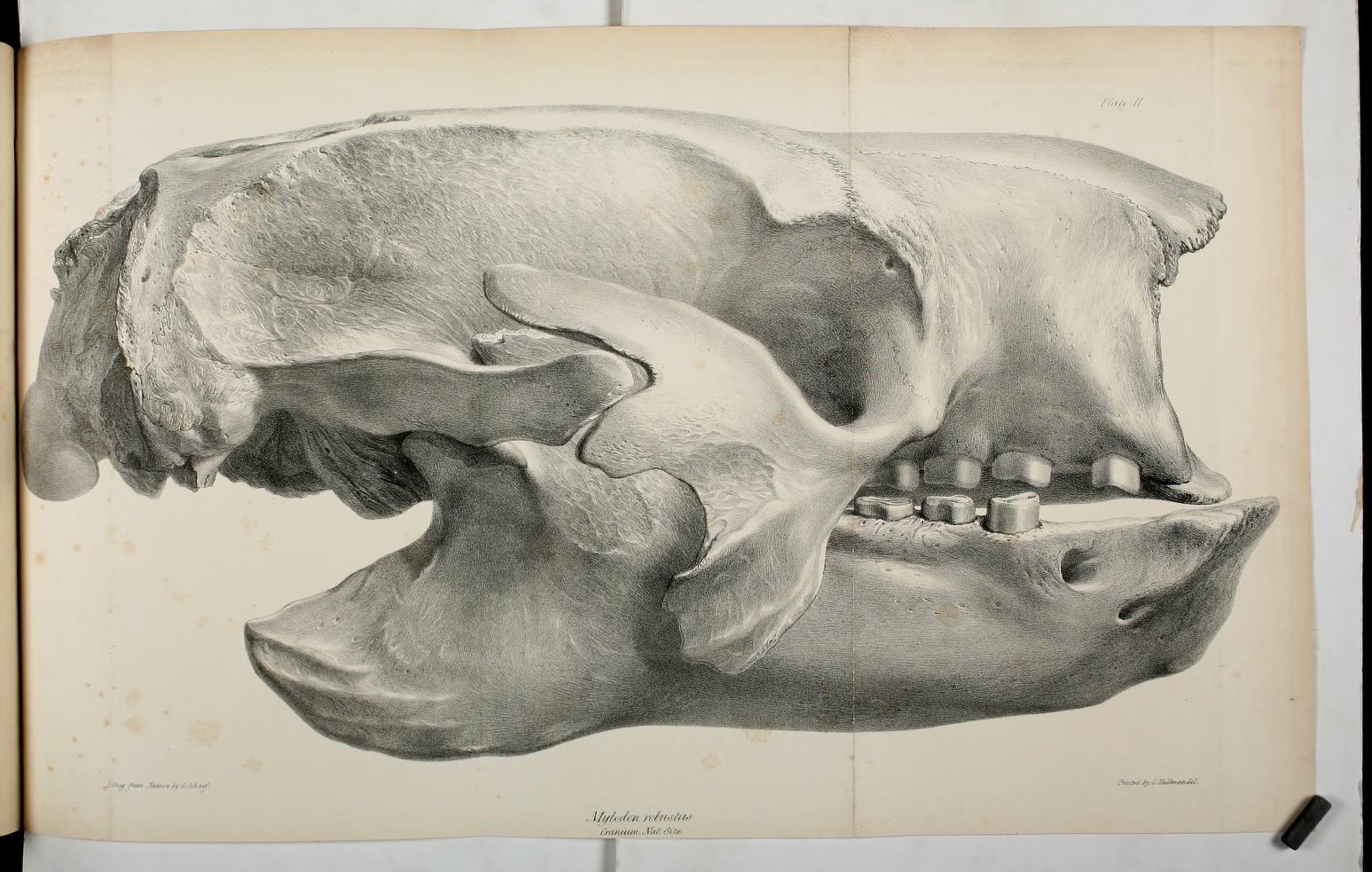
Side-view of the skull of the Mylodon robustus, natural size

Plate Two. Side-view of the skull of the Mylodon robustus, natural size. Owen, Richard. Description of the skeleton of an extinct gigantic Sloth, Mylodon robustus, Owen, with observations on … Megatherioid quadrupeds in general. 1842. Contributed in BHL from the Natural History Museum Library & Archives.

Megatherium (so named and described by Cuvier, 1795), discovered in the 18th century, was shipped to the Museo Nacional de Ciencias in Madrid. However, if you happen to walk down Fossil Way at the Natural History Museum today, you cannot miss the full Megatherium skeleton cast which stands on display. In terms of scale, Owen compares some of the bones of the Mylodon to that of Megatherium and a full-sized elephant.
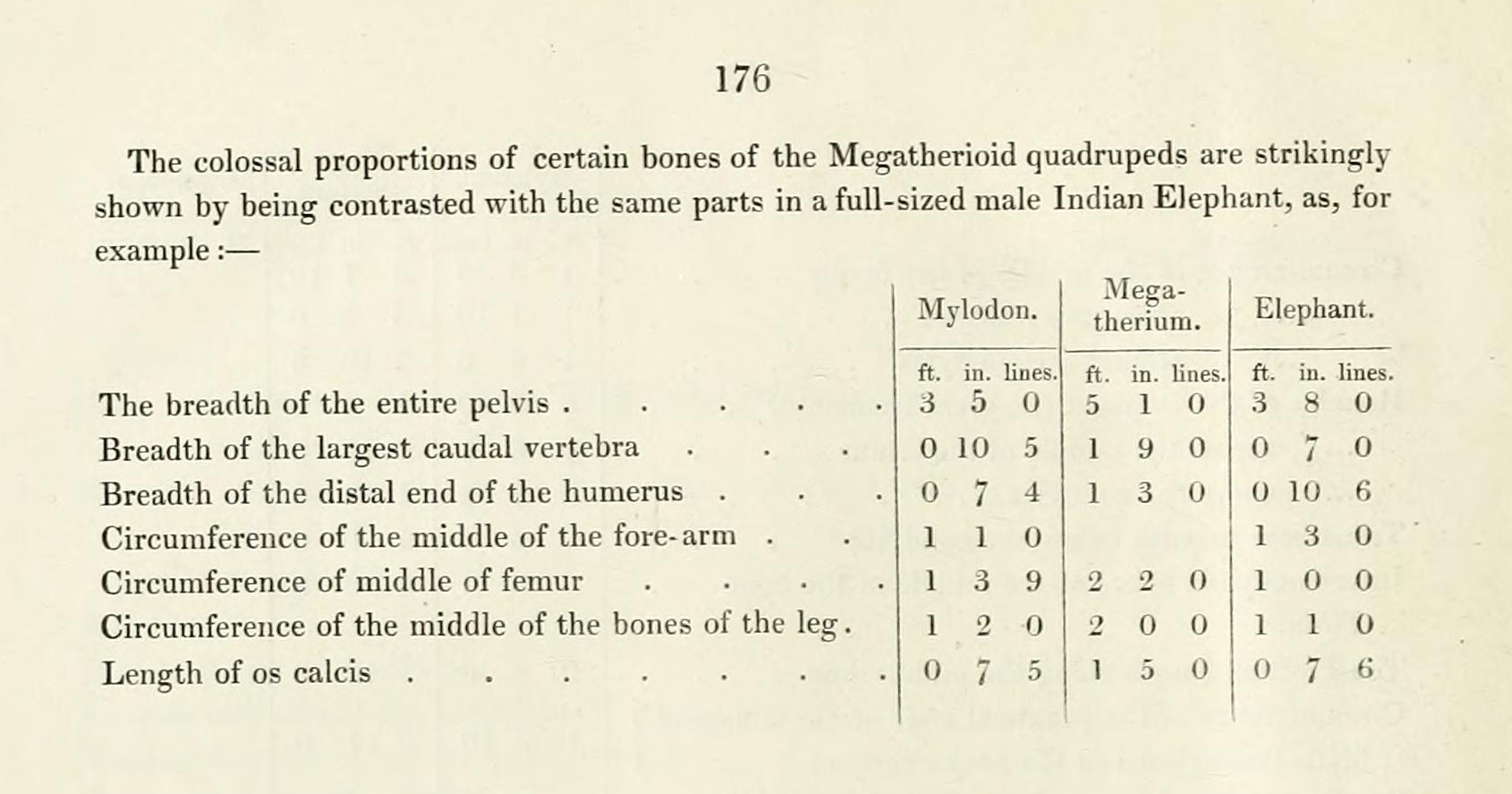
Comparison of certain bone size between Mylodon, Megatherium and an Indian Elephant

Comparison of certain bone size between Mylodon, Megatherium and an Indian Elephant, page 176. Owen, Richard. Description of the skeleton of an extinct gigantic Sloth, Mylodon robustus, Owen, with observations on … Megatherioid quadrupeds in general. 1842. Contributed in BHL from the Natural History Museum Library & Archives.

The Life of Richard Owen (1894), by his Grandson Rev. Richard Owen, summarizes how Owen was puzzled by the habits of these extinct creatures: “Their teeth showed, by their simple structure, that they lived on vegetable food, and probably on the leaves or tender twigs of trees”. It was hard to see how, like sloths today, they could possibly adapt to climbing trees given their sheer size and weight. Owen conjectured that they may have pulled the branches down from the trees instead of climbing them. Mylodon was also furnished with a “long tongue like a giraffe’s, which would help it to reach its leafy food”.
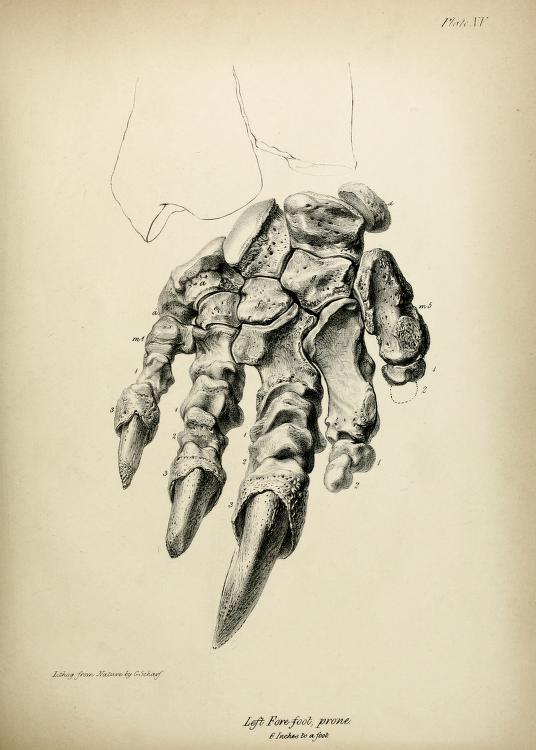
Upper, or anconal surface of the bones of the left fore-foot

Plate Fifteen. Upper, or anconal surface of the bones of the left fore-foot. Owen, Richard. Description of the skeleton of an extinct gigantic Sloth, Mylodon robustus, Owen, with observations on … Megatherioid quadrupeds in general. 1842. Contributed in BHL from the Natural History Museum Library & Archives.

The NHM Library & Archives holds a large collection of natural history drawings and original artworks amongst its collections. In November of 2019, the Images of Nature Gallery saw the installation of George Johann Scharf’s (1786-1860) watercolour drawing of a Megatherium on full display. Completed in 1842, this one drawing comprises of fourteen sheets approximately 2463 x 5745 mm which Scharf completed for Owen. A MEGA task in itself!
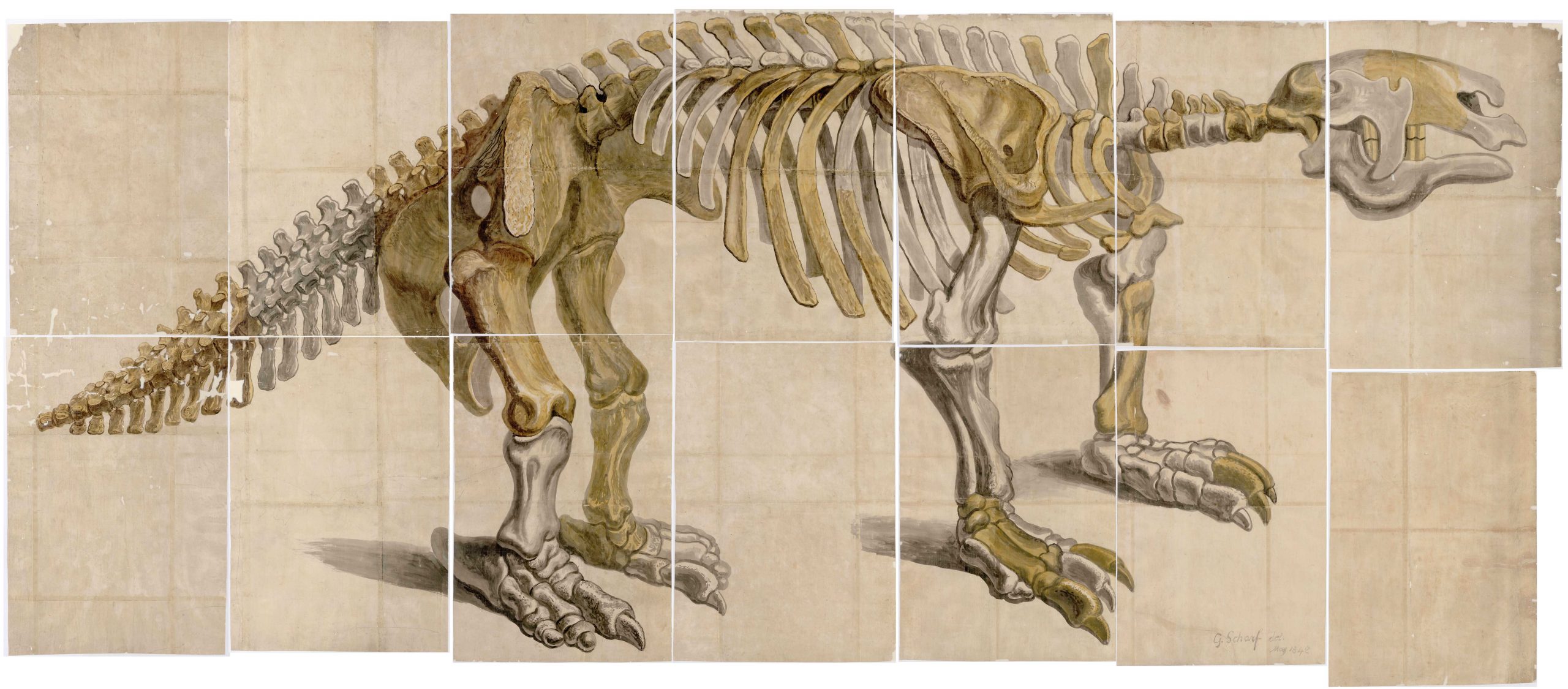
George Johann Scharf (1786-1860) Watercolour drawing of a Megatherium. N.p., 1842.

George Johann Scharf (1786-1860). Watercolour drawing of a Megatherium. N.p., 1842. Print. From the Library and Archives, Natural History Museum, London.


April 22, 2021by michelle.underhill
BHL News, Blog Reel

BHL Welcomes Three New Affiliates

BHL is pleased to welcome three long-time Partners as the consortium’s newest Affiliates: BHL Egypt, BHL China, and BHL SciELO.

The BHL consortium now consists of 18 Members and 18 Affiliates. Members and Affiliates contribute content, provide technical services, and participate in BHL committees, task forces, and working groups. Additionally, Members, who contribute 10,000 USD in annual dues, have governance privileges and vote on strategic directives.

BHL Egypt 

View Full Size Image


BHL Egypt, led by the Bibliotheca Alexandrina (BA), joined the Biodiversity Heritage Library in 2009. A major library and cultural center located in Alexandria, Egypt, Bibliotecha Alexandrina has long brought considerable technical expertise to the BHL consortium. The BA provides access to a subset of the BHL collection through its own Digital Assets Repository, which features an Arabic-aware (right to left) book reader. As an Affiliate, BHL Egypt will continue to provide technical support and services to facilitate BHL’s ongoing development.

BHL China 

View Full Size Image


BHL China, founded by the Institute of Botany at the Chinese Academy of Sciences, is the Biodiversity Heritage Library’s first Affiliate in China. Established in 1928, the Institute of Botany is one of the oldest comprehensive research institutions in China. Host to the largest herbarium in Asia, two botanical gardens, and several laboratories, the Institute is a national leader in the development of the country’s plant science research. Since first joining BHL as a partner in 2010, the Institute of Botany has contributed over 325,000 pages to BHL through the BHL China program.

BHL SciELO 

View Full Size Image


The BHL SciELO Network is the Biodiversity Heritage Library’s first Affiliate in South America. BHL SciELO is implemented by the Scientific Electronic Library (SciELO) Program, which encompass a network of national collections of open access journals in 15 countries. SciELO Brazil coordinates the BHL SciELO Network involving the main biodiversity libraries of Brazil with political and financial support from the São Paulo Research Foundation (FAPESP) and the Secretary of Biodiversity of the Ministry of Environment. SciELO joined BHL as a partner in 2010, and since then it has contributed over 107,000 pages to BHL’s collection.

July 3, 2017by Grace Costantino
BHL News, Blog Reel

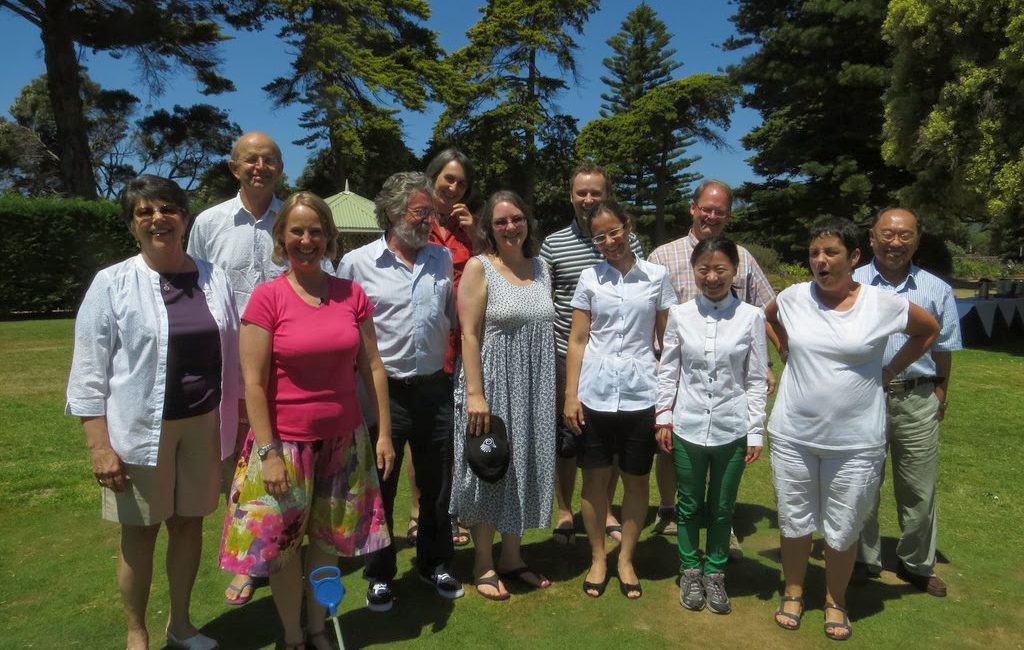
5th Global BHL Meeting, Lorne, Australia


View Full Size Image
Representatives from BHL-Global nodes at the
5th Global BHL Meeting

The 5th Global Biodiversity Heritage Library Meeting was held in Lorne, Australia, February 1-2, 2014.   Representatives from each of BHL’s global nodes, with the exception of BHL Egypt, convened to discuss the status of current goals, the formation of new goals, and to work together in forming the overall direction of BHL Global.  The meeting consisted of reports from the global nodes, the election of officers, and discussion of bylaws, technical issues and goals.

The first day of the meeting consisted of presentations delivered by representatives from BHL Central and the Global Nodes.

BHL Central
Kicking off the presentations, Martin Kalfatovic, BHL Program Director, reported on BHL Central’s continued growth.  BHL Central is now comprised of 15 dues-paying member institutions, with a collection of over 42 million pages, and usage statistics that include over 3 million visitors since BHL launched in 2007.  In other news, the latest version of the Macaw software developed at the Smithsonian Libraries is now being tested at Harvard, New York Botanical Garden and the California Academy of Sciences with the University of Pretoria to also begin testing soon.  With this release, users can now upload to a cloud server, after which the files go to the Internet Archive and then the BHL portal.

BHL Africa
Anne-Lise Fourie, Principal Librarian at South African National Biodiversity Institute (SANBI), shared the good news that two more institutions in Kenya have joined BHL.  In South Africa, institutions are sending digitized content to the University of Pretoria for quality assurance.  To date, the Steering Committee has met twice with the possibility of more frequent meetings of the regional representatives to help build and maintain momentum.

Grants and Social Media 
Connie Rinaldo, Vice Chair of the BHL Executive Committee and Librarian of the Ernst Mayr Library, Harvard Museum of Comparative Zoology, reported on BHL’s grant-funded projects and on the status of BHL Central’s social media efforts.  BHL currently has four active grants, two of which are about to wrap up and two that just recently kicked off.  Connecting Content, an IMLS grant led by the California Academy of Sciences Library, is linking field notes, specimens, and published literature.  Connie demonstrated MCZ-Harvard’s contributions with the William Brewster collection.  Concurrently, the Art of Life is exploring automated ways of locating illustrations in natural history literature and providing metadata for them.  Led by the Missouri Botanical Garden, this NEH grant will broaden and engage the BHL audience by integrating tagging applications so users can edit descriptive metadata, and integrating that user-generated metadata to enhance access to illustrations.  The two new grants—Purposeful Gaming and the BHL and Digging Into Data—are both funded by IMLS and led by the Missouri Botanical Garden.  Purposeful Gaming and the BHL will develop a game to crowdsource OCR corrections for seed catalogs and transcriptions of field notes.  Digging Into Data will explore new methods for the explore integration of text mining, visualization, crowdsourcing and social media for enhancing use of BHL content.

Social media has been a strong component of the BHL outreach strategy and in 2013 over 36,000 visits to the BHL website came from social media platforms (out of a total of 1.4 million visits).  With recent staff departures, BHL’s social media presence is shifting to maintenance mode and we’ve seen a corresponding decrease in traffic.  A discussion ensued about how best to tailor outreach efforts for maximum impact with existing resources, including recent efforts in the education domain such as BHL Europe’s Historian app for teachers and BHL Africa’s push to teach younger students about the environment.

Encyclopedia of Life 
Nancy Gwinn, Chair of the BHL Executive Committee and Director, Smithsonian Libraries, presented on the recent EOL meetings in Canberra.  The meetings included demonstrations for new tool suites including the recently released Traitbank, which provides the capability to assemble similar traits from across species for comparisons.

Biodiversity Library Exhibitions 
Jiři Frank, Vice-Chair of BHL-Global, reported on the current status of the BHL-E exhibition software and the group discussed the idea of having a “Treasures of the Global BHL” online exhibition.  We’re very pleased that Connie Rinaldo and Jiři have both already graciously volunteered their time for coordination and training, respectively.

Following the presentations and going into the second day, attendees moved to setting the direction for Global BHL for the coming year.  Each of the Global BHL Officers–Ely Wallis, Jiři Frank and Nancy Gwinn–were re-elected to two year terms in the offices of Chair, Vice-Chair and Secretary, respectively.  One of the first tasks that the re-elected executive committee will be taking on is the review of the bylaws.

Action items for the global nodes were also identified and will help guide collection and technical development, outreach efforts, and overall growth for the BHL global nodes in 2014.  BHL Central will work with the global nodes on creating new collections of content for inclusion in the BHL Portal and on continued development of Macaw.  Based on their extensive experience and thanks to their existing resources, BHL Europe will develop a marketing plan for others to use as a model.  BHL Australia will coordinate the collection of input from API users to help inform new features and improvements.  Finally, all nodes have agreed to work together on recruiting new nodes to ensure representation of all continents.

All told, it was a very successful meeting with inspiring updates from all and some exciting new directions for BHL-Global.  We’re looking forward to working with our colleagues across the globe on completing the tasks we have set out to accomplish and working towards an ever-growing and adaptive BHL!

March 6, 2014by sayeedmd
BHL News, Blog Reel

Global BHL at TDWG 2012

Portrait version of the Biodiversity Heritage Library logo.

A great participation in Beijing, China.

View Full Size ImageNǐ hǎo! Last month, I attended the Annual Meeting of the Biodiversity Informatics Standards Organization (www.tdwg.org), one of my favorite meetings of the year because it provides a thorough view of the current advances in the field of Biodiversity Informatics.  TDWG 2012 was hosted by the Chinese Academy of Sciences in Beijing, China, on Oct. 22-27.

This meeting was particularly relevant for the Biodiversity Heritage Library because of its role: “Toward an International Infrastructure for Biodiversity Information“. Personally, this was my first time involved as Technical Director of BHL and therefore, I wanted to get as much as possible from the opportunity, sharing the technical work that all my BHL colleagues around the world have done this year and conveying the message of the new challenges that BHL will follow.

I arrived on Saturday and attended the TDWG Executive Committee Meeting all Sunday.  On Monday, Oct. 22nd, after the formal opening and introductions and a warm welcome by the hosts and TDWG officials, the Plenary speaker, Dr. Robert Robbins, presented on “How Diverse is the Biosphere? New Tools, Recent Discoveries, Huge Implications,” followed up by several paper presentations that addressed different topics on biodiversity information standards, organization of genomic data, aggregation efforts, regional initiatives and developing technologies.  I presented on the work done by our colleague Trish Rose-Sandler to define the functional requirements for a repository of citations as improvements to our existing infrastructure in The BHL and  bibliographic citations and commented on our plans in BHL towards new services in support of a Global Names Architecture.

View Full Size Image
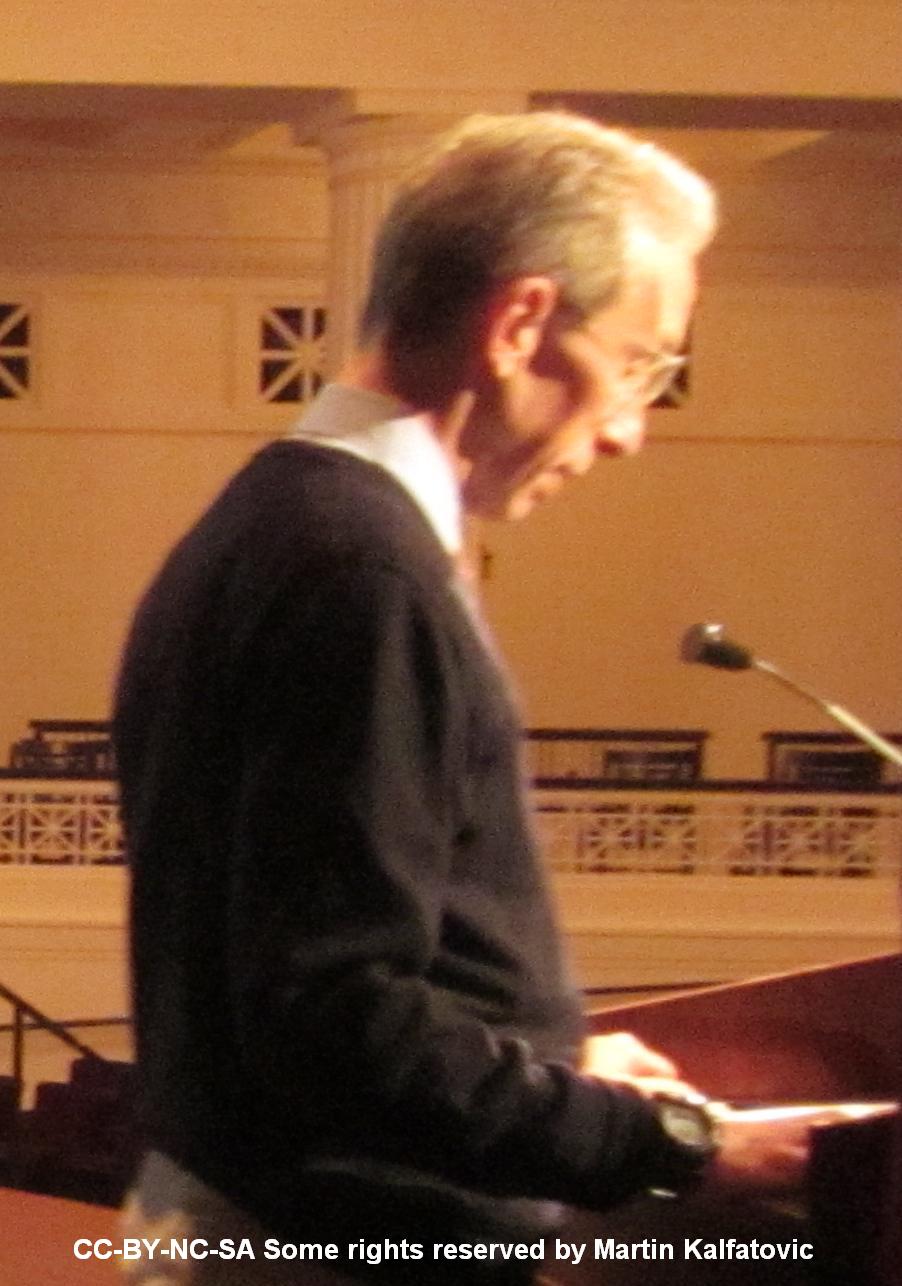
Tom Garnett

Former BHL Director

On Tuesday morning, at the “Biodiversity database and journal interface in e-publication era” Symposium, we enjoyed a talk titled “From Taxonomic Literature to Cybertaxonomic Content” based on a paper that our former BHL Program Director, Tom Garnett and our former BHL Technical Director, Chris Freeland, co-authored in BMC Proceedings with several other colleagues from different institutions, including Dr. Cynthia Parr from Encyclopedia of Life (EOL).

Closing Tuesday morning, the JRS Biodiversity Foundation and the Belgian Cooperation for Development sponsored the African Biodiversity Information Symposium.  It was great to see there, among other presenters, two of our colleagues who participated last year in the JRS Africa Digitization Workshop in Chicago (previous to the Life and Literature Conference): Dr. Alex Asase, from the Department of Botany, University of Ghana was presenting on “Developing biodiversity informatics infrastructure to support conservation of plant diversity in Ghana” and Lucy W. Wauringi, from Africa Conservation Center in Kenya, presented on “Building Biodiversity Information Networks for the compilation of Kenya’s Natural Capital”.  Dr. Asase was also present at the BHL Africa Meeting earlier in June of this year at SANBI.

View Full Size Image
Dr. Hong Cui presenting at the Institute of Botany, CAS

Tuesday afternoon, I was invited to present at the Institute of Botany of the Chinese Academy of Sciences (CAS) on the latest Global BHL developments and learned about this year’s activities and future plans for the next two years with BHL-China and the National Specimen Information Infrastructure.  Dr. Hong Cui, Assistant Professor at the University of Arizona, was also invited to present on Semantic Annotation, Ontology Building, and Interactive Key Generation from Morphological Descriptions and she was also extremely kind to help out with the language barrier throughout all the meeting.

View Full Size Image
Art of Life at TDWG 2012 poster session

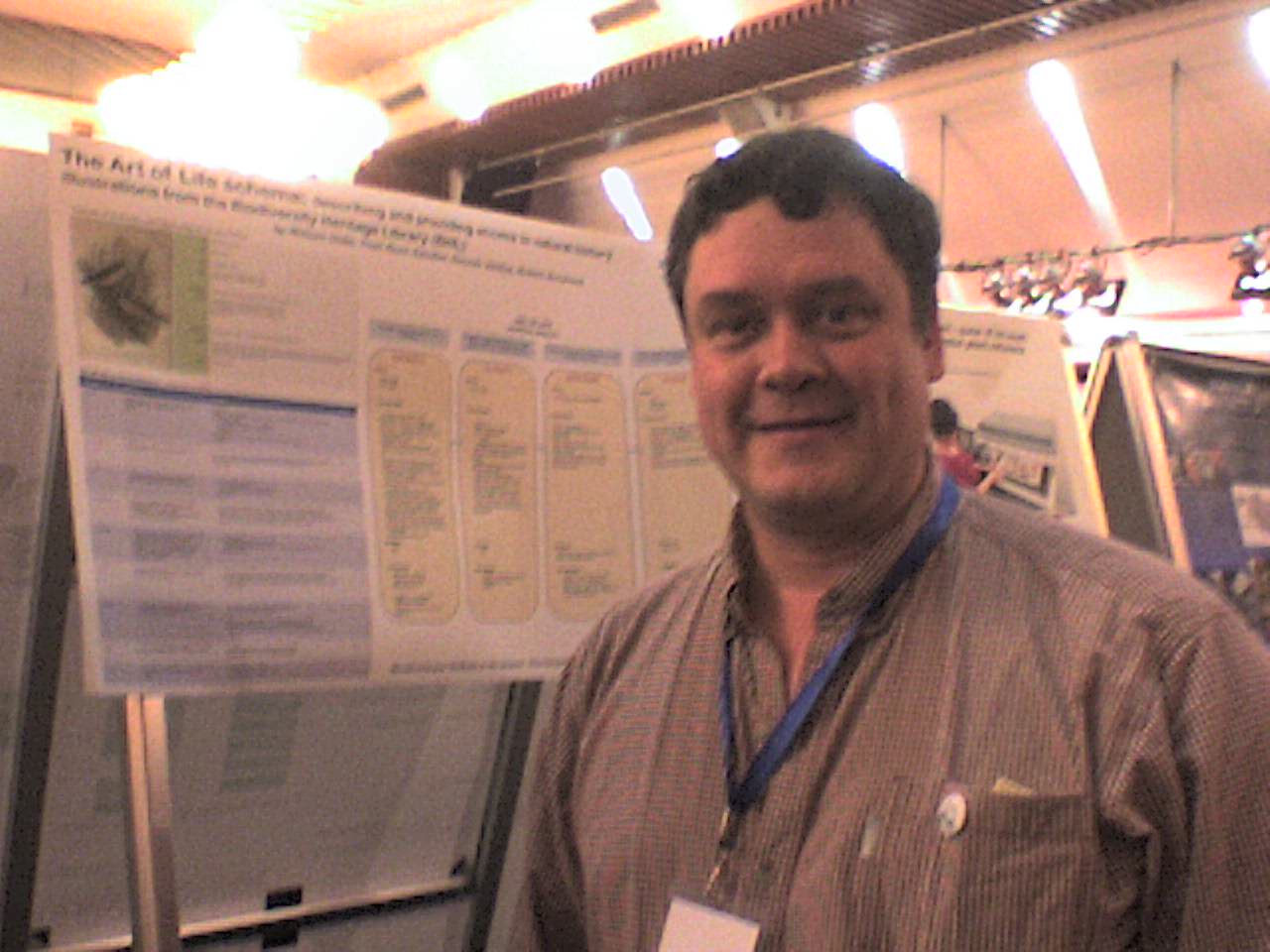
Wednesday morning started with personal recollections from the organizers and participants in honor of the late Dr. Frank Bisby.  Following the remembrance, the Plenary Speaker, Dr. Li-Qiang Ji from the Institute of Zoology, CAS, presented the Bisby Core – a Taxonomic Data Transfer Standard for the Multiple Taxonomy Environment.  The last hour and a half of Wednesday morning was dedicated to the poster session where I had the opportunity to represent my colleagues’ work on the Art of Life project.  Funded by NEH, this multi-institutional project involves participation from the Missouri Botanical Garden, the University of Colorado Boulder, the Indianapolis Museum of Art and other BHL partner institutions.  I was glad to see such great interest in improving access to millions of digital images demonstrated by several of the participants who approached the poster session.

View Full Size Image
Dr. Fenghong Liu at the Institute of Botany, CAS

On Wednesday afternoon, Jiří Frank, from the National Museum Prague, a member of BHL-Europe, lead the Workshop “Global dissemination of natural history content via Biodiversity Library Exhibition (BLE)” where I contributed with a small introduction to Global BHL and Dr. Fenghong Liu from the Institute of Botany of the Chinese Academy of Sciences, presented BHL China’s Latest Progress. Jiří gave an interesting Introduction to the BLE platform from the user perspective.

View Full Size Image
Dr. Xu Zheping attending TDWG 2012

Thursday morning, Dr. Zheping Xu introduced an interesting paper on the “Biodiversity Information Service in China: The Architecture and Techniques” and Cynthia Parr presented case studies from her experiences at EOL, with Katja Schulz and Jennifer Hammock, on “leveraging an international infrastructure“.  Later in the afternoon, I was invited to present at the Biodiversity for Cooperation and Development Interest Group session on BHL Africa, as a way to evaluate how to work together for a coordinated project on biodiversity literature digitization towards development of digital libraries.

Finally, during the Lighting Talks on Friday, Janna Hoffman, from the Museum für Naturkunde Berlin, a BHL-Europe member, presented on Open Up! paleontological multimedia data for the public.  I also took the opportunity to give a short talk reminding all attendees interested in contributing to the Art of Life Schema to please send us their feedback.
As the meeting came to an end, with a feeling of having attended a very fruitful and busy event, where Global BHL staff was definitely present and very active, we all said goodbye, hoping to meet again next year during TDWG 2013 in Florence, Italy.  By the way, next year’s Chair of the Program Committee will be our colleague of BHL-Europe, Heimo Rainer, from the Natural History Museum of Vienna!

And for those of you interested in reading more in depth about any of these topics, I invite you to look at the TDWG 2012 program in more detail and browse through the presentations linked here: http://www.tdwg.org/fileadmin/2012conference/slides/TDWG_2012_Presentations.pdf.

Until the next one, Xièxiè! Ciao!

View Full Size Image
The Great Wall of China
November 19, 2012by suzanne.chase
BHL News, Blog Reel

Visit to BHL China

Portrait version of the Biodiversity Heritage Library logo.

Chris Freeland, Martin Kalfatovic and Keri Thompson attended technical meetings related to the Biodiversity Heritage Library China node, November 15-17, 2010. The meetings, held at the Institute of Botany, Chinese Academy of Sciences (Beijing) took place over three days and covered scanning workflow, operation of the Internet Archive Scribe machine, technical standards for ingesting BHL-China materials into the BHL portal site, and replicating BHL data on IB/CAS servers.

BHL China program director Dr. Jinzhong Cui led the meetings. Also attending from BHL China were Fenghong Liu (project coordinator and Director of the Institute of Botany Library), Zheping Xu (technical director), and Shao Qing representing the Institute of Botany.

Additional presentations from the Institute of Botany staff included Chen Bin discussing the building the Chinese Field Herbarium, Li Min, project director for the Plant Photo Bank of China (PPBC), and a detailed presentation on the data storage systems in place at the Chinese Academy of Sciences.

The BHL team also received a tour of the Institute of Botany Library, source of materials for the initial scanning project.

View Full Size Image

November 27, 2010by joelrichard

Help Support BHL

BHL's existence depends on the financial support of its patrons. Help us keep this free resource alive!

search

About BHL

The Biodiversity Heritage Library (BHL) is the world’s largest open access digital library for biodiversity literature and archives. BHL operates as a worldwide consortium of natural history, botanical, research, and national libraries working together to digitize the natural history literature held in their collections and make it freely available for open access as part of a global “biodiversity community.”

Join Our Mailing List

Sign up to receive the latest news, content highlights, and promotions.

Subscribe Now

Subscribe to Blog via Email

Enter your email address to subscribe to this blog and receive notifications of new posts by email.

Join 319 other subscribers

Subscribe to Blog Via RSS

Subscribe to the blog RSS feed to stay up-to-date on all the latest BHL posts.

Access RSS Feed

Inspiring Discovery through Free Access to Biodiversity Knowledge.

The Biodiversity Heritage Library makes it easier than ever for you to access the information you need to study and explore life on Earth…for free, anytime, anywhere.


64+ Million Pages of
Biodiversity Literature Online.

EXPLORE

Tools and Services
to Transform Research.

EXPLORE

300,000+
Illustrations on Flickr.

EXPLORE

ABOUT | HARMFUL CONTENT | PRIVACY | SITE MAP | TERMS OF USE