Biodiversity Heritage Library - Program news and collection highlights from BHL
  • Home
  • News
  • Featured Books
    • All Featured Books
    • Book of the Month Series
    • BHL at 20
  • User Stories
  • Campaigns
    • Fossil Stories
    • Garden Stories
    • Monsters Are Real
    • Page Frights
    • Her Natural History
    • Earth Optimism 2020
  • Tech Blog
  • Visit BHL
Home
News
Featured Books
    All Featured Books
    Book of the Month Series
    BHL at 20
User Stories
Campaigns
    Fossil Stories
    Garden Stories
    Monsters Are Real
    Page Frights
    Her Natural History
    Earth Optimism 2020
Tech Blog
Visit BHL
  • Home
  • News
  • Featured Books
    • All Featured Books
    • Book of the Month Series
    • BHL at 20
  • User Stories
  • Campaigns
    • Fossil Stories
    • Garden Stories
    • Monsters Are Real
    • Page Frights
    • Her Natural History
    • Earth Optimism 2020
  • Tech Blog
  • Visit BHL
Biodiversity Heritage Library - Program news and collection highlights from BHL
Blog Reel

My Life as a BHL Staffer: Bianca Crowley

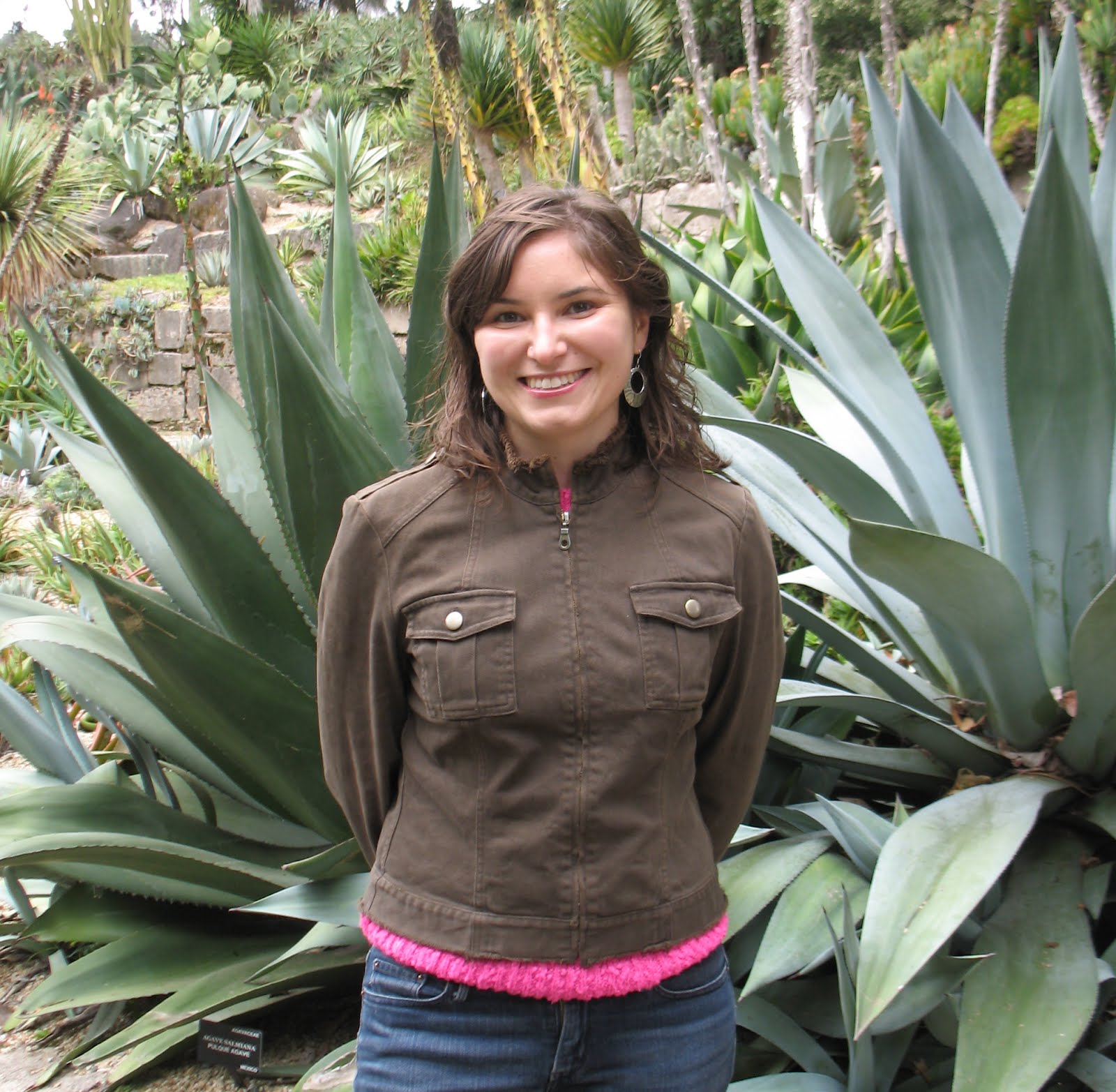
As Collections Coordinator for the Biodiversity Heritage Library, I am the point person for all things collections related. I lead and organize the work of the BHL Collections Committee, process all scanning requests, manage the acquisition of new materials and handle our permissions agreement workflow. In addition to my collections management work, I also…”coordinate”…things…namely the communications across our 14 member consortium, BHL Staff, and our Technical Development Team working out of the Missouri Botanical Garden. And then there’s also social media work, cataloging tasks, assisting the Tech Team to improve the BHL user experience, and answering the occasional reference question.
View Full Size Image
Content is King
The BHL collection holds nearly 54,000 titles, over 102,000 volumes, and continues to grow. The majority of the BHL digital corpus derives from the physical collections of the 14 member BHL consortium. In addition, we “ingest” biodiversity related materials from the corpus of texts held within the Internet Archive. In doing so, you will see content in BHL from the California Digital Library, Library of Congress, University of Toronto, North Carolina State University Libraries, and others.

The BHL Collections Committee developed the criteria for ingesting biodiversity relevant materials from the Internet Archive, and continues to tweak this criteria as new content is made available. We also put together the BHL Collection Development Policy and the BHL Deaccession Policy. It is not often that we decide to remove something from the BHL collection, but when we do it is only by unanimous vote. We meet regularly to discuss collections related decisions and tasks, such as developing new sub-collections of BHL content as well as new collections for iTunes U. If you have any suggestions for collections you would like to see in BHL or iTunes U, please let us know by submitting your comments to the BHL feedback form.

The Long and Winding Queue
Speaking of the feedback form…as you may know by now, we have a “scanning request” form that allows you to enter requests for content to be scanned. To date, nearly 1500 scanning requests have been submitted and it is my responsibility to process each one. We use an issue tracking system to manage all the requests that come through, from initial scanning assignment to availability of the title in the BHL web portal.

On average, we receive between 2-3 requests per day and approximately 25% of the requests we receive are for materials that require “special handling,” meaning that these materials are either rare, oversized, or in such a condition as to render them ineligible for scanning through our standard workflow with the Internet Archive. We take every measure to fulfill the requests that come in from our users, but requests for “special handling” materials are particularly difficult to fulfill as they are expensive, take additional time and resources to process, and may be so rare that only 1 BHL member library holds the title in their collection. Additionally, only a few BHL member libraries are equipped to digitize rare book materials.

One request at a time, books and missing volumes of a journal, aka “gap-fills,” are processed in the order they are received. At times a seemingly simple scanning request can take hours to investigate, require the work of 3 or more BHL member libraries to scan, and months may go by before the content is made available online. This is because processing scanning requests might require a good deal of bibliographic sleuthing before they can be appropriately assigned. Is the material requested already in BHL under a different title or series? Is the work available at a BHL member library for scanning? Is the book in the public domain? Is the volume requested bound with another volume or available under its monographic title? Will the bibliographic record in one library’s catalog match the record in another library’s catalog? Etc., etc., etc. I can easily find myself lost down a rabbit hole of bibliographic metadata, only to come out in a wonderland of biodiversity literature.

Pride & Permissions
I am proud to work for a digital library project that advocates for open access and open data. Not only am I living my dream of working for a digital library project at the Smithsonian Institution, but I am participating in what I see as a fundamental shift away from the library-as-information-silo to the library of the 21st Century. By putting our data out there (all the taxonomic names held within the pages of our corpus and all the bibliographic data about the books in our collection), the BHL is providing opportunities for biodiversity literature to be repurposed in new ways, ultimately connecting it back to the scholarly research cycle. Want to automatically link all the specimens in your database to the first publication of the scientific name? Be my guest. All I ask is that you let us know what cool things you’re doing with BHL data via @BioDivLibrary, BHL on Facebook, or through our feedback form.

This is why it is so important for the BHL to increase the amount of content it has in its collection beyond the United States public domain cut-off of 1922. As Collections Coordinator I manage the agreements with publishers and copyright holders who grant us permission to digitize in-copyright content. Thus far, I have not had the time to be proactive about pursuing permissions agreements but it is my goal for this year to ramp up BHL permissions activities. If you are a publisher or copyright holder that would like to see your content available via the BHL, please contact me at crowleyb[at]si.edu or visit our BHL Permissions page for more information.

Channeling the Hive Mind
I am privileged to work with an amazing team of librarians, techies, and biodiversity literature users. One of the most important aspects of my work has been to improve and uphold the free flow of communications among our BHL Staff, Technical Development Team, and our users. With staff scattered throughout the United States and United Kingdom, over 5 different time zones, with varying degrees of institutional resources, and differing digitization workflows, it is amazing to see how closely we work together. We use whatever tools we can to get things done, including but not limited to wikis, conference calls, email, video, issue tracking systems (one for scanning issues and one for tech stuff), skype, Google Docs, Twitter, quarterly reports, listservs, and our blog. As each BHL member institution works autonomously to select and scan what they can within their own digitization workflow, it is critical to maintain a balance between an institution’s independent needs as well as the collective requirements of the consortium. We do this by empowering ourselves to make decisions from the bottom-up and trusting each other to do what’s best for the project.

I received my MSLS from the Catholic University of America and a BA in Anthropology from the University of Maryland at College Park. My love of digital libraries largely grew out of my work in the Botany Department of the National Museum of Natural History as Project Manager for the Botany of the United States Exploring Expedition project. I love what I do for the Biodiversity Heritage Library. I have seen the project grow and mature in the 3 years that I have been working as Collections Coordinator and look forward to playing my part in the progress that BHL will make in the future.

March 5, 2012by SheilaC7108
Blog Reel

My Life as a BHL Staffer: JJ Ford

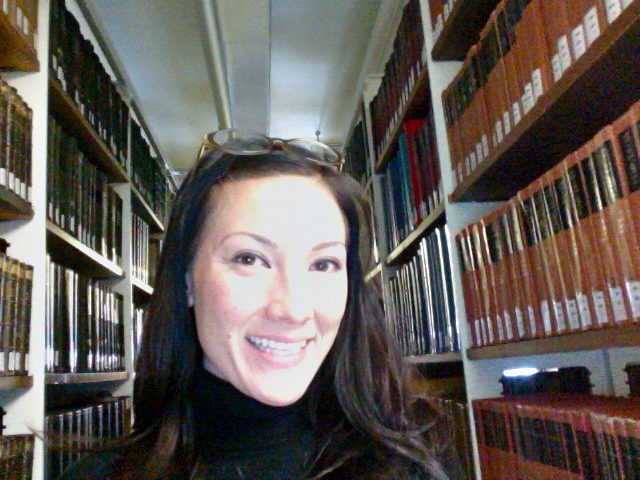
View Full Size ImageGreetings from Cambridge, Mass.! My name is JJ Ford and I have been working as the BHL Project Assistant at the Ernst Mayr Library located in Harvard’s Museum of Comparative Zoology since May 2011. And although I’ve only been working as a BHL staff member for ten months, it feels like so much longer — in a good way of course! In less than a year’s time, I have learned just how much staff time, effort and brainpower it takes to build the world’s first collaborative digital library that makes legacy taxonomic literature available to users for free. The BHL staff members that I have come to know, truly are committed to the idea of making knowledge open, extensive and available to a global audience. Sometimes I have to stop and pinch myself because I feel so lucky to be contributing to such a gratifying mission.

While I may be stationed at Harvard, my role is actually quite similar to Smithsonian staff member, Gilbert Borrego, who we heard from in last month’s installment of “My Life as a BHL Staffer.” Gilbert beautifully outlined the nuts and bolts of the BHL digitization operation, which gave us an overview of how the books in each partner library’s physical collections are selected, processed and scanned. Additionally, we learned why Paginationand Flickr are such important activities. Having the correct pagination for books in BHL and allowing the fabulous plates and illustrations to be exposed in Flickr are two ways that we facilitate better user discovery of articles and images. Like Gilbert, I manage many of these very same activities for Harvard’s portion of BHL user requests. We even have our own Facebook and Flickr sites which, we use to disseminate BHL’s outreach messages locally for the students and faculty members here at Harvard. However, to keep things interesting and build on Gilbert’s last blog post, I am going to touch on two of my favorite extracurricular BHL activities : 1) the basics of book preservation and 2) my involvement with BHL’s website usability studies.

Preservation and Book Repair

Unlike many of the other institutions, many of the book repairs at the Ernst Mayr Library are done on-site. We are lucky to have on staff a resident preservation specialist, Susan DiSanctis, a woman with one of the most interesting lives on human record. Not only has Susan lived amongst the native people of Papua New Guinea, she knows how to fix a book! While working under Susan’s instruction, I learned the basics of paper repair and contrary to what one may think, this is not a skill that is normally taught in library school. In today’s digital world, many might say that book preservation is a dying art. Nevertheless, it is still an extremely important activity because often the books that users request to be digitized are damaged and require preservation treatment prior to being sent over to the Internet Archive for scanning. It is my job to determine what our preservation strategy should be for these vulnerable books. In some unfortunate cases, there is very little that we can do for a book because the decaying process is in the advanced stages. For example, this book cannot be repaired because the paper is far too brittle:

View Full Size Image

Brittle books like these are made from wood-pulp paper. Their pages are literally “burning” from the slow fires of acid decay. The paper in this book will eventually disintegrate into a pile of dust. A very sad fate indeed.

However, there are a good number of lucky books that can be saved and subsequently scanned.

Usability Studies

In stark contrast to the hands-on work that book preservation requires, usability studies are conducted in order to measure ” the quality of a user’s experience when interacting with a product or system–whether a Web site, a software application, mobile technology, or any user-operated device.” (Usability.gov)

The results of these types of studies help web designers build more effective user-centric websites. In keeping with this principle, it has always been BHL’s goal to provide a web interface that marries both efficiency and design.

Recently, BHL staff members saw the need to conduct a usability study of our own. The emergence of a newly designed BHL-AU portal from our partners down in Australia prompted us to compare their design with the existing BHL-US website that most of you are probably already intimately acquainted with. Along with my colleagues at the other BHL partner libraries, I conducted local usability tests here at Harvard. The results of the study were illuminating and surprising and will certainly help inform future BHL web interface designs.

BHL-Australia Web Portal

View Full Size Image

BHL-US Web Portal

View Full Size Image

Same content. Different interface. Which one do you like better? Which one is easier to navigate and use? Keep reading to find out…

And what was the outcome of the usability study done here at Harvard? Our study participants found that the BHL-US portal website was easier to navigate and complete specific BHL related tasks such as finding articles, images and taxonomic species names however, most users thought that BHL-Australia was visually more appealing. The results of this study, will inform the future design of the BHL-US interface which, will be a “love-child” that merges the beauty of Australia’s BHL portal with the function of the US version of the site. Stay tuned for more details on design developments in the months to come! Additionally, if you have extra time to kill you can see the entire usability study in action via screencast.

February 6, 2012by [email protected]
Blog Reel

My Life as a BHL Staffer: Gilbert Borrego

View Full Size ImageTo kick off the new year, we here at BHL are starting a new monthly series titled “My Life as a BHL Staffer.” Each month, we will showcase a different BHL staff member and give an overview of what tasks and duties that person performs. We kick off the series with me, Gilbert Borrego, BHL staff member from the Smithsonian Institution. While I have a lot of different duties to perform for BHL, I can group them into three main areas: Social Media (which includes Flickr and Facebook), the pagination of BHL materials, and lastly, the pulling and returning of the physical items that will be scanned and eventually show up on BHL. I’ll start with the fan favorite:

BHL Flickr:

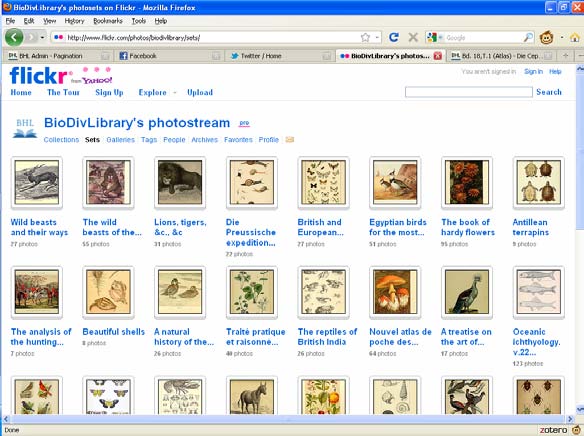
The goal of having a BHL Flickr page (http://www.flickr.com/photos/biodivlibrary/sets/) is to have a means to showcase BHL content in a new and fun way. We want to supply a pool of image content for dissemination through multiple social media sites like Facebook and Twitter, and for other potential BHL projects. We also use it to provide BHL content to the Encyclopedia of Life (http://eol.org) as part of their practice to automatically pull images from Flickr to include on EOL taxon pages. Lastly, we want to use it a way to connect with you, the BHL and Flickr communities!

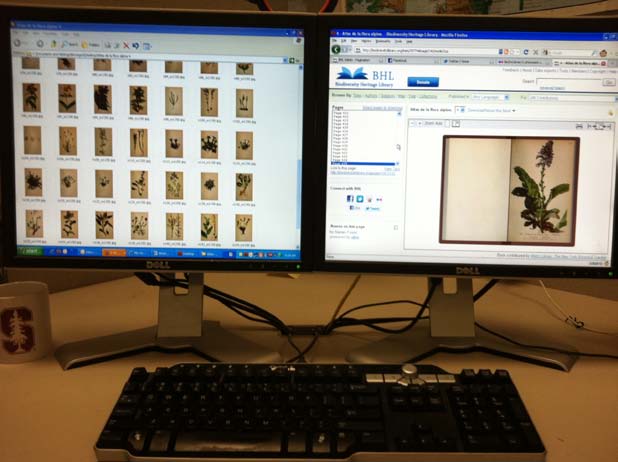
We started making a real concerted effort to populate and utilize Flickr in July 2011 and it just took off! I usually choose the items that I want to post on Flickr based on what items come across my desk, looking at items on the BHL recent addition feed (http://biodiversitylibrary.org/Recent.aspx), or doing keyword searches on BHL (http://biodiversitylibrary.org/). I look for the most visually stunning, interesting or intricate plates that I can find. I download all the images from an item, one image at a time.

View Full Size Image

Believe me, the two monitor set up is necessary!

I then upload them into Adobe Bridge which enables me to attach the all important metadata to all of the images. The metadata includes the filename, the creator, the source, descriptive information, keywords, credits, and copyright information. After that, I upload the whole batch to the BHL Flickr page and assign it to various categories including the contributing institution, the classification of the animals or plants pictured, and whether the item was used as a Book of the Week for this blog.

View Full Size Image
Beautiful, huh? 🙂

We also provide BHL content to the Encyclopedia of Life (http://eol.org). Images from our Flickr page are added to EOL when tagged with the proper machine tags with scientific names. You can learn more about machine tags here:
http://www.flickr.com/groups/encyclopedia_of_life/rules/
And guess what? YOU can add machine tags to our images too! In fact, we would love for some assistance in getting even more of our images into EOL! Learn how to do it with this snazzy tutorial:
http://www.slideshare.net/eoleducation/eol-flickr-tutorial

We currently have over 22,000 images on Flickr and will continue to keep adding more and more! If you know of any items in BHL with images that are screaming to be added to Flickr, please let us know via FlickrMail or leave us some feedback ([email protected]).

I also post everyday on Facebook: https://www.facebook.com/pages/Biodiversity-Heritage-Library/63547246565 We typically provide news and information that would be of potential interest to our Facebook followers. We try to change up the look of our page when we can, which means changing the profile picture often. Most importantly, we try to engage our users by being as interactive as we can. We love replying to comments and questions, so please be active and participate on our quizzes and make plenty of comments about anything we post!

Pulling and Returning Items:

SIL’s scanning process begins with the selection of material to scan. Material is selected for scanning based on three key areas: content identified by the systematic scanning of a biodiversity discipline topic (i.e. Entomology, Ornithology, Botany, etc.), institutional publications, and content identified through BHL’s issue tracking system, called Gemini, which includes user-submitted feedback. You can submit a scan request (or any other type of question or feedback here:

http://biodiversitylibrary.org/Feedback.aspx

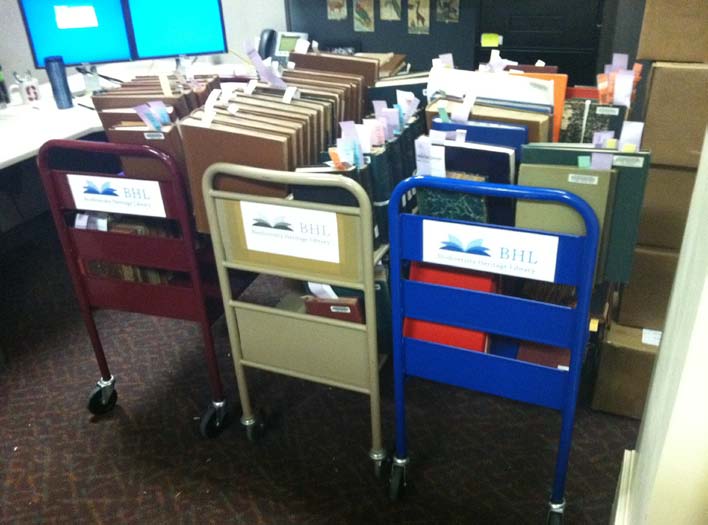
Staff members work to resolve this feedback by assigning them to various BHL institutions to address. We also have a system in place that helps to help make sure different institutions do not scan the same items. Once items have been selected for scanning, I will retrieve the items from the appropriate library branch which are located throughout the Smithsonian Natural History Museum building.

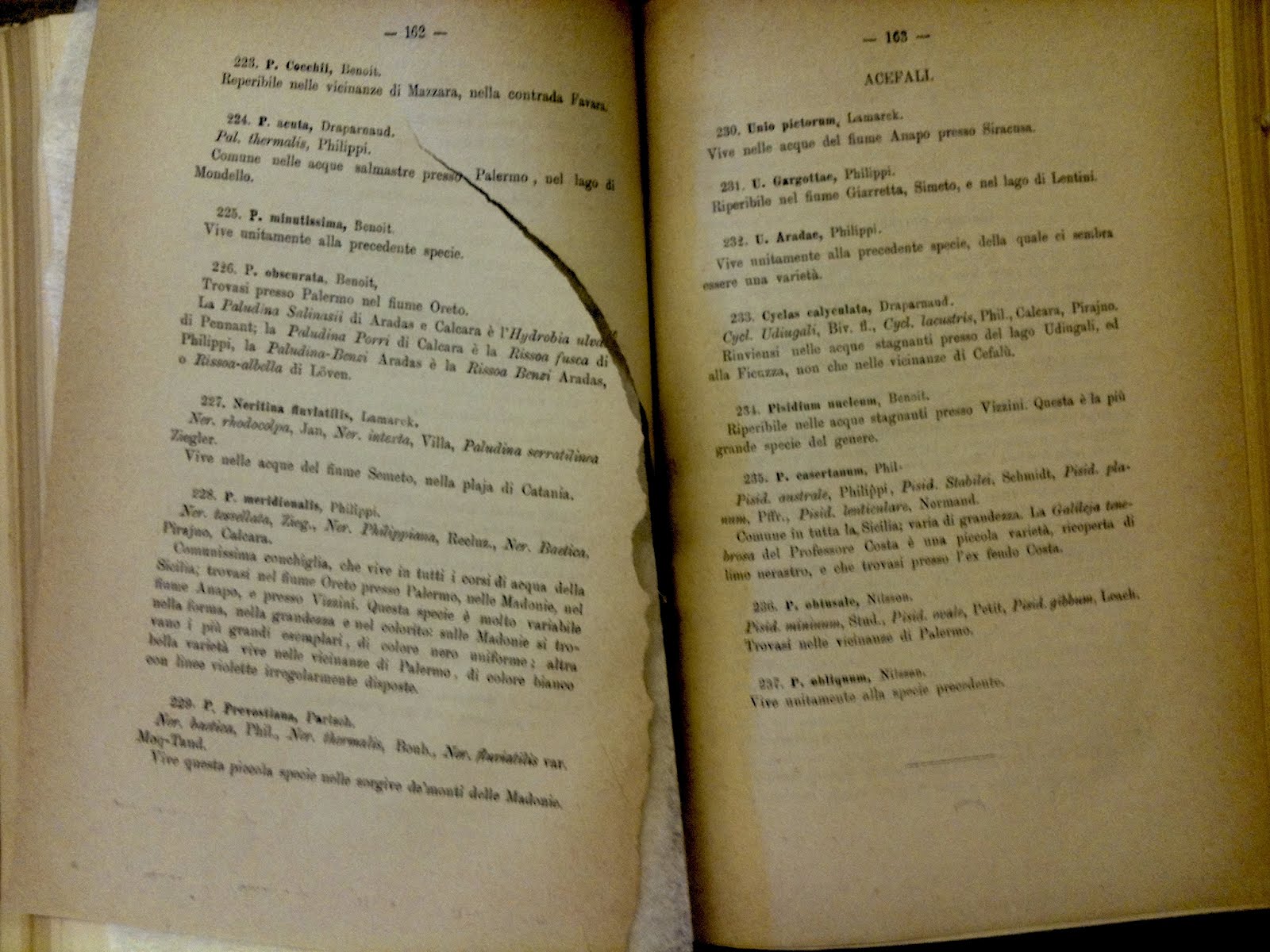
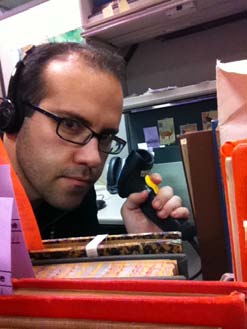
Once the items have been scanned and the books are sent back to us, I review the quality of the scans by performing a statistical sampling of books from the shipment or scanning batch. The process of quality assessment can be time consuming as it involves clicking through the scanned page images while turning the physical pages of the book at the same time. However, it is very important that we provide high quality scans that are not missing pages or that have pages that are cut off. After the assessment, the items are checked back in and reshelved.

View Full Size Image

Yikes, that is a lot of books!

Pagination:

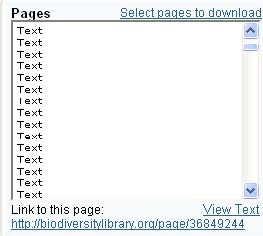
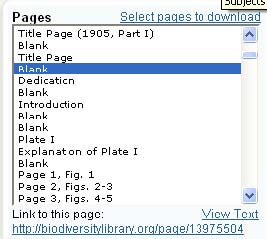
Pagination is the process of dividing our content into discrete pages in order to more easily find the information researchers need to help them do their work in a timely manner without having to search for information page by page. Basically, pagination includes indicating things such as page numbers, volume and issue numbers, tables of content, indices, identifying plates and figures and anything else to make searching through online items easy and quick. My position requires me to do quite a bit of pagination as it is an important component to using BHL for research. In the end, I want to make something that looks like this…
View Full Size Image

…to look a little more like this.

View Full Size Image

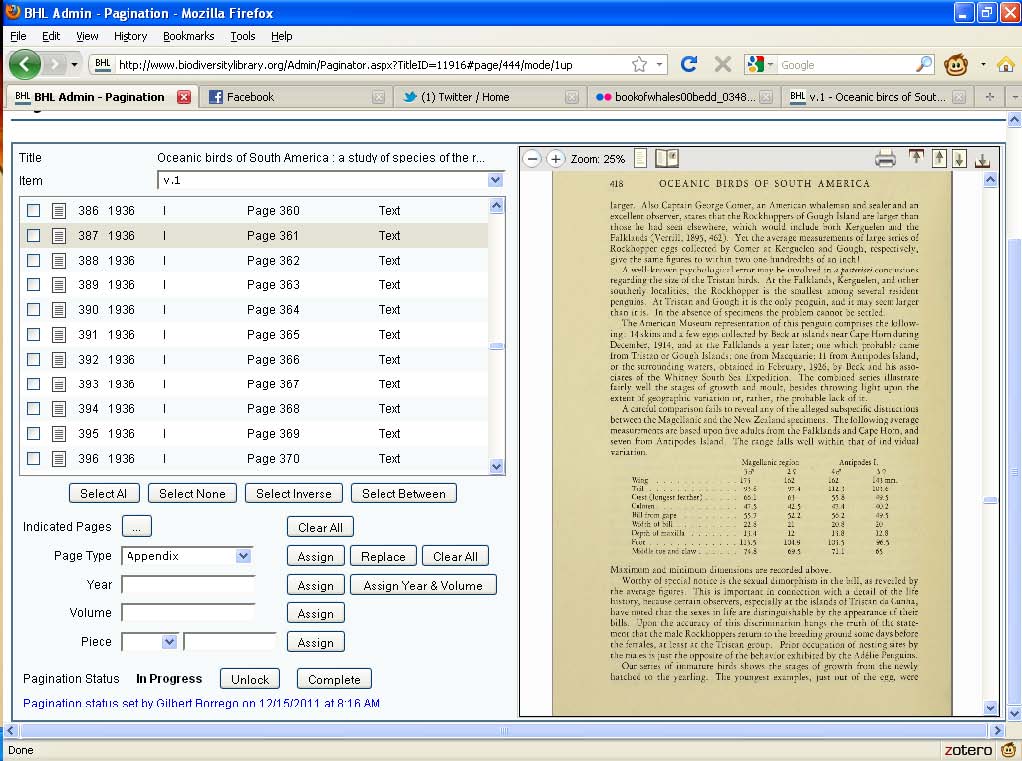
My pagination work screen looks like this:
View Full Size Image

I can manipulate multiple items at one time by checking the appropriate boxes, (for example, finding and checkmarking all the plates and have them numbering sequentially). If this looks like it takes a long time, it does! I have to look at every single page to verify what it is and give it the correct information. An item may take anywhere from 30 minutes to several hours, and certain series may take WEEKS, so be patient with us! 🙂

Seriously, we are looking at various ways to make the pagination process more automated, but for now, we have to manually manipulate each page. We prioritize pagination based on requests from users and we try to finish them up as soon as we can. So, if you know of an item in BHL that you would like paginated, please let us know (http://biodiversitylibrary.org/Feedback.aspx). We will be happy to do it, just give us a little time to get it done.

Well, that is a very brief and simplified description of what I do for BHL. Hopefully it was both interesting and informative! You would not believe how hardworking and committed every BHL staffer is and how committed everybody is to this ambitious project and I am still amazed that I get to play a role in it! Be sure to look out for our next BHL member profile next month and learn more about us!

January 9, 2012by jjdipasquale
Page 2 of 2«12

Help Support BHL

BHL's existence depends on the financial support of its patrons. Help us keep this free resource alive!

search

About BHL

The Biodiversity Heritage Library (BHL) is the world’s largest open access digital library for biodiversity literature and archives. BHL operates as a worldwide consortium of natural history, botanical, research, and national libraries working together to digitize the natural history literature held in their collections and make it freely available for open access as part of a global “biodiversity community.”

Follow BHL

  • Bluesky logo
  • Instagram logo
  • Facebook logo
  • Flickr logo
  • Twitter logo

Join Our Mailing List

Sign up to receive the latest news, content highlights, and promotions.

Subscribe Now

Subscribe to Blog via Email

Enter your email address to subscribe to this blog and receive notifications of new posts by email.

Join 319 other subscribers

Subscribe to Blog Via RSS

Subscribe to the blog RSS feed to stay up-to-date on all the latest BHL posts.

Access RSS Feed


64+ Million Pages of
Biodiversity Literature Online.

EXPLORE

Tools and Services
to Transform Research.

EXPLORE

300,000+
Illustrations on Flickr.

EXPLORE

ABOUT | HARMFUL CONTENT | PRIVACY | SITE MAP | TERMS OF USE