
Biodiversity Heritage Library - Program news and collection highlights from BHL
  • Home
  • News
  • Featured Books
    • All Featured Books
    • Book of the Month Series
    • BHL at 20
  • User Stories
  • Campaigns
    • Fossil Stories
    • Garden Stories
    • Monsters Are Real
    • Page Frights
    • Her Natural History
    • Earth Optimism 2020
  • Tech Blog
  • Visit BHL
Home
News
Featured Books
    All Featured Books
    Book of the Month Series
    BHL at 20
User Stories
Campaigns
    Fossil Stories
    Garden Stories
    Monsters Are Real
    Page Frights
    Her Natural History
    Earth Optimism 2020
Tech Blog
Visit BHL
  • Home
  • News
  • Featured Books
    • All Featured Books
    • Book of the Month Series
    • BHL at 20
  • User Stories
  • Campaigns
    • Fossil Stories
    • Garden Stories
    • Monsters Are Real
    • Page Frights
    • Her Natural History
    • Earth Optimism 2020
  • Tech Blog
  • Visit BHL
Biodiversity Heritage Library - Program news and collection highlights from BHL
Blog Reel

Ole Worm’s Cabinet of Wonder: Natural Specimens and Wondrous Monsters

View Full Size Image
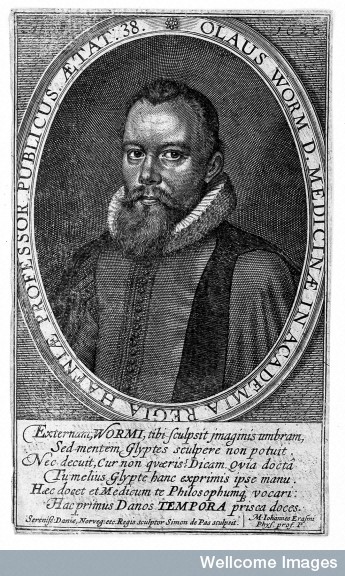
Portrait of Ole Worm (Credit: Wellcome Library, London; Creative Commons)

Ole Worm (1588-1654) was the first, and most well-known, collector in Scandinavia during the Renaissance.  In his homeland, Ole was attributed as the founder of the modern disciplines of archaeology, museology, philology, ethnology, and folklore.  Ole’s cabinet of wonder, documented in a catalog of its holdings, Museum Wormianum (which we highlight in this post), was the foundation for what would become Denmark’s National Museum.

Ole was born in Arhus, Denmark, the son of a mayor, and went to grammar school in his hometown and then in Germany, after which he moved to Emmerich on the Rhine in 1603 to study at a Jesuit school.  He returned to Denmark but set out again in 1605 on a “grand tour” of Europe, visiting important cities, museums, and centers of learning; taking such a grand tour was popular at the time among the sons of nobleman and the newly rich.  While on his grand tour, Ole studied philosophy, anatomy, medicine and theology, acted as a private tutor, and received a doctorate in medicine in 1611 for writing a dissertation on almost all known diseases (at the time) and their cures.

It was while Ole was on his grand tour of European cities of learning and culture that he began collecting objects that would come to inhabit his cabinet of wonder–also interchangeably called cabinets of curiosity during the period, or as he referred to it in a letter, his cabinet of naturalia.  (For more on cabinets of wonder, see our blog post on Ferrante Imperato and his cabinet of wonder here).  Ole visited a well-known collector in Italy in 1609, went to Germany and saw a famous art collection, and in Enkhuizen, the famous collector Bernhard Paludanus gave Ole a coffee bean and an exotic reed–both objects obtained through foreign travels and international trade.  Cabinets of wonder during this period especially valued the exotic, objects that came from America or other faraway lands that were now accessible through foreign trade and colonialist empire-building.
View Full Size Image
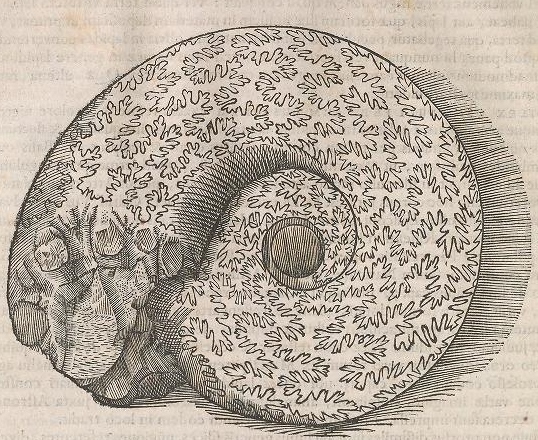
Lapis sceleton serpentis, also known as “snake-stone”, found in the section on stones in Museum Wormianum here.
In the 1600s, some thought snake-stones from India could heal venomous snake bites, and snake-stones are attributed as the divine stones Homer mentioned in The Iliad that healed Philoctete’s wound.

Ole continued to correspond with various European collectors who were famous for their pursuits of knowledge and virtue.  How does collecting objects make one virtuous?  The pursuit of knowledge was a virtue, and collecting physical objects aided in pursuing knowledge.

According to the philosophy of the time, by collecting physical things that reflected God’s creative powers, one was highlighting God’s power.  And those things that were once considered monstrous in the medieval period–Siamese twins, deformed fetuses, strange creatures–now represented God’s omnipotent ability to intervene with creation and produce wondrous rarities worthy of gazing upon and studying in cabinets of wonder.

Since Ole lived during a period after the Reformation (a break with the ways of the medieval church), scholars and wealthier individuals were able to establish themselves as creators of knowledge, collectors and curators of cabinets of wonder, studying by means of a proto-empiricism where knowledge was gained by physical experience with an object (rather than the later definition of empiricism as knowledge gained through experimentation).
View Full Size Image
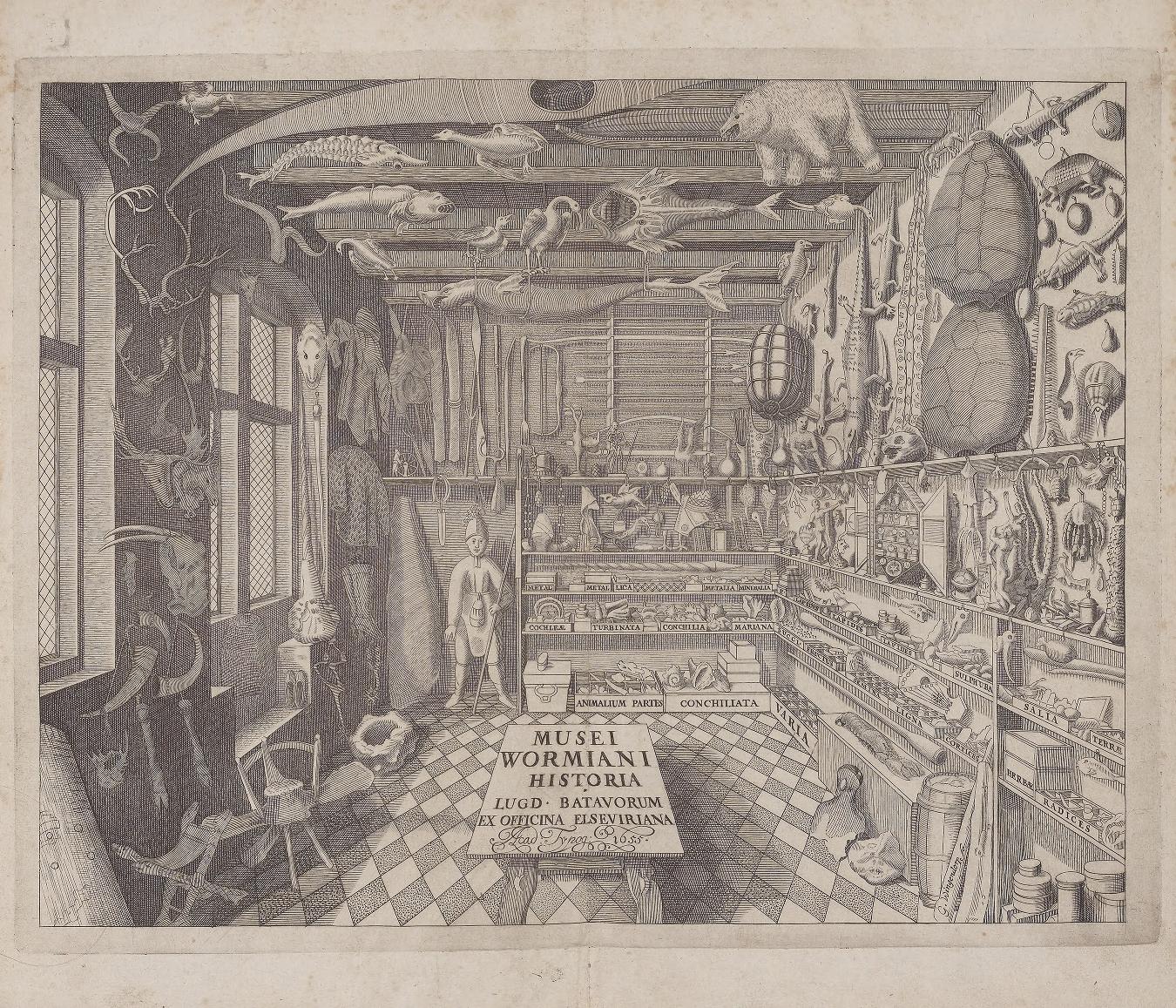
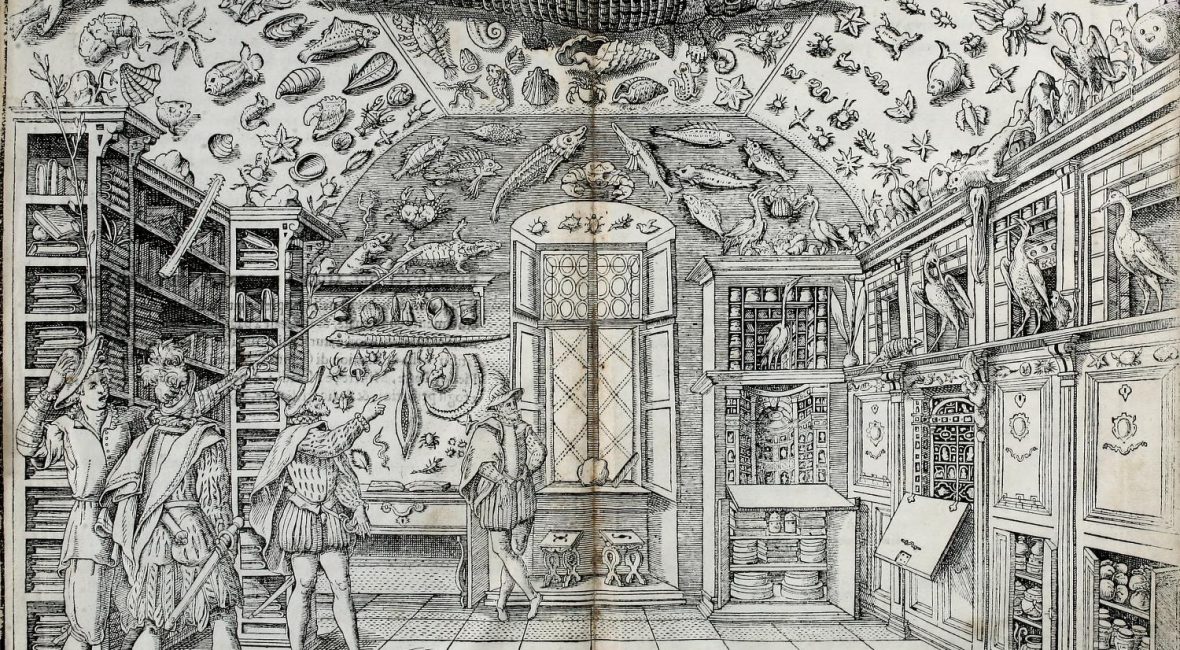
Ole Worm’s cabinet of wonder, from the frontispiece in Museum Wormianum.  The table in the center of the room, where the name of the book is inscribed, is where Ole would have taken down objects for himself, and visitors, to handle and observe.
(View the image here.)

After Ole returned from his grand tour, he took a position at the University of Copenhagen and was the chair of pedagogy, Greek and physics, consecutively, and in 1624 became a professor of medicine.  Around 1620 he began creating his museum, “Museum Wormianum”.

In its nascent form, the museum contained the curiosities Ole collected on his grand tour, mostly geological and biological, along with cultural items.  The majority of his museums holdings, or “wonders”, were donated to Ole from other European collectors whom he met and with whom he corresponded and sometimes asked for items.  By the time Ole died in 1654, his museum was held in high regard and contemporaries wrote that the museum had wonderful, curious and odd rarities that were visited by famous and royal people from all over Europe.

View Full Size Image
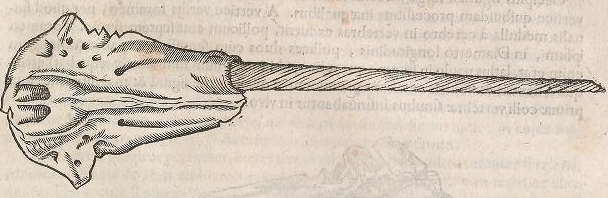
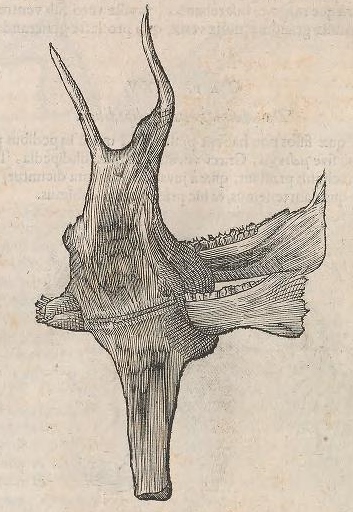
What people in the 17th century, and prior, thought was a unicorn horn.
(View the image in Museum Wormianum here.)
View Full Size Image
During the period, people believed they could purchase “unicorn” horns to use for medicinal purposes. Having never seen a horn attached to a skull, Ole was skeptical.  When presented with this “unicorn skull” by another collector, Ole determined that it likely belonged to a narwhal, and he was correct.
(View the image in Museum Wormianum here.)


View Full Size Image
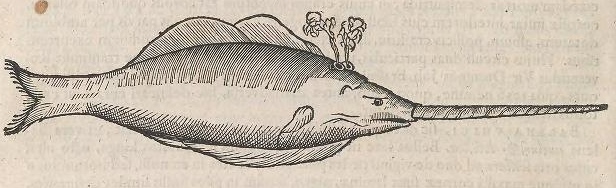
Illustration of a narwhal, whimsical but not completely accurate, in Museum Wormianum, which can be viewed here.

The reason for collecting objects from the natural world, as well as curiosities and antiquities, was to enrich visitors’ own knowledge.  In 1639, Ole wrote of his museum and its “curiosities” saying:

“I have collected various things on my journeys abroad, and from India and other very remote places I have been brought various things: samples of soil, rocks, metals, plants, fish, birds, and land-animals, that I conserve well with the goal of, along with a short presentation of the various things’ history, also being able to present my audience with the things themselves to touch with their own hands and to see with their own eyes, so that they may themselves judge how that which is said fits with the things, and can acquire a more intimate knowledge of them all.”

During this great period of collecting, a new form of literature was created: the catalog.  Collectors used catalogs of their items to promote their collections and display their own wisdom.  Ole published two catalogs (one in 1642 and one in 1645) with inventories of the wonders in his cabinet of curiosity.  However, it was the third catalog, which came to be the version of Museum Wormianum we explore today, published posthumously in 1655 that contained the most information, as well as engravings.

The catalog is divided into four categories: minerals, plants, animals and artificialia (man-made objects); the books go in ascending order from “lowest” form of life, minerals, to “highest” form of life, animals, with the fourth category, artificialia, existing outside that context of the three kingdoms of nature.

Man is cataloged with “animals” in Book III, along with divine monstrosities such as deformed fetuses, a giant tooth and giant skull believed to have come from an ancient race of giant humanoids.  Curiously, mummies, although they are human remains, are cataloged with “minerals” in Book I.

Book II deals with plants, and includes a section on tree “monstrosities”, so-called because they were thought to resemble animals or other objects.
View Full Size Image
Horse mandible around which a tree has grown, found in Book III, on Animals (including man), in Museum Wormianum.
(View the image here.)

Book IV, De artificiosis, discusses man-made objects in the collection, including both contemporary-but-exotic items like bows, arrows and tobacco pipes from America, and antiquities like Roman and Danish jewelry and metal weapons from India and Norway.

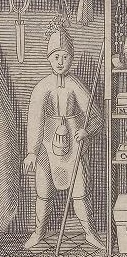
Two of the most amazing man-made creations were wooden automata created by contemporaries: mus rotis actus, a wooden mouse covered with a mouse hide that operated by means of internal clockworks; and statua librata pondere mobilis, a human automaton made of wood with flexible limbs that could imitate human movement by means of a wheel crank.  This figure was dressed in clothes believed to be worn by native peoples in America and given a spear to hold, and is clearly visible in the frontispiece to the book in the middle of the image of Ole’s cabinet of wonder (see image below).

If one views the objects in the frontispiece to Museum Wormianum from right to left, the order of objects mirrors the order of the same objects as they are listed in the books that comprise this work.
View Full Size Image
Humanoid automata, visible in the frontispiece to Museum Wormianum here, could run around and pick things up.  It was dressed to represent what the creator thought native people in America looked like, and held a spear.

Ole Worm inspired future generations of collectors and multitudes of visitors to his cabinet of wonder by showing them curiosities they likely never would have seen otherwise.  For Ole and many of his contemporaries, these items were outward symbols of the divine creative powers of God and of the powerful knowledge and virtue possessed by the scholar who collected them.

Interesting Facts:

Ole was considered a great academe and writer in Europe after publishing a compendium on Danish runestones in 1643, called Danicorum Monumentorum Libri Sex.  To create this work, he sent artists around the Danish kingdom to accurately sketch the monuments and their engraved runes.

In attempting to create a book of medieval Icelandic sagas, Ole worked with a prominent Icelandic historian, Arngrimur Jonsson; when both men had no luck finding the sagas, Arngriumur told Ole that he heard of an old woman who lived on a distant coast who knew about the medieval sagas and could perhaps retell them, and that they could send a poet to her to have them written down.  There is no record of any success in this venture.

During his grand tour of Europe, Ole had an autograph book which he filled with the signatures of famous cultural figures, including professors and dignitaries, whom he met during his travels. 

Shop Objects of Wonder in the BHL Store

Ole Worm’s cabinet of curiosity is one of the many wonders you can find in our Objects of Wonder BHL Store collection.
View Full Size Image

Shop today to bring some curiosities home with you.

100% of the proceeds from the sale of products in the store are used to digitize more books for BHL. Learn how these books help save biodiversity.

References:

Barroso, M.D.S. (2013). Bezoar stones, magic, science and art. In Duffin, C.J., Moody, R.T.J., & Gardner-Thorpe, C. (Eds.), A history of geology and medicine (pp. 193-208). London: The Geological Society.

Grice, G. (2015). Cabinet of curiosities: Collecting and understanding the wonders of the natural world. New York, N.Y.: Workman Publishing.

>Hafstein, V. (2003). Bodies of knowledge: Ole Worm & collecting in late Renaissance Scandinavia. Ethnologia Europaea 33(1), 5-20.

Hoskin, D. (2015). Born on this day: Ole Worm — collector extraordinaire. Victoria and Albert Museum Blog. Retrieved from http://www.vam.ac.uk/blog/creating-new-europe-1600-1800-galleries/born-on-this-day-ole-worm-collector-extraordinaire.

Meier, A. (2013). Ole Worm returns: An iconic 17th century curiosity cabinet is obsessively recreated. Atlas Obscura. Retrieved from http://www.atlasobscura.com/articles/ole-worm-cabinet.

Richards, S. (2012). The world in a cabinet, 1600s. The Scientist. Retrieved from http://www.the-scientist.com/?articles.view/articleNo/31897/title/The-World-in-a-Cabinet–1600s/.
May 9, 2017by micahv
Blog Reel, Featured Books

Ferrante Imperato: Step Into His Cabinet of Wonders!

Cabinets of Wonder: What Are They and Why Were They Created?

The term, “cabinet of wonder”, comes from the term “wunderkammer” (literally meaning “wonder chamber”).  The tradition of creating cabinets of wonder began during the Renaissance, the period of time between the 14th and 17th centuries.

In England and France, these cabinet of wonder collections were called “cabinets” or “curiosity cabinets”.  German speaking countries called the collections a variety of more specific terms: kunstkammer (“art cabinets”), schatzkammer (“treasure cabinets”), rüstkammer (history cabinets), and eventually wunderkammer (“marvel or curiosity cabinets”).  People during the Renaissance referred to these collections generically using the terms “wunderkammer” or “curiosity cabinet” interchangeably.

View Full Size Image
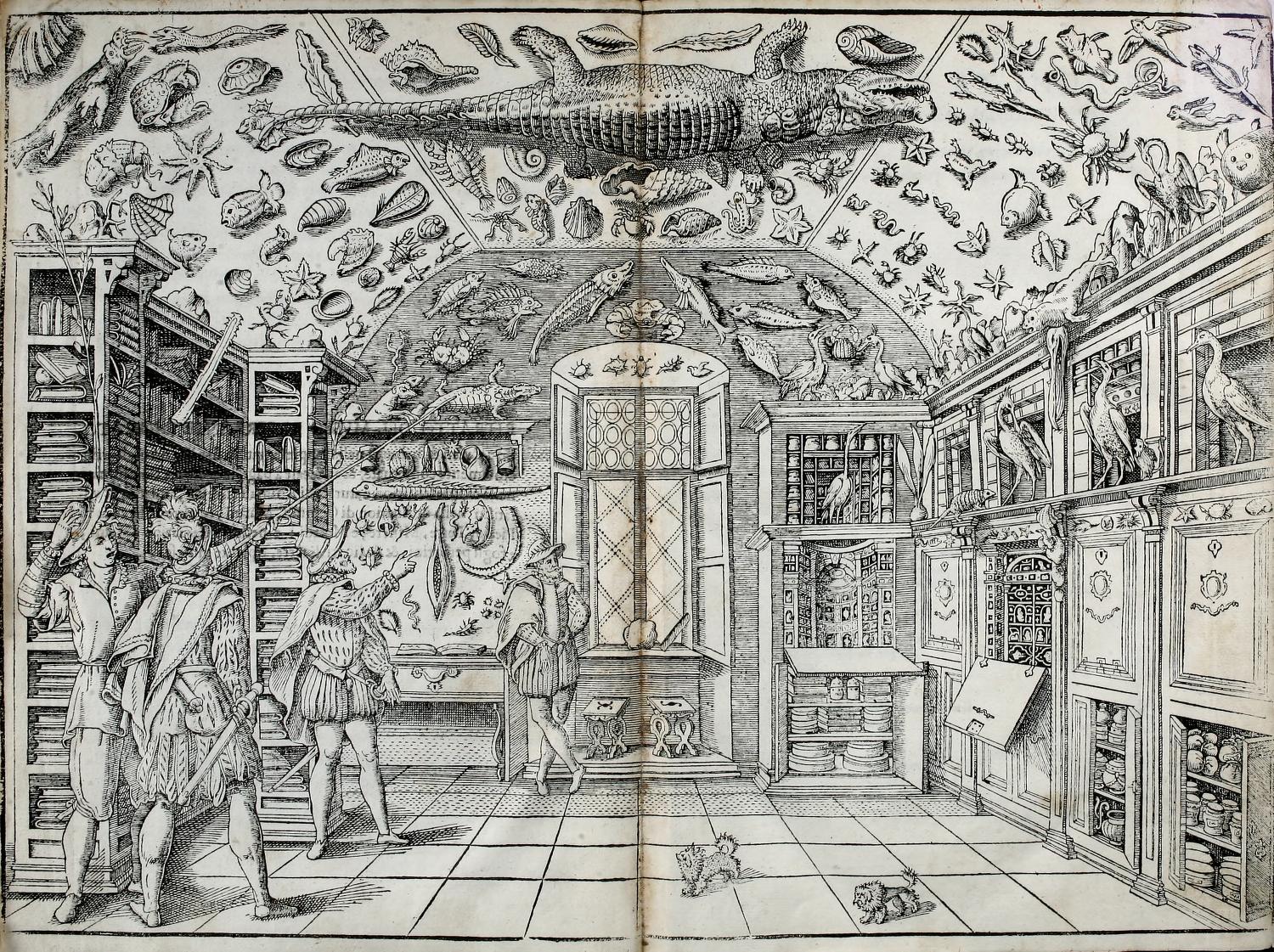
The first published pictorial representation of a Renaissance cabinet of curiosity in Ferrante Imperato’s Dell’historia Naturale. (Image digitized by Smithsonian Libraries.)

The Renaissance idea of creating a collection of (formerly) animate, inanimate, and botanical objects, and even odd specimens, came from a human desire to place mankind somewhere within the larger scheme of things.  Formerly, European princes built their own private studiolo or cabinets, which contained rare natural objects and books, and acted as status symbols to impress others.  Then the cabinets came to be used for scientific observation and contained more humble–but important–natural objects and specimens.  During the Renaissance, theorists from all fields of academia were making new scientific and philosophical discoveries, and realized that all of this new knowledge sometimes challenged previous beliefs about existence and mankind’s place within it.

View Full Size Image
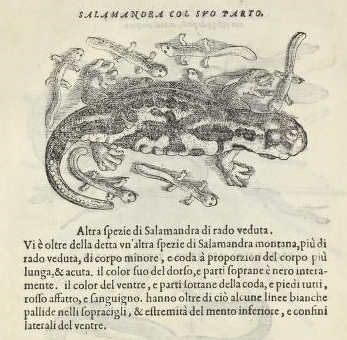
Salamander, from Ferrante Imperato’s Dell’historia Naturale (1599). Digitized by Smithsonian Libraries.

Different from modern museums, wunderkammer were generally created by a single scholar: in our example, Ferrante Imperato (1550-1625), an apothecary and scholar living in Naples.  In addition, the objects were believed to be interconnected by some singular purpose that could shed light on man’s place within existence.

Humanism was one of the most predominant movements in Italy during the Renaissance, and some humanists believed, among other things, in a notion of universalism–the idea that all things and all people were connected by some shared visible and/or invisible similarities, and all created by the divine.

The Renaissance humanists endeavored to use reasoning to explain unknown aspects of nature, which developed into the study of natural history: empirical observations and experimentation were used to make conclusions about the physical world.  Thus the Renaissance, and the creators of cabinets of wonder, were important in setting the stage for extraordinary advances in scientific knowledge in the decades following.

View Full Size Image
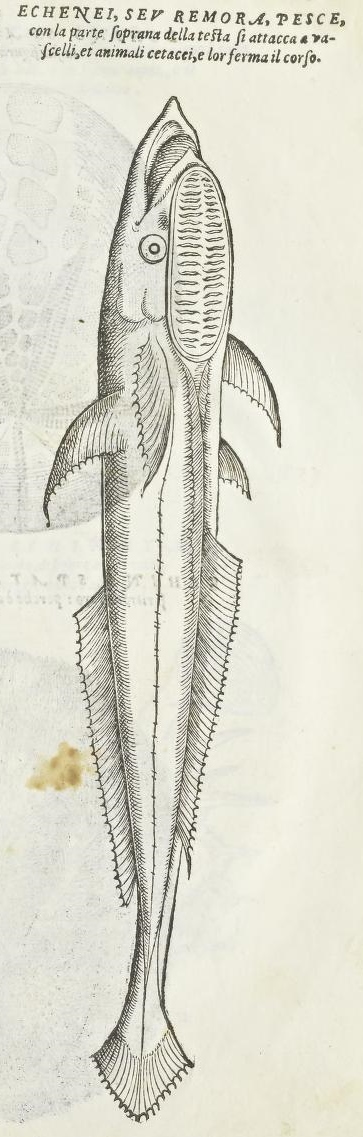
Remora fish, from Ferrante Imperato’s Dell’historia Naturale (1599). Digitized by Smithsonian Libraries.

What Were the Beliefs of Some Creators of Cabinets of Wonder, and Why Was Ferrante Imperato So Important?

Some creators of cabinets of wonder used for scientific observation and experimentation were pietistic, and stressed living a good and helpful life.  For this reason, the cabinets’ creators often wrote of their collections and made them open to the public to make people aware of the beauty of nature and the usefulness of natural objects.  The creators would also observe and experiment on items in their collections in an endeavor to increase knowledge of all aspects of the world.  Additionally, creators of cabinets of wonder often corresponded with, and visited, one another and discussed their collections and findings to increase the collective knowledge about the natural world and existence.

In this vein of sharing knowledge, Ferrante Imperato was convinced by his son, Francesco, and by his own friends, to produce a written account of his cabinet of wonder, in the form of the 28 books which comprise his work Dell’historia Naturale.  The majority of the work’s books are concerned with stones, minerals, gems and earth (i.e., minerology and related fields).  The last two books deal with living organisms: plants and animals.  Imperato especially featured and worked with herbs used to create medicines as an apothecary.

The first version of Dell’historia Naturale, printed in 1599, totaled 791 pages between the 28 books that comprised it, with 119 woodcut illustrations interspersed throughout the text.  One of the first European natural history research collections, Imperato’s cabinet may have contained as many as 35,000 plant, animal and mineral specimens.  Imperato quoted other authors at the beginning of his subject sections and discussed what he thought of the authors’ ideas, and then launched into his own beliefs about the subjects based on his experimentation on, and observation of, specimens in his cabinet of wonder.

View Full Size Image
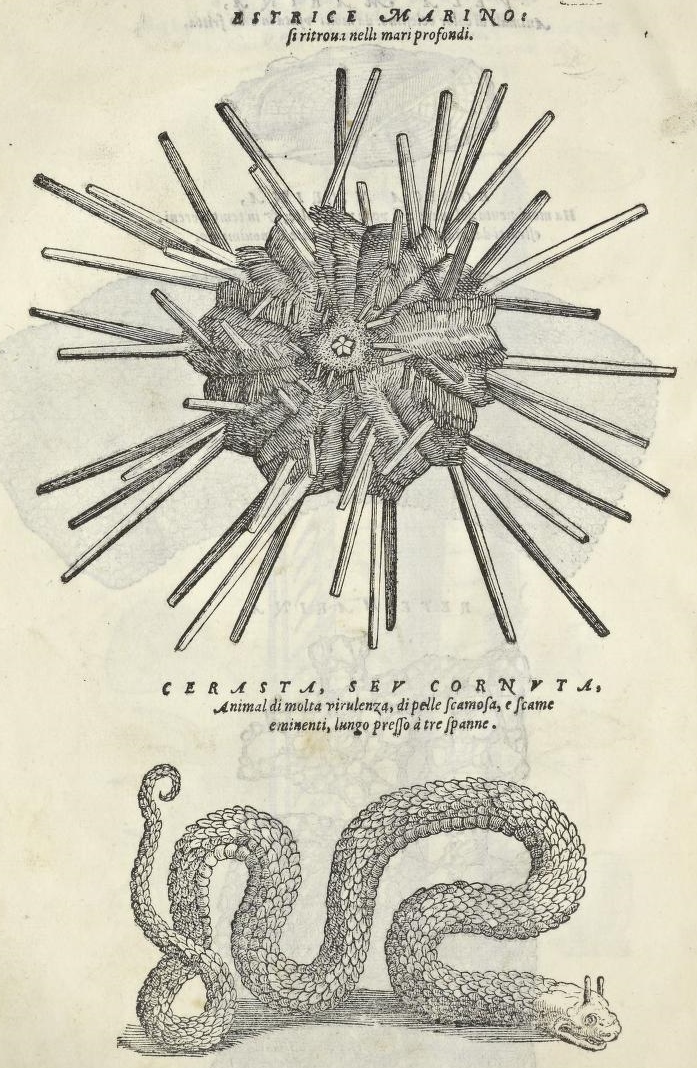
Marine creature and Horned Viper, from Ferrante Imperato’s Dell’historia Naturale (1599). Digitized by Smithsonian Libraries.

Many creators of these cabinets were drawn to collecting specimens in an endeavor to make life more comfortable for people in acts of piety, either by collecting herbs and natural materials like Imperato did in order to create medicines, or by collecting natural materials believed to be alchemical or metallurgical in order to experiment with new recipes (“segreti”, or “secrets”) to ease human ailments. Sometimes piety, however, was considered heretical by the Catholic Church in Italy at this time due to pietism’s emphasis on individual religious devotion (which leaves room for the idea that the Church may not be needed).

Imperato’s friend and scientific rival, Giovanni Battista Della Porta, who practiced pietism, created the Academia Secretorum Naturae (“Accademia dei Segreti”), which translates to “The Academy of the Mysteries of Nature”, in order to study and share information about natural science with like-minded scholars.  In 1579, Della Porta’s Accademia was accused of sorcery and disbanded by the Pope.

View Full Size Image
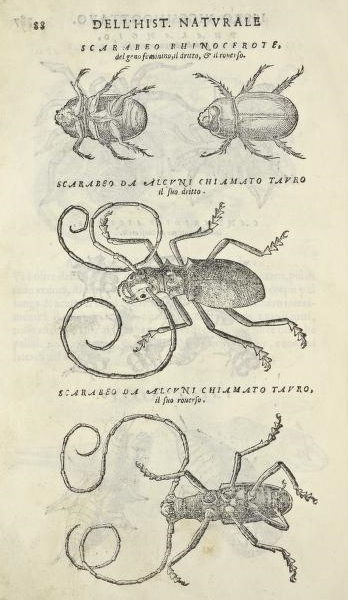
Insects from Ferrante Imperato’s Dell’historia Naturale (1599). Digitized by Smithsonian Libraries.
View Full Size Image
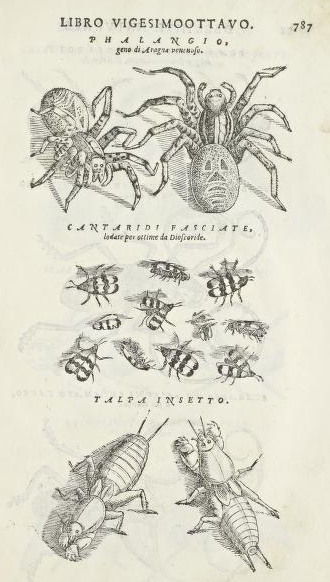
Arachnids and other insects from Ferrante Imperato’s Dell’historia Naturale (1599). Digitized by Smithsonian Libraries.

Some humanist scholars did, in fact, possess objects in their cabinets of wonder believed to have magical properties based on arcane knowledge, and these items included magical lanterns, speaking tubes, and distorting mirrors.  So the humanist sharing of “secrets of nature” did include, for some, secret of a magical (heretical) sort.

Imperato saw his cabinet of wonder as a place to derive knowledge directly from the artifacts before him, rather than trying to apply secret knowledge from arcane ancient and contemporary manuscripts to the objects in order to try and produce a result, like other scholars of his time, such as Girolamo Ruscelli (who had his own Accademia Segreta).

When Imperato’s Dell’historia Naturale was being printed in 1599, and more people knew about the pietism, and beliefs in magical properties of some items in some cabinets of wonder, Imperato’s son, Francesco, feared his father’s text might lead to heresy charges.  Francesco thus quickly printed another shorter version of his father’s text with many references to saints and Christian writers.

Imperato was not charged by the Church with heresy or sorcery when his full text, in all 28 books, came out, and this text became the first to feature an illustration of a cabinet of wonder, and the first work on natural history completely written in Italian (rather than scholarly Latin).

View Full Size Image
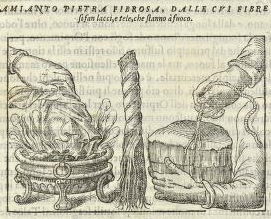
An experiment with asbestos, from Ferranto Imperato’s Dell’historia Naturale (1599). Digitized by Smithsonian Libraries.

Interesting Facts:

Some of the scholars and knowledgeable men with whom Ferrante Imperato corresponded included: Ulisse Aldovrandi, Gaspard Bauhin, Pierandrea Mattioli, and Fabio Colona.

Imperato was amazed by asbestos, which was a relatively new substance at the time, with paradoxical and malleable qualities.  Imperato experimented with asbestos and included an illustration of one of his experiments with it in Dell’historia Naturale (fig. 18)–the only experiment depicted in the work.

In order to argue that a toad’s skull was actually a stone unlike any other natural stones, Imperato captured a pregnant viper and gathered many toads to prove that the viper could not penetrate the toad’s skull, and called the toad’s skull “toadstone” (pietra di rospo).

In 1611, Galileo demonstrated for other scholars the luminescent nature of a stone called the “Bologna stone” (lapis Bononiensis), or the “solar sponge”.  When Imperato heard about this stone, he was fascinated but thought it qualified as natural magic and claimed: “I believe that it is not natural but artificial”.

Cabinets of wonder often included fossils–Imperato had many–and humanist debate in Italy in the early fifteenth century led to subsequent discussions about what the existence of fossils meant; European students visiting Italy spread this debate throughout many regions when they returned to their home towns.

Ferrante Imperato’s Dell’historia Naturale contains medical folklore such as the ideas that wearing amethyst in the navel prevents drunkenness, sapphire cleans the eyes in such a way as to prevent lust, and jasper worn as an amulet can stop bleeding.

References:

Dion, M. (n.d.). History of the wunderkammern (cabinet of curiosities). Mark Dion: Tate Thames Dig. Retrieved from http://www.tate.org.uk/learn/online-resources/mark-dion-tate-thames-dig/wunderkammen

Duffin, C.J., Moody, R.T.J., & Gardner-Thorpe, C. (Eds.). (2013). A history of geology and medicine. Geological Society: Special Publication, 375, 23-24.

Findlen, P. (1994). Possessing nature: Museums, collecting, and scientific culture in Early Modern Italy. Berkeley, C.A.: University of California Press.

Grice, G. (2015). Cabinet of curiosities: Collecting and understanding the wonders of the natural world. New York, N.Y.: Workman Publishing.

Guitard, E. (1937). Ferrante Imperato. Revue d’histoire de la pharmacie, 25(100), 196.

Mottana, A. (n.d). The first modern translation of Theophrastus’ “On Stones” (pi epsilon rho Anot sign lambda AI omega I1/2; De lapidibus): Ferrante Imperato (1599). Rendiconti Lincei-Scienze Fisiche E Naturali, 21(1), 1-25.

Philippe, J. (2003). Les curiosités de trois apothicaires. Revue d’histoire de la pharmacie, 91(340), 603-610.

Rosenberg, G.D. (Ed.). (2009). The revolution in geology from the Renaissance to the Enlightenment. GSA Memoir Series, 203, 84.

Vai, G. B., & Cavazza, W. (2006). Ulisse Aldrovandi and the origin of geology and science. The origins of geology in Italy: GSA special papers, 411, 43-63.

March 13, 2017by micahv

Help Support BHL

BHL's existence depends on the financial support of its patrons. Help us keep this free resource alive!

search

About BHL

The Biodiversity Heritage Library (BHL) is the world’s largest open access digital library for biodiversity literature and archives. BHL operates as a worldwide consortium of natural history, botanical, research, and national libraries working together to digitize the natural history literature held in their collections and make it freely available for open access as part of a global “biodiversity community.”

Join Our Mailing List

Sign up to receive the latest news, content highlights, and promotions.

Subscribe Now

Subscribe to Blog via Email

Enter your email address to subscribe to this blog and receive notifications of new posts by email.

Join 319 other subscribers

Subscribe to Blog Via RSS

Subscribe to the blog RSS feed to stay up-to-date on all the latest BHL posts.

Access RSS Feed

Inspiring Discovery through Free Access to Biodiversity Knowledge.

The Biodiversity Heritage Library makes it easier than ever for you to access the information you need to study and explore life on Earth…for free, anytime, anywhere.


64+ Million Pages of
Biodiversity Literature Online.

EXPLORE

Tools and Services
to Transform Research.

EXPLORE

300,000+
Illustrations on Flickr.

EXPLORE

ABOUT | HARMFUL CONTENT | PRIVACY | SITE MAP | TERMS OF USE