Biodiversity Heritage Library - Program news and collection highlights from BHL
  • Home
  • News
  • Featured Books
    • All Featured Books
    • Book of the Month Series
    • BHL at 20
  • User Stories
  • Campaigns
    • Fossil Stories
    • Garden Stories
    • Monsters Are Real
    • Page Frights
    • Her Natural History
    • Earth Optimism 2020
  • Tech Blog
  • Visit BHL
Home
News
Featured Books
    All Featured Books
    Book of the Month Series
    BHL at 20
User Stories
Campaigns
    Fossil Stories
    Garden Stories
    Monsters Are Real
    Page Frights
    Her Natural History
    Earth Optimism 2020
Tech Blog
Visit BHL
  • Home
  • News
  • Featured Books
    • All Featured Books
    • Book of the Month Series
    • BHL at 20
  • User Stories
  • Campaigns
    • Fossil Stories
    • Garden Stories
    • Monsters Are Real
    • Page Frights
    • Her Natural History
    • Earth Optimism 2020
  • Tech Blog
  • Visit BHL
Biodiversity Heritage Library - Program news and collection highlights from BHL
Blog Reel, Featured Books

Voilà! Evolution by Means of Natural Selection

Portrait version of the Biodiversity Heritage Library logo.

Exploring Darwin’s Journey Towards the Theory of Evolution,

Part 2 (View Part 1)

In our previous post, David Kohn, Director of the Darwin Manuscripts Project, discussed two Darwin manuscripts illustrating the development of his theory of evolution: excerpts from “Ornithology Notes” and his “Transmutation Notebook D.”

In this installment, we explore two additional manuscript excerpts: “Principles of Divergence” and Darwin’s “Origin Manuscripts.”

Celebrating Darwin Day. By David Kohn. Director, Darwin Manuscripts Project, Part 2

Principle of Divergence. Natural Selection Portfolios II

(Cambridge University Library, DAR 205.5: 148 http://darwin.amnh.org/viewer.php?history=&eid;=21139. For the whole of DAR 205, Darwin’s divergence portfolio, see http://darwin.amnh.org/viewer.php?mid=143)

View Full Size Image
Principles of Divergence Portfolio. Pg. 148. Cambridge University Library.

Darwin finished his last notebook in 1839 and waited until 1842 to write a first short essay and until 1844 to write a much longer essay. Then it isn’t until 1854 that he returned in earnest to work on what became the Origin, published in 1859. There are many reasons for all these obvious intervals and gaps. But let’s focus on one big reason, namely: as a comprehensive explication of evolution, the theory even in 1844 was incomplete. For all that Darwin had fully worked out natural selection—which explains the origin of adaption—between 1838 and 1842, yet we can see in retrospect that natural selection wasn’t sufficient to explain how new species are formed. Nor did natural selection explain the principle behind the irregularly branched tree of life that Darwin first drew back in 1837.  According to his autobiography, this big intellectual gap did not dawn on Darwin until the 1850s.

I overlooked one problem of great importance; and it is astonishing to me, except on the principle of Columbus and his egg, how I could have overlooked it and its solution. This problem is the tendency in organic beings descended from the same stock to diverge in character as they become modified. That they have diverged greatly is obvious from the manner in which species of all kinds can be classed under genera, genera under families, families under sub-orders, and so forth; and I can remember the very spot in the road, whilst in my carriage, when to my joy the solution occurred to me; and this was long after I had come to Down. The solution, as I believe, is that the modified offspring of all dominant and increasing forms tend to become adapted to many and highly diversified places in the economy of nature.  (Autobiography 120-121)

What intrigues me about this explanation of how the principle of divergence originated is Darwin’s memory of ‘the very spot in the road, whilst in my carriage, when to my joy the solution occurred to me’.  Did this really happen? Did he have a eureka moment riding in his carriage? For good reason, historians don’t like to trust autobiographical accounts. Darwin’s memory has been proven inaccurate more than once. And yet, let me rush in where wiser scholars may fail/fear to rush. In Darwin’s Natural Selection Portfolios II, there is a series of 15 loose notes, all related to divergence, all dated October to November 1854, and all written on identical grey paper. But one of these notes is written in pencil rather than ink. Unlike any of the other notes in the 1854 series, Darwin’s hand writing here is exceedingly ‘jumpy’.  Could this be the manuscript record of the carriage ride? The text reads:

We include all in class, as «in» Crustacea, which are connected, but yet no definition will define, — a proceeding explicable on descent.—

I suggest that this passage parallels the bolded sentences above from the Autobiography.  What I’m proposing as the carriage-ride note is a succinct statement of the problem or challenge of divergence—how to make the apparent “connectedness” of “all in class” more than just “heraldic”, but actually “explicable” on descent. The succeeding flood of grey-paper notes contain elements of Darwin’s solution—that is, the principle of divergence, which probably began to come into focus for him after he stepped down from his carriage. I think in this scrap of paper, we’ve again caught Darwin in the act of being Darwin.

Surviving draft manuscript sheets of the Origin of Species

(American Philosophical Society Library, BD 25.57 and Cambridge University Library, DAR 185: 109a (6v). For the entire known collection of Origin sheets see http://darwin.amnh.org/viewer.php?mid=2.)

View Full Size Image
Origin Manuscript. Pg. 224. American Philosophical Society Library.

The first edition of the Origin is a book of 490 pages. So Darwin’s hand-written draft must have been a respectable pile of paper. Yet for all the voluminous size of the Darwin archive, only some 30 sheets of the Origin survive. Happily, my favorite passage in the book is one of the five sheets owned by the American Philosophical Society Library in Philadelphia. Here is the passage:

Natural selection tends only to make each organism as perfect «as», or slightly more perfect than, the other inhabitants of the same country, with which it has to struggle for existence. And we see that this is so in nature.

This comes from Chapter VI, entitled ‘Difficulties on Theory,’ which perhaps could be more aptly called ‘Difficulties Conquered.’ The difficulty Darwin sought to overcome here was the appearance of perfection in nature, a concept invoked in the natural theology that Darwin encountered as a student in the work of William Paley. I am drawn to this passage because here Darwin pursues a metaphysical implication of his theory. He argues, rather slyly, that natural selection undoes the prevailing view that adaptations are perfect. He does this by introducing a contradiction in terms. How can anything be ‘slightly more perfect’. Perfect should be perfect. But Darwin shows that the concept of natural selection makes perfection relative. To be adapted organisms need only be ‘slightly more perfect than, the other inhabitants of the same country.’ But that renders perfection in nature a baseless and useless idea.

Finally, let’s consider one of the reasons that so few Origin sheets have survived. This picture on the back of an Origin sheet in Cambridge University Library is one of several with drawings like this one showing a battle between soldiers, who we may call knights of the aubergine and the carrot. The artist was Darwin’s son Francis, who evidently was given access to pages from the manuscript version of the great book. Indeed the manuscript only survives because Francis used it for drawing paper. His father didn’t seem to care!

View Full Size Image 
Aubergine and Carrot Cavalry. By Francis Darwin. Cambridge University Library.

Images in this post reproduced with the permission of the Syndics of Cambridge University Library and the American Philosophical Society Library.
____________

We hope you’ve enjoyed our exploration into the insights that Darwin recorded in his manuscripts, all of which ultimately led to the publication of his theory of Evolution by means of Natural Selection. We extend a special thanks to David Kohn, Director of the Darwin Manuscripts Project, for contributing these posts, and to Cambridge University Library and the American Philosophical Society Library for the use of the manuscript images included within these posts.

Read Part 1 of this Blog Post, discussing “Ornithology Notes” and “Transmutation Notebook D.”

Explore Darwin on BHL and the Darwin Manuscripts Project:

Charles Darwin’s Library
Charles Darwin’s Library on iTunes U
Charles Darwin’s Library on Flickr
Darwin Manuscripts Project
Official Darwin Day Website

February 12, 2015by Grace Costantino
Blog Reel, Featured Books

Lepidoptera Love: Nabokov’s Untold Story

Portrait version of the Biodiversity Heritage Library logo.

View Full Size Image

“I have hunted butterflies in various climes and disguises: as a pretty boy in knickerbockers and sailor cap; as a lanky cosmopolitan expatriate in flannel bags and beret; as a fat hatless old man in shorts.”

Although Vladimir Nabokov is remembered as one of America’s most venerated novelists, his first and most beloved pastime was not the writing of books, but the chasing of butterflies. Nabokov loved butterflies long before Humbert Humbert fell so tragically in love with his adolescent nymphet and long after American parents had stopped naming their children “Lolita.”

Book of the Week: Nabokov’s Childhood Inspiration

In celebration of Nabokov’s lifelong love for this branch of entomology, this week’s choice for Book of the Week is:

The butterflies of the eastern United States and Canada : with special reference to New England  by Samuel Hubbard Scudder.

View Full Size Image
From VN’s personal collection

The three volume set of this work indisputably shaped Nabokov’s first perceptions of the hidden world of taxonomy; a world concerned with type specimens, small red tags, and the tiniest of minutia. It has been confirmed that the Nabokov family library in Vyra, Russia held a copy of this book. Perhaps, it is the very same one that Nabokov is enjoying featured in the picture above. Although Nabokov appears to exhibit the politeness and propriety as expected from a young aristocratic boy, one can only imagine a young Vladimir privately perusing this book’s pages and beautiful color lithographs with gluttonous delight.

A little known fact is that Nabokov deeply admired Samuel Hubbard Scudder, author of this work. Nabokov emigrated to the United States in 1940 and within a year moved to Cambridge, Massachusetts where he would volunteer to organize the then disheveled collections of butterfly specimens held in the Museum of Comparative Zoology’s Entomology Department. This is the collection that was started by Samuel Scudder and A.S. Packard in 1859. In fact, many of the specimens held in the collection were personally contributed by Scudder himself. It was not by a twist of fate that Nabokov ended up in Cambridge; his admiration for Scudder had paved the way.

View Full Size Image
From the Book of the Week

In tribute to Scudder, upon discovering a misclassified species of  butterfly that bore the wrong label in the Museum of Comparative Zoology’s collection, he renamed the sub-species of melissa after him: Lycaeides mellisa samuelis, commonly known as the Karner Blue.

It truly was a rare person to be held in high esteem by Nabokov who has been noted by his biographers to be a markedly irreverent man who saw little wrong with calling Ezra Pound a total fake, criticizing Audubon’s technique in regards to his illustrations of butterflies, or perhaps most shocking: disparaging Darwin’s Theory of Evolution. To the average person,  such criticism is considered blasphemy. Nevertheless, we all know Nabokov was far from average and behind each criticism he had as always had diligently and ever so painstakingly collected evidence to support his statements.

Click here to view all of the plates from this week’s book of the week on Flickr and Pinterest!

Nabokov’s Lepidoptera Career and Contributions

While working at MCZ, Nabokov’s passion for lepidoptera was quickly noted. He was eventually appointed to a paid position as the de-facto Curator of Lepidoptera for the museum and served this post from 1942-1948. It would be during this time that he would produce his most important contributions to the field. His top three accomplishments were:

View Full Size Image
The Karner Blue, its own species?

1) The separation of the Karner Blue aka Lycaeides melissa samuelis from the Lycaeides idas group. As noted earlier, there was a butterfly that had been misclassified in the MCZ collections. This particular butterfly had previously not been observed and described by taxonomists. After doing extensive work in genitalia comparison for the butterfly, Nabokov renamed the specimen in honor of Scudder by giving the specimen his first name samuelis. Some have even suggested that this sub-species might be a full-fledged biological species in its own right but, further inquiry still needs to be done. Any takers? You can read his 1943 article in the open-source journal Psyche where he separates out the Karner Blue from the idas.

2) Providing a compelling hypothesis about the Polyommatus blues evolutionary and migratory paths in his 1945 Psyche paper Notes on Neotropical Plebejinae. He conjectured that they came from a common ancestor that lived about 10 million years ago in Asia and they migrated by way of the Bering Strait and moved slowly all the way down to Chile. While most full-time lepidopterists had disregarded Nabokov’s findings as those of a dilettante, a recent paper has vindicated Nabokov’s theory (using gene-sequencing technology to map evolutionary relationships) showing that he was correct about the migratory patterns of the Blues. Of the discovery, Naomi Pierce current Curator of Lepidoptera at the MCZ and co-author of the vindicating paper said she “was blown away…because he made these five predictions about what our time traveler would see, and he was spot-on correct about all of them.” Read the full story which appeared in the NY Times last year.

View Full Size Image
Migratory patterns of the Blues from N.Pierce’s et. al. article

3)  A complete revision of the North American members of the genus Lycaeides. After dissecting 350 specimens, Nabokov came up with three groups: Lycaeides argyrognomon (renamed idas in 1954), Lycaeides scudderi and Lycaeides melissa. Of the paper he wrote and published in the Bulletin of the Museum of Comparative Zoology (available for free on the BHL) Nabokov said, “This work took me several years and undermined my health for quite a while. Before I never wore glasses. This is my favorite work. I think I really did well there.” Later, a review from Alexander Klots author of Field Guide to the Butterflies of North America glowingly said “the recent work of Nabokov has entirely rearranged the classification of this genus.”  Nabokov couldn’t have been more pleased saying, “That’s real fame. That means more than anything a literary critic might say.”

View Full Size Image
Nabokov’s fanciful illustrations

Nabokov’s Legacy?

So are we to remember this man foremost as a Novelist or a Lepidoperist? Surely, his books would have been nothing without his butterflies. The pages of Nabokov’s fictional work flutter with 570 mentions of butterflies and entomologists have now named over 20 species of butterfly after characters from his novels. Ironically, it was Nabokov’s literary importance and notoriety that drew disdain from the very community that he so desired to be apart of. Most full time lepidopterists considered Nabokov a boyish aficionado with a reputation for excessive”splitting.” Moreover, they felt he had not earned but garnered the title “most famous lepidopterist in the world,” simply because of his literary status. Since many of Nabokov’s contributions to the sciences have been vindicated we think it only right to remember him as much a lepidopterist as a literary giant. The notion that the twain can meet is perhaps embodied in a quote from his novel Pale Fire:

“Does there not exist a high ridge where the mountainside of ‘scientific’ knowledge joins the opposite slope of ‘artistic’ imagination?”

Yes, and it is on this Ridge where one will find Nabokov. At last Nabakov has been wholeheartedly accepted by the very community that once disregarded him. We know he would be pleased if he were alive today. Is it not comforting to know that a man of such incredible fame considered the life of the taxonomist, who busies himself with the classification and description of all of Earth’s wonderful creatures, the most rewarding of all. He knew the work to be done was endless, the pay less than fabulous, and the fame? Are you kidding? The thought is laughable. The work of the taxonomist is oft overlooked and its characters considered by society as dusty anachronisms who do monotonous “detail-oriented things.” Yet the work that is done is not done for the attention or glamor that it brings, but rather the inner satisfaction that comes from knowing that you are making a contribution that is vitally important to the existence and persistence of life.

View Full Size Image
Photocredit: US Fish and Wildlife Service, Ann Swengel

Today, the Karner Blues are poster-children of the conservation movement due in-part because of Nabokov’s work on them. In the early 60’s and 70’s Nabokov was still able to catch them on road-trips from Cornell to Boston. However in 1992, the Karner blue butterflies were federally listed as endangered. The dramatic decline in their population is due to habitat loss and modification resulting from human activities.

Learn more about the Karner Blue and the Recovery Plan in place to help save this iconic species.

We hope you enjoyed this post. Interested in guest-blogging for BHL? We’d love that! Natural history, biodiversity and conservation topics are especially welcomed. Email us your ideas at [email protected]

  • Lepidoptera Links:Pictures of Butterflies on BHL Flickr

    Book of the Week: The butterflies of the eastern United States and Canada : with special reference to New England

    Taxon Bibliographies of the Lycaiedes in the BHL

    The Nearctic members of the genus Lycaeide, Nabokov

    NYTimes: Nabokov Theory Vindicated

    Nabokov Museum, holds his personal collection of butterflies and illustrations

    Nabokov Butterfly Bibliography

December 7, 2012by BeccaQ_92
BHL News, Blog Reel, Tech Updates

The 2012 BHL Staff & Technical Meeting

View Full Size Image
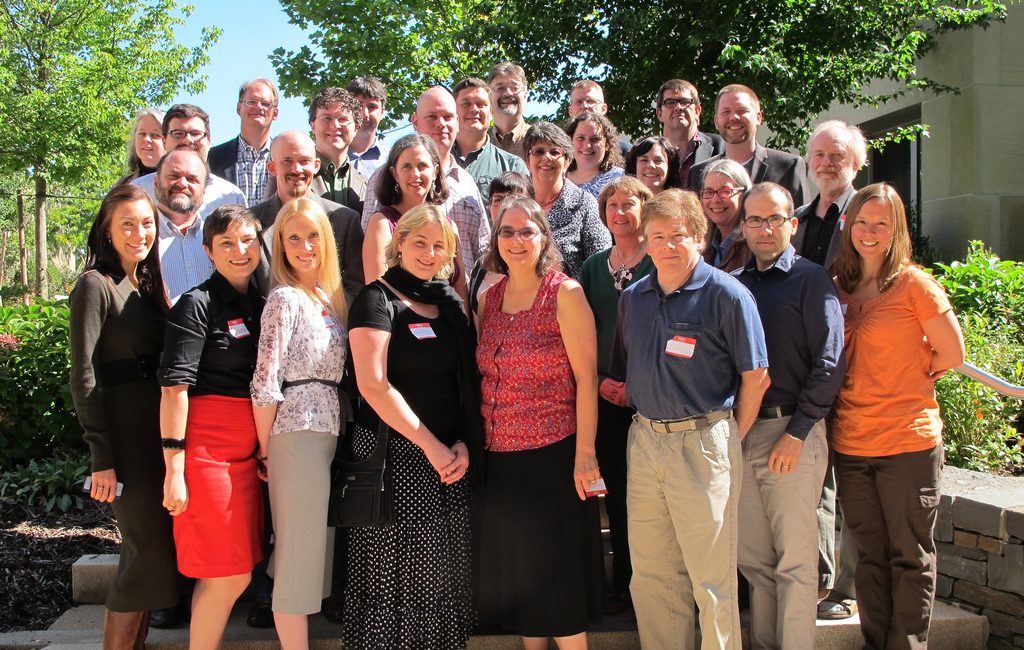
BHL Staff at the 2012 BHL Staff & Technical Meeting, Cambridge, MA, 27-28 September

On September 27-28, 2012, thirty-one staff members representing all 14 BHL member institutions convened at the Ernst Mayr Library at the Museum of Comparative Zoology at Harvard University for the 2012 BHL Staff and Technical Meeting. As a combined meeting, it brought together not only those that manage the digitization workflow at each member institution, but also those that work to keep BHL’s technical infrastructure running smoothly and constantly improving.

To maximize the 16 hours available for discussions, the meeting was divided into separate Staff and Technical tracks, with only those sessions relevant to all staff combined. Combined sessions included Program and Technical updates, as well as a discussion of BHL Projects and Initiatives, which was a chance for staff to identify high-impact projects to incorporate into a 2-year workplan for BHL. Staff sessions included a Program Management Update; brainstorming requirements for a BHL-Awareness Program; a Collections Analysis, Scope, and Prioritization discussion; a Blog brainstorming session; and discussions about BHL’s mission statement and goals. The Technical sessions discussed providing article-level access in BHL; replicating and synchronizing BHL content globally; the NEH Art of Life project status; BHL’s boutique digitization workflow management tool Macaw; Full-text searching; and OCR improvements.

This was also the first opportunity for BHL’s newest members, Cornell and the United States Geological Survey (USGS), to participate in one of our staff meetings. As a BHL-staff meeting virgin, we asked Jenna Nolt, librarian at the USGS, to share with us her thoughts about the meeting.

View Full Size Image
Jenna Nolt with a specimen of an edible polypore, genus Laetiporus, commonly known as chicken of the woods.

As a new librarian and new member of BHL, I was privileged to represent the U.S. Geological Survey Libraries at the staff meeting in September.  Our libraries have been contributing to BHL since March, and this was an exciting opportunity to meet, learn from, and collaborate with the other members.

From the moment I walked through the door I was impressed by the positive energy and enthusiasm of the whole group. After a general session we broke out into the staff track and the technical track; I stayed on the technical track.  As the sole librarian at my library dedicated to digitization, this was a valuable opportunity for me to discuss in detail some of the complexities of the digital world.  One thing I realized very quickly during these discussions is that all of us, in our individual libraries as well as in BHL, are addressing the same challenges of how to best organize, preserve, and expose complex objects in a constantly shifting digital landscape.

I was particularly interested in the discussion about OCR (optical character recognition) and excited by the plan for BHL to implement full-text searching, something that would be a huge benefit to our scientists and researchers. To accomplish this BHL will be using Solr which not only allows full-text searching, but also allows for faceted navigation, hit highlighting, and corrective spelling (“did you mean…”) features that any researcher knows the value of.

I was most actively involved with the section on Macaw, a piece of software created by Joel Richard at the Smithsonian used to upload digital objects packaged with metadata to Internet Archive. Our library has been testing and using Macaw for the past few months, and it has given us the ability to create a completely in-house digitization process for public domain materials. It was a great chance to speak with Joel directly and discuss with the group the possibility of setting up a cloud-based instance with multi-institutional access, which would be a huge advantage for many BHL members.

One theme emerged strongly for me over the course of the meeting.  I’ve become increasingly aware working in the information field that there are no simple answers in the digital world, no clear standards, and sometimes no answers at all. As anyone who has tried to do serious research online knows, this can be extremely frustrating.  But what I realized is that the BHL is at the cutting edge of constructing standards and creating answers where there are none to find.  When those skills are combined with the enthusiasm, passion for knowledge, and a love of science I saw at the meeting – well, that’s where the really cool stuff happens.

Thank you all and…I can’t believe I am saying this, but…can’t wait for the next meeting!

We are thrilled to welcome Jenna and our other new staff members to the BHL project. Nothing solidifies the initiation process more than participation in a two-day intensive staff and technical meeting!

The meeting may be over, but now the real work begins! We are busy developing plans to address our meeting action items and continue discussions about revising BHL’s mission and goals in order to further inform a 2 year workplan for the project. The 2012 Staff and Technical Meeting was a hands-down success and a fabulous opportunity for BHL’s dedicated staff to further our vision to repatriate biodiversity knowledge to the world.

October 9, 2012by Grace Costantino
BHL News, Blog Reel

Two Cities Named Cambridge and One Library Named the Biodiversity Heritage Library

Portrait version of the Biodiversity Heritage Library logo.

Last week the BHL Librarian and Technical Staff met at Harvard University in Cambridge, Massachusetts, for one of our invaluable staff meetings (our last face to face meeting was about one year ago right after the BHL Chicago Life and Literature Conference.)  These meetings are always lively and packed full of agenda items that we generate during our monthly teleconference calls…and usually a memorable meal or some cultural event are also included! After each of these meetings we return to our home libraries laden down with an armful of tasks to complete within a specific timeframe (which we try to stick to!). Check back soon for a post about the Meeting.

View Full Size Image
Matthew Person

A month ago one of our librarians, Matthew Person of the MBLWHOI Library in Woods Hole, Massachusetts, was given the unique opportunity to speak about the BHL to Science Historians and digital media specialists who were meeting in the other Cambridge: that’s Cambridge University in England! Matt was attending the 9th Digital History and Philosophy of Science Workshop at Cambridge University as a member of the Arizona State University/Marine Biological Laboratory History and Philosophy of Science Program of MBL’s Center for Library and Informatics.

The opening day afternoon of the Cambridge UK conference was themed “If you build it will they come? Mobilizing online Communities for Research.” Matt was asked by Dr. Alison Pearn, who is Associate Director of the Darwin Correspondence Project, if he would give a presentation about BHL’s social media work, our use of crowd sourcing, and games development, all which assist our BHL development. The presentation Matt gave was titled “Building a large digital library and interacting with the World”, and this was just one of a number of interesting presentations made that day by staff of: The Genizah Project (Dr. Ben Outhwaite of Cambridge University), the oldWeather Project (Dr. Philip Brohan of the MetOffice UK), and the Chymistry of Issac Newton Project (Dr. Wally Hooper of Indiana University), to name just a few of about 20 projects and presenters who spoke during the 3 day workshop.

Matt consulted with BHL colleagues Gilbert Borrego, Grace Costantino, Suzanne Pilsk, and Martin Kalfatovic of the Smithsonian Institution Libraries, Diane Rielinger and Cathy Norton of the MBLWHOI Library, Trish Rose-Sandler and Chris Freeland of the Missouri Botanical Garden, and Connie Rinaldo of the Harvard Museum of Comparative Zoology, in preparation for his BHL talk, the first part of which was a concise account of the purpose, history, and function of the BHL. The second part of the talk detailed our working with the tools of social media websites such as facebook, twitter, and flickr, and our daily use of an issue resolution tool informed by our BHL library users called Gemini. Matt also spoke of our thoughts on the development of a mobile device type of game App, which could assist us with scanned text correction, for example.*

The Biodiversity Heritage Library goes beyond being a virtual biodiversity library serving scholars and citizen scientists. Our work on Flickr isolates some of the remarkable corpus of illustrations in the scanned BHL literature, and works with our partner the Encyclopedia of Life to hold flickr tagging events to have the “crowd sourced” community establish appropriate descriptive metadata for the illustrations so that they can be uploaded to EOL species pages. Our work in social media is dynamic, ongoing and developing, and the talk Matt gave at the Digital History and Philosophy of Science Workshop in Cambridge, UK, was well received by scholars and technicians who both use the BHL and have wondered a bit about what’s behind those 39 million+ scanned pages!

The image of a science historian or any scholar working solely in print materials these days is being replaced by dynamic projects that combine digital versions of scanned historic text with the most advanced computational and visualization tools of the day. Many of these tools have been developed by the BHL partner libraries, and many are also being developed by the History and Philosophy of Science community. This work expands dramatically the scope and depth of the study of the history of science.

We asked Matt, who lives near Cambridge, Massachusetts, to comment on these two cities which figured in BHL life this September…named Cambridge…the one in Massachusetts and the other in England. He told us, “Both cities named Cambridge are relatively small in size, but huge in scholarly content; both cities have bucolic riverside settings, and also are on the forefront of knowledge creation, and have been so for centuries.” So it’s quite appropriate that in September 2012 both historic cities named Cambridge figured in the life of the historic and ground breaking Biodiversity Heritage Library!

* BHL is not, at this time, performing any development with gaming Apps, though we are exploring the possibility of doing so one day.

October 3, 2012by ulib-libraryjobs

Help Support BHL

BHL's existence depends on the financial support of its patrons. Help us keep this free resource alive!

search

About BHL

The Biodiversity Heritage Library (BHL) is the world’s largest open access digital library for biodiversity literature and archives. BHL operates as a worldwide consortium of natural history, botanical, research, and national libraries working together to digitize the natural history literature held in their collections and make it freely available for open access as part of a global “biodiversity community.”

Join Our Mailing List

Sign up to receive the latest news, content highlights, and promotions.

Subscribe Now

Subscribe to Blog via Email

Enter your email address to subscribe to this blog and receive notifications of new posts by email.

Join 319 other subscribers

Subscribe to Blog Via RSS

Subscribe to the blog RSS feed to stay up-to-date on all the latest BHL posts.

Access RSS Feed

Inspiring Discovery through Free Access to Biodiversity Knowledge.

The Biodiversity Heritage Library makes it easier than ever for you to access the information you need to study and explore life on Earth…for free, anytime, anywhere.


64+ Million Pages of
Biodiversity Literature Online.

EXPLORE

Tools and Services
to Transform Research.

EXPLORE

300,000+
Illustrations on Flickr.

EXPLORE

ABOUT | HARMFUL CONTENT | PRIVACY | SITE MAP | TERMS OF USE