

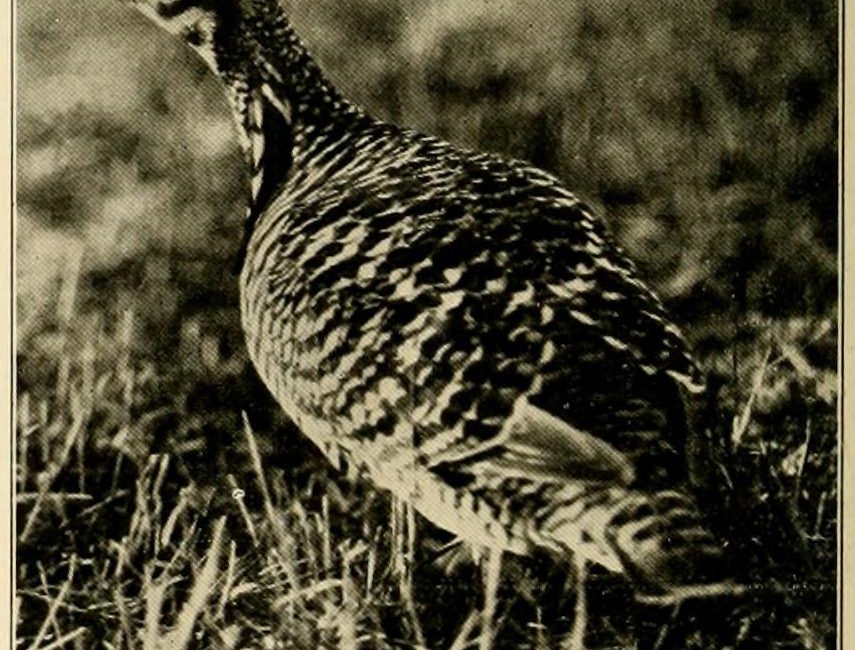
“On Martha’s Vineyard Island just across the Sound from the Marine Biological Laboratory is the home of the lone survivor of the Heath Hen. The death of this individual will also mean the death of its race, and then another bird will have taken its place among the endless array of extinct forms. The numbers of Heath Hen have been closely followed by ornithologists and since 1908 a detailed census has been taken of the birds each year. For the first time in the history of ornithology a species has been studied and photographed in its normal environment down to the very last individual.”
-Professor Alfred O. Gross, Bowdoin College, as written in The Collecting Net: Volume 5, Number 3, 12 July 1930.
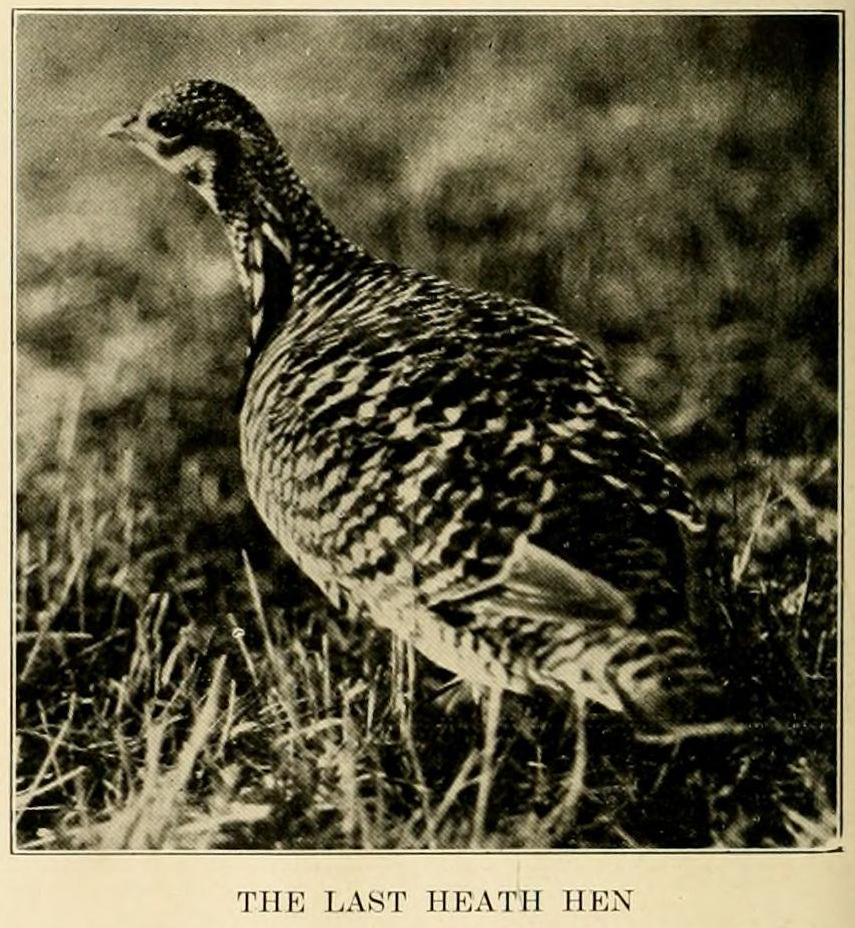
“The Last Heath Hen.” Gross, Alfred O. The Collecting Net. v.5, no.33 (1930). Contributed in BHL from MBLWHOI Library. In copyright. Digitized with the permission of the rights holder. CC BY-NC-SA.
We came across a unique article, “The Last Heath Hen,” in the Biodiversity Heritage Library recently. The article from The Collecting Net newspaper is a beautifully-crafted account from 1930 of the then-last stand and near extinction of the last animal of the ground-feeding Heath Hen species (Tympanuchus cupido cupido), a member of the grouse family and subspecies of the Prairie Chicken. This species once ranged from Maine to the Carolinas in American colonial times and before but was all but extinct on the US mainland by 1870, except for it holding its own in the scrub brush, open fields, and low pine forests of Martha’s Vineyard, Massachusetts.
Historical Spotlight: Martha’s Vineyard
Martha’s Vineyard is an island about twice as long and a bit wider than the island of Manhattan, four miles across the Vineyard Sound body of water from the village of Woods Hole in the town of Falmouth on the Cape Cod peninsula.. The Aquinnah Wampanoag Tribe had lived on the Island of Martha’s Vineyard for close to 10,000 years when the island was “discovered” by English explorer Bartholomew Gosnold and named after his deceased daughter Martha in 1602. Woods Hole (also a land of the Wampanoag Nation), “discovered” by Gosnold in 1602, is a village which in the 19th Century was a whaling port and maritime industrial center, and in the 20th Century became home to six world renowned scientific research institutions, the second oldest of which in 1888 was founded as the Marine Biological Laboratory (MBL), which published The Collecting Net.
The Collecting Net article, “The Last Heath Hen,” was written by the ornithologist Dr. Alfred Otto Gross, an MBL summer research scientist and Professor of Zoology at Bowdoin College in Maine. This story is a simple account of the prelude to the end of this species, as extinction officially occurred two years later in 1932. The Commonwealth of Massachusetts and a coalition of conservation organizations made real efforts to save the heath hen—efforts which ultimately failed, as sadly in the end disease, predators, and a forest fire in its breeding ground sealed the fate of this species. Dr. Gross writes that it was decided by conservation organizations, with respect to the last individual of this species, to allow it to live its last years in peace without interference from the government or hunters. Thus, this sensitive account by Dr. Gross, based upon his own research.
According to this undated appreciation of Dr. Gross in the Bowdoin College Daily Sun:
“Although he enjoyed teaching, Gross was a devoted researcher who contributed prolifically to the study of ornithology; he was the author of 265 scientific articles and books and was recognized as a Fellow of the American Ornithologists’ Union in 1930.”
The science history of the oldest private biological laboratory in the United States, the Marine Biological Laboratory (MBL), is well documented through thousands of publications, as well as in The Collecting Net. The venerable in-house journal of the Marine Biological Laboratory, the Biological Bulletin, has been continuously published, first by MBL and now by the University of Chicago Press, since 1890. The Archives of the MBL holds the papers of scientists, photographs, films, and the administrative records of 133 years of transformative biological science, not to mention over 15,000 rare books going back to the 1500’s, many of which are freely accessible through the BHL. While the science is well documented, getting to know the social history of this year-round (once only during the summer) seaside science mecca is assisted by examining The Collecting Net weekly newspaper, a scrappy summertime tabloid which was published by the social MBL Club from 1926-1953.
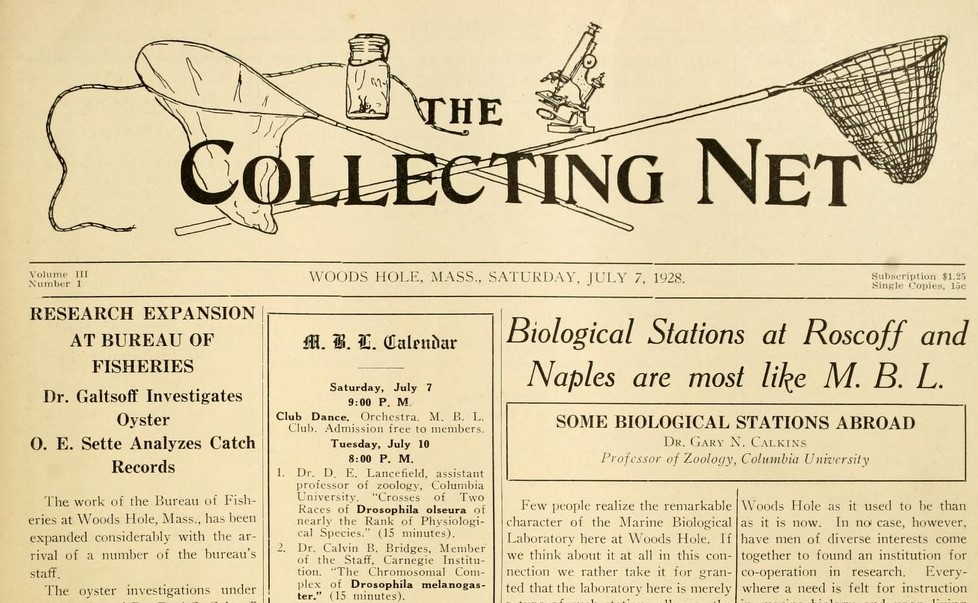
Front page, The Collecting Net, v.3, no.1 (1928). Contributed in BHL from MBLWHOI Library. In copyright. Digitized with the permission of the rights holder. CC BY-NC-SA.
The Collecting Net joined the science and the social going on during busy MBL summers, used advertising revenues for a scholarship fund for MBL students, and was edited by a team initially led by Ware Cattell, who later became editor of the journal Science. When the newspaper hit its weekly publishing deadline, it was loaded on a boat and motored across Buzzards Bay to New Bedford where it was typeset, printed, and returned to Woods Hole. While the more recent issues (1950’s) present official-looking administrative accounts of lectures and research, the first years of The Collecting Net offered an exciting and often humorous glimpse into the arts and sciences and lives of the people who spent their summers working at the Marine Biological Laboratory—from ferry and train schedules to Boston, New York, Martha’s Vineyard and Nantucket; to a comprehensive directory of all the employees and scientists at MBL every summer; to summer choral and drama auditions and performances; and many, many advertisements (see below an assortment of these).
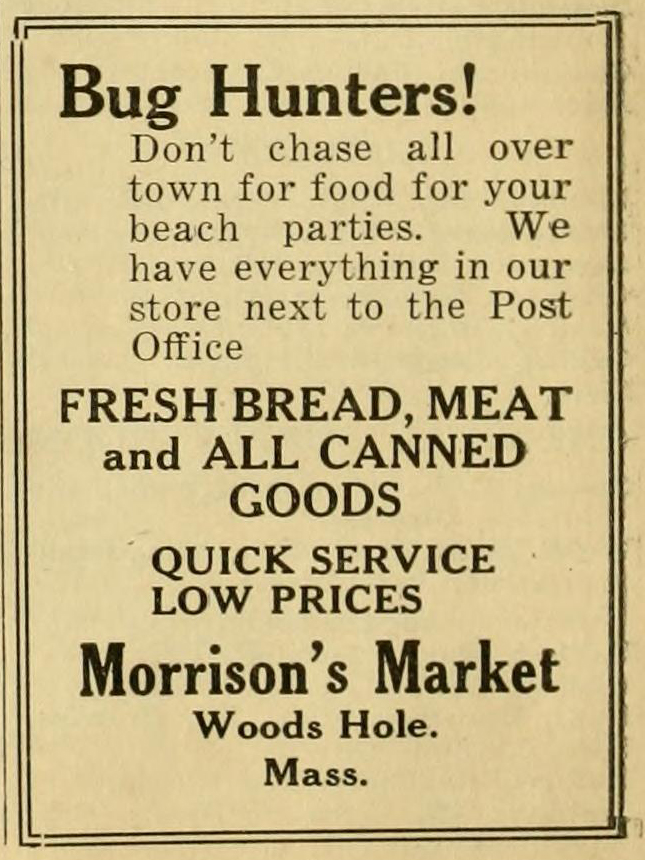
Scientists in Woods Hole are still known as “bug hunters”! Advertisement from Morrison’s Market in The Collecting Net, v.1 (1926). Contributed in BHL from MBLWHOI Library. In copyright. Digitized with the permission of the rights holder. CC BY-NC-SA.
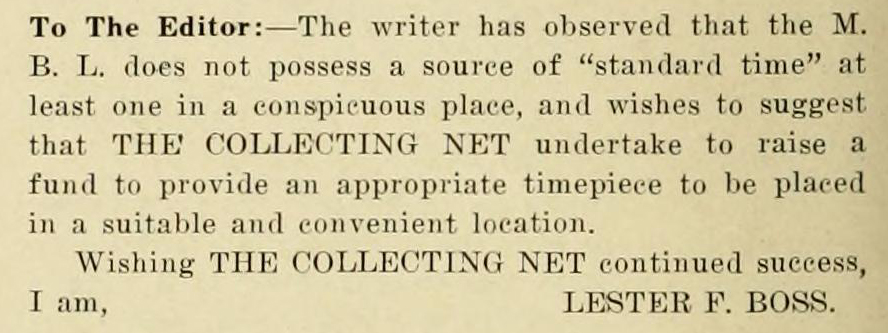
A vital “Letter to the Editor”. The Collecting Net, v.5, no.33 (1930). Contributed in BHL from MBLWHOI Library. In copyright. Digitized with the permission of the rights holder. CC BY-NC-SA.
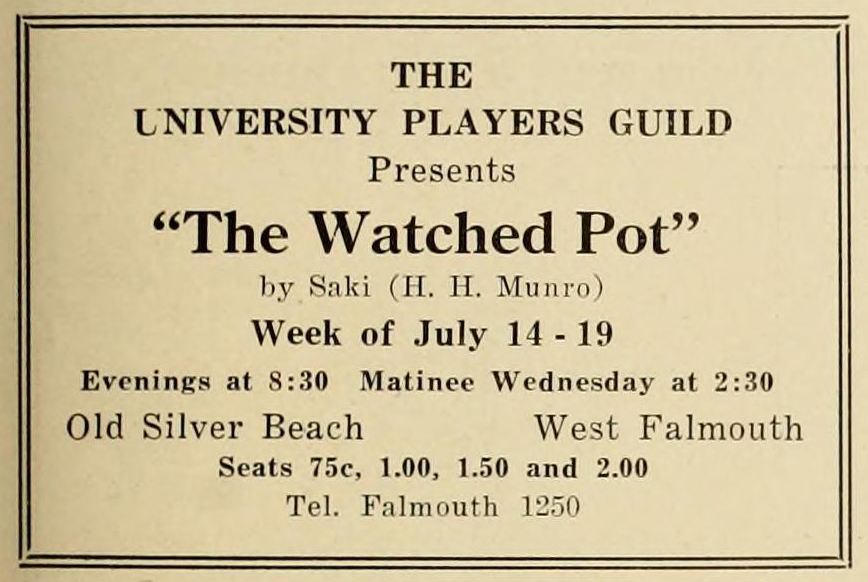
The most well known University Players were Henry Fonda and James Stewart. The University Platers Guild advertisement. The Collecting Net, v.5, no.33 (1930). Contributed in BHL from MBLWHOI Library. In copyright. Digitized with the permission of the rights holder. CC BY-NC-SA.
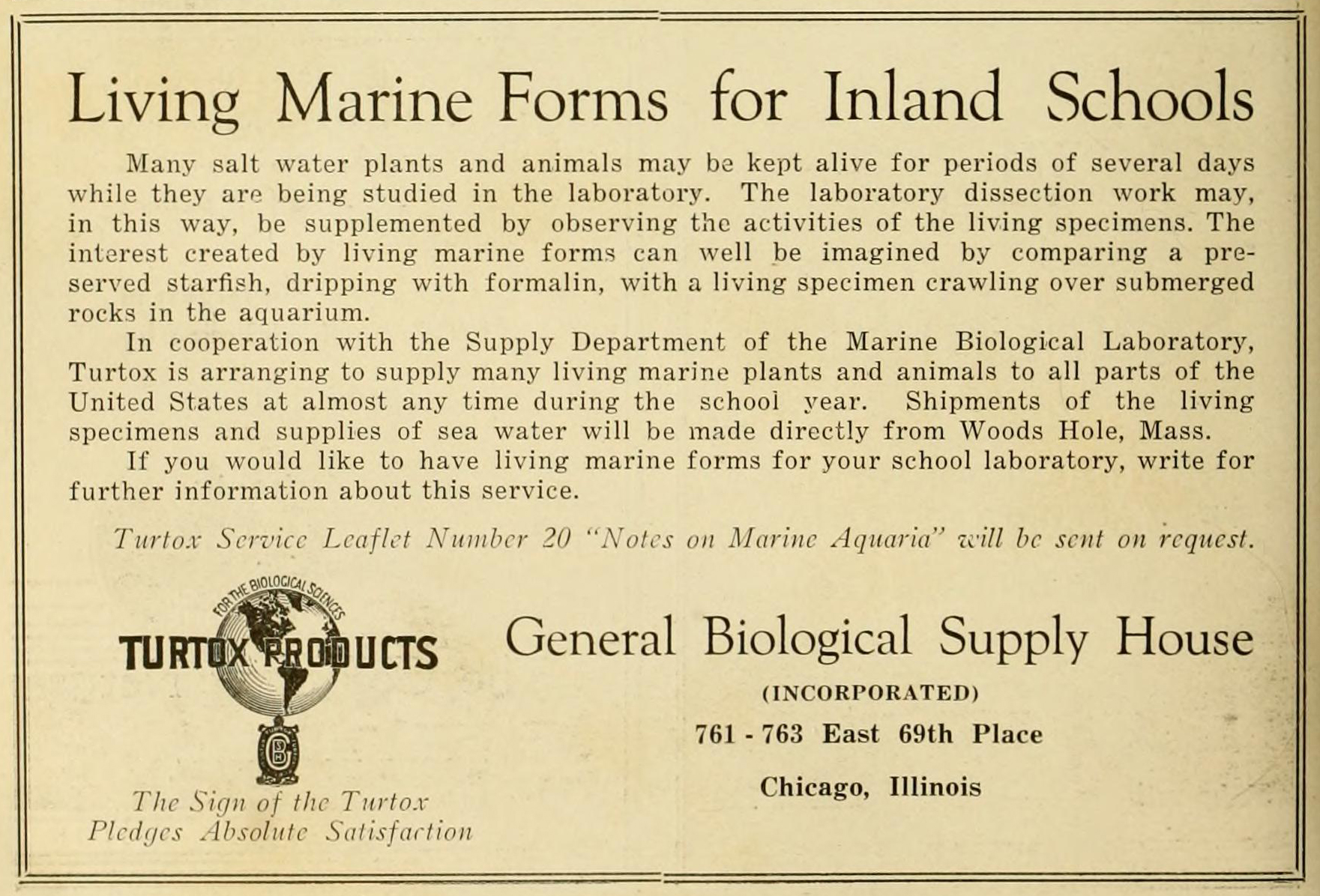
Live marine specimens were locally collected and packed for the Woods Hole departing train for all points, USA. General Biological Supply House advertisement. The Collecting Net, v.5, no.33 (1930). Contributed in BHL from MBLWHOI Library. In copyright. Digitized with the permission of the rights holder. CC BY-NC-SA.
The Collecting Net masthead was “an independent publication devoted to the activities of biologists at the laboratories in Woods Hole.” One thing which The Collecting Net offered relative to the science taking place in Woods Hole during the summers was something which has always been quite important in science literature, and that is the opportunity to rapidly publish findings and new ideas. This, The Collecting Net provided, as in Dr. Ernest E. Just’s “Methods for experimental embryology…,” below, which was published so it could be used by students at MBL the next day! Dr. Alfred O. Gross’ account of the final days of the heath hen was published so the readers of the work could respond to it immediately.
One thing missing though, relative to all the current science of those times, was that The Collecting Net, when published, was not indexed for later discovery. For this reason, almost a century after the first issue was published in 1926, through the Biodiversity Heritage Library it is possible to search the full text content of the articles published within, thereby giving that science new exposure, freely accessible in Woods Hole or anywhere in the world.
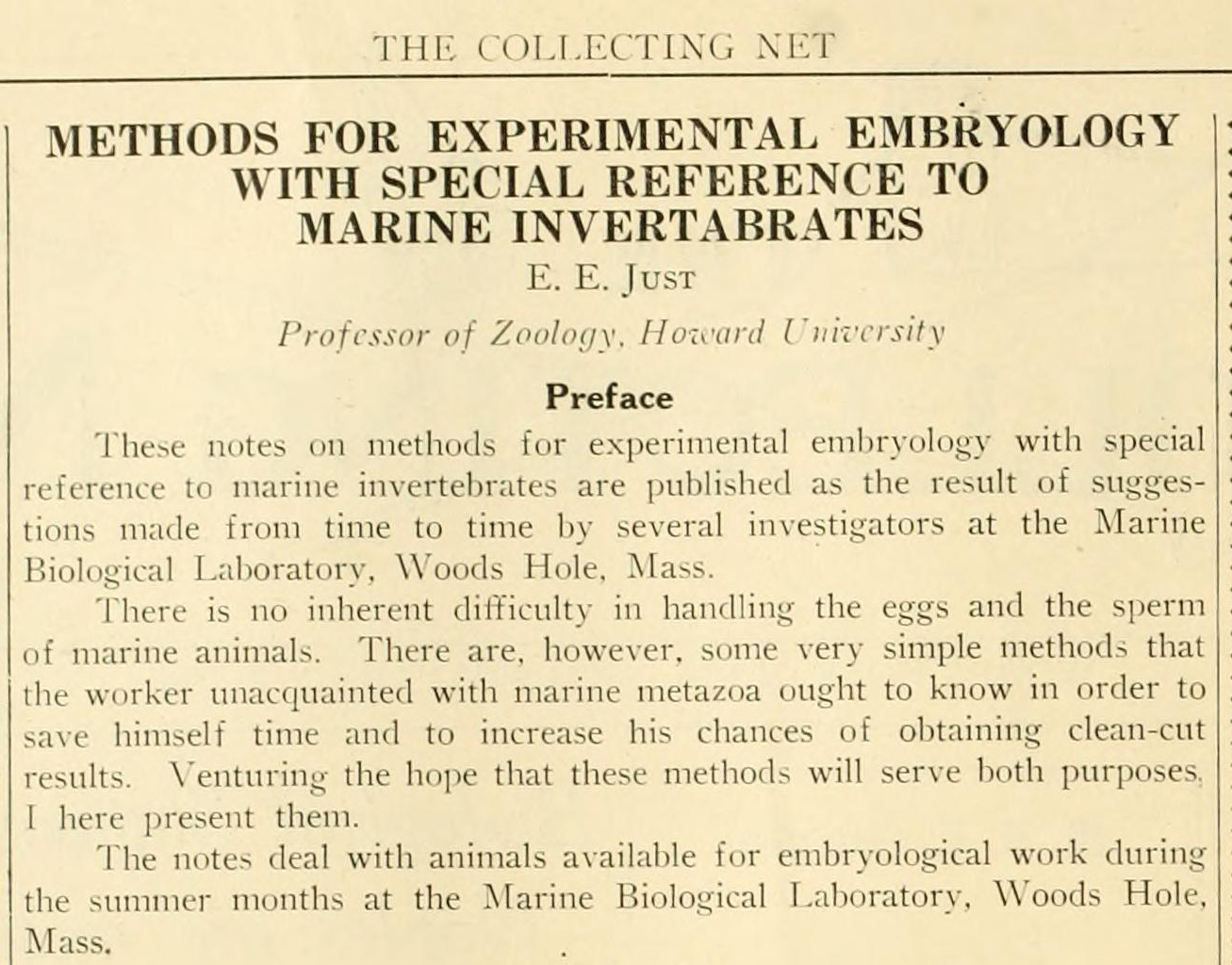
Ernest E. Just, an MBL scientist, was known for his experimentation technique. He was the first African American scientist in the United States to receive a PhD in Zoology, from the University of Chicago. “Methods for Experimental Embryology with Special Reference to Marine Invertebrates.” The Collecting Net, v.3 (1928). Contributed in BHL from MBLWHOI Library. In copyright. Digitized with the permission of the rights holder. CC BY-NC-SA.
