

Biodiversity Heritage Library - Program news and collection highlights from BHL
  • Home
  • News
  • Featured Books
    • All Featured Books
    • Book of the Month Series
    • BHL at 20
  • User Stories
  • Campaigns
    • Fossil Stories
    • Garden Stories
    • Monsters Are Real
    • Page Frights
    • Her Natural History
    • Earth Optimism 2020
  • Tech Blog
  • Visit BHL
Home
News
Featured Books
    All Featured Books
    Book of the Month Series
    BHL at 20
User Stories
Campaigns
    Fossil Stories
    Garden Stories
    Monsters Are Real
    Page Frights
    Her Natural History
    Earth Optimism 2020
Tech Blog
Visit BHL
  • Home
  • News
  • Featured Books
    • All Featured Books
    • Book of the Month Series
    • BHL at 20
  • User Stories
  • Campaigns
    • Fossil Stories
    • Garden Stories
    • Monsters Are Real
    • Page Frights
    • Her Natural History
    • Earth Optimism 2020
  • Tech Blog
  • Visit BHL
Biodiversity Heritage Library - Program news and collection highlights from BHL
Blog Reel

BHL Welcomes the Arboretum Library at the LA County Arboretum and Botanic Garden

Portrait version of the Biodiversity Heritage Library logo.
View Full Size Image

This quarter, the Biodiversity Heritage Library was pleased to welcome The Arboretum Library at the Los Angeles County Arboretum and Botanic Garden as its newest Affiliate. The BHL consortium, which has grown substantially over the past year, now consists of 17 Members and 16 Affiliates.

The Arboretum Library holds an extensive collection of books, magazines, government documents, pamphlets, and audio-visual materials covering a wide range of topics, including gardening and garden design, plant lore, medical botany, botanical art, ethnobotany, California native plant life, and Mediterranean-climate botany.

Twenty-four magazine titles published by the Los Angeles County Arboretum and Botanic Garden are already available through BHL as a result of The Arboretum Library Good Family Foundation Digitization Project, a collaboration between the Arboretum, BHL, and the Missouri Botanical Garden. The publications, dating back to the 1950s, include information about the institution’s history, Los Angeles area horticulture, and research conducted by Arboretum staff. The articles have been indexed for author, title, date, and subjects (including people and plant names), all of which are searchable.

The articles in the Arboretum publications have both a scientific and popular appeal. For example, among the many interesting topics covered is the history of coffee, which Leonid Enari explores in the June 1976 issue of Lasca Leaves.

According to the article, coffee was used as food at least by 800 AD, but the “habit of coffee drinking seems to have started in Arabia in the 15th century” (Enari 1976). The first beverages created from the berries of the coffee plant were likely alcoholic, made from the pulp of the berries. It is unknown when the practice of roasting the seeds (beans) and using them to prepare today’s familiar coffee beverage was discovered, but its consumption in Europe was popularized through coffeehouses that were often regarded, particularly in England, by the church and state as “centers of political agitation.”
View Full Size Image
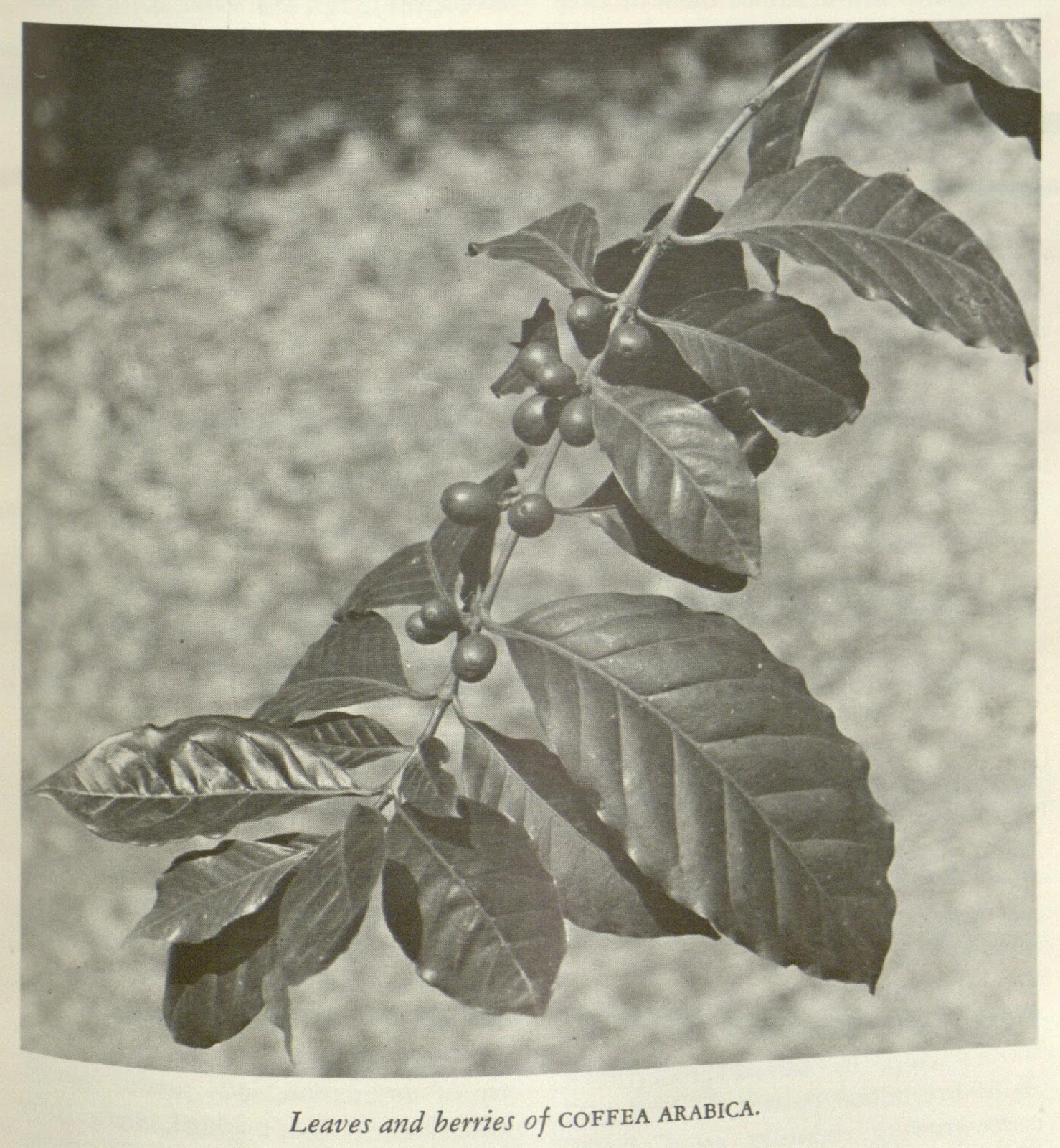
Leaves and berries of Coffea arabica. Enari, Leonid. “Coffee.” Lasca Leaves. v. 26 (1976). http://www.biodiversitylibrary.org/page/41846781. Digitized by the Missouri Botanical Garden. CC-BY-NC-SA.

The Arabian coffee tree (Coffea arabica) is used for the majority of the world’s commercial coffee production. The all-important coffee beans are the seeds of the coffee plant (found inside the plant’s fruit) which have been dried and roasted. After being roasted and ground, coffee will lose most of its aroma and flavor within 10 days. You can learn more about the history of coffee and its commercial production in the Lasca Leaves article.

The existing and future contributions from the Arboretum Library will provide valuable access to information about the history of botany and horticulture, botany in Southern California, and the Arboretum’s impact on these research areas. We look forward to working with our newest Affiliate to enhance BHL’s collections and expand our service to the global botanical, horticultural, and wider research communities.
January 11, 2017by michelle.underhill
Blog Reel, Featured Books

Book of the Week: The Berry That Changed The World

Portrait version of the Biodiversity Heritage Library logo.

It’s been called the drink of civilization. The beverage that reflects the entire history of the Western world in one gulp. A small berry has sparked revolutions, genocide, imperialism, innovation–and yet is still able to satisfy the standard caffeine craving every morning. Coffee is a powerful concoction, serving as inspiration for most activities before lunch, and, this week, it also serves as inspiration for the

View Full Size Image
The cover of these week’s
Book of the Week

Book of the Week, “Coffee; its history and also its remarkable growth in the world of commerce.”

Most people would easily be able to pick a coffee bean out of a line up, but finding the coffee in nature might be more difficult. The plant that provides us with this intoxicating drink can be traced to the genus of Coffea, which varies from tree to shrub and comes in shades of purple, yellow, and green. Coffea arabica and Coffea canephora or robusta are the two most drinkable species that allow for the berries to be dried, roasted, and poured into your mug for consumption.

The origin story of this stimulant is murky. Coffee plants grow wild in the rocky soil of Ethiopia and several legends have cropped up about who first discovered they could roast the seeds of this abundant shrub.

View Full Size Image
Coffea arabica

One legend says that when the pious dervish Hadji Omar fell under the ban of the people of Mocha, and was driven forth in the year 1285, A.D., to perish in the wilderness, he roasted some of the berries that grew wild in the thickets, and some of them accidentally fell into the water which he had collected for drinking. He failed to notice it for some time, and when he did, lo ! coffee was discovered. He stole back into Mocha, proclaimed his discovery, and the Mochans […] took him back into favor, and made a saint of him on the spot.

The Mochans knew a good thing when they drank it, but were not the only ones who lay claim to this powerful breakthrough in berry consumption.

Another story gives credit to the friar of a monastery for the first use of coffee. The friar had great difficulty in keeping his monks awake during devotions, and on being told by a goatherd of the exciting effect, produced on his goats by eating coffee berries, he decided to try them on his charge. He did so with admirable results and thus was discovered the great stimulating effects of coffee, which prepared the way for its world-wide popularity.

To allow for this expansion in caffeine indulgence, greater cultivation was needed.

View Full Size Image
Illustration,
Thompson &
Taylor
Spice Co.

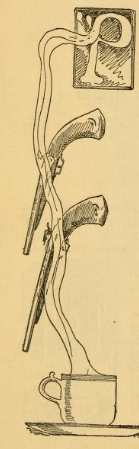
Harsh conditions on coffee plantations led to unrest, uprisings, and suppression, leading to the proliferation of the expression, “Pistols for two, and coffee for one.” Dutch East India Company and British East India Company, some of the first multinational corporations, were founded to monetize coffee and import the berries–which were mistakingly referred to as “beans” due to a certain likeness.
Part of the appeal to coffee has always been the caffeine. Caffeine is a naturally occurring stimulant acting as a psychoactive drug similar to cocaine. With such an intoxicating chemistry, it’s easy to understand why coffee parties and coffee-houses quickly became establishments–gathering places for those looking to partake in a cup as well as exchange gossip and ideas. Newspapers were created, businesses chartered, revolutions planned, even music composed by the likes of Bach and Beethoven in the cáfes of Europe.

View Full Size Image
An American
enjoying his
coffee.

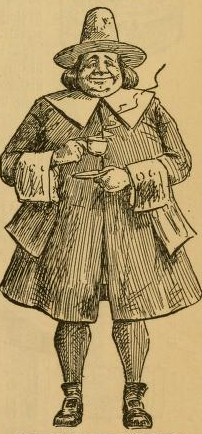
In America, coffee was slow to replace traditional alcoholic favorites. However, once the colonists declared some independence from the notoriously tea-loving empire, coffee became the beverage of choice. In one letter to his wife, Abigail, John Adams wrote his affection for tea was stronger, but he made the switch to coffee as it was the more patriotic option.

Despite this resistance, it was not long before coffee addiction had taken hold in the states. During the Civil War, the Union knew how to put a hurt on the South and a naval blockade prevented vital materials from making its way to port–coffee was one of these essential restricted items. Union soldiers took to chewing whole beans, while the Confederate troops were forced to find workable substitutes. An unsuccessful endeavor as Rebels on the front lines often called for informal truces so Southern tobacco could be swapped for the precious Northern drink.

Coffee is now engrained in Western culture, from cultivation on large plantations to a Starbucks on every corner. Coffee talk is shorthand for both small talk and a popular Saturday Night Live skit. Coffee is the reason for an extra break at work and the best part of waking up. So pour another cup and enjoy the bittersweet concoction almost a thousand years in the making, with or without cream.

References:

  • Norris, D.A. (2007, October 29). How a coffee played a role in Civil War. CNN. Retrieved from www.cnn.com/2007/LIVING/wayoflife/10/29/mf.coffee.confederacy/.
  • Zuraw, L. (2003, April 24). How Coffee Influenced The Course Of History. NPR. Retrieved from www.npr.org/blogs/thesalt/2013/04/24/178625554/how-coffee-influenced-the-course-of-history.


August 29, 2013by LANL_RL

Help Support BHL

BHL's existence depends on the financial support of its patrons. Help us keep this free resource alive!

search

About BHL

The Biodiversity Heritage Library (BHL) is the world’s largest open access digital library for biodiversity literature and archives. BHL operates as a worldwide consortium of natural history, botanical, research, and national libraries working together to digitize the natural history literature held in their collections and make it freely available for open access as part of a global “biodiversity community.”

Join Our Mailing List

Sign up to receive the latest news, content highlights, and promotions.

Subscribe Now

Subscribe to Blog via Email

Enter your email address to subscribe to this blog and receive notifications of new posts by email.

Join 319 other subscribers

Subscribe to Blog Via RSS

Subscribe to the blog RSS feed to stay up-to-date on all the latest BHL posts.

Access RSS Feed

Inspiring Discovery through Free Access to Biodiversity Knowledge.

The Biodiversity Heritage Library makes it easier than ever for you to access the information you need to study and explore life on Earth…for free, anytime, anywhere.


64+ Million Pages of
Biodiversity Literature Online.

EXPLORE

Tools and Services
to Transform Research.

EXPLORE

300,000+
Illustrations on Flickr.

EXPLORE

ABOUT | HARMFUL CONTENT | PRIVACY | SITE MAP | TERMS OF USE
