
Biodiversity Heritage Library - Program news and collection highlights from BHL
  • Home
  • News
  • Featured Books
    • All Featured Books
    • Book of the Month Series
    • BHL at 20
  • User Stories
  • Campaigns
    • Fossil Stories
    • Garden Stories
    • Monsters Are Real
    • Page Frights
    • Her Natural History
    • Earth Optimism 2020
  • Tech Blog
  • Visit BHL
Home
News
Featured Books
    All Featured Books
    Book of the Month Series
    BHL at 20
User Stories
Campaigns
    Fossil Stories
    Garden Stories
    Monsters Are Real
    Page Frights
    Her Natural History
    Earth Optimism 2020
Tech Blog
Visit BHL
  • Home
  • News
  • Featured Books
    • All Featured Books
    • Book of the Month Series
    • BHL at 20
  • User Stories
  • Campaigns
    • Fossil Stories
    • Garden Stories
    • Monsters Are Real
    • Page Frights
    • Her Natural History
    • Earth Optimism 2020
  • Tech Blog
  • Visit BHL
Biodiversity Heritage Library - Program news and collection highlights from BHL
Blog Reel, Campaigns, Featured Books

Color Our Collections: The Art of Intaglio Printing

View Full Size Image

This year for Color Our Collections, we’ve produced a coloring book with illustrations from books that represent the evolution of the art of printing. This week on our blog, we’ll explore the books featured in the coloring book and the printing techniques used for the illustrations.

You can download our 2017 Color Our Collections coloring book here.

Learn more about Color Our Collections here.

The Art of Intaglio Printing

In the Intaglio family of printmaking, an image is incised into a surface, usually a metal plate. Intaglio includes such familiar processes as etching and engraving. In engraving, the image is physically carved into a plate using special tools like burins. In etching, an image is drawn onto the surface of a plate that is covered in wax. The stylus, used to draw the lines in the wax, exposes the metal of the image lines. The plate is then dipped in an acid bath. The acid etches the exposed image lines but does not affect the portions of the plate covered in wax.

Intaglio techniques were used for book illustration by the latter half of the 15th century and became the standard for illustrating books by the late 16th century. Intaglio was used predominantly until around the mid-19th century, when lithography started gaining ground.

This video from the Museum of Art, Rhode Island School of Design demonstrates the copper plate engraving process:

Catesby’s Copper Plate Etchings

In the early eighteenth century, English naturalist Mark Catesby set foot in a New World. After spending the better part of ten years, spread across two separate trips, exploring and documenting North America’s rich biodiversity, he would eventually publish his research and original artworks as the first fully illustrated book on the flora and fauna of North America.
View Full Size Image
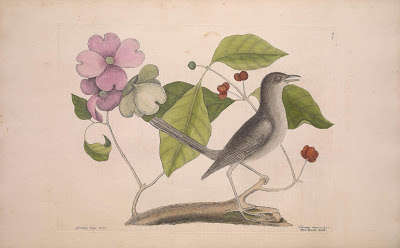
Eastern flowering dogwood (Cornus florida) and northern mockingbird (Mimus polyglottos). Catesby, Mark. The natural history of Carolina, Florida and the Bahama Islands. v. 1, ed. 1. pl. 27. Digitized by Smithsonian Libraries. http://biodiversitylibrary.org/page/40753198.

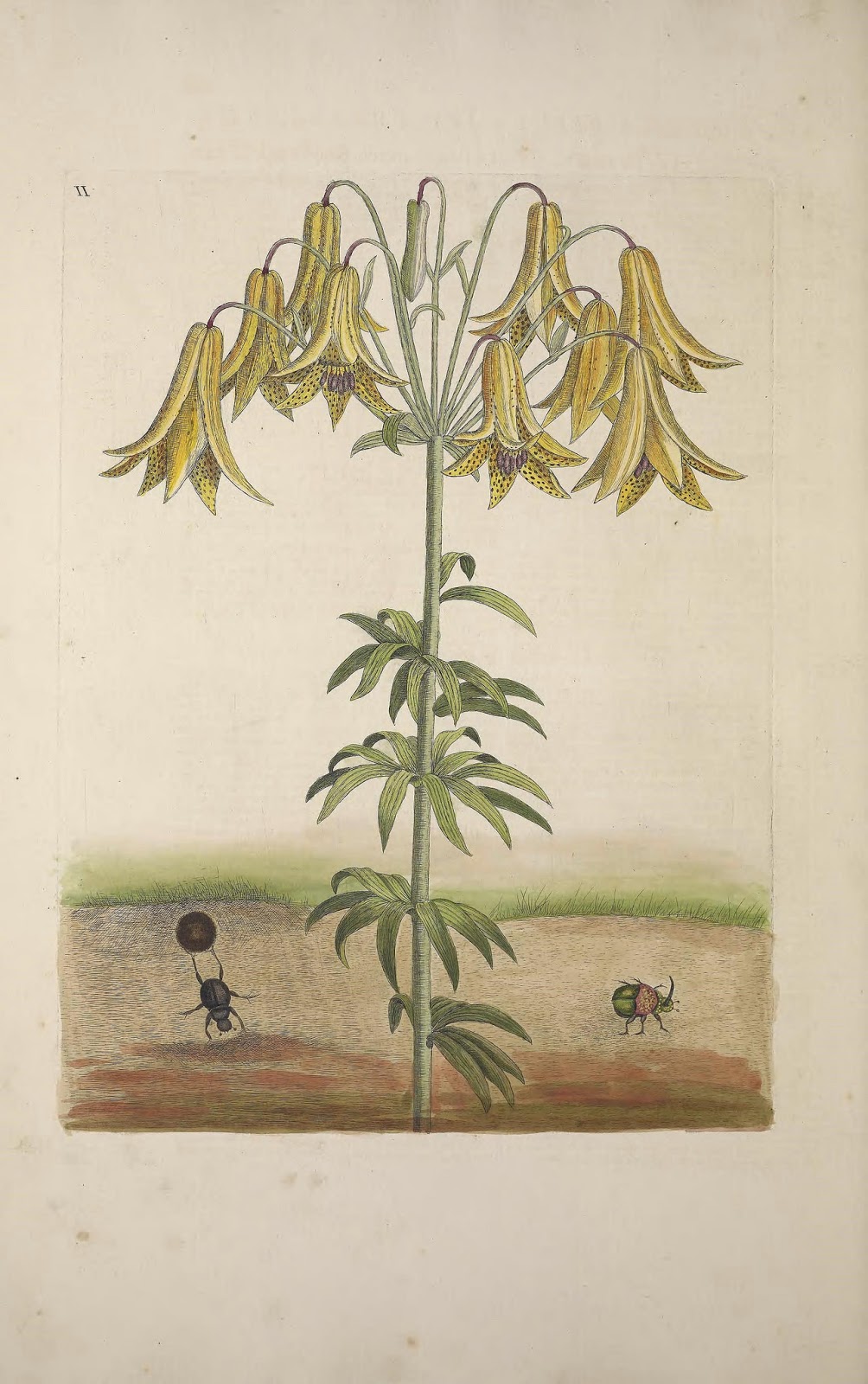
Published over eighteen years between 1729-1747, The Natural History of Carolina, Florida, and the Bahama Islands contains 220 plates based mostly upon Catesby’s own watercolors, which he worked up based on sketches he made in the field. The final publication was illustrated with copper plate etchings produced by Catesby himself. Catesby also hand-colored (maybe not all) the prints as well.
View Full Size Image
Canada lily (Lilium canadense), dung beetle (Canthon pilularis), and rainbow scarab beetle (Phanaeus vindex). Catesby, Mark.The Natural History of Carolina, Florida, and the Bahama Islands. v. 2, ed. 1. pl. 11. Digitized by Smithsonian Libraries. http://www.biodiversitylibrary.org/page/40680431.

Catesby’s work was also extremely influential to the work of Carl Linnaeus, whose binomial system for naming plants and animals is still in use today. Linnaeus cited Catesby extensively in his Species Plantarum (1753) and Systema Naturae (1758). For many of Linnaeus’ species names, Catesby is his only reference, and thus Catesby’s illustrations in Natural History serve as the type for many of Linnaeus’ species.
View Full Size Image
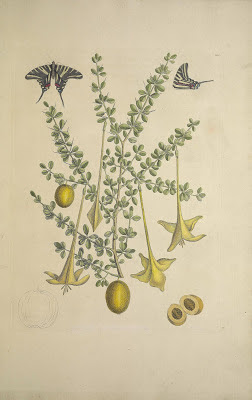
Lily thorn (Catesbaea spinosa). Pictured with zebra swallowtail (Protographium marcellus). Catesby is the only source that Linnaeus cited when naming Catesbaea spinosa in Species Plantarum (1753). This engraving serves as the type for this name. Catesby, Mark. The Natural History of Carolina, Florida, and the Bahama Islands. v. 2, ed. 1. pl. 100. Digitized by Smithsonian Libraries. http://biodiversitylibrary.org/page/40680398.

The first edition of Catesby’s Natural History in BHL, which was used to produce the coloring pages in this year’s coloring book, was digitized from the collections of Smithsonian Libraries. This copy is one of only a few known perfect copies of this first edition and the only one known to contain all three pieces of ephemera relating to the production of the work.

Note: This post was edited on 8 February 2017.

References

  • American Printing History Association. History of Printing Timeline. https://printinghistory.org/timeline/.
  • National Gallery of Art. Colorful Impressions. https://www.nga.gov/exhibitions/clrflimpr-tech.shtm.
  • Nelson, E C, and David J. Elliott. The Curious Mister Catesby: A “truly Ingenious” Naturalist Explores New Worlds. 2015. Print.
February 8, 2017by michelle.underhill
Blog Reel

Color Our Collections

Get your colored pencils ready!

View Full Size Image

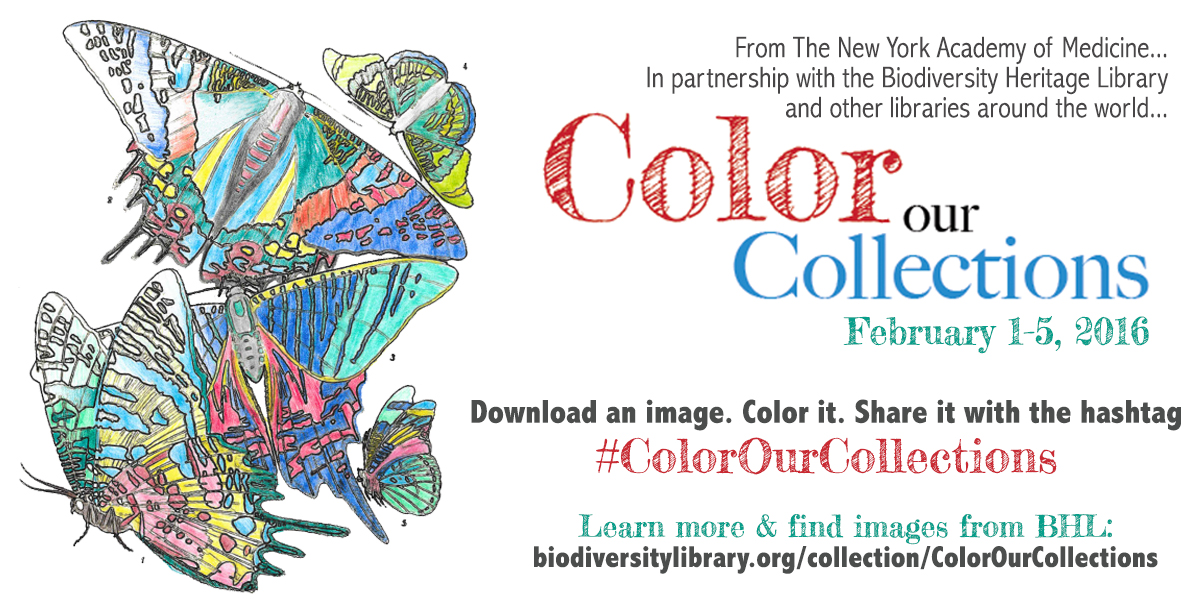
Join us for the Color Our Collections event this week, February 1-5, 2016. Led by The New York Academy of Medicine, the event invites you to download images from library and cultural institution collections, color them, and share them on social media using the event hashtag #ColorOurCollections. With millions of natural history illustrations produced over 500 years in our collection, BHL is thrilled to participate in the event.

 
How to Download Images from BHL for Color Our Collections
 
BHL Flickr

We’ve gathered over 1,000 black and white images from books in the BHL collection into a new Flickr collection. Browse the images, download your favorites, and color away! https://www.flickr.com/photos/biodivlibrary/sets/72157663149641612/

BHL Pinterest

While BHL is full of beautiful black and white images that are just waiting to be colored, there are also thousands of stunning color illustrations in our library that are great candidates for a coloring book. We’ve selected some of our favorites and turned them into coloring pages. They’re available for you to browse, download, and color in Pinterest: https://www.pinterest.com/biodivlibrary/bhl-coloring-pages/

To download one of the images in Pinterest, right click on the pin and choose “save image as” to save the image to your computer. You can then print and color at your leisure!

View Full Size Image

 
BHL Coloring Book

Want to download all of the coloring pages in the BHL Pinterest at once? We’ve prepared a handy PDF, which you can download for free here: 2016 BHL Coloring Book

Source Books in BHL
 

You can browse the books that the images in our Color Our Collections Flickr and Pinterest sets come from in our BHL Collection here: http://biodiversitylibrary.org/browse/collection/ColorOurCollections

Many other institutions will also be participating in the event and sharing images from their own collections for you to download and color. Check out this list to see who else is involved. Be sure to follow the hashtag #ColorOurCollections on social media to learn more, and don’t forget to share your masterpieces with that same hashtag (and tag @BioDivLibrary if it’s from a BHL image). We look forward to seeing your works of art!

February 1, 2016by michelle.underhill

Help Support BHL

BHL's existence depends on the financial support of its patrons. Help us keep this free resource alive!

search

About BHL

The Biodiversity Heritage Library (BHL) is the world’s largest open access digital library for biodiversity literature and archives. BHL operates as a worldwide consortium of natural history, botanical, research, and national libraries working together to digitize the natural history literature held in their collections and make it freely available for open access as part of a global “biodiversity community.”

Join Our Mailing List

Sign up to receive the latest news, content highlights, and promotions.

Subscribe Now

Subscribe to Blog via Email

Enter your email address to subscribe to this blog and receive notifications of new posts by email.

Join 319 other subscribers

Subscribe to Blog Via RSS

Subscribe to the blog RSS feed to stay up-to-date on all the latest BHL posts.

Access RSS Feed

Inspiring Discovery through Free Access to Biodiversity Knowledge.

The Biodiversity Heritage Library makes it easier than ever for you to access the information you need to study and explore life on Earth…for free, anytime, anywhere.


64+ Million Pages of
Biodiversity Literature Online.

EXPLORE

Tools and Services
to Transform Research.

EXPLORE

300,000+
Illustrations on Flickr.

EXPLORE

ABOUT | HARMFUL CONTENT | PRIVACY | SITE MAP | TERMS OF USE