

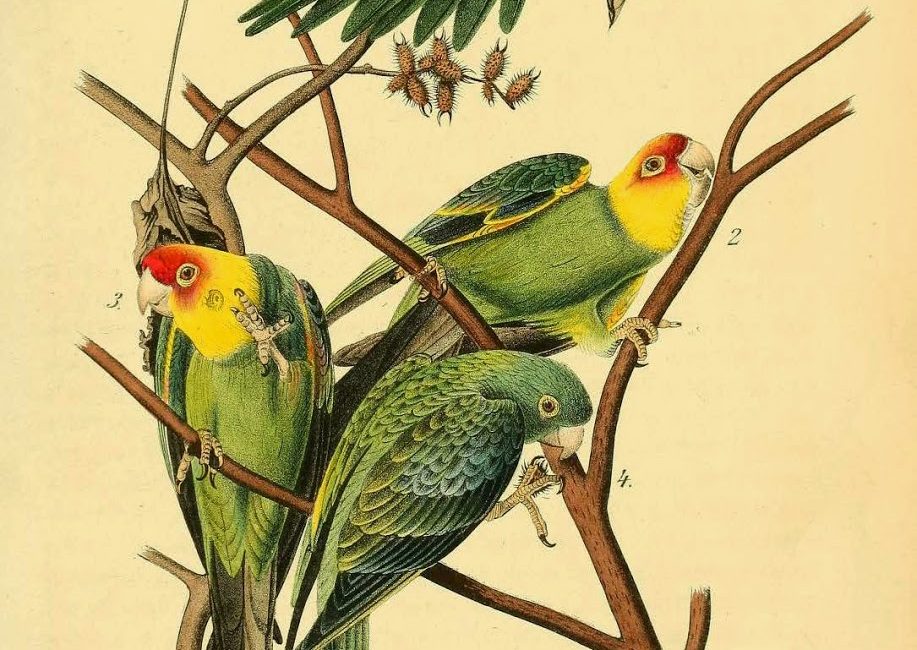
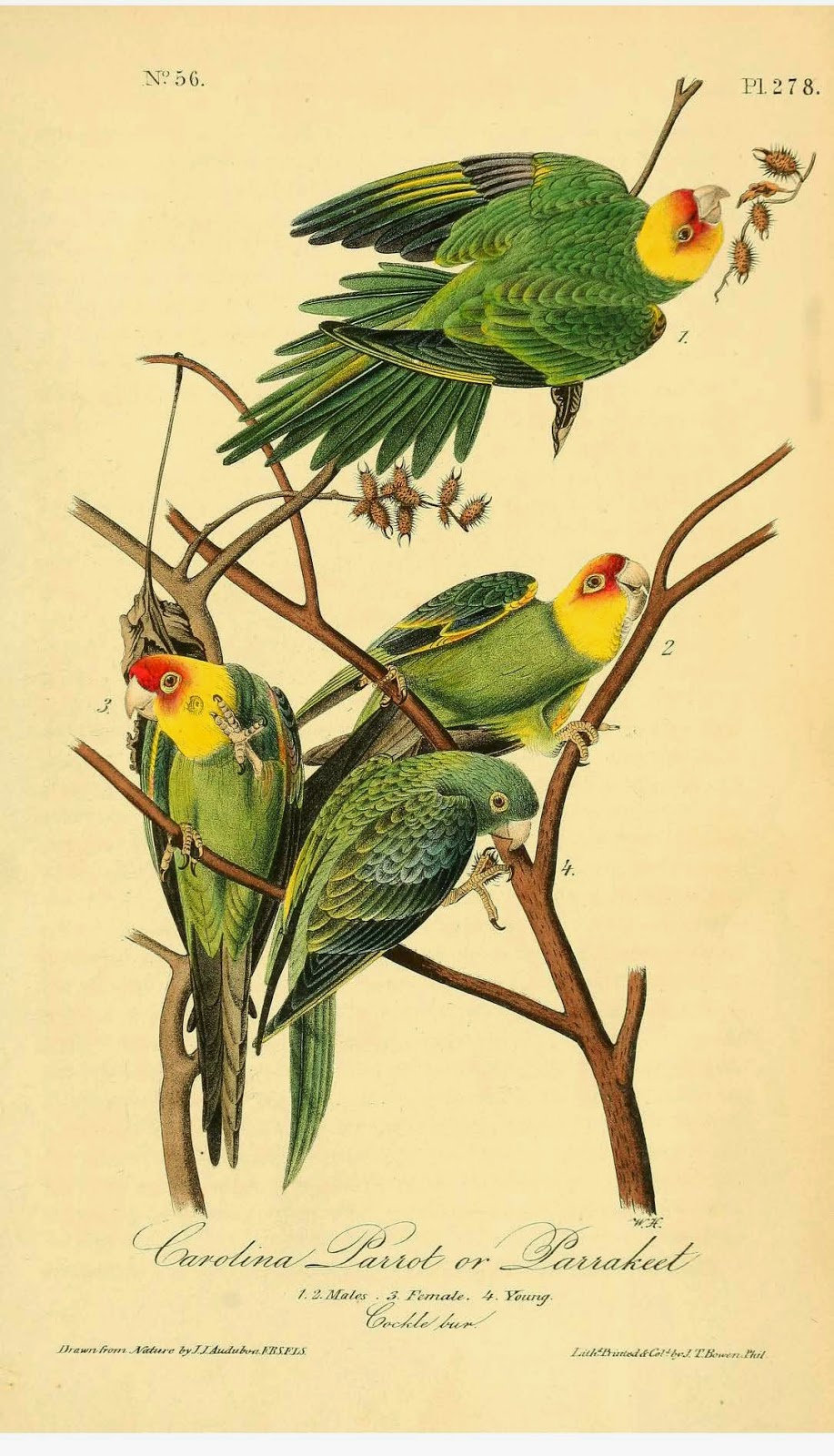
At this time of year, those of us in the U.S. often find our eyes turned skyward to admire a brilliant array of colors lighting up the night sky in celebration of America’s independence. Up until about a hundred years ago, a colorful display of another kind filled the North American skies, and not just on the fourth of July. Jewel-colored Carolina Parakeets (Conuropsis carolinensis) traveled in huge, noisy flocks from southern New York and Wisconsin to the Gulf of Mexico, favoring old forests along rivers. Although they looked tropical, Carolina Parakeets didn’t migrate south in the winter but weathered the cold.
 |
|
The Birds of America: From Drawings Made
in the United States and Their Territories John James Audubon
New York: J.B. Chevalier, 1840–44
http://biodiversitylibrary.org/item/125069#page/ |
As their forests were cut to make space for farms, the parrots were shot for feeding on crops and orchards. Trappers captured them to sell as pets, and hunters sold them as colorful decorations. Hat makers and clothiers prized the Carolina Parakeet’s brilliant plumage, using feathers or entire birds to decorate ladies’ hair, hats, and gowns. In 1886 alone, the hat trade claimed an estimated 5 million birds of various species—victims of fashion. By 1904, they were gone in the wild. The last Carolina Parakeet died in captivity in 1918.
While we can’t bring back the species and subspecies that have gone extinct, we can preserve and share our knowledge of them to help avoid future extinctions. The plight of the Carolina Parakeet is highlighted in Once There Were Billions: Vanished Birds of North America, a new exhibit at the National Museum of Natural History (NMNH). Co-curated by BHL, Smithsonian Libraries, and NMNH, the exhibit includes illustrations from BHL and specimens from NMNH. Research on extinct species—and extinction itself—depends on the taxonomic literature and natural history specimen collections to understand the morphology, distribution, and behaviors of lost species. Having access to this information can help scientists understand not only how different factors led to one species’ extinction but also how those same factors may impact other species.
The BHL currently provides access to over 44 million pages and over 91,000 images and is changing the face of research methodology. Scientists around the world are using BHL to identify and classify species, facilitate further scientific research, and support conservation efforts to prevent extinctions. The ongoing growth of BHL is supported in part by our dedicated patrons whose gifts support the digitization of additional literature, and technical development of the program, and improvement of data curation. To learn more about how your donation supports the continued growth of BHL, please visit http://archive.constantcontact.com/fs181/1103622715135/archive/1115465985290.html. We hope you’ll consider making a contribution today!
