Biodiversity Heritage Library - Program news and collection highlights from BHL
  • Home
  • News
  • Featured Books
    • All Featured Books
    • Book of the Month Series
    • BHL at 20
  • User Stories
  • Campaigns
    • Fossil Stories
    • Garden Stories
    • Monsters Are Real
    • Page Frights
    • Her Natural History
    • Earth Optimism 2020
  • Tech Blog
  • Visit BHL
Home
News
Featured Books
    All Featured Books
    Book of the Month Series
    BHL at 20
User Stories
Campaigns
    Fossil Stories
    Garden Stories
    Monsters Are Real
    Page Frights
    Her Natural History
    Earth Optimism 2020
Tech Blog
Visit BHL
  • Home
  • News
  • Featured Books
    • All Featured Books
    • Book of the Month Series
    • BHL at 20
  • User Stories
  • Campaigns
    • Fossil Stories
    • Garden Stories
    • Monsters Are Real
    • Page Frights
    • Her Natural History
    • Earth Optimism 2020
  • Tech Blog
  • Visit BHL
Biodiversity Heritage Library - Program news and collection highlights from BHL
Blog Reel, Featured Books

Darwin’s Early Love

Charles Darwin, the famous naturalist known around the world for his publication On the Origin of Species and contributions to evolutionary theory, was born on February 12, 1809. As such, February 12 is known as International Darwin Day – a celebration with a vision to:

“Inspire people throughout the globe to reflect and act on the principles of intellectual bravery, perpetual curiosity, scientific thinking, and hunger for truth as embodied in Charles Darwin. It will be a day of celebration, activism, and international cooperation for the advancement of science, education, and human well-being.”

February 12 also happens to be just days before Valentine’s Day, a holiday now associated with love and the presentation of valentines as expressions of affection. How might these two, seemingly disparate holidays, be brought together? Why not by thinking about who Darwin himself might give a valentine to in the natural world?

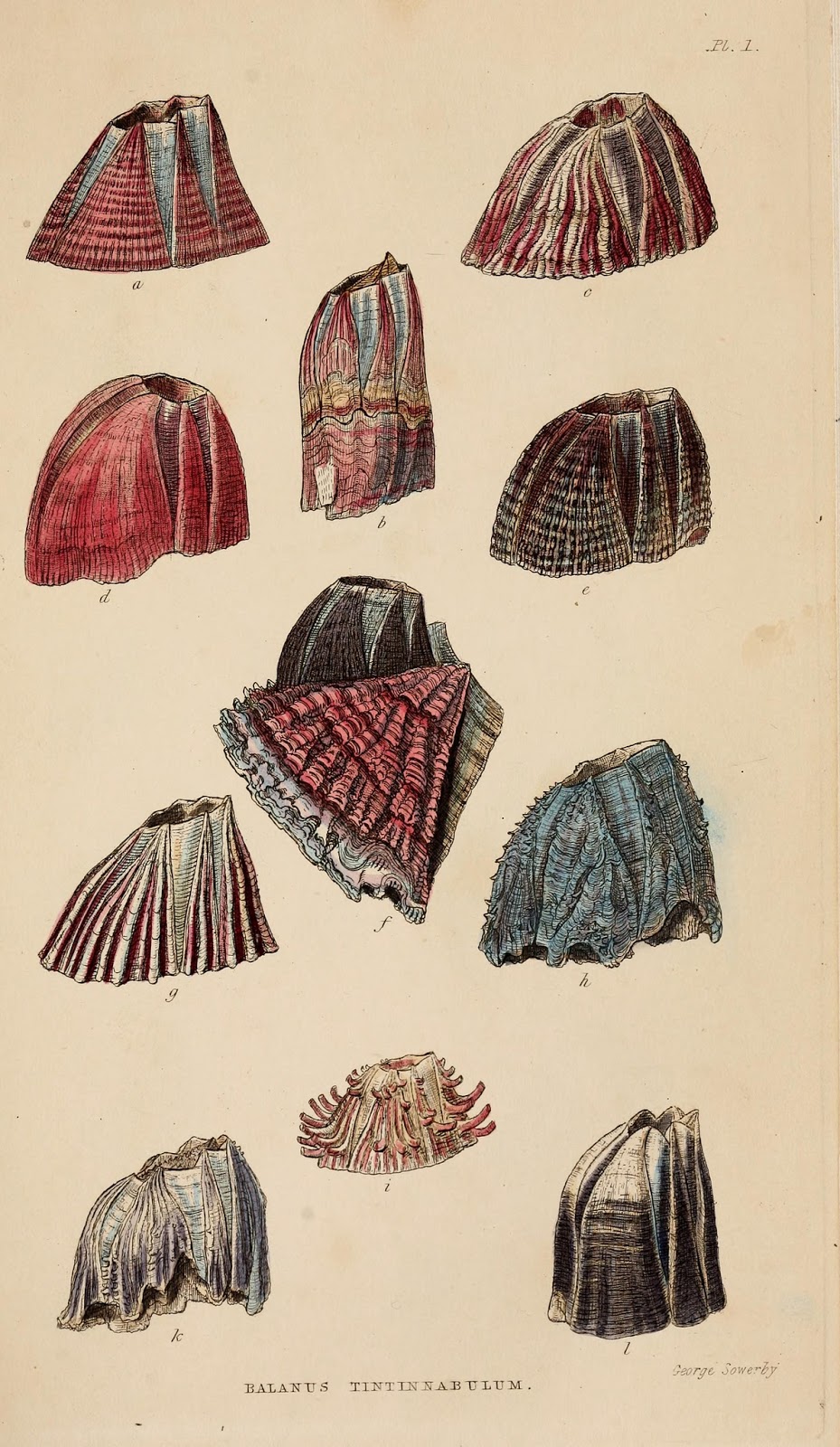
Many people, when thinking of Darwin, might associate him with finches, mockingbirds, rheas, or Galápagos tortoises. But when Darwin began to investigate natural history while studying medicine in Edinburgh in the 1820s, it was marine invertebrates that first sparked his interest. While still a teenager, Darwin became a member of the Plinian Society, which was dedicated to the study of natural history amongst Edinburgh students. The zoologist Robert Edmond Grant nurtured Darwin’s interest in natural history, especially marine invertebrates, and taught him how to collect and rear specimens. Darwin’s first scientific paper, which was presented to the Plinian Society in March of 1827, was about bryozoan larvae and the black spots sometimes seen on oyster shells, which he demonstrated were the eggs of marine leeches. Sadly, Darwin’s mentor Grant had presented these same findings just days before Darwin at another venue, leading Darwin to feel betrayed and prompting his exodus from Edinburgh (Stiassny, 83).
View Full Size Image
Darwin, Charles. A monograph on the sub-class Cirripedia, with figures of all the species. (1851-54). http://biodiversitylibrary.org/page/2007053. Digitized for BHL by the MBLWHOI Library.

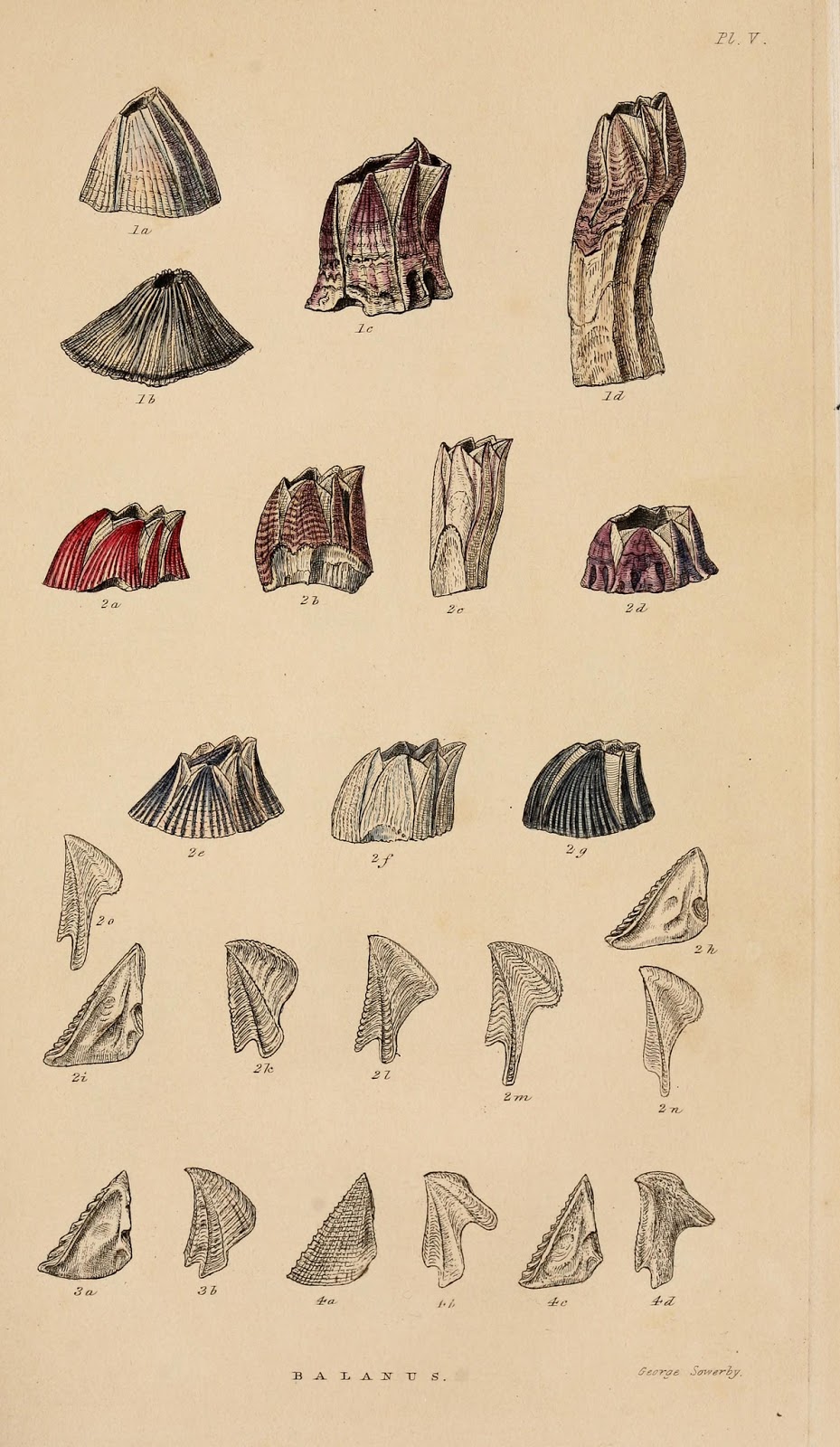
Time passed, Darwin spent some time at Cambridge, and eventually he joined the voyage of the HMS Beagle thanks to a recommendation from his new mentor, botanist and geologist John Stevens Henslow. Darwin’s observations and research during the voyage would fuel his later revolutionary theories. But, as Dr. Melanie L.J. Stiassny, a curator at the American Museum of Natural History, points out in her article on Darwin within the book Natural Histories: Opulent Oceans, Darwin felt somewhat hesitant about his ideas during the early stages of their development. After all, they represented an entirely new way of looking at the natural world and thinking about its origins. So, while he fleshed out his theories on natural selection, Darwin also turned his attention back to, as Stiassny calls it, “his early love” – marine invertebrates. It was his work on barnacles that arguably helped pave the way for the acceptance of his later theories. As Stiassny states on page 84 of Opulent Oceans:

“It was the study of one group, the barnacles (Cirripedia), that would solidify his credentials as a taxonomic expert and provide him with empirical evidence for many of his evolutionary ideas…such as the loss of unnecessary structures (barnacles have no trace of the abdominal segments and swimming appendages of other crustaceans), and evidence that features inherited from a common ancestor can transform in anatomy and function (the typical walking limbs of crustaceans are modified into specialized feeding cirri in barnacles).”
 

View Full Size Image
Darwin, Charles. A monograph on the sub-class Cirripedia, with figures of all the species. (1851-54). http://biodiversitylibrary.org/page/2007061. Digitized for BHL by the MBLWHOI Library.

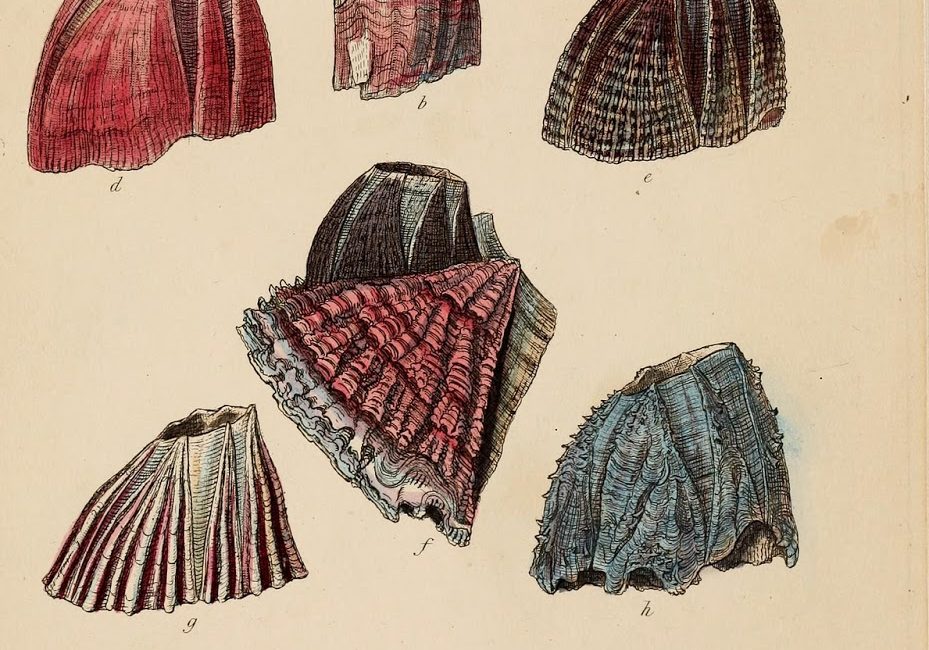
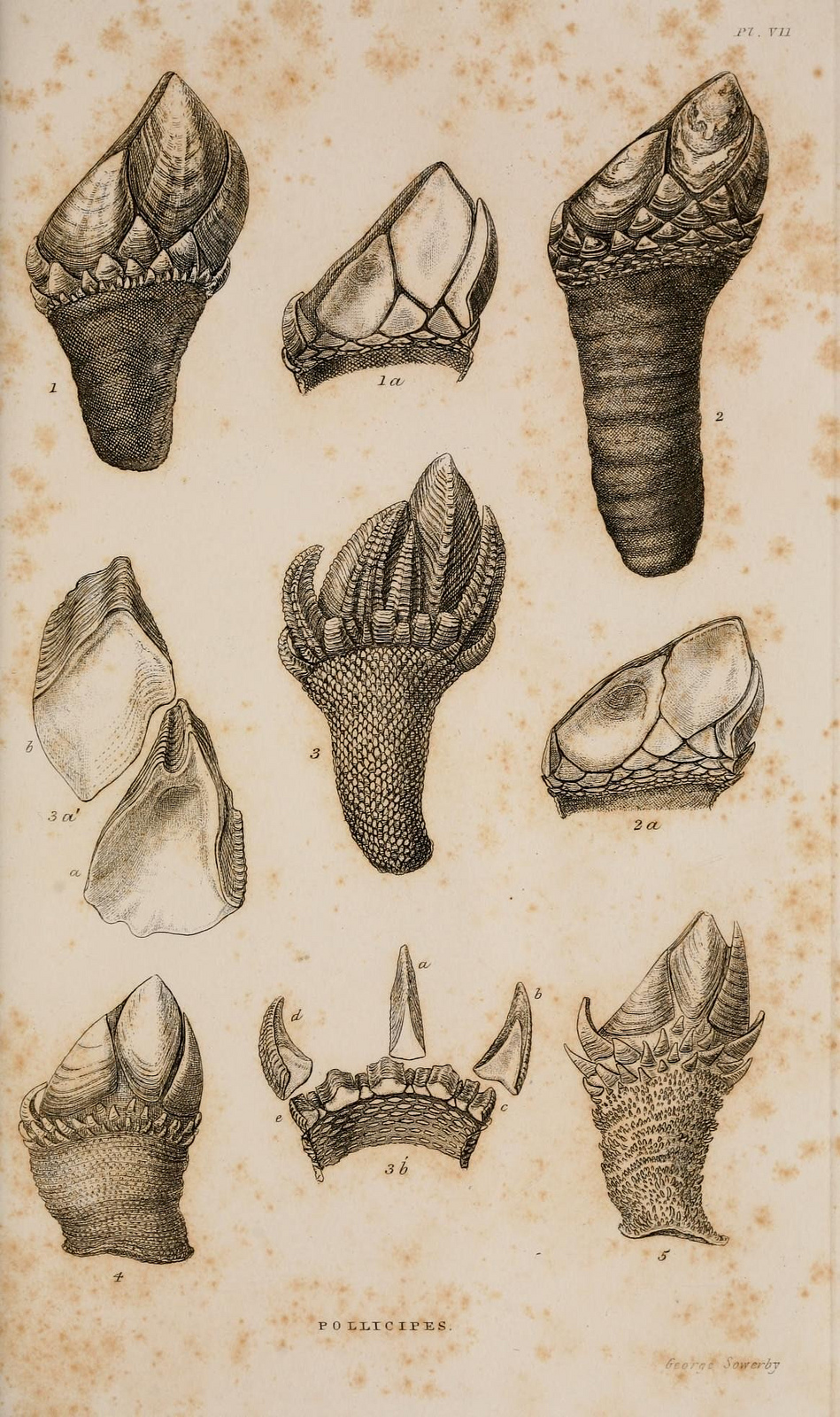
Darwin spent eight years working on his barnacle studies, and from 1851-54 finally published his work in a four-part series: A monograph on the sub-class Cirripedia, with figures of all the species. Within the work, Darwin provides a classification for the crustacean Subclass Cirripedia, making it “the first based on the evolutionary principle of common descent” (Stiassny, 85). His On the Origin of Species, published in 1859, five years after his Cirripedia work, references cirripedes twenty-six times, demonstrating the impact this research had on Darwin’s evolutionary ideas.
View Full Size Image
Darwin, Charles. A monograph on the sub-class Cirripedia, with figures of all the species. (1851-54). http://biodiversitylibrary.org/page/2011425. Digitized for BHL by the MBLWHOI Library.

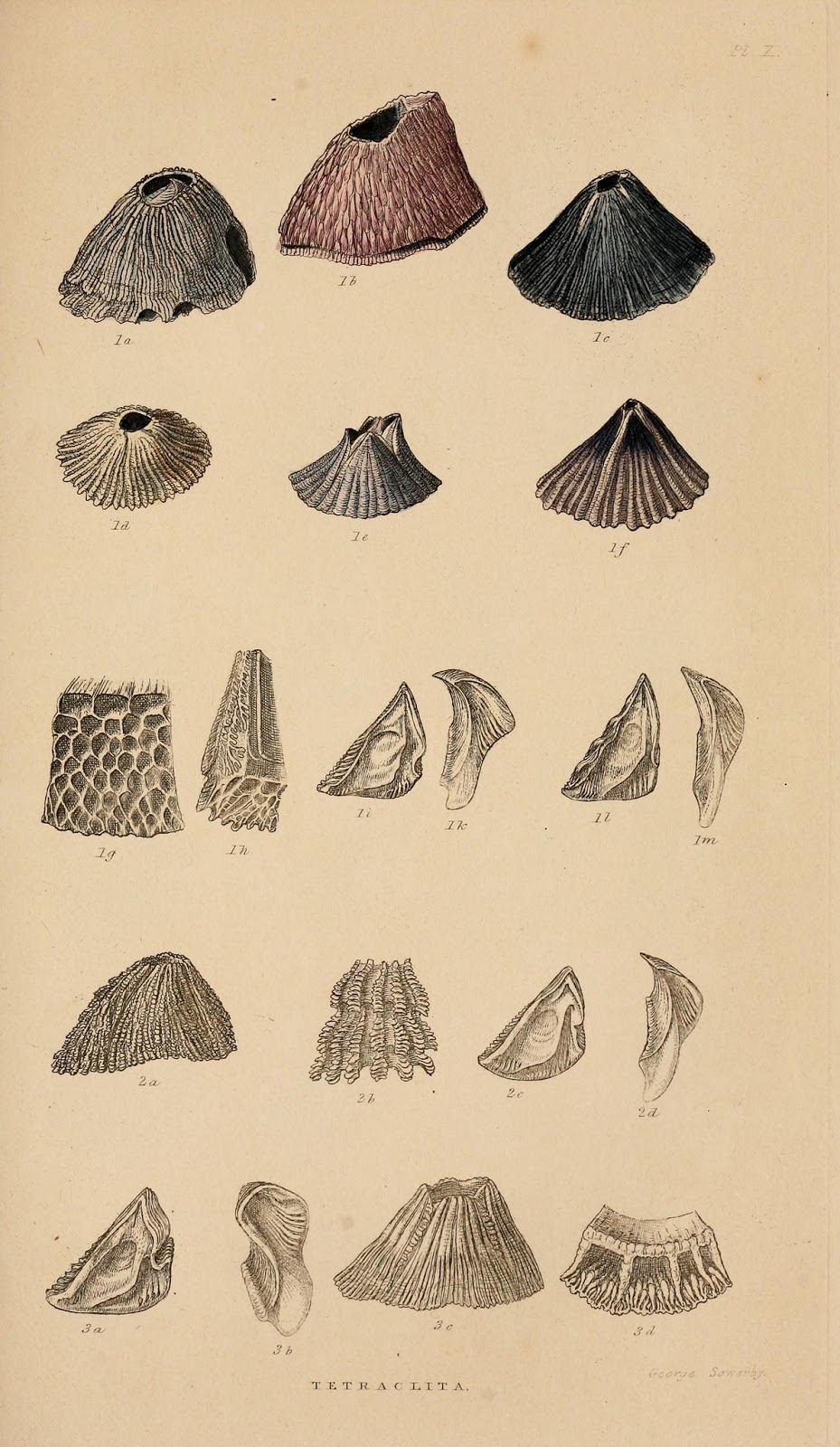
Darwin’s name is arguably the most well-known from the world of natural history. Knowing Darwin’s history with the Cirripedia, one might wonder if he would have realized the heights of his scientific achievements without his barnacles.

So, we think, if Darwin were to give a Valentine to someone in the non-human animal kingdom, there’s a good chance it would go to a barnacle.
View Full Size Image
Darwin, Charles. A monograph on the sub-class Cirripedia, with figures of all the species. (1851-54). http://biodiversitylibrary.org/page/2007081. Digitized for BHL by the MBLWHOI Library.


  • See books and articles written by Charles Darwin in BHL.
  • Explore digitized versions of the books in his personal library in Charles Darwin’s Library in BHL.
  • Explore images from books in Charles Darwin’s Library in Flickr.

Reference:
Stiassny, Melanie L.J. (2014). Darwin’s “Beloved Barnacles.” Natural Histories Opulent Oceans: Extraordinary Rare Book Selections from the American Museum of Natural History Library (pp. 82-85). New York: Sterling Publishing.

February 12, 2016by ulib-libraryjobs
Blog Reel, Featured Books

Happy Darwin Day!

View Full Size Image
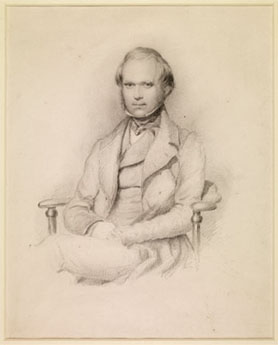
Charles Darwin by George Richmond. Cambridge University Library.

Today in 1809, Charles Darwin, remembered for his theory of Evolution by means of Natural Selection (which was so eloquently outlined in the 1859 publication On the Origin of Species by Means of Natural Selection) was born. We celebrate this day as Darwin Day.

In 2011, BHL released Charles Darwin’s Library, a collection of books found in Charles Darwin’s personal library, with his hand-written annotations marked-up and indexed. We made a selection of these books available for free download in iTunes U. This year, we’ve selected images from these books and created a Darwin collection in Flickr. As with all BHL content, these images are free for download and reuse.

As we continue our celebrations of this great man of science, we highlight another project (headquartered at the American Museum of Natural History) which is dedicated to providing free access to Charles Darwin’s scientific manuscripts – the Darwin Manuscripts Project.

In this two-part post, Darwin Manuscripts Project Director, David Kohn, examines four of Darwin’s manuscripts that show the development of his evolution theory. Let’s begin with excerpts from “Ornithology Notes” and Darwin’s “Transmutation Notebook.”

Celebrating Darwin Day. By David Kohn. Director, Darwin Manuscripts Project

The Darwin Manuscripts Project has the admittedly ambitious goal of publishing all of Darwin’s scientific manuscripts. When digitized this will come to well over 100,000 high-resolution images, which we aim to faithfully transcribe and edit to the exacting standards of contemporary textual and historical scholarship. Among all these manuscripts my first love has always been those items that reveal—or at least allow us to glimpse at—the development of Darwin’s commitment to transmutation (his term for evolution) and the insights that led him to natural selection and eventually to the Origin of Species. Beyond their intellectual content, what appeals to me is how passionate are these manuscript glimpses of Darwin deeply in the midst of theory creation. So I’ve selected three items that capture chronological high points in what must be the most crucial intellectual journey in the history of natural history. And then I’ve selected two manuscript pages from the end point of the journey—the Origin itself. The entirety of this  journey can easily be followed on the DMP site by going to Edited Manuscripts (in the left-hand navigation) and then selecting ‘Creation of the Origin’, where the reader will find all the many surviving documents that are relevant to this process from 1835 to 1859.

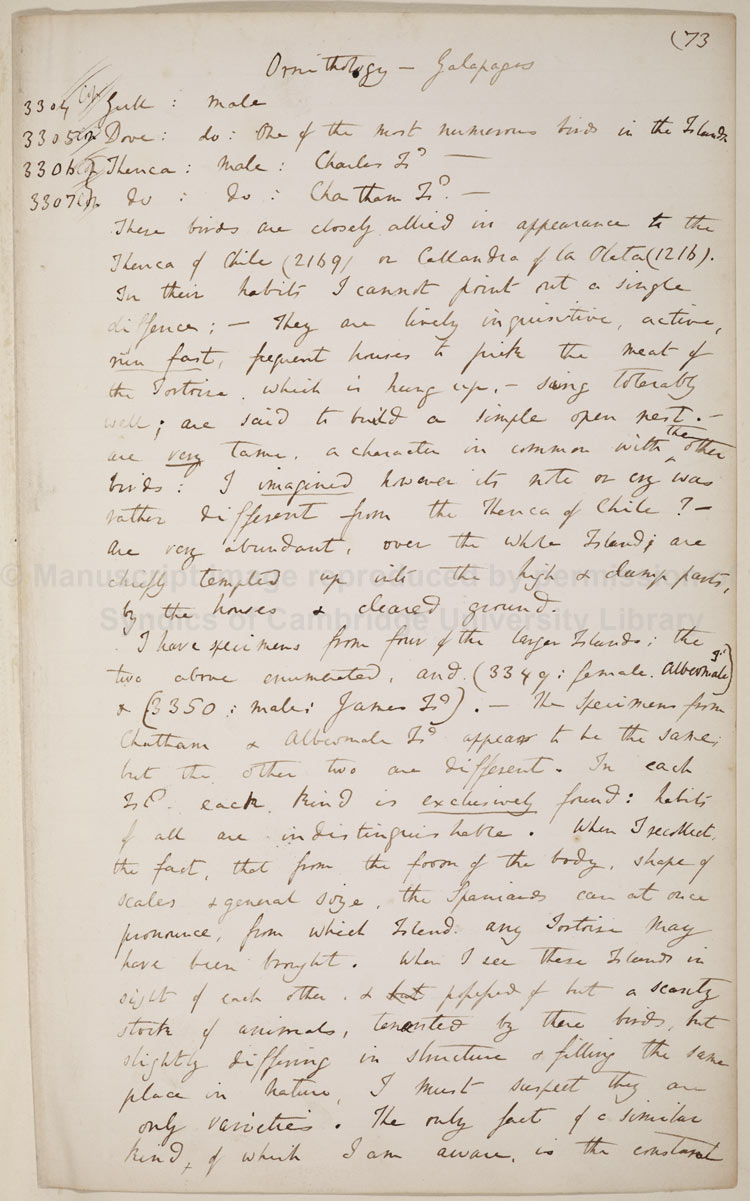
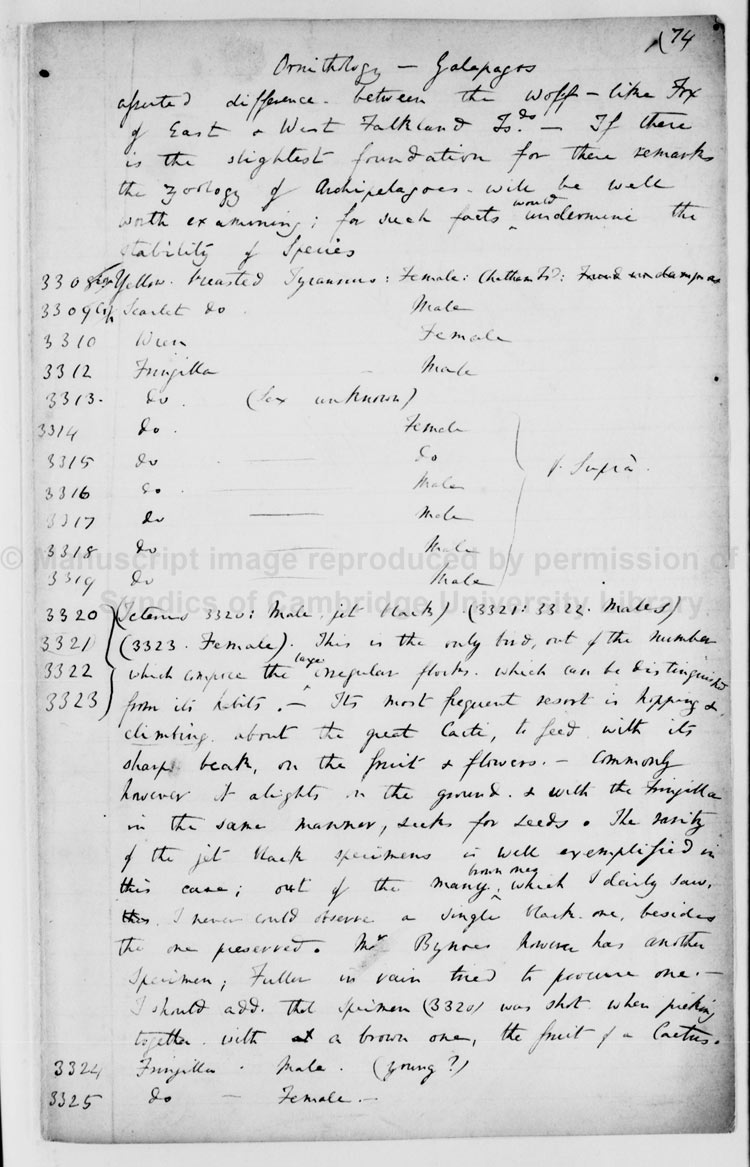
Ornithology Notes, Summer 1836

(Cambridge University Library, DAR 29.2: 73-74)

View Full Size Image
Ornithology Notes. Pg. 73. Cambridge University Library.
View Full Size Image
Ornithology Notes. Pg. 74. Cambridge University Library.

I want to focus on the following passage about the slightly different forms of mocking birds Darwin found as he travelled from island to island. This was written in the summer of 1836 and is a significantly revised version of notes written in 1835, shortly after the Beagle left the Galapagos.

“When I see these Islands…tenanted by these [mocking] birds…I must suspect they are only varieties. … If there is the slightest foundation for these remarks the Zoology of Archipelagoes, will be well worth examining; for such facts «would» undermine the stability of Species.”

What a tantalizing passage. What does he mean by the concluding remark: ‘undermine the stability of Species’?

Undoubtedly, this remains one of the most controversial passages in the Darwin manuscript corpus. And I am offering a part of my humble, yet accurate, interpretation. By ‘stability’ Darwin means immutability. For stability of species is the exact term that Charles Lyell used when he discussed Lamarck’s evolutionary theory at length in the Principles of Geology. By 1836, Darwin had almost four years to read Lyell. And we know definitively he had read and indeed thought about Lyell’s anti-evolutionary views by February 1835. While there are several ways that Darwin was exposed to evolution before the voyage, Lyell’s deep exposition of Lamarck was, I believe, the most important exposure. For reading Lyell gave Darwin a major and thorough injection of evolution theory at the very time when Darwin was actively collecting specimens. But this belief has to be a matter of guess work because Darwin did not begin annotating his books until after the Beagle voyage. (If you really want to have some fun browse through the heavy marginalia on Darwin’s immediately post-Beagle copy of the 1837 edition of Lyell’s Principles in the Charles Darwin’s Library collection at BHL: http://biodiversitylibrary.org/item/105893 and http://biodiversitylibrary.org/item/105574.)

So to me ‘undermine the Stability of species’ translates as to ‘negate immutability’. Logically, to negate immutability equates to assert evolution. But in this passage Darwin did not assert evolution—not yet. We learn that the logic of discovery can proceed more gradually than mere logic.  However, this passage is an extremely important index of Darwin’s intellectual development. For while it shows that Darwin was not yet an evolutionist, it also shows that he was thinking about evolution and indeed thinking that evidence he had collected could destroy the received view that species are perpetually immutable.

Some more context is necessary.  When he wrote this passage, Darwin was in the midst of an important transition. South America and the years of specimen collecting were long behind him. So as a scientific expedition, the voyage itself was behind him. Yet with the ship homeward bound in the Atlantic, the voyage had not yet ended. But Darwin is already looking to the near future, when he would make a powerful entrance into London’s scientific scene by delivering his Beagle specimens to specialists to identify, describe, and evaluate. For these are the people who will determine whether or not his evidence on the ‘Zoology of Archipelagoes, will be well worth examining’. But now, while still sailing, Darwin was prepared to speculate, and indeed to set the grounds for his future evolutionary theorizing.


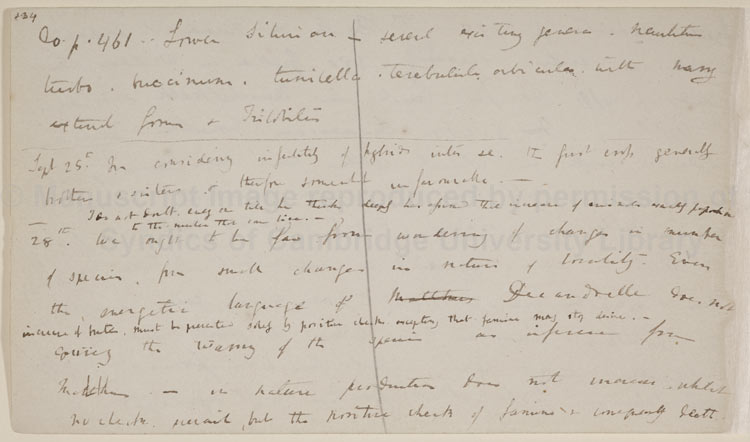
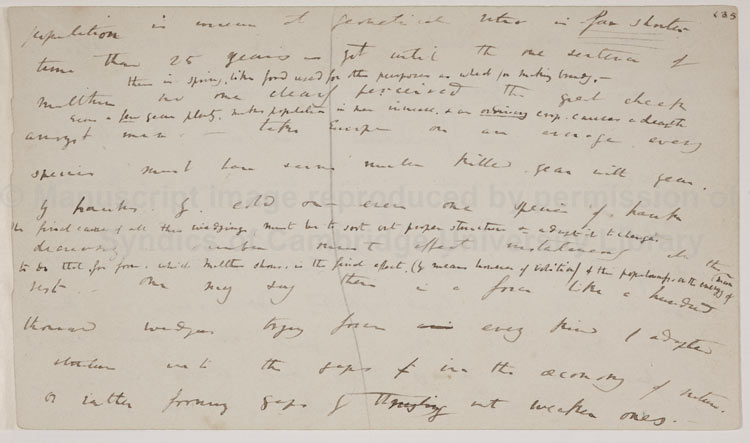
Transmutation Notebook D 134e-D135e, 28 September 1838

(Cambridge University Library, DAR 208: 73-74, http://darwin.amnh.org/viewer.php?eid=75168 and http://darwin.amnh.org/viewer.php?eid=75169.  For the whole Notebook D see http://darwin.amnh.org/viewer.php?mid=7.)


View Full Size Image
Transmutation Notebook D. Pg. 134e. Cambridge University Library.
View Full Size Image
Transmutation Notebook D. Pg. 135e. Cambridge University Library.


28th. «I do not doubt, every one till he thinks deeply has assumed that increase of animals exactly proportiona[l] to the number that can live.—» We ought to be far from wondering of changes in number of species, from small changes in nature of locality. Even the energetic language of ‹Malthus› «Decandoelle» does not convey the warring of the species as inference from Malthus.— … population in increase at geometrical ratio in FAR SHORTER time than 25 years— yet until the one sentence of Malthus no one clearly perceived the great check amongst men.— … One may say there is a force like a hundred thousand wedges trying force ‹into› every kind of adapted structure into the gaps ‹of› in the œconomy of Nature, or rather forming gaps by thrusting out weaker ones. «The final cause of all this wedgings, must be to sort out proper structure & adapt it to change.—»

These two pages from the third of Darwin’s ‘Notebooks on the Transmutation of Species’ give us a window into another crucial moment, for here we see Darwin’s profound excitement as he responds to reading Malthus’ Essay On Population. Visually, I have always been struck by Darwin’s uncharacteristically small, yet very well formed, handwriting here. And notice how there seems to be at least two layers of writing. Indeed the pages are so densely packed that in some places scholars have difficulty cleanly separating the layers.

But, what is Darwin saying?  Well, you need to know that by September 1838, Darwin was deeply engaged in what became the two branches of his life’s work. One branch was the constant weighing of the evidence for and against evolution, though by March 1837—so about six months after the Ornithology Notes, he was convinced that the mutability of species was the way nature is organized—evolution is a correct theory. The other branch was Darwin’s search to define mechanisms that explain two things: how species acquire adaptations and how new species are formed.  In these two pages Darwin is, for the very first time,  beginning to formulate the essence of the mechanism for adaptive evolution, namely: by natural selection. No wonder he writes with so much energy, and yet with so much precision. What he does here is grasp the power of Malthus’ population pressure—‘the energetic language of Malthus,’ which he then harnesses as a natural agent that through the differential survival of the fittest—‘forming gaps by thrusting out weaker ones’ can thereby ‘sort out proper structure & adapt it to change’. This is the essence of natural selection. Not the  grown tree in full bloom. But it is more than just a seed, for if theories are like trees, at this stage Darwin’s was a healthy sapling.

(To Be Continued…View part 2 of this blog post.)

Images in this post reproduced with the permission of the Syndics of Cambridge University Library.

___________________________

Explore Darwin on BHL and the Darwin Manuscripts Project:

Charles Darwin’s Library
Charles Darwin’s Library on iTunes U
Charles Darwin’s Library on Flickr
Darwin Manuscripts Project
Official Darwin Day Website


February 12, 2015by ulib-libraryjobs
Blog Reel, Featured Books

Voilà! Evolution by Means of Natural Selection

Portrait version of the Biodiversity Heritage Library logo.

Exploring Darwin’s Journey Towards the Theory of Evolution,

Part 2 (View Part 1)

In our previous post, David Kohn, Director of the Darwin Manuscripts Project, discussed two Darwin manuscripts illustrating the development of his theory of evolution: excerpts from “Ornithology Notes” and his “Transmutation Notebook D.”

In this installment, we explore two additional manuscript excerpts: “Principles of Divergence” and Darwin’s “Origin Manuscripts.”

Celebrating Darwin Day. By David Kohn. Director, Darwin Manuscripts Project, Part 2

Principle of Divergence. Natural Selection Portfolios II

(Cambridge University Library, DAR 205.5: 148 http://darwin.amnh.org/viewer.php?history=&eid;=21139. For the whole of DAR 205, Darwin’s divergence portfolio, see http://darwin.amnh.org/viewer.php?mid=143)

View Full Size Image
Principles of Divergence Portfolio. Pg. 148. Cambridge University Library.

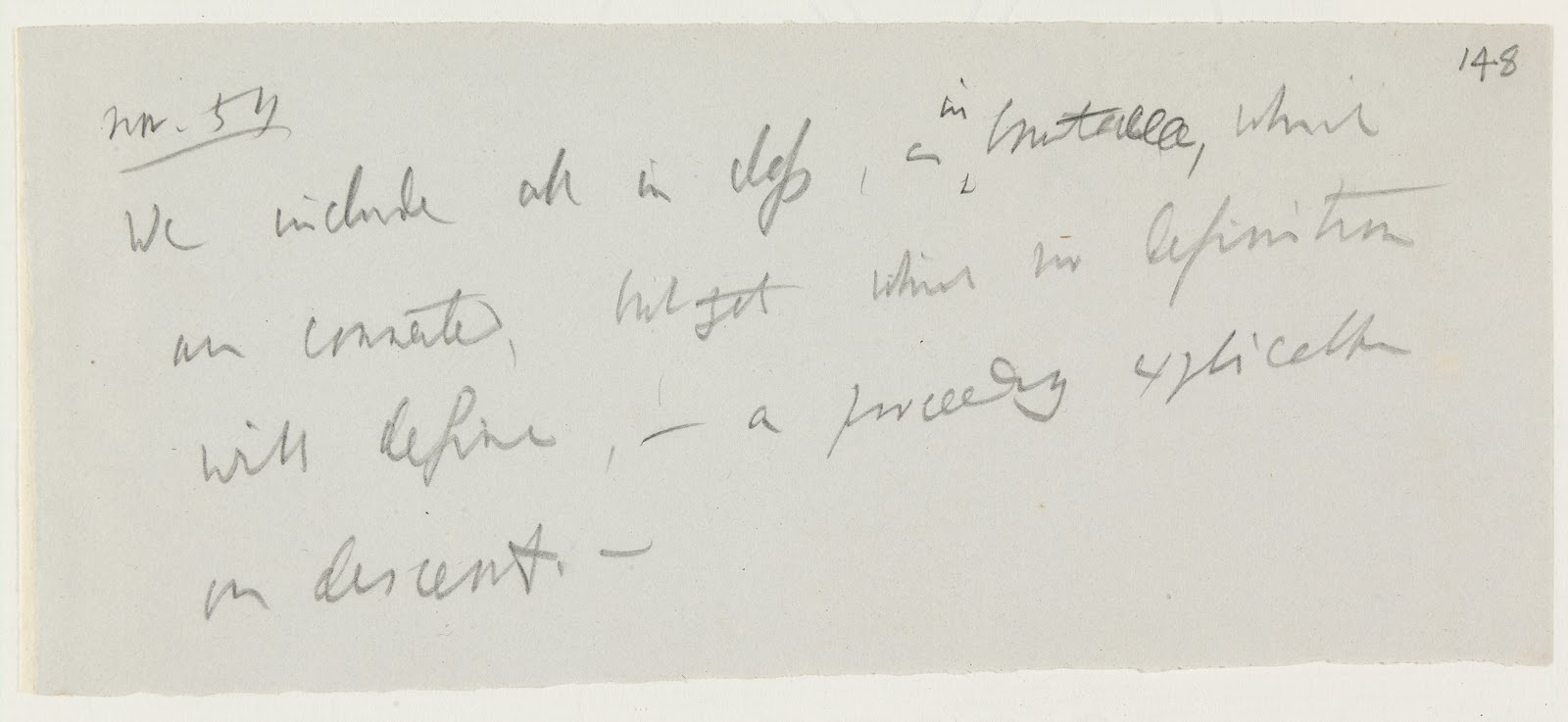
Darwin finished his last notebook in 1839 and waited until 1842 to write a first short essay and until 1844 to write a much longer essay. Then it isn’t until 1854 that he returned in earnest to work on what became the Origin, published in 1859. There are many reasons for all these obvious intervals and gaps. But let’s focus on one big reason, namely: as a comprehensive explication of evolution, the theory even in 1844 was incomplete. For all that Darwin had fully worked out natural selection—which explains the origin of adaption—between 1838 and 1842, yet we can see in retrospect that natural selection wasn’t sufficient to explain how new species are formed. Nor did natural selection explain the principle behind the irregularly branched tree of life that Darwin first drew back in 1837.  According to his autobiography, this big intellectual gap did not dawn on Darwin until the 1850s.

I overlooked one problem of great importance; and it is astonishing to me, except on the principle of Columbus and his egg, how I could have overlooked it and its solution. This problem is the tendency in organic beings descended from the same stock to diverge in character as they become modified. That they have diverged greatly is obvious from the manner in which species of all kinds can be classed under genera, genera under families, families under sub-orders, and so forth; and I can remember the very spot in the road, whilst in my carriage, when to my joy the solution occurred to me; and this was long after I had come to Down. The solution, as I believe, is that the modified offspring of all dominant and increasing forms tend to become adapted to many and highly diversified places in the economy of nature.  (Autobiography 120-121)

What intrigues me about this explanation of how the principle of divergence originated is Darwin’s memory of ‘the very spot in the road, whilst in my carriage, when to my joy the solution occurred to me’.  Did this really happen? Did he have a eureka moment riding in his carriage? For good reason, historians don’t like to trust autobiographical accounts. Darwin’s memory has been proven inaccurate more than once. And yet, let me rush in where wiser scholars may fail/fear to rush. In Darwin’s Natural Selection Portfolios II, there is a series of 15 loose notes, all related to divergence, all dated October to November 1854, and all written on identical grey paper. But one of these notes is written in pencil rather than ink. Unlike any of the other notes in the 1854 series, Darwin’s hand writing here is exceedingly ‘jumpy’.  Could this be the manuscript record of the carriage ride? The text reads:

We include all in class, as «in» Crustacea, which are connected, but yet no definition will define, — a proceeding explicable on descent.—

I suggest that this passage parallels the bolded sentences above from the Autobiography.  What I’m proposing as the carriage-ride note is a succinct statement of the problem or challenge of divergence—how to make the apparent “connectedness” of “all in class” more than just “heraldic”, but actually “explicable” on descent. The succeeding flood of grey-paper notes contain elements of Darwin’s solution—that is, the principle of divergence, which probably began to come into focus for him after he stepped down from his carriage. I think in this scrap of paper, we’ve again caught Darwin in the act of being Darwin.

Surviving draft manuscript sheets of the Origin of Species

(American Philosophical Society Library, BD 25.57 and Cambridge University Library, DAR 185: 109a (6v). For the entire known collection of Origin sheets see http://darwin.amnh.org/viewer.php?mid=2.)

View Full Size Image
Origin Manuscript. Pg. 224. American Philosophical Society Library.

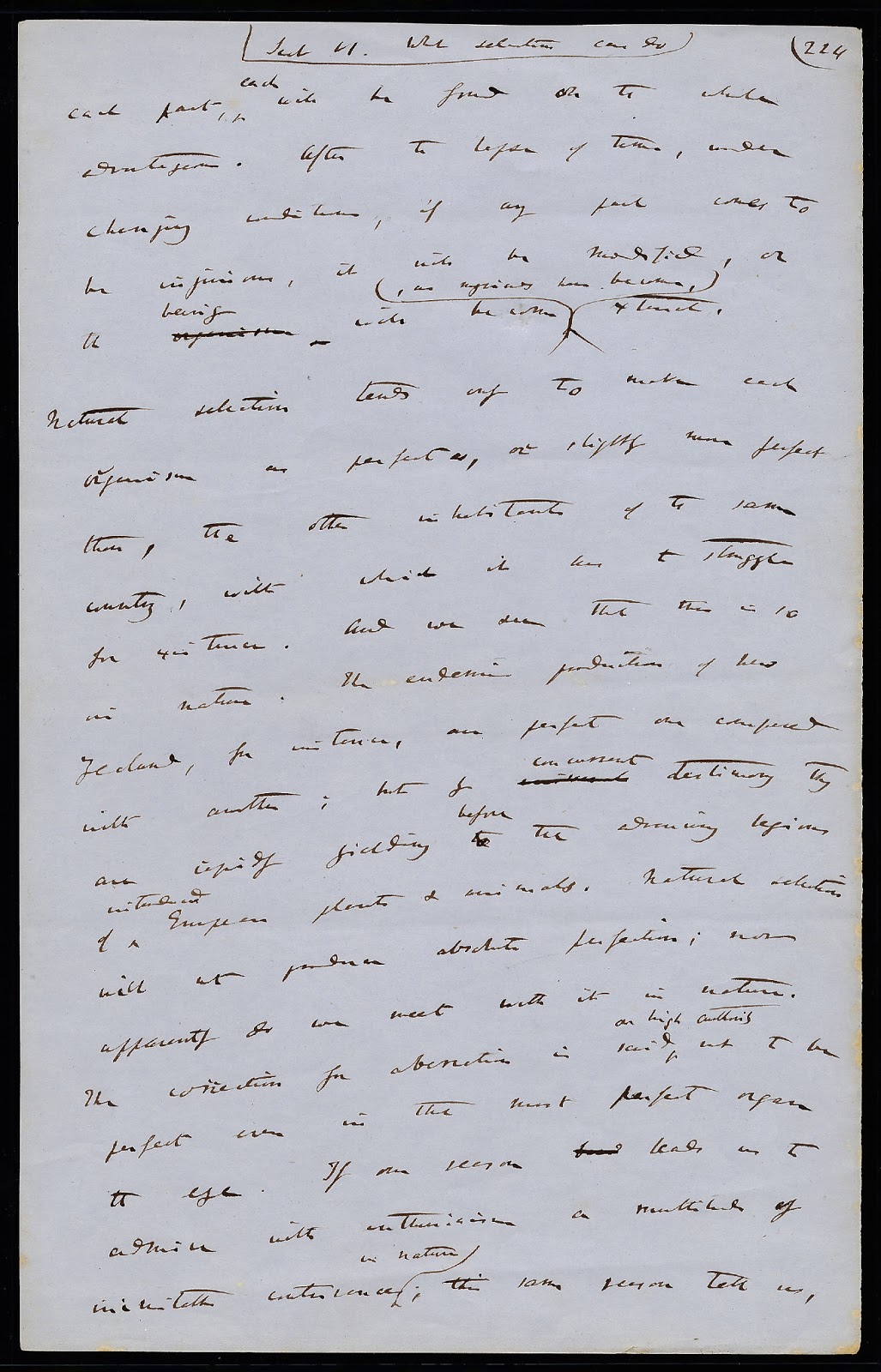
The first edition of the Origin is a book of 490 pages. So Darwin’s hand-written draft must have been a respectable pile of paper. Yet for all the voluminous size of the Darwin archive, only some 30 sheets of the Origin survive. Happily, my favorite passage in the book is one of the five sheets owned by the American Philosophical Society Library in Philadelphia. Here is the passage:

Natural selection tends only to make each organism as perfect «as», or slightly more perfect than, the other inhabitants of the same country, with which it has to struggle for existence. And we see that this is so in nature.

This comes from Chapter VI, entitled ‘Difficulties on Theory,’ which perhaps could be more aptly called ‘Difficulties Conquered.’ The difficulty Darwin sought to overcome here was the appearance of perfection in nature, a concept invoked in the natural theology that Darwin encountered as a student in the work of William Paley. I am drawn to this passage because here Darwin pursues a metaphysical implication of his theory. He argues, rather slyly, that natural selection undoes the prevailing view that adaptations are perfect. He does this by introducing a contradiction in terms. How can anything be ‘slightly more perfect’. Perfect should be perfect. But Darwin shows that the concept of natural selection makes perfection relative. To be adapted organisms need only be ‘slightly more perfect than, the other inhabitants of the same country.’ But that renders perfection in nature a baseless and useless idea.

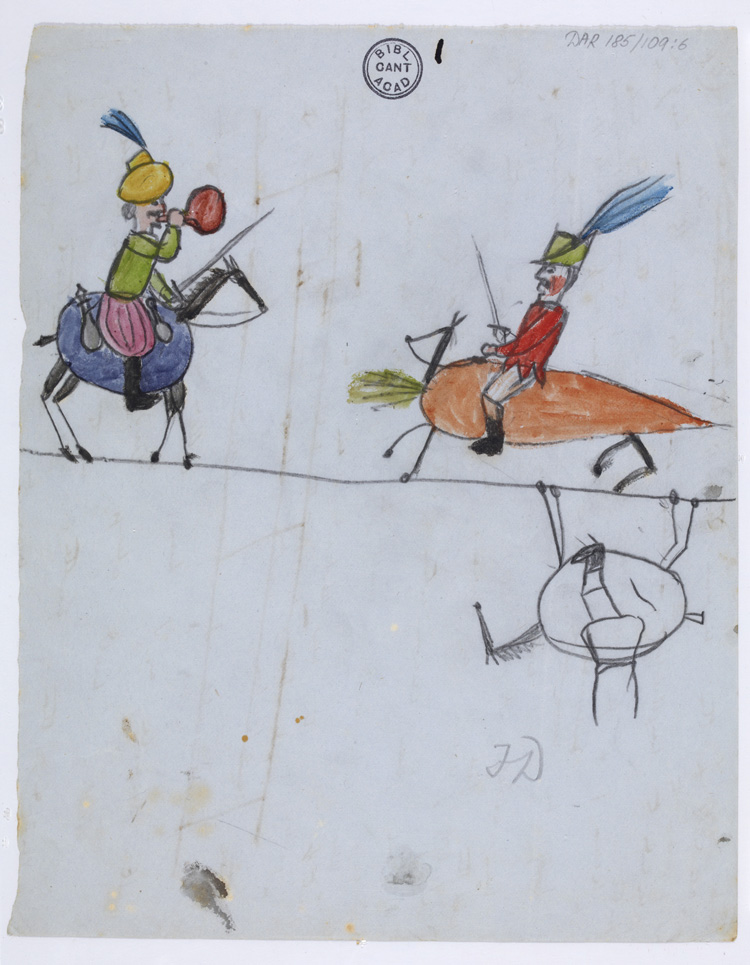
Finally, let’s consider one of the reasons that so few Origin sheets have survived. This picture on the back of an Origin sheet in Cambridge University Library is one of several with drawings like this one showing a battle between soldiers, who we may call knights of the aubergine and the carrot. The artist was Darwin’s son Francis, who evidently was given access to pages from the manuscript version of the great book. Indeed the manuscript only survives because Francis used it for drawing paper. His father didn’t seem to care!

View Full Size Image 
Aubergine and Carrot Cavalry. By Francis Darwin. Cambridge University Library.

Images in this post reproduced with the permission of the Syndics of Cambridge University Library and the American Philosophical Society Library.
____________

We hope you’ve enjoyed our exploration into the insights that Darwin recorded in his manuscripts, all of which ultimately led to the publication of his theory of Evolution by means of Natural Selection. We extend a special thanks to David Kohn, Director of the Darwin Manuscripts Project, for contributing these posts, and to Cambridge University Library and the American Philosophical Society Library for the use of the manuscript images included within these posts.

Read Part 1 of this Blog Post, discussing “Ornithology Notes” and “Transmutation Notebook D.”

Explore Darwin on BHL and the Darwin Manuscripts Project:

Charles Darwin’s Library
Charles Darwin’s Library on iTunes U
Charles Darwin’s Library on Flickr
Darwin Manuscripts Project
Official Darwin Day Website

February 12, 2015by Grace Costantino

Help Support BHL

BHL's existence depends on the financial support of its patrons. Help us keep this free resource alive!

search

About BHL

The Biodiversity Heritage Library (BHL) is the world’s largest open access digital library for biodiversity literature and archives. BHL operates as a worldwide consortium of natural history, botanical, research, and national libraries working together to digitize the natural history literature held in their collections and make it freely available for open access as part of a global “biodiversity community.”

Join Our Mailing List

Sign up to receive the latest news, content highlights, and promotions.

Subscribe Now

Subscribe to Blog via Email

Enter your email address to subscribe to this blog and receive notifications of new posts by email.

Join 319 other subscribers

Subscribe to Blog Via RSS

Subscribe to the blog RSS feed to stay up-to-date on all the latest BHL posts.

Access RSS Feed

Inspiring Discovery through Free Access to Biodiversity Knowledge.

The Biodiversity Heritage Library makes it easier than ever for you to access the information you need to study and explore life on Earth…for free, anytime, anywhere.


64+ Million Pages of
Biodiversity Literature Online.

EXPLORE

Tools and Services
to Transform Research.

EXPLORE

300,000+
Illustrations on Flickr.

EXPLORE

ABOUT | HARMFUL CONTENT | PRIVACY | SITE MAP | TERMS OF USE