
Biodiversity Heritage Library - Program news and collection highlights from BHL
  • Home
  • News
  • Featured Books
    • All Featured Books
    • Book of the Month Series
    • BHL at 20
  • User Stories
  • Campaigns
    • Fossil Stories
    • Garden Stories
    • Monsters Are Real
    • Page Frights
    • Her Natural History
    • Earth Optimism 2020
  • Tech Blog
  • Visit BHL
Home
News
Featured Books
    All Featured Books
    Book of the Month Series
    BHL at 20
User Stories
Campaigns
    Fossil Stories
    Garden Stories
    Monsters Are Real
    Page Frights
    Her Natural History
    Earth Optimism 2020
Tech Blog
Visit BHL
  • Home
  • News
  • Featured Books
    • All Featured Books
    • Book of the Month Series
    • BHL at 20
  • User Stories
  • Campaigns
    • Fossil Stories
    • Garden Stories
    • Monsters Are Real
    • Page Frights
    • Her Natural History
    • Earth Optimism 2020
  • Tech Blog
  • Visit BHL
Biodiversity Heritage Library - Program news and collection highlights from BHL
Blog Reel, Featured Books

Book of the Week: Die Cephalopoden

This week we are celebrating cephlapods. Not sure what they are? Cephalopods are a group of exclusively marine mollusks that include squid, octopus and nautilus. They are closely related to snails, slugs and clams. Let’s be honest, you might be most familiar with them on your plate.

View Full Size Image
Cephlopods have short life spans that range from 6 months to 2 years.

These intelligent but vulnerable invertebrates are fascinating. They are represented in fossil records as long ago as 500 million years. If I had to pick, I’d say squids are my favorite 8-legged species, and not just because this is Squidturday. Squids defend themselves by being agile and fast as well as releasing sepia, often referred to as ink. The sepia creates a smokescreen providing the squid to make a get away. Camouflage is another defense mechanism. They cannot only change the color of their skin but the shape and texture to reflect their surroundings. This is possible through pigment cells on their arms called chromatophores. It doesn’t stop there, certain species can fly out of the water for short distances.

The most well known species of squid popularized in book like Homer’s Odyssey and Jules Verne’s 20,000 leagues Under the Sea is the Giant or Colossal Squid. Not much is known about this squid because it is so rare to find. However, it is known that they live in the deep Atlantic Ocean and can bite with their sharp beaks. Their only predator is the sperm whale. They can reach lengths of up to 60 feet and weight as much as 1,000 pounds. Imagine looking into the soccer ball sized eyes of one of these invertebrates. Scary!

View Full Size Image
Image of Carl Chun from Jarhrbuch der Berliner Morgenzeitung, 1900.

Little was known about these creatures in the 1900s. So Carl Chun, a well known German marine biologist with a specialty in cephalopods and plankton, led the German expedition aboard the steamboat Valdivia in 1898 to explore the deep sea. He was among a growing fraction of scientist who believed that there was life in the deep sea. Lasting just a year, the trip explored the West Coast of South Africa, the Gulf of Guinea, the Antarctic Sea, and a large portion of the Indian Ocean and collected as many biological samples as possible. The results of the expedition lead to 24 volumes titled Ergebnisse der Deutschen Tiefsee-Expedition auf dem Dampfer “Valdivia” 1898-1899″ (Scientific results of the German deep-sea expedition on the steamer “Valdivia” 1898-1899) which Die Cephalopoden is apart of.

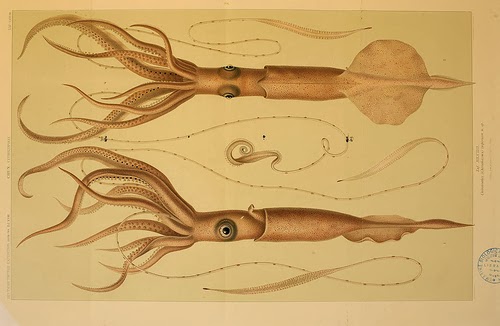
BHL’s copy of Die Cephalopoden provides much more information on cephalopods and squid. If you don’t sprechen deutsch, check out the English translation. From this expedition, Chun discovered and named a new species of squid, the vampire squid. Its species name, Vampyroteuthis infernalis, means “vampire squid from hell.”

To learn more about the Valdivia expedition, check out the BHL blog post Book of the Week: The Valdivia Expedition.

View Full Size Image
They are curious animals that explore their environment and are capable of learning, and will play with objects.

And if you want to see more beautiful illustrations from Chun’s Die Cephalopoden check out the BHL Flickr set.

References:
Ferris, Jabr. (2 August 2010). Fact or Fiction: Can a a Squid Fly out of the Water? Scientific American. Retrieved from http://www.scientificamerican.com/article.cfm?id=can-squid-fly≻=WR_20100804

Robey, Jason. (25 January 2013). Giant Squid Facts. Top 10 Startling Giant Squid Facts. Discovery. Retrieved from http://blogs.discovery.com/show-news/2013/01/top-10-startling-giant-squid-facts.html

Rodolfo. (19 June 2010). Basic Facts about Cephlapods. OBIS, Ocean Biographic Information System.  retrieved from http://www.iobis.org/node/161

Unknown. (n.d.) Cephalopod DayRetrieved from http://cephalopodday.tumblr.com/about

Watson, Stephanie. (1 June 2007). How Squid WorkHowStuffWorks.com. Retrieved from http://science.howstuffworks.com/zoology/marine-life/squid.htm

October 8, 2013by gworthey

Help Support BHL

BHL's existence depends on the financial support of its patrons. Help us keep this free resource alive!

search

About BHL

The Biodiversity Heritage Library (BHL) is the world’s largest open access digital library for biodiversity literature and archives. BHL operates as a worldwide consortium of natural history, botanical, research, and national libraries working together to digitize the natural history literature held in their collections and make it freely available for open access as part of a global “biodiversity community.”

Join Our Mailing List

Sign up to receive the latest news, content highlights, and promotions.

Subscribe Now

Subscribe to Blog via Email

Enter your email address to subscribe to this blog and receive notifications of new posts by email.

Join 319 other subscribers

Subscribe to Blog Via RSS

Subscribe to the blog RSS feed to stay up-to-date on all the latest BHL posts.

Access RSS Feed

Inspiring Discovery through Free Access to Biodiversity Knowledge.

The Biodiversity Heritage Library makes it easier than ever for you to access the information you need to study and explore life on Earth…for free, anytime, anywhere.


64+ Million Pages of
Biodiversity Literature Online.

EXPLORE

Tools and Services
to Transform Research.

EXPLORE

300,000+
Illustrations on Flickr.

EXPLORE

ABOUT | HARMFUL CONTENT | PRIVACY | SITE MAP | TERMS OF USE