April 2020 marks the 50th anniversary of Earth Day. Organizations around the world have commemorated the occasion by participating in the global Earth Optimism movement — an initiative spearheaded by the Smithsonian to “turn the conservation conversation from doom and gloom to optimism and opportunity”.
Throughout 2020, the Biodiversity Heritage Library (BHL) and our partners are joining the movement by sharing conservation success stories from and made possible by the BHL collection. Follow our blog for conservation stories — past and present — and visit our website for more information and to explore our Earth Optimism book collection.
———————
Alexander von Humboldt (1769-1859) was a man who believed all of nature was interconnected, and that by affecting one aspect of nature, other parts of nature would be affected, too—for good or ill. Humboldt believed that one’s own emotions and subjective views were necessary in order to completely experience nature. Simply taking measurements or classifying animals, plants, rocks and other forms of life would never allow one to fully experience the truth of nature.
Born to an aristocratic Prussian family in 1769, Humboldt grew up during the Age of Enlightenment, which emphasized intense observation paired with scientific information as the primary sources of knowledge. However, Immanuel Kant’s Critique of Pure Reason (1781), which outlined the interplay of inner subjectivity and knowledge of external things, greatly influenced Humboldt’s view of nature as he grew older. According to Kant, when you look at a rock, for example, you are influenced by your own subjective beliefs. Thus, you cannot truly see the rock as a rock-in-itself, as you will always see the external world through a filter of internal senses and emotions. Humboldt likewise claimed that the external world only existed as we perceived it “within ourselves” (Humboldt in Wulf, p. 40).
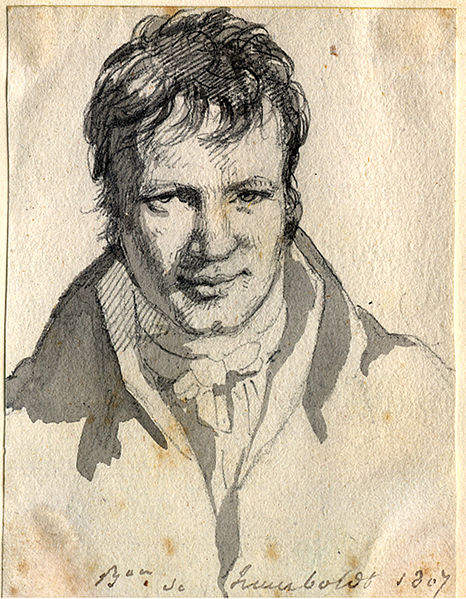
Houdetot, Frédéric Christophe de. Alexander von Humboldt, in Berlin 1807, Bleistift und Tusche [Pencil and Ink]. 1807. Public domain.
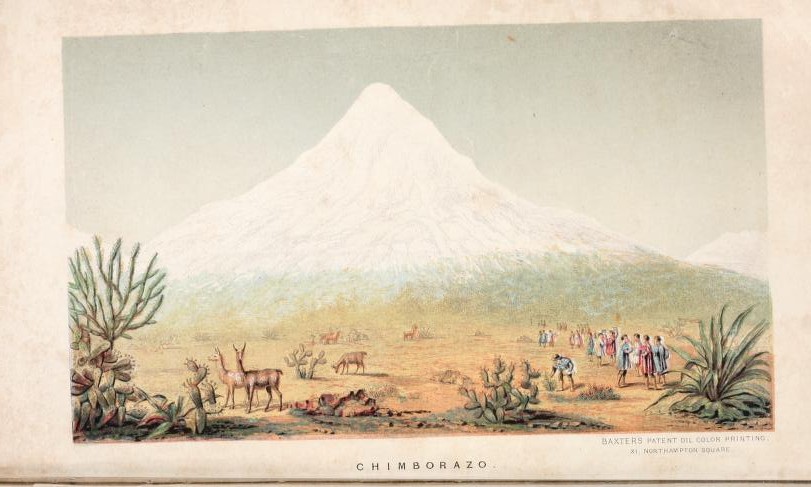
Chimborazo mountain. Humboldt, Alexander von. Views of nature, or, Contemplations on the sublime phenomena of creation: With scientific illustrations. 1850. Contributed in BHL from MBLWHOI Library.
After receiving a rather large inheritance following his mother’s death in 1796, Humboldt’s scientific pursuits became more determined and ambitious. He decided to attempt a research expedition, and in 1799, asked permission of King Carlos IV of Spain to explore the Spanish colonies in South America and the Philippines. While he was granted a Spanish passport by the king, Humboldt had to fund the trip himself and send the king plants and animals for the royal cabinet and garden.
It was very rare for a foreigner to be allowed into the Spanish territories, and Humboldt made the most of his travels, bringing many scientific instruments with which to make observations and take measurements. He spent five years exploring different areas in South America. He compared the environments to those in different parts of Europe, noting that similar plants existed in similar climates.
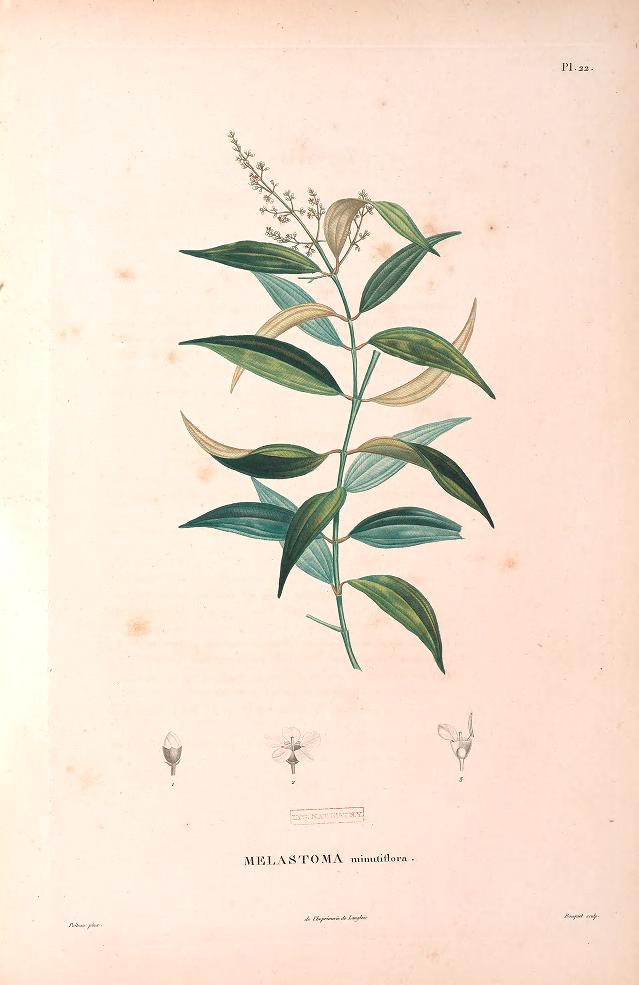
Illustration of the “Melastoma minutiflora” which Humboldt observed in Cumana. Humboldt, Alexander von. Monographie des melastomacées, comprenant toutes les plantes de cet ordre récueillies jusqu’à ce jour. 1833. Contributed in BHL from New York Botanical Garden, LuEsther T. Mertz Library.
Humboldt’s time in Cumana, the capital of New Andalusia (an area now part of Venezuela), had a particularly profound impact on his personal and scientific views. His observations of the treatment of enslaved people in the slave market near his lodgings impelled Humboldt to become an avid abolitionist for the rest of his life. It was also in Cumana that Humboldt saw how colonialism destroyed native ecosystems, as colonists had felled so many trees that the land became dry and farming yielded less crops.
While visiting Lake Valencia, Humboldt first recorded his observation that humans could induce climate change and destroy ecosystems. He noted that when forests are destroyed, springs and riverbeds dry up, the forest floor—no longer protected by tree foliage—becomes oversaturated with rain and soil is loosened, and different types of plants and animal life die. Humboldt observed that all aspects of nature are interconnected— when one part of a natural environment is drastically altered, such as with deforestation, the rest of that environment will be impacted in various drastic ways as a result. Humboldt gave many written warnings about the importance of understanding the many reciprocal interactions in nature in order to prevent the devastation of ecosystems and biodiversity caused by humans’ interference with nature.
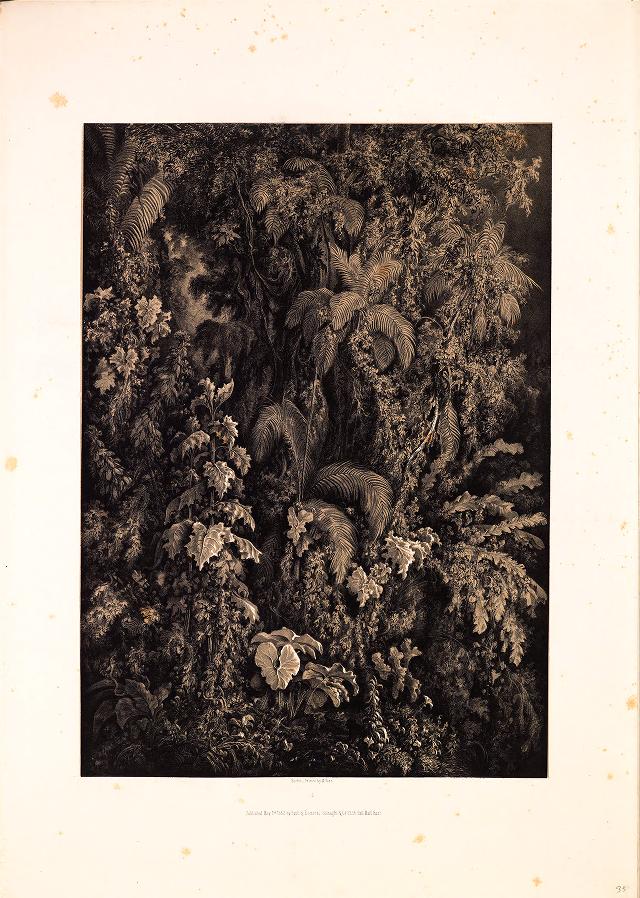
South American forest illustration. Berg, Albert. Physiognomy of tropical vegetation in South America […]. Book includes part of a letter by Humboldt to Berg. 1854. Contributed in BHL from New York Botanical Garden, LuEsther T. Mertz Library.
It was here that Humboldt came up with a name and a visual for his theory that all of nature was connected—not just as a living entity, but as a composite of ecosystems all over the world at different locations containing similar flora and fauna at similar geological heights and climates. The different vegetation zones of the volcano reminded Humboldt of the different vegetation zones in the wider world, going from hotter equatorial zones to colder polar zones, just as one went from the warmer base of the mountain toward its freezing summit.
Humboldt depicted his “Naturgemälde”, which in German means “painting of nature” but also “unification”, through a visualization published within Essai sur la géographie des plantes (1805). This illustration, with the unique name he gave it, showed Chimborazo as a cross-section in which different plants grew at different altitudes and temperatures. Next to the illustration was information about other mountains around the world and a description of how their plant and climate zones could be compared to those on Chimborazo at similar heights. The idea that one could visually illustrate and describe plant life based on climate and location was a completely unprecedented idea at the time, and one which still influences our scientific views today.
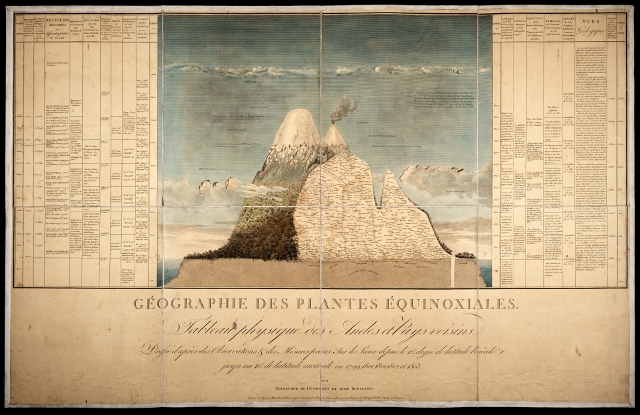
“Naturgemälde” illustration. Bonpland, Aimé and Alexander von Humboldt. Essai sur la geographie des plantes [Essay on the geography of plants]. 1805. Contributed in BHL from Missouri Botanical Garden, Peter H. Raven Library.
Humboldt had only one other trip to a distant land in his life. Invited by Tsar Nicholas I to gather research on platinum, which had been found in the Ural Mountains, he traveled to Russia in 1829, hoping to gather more information on different climates and plant life. While disappointed by the trip and its focus on finding platinum as a source of possible Russian currency, Humboldt nevertheless returned to Berlin filled with ideas for his next, and most popular, work—a multi-volume opus called Cosmos (Kosmos in German).
Cosmos was an embodiment of Humboldt’s ideas on the interconnectedness of nature and being. It discussed celestial matters, earthly matters, and the inner, organic life of plants, animals and humans. Humboldt enlisted the help of experts in varying fields, including classicists and historians, once again unifying seemingly separate fields by creating a work connecting ideas from these fields to one another and to science.
In 1845, the first volume of Cosmos was published in Germany. It was an instant success and was translated into various other languages. The introduction explained Humboldt’s view that all of nature was connected and formed a living whole. Humboldt was the first to describe the climate as an interaction between landmasses, the oceans and the atmosphere. He described a breath of life that came from the earth—not from divinity—and was intrinsic in all living things. Humboldt became one of the most celebrated scientists in the world after the distribution of this work not only throughout Europe, but in America as well.
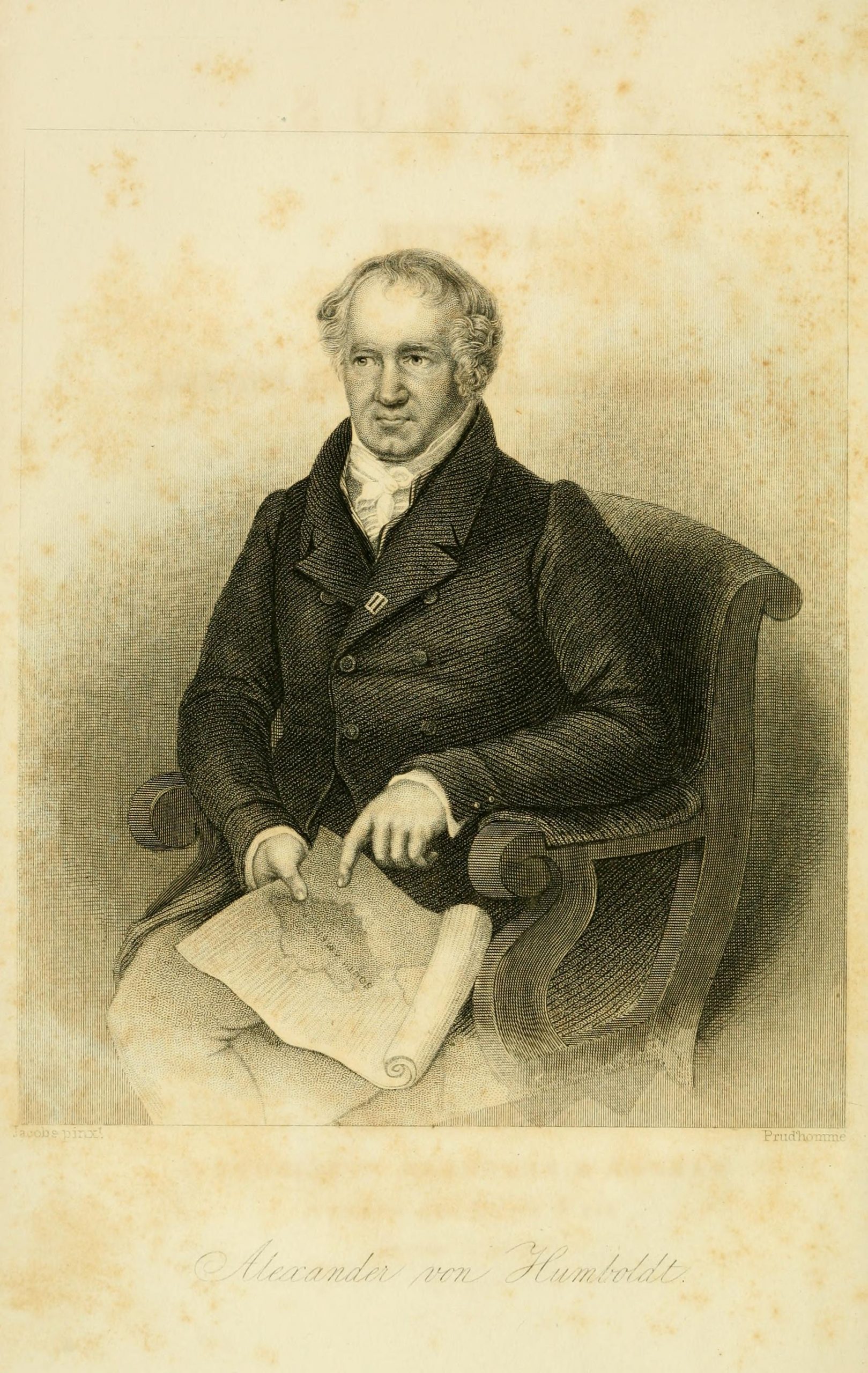
Portrait of Humboldt. Humboldt, Alexander von. Cosmos : a sketch of a physical description of the universe. v. 1 (1877). English translation by E.C. Otté. Contributed in BHL from the MBLWHOI Library.
Even though Humboldt expressed many dire warnings about human-induced climate change, his belief that nature was a unified whole meant that if destroying one part of an ecosystem destroyed the rest of it, then rebuilding different parts of an ecosystem could aid in its complete restoration. He encouraged everyone to experience nature by immersing themselves within it, by taking walks and going outdoors. Humboldt also believed in sharing scientific information, both within scientific circles and across other disciplines. By using this method of information sharing, we have a chance, as a world community—as a part of that living organism called “nature”—to combat climate change, to counter humans’ negative impact on nature, and to rebuild and restore different habitats and the biodiversity contained within them.
Humboldt at the Smithsonian American Art Museum
You can learn more about Humboldt’s legacy and his impact on American perceptions of nature and the environment through the exhibit Alexander von Humboldt and the United States: Art, Nature, and Culture at the Smithsonian American Art Museum (SAAM).
As the SAAM website articulates, “This exhibition will be the first to examine Humboldt’s impact on five spheres of American cultural development: the visual arts, sciences, literature, politics, and exploration, between 1804 and 1903. It centers on the fine arts as a lens through which to understand how deeply intertwined Humboldt’s ideas were with America’s emerging identity. The exhibition includes more than 100 paintings, sculptures, maps, and artifacts as well as a video introduction to Humboldt and his connections to the Smithsonian through an array of current projects and initiatives.”
The exhibit is on display from 18 September 2020 – 3 January 2021. Learn more.
Interesting Facts
Humboldt had an intense fear of ghosts, and especially feared the ghost of his mother after she died. It was rumored that he participated in several seances after her death in hopes of contacting her.
In 1804, Thomas Jefferson, then-President of the United States, invited Humboldt to the capital to discuss Humboldt’s scientific findings in the Spanish colonies. Humboldt even let Jefferson have a sizable number of pages of his research to translate, not knowing that Jefferson considered all of this information to be valuable intelligence about the Spanish territories that bordered Jefferson’s recently acquired Louisiana Purchase.
Charles Darwin, who determined that all animals evolve through natural selection, was a huge admirer of Humboldt and kept a copy of Humboldt’s Views of Nature onboard the Beagle as he sailed around the world observing animal and plant life. Humboldt did not get involved in the debate over how certain plants and animals seemed to be present only in some climates and geographies but not always in other similar ones, writing that his study of plants and animals was not about “the investigation of the origin of beings” (Wulf, p. 275)—a phrase which Darwin underlined. Darwin took up the challenge in his Origin of the Species (1859).
Humboldt called black coffee “concentrated sunshine” (Wulf, p. 283).
References
Berg, A., & Humboldt, A. (1854). Physiognomy of tropical vegetation in South America; a series of views illustrating the primeval forests on the river Magdalena, and in the Andes of New Grenada. London: Paul and Dominic Colnaghi and Co., Publishers to Her Majesty. https://doi.org/10.5962/bhl.title.119819
Bonpland, A., & Humboldt, A. (1805). Essai sur la géographie des plantes: Accompagné d’un tableau physique des régions équinoxiales, fondé sur des mesures exécutées, depuis le dixième degré de latitude boréale jusqu’au dixième degré de latitude australe, pendant les années 1799, 1800, 1801, 1802 et 1803. Paris: Levrault, Schoell et Compagnie, Libraires. https://doi.org/10.5962/bhl.title.9309
Bonpland, A., & Humboldt, A. (1833). Monographie des melastomacées, comprenant toutes les plantes de cet ordre récueillies jusqu’à ce jour, et notamment au Mèxique, dans l’Ile de Cuba, dans les provinces de Caracas, de Cumana, et de Barcèlone, aux Andes de la Nouvelle-Grenade, de Quito et du Pérou, et sur les bords du Rio-Negro, de l’Orénoque et de la rivière des Amazones. London: Gide. https://doi.org/10.5962/bhl.title.162868
Bonpland, A. & Humboldt, A. (1826). Personal narrative of travels to the equinoctial regions of the New Continent, during the years 1799-1804, by Alexander de Humboldt, and Aimé Bonpland. Vol. 6. (H.M. Williams, Trans.). London: Longman, Hurst, Rees, Orme, Brown, and Green. https://doi.org/10.5962/bhl.title.87622
Darwin, C. (1859). On the origin of species by means of natural selection, or, The preservation of favoured races in the struggle for life. London: John Murray. https://doi.org/10.5962/bhl.title.68064
Humboldt, A. (1849). Aspects of nature, in different lands and climates; with scientific elucidations. Vol. 1. (E.J. Sabine, Trans). London: Longman, Brown, Green, and Longmans. https://doi.org/10.5962/bhl.title.151955
Humboldt, A. (1871). Cosmos: A sketch of a physical description of the universe. Vol. 3. (E.C. Otté, Trans.). London: Bell & Daldy. https://doi.org/10.5962/bhl.title.27525
Humboldt, A. (1893). Cosmos: A sketch of a physical description of the universe. Vol. 1. (E.C. Otté, Trans.). London: George Bell & Sons. https://doi.org/10.5962/bhl.title.29831
Humboldt, A. (1849). Cosmos: Sketch of a physical description of the universe. Vol. 2. (E. Sabine & E. Sabine, Trans.). London: Longman, Brown, Green, and Longmans. https://doi.org/10.5962/bhl.title.29892
Humboldt, A. (1850). Views of nature, or, Contemplations on the sublime phenomena of creation: With scientific illustrations. (E.C. Otté, & H.G. Bohn, Trans.). London: Henry G. Bohn. https://doi.org/10.5962/bhl.title.4802
Magee, J. (2019). Alexander von Humboldt: A vision of the unity of Nature. In R. Huxley (Ed.), The Great Naturalists, (n.p., Kindle edition). London: Thames & Hudson.
Meinhardt, M. (2019). Alexander von Humboldt: How the most famous scientist of the Romantic Age found the soul of nature. Katonah, N.Y.: BlueBridge.
Wulf, A. (2015). The invention of Nature: Alexander von Humboldt’s new world. New York: Vintage Books.
 Public Domain.