Biodiversity Heritage Library - Program news and collection highlights from BHL
  • Home
  • News
  • Featured Books
    • All Featured Books
    • Book of the Month Series
    • BHL at 20
  • User Stories
  • Campaigns
    • Fossil Stories
    • Garden Stories
    • Monsters Are Real
    • Page Frights
    • Her Natural History
    • Earth Optimism 2020
  • Tech Blog
  • Visit BHL
Home
News
Featured Books
    All Featured Books
    Book of the Month Series
    BHL at 20
User Stories
Campaigns
    Fossil Stories
    Garden Stories
    Monsters Are Real
    Page Frights
    Her Natural History
    Earth Optimism 2020
Tech Blog
Visit BHL
  • Home
  • News
  • Featured Books
    • All Featured Books
    • Book of the Month Series
    • BHL at 20
  • User Stories
  • Campaigns
    • Fossil Stories
    • Garden Stories
    • Monsters Are Real
    • Page Frights
    • Her Natural History
    • Earth Optimism 2020
  • Tech Blog
  • Visit BHL
Biodiversity Heritage Library - Program news and collection highlights from BHL
Blog Reel

Book of the Week: X-Ray Vision

Have you ever wondered what a fish looks like inside? With the advent of x-ray technology, your curiosity can be sated, all without having to dissect a fish. And with the new Smithsonian exhibit, X-Ray Vision: Fish Inside Out, you can explore the evolutionary development of fish through a progression of x-rays from cartilaginous to bony fish. Our friends at EOL brought this exhibit to our attention through their online collection by the same name, which not only displays the incredible x-ray images seen in the Smithsonian exhibit, but also provides links to species pages providing more information about the fish showcased in each x-ray. Browsing through the EOL collection, we realized that one of the books in our collection features illustrations of a majority of the fish-types represented, and we thought that it would make a perfect book of the week post.

Celebrating the awesome power of x-rays, bringing us fish from the inside-out, we proudly present fish from the outside-in, aligning the Smithsonian and EOL exhibits X-Ray Vision with our book of the week: Our Country’s Fishes and How to Known Them: A Guide to all the Fishes of Great Britain (1902), by W.J. Gordon. In this post, we highlight just a few of the species featured in the exhibit, alongside portraits of them or members of their genus in our book of the week, and garnished with a few fun facts. Enjoy!

View Full Size Image

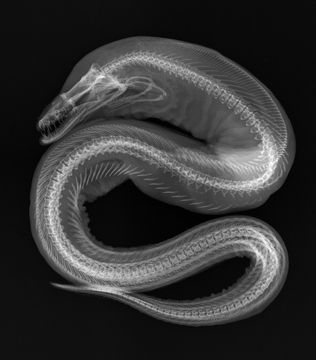
This is an x-ray of the Viper Moray, which is a Moray Eel of the family Muraenidae. The x-ray is presented alongside an illustration of the Mediterranean Moray (fig. 168).

Moray Eels are known for a second set of jaws, called pharyngeal jaws, found in the back of their throat. These jaws possess teeth, and when an eel bites down on its prey with its first set of teeth, the pharyngeal jaws come forward to grab the prey and drag it back down the throat towards the esophagus for swallowing.

_________________________________________________
View Full Size Image

Seen here is an x-ray of an Alligator Pipefish, of the Syngnathidae family and in this case a member of the Syngnathoides genus. Accompanying the x-ray is an illustration of a variety of pipefish, including members of the Syngnathus genus and the Nerophis genus (figs. 114-118).

Sometimes thought of as “seahorses unfurled,” pipefish have a highly modified skeleton formed into armored plating. The numerous bony body rings are used to differentiate one species of pipefish from another.

_________________________________________________
View Full Size Image

Presented here in lovely x-ray detail is the Monterey Skate, of the family Rajidae and genus Raja. This image is presented alongside illustrations of several other members of the skate family, including the flapper skate and white skate (figs. 239-240).

Skate mating typically occurs in the spring, when females lay numerous eggs which are encapsulated in leathery cases called “mermaid’s purses.” The fossil record dates skates back to the Upper Cretaceous period, 100-65 million years ago.

_________________________________________________
View Full Size Image

Our final featured x-ray is that of the Bulbous Deep Sea Angler, of the order Lophiiformes and the only species in the genus Dermatias. This species is known only from three specimens. In compliment to the x-ray, we feature Lophius piscatorius, or The Angler, sometimes known as a frog-fish or sea-devil (fig. 47). The Bulbous Deep Sea Angler is of the family Oneirodidae (deep-sea anglerfish), while The Sea-Devil is from the family Lophiidae, or Monkfish.

Anglerfish are so named because of their mode of predation, which involves luring prey with a fleshy lobe on top of the angler’s head. Anglerfish like those of the Ceratioid group exhibit extremely unusual mating practices. Male ceratioids, tiny in size compared with the females, become parasites attached to females. After locating a female anglerfish, the male will bite onto her, release an enzyme that digests the skin of his mouth and her body, and fuze to her at the blood vessel level. Over time, the male slowly atrophies, losing eyes, heart, and even brain, till he is nothing more than a pair of gonads that release sperm in response to hormones in the female’s bloodstream.

_______________________________________________

You can explore all of the wonders of X-Ray Vision: Fish Inside Out on the official website. Learn more about all of the species featured in the x-rays on EOL’s collection. Finally, browse all the beautiful illustrations in our book of the week on Flickr.

All x-ray images courtesy Smithsonian National Museum of Natural History.

February 23, 2012by michelle.underhill
Blog Reel, Featured Books

Book of the Week: Living Sea Mammoths of Myth and Legend

This week, while browsing our Flickr site (which, by the way, has over 15,900 images!), we stumbled across the book Field Book of Giant Fishes (1949), by J.R. Norman and F.C. Fraser, and were intrigued. What exactly was a giant fish by this book’s standards, and what would we find when we delved into the pages of this enigmatic title?

To our delight, we found some surprising species featured within this volume. Species that make you think, “Maybe we aren’t too far off from the dinosaurs.” Some even include creatures that might be responsible for many of the “sea monster” claims sailors have made over the years. Plus, as is always a bonus for us, the descriptions were accompanied by lovely illustrations (by W.P.C. Tenison) of the mighty fish that call our oceans home today. We thought this title offered a great opportunity to showcase some of these aquatic marvels. So, without further ado…

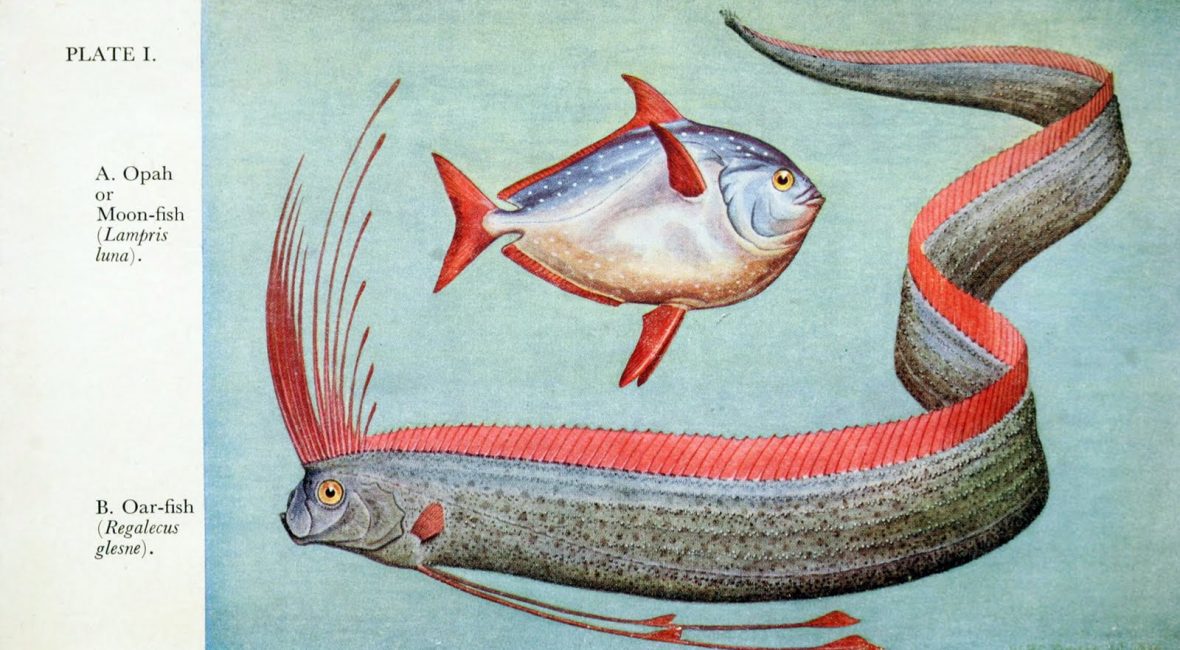
View Full Size Image1) Giant Oar-Fish, also known as the King of Herrings. This critter is the world’s longest bony fish, reaching up to at least 11 meters (unconfirmed reports of 17 meters exist!) and weighing upwards of 300 kg! Living 300-1000 meters below the ocean’s surface, it is a rarely-seen deep sea wonder. Nevertheless, many scientists believe that this colossal beast may be responsible for many of the strange sea monster sightings reported throughout the years.

Despite the scarcity of sightings, there are several documented encounters with this species:

  • On Dec. 10, 2010, a live specimen measuring 4 meters was caught off the Sinaloan coast of Mexico. One of the fisherman who caught it cautioned that “it might be the devil” and “feared it might swallow them.”
  • On April 6, 2011, a 3.5 meter Giant Oar-Fish was found off of the east coast of Taiwan. It is believed that the creature surfaced as a result of the tsunami that hit Japan in March. Thus, it was given the nickname “Earthquake Fish.”
  • And finally, in 1996, a 7-meter specimen was caught off of the coast of California. Pictured below is a team of Navy SEALs displaying the beast. (Image from pg. 20, All Hands)

View Full Size Image

View Full Size Image2) Blue Whale. So, everyone’s familiar with the Blue Whale – the largest animal on the face of the planet, and, for that matter, the largest animal known to have ever existed. (Take that, Dinosaurs!). At 30 meters long and 180 metrics tons, this creature is truly a behemoth. However, despite its size, the Blue Whale’s diet consists completely of small crustaceans called krill.

Some very interesting facts about the Blue Whale:

  • It’s tongue weighs as much as an elephant (which, incidentally, is the largest living land mammal)
  • When fully expanded, a Blue Whale’s mouth is large enough to hold 90 metrics tons of food and water
  • Despite this large mouth, the Whale’s throat is so small that it cannot swallow anything larger than a beach ball
  • At birth, Blue Whales weigh 6,000 lbs – the weight of a full-grown hippopotamus – and drink an average of 100 gallons of milk every day
  • Blue Whale calves gain as much as 200 lbs every day
  • A Blue Whale’s Heart weighs 1,300 lbs.

View Full Size Image3) Narwhal. Although not a mammoth in proportions, this sea critter nevertheless has many links to mythological associations. For obvious reasons, it is known as the “sea unicorn,” and Medieval Europeans believed that these “unicorn” horns possessed magical powers, such as the ability to cure poison and melancholia. The Inuit people believe the Narwhal tusk came about when “a women with a harpoon rope tied around her waist was dragged into the ocean after the harpoon had struck a large narwhal. She was transformed into a Narwhal herself, and her hair, which she was wearing in a twisted knot, became the characteristic spiral Narwhal tusk.”

  • The Narwhal is most closely related to the Beluga Whale, and together they make up the only two living species of the Monodontidae family
  • Narwhals are a strictly Arctic species, and rarely venture below 65 degrees North latitude
  • The Narwhal’s name comes from the Old Norse word “nár,” which means “corpse.” It was given this name due to its grayish pigmentation, which gave it the appearance of a drowned sailor.
  • A male Narwhal’s tusk can grow as long as 3 meters and weigh up to 22 lbs. About 1 in 500 male Narwhals grows a second tusk.
  • In the 16th century, Queen Elizabeth was given a carved and bejeweled Narwhal tusk worth £10,000 – the cost of, in those times, an entire castle!
  • The Narwhal is one of two possible explanations for the “giant sea phenomenon” described by Jules Verne in Twenty Thousand Leagues Under the Sea. (The other possibility? A man-made vessel. We like the Narwhal option better!)

We hope you’ve enjoyed these fun facts about some surprising creatures from the sea. Don’t forget that these are only a few of the animals pictured in our book of the week, Field Book of Giant Fishes (1949), by J.R. Norman and F.C. Fraser. The color illustrations from this book can be found on our Flickr site, but there are also dozens of smaller, ink drawings within the actual text, so be sure to check out the book in BHL as well!And remember, it might not be the age of the dinosaurs, but we’ve still got some mammoths living among us!

October 20, 2011by ulib-libraryjobs
Blog Reel, User Stories

BHL and Our Users: EOL Rubenstein Fellow, Dr. John Sullivan

Portrait version of the Biodiversity Heritage Library logo.

View Full Size Image

Today, we continue with our mini-series featuring EOL Rubenstein Fellows and their research activities. For this installment, meet Dr. John Sullivan, a passionate ichthyologist dedicated to discovering and describing fish species all over the world, but particularly in Africa.

What are your research interests, where you do the bulk of your work (country), and what is your institutional affiliation?

I am an evolutionary biologist who studies the phylogenetic interrelationships and evolution of freshwater fishes. I focus on two groups in particular: weakly electric fishes (Mormyridae and Gymnotiformes) which are found in Africa and South America, respectively, and catfishes (Siluriformes), which are distributed pretty much all over the world. In addition to using molecular techniques to work out phylogenies for these fishes, I describe species and work on the taxonomy of all three groups. My most recent collecting field trips have been to Ethiopia, the Democratic Republic of Congo, and Gabon. I am affiliated with two institutions, the Academy of Natural Sciences in Philadelphia, where I am a Research Associate, and the Cornell University Museum of Vertebrates in Ithaca, New York, where I am a Curatorial Affiliate. I live with my wife in Ithaca.

In the program, Fellowships are expected to serve as a complementary funding source to existing funding you have that supports your primary research activities. Please describe what you primary research activities are.

I used the Rubenstein Fellowship to supplement a nine-month Fulbright Research Fellowship in the Democratic Republic of the Congo. My Fulbright work was to make an inventory of fish species found in the vicinity of Kisangani, a city on the Congo River at the base of the Upper Congo rapids and to help build capacity at the University of Kisangani in ichthyology. As a Rubenstein Fellow, I made creation of EOL species pages for Congo River freshwater fishes a key activity of my time there. And since my return from Congo, I’ve been continuing to add many of the hundreds of photographs of fish specimens I took as we identify the specimens. We’ve already found several undescribed species from our collections, and I and my colleagues are beginning work on their descriptions.

Please describe how you use EOL to disseminate or support your primary research activities, or what your primary duties related to EOL are.

Eventually, I’d like to see great photos, descriptions and keys available online through EOL for all African freshwater fishes. We still have a lot of work to do to get there, but one can now see that this is the future. It still takes a lot of time to do careful taxonomic work, but now as soon as it’s published, we can get the name into a classification and a picture and description up online. For instance, we got the new mormyrid species Petrocephalus similis into EOL the week it was published in July. Taxonomy is a dynamic discipline: names and classifications frequently change to reflect our improving knowledge of the organisms (a sometime annoyance to end-users of taxonomies, but unavoidable). So static books are in some ways poor repositories of this information. Taxonomy and the Web are really made for each other and in hindsight something like EOL was inevitable.

How has the EOL Fellows program made a difference in your career/research?

The Rubenstein EOL Fellows program gave me an easy way to help make knowledge about African fishes available to everyone, including Africans who often have internet access but nothing in the way of libraries. The more informed my African colleagues are about their own fish fauna, the more effective our collaborations can be. While it doesn’t take the place of getting published in the primary literature, contributing to EOL tells your colleagues that you’re committed to the “broader impacts” of what we taxonomists do and that you’re at the forefront of where the field of taxonomy is headed. I am looking forward to the day when publishing a new species description and publishing content on EOL are one and the same thing. In fact, that future is already here with the journal ZooKeys that automatically exports to EOL. We plan to use that journal for our next mormyrid description.

Who is your Mentor, what is their area of interest (research activities), and how have they supported you throughout your Fellowship?

My mentor is Dr. Melanie Stiassny, curator of fishes at the American Museum of Natural History in New York. Melanie has really reinvigorated the study of fish diversity of the Congo River over the past few years and has made a number of stunning discoveries in the rapids area of the Lower Congo. She was great at providing me the logistical and moral support I needed for my project in Kisangani.

How does BHL support your Fellows activities, as well as those research activities that fall outside of your duties as an EOL Fellow?

I tend to think of BHL as my personal ichthyology library (although I know there’s a bit more archived in it than that). I have retrieved dozens and dozens of species descriptions from it that are now on my personal computer for instant reference and also appended to species pages in one of my two EOL Lifedesks: http://mormyrids.lifedesks.org/ and http://congofishes.lifedesks.org/.

I’ll give you a concrete example of how BHL supports my work. In systematics, the old literature is often just as important as the new. For instance, the systematics of a genus of mormyrid fish we work on was really blocked by our inability to establish the identity of Mormyrus sphekodes (now Paramormyrops sphekodes), described in 1879 by French ichthyologist H.E. Sauvage. The type specimen still exists, but is in bad condition in the Paris Museum collection. If we were to describe new species without knowing what P. sphekodes really was, we risked redescribing it under a different name and creating a synonym.

So this past May I arranged to go back to the type locality mentioned by Sauvage, the “Chutes de Doumé” on the Ogooué River in Gabon to make a new collection of it. I’m happy to report I succeeded! Before going there, I had downloaded Sauvage’s description of this fish from BHL, published in the Bulletin de la Société Philomatique de Paris. It had taken me just a few minutes to locate this paper and customize the pdf. I had it on my Kindle as I stood at the site, a place I don’t think ichthyologists had revisited since the 1870s.

When did you first discover BHL?

Some time before I started my Fellowship, probably in 2008.

What are your favorite features/services on BHL?

I love how it takes me no time at all to find a species description in some old serial like the Annals and Magazine of Natural History and, using the web interface, generate a pdf of just those pages that I want. Even if I lived in a library that had these volumes on the shelf, it would take me longer to locate what I was looking for. I can then take those pdfs BHL generates for me and attach them to the species pages I create on my Lifedesks. Now anybody in the world has instant access to the original species description in a couple of clicks!

If you could change one thing about BHL, or suggest one thing to be the next developmental priority for BHL, what would it be?

It seems like you are doing the right thing: continue to expand and add content. It is great to see a number of biodiversity journals allowing BHL to digitize their back catalog, including material still under copyright, and very encouraging to see BHL go international with BHL-Europe and other initiatives. Now that much of the really old stuff is available, it’s the material from the 1930’s – 1970’s that is notably hard to obtain if you don’t have a world-class library, so I hope more of it finds its way onto BHL in the near future.

Please describe why you think services like EOL and BHL are important for today’s scientific community.

Science is all about disseminating knowledge and building upon what has come before, yet so much of our knowledge of plants and animals has remained inaccessible to those who could make use of it. This has been a big part of the “taxonomic impediment.” BHL is radically changing the status quo and democratizing access to knowledge about biodiversity. Now that access to the works of so many great 18th and 19th Century biologists is an easy affair, I expect we’ll see them cited a lot more in the modern literature. In this way, BHL is contributing to the continuity of biodiversity science.

Do you have a favorite book in BHL, or a book that has most supported your research activities or EOL responsibilities?

My favorite book in BHL would have to be the four volumes of George Albert Boulenger’s Catalogue of the Fresh-Water Fishes of Africa, published from 1909 to 1916. This work remains the single-most important publication on African ichthyology. While many more species have been described in the subsequent century and generic names have undergone changes, it is still a remarkably useful resource for identifying African fishes. Until BHL made pdfs of all four volumes freely available, you had to pay dearly even for a reprinted version. Now all my African colleagues who never had these advantages have the pdfs on their laptops.

Thank you, Dr. Sullivan, for taking the time to give us a glimpse into your world and research, and for articulating how important BHL has been to your endeavors. As we continue to grow our collection, we hope to be able to establish more and more relationships with publishers and provide access to a plethora of in-copyright materials, freeing, as you so eloquently describe, this information from the static written page to the future of dynamic electronic access for the world.

Information on the photo from Dr. Sullivan: “The photo is of me on the Ogooué River in Gabon, Africa in May of this year. The site is a famous one for African ichthyology: it is the “Chutes de Doumé” from which H.-E. Sauvage described the catfish Doumea typica and the mormyrid electric fish Mormyrus sphekodes – now Paramormyrops sphekodes – (among others) in an 1879 publication published in the Bulletin de la Société philomathique de Paris, a pdf of which I downloaded from BHL!”

September 13, 2011by michelle.underhill

Help Support BHL

BHL's existence depends on the financial support of its patrons. Help us keep this free resource alive!

search

About BHL

The Biodiversity Heritage Library (BHL) is the world’s largest open access digital library for biodiversity literature and archives. BHL operates as a worldwide consortium of natural history, botanical, research, and national libraries working together to digitize the natural history literature held in their collections and make it freely available for open access as part of a global “biodiversity community.”

Follow BHL

  • Bluesky logo
  • Instagram logo
  • Facebook logo
  • Flickr logo
  • Twitter logo

Join Our Mailing List

Sign up to receive the latest news, content highlights, and promotions.

Subscribe Now

Subscribe to Blog via Email

Enter your email address to subscribe to this blog and receive notifications of new posts by email.

Join 319 other subscribers

Subscribe to Blog Via RSS

Subscribe to the blog RSS feed to stay up-to-date on all the latest BHL posts.

Access RSS Feed


64+ Million Pages of
Biodiversity Literature Online.

EXPLORE

Tools and Services
to Transform Research.

EXPLORE

300,000+
Illustrations on Flickr.

EXPLORE

ABOUT | HARMFUL CONTENT | PRIVACY | SITE MAP | TERMS OF USE